



How to Determine If Your Business Qualifies for SR&ED Tax Credits in Canada
SR&ED eligibility Canada is key for businesses looking to claim SR&ED tax credits eligibility on innovation and development activities. Gondaliya CPA specializes in identifying SR&ED qualified projects and guiding clients through the technical and financial requirements to maximize benefits.
Quick Summary
Three tests decide it: a scientific or technological uncertainty, a systematic investigation, and an advancement in knowledge. Please note that commercial success is irrelevant, a failed project can still qualify, and the most common reason a valid claim is denied is that nobody wrote anything down while the work was happening.
| Aspect | Details |
|---|---|
| The uncertainty | Existing knowledge could not solve the problem. |
| The method | Hypotheses tested through experiment or analysis. |
| The advancement | Real progress beyond what was already known. |
| The proof | Time logs, notes and version history, kept as you go. |
Reading time: 40 minutes.
Table of Contents
- Introduction to SR&ED Eligibility in Canada
- Eligibility Criteria for SR&ED Tax Credits
- Categories of Eligible SR&ED Projects
- Ineligible Work and Activities
- Claim Preparation and Filing Process
- CRA Support, Provincial Credits and Choosing an Accountant
- Frequently Asked Questions on SR&ED Eligibility
- Important Points on Remaining SR&ED Keywords
- Industry Spotlights: Sectors We Represent
- Professional Guidance and Quick Reference
The Numbers That Matter
This article covers Canada, with Ontario and Toronto context, and reflects CRA rules current to 2026. It assumes an incorporated business carrying out research or development work. Figures marked illustrative are examples, not quotes, and any masked engagement notes end with “Figures changed for privacy.” This is educational information only and not tax, legal, or financial advice. Rates, limits and program rules change, so please confirm your own situation with a CPA Ontario member before acting.
Introduction to SR&ED Eligibility in Canada
Introduction to SR&ED Eligibility in Canada
The Basics
What is the Scientific Research and Experimental Development (SR&ED) Program?
The Scientific Research and Experimental Development (SR&ED) program is a Canadian government plan. It aims to get businesses involved in research and development work. Companies that qualify can claim tax credits for money spent on R&D. These credits can lower the amount of tax they owe. To be eligible, projects need to show scientific or tech progress. They must also tackle problems that regular methods can’t solve.
Purpose and Business Benefits of SR&ED Tax Incentives
The SR&ED tax incentives exist to boost innovation in Canadian companies. Businesses that meet the rules can get helpful tax credits. These credits improve cash flow and help companies invest more in new ideas. They support business growth and keep Canada strong in tech industries.
Overview of SR&ED Eligibility for Canadian Businesses
Businesses must follow certain rules to be part of SR&ED eligibility Canada. The Canada Revenue Agency (CRA) sets these rules. The main points are:
- Show there is scientific or tech uncertainty.
- Carry out careful tests or analysis.
- Achieve progress in knowledge or tech.
Knowing these points helps businesses check if their projects meet SR&ED tax credits eligibility requirements.
Types of SR&ED Tax Credits Available
There are different kinds of SR&ED tax credits eligibility, such as:
- Refundable Credits: Usually for Canadian-controlled private corporations (CCPCs). These can get money back even if they don’t owe taxes.
- Non-Refundable Credits: Mostly for bigger companies. They can use unused credits later or apply them to past taxes owed.
- Provincial Credits: Some provinces offer extra credits that add to federal ones.
Understanding these types helps businesses claim the right benefits while following CRA rules about qualified projects.
Owners rule themselves out too early. The work that qualifies is usually already happening, described internally as fixing something difficult rather than as research. Figures changed for privacy.
Key Stat: A CCPC can reach an enhanced refundable rate of up to 35% on eligible spending below $3 million a year. Other corporations receive 15%, and it is not refundable.
Eligibility Criteria for SR&ED Tax Credits
Eligibility Criteria for SR&ED Tax Credits
The Criteria
Figuring out SR&ED eligibility Canada means knowing the rules set by the Canada Revenue Agency (CRA). Only projects that fit these rules can get SR&ED tax credits eligibility. The CRA looks for projects that tackle scientific or technological problems in a systematic way.
Understanding SR&ED Eligibility Requirements
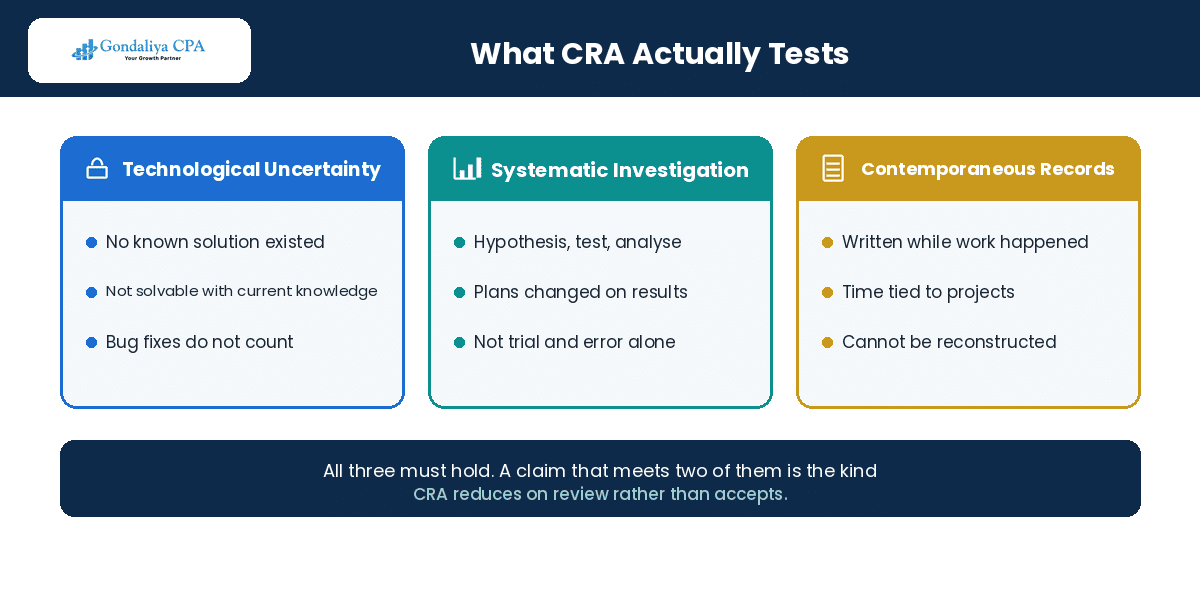
To meet SR&ED eligibility Canada, your project has to check three boxes:
- It must deal with a scientific or technological uncertainty.
- It should use a planned method of investigation, like experiments or analysis.
- The goal must be to create some scientific or technological progress.
The CRA cares about the work itself, not if your product sells well. Projects like experimental development, applied research, or basic research can qualify if you keep good records and file correctly.
Documentation Needs
Working with an SR&ED accountant Canada like Gondaliya CPA means keeping solid proof. Here’s what you need:
- Clear descriptions of your project goals and guesses.
- Day-to-day notes on experiments and their results.
- Time logs showing who did what work.
- Financial papers like pay slips and receipts for materials.
Good records cut down audit risks and make your claim stronger.
Eligible Business Structures: CCPCs, Other Corporations, Proprietorships, Partnerships, Trusts
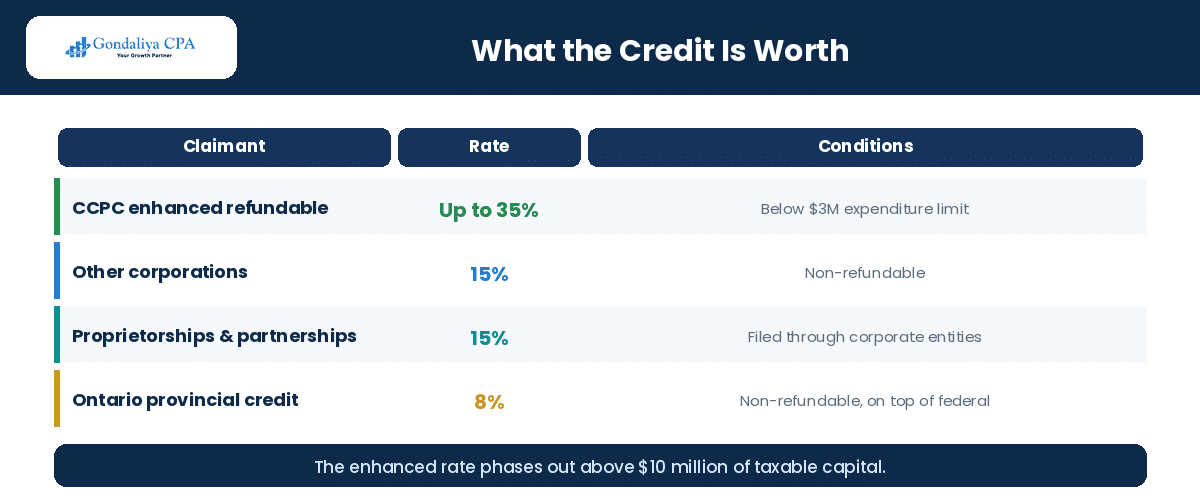
Different business types can claim SR&ED credits, but rates vary:
| Business Type | Refundable ITC Rate | Notes |
|---|---|---|
| Canadian-Controlled Private Corporation (CCPC) | Up to 35% enhanced refundable rate* | Applies under certain spending limits |
| Other Corporations | 15% basic non-refundable rate | No refundable credits |
| Proprietorships & Partnerships | 15% basic non-refundable rate | Claims filed through corporate entities |
| Trusts | Similar to corporations | Must fit CRA definitions |
*Enhanced refund applies only if taxable capital is below limits (CRA).
Canadian-Controlled Private Corporations (CCPCs)
If you run a CCPC, you get bigger perks:
- An enhanced refundable ITC rate up to 35% on eligible costs under $3 million per year.
- This benefit phases out once taxable capital in Canada passes $10 million (CRA).
Knowing this helps plan your R&D spending and keep credits high.
Eligibility for Other Business Types
Other companies get a 15% investment tax credit. It usually isn’t refundable but cuts your taxes over time.
Also,
- If prior-year taxable income is too high, it might lower your credit amount (CRA).
Check your business type carefully before claiming since rules differ by entity and finances.
Qualifying Expenditures for SR&ED Claims
When a project qualifies, here’s what you can claim:
- Salaries paid for SR&ED-related work.
- Materials used or changed during research.
- Overhead costs figured by proxy percentages or detailed accounting.
- Contract payments tied to qualified R&D activities (CRA Form T661 Guide).
Sorting costs right gets you full credit without issues later on.
Eligible Salaries and Wages
You can claim wages paid to employees who work on experiments or research tasks linked directly to the project.
- Pay must stay within specified employee salary limits set by CRA (salary limit info).
Keeping timesheets that show hours spent on eligible work boosts your wage claims during reviews.
Materials and Overhead
Material costs cover things actually used up or changed during R&D. For example, raw stuff in prototype building or software licenses tied only to experimental development.1
Overhead can be claimed two ways:
- Proxy method: Use a fixed percent of direct labour. Simple but may give less refund.
- Traditional method: Track actual overhead expenses. Harder but might recover more.2
1: CRA Material Costs Policy
2: Proxy vs Traditional Method – CRA
Other Allowable Expenses
Payments to outside contractors doing qualifying R&D reduce how much you can claim because they might also claim themselves.34
Government grants like IRAP also cut the net expenses dollar-for-dollar. You must report all this on Form T661 as per rules.5
3: Contract Payment Rules – CRA s127(11)
4: Third Party Contract Work Guidance – CRA
5: Assistance Disclosure – Form T661 Instructions
Distinguishing Eligible Work from Excluded Activities
Some tasks never qualify no matter what:
| Activity Type | Included? | Why |
|---|---|---|
| Routine testing & QC | No | It’s maintenance, not advancement |
| Market research & sales | No | Not related to science or tech |
| Commercial production | No | Focuses on marketing not innovation |
Simple engineering without tech uncertainty doesn’t count either. Knowing these exclusions avoids mistakes. Check s248(1)(e-k) of Income Tax Act for details (link).
Eligible R&D Work
Projects called SR&ED qualified projects include things like:
- Experimental development making new products or processes.
- Applied research solving practical tech problems.
- Basic research adding knowledge without immediate use.
They follow planned tests and hypotheses with notes taken at the time. For example, developing fresh algorithms fixing hidden bugs in software platforms is common among tech startups in Toronto/Ontario.
Activities Typically Not Eligible
Excluded activities often seen but denied include:
- Routine data gathering with no analysis.
- Social science studies unrelated to science/tech goals.
- Prospecting or drilling outside pure exploration efforts.
Knowing this saves wasted effort since unsupported claims get rejected when experts check them at offices across Ontario and other regions.
Key Definitions: Scientific or Technological Advancement, Technological Uncertainty, Systematic Investigation
Scientific Or Technological Uncertainty
It happens when known knowledge doesn’t solve a problem using usual methods at project start.CRA §248(1)
Systematic Investigation
A planned approach that tests guesses through experiments until answers clear up uncertainties.See Form T661 “Systematic Investigation” section
Technological Advancement
Making real progress beyond existing science or tech—doesn’t matter if it sells well—as long as controlled tests show improvement.Income Tax Act s248(1)
These ideas form the base for all valid SR&ED qualified projects. They guide how claims are made and reviewed by auditors alike.
If you keep these points in mind—know who qualifies, what costs count, and how to document—you’ll be better set for claiming Canada’s SR&ED tax credits.
Contact us anytime at info@gondaliyacpa.ca or call 647‑212‑9559 for help with your company’s SR&ED eligibility Canada today.
Sharad Gondaliya, CPA, has over 10 years helping many Canadian businesses organize their books.
The three tests are read together, not separately. Work with genuine uncertainty but no documented method fails, and a well-documented method applied to a solved problem fails too. Figures changed for privacy.
Risk Warning: Contract payments and government assistance such as IRAP both reduce your eligible expenditure. Claiming the gross figure is one of the fastest routes to a financial review.
Categories of Eligible SR&ED Projects
Categories of Eligible SR&ED Projects
The Categories
The SR&ED program in Canada helps support different kinds of research. These projects have to meet specific rules to qualify. If you want to get the best SR&ED tax credits eligibility, you need to know these categories well. They include basic research, applied research, experimental development, and support work that links directly to these efforts.
Basic Research and Its Role in SR&ED
Basic research means studying scientific ideas without aiming for a specific product or use. It’s about learning more about science itself.
In terms of SR&ED eligibility Canada, basic research counts when it tackles unknown science or technology problems through careful study. It might not lead right away to a new product but still helps build knowledge.
For example, a tech company trying out new algorithms just for theory could claim basic research. But simple data collection or market studies don’t count here (CRA ITA s.248(1)).
Applied Research within SR&ED Eligibility
Applied research focuses on science with a clear goal — usually solving a problem or making new tech that businesses can use.
To qualify for SR&ED Canada under this:
- The project must deal with technical unknowns.
- It needs systematic tests to make progress.
- You must show how experiments check ideas about fixing tech issues.
Applied research applies what we learn from basic science to real products or processes. For example, an engineering firm testing new materials for strength fits here if they keep good records on results (CRA Form T661 Guide).
Experimental Development Explained
Experimental development is the most common type claimed under SR&ED qualified projects. This involves creating new products or improving old ones by testing and redesigning while solving tech problems.
Key parts are:
- Careful study with guesses tested by experiments.
- Trying to push tech forward, not just making sales.
- Activities like making prototypes, pilot runs, or coding beyond normal updates qualify if they solve technical problems and are well documented.
For instance, manufacturers who try many versions of a tool before it works fit this category (Canada Revenue Agency).
Support Work Associated with SR&ED Projects
Support work helps main R&D tasks but isn’t core R&D itself. It counts when it clearly supports qualifying projects’ goals. Examples are:
- Engineering design changes during experiments
- Computer programming that solves tech issues (not regular coding)
- Math analysis checking models used in tests
- Data gathering needed for experiments (not general surveys)
- Quality checks linked only to prototype testing, not production control (CRA Policy Statement CPS‑024).
Support work qualifies only when time and costs clearly tie back to the core R&D tasks in each project phase and meet SR&ED tax credits eligibility rules across industries like software or manufacturing.
Examples of Eligible Projects in Each Category
| Project Type | Example Activity | Why It Qualifies |
|---|---|---|
| Basic Research | Studying quantum computing principles | Builds basic knowledge without immediate use |
| Applied Research | Creating corrosion-resistant coatings | Tackles clear technical problems |
| Experimental Development | Building prototypes of IoT devices needing custom code | Tests fix tech unknowns through trial and error |
| Support Work | Making engineering changes during prototype testing | Directly helps main R&D efforts |
These examples show how companies in tech fields can find claims that match CRA’s rules for SR&ED qualified projects in places like Toronto/Ontario (CRA ITA s.248(1)). Sorting projects this way helps avoid claims for things like regular upkeep or cosmetic tweaks, which aren’t allowed.
Sharad Gondaliya, CPA, has over 10 years helping Canadian businesses get their finances right.
Experimental development carries the great majority of claims we prepare. Basic research is rare outside academia, and applied research usually sits somewhere between the two in practice. Figures changed for privacy.
Pro Tip: Support work is claimable but only where the time ties back to a specific core task. Log it against the project from the start rather than reconstructing the link at year end.
Ineligible Work and Activities
Ineligible Work and Activities
The Exclusions
Figuring out SR&ED eligibility Canada means knowing what counts and what doesn’t. The CRA only approves SR&ED qualified projects that meet certain scientific or tech rules. Knowing what work is off-limits helps businesses avoid mistakes when applying for SR&ED tax credits eligibility.
Work and Activities Excluded from SR&ED Claims
Some work types don’t qualify for SR&ED tax credits eligibility in Canada. These rules keep claims focused on real research, not everyday business stuff or marketing.
Excluded activities include:
- Market Research and Sales Promotion: Marketing products or services isn’t eligible.
- Quality Control Testing: Routine checks to keep standards don’t count.
- Routine Data Collection: Just gathering info without a clear experiment is excluded.
- Social Sciences and Humanities Research: Studies in these fields don’t fit ITA s.248(1).
- Prospecting, Drilling, Mining Exploration: These geological tasks are left out.
- Commercial Production or Routine Engineering: Regular production or standard engineering lack the needed tech uncertainty.
- Style Changes: Cosmetic tweaks with no tech improvement aren’t accepted.
The CRA says only work with real scientific or tech uncertainty, done through careful investigation, qualifies (CRA Eligibility Policy).
Non-qualifying expenditures
Even if a project fits the rules, some costs can’t be claimed in SR&ED. These usually involve expenses not directly tied to eligible R&D work:
| Expenditure Category | Reason for Exclusion | CRA Reference |
|---|---|---|
| General administrative costs | Not linked directly to experimental development | ITA s.37(2)(a), Reg 2900 |
| Capital assets (except limited cases) | Most equipment costs not allowed | ITA s.127(9), Reg 2900 |
| Commercial-scale production | Costs after experimentation ends | ITA s.248(1)(e)-(k) |
| Overhead exceeding proxy amount (traditional method only) | Too much overhead without proof | Form T661 Guide |
Classifying expenses right helps avoid overclaiming. CPAs guide this well (CPA Canada Guidance).
Common Misconceptions about Ineligible Work
People often get confused about what counts as ineligible work. This causes them to miss valid claims or risk penalties for overclaiming.
Frequently mistaken ineligible work
- Thinking all software development qualifies: Only software solving tech uncertainty with experiments counts, not routine coding.
- Assuming failed projects don’t qualify: Failed tests might still count if they add knowledge even without commercial success.
- Believing quality control tests are eligible: Normal product inspections don’t meet the investigation requirement.
Knowing these clears things up for SR&ED tax credits eligibility (CRA Software Eligibility).
Clarifications on boundaries
The difference between eligible and excluded depends on three things: scientific/tech uncertainty, testing by experiment or analysis, and pushing knowledge forward—even if the project fails commercially.
An engineering firm redesigning parts using known methods does routine engineering (excluded). But creating new materials needing repeated tests targets tech uncertainty (maybe eligible).
Good records separating support from routine tasks help during CRA checks (CRA Technical Review Guidelines).
Clarifying Boundaries: What Cannot Be Claimed under SR&ED
Knowing exactly what you can’t claim stops problems like audits or penalties under Canadian law on technology tax credits.
Work that can’t be claimed includes:
- Routine maintenance without innovation
- Commercial production after R&D is done
- Admin tasks supporting R&D but with no technical role
- Market research for product placement
- Employee training unless part of experiments
This matches legal definitions that only true research gets credit (ITA Section 248(1)). Talk to experienced CPAs who get these rules—like Gondaliya CPA—for advice tailored to Toronto/Ontario incorporated SMBs.
Important: Keep records that clearly separate experimental work from regular tasks as CRA asks; missing this risks claim denial [Source: CRA Reporting Requirements].
Tip: Write down hypotheses tested versus normal operations — it really helps prove your claim fits “SR&ED qualified projects.”
For clear help sorting exclusion rules that affect your claim—across software, manufacturing, engineering, and more—call Gondaliya CPA at 647‑212‑9559 for a free chat about legit technology tax credits while avoiding common mistakes in Ontario & Toronto firms.
The failed-project misconception costs the most. Claims are abandoned because the work did not succeed, when a documented failure that ruled something out is exactly what the programme is designed to support. Figures changed for privacy.
Claim Preparation and Filing Process
Claim Preparation and Filing Process
The Filing
Steps to Prepare a Comprehensive SR&ED Tax Credit Claim
To prepare a solid SR&ED tax credit claim, start by figuring out if your projects fit SR&ED eligibility Canada rules. These projects usually deal with scientific or tech uncertainty and involve testing or experiments. Gather all records like project plans, test results, and time logs. It helps to work with an SR&ED accountant Canada who knows the rules well. They can spot what counts and what doesn’t.
Next, you need to figure out costs carefully. This means adding up salaries, materials, contractor fees, and overhead. Do it right so you follow CRA rules but still claim as much as you can without triggering audits. Then, write clear descriptions on Form T661 explaining how your projects meet the criteria for SR&ED tax credits eligibility.
Methods for Calculating Eligible Expenditures: Traditional vs Proxy Method
There are two ways to calculate eligible expenses on your SR&ED qualified projects: traditional and proxy methods.
- The traditional method tracks real overhead costs like rent and utilities tied directly to SR&ED work. You need detailed accounting but might get a bigger credit if overhead is high.
- The proxy method uses a set rate of 55% of labor costs for overhead. It’s simpler because it doesn’t need lots of paperwork but might lower your credit if indirect costs are big.
Pick the method that fits your recordkeeping and business size. Many small to medium businesses in Ontario find the proxy method easier while larger or more complex firms might choose traditional costing for better returns.
| Factor | Traditional Method | Proxy Method |
|---|---|---|
| Overhead Calculation | Actual documented costs | Fixed percentage (55% of labour) |
| Recordkeeping Required | Extensive | Minimal |
| Best For | Complex operations with high indirect costs | Small-medium businesses preferring simplicity |
| Key Risk | Missing expense allocations reduces credit | Potentially lower credit amount |
Overall, the proxy method works well unless you have strong records showing higher overheads (CRA source).
Required Forms and Documentation for Submission
You file your claim using Form T661 plus Schedule 31 with your T2 corporate tax return. These forms ask for:
- Project details
- Technical explanations about what problems you solved
- Steps you took during investigations
- A breakdown of expenses like wages, materials, contracts
- Info on any government funding that lowers eligible amounts
Keep supporting documents ready too: time sheets linked to each project, code version logs for software work, lab notes or prototypes showing experiments, invoices proving material use, payroll records showing salary split.
Filling forms carefully according to CRA rules helps avoid delays or questions later (CRA guide).
Deadlines and Timelines for Filing SR&ED Claims
You must file your completed T661 and Schedule 31 within 12 months after your company’s fiscal year ends on its T2 return. If you miss this deadline, you lose any refundable investment tax credits even if you qualify otherwise.
If you change past claims through amended returns, those corrections also must follow the same deadline window. There’s no way to extend it legally using taxpayer relief rules. So watch the calendar carefully! Businesses in Toronto or Ontario should plan ahead using their accounting tools to keep track (CRA reporting deadlines).
Overview of Post-Submission Review: Technical and Financial Assessments
Once CRA gets your claim electronically with your taxes, they start two kinds of reviews:
- The technical review looks at whether the work really meets the science or tech uncertainty tests based on evidence.
- The financial review checks that expenses add up correctly, wages follow caps, and any grants were reported right.
If this is your first time claiming, you can ask for advisory help before submission to lower risks early on. There are also pre-claim consultations that give feedback before filing officially — handy if you have complex projects in engineering or software typical in Toronto-area companies (CRA review process details).
Best Practices for Maintaining Supporting Documentation
Good records make claims stronger during audits:
- Log hours daily on digital timesheets tied directly to specific projects.
- Use version control systems for software showing ongoing tests or changes.
- Save design sketches or prototypes that prove problem-solving efforts.
- Keep purchase orders and invoices backing up material usage during experiments.
Hold onto all files safely for at least six years after the fiscal year ends because Corporations Canada requires this. This way, you’re ready if CRA asks later (Record retention policy).
Consistent recordkeeping cuts chances of rejected claims from unsupported salaries or wages—one common cause of denied credits seen by CPA accountants familiar with Canadian SR&ED tax credits eligibility rules.
The twelve-month window is absolute. We have seen valid claims worth six figures lost to a filing date, with no relief available because the deadline is statutory rather than administrative. Figures changed for privacy.
Risk Warning: Miss the twelve-month filing window and the refundable credits are gone permanently. Taxpayer relief provisions cannot extend this deadline, so please diarise it the day the fiscal year closes.
Available CRA Support Services: Pre-Claim Approval, FTCAS, Seminars
CRA Support, Provincial Credits and Choosing an Accountant
The Support
The Canada Revenue Agency (CRA) gives several services to help businesses check their SR&ED eligibility Canada and boost SR&ED tax credits eligibility. These include Pre-Claim Consultations, the First-Time Claimant Advisory Service (FTCAS), and seminars.
Pre-Claim Consultations let you talk to CRA Research and Technology Advisors before you file. They help figure out if your work counts as SR&ED under current rules. FTCAS helps first-time claimants understand the technical and money side of making an eligible SR&ED claim. This service lowers mistakes that might cause delays or rejections.
CRA also runs seminars across Ontario, including Toronto, and all over Canada. These talks explain program rules, how to keep proper documents, and recent updates about SR&ED qualified projects. The sessions offer useful tips on meeting rules like proving technological uncertainty or experimental development.
Using these official services can make you feel sure about your claim’s correctness and cut down audit problems.
*Sources: CRA – Pre-Claim Consultation, CRA – FTCAS*
Provincial and Territorial R&D Tax Credits Coordination
SR&ED tax credits eligibility is not just about federal incentives; many provinces offer extra R&D tax credits that work alongside the federal program. Ontario’s Innovation Tax Credit (OITC) and Research & Development Tax Credit apply to businesses in Toronto and nearby areas.
Usually, provincial programs ask you to qualify federally first under SR&ED rules before applying provincially. The costs you claim must match those on Form T661 at the federal level. But each province may have different rates or limits.
Coordination stops double-dipping—when assistance overlaps from different government levels—by lowering qualified expenses as per CRA rules. Keep in mind that provincial deadlines differ from federal ones, so track them carefully by region.
Knowing this system helps get the best total refundable benefits while following both provincial and federal rules for tech tax credits in Canada.
*Source: Ontario Ministry of Finance – Innovation Tax Credits
Choosing an SR&ED Accountant in Canada: How Gondaliya CPA Can Assist
Picking a skilled SR&ED accountant Canada matters if you want to get your claims right without risking penalties. Gondaliya CPA works mainly with incorporated small and medium businesses in software, engineering design, manufacturing, product development, and other tech fields across Toronto/Ontario and Canada-wide.
Our firm offers fixed-fee pricing plus deep knowledge of tricky SR&ED eligibility Canada rules like tests for technological uncertainty, documentation for systematic investigations, wage limits for certain employees, contract payment cuts due to grants like IRAP—all matching CRA policies from 2026 onward.
We do full CPA-led reviews—not quick self-checks or pay-only-if-you-win setups—to ensure claims are strong with clear records suited to your business type. For example, we help SaaS startups rebuilding data pipelines or makers testing tooling under uncertain conditions.
Over 1300+ five-star Google reviews show our clear communication—including weekend/evening support—and fast replies within one business day. We guide clients step-by-step—from spotting projects through writing Form T661 stories to handling audits if they happen.
Call us at 647-212-9559 or email info@gondaliyacpa.ca for a free talk about your SR&ED qualified projects.
Handling Audits and Navigating the Review Process
Understanding SR&ED eligibility Canada means knowing what happens after you file your claim with CRA. Two reviewers get involved:
- A Technical Reviewer (Research & Technology Advisor) checks if your activities meet scientific or technological progress criteria.
- A Financial Reviewer checks that expenses follow limits like salary caps for specified employees plus changes related to grants such as IRAP reducing costs claimed.
During audits—which might include site visits—reviewers ask for proof like project hypotheses tested using experiments or analyses documented carefully with version controls or sprint notes common among software devs claiming experimental work.
The First-Time Claimant Advisory Service offers advice before audits to avoid usual errors like weak time logs or listing routine tasks not allowed by law (ITA s248(1)).
If there’s disagreement after review decisions, you can formally object within CRA’s strict deadlines. But this usually needs help from CPAs who know both technical details and tax filings well.
*Source: CRA – Claim Review Process
Accessing Official SR&ED Policies, Guidelines, and Publications
For correct info on SR&ED eligibility Canada, look at official sources kept by Canadian authorities:
- Income Tax Act section 248(1) explains which kinds of work qualify—basic research vs applied research vs experimental development.
- Form T661 Guide shows how to report project details along with Schedule 31 which breaks down expenses following s37 deadlines.
- Proxy amount percentages used when skipping usual overhead calculations are clear with updated investment tax credit rate tables yearly.
These key documents keep you updated about changes starting fiscal year 2026 around capital cost rules affecting eligible expense pools mainly for CCPCs seeking higher refundable rates.
You can find these online here:
- Canada Revenue Agency Scientific Research Experimental Development Program Overview
- Canada Gazette / Federal Regulations Updates Relevant To SRED Claims
Checking these regularly helps avoid overstating claims while knowing exactly what counts as real technological uncertainty versus routine improvements that are excluded by law.
Contact Information and Additional Resources for SR&ED Assistance
If you’re looking for expert help with SR&ED qualification, especially tailored for incorporated SMBs working on software innovation, manufacturing upgrades or engineering design—contact Gondaliya CPA. We’re a CPA Ontario Registered Firm known across Toronto/Ontario areas including Etobicoke, Vaughan, Mississauga, Brampton—and beyond—with solid experience handling complex claims across industries.
Reach us here:
- Phone: 647‑212‑9559
- Email: info@gondaliyacpa.ca
Some handy resources include these links offering official forms and guides needed during applications:
| Resource | Description | Link |
|---|---|---|
| Form T661 | Official form with project narratives & expenses | https://www.canada.ca/form-t661 |
| Schedule 31 | Expense schedule for corporate returns | https://www.canada.ca/schedule31 |
| CRA Reporting Deadlines | Important dates for filing claims | https://www.canada.ca/reporting-deadlines |
Gondaliya CPA suggests new clients check their projects carefully against CRA definitions before spending lots on preparing claims. We offer a free initial consultation giving clear advice based on current law.
Sharad Gondaliya, CPA, has over 10 years helping hundreds of Canadian business owners get their accounting right.
The pre-claim consultation is underused. A short conversation with a Research and Technology Advisor before filing settles most eligibility arguments before they can become a review. Figures changed for privacy.
Key Stat: Ontario adds a further non-refundable credit at 8% on qualified expenditures, but the federal claim must be established first and the same expenditures are used.
Frequently Asked Questions on SR&ED Eligibility
FAQ
What is the enhanced refundable ITC rate for CCPCs under SR&ED?+
CCPCs qualify for an enhanced refundable investment tax credit (ITC) rate of up to 35% on eligible SR&ED expenditures below the $3 million limit.
How does the taxable capital phase-out threshold affect SR&ED claims?+
The enhanced refundable ITC rate phases out when a CCPC’s taxable capital in Canada exceeds $10 million, reducing the credit gradually.
What is the specified employee salary limit in SR&ED claims?+
CRA sets salary limits for employees whose wages qualify for SR&ED claims; only wages up to this limit are eligible for tax credits.
Where can I find the exact section reference for the SR&ED filing deadline?+
The SR&ED filing deadline is stated under Income Tax Act section 37(11); claims must be filed within 12 months after fiscal year-end.
What is the required record retention period for SR&ED documentation?+
Businesses must keep all SR&ED records and supporting documents for at least six years after the tax year-end to comply with CRA rules.
How does CRA define systematic investigation in SR&ED?+
Systematic investigation means a planned approach involving hypotheses, experiments, and analysis aimed at resolving scientific or technological uncertainty.
Which CRA policies are critical references for SR&ED eligibility?+
Key references include Income Tax Act s.248(1), Form T661 Guide, CRA Policy Statement CPS-024, and s127(9) for credit rates.
What exclusions does income tax act s248(1)(e-k) list regarding SR&ED?+
Exclusions include commercial production, routine testing, market research, style changes, prospecting, social sciences research, and administrative tasks.
What steps are involved in the pre-claim consultation process with CRA?+
Pre-claim consultation involves submitting project details early, discussing eligibility with a Research and Technology Advisor, and receiving feedback before filing.
How does CRA conduct site visits during SR&ED claim reviews?+
Site visits involve technical and financial reviewers inspecting documentation and work processes to verify that claimed activities meet eligibility criteria.
What options exist if I disagree with CRA’s decision on my SR&ED claim?+
You can file formal objections within CRA deadlines and pursue appeals with professional CPA support to challenge review outcomes.
How do self-assessment, preparer review, and CPA-led assessment differ in SR&ED claims?+
| Assessment Type | Description | Benefit |
|---|---|---|
| Self-Assessment | Business prepares claim independently | Cost-effective but higher risk |
| Preparer Review | Accountant checks claim accuracy | Reduces errors |
| CPA-Led Assessment | Full CPA-led detailed claim review | Maximizes claim strength |
Can you provide an example calculation of an SR&ED claim using proxy method overhead?+
If direct labour costs are $100,000, proxy overhead equals 55% or $55,000. Total eligible costs become $155,000 before applying credit rates.
Important Points on Remaining SR&ED Keywords
Important Points on Remaining SR&ED Keywords
Quick Reference
- Risk of Overstated Claims: Overclaiming may trigger audits or penalties; accurate records help reduce risks.
- CPA Deliverables: Gondaliya CPA provides comprehensive reports including narratives, expense breakdowns, and audit support.
- Missed Opportunity Examples: Many startups miss credits by excluding prototype coding or engineering design changes.
- Documentation Routine: Keep daily time logs and use tools like version control commit logs for software R&D evidence.
- Proxy vs Traditional Method Percentage: Proxy method uses a fixed 55% of direct labour costs as overhead federally recognized.
- Ontario Provincial Credit Rate: Ontario offers an additional non-refundable R&D credit at 8% on qualified expenditures.
- Payroll-Time Log Linkage: Timesheets should link hours worked directly to specific projects for wage eligibility verification.
- Contract Payment Reduction Formula: Contract payments are reduced dollar-for-dollar by any government assistance received.
- Taxpayer Relief Rules Mention: Late filings cannot extend deadlines via taxpayer relief; claims filed late lose refundable credits.
- Version Control Commit Logs as Evidence: Commit logs help prove experimental software changes during systematic investigation phases.
- Lab Notes & Prototypes as Evidence: Physical notes and prototypes document hypotheses tested and results obtained during R&D.
- Data Collection vs Routine Testing Distinction: Only data gathering tied directly to experimentation qualifies; routine testing doesn’t.
- Social Sciences Exclusion: Psychological or social science research generally does not qualify under ITA s.248(1).
- Engineering Design During Prototyping Qualified Detail: Design modifications addressing tech uncertainty in prototypes count as support work.
- Mathematical Analysis Supporting Hypotheses: Analytical modeling validating experimental results qualifies if linked to systematic investigations.
- Psychological Research Clarification: Research focused solely on human behavior is excluded unless integrated with tech development aspects.
- Commercial Production Exclusion Legal Basis: Post-experiment manufacturing or sales activities do not qualify under s248(1)(e-k).
- Market Research Exclusion Legal Basis: Activities aimed at marketing strategy or customer preferences are excluded from eligible work.
- Style Changes Exclusion: Cosmetic or aesthetic changes without technological advancement don’t qualify for credits.
- CRA Review Phases Naming & Impact: Reviews include Technical Review by Research & Technology Advisors plus Financial Review by auditors impacting final claim approval.
- Audit Risks From Weak Documentation: Missing timesheets or poor project descriptions increase chances of audit rejection or reduced credits.
- SR&ED Claim Cost Estimation Tips: Accurate tracking of hours and expenses ensures correct calculation of eligible amounts under both methods.
- SR&ED Claim Late Filing Consequences: Missing filing deadlines forfeits refundable credits permanently; non-refundable credits may be lost too.
- Pre-Claim Consultation Benefits Summary: Early advice reduces errors, clarifies eligibility, and improves success rates in complex technology projects.
- Provincial-Federal Credit Coordination Process Overview: Federal claims must precede provincial applications; expenses claimed federally reduce provincial eligible amounts to prevent overlap.
- CRA Guidance on Salary Limits Details: Wages above prescribed limits aren’t eligible; clear documentation linking salaries to specific R&D work is essential.
- Details About Grants Such as IRAP Reduction Methodology: Government assistance reduces net eligible expenditures dollar-for-dollar per Form T661 instructions.
- Material Costs Defined as Consumed or Transformed Items Only: Materials used up or physically altered during experiments qualify; general supplies don’t count unless consumed in R&D processes.
Overhead Allocation Methods Pros & Cons Recap:
| Method | Advantages | Disadvantages |
|---|---|---|
| Proxy | Simple recordkeeping | May yield lower credit amount |
| Traditional | Potentially higher refund | Requires detailed accounting |
Support Work Inclusion Criteria Expanded Examples:
- Engineering changes aiding experiments
- Computer programming solving tech uncertainties
- Data collection directly related to tests
- Quality checks limited to prototype validation
These must tie clearly to core experimental tasks.
For tailored guidance on these topics or help preparing your claim correctly per latest CRA rules contact Gondaliya CPA at 647‑212‑9559 or info@gondaliyacpa.ca today!
Commit logs are the strongest evidence a software claim can have, because they were created for another purpose entirely and carry timestamps nobody manufactured for the CRA. Figures changed for privacy.
Industry Spotlights: Sectors We Represent
Industry Expertise
SR&ED work looks different in each sector. Here are eleven and the form the eligible work usually takes.
| Industry | Where the Eligible Work Usually Sits |
|---|---|
| Technology startups & SaaS | Algorithms, data pipelines and architecture problems |
| Construction, contractors & skilled trades | New methods and materials under untested conditions |
| Property developers & builders | Structural or systems problems without a known solution |
| Transportation, logistics & trucking | Routing, telematics and fleet systems development |
| E-commerce & online retailers | Platform integration and inventory algorithms |
| Medical doctors & physician corporations | Clinical device or diagnostic tool development |
| Dentists & dental practices | Materials and appliance design testing |
| Restaurants & food and beverage | Formulation, shelf life and process development |
| Daycare, childcare & CWELCC services | Rarely eligible; software or systems work only |
| Consulting firms | Internal tools built to solve technical unknowns |
| Real estate investors & holding companies | Rarely eligible; building systems R&D occasionally |
- Technology startups & SaaS: Algorithm work, data pipeline rebuilds and architecture problems are where most software claims genuinely sit.
- Construction, general contractors & skilled trades: New methods or materials tested under conditions nobody has documented can qualify.
- Property developers & builders: Structural or building systems problems without a known solution occasionally meet the uncertainty test.
- Transportation, logistics & trucking: Routing engines, telematics and fleet management development are the usual candidates.
- E-commerce & online retailers: Platform integration and inventory algorithms qualify where the problem was genuinely unsolved.
- Medical doctors & physician professional corporations: Device or diagnostic tool development qualifies; clinical practice itself does not.
- Dentists & dental practices: Materials testing and appliance design work can meet the tests where results were uncertain.
- Restaurants & food and beverage: Formulation, shelf life and process development qualify far more often than operators expect.
- Daycare, childcare & CWELCC services: Rarely eligible, since the exclusion for social sciences research covers most of the sector.
- Consulting Firms: Internal tools built to solve a technical unknown can qualify even when the tool is never sold.
- Real estate investors, landlords & holding companies: Rarely eligible, though building systems development occasionally meets the tests.
The sector matters less than the problem. What decides eligibility is whether the answer was genuinely unknown when the work started, and whether anyone recorded the attempt to find it. Figures changed for privacy.
Professional Guidance and Quick Reference
Guidance
Professional Guidance on SR&ED Claims: How Gondaliya CPA Supports Canadian Innovators
Most businesses that qualify for SR&ED do not think of themselves as doing research. They think of themselves as having spent months solving something difficult. The programme exists for exactly that work, and the difference between a claim and a missed opportunity is usually documentation rather than eligibility. Gondaliya CPA prepares these claims on a fixed fee.
We handle what decides the outcome: identifying which projects genuinely faced a technological uncertainty, separating eligible experimental work from routine development, calculating salaries within the specified employee limits, choosing between proxy and traditional overhead, reducing for contract payments and government assistance such as IRAP, writing the Form T661 narratives, filing Schedule 31 inside the twelve-month window, and defending the claim through technical and financial review.
Our team works from your own time logs, commit history and project records rather than a template. Software, manufacturing or engineering, you get clear advice and a fixed price before we start.
Quick Answers: Key Numbers & Concepts at a Glance
At a Glance
- Enhanced refundable ITC: Up to 35% for CCPCs
- Expenditure limit: $3 million per year for the enhanced rate
- Phase-out: Taxable capital above $10 million
- Basic rate: 15%, non-refundable
- Proxy overhead: 55% of direct labour
- Ontario credit: 8% non-refundable on qualified expenditures
- Filing deadline: 12 months after fiscal year end, ITA s.37(11)
- Record retention: Six years after the tax year end
- The forms: T661 and Schedule 31 with the T2
- The three tests: Uncertainty, systematic investigation, advancement
Who This Is For / Not For
Fit Check
- For: Incorporated Canadian businesses in software, manufacturing, engineering or product development that solved a genuine technical unknown and kept some record of doing so.
- Not For: Routine development, market research or production work, where no technological uncertainty existed and the exclusions in s.248(1) apply.
People Also Ask
Quick Answers
Does a failed project still qualify?+
Yes. Eligibility turns on the uncertainty faced and the investigation undertaken, not the outcome. A documented failure that ruled something out is a valid claim.
Can I claim work done by a contractor?+
Yes, but contract payments reduce your eligible expenditure, because the contractor may be entitled to claim as well. The reduction applies dollar for dollar.
How far back can I claim?+
Twelve months after the fiscal year end, and no further. The deadline is statutory, so taxpayer relief cannot extend it once the window closes.
Glossary of Key Terms
Plain-English Definitions
- SR&ED: Scientific Research and Experimental Development, the federal R&D incentive programme.
- Technological uncertainty: A problem existing knowledge could not solve at the outset.
- Systematic investigation: A planned approach testing hypotheses through experiment or analysis.
- Technological advancement: Real progress beyond what was already known.
- Basic research: Study of scientific ideas without a specific product in view.
- Applied research: Science directed at a practical technical problem.
- Experimental development: Creating or improving products and processes by testing and redesign.
- Support work: Activity that directly assists core R&D without being R&D itself.
- Investment tax credit: The credit earned on qualifying SR&ED expenditures.
- Refundable credit: A credit paid out even where no tax is owing.
- CCPC: Canadian-controlled private corporation, eligible for the enhanced rate.
- Proxy method: Overhead claimed at a fixed 55% of direct labour.
- Traditional method: Overhead claimed from actual documented costs.
- Form T661: The SR&ED claim form carrying project narratives and expenditures.
- Schedule 31: The investment tax credit schedule filed with the T2.
- Specified employee: An employee not dealing at arm’s length with the corporation, subject to salary limits.
SR&ED Eligibility Check
This quick self-check indicates where your operation most likely has room. Please answer the six questions below.
SR&ED Eligibility Check
Six quick questions on your R&D work. No fee shown.
Points to raise with us:
This is a general prompt, not tax or legal advice or a quote. Your position depends on your full facts. For a real review, please book a free consultation.
Want a checklist to work from? You can download our free SR&ED eligibility checklist before your consultation.
Test every project against all three criteria together, not one at a time. Do not discard failed work, because outcome is irrelevant to eligibility. Log hours daily against named projects rather than reconstructing them later. Reduce for contract payments and government assistance before filing, not after. Choose proxy or traditional on the strength of your records. File inside twelve months, because that deadline cannot be extended.
2026 Update — what is current: Capital cost rules affecting eligible expenditure pools change from fiscal year 2026, mainly for CCPCs seeking the higher refundable rate. The 35% enhanced rate, the $3 million expenditure limit, the $10 million taxable capital phase-out, the 15% basic rate, the 55% proxy figure and the twelve-month filing window are unchanged. Please confirm current investment tax credit rate tables before relying on the figures here.
SR&ED eligibility Canada: Understanding SR&ED tax credits eligibility and qualified projects with Gondaliya CPA
Find out whether you qualify
Gondaliya CPA identifies which projects meet the three tests, separates eligible work from routine development, calculates salaries within the specified employee limits, chooses the overhead method that suits your records, reduces correctly for assistance and contract payments, writes the Form T661 narratives, and defends the claim through review, on a fixed fee with a one-business-day response. Please book a free consultation.
Next Steps
Please book a free consultation with Gondaliya CPA and bring your fiscal year end date, a short description of the hardest technical problem you tackled this year, and whatever time records exist. Those three tell us quickly whether a claim is worth preparing. You will get a fixed fee before any work begins. If our content helps, please add gondaliyacpa.ca as a preferred source on Google.
Published: August 17, 2026 · Last updated: August 17, 2026
Editorial policy: We research against CRA and CPA Ontario sources, fact-check the figures, and Sharad Gondaliya, CPA, reviews the content, which we update as the rules change.
Disclaimer: This article is educational information only and is not tax, legal, or financial advice. Figures marked illustrative are examples rather than quotes or guarantees. It reflects CRA rules current to 2026, including the 35% enhanced refundable investment tax credit rate for CCPCs, the $3 million expenditure limit, the $10 million taxable capital phase-out, the 15% basic rate, the 55% proxy overhead figure, and the twelve-month filing deadline under ITA s.37(11). Rates, limits and expensing rules change and outcomes depend on your specific facts. Please consult a CPA Ontario member before acting.

Sharad Gondaliya is a CPA Canada & CPA USA with 15 Years+ experience of Accounting, Tax, Payroll of Corporate Small Businesses as Tax Accountant. He is a CPA Ontario member (61040184) and holds US CPA licences in Washington and Montana and is well known among corporate small businesses for tax planning, efficient tax solutions, and affordable CPA services. Sharad is the Principal (Director) of Gondaliya CPA – Affordable CPA Firm in Canada. Licenses: CPA Ontario: 61040184 | CPA USA (MT): PAC-CPAP-LIC-033176 | CPA USA (WA): 57629 | CPA Firm License: 61330051 View Full Author Bio