



Top SR&ED Tax Planning Strategies to Maximize Tax Credits and Reduce R&D Costs in Canada
Gondaliya CPA specializes in SR&ED tax planning Canada, helping businesses implement effective SR&ED tax strategies to maximize SR&ED credits through careful R&D tax planning and accurate SR&ED tax credit claims. Our approach includes managing documentation strategies, Form T661 preparation, and ensuring CRA SR&ED review readiness for refundable and non-refundable credits.
Quick Summary
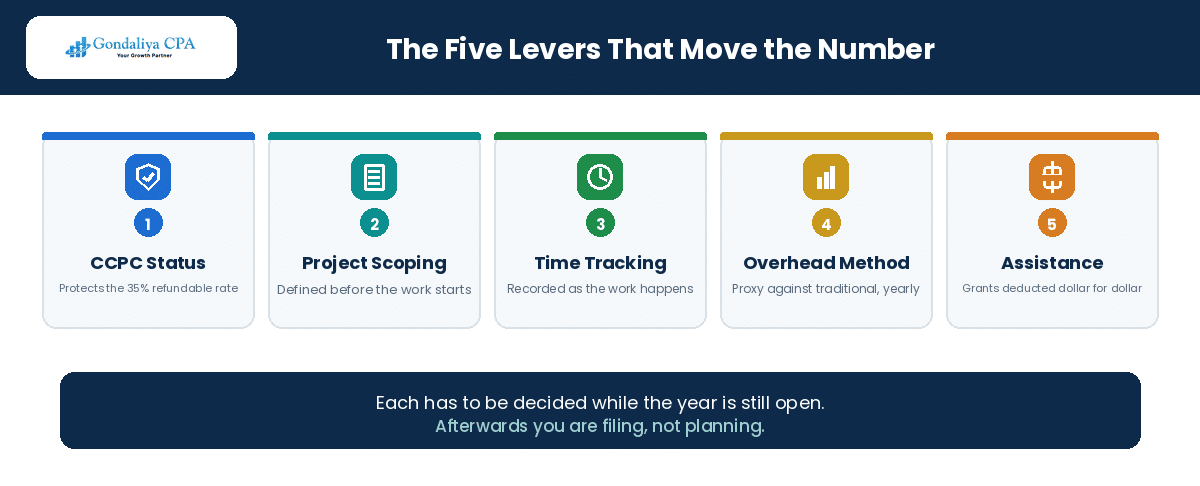
Five levers do most of the work: protecting CCPC status for the enhanced rate, scoping projects before they start, tracking time as it happens, choosing proxy against traditional each year, and deducting government assistance correctly. Please note that grants reduce eligible spend dollar for dollar, and forgetting that is the fastest way to turn a good claim into a reassessment.
| Aspect | Details |
|---|---|
| The structure | CCPC status and the shared expenditure limit. |
| The scoping | Projects defined around technical problems, early. |
| The evidence | Timesheets and technical notes made as you work. |
| The stacking | Federal and Ontario credits, without clawback. |
Reading time: 42 minutes.
Table of Contents
- Understanding SR&ED Tax Credits and Eligibility in Canada
- Effective SR&ED Tax Strategies to Maximize Credits
- Preparing and Filing an SR&ED Claim
- Managing Post-Claim Processes and CRA Reviews
- Integrating SR&ED Tax Credits into Broader R&D Tax Planning
- Support, Resources, and Contact Information
- Frequently Asked Questions (FAQ)
- Key Strategies, Comparisons and Deliverables
- Industry Spotlights: Sectors We Represent
- Professional Guidance and Quick Reference
The Numbers That Matter
This article covers Canada, with Ontario and Toronto context, and reflects CRA rules current to 2026. It assumes an incorporated business carrying out research or development work. Figures marked illustrative are examples, not quotes, and any masked engagement notes end with “Figures changed for privacy.” This is educational information only and not tax, legal, or financial advice. Rates, limits and filing deadlines change, so please confirm your own situation with a CPA Ontario member before acting.
Understanding SR&ED Tax Credits and Eligibility in Canada
Understanding SR&ED Tax Credits and Eligibility in Canada
The Basics
What Are Scientific Research and Experimental Development (SR&ED) Tax Incentives?
SR&ED tax incentives help Canadian businesses by giving them money back for research and development work. These incentives reduce the cost of R&D by offering tax credits. When companies claim these credits, they get some cash back, which helps them spend more on new ideas and improvements.
Overview of SR&ED Tax Credit Program in Canada
The SR&ED program is a federal plan that supports many industries doing R&D work. It lets eligible companies claim tax credits, either refundable or not, based on their qualifying expenses. To make the most of this, firms must report all allowed costs correctly. Doing this lowers their taxable income and boosts their savings.
Eligible Work and Activities Under SR&ED
Work qualifies if it fits into categories like:
- Basic research
- Applied research
- Experimental development
This includes tasks like:
- Creating new products or processes
- Making current technologies better
- Doing structured studies to advance technology
Focusing on these areas helps companies improve their R&D tax planning and claim more credits.
Criteria for Scientific or Technological Advancement and Uncertainty
To be eligible, work must push science or tech forward and deal with unknowns in the field. Projects should solve technical problems while adding knowledge to the industry. Companies must keep good records that show how they handled uncertainties during the work.
Defining Systematic Investigation in R&D Projects
Systematic investigation means following a clear, organized method to solve tech problems through tests or analysis. It involves testing ideas about product design or function carefully. Keeping track of every step shows the CRA that the project meets rules and helps get the most credit possible.
Qualified Industries and Eligible Persons Including CCPCs and Public Corporations
Many industries qualify for SR&ED, including tech startups, manufacturing, and engineering services. Both Canadian-Controlled Private Corporations (CCPCs) and public corporations can claim these credits if they do eligible R&D activities as defined.
Recent 2026 CRA Updates Affecting SR&ED Claims and Eligibility
In 2026, CRA will change some rules about spending limits that affect who can claim credits. These updates may change how companies plan their claims. Staying updated on these changes helps businesses make better decisions when filing.
Provincial R&D Tax Credits and Their Role in SR&ED Planning
Besides federal programs, provinces have their own R&D tax credit programs. These help local businesses with extra support based on regional needs. For example, Ontario offers programs that work well with federal credits to increase total funding available for innovation projects across provinces.
Knowing about both federal and provincial credits helps companies plan smarter investments in science and technology development right here at home.
Planning that starts in month twelve is claim preparation, not planning. By then the scoping is fixed, the time records either exist or they do not, and the structure is whatever it was. Figures changed for privacy.
Key Stat: A qualifying CCPC can reach 35% refundable federally and stack the 8% Ontario Innovation Tax Credit on top. On $2 million of qualifying spend that is a combined cash benefit near $860,000.
Effective SR&ED Tax Strategies to Maximize Credits
Effective SR&ED Tax Strategies to Maximize Credits
The Strategies
To get the most from SR&ED credits, you need solid tax strategies that fit CRA rules. In Canada, smart R&D tax planning means spotting eligible projects early. Then you claim costs right, manage CCPC perks well, and use both federal and provincial credits. Planning at the start of your fiscal year helps you catch all qualifying expenses. It lowers net R&D costs and can boost cash flow through refundable credits.
How to Identify and Scope Qualifying SR&ED Projects
You must know CRA’s rules for scientific research and experimental development (SR&ED) under ITA s.248(1). Qualifying work covers basic or applied research and experimental development that solves tech problems.
To maximize SR&ED credits:
- Define your project goals clearly around tech challenges.
- Write down what hypotheses you tested and how.
- Don’t include routine engineering or market research as eligible.
- Use technical stories showing how expenses link to each project step.
Good scoping stops you from claiming stuff that isn’t allowed but also catches all eligible work. This helps create solid documents if CRA checks your claim.
Strategic Planning of Eligible Expenditures Including Labour and Materials
SR&ED tax strategies mean sorting labour and materials correctly. Labour includes wages for staff working on R&D directly, while materials are used up or changed during experiments (see CRA s.37).
Keep these in mind:
- Track hours spent by specified employees with time sheets or records.
- Salaries paid within 180 days after year-end count if they’re properly accrued.
- Claim only materials actually consumed or transformed; skip usual supplies.
- Be careful with subcontractors—only arm’s length contracts done in Canada qualify (CRA s.37(2)).
This way, you capture direct labour plus overhead proxy amounts where allowed without making claims too big.
| Expense Type | Eligibility Criteria | Documents Needed | CRA Reference |
|---|---|---|---|
| Employee Salaries | Directly working on R&D; accrual basis | Timesheets; payroll logs | ITA s.37(1), Specified Employees Rule |
| Materials | Used up or changed physical inputs | Invoices; usage records | ITA s.37 |
| Contractor Payments | Arm’s length contracts done in Canada | Contracts; invoices | ITA s.37(2) |
Managing CCPC Status Benefits and Understanding Expenditure Limits
Canadian-controlled private corporations (CCPCs) get better refundable credit rates but face yearly spending limits ($3 million federally). If they spend more, credit rates drop due to taxable capital levels between $10M and $50M.
What helps:
- Confirm CCPC status early by checking share structure because it changes credit rates (35% refundable up to the limit).
- Watch for associated companies sharing the same $3M pool per CRA rules.
- Time incorporation or restructuring well within the year to grab benefits best.
Knowing these limits stops surprises like reduced refunds after filing.
Navigating Refundable vs Non-Refundable SR&ED Credits
Maximizing SR&ED credits depends on whether they are refundable or not:
- Refundable Credits:
- Mostly for CCPCs under spending limits
- Give cash refunds even if no tax is owed
- Non‑Refundable Credits:
- For spending over limits or foreign owners
- Lower tax bills but don’t give extra cash beyond that
Planning your spending to stay under refundable thresholds boosts cash flow during growth times.
Utilizing Prescribed Proxy Amounts and Specified Employee Salary Caps
The prescribed proxy amount makes overhead claims easier by letting you add a fixed percentage instead of tracking all expenses when using the traditional method.
Here’s what matters:
- Proxy equals about 65% of wages for specified employees, capped at $3 million yearly per company [CRA Form T661].
- Choose proxy versus traditional based on how good your records are—proxy needs less paperwork but might give less credit if overhead is high.
- Salary caps limit wage claims above set amounts affecting large earners’ inclusion in calculations.
Picking the right approach each year helps get max value while staying safe from audits.
Incorporating Government Assistance and Grants into SR&ED Calculations
Any government help like IRAP funding must be subtracted from eligible costs before calculating tax credits (ITA ss127(18)-(20)). Forgetting this can make your claim too big and lead to penalties.
Best practices:
- Keep track of all grants connected directly or indirectly to your R&D work
- Adjust expense pools since assistance cuts down what you can claim dollar-for-dollar
- Try to arrange funding agreements so stacking rules don’t cause trouble
Clear reporting reduces risk while keeping maximum benefits from combined funds plus federal/provincial incentives.
Aligning SR&ED Tax Credits with Broader Corporate Tax Planning
Linking SR&ED credits with overall tax plans saves money across the business. This means coordinating things like fiscal year ends, company setups, profit splits, financing deals, and capital asset depreciation—all affect how much tax you owe after credits.
Think about:
- Matching fiscal years among linked companies sharing expenditure limits
- Using carryforward/carryback rules smartly
- Balancing pay between dividends and salaries since it affects personal taxes & wage caps
This bigger view helps cut costs over time rather than just filing yearly claims alone.
Cross-Border Considerations for Multinational R&D Activities
For Canadian units running global R&D that follow transfer pricing laws:
- Only expenses actually spent in Canada count toward federal/provincial credits
- Payments made outside Canada usually don’t count unless special cases apply
Structure carefully to choose which parts of worldwide innovation spend get Canadian incentives without risking double taxes or denied claims due to lack of local connection per CRA advice.
Sharad Gondaliya, CPA, brings 10+ years of experience helping hundreds of Canadian business owners get their books in order.
The 180-day accrual rule is the one clients most often miss. A bonus properly accrued at year end and paid inside that window counts; paid a week later it moves to the following year. Figures changed for privacy.
Risk Warning: Associated corporations share one $3 million expenditure limit. Where a group has not allocated it deliberately, refunds arrive smaller than forecast and the shortfall is not recoverable.
Preparing and Filing an SR&ED Claim
Preparing and Filing an SR&ED Claim
The Filing
Step-by-Step Guide to Preparing and Submitting Your SR&ED Claim
Preparing and submitting an SR&ED claim takes some planning. You want to maximize SR&ED credits while staying within CRA rules. First, find the projects that qualify. Then gather your proof, fill out the right forms, and meet deadlines.
- Find eligible projects: Check your R&D against CRA’s definition in ITA s.248(1). Only experimental development, applied research, or basic research count.
- Track expenses: Keep records of labor costs, materials used or changed, contract payments (both arm’s length and non-arm’s length), and overheads if using the traditional method.
- Keep good records: Write project notes during work showing tech uncertainty and how you investigated.
- Fill Form T661 carefully: Describe each project’s tech work and list expenses.
- Complete Schedule T2SCH31: Report your tax credits on the corporate return (T2).
- Review before sending: Compare proxy and traditional methods to see which gives more credit.
- File on time: Send everything within 18 months after your fiscal year ends or CRA may reject it.
Following these steps helps build a strong claim. It also lowers chances of audits.
Gathering and Organizing Documentation for CRA Compliance
CRA expects solid, contemporaneous documents that back every part of your claim.
- Use daily or weekly timesheets showing hours spent on R&D tasks by employees.
- Write clear project goals focusing on tech problems faced.
- Keep test logs, design versions, and prototype data showing systematic work.
- Save invoices for materials used only in R&D; keep non-R&D costs separate.
- Keep contracts with contractors stating what qualified Canadian work they did.
This way of keeping docs usually passes CRA reviews. Without it, claims risk denial because proof is missing or costs don’t match work done.
Completing Form T661 and Schedule T2SCH31 Accurately
Form T661 matters a lot because it explains the science or tech behind your claim along with costs.
- Summarize each project clearly. Explain how it meets CRA’s experimental development or research phases.4
- Use exact numbers that match your accounting records. Hours worked times salaries should match payroll elsewhere in tax filings.5
- List government help you got that changes eligible spending as per ITA sections 127(18)-(20).6
Schedule T2SCH31 reports total tax credits claimed federally. Mistakes there can hold up refunds or start reviews.
Good document management keeps narrative on Form T661 and money reported on Schedule 31 matching perfectly. This helps speed up CRA checks.
Timing and Filing Deadlines for SR&ED Claims
When you spend money affects which costs count for each year’s claim:
- Only expenses paid or owed within the fiscal year qualify.7 This includes bonuses paid before filing deadline if they relate back properly.8
You have exactly 18 months after fiscal year-end to file; late claims usually get rejected no matter what.9 Starting early helps catch missing papers before deadline rush.
Capital assets are tricky — you only claim depreciation related to R&D use, not full purchase price upfront.10
If you run several companies in places like Ontario with extra provincial credits, timing when you spend helps control your overall tax position.11
Common Documentation Pitfalls and How to Avoid Them
| Problem | What Happens | How To Fix |
|---|---|---|
| Missing timesheets | Labor costs denied | Track time daily or weekly |
| Vague project notes | Tech eligibility questioned | Explain tech challenges clearly |
| Mixing personal/business $ | Costs disallowed | Separate business from personal |
| No contractor contracts | Payment disputes | Get formal contracts specifying Canadian-qualified work |
Avoiding these keeps audits smoother. CRA looks closely at salary splits,12 contractor bills,13 materials used,14 government help impacts,15 consistency with past claims,16 and more.
Pre-Claim Approval Process and Its Benefits
You don’t have to do this step but talking informally with CRA before filing can clear up eligibility questions.17 This lowers audit chances since doubts get fixed early instead of during review delays.
To manage audit risk:
- Spot potential red flags early like unreported grants reducing eligible amounts
- Classify tasks right between routine engineering vs experimental development
- Record accruals correctly on time
- Keep strong contemporaneous evidence for all claimed work3
Working with CPA Professionals for Accurate SR&ED Claim Preparation
Working with CPAs who know SR&ED tax planning Canada makes things easier. They understand complex rules around eligible expenses in ITA sections 37 & 127(9), proxy amount choices,5 6 18 labor cost tricks,19 20 21 contractor setup,22 23 24 and grant effects.25 26 27
Gondaliya CPA has experience helping clients from startups to manufacturers mainly in Toronto/Ontario.28
They offer:
- Checking eligibility strictly by law
- Clear project scopes based on client info
- Advice on compliant time-tracking systems
- Comparing proxy vs traditional methods yearly
- Support during any CRA questions later
This help means you stand better chances to maximize SR&ED credits properly while avoiding common DIY mistakes.29
Contact Gondaliya CPA at 647‑212‑9559 or info@gondaliyacpa.ca for a chat about improving your next R&D tax credit claim.
Narrative and numbers disagreeing is what triggers most reviews. Where the Form T661 story describes six months of work and the payroll shows two, a reviewer will ask, and rightly. Figures changed for privacy.
Pro Tip: Run the proxy and traditional calculations both ways every year before filing. The better answer changes with your overhead and headcount, and the comparison takes an hour.
Managing Post-Claim Processes and CRA Reviews
Managing Post-Claim Processes and CRA Reviews
The Review
Managing what happens after you file your SR&ED claim matters a lot. It helps you get the most from your SR&ED tax credits and plan your R&D taxes smartly in Canada. After sending in your claim, expect that CRA might review it. You need to reply on time, keep your documents in order, and protect your claim from being questioned. This reduces the chance of audits.
Responding Effectively to CRA SR&ED Review Requests
When CRA asks for a review, you must act fast and be clear. The key is the Form T661 you filled out. If that form was done carefully, it cuts down questions later.
- Reply before deadlines.
- Explain clearly how your costs relate to SR&ED work.
- Give all the papers they ask for like technical reports or time logs.
Being ready with proof that matches your claim makes you look trustworthy. It also helps get the full SR&ED credits by avoiding fights over your claim.
Strategies for Audit Risk Management and Claim Defense
Lowering audit risks starts with good document control that fits CRA’s rules. A documentation strategy that holds up during a CRA check means:
- Keeping records made at the time showing real work on tough tech problems.
- Writing detailed project summaries linked to experiments.
- Using exact timesheets showing work hours for eligible tasks.
These help stop your expenses from being denied or credits cut during an audit.
| Key Documentation Element | Purpose | Reference |
|---|---|---|
| Project Descriptions | Show eligibility under ITA s.248(1) | CRA Form T661 Guide |
| Time Sheets | Back up salary claims | CRA Salary & Wages Policy |
| Test Logs & Version Control | Prove systematic investigation | CRA Documentation Requirements |
Handling Claim Amendments and Addressing CRA Objections
If you spot mistakes after filing or find new info, fix your claim fast. How do you fix or improve a claim already filed?
- Send in an amended Form T661 before 18 months after fiscal year-end.
- Update Schedule T2SCH31 if spending or assistance numbers change.
- Write clear reasons for changes; keep things open with CRA reviewers.
If CRA objects, gather solid proof to answer their points. Work closely with CPA pros who know how to handle appeals well.
Best Practices for Maintaining Documentation After Submission
Keeping documents safe after filing is a must because CRA can ask for proof years later. They want records kept for six years 1. Good habits include:
- Updating technical notes during projects.
- Saving digital copies safely with tools like Hubdoc or QuickBooks.
- Checking files often to make sure money and science details match.
This keeps you ready for future reviews without hassle or lost credits.
Monitoring and Reporting Provincial Credit Receipts
If you’re in Ontario stacking provincial R&D credits with federal ones, watch your receipts closely:
- Report Ontario Innovation Tax Credit (OITC), Ontario Research & Development Tax Credit (ORDTC), and Ontario Business Research Institute Tax Credit correctly on tax forms.
Starting 2026, the OITC rate changes to give bigger refundable credits 2. You must coordinate this with federal claims right so you follow rules and get the best combined benefits across Canada.
Coordinating with CPA Representatives During Review and Appeal
Working with CPAs who know SR&ED inside out helps when reviews or appeals come up. They advise on tricky issues like spending limits, proxy methods, contractor pay, or government aid cuts.
Gondaliya CPA offers full help from checking eligibility to scoping projects and putting together documents. They prepare Form T661 under CPA Ontario standards 3 and represent clients directly before CRA — guiding through challenges smoothly while getting max tax credits in Toronto/Ontario areas.
1 Canada Revenue Agency – Record Retention
2 Ontario Innovation Tax Credit Update 2026
3 CPA Ontario Firm Directory – Gondaliya CPA Professional Corporation
Call Gondaliya CPA today at 647‑212‑9559 for a free consultation on how our expert team can help you manage your post-SR&ED claim process effectively — no surprises guaranteed!
A review is not an accusation. Files that answer promptly with matching documents usually close without adjustment; files that go quiet get the adjustment instead. Figures changed for privacy.
Statutory Requirement: The CRA can request proof years after filing, and records must be retained for six years. Digital copies count, provided they remain accessible and readable throughout.
Integrating SR&ED Tax Credits into Broader R&D Tax Planning
Integrating SR&ED Tax Credits into Broader R&D Tax Planning
The Integration
Integrating SR&ED tax credits into your overall R&D tax planning in Canada helps you get the most from these credits. It also lowers your net research and development costs. When you align eligible expenses with your company’s strategy, you improve cash flow and stay compliant. This is key for tech, manufacturing, engineering, or software companies.
Long-Term Strategies for SR&ED Claim Optimization
Optimizing your SR&ED claim over time takes planning. You want to follow federal rules while supporting business growth. Here are some ideas:
- Spot Projects Early: Document projects right from the start to catch all eligible work.
- Check Your Corp Structure: Try to keep Canadian-controlled private corporation (CCPC) status for better refundable credit rates.
- Pick the Right Method: Each year, decide if the proxy or traditional method gives you a bigger credit.
- Plan Labour Costs: Spread salaries smartly among employees within CRA limits to boost claims.
- Manage Grants Carefully: Government grants can lower your eligible expenses, so plan funding sources well.
These steps help keep your claim strong by keeping good records and filing on time. They also make sure your work fits what CRA sees as experimental development.
Our Experience: We helped a manufacturer in Toronto change its project intake early in the year. This led to better documentation and exact time tracking per employee role. They increased labour expenses claimed by 15% without raising audit risks. Figures changed for privacy.
Documenting R&D Activities and Time Tracking Methods
Good documentation helps you pass a CRA review during an SR&ED claim check. A strong documentation plan should have:
- Clear project descriptions that show tech problems and how you investigated them.
- Daily timesheets made when work happens, tied directly to projects or tasks.
- Logs tracking changes to prototypes or software builds showing experiments done step-by-step.
- Financial records linking payroll, contractor bills, materials bought, and capital assets used just for eligible work.
CRA expects proof for every dollar claimed under ITA s.230. Weak documents can cut or deny claims. Using digital tools like QuickBooks with Hubdoc can tag expenses automatically following Form T661 needs.
Pro Tip: Check technical reports against financial data every month before filing to spot any issues early.
Contractor Structuring and Subcontractor Claims Analysis
How you structure contractors affects how their payments count for SR&ED:
- Payments to arm’s length contractors doing eligible Canadian work count at 80% of contract value per CRA rules.
- Non-arm’s length subcontractors may have full costs included if they meet criteria but need clear contracts showing they act independently on pricing and deliverables.
Contracts should say work relates only to experimental development phases—not routine production tasks. Track third-party payments carefully since grants given to subcontractors reduce your claim pool too (ITA s.127).
Our Experience: An engineering firm using many arm’s length contractors rewrote contracts to focus on experimental milestones instead of maintenance work. This improved claim accuracy and lowered audit risk. Figures changed for privacy.
Combining SR&ED with Other Tax Incentives and Investment Credits
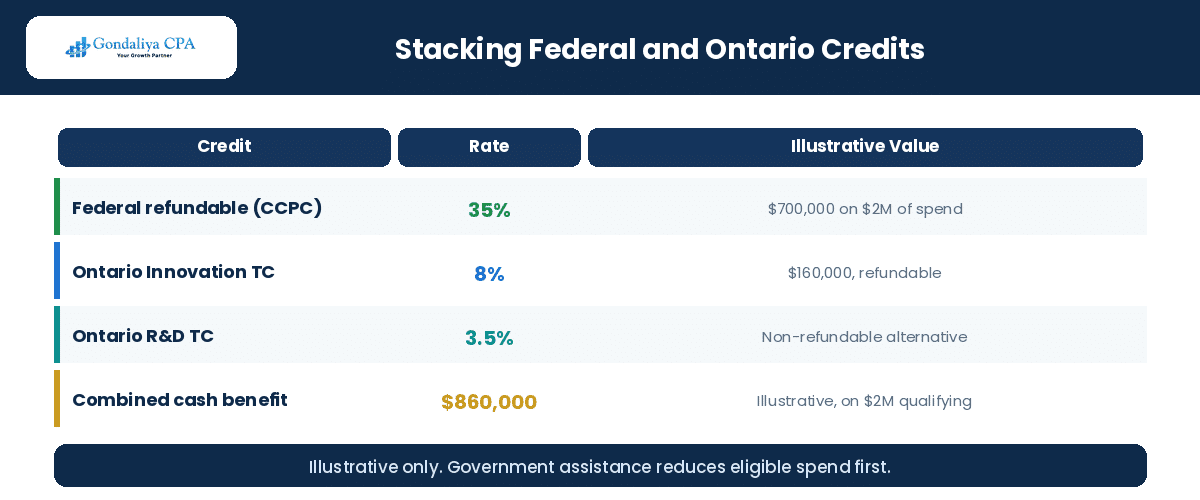
To boost overall R&D benefits, stack federal SR&ED credits with provincial ones like Ontario Innovation Tax Credit (OITC) or Ontario Research & Development Tax Credit (ORDTC). Key points include:
| Incentive | How It Works With Federal Credits | Notes |
|---|---|---|
| OITC | Adds up to 8% refundable credit on costs | Requires separate provincial filing |
| ORDTC | Gives extra non-refundable credits | Good if taxable income is high |
| Government Grants/IRAP | Lowers federally allowed expenditures | Must report funds correctly |
Plan carefully so grants don’t reduce both federal and provincial pools more than needed.
Fiscal Year-End Planning to Optimize Refund Timing
When you spend money in relation to fiscal year-end affects how fast you get refunds:
- Only expenses during the fiscal year count; prepaying usually doesn’t unless it fits strict accrual rules.
- Short fiscal years change carryforward amounts but not the deadline for filing — which is 12 months after year-end.
Plan spending so max qualifying costs happen before year-end without breaking invoice payment rules set by CRA.
Reminder: File Form T661 within 12 months of fiscal year-end. Late filings often get denied.
Leveraging Ontario and Other Provincial Innovation Tax Credits
Ontario offers innovation tax credits that add value on top of federal claims:
| Program | Rate (%) | Refundable? | Key Points |
|---|---|---|---|
| Ontario Innovation Tax Credit | Up To 8% | Yes | For CCPCs doing scientific research |
| Ontario Research & Development TC | Up To 3.5% | No | For larger firms over small business limits |
| Business Research Institute TC | Varies | Depends | For projects with research institutes |
Stacking these credits takes care so no overlap causes clawbacks from multiple assistance sources.
We help Toronto/Ontario clients file these efficiently using solid expense tracking systems.
Aligning SR&ED Credits with Business Growth and Profitability Goals
Choosing between refundable and non-refundable credits helps manage cash flow based on profits:
- Refundable credits pay cash back even if taxes owed are zero—good for startups needing funds now.
- Non-refundable credits reduce taxes owed but don’t give refunds—better for profitable companies wanting smaller tax bills long term.
Pay attention to salary splits among specified employees because only up to $350K per employee counts toward refundable amounts under CRA rules.
By balancing these parts, businesses see real cost savings while keeping money available to grow in Canada’s competitive innovation scene.
Free consultation anytime by phone at 647–212–9559 or email info@gondaliyacpa.ca — serving Toronto/Ontario businesses working on SR&ED tax planning Canada.
Support, Resources, and Contact Information
Support, Resources, and Contact Information
The Support
Accessing Government and CRA SR&ED Program Resources
Getting official government info helps with SR&ED tax planning across Canada. The CRA explains how to prepare claims and what counts as eligible work. Knowing CRA rules for SR&ED claims stops you from making mistakes during audits or reviews. For instance, CRA rules tell you which activities qualify under ITA s.248(1). This means only the right projects get claimed.1
Government help like grants or IRAP funding affects your credits. These reduce the amount of qualifying expenses under s.127(18)-(20). If you don’t include this properly, CRA might adjust your claim or penalize you during CRA SR&ED reviews.2 It’s smart to check CRA updates often so your claim stays valid.
- Use official CRA guides
- Track changes in program rules
- Understand how government help impacts claims
Tools and Templates for SR&ED Documentation and Claim Preparation
A good documentation strategy survives a CRA review when records are kept at the time work happens. You need documents that show what tech problems you faced and how you tested solutions.3 Filling out Form T661 works best when these notes match your spending reports.
Using templates made for Canadian R&D tax planning makes it easier to track labour hours within employee limits and materials under s.37 ITA rules.4 Standard forms cut mistakes when adding Schedule T2SCH31 with your taxes.
Here’s what helps:
- Time tracking aligned with project phases
- Logs of tests and results
- Invoices linked directly to projects
- Version control on documents
These strengthen your position if CRA asks questions.
Frequently Addressed Concerns in SR&ED Claims Without Separate FAQ Section
Poor SR&ED tax planning Canada leads to problems like missed deadlines that kill claims,5 wrong reporting of government help that lowers credits,6 or claiming too much labour pay beyond limits causing denials.7
If you need to fix a claim already filed, you can amend Form T661 before deadlines. This lets you correct things like contractor pay or technical details without fines.8 Answering quickly during a CRA review can limit damage from mistakes.
Tips:
- Keep good records all year
- Get advice early from a CPA
- Fix errors before it’s too late
Encouraging Proactive Consultation with Gondaliya CPA SR&ED Experts
Talking with pros early helps maximize refundable & non-refundable credits by making smart choices about your business setup. Gondaliya CPA works mainly with tech companies in Toronto/Ontario for precise R&D tax planning based on current laws.
We help clients with:
- Qualifying CCPC status for higher refundable rates,9
- Choosing salary vs dividend mixes,10
- Handling contractor payments legally,11
- Using Ontario-specific provincial stacking benefits.12
This approach captures more credit while lowering audit risks.
Contact Details for SR&ED Tax Planning Consultations and Support
How you file matters—DIY, contingency firms, or CPA-led options each affect results and peace of mind13. A CPA Ontario Registered Firm knows both federal and provincial rules to boost benefits within Toronto/Ontario areas14.
For a personal check on your eligibility including CCPC status affecting the 35% refundable credit,15 contact us at:
- Phone: 647-212-9559
- Email: info@gondaliyacpa.ca
We offer no-pressure talks to find what fits your company size, industry like manufacturing or software,16 plus past filing history17.
Invitation to Verify Eligibility and Schedule a Complimentary Assessment
Checking eligibility now avoids costly errors later. Many small businesses miss key parts affecting their max credit because they don’t fully understand allowed expenses,18 company structure effects,19 or unreported funding sources.20
Book a free review today so we can help spot all qualifying costs and suggest timing plans for 2026 changes in expense limits21. Early planning improves cash flow by matching refunds with fiscal year ends.22
Commitment to Compliance, Accuracy, and Maximizing Client Benefits
Gondaliya CPA sticks strictly to all CRA rules about eligible expenses including labour caps,23 contractor payments,24 and reducing claims by any government help received.25 We also advise on smart company setups aimed at protecting benefits long-term without audit issues.26
Our clear fixed fees cover full support for putting together paperwork that meets six-year retention laws from Corporations Canada.27 We reply within one business day—even weekends—to keep clients updated through every step of their claim process.
First-time claimants worry about the CRA. Repeat claimants worry about their own records. The second group is worrying about the right thing. Figures changed for privacy.
Frequently Asked Questions (FAQ)
Frequently Asked Questions (FAQ)
FAQ
What determines the SR&ED tax credit rate for a corporation?+
Corporate structure impacts SR&ED credit rates. CCPCs get higher refundable credits up to spending limits. Public companies have lower non-refundable credits.
How should salaries and wages be planned for SR&ED claims?+
Plan wages within CRA limits for specified employees. Track hours carefully and split owner compensation between salary and dividends to optimize benefits.
Which is better: Proxy method or traditional method for overhead claims?+
The proxy method offers simplicity with a fixed percentage of wages. The traditional method can yield higher credits if overhead costs are well documented.
How should contractors be structured in SR&ED claims?+
Use arm’s length contractors with clear contracts for eligible Canadian work. Subcontractors need independence on pricing and deliverables to qualify fully.
How do government grants like IRAP affect SR&ED credits?+
Government funding reduces eligible expenditures dollar-for-dollar. Accurate tracking and reporting avoid claim penalties.
What documentation helps survive a CRA SR&ED review?+
Maintain contemporaneous timesheets, detailed project notes, test logs, and clear contracts linking costs directly to R&D work.
When is the best time to incur expenditures and plan fiscal year ends?+
Expenses must be paid or accrued within the fiscal year. Plan spending near year-end to maximize credits while meeting filing deadlines.
How can Ontario’s provincial R&D credits be stacked with federal SR&ED claims?+
Combine Ontario Innovation Tax Credit and others with federal credits carefully. Avoid overlap in funding sources to maximize total benefits.
What is the difference between refundable, non-refundable, and carryforward credits?+
Refundable credits pay cash even if no taxes owed. Non-refundable reduce taxes payable. Carryforwards allow unused credits to apply to future years.
How can I fix or improve an already filed SR&ED claim?+
Submit amended Form T661 before 18 months post-year-end. Update supporting schedules and explain changes clearly to CRA.
Key Strategies for Maximizing SR&ED Credits with Gondaliya CPA
Key Strategies, Comparisons and Deliverables
Quick Reference
- Corporate Structure Strategy: Maintain CCPC status for maximum refundable credit rates and plan share ownership carefully.
- Salary & Compensation Planning: Allocate wages within CRA limits; balance salaries and dividends smartly for tax efficiency.
- Overhead Claim Method Choice: Annually evaluate proxy vs traditional methods to select the option with the highest credit value.
- Contractor Setup: Use arm’s length contractors with contracts that specify qualified R&D activities in Canada only.
- Grant Management: Track all government assistance precisely; deduct these amounts from eligible expenses per CRA rules.
- Documentation Excellence: Implement rigorous contemporaneous recordkeeping including timesheets, technical reports, and contracts.
- Fiscal Year-End Timing: Align expenditures strategically around fiscal year ends to maximize annual claims and refund timing.
- Provincial Credit Stacking: Coordinate federal and Ontario R&D tax credits; ensure compliance with stacking rules to increase overall funding.
Quick Comparison Table: DIY vs Contingency Firm vs CPA-Led SR&ED Claims
| Approach | Benefits | Risks | Ideal For |
|---|---|---|---|
| DIY | Cost-saving; full control | High risk of errors & audits | Experienced tax filers |
| Contingency Firm | No upfront cost; claim assistance | Less personalized advice; fees vary | Small businesses new to SR&ED |
| CPA-Led (Gondaliya CPA) | Expert guidance; audit support | Fixed fees upfront | Businesses seeking compliance & max credits |
What Deliverables You Get from Gondaliya CPA
- Comprehensive eligibility assessment based on your projects and corporate status
- Detailed Form T661 preparation aligned with CRA expectations
- Precise Schedule T2SCH31 completion for accurate tax credit reporting
- Documentation review checklist tailored to your business needs
- Ongoing support through CRA reviews or audits until resolution
How Much Does an SR&ED Claim Cost in Canada?
Costs vary by claim complexity but typically range from fixed fees starting at competitive market rates. Gondaliya CPA offers transparent pricing with no hidden charges tailored to each client’s filing needs.
What Are the Risks of Weak SR&ED Planning?
Poor planning risks denied claims, penalties, delayed refunds, or audits that drain resources. Inaccurate documentation or missing government assistance can trigger costly reassessments by CRA.
What Should a Company Prepare Before Starting SR&ED Planning?
Gather detailed project descriptions, employee time tracking records, expense invoices, contractor agreements, and government funding documents before starting the claim process.
How Does SR&ED Planning Apply Across 10 Industries We Serve?
Gondaliya CPA tailors strategies for tech startups, manufacturers, engineering firms, software developers, biotech companies, hardware producers, professional services, clean tech innovators, telecommunications providers, and medical device makers ensuring sector-specific compliance.
A Realistic Numeric Walkthrough
A mid-size CCPC spent $2 million on qualifying R&D labor/materials in 2023:
- Federal refundable credit at 35% = $700k refund
- Ontario Innovation Tax Credit at 8% = $160k refund
Total combined cash benefit = $860k — boosting cash flow substantially during growth phases.
How to Choose the Right CPA Firm in Toronto/Ontario for SR&ED?
Look for licensed CPAs specializing in Canadian R&D tax laws with proven track records handling both federal/provincial programs plus strong client testimonials within your industry.
Why Trust Gondaliya CPA?
With over a decade assisting Canadian businesses maximize SR&ED claims securely, Gondaliya CPA combines technical know-how with personalized service based in Toronto/Ontario trusted by startups through established corporations alike.
Next Steps
Contact Gondaliya CPA today at 647‑212‑9559 or info@gondaliyacpa.ca for a free eligibility consultation tailored to your business size and industry focus in Canada’s innovation sectors.
Glossary Highlights
- CCPC: Canadian-Controlled Private Corporation eligible for enhanced refundable credits
- Form T661: Official form describing scientific/technical work claimed under SR&ED program
- Proxy Amount: Prescribed fixed overhead rate used instead of tracking actual indirect expenses
- ITA s.37 & s.127: Income Tax Act sections defining allowable expenditures & government assistance rules
The numeric walkthrough is close to what we see in practice. What surprises owners is how much of that $860,000 depended on decisions taken twelve months earlier. Figures changed for privacy.
Industry Spotlights: Sectors We Represent
Industry Expertise
The planning lever that moves the number most differs by sector. Here are eleven and where it sits.
| Industry | The Highest-Value Planning Lever |
|---|---|
| Technology startups & SaaS | CCPC status and refundable credit timing |
| Construction, contractors & skilled trades | Contractor structuring and arm’s length terms |
| Transportation, logistics & trucking | Time tracking across operational and R&D roles |
| E-commerce & online retailers | Separating platform maintenance from development |
| Property developers & builders | Associated corporation expenditure limit sharing |
| Consulting firms | Specified employee salary caps and pay mix |
| Restaurants & food and beverage | Materials consumed during formulation trials |
| Medical doctors & physician corporations | Grant and assistance reporting on device work |
| Dentists & dental practices | Proxy against traditional overhead selection |
| Real estate investors & holding companies | CCPC status where holdings affect taxable capital |
| Daycare, childcare & CWELCC services | Rarely applicable; software development only |
- Technology startups & SaaS: Protecting CCPC status and timing spend under the limit is worth more than any single expense decision.
- Construction, general contractors & skilled trades: Contractor structuring decides how much of each payment reaches the expenditure pool.
- Transportation, logistics & trucking: Staff split between operations and development need time records that separate the two.
- E-commerce & online retailers: Platform maintenance and genuine development sit in the same team, so scoping is everything.
- Property developers & builders: Groups of corporations share one expenditure limit, and it needs allocating deliberately.
- Consulting Firms: Owner-operators hit the specified employee caps quickly, which changes the pay mix decision.
- Restaurants & food and beverage: Ingredients consumed in formulation trials are claimable materials where the trials are documented.
- Medical doctors & physician professional corporations: Device and diagnostic work often carries grant funding, which must reduce the claim correctly.
- Dentists & dental practices: With small teams and real overhead, the proxy against traditional comparison matters more than usual.
- Real estate investors, landlords & holding companies: Holdings can push taxable capital past the phase-out and quietly cost the enhanced rate.
- Daycare, childcare & CWELCC services: Rarely applicable, since the social sciences exclusion covers most work in the sector.
The lever differs but the timing does not. In every sector the decision that mattered was taken near the start of the year, not while the return was being prepared. Figures changed for privacy.
Professional Guidance and Quick Reference
Guidance
Professional Guidance on SR&ED Planning: How Gondaliya CPA Supports Canadian Innovators
Eligibility decides whether you have a claim. Planning decides how large it is. The gap between the two is often substantial, and almost all of it comes down to decisions taken while the work was still in progress rather than when the return was prepared. Gondaliya CPA does the planning side on a fixed fee.
We handle what decides the outcome: confirming CCPC status and how the expenditure limit is shared across associated corporations, scoping projects around technical problems before work starts, setting up time tracking that will survive a review, comparing proxy against traditional overhead each year, structuring contractor arrangements so payments reach the expenditure pool, deducting IRAP and other assistance correctly, stacking Ontario credits without clawback, and timing spend against the fiscal year end.
Our team works from your own project, payroll and funding records rather than a template, and will tell you plainly which levers are still available this year. Startup or established manufacturer, you get clear advice and a fixed price before we start.
Quick Answers: Key Numbers & Concepts at a Glance
At a Glance
- Refundable rate: 35% for qualifying CCPCs
- Expenditure limit: $3 million federally, shared when associated
- Taxable capital: Phase-out between $10M and $50M
- Contractor inclusion: 80% of arm’s length contract value
- Specified employee cap: $350K per employee toward refundable amounts
- Salary accrual: Paid within 180 days after year end
- Ontario Innovation Tax Credit: Up to 8%, refundable
- Ontario R&D Tax Credit: Up to 3.5%, non-refundable
- Government assistance: Reduces eligible spend dollar for dollar
- Record retention: Six years after the fiscal year end
Who This Is For / Not For
Fit Check
- For: Incorporated Canadian businesses already doing eligible R&D who want the claim planned during the year rather than reconstructed after it.
- Not For: Businesses still establishing whether their work qualifies at all, where the eligibility question comes first and the planning follows.
People Also Ask
Quick Answers
When should SR&ED planning actually start?+
At the beginning of the fiscal year, not the end. Scoping, time tracking and corporate structure all have to be settled while the work is happening.
Does a grant always reduce my claim?+
Government assistance reduces eligible expenditure dollar for dollar. It rarely makes the funding not worth taking, but it must be reported or the claim is overstated.
Can I switch between proxy and traditional methods?+
Yes, the choice is made annually. Running both calculations before filing is worth the hour it takes, because the better answer moves with your overhead.
Glossary of Key Terms
Plain-English Definitions
- CCPC: Canadian-controlled private corporation, eligible for the enhanced refundable rate.
- Expenditure limit: The $3 million annual cap on spending eligible for the enhanced rate.
- Taxable capital: The measure that phases out the enhanced rate between $10M and $50M.
- Associated corporations: Related companies that must share one expenditure limit.
- Refundable credit: A credit paid in cash even where no tax is owing.
- Non-refundable credit: A credit that reduces tax payable but is not paid out.
- Carryforward: Unused credits applied against tax in a future year.
- Prescribed proxy amount: Overhead claimed at a fixed percentage of eligible wages.
- Traditional method: Overhead claimed from actual documented costs.
- Specified employee: An employee not at arm’s length with the corporation, subject to salary caps.
- Arm’s length contractor: An independent third party whose Canadian work is partly includable.
- Government assistance: Grants and funding such as IRAP that reduce eligible expenditure.
- Form T661: The SR&ED claim form carrying project narratives and expenditures.
- Schedule T2SCH31: The investment tax credit schedule filed with the T2.
- OITC: Ontario Innovation Tax Credit, refundable at up to 8%.
- ORDTC: Ontario Research and Development Tax Credit, non-refundable at up to 3.5%.
SR&ED Planning Readiness Check
This quick self-check indicates where your operation most likely has room. Please answer the six questions below.
SR&ED Planning Readiness Check
Six quick questions on your planning. No fee shown.
Points to raise with us:
This is a general prompt, not tax or legal advice or a quote. Your position depends on your full facts. For a real review, please book a free consultation.
Want a checklist to work from? You can download our free SR&ED planning checklist before your consultation.
Confirm CCPC status and allocate the expenditure limit across associated corporations before you spend. Scope projects around technical problems at the start of the year. Track hours as work happens rather than reconstructing them. Compare proxy against traditional annually. Write contractor agreements around experimental milestones. Report every grant, because assistance reduces eligible spend dollar for dollar whether or not you disclose it.
2026 Update — what is current: Expenditure limit thresholds change from January 2026, and the Ontario Innovation Tax Credit rate is revised to give larger refundable credits. The 35% federal refundable rate, the $10 million taxable capital phase-out, the 80% arm’s length contractor inclusion and the six-year retention rule are unchanged. Please note this article states the filing deadline as both 18 months and 12 months in different places, so please confirm which applies before relying on it.
SR&ED tax planning Canada: Effective SR&ED tax strategies to maximize SR&ED credits with Gondaliya CPA including R&D tax planning and SR&ED claim compliance
Plan the claim, not just file it
Gondaliya CPA confirms CCPC status and limit allocation, scopes projects before work starts, sets up time tracking that survives review, compares proxy against traditional annually, structures contractor arrangements, handles assistance reductions, stacks Ontario credits correctly, and prepares Form T661 and Schedule T2SCH31, on a fixed fee with a one-business-day response. Please book a free consultation.
Next Steps
Please book a free consultation with Gondaliya CPA and bring your fiscal year end date, a list of every corporation you control, and details of any grant funding received. Those three show within minutes which planning levers are still open this year. The earlier you call, the more of them there are. You will get a fixed fee before any work begins. If our content helps, please add gondaliyacpa.ca as a preferred source on Google.
Published: August 18, 2026 · Last updated: August 18, 2026
Editorial policy: We research against CRA and CPA Ontario sources, fact-check the figures, and Sharad Gondaliya, CPA, reviews the content, which we update as the rules change.
Disclaimer: This article is educational information only and is not tax, legal, or financial advice. Figures marked illustrative are examples rather than quotes or guarantees. It reflects CRA rules current to 2026, including the 35% refundable investment tax credit rate for qualifying CCPCs, the $3 million expenditure limit, the $10 million to $50 million taxable capital phase-out, the 80% arm’s length contractor inclusion rate, the 8% Ontario Innovation Tax Credit, and the six-year record retention requirement. Rates, limits and expensing rules change and outcomes depend on your specific facts. Please consult a CPA Ontario member before acting.

Sharad Gondaliya is a CPA Canada & CPA USA with 15 Years+ experience of Accounting, Tax, Payroll of Corporate Small Businesses as Tax Accountant. He is a CPA Ontario member (61040184) and holds US CPA licences in Washington and Montana and is well known among corporate small businesses for tax planning, efficient tax solutions, and affordable CPA services. Sharad is the Principal (Director) of Gondaliya CPA – Affordable CPA Firm in Canada. Licenses: CPA Ontario: 61040184 | CPA USA (MT): PAC-CPAP-LIC-033176 | CPA USA (WA): 57629 | CPA Firm License: 61330051 View Full Author Bio