



The Ultimate Guide to Section 85 Rollovers in Canada: How to Transfer Business Assets Tax-Efficiently
Section 85 rollover Canada offers a valuable tax deferred rollover option to transfer assets to a corporation while deferring taxes under the Section 85 election. Gondaliya CPA specializes in using elected amounts, price adjustment clauses, and paid-up capital strategies for effective corporate tax planning and business asset rollover in Canada.
Quick Summary
Four things decide whether a rollover holds: the property must be eligible, the transferee must be a taxable Canadian corporation, at least one share must be issued, and the elected amount must sit between the cost floor and fair market value. Please note the form has to be filed by the earliest return deadline of any party, and missing it cannot be undone.
| Aspect | Details |
|---|---|
| The floor | Adjusted cost base, or undepreciated capital cost. |
| The ceiling | Fair market value at the time of transfer. |
| The consideration | At least one share, plus boot within limits. |
| The filing | Form T2057, signed by every party, on time. |
Reading time: 41 minutes.
Table of Contents
- Section 85 rollover: Definition and importance in Canadian tax planning
- Eligibility Criteria and Qualified Properties
- Mechanics and Process of Section 85 Election
- Advantages and Disadvantages of Using Section 85 Rollovers
- Illustrative Examples and Scenario Analysis of Section 85 Rollovers in Canada
- Compliance, Legal References, and Further Support
- Frequently Asked Questions (FAQs) on Section 85 Rollover and Related Tax Planning
- Essential Points on Compliance and Tax Planning for Section 85 Rollovers
- Industry Spotlights: Sectors We Represent
- Professional Guidance and Quick Reference
The Numbers That Matter
This article covers Canada, with Ontario and Toronto context, and reflects CRA rules current to 2026. It assumes a transfer of business property to a taxable Canadian corporation. Figures marked illustrative are examples, not quotes, and any masked engagement notes end with “Figures changed for privacy.” This is educational information only and not tax or legal advice. Section 85 transactions require both accounting and legal input, so please engage a CPA Ontario member and a lawyer before acting.
Section 85 rollover: Definition and importance in Canadian tax planning
Section 85 rollover: Definition and importance in Canadian tax planning
The Basics
A Section 85 rollover lets business owners in Canada move assets into a corporation without paying taxes right away. This rule is part of the Income Tax Act. When you transfer property like goodwill or real estate, you can delay paying tax until the corporation sells that asset. It’s a handy tool for Section 85 tax planning.
Why does this matter? Well, it helps businesses reorganize without a big tax bill at once. Deferring taxes during transfers keeps more cash on hand and makes managing money easier. This method supports smoother ownership changes and fits well with plans to grow the business over time.
Purpose of Section 85 rollover elections in deferring tax on asset transfers
The main goal of Section 85 rollover elections is to let taxpayers put off paying capital gains tax when moving assets into a corporation. If you start a corporation and use this election, you don’t have to pay tax on the assets at their full market value right away. Instead, the gain stays “on hold” until the corporation sells those assets later.
This tax deferred rollover brings some clear benefits:
- It keeps more cash inside your new company.
- It opens up chances to reinvest without a tax hit.
- It makes passing your business on easier.
Using this election smartly helps keep your business running smoothly while keeping taxes manageable.
Key terms explained: tax deferred rollover, elected amount, price adjustment clauses, paid-up capital
Here are some important words linked to Section 85 rollovers:
- Tax Deferred Rollover: This lets people delay reporting income from moving eligible property into a corporation.
- Elected Amount: This is the value both sides pick for the transfer. It decides how much income shows up from selling the asset. The amount must fall between limits set by the CRA based on fair market value and adjusted cost base.
- Price Adjustment Clauses: These let parties change the agreed price after transfer if something affects property values before finalizing. They keep things fair when values shift unexpectedly.
- Paid-Up Capital (PUC): This means money a corporation gets from shareholders when issuing shares. Keeping correct PUC records follows rules about share distributions after asset transfers under section 85.
Knowing these terms helps you work through corporate moves carefully while following CRA rules. That way, your Section 85 plans can run smoothly and correctly in your business setup going forward!
Owners often assume the rollover happens automatically on incorporation. It does not. Without the election filed on time, the transfer is a sale at market value and the tax is due that year. Figures changed for privacy.
Risk Warning: The deadline is the earliest return due date among all parties, not your own. Where an individual transfers to a corporation with a different year end, the individual’s date often governs.
Eligibility Criteria and Qualified Properties
Eligibility Criteria and Qualified Properties
The Eligibility
Section 85 rollover Canada lets business owners move certain assets into a taxable Canadian corporation without paying tax right away. You need to know who qualifies as transferors and transferees, and what kinds of property you can roll over. This helps with Section 85 tax planning and keeps you in line with CRA rules.
Eligible Transferors and Transferees for Section 85 Rollovers
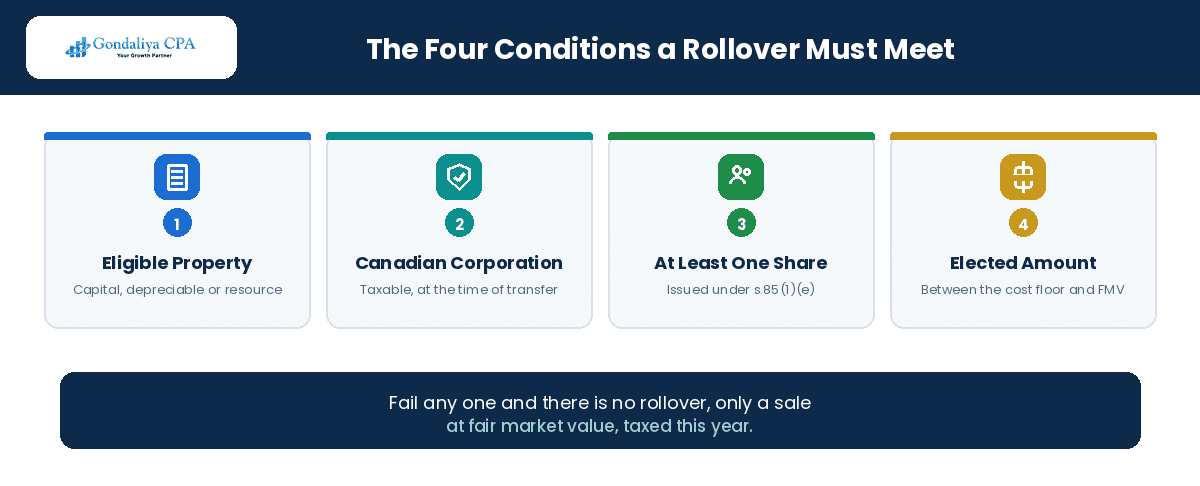
Not everyone can do a Section 85 rollover. The transferor is the person or company giving the property. That can be an individual, partnership, or corporation. The transferee must be a taxable Canadian corporation when the transfer happens. Foreign companies or exempt groups don’t qualify.
The rollover works if these happen:
- Transferor hands over eligible property.
- Transferee gives shares (and maybe other stuff) in return.
- Both file Form T2057 together before the deadline.
This setup allows tax deferred rollovers Canada-wide but sticks tightly to Income Tax Act rules.
Categories of Eligible Property under Section 85: Depreciable, Non-Depreciable, Resource Property, Inventory
You can transfer several types of business assets using Section 85, but each has special rules on how much you can elect as the transfer amount.
Depreciable Property
These are things like equipment or machines used in your business. When you transfer depreciable property under Section 85 rollover Canada rules:
- The elected amount can’t go below the Undepreciated Capital Cost (UCC) at the time of transfer.
- This UCC floor stops you from having to pay tax on depreciation recapture right away.
Say your equipment’s fair market value (FMV) is $150,000 but its UCC is $100,000. You have to choose at least $100,000 as the elected amount to avoid extra tax now.
Non-Depreciable Property
Things like land or goodwill fall here. They work differently:
- The elected amount can’t be less than their Adjusted Cost Base (ACB).
This ACB floor avoids accidental capital gains from undervaluing assets when you transfer them.
Resource Property
Resource properties include mining claims or oil rights. They’re generally treated like depreciable or non-depreciable properties depending on their classification but still count as eligible business assets.
Inventory
Inventory gets tricky:
- Usually, it’s not allowed in typical Section 85 elections since inventory is held for sale, not long-term use.
But,
- You might use a separate election under section 22 to defer income on inventory-related receivables connected to these transactions.
You have to be careful here. Mishandling inventory could cause income taxes immediately instead of letting you defer them.
| Property Type | Eligible? | Floor Rule | Common Issue | CRA Reference |
|---|---|---|---|---|
| Depreciable Assets | Yes | UCC | Risk of recapture if below UCC | ITA s.13(7), Folio S4-F3-C1 |
| Non-depreciable Capital Property | Yes | ACB | Possible capital gain if below ACB | ITA s.54(1)(a) |
| Resource Properties | Yes | Varies | Can be complex to classify | IC76‑19R |
| Inventory | No* | *Section 22 applies | Immediate income risk if mishandled | *ITA s.22 Election |
* Exceptions exist only via separate elections; direct rollover usually won’t work here.
Necessary Considerations: Shares, Non-share Consideration (“Boot”), and Impact on Elected Amounts
When you do a Section 85 transaction, the transferee corporation must issue shares as part of the deal. Every transferor gets at least one share plus any extra non-share consideration called “boot.” Boot means cash, promissory notes, or similar things given instead of shares.
Some key points:
- Elected amounts can’t drop below set floors based on asset type (UCC or ACB).
- They also can’t go higher than fair market value (FMV).
- If boot goes over the elected amount, that extra boot counts as immediate taxable gain.
Paid-up capital has to match share values and elected amounts correctly. This matters under subsection 85(2.1).
Sometimes price adjustment clauses get used in agreements. These let parties fix valuation issues later without causing CRA reassessments.
These details keep legal paperwork aligned with CRA’s view and cut down audit risks while helping businesses handle asset rollovers properly in places like Ontario or Toronto.
Restrictions and Special Rules Affecting Eligibility Including Related Anti-Avoidance Provisions
The CRA watches Section 85 elections closely and has strict rules about late filings:
- Form T2057 must be filed with your earliest return deadline; filing late means penalties that add up fast.
- You can amend elections only sometimes—and only with strong reasons that don’t hurt revenue collection.
There are anti-abuse rules too. These stop taxpayers from messing with paid-up capital balances or making boot bigger than allowed. If caught, reassessments and extra taxes can hit hard under rules like subsection 84.1 about shareholder benefits.
Keeping good records for six years after filing helps during audits. Voluntary disclosures also soften penalties if mistakes happen without intent.
Hiring professional CPA firms that know corporate reorganizations well improves control over risks. Experts help structure deals right according to current Income Tax Act rules so DIY errors don’t trip you up easily.
Inventory is the item most often assumed to roll over and most often cannot. Where receivables are involved a separate section 22 election is usually the answer, and it has its own paperwork. Figures changed for privacy.
Key Stat: The elected amount must sit between the cost floor and fair market value. Below the floor triggers recapture or gain now; above fair market value triggers gain now as well.
Mechanics and Process of Section 85 Election
Mechanics and Process of Section 85 Election
The Process
A Section 85 rollover in Canada lets business owners transfer certain property to a corporation without paying tax right away. They do this by choosing an agreed amount under the Income Tax Act. This process needs clear planning, good paperwork, and filing Form T2057 on time to meet CRA rules and get the best tax result.
Step-by-step Process to Complete a Section 85 Election in Canada
To complete a Section 85 election, the transferor (person or partnership) and the corporation work together. They follow these main steps:
- Transfer eligible property
- Issue shares as payment
- Decide on elected amounts within limits
- Prepare required papers like Form T2057
- File before deadlines
Property Transfer Process
Eligible property includes things like goodwill, business equipment, land used in business, shares of related companies, and some intangible assets. Inventory or personal-use stuff usually doesn’t qualify unless special elections apply.
The transferor legally gives these assets to the corporation at an agreed value. This “tax deferred rollover Canada” avoids immediate taxes on gains or recapture at fair market value (FMV).
Share Issuance and Consideration
The corporation issues shares back to the transferor as payment for the assets. At least one share must be issued according to subsection 85(1)(e).
Paid-Up Capital (PUC) adjustments happen here. These adjust how much capital is recorded for each share class involved in this deal. This keeps dividend treatment correct and avoids double taxation.
Determining the Agreed Amount: Floors, Ceilings, and Pricing Strategies
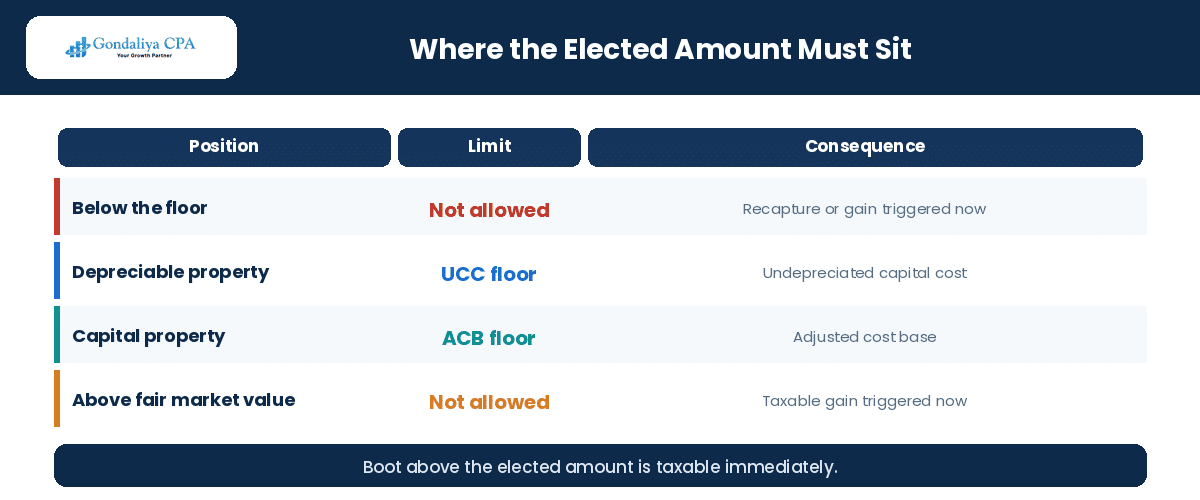
The parties pick an elected amount that decides what part of gain is taxed now versus later.
- Elected Amount Floor: For capital properties like land or goodwill, this must be at least their adjusted cost base (ACB). Going lower isn’t allowed.
- Elected Amount Ceiling: It can’t be more than FMV when transferred. More than that means taxable gain right away.
- Price Adjustment Clause Limit: Price changes after closing may happen due to disputes or conditions. These clauses must follow CRA rules strictly so election stays valid.
Choosing the right amount balances paying less tax now and keeping flexibility for valuation changes. This is key in Section 85 tax planning.
Completing and Filing Form T2057 and T2058: Requirements and Procedures
Form T2057 (“Election on Disposition of Property by a Taxpayer to a Taxable Canadian Corporation”) makes the election official under section 85(1). It must list all properties transferred with their elected amounts correctly.
Required Documentation
You need these documents to meet CRA rules:
- Asset schedules with descriptions plus ACB, UCC, FMV
- Valuation reports showing FMVs when needed
- Directors’ resolutions accepting the assets
- Share subscription agreements proving share issuance terms
These help if CRA checks your files later.
Joint Elections (Multiple Properties/Transferors)
If there are many properties from one or more transferors going into one corporation — or multiple taxpayers join — you can file one joint Form T2057 signed by everyone involved. This keeps things simpler but needs good coordination on values and allocations per asset type.
Handling Multiple Properties and Joint Elections Involving Multiple Transferors
Joint elections call for clear roles:
- Each transferor declares their eligible properties rolled over.
- The transferee corporation confirms getting them through resolutions.
Eligible categories stay similar but vary by ownership. All parties must avoid duplication while respecting floors and ceilings per asset under section 85 rules.
Deadlines for Filing Elections And Options For Late Or Amended Elections
You must file Section 85 elections by the earliest due date for either party’s tax return—usually April 30 after year-end for individuals. Missing this means no deferral; gains become taxable immediately plus possible penalties.
Penalties For Late Filings
CRA charges late filing penalties up to $8,000 max. It’s $25 per day until they accept your election or penalty hits the cap. If you disclose voluntarily before reassessment, you might reduce penalties but need professional help with CRA rules about amendments within allowed time frames.
Footnotes:
1 Income Tax Act subsection 85(1)(e); CRA ITA Folio S4-F3-C1
2 Income Tax Act sections re ACB floors; CRA Eligible Property Guidelines
3 Fair Market Value ceiling rule – ITA & Folio S4-F3-C1
4 Price Adjustment Clauses – IC76‑19R & Folio S4-F3-C1
5 Form T2057 instructions & filing deadlines — Canada.ca / CRA
6 Joint Election Rules — Income Tax Act s.85 & CRA guidance
For help with your Section 85 rollover Canada election — including valuations or corporate resolutions — contact Toronto-based Gondaliya CPA at info@gondaliyacpa.ca or call 647‑212‑9559.
Table: Key Steps in Completing a Section 85 Election
| Step | Description | Reference |
|---|---|---|
| Identify Eligible Property | Confirm which business assets qualify | ITA s.85; CRA Eligible Property |
| Agree Elected Amount | Set floor ≥ ACB/UCC ≤ FMV | ITA s.85(1); Folio S4-F3-C1 |
| Prepare Asset Schedule | List each asset with cost bases & FMVs | Form T2057 Instructions |
| Draft Corporate Resolutions | Approve acceptance & share issuance | Corporations Act/Ontario Registry |
| Issue Shares | Minimum one share issued | ITA s.85(1)(e) |
| Complete/Form File T2057 | Submit signed form before earliest return due date | Canada Revenue Agency |
Sources: Canada Revenue Agency, Income Tax Act, Folio S4-F3-C1
Callout Box Examples
Key Stat: Maximum penalty cap for late-filed section 85 elections is $8,000 according to current CRA policy.5
CRA Requirement: Both transferor(s) AND transferee corporation MUST sign Form T2057 before filing it by earliest income tax return deadline.5
Pro Tip: Include price adjustment clauses carefully drafted within purchase agreements adhering strictly to IC76‑19R guidelines.4
Risk Warning: Failure to issue minimum required shares invalidates rollover causing immediate gain recognition.1
The single share requirement sounds trivial and is the most common technical failure we see on files prepared without a lawyer. No share issued means no rollover, whatever the paperwork says. Figures changed for privacy.
Advantages and Disadvantages of Using Section 85 Rollovers
Advantages and Disadvantages of Using Section 85 Rollovers
The Trade-Offs
Main Benefits of Deferring Tax Liability During Asset Transfers to Corporations
Section 85 rollover Canada lets business owners move assets into a corporation without paying tax right away. This tax deferred rollover Canada tool helps delay capital gains or recapture until a later sale or transfer. It’s a key part of smart Section 85 tax planning.
Tax deferral mechanics
With a Section 85 rollover, the transferor—whether an individual, partnership, or corporation—chooses an “elected amount” for the property transferred. This sets the deemed proceeds of disposition and cost base for both parties. The elected amount must fall between set limits based on fair market value (FMV) and adjusted cost base (ACB). By picking the right numbers, taxpayers push off recognizing gains or losses. This creates a smooth tax-deferred transfer that keeps cash in the business while avoiding immediate tax bills.
Facilitation of business incorporation and reorganizations
Section 85 rollovers also help with complex moves like turning a sole proprietorship into a corporation or freezing estates. They support share restructurings under section 86 reorganization rules too. Instead of selling assets at FMV and triggering taxes immediately, these rollovers keep ownership interests intact with little interruption. Used alongside section 86 for share exchanges during amalgamations or wind-ups, they become essential tools for corporate reshuffles.
Potential Risks and Disadvantages Including Double Taxation and Complexity in Compliance
Section 85 rollovers offer benefits but come with risks if done wrong. Double taxation and compliance headaches can undo your plans.
Double tax risk scenarios
A big risk comes from Income Tax Act section 84.1. It targets surplus stripping when non-share consideration (“boot”) is involved. If boot goes over limits compared to paid-up capital changes under subsection 85(2.1), it triggers immediate shareholder benefits taxed as income instead of deferral. This causes double taxation on amounts you thought were sheltered by the rollover.
Compliance challenges
You must file Form T2057 by the earliest due date among all parties’ returns that year. Missing this deadline leads to penalties based on excess boot plus interest according to CRA rules1. Late elections get accepted only in limited timeframes with penalty caps but raise audit risks if mishandled.
Impact of Section 84.1 and Other Tax Provisions on Rollover Outcomes
Section 84.1 anti-surplus stripping rules mix with price adjustment clauses to complicate Section 85 election Canada results.
Price adjustment clauses let parties tweak elected amounts after closing but must follow CRA’s Folio S4-F3-C1 guidance2. Not sticking to these rules invites reassessments that undo initial deferrals, cause retroactive gains, or trigger extra taxes under rules for receivables elections or depreciable property recapture.
Knowing how these laws interact helps set elected amounts correctly within allowed ranges while handling paid-up capital effects well. This knowledge plays a big role in advanced corporate tax planning, like what Gondaliya CPA offers in Toronto Ontario.
Practical Considerations for Tax Planning and Corporate Reorganization Strategies
- Get valuation documents that back up FMV claims
- Structure share classes carefully so you get at least one share
- Coordinate other elections like GST/HST section167 where needed
- Work with lawyers to draft resolutions properly
Each client has unique needs—from medical professional corporations bound by OHIP/RCPSC to real estate holding companies needing precise land-transfer steps3.
Picking advisors who know Toronto/Ontario’s specific rules cuts errors like missed deadlines—the top cause of failed elections—and helps you make the most of deferral benefits compared to outright sales at FMV or simple incorporations without deferrals4.
If you’re thinking about using Section 85 rollover now, start early. Plan for possible boot exposure linked to Income Tax Act sections above and take steps to avoid reassessments before filing Form T2057 on time—the crucial form that makes your election valid across Canada.
[^1]: CRA Form T2057 Instructions – Filing Deadlines & Penalties.
[^2]: CRA Folio S4-F3-C1 – Price Adjustment Clauses Guidance.
[^3]: Income Tax Act Sections: s22 Receivables Election & s167 GST/HST Election.
[^4]: Gondaliya CPA Professional Corporation – Corporate Reorganizations & Expert Advisory Services Toronto Ontario
Section 84.1 is where a clean-looking rollover comes apart. Boot taken as a promissory note feels like getting your own money back, and the CRA can treat it as a dividend. Figures changed for privacy.
Risk Warning: Boot in excess of the elected amount is taxable immediately. Where the boot is a note payable to yourself, section 84.1 may recharacterise it as a deemed dividend rather than a return of capital.
Illustrative Examples and Scenario Analysis of Section 85 Rollovers in Canada
Illustrative Examples and Scenario Analysis of Section 85 Rollovers in Canada
The Examples
Example Scenarios Demonstrating Tax Consequences With and Without Section 85 Rollovers
A Section 85 rollover Canada lets business owners move assets into a corporation without paying tax right away. This tax deferred rollover Canada means you avoid triggering immediate capital gains.
If you skip this, the transfer counts as a sale at fair market value (FMV). That can mean instant capital gains triggered and taxes due.
For example, if someone moves equipment bought for $100,000 but worth $150,000 without using section 85 rollover, they face $50,000 capital gain right away. Using section 85 defers that gain. The elected amount falls between the asset’s adjusted cost base (ACB) and FMV.
This helps preserve cash flow since taxes come later. It also makes corporate reorganizations smoother while keeping asset values stable for tax purposes.
Individual Asset Transfer: Elected Amount Floor for Capital Property and Boot Limit
When transferring assets under Section 85 rollover Canada, you must follow rules on elected amounts.
- For capital property like land or shares, elected amount can’t be below its ACB.
- For depreciable assets such as machinery, it’s usually the undepreciated capital cost (UCC).
If you get extra non-share consideration (“boot”) that goes beyond the allowed limit, that excess counts as taxable income immediately.
The max boot you can accept cannot go above FMV minus the elected amount.
Here’s a simple table to understand:
| Asset Type | Cost/UCC | FMV | Elected Amount Floor | Boot Allowed Max |
|---|---|---|---|---|
| Capital Property | $80,000 | $120k* | $80,000 | Up to $40k |
| Depreciable Asset | $60,000 | $90k* | UCC = $55k | Up to $35k |
*Figures are examples only
Boot above limits causes immediate taxable income.[1]
Planning carefully helps keep transfers clean when mixing asset types or different payments.
Business Incorporation Examples: Goodwill Valuation Complexity and Paid-Up Capital Adjustment
Starting a corporation often involves moving goodwill along with physical assets using section 85 rollover Canada.
Valuing goodwill is tricky since it’s intangible. You’ll want professional help to get it right according to CRA rules.[2]
The elected amount affects the paid-up capital (PUC) credited on shares issued. Overvaluing goodwill inflates PUC wrongly. That can cause CRA reassessments or shareholder benefit problems under subsection 84(1). Undervaluing might trigger recapture or disallowed losses.
Example:
- Proprietor transfers equipment ($50K UCC), inventory ($20K cost), plus goodwill valued at FMV of $100K.
- Elected amounts fit within allowed ranges.
- Shares issued reflect total PUC equal to all elected amounts minus any boot accepted.
Working with a CPA ensures correct valuations and smooth share capitalization adjustments for ongoing tax planning.[3]
[2] IC76-19R – Intangible Assets Valuation Guidelines
[3] Income Tax Act subsection 85(2.1)
Case Studies Involving Incorporation of Businesses and Family Business Succession Planning
Family business owners often use Section 85 rollovers during estate freezes or succession plans. This defers taxes while passing ownership across generations.[4]
These deals involve complex rules about which properties qualify. Preferred shares usually represent frozen values while growth shares capture future appreciation.
For instance, we’ve helped family manufacturers in Toronto move operating assets and goodwill into new holding companies using these elections. This minimized immediate tax hits and kept future options open.
Professional CPA advice matters here due to tricky rules around:
- Receivables (section 22)
- Shareholder benefits (section 84.1)
- Price adjustment clauses[5]
- Late filing penalties[6]
- GST/HST issues[7]
- Corporate registry filings[8]
- Cross-provincial complexities common in Ontario firms
[4] Department of Justice – Income Tax Act Part XIII
[5] Folio S4-F3-C1 Price Adjustment Clauses
[6] CRA Late-filed Election Penalties Guidance
[7] GST/HST Bulletin B-067 – Related Elections
[8] Corporations Canada Registry Filing Requirements
Explanation of Price Adjustment Clauses and Their Effect on Elections
Price adjustment clauses must be part of the election if you’re unsure about some consideration amounts when filing.[9] This clause covers cases where payments depend on future events like performance targets or final inventory numbers.
CRA wants clear formulas included so adjustments after closing don’t void elections or cause surprise taxes later.[10]
Leaving out these clauses risks reassessments that could undo your tax deferral under Section 85 elections. They’re essential in negotiations with variable purchase prices typical in private incorporations or asset sales via rollovers.
[9] IT Bulletin S4-F3-C1 Paragraphs on Price Adjustments
[10] Form T2057 Instructions & CRA Compliance Notes
Clarifying Complex Situations Such As Loss Dispositions And Pre‑1972 Appreciation
Generally, Section 85 elections don’t cover loss properties unless special rules apply.[11] Transferring assets with losses needs careful review because unrealized losses might be disallowed if rolled over incorrectly.
Also, pre‑1972 appreciation carries special restrictions limiting gain deferrals for growth before that year.[12] You’ll need detailed records and expert advice about these legacy rules tucked into current laws.
You can file late elections up to twelve months after original deadlines but expect penalties calculated per transaction capped yearly by CRA.[13] Voluntary disclosures reduce risk but emphasize why timely filings matter.
Always work closely with professionals experienced in amended returns related to T2057 forms required for valid Section 85 rollovers.[14]
[11] Income Tax Act Subsection 69(12);
[12] Historical Provisions Summary – Department Of Justice;
[13] Late-filing penalty cap details – CRA Circular RC4060;
[14] Voluntary Disclosure Program Guide – Canada Revenue Agency
Key Stat: The deadline for filing Form T2057 matches earliest personal or corporate return due dates next year15 ensuring everyone stays in sync.
Pro Tip: Get qualified CPAs involved early when moving multiple assets with goodwill valuation issues plus price adjustment clauses—this avoids costly mistakes affecting paid-up capital calculations.
Our Take: Done right, Section 85 rollovers are among Canada’s best ways to handle smooth business incorporations plus estate freezes working well within federal and provincial rules like those in Ontario’s system.
¹⁵ Canada Revenue Agency – Filing Deadlines
Goodwill valuation is where incorporations go wrong quietly. An optimistic number inflates paid-up capital, and the correction years later is far more expensive than the valuation would have been. Figures changed for privacy.
Compliance, Legal References, and Further Support
Compliance, Legal References, and Further Support
The Compliance
Filing Requirements and Penalties for Late or Incorrect Elections under Section 85
To make a valid Section 85 rollover election, you must file Form T2057 with the Canada Revenue Agency (CRA) on time. The deadline is the earliest due date of either the transferor’s or transferee corporation’s income tax return for that tax year. If you miss this deadline, you have up to one year after it to file a late election.
If your election is late or changed improperly, penalties apply under subsection 285(1) of the Income Tax Act. You face a $100 fine per day, but this caps at $2,500 total. On top of that, interest applies to any unpaid taxes caused by wrong elections. The CRA might accept late or amended filings if you provide reasonable reasons, but it can also refuse.
Form T2057 needs all details reported correctly. This includes:
- Description of eligible property
- Elected amounts within allowed floors and ceilings by property type
- Shares issued as consideration
- Boot received, if any
- Price adjustment clauses where needed[^1][^2]
| Obligation | Deadline | Applies To | Consequence if Missed | Source |
|---|---|---|---|---|
| File Form T2057 | Earliest filing due date among parties | Transferor & Transferee | Election invalid; immediate gain triggered; penalties apply | CRA Guide T2057 |
| Late-Filed Election Window | Up to 1 year after original deadline | Transferor & Transferee | Possible acceptance with penalty; risk remains | Income Tax Act s.285(1) |
Overview of Related Legislative Sections and Official CRA Guidelines Relevant to Section 85
Section 85 in the Income Tax Act lets taxpayers defer capital gains when they transfer business assets into taxable Canadian corporations. You choose an elected amount between floors (usually cost or UCC) and ceilings (fair market value). This delays tax until you sell or dispose of those assets[^3].
The official CRA guide for Form T2057 shows how to fill out elections properly. It defines eligible properties like depreciable assets, goodwill, shares given as consideration, boot (non-share consideration), and paid-up capital adjustments under subsection 85(2.1). It also explains compliance rules[^4].
Other key laws linked to Section 85 include:
- Section 22: Rules when inventory gets involved in rollovers.
- Section 84.1: Deemed dividend consequences after rollovers.
- Price Adjustment Clauses: Limits on adjusting prices after filing (Folio S4-F3-C1).
These rules give legal background for asset transfers during corporate reorganizations[^5].
Guidance on Handling Deemed Dividends, Appropriations, and Price Adjustments
Sometimes deemed dividends happen if the non-share consideration (called “boot”) exceeds elected amounts during a rollover. Section 84.1 sets rules here — extra boot triggers immediate taxable benefits instead of deferral[^6]. Careful planning keeps boot within allowed limits.
Price adjustment clauses let parties adjust amounts after transfer but within strict CRA limits (Folio S4-F3-C1). They allow changes without triggering reassessments if documented properly at filing time.
Skipping proper price adjustment clauses risks audits and reassessments if fair market value changes a lot after closing. Valuation evidence then becomes critical[^7].
Additional Resources and Training Opportunities Related to Section 85 Tax Planning
If your business needs help with tricky Section 85 rollovers in Ontario—especially Toronto—or across Canada, Gondaliya CPA offers detailed services for SMBs including medical clinics, real estate investors, and tech startups.
Our team keeps up with law changes like those effective by fiscal year ending December 31st 2026 covering:
- Clarified elected amount floors and ceilings
- Improved reporting for non-share consideration
- Updated processes for late or amended elections
- Better tracking of paid-up capital
We run training sessions focused on practical ways to stay compliant with CRA rules around tax deferred rollover Canada strategies.
Contact Gondaliya CPA for Expert Assistance in Section 85 Rollover Services and Corporate Tax Planning
Handling complex rules about Section 85 rollovers needs expert knowledge gained from working with CRA across Canada from our base in Toronto.
Call Gondaliya CPA at 647‑212‑9559 or email info@gondaliyacpa.ca to book your free consult about business asset transfers using safe tax deferral methods compliant with current rules.
[^1]: CRA – Form T2057 Instructions
[^2]: Income Tax Act R.S.C.,1985,c.I‑3,s285(1)
[^3]: Department Of Justice – Income Tax Act s.85
[^4]: CRA Guide RC4060 – Completing Form T2057
[^5]: CRA Folio S4-F3-C1 – Price Adjustment Clauses
[^6]: Income Tax Act s84.1 — Deemed Dividend Provisions
[^7]: IC76–19R — Valuation Issues Relating To Rollovers
Late elections are accepted more often than people expect, but the penalty and the audit attention are both real. Filing on time costs nothing; filing late costs money and scrutiny. Figures changed for privacy.
Statutory Requirement: Every transferor and the transferee corporation must sign Form T2057 before it is filed. An unsigned or partially signed form is not a valid election.
Frequently Asked Questions (FAQs) on Section 85 Rollover and Related Tax Planning
Frequently Asked Questions (FAQs) on Section 85 Rollover and Related Tax Planning
FAQ
What is the filing deadline for Form T2057 in Ontario and Toronto?+
The deadline to file Form T2057 matches the earliest tax return due date of either the transferor or transferee. Missing this causes loss of tax deferral.
Can you file a late election for Section 85 rollover?+
Yes, you have up to one year after the original filing deadline to submit a late election, but penalties may apply.
What is the penalty cap for late or amended Section 85 elections?+
The CRA caps penalties at $8,000 for late-filed elections, charged daily until acceptance or max reached.
Is there a minimum share consideration requirement in Section 85 rollovers?+
Yes, the transferee must issue at least one share per subsection 85(1)(e) to validate the rollover election.
How does the elected amount ceiling work?+
The elected amount cannot exceed the asset’s fair market value (FMV) at the time of transfer to avoid immediate tax.
What limits exist on price adjustment clauses in elections?+
Price adjustment clauses must follow CRA guidelines strictly to avoid reassessments and maintain rollover validity.
What is the typical reassessment period for Section 85 elections?+
CRA can reassess elections up to three years after filing, with exceptions extending timelines for certain audits.
How does Section 86 reorganization relate to Section 85 rollovers?+
Section 86 allows share exchanges, often used alongside Section 85 rollovers during corporate reorganizations.
Can partnerships make a Section 85 rollover election?+
Yes, partnerships can be transferors if they meet eligibility requirements and coordinate joint elections properly.
What corporate resolutions are needed during a Section 85 rollover?+
Directors’ and shareholders’ resolutions must approve asset acceptance and share issuance according to corporate law.
Are share subscription agreements necessary?+
Yes, these agreements document terms of share issuance to ensure compliance and support paid-up capital continuity.
Is promissory note documentation relevant in these transactions?+
When boot includes promissory notes, proper documentation is essential for tax compliance and valuation clarity.
Do Articles of Amendment play a role post-rollover?+
They may be required if share structures change after asset transfers to reflect new capital structures legally.
Are GST/HST considerations important in Section 85 rollovers?+
Yes, some transferred assets might trigger GST/HST obligations that need planning alongside income tax matters.
How do land transfer taxes impact Section 85 rollovers in Ontario?+
Transfers of land into corporations may trigger land transfer taxes unless specific exemptions apply during rollovers.
Can taxpayers use the voluntary disclosure program for errors in Section 85 elections?+
Yes, this program helps reduce penalties when disclosing mistakes made without intent to evade taxes.
Is Corporations Canada registry filing required after rollovers?+
Often yes; updating corporate records after share issuances or amendments maintains legal compliance federally.
Essential Points on Compliance and Tax Planning for Section 85 Rollovers
Essential Points on Compliance and Tax Planning for Section 85 Rollovers
Quick Reference
- Always file Form T2057 before your earliest tax return due date.
- Maintain detailed records of adjusted cost base (ACB) and undepreciated capital cost (UCC).
- Calculate elected amounts within floors (ACB/UCC) and ceilings (FMV).
- Avoid boot exceeding allowed limits; excess boot triggers immediate taxable benefits.
- Use price adjustment clauses cautiously as per CRA guidance.
- Ensure at least one share is issued; track paid-up capital continuity carefully.
- Obtain directors’ resolutions and shareholders’ approvals prior to transfers.
- Prepare share subscription agreements detailing terms clearly.
- Document promissory notes properly when used as boot.
- Consider Articles of Amendment for post-transfer structural changes.
- Evaluate GST/HST impacts on asset transfers, especially intangible assets.
- Plan for land transfer tax exemptions when transferring real estate assets.
- Leverage voluntary disclosure program promptly if errors arise.
- Update Corporations Canada filings following significant changes post-rollover.
- Understand reassessment periods and prepare documentation accordingly.
- Coordinate with CPA Ontario or other professional advisors familiar with local rules.
Contact Gondaliya CPA in Toronto for expert guidance on complex Section 85 rollover planning and compliance controls tailored to your business needs.
Almost every failed election we review failed on paperwork rather than tax analysis. The numbers were defensible; the form was late, unsigned, or the share was never actually issued. Figures changed for privacy.
Industry Spotlights: Sectors We Represent
Industry Expertise
What gets rolled over differs by sector. Here are eleven and the assets that usually move.
| Industry | What Typically Gets Rolled Over |
|---|---|
| Medical doctors & physician corporations | Goodwill and equipment on incorporation |
| Dentists & dental practices | Practice goodwill, chairs and imaging equipment |
| Real estate investors & holding companies | Land and buildings, with land transfer tax planning |
| Consulting firms | Client relationships and goodwill |
| Restaurants & food and beverage | Leaseholds, kitchen equipment and goodwill |
| Construction, contractors & skilled trades | Plant, vehicles and work in progress |
| Technology startups & SaaS | Intellectual property and development assets |
| E-commerce & online retailers | Brand, domains and platform assets |
| Transportation, logistics & trucking | Fleet vehicles with undepreciated capital cost floors |
| Property developers & builders | Land inventory, where section 85 often does not apply |
| Daycare, childcare & CWELCC services | Leaseholds and equipment on incorporation |
- Medical doctors & physician professional corporations: Goodwill and equipment move on incorporation, subject to college rules on share ownership.
- Dentists & dental practices: Practice goodwill valuation is the hardest number, and it drives the paid-up capital credited.
- Real estate investors, landlords & holding companies: Land transfers into corporations need land transfer tax reviewed alongside the election.
- Consulting Firms: Goodwill is often the only asset of substance, which makes the valuation the whole transaction.
- Restaurants & food and beverage: Leasehold improvements and kitchen equipment carry undepreciated capital cost floors.
- Construction, general contractors & skilled trades: Plant and vehicles roll over; work in progress needs separate treatment.
- Technology startups & SaaS: Intellectual property developed personally before incorporation is the usual rollover asset.
- E-commerce & online retailers: Brand, domains and platform assets transfer, while stock on hand usually cannot.
- Transportation, logistics & trucking: Fleet vehicles carry recapture exposure if elected below undepreciated capital cost.
- Property developers & builders: Land held for resale is inventory, which section 85 generally does not cover.
- Daycare, childcare & CWELCC services: Leaseholds and equipment move on incorporation, alongside licensing considerations.
The assets differ but the failure points do not. Valuation, the share issuance and the filing date account for nearly every problem we are asked to fix. Figures changed for privacy.
Professional Guidance and Quick Reference
Guidance
Professional Guidance on Section 85 Rollovers: How Gondaliya CPA Supports Canadian Business Owners
A Section 85 rollover is not complicated in principle. You transfer property to a corporation, the corporation issues shares, and you elect a value between the cost floor and market value so that no gain is realised today. What makes it difficult is that a tax filing, a valuation and a set of corporate law documents all have to line up, and a failure in any one of them undoes the other two. Gondaliya CPA handles the accounting side on a fixed fee.
We handle what decides the outcome: confirming the property is eligible and the transferee is a taxable Canadian corporation, setting elected amounts between the adjusted cost base or undepreciated capital cost floor and fair market value, keeping boot inside the limit so section 84.1 does not recharacterise it, tracking paid-up capital under subsection 85(2.1), coordinating section 22 and GST/HST section 167 elections where they apply, and filing Form T2057 signed by every party before the earliest return deadline.
Our team works from your own asset schedules and valuations rather than a template, and coordinates with your lawyer on the resolutions and share subscription documents. Incorporation or estate freeze, you get clear advice and a fixed price before we start.
Quick Answers: Key Numbers & Concepts at a Glance
At a Glance
- Elected amount floor: Adjusted cost base, or undepreciated capital cost
- Elected amount ceiling: Fair market value at transfer
- Minimum consideration: At least one share, s.85(1)(e)
- Maximum boot: Fair market value less the elected amount
- Filing deadline: Earliest return due date among all parties
- Late election window: Up to one year after that date
- Stated penalty: $8,000 cap at $25 per day
- Alternative stated penalty: $2,500 cap at $100 per day
- Reassessment period: Up to three years after filing
- Record retention: Six years after filing
Who This Is For / Not For
Fit Check
- For: Sole proprietors incorporating, business owners reorganizing, and families planning estate freezes who need eligible property moved without triggering tax today.
- Not For: Transfers of personal-use property or inventory, and situations where the transferee is not a taxable Canadian corporation.
People Also Ask
Quick Answers
Does a Section 85 rollover eliminate the tax?+
No. It defers it. The gain is carried into the corporation through the elected amount and is realised when the corporation eventually disposes of the property.
Do I need a lawyer as well as a CPA?+
Yes. The election is a tax filing, but the share issuance, resolutions and subscription agreements are corporate law documents that need drafting properly.
Can I roll over my home or personal assets?+
No. Section 85 applies to eligible property, which is business or investment property. Personal-use property does not qualify.
Glossary of Key Terms
Plain-English Definitions
- Section 85 rollover: A transfer of eligible property to a corporation with tax deferred by election.
- Transferor: The individual, partnership or corporation giving up the property.
- Transferee: The taxable Canadian corporation receiving it.
- Eligible property: Capital property, depreciable property, resource property and certain intangibles.
- Elected amount: The agreed transfer value, which sets proceeds and cost base for both sides.
- Adjusted cost base: The tax cost of non-depreciable capital property, and the elected amount floor.
- Undepreciated capital cost: The remaining tax cost pool of depreciable property, and its floor.
- Fair market value: The ceiling above which an elected amount triggers immediate gain.
- Boot: Non-share consideration such as cash or a promissory note.
- Paid-up capital: The amount a corporation may return to shareholders tax free.
- Price adjustment clause: A contractual mechanism to correct valuation after closing.
- Form T2057: The election form filed jointly by transferor and transferee.
- Section 22: The separate election covering receivables on a business transfer.
- Section 84.1: The anti-surplus stripping rule that can deem boot to be a dividend.
- Section 86: The share exchange reorganization provision often used alongside section 85.
- Estate freeze: Fixing current value in preferred shares so future growth accrues to others.
Section 85 Readiness Check
This quick self-check indicates where your operation most likely has room. Please answer the six questions below.
Section 85 Readiness Check
Six quick questions on your transfer. No fee shown.
Points to raise with us:
This is a general prompt, not tax or legal advice or a quote. Your position depends on your full facts. For a real review, please book a free consultation.
Want a checklist to work from? You can download our free Section 85 rollover checklist before your consultation.
Confirm the property is eligible and the transferee is a taxable Canadian corporation before anything moves. Get valuations in writing at the time, not afterwards. Set the elected amount between the cost floor and fair market value. Issue at least one share and document it properly. Keep boot inside the limit. File Form T2057 signed by every party before the earliest return deadline, because that date cannot be recovered.
2026 Update — what is current: Reporting for non-share consideration and processes for late or amended elections are clarified for fiscal years ending in 2026, alongside better paid-up capital tracking. The elected amount floors and ceilings, the single share requirement and the six-year retention rule are unchanged. Please note this article states the late filing penalty as both $8,000 at $25 per day and $2,500 at $100 per day, so please confirm the correct figures before relying on them.
Section 85 rollover Canada: Tax deferred rollover, Section 85 election, and corporate tax planning with Gondaliya CPA
Get the election right the first time
Gondaliya CPA confirms eligibility, sets elected amounts within the floors and ceilings, keeps boot inside the limit, tracks paid-up capital, coordinates section 22 and GST/HST elections, prepares the asset schedules and valuations, and files Form T2057 signed by every party on time, on a fixed fee with a one-business-day response. Please book a free consultation.
Next Steps
Please book a free consultation with Gondaliya CPA and bring a list of the assets you want to transfer, their original cost, and your best estimate of what they are worth today. Those three tell us quickly whether a rollover is worth doing and what the election should say. You will get a fixed fee before any work begins. If our content helps, please add gondaliyacpa.ca as a preferred source on Google.
Published: August 18, 2026 · Last updated: August 18, 2026
Editorial policy: We research against CRA and CPA Ontario sources, fact-check the figures, and Sharad Gondaliya, CPA, reviews the content, which we update as the rules change.
Disclaimer: This article is educational information only and is not tax, legal, or financial advice. Figures marked illustrative are examples rather than quotes or guarantees. It reflects CRA rules current to 2026, including the elected amount floors of adjusted cost base and undepreciated capital cost, the fair market value ceiling, the single share requirement under subsection 85(1)(e), the Form T2057 filing deadline, and the six-year record retention requirement. Rates, limits and expensing rules change and outcomes depend on your specific facts. Please consult a CPA Ontario member before acting.

Sharad Gondaliya is a CPA Canada & CPA USA with 15 Years+ experience of Accounting, Tax, Payroll of Corporate Small Businesses as Tax Accountant. He is a CPA Ontario member (61040184) and holds US CPA licences in Washington and Montana and is well known among corporate small businesses for tax planning, efficient tax solutions, and affordable CPA services. Sharad is the Principal (Director) of Gondaliya CPA – Affordable CPA Firm in Canada. Licenses: CPA Ontario: 61040184 | CPA USA (MT): PAC-CPAP-LIC-033176 | CPA USA (WA): 57629 | CPA Firm License: 61330051 View Full Author Bio