



How to Use a Section 85 Rollover to Minimize Tax When Incorporating Your Existing Business in Canada
Section 85 incorporation Canada offers a practical way to incorporate sole proprietorship tax efficiently by using the Section 85 election for incorporation and T2057 forms. Gondaliya CPA guides you through transferring goodwill, equipment, and other business assets while minimizing taxes through effective incorporation tax planning and Section 85 rollovers.
Quick Summary
Incorporating triggers a deemed sale at fair market value unless you elect otherwise. The Section 85 election replaces that value with an elected amount you choose, deferring the gain into the corporation. Please note the form must be filed by the earliest return deadline of either party, and cash taken out as boot above the elected amount is taxable straight away.
| Aspect | Details |
|---|---|
| The problem | Goodwill and equipment deemed sold at market value. |
| The fix | An elected amount between cost and fair market value. |
| The limit | Boot above the elected amount is taxed now. |
| The filing | Form T2057, jointly signed, before the deadline. |
Reading time: 40 minutes.
Table of Contents
- Incorporating a Sole Proprietorship: Why Consider a Section 85 Rollover
- Eligible and Ineligible Property for Section 85 Rollovers
- Scenarios Where Section 85 Rollover Applies
- Determining the Elected Amount
- Filing Requirements and Deadlines for Section 85 Elections
- Capital Gains Exemption, Integration and Compliance Risks
- Frequently Asked Questions (FAQ) — Section 85 Incorporation Canada
- Key Points on Incorporation Tax Efficiency
- Industry Spotlights: Sectors We Represent
- Professional Guidance and Quick Reference
The Numbers That Matter
This article covers Canada, with Ontario and Toronto context, and reflects CRA rules current to 2026. It assumes a sole proprietorship or partnership incorporating and transferring business assets. Figures marked illustrative are examples, not quotes, and any masked engagement notes end with “Figures changed for privacy.” This is educational information only and not tax or legal advice. Incorporation with a rollover needs both accounting and legal input, so please engage a CPA Ontario member and a lawyer before acting.
Incorporating a Sole Proprietorship: Why Consider a Section 85 Rollover
Incorporating a Sole Proprietorship: Why Consider a Section 85 Rollover
The Basics
Thinking about incorporating your sole proprietorship? In Canada, a Section 85 rollover can help you do this with tax savings. This option lets you move your business assets into a corporation without paying taxes right away. Many entrepreneurs find this approach useful when they want to grow their business and keep more cash on hand.
Key Tax Deferral Advantage
A big reason to use Section 85 incorporation in Canada is the tax deferral. Normally, if you sell assets at their fair market value (FMV), you’d pay taxes immediately on any gain. But Section 85 tax deferral stops that. Instead, you pick an “elected amount” to replace the FMV, pushing taxes to later. This means no upfront tax hit on capital gains or recapture. It helps keep your cash flow smooth and gives you room to plan financially.
Converting Business Assets into Corporate Shares Efficiently
When you move your business assets into a corporation, doing it efficiently matters. Section 85 rollovers let you turn those assets into corporate shares without triggering tax bills right away. Here’s how it works:
- You can transfer goodwill smoothly so its value stays inside the corporation.
- The asset transfer rollover Canada process covers other assets like equipment and inventory.
- This method fits well with long-term plans because it keeps your asset values intact.
Using this strategy keeps things simple and helps your corporation start strong.
Key Features of Section 85 Elections
Knowing the key parts of Section 85 elections makes incorporation easier.
Joint Election Process Between Transferor and Transferee
Section 85 elections require both the transferor (you) and the transferee (the corporation) to file together. This joint election section 85 process means both parties agree on the elected amounts before filing Form T2057. You have to send this form by the filing deadline, which matches your income tax return due date for that year. Missing it could cause trouble with the CRA.
Flexibility in Choosing the Elected Amount
One cool thing about section 85 rollovers is how flexible you are with setting elected amounts. Under ITA s.85:
- You can choose amounts lower than FMV if you want to lower future taxable gains.
- Or pick higher amounts if it helps use losses or credits inside the new company.
This flexibility means you can adjust values to suit your tax situation and make incorporation smoother overall.
The moment that costs people money is incorporating first and asking about the election afterwards. By then the transfer has happened at market value and the conversation is about damage rather than planning. Figures changed for privacy.
Risk Warning: Goodwill is usually the largest number in an incorporation and the one owners least expect. A practice built over fifteen years can carry a six-figure deemed gain if no election is filed.
Eligible and Ineligible Property for Section 85 Rollovers
Eligible and Ineligible Property for Section 85 Rollovers
The Property
When you’re incorporating a business in Canada, knowing which assets qualify for a Section 85 rollover can save you from paying taxes right away. The Income Tax Act lets you transfer certain properties tax-deferred under Section 85 incorporation Canada rules. But not all assets make the cut.
Qualifying Property
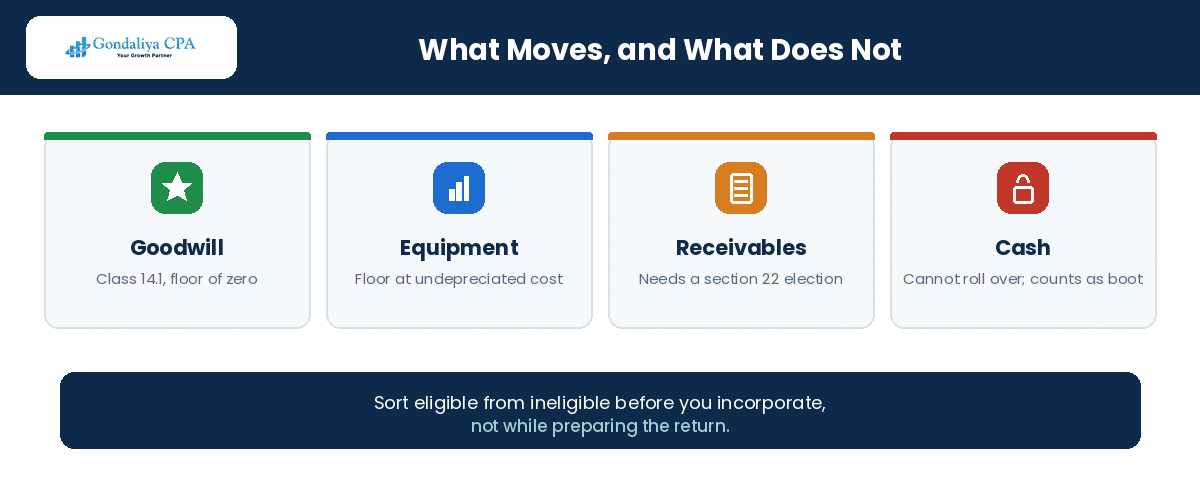
Here’s what usually qualifies for a Section 85 rollover:
- Inventory and Depreciable Capital Property
This includes stock held to sell and things like equipment, machinery, or vehicles. These are tangible assets that lose value over time. Moving them into your corporation lets you delay tax on any recaptured value or losses until later. - Non-Depreciable Capital Property
Think land (not personal-use real estate), buildings that don’t depreciate according to CRA rules, and long-term investments owned by your business when you incorporate. - Eligible Intangible Assets
Goodwill (which is Class 14.1) and things like patents or trademarks also fit here if you value them right. Using Section 85 to transfer goodwill means you don’t pay capital gains tax right away when these intangibles become corporate property.
You have to pick an elected amount on Form T2057 carefully. It must meet cost base or undepreciated capital cost (UCC) limits from CRA rules. Having proper valuation proof helps avoid trouble later.
Ineligible Property
Some property just can’t be rolled over under Section 85:
- Accounts Receivable Due To Cash Basis Accounting
Many small businesses use cash-basis accounting, which means income shows up only when money arrives. Because of this, accounts receivable often represent income already taxed at the owner level. They can’t be included directly but might get special treatment through section 22 deferrals during incorporation. - Realized Income Items
Amounts earned but unpaid before incorporation count as taxable income. These aren’t capital assets and so can’t go in the rollover. - Cash and Certain Types of Debt
Cash doesn’t appreciate and can’t defer gains in rollovers—it counts as boot or non-share consideration. Some debts passed on to the corporation must be handled with care because of boot limits in subsection 85(1)(e.2). Promissory notes paid back to shareholders might help but must follow CRA’s strict rules on non-share consideration during rollovers.
Knowing what doesn’t qualify keeps you from triggering unexpected taxes during incorporation planning. It’s smart to separate eligible assets from those that cause immediate tax hits.
1: CRA Folio S4-F3-C1 – Eligible Properties
2: Income Tax Act sections related to depreciable vs non-depreciable properties
3: ITA Class 14.1 – Goodwill definitions & treatment
4: Form T2057 Instructions – Elected Amount Rules
5: CRA Interpretation Bulletin IT-479R – Accounts Receivable Treatment
6: Subsection 85(1)(e.2) – Boot Limitations
7: IC76‑19R – Promissory Notes & Non-share Consideration Limits
Receivables catch most sole proprietors out. On a cash basis they are untaxed income rather than property, which is why the section 22 election exists and why it needs filing alongside the rollover. Figures changed for privacy.
Key Stat: Goodwill sits in Class 14.1 and is usually the largest single item in a professional or service business incorporation. It carries an elected amount floor of zero, which gives the widest planning range of any asset.
Scenarios Where Section 85 Rollover Applies
Scenarios Where Section 85 Rollover Applies
The Scenarios
Section 85 incorporation Canada lets business owners transfer assets to a corporation without paying tax right away. You can pick an elected amount to avoid immediate taxes on gains. This is handy for those wanting a tax efficient incorporation. It helps keep more cash in the business and plan for future growth.
Incorporation of a Sole Proprietorship or Partnership
Usually, when you incorporate a sole proprietorship or partnership, the assets are deemed sold at fair market value (FMV). This can cause capital gains or recapture that you must pay taxes on right away. The Section 85 rollover stops this by letting you choose an amount between the adjusted cost base (ACB) and FMV. This defers the taxes until later.
This works well for business owners seeking tax-efficient restructuring because it:
- Delays income inclusion on goodwill transfers
- Avoids recapture on equipment transfers
- Keeps cash flowing by cutting upfront tax bills
- Helps partners split elected amounts across asset types
You need to file Form T2057 on time based on deadlines linked to both parties’ filing dates. Getting good valuations is key to meeting CRA rules and avoiding audits.
Estate Freeze and Corporate Reorganization Transactions
Section 85 rollovers are often used in estate freezes and corporate reorganizations. They help lock in current values but still allow growth through new shares. This tax efficient incorporation method is very different from selling assets at FMV, which triggers immediate gains.
| Aspect | Section 85 Rollover | Sale at Fair Market Value |
|---|---|---|
| Immediate Tax Trigger | Deferred using elected amount | Capital gain taxed immediately |
| Cash Extraction | Limited boot allowed; excess taxed | Full payment received |
| Complexity | Requires detailed docs & elections | Simpler but higher taxes |
| Cost-Benefit | Higher professional fees upfront | Lower initial costs but bigger taxes |
For big assets like goodwill or equipment, Section 85 helps cut early taxes and supports long-term plans.
Good ways to set up these deals include taking full asset inventories, modelling elected amounts with UCC balances, managing boot carefully, choosing year-ends smartly, filing T2057 timely, and working with lawyers on price clauses.
Transferring Appreciated Assets
Moving appreciated assets into your corporation without planning can cause big taxable events. The Section 85 rollover lets you swap FMV proceeds for an elected amount closer to your cost base. This defers tax bills.
Which assets qualify? These include:
- Class 14.1 goodwill
- Depreciable property like machinery under UCC rules
- Inventory with section 22 election
- Receivables
- Certain real estate (not cash)
Each type has set minimums and maximums for elected amounts per CRA rules.
Picking the right elected amount means:
- Don’t go too low or you risk gains from deemed proceeds below ACB
- Going above cost can use losses or credits efficiently
- Stay under FMV limits per asset class
Making a clear table showing floors and ceilings helps during planning. Get solid valuations from appraisers when moving things like customer lists counted as goodwill.
Our actual work: We helped contractors in Toronto move $250,000 worth of equipment (UCC $180,000) plus $100,000 goodwill. We chose elections totaling $320,000 across classes. This deferred about $30,000 in capital gains with proper T2057 filing. Figures changed for privacy.
1: Canada Revenue Agency – Form T2057 Instructions
2: Income Tax Act Sections 84.1 & 69 – Department of Justice
3: CRA Folio S4-F3-C1 – Price Adjustment Clauses Guidance
4: CRA ITA Interpretation Bulletin IC76-19R – Eligible Property Definitions
5: Canada.ca – Elected Amount Floor Rules Table
For expert help with Ontario businesses moving from sole proprietorships or partnerships to corporations using Section 85 rollovers contact Gondaliya CPA free consultation: info@gondaliyacpa.ca / +1 (647)212‑9559
Partnerships are the harder case. Every partner has to agree the elected amounts and sign, and a single partner who delays can cost the whole group the deferral. Figures changed for privacy.
Pro Tip: Take a full asset inventory before you incorporate, with cost, undepreciated capital cost and an estimate of value for each item. Everything else in the election follows from that one schedule.
Determining the Elected Amount
Determining the Elected Amount
The Numbers
The elected amount in a Section 85 incorporation Canada election is the value you assign to each asset you transfer for tax purposes. It replaces the fair market value (FMV) and helps you defer tax right away. This amount has to be between certain limits set by the Income Tax Act. These limits keep things fair and compliant while letting you delay paying tax.
When you incorporate sole proprietorship tax assets into a corporation using Section 85, picking the right elected amount matters a lot. The amount can’t be lower than the asset’s adjusted cost base (ACB) or undepreciated capital cost (UCC). It also can’t be higher than its FMV at transfer time[1]. Choosing an amount near ACB or UCC lets you defer tax more but might limit future depreciation or loss claims in your corporation.
Here’s some examples:
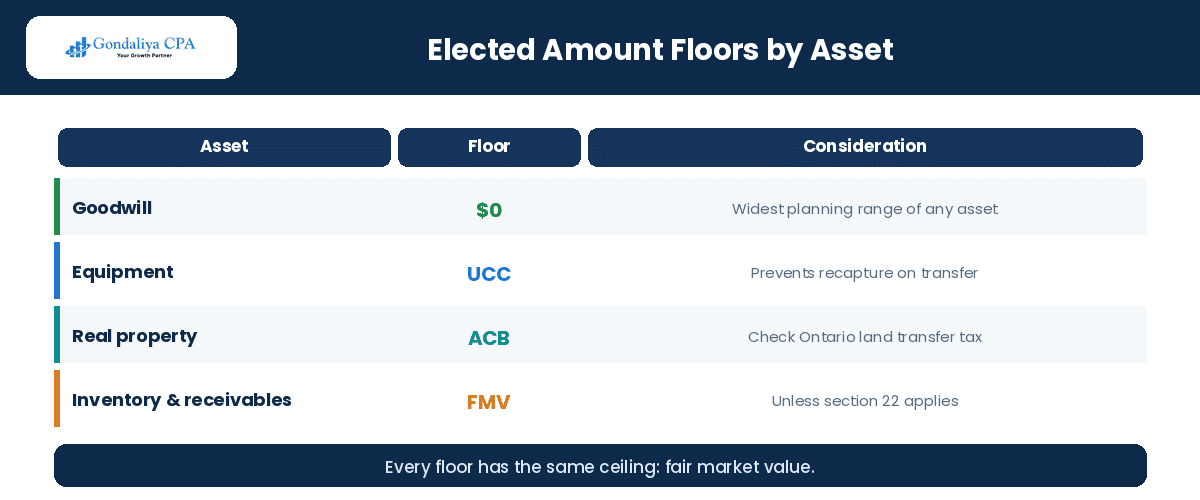
- Goodwill usually has a floor of zero for its elected amount but can’t go over FMV[2].
- Equipment’s minimum equals UCC.
- Inventory and receivables normally require election at FMV unless section 22 applies[3].
- Real property elections follow similar rules with special points under subsection 85(1)(e.2).
If you pick elected amounts above cost, you might use losses or non-capital credits inside the new corporation better while avoiding immediate taxable gains. But going too high risks CRA questioning your values and reassessing taxes if you don’t have proof.
You need to list your assets carefully, get updated valuations from appraisers when needed — especially for goodwill — and think through how deferring gains affects your taxes after incorporation. Form T2057 filing needs these figures reported accurately to back your Section 85 tax deferral claim[4].
| Asset Type | Elected Amount Floor | Maximum Allowed | Common Considerations | CRA Reference |
|---|---|---|---|---|
| Goodwill | $0 | Fair Market Value | Valuation proof required | ITA s.85(1), Class14.1 |
| Equipment | Undepreciated Capital Cost | Fair Market Value | UCC affects future depreciation | ITA s.13(7), Folio S4-F3-C1 |
| Inventory/Receivables* | Fair Market Value | Fair Market Value | Section 22 may apply | |
| Real Property | Adjusted Cost Base | Fair Market Value | Special land/building rules | ITA s.85(1)(e.2) |
*Section 22 lets you transfer some receivables/inventory without triggering income immediately.
Consideration Structure and Tax Consequences
When you transfer business assets using a Section 85 incorporation Canada rollover, the main consideration comes from shares issued by the new corporation plus any extra cash or debt called “boot.” You need to handle this carefully to avoid paying tax too soon.
If cash or debt boot goes over the elected amounts, you must recognize capital gains on the extra proceeds that don’t qualify for deferral[5]. For example, say you get $100,000 in shares matching your elected amounts but also take out $20,000 cash boot when only $10,000 was allowed on your T2057 filing. That extra $10,000 becomes taxable immediately.
Non-share consideration like promissory notes must match values shown on Form T2057 filed at incorporation[6]. If not, penalties apply — fines up to $25 per day maxing at $2,500 plus interest on unpaid taxes linked to wrong elections[7].
Form T2057 deadlines tie closely to fiscal year-ends of all parties involved in transfers during incorporation year[8]. Miss this deadline and you risk losing Section 85 rollover benefits altogether.
Comparing Section 85 rollovers versus selling assets outright at fair market value shows key differences:
| Factor | Section 85 Rollover vs Sale @ FMV |
|---|---|
| Tax Timing | Deferred gain until disposition Immediate gain recognized |
| Cash Extraction Flexibility | Limited without triggering boot Full cash extraction possible |
| Complexity & Compliance | Requires accurate filings + valuations Simpler transaction but higher upfront taxes |
| Capital Gains Exemption Interaction | Preserves exemption eligibility May reduce exemption availability |
Generally, Section 85 rollover suits those who want to incorporate efficiently with deferred gains. Selling assets at FMV suits those needing immediate cash despite upfront taxes[9].
It’s important to know how much boot you can safely take without losing deferral status when incorporating a sole proprietorship — especially if equipment or goodwill are big parts of what you’re transferring.
References
- Income Tax Act (ITA), section 85; CRA Folio S4-F3-C1.
- CRA Interpretation Bulletin IC76-19R – Goodwill.
- ITA sections 22 and 69; CRA Guide RC4060.
- Form T2057 Instructions – Canada Revenue Agency.
- ITA subsection 84(1); Folio S4-F3-C6 Boot Rules.
- Form T2057 Filing Requirements – CRA.
- Late-filed Election Penalties – CRA Policy Statement CPS-022R5.
- Fiscal Period Selection Guidance – CRA Information Circular IC75-16R6.
- CPA Canada Corporate Restructuring Guidelines.
Owners want cash out of the corporation on day one, and boot is how they try. Above the elected amount it is taxable, which usually surprises people more than the rollover itself. Figures changed for privacy.
Risk Warning: Electing at zero on goodwill maximises deferral but leaves the corporation with no cost base to amortise. The right number depends on your own tax position, not on the lowest figure available.
Filing Requirements and Deadlines for Section 85 Elections
Filing Requirements and Deadlines for Section 85 Elections
The Deadline
Section 85 incorporation Canada needs you to follow filing deadlines closely. Missing them means losing tax deferral benefits. The key form here is Form T2057. It confirms the joint election between the transferor and the transferee corporation. If you miss these deadlines, you risk penalties and losing tax-efficient incorporation advantages.
Here’s what you need to keep in mind:
- File Form T2057 on time.
- Both parties must agree on election details.
- The CRA expects strict compliance.
Form T2057 and Joint Election Process
Form T2057 gets filed by both the transferor (person or partnership) and the new corporation getting assets. This form sets the elected amounts instead of fair market value. That’s how Section 85 tax deferral works at incorporation.
You file Form T2057 by the earliest tax return deadline of either party during the transfer year:
- Corporations have six months after fiscal year-end.
- Individuals (transferors) file by April 30 after calendar-year transfers.
Both parties must agree on these points:
- What property is transferred.
- Elected amounts within legal limits.
- Payment received (shares plus any cash or boot).
Filling it out right keeps you aligned with CRA rules under subsection 85(1). Gondaliya CPA helps clients prepare valuations, coordinate share classes with lawyers, and model election amounts to get tax benefits without errors.
Penalties and Procedures for Late or Amended Elections
Late filing triggers penalties meant to push timely submissions. You pay $25 per day late, capped at $2,500 total. This applies if just one party files late because both must submit identical forms together.
Amended elections follow similar rules. They must come in before reassessment periods end—usually three years from original filing—and stick to original deadlines unless special relief applies. Delay in amending risks losing deferrals or facing immediate capital gains taxes.
The CRA might charge interest on unpaid taxes caused by missed elections. Working with pros like Gondaliya CPA can spot issues early and allow voluntary disclosures before fines get worse.
1: Canada Revenue Agency – Income Tax Folio S4-F3-C1
2: Income Tax Act subsection 221(1) & related regulations
3: CRA Guide RC4065 – Penalties Related To Late Filings
4: CRA Interpretation Bulletin IT-484R – Amendments To Elections
For questions about Section 85 incorporation filings in Toronto or Ontario, email info@gondaliyacpa.ca or call 647-212-9559 for a free chat about your Section 85 tax deferral options and avoiding costly penalties.
An individual transferring in January still files by April 30 of the following year, even where the corporation has a much later year end. The earlier of the two governs, and people routinely assume the later one does. Figures changed for privacy.
Statutory Requirement: Both parties must file identical forms. A penalty applies where either one is late, so coordinating the corporation and the individual matters as much as getting the numbers right.
Utilizing the Capital Gains Exemption and Price Adjustment Clauses
Capital Gains Exemption, Integration and Compliance Risks
The Wider Picture
The Lifetime Capital Gains Exemption (LCGE) can help reduce tax when you transfer business assets during incorporation. Using a Section 85 incorporation rollover allows sole proprietors to defer capital gains tax by electing certain amounts. This keeps the LCGE intact for future sales.
Price adjustment clauses in transfer agreements let you tweak elected amounts if asset values change after the deal. This flexibility helps meet CRA rules while optimizing tax results during incorporation.
Good planning aligns goodwill and equipment values with LCGE limits and elected amounts shown on Form T2057. This approach supports a tax efficient incorporation strategy following Canadian Income Tax Act rules.
Integration with Other Rollover Provisions
Section 85 rollovers often work alongside other Income Tax Act rules like Section 22 for inventory, Section 44 for share-for-share swaps, and Subsection 97(2) for partnership interests. Combining these lets you defer taxes on different assets moving into a corporation.
For example:
- Use Section 85 for business assets during incorporation.
- Use Section 22 to avoid income inclusion on receivables transferred.
- Use Subsection 97(2) when partnerships are involved.
Knowing how these fit together helps with smooth and tax efficient incorporation in Canada.
Section 85 vs Section 85.1
Both sections help defer taxes on transfers but differ in who they apply to. Section 85 covers transfers of eligible property from individuals to corporations at or after incorporation.
Section 85.1 applies mainly to shares received by trusts or partnerships instead of individuals directly.
Most sole proprietors benefit from using standard Section 85 elections via Form T2057. You only use Section 85.1 if trusts or partnerships own shares involved in the transfer.
Section 85 vs Section 86
Section 86 deals with reorganizing shares inside an existing corporation. It doesn’t apply when you incorporate a new company from a sole proprietorship’s assets.
Section 85 lets you move assets into a newly formed corporation without immediate tax by using elected amounts instead of fair market value. This defers capital gains tax better than selling assets before incorporating under Section 86 rules.
Use this difference to incorporate your sole proprietorship tax efficiently from the start.
Section 85 vs Subsection 97(2)
Subsection 97(2) helps when partnership interests move into corporations but usually doesn’t cover direct asset rollovers like in most incorporations from sole proprietorships.
Section 85 handles both tangible and intangible assets, like goodwill, transferring them into new corporations with deferred capital gains via elections like Form T2057 filed with CRA.
Choosing the right provision avoids unexpected taxes when partners or individuals restructure their businesses into incorporated entities across Canada, including Ontario.
Ontario Business Implications, Land Transfer Tax, and Professional Corporation Rules
In Ontario, transferring real estate during incorporation may trigger land transfer tax unless exemptions apply under provincial laws. Structuring transactions properly within tax efficient incorporation plans avoids extra costs on land along with federal income tax concerns tied to Section 85 incorporation Canada rules.
Professional corporations regulated by groups like OHIP or RCDSO face additional rules about who can hold shares and what goodwill can be transferred at setup time. These affect valuation methods used when deciding elected amounts, ensuring compliance and good fiscal results for firms such as Gondaliya CPA servicing Ontario/Toronto clients.
Common Pitfalls and Compliance Risks
People often trip up by:
- Missing Form T2057 deadlines.
- Choosing elected amounts too low, triggering reassessments.
- Taking excess boot which causes immediate taxable gain.
- Undervaluing assets leading to audit issues.
- Lacking full documentation for CRA reviews.
Accurate valuations backed by qualified appraisals lower risks. Good record-keeping covering all transaction details also helps comply with CRA rules for up to six years after filing. Getting help from experienced pros reduces mistakes that cause penalties or loss of deferral benefits under Section 85 rollovers designed for Canadian small businesses moving from sole proprietorships to corporations, including Toronto-area clients served by Gondaliya CPA.
Consequences of Taking Excess Boot
If you get more boot (non-share consideration) than agreed elected amounts, you must report immediate capital gains equal to that excess per subsection 84(3). That wipes out some or all of your tax deferral benefits and may cause unexpected cash flow problems at year-end.
Importance of Properly Valuing Transferred Assets
Getting fair market values right is key. Wrong valuations can lead to adjustments during audits, making you owe back taxes plus interest or penalties. Goodwill needs careful appraisal because it’s subjective but important for Class14.1 cost calculations used in incorporate sole proprietorship tax planning.
Required Supporting Documents
You need:
- Asset lists showing costs, UCC, FMVs, and elected values.
- Corporate resolutions approving transfers.
- Signed asset purchase agreements with price adjustment terms if any.
- Promissory notes if boot was taken.
- Professional appraisals supporting valuations.
- Timely filed Form T2057 paperwork following CRA deadlines.
Managing CRA Audit Requests and Queries
When CRA asks questions about your section 85 rollover, respond quickly and clearly with requested info on valuations and share issuances matching consideration received. Support goodwill allocations consistently across financial statements too.
Firms like Gondaliya CPA help clients handle audits smoothly without stress by providing expert advice aligned with current Canadian Revenue Agency protocols on section 85 matters throughout Toronto/Ontario regions.
Working With CRA and Professional Advisors
Work closely with CPAs who specialize in incorporate sole proprietorship tax issues plus legal advisors drafting articles or shareholder agreements. Early planning makes sure your model fits your goals — minimizing upfront taxes while supporting long-term growth through proper use of form T2057 data monitored carefully after incorporation events by Gondaliya CPA experts.
Record-Keeping Requirements
Keep organized files including:
- Copies of filed Forms T2057,
- Signed contracts covering price adjustment clauses,
- Correspondence related to voluntary disclosures,
- Bookkeeping entries showing paid-up capital changes.
These records keep you ready if CRA reviews your return anytime within six years after filing dates—strictly enforced across provinces including Ontario/Toronto areas where Gondaliya CPA serves many small-medium businesses using proper section eighty-five rollovers.
Requesting Advance Rulings When Appropriate
Sometimes it pays to ask CRA for advance rulings before filing elections—especially if goodwill classification or mixed asset bundles seem unclear or complex. Getting early clarity avoids costly mistakes later down the road.
Gondaliya CPA regularly guides clients through this process helping secure rulings aligned with up-to-date legislative changes expected around year two thousand twenty-six nationwide.
Professional Support For Planning And Compliance
Expert support covers:
- Reviewing eligible properties for election,
- Modeling outcomes comparing alternatives,
- Maximizing deferred tax benefits balanced against business realities,
- Providing clear document checklists,
- Coordinating timelines tightly to avoid delays common without specialist knowledge.
Clients working closely with licensed professionals at Gondaliya CPA get these services designed specifically for SMB incorporations using section eighty-five properly done.
Our Actual Experience: Real-World Case Study – Incorporation Rollovers Versus Selling Assets At Fair Market Value & Meeting T2057 Deadlines
We helped a medical practice owner move $450K in goodwill plus $120K cost / $150K FMV equipment using an optimized section eighty-five rollover instead of selling first—avoiding full immediate capital gains tax:
| Metric | Amount (Example) |
|---|---|
| Goodwill FMV | $450,000 |
| Equipment Cost | $120,000 |
| Equipment FMV | $150,000 |
| Total Elected Amount | $500,000 |
| Boot Taken | $100 |
| Shares Issued | Matching Paid-Up Capital |
| Deferred Gain | About $100K |
| Filing Date | Within earliest deadline |
This saved eligibility toward lifetime exemption later compared well against selling then incorporating—which would have triggered big taxes right away removing flexibility.
We made sure filings met strict deadlines impacting first-year fiscal choices affecting future reports handled professionally throughout GTA including Toronto regularly.
Numbers changed slightly here for privacy reasons.
Advance rulings are worth the cost on unusual bundles and a waste of it on straightforward ones. Goodwill in a professional practice is rarely unusual enough to need one. Figures changed for privacy.
Frequently Asked Questions (FAQ) – Section 85 Incorporation Canada with Gondaliya CPA
Frequently Asked Questions (FAQ) — Section 85 Incorporation Canada
FAQ
What is the filing deadline for Form T2057?+
Form T2057 must be filed by the earliest income tax return deadline of either the transferor or the corporation for the taxation year in which assets are transferred. Missing this can void tax deferral.
What is the maximum boot allowed before a capital gain triggers?+
The CRA limits boot to amounts agreed on Form T2057. Excess boot over elected amounts triggers immediate capital gains inclusion under subsection 84(3).
What is the minimum paid-up capital share requirement in Section 85 elections?+
The corporation must issue shares with a paid-up capital at least equal to the elected amount on each asset transferred to maintain compliance with CRA rules.
How long must records related to Section 85 elections be retained?+
Records should be kept for at least six years from the end of the tax year to comply with CRA requirements and support any audits.
What penalties apply for late-filed Section 85 elections?+
Late filings incur $25 per day penalties capped at $2,500 plus interest on any unpaid taxes linked to incorrect elections.
What is the Section 167 GST/HST election deadline during incorporation?+
Section 167 GST/HST election must be made within 30 days after acquiring eligible property to defer GST/HST payment during asset transfers.
What is the maximum length of the first fiscal period after incorporation?+
A new corporation’s first fiscal period can be up to 53 weeks long, providing flexibility in aligning year-ends.
Who should consider using Section 85 incorporation? Who should not?+
Section 85 suits owners wanting to defer taxes on asset transfers into corporations. It’s not ideal for those needing immediate cash extraction or who have minimal assets.
Key Points on Incorporation Tax Efficiency – Gondaliya CPA Insights
Key Points on Incorporation Tax Efficiency
Quick Reference
- Filing Form T2057 timely ensures tax deferral benefits during sole proprietorship incorporation.
- Keeping boot within limits avoids triggering immediate capital gains taxes.
- Issuing shares with proper paid-up capital supports legal and tax compliance.
- Maintain complete records for six years; crucial for potential CRA reviews.
- Avoid late-filing penalties by submitting joint elections promptly.
- Consider Section 167 GST/HST election deadlines to manage sales tax during transfers.
- Plan first fiscal period length strategically, up to 53 weeks, for financial alignment.
- Use professional advice from Gondaliya CPA for tailored incorporation and tax planning.
Additional Important Considerations
- Quick Comparison Table: Choose between Section 85 rollover and outright sale based on tax timing, cash needs, and complexity.
- GST/HST Impact: Proper elections can defer GST/HST liabilities tied to transferred assets at incorporation.
- Payroll & Business Numbers: Incorporation requires new payroll accounts and business numbers registered promptly with CRA.
For expert guidance tailored to your sole proprietorship incorporation and Section 85 rollovers, contact Gondaliya CPA at info@gondaliyacpa.ca or +1 (647)212‑9559. We provide comprehensive support ensuring efficient tax planning across Canada.
The section 167 window is thirty days and is missed more often than the T2057 deadline, because owners think of GST/HST as a separate matter from the incorporation. Figures changed for privacy.
Industry Spotlights: Sectors We Represent
Industry Expertise
What a sole proprietor is actually moving into the corporation differs by sector. Here are eleven.
| Industry | The Main Asset at Incorporation |
|---|---|
| Consulting firms | Goodwill and client relationships |
| Medical doctors & physician corporations | Practice goodwill, subject to college rules |
| Dentists & dental practices | Goodwill plus chairs and imaging equipment |
| Construction, contractors & skilled trades | Plant, vehicles and tools with UCC floors |
| Restaurants & food and beverage | Leaseholds, kitchen equipment and goodwill |
| E-commerce & online retailers | Brand and domains; stock needs section 22 |
| Technology startups & SaaS | Code and intellectual property built personally |
| Transportation, logistics & trucking | Fleet vehicles carrying recapture exposure |
| Real estate investors & holding companies | Property, with land transfer tax to check |
| Daycare, childcare & CWELCC services | Leaseholds, equipment and licences |
| Property developers & builders | Land held for resale is inventory, not eligible |
- Consulting Firms: Goodwill is often the only asset of real value, which makes the valuation the entire transaction.
- Medical doctors & physician professional corporations: Practice goodwill transfers, but college rules govern who may hold the shares issued for it.
- Dentists & dental practices: Goodwill and clinical equipment move together, each with a different elected amount floor.
- Construction, general contractors & skilled trades: Vehicles and tools carry undepreciated capital cost floors that prevent recapture on transfer.
- Restaurants & food and beverage: Leasehold improvements and kitchen equipment transfer; the lease itself may need landlord consent.
- E-commerce & online retailers: Brand and domains roll over, while stock on hand usually needs a section 22 election.
- Technology startups & SaaS: Code written before incorporation is personally owned property and needs transferring deliberately.
- Transportation, logistics & trucking: Fleet vehicles are the largest recapture exposure in most incorporations we handle.
- Real estate investors, landlords & holding companies: Land transfer tax has to be checked alongside the federal election.
- Daycare, childcare & CWELCC services: Leaseholds and equipment transfer, while licences usually require separate re-application.
- Property developers & builders: Land held for resale is inventory, which section 85 generally does not cover.
The assets differ but the sequence does not. Value first, elect second, issue shares third, file fourth. Getting that order wrong is what creates the problems we are asked to fix. Figures changed for privacy.
Professional Guidance and Quick Reference
Guidance
Professional Guidance on Incorporating: How Gondaliya CPA Supports Canadian Sole Proprietors
Incorporating without a Section 85 election is a sale of your business to yourself at market value. For a sole proprietor with real goodwill, that can mean a six-figure capital gain in a year where no money changed hands. The election replaces market value with an amount you choose, and the whole exercise turns on getting that number and the paperwork right. Gondaliya CPA handles the accounting side on a fixed fee.
We handle what decides the outcome: taking a full asset inventory with cost, undepreciated capital cost and value for every item, arranging goodwill valuation where it matters, setting elected amounts within the floors and ceilings for each asset class, keeping boot inside the limit so nothing is taxed on day one, coordinating the section 22 receivables and section 167 GST/HST elections, choosing the first fiscal year end, and filing Form T2057 signed by both parties before the earliest deadline.
Our team works from your own records rather than a template, and coordinates with your lawyer on the articles, resolutions and share subscription documents. Sole proprietor or partnership, you get clear advice and a fixed price before we start.
Quick Answers: Key Numbers & Concepts at a Glance
At a Glance
- Goodwill floor: $0, ceiling at fair market value
- Equipment floor: Undepreciated capital cost
- Real property floor: Adjusted cost base
- Inventory and receivables: Fair market value, unless section 22 applies
- Boot limit: Excess over the elected amount is taxable now
- Late filing penalty: $25 per day, capped at $2,500
- Amendment window: Usually three years from original filing
- GST/HST section 167: Within 30 days of acquiring the property
- First fiscal period: Up to 53 weeks
- Record retention: Six years after filing
Who This Is For / Not For
Fit Check
- For: Sole proprietors and partnerships incorporating with real goodwill, equipment or property to move, who want the transfer planned before it happens.
- Not For: Owners needing immediate cash extraction from the corporation, or businesses with minimal assets where the deemed gain would be negligible.
People Also Ask
Quick Answers
Should I incorporate first and roll over later?+
You can, but the assets transfer at market value on the day they move. The election has to cover that transfer, so plan it before rather than after.
How is goodwill valued for an incorporation?+
By a qualified appraiser looking at earnings, client base and transferability. A figure produced at the time carries far more weight than one reconstructed later.
What happens to my business number and payroll accounts?+
The corporation is a new legal entity, so it needs its own business number, payroll and GST/HST accounts registered with the CRA.
Glossary of Key Terms
Plain-English Definitions
- Section 85 rollover: A transfer of eligible property to a corporation with tax deferred by election.
- Elected amount: The value chosen in place of fair market value for tax purposes.
- Adjusted cost base: The tax cost of non-depreciable capital property.
- Undepreciated capital cost: The remaining tax cost pool of depreciable property.
- Class 14.1: The capital cost allowance class covering goodwill and similar intangibles.
- Boot: Non-share consideration such as cash or a promissory note.
- Paid-up capital: The amount a corporation may return to shareholders tax free.
- Form T2057: The election form filed jointly by transferor and transferee.
- Joint election: The requirement that both parties agree and sign the same form.
- Section 22: The separate election covering receivables on a business transfer.
- Section 167: The GST/HST election on the sale of a business as a going concern.
- Price adjustment clause: A contractual mechanism to correct valuation after closing.
- Lifetime capital gains exemption: The exemption available on qualifying small business shares.
- Recapture: Previously claimed depreciation brought back into income on disposal.
- Deemed disposition: A transfer treated as a sale at fair market value for tax purposes.
- First fiscal period: The corporation’s opening year, which may run up to 53 weeks.
Incorporation Rollover Readiness Check
This quick self-check indicates where your operation most likely has room. Please answer the six questions below.
Incorporation Rollover Readiness Check
Six quick questions on your incorporation. No fee shown.
Points to raise with us:
This is a general prompt, not tax or legal advice or a quote. Your position depends on your full facts. For a real review, please book a free consultation.
Want a checklist to work from? You can download our free Section 85 incorporation checklist before your consultation.
Take the asset inventory before you incorporate, not after. Get goodwill valued in writing by someone qualified. Set elected amounts per asset class, remembering goodwill floors at zero and equipment at undepreciated capital cost. Keep boot inside the limit if you want cash out. File the section 22 and section 167 elections alongside the T2057. File all of it by the earliest deadline of either party.
2026 Update — what is current: Legislative changes affecting elections are expected during 2026, and this article recommends confirming positions before filing. The Class 14.1 treatment of goodwill, the $25 per day penalty capped at $2,500, the 30-day section 167 window, the 53-week first fiscal period and the six-year retention rule are unchanged. Please confirm current figures with the CRA before relying on them.
Section 85 incorporation Canada: How to Incorporate Sole Proprietorship Tax Efficiently with Gondaliya CPA
Incorporate without the tax bill
Gondaliya CPA inventories your assets, arranges goodwill valuation, sets elected amounts per asset class, keeps boot inside the limit, coordinates the section 22 and section 167 elections, chooses your first fiscal year end, and files Form T2057 signed by both parties on time, on a fixed fee with a one-business-day response. Please book a free consultation.
Section 85 Rollovers Blog Title:
Next Steps
Please book a free consultation with Gondaliya CPA and bring your last two years of business figures, a list of equipment with what you paid, and a note of when you plan to incorporate. Those three tell us quickly what the goodwill is likely worth and whether the timing still works. You will get a fixed fee before any work begins. If our content helps, please add gondaliyacpa.ca as a preferred source on Google.
Published: August 19, 2026 · Last updated: August 19, 2026
Editorial policy: We research against CRA and CPA Ontario sources, fact-check the figures, and Sharad Gondaliya, CPA, reviews the content, which we update as the rules change.
Disclaimer: This article is educational information only and is not tax, legal, or financial advice. Figures marked illustrative are examples rather than quotes or guarantees. It reflects CRA rules current to 2026, including the Class 14.1 treatment of goodwill, the elected amount floors and fair market value ceilings by asset class, the $25 per day late filing penalty capped at $2,500, the 30-day section 167 GST/HST election window, and the six-year record retention requirement. Rates, limits and expensing rules change and outcomes depend on your specific facts. Please consult a CPA Ontario member before acting.

Sharad Gondaliya is a CPA Canada & CPA USA with 15 Years+ experience of Accounting, Tax, Payroll of Corporate Small Businesses as Tax Accountant. He is a CPA Ontario member (61040184) and holds US CPA licences in Washington and Montana and is well known among corporate small businesses for tax planning, efficient tax solutions, and affordable CPA services. Sharad is the Principal (Director) of Gondaliya CPA – Affordable CPA Firm in Canada. Licenses: CPA Ontario: 61040184 | CPA USA (MT): PAC-CPAP-LIC-033176 | CPA USA (WA): 57629 | CPA Firm License: 61330051 View Full Author Bio