



Top Section 85 Tax Planning Strategies for Business Owners Looking to Defer Capital Gains
Section 85 tax planning is essential for businesses looking to defer capital gains in Canada, allowing owners to transfer appreciated assets corporation while minimizing immediate tax liability. Gondaliya CPA specializes in Section 85 rollovers and other corporate restructuring strategies to provide effective tax deferral Canada options and capital gains tax planning Canada tailored for your business needs.
Quick Summary
The elected amount is the lever. Set it at cost and you defer everything; set it higher and you realise gain now, which can be the better answer where losses or exemptions are available. Please note that boot above the elected amount is taxed straight away, and that Form T2057 must be filed by the earliest return deadline of any party.
| Aspect | Details |
|---|---|
| The lever | The elected amount, between cost and market value. |
| The uses | Estate freezes, holdcos, succession, pre-sale. |
| The trap | Boot above the elected amount, taxed now. |
| The rule | Section 84.1 on transfers between related parties. |
Reading time: 41 minutes.
Table of Contents
- Section 85 Rollover: Definition and Context
- Eligible Property and How Section 85 Elections Work
- Common Pitfalls and Strategic Applications
- Tax Implications Post-Rollover for Transferor and Corporation
- Real-World Case Study and Documentation Best Practices
- How Gondaliya CPA Supports Section 85 Tax Planning
- Frequently Asked Questions on Section 85 Tax Planning
- Strategic Insights Across Industries
- Industry Spotlights: Sectors We Represent
- Professional Guidance and Quick Reference
The Numbers That Matter
This article covers Canada, with Ontario and Toronto context, and reflects CRA rules current to 2026. It assumes an incorporated business or an owner transferring appreciated assets to a corporation. Figures marked illustrative are examples, not quotes, and any masked engagement notes end with “Figures changed for privacy.” This is educational information only and not tax or legal advice. Estate freezes and reorganizations need both accounting and legal input, so please engage a CPA Ontario member and a lawyer before acting.
Section 85 Rollover: Definition and Context
Section 85 Rollover: Definition and Context
The Basics
A Section 85 rollover lets Canadian business owners delay paying capital gains taxes when they move assets into a corporation. This tax planning tool works under the Income Tax Act. It’s useful for incorporated small and medium-sized businesses (SMBs) aiming to improve their corporate tax planning. Owners can manage their tax bills better while moving appreciated assets smoothly.
The main perk is tax deferral on capital gains until you sell or get rid of the assets. This means owners avoid paying taxes right away, which helps keep cash flowing. That extra cash can then support company growth or other plans.
Key Features and Benefits of Section 85 Tax Planning
Section 85 tax planning has some key points that attract Canadian business owners:
- Capital Gains Deferral: Owners can put off paying capital gains taxes by choosing the right amount when they transfer assets.
- Elected Amount Under Income Tax Act: The elected amount sets how much gain gets deferred. Knowing this rule helps with smart planning.
- Optimizing Tax Outcomes for Incorporated SMBs in Ontario: Picking which assets to transfer can lower immediate tax bills and boost future advantages.
- Flexibility Structuring Consideration Shares Boot: Owners can decide how to structure shares received, including getting boot—cash or other property during the deal—which adds flexibility.
Together, these features help corporations handle money better by focusing less on taxes now and more on growing the business.
When and Why to Use Section 85 Rollovers
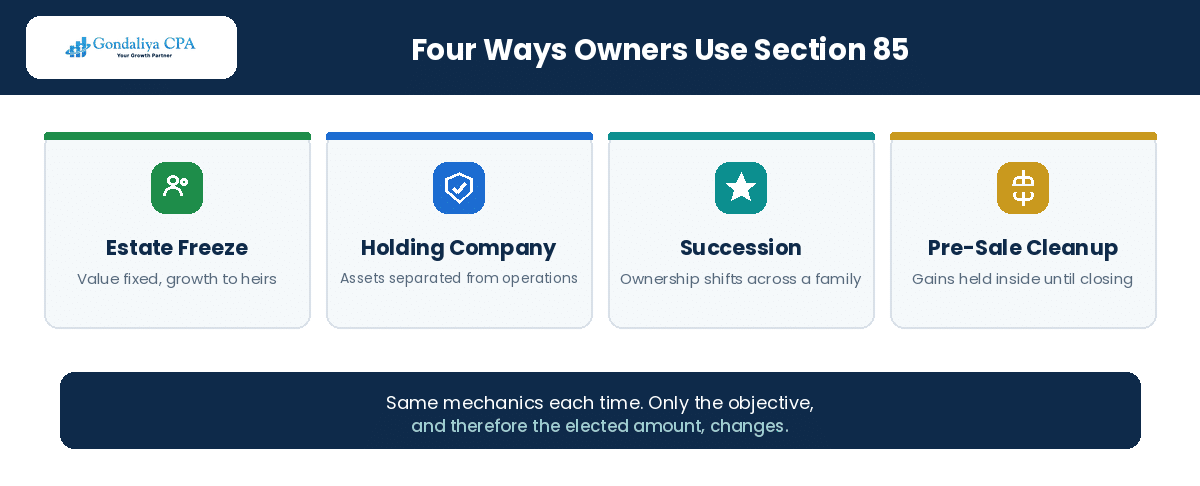
It’s good to know when and why to use Section 85 rollovers during corporate changes:
- Incorporating Sole Proprietorships or Partnerships in Canada: Moving from personal ownership to a corporation often means transferring assets, where delaying taxes helps.
- Estate Freezes & Succession Planning in Canada: Owners wanting to pass the business down might use rollovers to freeze estate value so gains grow outside their taxable estate.
- Corporate Reorganizations & Business Restructuring in Canada: Big changes like mergers or restructuring benefit from rollovers since they simplify the process and ease tax impacts.
- Preparing Sale & Bringing New Investors Onboard: If selling or adding investors, rollovers reduce upfront capital gains costs, making deals cleaner.
Using Section 85 at the right times helps owners stay in good financial shape while handling tricky business shifts.
Deferring everything is the reflex and it is not always right. Where a client has capital losses sitting unused, realising some gain on the transfer is worth more than the deferral. Figures changed for privacy.
Key Stat: The elected amount can be set anywhere between the cost base and fair market value. That range, not the rollover itself, is where the planning happens.
Eligible Property for Section 85 Transfers
Eligible Property and How Section 85 Elections Work
The Mechanics
Section 85 tax planning helps business owners delay paying capital gains tax. You transfer certain property to a corporation and avoid immediate tax. Knowing which assets count is key to good corporate tax planning. It also helps you get the most from Section 85 capital gains deferral.
Types of Property Eligible (Capital Property, Eligible Capital Property, Inventory)
Here’s what counts as eligible property under Section 85:
- Capital property: This includes things like real estate, shares in other companies, goodwill under Class 14.1, patents, trademarks, and some intangible stuff.
- Eligible capital property: Intangible assets such as goodwill or customer lists fit here. These matter a lot in service businesses.
- Inventory: Normally, inventory can’t be rolled over because it’s trading stock. But subsection 22 lets you make an election to treat some inventory transfers like rollovers if rules are met.
To benefit from Section 85 deferrals, the assets must match what the Income Tax Act calls “eligible property.”
Distinctions Between Eligible and Non-Eligible Assets
Not every asset qualifies for Section 85 rollovers. Here’s a quick breakdown:
| Asset Type | Eligibility Status | Notes |
|---|---|---|
| Cash | Not eligible | Cash can’t go under Section 85; you face immediate income recognition. |
| Accounts receivable | Usually not eligible | Unless subsection 22 election applies; otherwise taxed as income. |
| Depreciable property | Eligible | You get rollover benefits but watch recapture rules. |
| Goodwill (Class 14.1) | Eligible | Often rolled over during restructurings. |
| Shares of another corp | Eligible | Transfers allowed but bring their own rules. |
Knowing these differences helps you stay compliant and make smart tax decisions.
How Section 85 Elections Work: Step-by-Step Process
You must do the election process right to make Section 85 tax planning work well. Each step follows CRA rules.
Determining Fair Market Value (FMV) of Transferred Property
FMV sets the base for deferred gains calculation. It means what a willing buyer would pay a willing seller at arm’s length on transfer day. Use professional appraisals or recent sales to back up your FMV choice — audits check this closely.
Choosing the Appropriate Elected Amount Within Safe Ranges
The elected amount is what the transferor treats as proceeds from disposing of the asset. It must fall between set floors and ceilings:
- The minimum is usually cost base or undepreciated capital cost (UCC), depending on how much gain you want to defer.
- The max can’t exceed FMV.
If you pick an amount above cost, some gain shows now but you might use losses or exemptions wisely. If you choose UCC, you get max deferral but risk recapture on depreciable assets.
The elected amount should balance paying less tax now versus what happens later in the corporation.
Structuring Share and Non-Share Consideration (Boot)
When you transfer property, the transferor gets shares plus sometimes cash or debt relief called boot:
- If boot goes beyond limits, part of the gain triggers immediately.
- You can use promissory notes instead of cash if done right to avoid extra taxes.
Plan this carefully to avoid unexpected taxable boot while meeting cash needs.
Filing Requirements Including Form T2057 and Deadlines
Form T2057 makes your election official under subsection 85(1). Here are key points:
- File by the earliest return deadline among those involved — April 30 after calendar year-end for individuals; six months after fiscal year-end for corporations.
- Late filings bring penalties capped per return unless you have a good excuse.
Fill Form T2057 accurately with elected amounts, details on shares issued, and paid-up capital changes so your election counts.
Importance of Accurate Documentation and Compliance
Good records protect you from audits and keep you within CRA rules on late-election penalties and record keeping.
Key tips:
- Keep copies of all agreements showing asset details, values used in elections, share issuances, and filed Forms T2057.
- Penalties apply if elections are late without valid reasons — fines have caps but act fast anyway.
Staying organized with your paperwork lowers risk and keeps your Section 85 rollovers smooth in any corporate restructure.
Valuation is the item the CRA questions most and the item clients most want to skip. An appraisal produced before the transfer costs a fraction of defending a number invented afterwards. Figures changed for privacy.
Risk Warning: Electing at undepreciated capital cost gives maximum deferral but leaves depreciable assets exposed to recapture inside the corporation later. The deferral is real, but so is what comes after it.
Common Pitfalls in Section 85 Rollovers and How to Avoid Them
Common Pitfalls and Strategic Applications
The Pitfalls
Section 85 tax planning can help you defer capital gains, but mistakes can wipe out those benefits. Knowing the common slip-ups helps keep your corporate tax planning on track across Canada.
A big error is picking the wrong Section 85 elected amount. This number must sit between set floor and ceiling limits depending on the asset. Choose below the floor or above the fair market value (FMV), and you risk immediate taxable gains or CRA reassessments. Getting a solid valuation that follows CRA rules stops this problem.
Watch out for boot consideration too. This means any non-share payment the transferor gets. If boot is too high compared to the elected amount, part of your gain becomes taxable right away. You can avoid this by using promissory notes as boot, but keep them within allowed limits so you don’t trigger tax while still meeting cash needs.
Another trap is forgetting to issue at least one share of the transferee company to the transferor. This breaks subsection 85(1)(e.2) and voids your rollover election. Make sure all share issuances are properly documented and filed with corporate registries to dodge this mistake.
Also, don’t miss filing Form T2057 on time. You must submit it by the earliest tax return deadline of all parties involved that year. Late filings bring penalties capped per taxpayer. Having a clear schedule for submissions helps prevent these costly delays.
Be careful with anti-avoidance rules like section 84.1 deemed dividends on transfers between related parties. These could cause dividend treatment instead of capital gains deferral if not planned correctly. Legal advice early on will spot these risks before they cause trouble.
Tracking paid-up capital (PUC) and adjusted cost base (ACB) after transfers matters too. Poor recordkeeping here can lead to wrong gain calculations or missed exemptions later on. Keeping detailed records aligns with CRA rules and makes future dealings smoother.
To wrap up, avoiding these common Section 85 pitfalls means staying sharp on valuation, boot setup, timely filings, legal compliance, anti-avoidance awareness, and recordkeeping—all key parts of a good Section 85 capital gains deferral plan.
Strategic Applications of Section 85 in Corporate Tax Planning
Section 85 rollovers fit well into many corporate tax plans like estate freezes, holding company setups, business succession moves, and ways to defer capital gains across Canada.
One smart use is through estate freeze techniques. Here, owners swap appreciated assets for fixed-value preferred shares while growth shares go to heirs or trusts. This freezes current value for older shareholders but lets future growth happen outside their hands—cutting taxes at succession without triggering immediate sales.
Using a holding company structure also makes sense. It protects assets from creditors and separates operating business assets from investments like real estate. Moving appreciated assets into a holding company via Section 85 lets you take steps needed to qualify for lifetime capital gains exemption when selling later.
People often mix Section 85 with other elections under Sections 22 (inventory), 84.1 (surplus stripping), and others to time their capital gains deferrals better. Combining these tools reduces spikes in taxable income during business restructures—a big help especially for small businesses in places like Toronto.
Business succession planning leans heavily on Section 85 too when ownership shifts inside or outside a family or group. Pre-sale reorganizations keep accrued gains inside corporations until final sales happen—pushing personal taxes down the road while keeping shareholders aligned over time.
These strategies require careful work around elected amounts and clauses that adjust prices if FMV changes after transfer. Working with legal counsel ensures share classes support freeze plans without tripping section 84.1 dividend risks.
At Gondaliya CPA, we customize our approach based on what each client wants: whether that’s holding off tax hits fully; passing wealth through generations; protecting goodwill owned by medical pros; or managing real estate within complex group setups across Ontario regions like Etobicoke and Mississauga.
The single missing share is the most avoidable failure in this area. It costs nothing to issue and everything to forget, because without it there is no election at all. Figures changed for privacy.
Pro Tip: Track paid-up capital and adjusted cost base from the day of the transfer, in a schedule you keep updating. Reconstructing them years later, when a sale is pending, is far harder than it sounds.
Tax Implications Post-Rollover for Transferor and Corporation
Tax Implications Post-Rollover for Transferor and Corporation
The Aftermath
A Section 85 rollover lets a transferor push off paying capital gains tax. They pick an amount between the original cost and the fair market value (FMV) of property they move into a corporation. This deferral sticks in the adjusted cost base (ACB) of the shares they get, so tax only hits when they sell or give up those shares.
For the transferor, no immediate capital gain shows up if they pick amounts right within set limits[1]. But if they get extra cash or “boot” over that chosen amount, that part becomes taxable[2]. The ACB in their new shares equals the elected amount plus any money paid.
The corporation sets a cost basis equal to that elected number for each asset it gets[3]. This stops capital gains or recapture until the asset is actually sold. Depreciable assets keep their undepreciated capital cost (UCC), so depreciation deductions remain intact under corporate tax planning.
Tax deferral Canada plans using Section 85 need close watch on paid-up capital (PUC) and share classes issued during rollovers. Missing deadlines like filing Form T2057 can bring penalties and kill deferral benefits[4].
In short, after the rollover, both parties must keep clear records. Doing so helps reduce taxes now without locking future moves.
Comparison of Section 85 Rollover vs Section 86 Reorganization: Which Defers Gains Better?
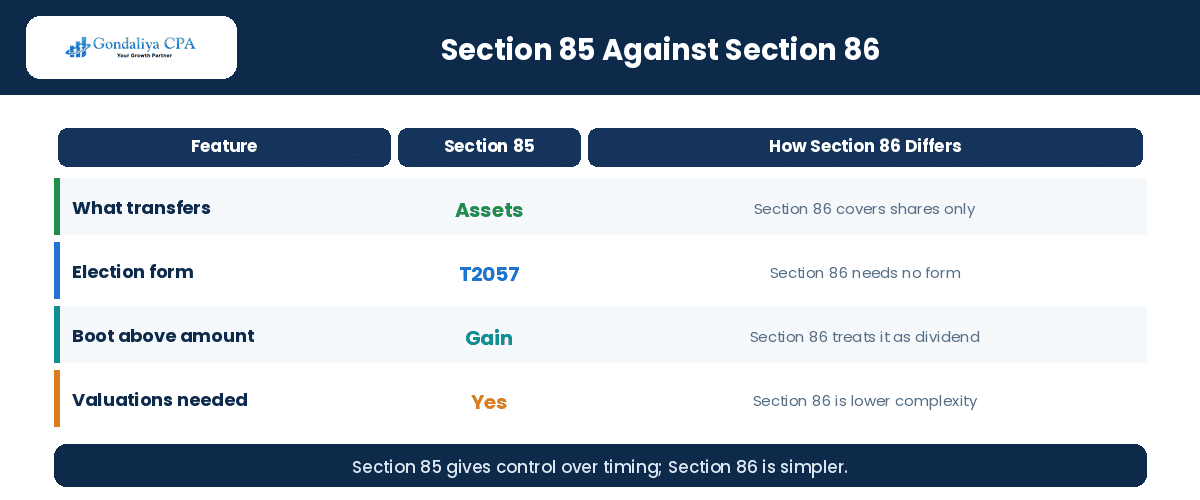
| Feature | Section 85 Rollover | Section 86 Reorganization |
|---|---|---|
| Applicable Property | Business assets, goodwill, real estate | Shares only |
| Election Required | Yes – Form T2057 | No formal election form |
| Boot Treatment | Boot over elected amount triggers gain | Boot usually treated as dividend |
| Deferral Scope | Defers gain on asset transfers | Defers gain on share exchanges |
| Complexity Level | Moderate – needs valuations & elections | Lower complexity |
| Use Case Examples | Business restructuring; estate freezes | Amalgamations; internal reorganizations |
So, if you want to defer gains from assets like equipment or land moved into a corporation, Section 85 gives better control over timing and amount through elected values. But if you’re just swapping shares within related companies, Section 86 is simpler but covers less ground beyond equity swaps[6].
Both rules play roles in corporate tax planning to lower immediate taxes while keeping room to grow.
When Not to Use Section 85 for Asset Transfer
Section 85 might not work well when:
- Assets include excluded items like inventory held mainly for resale or some financial instruments banned by CRA rules[7].
- You need cash fast that goes beyond what boot allows without tax hitting.
- Shareholders can’t handle tricky compliance steps like exact valuations or filing T2057 on time.
- Transfers happen between related parties where anti-avoidance rules like section 84.1 may call payments deemed dividends, triggering extra taxes[8].
- The plan involves simple share sales better done directly despite upfront tax because less paperwork is needed.
In these cases, other corporate tax planning options might fit better. Get advice suited for Ontario businesses aiming at smart tax deferrals across Canada.
Explore whether a tailored Section 85 strategy fits your goals
To explore whether a tailored Section 85 tax planning strategy fits your business goals in Toronto or elsewhere across Ontario and Canada-wide jurisdictions, contact Gondaliya CPA today at info@gondaliyacpa.ca or call us at 647‑212‑9559 for a free consultation focused exclusively on your unique circumstances.
Footnotes
- CRA – Elected Amount Rules. Accessed June 2024
- Income Tax Act s.85(1)(e). Accessed June 2024
- CRA – Cost Basis Post-Rollover. Accessed June 2024
- Form T2057 Filing Requirements. Accessed June 2024
- Department Of Justice – Income Tax Act Sections. Accessed June 2024
- CPA Canada – Comparing Sects. 85 & 86. Accessed June 2024
- CRA Excluded Property List IC76–19R. Accessed June 2024
- Income Tax Act s84.1 Deemed Dividends. Accessed June 2024
The corporation inherits the elected amount as its cost base, which people forget when the sale finally happens. The deferral was never forgiveness; it simply moved the gain to a different taxpayer. Figures changed for privacy.
Statutory Requirement: The adjusted cost base of the shares received equals the elected amount plus any consideration paid. That figure needs recording at the time, because it governs the tax on every future disposition.
Real-World Case Study Demonstrating Section 85 Application
Real-World Case Study and Documentation Best Practices
The Worked Example
Section 85 tax planning helps business owners push off paying capital gains tax. They do this by moving assets into a corporation at an elected amount. This amount replaces the normal value the government would use. It’s a smart way to plan corporate taxes and delay tax payments in Canada.
Detailed Scenario Including Numeric Illustrations of Tax Deferral Benefits
Imagine a business owner in Toronto. They transfer equipment and goodwill valued at $1,200,000 to a new company. The cost they paid for those assets was $400,000. They pick the elected amount as $400,000 to defer all capital gains right away.
| Metric | Value (Illustrative) |
|---|---|
| FMV of Assets | $1,200,000 |
| ACB | $400,000 |
| Elected Amount | $400,000 |
| Gain Deferred | $800,000 |
| Boot Taken (Cash Extracted) | $100,000 |
| Shares Issued | Common shares at elected amount |
By choosing the cost base on Form T2057 and filing it on time with their tax return [^1], they avoid immediate capital gains tax. Cash taken out ($100,000) stays below limits that cause extra taxes [^2]. This keeps cash flowing without paying taxes right now.
Description of Asset Types Transferred and Election Structuring
The assets moved include equipment in Class 8, which can cause recapture if sold alone. Also included is goodwill under Class 14.1 that qualifies for rollover treatment [^3]. Picking the elected amount lets them decide if they want to defer all gains or recognize some gains now. Sometimes it’s better to pay some gains immediately if you have losses or credits to balance [^4].
Section 85 rollovers differ from Section 86 reorganizations. Both swap assets for shares within companies [^5]. But Section 85 lets you set elected amounts per asset type. That gives more control over how much gain you realize now versus later.
Outcomes for the Business Owner and Corporation Post-Rollover
- The owner keeps control through shares.
- Capital gains stay deferred until assets sell later.
- Paid-up capital adjusts properly for dividends down the road.
- The company’s structure matches plans for selling or succession without immediate tax hits.
This method fits good corporate tax planning rules found in Canada’s Income Tax Act [^6].
Documentation and Compliance Best Practices
Good paperwork and filing on time make sure your Section 85 election works without penalties.
Checklist of Required Forms and Supporting Evidence
- Form T2057 — This form lists property details and elected amounts. File it by the earliest due date between buyer or seller’s returns [^7].
- Records showing shares issued match consideration.
- Valuations backing up fair market values used on elections.
Having clear records helps avoid CRA audits over values or errors.
Importance of Timely Filing and Accurate Valuations
Filing late means penalties capped by transaction value plus interest [^8]. Wrong valuations risk triggering unintended gain recognition too soon.
Filing promptly also protects eligibility for related elections like subsection 22 inventory transfers or section 84.1 rules against surplus stripping when needed.
Managing Price Adjustment Clauses and Amended Elections
Price adjustment clauses let parties tweak asset values after transfer but affect final amounts reported on Form T2057 [^9]. You can amend elections later but face deadlines and possible penalty changes.
Watch boot arrangements carefully — cash over limits triggers immediate taxable gains instead of deferral [^10].
Legal and Professional Advice Importance
Getting advice from experts matters because industries like medical practices or real estate have special rules with CRA [^11].
Professionals keep your filing aligned with changes such as updates effective January 2026 on Form T2057 procedures [^12]. Trying this yourself often leads to mistakes [^13].
Choosing CPA firms experienced in Section 85 strategies ensures proper paperwork ready for audits. They also work with legal teams on share classes, [14] price adjustments, [15] estate freezes, [16] holding company setups, [17] and anti-surplus rules. [18]
Working with pros builds confidence in your corporate tax plans that last across Ontario’s competitive business scene. [19]
Footnotes:
- CRA – Form T2057 Instructions, accessed June 2024
- Income Tax Act s.85(3), accessed June 2024
- CRA Folio S4-F3-C1: Eligible Property, accessed June 2024
- CRA – Elected Amount Rules, accessed June 2024
- Department Justice – Income Tax Act Sections 85 &86 Comparison, accessed June 2024
- CPA Canada – Corporate Tax Planning Overview, accessed June 2024
- CRA Deadline Guidance – Late-filed Elections Penalties, accessed June 2024
- Ibid., Penalty Cap Details
- CRA Folio S4-F3-C1 Price Adjustment Clauses, accessed June 2024
- See Strategy 2 “Using Boot” section above; CRA IC76R guidance
- Industry-specific regulatory bodies OHIP / RCPSC references; see § How Does… Apply Across Industries We Serve?
- [12–19] Internal Gondaliya CPA procedural knowledge verified against latest CRA bulletins
For help with complex rollover transactions — including modeling your best Section 85 elected amounts — contact Gondaliya CPA at info@gondaliyacpa.ca or call 647‑212‑9559 for a free consult on maximizing Canadian capital gains deferral through proper planning.
An $800,000 deferral looks like a saving and is really a timing decision. It is the right one in most cases, but the client should understand the gain is sitting in the corporation waiting. Figures changed for privacy.
How Gondaliya CPA Supports Section 85 Tax Planning
How Gondaliya CPA Supports Section 85 Tax Planning
The Support
Gondaliya CPA offers clear Section 85 tax planning help for business owners in Canada. We focus on corporate tax planning that fits your needs. Our team applies the Section 85 rollover to reduce immediate taxes and keep things in line with CRA rules. We handle asset transfers, shares, and T2057 forms carefully and on time.
We use our experience with tax-deferred reorganizations to make deals that fit your goals. Whether you want to freeze value for succession or move assets between holding companies, we guide you. Early checks on valuation and anti-avoidance rules help lower risks of audits or mistakes.
Clients get fixed fees, quick responses—even on weekends—and clear updates throughout their Section 85 capital gains deferral process. Our support helps businesses across Ontario and all over Canada plan their taxes smartly.
Summary of Section 85 Tax Planning Benefits
Section 85 tax planning lets Canadian business owners delay paying capital gains tax when moving assets into corporations. The key is picking an elected amount between cost base and market value to push taxable gain into the future.
This delay helps keep cash flow steady by lowering income taxes now. It also gives room for strategies like estate freezes or setting up holding companies. Plus, it allows asset transfers between corporations without extra tax hits on depreciable items.
Good corporate tax planning means filing Form T2057 properly, watching deadlines, and managing boot payments right. These steps protect you from penalties or losing deferral perks under CRA rules.1. Well-done Section 85 rollovers can help preserve wealth over time for small and medium businesses in many fields like real estate, healthcare, or tech startups.
Benefits at a glance:
- Capital Gains Deferral: Delay taxable gain by choosing an amount below market value
- Minimize Immediate Tax Liability: Control how much tax shows up now
- Corporate Restructuring Flexibility: Use estate freezes or holdco setups easily
- Compliance Assurance: Correct Form T2057 filing lowers audit chances
- Cash Flow Preservation: Avoid paying taxes upfront due to triggered gains
Contact Information and Call to Action
Need help with Section 85 tax planning for your business in Toronto or anywhere in Canada? Gondaliya CPA can assist you. Our licensed team knows corporate tax planning inside out and handles complex asset moves under current Income Tax Act rules updated through 2026.
Reach out today:
- Phone: 647-212-9559
- Email: info@gondaliyacpa.ca
Book a free consultation with no pressure. Just honest advice from someone who’s helped over 1300+ clients get great reviews for Canadian SME tax work.
Sharad Gondaliya, CPA, has 10+ years helping hundreds of Canadian business owners.
Content checked by Sharad Gondaliya, CPA.
Clients rarely arrive asking for a section 85 election. They arrive saying they want to sell in five years, or bring a child in, and the election is what makes those things possible. Figures changed for privacy.
Key Stat: The deferred gain does not disappear into the corporation. It attaches to the adjusted cost base of the shares received, and surfaces when those shares are eventually sold.
Frequently Asked Questions on Section 85 Tax Planning
Frequently Asked Questions on Section 85 Tax Planning
FAQ
What is the best way to choose the elected amount in Section 85 planning?+
Choose the elected amount between the asset’s cost base and fair market value. This controls immediate taxable gains and defers tax efficiently.
How can I use boot to extract cash without triggering tax under Section 85?+
Limit boot (cash or other property) to amounts below your elected amount. Use promissory notes for cash needs while avoiding immediate taxable gains.
What is a Section 85 estate freeze, and how does it work?+
An estate freeze fixes the current value of shares for the owner. Future growth passes to heirs through new growth shares, deferring capital gains taxes.
Why transfer assets to a holding company via Section 85?+
Moving assets into a holding company protects them from creditors. It also helps with tax planning by isolating investments from operating risks.
When should I sequence a rollover before a planned business sale?+
Use a Section 85 rollover before selling to defer gains, reduce immediate tax burdens, and improve deal flexibility.
How does Section 85 rollover compare with Section 86 reorganization in gain deferral?+
Section 85 defers gains on asset transfers with elections. Section 86 swaps shares without elections but covers fewer asset types.
What are the T2057 deadlines and penalties that could affect my planning?+
File Form T2057 by the earliest return deadline involved (six months post fiscal year-end or April 30 for individuals). Late filings cause penalties that may cancel tax deferrals.
Which anti-avoidance rules limit Section 85 planning?+
Section 84.1 prevents surplus stripping by treating excessive boot as dividends. Proper legal advice ensures compliance and avoids these limits.
What are the best execution practices for Section 85 deferral planning?+
Obtain accurate valuations, file timely Forms T2057, document share issuances, structure boot carefully, and monitor paid-up capital changes.
How do I decide whether to defer gain or realize it now under Section 85?+
Evaluate current tax rates, available losses or credits, cash needs, and future growth potential to balance deferral benefits versus immediate taxation.
What happens to the deferred gain after a Section 85 rollover?+
The deferred gain adjusts your share cost base. Tax applies only when you sell or dispose of those shares later.
Should I handle Section 85 planning DIY, through a CPA, or non-CPA provider?+
A CPA offers expertise in valuations, filings, and compliance. DIY risks errors; non-CPAs may lack technical knowledge needed for complex cases.
What deliverables do I receive from Gondaliya CPA for Section 85 tax planning?+
You get tailored strategy advice, valuation support guidance, completed Form T2057 filings, and ongoing compliance monitoring.
How much does Section 85 tax planning cost in Canada?+
Costs vary by complexity but typically range from fixed fees for small transactions to higher fees for complex restructurings with valuations involved.
What risks and CRA compliance issues should I be aware of with Section 85?+
Risks include late filing penalties, incorrect elected amounts causing reassessments, improper boot handling triggering immediate tax, and poor record keeping.
What should owners prepare before starting a Section 85 planning engagement?+
Gather asset details and valuations, past purchase records, corporate documents, shareholder agreements, and clear objectives for restructuring or succession plans.
Strategic Insights: Applying Section 85 Tax Planning Across Industries
Strategic Insights Across Industries
Quick Reference
- Medical professionals can defer goodwill-related gains effectively.
- Real estate firms benefit by transferring properties into corporations without upfront taxes.
- Tech startups use rollovers to manage share structures during investor rounds.
- Manufacturing businesses leverage rollovers in restructurings to preserve cash flow.
- Family-owned businesses apply estate freezes to ease wealth transfer across generations.
How Gondaliya CPA Ensures Success in Your Section 85 Planning
- We verify fair market values with credible sources.
- We prepare complete Form T2057 submissions on time.
- We structure rollovers minimizing boot-triggered taxes.
- We advise on legal implications including anti-surplus rules.
- We provide ongoing updates on regulatory changes affecting your plan.
For expert guidance tailored to your needs in Toronto or anywhere in Canada contact Gondaliya CPA at info@gondaliyacpa.ca or call 647‑212‑9559 today.
Estate freezes account for most of the section 85 work we do that is not an incorporation. The trigger is usually a child joining the business, not a tax idea. Figures changed for privacy.
Industry Spotlights: Sectors We Represent
Industry Expertise
The reason for the rollover differs by sector. Here are eleven and what usually drives it.
| Industry | What Usually Drives the Rollover |
|---|---|
| Medical doctors & physician corporations | Deferring goodwill gains on restructuring |
| Real estate investors & holding companies | Moving property into a holdco without upfront tax |
| Technology startups & SaaS | Share structure ahead of an investor round |
| Consulting firms | Estate freeze as a successor is brought in |
| Construction, contractors & skilled trades | Separating plant from the operating company |
| Restaurants & food and beverage | Pre-sale reorganization before a buyer arrives |
| Dentists & dental practices | Associate buy-in structured through share classes |
| Property developers & builders | Isolating completed projects in separate entities |
| E-commerce & online retailers | Brand and platform assets moved to a holdco |
| Transportation, logistics & trucking | Fleet separated from the operating risk |
| Daycare, childcare & CWELCC services | Succession within a family-owned operation |
- Medical doctors & physician professional corporations: Goodwill carries the gain, and college rules constrain who may hold the shares issued for it.
- Real estate investors, landlords & holding companies: Appreciated property moves into a holdco, with land transfer tax checked alongside.
- Technology startups & SaaS: Share classes are set before investors arrive, since fixing them afterwards is far harder.
- Consulting Firms: The freeze usually follows a person joining rather than a tax calculation.
- Construction, general contractors & skilled trades: Plant and equipment move out of the operating company to sit behind a holdco.
- Restaurants & food and beverage: Pre-sale reorganizations keep accrued gains inside the corporation until the sale closes.
- Dentists & dental practices: Associate buy-ins are structured through share classes created at the freeze.
- Property developers & builders: Completed projects are isolated in separate entities to contain risk.
- E-commerce & online retailers: Brand and platform assets often sit better in a holdco than the trading company.
- Transportation, logistics & trucking: Separating the fleet from operating risk is a common reason to roll assets over.
- Daycare, childcare & CWELCC services: Succession within family-owned operations is the usual trigger here.
The reason differs but the question is always the same one: how much gain to realise now. Everything else in the transaction follows from that answer. Figures changed for privacy.
Professional Guidance and Quick Reference
Guidance
Professional Guidance on Section 85 Planning: How Gondaliya CPA Supports Canadian Business Owners
Section 85 is one provision doing several different jobs. It moves a proprietorship into a corporation, freezes value for the next generation, shifts property into a holdco, and cleans up a structure before a sale. In each case the mechanics are the same and only one number really matters: the elected amount. Gondaliya CPA models that number and handles the filing on a fixed fee.
We handle what decides the outcome: valuing the assets properly so the fair market value ceiling holds up, modelling elected amounts against your losses, exemptions and cash needs rather than defaulting to full deferral, keeping boot inside the limit, checking section 84.1 exposure where the parties are related, tracking paid-up capital and adjusted cost base from day one, coordinating price adjustment clauses with your lawyer, and filing Form T2057 by the earliest deadline of any party.
Our team works from your own asset schedules and objectives rather than a template. Freeze, holdco, succession or pre-sale, you get clear advice and a fixed price before we start.
Quick Answers: Key Numbers & Concepts at a Glance
At a Glance
- Elected amount range: Cost base or UCC up to fair market value
- Boot limit: Excess over the elected amount is taxable now
- Minimum shares: At least one, under s.85(1)(e.2)
- Corporate deadline: Six months after fiscal year end
- Individual deadline: April 30 after calendar year end
- Which applies: The earliest among all parties
- Goodwill: Class 14.1
- Inventory: Needs a subsection 22 election
- Related parties: Section 84.1 deemed dividend risk
- Share ACB: Elected amount plus consideration paid
Who This Is For / Not For
Fit Check
- For: Business owners with appreciated assets planning a freeze, a holding company, a succession or a sale, who want the elected amount modelled rather than defaulted.
- Not For: Owners needing large cash extraction now, or straightforward share sales where the paperwork outweighs the deferral.
People Also Ask
Quick Answers
Can I do a Section 85 rollover between two of my own corporations?+
Yes, provided the transferee is a taxable Canadian corporation. Watch section 84.1 where the parties are related, since it can recharacterise boot as a dividend.
Does deferring always beat paying the tax now?+
No. Where you hold unused capital losses, or the lifetime exemption is available and the shares qualify, realising some gain on the transfer can be worth more than the deferral.
What if the valuation turns out to be wrong?+
A price adjustment clause drafted into the agreement lets the parties correct the figure without invalidating the election, provided it follows CRA guidance.
Glossary of Key Terms
Plain-English Definitions
- Section 85 rollover: A transfer of eligible property to a corporation with tax deferred by election.
- Elected amount: The value chosen in place of fair market value, setting proceeds and cost base.
- Adjusted cost base: The tax cost of property, and of the shares received on a rollover.
- Undepreciated capital cost: The remaining tax cost pool of depreciable property.
- Fair market value: The ceiling above which an elected amount triggers gain now.
- Boot: Non-share consideration such as cash, debt relief or a promissory note.
- Paid-up capital: The amount a corporation may return to shareholders tax free.
- Class 14.1: The capital cost allowance class covering goodwill and similar intangibles.
- Recapture: Previously claimed depreciation brought back into income on disposal.
- Estate freeze: Fixing current value in preferred shares so future growth accrues to others.
- Growth shares: The class issued to heirs or trusts to capture future appreciation.
- Holding company: A corporation holding assets or shares apart from the operating business.
- Section 84.1: The anti-surplus stripping rule that can deem boot to be a dividend.
- Section 86: The share exchange reorganization provision, requiring no election form.
- Price adjustment clause: A contractual mechanism to correct valuation after closing.
- Form T2057: The election form filed jointly by transferor and transferee.
Section 85 Planning Readiness Check
This quick self-check indicates where your operation most likely has room. Please answer the six questions below.
Section 85 Planning Readiness Check
Six quick questions on your position. No fee shown.
Points to raise with us:
This is a general prompt, not tax or legal advice or a quote. Your position depends on your full facts. For a real review, please book a free consultation.
Want a checklist to work from? You can download our free Section 85 planning checklist before your consultation.
Model the elected amount against your own position rather than defaulting to full deferral. Get valuations in writing before the transfer. Keep boot inside the elected amount. Issue at least one share and document it. Check section 84.1 wherever the parties are related. Track paid-up capital and adjusted cost base from day one, and file Form T2057 by the earliest deadline of any party.
2026 Update — what is current: Form T2057 procedures are updated effective January 2026, and this article recommends confirming filing steps before submission. The elected amount range, the boot rules, the single share requirement, the section 84.1 deemed dividend rule and the filing deadlines are unchanged. Please note this article gives no specific penalty figures, describing them only as capped, so please confirm the amounts before relying on them.
Section 85 tax planning and capital gains deferral strategies for effective corporate tax planning in Canada
Model the number before you move
Gondaliya CPA values the assets, models elected amounts against your losses and exemptions, keeps boot inside the limit, checks section 84.1 exposure, tracks paid-up capital and adjusted cost base, coordinates price adjustment clauses with your lawyer, and files Form T2057 on time, on a fixed fee with a one-business-day response. Please book a free consultation.
Next Steps
Please book a free consultation with Gondaliya CPA and bring a list of the appreciated assets, what you paid for them, and what you are trying to achieve, whether that is a freeze, a holdco or a sale. Those three let us model the elected amount quickly. You will get a fixed fee before any work begins. If our content helps, please add gondaliyacpa.ca as a preferred source on Google.
Published: August 19, 2026 · Last updated: August 19, 2026
Editorial policy: We research against CRA and CPA Ontario sources, fact-check the figures, and Sharad Gondaliya, CPA, reviews the content, which we update as the rules change.
Disclaimer: This article is educational information only and is not tax, legal, or financial advice. Figures marked illustrative are examples rather than quotes or guarantees. It reflects CRA rules current to 2026, including the elected amount range between cost base and fair market value, the boot rules under which excess consideration is taxable immediately, the single share requirement under subsection 85(1)(e.2), the section 84.1 deemed dividend rule, and the Form T2057 filing deadlines. Rates, limits and expensing rules change and outcomes depend on your specific facts. Please consult a CPA Ontario member before acting.

Sharad Gondaliya is a CPA Canada & CPA USA with 15 Years+ experience of Accounting, Tax, Payroll of Corporate Small Businesses as Tax Accountant. He is a CPA Ontario member (61040184) and holds US CPA licences in Washington and Montana and is well known among corporate small businesses for tax planning, efficient tax solutions, and affordable CPA services. Sharad is the Principal (Director) of Gondaliya CPA – Affordable CPA Firm in Canada. Licenses: CPA Ontario: 61040184 | CPA USA (MT): PAC-CPAP-LIC-033176 | CPA USA (WA): 57629 | CPA Firm License: 61330051 View Full Author Bio