



What Happens After a CRA Audit? How Corporations Can Respond to Reassessments and Protect Their Tax Position
CRA audit reassessment and corporate tax reassessment require precise handling of audit findings, T2 returns, and related accounts review. Gondaliya CPA provides expert CRA audit support including preparing proposal letters, managing notice of reassessment, and ensuring timely objection deadlines while addressing penalty and interest relief.
Quick Summary
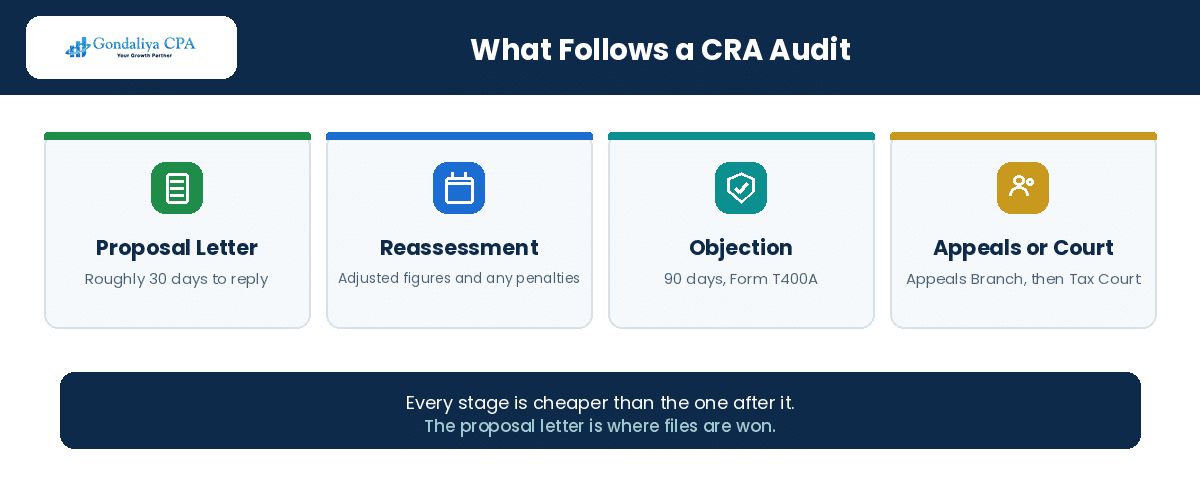
Two deadlines govern everything that follows an audit: roughly thirty days to answer the proposal letter, and ninety days to file a notice of objection once the reassessment lands. Please note that missing the second one ends your appeal rights entirely, and that filing an objection is also what pauses collection on the disputed amount.
| Aspect | Details |
|---|---|
| The warning | A proposal letter setting out what will change. |
| The document | A notice of reassessment with adjusted figures. |
| The deadline | Ninety days to object, from the mailing date. |
| The escalation | Appeals Branch, then the Tax Court of Canada. |
Reading time: 39 minutes.
Table of Contents
- What is a CRA Audit Reassessment?
- Reassessment Periods and CRA Authority
- Audit Triggers and Types of CRA Audits
- Documentation and Compliance Requirements
- Your Rights, Deadlines, Objections and Appeals
- Expert CRA Audit Support and Resolution Strategies by Gondaliya CPA
- Frequently Asked Questions (FAQs)
- Key Points: How Corporations Can Protect Their Tax Position
- Industry Spotlights: Sectors We Represent
- Professional Guidance and Quick Reference
The Numbers That Matter
This article covers Canada, with Ontario and Toronto context, and reflects CRA rules current to 2026. It assumes an incorporated business that has been audited or reassessed. Figures marked illustrative are examples, not quotes, and any masked engagement notes end with “Figures changed for privacy.” This is educational information only and not tax or legal advice. Where gross negligence or prosecution may be in question, please instruct a lawyer alongside your CPA, because accountant-client communications do not carry privilege.
What is a CRA Audit Reassessment?
What is a CRA Audit Reassessment?
The Basics
A CRA audit reassessment happens when the Canada Revenue Agency (CRA) takes another look at a corporation’s tax return after an audit. They might find things that don’t add up or get new info that changes what they thought before. Then, they send a notice of reassessment to explain what they changed.
This notice usually shows:
- Changes to income or expenses
- Adjustments to tax credits claimed
- Penalties if the company didn’t follow the rules
If a corporation gets this notice, it should act fast. Ignoring it can cause more trouble and extra fines.
Proposal Letter
Before sending the official notice, CRA often sends a proposal letter. This letter says what changes they want to make. It lets companies check these points and send proof if they disagree. Handling this part well can stop bigger problems down the line.
The Importance of Corporate Tax Reassessment
Knowing about corporate tax reassessments helps keep your business safe and legal. A CRA reassessment corporation might face several challenges that impact its money and operations.
Here’s why it matters:
- Money Matters: A reassessment can mean you owe more taxes if mistakes are found. This can hit your cash flow unexpectedly.
- Penalties on Corporate Reassessments: If serious errors show up, penalties may come in. These range from late-filing fees to charges for carelessness, depending on how bad and intentional the errors were.
- Fixing Mistakes: Even if it sounds scary, reassessments let businesses correct errors before they get worse. It’s better to fix things early than wait for audits or lawsuits.
- Stay Compliant Over Time: Checking past returns against current rules keeps you in line with Canada’s tax laws. This habit lowers future risks tied to audits or reassessments.
To sum up, knowing what a CRA audit reassessment is and why corporate tax reassessment matters helps businesses deal with rules while protecting their finances.
The proposal letter arrives and people put it aside because it is not a bill. It is the last cheap moment in the process, and answering it well is worth more than any objection filed later. Figures changed for privacy.
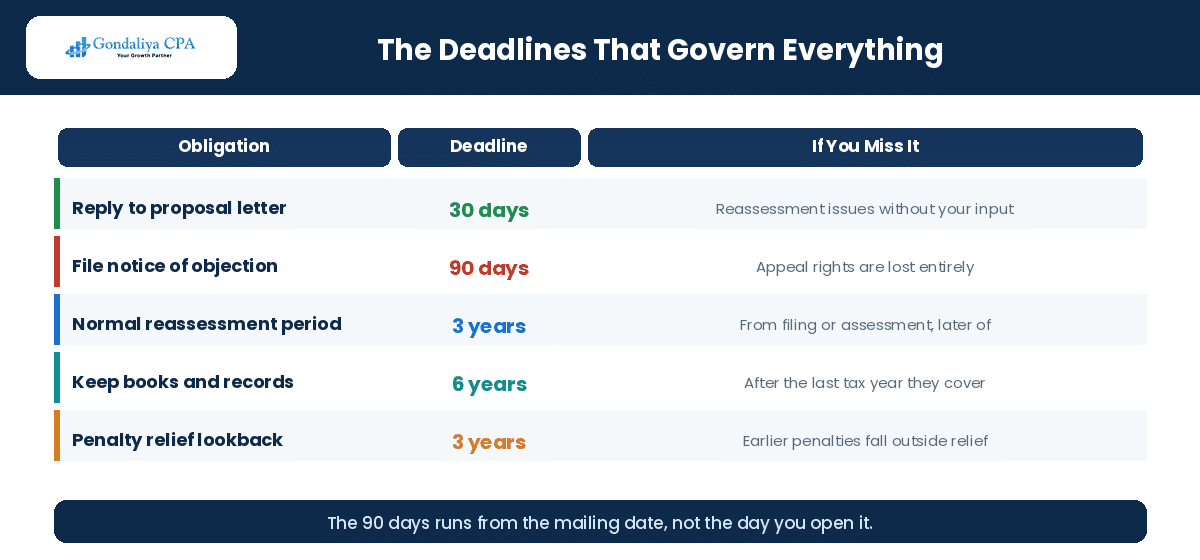
Risk Warning: The ninety-day objection deadline runs from the date the CRA mails the notice, not the date you open it. Post that date the moment the envelope arrives.
Reassessment Periods and CRA Authority
Reassessment Periods and CRA Authority
The Time Limits
Normal Reassessment Period for Corporate Tax Returns
The Canada Revenue Agency (CRA) usually has three years to reassess corporate tax returns. For Canadian-controlled private corporations (CCPCs), this three-year period starts from the later of either the date the return was filed or the original Notice of Assessment. Other types of corporations follow the same three-year timeline.
During this window, CRA can review your tax filings, carry out an audit reassessment, or issue a notice if something looks off. After this time passes, CRA generally can’t adjust your taxes without your consent.
Here’s what you should keep in mind:
- The normal reassessment period is 3 years for CCPCs and other corporations.
- This applies to both federal and Ontario provincial corporate income taxes.
- The clock starts from the filing date or assessment date—whichever happens last.
Knowing these limits helps businesses get ready in case CRA decides to audit.
Extended Reassessment Periods and Conditions
Sometimes, CRA gets more time beyond that normal three-year limit. This happens when they suspect omissions, misrepresentations, neglect, or fraud on your corporate tax return. Under section 152(4) of the Income Tax Act, CRA can reopen assessments past usual deadlines in these cases.
Also, companies can choose to give CRA more time by signing Form T2029, which is a waiver that extends CRA’s right to reassess. You must sign this form before the usual objection period ends.
A few points about extensions:
- Waivers let CRA assess beyond normal periods.
- Extensions can be granted if there’s a reasonable cause, but it’s up to CRA’s discretion.
- Signing waivers carries risks; it’s best to talk with a tax pro first.
These extended periods give CRA more room during tricky audits but need careful handling.
Unlimited Reassessment Period: Scope and Implications
If fraud, gross negligence, or willful default comes into play, CRA can reopen your returns with no time limit at all. Section 152(5) of the Income Tax Act allows an unlimited reassessment period in such situations.
This means CRA can look back many years if they believe wrongdoing happened. Companies must keep all tax-related records for at least six years after each tax year ends. Failing to do so increases risk during investigations.
Some effects of unlimited reassessments include:
- Reopening multiple prior years’ returns regardless of age.
- Facing heavier penalties like gross negligence penalties under section 163(2).
If you’re under suspicion for serious issues, you should get help from a CPA experienced in complex tax matters right away.
Special Reassessment Considerations for Non-Resident and Related Parties
Transactions with non-residents or related parties get extra attention because of transfer pricing rules. These rules make sure prices charged between related companies are fair and match market values across borders. The Income Tax Act sections 247 through 247.7 cover this area closely.
Reassessments here often differ:
- They may take longer due to complexity.
- Companies must keep detailed transfer pricing documentation that shows how prices were set fairly.
- Auditors who specialize in international tax handle these reviews.
If you don’t comply, not only could you owe extra taxes but also face penalties linked to gross negligence if prices were set intentionally wrong.
Businesses working internationally should have strong transfer pricing policies and be ready with proof if audited on intercompany transactions.
Waivers are signed too readily. A Form T2029 keeps a file open that would otherwise have closed, and it should never be signed without understanding what the auditor still hopes to find. Figures changed for privacy.
Risk Warning: Where misrepresentation or neglect is alleged, the three-year window does not protect you. That is why the substance of the audit response matters as much as the calendar.
Audit Triggers and Types of CRA Audits
Audit Triggers and Types of CRA Audits
The Triggers
The CRA starts audit reassessment processes when certain triggers pop up. These alerts push the Canada Revenue Agency to dig into corporate tax filings. Knowing what sets off these triggers and the types of audits that follow helps corporations handle reassessments or get ahead with CRA audit support.
Common Triggers for CRA Audits in Corporate Tax Filings
Corporate tax reassessment often happens when the CRA spots risks or mismatches during checks or data scans. Some common triggers are:
- Odd jumps or drops in reported income, expenses, or deductions versus past years.
- Big changes in business activities without matching tax report updates.
- Huge claims on things like shareholder benefits or personal-use assets that usually aren’t deductible.
- Mismatches between GST/HST returns and corporate income tax filings.
- Deals with related parties lacking solid documentation or done on non-arm’s length terms.
- Tips from banks, other government bodies, or third parties.
These clues make the CRA more likely to reassess a corporation’s taxes because they hint at possible errors or hidden income.
Overview of Correspondence Audits and Desk Reviews
Correspondence audits—also called desk reviews—are focused checks mostly done by mail or online. The CRA sends letters asking for explanations on parts of your T2 return.
Here’s what to expect:
- They zoom in on specific line items, not your entire file.
- They ask for proof like invoices, contracts, bank statements, or reconciliations.
- You usually have about 30 days to reply.
This audit type keeps things quick and avoids visits. Companies can get good CRA audit support here by responding fast and accurately to prevent bigger problems.
Field Audits: Scope and Process
Field audits are more intense. CRA auditors come to your office and check your records face-to-face. These take longer than correspondence audits and cover more ground.
The process usually looks like this:
- You get a letter explaining what they want to review before they show up.
- Auditors examine books, software like QuickBooks, payroll files, GST/HST reports, contracts, board minutes especially about intercompany stuff.
- They talk with people managing money and records.
- If they find issues you don’t agree with, you might get a formal notice of reassessment.
You’ll want strong CRA audit support during field audits because of their size and detail. Preparing well can save headaches later.
Focus Areas: Unusual Deductions, GST/HST Reporting Irregularities, Intercompany Transactions
| Focus Area | Description | Why It Matters |
|---|---|---|
| Unusual Deductions | Claims like shareholder benefit loans; home office costs; motor vehicle expenses | Often checked since they’re frequently misused |
| GST/HST Reporting Irregularities | Differences between input tax credits claimed and actual purchases | Wrong claims here can lead to fines |
| Intercompany Transactions | Transfers among related companies missing arm’s-length pricing papers | A hot spot for transfer pricing disputes |
Auditors focus here because mistakes can change taxable income figures a lot. Good CRA audit support means having clear proof ready early to avoid trouble.
For businesses in Toronto/Ontario facing any stage after getting a note from the CRA—whether it’s first contact by letter or final notice—knowing these triggers and audit types helps owners understand what’s coming before getting expert help like Gondaliya CPA’s services.
You can reach out anytime for advice at info@gondaliyacpa.ca or call 647‑212‑9559 if you want help handling corporate tax reassessments without stress.
The most common trigger we see is not fraud, it is a GST/HST return that does not agree with the T2. Two returns from the same books telling different stories invites a look. Figures changed for privacy.
Pro Tip: Reconcile your GST/HST filings to your T2 revenue every year before filing. It takes an afternoon and removes one of the most common reasons a corporate file gets selected.
Documentation and Compliance Requirements
Documentation and Compliance Requirements
The Evidence
When the CRA starts a corporate tax reassessment, they want to see solid paperwork. They check for records that back up what your company reported—like income, deductions, and shareholder benefits. Keeping things neat and clear helps when the CRA reviews your files.
Essential Records and Documentation the CRA Expects to Review
The CRA looks at a few key papers during their audit reassessment:
- Shareholder Benefits: Records about perks given to shareholders. This includes loans, expense reimbursements, or deals that aren’t at arm’s length.
- Bank Statements: Full bank statements show money moving in and out. These help prove your reported income matches actual cash flow.
- Contracts and Invoices: Contracts prove business deals are real. Invoices from suppliers or customers back up amounts shown in your books.
- Reconciliations: Bank reconciliations and reports on accounts receivable or payable show you control your financial info well.
Getting these docs ready fast makes the audit smoother and might cut down extra penalties.
Managing Digital Records and Contemporaneous Documentation
Contemporaneous records are docs made right when a transaction happens. They hold more trust during tax reassessment. Having digital versions makes it easier to find stuff fast.
Here are good habits for digital record keeping:
- Use cloud software like QuickBooks or Xero that updates records instantly.
- Organize files by year and type—such as invoices or contracts.
- Make sure electronic docs have timestamps matching transaction dates.
These steps give auditors clear evidence linked to your returns.
Record Retention Policies and Audit Preparedness
The Income Tax Act s.152 [2] says companies must keep books of account for six years after the last tax year they cover.1 This rule applies even if no audit started yet.
Important points about keeping records:
- Keep original documents when possible. But certified digital copies count if kept properly.
- If you can’t show required papers when asked, it could hurt your case during reassessment.
Following these rules helps companies be ready if the CRA comes knocking with a notice of reassessment.
1: Income Tax Act RSC 1985 c 1 (5th Supp), s 152(2).
Role of Contracts, Invoices, Bank Statements, and Board Resolutions in Audits
Contracts set out legal duties between parties. They justify what income or expenses you report in T2 returns. Likewise:
- Invoices prove sales happened as recorded.
- Bank statements confirm money movements seen in ledgers, highlighting issues auditors might ask about.
Board resolutions document key decisions—like dividend payouts or transfers between companies—that affect taxable events.2 Third-party confirmations add extra trust by verifying facts independently.
Together, these records form solid proof needed during every phase of a corporate tax dispute—be it proposal letters or reviewing a notice of reassessment.
2: Canada Revenue Agency – Books & Records
If you need advice after getting a notice of assessment on your corporation’s taxes, contact Gondaliya CPA at info@gondaliyacpa.ca or call 647‑212‑9559 for help in Toronto/Ontario.
Records created at the time carry weight that reconstructions never do. An auditor can tell the difference between a contract signed three years ago and a memo written last week to explain it. Figures changed for privacy.
Statutory Requirement: Books and records must be kept for six years after the last tax year they relate to, whether or not an audit has begun. Certified digital copies are acceptable when properly maintained.
Rights to Professional Representation and Confidentiality
Your Rights, Deadlines, Objections and Appeals
The Process
If your corporation faces a CRA audit reassessment, you have the right to professional representation. That means you can hire licensed pros like CPAs who know corporate tax reassessments well. The CRA accepts authorized representatives, so they can speak directly with auditors for you. This helps make sure answers are accurate and on time.
Confidentiality matters a lot during these reassessments. Any info you or your rep shares with the CRA is protected by privacy laws in the Income Tax Act[^1]. This includes sensitive financial details given during audits or disputes. The goal is to keep your corporation’s info safe from unauthorized access.
Using skilled CPA firms helps protect your rights and keeps things private, as Canadian law requires[^2].
Obligation to Provide Complete and Accurate Information
When facing a CRA audit reassessment, you must give full and accurate info as the law demands. The Income Tax Act says you need to share all records, documents, and explanations that support your income or deductions[^3]. If you don’t, penalties or longer reassessment periods can happen.
Good record-keeping makes audits easier. Make sure filings match documents like bank statements, contracts, invoices, and ledgers. Providing incomplete or misleading info risks harsher assessments or gross negligence penalties[^4].
Being cooperative on time shows good faith during corporate tax reassessments.
Understanding the Notice of Reassessment and Audit Findings
A notice of reassessment tells you about changes the CRA made after reviewing your audit or proposal letter reply. It shows new taxable income amounts, taxes owed, interest charges, any penalties, plus payment deadlines[^5].
Usually, it includes:
- A summary page with total amounts due.
- Line-by-line comparisons of original vs adjusted figures.
- Legal references backing those changes.
- Instructions on how to file a notice of objection on time.
Knowing this document helps you decide whether to accept or formally object based on your evidence[^6]. Proposal letters come before notices and give a chance to resolve things early.
Deadlines and Timelines: Objection Deadline and Response Windows
You need to meet objection deadlines strictly after getting a notice of reassessment. Usually, incorporated corporations have 90 days from mailing date[^7]. Missing it means losing appeal rights unless extensions apply under special taxpayer relief rules (Form RC4288).
Response windows depend on the letter type—proposal letters often give 30 days for replies before final assessment comes out[^8]. You can ask for more time but must explain why CRA should agree.
Tracking these deadlines keeps your legal options open against disputed corporate tax audit results.
| Obligation | Deadline | Applies To | Consequence if Missed | Source |
|---|---|---|---|---|
| File Notice of Objection | 90 days post-notice | Incorporated Corporations | Lose appeal rights | CRA |
| Respond to Proposal Letter | Usually 30 days | All audited taxpayers | Final assessment without input | CRA |
Formal Objection Procedures and Notice of Objection Requirements
Sending a formal notice of objection moves dispute resolution past the initial review phase. Corporations below large corporation size (less than $20 million taxable capital) just need Form T400A. Larger ones have extra paperwork needs under section 230(1)(a) ITA rules[^10].
You must include:
- Business number and identification.
- Reasons why you disagree with facts.
- Any supporting evidence if possible.
- Signature from company officers or reps using Form AUT01 (“Represent a Client”).
Filing objections properly protects appeal rights up through Appeals Branch reviews. It also pauses collections under certain conditions covered later.[^10]
Payment of Disputed Amounts and Associated Risks
- Payment Rules
Usually required unless collection restrictions kick in when objections are timely filed.[^11] Paying “under protest” keeps your legal rights but interest like arrears still builds up at set rates.[^12] - Penalties & Interest
You might still owe penalties even if principal is disputed.[^13] Gross negligence penalties can be severe—up to 50% depending on how bad it was.[^14] - Collection Limits
Collections often pause during appeals within statutory limits (about two years), but GST/HST or payroll source deductions might still be collected separately.[^15] - Security Deposits & Refund Holds
Sometimes CRA asks for deposits as security while waiting for results; refunds may be put on hold till case ends.[^16]
Knowing this helps manage cash flow risks when disputes drag out across several fiscal years.
How Objections Are Processed by the CRA
- After Appeals Branch gets your objection:
- An appeals officer reviews your case independently with all submissions.[17]
- They may meet with your representatives to clarify points aiming for a settlement.[18]
- Outcomes include confirmation (assessment stands), variation (adjustment), or vacating (canceling). Notices explain what happened.[19]
- Usually, this process takes six months to one year depending on case complexity.[20]
- Clear mistakes might get quicker decisions.[21]
- If no resolution happens here,[22] you can take it further with judicial steps starting at Tax Court.[23]
Options for Appeal, Including CRA Appeals and Tax Court of Canada
- Tax Court Informal Procedure fits smaller claims under $25K disputed amount. It offers simpler hearings without needing lawyers but still fair treatment.[24]
- General Procedure applies above that limit requiring formal pleadings like court cases federally.[25]
Appeals involve strict timelines—usually within ninety days after Notices confirm prior outcomes[26]. Pre-trial meetings happen to try settling[27], then possibly trial with binding rulings across Canada[28].
Negotiated settlements remain possible anytime in either path to avoid long court fights while protecting taxpayer rights under Canadian tax law[29].
Sharad Gondaliya, CPA, has over ten years helping Canadian businesses with complex CRA audit support cases.
Most objections settle at the Appeals stage without ever reaching court. The officer reviewing it is independent of the auditor, which is precisely why a clear written case is worth preparing properly. Figures changed for privacy.
Key Stat: Filing a timely objection pauses collection on the disputed amount. That alone is often reason enough to file, even where the outcome is uncertain.
Expert CRA Audit Support and Resolution Strategies by Gondaliya CPA
Expert CRA Audit Support and Resolution Strategies by Gondaliya CPA
The Support
Pre-Audit Preparation and Communication Management
After a CRA audit ends, corporations usually get a proposal letter. This letter shows what the auditor found. It starts the response window, which often lasts 30 days. During this time, companies must reply with explanations or extra documents. Keeping records well organized helps a lot. Canadian tax law says you must keep corporate documents for at least six years after the tax year ends. This supports any questions during audits or reassessments. Quickly checking the proposal letter and preparing a clear response can stop bigger problems.
Key points to remember:
- Proposal letter arrives after audit
- 30-day response window to reply
- Keep records for at least six years
- Responding early helps avoid issues
Technical Advocacy and Negotiation with the CRA
Answering on time in the proposal letter response window lets companies explain their side clearly. Good advocacy means presenting facts and negotiating changes before formal reassessments happen. This can lower penalties or interest charges. The penalty relief lookback period covers three years before asking for help under CRA’s Taxpayer Relief Policy. That lets you discuss penalties from past years if there is a good reason. Also, knowing the gross negligence penalty rate—up to 50% of missed tax—helps guide talks to reduce harsh penalties.
Remember:
- Use the proposal letter response window well
- Negotiate adjustments before reassessment
- Penalty relief lookback covers last three years
- Gross negligence penalty can be very high (up to 50%)
Leveraging the Voluntary Disclosures Program for Penalty Relief
The Voluntary Disclosures Program (VDP) allows companies to fix wrong filings without usual penalties or prosecution if they come forward before CRA finds out. Using VDP within allowed times fits with penalty relief lookback rules under Taxpayer Relief Policy. If errors show up after an audit but before reassessment, VDP can cut financial costs a lot while keeping things legal.
VDP basics:
- Fix errors before CRA detects them
- Avoid usual penalties and prosecution
- Works with Taxpayer Relief Policy timelines
- Helps reduce costs after audit but pre-reassessment
Managing Penalties, Interest, and Gross Negligence Considerations
Corporate reassessments often include penalties like late-filing fees, repeated failure charges, or gross negligence penalties if intentional wrongdoing is suspected. Interest builds daily on unpaid amounts from due dates until full payment; it compounds monthly as per Income Tax Act rules. Paying “under protest” when disputing bills helps manage cash flow while fighting charges through objections or appeals. Knowing how these work keeps money moving during disputes.
Key facts:
- Penalties include late filing and gross negligence
- Interest adds up daily and compounds monthly
- Pay under protest while disputing amounts
- Understand rules to manage finances better
Planning for Collection Restrictions and Payment Arrangements
When companies file objections on disputed corporate income tax within deadlines (usually 90 days from notice), CRA can’t collect those disputed amounts right away. Still, non-disputed taxes must be paid immediately. Businesses may work out payment plans like installments or partial payments “under protest” while waiting for final decisions. These options help balance paying taxes with keeping cash available during disputes.
Important notes:
- Objection filing stops collection on disputed sums
- Non-disputed parts remain payable now
- Payment plans possible during dispute
- Helps keep business cash flowing
Case Management and Escalation Paths During Audit Closing
When audits close, deadlines become critical. Replying fast to proposal letters protects rights against quick reassessments; extensions are possible but need solid reasons. After responses or objections go in, final letters confirm results including any reassessments sent out. If disagreements stay after first steps, you can escalate issues to team leaders or Appeals officers. Clear communication here ensures fairness as audits wrap up.
What happens next:
- Timely replies keep options open
- Extensions require good reasons
- Final letters show audit results
- Escalate issues if needed
How Gondaliya CPA Assists Corporations Through Audit and Reassessment Processes
Gondaliya CPA supports every step—from first intake triage that checks urgency, through authorization using Form AUT‑01 (“Represent a Client”) so we can talk directly with CRA agents—to deep file reviews of audit points. We gather evidence by collecting all related records matching discrepancies found in audits or proposals. Then we draft clear responses or Notices of Objection (Form T400A). We track submissions till acknowledged and manage Appeals letters if needed along with penalty relief requests under taxpayer relief rules.
We also plan collections based on client cash flow needs and review prior years to spot risks early. After everything settles, we put controls in place so problems don’t come back again.
Our process includes:
- Intake triage and authorization forms
- Detailed file reviews
- Evidence collection
- Drafting objections
- Submission tracking
- Appeals handling
- Penalty relief applications
- Collection planning
- Prior-year risk reviews
- Post-resolution controls
[1]: Canada Revenue Agency – Records Retention Requirements
[2]: Canada Revenue Agency – Taxpayer Relief Provisions
[3]: Income Tax Act Section 163(2) – Gross Negligence Penalty
[4]: Canada Revenue Agency – Voluntary Disclosures Program Guide
[5]: Income Tax Act Sections 162 & 163 – Late Filing & Repeated Failure Penalties
[6]: Income Tax Act Section 220(3) – Interest Calculation Rules
[7]: Canada Revenue Agency – Collection Restrictions During Objections
[8]: Canada Revenue Agency – Proposal Letter Response Deadlines
For expert help dealing with your corporation’s audit results or managing complex corporate tax reassessments across Toronto, Ontario, or Canada-wide areas, contact Gondaliya CPA at info@gondaliyacpa.ca | 647‑212‑9559 for a free consultation today.
Authorization comes first, always. Without Form AUT-01 on file we cannot speak to the auditor at all, and the days spent arranging it are days off the response window. Figures changed for privacy.
Pro Tip: Pay the undisputed portion promptly even while objecting to the rest. Interest keeps running on everything, and separating the two limits what accrues against you.
Frequently Asked Questions (FAQs)
Frequently Asked Questions (FAQs)
FAQ
What happens after a CRA audit ends?+
After a CRA audit ends, you usually receive a proposal letter. This letter details potential adjustments and starts a response window for your reply. Timely and clear communication at this stage helps avoid harsh reassessments.
How do corporations respond to a CRA notice of reassessment?+
Corporations should carefully review the notice line-by-line, verify figures against their filed T2 return, and decide whether to accept or object. Filing a formal objection within 90 days preserves appeal rights.
What is the objection deadline for corporate reassessments?+
The standard deadline to file a notice of objection for incorporated corporations is 90 days from the date the CRA mails the notice of reassessment.
What is the penalty relief lookback period?+
The penalty relief lookback period covers three years prior to the current tax year. It allows taxpayers to request relief on penalties assessed within that timeframe under CRA’s Taxpayer Relief Policy.
How long must corporations keep their records?+
Corporations must retain books and records for at least six years after the end of the last tax year they relate to, as required by the Income Tax Act.
What is the gross negligence penalty rate?+
The gross negligence penalty can be up to 50% of the tax amount understated if the CRA proves intentional or reckless disregard of tax laws.
Who needs to file an objection for large corporations?+
Large corporations with taxable capital over $20 million must follow specific rules and provide detailed evidence when filing notices of objection.
What is included in a notice of reassessment?+
A notice includes adjusted income, taxes owed, penalties, interest charges, due dates, and instructions on how to file objections.
Should I respond to a proposal letter before reassessment?+
Yes. Responding promptly with clear evidence during the proposal letter phase can prevent costly reassessments later.
What is the difference between a notice of objection and a request for adjustment?+
A notice of objection is a formal appeal preserving legal rights. A request for adjustment is informal and does not suspend collection or preserve appeal rights fully.
Key Points: How Corporations Can Protect Their Tax Position After a CRA Audit
Key Points: How Corporations Can Protect Their Tax Position
Quick Reference
- Track all deadlines carefully, especially the 90-day objection window.
- Maintain clear authorization documents like Form AUT01 for CPA representation.
- Keep contemporaneous digital and paper records organized by year and type.
- Review related accounts and prior years for consistency before responding.
- Draft well-supported responses including contracts, invoices, and reconciliations.
- Request extensions only with valid reasons when additional time is needed.
- Negotiate penalties and interest proactively using taxpayer relief provisions.
- Consider filing objections early to pause collections on disputed amounts.
- Plan payment arrangements “under protest” when disputing tax balances.
- Escalate unresolved issues through Appeals Branch or Tax Court if necessary.
- Use professional CPA firms like Gondaliya CPA experienced in CRA audit support.
For assistance with your corporate tax reassessment or CRA audit support, contact Gondaliya CPA at info@gondaliyacpa.ca or call 647‑212‑9559.
Clients arrive frightened and leave surprised at how procedural it all is. Deadlines, documents and a written case; the outcome usually turns on those three rather than on argument. Figures changed for privacy.
Industry Spotlights: Sectors We Represent
Industry Expertise
What the CRA looks hardest at differs by sector. Here are eleven and the usual focus.
| Industry | What the CRA Usually Examines |
|---|---|
| Restaurants & food and beverage | Cash sales against reported revenue |
| Construction, contractors & skilled trades | Subcontractor payments and T5018 reporting |
| Transportation, logistics & trucking | Vehicle expenses and driver classification |
| Real estate investors & holding companies | Property flips treated as income, not capital |
| Medical doctors & physician corporations | Shareholder benefits and personal expenses |
| Dentists & dental practices | Equipment claims and associate arrangements |
| E-commerce & online retailers | Platform income against GST/HST filings |
| Consulting firms | Home office, travel and meal deductions |
| Technology startups & SaaS | SR&ED claims and intercompany charges |
| Property developers & builders | Capitalisation and GST/HST on new builds |
| Daycare, childcare & CWELCC services | Grant funding reported against revenue |
- Restaurants & food and beverage: Cash-heavy operations attract revenue testing, so point-of-sale records matter more than usual.
- Construction, general contractors & skilled trades: Subcontractor payments and their reporting are the standard starting point for an auditor.
- Transportation, logistics & trucking: Vehicle expenses and whether drivers are employees or contractors are examined closely.
- Real estate investors, landlords & holding companies: Whether a disposition was capital or business income is the recurring dispute.
- Medical doctors & physician professional corporations: Shareholder benefits and personal expenses run through the corporation draw attention.
- Dentists & dental practices: Equipment claims and how associates are engaged are both common review areas.
- E-commerce & online retailers: Platform reporting gives the CRA an independent figure to compare against your returns.
- Consulting Firms: Home office, travel and meals are small amounts that attract disproportionate scrutiny.
- Technology startups & SaaS: SR&ED claims and intercompany charges are reviewed by specialist auditors.
- Property developers & builders: Capitalisation decisions and GST/HST on new residential builds are both examined.
- Daycare, childcare & CWELCC services: Grant funding has to reconcile to reported revenue, and often does not at first pass.
The focus differs but the defence does not. Contemporaneous records, a clear written explanation and a reply inside the window resolve most files whatever the sector. Figures changed for privacy.
Professional Guidance and Quick Reference
Guidance
Professional Guidance on CRA Audits: How Gondaliya CPA Supports Canadian Corporations
An audit ending is not the end of the matter. What follows is a sequence with fixed deadlines: a proposal letter you have roughly thirty days to answer, a notice of reassessment, then ninety days to object. Each stage is cheaper than the one after it, and the file is usually decided by how well the first one is handled. Gondaliya CPA represents corporations through all of it on a fixed fee.
We handle what decides the outcome: getting Form AUT-01 authorization in place so we can speak to the auditor directly, reviewing the audit points against your own records, collecting the evidence that answers each adjustment, drafting the proposal letter response or the Notice of Objection on Form T400A, tracking submissions until acknowledged, applying for penalty and interest relief where the facts support it, and planning collection around your cash flow while the dispute runs.
Our team works from your books and the CRA’s own correspondence rather than a template, and will tell you plainly where your position is strong and where it is not. Correspondence audit or field audit, you get clear advice and a fixed price before we start.
Quick Answers: Key Numbers & Concepts at a Glance
At a Glance
- Proposal letter reply: Usually 30 days
- Objection deadline: 90 days from the mailing date
- Objection form: T400A for most corporations
- Large corporation threshold: $20 million taxable capital
- Normal reassessment period: 3 years
- Unlimited period: Fraud, gross negligence or wilful default
- Gross negligence penalty: Up to 50% of understated tax
- Penalty relief lookback: 3 years
- Record retention: 6 years after the last tax year
- Tax Court informal procedure: Disputes under $25,000
Who This Is For / Not For
Fit Check
- For: Incorporated Canadian businesses that have received a proposal letter, a notice of reassessment, or an audit query and need to respond within the deadlines.
- Not For: Situations where prosecution or criminal investigation is in prospect, which need a tax lawyer instructed first because privilege applies.
People Also Ask
Quick Answers
Can I still object if I miss the 90 days?+
You can apply for an extension, but it is discretionary and must be made within a further limited period. The safer course is treating the ninety days as absolute.
Does objecting make the CRA more aggressive?+
No. Objections are routine and reviewed by an officer independent of the auditor. Filing one is a normal step, not a provocation.
Should I pay the reassessment while objecting?+
Filing a timely objection pauses collection on the disputed amount, but interest continues to accrue. Many clients pay under protest for that reason.
Glossary of Key Terms
Plain-English Definitions
- Audit: A CRA review of filed returns and the records behind them.
- Proposal letter: The CRA letter setting out intended adjustments before reassessing.
- Notice of reassessment: The formal document changing a previously assessed return.
- Notice of objection: The formal dispute filing that preserves appeal rights.
- Form T400A: The objection form used by most corporations.
- Form AUT-01: The authorization allowing a representative to deal with the CRA.
- Form T2029: The waiver extending the CRA’s right to reassess.
- Normal reassessment period: The three-year window in which the CRA may reassess.
- Gross negligence penalty: A penalty for intentional or reckless disregard of tax law.
- Taxpayer relief: Discretionary cancellation of penalties and interest by the CRA.
- Voluntary Disclosures Program: The route to correct filings before the CRA finds the error.
- Collection restrictions: The pause on collecting disputed corporate income tax during an objection.
- Under protest: Paying a disputed amount while preserving the right to contest it.
- Appeals Branch: The CRA division reviewing objections independently of the auditor.
- Informal procedure: The simplified Tax Court route for smaller disputed amounts.
- Contemporaneous records: Documents created at the time of the transaction.
CRA Audit Response Readiness Check
This quick self-check indicates where your operation most likely has room. Please answer the six questions below.
CRA Audit Response Readiness Check
Six quick questions on your situation. No fee shown.
Points to raise with us:
This is a general prompt, not tax or legal advice or a quote. Your position depends on your full facts. For a real review, please book a free consultation.
Want a checklist to work from? You can download our free CRA audit response checklist before your consultation.
Diarise the deadline the day the letter arrives, counting from the mailing date. Answer the proposal letter properly, because it is the cheapest stage. File the objection inside ninety days even where the outcome is uncertain, since it preserves rights and pauses collection. Pay the undisputed portion. Request penalty relief separately. Review prior years before you answer, not after.
2026 Update — what is current: The 90-day objection deadline, the 3-year normal reassessment period, the 50% gross negligence penalty, the 3-year penalty relief lookback, the $20 million large corporation threshold and the 6-year retention rule are unchanged. Please note this article cites the unlimited reassessment period to section 152(5) and record retention to section 152, where 152(4) and 230 are the provisions usually cited, so please verify before relying on those references.
CRA audit reassessment and corporate tax reassessment: expert CRA audit support for corporations by Gondaliya CPA
Answer before the window closes
Gondaliya CPA arranges authorization, reviews the audit points against your records, collects the supporting evidence, drafts the proposal letter response or Notice of Objection, tracks it to acknowledgement, applies for penalty and interest relief, and represents you through Appeals, on a fixed fee with a one-business-day response. Please book a free consultation.
Next Steps
Please book a free consultation with Gondaliya CPA and bring the CRA letter itself, the date printed on it, and the return it relates to. Those three tell us immediately how long you have and what is actually in dispute. The earlier you call within the window, the more options remain. You will get a fixed fee before any work begins. If our content helps, please add gondaliyacpa.ca as a preferred source on Google.
Published: August 19, 2026 · Last updated: August 19, 2026
Editorial policy: We research against CRA and CPA Ontario sources, fact-check the figures, and Sharad Gondaliya, CPA, reviews the content, which we update as the rules change.
Disclaimer: This article is educational information only and is not tax, legal, or financial advice. Figures marked illustrative are examples rather than quotes or guarantees. It reflects CRA rules current to 2026, including the 90-day objection deadline, the usual 30-day proposal letter response window, the three-year normal reassessment period, the 50% gross negligence penalty, and the six-year record retention requirement. Rates, limits and expensing rules change and outcomes depend on your specific facts. Please consult a CPA Ontario member before acting.

Sharad Gondaliya is a CPA Canada & CPA USA with 15 Years+ experience of Accounting, Tax, Payroll of Corporate Small Businesses as Tax Accountant. He is a CPA Ontario member (61040184) and holds US CPA licences in Washington and Montana and is well known among corporate small businesses for tax planning, efficient tax solutions, and affordable CPA services. Sharad is the Principal (Director) of Gondaliya CPA – Affordable CPA Firm in Canada. Licenses: CPA Ontario: 61040184 | CPA USA (MT): PAC-CPAP-LIC-033176 | CPA USA (WA): 57629 | CPA Firm License: 61330051 View Full Author Bio