



Common Tax and Accounting Mistakes Non-Resident Business Owners Make in Canada and How to Avoid Them
Avoid common non-resident corporation tax mistakes and foreign-owned corporation tax Canada issues with Gondaliya CPA, including errors in T2 filing, Part XIII withholding, GST/HST registration, and transfer pricing. Proper corporate tax planning, director residency compliance, and understanding Regulation 102 and 105 withholding can help your business avoid late-filing penalties and withholding agent liability.
Quick Summary
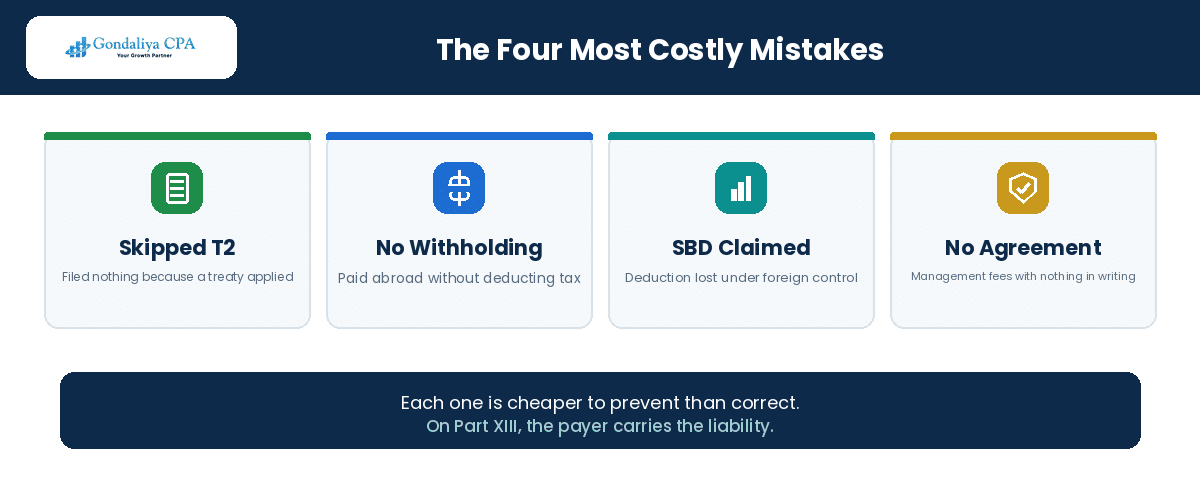
The costly mistakes cluster in four places: T2 returns not filed because a treaty applied, Part XIII tax not withheld before payment, the small business deduction claimed by a foreign-controlled company, and management fees charged with no agreement behind them. Please note that the payer, not the recipient, carries the liability for unwithheld Part XIII tax.
| Aspect | Details |
|---|---|
| The filing | T2 due annually, treaty or not. |
| The withholding | Part XIII deducted before payment leaves. |
| The deduction | No small business deduction under foreign control. |
| The documents | Intercompany agreements written in advance. |
Reading time: 42 minutes.
Table of Contents
- Income Tax Information for Non-Resident Corporations
- Part XIII Withholding, GST/HST, Transfer Pricing and Bookkeeping Errors
- Corporate Tax Planning and Reporting Pitfalls
- Regulatory Updates and Compliance Risks
- Practical Guidance and Procedural Steps
- Support and Resources for Non-Resident Corporations
- Frequently Asked Questions
- Fixing Non-Resident Corporation Tax Mistakes
- Industry Spotlights: Sectors We Serve
- Professional Guidance and Quick Reference
The Numbers That Matter
This article covers Canada, with Ontario and Toronto context, and reflects rules current to 2026. It assumes a foreign-owned Canadian corporation or a non-resident corporation with Canadian obligations. Figures marked illustrative are examples, not quotes, and any masked engagement notes end with “Figures changed for privacy.” This is educational information only and not tax or legal advice. Penalty rates and thresholds vary by provision, so please confirm the figures for your own situation before relying on them.
Income Tax Information for Non-Resident Corporations
Income Tax Information for Non-Resident Corporations
The Basics
Non-resident corporations working in Canada face a tricky tax system. They must know their income tax duties well to avoid common non-resident corporation tax mistakes. For example, not filing returns on time or mixing up residency rules can cause big fines.
Residency Rules and Determination for Foreign-Owned Corporations
Knowing if a corporation is a resident matters a lot. If the company was formed in Canada or its main control is inside Canada, it counts as resident. This decides if the company pays tax on all its income or just on Canadian-source money. So, non-resident business Canada owners must check their status carefully.
Overview of Canada’s Tax Laws Based on Residency and Source
Canada taxes depend on where the company lives and where it earns money. Non-resident corporations pay tax only on income from Canada. Still, they have to file certain forms correctly. Missing this leads to Canadian corporate tax mistakes like wrong filings or late papers.
Filing Requirements for T2 Corporation Income Tax Return for Non-Resident Corporations
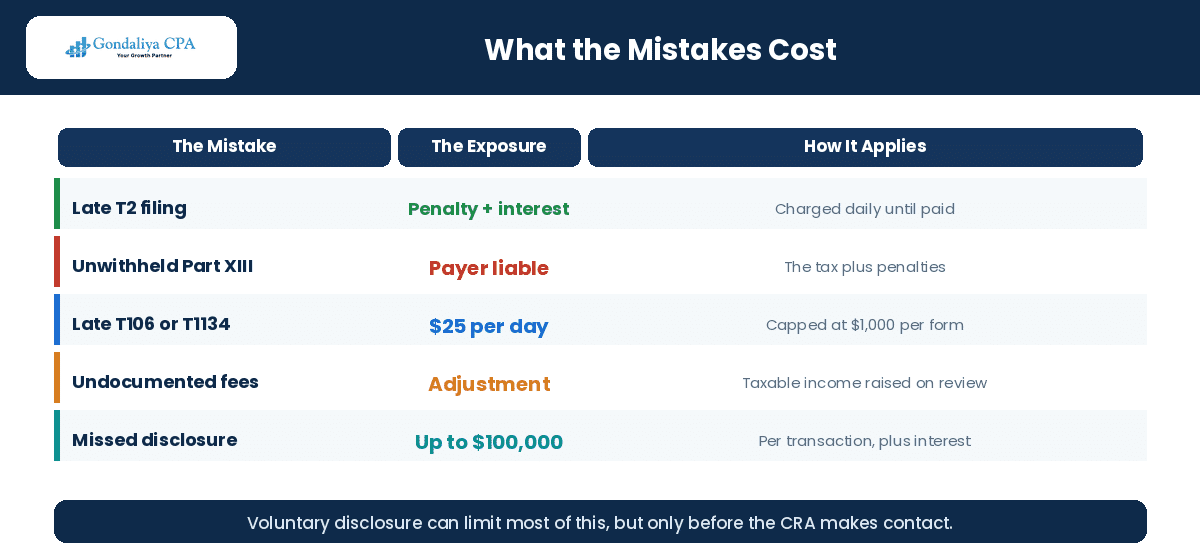
All non-resident companies that make money in Canada need to file a T2 Corporation Income Tax Return every year. It doesn’t matter if they owe taxes or not. Missing the T2 deadline causes late-filing penalties. These can add up fast—5% each month up to 50% of unpaid tax (CRA rules). So, foreign-owned corporations should watch these dates closely.
Registration for Canadian Corporate Income Tax and Business Number
Foreign-owned corporations must register with CRA to pay corporate income tax and get a business number (BN). When sales go over $30,000 in four quarters, GST/HST registration threshold applies. Not registering means trouble — unpaid sales taxes and fines can come fast.
Taxable Period, Tax Returns, and Payment Deadlines for Non-Resident Corporations
Usually, the taxable period matches the calendar year unless CRA or the company sets a different date. Most companies have six months after fiscal year-end to file T2 returns. Payments should happen at least two months before the deadline if there’s a balance owing. Doing this helps avoid late-filing penalty fees.
| Obligation | Deadline | Applies To | Consequence If Missed |
|---|---|---|---|
| File T2 return | 6 months after fiscal year-end | All non-residents | Late-filing penalty |
| Pay balance due | 2 months before return deadline | All non-residents | Interest charges and penalties |
Common Canadian Corporate Tax Mistakes Related to Filing Deadlines and Instalments
Many non-resident businesses miss deadlines for instalment payments or don’t pay amounts on time. These slip-ups cause interest fees and big CRA fines under Canada’s Income Tax Act (ITA). Staying on top of these dates prevents costly errors.
By knowing these key points about tax rules for foreign-owned corporations in Canada—and following them—non-residents can lower risks from compliance problems and run operations more smoothly.
The single most expensive assumption we see is that a treaty exemption removes the return. It removes the tax. The penalty is calculated on a filing that was never made. Figures changed for privacy.
Risk Warning: A nil T2 filed late still attracts a penalty. Please diarise the six-month deadline whether or not you expect to owe anything.
Part XIII Withholding Tax on Passive Income and Services Rendered in Canada
Part XIII Withholding, GST/HST, Transfer Pricing and Bookkeeping Errors
The Mistakes
Non-resident corporations often slip up by paying dividends, interest, royalties, or management fees without deducting the required Part XIII withholding tax. This error exposes foreign-owned corporations to penalties and interest from the CRA.
Part XIII withholding covers passive income earned in Canada by non-residents. It applies to dividends from Canadian corporations, interest on loans sourced in Canada, royalties for intellectual property used here, and fees for services done within Canada[^1]. If you don’t withhold, the payer becomes liable for unpaid taxes plus penalties under section 227 of the Income Tax Act[^2].
Withholding rates usually run at 25%. However, tax treaties can lower this rate—sometimes down to 15% or even less[^3]. The withheld amounts must be remitted within 30 days after payment[^4]. Missing deadlines triggers late-filing penalties and possible repeated failure charges.
What to do:
- Identify all payments subject to Part XIII withholding quickly.
- Get valid NR301 forms from recipients claiming treaty benefits before paying.
- Keep detailed records proving treaty eligibility.
- Remit withheld amounts on time using CRA forms like NR4 slips annually.
Regulation 102 and 105 Withholding Obligations for Non-Residents and Withholding Agents
Ignoring Regulations 102 and 105 causes costly mistakes for many non-resident businesses when making payments outside regular payroll.
Regulation 102 says payers must withhold tax at source on certain payments (like rent or service fees) benefiting a non-resident unless they get a waiver[^5]. Regulation 105 requires withholding on pay to employees who work in Canada but live outside it[^6].
Common errors include running payroll without registering for source deductions or failing to remit CPP/EI contributions on time. These errors expose directors personally because of joint liability under Excise Tax Act section 323[^7].
How to avoid trouble:
- Register as an employer if you have workers physically in Canada, no matter their residency.
- Deduct federal/provincial taxes plus CPP/EI each pay period.
- File T4/T4A slips accurately by year-end.
- For contractor payments under Regs 102/105, check waivers before skipping withholding.
GST/HST Registration and Compliance for Foreign-Owned Corporations
Foreign-owned corporations often skip GST/HST registration even when they should not. This leads to unpaid sales taxes and possible reassessments.
You must register for GST/HST once taxable revenues from Canadian sources go over $30,000 CAD within four consecutive calendar quarters[^8]. Even below this amount, voluntary registration might help recover input tax credits. Ignoring registration rules risks penalties under the Excise Tax Act[^9].
Keep these tips in mind:
- Track your revenue streams carefully against the threshold for foreign entities selling goods/services in Canada (e.g., Ontario’s HST is 13%).
- File returns monthly or quarterly based on your volume.
- Claim input credits only if properly registered.
- Keep accurate invoices showing GST/HST charged.
Transfer Pricing Rules and Cross-Border Payment Considerations
Charging management fees without formal agreements or transfer pricing support breaks Canada’s arm’s length rule. This invites reassessments and penalties up to $1000 per day after notice under subsection 247(3)[^10].
Cross-border deals between related parties need contracts that spell out fees clearly. These agreements must align with market rates supported by benchmarking studies where needed[^11]. Without documents, audits may increase your taxable income unfairly and slap fines on you.
How to stay safe:
- Draft clear intercompany agreements before your fiscal year starts. Detail services provided between related parties inside/outside Canada.
- Prepare transfer pricing reports following OECD guidelines adapted locally[^12].
- Review documents regularly during corporate planning cycles. Consulting experts like Gondaliya CPA helps keep compliance tight while minimizing double taxation legally.
Director Residency Requirements and Related Compliance Mistakes
Many get director residency rules wrong, causing registry errors that risk dissolution notices or personal liability claims under CBCA s106 & OBCA rules requiring resident directors unless exempted[^13].
Some foreign-owned firms appoint only non-resident directors unaware provincial laws require some resident representation (Ontario allows one-third residents)[^14]. Ignoring this not only messes up registries but also affects shareholder rights enforcement amid CRA checks linked to control tests impacting CCPC status[^15].
Tips:
- Make sure director appointments meet local rules documented in annual returns filed on time via Corporations Canada/Ontario Business Registry portals.
- Seek advice early during incorporation to avoid costly fixes later affecting corporate governance — especially if operating out of Toronto serving clients nationwide like Gondaliya CPA routinely does.
Corporate Bookkeeping Errors Frequently Made by Non-Resident Corporations
Poor bookkeeping leads to mistakes like wrong GIFI mapping causing incorrect Schedule filings such as Schedules 100 & 125 which impact T2 return accuracy[17].
Missing receipts or documents weaken expense claims and can cause disallowed deductions raising your tax unexpectedly[18]. Other issues include mixing capital vs operating expenses improperly[19], inconsistent foreign exchange treatment[20], and failing six-year record retention per CRA rules[21], especially when books are offshore complicating audits further[22].
How to fix it:
- Use a solid chart-of-accounts designed for Canadian reporting standards integrated into software like QuickBooks/Xero used professionally[23].
- Apply correct GIFI codes systematically.
- Keep original receipts securely available upon request following Section 230 regulations about records maintenance[24].
Errors Related To Schedule 97 And Schedule 20 Filings For Non-Resident Corporations
Many assume treaty exemptions or nil activity mean no T2 filing duty—this is wrong! Foreign-owned companies must still file Schedules 97 & 20 with their T2 returns[25].
Schedule 97 reconciles dividend gross-ups even if no actual payment happens. Schedule 20 shows ownership changes affecting attribution rules important with complex multi-jurisdictional shareholdings common among Toronto SMBs served by Gondaliya CPA[26].
Skipping these leads to late-filing penalties plus loss of transparency inviting deeper CRA probes that can escalate audits beyond initial scope disrupting finances and operations[27].
What you should do:
- File full T2 returns every fiscal year no matter profits.
- Attach all schedules correctly reflecting shareholder structure updates promptly.
- Coordinate expert reviews early to avoid costly corrections later reducing headaches down the road.
References
- CRA – Part XIII Withholding
- Income Tax Act s227
- Finance Canada Treaty Texts – Dividend Rates
- CRA Form NR4 Guide
- Income Tax Regulations s102
- Income Tax Regulations s105
- Excise Tax Act s323 – Director Liability
- Excise Tax Act ss221–223 – GST Thresholds
- CRA GST/HST Filing Penalties
- Income Tax Act s247(3) – Transfer Pricing Penalty
- OECD Transfer Pricing Guidelines
- CPA Ontario Guidance on TP Documentation
- CBCA ss106–107 / OBCA Resident Director Rules
- Ontario Business Registry Requirements
- Corporations Canada Annual Return Filing Instructions
- CRA Guide T4012 Chapter re: GIFI Codes
- Income Tax Folio S1-F1-C1 Reasonable Expenses
- Capital Cost Allowance Policies – ITA Section 18(1)(a)
- Accounting Standards ASPE / IFRS FX Treatment
- ITA Section 230 Records Retention Requirement
- CRA Audit Manual Record Location Policy
- CPA Compilation Engagement CSRS4200 Best Practices
- IncomeTaxActSection230RecordsRetention
- T2 Corporation Return Guide – Schedules Overview
- Schedule97 & Schedule20 Instructions – CRA
- Late Filing Penalty Provisions ITA Sections
The payer bears the risk on Part XIII, which surprises Canadian subsidiaries every time. Paying a foreign parent without withholding leaves the Canadian company owing the tax it should have deducted. Figures changed for privacy.
Key Stat: Withheld amounts must be remitted within 30 days of payment. Please treat that as the real deadline rather than the annual NR4 filing date.
Corporate Tax Planning and Reporting Pitfalls for Foreign-Owned Corporations
Corporate Tax Planning and Reporting Pitfalls
The Pitfalls
Foreign-owned corporations doing business in Canada face tricky tax rules. Non-resident corporation tax mistakes can cost a lot in penalties and interest. It’s important to know the common errors around deductions, capital gains reporting, foreign reporting forms, withholding taxes, payroll duties, and transfer pricing. Staying clear of these keeps you in line with the Income Tax Act (ITA) and CRA rules.
Missteps in Claiming Small Business Deductions and Other Eligible Tax Credits
A common Canadian corporate tax mistake is trying to claim the small business deduction (SBD) when foreign owners control the company. The SBD only applies to Canadian-controlled private corporations (CCPCs). If non-residents have control, the corporation doesn’t qualify—even if it’s incorporated here.
Claiming the SBD wrongly means CRA can reassess your taxes. This usually results in higher taxes because you lose the special lower rate on active business income up to $500,000. Other credits tied to CCPC status can get denied too.
Here’s what matters about control:
- Control means direct or indirect power over voting shares or board members.
- Foreign parents often have this control through shareholding setups.
To avoid trouble:
- Check control status every year using shareholder lists and agreements.
- Ask a CPA who knows foreign-owned corporation tax Canada rules before claiming benefits.
Impact of Incorrect Reporting on Capital Gains and Dispositions of Taxable Canadian Property
If you sell taxable Canadian property without following section 116 clearance certificate timing rules, you face big problems. Section 116 says buyers must withhold part of the purchase price from non-resident sellers until CRA confirms no taxes are owed.
Failing to get this certificate can delay your sale or force buyers to withhold 25% regardless of your actual gain. Sellers who file late risk paying more tax twice: money withheld plus any reassessment if gains were underreported.
Key points:
- You must request the clearance certificate within ten days after selling.
- Late requests increase chances of penalties under subsection 227(8).
Prevent issues by:
- Coordinating early between sellers’ and buyers’ legal teams.
- Keeping proof that your application was timely as per CRA’s guidance on canada.ca.
Challenges with Certificates of Compliance Under Section 116 Clearance Certificate
Non-resident businesses often mess up when applying for section 116 compliance certificates. Problems come from missing forms like T2062 or not listing all sold assets properly—this includes goodwill or inventory bundled with sales.
CRA takes about six months to process these requests unless you ask for faster handling with a valid reason under subsection 227(9).
Without these certificates:
- Buyers must hold back withholding amounts.
- Deals get delayed unpredictably.
- Disputes about releasing withheld funds rise after closing.
Best practice tips:
- File complete documents right after agreeing to a sale.
- Track your application status via CRA’s Represent a Client tools online.
Filing Mistakes Involving Form T106 and T1134 for Foreign Reporting Requirements
Many foreign-owned corporations slip up by filing Forms T106 (Transfer Pricing Report) and T1134 (Info Return for Controlled Foreign Affiliates) late or not at all. This is a serious non-resident corporation tax mistake that leads to big penalties.
You need Form T106 if intercompany deals top $1 million yearly. Form T1134 is required if you control certain foreign affiliates no matter how much business they do.
Penalties include:
- $25 daily fines capped at $1,000 per form.
- Greater risk of audits targeting transfer pricing errors.
Late filing can also hurt treaty benefits that depend on proper paperwork filed on time.
To keep clean:
- Set strict internal deadlines synced with your fiscal year end (6 months after).
- Work closely with CPAs familiar with cross-border rules well ahead of deadlines.
Branch Tax and Its Implications for Non-Resident Corporations With Canadian Operations
Branch tax adds extra Part XIII withholding when profits from permanent establishments are sent abroad without forming a local company. It differs from dividend withholding, which applies to subsidiaries paying profits out.
Mistakes include paying dividends, interest, royalties, or management fees without applying correct Part XIII withholding rates—usually between 15%–25%, lowered by treaties sometimes.
Common rates example:
| Payment Type | Statutory Rate | Treaty Rate Example | Required Form | Payment Deadline |
|---|---|---|---|---|
| Dividends | 25% | US:15% | NR301 | Within one month post payment |
| Interest | 25% | UK:10% | NR301 | Same as above |
| Royalties | 25% | Germany:0%-10% | NR301 | Same |
Ignoring these rules causes unpaid tax plus penalties and interest that grow monthly after due dates.
Common Pitfalls In Payroll Source Deductions And Related Registrations
Employers sometimes run payroll without registering source deductions properly—even when workers are physically in Canada. This breaks regulations and invites trouble, especially if they ignore Regulation 102/105 requirements about payments outside Canada needing special handling.
Typical mistakes include:
- Not registering payroll accounts upfront.
- Failing to remit deductions timely.
CRA may demand payment aggressively and even go after directors personally under certain laws like Excise Tax Act s323. Missing payments also accumulate interest daily until settled fully.
Make sure you:
- Register as soon as you hire anyone working inside Canada.
- Use reliable payroll software integrated into your bookkeeping system for accuracy.
Issues Arising From Inadequate Intercompany Agreements And Transfer Pricing Documentation
Charging management fees without written agreements violates ITA transfer pricing rules. Without proper contracts backed by market comparisons, CRA can adjust your taxable income upward and slap big penalties — up to CAD$100K depending on how bad it is.
Missing documentation raises red flags that slow audits down and hurt investor confidence—especially for startups or SaaS companies common among firms like Gondaliya CPA’s clients here in Ontario.
What helps:
- Draft clear written contracts stating fee details upfront.
- Support fees with benchmarking studies done before year end.
Keeping solid records reduces audit risks and shows good corporate governance expected by authorities around Toronto and Ontario regions like Mississauga or Vaughan.
Founders assume incorporating in Canada earns them the small business rate. Foreign control removes it entirely, and the reassessment usually arrives after two or three years of returns. Figures changed for privacy.
Risk Warning: A management fee charged without a written agreement is the most reliable way to invite a transfer pricing adjustment. The contract has to exist before the fee, not after the audit letter.
Regulatory Updates and Compliance Risks Affecting Non-Resident Corporations
Regulatory Updates and Compliance Risks
The Updates
Non-resident corporations working in Canada must keep up with changing tax rules. If they don’t, they can make costly non-resident corporation tax mistakes. Foreign-owned corporations in Canada face penalties and audits when they slip up. Knowing these rules helps avoid Canadian corporate tax mistakes and keeps business running smooth.
Recent Legislative Changes Impacting Non-Resident Corporate Tax Compliance
In 2026, new laws changed how non-resident businesses Canada-wide must file taxes. Now, T2 returns are due earlier—six months after the year ends. Also, the balance due dates match instalment payments more strictly[1]. Rules for foreign-owned corporation tax Canada stress more transparency. Companies must provide detailed ownership info in Schedule 50 filings[2].
Some non-resident companies must also register for GST/HST if their sales cross a certain level[3]. These rules close loopholes but increase chances of errors if you don’t act quickly.
Example: A Toronto subsidiary owned by a U.S. parent forgot to update Schedule 50 with ownership changes in 2025. This caused late filing problems and reassessments from CRA in 2026 (ITA section 233.1).
General Anti-Avoidance Rule (GAAR) Considerations Relevant to Foreign-Owned Corporations
The GAAR stops tax avoidance schemes that lack real business reasons. Foreign-owned corporations sometimes misuse treaties or create fake setups to dodge Part XIII withholding taxes[4]. These Canadian corporate tax mistakes bring heavy reassessments and penalties under Income Tax Act sections 245(1)–(4).
CRA often applies GAAR broadly if structures seem fake or ignore arm’s length rules. Showing real business reasons helps avoid trouble.
Tip: Work with CPAs who know international tax well to review plans before you act.
Mandatory Disclosure Rules and Reporting of Notifiable Transactions by Non-Resident Entities
Since January 2026, mandatory disclosure rules require quick reporting of certain deals by non-residents that might lower Canadian taxes improperly[5]. This covers hybrid mismatches, treaty shopping, and artificial loss schemes relevant for foreign-owned corporation tax Canada.
If you don’t report, penalties can reach $100,000 per deal plus interest[6]. You must fully explain the transaction using special forms along with your yearly filings.
Example: A Vancouver holding company missed reporting a hybrid financing deal during an audit and got fined (ITA section 237.91).
Voluntary Disclosures Program for Correcting Previously Unreported Tax Errors
CRA’s Voluntary Disclosures Program (VDP) lets taxpayers fix past unreported income or missed filings without facing normal penalties if done before CRA starts enforcement[7]. This helps fix common non-resident corporation tax mistakes like late T2 returns or missing NR4 slips on withholding taxes.
You must disclose fully and accurately; partial info won’t work and may bring back penalties[8].
Hint: Start VDP talks early with CPAs familiar with cross-border cases like Gondaliya CPA in Toronto/Ontario.
Penalties for Late-Filing, Repeated Failures, and Withholding Agent Liabilities
| Obligation | Penalty Basis | Interest | Relief Option | Source |
|---|---|---|---|---|
| Late T2 Filing | $250/month up to max ($3K/year) | Charged daily until payment | Taxpayer Relief Request | CRA – Penalties |
| Repeated Failure | Increased cap ($12K/year) | Same | Voluntary Disclosure | ITA s230 |
| Withholding Agent Default | Amount withheld + penalty | Accrued from remittance due | Possible waiver via relief | ITA ss227 & Regulations |
CRA Audit Focus Areas Including Transfer Pricing, Permanent Establishment, and Treaty Shopping
CRA now focuses audits on transfer pricing where related parties set prices without arm’s length basis[12]. They also watch permanent establishment issues because those create taxable presence in Canada[13]. Treaty shopping is another red flag—they spot entities misusing treaties[14].
Foreign-owned corporation tax Canada clients must keep transfer pricing records following OECD rules embedded in Canadian law[15]. Skipping this risks big reassessments and extra work[16].
Example: An Ontario startup owned overseas got a CAD$500K audit adjustment after failing to prove fair transfer pricing on service fees[17].
Impacts of Base Erosion and Profit Shifting (BEPS) and International Tax Reform Initiatives
Canada follows OECD/G20 BEPS plans to stop profit shifting by multinationals including foreign owners here[18]. Key changes include:
- More detailed country-by-country reporting.
- Tougher anti-hybrid rules stopping deduction mismatches.
- Broader permanent establishment definitions increasing taxable presence.
These raise compliance demands but push transparency for taxpayers and their advisors[19]. Keeping up means watching updates closely and consulting experts on cross-border SME incorporations common around Toronto/Ontario served by firms like Gondaliya CPA.
References:
- CRA – Corporation Filing Deadlines, Income Tax Act s150(1).
- Schedule 50 Requirements – CRA Guide.
- Excise Tax Act ss240(1), GST/HST registration guidance https://www.canada.ca/en/revenue-agency/services/tax/businesses/topics/gst-hst-businesses/register-a-gst-hst-account.html
- Income Tax Act s245 – General Anti-Avoidance Rule overview
- Mandatory Disclosure Rules summary
- Ibid., penalty provisions s237.91(7)
- Voluntary Disclosures Program official page
- Ibid., conditions & exclusions section explained clearly therein
- Late-filing & repeated failure penalties detailed here
- Part XIII withholding agent liabilities explained: Income Tax Act ss227 & Regulations102 /105 references available on canada.ca pages linked above
- See “Risk Warning” callouts re remote owner pitfalls below table plan section
- [12]-[19] Various OECD BEPS reports accessible via financecanadaca.gov.on etc.; see also Transfer Pricing Guidelines published jointly online
For help dealing with complex Canadian corporate tax updates affecting your foreign-owned company, contact Gondaliya CPA at info@gondaliyacpa.ca or call 647‑212‑9559 for a no-cost talk about your unique case in Toronto/Ontario or nationwide.
Voluntary disclosure is a narrow door and it closes the moment the CRA makes contact. The clients who use it well are the ones who called us before the letter arrived. Figures changed for privacy.
Pro Tip: Please treat any CRA contact as closing the voluntary disclosure window. If you know a filing is outstanding, the time to act is now rather than after the review begins.
Practical Guidance and Procedural Steps to Avoid Common Tax Mistakes
Practical Guidance and Procedural Steps
The Steps
Step-by-step Guide to Accurate T2 Filing and Required Supporting Schedules
Non-resident corporations often slip up by filing T2 returns late or incorrectly. They might also miss deadlines or wrongly claim the small business deduction when controlled by non-residents. The CRA requires every Canadian corporation, including foreign-owned ones, to file a complete T2 return every year no matter what[^1].
Here’s what you should do for accurate T2 filing:
- Check your filing deadline: The T2 must be filed within six months after your fiscal year ends[^1]. Missing this means late penalties.
- Know when payment is due: Pay any balance owed within two months after fiscal year-end. Some eligible CCPCs get three months[^1].
- Fill out required schedules:
- Schedule 100 (Balance Sheet) and Schedule 125 (Income Statement) need the right GIFI codes[^1].
- Schedule 50 shows shareholders’ residency, which affects eligibility for deductions like the Small Business Deduction (SBD)[^2].
- Schedule 91 applies if you claim treaty exemptions on Part XIII withholding taxes[^3].
- Don’t claim SBD if non-residents control the company: CCPCs can’t claim SBD if non-residents control them directly or indirectly[^2]. Mistakes here invite penalties.
- File information returns on time: Forms T106 and T1134 report cross-border transactions and foreign affiliates. They share deadlines with your tax return; missing these causes heavy fines[^5] [^6].
For example, a Toronto subsidiary owned by a foreign parent missed its June 30th deadline by four months without asking for relief. The company faced $8,000 in late-filing penalties plus interest on over $40,000 in unpaid taxes[^7].
Procedures for Proper Part XIII Withholding Tax Remittance and Reporting
Paying dividends, interest, royalties, or management fees without applying Part XIII withholding tax can cause big problems. The company risks penalties and interest charges under Income Tax Act sections 212(3) and 215(3)[^8].
To avoid trouble:
- Identify which payments require withholding: Dividends sent abroad usually need a 25% withholding tax unless a tax treaty lowers this rate between zero and fifteen percent depending on the country[^9].
- Get NR301 forms from payees: This lets you apply treaty-reduced rates properly.
- Send withheld amounts promptly: Pay within thirty days after the month of payment to avoid penalties under Regulation 102/105[^10].
- File NR4 slips every year: These report payments made and taxes withheld.
- Follow Regulation 102 & 105 rules for service fees paid to non-residents working in Canada: Timely remittance is mandatory unless CRA grants waivers.
If you don’t comply, the payer can be held personally responsible for unremitted amounts plus fines reaching ten percent per case.
How to Maintain Effective Bookkeeping and Documentation for Compliance
Poor bookkeeping causes many mistakes for non-resident businesses in Canada. Problems include wrong GIFI mapping or lost records that breach section 230 rules[^9].
Here’s how to keep books right:
- Set up a detailed chart of accounts matching CRA’s GIFI standards used in Schedule100/125.
- Keep all source documents—like invoices, receipts, bank statements—securely either in Canada or digitally accessible.
- Record foreign exchange gains or losses consistently using accepted accounting methods adapted locally[^10].
- Keep records available for at least six years after the tax year ends as required by law.
Good records help defend audits and stop costly corrections during assessments.
Steps to Register and Comply with GST/HST as a Foreign-Owned Corporation
Not registering for GST/HST when selling taxable goods or services in Canada leads straight into compliance problems. Companies face financial penalties plus damage to their reputation11.
Foreign-owned corporations should:
- Check if their activities count as “carrying on business” in Canada—this triggers mandatory GST/HST registration12.
- Register once revenues exceed $30K CAD over four consecutive calendar quarters—or earlier if desired—to claim input tax credits13.
- File returns regularly based on assigned schedules; monthly filings are common when taxable supplies surpass set limits14.
- Watch out for security deposit requirements that may apply if credit history is weak15.
If you missed registration but made sales, back-registering shows good faith though it may increase exposure16.
Best Practices for Establishing Director Residency and Managing Corporate Governance
Getting director residency wrong messes up registry filings and risks dissolution under CBCA/OBCA laws. Directors may face personal liability too, especially related to source deduction defaults under Excise Tax Act section 3231718.
Follow these tips:
- Appoint at least one resident director per provincial rules to keep governance valid19.
- File annual returns on time with updated director info to avoid administrative troubles20.
- Maintain Significant Control Registers showing ownership changes complying with rules coming January 202621.
These steps help avoid regulatory headaches while protecting directors from legal issues linked to non-compliance22.
Checklist for Meeting Payroll Deduction Account Registration and Remittance Obligations
| Requirement | Description | Source |
|---|---|---|
| Obtain Business Number | Needed before hiring employees | CRA Payroll Guide |
| Register Payroll Program Account | A separate account specifically for payroll | CRA |
| Calculate Deductions Accurately | CPP/QPP contributions, EI premiums & income tax | Income Tax Act |
| Submit Monthly Remittances | By prescribed due dates | Excise Tax Act s323 |
| Issue Annual Slips | Prepare & file T4/T4A slips | CRA |
Missing any step risks employer penalties starting at five percent monthly and rising until fixed[^24].
How To Handle CRA Correspondence And Requests Efficiently
Ignoring mail from the CRA leads to bigger costs through arbitrary assessments25.
Handle it well by:
- Naming an authorized representative via AUT‑01 form so professionals like CPA firms can act quickly26
- Opening all mail right away noting deadlines especially demands-to-file notices with harsh consequences27
- Responding fully with requested documents cutting down follow-ups28
- Using taxpayer relief provisions only when delays are unavoidable with proper reasons29
Quick action keeps your compliance status safe and stops matters from escalating into collections.
Unopened CRA mail turns a manageable question into an arbitrary assessment. Once that lands you are arguing backwards, and the numbers are the auditor’s rather than yours. Figures changed for privacy.
Key Stat: Filing Form AUT-01 lets your CPA act on the file directly. Until it is on the CRA’s system nobody but the corporation itself can respond to a demand.
Support and Resources for Non-Resident Corporations in Canada
Support and Resources for Non-Resident Corporations
The Support
Non-resident corporations often make tax mistakes because they don’t know Canadian rules well. If you’re running a non-resident business in Canada, you need clear info. Without it, foreign-owned corporation tax Canada issues can get costly fast.
Where to find official forms, publications, and technical references from the CRA
The Canada Revenue Agency (CRA) offers all the official forms and guides non-resident companies need. The CRA T2 Filing Guide shows how to fill out corporate income tax returns. Important laws include:
- Income Tax Act s.150 explains who must file taxes in Canada.
- Income Tax Act s.162(2) covers penalties when withholding taxes aren’t paid on time.
- Income Tax Act s.212(1) sets rules for filing info returns like NR4 slips for payments to non-residents.
- The Excise Tax Act includes GST/HST rules, registration limits, penalties under section 240, and interest on late payments.
You can find these documents at Canada.ca. Always check them for the latest 2026 updates.
Contact information and support channels for non-resident corporation tax inquiries
If you need help with tricky non-resident corporation tax issues in Toronto or Ontario, CPA firms like Gondaliya CPA Professional Corporation can assist. They specialize in foreign-owned corporation tax Canada matters and handle T2 filings, bookkeeping fixes, Part XIII withholding, and CRA dealings.
Reach them at:
– Phone: 647‑212‑9559
– Email: info@gondaliyacpa.ca
They usually respond within one business day to help you avoid late-filing fees or missed payments.
Additional resources on Canadian corporate tax laws and international treaty benefits
Non-resident businesses should know about treaty benefits that lower or remove withholding taxes. Here’s what to look for:
- NR301 treaty exemption certificates — needed before payers reduce Part XIII withholding rates.
- CRA guides on Part XIII withholding rules for dividends, interest, and royalties sent overseas.
- Info about cross-border intercompany deals that must follow transfer pricing rules under the Income Tax Act.
These resources help foreign owners understand how treaties affect their Canadian taxes and avoid common audit triggers.
Overview of related taxes: provincial retail sales tax, commodity taxes, and indirect taxes
Besides income tax filings (T2), many indirect taxes matter to non-residents:
| Tax Type | Threshold / Rate | Law Reference |
|---|---|---|
| GST/HST Registration | $30,000 taxable supplies per year | Excise Tax Act section 240 |
| Provincial Retail Sales | Varies by province (Ontario PST is 8%) | Provincial statutes |
| Commodity Taxes | Applied to certain goods | Various excise laws |
If your taxable sales go over $30K without registering GST/HST, expect penalties plus daily interest until you register. Knowing these taxes helps avoid unexpected costs beyond your main income tax bills.
Summary of key contacts for expert advice on non-resident corporate tax matters
Foreign-owned companies want advisors who understand both Canadian federal and Ontario rules plus US states like Washington or Montana when relevant. Gondaliya CPA fits this bill with CPA Ontario certification plus US licenses. They have over 1300+ five-star Google reviews, showing strong trust from clients ranging from real estate investors to tech startups.
Their experience helps clients file right while making the most of legal deductions without risking audits from overlooked details tied to doing business as a non-resident in Canada.
Guidance on appeals, taxpayer relief options, and dispute resolution programs
If you get penalty notices or assessments because of late T2 filings or missing NR4 slips—common errors by non-residents—you can:
- Use the Voluntary Disclosures Program (VDP) to come clean before CRA enforcement starts; it may cut penalties but doesn’t guarantee full relief.
- Apply quickly after getting CRA letters demanding payment; showing good reason can lower fines.
Taxpayers can authorize reps using form AUT‑01 so they deal directly with CRA during disputes without causing delays or extra hassle.
Knowing these steps prevents bigger problems from ignored CRA mail—a frequent issue for foreign companies new to Canada’s system.
How Gondaliya CPA supports foreign-owned corporations in avoiding tax filing errors and penalties
Gondaliya CPA focuses on fixing typical non-resident corporation tax mistakes. Their process involves:
- Checking past returns carefully against current laws.
- Advising if DIY fixes are enough or if a pro CPA is needed.
- Setting up calendars tied to T2 six-month deadlines plus balance due dates to prevent late filings.
- Managing Part XIII withholding duties properly so clients avoid payer penalties.
- Cleaning up bookkeeping with correct GIFI codes (Schedule 100/125) ready for audits.
This way cuts down risks compared to unplanned self-fixes that often lead to repeated errors and harsher fines under Income Tax Act penalty rules. Clients also get ongoing support keeping compliance steady despite changing regulations affecting foreign ownership structures.
Most of this work is a calendar and a checklist rather than a technical argument. The clients who stay out of trouble are the ones who put both in place early. Figures changed for privacy.
Verification: Our CPA Ontario firm registration can be checked on the public firm directory. Please verify any firm you engage on cross-border work, whatever they tell you about their credentials.
Frequently Asked Questions on Common Non-Resident Tax Mistakes
Frequently Asked Questions
FAQ
What happens if I assume a treaty or nil activity year exempts me from filing a T2 return?+
Assuming this leads to penalties. Every Canadian corporation, including foreign-owned ones, must file T2 returns yearly regardless of income or treaty claims.
Can I claim the Small Business Deduction if my corporation is controlled by non-residents?+
No. Only Canadian-Controlled Private Corporations (CCPCs) qualify. Claiming it wrongly causes reassessments and extra taxes.
What are the consequences of filing Forms T106 and T1134 late or not at all?+
Late or missing filings result in daily fines up to $1,000 per form and raise audit risks for transfer pricing and foreign affiliate compliance.
What risks do I face by running payroll without registering for source deductions?+
You risk penalties, interest charges, and director liability under federal laws for unpaid CPP/EI and income tax withholdings.
How critical is appointing resident directors correctly in Canada?+
Very. Provincial laws require resident directors. Incorrect appointments risk dissolution, registry errors, and personal liability.
What problems arise from weak bookkeeping and wrong GIFI mapping?+
These cause inaccurate tax filings, disallowed deductions, audit triggers, and potential CRA reassessments.
Why should I avoid claiming expenses that CRA will deny?+
Denying claims leads to higher taxable income, penalties, and interest on unpaid taxes during audits.
What should I do if I ignore CRA mail or demands?+
Ignoring mail increases penalties and interest. Prompt response with proper authorization prevents escalations.
What issues occur when selling property without a Section 116 clearance certificate?+
Without clearance, buyers must withhold 25% of sale price, delaying transactions and risking double taxation for sellers.
When should I consider voluntary disclosure to fix past tax mistakes?+
Use Voluntary Disclosures Program before CRA enforcement begins to avoid penalties on late filings or missing reports.
Fixing Non-Resident Corporation Tax Mistakes: Key Considerations
Fixing Non-Resident Corporation Tax Mistakes
Quick Reference
- Assess whether DIY fixes are adequate or CPA involvement is needed.
- Review prior returns for errors with professional help like Gondaliya CPA.
- Set firm internal deadlines aligned with CRA filing requirements.
- Prioritize remittance of withheld taxes to avoid payer liabilities.
- Correct bookkeeping with accurate GIFI codes for audit readiness.
Common Warning Signs You May Have Tax Compliance Issues
- Receiving multiple CRA notices or demands without responding timely.
- Missing deadlines for T2 returns or information slips like NR4.
- Unexplained adjustments during audits on transfer pricing or withholding taxes.
- Lack of proper director residency compliance documents.
- Inconsistent bookkeeping records or missing receipts.
Preparation Checklist Before a Tax Cleanup Engagement
- Gather all previous tax returns and supporting schedules.
- Collect payroll records including source deduction filings.
- Compile copies of intercompany agreements and transfer pricing reports.
- Assemble GST/HST registration documentation and filings.
- Provide details on shareholders’ residency and control status.
Which Tax Mistakes Are Most Common Across Industries?
- Filing late or skipping T2 returns due to treaty assumptions.
- Incorrect Small Business Deduction claims by non-resident-controlled firms.
- Missing foreign reporting forms T106/T1134 deadlines.
- Payroll processing errors without proper registration or remittances.
- Director appointment mistakes causing registry non-compliance.
How to Choose the Right CPA Firm in Toronto/Ontario?
- Look for expertise in foreign-owned corporation tax compliance in Canada.
- Verify certifications such as CPA Ontario plus knowledge of international tax laws.
- Check client reviews and industry experience across sectors served locally like Gondaliya CPA does.
- Confirm availability for proactive communication on filing deadlines and regulatory changes.
Why Trust Gondaliya CPA for Non-Resident Corporation Tax Issues?
Gondaliya CPA holds deep expertise in Canadian corporate tax rules affecting foreign owners. They offer tailored solutions backed by strong client satisfaction across Ontario businesses—ensuring precise filings, reduced penalties, and ongoing compliance support trusted nationwide.
Frequently Asked Questions (FAQ)
Can foreign-owned corporations claim CCPC benefits?+
No, control by non-residents disqualifies you from CCPC status benefits including the Small Business Deduction.
Is it mandatory to file all schedules with T2 even if inactive?+
Yes, schedules like 97 & 20 must be filed annually regardless of activity to avoid penalties.
How soon after fiscal year-end must Part XIII withholding taxes be remitted?+
Within 30 days following payment month; delays incur penalties plus interest charges.
Glossary of Key Terms
- T2 Return: Annual Canadian corporate income tax return required for all corporations including non-residents.
- Part XIII Withholding: Tax withheld on certain payments made to non-residents such as dividends and royalties.
- Small Business Deduction (SBD): Reduced tax rate available only to Canadian-controlled private corporations.
- Section 116 Clearance: Certification required when selling taxable Canadian property by a non-resident seller.
- GIFI Codes: Standardized codes used to report financial data consistently on corporate tax forms.
Every item on this page is cheaper to prevent than to correct. A calendar, a chart of accounts and a habit of opening the mail cover most of it. Figures changed for privacy.
Industry Spotlights: Sectors We Serve
Industry Expertise
The mistake that costs most differs by sector. Here are eleven and the usual one.
| Industry | The Mistake We See Most |
|---|---|
| Technology startups & SaaS | Management fees charged with no agreement |
| Real estate investors & holding companies | Section 116 certificate applied for too late |
| E-commerce & online retailers | GST/HST registration missed past the threshold |
| Consulting firms | Regulation 105 withholding skipped on service fees |
| Transportation, logistics & trucking | Payroll run without a source deduction account |
| Construction, contractors & skilled trades | Small business deduction claimed under foreign control |
| Property developers & builders | Part XIII not withheld on rents paid abroad |
| Restaurants & food and beverage | Nil T2 returns skipped in loss-making years |
| Medical doctors & physician corporations | Schedule 50 not updated after ownership changes |
| Dentists & dental practices | Capital and operating expenses mixed in the ledger |
| Daycare, childcare & CWELCC services | Records kept offshore without CRA permission |
- Technology startups & SaaS: Parent company recharges are the classic transfer pricing adjustment, and the contract has to predate the fee.
- Real estate investors, landlords & holding companies: The certificate governs the closing, so applying after the deal is agreed stalls the funds.
- E-commerce & online retailers: The four-quarter test rolls, so a strong season can trigger registration in a quiet year.
- Consulting Firms: Work performed physically here triggers withholding at source regardless of the eventual tax position.
- Transportation, logistics & trucking: One driver based in Canada creates registration, deduction and remittance duties immediately.
- Construction, general contractors & skilled trades: Owners budget on the small business rate that foreign control has already removed.
- Property developers & builders: Rent paid to a non-resident owner needs withholding and an annual slip, and both are routinely overlooked.
- Restaurants & food and beverage: Early losses still require returns, and skipping them starts the penalty clock quietly.
- Medical doctors & physician professional corporations: Share transfers have to reach Schedule 50 in the year they happen.
- Dentists & dental practices: Equipment expensed rather than capitalised distorts several years before anyone notices.
- Daycare, childcare & CWELCC services: Books held abroad without written permission make an ordinary review much harder.
The sector changes which mistake appears first. It does not change the cause, which is almost always an assumption nobody checked. Figures changed for privacy.
Professional Guidance and Quick Reference
Guidance
Professional Guidance on Corrections: How Gondaliya CPA Fixes Non-Resident Filings
The expensive mistakes on this page share one shape: somebody assumed correctly that no tax was owed, and concluded wrongly that nothing needed doing. Treaty relief does not remove the T2. Exempt supplies do not remove GST/HST registration. Foreign control does not preserve the small business deduction. Gondaliya CPA corrects these files and then keeps them clean on a fixed annual fee.
We handle what decides the outcome: reviewing prior returns against the current rules, filing the outstanding T2s with Schedules 50, 91 and 97, testing Part XIII and Regulation 105 withholding on every payment leaving Canada, registering for GST/HST and payroll where thresholds were crossed, documenting intercompany charges properly, obtaining Section 116 clearance before a disposition, and using voluntary disclosure while it is still available to you.
Our team works from your CRA account history rather than a template, and will tell you plainly whether a self-correction is enough. Current or several years behind, you get clear advice and a fixed price before we start.
Quick Answers: Key Numbers & Concepts at a Glance
At a Glance
- T2 deadline: Six months after fiscal year-end
- Part XIII rate: 25%, reduced by treaty
- Remittance window: 30 days after payment
- Treaty form: NR301, filed before payment
- GST/HST threshold: $30,000 over four quarters
- T106 trigger: $1 million in intercompany transactions
- Information return penalty: $25 per day, capped at $1,000
- Section 116 request: Within ten days of disposition
- Small business deduction: Unavailable under foreign control
- Records retention: 6 years
Who This Is For / Not For
Fit Check
- For: Foreign-owned Canadian corporations and non-resident business owners, whether current on filings or correcting past years.
- Not For: Deliberate concealment or aggressive avoidance structures, which we do not assist with and which the anti-avoidance rules exist to catch.
Mistake Exposure Check
This quick self-check indicates where your operation most likely has room. Please answer the six questions below.
Mistake Exposure Check
Six quick questions on your exposure. No fee shown.
Points to raise with us:
This is a general prompt, not tax or legal advice or a quote. Your position depends on your full facts. For a real review, please book a free consultation.
Want a checklist to work from? You can download our free non-resident mistake-prevention checklist before your consultation.
File the T2 every year, treaty or not. Withhold before the payment leaves rather than correcting afterwards. Test control before claiming the small business deduction. Register for GST/HST and payroll at the threshold, not after it. Put intercompany agreements in place before the charge. Open the CRA mail the day it arrives. Please use voluntary disclosure while the door is still open.
2026 Update — what is current: This article notes the mandatory disclosure rules in force from January 2026 and expanded Schedule 50 ownership reporting. The six-month T2 deadline, the 25% statutory Part XIII rate, the 30-day remittance window, the $30,000 GST/HST threshold and the six-year retention rule are unchanged. Please note the article describes Regulation 102 as covering rent and service fees and Regulation 105 as covering employees, which reverses their actual scope, gives the late filing penalty as both 5% monthly and $250 monthly, and cites director liability to the Excise Tax Act for income tax deductions, so please confirm each before relying on it.
Non-resident corporation tax mistakes and foreign-owned corporation tax Canada: Avoiding Canadian corporate tax filing errors with Gondaliya CPA
Check the assumption before skipping the filing
Gondaliya CPA reviews your prior returns, files outstanding T2s with the right schedules, tests every payment for Part XIII and Regulation 105 withholding, registers you for GST/HST and payroll where thresholds were crossed, documents intercompany charges, and handles voluntary disclosure where it applies, on a fixed annual fee with a one-business-day response. Please book a free consultation.
Next Steps
Please book a free consultation with Gondaliya CPA and bring your last filed return if there is one, your Canadian business number, and any CRA correspondence you have received. Those three tell us immediately how large the exposure is and whether voluntary disclosure remains open. Calling before the CRA does keeps that option available. You will get a fixed fee before any work begins. If our content helps, please add gondaliyacpa.ca as a preferred source on Google.
Published: August 19, 2026 · Last updated: August 19, 2026
Editorial policy: We research against CRA and CPA Ontario sources, fact-check the figures, and Sharad Gondaliya, CPA, reviews the content, which we update as the rules change.
Disclaimer: This article is educational information only and is not tax, legal, or financial advice. Figures marked illustrative are examples rather than quotes or guarantees. It reflects CRA rules current to 2026, including the six-month T2 filing deadline, the 25% statutory Part XIII rate, the 30-day remittance window, the $30,000 GST/HST registration threshold, and the six-year record retention requirement. Rates, limits and expensing rules change and outcomes depend on your specific facts. Please consult a CPA Ontario member before acting.

Sharad Gondaliya is a CPA Canada & CPA USA with 15 Years+ experience of Accounting, Tax, Payroll of Corporate Small Businesses as Tax Accountant. He is a CPA Ontario member (61040184) and holds US CPA licences in Washington and Montana and is well known among corporate small businesses for tax planning, efficient tax solutions, and affordable CPA services. Sharad is the Principal (Director) of Gondaliya CPA – Affordable CPA Firm in Canada. Licenses: CPA Ontario: 61040184 | CPA USA (MT): PAC-CPAP-LIC-033176 | CPA USA (WA): 57629 | CPA Firm License: 61330051 View Full Author Bio