



Mortgage Broker Tax Deductions: How to Maximize Legitimate Business Expenses and Reduce Taxable Income
Mortgage broker tax deductions Canada are essential for reducing taxable income, and Gondaliya CPA helps mortgage brokers identify key deductible expenses such as home office, vehicle, and marketing costs while following CRA business expense rules. Utilizing mortgage broker business expenses and tax write offs effectively can result in significant mortgage broker tax savings and improved cash flow.
Quick Summary
Three claims carry most of the value and most of the risk: vehicle costs, the home office, and marketing. All three depend on records kept as you go, since a mileage log or a floor plan cannot be reconstructed convincingly after the fact. Please note that expenses must be incurred to earn business income and be reasonable in amount.
| Aspect | Details |
|---|---|
| The test | Incurred to earn income, and reasonable. |
| The vehicle | Business-use percentage from a mileage log. |
| The home office | Workspace area over total finished area. |
| The records | Six years after the tax year. |
Reading time: 38 minutes.
Table of Contents
- Understanding Mortgage Broker Tax Deductions in Canada
- Home Office, Vehicle, Marketing and Other Deduction Categories
- Tax Forms and Documentation for Expense Claims
- Creating an Effective Expense Strategy
- Risks, Limitations, and Considerations
- Resources and Support for Tax Savings
- Frequently Asked Questions
- Deduction Reviews, Mistakes and Preparation
- Broker Segments We Serve
- Professional Guidance and Quick Reference
The Numbers That Matter
This article covers Canada, with Ontario and Toronto context, and reflects rules current to 2026. It assumes a mortgage broker claiming business expenses, incorporated or self-employed. Figures marked illustrative are examples, not quotes, and any masked engagement notes end with “Figures changed for privacy.” This is educational information only and not tax or legal advice. Deduction limits and per-kilometre rates change annually, so please confirm the current figures before claiming.
Understanding Mortgage Broker Tax Deductions in Canada
Understanding Mortgage Broker Tax Deductions in Canada
The Basics
Mortgage brokers in Canada can lower their taxable income by using certain tax deductions. Knowing these deductions helps you save money and follow rules from the Canada Revenue Agency (CRA).
Mortgage Broker Business Expenses Eligible for Tax Deductions
Mortgage broker business expenses cover many costs needed to earn income. Common deductible expenses include:
- Office Supplies: Things like paper, pens, and other materials for daily use.
- Marketing Costs: Money spent on ads, promos, and getting leads.
- Professional Fees: Fees paid to accountants or lawyers related to your brokerage.
For an expense to count as a mortgage broker tax deduction in Canada, it needs to:
- Be for earning business income.
- Be reasonable compared to similar businesses.
- Have proper proof or receipts.
Key Categories of Deductible Business Expenses for Mortgage Brokers
Knowing key deductible expenses can help you claim the right ones:
Home Office Deduction for Mortgage Brokers
If you work from home, you can claim part of your home costs. This includes bills like electricity and internet. You only claim the part used just for work.
Vehicle Expenses for a Broker Who Drives to Clients
You can deduct vehicle costs if you use your car to meet clients or visit properties. This covers gas, repairs, insurance, and wear and tear following CRA rules.
Marketing and Advertising Expenses Specific to Mortgage Brokerage
Money spent on ads that promote your mortgage services is deductible. This could be online ads or print flyers aimed at getting clients.
Professional Fees Deductible by Mortgage Brokers
Fees for pros like accountants or lawyers who help with your business are usually deductible by the CRA.
Overview of CRA Rules on Business Expense Deductions for Mortgage Brokers
The CRA has clear rules about what counts as a business expense:
- Income-Earning Purpose: You can only deduct expenses used to make money.
- Reasonableness Test: The amount claimed should be normal for the industry. Claiming too much might get you checked by CRA.
Distinctions Between Personal and Business Expenses in Mortgage Brokerage
It’s important to separate personal from business expenses:
- Personal costs cannot be claimed.
- If an expense is partly personal and partly work-related (like car use), only the business portion counts.
- Use proration to figure out how much you can claim when something has mixed uses.
By knowing these basics about mortgage broker tax deductions in Canada, brokers can keep more money while following CRA rules carefully.
The claim that fails review is almost never the wrong expense. It is the right expense with no log, no floor plan and no invoice behind it. Figures changed for privacy.
Risk Warning: A vehicle claim without a contemporaneous mileage log is the most commonly denied deduction in this sector. Please record trips as you drive rather than rebuilding them from a calendar afterwards.
Home Office Deduction for Mortgage Brokers: Eligibility and Calculation
Home Office, Vehicle, Marketing and Other Deduction Categories
The Categories
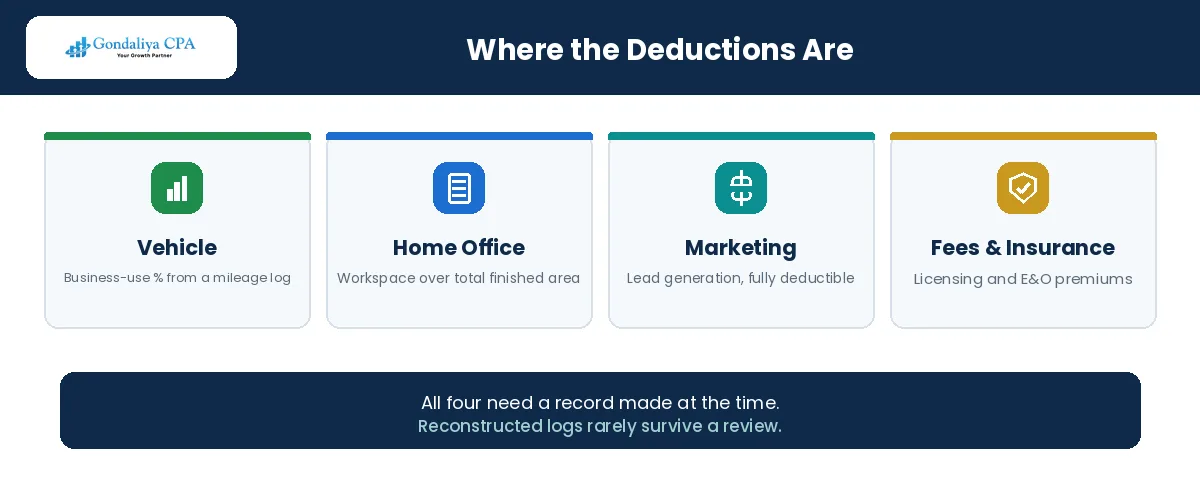
If you’re a mortgage broker in Canada, you might be able to claim a home office deduction. This works if you use part of your home just for work or it’s your main business spot. The CRA uses a workspace test. That means the space must be used regularly and only for business.
To figure out the deduction, measure your office size compared to your whole finished home space. Expenses you can include are utilities, maintenance, property taxes, mortgage interest (not the principal), and rent based on that workspace percentage.
If you run a corporation and get reimbursed by it, keep a written agreement for the reimbursement. The CRA wants good records to prove your workspace qualifies and that expenses are fair. Claiming personal space or too much can lead to problems if audited.
Vehicle Expenses: When and How Mortgage Brokers Can Claim Them
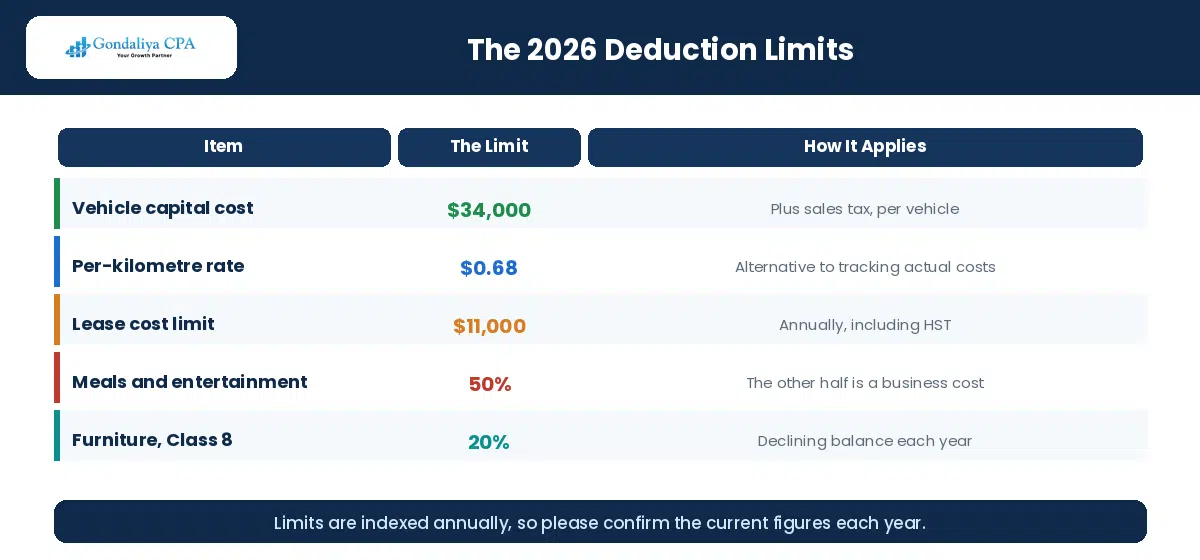
Mortgage brokers who drive clients or go to meetings can claim vehicle expenses. You can deduct costs like fuel, insurance, maintenance, lease payments (up to limits), capital cost allowance (CCA) within set vehicle cost limits (see CRA guidelines) ($34,000 plus sales tax for 2026), and interest on loans with CRA limits.
If you use your own car without tracking all expenses, you can claim $0.68 per kilometre for 2026. But keep a detailed mileage log showing dates and distances for business trips versus total driving.
Deciding between a company car or personal car with mileage allowance depends on things like standby charges and benefits under tax rules. Good records help avoid denied claims during audits.
Here’s a quick look:
- Passenger Vehicle CCA: Deduct business % × allowable CCA; max cost $34K + sales tax; keep purchase invoice and logs.
- Lease Payments: Deduct business % × lease amount; monthly limit applies; keep lease agreement and logs.
- Per-Kilometre Allowance: Flat rate per km ($0.68); mileage log required.
Marketing and Advertising Expenses Specific to Mortgage Brokerage
Mortgage brokers can claim marketing costs tied directly to getting leads if they’re reasonable under CRA rules. This includes online ads like Google Ads, portal fees where leads come from legit Canadian sources licensed by FSRA, print ads in local papers, signage at your office, or event sponsorships in Ontario or Toronto.
Website costs split into two parts: building the site might be capitalized but hosting fees are deductible every year. Ads through foreign media usually don’t qualify unless they target Canadian clients directly.
Keep invoices showing what was paid and when. Also save proof linking these costs to client leads in case of review.
Professional Fees: Legal, Accounting, and Consulting Costs Deductible by Mortgage Brokers
Legal fees related strictly to your mortgage brokerage business count as deductible expenses under the Income Tax Act. Same goes for accounting services like bookkeeping.
Licensing fees required by provincial regulators such as FSRA also qualify as deductions. But club memberships unrelated to work don’t count here.
Insurance premiums protecting against professional liability (errors-and-omissions insurance) are deductible too. Life insurance premiums don’t qualify since they’re personal benefits.
Keep all receipts showing what each fee was for and save copies of licenses renewed yearly—this is important especially in Toronto/Ontario.
Software and Technology Expenses Used in Mortgage Brokerage
Subscriptions to software that you use every day—like CRM tools managing client contacts—and apps for electronic signatures qualify if mainly used for work.
Laptops bought just for work should be capitalized under Class 50 assets but can be expensed immediately if under CRA’s 2026 small asset thresholds.
For phone bills, split costs between personal use and dedicated work lines reasonably. Internet charges follow the same rule—allocate only what applies to your brokerage activities.
Keep subscription invoices clearly dated by billing periods aligned with tax years claimed. If you mix personal with business use, logs help avoid overclaiming rejected by CRA reviews.
Travel Expenses Related to Mortgage Brokerage Business Activities
Travel related only to mortgage brokerage counts if it’s for conferences approved inside Canada or international events meeting certain location tests.
You can deduct accommodation with hotel receipts plus transport fares if travel days match event dates without extra personal days added in.
Training courses that improve mortgage brokering skills qualify as current expenses while long programs needing certification might have to be capitalized instead.
Keep detailed itineraries with purpose notes signed before trips so you prove travel connects directly to earning commission income in Ontario/Toronto areas—this helps when audits check expensive claims from incorporated small businesses.
Office Supplies and Administrative Expenses Recognized by CRA
Everyday office stuff like paperclips, pens, printer ink used only at your brokerage office count as deductible mortgage broker business expenses. Postage stamps sent strictly for client mailings also qualify if there’s no mixed use involved.
Small equipment costing less than capitalization limits can be expensed right away. Bigger furniture needs classification into correct capital cost classes following half-year rule guidelines.
Organize receipts monthly so it’s easier during tax time to reconcile ledgers without headaches—something many mortgage brokers appreciate when filing corporate returns through services like Gondaliya CPA in Toronto serving across Canada.
Brokers underclaim the small recurring items and overclaim the visible ones. The CRM subscription and the licence renewal add up quietly; the car is where the attention goes. Figures changed for privacy.
Key Stat: The 2026 per-kilometre rate is $0.68. Please note this is an alternative to tracking actual costs, not an addition to them, and it still requires the log.
Tax Forms and Documentation for Mortgage Broker Expense Claims
Tax Forms and Documentation for Expense Claims
The Paperwork
When you’re dealing with mortgage broker tax deductions Canada, you need to keep good records. This helps you claim expenses the right way. It also keeps you safe from CRA trouble. Knowing which tax forms to use, how to track your expenses, and how to separate business from personal costs is key.
Key CRA Tax Forms for Mortgage Brokers: T2125 and T776 Explained
If you’re a mortgage broker running your own business in Canada, you mostly use Form T2125. This form lets you report your income and business expenses like vehicle costs, office space, professional fees, and ads[1].
Now, if you get rental income from properties you own or manage, you’ll need Form T776. This one shows your rental income and expenses like mortgage interest[2].
Most brokers just fill out T2125 unless they have rental properties too. When both forms apply, it’s important to split personal and business use carefully — especially for your home office or car — so CRA accepts your claims.
Proper Record-Keeping Practices to Support Expense Claims
CRA says you must keep all receipts and records for at least six years after filing[3]. What should you save? Here’s a quick list:
- Receipts or invoices with date, amount, and vendor
- Bank statements that match payments
- Mileage logs showing trip dates, purpose, and kilometers
- Home office size measurements
- Contracts with partners or contractors
Your mileage log needs details like date, where you went, why (business or personal), and kilometers driven. If the log isn’t done right — say not entered at the time of travel — CRA can reject your vehicle expense claim[4].
You can keep digital copies but make sure they’re clear and complete.
Reporting Rental Income and Related Mortgage Interest Deductions
If you get rent from properties tied to your mortgage business — like investments — report the full rent on Form T776[2]. You can deduct some costs against that rental income:
- Mortgage interest on rented property
- Property taxes for rentals
- Maintenance costs needed for tenants
Only the interest related to earning rental income qualifies here. If it’s for a personal residence loan, it doesn’t count[5].
You must keep loans for personal use separate from those on investment properties to avoid issues.
Documenting Vehicle and Home Office Use for Tax Purposes
Vehicle expenses depend on how you own or lease the car. For passenger vehicles used by brokers driving clients around:
- CRA caps depreciable cost at $34,000 plus sales taxes for 2026[6]
- Lease payments can be deducted up to $11,000 a year including HST[7]
- Loan interest limits also apply
You figure out business use by keeping detailed mileage logs. Then apply that percentage to fuel, repairs, and other car costs[8].
Your home office counts only if it’s your “principal place of business.” That means it’s where most work happens day-to-day[9]. You can deduct utilities based on how much space your workspace takes up in your home. But don’t deduct stuff like mortgage principal payments unless your company reimburses them[10].
Keep measurements and utility bills handy as proof.
| Cost Type | Deductible Portion | Allocation Basis | Records Required | Source |
|---|---|---|---|---|
| Vehicle Operating Expenses | Business-use % | Kilometres driven | Detailed mileage log | CRA |
| Passenger Vehicle CCA Limit 2026 | Max $34K + taxes | Capital cost cap | Purchase invoice | Income Tax Act |
| Lease Cost Limit | Max $11K incl HST annually | Annual lease payments | Lease agreement | CRA |
| Home Office Utilities & Maintenance 2026 | Proportional (% area) | Workspace sq ft / total sq ft | Utility bills + floor plan | CRA – Business Expenses Guide |
Handling Prepaid Expenses and Capital Expenses for Mortgage Brokers
Sometimes prepaid expenses cover less than a year—like insurance premiums—and you can deduct those right away[11].
Other times, what you buy is a capital asset that lasts over a year. For these items, CRA makes you claim depreciation using Capital Cost Allowance (CCA). Furniture usually falls under Class 8 with a 20% declining balance rate[12].
Passenger vehicles fall under Class 10 or 10.1 but face caps on cost[12].
Mortgage brokers should keep an asset register listing what qualifies as immediate expense versus what needs CCA treatment[13].
Additional Mortgage‑Related Fees That Qualify as Business Expenses
Certain professional fees count as deductible expenses if they relate directly to your mortgage brokerage operations[14]:
- Accountant fees for corporate returns[15]
- Legal fees strictly about contracts with clients or brokers
- Licensing fees required by provincial regulators[16]
- Errors & omissions insurance protecting against liability
But not everything makes the cut. For example:
- Life insurance premiums don’t qualify[17]
- Club memberships aren’t deductible unless required for licensing[18]
Keep invoices that clearly show these fees support your commission-based work.
Footnotes
- https://www.canada.ca/en/revenue-agency/services/forms-publications/publications/t4002.html#P179_11484
- https://www.canada.ca/en/revenue-agency/services/forms-publications/publications/t4036/rental-income-guide-t4036.html#s4_1_0_0
- https://www.canada.ca/en/revenue-agency/services/tax/businesses/topics/recordkeeping-business-records.html#howlongkeeprecords
- https://www.canada.ca/en/revenue-agency/services/forms-publications/publications/ic87r3/income-tax-act-deductibility-motor-car-expenses-canadian-controlled-private-corporation-part-i-taxable-income-computation-section-a01a03b04c05d06e07f08g09h10i11j12k13l14m15n16o17p18q19r20s21t22u23v24w25x26y27z28aa29ab30ac31ad32ae33af34ag35ah36ai37aj38ak39al40am41an42ao43ap44aq45ar46as47at48au49av50aw51ax52ay53az54ba55bb56bc57bd58be59bf60bg61bh62bi63bj64bk65bl66bm67bn68bo69bp70bq71br72bs73bt74bu75bv76bw77bx78by79bz80ca81cb82cc83cd84ce85cf86cg87ch88ci89cj90ck91cl92cm93cn94co95cp96cq97cr98cs99ct100cu101cv102cw103cx104cy105cz106da107db108dc109dd110de111df112dg113dh114di115dj116dk117dl118dm119dn120do121dp122dq123dr124ds125dt126du127dv128dw129dx130dy131dz132ea133eb134ec135ed136ee137ef138eg139eh140ei141ej142ek143el144em145en146eo147ep148eq149er150es151et152eu153ev154ew155ex156ey157ez158fa159fb160fc161fd162fe163ff164fg165fh166fi167fj168fk169fl170fm171fn172fo173fp174fq175fr176fs177ft178fu179fv180fw181fx182fy183fz184ga185gb186gc187gd188ge189gf190gg191gh192gi193gj194gk195gl196gm197gn198go199gp200gq201gr202gs203gt204gu205gv206gw207gx208gy209gz210ha211hb212hc213hd214he215hf216hg217hh218hi219hj220hk221hl222hm223hn224ho225hp226hq227hr228hs229ht230hu231hv232hw233hx234hy235hz236ia237ib238ic239id240ie241if242ig243ih244ii245ij246ik247il248im249in250io251ip252iq253ir254is255it256iu257iv258iw259ix260iy261iz262ja263jb264jc265jd266je267jf268jg269jh270ji271jj272jk273jl274jm275jn276jo277jp278jq279jr280js281jt282ju283jv284jw285jx286jy287jz288ka289kb290kc291kd292ke293kf294kg295kh296ki297kj298kk299kl300km301kn302ko303kp304kq305kr306ks307kt308ku309kv310kw311kx312ky313kz314la315lb316lc317ld318le319lf320lg321lh322li323lj324lk325ll326lm327ln328lo329lp330lq331lr332ls333lt334lu335lv336lw337lx338ly339lz340ma341mb342mc343md344me345mf346mg347mh348mi349mj350mk351ml352mm353mn354mo355mp356mq357mr358ms359mt360mu361mv362mw363mx364my365mz366na367nb368nc369nd370ne371nf372ng373nh374ni375nj376nk377nl378nm379nn380no381np382nq383nr384ns385nt386nu387nv388nw389nx390ny391nz392oa393ob394oc395od396oe397of398og399oh400oi401oj402ok403ol404om405on406oo407op408oq409or410os411ot412ou413ov414ow415ox416oy417oz418pa419pb420pc421pd422pe423pf424pg425ph426pi427pj428pk429pl430pm431pn432po433pp434pq435pr436ps437pt438pu439pv440pw441px442py443pz444qa445qb446qc447qd448qe449QF450Qg451qh452qi453QJ454QK455Ql456qm457qn458qo459qp460qq461qr462qs463qt464qu465QV466qw467qx468qy469QZ470ra471rb472rc473rd474re475rf476rg477rh478ri479rj480rk481rl482rm483rn484ro485rp486rq487rr488rs489rt490ru491rv492rw493rx494ry495rz496sa497sb498sc499sd500se501sf502sg503sh504si505sj506sk507sl508sm509sn510so511sp512sq513sr514ss515st516su517sv518sw519sx520sy521sz522ta523tb524tc525td526te527tf528tg529th530ti531tj532tk533tl534tm535tn536to537tp538tq539tr540ts541tt542tu543tv544tw545tx546ty547tz548ua549ub550uc551ud552ue553uf554ug555uh556ui557uj558uk559ul560um561un562uo563up564uq565ur566us567ut568uu569uv570uw571ux572uy573uz574va575vb576vc577vd578ve579vf580vg581vh582vi583vj584vk585vl586vm587vn588vo589vp590vq591vr592vs593vt594vu595vv596vw597vx598vy599vz600wa601wb602wc603wd604we605wf606wg607wh608wi609wj610wk611wl612wm613wn614wo615wp616wq617wr618ws619wt620wu621wv622ww623wx624wy625wz626xa627xb628xc629xd630xe631xf632xg633xh634xi635xj636xk637xl638xm639xn640xo641xp642xq643xr644xs645xt646xu647xv648xw649xx650xy651xz652ya653yb654yc655yd656ye657yf658yg659yh660yi661yj662yk663yl664ym665yn666yo667yp668yq669yr670ys671yt672yu673yv674yw675yx676yy677yz678za679zb680zc681zd682ze683zf684zg685zh686zi687Zj688Zk689Zl690Zm691Zn692Zo693Zp694Zq695Zr696zs697zt698Zu699Zv700Zw701zx702zy703zz704aaa705aab706aac707aad708aae709aaf700aag711aah712aai713aaj714Email…
Published: August 20, 2026 • Last updated: September 29, 2026
Sharad Gondaliya CPA Ontario │ CPA Ontario Registered Firm │1300+ 5-star Google reviews
The forms are the easy part. Whether the claim survives depends on the log, the floor plan and the invoice sitting behind the number on the line. Figures changed for privacy.
Pro Tip: Please photograph or scan the floor plan with measurements once, and keep it with the file. The workspace percentage rarely changes, and having it on hand settles the question immediately if asked.
Creating an Effective Tax-Deductible Mortgage Broker Expense Strategy
Creating an Effective Expense Strategy
The Strategy
Starting with a clear plan is key for mortgage brokers in Canada who want to claim tax deductions. Mortgage broker business expenses must be reasonable and used only for work. You need to keep good records to back up your claims[1]. Common deductions include marketing costs, vehicle expenses based on business use, home office space, professional fees, and software subscriptions.
Here’s how to get the most from mortgage broker tax write offs without trouble:
- Keep personal and business spending separate.
- Save every receipt and track all expenses carefully.
- For mixed costs like phone or internet, split expenses based on how much you use them for work.
- Follow rules about when to capitalize big buys or expense smaller items right away[2].
Having a solid strategy lowers your taxable income but stays within CRA rules. For example, if you spend $5,000 yearly on lead generation in Toronto and it’s all for commissions, you can claim it fully. But claiming your car if you also use it personally needs logs showing business miles.
[1]: CRA Business Expenses Guide
[2]: Income Tax Act Sections 18(1)(a), 20(1)(a)
Monitoring and Adjusting Your Expense Claims Throughout the Fiscal Year
Keep an eye on your mortgage broker tax deductions in Canada all year. Checking your spending monthly against your expected mortgage broker business expenses helps catch mistakes early.
Try these tips:
- Keep mileage logs showing actual kilometers driven for work vs personal trips.
- Review marketing spend before the year ends so you don’t claim anything not related to business.
- Adjust home office utility claims as heating or cooling costs change through seasons.
You might need to tweak claims if actual usage differs from estimates or if CRA changes rules—like updates to vehicle cost limits starting 2026[3].
Reviewing often stops big errors at tax time that might lead to audits. For instance, updating your vehicle use percentage each quarter based on logs keeps your claims accurate.
[3]: CRA Automobile Deduction Limits Update 2026
Integrating Business and Personal Finances for Optimal Tax Savings
Separating business money from personal funds helps maximize mortgage broker tax savings. Mixing them makes tracking expenses confusing and risks audits.
Here are some simple steps:
- Use bank accounts and credit cards just for your brokerage.
- If you use personal money for business bills, pay yourself back officially with paperwork.
- Only claim parts of household costs like utilities that relate directly to your workspace[4].
This keeps things clear when claiming mortgage broker tax write offs and makes bookkeeping easier with apps like QuickBooks or Hubdoc.
For example, if your cellphone bill covers both personal calls and client calls, only deduct the part related to clients. This matters especially in Ontario cities like Toronto.
[4]: CRA Home Office Workspace Guidelines
Understanding Limits and Restrictions on Deductible Mortgage Interest
Mortgage interest on your personal home usually can’t be deducted against income from an incorporated mortgage broker business. The law limits interest deductions unless the loan is strictly tied to earning income[5].
| Type of Interest | Deductible? | Limits | Needed Documents |
|---|---|---|---|
| Interest on commercial mortgages used only by office | Yes | Must allocate if mixed use | Loan agreements; payment slips |
| Personal home mortgages | No | Never deductible | N/A |
| Loans for capital assets like computers | Yes | Follow capitalization rules | Loan papers; asset list |
If you wrongly claim interest on a home mortgage, CRA may reassess your taxes or fine you. Knowing these limits protects you while helping claim all allowed expenses related to offices or equipment in places like Mississauga or Vaughan.
[5]: Income Tax Act Section 18(1)(b); FSRA Licensing Rules
Benefits of Maximizing Tax Write Offs for Mortgage Broker Cash Flow and Growth
Using every legal mortgage broker tax write off can really help cash flow. That extra money means less corporate tax paid across Canadian markets such as Toronto’s Greater Area. You can put saved cash back into growing your team or upgrading tech[6].
Some advantages:
- More funds let you buy better CRM tools that boost sales.
- Lower taxes free up money for targeted local marketing (say between Etobicoke and Scarborough).
- Better profits can attract investors or lenders with improved financing options& 8.
Still, careful planning is needed because rules around car allowances, conference costs, and software write-offs keep changing[9] [10].
Good strategies protect your long-term business while using every deductible dollar allowed by Canadian authorities including FSRA who oversee licensing fees[11].
Need expert advice? Gondaliya CPA offers guidance designed just for incorporated brokers wanting full deduction benefits backed by strong reviews.
References
6 – Canada Revenue Agency Corporate Taxes Overview
7 – FSRA Brokerage Owner Regulations
8 – Industry Report: Commercial Mortgage Brokers Financial Trends
9 – CRA Convention Attendance Limit Updates
10 – Income Tax Regulations Immediate Expensing Provisions
11 – FSRA Licensing Fee Deductions Guidance
Separating the accounts is the single change that saves clients the most time and the most argument. Everything downstream gets easier once personal and business stop sharing a card. Figures changed for privacy.
Risk Warning: Interest on a personal residence mortgage is not deductible against brokerage income. Claiming it is a reassessment waiting to happen, and it draws attention to the rest of the return.
Risks, Limitations, and Considerations When Claiming Business Expenses
Risks, Limitations, and Considerations
The Risks
Mortgage brokers in Canada need to be careful when claiming business expenses. Only costs that directly relate to earning business income count as mortgage broker tax deductions Canada. The CRA will deny claims if expenses are too high or mixed with personal use. For example, claiming all vehicle costs without proper mileage records is risky.
It’s also important to know the difference between capital and current expenses. Big purchases like cars or computers are capital assets. These get written off over time using capital cost allowance (CCA) rules. Passenger vehicle limits apply too—like $34,000 plus tax for certain classes. Prepaid costs must match the right fiscal year.
Keep all proof of expenses handy. Receipts, invoices, and contracts show the CRA that claims are legit during audits. You must keep these records for at least six years after filing your return.
The 2026 rules change some per-kilometre rates and tighten automobile deductions. Mortgage brokers should watch these updates closely when working on their mortgage broker business expenses[1]. Staying up-to-date helps avoid mistakes and gets you the right write offs.
Common Pitfalls to Avoid in Mortgage Broker Expense Deductions
Many mortgage brokers make simple errors that cause problems with their tax write offs:
- Not keeping good records, like missing mileage logs or lost receipts.
- Mixing personal and business use, especially for home office claims.
- Claiming too much for marketing, such as non-business sponsorships.
- Writing off equipment fully instead of using CCA rules.
- Claiming fees not allowed under provincial licensing rules[2].
These mistakes often lead to rejected claims or audits. Good bookkeeping is key. It helps if you review your expenses regularly with someone who knows the mortgage broker business well.
CRA Audit Triggers Related to Mortgage Broker Business Expenses
The CRA often targets certain things when auditing mortgage broker tax deductions Canada:
- Lots of meal or entertainment claims compared to income.
- Vehicle expenses without solid mileage tracking.
- Large home office claims that don’t match your living space.
- Repeated round numbers year after year.
- Payments made without T4A slips for assistants or contractors.
These can make the CRA suspicious of inflated claims[3]. The agency uses data tools to compare your filing against others in Ontario and Toronto. Keeping clear records like contracts helps you avoid trouble and keep your rightful deductions safe.
Managing Market and Interest Rate Risks in Mortgage Interest Deduction Strategies
Interest on loans used only for brokerage work is deductible under Canadian law[4]. But market changes affect interest rates a lot. This impacts how much mortgage broker tax savings you can get.
You must prove the loan supports business activities—not personal stuff. When interest rates go up, your financing costs rise but some planning options might improve too. Paying off loans faster could lower taxable income later.
Review your loan terms yearly with cash flow plans. This helps balance what you owe with how much interest you deduct. Follow FSRA rules that apply in places like Vaughan or Mississauga too.
Psychological and Financial Impacts of Aggressive Tax Planning
Going too far with tax savings can cause stress and money troubles:
- Keeping detailed records gets hard.
- Fear of penalties can hurt your decision making.
- Overly aggressive claims might bring fines or audits.
- Public disputes with the CRA can damage your reputation[5].
It’s better to plan smartly and follow rules carefully. That way, you keep more money after taxes without risking big problems later.
Importance of Professional Consultation with a CPA for Mortgage Broker Taxes
Working with a CPA who knows mortgage broker taxes helps you spot real deductions tailored for Ontario businesses including Toronto††.
A good CPA clears up tricky rules like FSRA licensing fees eligibility. They help set up bookkeeping systems that work well and prepare you if an audit happens.
Gondaliya CPA offers fixed-rate annual help based on years of experience backed by positive client feedback††. They answer questions fast—even weekends—and handle everything from GST/HST filings to corporate cleanups.
You can reach them at info@gondaliyacpa.ca or call 647‑212‑9559 for a free chat about your taxes.
[1]: Canada Revenue Agency – Automobile Deduction Limits & Per-Kilometre Rates (2026 Update)
[2]: FSRA – Licensing Fees Eligibility Under MBLAA Regulations
[3]: Canada Revenue Agency – Common Audit Triggers & Compliance Guidelines
[4]: Income Tax Act Section 18(1)(a) – Interest Deductibility Rules
[5]: CPA Canada – Ethical Considerations & Risk Management In Tax Planning
[††;] Gondaliya CPA internal knowledge base & client experience summary
Round numbers repeated year after year attract attention faster than large ones. A claim that lands on exactly the same figure three years running invites the question. Figures changed for privacy.
Key Stat: Records must be kept six years after the tax year. Please treat that as the minimum, since a reassessment can reach back further where a return was filed late or not at all.
Resources and Support for Mortgage Brokers Seeking Tax Savings
Resources and Support for Tax Savings
The Support
Mortgage brokers in Canada can save money on taxes by knowing which business expenses they can deduct. If you track your mortgage broker business expenses carefully, you can lower your taxable income. Claiming mortgage broker tax write offs properly also helps you avoid trouble with the CRA. Keeping up to date with tax rules means incorporated brokers can feel sure when they file.
Practical Examples Illustrating Mortgage Broker Expense Deductions and Calculations
Here are some simple examples to explain deductions:
- A mortgage broker in Toronto spends $12,000 a year on car costs.
- They use the car 60% of the time for business.
- The CRA allows claims on up to $34,000 of vehicle cost plus 68 cents per kilometre driven in 2026.
- Keeping a mileage log helps prove $7,200 of the vehicle expense is deductible.
Another example involves home office costs:
- If your office is 15% of your home’s size, only that portion of utility bills counts.
- So, if utilities cost $3,600 a year, you can claim $540.
These examples show how to use CRA rules and keep records for valid mortgage broker tax deductions Canada-wide.
Visual Aids: Tax Form Samples and Expense Allocation Tables
Here’s a table to help explain deductible expenses:
| Expense Category | Deductible Portion | Basis of Allocation | Records Needed | Source |
|---|---|---|---|---|
| Vehicle Expenses | Business-use % | Kilometres driven ratio | Mileage log; purchase papers | CRA ITA s.20(1)(a), CCA classes |
| Home Office Costs | Workspace % | Square footage | Floor plans; utility bills | CRA Guide T4044 |
| Marketing & Advertising | Full amount if reasonable | N/A | Invoices; contracts | CRA ITA s.18(1)(a) |
| Professional Fees | Fully deductible | N/A | Receipts | FSRA licensing rules |
This helps show what counts as mortgage broker business expenses and what doesn’t.
How Gondaliya CPA Supports Mortgage Brokers in Maximizing Tax Savings
Gondaliya CPA works closely with Ontario’s incorporated mortgage brokers. Our team checks ledgers carefully to spot every possible mortgage broker tax write off. We follow Income Tax Act rules and FSRA guidelines strictly.
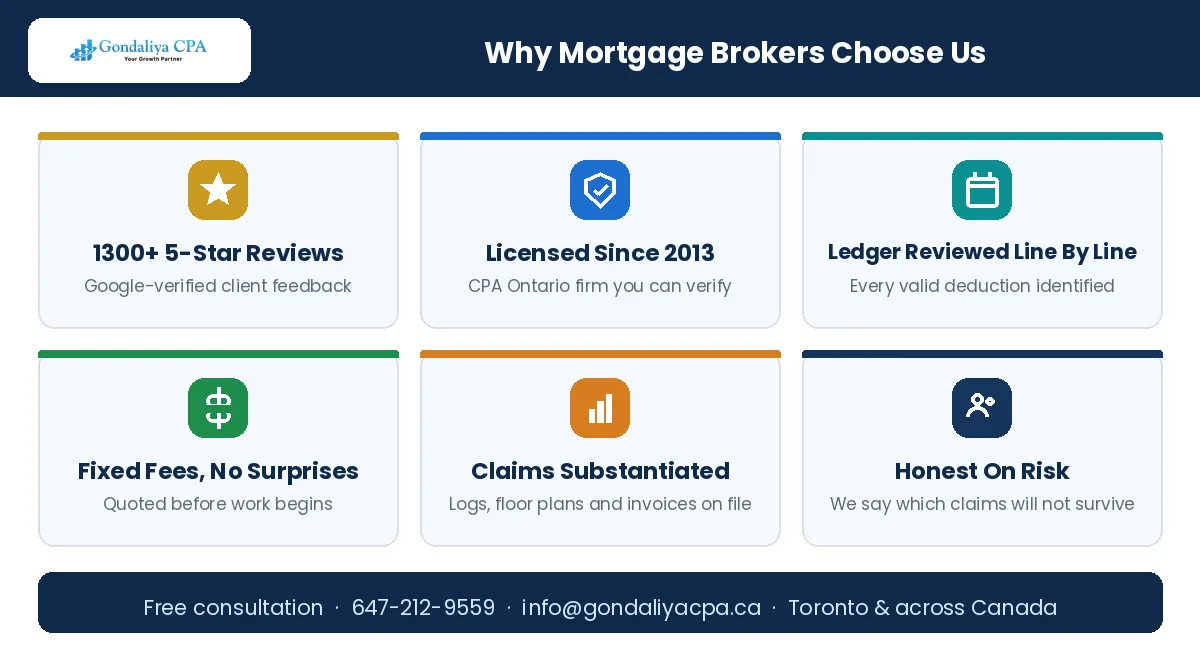
We offer flat-fee annual bookkeeping services focused on claiming deductions safely — like vehicle costs or professional fees. Our firm has more than 1300 five-star reviews from clients around Toronto, Etobicoke, and Vaughan.
We guide clients on good record keeping so they can support their claims easily. This lowers audit risks and improves mortgage broker tax savings all year long.
Links to Official CRA Publications and Relevant Tax Guides
Check these official resources for more details on deductions:
- CRA Business Expenses
- Capital Cost Allowance Classes
- Home Office Expenses
- Vehicle Expenses Rules
Regularly reviewing these keeps you updated on how to handle mortgage broker business expenses in Canada.
Encouraging Professional Advice to Ensure Compliance and Optimize Tax Benefits
Tax rules for deductions can be tricky. If you claim wrong amounts, the CRA may reassess or deny your refund. Getting help from licensed pros who know both federal law (Income Tax Act) and provincial rules (FSRA/MBAAA) avoids mistakes like inflating vehicle costs or home office claims.
Professionals also advise when to buy items or how to label expenses for best cash flow using new Canadian expensing options starting in 2026.
Trying to rely just on internet info risks missing out or making errors in complex cases. This happens often with incorporated agents who mix personal and business assets.
Contact Options for Expert Assistance and Feedback Opportunities
If you want help tailored to your situation with mortgage broker tax deductions Canada-wide:
Call Gondaliya CPA at 647‑212‑9559 or email info@gondaliyacpa.ca for a free no-obligation consult. Our licensed Ontario CPA team answers quickly — usually within one business day — with weekend options too. We serve small businesses all over Toronto, Mississauga, Brampton, Ottawa, Hamilton, and beyond across Canada.
Feel free to send feedback too. We work only to help you claim rightful expenses safely under Canada’s changing mortgage brokerage tax laws.
1: Canada Revenue Agency (CRA), “Per-Kilometre Rates,” accessed April 2026.
2: CRA Publication T4044 – Employment Expenses.
3: Income Tax Act sections relevant to Capital Cost Allowance classes.
4: Financial Services Regulatory Authority of Ontario (FSRA).
5: CRA Audit Risk Indicators – Business Expense Claims.
6: Budget Implementation Act updates effective January 2026 regarding immediate expensing thresholds.
Sharad Gondaliya, CPA, has over ten years helping many Canadian businesses manage taxes right.
The worked example most clients find useful is the simplest one. Sixty percent business use on twelve thousand dollars of car costs is seven thousand two hundred, and the log is what makes it stick. Figures changed for privacy.
Verification: Our CPA Ontario firm registration can be checked on the public firm directory. Please verify any firm you engage before handing over your records.
Frequently Asked Questions on Mortgage Broker Tax Deductions Canada
Frequently Asked Questions
FAQ
What is the T4A slip filing deadline for mortgage brokers?+
Mortgage brokers must file T4A slips by the last day of February following the tax year. Missing this deadline may cause penalties.
How does Capital Cost Allowance Class 8 rate apply to mortgage brokers?+
Class 8 assets depreciate at a 20% declining balance. Brokers use this for furniture and equipment costing over the immediate expensing limit.
What is the records retention period for mortgage broker business expenses?+
Keep all tax-related records for six years after the tax year. This includes receipts, logs, and contracts supporting your expense claims.
Are licensing fees deductible for mortgage brokers in Canada?+
Yes, licensing fees paid to regulators like FSRA are deductible as they relate directly to your brokerage business.
Can association dues be claimed as a tax deduction?+
Only professional association dues linked to your mortgage brokerage work qualify. Personal or unrelated memberships do not.
What insurance deductibles can mortgage brokers claim?+
Deduct premiums for errors and omissions insurance protecting your business. Personal insurance premiums are not deductible.
Are client gifts tax deductible for mortgage brokers?+
You can deduct up to $500 per year on reasonable client gifts that promote your business. Keep receipts and gift details.
What are the meals and entertainment limits for expense claims?+
You can claim 50% of meal and entertainment expenses related to business meetings with clients or partners.
Should I use a company car or personal car with mileage allowance?+
Choose based on cost, convenience, and tax impact. Mileage allowance offers simplicity; company cars require detailed tracking but can yield bigger deductions.
Is errors and omissions insurance deductible as a business expense?+
Yes, premiums for professional liability insurance are fully deductible under CRA rules for mortgage brokers.
How do input tax credits (ITCs) work with GST/HST for brokers?+
You can claim ITCs on GST/HST paid on eligible business expenses if you are registered for GST/HST.
How to differentiate current expenses from capital assets?+
Current expenses are day-to-day costs deducted immediately. Capital assets last longer and must be depreciated using CCA rules.
What deduction claims often trigger a CRA review?+
Large vehicle expenses without logs, excessive home office claims, and high marketing costs may prompt CRA audits.
How do you fix prior-year incorrect deduction claims?+
File an adjustment request with CRA using Form T1-ADJ or through your accountant promptly to correct past errors.
What are best practices to capture every legitimate deduction?+
Keep organized records, separate personal and business expenses, track mileage daily, save all invoices, and consult a CPA annually.
Mortgage Broker Deduction Reviews: Gondaliya CPA Approach
Deduction Reviews, Mistakes and Preparation
Quick Reference
- We review ledgers meticulously to identify all valid deductions.
- Our team verifies documentation against CRA rules.
- We provide clear reports showing potential savings and compliance risks.
- Clients get practical advice on improving bookkeeping systems.
- We offer fixed fees based on service scope—no surprises.
Common Deduction Mistakes and Prevention Tips
- Missing or incomplete mileage logs reduce vehicle expense claims.
- Claiming personal costs as business expenses triggers audits.
- Overlooking capitalization requirements leads to misclassified purchases.
- Ignoring licensing fee eligibility risks denied claims.
- Lack of receipts weakens support during CRA reviews.
Prevent by consistent record keeping and periodic professional reviews.
Preparing For a Deduction Review
Before starting:
- Gather all receipts, invoices, bank statements for the fiscal year.
- Organize mileage logs with dates and purposes documented.
- Prepare contracts related to licensing, insurance, or services purchased.
- List capital asset purchases separately from daily expenses.
- Identify any prepaid amounts or reimbursements received during the year.
Choosing the Right CPA Firm in Toronto/Ontario for Broker Deductions
Look for:
- Experience with mortgage broker clients specifically in Ontario regulations.
- Transparent pricing without hidden fees.
- Strong communication channels including weekend availability.
- Proven track record via client reviews or testimonials.
- Comprehensive service from bookkeeping to audit support.
Gondaliya CPA fits these criteria with over 1300 five-star reviews.
Why Trust Gondaliya CPA?
We specialize in mortgage broker taxation across Canada including Ontario markets like Toronto and Mississauga. Our licensed CPAs deliver tailored strategies respecting CRA compliance while maximizing deductions safely. We update clients on changing tax laws and vehicle deduction limits annually.
Every deduction on this page comes down to the same habit. Record it when it happens, keep the invoice, and the claim looks after itself. Figures changed for privacy.
Broker Segments We Serve
Industry Expertise
Which deduction carries the most weight differs by segment. Here are ten and the main one.
| Broker Segment | The Deduction That Matters Most |
|---|---|
| Residential purchase brokers | Home office and vehicle, both log-dependent |
| Refinance & renewal specialists | Marketing and lead generation spend |
| Private lending & MIC-connected brokers | Interest on funds used in the business |
| Commercial mortgage brokers | Travel and conference attendance |
| Construction & development financing | Capital cost allowance classification |
| Reverse mortgage & senior lending | Professional and licensing fees |
| Brokerage owners & principal brokers | Office premises and administrative costs |
| Team leads with agent splits | T4A slips on amounts paid out |
| Referral-based & part-time agents | Prorating mixed personal and business costs |
| Brokers cross-selling insurance or real estate | Input tax credits on taxable activity only |
- Residential purchase brokers: The two largest claims are also the two most often denied, and both fail for the same reason.
- Refinance and renewal specialists: Lead spend is fully deductible where it is reasonable, which makes the invoice trail worth keeping.
- Private lending and MIC-connected brokers: Interest is deductible only where the borrowed funds genuinely earn business income.
- Commercial mortgage brokers: Conference travel needs the itinerary and the dates to line up with the event.
- Construction and development financing: Equipment coded to the wrong class distorts several years before anyone notices.
- Reverse mortgage and senior lending: Licensing and errors and omissions premiums are straightforward and often understated.
- Brokerage owners and principal brokers: Premises costs replace the home office question entirely, which simplifies the file.
- Team leads with agent splits: Payments without slips are among the fastest ways to attract a review.
- Referral-based and part-time agents: Almost everything is mixed use, so the proration method needs to be consistent.
- Brokers cross-selling insurance or real estate: Input tax credits attach only to the taxable side of the revenue.
The segment changes which deduction dominates. It does not change what makes it stick, which is a record created at the time the money was spent. Figures changed for privacy.
Professional Guidance and Quick Reference
Guidance
Professional Guidance on Deductions: How Gondaliya CPA Maximizes Broker Write Offs
Most mortgage brokers are leaving deductions on the table and defending the wrong ones. The claims worth having are ordinary: vehicle costs supported by a log, a home office measured against the whole finished area, marketing invoices tied to lead generation, and licensing and insurance premiums. Gondaliya CPA reviews the ledger line by line on a fixed annual fee.
We handle what decides the outcome: separating business from personal spending so the claim is defensible, setting a consistent proration method for mixed costs like phone and internet, calculating the workspace percentage from an actual floor plan, applying the vehicle capital cost and lease limits correctly, deciding what gets capitalised and what gets expensed, keeping T4A slips issued on amounts paid to assistants and contractors, and building a file that answers a review before it starts.
Our team will tell you plainly which claims will not survive, which is more useful than a larger number on the return. Whether your records are tidy or not, you get clear advice and a fixed price before we start.
Quick Answers: Key Numbers & Concepts at a Glance
At a Glance
- Vehicle capital cost cap: $34,000 plus sales tax for 2026
- Per-kilometre rate: $0.68 for 2026
- Lease cost limit: $11,000 annually including HST
- Home office basis: Workspace area over total finished area
- Meals and entertainment: 50% deductible
- Client gifts: Up to $500 per year, reasonable
- Furniture: Class 8, 20% declining balance
- Passenger vehicles: Class 10 or 10.1
- T4A slips: Due the last day of February
- Records retention: 6 years after the tax year
Who This Is For / Not For
Fit Check
- For: Mortgage brokers claiming business expenses in Canada, incorporated or self-employed, and those correcting past claims.
- Not For: Inflated or unsupported claims, which we will not prepare and which the audit triggers on this page are designed to catch.
People Also Ask
Related Questions
Can I claim a home office if I also meet clients at a brokerage office?+
It depends on where most of your work actually happens. The workspace has to be your principal place of business or used exclusively and regularly for meeting clients.
Is the per-kilometre rate better than tracking actual vehicle costs?+
Usually not for higher-mileage brokers, since actual costs plus capital cost allowance often exceed the flat rate. Both still require the log.
Do I need receipts if I have bank and credit card statements?+
Yes. A statement proves payment but not what was purchased, and the CRA generally asks for the invoice behind the amount.
Glossary of Key Terms
- Business expense: A cost incurred to earn business income, deductible if reasonable in amount.
- Mileage log: A contemporaneous record of date, destination, purpose and kilometres driven.
- Business-use percentage: Business kilometres divided by total kilometres, applied to vehicle costs.
- Home office deduction: A proportional claim based on workspace area over total finished area.
- Capital cost allowance: The tax deduction for depreciation on eligible assets over time.
- Class 8: The capital cost allowance class for furniture and equipment, at 20% declining balance.
- Class 10.1: The capital cost allowance class for passenger vehicles above the cost cap.
- Current expense: A day-to-day cost deducted in full in the year it is incurred.
- Prepaid expense: An amount paid in advance, deducted in the period it relates to.
- Immediate expensing: Rules permitting the full cost of certain assets to be deducted at once.
- Per-kilometre rate: A flat allowance per business kilometre used instead of tracking actual costs.
- Form T2125: The statement of business activities filed by self-employed brokers.
- Form T776: The statement of real estate rentals filed where rental income exists.
- T4A slip: The slip reporting commissions and other non-employment payments made.
- Input tax credit: GST/HST recoverable on purchases used in taxable activities.
- Reasonableness test: The requirement that a claimed amount be normal for the industry and circumstances.
Deduction Readiness Check
This quick self-check indicates where your operation most likely has room. Please answer the six questions below.
Deduction Readiness Check
Six quick questions on your records. No fee shown.
Points to raise with us:
This is a general prompt, not tax or legal advice or a quote. Your position depends on your full facts. For a real review, please book a free consultation.
Want a checklist to work from? You can download our free broker deduction checklist before your consultation.
Log mileage as you drive. Measure the workspace once and keep the floor plan. Run business spending through separate accounts. Keep the invoice, not just the statement. Apply a consistent proration to phone and internet. Check whether a purchase is capital before expensing it. Issue T4A slips on amounts paid out. Keep everything six years.
2026 Update — what is current: This article notes changes expected in 2026 to commission reporting disclosure tied to FSRA licensing. The six-month T2 deadline, the three-month balance due date, the 28 February slip deadline, the 5% plus 1% late filing penalty, the 50% meals limit and the $3,000 instalment threshold are unchanged. Please note the article cites the GST/HST exemption to Excise Tax Act section 123(1) in one place and Schedule V Part VII in another, and cites the instalment rule to subsection 159(1), so please confirm each reference before relying on it.
Mortgage Broker Tax Deductions Canada: Maximizing Business Expenses and Tax Write Offs with Gondaliya CPA
Create the record when you spend the money
Gondaliya CPA reviews your ledger line by line, sets a consistent proration for mixed costs, calculates the workspace percentage from a floor plan, applies the vehicle and lease limits correctly, decides what is capital and what is current, issues T4A slips on amounts paid out, and builds a file that answers a review before it starts, on a fixed annual fee with a one-business-day response. Please book a free consultation.
Next Steps
Please book a free consultation with Gondaliya CPA and bring your expense records for the year, your mileage log if you keep one, and a note of any equipment bought. Those three tell us immediately which claims are solid and which need supporting before they go on a return. You will get a fixed annual fee before any work begins. If our content helps, please add gondaliyacpa.ca as a preferred source on Google.
Published: August 19, 2026 · Last updated: August 19, 2026
Editorial policy: We research against CRA and CPA Ontario sources, fact-check the figures, and Sharad Gondaliya, CPA, reviews the content, which we update as the rules change.
Disclaimer: This article is educational information only and is not tax, legal, or financial advice. Figures marked illustrative are examples rather than quotes or guarantees. It reflects CRA rules current to 2026, including the $34,000 vehicle capital cost cap for 2026, the $0.68 per-kilometre rate, the $11,000 annual lease cost limit, the 50% meals and entertainment limit, and the six-year record retention requirement. Rates, limits and expensing rules change and outcomes depend on your specific facts. Please consult a CPA Ontario member before acting.

Sharad Gondaliya is a CPA Canada & CPA USA with 15 Years+ experience of Accounting, Tax, Payroll of Corporate Small Businesses as Tax Accountant. He is a CPA Ontario member (61040184) and holds US CPA licences in Washington and Montana and is well known among corporate small businesses for tax planning, efficient tax solutions, and affordable CPA services. Sharad is the Principal (Director) of Gondaliya CPA – Affordable CPA Firm in Canada. Licenses: CPA Ontario: 61040184 | CPA USA (MT): PAC-CPAP-LIC-033176 | CPA USA (WA): 57629 | CPA Firm License: 61330051 View Full Author Bio