



Should a Mortgage Broker Incorporate in Canada? Tax Benefits, Costs and Planning Considerations
Incorporate mortgage broker business in Canada with Gondaliya CPA to understand mortgage broker corporate tax rates, incorporation costs, and the best mortgage broker business structure for your needs. We cover essential topics such as when to incorporate mortgage broker, mortgage broker salary vs dividends, and how corporate tax planning Canada can save you money.
Quick Summary
Incorporation starts paying for itself around $100,000 in gross commissions, provided you can leave money in the company. Below that, the annual compliance cost usually outweighs the saving. Please note that the deciding factor is often regulatory rather than financial, since your brokerage and provincial regulator control whether commissions can be paid to a corporation at all.
| Aspect | Details |
|---|---|
| The threshold | Roughly $100,000 in gross commissions. |
| The gate | Brokerage and regulator approval first. |
| The saving | Deferral, not elimination, unless you retain earnings. |
| The risk | Personal services business reclassification. |
Reading time: 40 minutes.
Table of Contents
- Regulatory Framework and Licensing Requirements
- Sole Proprietorship versus Corporation, and When to Incorporate
- Key Tax Benefits of Incorporating
- Compliance, Costs, and Ongoing Obligations
- Risk Factors and Limitations
- Steps to Set Up and Expert Guidance
- Frequently Asked Questions (FAQs)
- Additional Key Points on Incorporation
- Broker Segments We Serve
- Professional Guidance and Quick Reference
The Numbers That Matter
This article covers Canada, with Ontario and Toronto context, and reflects rules current to 2026. It assumes a licensed mortgage broker weighing incorporation. Figures marked illustrative are examples, not quotes, and any masked engagement notes end with “Figures changed for privacy.” This is educational information only and not tax or legal advice. Whether commissions may be paid to a corporation depends on your brokerage agreement and provincial regulator, so please confirm that before incorporating.
Regulatory Framework and Licensing Requirements for Mortgage Broker Corporations
Regulatory Framework and Licensing Requirements
The Rules
In Canada, mortgage brokers can incorporate their businesses, but they must follow certain rules. Provincial regulators like the Financial Services Regulatory Authority of Ontario (FSRA) set licensing requirements. To incorporate a mortgage broker business, you need to meet rules in the Mortgage Brokerages, Lenders and Administrators Act (MBLAA).
Can a Mortgage Broker Legally Incorporate in Canada?
Yes, mortgage brokers can legally incorporate in Canada. But it depends on following provincial regulations and brokerage agreements. Brokers should check if their brokerage allows commission payments through an incorporated company. Usually, this means getting approval from both the brokerage and regulators before moving ahead.
Overview of regulatory bodies (e.g., FSRA)
In Ontario, FSRA is the main regulator for mortgage brokers. It makes sure all licensed businesses follow consumer protection and market rules. Other provinces have their own authorities, so you need to know local laws.
- FSRA Brokerage Licensing Renewal Cycle: You must renew your license regularly.
- Provincial Licensing Regulations: Rules can change from one province to another.
| Regulator | Role |
|---|---|
| FSRA | Oversees licensing and regulation in Ontario |
| BCFSA | Regulates financial services in British Columbia |
Licensing process and compliance essentials
Once you incorporate as a mortgage broker corporation, you must keep up with these:
- Confirm your corporation fits licensing rules.
- Get written okay from your brokerage to pay commissions to the corporation.
- Learn how commission payments work inside your company.
Skipping any step could cause penalties or even lose your license.
Regional requirements and variations across provinces
When you decide how to incorporate your mortgage broker business, think about:
- Federal vs Provincial Incorporation: Federal incorporation covers all of Canada but has more paperwork. Provincial incorporation is simpler but only works within that province.
- Extra-provincial Registration Requirements: If you do business outside your home province, you might need extra registrations.
Knowing these details helps your business run smoothly no matter where it’s set up.
If you follow these guidelines on incorporating mortgage broker corporations in Canada, you’ll handle licensing and regulations better while enjoying benefits of being incorporated.
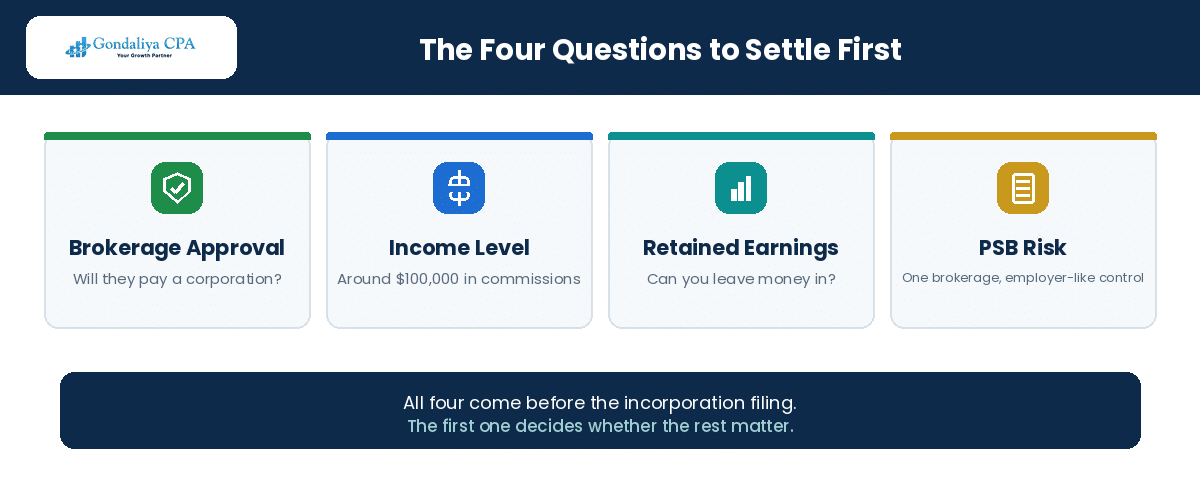
The conversation that saves the most time is the one with the brokerage, not the accountant. If they will not pay a corporation, the tax analysis never gets started. Figures changed for privacy.
Risk Warning: Please get the brokerage’s written agreement to pay commissions to your corporation before you incorporate. Incorporating first and asking afterwards leaves you paying annual filing costs on a company that cannot receive income.
Sole Proprietorship versus Corporation for Mortgage Brokers
Sole Proprietorship versus Corporation, and When to Incorporate
The Comparison
Deciding between a sole proprietorship and a mortgage broker corporation in Canada changes how you handle taxes, liability, paperwork, and growth. It’s important to get this right based on your goals and rules you must follow.
A sole proprietorship is easy to start and run. Your income goes straight onto your personal tax return. The tax rate can be high—up to about 53.53% federally plus provincial taxes in Ontario[1]. You don’t have a legal split between you and the business, so your personal stuff could be at risk if things go wrong.
On the other hand, a mortgage broker corporation creates a separate legal entity. This limits your liability. The company pays corporate tax rates, which are lower—about 12.2% on active business income with the small business deduction in Ontario[2]. This means you might delay some personal taxes if profits stay inside the company. But it costs more to set up and maintain. You’ll need to file T2 returns with CRA on time (six months after your fiscal year ends)[3], send annual reports to Corporations Canada or provincial offices[4], keep detailed records that meet CPA rules[5], and handle payroll if you pay yourself a salary.
Here’s a quick comparison:
| Factor | Sole Proprietor | Corporation | Who It Fits | Source |
|---|---|---|---|---|
| Tax Rate | Personal marginal rate (up to ~54%) | Corporate small-business rate (~12%) | Part-time or low-earning brokers like simplicity; high earners want tax planning | CRA Small Business Deduction [2] |
| Liability | Unlimited | Limited | Brokers wanting asset protection | CBCA / OBCA Sections [4] |
| Setup & Annual Costs | Very low | Incorporation fees + accounting | Brokers ready for formal structure | Corporations Canada Fees [4]; Gondaliya CPA experience |
| Administration | Simple record-keeping | Formal filings + minute book | People comfortable with compliance | CPA Compilation Standards [5] |
| Tax Planning Flexibility | Limited | Salary/dividend mix options | Brokers optimizing their pay |
So, if you make moderate commissions and want simplicity over fancy tax moves or legal protection, sole proprietorship might work fine. But if you expect steady income above $100,000 a year, incorporation could save you money on taxes and let you plan how to pay yourself better.
When to Incorporate a Mortgage Broker Business
Knowing when to incorporate depends mostly on how much commission you make compared to what it costs.
At What Commission Level Does Incorporation Start To Make Sense?
Usually, incorporation pays off when gross commissions hit about $100,000 a year[6]. That number factors in:
- Keeping earnings inside the corporation at the lower small-business tax rates.
- Covering extra costs like government fees ($360 federal filing), NUANS name search ($25, HST included), bookkeeping ($1,200+ yearly), T2 return preparation ($800+), and payroll setup.
- Deferring personal income taxes by taking dividends later instead of cashing out all earnings immediately.
For instance: A mortgage broker in Toronto making $150,000 in commissions might keep $50,000 inside their incorporated mortgage broker corporation. Then they pay themselves an optimized mix of salary and dividends.
When Does Incorporation Not Make Sense?
- Low or changing commissions: If you earn less than ~$80K annually,[7] the extra costs outweigh benefits.
- Need cash right away: If you want all your earnings personally now, deferral doesn’t help.
- Part-time or close to retirement: Short-term plans mean incorporation costs won’t pay off.
- Brokerage rules: Some brokerages don’t allow paying commissions through corporations.
What Happens If You Want To Wind The Corporation Up Later?
- File final T2 return marking when the business ended within six months of closing.[3]
- Give out remaining assets according to who owns shares; watch for capital gains tax depending on what you transfer out.[8]
- Cancel GST/HST accounts if not using them anymore.[9]
- Submit Articles of Dissolution federally or provincially within allowed time (usually two years).[4]
- Keep records for at least six years per CRA rules even after shutting down.[10]
Missing these steps can lead to fines that grow bigger each month until fixed.
Contact Gondaliya CPA today at 647‑212‑9559 or info@gondaliyacpa.ca for your free consultation on whether incorporating your mortgage broker business fits your unique circumstances.
References
- CRA Marginal Rates Ontario – https://www.canada.ca/en/revenue-agency/services/tax/individuals/frequently-requested-information-individuals/marginal-tax-rates.html
- CRA Small Business Deduction – https://www.canada.ca/en/revenue-agency/services/tax/businesses/topics/corporations/small-business-deduction.html
- CRA Corporate Filing Deadlines – https://www.canada.ca/en/revenue-agency/services/tax/businesses/topics/corporations/corporate-income-tax-return.html
- Corporations Canada Filings – https://www.ic.gc.ca/eic/site/cd-dgc.nsf/eng/home
- CPA Compilation Engagement CSRS4200 – https://www.cpacanada.ca/en/business-and-accounting-resources/audit-and-assurance/practice-alerts-and-guidance/compilation-engagement-standard-csrs4200
- Our Actual Experience – Illustrative figures based on client data (Toronto) – Figures changed for privacy
- CRA Administrative Cost Threshold Guidance – Internal policy notes
- Income Tax Act Section 85 Rollover – Department of Justice Canada
- Excise Tax Act Financial Services Exemption – Government of Canada
- CRA Record Keeping Requirements – https://www.canada.ca/en/revenue-agency/services/tax/businesses/topics/recordkeeping.html
The hundred thousand figure holds up in practice, but only where the broker can actually leave money in the company. Someone drawing everything out each year gets deferral and little else. Figures changed for privacy.
Key Stat: Annual running costs of an incorporated brokerage typically start around $2,000 once bookkeeping, the T2 and the annual return are included. That is the number the tax saving has to beat.
Key Tax Benefits of Incorporating as a Mortgage Broker
Key Tax Benefits of Incorporating
The Benefits
Starting a mortgage broker corporation in Canada can save you money on taxes. When you incorporate mortgage broker business, you get access to tax breaks not available if you work solo. For example, you can use the small business deduction. This helps lower your overall tax bill. Also, a corporation lets you spread out income more easily. This adds flexibility when planning your taxes as a mortgage broker in Canada.
Corporate Tax Rates and Professional Corporation Features
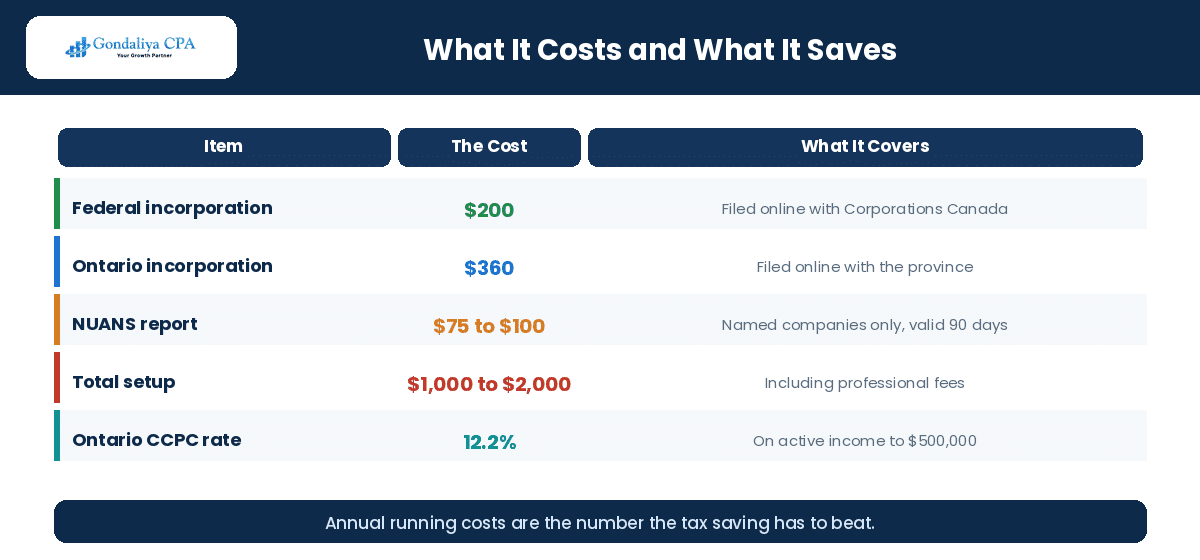
Mortgage broker incorporation Canada offers nice tax perks. In Ontario, most CCPCs pay about 12.2% tax on active income up to $500,000 thanks to the small business deduction limit. That’s way less than personal tax rates over 40%. This means you can keep more cash inside the company at first.
Here are some key points:
- The $500,000 limit counts for all connected companies together.
- Passive income above $50,000 inside your corporation cuts this limit down.
- There’s no specific professional corporation status for mortgage brokers in Ontario.
- You can still incorporate as a standard CCPC if brokerage rules allow commissions paid through corporations.
- Incorporation keeps personal and business money separate.
- You get clearer records that meet CRA standards.
Understanding these points helps in mortgage broker tax planning.
Tax Planning Strategies: Salary, Dividends, and Income Splitting
Using salary and dividends smartly saves tax when you have a mortgage broker corporation.
Salary has perks:
- Builds RRSP contribution room.
- Counts for CPP contributions.
- Comes with payroll deductions.
Dividends:
- Face lower personal taxes because of dividend credits.
- Don’t create RRSP room or CPP benefits.
Mixing salary with dividends often works best. It balances what you need now with future savings and reduces overall tax bills.
You can also do income splitting by giving shares to family members who really help in the business or own holding companies. Then you split dividends among adult family shareholders. This can lower total household taxes if done right and within CRA rules about split income (TOSI).
Finally, keeping profits inside the corporation lets you defer personal tax until you take money out. You can also reinvest those funds into growing your business without paying high personal tax now.
[1] CRA – Small Business Deduction Rate & Limit
[2] Income Tax Act – Associated Corporations Rules (Section 256)
[3] CRA – Passive Investment Income Impact on SBD
[4] CRA Payroll Deductions Tables & T4 Filing Requirements
[5] CPA Canada – Salary vs Dividend Optimization Guide
[6] Income Tax Act Section 120.4 – Split Income Rules
FSRA Licensing Position
Income splitting is the benefit clients ask about most and qualify for least. The split income rules only step aside where the family member genuinely contributes, and that has to be real. Figures changed for privacy.
Risk Warning: There is no professional corporation status for mortgage brokers in Ontario. Please do not assume the liability protections available to regulated professions such as medicine or law apply to your licence.
Compliance, Costs, and Ongoing Obligations for Incorporated Mortgage Brokers
Compliance, Costs, and Ongoing Obligations
The Costs
Incorporation Costs, Professional Fees, and FSRA Requirements
Starting a mortgage broker business in Canada means facing certain costs and rules. You should know these before you decide to incorporate your mortgage broker corporation.
Federal incorporation fees through Corporations Canada run about $200 online. If you go provincial in Ontario, expect $360. Want a named company? Then prepare for a NUANS name search costing $25, HST included. Choosing a numbered company skips this cost. Besides fees, hiring a lawyer or CPA can add $800 to $1,500. They help with articles of incorporation, share plans, minute books, and mortgage broker tax planning.
FSRA (Financial Services Regulatory Authority) sets licensing rules under the Mortgage Brokerages, Lenders and Administrators Act (MBLAA). Some wonder if commissions can flow straight into their corporation. That depends on your brokerage agreement and local laws. Double-check this before you start; otherwise, commissions might only be payable personally despite your corporation setup.
Unlike other regulated fields, professional corporations don’t officially cover mortgage brokers in Ontario or most provinces. So, there is no “mortgage broker professional corporation” status. This matters for liability protections after incorporation.
Think of mortgage broker tax planning as including those upfront fees plus yearly costs like corporate tax filings (T2), payroll if you pay salaries, and bookkeeping fit for financial pros. Don’t forget GST/HST rules under the Excise Tax Act section 123(1).
Main Costs When Incorporating
| Item | Description | One-time / Annual | Notes |
|---|---|---|---|
| Government Filing Fee | Federal ($200) or Ontario ($360) | One-time | Online filing is cheaper |
| NUANS Name Search | Needed for named companies | One-time | $25 (HST included) |
| Professional Advisory Fees | Legal/CPA help with docs & tax planning | One-time | Depends on complexity |
| Minute Book Setup | Keeps corporate records organized | One-time/Annual | Required by law |
| Annual Return Filing | Registry updates every year | Annual | Must file on time |
Confirm FSRA licensing rules early on to avoid changes later. Total startup cost often sits between CAD 1,000 and CAD 2,000 depending on your needs.
Bookkeeping, GST/HST Compliance, and Corporate Tax Filings
After you incorporate your mortgage broker corporation in Canada, keeping clean books is a must. The CRA expects clear records to back up your T2 corporate income tax return and any deductions from mortgage broker tax planning.
Mortgage brokering mostly falls under exempt financial services per the Excise Tax Act Part VII Schedule V. That usually means commissions are zero-rated for GST/HST [CRA IT-496R3]. But there’s a catch:
- If you sell taxable goods or non-exempt services (like insurance), you may need GST/HST registration.
- You can’t claim input tax credits fully on exempt sales but may do so proportionally for mixed supplies.
Using bookkeeping software like QuickBooks or Xero helps separate these revenue types clearly for reporting. Paying yourself a salary means handling payroll accounts with source deductions sent on time per CRA deadlines.
Each year you must file Form T2 within six months after your fiscal year ends [CRA T2 Guide]. Include schedules showing active business income that qualifies for small business deductions up to CAD 500K gross limit. Watch out—passive investment income can reduce this benefit [Income Tax Act sections 125(5)].
Corporate compliance keeps going beyond taxes:
- Keep minute books current with resolutions
- File annual returns on time
- Update Individuals With Significant Control registers yearly
- Issue T4/T4A slips if paying payroll
Skipping these can lead to fines or interest charges per CRA penalty rules [CRA Penalty Guide].
Ongoing Compliance Tasks at a Glance
| Obligation | Frequency | Description |
|---|---|---|
| Bookkeeping Maintenance | Ongoing | Keep accurate records supporting all business activities |
| Corporate Income Tax Return | Annual | File T2 within six months after fiscal year-end |
| Payroll Remittances | Monthly/Quarterly | Remit source deductions on time if paying salary |
| Annual Return Filing | Annual | Update registry with current directors/shareholders info |
| Significant-Control Register Update | Annual | Report individuals who control the corporation |
Incorporated mortgage brokers gain from clear accounting systems helping with mortgage broker tax planning. This includes balancing earnings kept inside the corporation versus personal draws via salary or dividends without running afoul of personal services business rules.
For questions about incorporating your mortgage brokerage in Toronto, Ontario or anywhere in Canada — including detailed FSRA-compliant costs — reach out to Gondaliya CPA’s licensed team at info@gondaliyacpa.ca or call 647‑212‑9559. We offer free consultations to guide you through incorporations while staying fully within regulations backed by over 1300+ five-star Google reviews.
Clients budget for the incorporation fee and forget the annual cost that follows it. The government filing is the small number; the bookkeeping and T2 every year is the real commitment. Figures changed for privacy.
Pro Tip: Please open the corporate bank account before the first commission is paid. Money landing in a personal account after incorporation creates a reconciliation problem that lasts the whole year.
Risk Factors and Limitations of Incorporating a Mortgage Broker Business
Risk Factors and Limitations
The Risks
Incorporating a mortgage broker business in Canada can bring benefits but also some risks and limits. You need to understand these before making decisions about mortgage broker incorporation Canada. This helps you stay compliant and manage mortgage broker tax planning smartly.
Here are key points to keep in mind:
- Incorporation creates a separate legal entity.
- It may affect how taxes apply to your business.
- Some rules can limit your deductions or add extra taxes.
- You must follow provincial regulations carefully.
Personal Services Business (PSB) Risk and Liability Protection
Mortgage brokers who incorporate should watch out for the personal services business (PSB) rules in the Income Tax Act. PSB applies when you mostly work for one client or brokerage that controls your work like an employer. This means the CRA might treat you as an employee, not a business.
If labeled a PSB, you could face:
- Losing many deductions.
- Paying higher corporate taxes.
- Losing small business deduction benefits.
To avoid PSB status, you must show that you work independently. This means having multiple clients or agreements without strict control over your schedule or methods. Reviewing contracts before incorporation is smart to avoid surprises.
Limited liability protection matters too. A mortgage broker corporation protects your personal assets from general business debts. But this does not cover penalties from licensing authorities like FSRA in Ontario if you break professional rules. So, liability protection mainly covers regular business risks, not licensing issues.
Good mortgage broker tax planning means balancing PSB risks with liability benefits. Talking to a CPA who knows corporate structures and mortgage broker rules helps you stay on track.
Record Keeping, Transparency Register, and Audit Considerations
After incorporating your mortgage broker corporation in Canada, accurate records are a must. The CRA wants detailed bookkeeping showing all income, expenses from commissions, payroll if any, GST/HST filings (even though most commissions are exempt), and asset purchases or sales.
Keep these points in mind:
- File annual T2 tax returns within six months after your fiscal year ends.
- Late filing causes penalties and interest on unpaid taxes.
- Maintain a transparency register listing people with significant control (ISC).
- Update this register within 15 days of any changes if required by Corporations Canada.
If you operate in different provinces, keep bookkeeping consistent nationwide because filing deadlines vary. For example, Ontario requires annual returns within 60 days after the anniversary date.
Auditors often check commission flows to ensure they match brokerage agreements and licensing rules. Incorrect billing through your corporation can lead to trouble with regulators like FSRA.
Having professional accounting help with bookkeeping for mortgage brokers Canada-wide reduces audit risk. It also ensures you meet corporate tax filing deadlines on time. That way, you get peace of mind while growing your business after incorporation.
For tailored advice about your situation regarding mortgage broker incorporation Canada, contact Gondaliya CPA at info@gondaliyacpa.ca or call 647-212-9559 for a free consultation focused on compliant structure setup and ongoing tax planning strategies.
The personal services business question is decided by the contract, not the corporation. A broker working under one brokerage with set hours and set methods is the profile the rules were written for. Figures changed for privacy.
Risk Warning: A personal services business loses almost every deduction and pays a higher corporate rate. Please have the contract reviewed before incorporating rather than after the first assessment.
Steps to Set Up a Mortgage Broker Corporation and Accessing Expert Guidance
Steps to Set Up and Expert Guidance
The Setup
Incorporation Process and Documentation
Starting a mortgage broker incorporation in Canada means following several rules. You first decide if you want to incorporate federally or provincially. Then, you pick the company name type — named or numbered — and fill out the papers.
Named vs Numbered Company:
A named company uses a unique business name. This name must pass a NUANS (Newly Updated Automated Name Search) report, which is good for 90 days. This report checks that no one else uses the same name. A numbered company gets a number from Corporations Canada or provincial registries. It doesn’t need a NUANS report but limits branding options.1 Many brokers like named companies for marketing unless they want to save money.
Share Structure Setup:
How you set up shares when you incorporate matters for control and income splitting later on. Usually, businesses create different classes of shares: common shares for voting and preferred shares for dividends.2 Including family members as shareholders can lower tax bills if done carefully, since TOSI (Tax on Split Income) rules apply.3 Articles of incorporation should clearly state share rights, restrictions, and transfer rules to keep things flexible.
Cost Considerations:
The total cost includes government fees and professional service fees like those from CPA firms such as Gondaliya CPA.4 They handle filings, NUANS reports (if needed), preparing minute books, filing your T2 corporate tax return, setting up bookkeeping advice, and payroll registration help. Fees vary: federal incorporation costs $200 online; Ontario incorporation costs $360 online currently.5
Here’s a quick look at typical fees:
- Federal Incorporation Fee: $200 (one-time)
- Ontario Provincial Incorporation Fee: $360 (one-time)
- NUANS Report: $25, HST included (one-time, only for named companies)
- Minute Book Preparation: one-time essential records
- Annual Return Filing Fees: yearly, depends on jurisdiction
Registrations Post-Incorporation:
After incorporation, you must register for these accounts:
- Business Number & Corporate Income Tax Account – automatic with federal incorporation; provincial registration may be needed
- Payroll Account – if you pay salaries with CPP contributions
- GST/HST Registration – usually not required if commissions are exempt under Excise Tax Act section 123(1), but check your commission type first
- Corporate Bank Accounts – keep personal and business finances separate
Make sure all registrations meet CRA deadlines like T2 tax return filings within six months after your fiscal year ends.6
Accounting Support and Tax Planning for Mortgage Brokers
Mortgage broker corporations need smart accounting plans to save on taxes while following Canadian rules.
Salary vs Dividends Decisions Impact RRSP Room & CPP Contributions:
Paying yourself a salary adds to your RRSP contribution room because it counts as earned income. But it also means paying into CPP now.7 Dividends don’t add RRSP room or trigger CPP payments but may lower personal taxes by blending corporate and personal tax rates.8
Choosing between salary and dividends depends on what cash you need now versus saving for retirement later. For example:
- Salary offers steady income that builds RRSP room.
- Dividends give flexible timing without payroll hassles.
Income Splitting Opportunities With Family Members:
You can issue different share classes so family members can receive dividends if they legitimately hold shares in the business or investments. New rules starting in 2026 limit this strategy more than before, especially when passive income passes certain levels affecting small business deductions.910
Proper planning helps avoid TOSI penalties while sharing profits with family members who qualify.
Corporate Tax Rates Applicable To Mortgage Broker Corporations in Ontario (CCPC):
Mortgage broker corporations that qualify as Canadian-Controlled Private Corporations get lower combined federal-provincial rates on active business income up to $600K federally.11
| Jurisdiction | Rate on First $500K Active Business Income (%) |
|---|---|
| Federal Small Business Deduction | 15% |
| Provincial – Ontario Small Business | 3.2% |
| Combined CCPC Rate | 18.2% |
Note: The small business limit reduces if you have associated corporations.
Also, passive investment income above $50K per year within the corporation reduces small business deductions. Some brokers invest outside core operations; that can raise taxes sharply due to clawbacks.11
For mortgage brokers setting up their corporation in Toronto, Ontario, or anywhere across Canada, expert help with naming your mortgage broker corporation and picking share structures helps avoid costly mistakes. Accounting support focused on mortgage broker tax planning plays a key role throughout this process.
Reach out to Gondaliya CPA at info@gondaliyacpa.ca or call 647‑212‑9559 for advice based on years of experience helping brokers just like you.
References:
- Corporations Canada – Naming Your Corporation
- Income Tax Act Sections re Share Classes
- Tax on Split Income Rules – CRA
- Ontario Ministry of Government Services – Incorporation Fees
- CRA Corporate Filing Deadlines
- RRSP Contribution Limits – CRA Guide RC4135-E
- Integration Concept Overview — Department of Finance Canada
- Budget Implementation Act Amendments Effective January 2026 — Department of Finance
- Tax Planning After New Attribution Rules — CPA Canada Insights
- Federal Small Business Deduction — CRA Website
Share structure is the decision people regret skipping. Adding classes later means a reorganisation; setting them up at incorporation costs almost nothing extra. Figures changed for privacy.
Key Stat: A NUANS report is valid for 90 days. Please time the search close to the filing, since an expired report means paying for a second one.
Frequently Asked Questions (FAQs) – Mortgage Broker Incorporation Canada
Frequently Asked Questions (FAQs)
FAQ
What is the Small Business Deduction Limit for mortgage broker corporations?+
The Small Business Deduction Limit for CCPCs in Ontario is $500,000. This cap applies to combined active business income across associated companies.
What corporate tax rate applies to Ontario CCPCs?+
Ontario CCPCs benefit from a combined federal and provincial small business tax rate around 12.2% on qualifying active business income.
What is the typical personal marginal tax rate range for mortgage brokers?+
Personal marginal rates can reach up to approximately 53.53% depending on income level and province.
How long is a NUANS Name Search valid for incorporation purposes?+
A NUANS report remains valid for 90 days when registering a named corporation in Canada.
What is the T2 Corporate Tax Filing Deadline?+
T2 returns must be filed within six months after your corporation’s fiscal year-end.
How often must a mortgage broker renew their FSRA brokerage license?+
FSRA requires regular renewal of brokerage licenses, typically every two years, depending on provincial rules.
When should CRA instalment payments start for an incorporated mortgage broker?+
CRA requires instalments once your net tax owing exceeds $3,000 in either current or previous years.
What are the CRA T4 and T5 slips filing deadlines?+
T4 and T5 slips must be filed by the last day of February following the calendar year in which payments were made.
Who benefits most from incorporating a mortgage broker business?+
Incorporation suits brokers earning over $100,000 annually who seek tax planning and liability protection.
At what commission level does incorporation start to make sense financially?+
Incorporation generally becomes advantageous when gross commissions reach around $100,000 per year.
Is incorporating a mortgage broker business a real tax saving or only a deferral?+
Incorporation offers both tax deferral opportunities and potential savings through lower corporate tax rates and income splitting.
Are you at risk of Personal Services Business (PSB) rules as a mortgage broker?+
You face PSB risks if you work mostly for one client with employer-like control over your work conditions.
Should you choose federal or provincial incorporation as a mortgage broker?+
Federal incorporation allows Canada-wide operation but has more compliance. Provincial suits local businesses with simpler rules.
What is better: Named or Numbered Company for mortgage brokers?+
Named companies help branding but require NUANS reports; numbered companies are cheaper but less marketable.
How does the NUANS report work during incorporation?+
NUANS verifies name uniqueness by comparing it against existing corporate names, reserving it for 90 days.
How should shares be set up at incorporation for income splitting?+
Different share classes with specific voting and dividend rights allow flexible ownership and tax-efficient income distribution.
What does it actually cost to incorporate and run a corporation in Canada?+
Total costs range between CAD 1,000–2,000 initially, plus yearly fees for filings, accounting, and compliance services.
What registrations follow incorporation of a mortgage broker corporation?+
Register corporate income tax accounts, payroll accounts if paying salaries, GST/HST if applicable, and open separate bank accounts.
Additional Key Points on Mortgage Broker Incorporation
Additional Key Points on Incorporation
Quick Reference
- Moving an Existing Broker Business Into a Corporation: Transfer assets via rollover provisions under Income Tax Act section 85 to defer capital gains. Consult experts to avoid pitfalls.
- How Should an Incorporated Broker Pay Themselves?: Use an optimized mix of salary and dividends. Salary builds RRSP room; dividends reduce personal taxes.
- Small Business Deduction Application: Applies only to active business income up to $500K federally; passive income above $50K reduces this limit sharply.
- When Does Holding Company Make Sense for Brokers?: A holding company may protect assets and assist succession planning but adds complexity and costs.
- Compliance Requirements With Corporations: Annual returns, minute books, payroll remittances, transparency registers, and timely T2 filings keep you compliant.
- When Does Incorporation Not Make Sense?: If commissions are under ~$80K or if immediate personal access to cash outweighs deferral benefits, sole proprietorship may be better.
- Winding Up the Corporation: File final T2 return within six months of closing, distribute assets carefully considering capital gains taxes, cancel registrations properly.
- Best Practices After Incorporating: Maintain accurate bookkeeping, update registry info timely, prepare annual reports early, use professional CPA advice regularly.
- DIY vs CPA vs Non-CPA Incorporation Support: CPA firms provide tailored tax planning plus compliance support; DIY risks missing nuances; non-CPA providers may lack specialized knowledge.
- Gondaliya CPA Approach: We offer personalized guidance from naming through share structure setup to ongoing tax planning focused on mortgage broker needs in Canada.
- Deliverables From Gondaliya CPA: Incorporation filing support, minute book setup, T2 corporate filings, payroll advice, FSRA compliance consulting included in our packages.
- Cost of Incorporation & Ongoing Support at Gondaliya CPA: Transparent flat fees covering government filings plus professional accounting help tailored to brokers’ requirements.
- Top Incorporation Mistakes & Prevention: Avoid skipping licensing checks with FSRA; don’t neglect shareholder agreements; meet all filing deadlines to prevent penalties.
- Preparation Before Incorporating: Review brokerage agreements about commission payments; gather financial statements; plan share allocation; understand local licensing rules fully.
- Does Incorporation Fit These 10 Broker Segments We Serve?: We serve part-time brokers seeking growth; high earners aiming for tax efficiency; family businesses wanting income splitting; and brokers expanding across provinces.
- A Realistic Numeric Walkthrough: For example, at $150K commission with $50K retained earnings in corporation reduces personal taxes significantly versus sole proprietorship.
- Choosing the Right CPA Firm in Toronto/Ontario: Look for specialized knowledge in mortgage broker incorporation regulations plus clear communication and transparent pricing like Gondaliya CPA offers.
- Why Trust Gondaliya CPA?: Over 1300 five-star Google reviews attest to our expertise supporting Canadian mortgage brokers with compliant incorporations and effective tax strategies.
For expert help with your mortgage broker incorporation in Canada contact Gondaliya CPA at info@gondaliyacpa.ca or call 647‑212‑9559 today.
The brokers who are happiest with incorporating decided it on a spreadsheet rather than a conversation at a conference. The threshold is real, and below it the costs simply win. Figures changed for privacy.
Broker Segments We Serve
Industry Expertise
Whether incorporation fits differs by segment. Here are ten and the deciding factor.
| Broker Segment | The Deciding Factor |
|---|---|
| Residential purchase brokers | Whether commissions clear the $100,000 threshold |
| Refinance & renewal specialists | Consistency of income across years |
| Private lending & MIC-connected brokers | Passive income eroding the small business deduction |
| Commercial mortgage brokers | Income well above the business limit |
| Construction & development financing | Retaining earnings between project cycles |
| Reverse mortgage & senior lending | Personal services business exposure |
| Brokerage owners & principal brokers | Liability protection and team payroll |
| Team leads with agent splits | Share structure supporting the split |
| Referral-based & part-time agents | Whether the annual cost is justified at all |
| Brokers cross-selling insurance or real estate | Mixed taxable and exempt revenue treatment |
- Residential purchase brokers: The threshold is the whole question, and it assumes you can leave money in the company.
- Refinance and renewal specialists: Income that swings between years makes the deferral benefit less reliable than it looks.
- Private lending and MIC-connected brokers: Investment income inside the company is exactly what erodes the deduction incorporation was meant to capture.
- Commercial mortgage brokers: Above the business limit the general rate applies, which changes the pay mix calculation entirely.
- Construction and development financing: Retaining earnings between projects is one of the strongest arguments for a corporation.
- Reverse mortgage and senior lending: A single dominant relationship raises the personal services business question directly.
- Brokerage owners and principal brokers: Liability protection and payroll for a team usually settle it well before the tax analysis does.
- Team leads with agent splits: Share classes need designing at incorporation rather than added afterwards.
- Referral-based and part-time agents: Below the threshold the annual compliance cost simply outweighs the saving.
- Brokers cross-selling insurance or real estate: Mixed revenue changes the GST/HST position and needs working out before setup.
The segment changes what tips the decision. It does not change the order: confirm the brokerage will pay a corporation, then check the numbers. Figures changed for privacy.
Professional Guidance and Quick Reference
Guidance
Professional Guidance on Incorporation: How Gondaliya CPA Sets Brokers Up Properly
Most mortgage brokers are leaving deductions on the table and defending the wrong ones. The claims worth having are ordinary: vehicle costs supported by a log, a home office measured against the whole finished area, marketing invoices tied to lead generation, and licensing and insurance premiums. Gondaliya CPA reviews the ledger line by line on a fixed annual fee.
We handle what decides the outcome: separating business from personal spending so the claim is defensible, setting a consistent proration method for mixed costs like phone and internet, calculating the workspace percentage from an actual floor plan, applying the vehicle capital cost and lease limits correctly, deciding what gets capitalised and what gets expensed, keeping T4A slips issued on amounts paid to assistants and contractors, and building a file that answers a review before it starts.
Our team will tell you plainly which claims will not survive, which is more useful than a larger number on the return. Whether your records are tidy or not, you get clear advice and a fixed price before we start.
Quick Answers: Key Numbers & Concepts at a Glance
At a Glance
- Vehicle capital cost cap: $34,000 plus sales tax for 2026
- Per-kilometre rate: $0.68 for 2026
- Lease cost limit: $11,000 annually including HST
- Home office basis: Workspace area over total finished area
- Meals and entertainment: 50% deductible
- Client gifts: Up to $500 per year, reasonable
- Furniture: Class 8, 20% declining balance
- Passenger vehicles: Class 10 or 10.1
- T4A slips: Due the last day of February
- Records retention: 6 years after the tax year
Who This Is For / Not For
Fit Check
- For: Licensed mortgage brokers weighing incorporation, and incorporated brokers reviewing whether the structure still fits.
- Not For: Incorporating purely to redirect commissions your brokerage has not agreed to pay a corporation, which creates regulatory rather than tax problems.
People Also Ask
Related Questions
Can I incorporate before my brokerage agrees to pay a corporation?+
You can, but it is usually the wrong order. Without that agreement the commissions remain payable to you personally and the company sits idle while still costing money each year.
Does incorporating protect my licence if something goes wrong?+
No. Limited liability covers ordinary business debts. Regulatory penalties from FSRA attach to the licensed individual regardless of the corporate structure.
Can I move my existing broker business into a corporation without tax?+
Often yes, using a section 85 rollover to defer capital gains on the transfer. It needs to be documented properly at the time.
Glossary of Key Terms
- CCPC: A Canadian-controlled private corporation, eligible for the small business deduction.
- Small business deduction: The reduced federal rate on the first $500,000 of active business income.
- Business limit: The threshold above which the general corporate rate applies.
- Passive investment income: Investment earnings inside the corporation that erode the deduction above $50,000.
- Personal services business: A corporation treated as an incorporated employee, losing most deductions.
- NUANS report: The name search confirming a proposed corporate name is available, valid 90 days.
- Numbered company: A corporation identified by a registry number rather than a chosen name.
- Share class: A category of shares carrying defined voting, dividend and redemption rights.
- TOSI: The tax on split income, applying where family members receive amounts without contribution.
- Minute book: The corporate record holding resolutions, consents, registers and share records.
- Annual return: The yearly registry filing updating directors and corporate information.
- Significant control register: The record of individuals holding significant control over the corporation.
- Section 85 rollover: The provision allowing assets to transfer into a corporation on a tax-deferred basis.
- Articles of dissolution: The filing that formally winds up a corporation.
- Exempt supply: Revenue not subject to GST/HST, on which input tax credits are unavailable.
- Extra-provincial registration: Registration required to carry on business outside the province of incorporation.
Incorporation Readiness Check
This quick self-check indicates where your operation most likely has room. Please answer the six questions below.
Incorporation Readiness Check
Six quick questions on your situation. No fee shown.
Points to raise with us:
This is a general prompt, not tax or legal advice or a quote. Your position depends on your full facts. For a real review, please book a free consultation.
Want a checklist to work from? You can download our free broker incorporation checklist before your consultation.
Log mileage as you drive. Measure the workspace once and keep the floor plan. Run business spending through separate accounts. Keep the invoice, not just the statement. Apply a consistent proration to phone and internet. Check whether a purchase is capital before expensing it. Issue T4A slips on amounts paid out. Keep everything six years.
2026 Update — what is current: This article notes changes expected in 2026 to commission reporting disclosure tied to FSRA licensing. The six-month T2 deadline, the three-month balance due date, the 28 February slip deadline, the 5% plus 1% late filing penalty, the 50% meals limit and the $3,000 instalment threshold are unchanged. Please note the article cites the GST/HST exemption to Excise Tax Act section 123(1) in one place and Schedule V Part VII in another, and cites the instalment rule to subsection 159(1), so please confirm each reference before relying on it.
Incorporate Mortgage Broker Business in Canada with Gondaliya CPA: Mortgage Broker Corporate Tax Rates and Business Structure Explained
Create the record when you spend the money
Gondaliya CPA reviews your ledger line by line, sets a consistent proration for mixed costs, calculates the workspace percentage from a floor plan, applies the vehicle and lease limits correctly, decides what is capital and what is current, issues T4A slips on amounts paid out, and builds a file that answers a review before it starts, on a fixed annual fee with a one-business-day response. Please book a free consultation.
Next Steps
Please book a free consultation with Gondaliya CPA and bring your expense records for the year, your mileage log if you keep one, and a note of any equipment bought. Those three tell us immediately which claims are solid and which need supporting before they go on a return. You will get a fixed annual fee before any work begins. If our content helps, please add gondaliyacpa.ca as a preferred source on Google.
Published: August 19, 2026 · Last updated: August 19, 2026
Editorial policy: We research against CRA and CPA Ontario sources, fact-check the figures, and Sharad Gondaliya, CPA, reviews the content, which we update as the rules change.
Disclaimer: This article is educational information only and is not tax, legal, or financial advice. Figures marked illustrative are examples rather than quotes or guarantees. It reflects CRA rules current to 2026, including the $34,000 vehicle capital cost cap for 2026, the $0.68 per-kilometre rate, the $11,000 annual lease cost limit, the 50% meals and entertainment limit, and the six-year record retention requirement. Rates, limits and expensing rules change and outcomes depend on your specific facts. Please consult a CPA Ontario member before acting.

Sharad Gondaliya is a CPA Canada & CPA USA with 15 Years+ experience of Accounting, Tax, Payroll of Corporate Small Businesses as Tax Accountant. He is a CPA Ontario member (61040184) and holds US CPA licences in Washington and Montana and is well known among corporate small businesses for tax planning, efficient tax solutions, and affordable CPA services. Sharad is the Principal (Director) of Gondaliya CPA – Affordable CPA Firm in Canada. Licenses: CPA Ontario: 61040184 | CPA USA (MT): PAC-CPAP-LIC-033176 | CPA USA (WA): 57629 | CPA Firm License: 61330051 View Full Author Bio