



Mortgage Broker Year-End Accounting Checklist: How to Prepare for Corporate Tax Filing and Maximize Tax Savings
Mortgage broker year end accounting requires precise handling of corporate tax filing deadlines, GST/HST returns, and CRA compliance to avoid penalties. Gondaliya CPA specializes in T2 return preparation, bookkeeping cleanup, payroll slips, and financial statements using tools like QuickBooks and Xero to support mortgage brokers across Canada.
Quick Summary
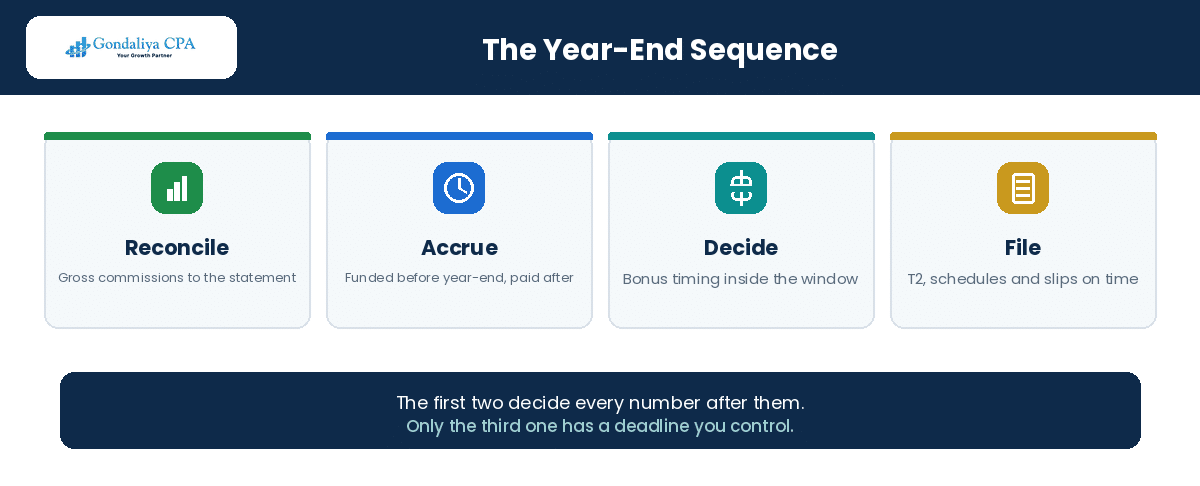
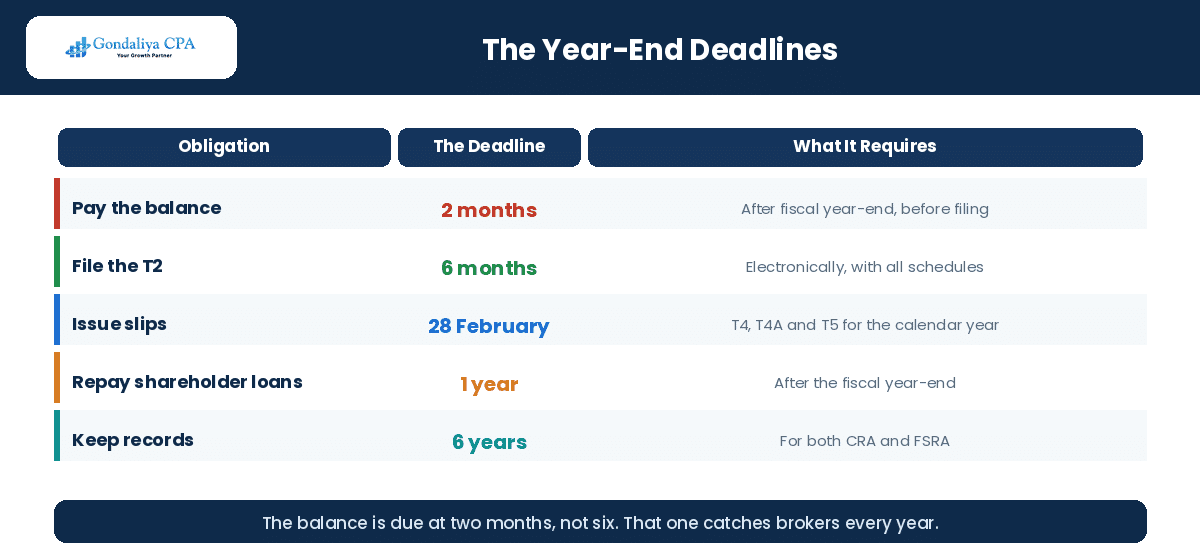
Commission reconciliation is the task that decides whether year-end takes a week or a quarter. Match gross commissions to the brokerage statement, accrue what was funded but not paid, and settle bonus timing before the books close. Please note that the balance is due at two months while the return is due at six.
| Aspect | Details |
|---|---|
| The return | T2 within six months of fiscal year-end. |
| The payment | Balance due two months after year-end. |
| The slips | T4, T4A and T5 by February 28. |
| The records | Six years, for both CRA and FSRA. |
Reading time: 36 minutes.
Table of Contents
- Year-End Accounting Challenges and Key Compliance Considerations
- Corporate Tax Filing Responsibilities
- T2 Filing, GST/HST, and Payroll Slips
- Financial Statements, Bookkeeping Cleanup and Commission Reconciliation
- CRA and FSRA Regulatory Requirements
- Choosing an Accountant
- Frequently Asked Questions (FAQs)
- Key Year-End Tax Items and Best Practices
- Broker Segments We Serve
- Professional Guidance and Quick Reference
The Numbers That Matter
This article covers Canada, with Ontario and Toronto context, and reflects rules current to 2026. It assumes an incorporated mortgage broker preparing for a corporate year-end. Figures marked illustrative are examples, not quotes, and any masked engagement notes end with “Figures changed for privacy.” This is educational information only and not tax or legal advice. Record-keeping obligations differ between CRA and provincial regulators, so please confirm both apply to your situation.
Introduction: Mortgage Broker Year-End Accounting Challenges and Key Compliance Considerations
Year-End Accounting Challenges and Key Compliance Considerations
The Basics
Overview of Mortgage Broker Accounting Needs
Mortgage brokers deal with a tricky accounting setup because they earn mostly from commissions. Their pay changes a lot depending on the deals they close. This makes it tough to keep clear records. So, sorting out your year-end finances takes some effort.
You need a good system to close your books right. This means checking all commissions carefully. Match what you earned with what’s in the brokerage statements. Doing this helps you report everything correctly. It also gives you a clearer picture of your business’s health.
Here’s what you should focus on:
- Track commission income accurately throughout the year
- Understand how to close the books for the year properly
- Reconcile all commission income by matching it with records
Key Compliance Considerations
Deadlines matter when it comes to corporate year-end filings. You have about six months after your fiscal year ends to file the T2 return. Missing this can cause penalties, so plan ahead.
Keeping records is another big deal. Mortgage brokerages must hold onto their documents for around six years from the tax year’s end. The CRA watches this closely.
Also, watch instalment payments closely. If you miss these deadlines, you may get charged interest or penalties by the CRA. Staying on top of your paperwork and timelines smooths out your tax filing process.
Remember these points:
- T2 return filing deadline is six months post fiscal year-end
- Retain financial records for at least six years
- Meet instalment payment due dates without delay
Following these steps helps mortgage brokers handle their corporate tax filing well and stay within Canada’s rules.
The brokers who close their year in two weeks are the ones who reconciled the brokerage statement every month. Everyone else spends the first quarter rebuilding it. Figures changed for privacy.
Risk Warning: The return is due at six months but the balance is due at two. Filing on time and paying late still costs interest, and that catches brokers every year.
Corporate Tax Filing Responsibilities for Mortgage Brokers
Corporate Tax Filing Responsibilities
The Obligations
Mortgage brokers who run corporations in Canada have to follow specific corporate tax filing rules. Good mortgage broker year end accounting helps you report income, expenses, and deductions correctly to the Canada Revenue Agency (CRA). The key step here is timely mortgage broker T2 filing, which shows your corporation’s yearly financial results. If you miss deadlines or send incomplete forms, CRA can charge penalties and interest.
Incorporated mortgage brokers should keep neat records all year long. That means tracking commission statements, payroll, buying assets, and shareholder loans before sending in the T2 return. Working with a mortgage broker accountant Canada-wide makes sure you follow CRA rules. They also help you claim all deductions allowed by law without mistakes.
T2 Corporate Tax Filing Essentials
Every incorporated business in Canada must file a T2 Corporation Income Tax Return. That includes mortgage brokers.1 This form sums up taxable income after removing non-deductible expenses and claiming capital cost allowance. Mortgage broker corporate tax filing needs extra detailed schedules attached to the main return:
- Schedule 1: Adjusts net income by adding back expenses you can’t deduct.
- Schedule 8: Shows Capital Cost Allowance (CCA) claims on assets.
- Schedule 50: Lists shareholders owning more than 10% of voting shares.
- Schedules 100 & 125: Show the balance sheet and retained earnings statement.
A licensed mortgage broker accountant Canada-based also makes sure electronic filing follows CRA’s e-filing rules coming in 2026.2 Filing online speeds up processing and lets you get your notice of assessment quicker.
Keep these points in mind:
- Choose a fiscal year-end that matches your business cycle or preferences.
- Report all commissions earned as gross income—not net—to avoid underreporting.
- Record bonuses paid within the allowed time frame to get tax deductions under section 18(1)(a) of the Income Tax Act.3
Leaving out schedules or entering wrong data might cause CRA to review or audit your files. CRA auditors focus on financial service industries like brokerage firms.
Importance of Proper Business Structure
Picking the right business structure matters for taxes and liability if you’re an incorporated mortgage broker. A good setup makes bookkeeping easier for year-end accounting done by a skilled mortgage broker accountant Canada recognizes.
Common structures include:
- Corporations with a single shareholder
- Holding companies paired with operating companies
- Partnerships that convert into corporations with multiple shareholders
Your choice affects how dividends or salaries get taxed,4 whether you qualify for small business deduction limits,5 and how shareholder loans get handled under section 15(2).6
Proper structuring also handles licensing rules set by FSRA Ontario7, so you don’t lose your right to bill commissions.
Getting advice early means choosing incorporation options that fit your long-term plans. This also smooths out yearly filings like T2 returns. It helps avoid missed deductions or accidental personal benefits that could raise your taxes during audits.
[^1]: CRA – Guide RC4029 – Corporations Income Tax Guide
[^2]: CRA – Mandatory Electronic Filing Requirements (2026 update)
[^3]: Income Tax Act Section 18(1)(a) – Deductibility of Bonuses
[^4]: Income Tax Act Sections on Salary vs Dividend Treatment
[^5]: Small Business Deduction Rules – CRA Documentation
[^6]: Income Tax Act Section 15(2) – Shareholder Loan Repayment Window
[^7]: FSRA Ontario – Mortgage Brokerages Licensing Guidelines
For help with corporate year-end accounting and full T2 filing support across Toronto, Vaughan, Mississauga, Brampton, Ottawa—and beyond—contact Gondaliya CPA at info@gondaliyacpa.ca or call 647‑212‑9559 today.
Reporting commissions net of the split is the error we correct most often. It understates income, and the brokerage statement the CRA can request shows the gross figure. Figures changed for privacy.
Key Stat: Schedule 50 discloses shareholders holding more than 10% of voting shares. Please keep it current, since ownership changes made mid-year are routinely missed at filing.
T2 Filing, GST/HST, and Payroll Slips: What Mortgage Brokers Must Prepare
T2 Filing, GST/HST, and Payroll Slips
The Filings
Preparing for T2 Filing
Mortgage broker year end accounting means getting your records in order before tax time. The main form is the T2 Corporation Income Tax Return. Every incorporated mortgage brokerage in Canada needs to file this each year with the CRA. A mortgage broker accountant Canada trusts can help you pull together financial statements, check commission income, and list deductible expenses.
Before you file your mortgage broker T2 filing, double-check your bookkeeping is complete and matches your fiscal year-end. This includes bank statements, commission reports, payroll info if you have employees, capital asset purchases with CCA rules, and shareholder loans. Missing or wrong info can slow down your return or even trigger an audit.
Since 2026, you must send your T2 return electronically through certified software using CRA’s EFILE system[1]. Paper forms aren’t accepted anymore unless you get special permission first. Make sure your accountant uses software that fits this rule—QuickBooks linked with tax software works well for smooth filing.
Here’s an example: a Toronto-based commercial mortgage broker finished bookkeeping by mid-January after a December 31 year-end. Their CPA gathered all financial info like Schedule 100 (Balance Sheet) and Schedule 125 (Income Statement). They filed electronically on March 30—well before the six-month deadline—and included all required schedules as per CRA instructions[2].
GST/HST Obligations
Incorporated mortgage brokers who provide taxable services need to follow GST/HST rules from the Excise Tax Act[3]. Most commissions are exempt financial services. But some referral fees or extra services might have GST/HST charges.
Check if you cross the $30,000 revenue mark over four calendar quarters; if yes, you must register for GST/HST. Once registered, you have to file returns showing taxes collected and input tax credits claimed on taxable business costs.
At year-end, clean up by confirming all input tax credits are correctly claimed without including exempt items[4]. Reconcile sales invoices with tax remittances carefully to avoid penalties from CRA audits.
For example: a refinance expert in Ontario registered for HST files quarterly returns using Xero linked with Stripe payment processing. Their accountant makes sure MIC commissions are treated as exempt but claims HST paid on rent fully through ITCs.
Payroll and T4/T5 Slips
Payroll compliance is key for incorporated brokers who pay staff or themselves salaries that include CPP and EI contributions under the Income Tax Act[5].
By year-end, employers must prepare accurate T4 slips showing employment income paid and source deductions withheld. Referral fees paid as other income need T4A slips[6]. Dividends paid out require T5 slips.
Deadlines matter: federal payroll slips must be filed electronically by February 28 after calendar year-end. Late filing causes penalties based on how many slips you report[7]. Check remittance totals match amounts deducted monthly or quarterly to avoid interest charges even if filings are on time.
A case in point: a Mississauga team lead used ADP integrated with Wagepoint payroll software; their CPA checked slip accuracy against payroll registers before filing electronically by CRA’s 2026 deadlines[8].
References
- Canada Revenue Agency – Mandatory Electronic Filing Requirements for Corporations
- CRA Guide RC4400 – Completing Your Corporation Income Tax Return
- Excise Tax Act Part VII Financial Services Definition
- CRA Input Tax Credits – Exempt Supplies Rules
- Income Tax Act Sections Regarding Payroll Deductions
- CRA Information Circular IC75-17R9 – Reporting Payments Made To Others
- CRA Penalties For Late Slip Filing And Remittance Interest Charges
- FSRA Guidelines On Brokerage Records And Commission Statements Compliance
Input tax credits claimed against exempt commission revenue is the GST/HST error that surfaces most. Registration for a small taxable side activity does not open credits on the whole business. Figures changed for privacy.
Pro Tip: Please reconcile payroll remittances against the slip totals before filing. Slips filed on time that disagree with what was remitted still generate interest and a follow-up letter.
Financial Statement Preparation, Bookkeeping Cleanup, and Commission Reconciliation
Financial Statements, Bookkeeping Cleanup and Commission Reconciliation
The Books
Getting your financial statements right is key for mortgage broker year end accounting and corporate tax filing. These statements show how your incorporated brokerage really performed. They also set the stage for your mortgage broker T2 filing. Cleaning up bookkeeping and reconciling commissions help make sure those numbers are correct. This lowers mistakes that can cause CRA to question your returns or slow down filings.
Financial Statement Preparation
Preparing financial statements matters a lot when you handle mortgage broker corporate tax filing. An accountant puts together reports like the trial balance, income statement, balance sheet, and cash flow statement. They follow ASPE rules or CSRS 4200 compilation standards[1]. These reports show every transaction for the fiscal year. They support accurate info on Schedules 100 (Balance Sheet) and 125 (Income Statement) in the T2 form.
Mortgage brokers in Canada must split revenue properly — like gross commissions versus net amounts — plus list expenses for operations, payroll, marketing, and depreciation through Capital Cost Allowance schedules[2]. Mistakes here can change taxable income or affect deduction limits.
Here’s what usually happens in preparation:
- Link general ledger accounts with CRA’s GIFI codes.
- Check all commission income against brokerage records.
- Sort expenses to fit allowed deductions.
- Review shareholder loans as per section 15(2) rules.
Doing this well helps file mortgage broker T2 returns on time and keeps audit issues low.
Bookkeeping Cleanup
Cleaning up bookkeeping before year-end is needed for your mortgage broker year end accounting checklist: how to prepare for corporate tax filing and maximize tax savings. It means matching bank accounts, fixing invoice or receipt errors, clearing mistakes, and making sure all transactions fall into the right fiscal period[3].
Look closely at these points:
- Match deposits from clients or referral fees correctly.
- Handle prepaid expenses by spreading costs over time instead of writing off too soon.
- Adjust accrued liabilities like bonuses payable within tax deduction periods.
- Keep fixed asset lists updated with new purchases that may qualify for immediate expensing under Income Tax Act changes starting in 2026[4].
If you skip cleanup, profits might be off. That can mess up instalment payments or cause missed deductions. A tidy ledger also makes it easier for your mortgage broker accountant Canada team at Gondaliya CPA to work accurately.
Accurate Commission Reconciliation
People often ask “how do you reconcile commission income at year-end?” It’s a tricky step for many incorporated brokers in Ontario[5]. This process makes sure the revenue you report matches commissions earned according to brokerage records. It also handles timing gaps between deal funding dates and statement dates.
Key steps include:
- Check deal numbers on brokerage commission statements against internal sales logs.
- Report gross commissions received — not just net splits — unless contracts say otherwise. This prevents understating income which CRA flags[6].
- Count deals closed but unpaid as accrued income if funded before year-end but paid later — this follows accrual accounting under Canadian GAAP[7].
- Record volume bonuses earned during the fiscal year even if paid after year-end by making proper accrual entries; this avoids losing deductions due to bonus timing rules in the Income Tax Act[8].
- Track clawbacks happening after year-end separately so they don’t mess with current-year results but adjust future ones.
If you skip good reconciliation, taxable income might be wrong. This risks reassessments or fines from CRA’s corporate tax division that oversees brokers running corporations across Toronto and wider Canada.
For help with your books before deadlines call Gondaliya CPA at 647‑212‑9559 or email info@gondaliyacpa.ca today for a free consultation focused on incorporated mortgage brokers throughout Ontario including Toronto, Mississauga, Vaughan, Brampton among others.
[^1]: CPA Canada – Compilation Engagements Standard CSRS 4200
[^2]: CRA Guide T4012 – Corporate Tax Filing Requirements
[^3]: FSRA Mortgage Brokerages Record-Keeping Rules
[^4]: Income Tax Act Amendments Effective January 2026 – Immediate Expensing Provisions
[^5]: FSRA Compliance Bulletin – Brokerage Commission Statements Accuracy
[^6]: Income Tax Act Section 18(1)(a) Revenue Recognition Principles
[^7]: ASPE Handbook Section 1100 – Accrual Basis Accounting
[^8]: ITA Bonus Payment Window Rules – Paragraphs relating to deductible bonus timing
Deals funded in December and paid in January are where most year-end disputes start. Accrue them and the numbers hold; leave them out and the following year carries income that belonged to this one. Figures changed for privacy.
Risk Warning: A bonus accrued but not paid inside the allowed window loses the deduction entirely. Please diarise the payment date at the same time as the accrual entry.
CRA and FSRA Regulatory Requirements for Mortgage Brokerages in Canada
CRA and FSRA Regulatory Requirements
The Regulators
Mortgage brokers need to follow rules set by both the Canada Revenue Agency (CRA) and the Financial Services Regulatory Authority (FSRA). These rules cover mortgage broker year end accounting, corporate tax filing, and T2 filing. Incorporated mortgage brokerages have specific duties. They must file taxes on time, keep good records, and meet FSRA standards. Knowing these rules helps avoid fines and makes year-end work easier.
Understanding CRA Audit Triggers
CRA audits can happen when mortgage brokers make mistakes in their corporate tax filing. Some common triggers include:
- Differences between reported income and brokerage records
- Claiming expenses without proof
- Filing T2 returns late
A mortgage broker accountant Canada can spot these issues early by checking documents carefully before submission. For example, not reporting clawbacks or using net instead of gross commissions might cause a CRA audit[1]. Keeping clear records lowers the chance of problems.
CRA Guide T4012 – Corporate Tax Filing Instructions
Common Red Flag Areas for Mortgage Brokerages
Mortgage brokers often miss key steps on their year end accounting checklist. Some frequent problems are:
- Not fully reconciling commission income
- Failing to accrue bonuses on time
- Wrongly reporting shareholder loans under section 15(2)
- Ignoring capital cost allowance rules
These issues come up during T2 filing reviews. Also, missing receipts for things like vehicle use or home office claims can lead to denied deductions[2]. Brokers should keep detailed records all year long instead of waiting till the end.
Income Tax Act sections 18(1)(a), 20(1)(c)
Documentation Best Practices
Good documentation is key for smooth mortgage broker year end accounting. Your accountant will want:
- Bank statements
- Detailed commission reports
- Payroll records like T4 slips if you have employees
- Lease agreements for offices or vehicles used in business
- Previous years’ CRA notices of assessment
- Minutes showing shareholder decisions about loans or dividends
- Receipts for all expenses claimed
Using digital tools like Hubdoc with QuickBooks helps organize these documents before corporate tax filing deadlines[3]. Labeling files by date and type saves time during reviews by your mortgage broker accountant Canada.
CPA Ontario Guidance on Record Keeping Best Practices
FSRA (Financial Services Regulatory Authority) Compliance
FSRA requires mortgage brokers in Ontario to keep records for usually six years under MBLAA rules[4]. This includes commission statements from your brokerage and trust account reconciliations when relevant.
Not following FSRA’s record rules can hurt your license—even if your federal taxes are correct. Your accountant should work with compliance staff to make sure your corporate filings meet both federal and provincial standards related to mortgage broker corporate tax filing.
FSRA Guidelines on Brokerage Records & Trust Accounts
Mandatory Filings and Forms
Incorporated mortgage brokers must file a full T2 return every year. Important schedules include:
- Schedule 50 (Shareholder Information)
- Schedule 8 (Capital Cost Allowance)
- Schedule 100 (Balance Sheet)
Other filings may be needed:
- Payroll slips like T4s/T4As for salaries or commissions paid
- Slips for referral fees if applicable
- T5 slips for dividends paid
All forms must be submitted electronically since mandatory e-filing started with fiscal periods ending January 2026[5]. Missing any required forms can lead to penalties. Working with an experienced mortgage broker accountant Canada reduces those risks.
CRA Corporation Income Tax Guide
Finance Act Update – Mandatory Electronic Filing Effective Jan 2026
Licensing and Trust Account Oversight
Licensing rules differ by province but usually don’t allow commissions to go through personal accounts outside approved corporations per FSRA’s view of MBLAA[7]. Managing trust accounts correctly is vital when handling client funds before deals close.
Your accountant helps make sure trust funds match monthly brokerage statements. They also check that business cash stays separate in company ledgers[8]. This keeps licenses safe and provides clear audit trails needed for inspections and clean tax filings.
FSRA Compliance Bulletin – Trust Accounting Controls
For expert advice designed just for incorporated Canadian mortgage brokers dealing with complex regulatory requirements, contact Gondaliya CPA at info@gondaliyacpa.ca or call 647-212-9559 today. We offer free consultations focused on Toronto-area clients across the country.
Two regulators, two record-keeping obligations, one set of documents. Brokers who satisfy the CRA and forget FSRA can end up compliant on tax and exposed on licence. Figures changed for privacy.
Key Stat: Both CRA and FSRA expect roughly six years of records. Please keep one set that satisfies both rather than maintaining separate files for each.
Choosing an Accountant: Specialized Services and Process for Mortgage Brokers
Choosing an Accountant
The Firm
Picking the right accountant matters a lot if you’re a mortgage broker. You want someone who knows how to handle mortgage broker year end accounting and corporate tax filing without stress. A mortgage broker accountant Canada trusts understands the details that affect your business. They follow CRA rules carefully while helping you keep more of your money through deductions. This makes your year-end accounting smoother and cuts down chances of mistakes or audits.
Qualities of a Mortgage Broker Accountant
A good mortgage broker accountant Canada needs to get your business inside out. They should know how commissions work, what FSRA record-keeping means, and all the corporate tax rules for incorporated brokers. Knowing how to file accurate T2 returns that fit mortgage brokers is key.
Here’s what to look for:
- Industry experience: They understand refinancing fees, referral income, commission structures, and clawbacks.
- CRA compliance: They keep up with electronic T2 filing rules starting 2026, slip deadlines like T4s, instalment payments, and payroll rules.
- Tech skills: Comfortable with QuickBooks or Xero tied into commission tracking software.
- Clear communication: Explains tax planning options before year end and talks through after-the-fact filings.
- Dependability: Replies within one business day, plus weekend help if needed.
With these skills, your accountant can handle tricky stuff like shareholder loans under section 15(2) or capital cost allowance claims that follow half-year rules without messing up your deductions.
Engagement and Onboarding Process
Starting with a pro firm for mortgage broker year end accounting means they’ll guide you step-by-step. First, they gather all the papers early on: bank records, commission reports that match FSRA standards, payroll info like T4 data, lease contracts if needed, plus past CRA letters or disputes.
Typical steps include:
- Chat about choosing your fiscal year end based on business cycles.
- Send a detailed list of needed documents — digital copies preferred.
- Clean up bookkeeping records if behind before working on T2 filing.
- Plan meetings before year-end about bonuses within CRA allowed timing.
- Confirm you can access cloud accounting tools used in compiling reports per CSRS 4200.
This method cuts surprises at tax time and lets you plan taxes smartly so cash flow stays healthy by managing instalments right.
Ongoing Support and Tax Planning
Mortgage broker corporate tax filing isn’t just one-time work. Ongoing support matters all year to keep up with changes and avoid surprises.
They help by:
- Watching instalment payments quarterly so you don’t owe interest on missed amounts.
- Advising what expenses you can claim—like FSRA licensing fees—without mixing in personal costs that aren’t deductible.
- Checking receipt accuracy before each quarter ends to help with GST/HST credits under financial service exemptions.
- Helping reply fast to any CRA questions about assessments or audits while keeping documents safe as required (at least six years).
This steady help stops late filing penalties and keeps your deductions solid despite complex mortgage broker commissions.
For help tailored to incorporated mortgage brokers in Toronto or Ontario handling their corporate year end accounting — including precise T2 filing — contact Gondaliya CPA at 647‑212‑9559 or info@gondaliyacpa.ca for a free consultation today.
[^1]: Canada Revenue Agency – Mandatory Electronic Filing Requirements for Corporations (2026).
[^2]: Income Tax Act Sections 15(2), 20 – Shareholder Loan Rules & Capital Cost Allowance Half-Year Rule Guidance.
[^3]: Financial Services Regulatory Authority Ontario – Brokerage Record-Keeping Obligations Under MBLAA Regulations.
[^4]: CRA Guide RC4400 – Accrued Bonus Payment Window Rules Before Year-End Close Deadlines.
[^5]: CPA Canada CSRS 4200 Compilation Engagement Standards Applicable To Small Business Clients Including Incorporated Brokers Documentation Requirements (2026).
[^6]: CRA Instalment Payments Guide – Monthly vs Quarterly Options For Corporate Taxes And Interest Calculations On Shortfalls Effective For Fiscal Years Ending In Or After January 2026 .
[^7]: Excise Tax Act Part VII Schedule V – GST/HST Exemptions Related To Financial Services Provided By Mortgage Brokers And Input Tax Credit Eligibility Criteria .
[^8]: Income Tax Act Section 230 Records Retention Periods For Corporate Entities Subject To Audit Or Review By The Minister Of National Revenue .
The most valuable thing an accountant does for a broker happens in November, not April. By the time the year has closed the bonus and instalment decisions are already made. Figures changed for privacy.
Verification: Our CPA Ontario firm registration can be checked on the public firm directory. Please verify any firm before handing over your commission records.
Frequently Asked Questions (FAQs) on Mortgage Broker Year-End Accounting and T2 Filing
Frequently Asked Questions (FAQs)
FAQ
What is the mortgage broker year-end accounting checklist?+
The checklist includes reconciling commission income, reviewing capital purchases, accruing bonuses, preparing financial statements, verifying payroll slips, and confirming document completeness before filing.
How do I prepare for corporate tax filing as a mortgage broker?+
Organize all financial records, reconcile commissions, finalize bookkeeping, review shareholder loans, calculate instalments due, and submit accurate T2 returns on time.
How can mortgage brokers maximize tax savings?+
Maximize deductions by tracking eligible expenses, timing bonus payments before year-end, using capital cost allowance claims properly, and managing shareholder loans within CRA rules.
What is involved in the mortgage broker T2 filing process?+
It includes compiling financial statements, completing required schedules (Schedule 1, 8, 50), validating data accuracy, and electronically filing the T2 return before the deadline.
Who should I choose as my mortgage broker accountant in Canada?+
Select an accountant with industry experience in mortgage brokerage accounting, knowledge of CRA regulations, strong communication skills, and proficiency with QuickBooks or Xero.
When is the T2 return filing deadline for incorporated mortgage brokers?+
The T2 return must be filed within six months after the corporation’s fiscal year-end to avoid penalties.
What is the balance due date for corporate taxes?+
Corporate taxes are due two months after the fiscal year-end; late payments may attract interest charges.
What are penalties for late T2 filing?+
CRA charges penalties based on how late the return is filed; repeated delays increase penalty amounts significantly.
When must payroll slips be filed?+
T4/T5 and other slips must be filed electronically by February 28 following the calendar year-end to avoid penalties.
How long should mortgage brokers retain financial records?+
Maintain all financial records for a minimum of six years from the end of the tax year as required by CRA and FSRA rules.
When are instalment payments due for incorporated brokers?+
Instalments are generally due quarterly based on estimated taxes; missing deadlines results in interest charges.
What is the commission payment accrual window?+
Commission income should be accrued when earned (deal funded), even if payment occurs after fiscal year-end under accrual accounting principles.
What is the shareholder loan repayment window?+
Shareholder loans must be repaid within one year after fiscal year-end to avoid deemed benefits and additional taxes under section 15(2).
Key Year-End Tax Items for Mortgage Brokers: Before vs After Year-End
Key Year-End Tax Items and Best Practices
Quick Reference
- Review capital asset purchases to claim Capital Cost Allowance before year-end.
- Decide on paying bonuses or dividends prior to fiscal close for tax deductibility.
- Close books accurately by reconciling commissions earned but unpaid.
- Prepare all payroll slips (T4/T5) timely post calendar year-end.
- Validate shareholder loan accounts to comply with CRA repayment rules.
Essential Documents Needed by Your Mortgage Broker Accountant
- Bank statements matching fiscal period transactions.
- Detailed commission reports per brokerage statements.
- Payroll registers and slip information (T4s/T5s).
- Lease agreements for office or vehicle expenses.
- Prior years’ CRA notices of assessment.
- Minutes on shareholder loan or dividend decisions.
Best Practices to Close Your Books for Year-End
- Match commission income exactly to brokerage reports.
- Accrue income earned but not received at fiscal close date.
- Adjust prepaid expenses over correct periods.
- Verify fixed asset listings with recent purchases included.
- Confirm bonus payments meet timing requirements for deduction eligibility.
How Gondaliya CPA Supports Your Mortgage Broker Year-End Process
- Provides detailed numeric walkthroughs illustrating income reporting accuracy.
- Manages electronic T2 filing ensuring compliance with CRA’s 2026 e-filing mandate.
- Coordinates payroll slip preparation aligned with federal deadlines.
- Offers tailored tax planning sessions focusing on instalment strategies and deduction optimization.
- Delivers clear communication with prompt responses throughout the engagement cycle.
Top Year-End Mistakes Mortgage Brokers Should Avoid
- Underreporting gross commission income as net amounts causes audits.
- Missing bonus accrual windows leads to denied deductions.
- Overlooking shareholder loan repayment deadlines triggers extra taxes.
- Failing to file T2 or slips electronically by deadlines risks fines.
- Ignoring retention rules risks compliance issues during CRA reviews.
Numeric Example: Mortgage Broker Corporate Tax Snapshot
Assume a December 31 fiscal year-end: total commissions earned $500K; bonuses accrued $25K; capital asset purchases $40K; shareholder loan outstanding $30K due repayment within one year; estimated tax instalments made quarterly totaling $90K; GST/HST exempt services properly separated from taxable sales.
For personalized assistance with your mortgage broker corporate tax filing or year-end accounting needs across Canada, contact Gondaliya CPA at info@gondaliyacpa.ca or call 647‑212‑9559 today.
The checklist works because it is boring. Reconcile, accrue, decide the bonus, file the slips. Brokers who run it every year rarely have a difficult April. Figures changed for privacy.
Broker Segments We Serve
Industry Expertise
Where year-end takes the longest differs by segment. Here are ten and the usual bottleneck.
| Broker Segment | The Year-End Bottleneck |
|---|---|
| Residential purchase brokers | Deals funded in December, paid in January |
| Refinance & renewal specialists | Volume bonuses straddling the year-end |
| Private lending & MIC-connected brokers | Separating exempt from taxable revenue |
| Commercial mortgage brokers | Large individual deals and their accrual timing |
| Construction & development financing | Fees tied to draw schedules across periods |
| Reverse mortgage & senior lending | Referral fee slips and T4A preparation |
| Brokerage owners & principal brokers | Payroll reconciliation and trust accounts |
| Team leads with agent splits | Gross versus net commission reporting |
| Referral-based & part-time agents | Instalment thresholds crossed unexpectedly |
| Brokers cross-selling insurance or real estate | Input tax credits allocated across revenue types |
- Residential purchase brokers: The accrual on December fundings decides which year a meaningful slice of income lands in.
- Refinance and renewal specialists: A volume bonus earned in one year and paid in the next needs an entry, not a note.
- Private lending and MIC-connected brokers: Exempt and taxable revenue have to be split cleanly before the GST/HST return is prepared.
- Commercial mortgage brokers: One large deal placed in the wrong period moves the whole year’s tax position.
- Construction and development financing: Draw-based fees need matching to the period the work relates to.
- Reverse mortgage and senior lending: Every referral fee paid out needs a slip by 28 February.
- Brokerage owners and principal brokers: Payroll remittances and trust account reconciliations both have to agree before the books close.
- Team leads with agent splits: Reporting net of the split understates income, which is exactly what the CRA looks for.
- Referral-based and part-time agents: A good year quietly triggers instalment obligations for the next one.
- Brokers cross-selling insurance or real estate: Input tax credits attach only to the taxable side, which needs working out rather than assuming.
The segment changes where year-end slows down. It does not change the fix, which is reconciling the brokerage statement monthly instead of once. Figures changed for privacy.
Professional Guidance and Quick Reference
Guidance
Professional Guidance on Year-End: How Gondaliya CPA Closes Broker Books
Most mortgage brokers are leaving deductions on the table and defending the wrong ones. The claims worth having are ordinary: vehicle costs supported by a log, a home office measured against the whole finished area, marketing invoices tied to lead generation, and licensing and insurance premiums. Gondaliya CPA reviews the ledger line by line on a fixed annual fee.
We handle what decides the outcome: separating business from personal spending so the claim is defensible, setting a consistent proration method for mixed costs like phone and internet, calculating the workspace percentage from an actual floor plan, applying the vehicle capital cost and lease limits correctly, deciding what gets capitalised and what gets expensed, keeping T4A slips issued on amounts paid to assistants and contractors, and building a file that answers a review before it starts.
Our team will tell you plainly which claims will not survive, which is more useful than a larger number on the return. Whether your records are tidy or not, you get clear advice and a fixed price before we start.
Quick Answers: Key Numbers & Concepts at a Glance
At a Glance
- Vehicle capital cost cap: $34,000 plus sales tax for 2026
- Per-kilometre rate: $0.68 for 2026
- Lease cost limit: $11,000 annually including HST
- Home office basis: Workspace area over total finished area
- Meals and entertainment: 50% deductible
- Client gifts: Up to $500 per year, reasonable
- Furniture: Class 8, 20% declining balance
- Passenger vehicles: Class 10 or 10.1
- T4A slips: Due the last day of February
- Records retention: 6 years after the tax year
Who This Is For / Not For
Fit Check
- For: Licensed mortgage brokers weighing incorporation, and incorporated brokers reviewing whether the structure still fits.
- Not For: Incorporating purely to redirect commissions your brokerage has not agreed to pay a corporation, which creates regulatory rather than tax problems.
People Also Ask
Related Questions
Can I change my fiscal year-end to make year-end easier?+
You can request a change, but the CRA has to approve it and there needs to be a business reason. A short transitional year also means an extra return.
Do I still file a T2 if the brokerage had no deals this year?+
Yes. A nil return is still a return, and the late-filing penalty applies whether or not tax is owed.
What happens if a clawback arrives after the books are closed?+
It is generally recorded in the year it occurs rather than reopening the prior year, which is why tracking them separately matters.
Glossary of Key Terms
- CCPC: A Canadian-controlled private corporation, eligible for the small business deduction.
- Small business deduction: The reduced federal rate on the first $500,000 of active business income.
- Business limit: The threshold above which the general corporate rate applies.
- Passive investment income: Investment earnings inside the corporation that erode the deduction above $50,000.
- Personal services business: A corporation treated as an incorporated employee, losing most deductions.
- NUANS report: The name search confirming a proposed corporate name is available, valid 90 days.
- Numbered company: A corporation identified by a registry number rather than a chosen name.
- Share class: A category of shares carrying defined voting, dividend and redemption rights.
- TOSI: The tax on split income, applying where family members receive amounts without contribution.
- Minute book: The corporate record holding resolutions, consents, registers and share records.
- Annual return: The yearly registry filing updating directors and corporate information.
- Significant control register: The record of individuals holding significant control over the corporation.
- Section 85 rollover: The provision allowing assets to transfer into a corporation on a tax-deferred basis.
- Articles of dissolution: The filing that formally winds up a corporation.
- Exempt supply: Revenue not subject to GST/HST, on which input tax credits are unavailable.
- Extra-provincial registration: Registration required to carry on business outside the province of incorporation.
Year-End Readiness Check
This quick self-check indicates where your operation most likely has room. Please answer the six questions below.
Year-End Readiness Check
Six quick questions on your year-end. No fee shown.
Points to raise with us:
This is a general prompt, not tax or legal advice or a quote. Your position depends on your full facts. For a real review, please book a free consultation.
Want a checklist to work from? You can download our free broker year-end checklist before your consultation.
Log mileage as you drive. Measure the workspace once and keep the floor plan. Run business spending through separate accounts. Keep the invoice, not just the statement. Apply a consistent proration to phone and internet. Check whether a purchase is capital before expensing it. Issue T4A slips on amounts paid out. Keep everything six years.
2026 Update — what is current: This article notes changes expected in 2026 to commission reporting disclosure tied to FSRA licensing. The six-month T2 deadline, the three-month balance due date, the 28 February slip deadline, the 5% plus 1% late filing penalty, the 50% meals limit and the $3,000 instalment threshold are unchanged. Please note the article cites the GST/HST exemption to Excise Tax Act section 123(1) in one place and Schedule V Part VII in another, and cites the instalment rule to subsection 159(1), so please confirm each reference before relying on it.
Mortgage Broker Year End Accounting and Corporate Tax Filing Guide by Gondaliya CPA: T2 Filing, GST/HST, and CRA Compliance
Create the record when you spend the money
Gondaliya CPA reviews your ledger line by line, sets a consistent proration for mixed costs, calculates the workspace percentage from a floor plan, applies the vehicle and lease limits correctly, decides what is capital and what is current, issues T4A slips on amounts paid out, and builds a file that answers a review before it starts, on a fixed annual fee with a one-business-day response. Please book a free consultation.
Next Steps
Please book a free consultation with Gondaliya CPA and bring your expense records for the year, your mileage log if you keep one, and a note of any equipment bought. Those three tell us immediately which claims are solid and which need supporting before they go on a return. You will get a fixed annual fee before any work begins. If our content helps, please add gondaliyacpa.ca as a preferred source on Google.
Published: August 19, 2026 · Last updated: August 19, 2026
Editorial policy: We research against CRA and CPA Ontario sources, fact-check the figures, and Sharad Gondaliya, CPA, reviews the content, which we update as the rules change.
Disclaimer: This article is educational information only and is not tax, legal, or financial advice. Figures marked illustrative are examples rather than quotes or guarantees. It reflects CRA rules current to 2026, including the $34,000 vehicle capital cost cap for 2026, the $0.68 per-kilometre rate, the $11,000 annual lease cost limit, the 50% meals and entertainment limit, and the six-year record retention requirement. Rates, limits and expensing rules change and outcomes depend on your specific facts. Please consult a CPA Ontario member before acting.

Sharad Gondaliya is a CPA Canada & CPA USA with 15 Years+ experience of Accounting, Tax, Payroll of Corporate Small Businesses as Tax Accountant. He is a CPA Ontario member (61040184) and holds US CPA licences in Washington and Montana and is well known among corporate small businesses for tax planning, efficient tax solutions, and affordable CPA services. Sharad is the Principal (Director) of Gondaliya CPA – Affordable CPA Firm in Canada. Licenses: CPA Ontario: 61040184 | CPA USA (MT): PAC-CPAP-LIC-033176 | CPA USA (WA): 57629 | CPA Firm License: 61330051 View Full Author Bio