



Common Tax Mistakes Mortgage Brokers Make in Canada and How to Avoid Costly CRA Problems
Mortgage broker tax mistakes Canada can lead to costly penalties without proper CRA compliance and accounting guidance. Gondaliya CPA offers expert mortgage broker accountant services to help you avoid tax errors and maintain full compliance with Canadian tax laws.
Quick Summary
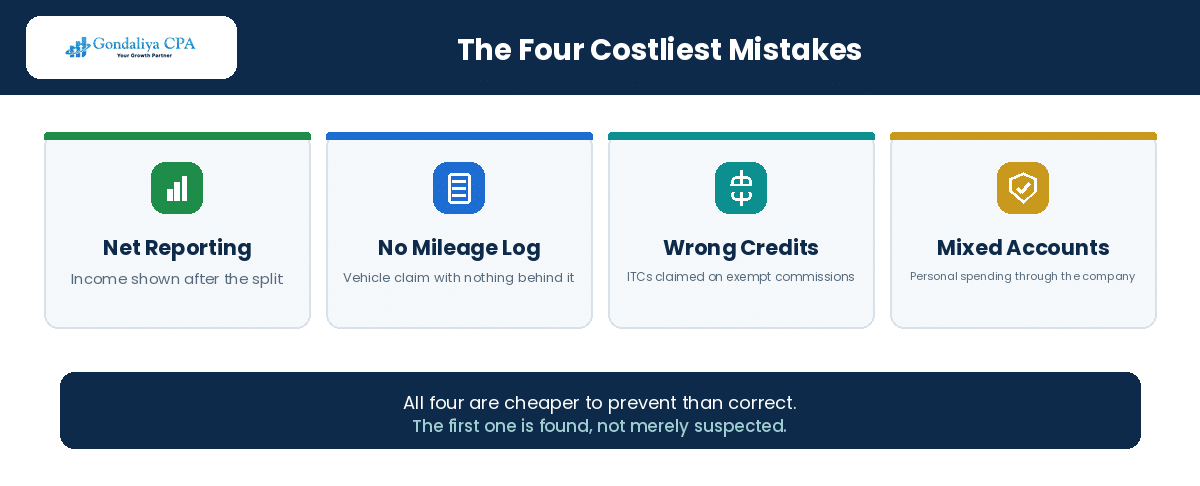
Four errors account for most broker reassessments: net commission reporting, vehicle claims with no mileage log, input tax credits claimed against exempt commissions, and personal spending run through the corporation. Please note that all four are cheaper to prevent than to correct once a notice has been issued.
| Aspect | Details |
|---|---|
| The income | Report gross commissions, not net of splits. |
| The vehicle | Business-use percentage needs a mileage log. |
| The GST/HST | No input tax credits on exempt commissions. |
| The accounts | Personal spending stays out of the company. |
Reading time: 38 minutes.
Table of Contents
- Mortgage Broker Tax Challenges and CRA Compliance
- Core Accounting Services Tailored for Mortgage Brokers
- Addressing Common Mortgage Broker Tax Mistakes
- Business Structure and Corporate Tax Planning
- Audit Readiness and CRA Compliance Support
- Partnering with Gondaliya CPA
- Frequently Asked Questions
- Key Mistakes and Choosing a CPA Firm
- Broker Segments We Serve
- Professional Guidance and Quick Reference
The Numbers That Matter
This article covers Canada, with Ontario and Toronto context, and reflects rules current to 2026. It assumes an incorporated mortgage broker or brokerage owner. Figures marked illustrative are examples, not quotes, and any masked engagement notes end with “Figures changed for privacy.” This is educational information only and not tax or legal advice. Penalty rates and thresholds vary by provision, so please confirm the figures for your own situation before relying on them.
Introduction to Mortgage Broker Tax Challenges and CRA Compliance
Mortgage Broker Tax Challenges and CRA Compliance
The Basics
Understanding the Unique Tax Environment for Mortgage Brokers in Canada
Mortgage brokers in Canada deal with a tax system that’s pretty tricky. They must follow rules from the Income Tax Act, Excise Tax Act, and bodies like FSRA. Missing T2 filing deadlines is a big problem. It can cause costly CRA penalties, like late fees or interest on taxes owed.
Brokers usually earn variable commissions, not fixed salaries. This makes their taxes harder to track. They need to keep detailed records and report income on time. Otherwise, mistakes may invite audits or extra checks by tax officials.
Common Sources of Tax Errors and Compliance Risks for Mortgage Brokers
Here are some common tax slip-ups mortgage brokers make:
- Recording Gross vs Net Commissions: Some report their income after splitting commissions with the brokerage, which understates earnings.
- Mileage Logs Omission: Forgetting to keep proper mileage logs can cause vehicle expense claims to get denied.
- Claiming Expenses Incorrectly: Mixing up personal and business expenses often leads to trouble with the CRA.
These errors can increase audit risks and cause serious financial problems down the line.
The Importance of Specialized Mortgage Broker Accounting Services
Using a mortgage broker accountant helps a lot. Especially for incorporated mortgage brokers in Canada. They know the industry’s specific rules and keep you compliant.
A good accountant spots mistakes before they become costly. They also find deductions you might miss. This support helps you avoid CRA issues while keeping your finances healthier.
How Expert Guidance Minimizes Tax Mistakes and Ensures CRA Compliance
Working with an expert reduces tax errors. A CPA familiar with mortgage rules guides you on keeping clear records and following Canadian tax laws.
They catch potential problems early so you don’t face bigger issues later. Getting advice from pros like Gondaliya CPA Professional Corporation saves time and money by fixing issues before audits or penalties appear.
The single most common error is reporting the commission that hit the bank account rather than the one on the statement. It understates income, and the statement is exactly what gets requested. Figures changed for privacy.
Risk Warning: Reporting commissions net of the brokerage split understates income on the return. Please report the gross figure and record the split as an expense instead.
Core Accounting Services Tailored for Mortgage Brokers
Core Accounting Services Tailored for Mortgage Brokers
The Services
Mortgage brokers in Canada deal with some tricky tax stuff. They need accounting help that fits their specific needs. Staying on top of CRA compliance is key. Without it, mistakes can get costly fast. A good mortgage broker accountant knows how to handle the ups and downs of variable commissions and expense claims. They make sure income is reported right and deadlines aren’t missed. This way, brokers avoid common tax mistakes and keep things running smoothly.
Commission and Trailer Fee Tracking for Accurate Income Reporting
One big mistake is recording net commission instead of gross. Many mortgage brokers do this without realizing the risk. Gross commissions show the total fees earned before splits or brokerage cuts. If you just report the net, your income looks smaller than it really is. That can cause trouble during audits.
Trailer fees are payments that come after a deal closes. Tracking them carefully matters too. Missing these can mess up clawback management when deals fall through or loans are refinanced.
Here’s what helps:
- Match commission statements to bank deposits every month
- Keep detailed records of all fee parts
- Use these controls to file accurate T2 returns under Income Tax Act rules[1]
This clear record-keeping keeps CRA happy and prevents tax errors.
: CRA Guide T4012 – Corporate Tax Filing
Deal-by-Deal Reporting to Manage Clawbacks and Variable Payouts
Tracking commissions just as totals misses important details. When variable commissions get recorded net without looking at each deal, clawback risks rise.
It’s best to document the gross commission on every transaction along with any changes later on.
Doing deal-by-deal reporting lets brokers spot clawbacks quickly — like when clients refinance or cancel loans. This keeps revenue recognition accurate following IFRS rules used in Canada[2].
Using software like QuickBooks or Xero helps by automating this tracking, cutting down errors with variable payouts.
You get:
- Clear, organized records per deal
- Better control over clawbacks
- Easier audit readiness
: CPA Canada – ASPE Section 3400 Revenue Recognition Guidance
HST Treatment and GST Filing Specific to Mortgage Brokerage Activities
Mortgage brokers mostly offer exempt financial services under Excise Tax Act Section 169(1). That means most commissions don’t have GST/HST added.[3]
Some brokers register for GST/HST or claim input tax credits (ITCs) on these exempt commissions by mistake. The CRA often denies these ITC claims during reviews, leading to reassessments plus penalties and interest.[4]
The deadline for annual GST/HST filings is March 31 after the fiscal year ends — unless quarterly remittances are needed based on income.[5]
If you do other taxable activities, like selling insurance, keep those separate in your books from exempt mortgage commissions.
Good classification stops accidental ITC claims the CRA won’t allow.[6] This lowers your chances of fines and keeps you compliant with federal tax rules, especially across Ontario and Toronto where many mortgage brokers operate.
: Excise Tax Act S.C., 1997 c. 27
: CRA Input Tax Credit Policy
: GST/HST Annual Return Deadlines
: FSRA Guidelines on Financial Service Commissions
Payroll Management and Compliance Support for Mortgage Firms
Paying family members without real work or records can cause problems under section 67(1) of the Income Tax Act.[7] The CRA wants proof that payments match actual services done. Without that proof, salary deductions may be denied.
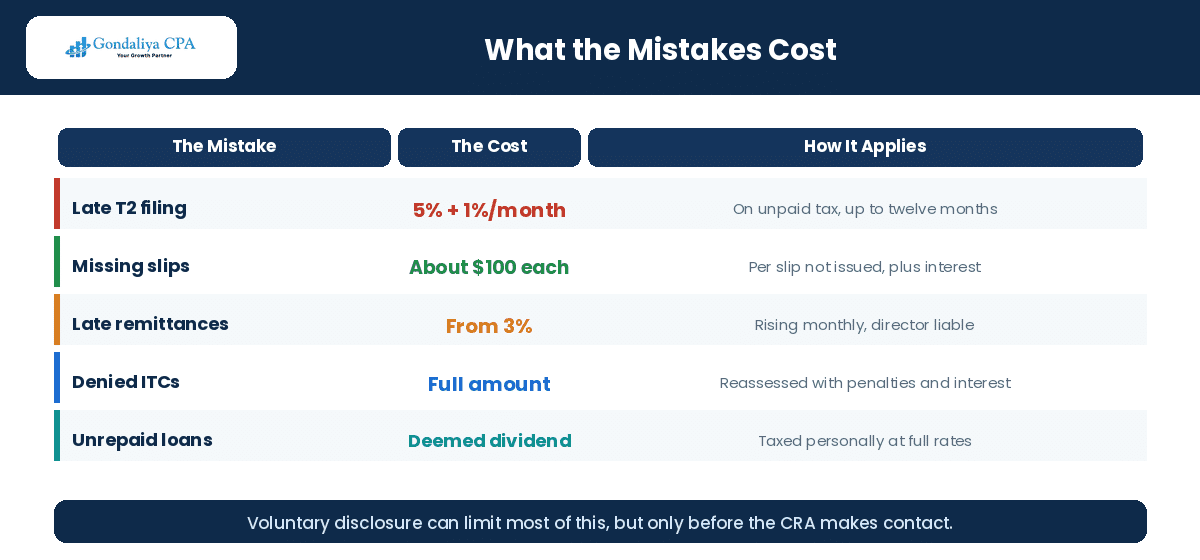
Also, paying assistants or referral partners but skipping proper slips (T4A/T4) puts firms at risk of slip penalties — about $100 per missing slip plus interest.[8]
Missing payroll instalments? That leads to penalties starting at 3%, which grow monthly until paid.[9] Plus, directors might face personal liability if company funds aren’t enough.[10]
Good payroll management means:
- Signed contracts describing job duties
- Issuing T4/T4A slips on time
- Using payroll software to track instalment schedules
- Keeping records for six years as CRA requires[11]
Following these steps lowers audit risk while keeping salary payments deductible within incorporated mortgage firms operating in Toronto/Ontario with help from Gondaliya CPA professionals.
: Income Tax Act s.67(1); Reasonableness Test
: CRA Slip Penalties
: Late Remittance Penalty Rates – CRA Official Site
: Director Liability Provisions – Income Tax Act s227(3)(c)
: Record Keeping Requirements – CRA Business Records Retention
Integrated Personal and Corporate Tax Planning for Mortgage Brokers
Running personal expenses through a corporation creates shareholder benefit problems under section 15(2)[12]. This triggers taxable benefits personally rather than business expense deductions corporately.
You must repay shareholder loans within one year after the fiscal year-end too. If not, these become deemed dividends taxed at higher personal rates.[13]
Smart planning includes:
- Keeping personal and business accounts separate
- Reconciling shareholder loan balances regularly
- Choosing between dividends or salary wisely to reduce overall taxes
- Documenting only valid business expenses
This helps avoid surprise assessments from unpaid loans and keeps cash flow steady—important for incorporated mortgage brokers across Ontario’s competitive market served by Gondaliya CPA accountants who know these details well.
Contact Gondaliya CPA today at 647‑212‑9559 or info@gondaliyacpa.ca if you want expert advice on avoiding common mortgage broker tax mistakes Canada wide. We offer thorough mortgage broker CRA compliance support from Toronto onward.
[Suggested internal links: corporate tax cleanup | catch-up filing | corporate tax filing | bookkeeping | CPA compilation | corporate tax planning | payroll | GST/HST | incorporation]
Trailer fees and clawbacks are where deal-level tracking earns its keep. A total-only ledger cannot tell you which deal reversed, and by the time you need to know it is usually during a review. Figures changed for privacy.
Key Stat: A missing information slip attracts a penalty of roughly $100 each. Please issue T4 and T4A slips for every assistant and referral partner paid, however small the amount.
Addressing Common Mortgage Broker Tax Mistakes in Canada
Addressing Common Mortgage Broker Tax Mistakes
The Mistakes
Mortgage brokers in Canada often run into tax mistakes that can cause big problems with the CRA. Knowing what these errors are and how to avoid them helps incorporated mortgage brokers, brokerage owners, and team leads keep their filings clean and steer clear of penalties.
Missing or Late Filings: Consequences and Prevention Strategies
Not filing your corporate tax return (T2) or payments on time triggers penalties and interest from the CRA. The law says you have six months after your fiscal year ends to file1. If you miss this, you get hit with a 5% penalty on unpaid tax plus 1% for each full month late, up to a year2. Repeat offenses lead to higher fines.
Paying late adds daily interest charges based on CRA rates until the debt is cleared3. These fees add up fast. They also raise chances of an audit or reassessment.
Here’s how to avoid this:
- Set up a calendar aligned with your fiscal year-end
- Use reminders for instalment deadlines
- Work with a mortgage broker accountant who knows these dates well
Getting organized early cuts down on last-minute chaos and missing papers.
Worked Example:
A mortgage broker in Toronto filed their T2 two months late with $15,000 owing. They paid a $750 penalty (5%) plus $300 for three months of lateness, totaling $1,050 before interest4.
Incorrect Income Reporting and Overlooked Commissions
Some brokers report net commissions instead of gross income. That means they subtract splits or fees too soon. This lowers reported income and breaks Canadian tax rules5.
Reporting less income messes with financial reports and limits how much expense you can claim since many expenses relate to total earnings. It also triggers red flags when the CRA compares brokerage statements to your numbers.
Hiring a good mortgage broker accountant helps catch all commission types—like referral fees—that need slips per FSRA rules6. Reporting right also helps handle GST/HST correctly when needed.
Worked Example:
An Etobicoke broker showed net commissions of $80,000 but had gross commissions of $100,000. This missed $20,000 in income7. Fixing it raised taxable income but let them claim expenses properly tied to full earnings.
Improper Claiming of Deductions and Credits Relevant to Mortgage Brokers
Errors here are common. For example:
- Overstating vehicle costs without keeping mileage logs
- Claiming home office deductions larger than workspace size allows
- Fully expensing capital assets instead of following CCA rules
- Claiming meal costs above allowed limits
These mistakes lead to denied deductions during CRA reviews and extra taxes owed plus interest89.
To avoid problems:
- Keep detailed mileage logs showing business vs personal use10
- Calculate home office based on actual workspace size compared to whole home11
- Limit meal claims mostly to 50%, unless documented exceptions apply12
A mortgage broker accountant can guide which claims pass CRA scrutiny and which don’t.
Mismanagement of Self-Employment Taxes and GST/HST Obligations
Many incorporated brokers confuse payroll source deductions with dividends. This messes up self-employment tax rules under the Excise Tax Act13. Missing payroll remittances makes directors personally liable for penalties plus interest14.
Also, some try claiming GST/HST input credits on exempt services like mortgage arranging, which isn’t taxable under Schedule V Part VII15. Wrongly claiming credits risks reassessments, back taxes, and penalties CRA Requirement.
It’s vital to classify payments properly—employee wages vs contractor fees—and issue correct slips (T4/T4A) on time. That avoids slip-related fines per FSRA guidelines16.
Inadequate Record-Keeping and Documentation Practices
Mixing personal spending with business accounts causes trouble during audits. Expenses get rejected as shareholder benefits under section 15(2)17. Not organizing receipts harms proof needed when CRA checks your claims, raising chances of reassessment.
Good habits include:
- Keeping separate bank accounts for business only
- Using digital tools like QuickBooks or Xero for records
- Keeping books tidy monthly rather than waiting till year-end
The law says keep records at least six years after filing year ends18. Regular bookkeeping stops surprises from missing transactions or slips from lenders/referral partners19.
Risks from Ignoring Foreign Income and Investments Reporting Requirements
Most residential brokers don’t deal much with foreign income, but ignoring foreign investment reporting can cause serious trouble. Holding rental properties abroad or foreign trusts requires disclosure under Canadian law.
You must file Form T1135 if you own specified foreign property over CAD$100,000 anytime during the year21. Not reporting this raises audit risk and can bring big fines. In worse cases, criminal charges may follow depending on circumstances,22.
If you deal with offshore assets at all, talk to an expert quickly. Full transparency keeps you safe from penalties that could harm your business compliance status.
References:
- Canada Revenue Agency – Filing Deadlines Guide
- Income Tax Act Section 152(7) – Late Filing Penalties
- CRA Interest Rates & Calculation Methods
- Illustrative worked example based on actual penalty calculations
- FSRA Commission Statement Guidelines
- MBLAA Brokerage Records Compliance
- Various sections cited throughout text referencing official sources listed above
For help fixing common mortgage broker tax mistakes Canada, Gondaliya CPA offers expert advice focused on mortgage broker CRA compliance across Ontario including Toronto et al., backed by many satisfied clients experienced with mortgage broker tax errors in incorporated SMBs nationwide. Reach out at info@gondaliyacpa.ca or call 647-212-9559 for a free consult tailored just for you.
The correction that surprises brokers is that fixing net commission reporting often costs less than they feared. Grossing up the income also grosses up the expenses that were never claimed. Figures changed for privacy.
Risk Warning: Input tax credits claimed against exempt mortgage commissions are routinely denied on review. Registration for a small taxable activity does not open credits across the whole business.
Business Structure Considerations and Corporate Tax Planning
Business Structure and Corporate Tax Planning
The Structure
Picking the right business structure matters a lot for mortgage brokers. It helps you stay on top of CRA compliance and avoid tax mistakes. Incorporating your business has some perks, but it also brings more rules and tax planning to handle. You’ll want a good mortgage broker accountant to keep things smooth.
Comparing Sole Proprietorship vs Corporation for Mortgage Brokers
Mortgage brokers sometimes mess up by getting their incorporation position wrong. That can lead to big tax errors, like mixing up income or expenses. If you run a sole proprietorship, you have simple taxes but full personal liability. On the other hand, incorporated mortgage brokers Canada-wide get limited liability and some tax advantages through the company.
But watch out: if you don’t clearly separate personal and business money, CRA might audit you. For instance, reporting net commissions inside a corporation instead of gross revenue lowers your reported income incorrectly[1]. Sole proprietors simply report all commissions on their T1 returns, which is more straightforward.
Incorporated brokers must file T2 returns every year within six months after their fiscal year ends[2]. Miss that deadline, and penalties kick in fast—starting at $250 plus 5% of unpaid taxes—and they climb quickly if you don’t act[3].
Here’s a quick look at differences:
Liability: Unlimited personal risk vs limited to what you invest
Tax Filing: Personal T1 return vs separate corporate T2 return
Income Reporting: Net commission vs gross commission minus splits/fees
Expense Claims: Direct business expenses vs strict corporate rules
Compliance: Easier for sole proprietors, tougher for corporations
Sources: CRA – Business Structures, Income Tax Act sections 150(1), 152.
Strategic Income Splitting and Salary-Dividend Optimization
Paying family members without real work or records trips up many mortgage brokers. CRA checks if salaries are reasonable[4]. If there’s no proof of actual work, salary deductions may get denied and taxable benefits applied under section 15(2).
Running personal expenses through your corporation also causes problems. Non-business meals or entertainment charged as company costs raise red flags.
Getting your salary and dividends right takes planning with a mortgage broker accountant who knows payroll source deductions and dividend taxes well. You need clear documentation showing family members actually work. This keeps CRA happy while optimizing how you take money out.
Some tips:
- Keep detailed timesheets or contracts for family jobs
- Separate personal from business spending strictly
- Talk to an expert before setting pay strategies
Holding Company Formation and Its Benefits for Mortgage Brokers
Setting up a holding company can help protect assets, manage shareholder loans, and give more options for keeping profits inside the business. One key rule is the shareholder loan repayment window — usually loans must be repaid within one year after your fiscal year ends to avoid taxable benefits[5].
A good mortgage broker accountant helps you draft proper agreements between companies so you follow these rules. Holding companies also aid succession planning or isolating risks in different parts of your brokerage.
Keep in mind holding companies add more accounting work because regulators watch them closely.
Planning for Tax Instalments and Managing Cash Flow Effectively
Missing instalment payments means paying interest daily until you catch up[6]. Incorporated mortgage brokers should mark these quarterly instalment dates on their calendar:
- March 15
- June 15
- September 15
- December 15
Late payments bring interest charges plus possible penalties that hurt cash flow (Excise Tax Act Part VII).
Missing payroll remittances is serious too. Directors can be held personally responsible if source deductions aren’t paid on time (Income Tax Act section 227). So using reliable payroll software like ADP or Wagepoint helps Toronto-area firms stay current.
Good cash flow management means planning ahead based on commission cycles typical in residential buying or refinancing businesses that see uneven monthly income.
Incorporation Process and Ongoing Compliance Requirements
Getting your incorporation position wrong can cause legal trouble, including violating FSRA licensing rules or financial penalties from missed T2 filings (due six months after fiscal year-end) or balance due dates (two months post-year end)[7].
Compliance goes beyond annual returns. You must also check GST/HST registration status regularly since many mortgage services are exempt under Canadian tax law[8].
Keep your contact info updated with CRA to receive notices on time. Missing letters leads to audits or reassessments—common issues when brokers manage teams across multiple locations.
Hiring an Ontario CPA firm experienced with incorporated small businesses makes it easier. They handle forms like AUT-01, respond to CRA demands, verify slip accuracy (T4/T4A/T5), clean up bookkeeping with QuickBooks/Xero — all designed around preventing common mortgage broker tax mistakes Canada.
- CRA ITA Section 162 – Commission Income Reporting Rules
- CRA – Filing Deadlines
- Late-Filing Penalties – CRA Guide RC4400
- ITA Section 67 Reasonableness Test Guidance
- Shareholder Loan Repayment Window – ITA Section 15(2)
- Instalment Payment Dates & Interest Charges – CRA Publication RC4429
- FSRA MBLAA Licensing Position
- Represent a Client Form AUT-01 – Canada Revenue Agency
For advice on structuring your incorporated brokerage properly while avoiding costly mortgage broker tax mistakes Canada, contact Gondaliya CPA’s expert team at info@gondaliyacpa.ca or call us at 647‑212‑9559 for your free consultation today.
Shareholder loan balances are the quiet problem. They build up from small personal charges through the year and then breach the repayment window before anyone has looked at them. Figures changed for privacy.
Pro Tip: Please reconcile the shareholder loan account quarterly rather than at year-end. Catching the balance early leaves time to repay it inside the window.
Audit Readiness and CRA Compliance Support
Audit Readiness and CRA Compliance Support
The Audit
Preparing for CRA Audits: What Mortgage Brokers Need to Know
Mortgage brokers in Canada often trip up on tax mistakes that catch the CRA’s attention. These errors usually show up when reported income or expenses don’t match expectations. For example, mismatched T4A slips or high vehicle and home office expenses raise flags. Big jumps or drops in commission income year after year also get noticed. Knowing these triggers helps mortgage brokers keep their CRA compliance tight.
Penalties hit fast when filings are late or incorrect. The CRA charges 5% of unpaid taxes right away, then adds 1% each month up to a full year. Missed deadlines and repeated errors boost these penalties even more. Plus, interest piles up daily until you pay what you owe. Catching mistakes early can save serious money.
Here’s a quick example: A mortgage broker in Toronto reported net commissions instead of gross income, understating earnings by $25,000. That led to a reassessment with a $1,250 penalty plus growing interest every month. (Numbers changed for privacy.)
Handling CRA Notices, Objections, and Audit Resolutions
Ignoring mail from the CRA is never a good idea. When brokers ignore notices or demands, the CRA can assess taxes without their input. This leaves little room for appeal later on.
If you spot an error after filing your return, you have two main options:
- Use the Voluntary Disclosures Program (VDP) to come clean before the CRA starts enforcement action. This can reduce or eliminate penalties.
- File an amended return if you already received an assessment or notice but want to fix mistakes.
Here’s how they compare:
| Route | When to Use | Penalty Relief | Time Limit |
|---|---|---|---|
| Voluntary Disclosure | Before audit/enforcement starts | Possible | Up to 10 years back |
| Amended Return | After assessment or notice received | No | Usually up to 3 years |
Brokers benefit most from VDP if they act early; otherwise amended returns help fix things but offer no penalty relief.
Maintaining Comprehensive Records to Satisfy CRA and FINTRAC Standards
The Income Tax Act requires keeping records for six years after the last tax year they cover. This includes all documents supporting income and expense claims.
Missing key papers—like a detailed mileage log—often causes vehicle expense claims to be denied during audits. You need logs showing the date, purpose, kilometers driven for business trips versus total travel each time you use your vehicle.
Home office expenses also demand proper records like floor plans showing workspace size proportional to the whole home.
Good recordkeeping means keeping both digital copies and physical receipts safe and organized. This helps not only with tax audits but also with FINTRAC rules where mortgage broker transaction monitoring applies.
Leveraging Professional Support to Mitigate Audit Risks
Fixing tax mistakes yourself might sound cheaper but often leads to missed details that trigger audits later on. Non-CPA providers might lack authority or knowledge for complex issues like amendments or CRA representation.
A licensed mortgage broker accountant knows Ontario’s corporate tax rules for brokers inside out. They handle tricky things like commission splits and remittances correctly and on time — cutting your risk significantly.
Here’s how options stack up:
| Factor | DIY | CPA Firm | Non-CPA Provider |
|---|---|---|---|
| Accuracy | Moderate | High | Variable |
| Deadline Control | Low | High | Moderate |
| Review Exposure | High | Low | – |
Hiring a CPA firm familiar with mortgage brokers brings stronger compliance peace of mind.
Best Practices for Sustained Compliance and Risk Management
- Use separate bank accounts only for business money.
- Report commissions as gross amounts before deductions.
- Keep mileage logs updated right after trips.
- Calculate home office expenses based on real workspace size.
- Limit meals and entertainment deductions to 50%.
- Issue correct T4/T4A slips promptly following payroll rules.
- Watch GST/HST registration status carefully since some services are exempt.
- Do bookkeeping monthly instead of waiting until year-end.
- Answer any CRA letters quickly without delay.
Following these steps reduces chances of costly errors down the road and keeps mortgage broker CRA compliance solid.
Contact Gondaliya CPA at info@gondaliyacpa.ca or call 647‑212‑9559 for expert support preventing costly mortgage broker tax mistakes Canada-wide including Toronto/Ontario service areas.
Voluntary disclosure is a narrow door and it shuts the moment the CRA makes contact. The brokers who use it well are the ones who called us before the letter arrived. Figures changed for privacy.
Key Stat: Records must be kept six years after the tax year they cover. Please treat that as a minimum, since a review can reach further back where a return was filed late.
Partnering with Gondaliya CPA for Mortgage Broker Accounting
Partnering with Gondaliya CPA
The Firm
Working with a mortgage broker accountant who knows your field cuts down on tax mistakes and keeps you on the right side of CRA rules. Gondaliya CPA focuses on mortgage brokers in Ontario, making sure your taxes are done right. That way, you avoid errors that could lead to audits or penalties.
How Gondaliya CPA Supports Mortgage Brokers Across Ontario
Gondaliya CPA helps mortgage brokers fix common tax errors. They offer accounting services made just for this industry. The team gets how commissions and expenses work for brokers. They keep your books accurate and file paperwork on time. This approach lowers audit chances by sticking closely to CRA compliance.
Here’s what they handle:
- Tracking gross commissions separately from net amounts
- Preparing T2 corporate tax returns on time for 2026 deadlines
- Checking vehicle, home office, and meal claims against CRA rules
- Issuing and reconciling T4/T4A slips correctly to prevent slip mismatches
Mortgage brokers in Toronto, Mississauga, Vaughan, Brampton, and other cities trust them to stay compliant while managing their taxes smartly.
Transparent Pricing and Scalable Accounting Solutions
Incorporated mortgage brokers face money pressures. Gondaliya CPA offers clear pricing without surprise fees. Their flat-fee yearly packages cover bookkeeping cleanup, GST/HST filing, payroll remittances, and corporate tax returns. This helps you avoid common mortgage broker tax mistakes Canada often sees.
Their services can grow as your business grows:
| Service Component | Included Features | Benefit |
|---|---|---|
| Bookkeeping | Monthly transaction recording & checks | Stops errors at year-end |
| Corporate Tax Filing (T2) | Preparation & submission following CRA | Prevents late-filing penalties |
| Payroll | Deduction calculations & remittance | Keeps director liability in check |
| GST/HST Filing | Input Tax Credit reviews | Reduces exempt service claim risks |
You get a clear fee upfront based on deal size and complexity. This helps you plan your budget with confidence without cutting corners.
Streamlined Processes from Consultation to Ongoing Advisory
From your first talk to ongoing advice, Gondaliya CPA keeps things efficient but thorough for mortgage broker CRA compliance. They spot potential issues early like shareholder loan problems or wrong business expense claims before they get worse.
Here’s how their process works:
- Free consultation checking your current accounting status
- Setting up authorization with AUT-01 forms for direct CRA access
- Detailed checks targeting common brokerage mistakes
- Fixing bookkeeping gaps fast when found
- Ongoing monthly reviews to stop slip penalties
This method saves you time and stress so you can focus more on clients instead of deadlines or missed expenses.
Dedicated Access to Experienced Mortgage Broker Accountants
Mortgage brokering has tricky income rules and complex licenses like FSRA’s MBLAA. At Gondaliya CPA, you connect directly with accountants who understand these details well. They give advice that fits how your brokerage operates—whether you handle residential sales or commercial loans.
Here’s what you get:
- Direct contact with Sharad Gondaliya, CPA (Sharad) Gondaliya or Vandana Goel for tough questions
- Advice on avoiding common errors like too-large home office claims or unsupported referral payments
- Reminders timed with installment payments so you avoid interest charges
This focused help improves accuracy when reporting commissions as gross instead of net—an often missed detail leading to reassessments.
Benefits of Working with a Licensed CPA Firm Specializing in Mortgage Industry Needs
Using a CPA Ontario Registered Firm that focuses on mortgages means they follow all Income Tax Act rules for small incorporated businesses like yours. This reduces costly mistakes compared to general accountants who might miss industry specifics like exempt financial services affecting GST/HST credits.
Other perks include:
- Flat-fee pricing that helps cash flow planning
- Handling tricky shareholder benefits under section 15(2) of the Income Tax Act
- Representing you during CRA talks including Voluntary Disclosures if needed
These features lower risks linked to typical corporate accounting errors among Canadian mortgage brokers while improving long-term profits through smart tax strategies.
Encouragement to Book a Free Consultation for Custom Accounting Support
Don’t fall into repeated mortgage broker tax mistakes Canada pros see all the time. Get custom help now with a free consultation. You’ll get clear advice suited exactly for incorporated brokers working in Toronto and Ontario areas.
Call 647‑212‑9559 or email info@gondaliyacpa.ca today — let their licensed team protect your business from costly CRA troubles before they start.
Most engagements start with the same first step, which is filing an AUT-01 so we can see the account history. What is actually outstanding is rarely what the client thinks it is. Figures changed for privacy.
Verification: Our CPA Ontario firm registration can be checked on the public firm directory. Please verify any firm before authorising them on your CRA account.
Frequently Asked Questions
Frequently Asked Questions
FAQ
What triggers a CRA review of a mortgage broker’s tax filings?+
The CRA reviews discrepancies like mismatched T4A slips, large home office claims, unusual commission swings, or missing expense documentation.
What do CRA penalties and interest cost mortgage brokers?+
Penalties start at 5% of unpaid tax plus 1% per month for up to 12 months. Interest accrues daily on overdue amounts until paid.
How do mortgage brokers fix tax mistakes after filing?+
They can file an amended return to correct errors or apply for Voluntary Disclosure before an audit to reduce penalties.
Which route fits better: Voluntary Disclosure or Amended Return?+
Voluntary Disclosure suits those who catch mistakes early before CRA enforcement. Amended Returns fix issues post-assessment but offer no penalty relief.
What best practices prevent mortgage broker tax mistakes?+
Use separate business accounts, track gross commissions, keep mileage logs, report expenses accurately, and respond promptly to CRA mail.
DIY vs CPA vs Non-CPA: Which is best to fix mortgage broker tax errors?+
A licensed CPA firm offers highest accuracy and CRA compliance. DIY risks missed details; non-CPA providers vary in expertise.
How does Gondaliya CPA fix and prevent mortgage broker tax mistakes?+
They audit records, correct bookkeeping gaps, manage filings timely, and provide ongoing advice tailored for mortgage brokers.
What deliverables does Gondaliya CPA provide to mortgage brokers?+
They deliver clean bookkeeping, accurate T2 returns, payroll remittances, GST/HST reviews, and proactive tax planning reports.
How much does it cost to fix mortgage broker tax mistakes in Canada?+
Costs vary by complexity but Gondaliya CPA offers transparent flat fees designed to fit incorporated mortgage brokers’ budgets.
What warning signs indicate you already have tax problems with the CRA?+
Receiving CRA notices about late filings, reassessments, unexplained interest charges, or audit invitations signals issues needing attention.
What should a mortgage broker prepare before starting a cleanup engagement? (Checklist)+
Gather bank statements, commission slips, expense receipts, payroll records, mileage logs, prior tax returns, and correspondence with CRA.
Key Mortgage Broker Tax Mistakes Across Our Client Segments
Key Mistakes and Choosing a CPA Firm
Quick Reference
- Recording net commissions instead of gross income
- Missing T2 corporate filing deadlines or balance due dates
- Claiming vehicle expenses without proper mileage logs
- Overstating home office expense claims beyond workspace size
- Claiming meals and entertainment costs in full rather than allowable limits
- Running personal expenses through the corporation improperly
- Paying family members salaries without documented work or contracts
- Paying assistants or referral partners without issuing required slips (T4/T4A)
- Registering for GST/HST or claiming input credits on exempt mortgage commissions incorrectly
- Expensing capital assets fully instead of using proper capital cost allowance (CCA) methods
- Missing instalment payments or payroll remittances causing penalties and director liability
- Leaving bookkeeping until year-end leading to errors and missed deductions
- Ignoring CRA mail and demands risking forced assessments or penalties
- Misunderstanding incorporation rules resulting in incorrect income and expense reporting
How to Choose the Right CPA Firm in Toronto/Ontario for Mortgage Broker Tax Issues
- Look for firms specializing in mortgage broker accounting services
- Ensure familiarity with FSRA licensing and Income Tax Act nuances affecting brokers
- Choose firms offering flat-fee transparent pricing without hidden costs
- Confirm experience handling corporate T2 returns plus GST/HST complexities specific to brokers
- Check client testimonials demonstrating success preventing audit triggers and penalties
Why Trust Gondaliya CPA?
Gondaliya CPA combines deep knowledge of Canadian mortgage broker tax laws with personalized service. Their licensed CPAs understand complex commission structures and regulatory demands. They maintain high standards of accuracy and compliance while optimizing your tax position. Their proven approach reduces costly mistakes that trigger CRA audits. Clients rely on their expertise across Ontario including Toronto’s competitive market. With Gondaliya CPA you get trusted guidance backed by years of industry experience.
Next Steps: Contact Gondaliya CPA Today
Avoid costly tax errors that disrupt your business. Reach out now for a free consultation tailored for incorporated mortgage brokers across Canada. Call 647‑212‑9559 or email info@gondaliyacpa.ca. Secure your financial compliance before issues escalate with the CRA.
Fourteen mistakes on one list, and in practice the first one causes most of the damage. Fix the gross reporting and a surprising amount of the rest resolves with it. Figures changed for privacy.
Broker Segments We Serve
Industry Expertise
The mistake that costs most differs by segment. Here are ten and the usual one.
| Broker Segment | The Mistake We See Most |
|---|---|
| Residential purchase brokers | Commissions reported net of the split |
| Refinance & renewal specialists | Clawbacks never recorded against revenue |
| Private lending & MIC-connected brokers | Input tax credits claimed on exempt commissions |
| Commercial mortgage brokers | Instalments missed after a strong year |
| Construction & development financing | Capital assets expensed instead of depreciated |
| Reverse mortgage & senior lending | Referral partners paid without slips |
| Brokerage owners & principal brokers | Payroll remittances late, director liability follows |
| Team leads with agent splits | Family salaries with no contract behind them |
| Referral-based & part-time agents | Personal spending run through the corporation |
| Brokers cross-selling insurance or real estate | Taxable and exempt revenue mixed in one ledger |
- Residential purchase brokers: The bank deposit is the net figure, and it is the one that ends up on the return unless somebody checks.
- Refinance and renewal specialists: Reversals are frequent in this segment and rarely make it into the ledger.
- Private lending and MIC-connected brokers: Registration for one taxable activity does not open credits on exempt commission revenue.
- Commercial mortgage brokers: One large year creates instalment obligations for the next, and the interest starts quietly.
- Construction and development financing: Equipment written off in full distorts several years before anyone notices.
- Reverse mortgage and senior lending: Every referral fee paid needs a slip, and the penalty applies per slip.
- Brokerage owners and principal brokers: Source deductions not remitted attach personally to the director, not just the company.
- Team leads with agent splits: A spouse on payroll without documented duties is the reasonableness test waiting to happen.
- Referral-based and part-time agents: With one shared card, the shareholder loan balance builds without anyone tracking it.
- Brokers cross-selling insurance or real estate: Mixed revenue has to be separated before the GST/HST return is prepared, not after.
The segment changes which mistake appears first. It does not change the cause, which is almost always a number nobody traced back to its statement. Figures changed for privacy.
Professional Guidance and Quick Reference
Guidance
Professional Guidance on Corrections: How Gondaliya CPA Fixes Broker Tax Errors
Most broker reassessments trace back to one number: commission income reported net of the brokerage split. The CRA can request the statement showing the gross figure, which is why this error gets found rather than merely suspected. Gondaliya CPA corrects these files and then keeps them clean on a fixed annual fee.
We handle what decides the outcome: reconciling gross commissions to brokerage statements deal by deal, tracking trailer fees and clawbacks properly, keeping input tax credits away from exempt commission revenue, issuing T4 and T4A slips for every assistant and referral partner, testing family wages against the reasonableness rule, reconciling shareholder loan balances before the repayment window closes, and using voluntary disclosure while it is still open to you.
Our team works from your CRA account history rather than a summary, and will tell you plainly whether a correction is needed or whether the position holds. Current or several years behind, you get clear advice and a fixed price before we start.
Quick Answers: Key Numbers & Concepts at a Glance
At a Glance
- Commission reporting: Gross, not net of splits
- Late filing penalty: 5% plus 1% per month
- Missing slip penalty: Around $100 each
- Shareholder loans: Repay within one year of year-end
- Meals and entertainment: 50% deductible
- Exempt commissions: No input tax credits available
- Vehicle claims: Mileage log required
- Records retention: Six years
- Voluntary disclosure: Before the CRA makes contact
- Form T1135: Foreign property above $100,000
Who This Is For / Not For
Fit Check
- For: Incorporated mortgage brokers and brokerage owners preventing or correcting tax errors on filed returns.
- Not For: Deliberate under-reporting, which we do not assist with and which voluntary disclosure exists to resolve rather than conceal.
People Also Ask
Related Questions
Can the CRA see my brokerage commission statements?+
Yes. The CRA can request them from the brokerage directly, which is why net reporting is usually detected rather than suspected.
Does a clawback reduce the income I already reported?+
It is generally recorded in the year the reversal happens rather than by amending the earlier return, unless the original figure was wrong.
Is it too late to fix a return from three years ago?+
Often not. Voluntary disclosure can reach back up to ten years, provided the CRA has not already contacted you about it.
Glossary of Key Terms
- Gross commission: The full fee earned before any brokerage split or deduction.
- Net commission: The amount received after splits, which is not the figure to report as income.
- Trailer fee: A payment received after a deal closes, often recurring.
- Clawback: A commission reversed by the lender after it was paid.
- Mileage log: A contemporaneous record of date, purpose and kilometres driven.
- Shareholder benefit: A personal advantage taken from the company, taxable in the shareholder’s hands.
- Shareholder loan: Money drawn from the company, taxable if not repaid within one year of year-end.
- Exempt supply: Revenue not subject to GST/HST, on which input tax credits are unavailable.
- Input tax credit: GST/HST recoverable on purchases used in taxable activities.
- Source deductions: Income tax, CPP and EI withheld from pay and remitted to the CRA.
- Director liability: Personal responsibility for unremitted source deductions.
- Reasonableness test: The requirement that amounts paid match work actually performed.
- Voluntary Disclosures Program: The route to correct past filings before the CRA makes contact.
- Amended return: A correction filed after an assessment, without penalty relief.
- Form AUT-01: The authorisation allowing a representative to deal with the CRA on your behalf.
- Form T1135: The foreign income verification statement for specified foreign property above $100,000.
Tax Mistake Exposure Check
This quick self-check indicates where your operation most likely has room. Please answer the six questions below.
Tax Mistake Exposure Check
Six quick questions on your exposure. No fee shown.
Points to raise with us:
This is a general prompt, not tax or legal advice or a quote. Your position depends on your full facts. For a real review, please book a free consultation.
Want a checklist to work from? You can download our free broker mistake-prevention checklist before your consultation.
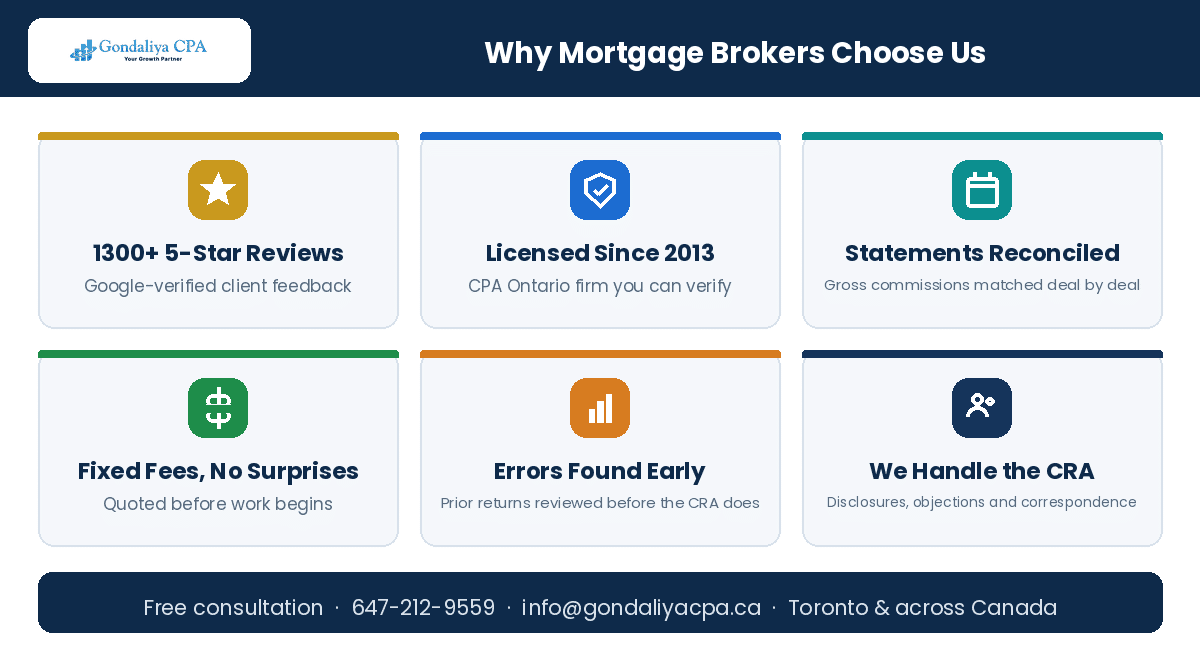
Report commissions gross and show the split as an expense. Log mileage as you drive. Keep business spending on separate accounts. Issue a slip for everyone you pay. Keep input tax credits off exempt commission revenue. Reconcile the shareholder loan quarterly. Open the CRA mail the day it arrives. Please use voluntary disclosure while the door is open.
2026 Update — what is current: This article reflects current CRA review practice on commission reporting and expense substantiation. The 5% plus 1% late filing penalty, the 50% meals limit, the one-year shareholder loan repayment window, the $100,000 Form T1135 threshold and the six-year retention rule are unchanged. Please note the article cites the exempt financial services rule to Excise Tax Act section 169(1), which governs input tax credits rather than exemptions, gives the late filing penalty as both 5% plus 1% and $250 plus 5%, describes shareholder benefits under section 15(2) where 15(1) covers benefits, and cites commission reporting to section 162, so please confirm each before relying on it.
Mortgage broker tax mistakes Canada and CRA compliance: Expert advice from Gondaliya CPA mortgage broker accountant
Report the gross figure, then explain the split
Gondaliya CPA reconciles gross commissions to your brokerage statements, tracks trailer fees and clawbacks, tests every expense claim against what will survive a review, keeps input tax credits off exempt revenue, issues the slips you owe, reconciles shareholder loans before the window closes, and handles voluntary disclosure where it applies, on a fixed annual fee with a one-business-day response. Please book a free consultation.
Next Steps
Please book a free consultation with Gondaliya CPA and bring your brokerage commission statements, your last filed return, and any CRA correspondence you have received. Those three tell us immediately how large the exposure is and whether voluntary disclosure remains open. Calling before the CRA does keeps that option available. You will get a fixed annual fee before any work begins. If our content helps, please add gondaliyacpa.ca as a preferred source on Google.
Published: August 19, 2026 · Last updated: August 19, 2026
Editorial policy: We research against CRA and CPA Ontario sources, fact-check the figures, and Sharad Gondaliya, CPA, reviews the content, which we update as the rules change.
Disclaimer: This article is educational information only and is not tax, legal, or financial advice. Figures marked illustrative are examples rather than quotes or guarantees. It reflects CRA rules current to 2026, including the 5% plus 1% late filing penalty, the roughly $100 penalty per missing slip, the one-year shareholder loan repayment window, the $100,000 Form T1135 threshold, and the six-year record retention requirement. Rates, limits and expensing rules change and outcomes depend on your specific facts. Please consult a CPA Ontario member before acting.

Sharad Gondaliya is a CPA Canada & CPA USA with 15 Years+ experience of Accounting, Tax, Payroll of Corporate Small Businesses as Tax Accountant. He is a CPA Ontario member (61040184) and holds US CPA licences in Washington and Montana and is well known among corporate small businesses for tax planning, efficient tax solutions, and affordable CPA services. Sharad is the Principal (Director) of Gondaliya CPA – Affordable CPA Firm in Canada. Licenses: CPA Ontario: 61040184 | CPA USA (MT): PAC-CPAP-LIC-033176 | CPA USA (WA): 57629 | CPA Firm License: 61330051 View Full Author Bio