



Corporate Tax Filing for Canadian Corporations With Multiple Shareholders: What Business Owners Need to Know
Corporate tax filing multiple shareholders Canada requires accurate T2 filing with shareholder information reporting like Schedule 50 and significant-control registers. Gondaliya CPA provides expert guidance on corporate tax compliance Canada, including shareholder changes, T5 filing, and corporation financial statements shareholders to help businesses meet CRA corporate tax filing requirements.
Quick Summary
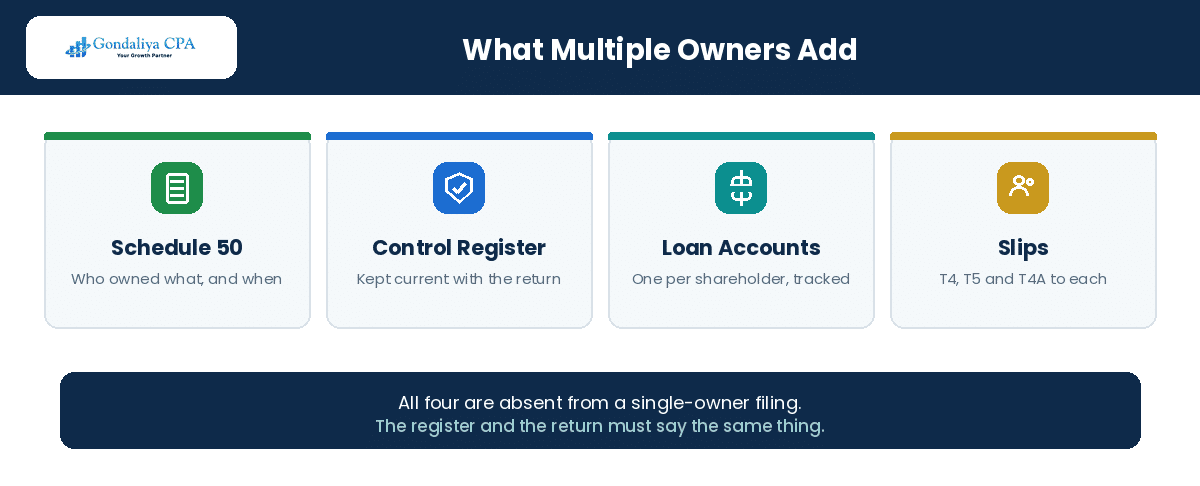
Four things separate a multi-shareholder filing from a single-owner one: Schedule 50 disclosure, a current significant-control register, shareholder loan accounts tracked separately, and slips issued to every recipient. Please note that shareholder loans must be repaid within one year of the fiscal year-end or they become income.
| Aspect | Details |
|---|---|
| The disclosure | Schedule 50, updated for every ownership change. |
| The register | Significant control, kept current. |
| The loans | One account per shareholder, repaid in a year. |
| The slips | T4, T5 and T4A by the last day of February. |
Reading time: 39 minutes.
Table of Contents
- T2 Requirements for Corporations with Multiple Shareholders
- Compliance and Deadlines for Corporate Tax Returns
- Corporate Tax Planning Strategies
- Supporting Services for Filing and Shareholder Management
- Selecting the Right Corporate Tax Accountant
- Practical Steps and Case Examples
- Frequently Asked Questions (FAQs)
- Key Points: Essential Tax Topics
- Ownership Structures We Serve
- Professional Guidance and Quick Reference
The Numbers That Matter
This article covers Canada, with Ontario and Toronto context, and reflects rules current to 2026. It assumes an incorporated corporation with two or more shareholders, active or passive. Figures marked illustrative are examples, not quotes, and any masked engagement notes end with “Figures changed for privacy.” This is educational information only and not tax or legal advice. Corporate law obligations differ between federal and provincial incorporation, so please confirm which applies to your corporation.
Corporate Tax Return Filing (T2) Requirements for Corporations with Multiple Shareholders
T2 Requirements for Corporations with Multiple Shareholders
The Basics
Filing a T2 corporate tax return in Canada is something every corporation must do. When there’s more than one shareholder, the rules change a bit. You have to make sure the return shows the company’s financial activity and who owns what. Corporations with multiple shareholders face specific filing requirements that single-owner companies don’t.
Key Reporting Obligations: Schedule 50, Significant-Control Registers, and Shareholder Information
Corporations need to include detailed info about their shareholders on Schedule 50 in the T2 return. This schedule lists who owns how much and points out anyone with big control over the company. Plus, companies must keep a significant-control register up-to-date. This tracks any changes in ownership during the year.
You file Schedule 50 whenever shareholders change or new ones come in during the fiscal year. If you don’t report this correctly, CRA might fine you for not following rules.
Understanding Shareholder Changes and Their Impact on T2 Filing
Changes in shareholders affect how you file your T2 return. Say one shareholder sells their shares to another or leaves mid-year; you must update Schedule 50 and your share registers to reflect this.
For example, if a shareholder sells out and someone new joins later that year, reporting these moves properly keeps you clear of CRA issues. It also covers any tax effects these changes might cause.
The Role of Shareholder Loans, Salaries, and Dividends in Corporate Tax Filing
In companies with several shareholders, deciding how people get paid can be tricky:
- Shareholder Loan Repayment Window: Loans from shareholders must be tracked carefully since they have set time limits for repayment under section 15(2) of the Income Tax Act.
- Salary vs. Dividends: If shareholders contribute differently—like some work full-time while others don’t—you need to pick a payment method that fits without breaking CRA rules.
- Unequal Dividend Payments: Dividends usually should be equal within each share class unless there’s a special resolution allowing otherwise. But knowing how uneven dividends affect taxes takes some planning.
These parts matter a lot when doing corporate tax filing right.
Overview of T5 Filing for Dividend Reporting in Multi-Shareholder Corporations
When your company pays dividends to multiple shareholders, you must give each one a T5 slip showing what they got during the year.
Issuing these slips on time matters because late or wrong filings can lead to CRA fines. Also, dividend reporting must match payments made across different share classes accurately.
Corporation Financial Statements and Reporting Responsibilities to Shareholders
Financial statements look different when you have more than one owner:
- You have to show related-party transactions clearly as per ASPE rules.
- Each shareholder’s loan accounts should be listed separately so things are clear.
- Any compilation reports need extra notes explaining details specific to having multiple shareholders.
Clear financial statements build trust between managers and owners while meeting CPA Ontario’s rules.
Share transfers get agreed verbally and papered months later. The minute book catches up eventually; Schedule 50 usually does not, and that is the mismatch a reviewer notices. Figures changed for privacy.
Risk Warning: Dividends paid unequally on shares of the same class are not simply a planning choice. Please confirm the share structure supports the split before any resolution is signed.
Compliance and Deadlines for Corporate Tax Returns Involving Multiple Shareholders
Compliance and Deadlines for Corporate Tax Returns
The Deadlines
When and Where to File Your Corporation Income Tax (T2) Return
If your corporation has multiple shareholders in Canada, you need to file the T2 corporate income tax return every year with the CRA. This return must include details about shareholders, such as any ownership changes, dividends paid, and loan accounts. Reporting all this info correctly helps avoid trouble with the CRA for multi-shareholder corporations. You file the return electronically using approved software or through a CPA firm that knows about corporate tax filing multiple shareholders Canada.
The T2 return deadline is six months after your fiscal year ends. If your company has complex shareholder setups, like family groups or holding companies, you’ll also need to fill out extra forms such as Schedule 50. This schedule shows accurate shareholder details. Missing these can cause audits or penalties.
Electronic Filing Mandate for T2 Returns and Exceptions Relevant to Multiple Shareholder Corporations
Since 2019, most Canadian corporations—including those with multiple shareholders—must file their T2 returns electronically. This rule applies regardless of how big or small the company is. Some exceptions exist, like inactive non-profits or tiny private firms without taxable income.
Electronic filing helps avoid mistakes on forms like Schedule 50 or Schedule 11 which report shareholder transactions. A corporate tax accountant Canada can make sure these forms are filled out right and filed on time.
Paper filing exceptions are rare and usually don’t apply to companies with multiple shareholders because reporting is more complex here. Always check if your company qualifies before deciding not to e-file.
Penalties and Risks for Late or Inaccurate Corporate Tax Filing with Multiple Shareholders
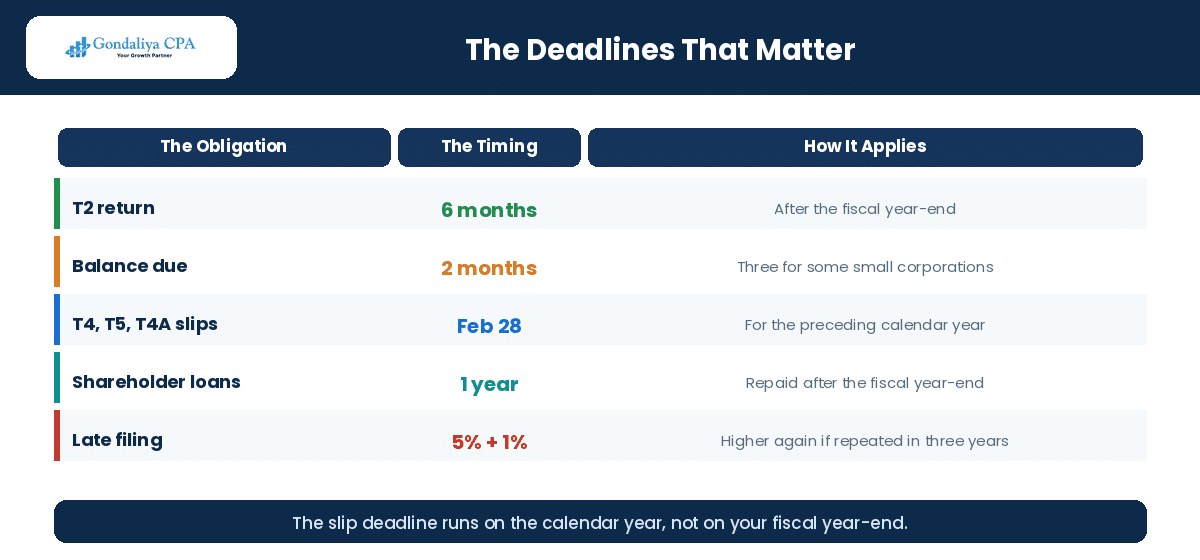
Filing your T2 late means paying a penalty: 5% of what you owe plus 1% extra per full month late, up to a year. If you’re late again within three years and have multiple shareholders, penalties get worse—up to 10% plus double monthly fees.
Errors around shareholder info—like forgetting to update Schedule 50 after share changes or missing dividend slips—can bring fines and extra CRA checks. Late or wrong T4s or T5s for salaries and dividends cause penalties too.
You risk reassessments where CRA adds interest on unpaid taxes. Filing accurately and on time reduces these risks and may help if you ask for taxpayer relief in special cases.
Coordinating Shareholder Reporting Deadlines with Fiscal Year-End Dates
Your fiscal year-end sets important deadlines:
- T2 Return: File within six months after year-end.
- Balance Due: Usually two months after year-end; some small businesses get an extra month.
- Slip Filings:
- T4 slips (for salaries) are due by February 28 of the next year.
- T5 slips (for dividends) are also due by February 28.
Companies with many shareholders issuing various slips need to close their books well before these deadlines. This avoids last-minute stress and errors.
Good coordination between bookkeeping teams and corporate tax accountants helps keep records straight so ownership percentages match at each deadline stage.
| Obligation | Deadline | Applies To | Consequence If Missed | Source |
|---|---|---|---|---|
| T2 Return Filing | Within six months post-year end | All Canadian corporations | Penalty plus interest | CRA |
| Balance Due | Two/three months post-year end | Small businesses get extension | Interest charges | ITA s230 |
| T4 & Summary | Feb 28 following calendar year | Employees/shareholders | Slip penalties | CRA Payroll Guide |
| T5 & Summary | Feb 28 following calendar year | Dividend recipients/shareholders | Slip penalties |
CRA Compliance Considerations for Complex Shareholder Structures
If your company has a complex shareholding setup, watch out for Schedule 50 rules. This form requires you to list anyone owning more than a certain percentage during the tax year. Forgetting this often causes CRA reviews focused on who controls the corporation (Schedule 9).
Other red flags include mismatched ownership info compared to public records, sudden shifts in control registers (which new federal rules require since Jan 2026), unreported passive investors affecting status claims like CCPC, or not updating loans between related parties under ITA section 15(2).
It’s best to regularly check your share registers against public filings at provincial or federal registries. Hold annual meetings documenting any changes clearly with proper resolutions. Getting help from a corporate tax accountant Canada familiar with these details is smart.
Maintaining Accurate Records for Shareholder Transactions and Financial Reporting
Keeping detailed records matters a lot because of ITA rules on shareholder loans. These loans usually must be paid back within one year after the fiscal period ends; if not repaid, they count as personal income under section 15(2). Track each shareholder’s loan separately—don’t mix them up—so it’s easy to show repayment during audits.
Significant-control registers now have strict update deadlines that align closely with annual returns filed federally or provincially. These show who holds voting rights directly or indirectly over shares under Income Tax Act Section 150(1).
Financial statements prepared inside your bookkeeping software (like QuickBooks or Xero) should include notes about related-party transactions involving shareholders per ASPE standards.
Good documentation makes it easier when preparing schedules like Schedule 11 (shareholder transactions), compiling financial reports under CSRS 4200, issuing slips correctly, and filing returns properly. This reduces risks tied directly to having many shareholders—a common issue among SMBs around Toronto served nationwide.
- https://www.canada.ca/en/revenue-agency/services/forms-publications/publications/t4010/corporation-income-tax-return-guide-t4010.html#schedule_50
- https://www.canada.ca/en/revenue-agency/services/e-services/e-file-for-corporation-information-returns.html
- Income Tax Act Section 162(7); https://www.canada.ca/en/revenue-agency/services/tax/businesses/topics/corporations/payments/penalties-interest-late-payments.html
- https://www.canada.ca/en/revenue-agency/services/tax/businesses/topics/payroll/completing-filing-slips-summary-reports/reminder-deadline-and-penalty-info.html
- https://www.canada.ca/en/revenue-agency/news/newsroom/tip-sheets/managing-your-business-accounting-records-efficiently.html
- Income Tax Act Section 150(1); https://laws-lois.justice.gc.ca/eng/regulations/SOR-2009-285/page-14.html#docCont
- CBCA Amendments Jan 2026; Corporations Canada News Release Jan 2026; see Significant-Control Register Requirements
- Income Tax Act Section 15(2)
- CRA Interpretation Bulletin IT‑471R – Loans Between Private Corporations And Their Shareholders
Contact Gondaliya CPA today at info@gondaliyacpa.ca or call us at 647‑212‑9559 if you want advice about managing compliance for your corporation’s multi-shareholder structure in Ontario including Toronto.
The register and the tax filing drift apart quietly. We start most multi-shareholder engagements by reconciling the two, and they disagree more often than not. Figures changed for privacy.
Key Stat: A repeat late filing within three years raises the penalty to 10% plus double the monthly charge. Please treat the six-month deadline as fixed rather than flexible.
Corporate Tax Planning Strategies for Businesses with Multiple Shareholders
Corporate Tax Planning Strategies
The Planning
Filing corporate taxes when you have multiple shareholders in Canada isn’t simple. You have to handle T2 filings, shareholder loans, dividend payouts, and income rules carefully. The CRA has many rules to follow, and missing one can cause trouble. Good planning helps you save taxes while staying on the right side of the law for companies with several owners.
Differences Between Corporate Tax and Personal Income Tax for Shareholders
Corporate tax returns for shareholders in Canada work differently than personal income tax. The company pays taxes on its profits using the T2 return at corporate rates[^1]. Shareholders pay taxes only when they get paid by the corporation — either as salary or dividends.
- Salaries reduce the company’s taxable income but come with payroll duties like T4 slips.
- Dividends come from after-tax profits and get taxed on your personal return with special gross-up and credit rules[^2].
A corporate tax accountant in Canada can help keep this clear so you avoid double taxation or losing deductions.
Example:
- A $50,000 salary counts as personal employment income but lowers corporate profit.
- A $50,000 dividend is not a corporate deduction but is taxed differently at the personal level based on dividend type.
Tax Implications of Active Income, Passive Income, and Personal Services Business Status
In corporations with many shareholders, knowing the difference between active and passive income matters a lot for taxes[^3].
- Active business income qualifies for lower small business tax rates if it meets Canadian-Controlled Private Corporation (CCPC) rules. You get up to $500,000 of income taxed at a reduced rate[^4].
- Passive income, like rental or investment earnings above $50,000, reduces this small business limit across related corporations shared by shareholders[^5].
- A Personal Services Business (PSB) happens when services feel like employment rather than real contracting. PSBs pay higher tax rates and lose small business deductions[^6].
If you have multiple shareholders involved differently in the business, figuring out if PSB status applies can be tricky. A corporate tax accountant in Canada helps sort all this out when doing T2 filings for companies with several owners.
Effective Planning for Shareholder Distributions, Loans, and Compensation
How should multiple shareholders get paid? Choosing salary or dividends depends on cash needs and tax rates[^7].
Here’s what to think about:
- Shareholders working more might deserve higher pay.
- Salaries add CPP contributions but increase RRSP room.
- Dividends skip payroll taxes but don’t build contribution limits[^8].
Shareholder loans need attention too:
- Keep each shareholder’s loan separate.
- Loans must be repaid within one year after fiscal year-end or they become taxable under section 15(2)[^9].
- Watch out for prescribed rate benefits where they apply.
Good records stop surprises on your tax returns. CRA wants details reported correctly on Schedule 11 about shareholder transactions.
Here’s a quick look at payment methods:
| Method | Deductible for Corp | Slip Issued | Personal Tax Effect | Records Needed |
|---|---|---|---|---|
| Salary | Yes | T4 | Employment Income + CPP | Timesheets & Resolutions |
| Dividend | No | T5 | Dividend Gross-Up & Credit | Dividend Declaration Docs |
Source: CRA ITA Sections 15(1), 15(2), Payroll Guide
Utilizing Tax Credits and Deductions Specific to Multi-Shareholder Corporations
Multi-shareholder CCPCs mainly benefit from the Small Business Deduction (SBD). This lowers federal taxes on active business income up to $500K yearly shared among linked companies via Schedule 23 agreements[^10].
Key points:
- You must test association between corporations controlled directly or indirectly by same shareholders.
- Family groups using trusts or holding companies need careful tracking to avoid double claims.
- Other credits like SR&ED may apply depending on each company’s role.
Tax accountants experienced with multi-shareholder setups ensure you claim what’s allowed without overlap during annual T2 filing.
Strategic Considerations for Income Splitting and Dividend Rates among Shareholders
Can dividends be paid unequally between shareholders? Only if different classes of shares exist that allow it. Otherwise, all shares usually get treated equally by law.
Income splitting through dividends tries to cut family tax bills but faces limits due to new Tax On Split Income (TOSI) rules.
Key facts:
- Active family members generally qualify as excluded shares from top-rate penalties if they meet age (>25) and involvement tests.
- Proof of real work matters especially if spouses or adult kids hold minority shares getting profits unevenly after salaries.
Proper dividend resolutions and correct slips help avoid CRA headaches when multiple owners contribute differently in Ontario-based companies during yearly filings.
Role of Corporate Tax Accountants in Developing Customized Tax Planning Solutions
Corporate tax accountants guide businesses with multiple shareholders through complex laws such as Schedule 50 reporting of significant control starting January fiscal years.
They handle:
- Association testing affecting Small Business Deduction splits
- Accurate T4/T5 slip preparation
- Smart structuring of salaries, dividends, loan repayments according to ITA rules
These pros craft plans based on unique shareholdings — family groups, partners, passive investors — reducing audit risks while maximizing allowed deferrals using mixed compensation methods supported by solid records following CPA standards.
Gondaliya CPA offers expert service in Toronto/Ontario helping businesses juggle these tricky issues around ownership structures with two or more active or passive stakeholders, backed by 1450+ five-star Google reviews.
References:
- CRA – Corporation Returns
- Income Tax Act – Division B
- CRA – Active vs Passive Investment Income
- Ibid.
- Ibid.
- Income Tax Act Section125(7)
- Payroll Deductions Online Calculator – CRA
- Ibid.
- Section15 Loan Rules – ITA
- Schedule23 Allocation Agreement Guidance – CRA
- Securities Law Principles / CSA Guidance
- Budget Implementation Act Amendments re: TOSI
- Family Attribution Rules – ITA Sections & CRA Interpretation Bulletins
For questions about your multi-shareholder corporation’s tax planning—like getting help with your T2 filing—contact Gondaliya CPA at info@gondaliyacpa.ca or call 647‑212‑9559. We focus on Ontario businesses dealing with complex ownership situations.
Unequal dividends among owners of the same class is the request we decline most often. The fix is a share reorganisation done properly, not a resolution written to fit the outcome. Figures changed for privacy.
Risk Warning: A shareholder loan left outstanding past one year after the fiscal year-end becomes personal income. Please reconcile the balances quarterly rather than discovering them at filing.
Supporting Services for Corporate Tax Filing and Shareholder Management
Supporting Services for Filing and Shareholder Management
The Services
Corporations in Canada with multiple shareholders have some tricky tax and management needs. You need to handle taxes and shareholder info just right to avoid trouble. A skilled corporate tax accountant Canada-wide can help you get through T2 filings, manage loans, report shareholders, and deal with the CRA smoothly.
Comprehensive T2 Corporate Tax Return Preparation and Filing Services
Filing a T2 return for companies with many shareholders takes careful work. You must report details about each shareholder, like ownership shares on Schedule 50. Dividends and salaries must be properly documented with T5 and T4 slips. Mistakes can cause CRA to question your filing or charge fines.
A good corporate tax accountant Canada fills out all forms correctly. This includes schedules like Schedule 9 for related companies and Schedule 23 for business limit sharing agreements. These forms help calculate deductions for small businesses shared between related firms.
For example, if a company has five shareholders including two holding companies, you list each on Schedule 50. Related-party deals must show up clearly on the financial statements sent with the return.[1]
[1] CRA Guide RC4027 – Corporation Income Tax Guide
Year-End Review, Tax Strategy Development, and Ongoing Corporate Tax Support
Year-end reviews catch errors before filing. They check dividend rules, shareholder loan repayment windows (under section 15(2)), and split income rules for family shareholders. A corporate tax accountant Canada guides you through these areas all year long.
Handling corporate tax filing multiple shareholders Canada requires steady planning, not last-minute fixes. Regular check-ins keep your share registers updated after any transfers or buyouts. This helps your returns always show who really owns what.[2]
[2] Income Tax Act sections 15(2), 120.4; CRA Interpretation Bulletin IT-533R3
Managing Shareholder Transactions, Loans, and Salary Documentation through Corporate Bookkeeping
Good bookkeeping is key when tracking loans or salary payments among many shareholders. The law sets a time limit (section 15(2)) to repay loans before they become taxable income.
Each shareholder needs their own loan account to avoid confusion or mistakes in audits.[3] Payroll records must also clearly show salaries tied to actual work done.
Proper paperwork makes it easier to issue the right slips: T4s for paychecks and T5s for dividends based on share types.[4] Without these steps, Canadian multi-shareholder corporations risk wrong filings and penalties.
[3] Income Tax Act section 15(2); CRA IT-533R3
[4] CRA Slip Filing Deadlines & Requirements
Handling CRA Correspondence, Audit Support, and Back-Filing Adjustments
CRA often reviews multi-shareholder returns if they spot missing updates on Schedule 50 or odd loan repayments.[5] Quick replies backed by expert help reduce chances of penalties or interest from late filing.
Fixing past mistakes means recalculating how profits were split among shareholders when ownership changed mid-year but wasn’t reported quickly. New rules from 2026 require careful updates to significant-control registers too.
CPA firms handle these cases professionally while keeping client details private—even when shareholders don’t see eye to eye.
[5] CRA Compliance Programs Manual CP-2000 Series
Advantages of Engaging a CPA Firm Experienced in Multi-Shareholder Corporate Tax Compliance
Choosing an Ontario CPA firm that knows multi-shareholder corporation compliance brings several benefits:
- Skilled at complex association tests affecting business limits
- Accurate preparation of important schedules
- Neutral stance when shareholders disagree
- Clear pricing without surprises
Gondaliya CPA has over ten years helping SMB clients in Toronto and across Canada. We have “1450+ 5-star Google reviews.” We find conflicts early during intake so we represent only the corporation unless told otherwise.
Picking your corporate tax accountant Canada means checking if they understand different ownership setups—from families sharing dividends unequally by class to joint ventures needing exact association tests.
Availability of In-Person and Virtual Services Across Ontario and Canada
We offer flexible options for busy business owners across Ontario cities like Toronto, Mississauga, Vaughan—and beyond through virtual meetings. We use secure digital platforms that work with QuickBooks, Xero, ADP, Wagepoint, and other payroll tools to keep data flowing into your filings without hassle.
Whether you want face-to-face talks downtown Toronto or online sessions timed around your schedule—Gondaliya CPA stays ready as your partner for smooth corporate tax filing multiple shareholders Canada needs today.
Need help preparing complex filings for your corporation’s many shareholders? Contact us anytime at info@gondaliyacpa.ca or call 647‑212‑9559 for a free consultation made just for you.
We represent the corporation, not individual owners, and we say so at intake. Where shareholders disagree, that single line prevents most of the difficulty that follows. Figures changed for privacy.
Verification: Our CPA Ontario firm registration can be checked on the public firm directory. Please verify any firm before authorising them on your corporate CRA account.
Selecting the Right Corporate Tax Accountant for Multi-Shareholder Corporations
Selecting the Right Corporate Tax Accountant
The Choice
Picking the right corporate tax accountant in Canada can be tricky, especially if your corporation has multiple shareholders. You need someone who gets the complexity and knows how to handle T2 filing for corporations with multiple shareholders properly. This helps you stay compliant, report shareholders correctly, and get the best tax results.
Essential Expertise for Managing Complex Corporate Tax Situations Involving Multiple Shareholders
A good corporate tax accountant Canada trusts must understand the tricky rules around corporate tax returns with multiple shareholders. They should be able to:
- Prepare Schedule 50 with all shareholder info
- Manage associated corporation rules under section 256 of the Income Tax Act
- Make sure slips are issued correctly to each shareholder
Handling shareholder loans and dividends across different share classes takes skill too. If these details slip, you risk penalties or mistakes.
For example, when doing a T2 filing for corporations with multiple shareholders, an experienced accountant divides income properly based on ownership and share rights. They also keep all papers ready if the CRA asks questions.
Evaluating CPA Firms’ Experience with Incorporated Businesses and Shareholder Reporting
Look for CPA firms like Gondaliya CPA that know corporate tax filing multiple shareholders Canada-wide well. They should have experience working with various setups—family businesses, joint ventures, or more complex ownerships.
Make sure they can:
- Prepare accurate Schedule 50 forms showing who controls what
- Match bookkeeping records with annual return filings
- Handle shareholder loan accounts per section 15(2) rules
Gondaliya CPA has worked a lot with Toronto SMBs and understands how to avoid risks from missing info or wrong dividend reports.
Questions to Ask When Choosing a Corporate Tax Accountant for Your Corporation
Before hiring a corporate tax accountant Canada-wide or in Ontario, ask:
- Are you familiar with T2 filing for companies with multiple shareholders?
- Can you update Schedule 50 quickly after shareholder changes?
- How do you make sure slips (T5/T4) go out on time and correctly?
- What’s your approach if shareholders disagree on tax matters?
- Do you offer flat fees including HST covering all filings?
These questions help you find someone who can handle multi-shareholder corporate returns right.
How Proactive Communication and Coordination Between Tax and Accounting Improve Outcomes
Good communication between your corporate tax accountant and accounting team is key. It stops common problems like mixed-up loan accounts or missing dividend approvals.
When both teams work together early on, they spot issues like association testing needs or split-income concerns fast.
This teamwork keeps everything aligned: payroll info (T4), dividend reports (T5), related party disclosures (ASPE), plus timely CRA e-filings.
With many shareholders involved, everyone needs clear info about taxable benefits on their shares.
Importance of Local Knowledge: Ontario and Canada-Wide Corporate Tax Regulations
Corporate tax rules have federal bases but vary slightly by province. For instance, Ontario has specific deadlines for business registration that link to annual returns and T2 filings.
An accountant familiar with Canadian laws like CBCA & OBCA keeps share registers updated after transfers and follows new rules about significant-control registers starting this year.[1]
Knowing local details also helps manage instalment payments set by provincial agencies so you don’t get hit with penalties.[2]
[1] CRA Guide T4010 – Filing Requirements; Corporations Canada Annual Return Guidelines
[2] Income Tax Act Section 162 Instalments Rules
Pricing Transparency, Guarantees, and Service Packages for Corporate Tax Return Filings
Most firms charge a flat annual fee that includes HST for services like:
- Reviewing bookkeeping focused on shareholder transactions
- Preparing & e-filing T2 returns including Schedules 50/9/23
- Managing slip issuance
- Doing compilations under CSRS standards
- Supporting clients through audits if needed
Clear pricing means no surprise costs when shareholder numbers change or groups share small business limits via Schedule 23.[3]
Some firms offer money-back guarantees or match competitor fees — Gondaliya CPA has “1450+ five-star Google reviews” backing their service quality.
[3] CRA Business Limit Sharing Rules – Income Tax Folio S4-F16-C1
Contact us today at info@gondaliyacpa.ca or call 647-212-9559 for a free consultation about your corporation’s unique multi-shareholder filing needs.
The question worth asking any firm is how quickly Schedule 50 gets updated after a transfer. The answer tells you whether they treat it as a form or as a record. Figures changed for privacy.
Pro Tip: Please agree at the outset who the accountant represents. Where owners have differing interests, a firm acting for the corporation alone avoids the conflict that otherwise surfaces later.
Practical Steps and Case Examples for Stress-Free Corporate Tax Filing with Multiple Shareholders
Practical Steps and Case Examples
The Process
Step-by-Step Process for Preparing and Filing T2 Returns with Shareholder Information
Filing a T2 return for a corporation with multiple shareholders means you have to be super careful with all the shareholder details. First, gather names, addresses, ownership percentages, and any changes during the year. This info is needed for corporate tax filing multiple shareholders Canada.
Then, put together financial statements that show related-party deals like shareholder loans or dividends. Make sure these match CRA’s rules in Schedules 9 and 11. Keeping neat books helps catch all income and expenses correctly.
When filling out the T2, you must complete Schedule 50. This reports anyone owning more than 10% or having control. Update your share registers too before sending.
Lastly, send slips on time:
- T5s for dividends paid based on each shareholder’s share
- T4s if shareholders got salaries
- File electronically by the deadline, which is six months after year-end
Late filing means penalties that affect all shareholders[^1].
This clear process helps meet corporate tax return shareholders Canada requirements and cuts down errors common with multiple owners.
Real-World Case Studies Highlighting Solutions for Shareholder Reporting Challenges
Here’s a real case: A Toronto company forgot to update Schedule 50 after selling shares mid-year to three new investors. CRA found mistakes and sent reassessments. We worked with a corporate tax accountant Canada to fix the entries fast during the repayment window under section 15(2). That stopped extra penalties[^2].
Another client had trouble tracking shareholder loans across five owners. Their loan balances got mixed up, making repayment confusing. We set up separate ledger accounts per shareholder following CRA rules. This cleared things up.
These stories show why getting help is smart when dealing with Schedule 50 shareholder information and deadlines tied to loans under Canadian law.
Common Issues Related to Shareholder Loans, Dividend Reporting, and Compliance Resolutions
Handling shareholder loans handled when there are several shareholders means you must keep track of each loan separately. If not, amounts might wrongly count as income under section 15(2).
About dividends: can they be paid unequally? Only if different share classes exist that say so in their rights. Paying uneven dividends on identical shares breaks CRA rules requiring equal treatment within class[^3]. You must have dividend resolutions before paying anything.
Corporations need to issue these slips on time:
- T5 slips show dividend income per shareholder
- T4 slips cover salaries paid
- T4A slips apply if other payments happen
Late slips cause penalties hitting both company and individual taxpayers[^4].
| Slip Type | Purpose | Applies To | Deadline |
|---|---|---|---|
| T5 | Dividends | All who got dividends | Last day of February |
| T4 | Salaries & wages | Employee-shareholders | Last day of February |
| T4A | Other payments | Non-salary pay | Last day of February |
Source: CRA Guide RC4080
How Expert Tax Planning Prevents Penalties and Optimizes Corporate Tax Savings
Good tax planning helps avoid costly late-filing penalties imposed six months after year-end plus daily interest[^1]. When corporations share small business deduction limits via Schedule 23 among associated companies, smart planning keeps claims correct and stops audits.
Figuring out control among shareholders affects CCPC status and access to lower tax rates[^5]. Knowing the difference between control in law versus control in fact helps decide how voting rights are split or agreements are made without losing benefits.
Tax pros help balance salary versus dividends pay considering CPP contributions and RRSP room while keeping payments reasonable — important when owners don’t contribute equally but want fair pay aligned with their work[^6].
Integrating Accounting, Payroll, GST/HST, and Advisory Services for Complete Corporate Support
Companies with many shareholders do better when accounting links smoothly with payroll and GST/HST services:
- Payroll systems create T4 slips required multi-shareholder corporation showing correct salaries
- Dividend payments lead to T5 slips required multi-shareholder corporation, helping clear reporting
- GST/HST filings cover intercompany deals well
Advisors keep watch on rules changing around complex groups like family or holding companies so they meet CRA demands about association tests or control registers[^7].
This approach cuts yearly headaches while avoiding mistakes from tricky ownership setups.
Clear Calls to Action for Consultation and Engagement with Corporate Tax Experts at Gondaliya CPA
Working with a skilled corporate tax accountant Canada who knows multi-shareholder companies makes filing way easier. At Gondaliya CPA, we start by mapping what’s needed clearly so no mix-ups happen.
We check your books especially focusing on keeping loan accounts separate per shareholder plus association testing. Then we do thorough compilation work following CSRS4200 standards before filing returns including Schedules 50, 9 & 23[^8].
Need help managing many owners? Contact us at info@gondaliyacpa.ca or call 647‑212‑9559 for a free chat focused on incorporated businesses in Toronto/Ontario but serving clients all over Canada. We’re licensed Ontario CPAs with over “1450+ five-star Google reviews.”
Let’s get your corporate taxes done without stress.
- Canada Revenue Agency – Corporation Internet Filing Guide
https://www.canada.ca/en/revenue-agency/services/tax/businesses/topics/corporations/corporation-internet-filing.html - Income Tax Act Sections – Section15(2) Loan Repayment Window
https://laws-lois.justice.gc.ca/eng/acts/I-3/page-12.html#h-18 - CRA Policy Statement PPMR – Dividends Paid Unequally Within Class
https://www.canada.ca/en/revenue-agency/services/forms-publications/publications/rc4070.html - CRA Information Circular IC75–Issuing Slips Deadlines
https://www.canada.ca/en/revenue-agency/services/tax/businesses/topics/payroll/completing-t-slips/deadlines-for-submitting-information-slips-summary.html - Income Tax Act Section125 – Associated Corporations Business Limit Sharing
https://laws-lois.justice.gc.ca/eng/acts/I-3/page-27.html#h-108 - Reasonable Salary Guidance – CPA Ontario Technical Resources
https://www.cpaontario.ca/professional-resources/practice-support-tools/tax-and-accounting-guidance - Significant-Control Register Update Requirements CBCA / OBCA Regulations
https://www.ic.gc.ca/eic/site/cd-dgc.nsf/eng/h_cs04954.html - CSRS4200 Compilation Engagement Standards CPA Canada
https://www.cpacanada.ca/en/business-and-accounting-resources/audit-and-assurance/practice-advice/completed-engagements
Separate ledger accounts per shareholder sounds obvious and is skipped constantly. Once balances are pooled, proving which owner repaid what becomes guesswork. Figures changed for privacy.
Key Stat: Slips are due the last day of February for the preceding calendar year, regardless of your fiscal year-end. Please diarise that date separately from the T2 deadline.
Frequently Asked Questions (FAQs) on Corporate Tax Filing for Multiple Shareholders in Canada
Frequently Asked Questions (FAQs)
FAQ
What is Schedule 50 shareholder information, and why is it important?+
Schedule 50 records detailed shareholder info for T2 returns. It shows ownership percentages and control. Accurate reporting avoids CRA penalties.
How do shareholder loan accounts affect corporate tax filings?+
Each shareholder loan must be tracked separately. Unpaid loans past the repayment window become taxable income under section 15(2).
What are dividends associated corporation rules?+
These rules govern dividend payments among related corporations sharing small business deductions. Proper allocation prevents double claims.
How does the significant-control register update impact compliance?+
Corporations must update this register annually to disclose who controls voting rights. It supports transparency and meets new federal rules.
What is the shareholder loan repayment window?+
Loans from shareholders must be repaid within one year after fiscal year-end to avoid being taxed as income.
When are slip filing deadlines for T4, T5, and T4A slips?+
All slips are due by February 28 following the calendar year in which payments were made.
What penalties apply for late-filing of corporate tax returns or slips?+
Penalties include a base fine plus monthly increments up to one year. Late or inaccurate filings increase audit risks.
How do dividend resolutions affect multi-shareholder corporations?+
Dividend resolutions authorize payments and clarify dividend rights, especially with mixed share classes or unequal dividends.
What are associated corporation relationships?+
Corporations linked by shared shareholders or control must file Schedule 9 and share small business limits on Schedule 23.
How does control in law differ from control in fact for CCPC status?+
Control in law refers to legal ownership; control in fact considers actual decision power. Both affect eligibility for CCPC tax benefits.
What are family attribution rules and how do they influence income splitting?+
These rules attribute income among family members to prevent tax avoidance through dividends or loans.
What is Personal Services Business (PSB) status and its impact on taxation?+
PSB status applies when services resemble employment rather than contracting, leading to higher tax rates and lost deductions.
Key Points: Essential Tax Topics for Multi-Shareholder Corporations
Key Points: Essential Tax Topics
Quick Reference
- Schedule 11 Shareholder Transactions: Reports loans, advances, and repayments between corporation and shareholders. Helps track taxable benefits accurately.
- Schedule 9 Related and Associated Corporations: Details relationships affecting business limits and tax credits. Necessary for accurate small business deduction claims.
- Schedule 23 Business Limit Allocation: Used to divide small business deduction limits among associated corporations sharing common shareholders.
- Tax on Split Income (TOSI): Rules limiting income splitting benefits by taxing certain dividends at highest rates unless exclusions apply.
- Prescribed Rate Benefit: Taxable benefit when a shareholder loan’s interest rate is below CRA’s prescribed rate, increasing personal taxable income.
- Minute Book Updates: Corporations must document shareholder changes promptly in minute books to support Schedule 50 reporting and CRA compliance.
- Financial Statement Notes on Related-Party Transactions: ASPE standards require disclosure of transactions involving shareholders, enhancing transparency for auditors and owners.
- Shareholder Benefits Assessment: CRA reviews if shareholder loans or perks constitute taxable benefits requiring declaration on personal returns.
- Shareholder Buyouts & Registers Maintenance: Accurate registers record ownership changes vital for correct tax reporting and avoiding audit triggers.
- Payroll Deductions (CPP/EI) Compliance: Salaries paid to shareholders require proper deductions reported via T4 slips each fiscal year to comply with CRA rules.
Contact Gondaliya CPA at info@gondaliyacpa.ca or call 647‑212‑9559 to ensure your corporation meets all these critical requirements smoothly.
Ten points and the minute book sits underneath most of them. Kept current, Schedule 50 writes itself; left behind, everything else becomes reconstruction. Figures changed for privacy.
Ownership Structures We Serve
Industry Expertise
What goes wrong differs by ownership structure. Here are ten and the usual issue.
| Ownership Structure | The Issue We See Most |
|---|---|
| Two equal working partners | Unequal pay without a share class supporting it |
| Family corporations with spouses | Split income rules applied after the fact |
| Parent and adult children | Dividends to children with no documented role |
| Working owner plus passive investor | Schedule 50 not updated after the investment |
| Holding companies as shareholders | Association testing missed across the group |
| Professional partners in one corporation | Business limit shared without a Schedule 23 |
| Joint ventures between two corporations | Control in fact overlooked in the CCPC test |
| Employee shareholders with small stakes | Slips not issued on modest dividend amounts |
| Companies after a partial buyout | Register updated, tax filing not |
| Corporations with a shareholders agreement | Agreement terms conflicting with share rights |
- Two equal working partners: Where both hold identical shares, differing amounts have to come through salary rather than dividends.
- Family corporations with spouses: The split income rules are easier to plan around than to unwind after payment.
- Parent and adult children: Involvement and age tests decide the treatment, and both need evidence kept at the time.
- Working owner plus passive investor: A new investor changes Schedule 50 for that year, not the next one.
- Holding companies as shareholders: Association can arise indirectly, and the business limit is then shared whether or not anyone intended it.
- Professional partners in one corporation: Where corporations are associated, the allocation agreement has to be filed rather than assumed.
- Joint ventures between two corporations: Control in fact can exist without a majority of votes, and it affects the CCPC position.
- Employee shareholders with small stakes: Every dividend recipient needs a slip, however modest the amount.
- Companies after a partial buyout: The register and the return have to agree, and after a buyout they frequently do not.
- Corporations with a shareholders agreement: Where the agreement and the articles conflict, the share rights govern the dividend.
The structure changes which issue appears first. It does not change the fix, which is keeping the register, the minute book and the return saying the same thing. Figures changed for privacy.
Professional Guidance and Quick Reference
Guidance
Professional Guidance on Shareholder Filings: How Gondaliya CPA Keeps Records Aligned
A corporation with two or more shareholders has obligations a single-owner company does not. Schedule 50 has to reflect who actually owned what during the year, the significant-control register has to match it, loan accounts have to be tracked per shareholder, and every person paid needs the right slip. Gondaliya CPA handles the full filing on a fixed annual fee including HST.
We handle what decides the outcome: preparing Schedule 50 for every shareholder change during the year, reconciling the register and minute book against the return, keeping separate loan accounts and watching the one-year repayment window, testing association across related corporations and filing Schedule 23 where the business limit is shared, setting the salary and dividend mix against the rights attaching to each class, issuing T4, T5 and T4A slips by the February deadline, and responding to CRA review.
We represent the corporation rather than any individual owner, and we say so at intake. Structure simple or complicated, you get clear advice and a fixed price before we start.
Quick Answers: Key Numbers & Concepts at a Glance
At a Glance
- T2 deadline: Six months after fiscal year-end
- Balance due: Two months after year-end, three for some
- Slips: T4, T5 and T4A by the last day of February
- Schedule 50: Shareholder detail and control
- Schedule 9: Related and associated corporations
- Schedule 23: Business limit allocation
- Shareholder loans: Repay within one year of year-end
- Business limit: $500,000, shared if associated
- Filing method: Electronic for most corporations
- Late penalty: 5% plus 1% monthly, higher if repeated
Who This Is For / Not For
Fit Check
- For: Canadian corporations with two or more shareholders, whether working partners, family members, holding companies or passive investors.
- Not For: Shareholder disputes requiring legal representation, which need a lawyer; we act for the corporation on its filings.
People Also Ask
Related Questions
Do all shareholders have to appear on Schedule 50?+
The schedule captures shareholders meeting the ownership threshold during the year, including those who joined or left mid-year.
Can one shareholder take a salary while another takes dividends?+
Yes, provided the salary reflects work actually performed and the dividend follows the rights attaching to that shareholder’s shares.
What happens if the share register and the tax filing disagree?+
The mismatch is visible to the CRA and to anyone checking public filings, and it is usually the first thing questioned on review.
Glossary of Key Terms
- Schedule 50: The T2 schedule disclosing shareholder identity, ownership and control.
- Schedule 9: The schedule listing related and associated corporations.
- Schedule 11: The schedule reporting transactions with shareholders and related parties.
- Schedule 23: The agreement allocating the business limit among associated corporations.
- Significant-control register: The corporate record of individuals with significant control over the corporation.
- Shareholder loan: Money drawn from the corporation, taxable if not repaid within one year of year-end.
- Shareholder benefit: A personal advantage conferred by the corporation, taxable in the shareholder’s hands.
- Prescribed rate benefit: The taxable benefit where a shareholder loan bears interest below the prescribed rate.
- Share class: A category of shares carrying defined rights, including entitlement to dividends.
- Dividend resolution: The directors’ authorisation declaring a dividend before it is paid.
- Associated corporations: Corporations linked by common control that must share one business limit.
- Control in law: Ownership of enough voting shares to elect the board.
- Control in fact: Influence sufficient to direct the corporation without holding legal control.
- TOSI: The tax on split income, applying where amounts are received without sufficient contribution.
- Personal Services Business: A corporation whose services resemble employment, taxed at higher rates.
- Minute book: The corporate record holding resolutions, registers and share transfers.
Shareholder Filing Readiness Check
This quick self-check indicates where your operation most likely has room. Please answer the six questions below.
Shareholder Filing Readiness Check
Six quick questions on your structure. No fee shown.
Points to raise with us:
This is a general prompt, not tax or legal advice or a quote. Your position depends on your full facts. For a real review, please book a free consultation.
Want a checklist to work from? You can download our free multi-shareholder filing checklist before your consultation.
Update Schedule 50 for every ownership change in the year it happens. Keep the register and the minute book aligned with it. Track each shareholder loan in its own account. Repay within one year of the year-end. Sign dividend resolutions before payment. Test association before claiming the full business limit. Issue every slip by the last day of February.
2026 Update — what is current: This article notes federal significant-control register requirements taking effect in January 2026. The six-month T2 deadline, the one-year shareholder loan repayment window, the last-day-of-February slip deadline and the $500,000 business limit are unchanged. Please note the article cites the balance due date to section 230, which governs books and records, gives the Schedule 50 threshold as both a certain percentage and 10%, and refers to a repeat late filing penalty of 10% plus double monthly charges, so please confirm each figure against your own circumstances before relying on it.
Corporate Tax Filing Multiple Shareholders Canada: T2 Filing, Schedule 50, and Shareholder Reporting Explained by Gondaliya CPA
Make the register and the return agree
Gondaliya CPA prepares Schedule 50 for every ownership change, reconciles the register and minute book against the return, keeps separate shareholder loan accounts inside the repayment window, tests association and files Schedule 23 where needed, sets the salary and dividend mix against actual share rights, and issues every slip on time, on a fixed annual fee including HST with a one-business-day response. Please book a free consultation.
Next Steps
Please book a free consultation with Gondaliya CPA and bring your share register or minute book, your last filed T2 with its schedules, and a note of any ownership changes since. Those three tell us immediately whether your filings match your actual ownership and where the gaps sit. You will get a fixed annual fee before any work begins. If our content helps, please add gondaliyacpa.ca as a preferred source on Google.
Published: August 19, 2026 · Last updated: August 19, 2026
Editorial policy: We research against CRA and CPA Ontario sources, fact-check the figures, and Sharad Gondaliya, CPA, reviews the content, which we update as the rules change.
Disclaimer: This article is educational information only and is not tax, legal, or financial advice. Figures marked illustrative are examples rather than quotes or guarantees. It reflects CRA rules current to 2026, including the six-month T2 filing deadline, the one-year shareholder loan repayment window, the last-day-of-February slip deadline, the $500,000 business limit shared among associated corporations, and Schedule 50 disclosure requirements. Rates, limits and expensing rules change and outcomes depend on your specific facts. Please consult a CPA Ontario member before acting.

Sharad Gondaliya is a CPA Canada & CPA USA with 15 Years+ experience of Accounting, Tax, Payroll of Corporate Small Businesses as Tax Accountant. He is a CPA Ontario member (61040184) and holds US CPA licences in Washington and Montana and is well known among corporate small businesses for tax planning, efficient tax solutions, and affordable CPA services. Sharad is the Principal (Director) of Gondaliya CPA – Affordable CPA Firm in Canada. Licenses: CPA Ontario: 61040184 | CPA USA (MT): PAC-CPAP-LIC-033176 | CPA USA (WA): 57629 | CPA Firm License: 61330051 View Full Author Bio