



How Waterproofing Contractors Can Reduce Corporate Taxes and Maximize After-Tax Profits in Canada
TLDR: For waterproofing contractors in Canada, Gondaliya CPA provides trusted tax strategies focused on contractor corporate tax planning, T5018 reporting, and year-end selection, ensuring full CRA compliance and timely corporate tax filing. They emphasize tax saving strategies for contractors, including holdback treatment, shareholder loans, and payroll source deductions to optimize tax outcomes.
Quick Summary
Four levers move a waterproofing contractor’s tax bill: when revenue is recognised against work actually done, whether holdbacks are deferred correctly, how equipment purchases are timed for capital cost allowance, and the salary against dividend mix. Please note that T5018 slips are due by the last day of February.
| Aspect | Details |
|---|---|
| The revenue | Matched to work completed, not cash received. |
| The holdbacks | Deferred until legally payable. |
| The equipment | Available for use before year-end. |
| The slips | T5018 for subcontractors over $500. |
Reading time: 42 minutes.
Table of Contents
- Specialized Tax Planning for Waterproofing Contractors
- Corporate Tax Filing, Savings and Revenue Recognition
- Specialized Credits, Incentives and HST Strategies
- Year-End and Ongoing Tax Compliance
- Shareholder Remuneration, Structure and Seasonality
- Technology, Specialist Advice and Resources
- Frequently Asked Questions (FAQs)
- Comparison, Scope and Deliverables
- Contractor Types We Serve
- Professional Guidance and Quick Reference
The Numbers That Matter
This article covers Canada, with Ontario and Toronto context, and reflects rules current to 2026. It assumes an incorporated waterproofing or foundation contractor using subcontractors. Figures marked illustrative are examples, not quotes, and any masked engagement notes end with “Figures changed for privacy.” This is educational information only and not tax or legal advice. Holdback rules and lien legislation differ by province, so please confirm the position where you operate.
Specialized Tax Planning for Waterproofing Contractors in Canada
Specialized Tax Planning for Waterproofing Contractors
The Basics
Tax planning matters a lot for waterproofing contractors in Canada. This field has its own set of rules and quirks. Knowing these details helps contractors save money and avoid trouble. Good tax strategies can really boost profits for waterproofing businesses. So, waterproofing contractor tax planning Canada is not just useful; it’s needed.
Importance of Industry-Specific Tax Knowledge for Waterproofing Contractors
Waterproofing contractors face special tax situations. They need smart strategies made just for them. A waterproofing tax accountant understands these specific needs well. With expert help, contractors get better results from their taxes. Contractor corporate tax planning helps find deductions others might miss. That makes a big difference in what you keep at the end of the day.
Challenges Unique to Waterproofing Contractor Accounting and Tax Reporting
Waterproofing companies deal with a few tricky things:
- T5018 Contract Payment Reporting Deadline: Missing this can cause fines and cash flow issues.
- Holdback Inclusion: Knowing when to report holdbacks affects income timing.
- Personal Services Business Rules: These rules may restrict some deductions if you work as a subcontractor.
These rules need careful attention. Without it, mistakes happen fast and cost money.
Overview of Gondaliya CPA’s Expertise in Contractor Corporate Tax Planning and Compliance
Gondaliya CPA works closely with waterproofing contractors in Ontario. They know contractor corporate tax planning inside out. Their team helps businesses stay on the right side of tax laws while saving money where possible. As waterproofing tax accountants, they focus on clear solutions that fit each client’s goals.
Understanding Construction Tax Planning Complexity for Waterproofing Businesses
Taxes in construction are not simple, especially for waterproofers who juggle many projects and rules.
Key Tax Rules Impacting Waterproofing Contractors (Holdbacks, Subcontractor Payments, CRA Compliance)
| Rule | Description |
|---|---|
| Holdback Inclusion | A part of your payment gets held until the job finishes. This delays income but protects quality. |
| T5018 Reporting | You must report what you pay subcontractors on time to avoid penalties. |
Missing these rules messes with cash flow and compliance.
Specific GST/HST Considerations for Waterproofing Projects Across Provinces Including Ontario and GTA
GST/HST changes depending on where you work:
- Register once your revenue hits a certain level.
- Track input taxes on materials carefully.
- Keep good records especially when projects cross areas like Ontario or GTA.
Following these steps helps you avoid fines and manage multiple jobs more smoothly.
The Impact of Seasonal Cash Flow Fluctuations on Tax Planning for Waterproofing Companies
Seasonal ups and downs affect your cash flow a lot:
- Busy times bring higher income but also bigger taxes if not planned well.
- Slow months mean expenses should be timed right to avoid losses.
Knowing when money flows in and out helps plan better taxes year-round. Gondaliya CPA’s team can guide you through this so your business stays steady no matter the season.
Waterproofing money arrives in a lump when the ground thaws and leaves steadily all winter. The tax planning has to follow that shape rather than the calendar. Figures changed for privacy.
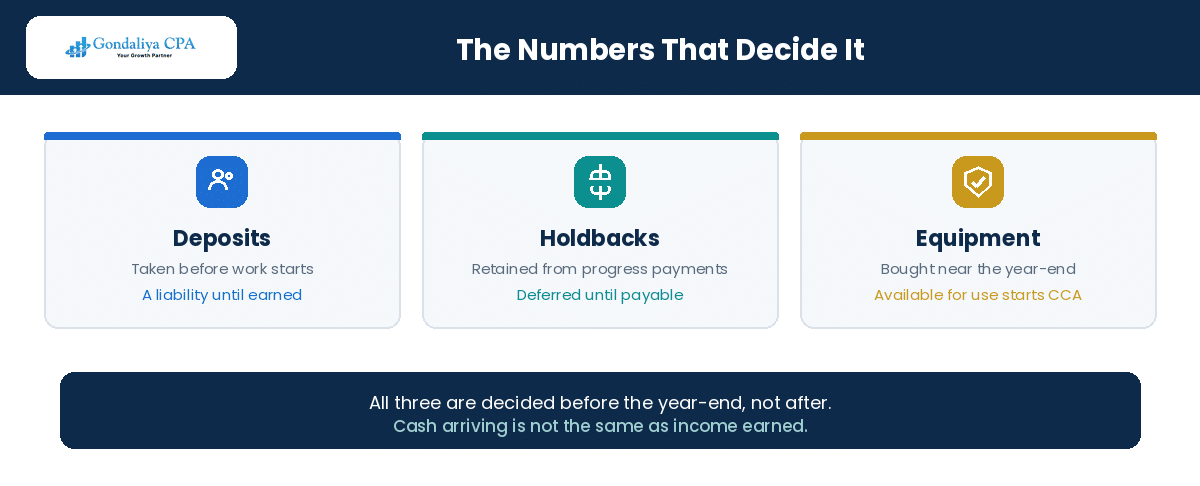
Risk Warning: A deposit taken before the work starts is a liability, not revenue. Please check how your bookkeeping treats deposits before the year-end figures are locked.
Corporate Tax Filing and Reporting Requirements for Waterproofing Contractors
Corporate Tax Filing, Savings and Revenue Recognition
The Filing
Waterproofing contractor tax planning Canada means following strict corporate tax filing rules. Good contractor corporate tax planning helps you stay compliant and manage cash flow well. It also lowers your taxable income with smart waterproofing tax strategies.
Corporations must file a T2 Corporation Income Tax Return every year. This return shows all income, expenses, capital cost allowance claims, and other details. Filing on time avoids penalties and interest from the CRA. Keeping neat records with job costing helps report business income and deductible expenses accurately.
T5018 Contract Payment Reporting and Subcontractor Compliance Essentials
Incorporated waterproofing contractors who hire subcontractors must meet the T5018 contract payment reporting deadline. The CRA requires Form T5018 reports by February 28 of the year after payments were made.1
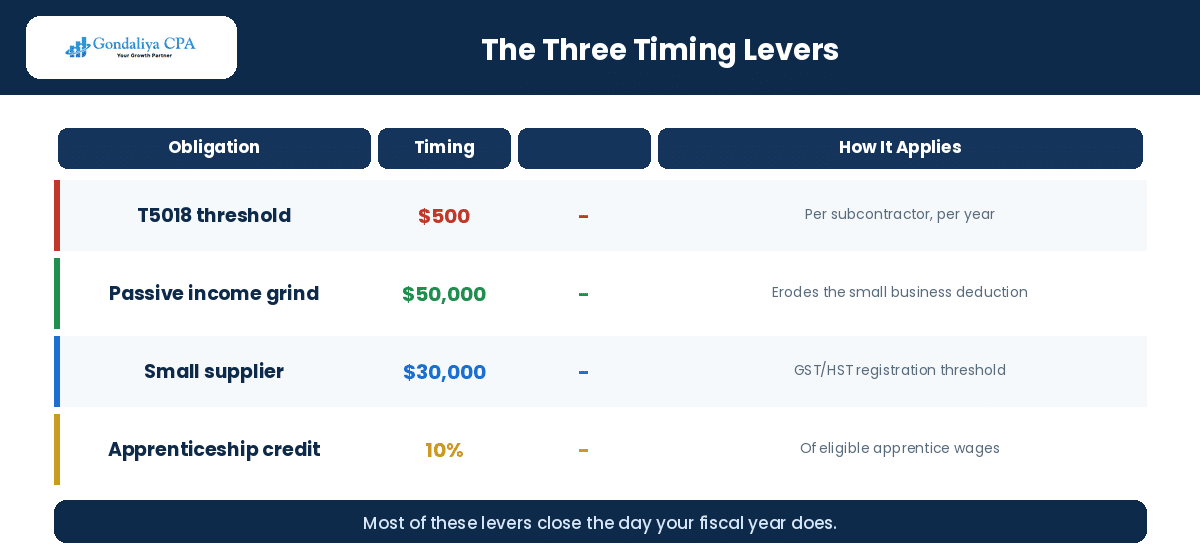
You must report if you paid more than $500 to a subcontractor in a fiscal year. Missing this deadline can lead to fines—$25 per wrong or missing slip plus interest.2 A waterproofing tax accountant can keep you on track by handling these reports carefully.
Keep clear records of subcontractor contracts, invoices, holdbacks released, and payment dates. This also helps decide if workers are employees or contractors, which affects payroll source deductions under Canadian rules.3
Addressing Catch-Up Filing and Corporate Tax Cleanup Issues Specific to Contractors
Contractor corporate tax planning sometimes involves fixing past tax filings that missed deductions or misreported income. Waterproofing contractor tax planning Canada benefits from cleaning up old returns before filing new ones.
Catch-up filing includes updating job costs, equipment purchases (capital assets), shareholder loan balances, payroll remittances like CPP contributions, GST/HST reconciliations, and proper handling of holdbacks paid after year-end.4
Reviewing past years might reveal lost small business deductions due to passive investment income or rules about associated corporations.5 Fixing these early cuts audit risk and improves cash flow management.
Tax Saving Strategies for Waterproofing Contractors and Corporations
Using provisions like the small business deduction business limit and capital cost allowance claims help contractors save taxes efficiently.
Utilizing the Small Business Deduction and Managing Associated Corporations
The small business deduction (SBD) lowers Ontario small business taxes on active income up to a combined federal-provincial limit—called the “business limit”—usually $600,000 federally.6 But this changes if corporations are linked under Income Tax Act s.125(1).7
Associated corporations share this limit, so multiple companies must plan carefully during contractor corporate tax planning. No one should exceed their share or lose SBD benefits.
You also need to watch passive investment income; if it’s above $50,000 per year per corporation, your SBD reduces gradually.8 Some holding companies might cut group benefits if they don’t handle intercompany dividends right. A CPA who knows construction sectors like waterproofing can advise here.
Capital Cost Allowance and Immediate Expensing Options on Waterproofing Equipment
Capital Cost Allowance (CCA) lets incorporated contractors claim depreciation over time on assets:
- Passenger vehicles: Class 10/10.1 at 30%, but subject to cost limits
- Heavy equipment like excavators: Class 16 at 40%
- Tools & small equipment: Class 12 with possible full immediate expensing
New rules let you fully expense certain assets bought after January 2026 immediately instead of waiting years.910
Timing matters: only half CCA can be claimed in the first year unless you time asset use before fiscal year-end.11
Passenger vehicle cost limits cap what you can deduct. Any amount over the threshold won’t get full CCA but may be partly allowed if used strictly for business.12
Impact of Shareholder Loans and Payroll Source Deductions on Taxable Income
Shareholder loans cause trouble if not repaid within a year after fiscal year-end. They become taxable benefits under section 15(2).13 These increase personal taxes unexpectedly unless repaid fast.
Payroll source deductions like CPP contributions apply when paying salaries—even family members working legit jobs get covered.14 Dividends don’t create RRSP room or pension credits but offer some tax advantages versus salary.
Choosing salary or dividends impacts both your company’s deductions and your after-tax income. Planning pays off when tailored for incorporated waterproofers while avoiding CRA reassessments.1516
Optimizing Revenue Recognition and Job Costing for Tax Efficiency
How you recognize revenue affects taxable profits during fluctuating project cycles typical in waterproofing jobs.
Selecting Appropriate Revenue Recognition Methods Suited To Waterproofing Projects
Waterproofers usually pick either completed-contract or percentage-of-completion methods consistent with ASPE standards. Deposits taken upfront go into revenue unless refundable or unearned amounts exist—contracts must clarify terms to avoid errors.
Year-end cutoffs should match actual work done instead of just invoiced amounts to prevent overstating taxable income. Keeping detailed progress records helps defend deferrals during audits, especially when projects cross fiscal years.
Effective Job Costing Practices To Maximize Deductible Business Expenses
Track direct materials like membranes carefully. Include crew labor hours, overtime pay, tool rentals, insurance premiums, and necessary training fees provincially required as core deductible expenses.
Limit meals expenses to allowed percentages so entertainment costs don’t inflate taxable profits. Separate vehicle costs by personal vs business use with mileage logs; deduct fuel and repairs accordingly while following passenger vehicle rules.
Keep clear distinctions between employee wages vs independent subcontractor fees to stay compliant for T5018 reporting.
Managing Holdback Treatment For Tax Purposes In Waterproofing Contracts
Provincial laws require statutory holdbacks—money kept until work finishes properly—which complicate revenue timing. You record holdbacks as deferred revenue until legally payable in next fiscal period.
A detailed receivables system tracks holdbacks by job. This avoids reporting income too early while keeping cash flow stable during seasonal ups and downs common in GTA waterproofing markets. Board resolutions document accounting treatments clearly for audit purposes.
For help dealing with complex tax issues in your incorporated waterproofing company contact our team at info@gondaliyacpa.ca or call 647-212-9559.
The half-year rule catches people who buy equipment in December. Buying it is not the trigger; having it available for use is, and the two dates are rarely the same. Figures changed for privacy.
Key Stat: Any subcontractor paid more than $500 in the fiscal year needs a T5018 slip. Please run that report in January rather than late February.
Specialized Credits and Incentives for Waterproofing Contractors
Specialized Credits, Incentives and HST Strategies
The Credits
Waterproofing contractor tax planning in Canada means using special credits and incentives to lower corporate taxes. These opportunities help contractors keep more money after tax. Understanding them is key to good waterproofing tax strategies and solid contractor corporate tax planning.
Exploring Tax Credit Opportunities Relevant to Waterproofing Companies
Waterproofing companies can get various tax credits that fit their business. These include credits for investments, workforce programs, and local construction support. To claim these, you must keep good records and follow CRA rules under the Income Tax Act.
Some examples:
- Costs for eligible equipment or training.
- Apprenticeship job creation tax credits.
- Regional incentives supporting contractors.
Using these properly can improve cash flow while staying within the law. It’s a smart move in your contractor corporate tax planning.
Apprenticeship Job Creation Tax Credit and Workforce Development Incentives
The Apprenticeship Job Creation Tax Credit (AJCTC) helps incorporated waterproofing firms save money. It refunds 10% of eligible wages paid to apprentices in approved trades. This lowers payroll costs while training new workers.
To qualify:
- Have apprentices registered in an approved program.
- Keep detailed payroll records showing apprentice pay.
- Claim the credit each year on your T2 return.
This credit suits seasonal hiring common among waterproofers. It helps with costs during busy times without messing up year-end filings.[1]
Investment Tax Credits Related to Clean Technology Adoption in Construction-Related Businesses
Contractors who invest in clean technology—like energy-saving machines or green materials—might get federal or provincial investment tax credits (ITCs). These reduce taxes on capital spent for eco-friendly tools that improve efficiency.
Keep in mind:
- Assets must meet CRA’s set criteria.
- New rules let you expense some green tech faster starting 2026.
- Keep clear proof that assets serve your waterproofing work.
Adding ITCs to your contractor corporate tax planning cuts taxable income and boosts profits over time.[2]
HST Strategies for Waterproofing Contractors in Ontario and Greater Toronto Area
Managing HST well matters a lot if you work in Ontario or the Greater Toronto Area. Good contractor corporate tax planning covers registration limits, input tax credit claims, payment timing, and place-of-supply rules from the Excise Tax Act.
Here are some tips:
- Claim input tax credits on things like membranes, tools, rentals, and subcontractors.
- Watch your revenue against the $30,000 small supplier limit.
- Even if below this threshold, registering can let you recover GST/HST inputs.
- Align invoicing with work done dates, not just when you get paid.
These steps help you stay legal and keep cash flowing through ups and downs of waterproofing jobs.[3]
Comparing the Quick Method versus Regular Method for HST Filing
Waterproofing contractors choose between Quick Method or Regular Method when filing HST. Both affect cash flow and paperwork differently across Canadian contractors.
| Factor | Quick Method | Regular Method |
|---|---|---|
| Eligibility | Annual sales ≤ $400K | No sales limit |
| Input Tax Credits | Simplified; no actual claims | Full claim on real purchases |
| Paperwork | Less complex | More detailed records needed |
| Cash Flow | Fixed remittances | Changes with purchases |
| Record Keeping | Basic documentation | Detailed invoices required |
Quick Method suits smaller firms wanting easy reporting but less input recovery. Bigger companies gain from Regular Method despite more complexity.[4]
Navigating New Housing Rebates, Self-Supply Rules, and Subcontractor HST Verification
New housing rebates apply when residential properties get big renovations including waterproofing parts tied to new builds or major retrofits. Contractors must know eligibility rules based on property status per CRA guidelines.[5]
Self-supply rules make sure companies charge GST/HST correctly when doing work internally—common for businesses with multiple locations or franchise crews.[6]
Checking subcontractors means confirming they have valid GST/HST numbers before paying them. Mistakes here bring penalties under Regulation 238 about T5018 contract payment reporting deadlines.[7] Keeping up-to-date records of subcontractors helps avoid audits.
Best practices to ensure accurate GST/HST filing and avoid audit triggers
- Keep all contracts showing scope and prices to prove revenue timing.
- Submit T5018 forms on time listing subcontractor payments per Regulation 238 deadlines.[7]
- Double-check input claims so you don’t overstate expenses like mixed-use vehicles.
- Watch yearly law changes especially those from 2026 about faster expensing rules affecting capital cost allowance.[2]
- Work with a knowledgeable waterproofing tax accountant who understands sector specifics and Ontario rules.[8]
Following these tips cuts audit risks greatly while supporting strong contractor corporate tax planning tailored to Canadian incorporated SMBs working in Ontario including Toronto’s busy market.
References:
- Canada Revenue Agency – Apprenticeship Job Creation Tax Credit
- Income Tax Act – Capital Cost Allowance Classes & Immediate Expensing Updates
- Excise Tax Act – Place of Supply & Input Tax Credits
- Canada Revenue Agency – Quick Method vs Regular Method Overview
- CRA Guide RC4028 – New Housing Rebate Details
- Excise Tax Act Regulations – Self-Supply Provisions
- Regulation 238 Reporting Requirements & Deadlines – https://laws-lois.justice.gc.ca/eng/regulations/SOR-2009–313/page–1.html
- Gondaliya CPA Professional Corporation internal expertise database (Toronto/Ontario)
For advice made just for your incorporated Canadian waterproofing business—including tricky rebate qualifications or choosing the right HST filing method—contact Gondaliya CPA at info@gondaliyacpa.ca or call 647‑212‑9559 for a free chat about smart contractor corporate tax planning based on current Canadian laws covering Ontario including Toronto’s market area.
The Quick Method looks attractive until you count the input tax credits it costs you. For a contractor buying membrane and renting equipment, the regular method usually wins. Figures changed for privacy.
Pro Tip: Please confirm a subcontractor’s GST/HST number before paying an invoice that charges it. Recovering a credit on an invalid registration is not possible after the fact.
Year-End and Ongoing Tax Compliance for Waterproofing Companies
Year-End and Ongoing Tax Compliance
The Year-End
Year-End Tax Planning Checklist for Waterproofing Contractors
If you’re an incorporated waterproofing contractor in Canada, year-end tax planning matters a lot. It helps you keep your taxes in check and avoid surprises. Here’s a simple checklist to guide you through contractor corporate tax planning and key waterproofing tax strategies.
- Check Revenue Recognition: Make sure all income is recorded correctly. This includes deposits, progress payments, and holdbacks. Your work-in-progress (WIP) should reflect what’s really done by year-end according to CRA rules.
- Review Capital Asset Purchases: Confirm your equipment or vehicle buys qualify under the available-for-use rule before claiming capital cost allowance (CCA). Keep exact purchase dates so you can claim immediate expensing if possible under 2026 rules.
- Look Over Shareholder Loans: Balance your shareholder loan accounts before the year ends. Pay back or properly document any loans to avoid them being treated as personal income under section 15(2). Always keep clear loan agreements and repayment plans.
- Finalize Payroll and Remuneration: Decide on salary vs dividends based on factors like RRSP room, CPP contributions, and tax integration. If you plan bonuses, make sure to record them within allowed payment windows to deduct them this fiscal year.
- Prepare T5018 Reporting: Gather all subcontractor payments carefully before the T5018 contract payment reporting deadline. Following Regulation 238 is key to avoiding penalties.
- Verify Expenses & Deductions: Check all business costs like ads, materials, and insurance. They need to be real expenses supported by invoices or contracts as per Income Tax Act sections 18(1)(a) & 67(1).
- Review Instalment Payments: Adjust your instalments if taxable income varies due to seasonal work cycles common in waterproofing. This helps dodge interest from late or low payments.
Following this checklist keeps you on track with Canadian tax laws specific to waterproofing contractor tax planning Canada.
| Year-End Action | Purpose | Record Required | Reference |
|---|---|---|---|
| Revenue recognition review | Accurate taxable income reporting | Job files; WIP schedules | CRA ITA s9; CSRS4200 |
| Equipment purchase timing | Maximize CCA claims | Purchase invoices; asset register | ITA s13; Reg Schedule II |
| Shareholder loan reconciliation | Prevent unintended shareholder benefit inclusion | Loan agreements; bank statements | ITA s15(2); CRA Interpretation |
| Payroll finalization | Optimize remuneration deductions | Payroll slips; bonus accruals | ITA ss7–10 |
| T5018 preparation | Meet subcontractor reporting rules | Subcontractor contracts/payment records | Reg 238 |
| Expense validation | Legitimate deduction claims | Invoices/receipts | ITA ss18(1)(a),67 |
Common Tax Pitfalls and CRA Audit Risks for Waterproofing Contractors
Waterproofing contractors can trip up on taxes in several ways. Problems often come from mistimed revenue reports, missing papers, wrong expense claims, or slipping up on subcontractor reports like T5018.
Here are some common mistakes:
- Wrong Deposit or Holdback Reporting: Sometimes deposits get counted as earned income too soon. The CRA wants revenue tied clearly to when work is done, not just when cash arrives.
- Late or Missing T5018 Filing: Forgetting the March deadline for T5018 forms can mean fines—starting at $100 per missing slip plus daily penalties till fixed. Tracking your subcontract payments all year helps avoid this.
- Unjustified Family Salaries: Paying family without proof they did real work risks having those salaries denied by CRA under reasonableness tests.
- Misusing Shareholder Loans: Not repaying shareholder loans on time means they become taxable personal income with possible extra charges under section 15(2).
How to lower audit risks?
Keep detailed records — signed contracts that explain deposit terms help a lot. Do regular reconciliations so numbers always match up. Working with a waterproofing tax accountant who knows construction industry quirks is smart too. They understand tricky points like holdback treatment governed by provincial lien laws combined with federal tax rules.
For example, a Toronto foundation repair company avoided reassessment by clearly linking holdback release terms in change orders with aged receivable reports—a best practice across Ontario’s construction field.
If CRA starts asking questions, don’t go it alone. Experienced CPA firms provide expert audit help specially for construction businesses around Toronto, Mississauga, Vaughan, and beyond.
Contact
If you want practical advice using compliant waterproofing contractor tax strategies within Canadian law, contact Gondaliya CPA at info@gondaliyacpa.ca or call 647‑212‑9559 for a free chat about maximizing after-tax profits safely.
The change order is where holdback disputes get settled before they start. Written release terms tied to the aged receivable is what turns an argument into a document. Figures changed for privacy.
Risk Warning: A salary paid to a family member needs evidence of work actually performed. Please keep timesheets or a job description on file rather than producing one during a review.
Structuring Shareholder Remuneration for Tax Optimization
Shareholder Remuneration, Structure and Seasonality
The Structure
Paying shareholders the right way is key for waterproofing contractor tax planning Canada. Choosing salary or dividends affects taxes, RRSP limits, and CPP payments. A good plan balances all these to keep more money and stay clear of CRA troubles.
Balancing Salary Versus Dividends to Maximize After-Tax Profits and RRSP Contribution Room
Salary lowers corporate taxes because it’s an expense. It also builds RRSP room but requires CPP payments. Dividends don’t create RRSP room and skip CPP but offer personal tax credits that help reduce overall tax.
Most contractors find a mix works best:
- Pay a reasonable salary up to the RRSP limit
- Add dividends on top to boost income without payroll costs
Shareholder loans must be repaid quickly. If not, CRA treats unpaid loans as taxable benefits, pushing your taxes higher.
Example:
An owner takes $75,000 in salary (max RRSP room), plus $30,000 in dividends yearly. The company deducts the salary fully. Dividends get lower personal tax rates. Loans get paid back on time, avoiding extra tax.
Understanding the Implications of TOSI (Tax on Split Income) and Personal Services Business Rules
TOSI hits when income gets shared with family members who don’t really work or hold special shares. Paying a spouse or relative means they must do real work; otherwise, TOSI can raise their tax rate sharply.
Personal services business (PSB) rules target single-builder subcontractors acting like employees but billing as businesses. PSBs pay higher corporate tax and lose some deductions. Keeping solid records showing control over work schedules, tools, contracts held by the corporation—not you—helps avoid PSB classification.
Tip: Always keep detailed contracts defining your independence when subcontracting alone.
Employing Family Member Remuneration Strategies Within CRA Guidelines
Pay family members fair wages based on real duties to claim expenses properly and help household cash flow. Pay must match market rates; CRA can deny excessive amounts under section 67(1).
Salaries build CPP coverage for retirement benefits; dividends don’t count for this or boost pension earnings. File payroll remittances on time with clear T4 slips.
Example:
A spouse handles office admin and earns $40,000 a year backed by timesheets and job descriptions during review. This counts as a real expense and boosts retirement savings via RRSP room based on earned income.
Corporate Structure Considerations for Waterproofing Contractors
Incorporating opens doors for contractor corporate tax planning but adds tasks like managing passive income and small business deduction limits to keep taxes low in Canada’s construction sector.
Benefits and Responsibilities of Incorporation and Professional Corporation Status
Incorporated contractors get small business deduction rates on active income up to about $600k federally. Professional corporations offer governance perks if you have partners but must follow CPA Ontario rules about names and allowed activities.
Corporations file T2 returns yearly plus GST/HST if revenue crosses thresholds common in Toronto/Ontario markets served by Gondaliya CPA’s team specializing in construction accounting.
Managing Passive Income and Small Business Deduction Limits for Contractor Corporations
The small business deduction limit gets shared among linked companies per Income Tax Act rules. Passive income over $50k cuts this limit dollar-for-dollar, creating the “passive income grind” that raises marginal rates until passive earnings hit $150k, where the benefit vanishes.
Planning when to realize investment gains versus reinvesting into assets like equipment helps protect your low-tax bracket during busy seasons needing cash reinvestment.
Planning for Corporate Wealth Building, Retaining Earnings, And Exit Strategy Preparation
Keeping profits after good seasons builds capital but can cause double taxation if you’re not careful. Using holding companies can delay taxes legally until you sell or transfer ownership later.
Losses from slow winters carry forward to offset future profits easing installment pressures common in seasonal waterproofing businesses.
Managing Seasonal Cash And Income Swings In Waterproofing Businesses
Seasonal ups and downs demand smart cash flow forecasting under Canadian law with advice from Gondaliya CPA experts who understand regional demand from Toronto to Windsor well.
Cash Flow Forecasting Tailored For Seasonal Demand Variations
You need precise forecasts that show busy summer periods against slow winters. This guides your installment payment schedule so you avoid interest penalties due March 15th, June 15th, September 15th, December 15th deadlines under Income Tax Act s157. Planning ahead keeps reserves ready for off-season expenses.
Instalment Timing Strategies To Minimize Interest And Penalties With CRA
Pay quarterly installments exactly on time or face interest plus daily penalties calculated per CRA rules. Adjust mid-year if contracts stall — this flexibility protects your cash flow especially during exterior excavation projects requiring sharp money control.
| Deadline | Applies To | Consequence If Missed | Source |
|---|---|---|---|
| March 15 | Previous fiscal year | Interest + penalty accrual | ITA s157 |
| June 15 | Current fiscal year Q1 | Same | ITA s157 |
| September 15 | Current fiscal year Q2 | Same | ITA s157 |
| December 15 | Current fiscal year Q3 | Same | ITA s157 |
Table: Quarterly Installment Deadlines
Watch installments carefully each season to avoid audit flags linked to late payments while keeping more profit after taxes.
Job Profitability Tracking And Real-Time Accounting Intelligence Tools
Use strong job costing tools like QuickBooks combined with Hubdoc for real-time expense tracking. This ensures all deductible waterproofing expenses are recorded right supporting proper GST/HST input claims.
Good tracking helps spot profitable jobs like commercial below-grade membranes needing tight cost control.
Don’t forget: issuing T5018 slips properly documents subcontractor payments lowering audit risk while backing labor classification consistent with Regulation238 requirements.
Sharad Gondaliya, CPA, has 10+ years working with Canadian business owners in this field.
The remuneration mix gets decided in December far too often. Set it in the first quarter and the CPP, RRSP and instalment consequences all land where you intended. Figures changed for privacy.
Key Stat: Passive income above $50,000 grinds the small business deduction away, and by $150,000 it is gone. Please watch that figure in the years after a strong season.
Leveraging Technology and AI Solutions for Construction Tax Planning
Technology, Specialist Advice and Resources
The Tools
Technology and AI are changing waterproofing contractor tax planning Canada. They automate data handling and help catch mistakes early. Programs like QuickBooks or Xero connect with payroll services such as ADP or Wagepoint. This connection makes bookkeeping, expense tracking, and GST/HST filing easier.
AI tools spot tax-saving chances by studying cash flow during busy times and slow winter months. For example, algorithms predict income swings from deposits, holdbacks, or progress billings. These details matter in contractor corporate tax planning. Contractors can then adjust instalment payments or buy equipment to claim capital cost allowance (CCA).
Cloud platforms let contractors work with their waterproofing tax accountant instantly. Secure sharing speeds up reviews while following CRA record rules. AI can also remind users about T5018 contract payment deadlines or shareholder loan repayments.
Using these tools creates detailed job costing records needed under the Income Tax Act for construction contracts. They also help manage issues like small business deduction limits for related companies or passive investment income thresholds affecting corporate taxes.
Our Take: Adding technology into contractor corporate tax planning boosts efficiency without risking compliance when a CPA Ontario member familiar with waterproofing guides the process.
When to Consult a Specialist Waterproofing Tax Accountant
You should talk to a specialist waterproofing tax accountant when your situation gets complex. This happens often for incorporated Canadian contractors. Here are some cases to consider:
- Setting up waterproofing tax strategies that fit seasonal cash flow.
- Dealing with small business deduction limits among connected companies.
- Balancing pay through salary versus dividends while watching RRSP room and CPP contributions.
- Buying capital assets using new immediate expensing rules starting in 2026.
- Filing T5018 forms correctly to report subcontractor payments per Regulation 238.
- Avoiding risks linked to personal services businesses with single-builder subcontract work.
Specialists know contractor corporate tax planning details in Ontario and across Canada. They understand laws like the Income Tax Act and Excise Tax Act rules on input tax credits.
For incorporated waterproofers who want to keep more money after taxes, seeing an expert early helps avoid costly audits. It keeps your plan legal and steers clear of schemes CRA rejects.
Pro Tip: Meet before year-end or before buying big equipment. This timing helps use deductions allowed under current CCA classes, including immediate expensing for some assets starting in 2026.
Supporting Multimedia and Additional Resources
Visual aids make waterproofing contractor tax planning Canada easier to grasp:
- Seasonal Cash Flow Cycle Diagram: Shows how revenue peaks and off-season expenses affect instalment calculations.
- Equipment Purchase Timing Flowchart: Helps decide when to buy capital assets considering the half-year rule on deductions.
Other resources include checklists on what papers you need for deposit timing and holdback tracking under provincial construction laws. We also provide sample templates for pay models mixing salary and dividends in line with Canadian tax rules.
Find these tools in Gondaliya CPA’s library made for foundation repair firms around Toronto/Ontario but useful anywhere in Canada.
These guides support advice from our team who use software like Hubdoc for receipt capture plus insights on law changes after 2025 affecting construction taxes.
CRA Requirement: Keep detailed job files proving every deduction claimed. Digital records must be safe but easy to access if CRA audits you, according to Income Tax Act rules on books & records.
Sharad Gondaliya, CPA, has over 10 years helping Canadian business owners manage tough corporate tax challenges well.
Software will not fix a costing structure that was wrong from the start. It will, however, make a good one nearly effortless to maintain. Figures changed for privacy.
Verification: Our CPA Ontario firm registration can be checked on the public firm directory. Please verify any firm before granting access to your accounting file.
Frequently Asked Questions (FAQs)
Frequently Asked Questions (FAQs)
FAQ
What actually drives a waterproofing contractor’s tax bill?+
Income timing, deductible expenses, shareholder remuneration, and compliance with CRA rules mainly drive your tax bill. Proper planning optimizes these factors.
Does the timing of revenue change what you owe?+
Yes. Reporting revenue too early can increase taxable income and taxes. Matching income recognition to work completed controls tax liability effectively.
How should you handle deposits and progress payments?+
Treat deposits as liabilities until work begins. Progress payments match revenue recognition tied to project milestones to avoid overstating income.
How do holdbacks affect taxable income?+
Holdbacks delay income recognition until legally payable. They create deferred revenue on your books and impact cash flow management.
How do you use the Small Business Deduction without losing it?+
Plan to keep active business income under limits and manage passive investment income below $50,000 annually to retain full deduction.
How should you time equipment and vehicle purchases?+
Buy assets before year-end for immediate expensing where possible. Avoid buying late in fiscal year to maximize Capital Cost Allowance claims.
Buy or lease trucks and excavation equipment: which route fits?+
Buying lets you claim CCA; leasing spreads costs but lacks depreciation claims. Consider cash flow, tax impact, and ownership goals.
How do you plan around recapture and terminal losses?+
Track asset disposals closely. Recapture adds taxable income; terminal losses can offset other income when assets are sold or fully depreciated.
Which expenses give the best legitimate return?+
Expenses directly related to projects like materials, labor, insurance, and subcontractors provide solid deductions under CRA rules.
How do you plan a seasonal cash and tax cycle?+
Forecast revenues and expenses by season. Adjust instalments accordingly to minimize interest penalties and manage cash flow fluctuations.
Which tax year-end fits a seasonal contractor?+
Choose a fiscal year-end that aligns with slower periods for better expense matching and smoother tax reporting.
Salary or dividends for a contractor owner: which route fits?+
Combine salary for RRSP room with dividends for lower personal taxes. Balance depends on CPP contributions and corporate deductions.
When should you pay a spouse or family member?+
Only when they perform real work at reasonable rates. Document duties clearly to meet CRA’s reasonableness tests.
How do you plan crew costs, subcontractors, and T5018 reporting?+
Keep accurate payroll records. Report subcontractor payments over $500 timely using T5018 forms to avoid penalties.
What should you do with retained earnings after a strong season?+
Consider reinvesting into assets or saving for slow periods. Plan distributions carefully to control personal vs corporate tax exposure.
How do shareholder loans and personal spending create problems?+
Unrepaid loans over one year become taxable benefits. Mixing personal expenses with company funds triggers CRA reassessments.
How do losses and carryforwards fit a bad season?+
Use non-capital loss carryforwards to offset future profits, smoothing tax burdens across uneven years.
What are the year-end planning moves for a contractor?+
Reconcile revenue timing, finalize capital purchases, settle shareholder loans, prepare T5018 reports, and confirm payroll entries.
Which strategies should contractors avoid?+
Avoid overstating expenses without proof, missing T5018 deadlines, misclassifying workers, and ignoring PSB rules on single-subcontractors.
What records support every planning position?+
Keep contracts, invoices, timesheets, loan agreements, job costing sheets, payroll slips, and T5018 documentation meticulously organized.
Quick Comparison Table: Tax Planning Approaches
Comparison, Scope and Deliverables
Quick Reference
| Aspect | DIY | Non-CPA Provider | Gondaliya CPA Specialist |
|---|---|---|---|
| Tax Law Expertise | Limited | Moderate | Deep industry-specific knowledge |
| Compliance Accuracy | Risky | Medium | High |
| Custom Strategy | Basic | General | Tailored to waterproofing |
| CRA Audit Support | Minimal | Some | Full support |
| Cost | Low | Moderate | Value-based |
Who This Is For / Not For
- For: Incorporated waterproofing contractors seeking tailored corporate tax planning in Canada. Those needing expert handling of T5018 reporting and holdbacks.
- Not For: Sole proprietors without incorporation or contractors who do not engage subcontractors or face complex cash flow cycles.
What Should You Prepare Before a Planning Engagement Starts?
Gather recent financial statements, subcontractor contracts, capital asset purchase records, payroll data including shareholder loans details, previous tax returns including T2 filings and GST/HST filings plus any notices from CRA about assessments or audits.
How Do We Build a Contractor’s Tax Plan at Gondaliya CPA?
We assess your business structure then identify key deduction opportunities such as CCA claims. We coordinate payroll structuring for owner remuneration balancing salary/dividends optimizing RRSP room while managing seasonal cash flows with tailored instalment schedules. Compliance areas like T5018 are rigorously monitored to prevent penalties.
What Deliverables Do You Get?
- Customized corporate tax strategy document
- Year-end checklist aligned with CRA compliance
- Cash flow forecast model
- Shareholder remuneration recommendations
- T5018 filing calendar alerts
- Post-filing audit readiness review
How Much Does Tax Planning Cost for a Waterproofing Contractor in Canada?
Fees depend on complexity but typically range from moderate annual retainers to project-based pricing reflecting specialized construction sector expertise at Gondaliya CPA offering excellent ROI through optimized savings.
What Are the Top Planning Mistakes and How Do You Prevent Them?
Mistakes include late T5018 filings causing fines; misclassifying workers triggering payroll issues; ignoring holdback accounting leading to inflated income; failing to manage shareholder loans risking taxable benefits; improper salary/dividend splits losing RRSP advantages; not tracking passive investment income restricting small business deductions. Prevention requires detailed record keeping plus expert CPA advice.
Which Strategies Should Contractors Avoid?
Avoid aggressive revenue deferrals unsupported by contracts; claiming personal expenses as business deductions; neglecting timely T5018 reporting; ignoring PSB rules when working as subcontractors alone; delaying shareholder loan repayments beyond allowable periods; skipping instalment adjustments amid seasonal shifts.
Why Trust Gondaliya CPA?
Gondaliya CPA has extensive experience serving Canadian waterproofing contractors with deep knowledge of contractor corporate tax planning nuances including Ontario’s regulatory environment. Our expert team helps clients maximize savings while maintaining full CRA compliance—providing peace of mind backed by proven results in this niche sector.
Twenty questions and one answer underneath most of them: match the revenue to the work. Almost every planning move on this page depends on that being right first. Figures changed for privacy.
Contractor Types We Serve
Industry Expertise
Which lever matters most differs by the work you do. Here are ten and the usual focus.
| Contractor Type | The Main Planning Lever |
|---|---|
| Exterior excavation waterproofing | Seasonal instalments against summer revenue |
| Interior weeping tile & sump systems | Deposits recorded as liabilities, not revenue |
| Foundation crack injection specialists | Small jobs, high volume, tight job costing |
| Commercial below-grade membrane | Holdbacks deferred to statutory release |
| Basement lowering & underpinning | Long contracts crossing fiscal year-ends |
| Concrete & masonry restoration | Equipment timing for capital cost allowance |
| Drainage & grading contractors | Excavator classes and vehicle cost limits |
| Roofing & above-grade waterproofing | Subcontractor classification and T5018 slips |
| Single-builder subcontractors | Personal services business risk |
| Multi-entity contractor groups | Associated corporations sharing one limit |
- Exterior excavation waterproofing: Revenue lands in a short window, so instalments set on last year’s figures rarely fit.
- Interior weeping tile and sump systems: Deposits collected before digging are liabilities until the crew arrives.
- Foundation crack injection specialists: Many small jobs hide margin problems unless costs are tracked per job.
- Commercial below-grade membrane: Statutory holdbacks are largest here and belong in deferred revenue.
- Basement lowering and underpinning: Contracts spanning two fiscal years need a cutoff based on work done.
- Concrete and masonry restoration: Equipment available for use before year-end is what starts the claim.
- Drainage and grading contractors: Excavators and passenger vehicles sit in different classes with different limits.
- Roofing and above-grade waterproofing: Crews paid as subcontractors need contracts and slips to support the position.
- Single-builder subcontractors: Working for one general contractor is where the personal services business rules bite.
- Multi-entity contractor groups: Related companies share one business limit whether or not that was intended.
The type of work changes which lever matters most. It does not change the sequence: fix the revenue timing first, then the structure. Figures changed for privacy.
Professional Guidance and Quick Reference
Guidance
Professional Guidance for Waterproofers: How Gondaliya CPA Cuts Your Tax Bill
Waterproofing tax planning turns on timing. A deposit taken in November is not income until the crew digs. Equipment bought in December earns nothing unless it was available for use. Holdbacks are not revenue until they are legally payable. Get those three right and the rest of the planning has something solid to sit on. Gondaliya CPA handles the full cycle on a fixed annual fee.
We handle what decides the outcome: matching revenue to work actually completed, treating deposits and progress payments correctly, deferring holdbacks until legally payable, timing equipment purchases around the available-for-use rule and immediate expensing, filing T5018 slips for every subcontractor over the threshold, protecting the small business deduction from the passive income grind, setting the salary and dividend mix against RRSP room and CPP, and adjusting instalments to your seasonal cycle.
Our team plans before year-end rather than reporting after it, because most of these levers close once the year does. Busy season or quiet, you get clear advice and a fixed price before we start.
Quick Answers: Key Numbers & Concepts at a Glance
At a Glance
- Deposits: A liability until work begins
- Holdbacks: Deferred until legally payable
- T5018 threshold: Over $500 per subcontractor
- T5018 deadline: February 28
- Equipment: Available for use starts the claim
- Half-year rule: Halves the first-year claim
- Passive income grind: Begins at $50,000
- Small supplier threshold: $30,000 for GST/HST
- Apprenticeship credit: 10% of eligible apprentice wages
- Instalments: March, June, September and December 15
Who This Is For / Not For
Fit Check
- For: Incorporated Canadian waterproofing and foundation contractors using subcontractors and managing seasonal cash flow.
- Not For: Audit or review engagements, which carry a different scope; we prepare compilations alongside the tax work.
People Also Ask
Related Questions
Is a deposit taxable in the year I receive it?+
Generally not, if the work has not been done and the contract makes the amount refundable or unearned. The contract wording is what decides it.
Can I claim full capital cost allowance on equipment bought in December?+
Only if it was available for use before your year-end, and the half-year rule may still apply unless immediate expensing covers the asset.
What happens if I miss the T5018 deadline?+
Penalties apply per slip and accumulate. Filing late is still better than not filing, and the exposure grows the longer it sits.
Glossary of Key Terms
- Work in progress: Value of partly finished jobs not yet billed.
- Deposit: Money taken before work starts, a liability until earned.
- Holdback: Amount retained from progress payments until statutory release.
- Percentage-of-completion: Recognising revenue in proportion to work performed.
- Completed-contract: Recognising revenue only when the contract finishes.
- T5018: The contract payment reporting slip for subcontractors.
- Regulation 238: The rule requiring contract payment reporting.
- Capital cost allowance: The tax deduction for depreciation on eligible assets.
- Available for use: The point at which an asset is ready to operate and CCA may begin.
- Half-year rule: The restriction limiting first-year capital cost allowance.
- Recapture: Income arising when disposal proceeds exceed the undepreciated capital cost.
- Terminal loss: A full deduction of remaining UCC where no assets remain in the class.
- Small business deduction: The reduced federal rate on active business income up to the business limit.
- Passive income grind: The reduction in the business limit caused by investment income.
- TOSI: The tax on split income, applying where family members receive amounts without contribution.
- Personal services business: A corporation whose work resembles employment, taxed at higher rates.
Waterproofing Tax Readiness Check
This quick self-check indicates where your operation most likely has room. Please answer the six questions below.
Waterproofing Tax Readiness Check
Six quick questions on your position. No fee shown.
Points to raise with us:
This is a general prompt, not tax or legal advice or a quote. Your position depends on your full facts. For a real review, please book a free consultation.
Want a checklist to work from? You can download our free waterproofing year-end checklist before your consultation.

Hold deposits as liabilities until the work starts. Defer holdbacks until legally payable. Match the year-end cutoff to work done, not invoices issued. Have equipment available for use before the year closes. File T5018 slips by the last day of February. Watch passive income against the $50,000 threshold. Set the pay mix early. Please adjust instalments when the season shifts.
2026 Update — what is current: This article notes immediate expensing rules taking effect for assets acquired after January 2026. The $500 T5018 threshold, the February slip deadline, the $50,000 passive income grind threshold, the $30,000 small supplier threshold and the 10% apprenticeship credit are unchanged. Please note the article gives the federal business limit as $600,000 where $500,000 is the current figure, gives the T5018 penalty as both $25 and $100 per slip, gives the deadline as both February 28 and March, and describes heavy equipment as Class 16 where Class 38 or Class 53 commonly applies, so please confirm each before relying on it.
Waterproofing Contractor Tax Planning Canada | Gondaliya CPA’s Guide to Tax Savings, CRA Compliance, and Corporate Tax Filing
Decide the timing before the year closes
Gondaliya CPA matches revenue to work completed, holds deposits as liabilities until earned, defers holdbacks to statutory release, times equipment purchases around the available-for-use rule, files T5018 slips on time, protects the small business deduction from the passive grind, and sets the salary and dividend mix, on a flat annual fee including HST with a one-business-day response. Please book a free consultation.
Next Steps
Please book a free consultation with Gondaliya CPA and bring your last financial statements, a list of deposits and holdbacks outstanding, and your subcontractor payment records for the year. Those three tell us immediately whether income is landing in the right year and which levers are still open. Calling before your year-end keeps most of them available. You will get a flat annual fee including HST before any work begins. If our content helps, please add gondaliyacpa.ca as a preferred source on Google.
Published: · Last updated:
Editorial policy: We research against CRA and CPA Ontario sources, fact-check the figures, and Sharad Gondaliya, CPA, reviews the content, which we update as the rules change.
Disclaimer: This article is educational information only and is not tax, legal, or financial advice. Figures marked illustrative are examples rather than quotes or guarantees. It reflects CRA rules current to 2026, including the $500 T5018 reporting threshold, the February slip deadline, the $50,000 passive income grind threshold, the $30,000 GST/HST small supplier threshold, and the 10% apprenticeship job creation tax credit. Rates, limits and expensing rules change and outcomes depend on your specific facts. Please consult a CPA Ontario member before acting.

Sharad Gondaliya is a CPA Canada & CPA USA with 15 Years+ experience of Accounting, Tax, Payroll of Corporate Small Businesses as Tax Accountant. He is a CPA Ontario member (61040184) and holds US CPA licences in Washington and Montana and is well known among corporate small businesses for tax planning, efficient tax solutions, and affordable CPA services. Sharad is the Principal (Director) of Gondaliya CPA – Affordable CPA Firm in Canada. Licenses: CPA Ontario: 61040184 | CPA USA (MT): PAC-CPAP-LIC-033176 | CPA USA (WA): 57629 | CPA Firm License: 61330051 View Full Author Bio