



Common Tax and Accounting Mistakes Apparel Brands Make in Canada and How to Avoid Costly CRA Problems
Top apparel brand tax mistakes Canada often involve neglecting important clothing business accounting rules, but Gondaliya CPA guides brands through preventing these common errors. Avoiding apparel CRA compliance pitfalls and clothing brand tax errors supports smoother operations and better financial outcomes for apparel companies.
Quick Summary
Four errors account for most apparel reassessments: reporting net platform payouts as revenue, leaving freight and duty out of inventory cost, paying influencers and contractors without slips, and filing the T2 late. Please note that records must be kept six years after the fiscal year-end.
| Aspect | Details |
|---|---|
| The revenue | Gross sales reported, fees deducted separately. |
| The inventory | Freight, duty and brokerage capitalised. |
| The slips | T4 and T4A by the last day of February. |
| The filing | T2 within six months of year-end. |
Reading time: 38 minutes.
Table of Contents
- Understanding Apparel Brand Tax Mistakes in Canada
- Corporate Tax Filing Errors and Expense Classification
- CRA Compliance Issues and Worker Classification
- Inventory, Cost Tracking and Income Streams
- Effective Solutions for Preventing Tax Errors
- Fixing Mistakes and Improving Corporate Tax Filing
- Frequently Asked Questions (FAQ)
- Key Insights on Fixing and Preventing Mistakes
- Apparel Sub-Sectors We Serve
- Professional Guidance and Quick Reference
The Numbers That Matter
This article covers Canada, with Ontario and Toronto context, and reflects rules current to 2026. It assumes an incorporated apparel or fashion brand selling through retail, wholesale, e-commerce or marketplace channels. Figures marked illustrative are examples, not quotes, and any masked engagement notes end with “Figures changed for privacy.” This is educational information only and not tax or legal advice. Import and customs obligations vary by product and origin, so please confirm your own position before acting.
Understanding Apparel Brand Tax Mistakes in Canada
Understanding Apparel Brand Tax Mistakes in Canada
The Basics
Common Apparel Brand Tax Mistakes
Apparel brands often make certain tax mistakes that can cause big problems with the Canada Revenue Agency (CRA). Knowing these errors helps you avoid trouble and fines.
Misreporting Business Income
A common slip-up is reporting net platform payouts instead of gross sales. Brands sometimes list only the money they get after fees, which makes their income look smaller than it really is. This can mess up financial reports and attract CRA audits. Also, many forget to include returns, refunds, and chargebacks when reporting income. Tracking these properly keeps your numbers accurate and lowers audit chances.
Failing to Separate Personal and Business Expenses
Mixing personal and business expenses causes headaches. Some owners put personal spending through their company or claim their own clothes as business costs. The CRA doesn’t allow this, and it raises red flags for audits since those deductions aren’t legit.
Improper Recordkeeping Practices
Poor recordkeeping trips up many clothing businesses. For example, leaving out freight duty and landed costs when counting inventory lowers the asset value on financial statements. Missing import Input Tax Credit (ITC) documents means missing tax credits on imports, making taxes higher than needed.
Why Apparel Brands Are Prone to Tax Errors
Several reasons explain why apparel brands often slip on taxes:
Complex Inventory Tracking
Fashion brands deal with lots of sizes and seasonal stock. They sometimes treat inventory purchases like expenses right away instead of as assets. This causes errors in cost calculations.
Multiple Revenue Streams
Many brands sell through various channels like online platforms or wholesale. This mix makes GST/HST rules tricky, especially if they mess up how marketplace sales are taxed.
Industry-specific Deduction Challenges
Paying influencers, models, or contractors without proper slips is common. Missing paperwork means the CRA may reject those deductions during reviews.
Understanding these tax traps helps apparel brands keep things straight with the CRA and manage money better.
The gross versus net question shows up in almost every apparel file we take over. The brand is not hiding revenue; the deposit is simply the only number they ever see. Figures changed for privacy.
Risk Warning: Recording the platform deposit as your sale understates revenue and the GST/HST on it. Please report gross sales and show the platform fee as a separate expense.
Corporate Tax Filing Errors Affecting Clothing Businesses
Corporate Tax Filing Errors and Expense Classification
The Filing
Missed Deadlines and Late Filings
When apparel brands miss the T2 corporate tax return deadline or the balance due date, CRA hits them with penalties and interest that add up fast. Incorporated clothing businesses in Canada must file their T2 returns within six months after their fiscal year ends. They also have to pay any balance owed within two months after the year-end, or three months if they qualify as certain small CCPCs.
If they miss these deadlines, CRA charges a late-filing penalty. This penalty is 5% of the unpaid tax plus 1% for each full month late—up to 12 months. If a business keeps missing deadlines repeatedly within three years, the penalty doubles.
On top of penalties, CRA charges interest every day on the unpaid amount and on penalties too. The interest grows quickly, making the total amount much higher than the original tax bill. Often, clothing brands fall behind because bookkeeping piles up or sales data from platforms come in late.
Worked Example:
Say a fashion brand owes $50,000 in corporate taxes but files its T2 return four months late without paying anything. They get a $2,500 penalty first (which is 5% of $50K). Then they add $500 more for five months of lateness (1% each month), reaching $4,000 in penalties alone before counting interest.
CRA Penalties and Interest Charges
CRA penalties kick in right after you miss a deadline. They keep adding up every month until you file and pay. Interest builds daily on both your unpaid taxes and any penalties you owe. The rates change quarterly as CRA sets them. Filing as soon as possible stops these charges from growing more.
| Failure Type | Penalty Rate | Max Duration | Interest Charged On |
|---|---|---|---|
| Late Filing | 5% + 1% per month | Up to 12 months | Unpaid tax & penalties |
| Repeated Failure | Double base rate | Same as above | Unpaid tax & penalties |
| Slip Filing Penalty | Min. $100 per slip | Per slip | N/A |
Ignoring late notices only makes things worse. Prompt action lowers costs and audit risks.
Loss of Tax Credits Due to Late Filing
Filing late can cause clothing businesses to lose important tax credits like SR&ED or other investment incentives tied to timely filings. If you find mistakes after filing, you can fix them by either using the Voluntary Disclosures Program (VDP) or filing an amended return:
- Voluntary Disclosures Program (VDP): You fix errors before CRA starts reviewing your file. It generally covers mistakes made in the past three years. Penalties might be reduced but not always fully removed.
- Amended Return: You file this after CRA has assessed your return if you notice errors later. Penalties usually don’t get waived with this option.
Which one fits better depends on when you caught the mistake and what kind it is.
Verdict: Use voluntary disclosure if you spot recent errors early on and want to avoid big penalties. Use amended returns for minor corrections found after assessment.
Wrong Expense Classification
Clothing business accounting mistakes often involve putting expenses in wrong categories. This messes up your taxable income calculations under Canadian rules.
Mixing Capital and Operating Expenses
One big error is treating capital items like normal expenses and deducting their full cost right away. Capital items should be handled differently using Capital Cost Allowance (CCA) rules:
- Leasehold improvements for stores count as capital.
- Equipment fits into specific CCA classes such as Class 8 or Class 50.
- The half-year rule means you can only claim half your usual CCA deduction in the year you buy an asset.
If you skip these rules, audits may find out later and adjust your taxes back up with interest.
Good practice means putting qualifying expenses as assets first, then claiming yearly CCA instead of expensing everything at once.
Claiming Ineligible Deductions
Sometimes clothing brands claim personal wardrobe costs wrongly as business expenses. CRA clearly says personal clothing isn’t deductible unless used exclusively for promotion or photoshoots with proof.
Also, running personal spending through your company books creates taxable shareholder benefits under section 15(2). These must be paid back quickly; otherwise, they get added back to income with penalties.
Mixing personal and business money invites trouble during audits or reviews if not fixed fast.
Keeping separate bank accounts and good records helps prevent these mistakes—and reduces risk for your apparel brand.
To avoid costly accounting mistakes in your clothing brand’s corporate tax filings across Canada—including Ontario—contact Gondaliya CPA today at info@gondaliyacpa.ca or call 647-212-9559.
Personal wardrobe is the deduction owners most want to claim and least often can. The exception is narrow and needs the photoshoot or campaign evidence attached. Figures changed for privacy.
Risk Warning: Repeated late filing within three years doubles the penalty. Please file even when you cannot pay, because the filing penalty and the payment interest are separate charges.
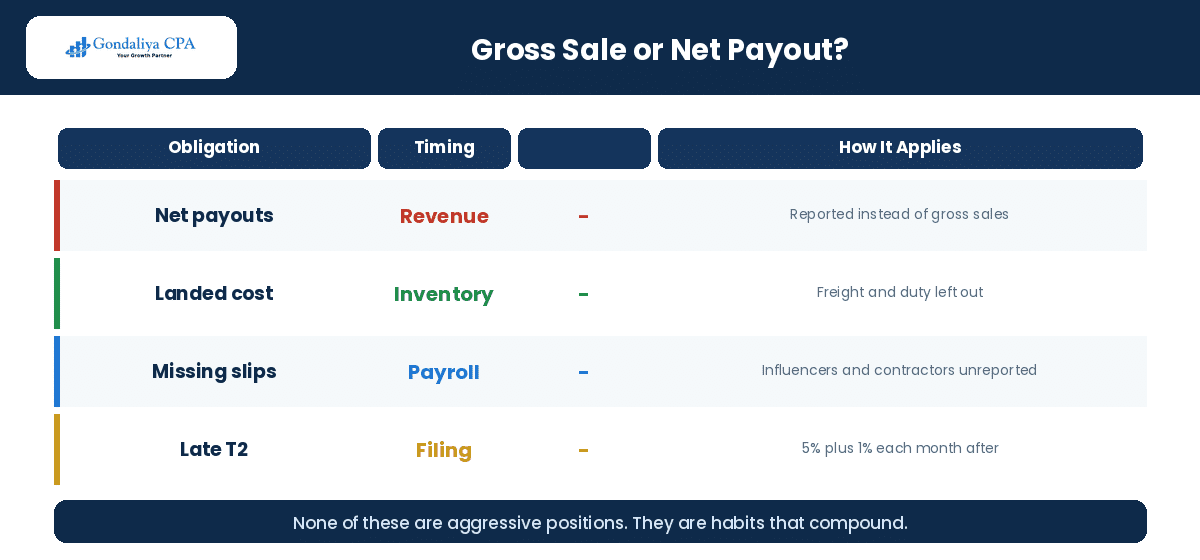
Common Apparel CRA Compliance Issues and Their Impact
CRA Compliance Issues and Worker Classification
The Compliance
Apparel brands in Canada often run into tax and accounting problems. These issues can cost a lot if not fixed. Many struggle with apparel CRA compliance because they miss key steps. Problems like late GST/HST registration, wrong tax payments, and worker classification mistakes are common. These clothing business accounting mistakes hurt the bottom line.
GST/HST Registration and Remittance Errors
Not signing up for GST/HST on time causes big headaches for many apparel brands. Others send in the wrong amount of taxes collected. Some forget to include GST/HST on imports or try claiming input tax credits without papers. Marketplace sales confuse many too.
These errors cause wrong reports, audits, and penalties under the Excise Tax Act. Knowing when to register, how to pay taxes right, and keeping good records stops these troubles.
Not Registering for GST/HST on Time
Incorporated apparel brands must register once their taxable sales pass $30,000 in four straight calendar quarters. If they miss this rule, penalties hit them for late registration.
Say an online streetwear company hits $35,000 but waits two months before registering. They owe back taxes plus interest. Keeping track of sales helps avoid these risks by registering early.
Incorrect Remittance of Collected Taxes
One big mistake is reporting the wrong GST/HST from marketplace sales. Sellers often report what platforms pay them after fees—not the full sale price which should be taxed.
This leads to lower reported income and penalties that can reach 50% depending on how bad it is. Matching what platforms report with your records avoids errors.
Common errors:
- Reporting net platform payouts → underreported income and penalties
- Claiming input tax credits without receipts → disallowed credits and audits
Good practice means reporting full sales first, then deducting fees separately. Always keep import or broker invoices for proof.
Worker Classification Problems
Many clothing brands mess up worker classification. Paying influencers, models, or contractors without giving proper slips (like T4A) causes tax trouble. This invites payroll audits and fines.
Worker status depends on control factors—like who sets work hours or tasks. Giving products instead of cash still needs clear records since it affects tax reporting differently.
Misclassifying Employees as Contractors
Treating employees like contractors causes unpaid payroll taxes such as CPP and EI. Audits can force you to pay those back plus penalties.
For instance:
- A uniform maker calling seamstresses contractors risks owing big amounts later
- Paying influencers with product trades requires T4A slips showing market value
Clear contracts that state employment terms help avoid these costly fixes.
Payroll Tax Implications
Paying influencers, models, or contractors without slips creates risks by missing source deductions reporting. The CRA demands T4A slips filed by end of February after year-end (CRA Guide RC4110).
Missing deadlines leads to fines and scrutiny during audits targeting undeclared income in fashion businesses. Organized records and signed agreements cut risk and keep payroll rules intact for everyone you work with.
Paying an influencer in product still creates a reportable amount at fair market value. Brands treat it as marketing spend and never issue the slip. Figures changed for privacy.
Key Stat: Registration is required once taxable sales pass $30,000 across four consecutive calendar quarters. Please track that figure monthly rather than discovering it at year-end.
Major Clothing Business Accounting Mistakes to Avoid
Inventory, Cost Tracking and Income Streams
The Inventory
Apparel brands in Canada often run into tax and accounting problems that cost them money. Common apparel brand tax mistakes Canada include poor inventory tracking, misstating sales, and missing income streams like imports or refunds. Knowing these mistakes helps clothing businesses stay on the right side of the CRA and keep their records clean.
Inaccurate Inventory and Cost Tracking
Inventory valuation errors happen a lot in clothing business accounting mistakes. Apparel brands need to track all costs tied to inventory — like freight, duty, and landed costs. Leaving these out lowers the reported value of inventory. This skews gross margin numbers and raises audit risks with the CRA.
Writing down unsold seasonal stock without proof is another problem. The Income Tax Act says you must have evidence for stock write-downs under section 10 valuation rules. Without records of markdowns or stock disposal, those deductions may get rejected.
Here are some points to watch:
- Purchase price goes into inventory at invoice amount.
- Freight and shipping count if directly linked; exclude if billed separately as expenses.
- Import duties and brokerage need customs papers; personal use items don’t count.
Example: A Toronto activewear company missed $12,000 in import duties in their year-end costing. This error made them claim a loss $12,000 too high and triggered an audit with interest charges.
| Cost Element | Included in Inventory? | Basis | Excluded When | Source |
|---|---|---|---|---|
| Purchase Price | Yes | Invoice amount | N/A | Income Tax Act s.10 |
| Freight & Shipping | Yes | Directly attributable costs | If billed separately as expense | CRA Guide T4012 |
| Import Duty & Brokerage | Yes | Customs documentation required | Personal use items | CBSA General Guidelines |
Impact on Profit Reporting
Many apparel brands slip up on GST/HST compliance when selling through marketplaces. They report net payouts from platforms instead of gross sales plus fees separately. This hides some taxable income and messes up input tax credit claims.
If you only show net deposits from platforms, you miss reporting full revenues as required by Excise Tax Act rules on distribution platforms. Reconciliation between total sales recorded and actual payouts helps avoid audit flags.
Example: A print-on-demand seller showed $150,000 in net deposits but left out $20,000 in marketplace fees as expenses without reporting gross sales properly. This caused underreported revenue.
Issues with Inventory Valuation for Tax Purposes
Section 10 valuation sets rules on how Canadian companies value closing inventory at year-end for tax filing. Getting this wrong affects cost of goods sold (COGS) numbers — which changes taxable income amounts.
The capital cost allowance (CCA) half-year rule matters too when claiming depreciation on assets like retail leasehold improvements or equipment used by apparel businesses. Using it wrong leads to incorrect depreciation claims that impact profit reports and asset values later.
Clothing brands should check that they:
- Use section 10 valuation methods matching ASPE standards.
- Apply CCA classes correctly for textile-related fixed assets.
- Follow half-year rule limits on first-year depreciation based on Regulation Schedule II classes.
Neglecting to Track All Income Streams
Skipping GST/HST on imported goods or claiming input tax credits (ITCs) without proof is a big mistake that ups audit risk for Canadian clothing companies importing from overseas.
CRA demands import accounting papers including broker statements before allowing ITCs on taxes paid at Canadian entry under Excise Tax Act sections 165–169. Without these docs, credits get denied — causing extra taxes plus penalties if not fixed quickly.
Ignoring returns, refunds, and chargebacks also hurts bookkeeping accuracy needed for correct GST/HST payments during the year. Businesses must update revenues when customers return items after sale—even across year-end—to stop income from being overstated and avoid reassessments later.
For incorporated apparel brands wanting help avoiding these common errors while keeping apparel CRA compliance across Toronto/Ontario/Canada-wide contact Gondaliya CPA at info@gondaliyacpa.ca or call 647-212-9559 for a free consult today.
Landed cost left out of inventory quietly moves profit from this year into last. The margin looks wrong all year and nobody can explain why. Figures changed for privacy.
Key Stat: A markdown without a record is a deduction without support. Please keep markdown logs and disposal evidence alongside the section 10 valuation.
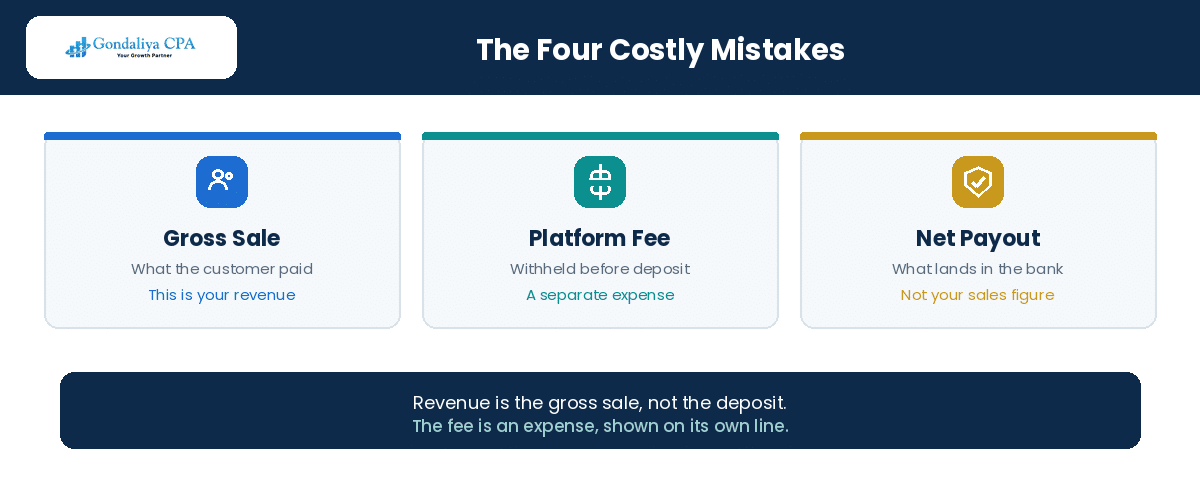
Effective Solutions for Preventing Tax Errors in Apparel Companies
Effective Solutions for Preventing Tax Errors
The Solutions
Implementing Robust Bookkeeping Systems
Many apparel brand tax mistakes Canada happen because bookkeeping is weak. Clothing business accounting mistakes often come from not tracking inventory or expenses right. Some companies record purchases as expenses right away or value inventory inconsistently. Good bookkeeping records every sale and purchase clearly. It tracks seasonal stock and sizes properly under section 10 of the Income Tax Act. This stops mistakes with cost of goods sold (COGS) and avoids showing wrong losses at year-end.
Here’s what helps:
- Keep detailed records for each SKU
- Track purchase dates, costs (including freight and duty)
- Record sales by each channel
- Update books every month, not just at year-end
This approach cuts down errors. Plus, it helps if the CRA audits your books since you have proof for write-downs or obsolete stock claims.
Using Accounting Software Tailored for Apparel
Using accounting software made for apparel can fix many clothing business accounting mistakes. These tools handle tricky things like:
- Different sizes and seasonal collections
- Landed cost calculations (including brokerage fees)
- Processing returns smoothly
- Tracking marketplace sales
This software follows section 10 rules for inventory valuation automatically. It also applies GST/HST correctly on imports or online sales per Excise Tax Act rules. Many brands mess up by reporting net platform payouts instead of gross income—this software prevents that.
Pick software that fits Canadian tax rules. It makes corporate tax filing like T2 easier and keeps your books compliant all year.
Regular Reconciliation of Accounts
Bookkeeping errors often come from not checking accounts regularly. This causes wrong numbers and risks missing apparel CRA compliance. Doing monthly reconciliations means you match bank statements with ledger entries, check supplier invoices against purchases, and confirm GST/HST collected matches what you file.
Reconcile often to catch:
- Returns and refunds
- Chargebacks and bad debts
Fix these before closing your books to avoid misstated revenue or COGS in your filings.
| Account Type | How Often | What To Check |
|---|---|---|
| Bank & Credit Cards | Monthly | Deposits vs recorded sales |
| Inventory | Quarterly | Stock counts vs book quantities |
| GST/HST Payable | Monthly/Quarterly | Input tax credits & output taxes |
Doing this lowers risks of late-filing penalties from CRA due to bad data.
Seeking Professional Tax Assistance
Hiring a CPA Ontario member who knows apparel brands can save you from costly clothing brand tax mistakes. Firms like Gondaliya CPA offer help cleaning up corporate taxes plus ongoing filing and bookkeeping services.
They spot industry-specific errors, like mixing personal wardrobe costs with business expenses or missing input tax credits on imported goods. They keep up with changing rules—like the 2026 inventory valuation updates—and reduce audit risk by using controls that follow law.
Outsourcing these tasks can give you peace of mind through flat-fee pricing that covers everything from payroll to SR&ED claims, especially for fashion e-commerce sellers in Toronto and Ontario.
Benefits of Working With a CPA Experienced in the Clothing Industry
A CPA who understands clothing business accounting mistakes offers solutions designed for the industry’s quirks. For example, they know how to handle multiple sales channels or stock changes during busy seasons—both common reasons CRA flags returns.
They apply correct capital cost allowance classes based on retail pop-ups versus online stores. They also manage shareholder loans properly to avoid unwanted taxable benefits under section 15(2). This cuts down chances of reassessments within Canada’s reassessment limits.
Partnering with a firm based in Ontario brings local insight plus national experience. That’s important because provincial rules change things like HST registration thresholds, so you stay fully compliant without guessing.
When to Outsource Corporate Tax Filing
Canada’s corporate tax filings late penalties hit hard if incorporated apparel brands miss deadlines. T2 returns must be filed within six months after fiscal year-end, with payments due at the same time. Missing this leads to fines starting at $250, which grow bigger the longer you wait—plus interest piles up fast if delays happen often.
Outsourcing your corporate tax filing makes sense when internal staff can’t keep up with growing transaction volume during busy growth phases in wholesale or direct-to-consumer sales.
Handing this off lets you focus on running your business while pros stick to deadlines using tech that pulls data straight from QuickBooks or Xero into compliant returns. This cuts human errors common in manual work.
For Canadian incorporated apparel brands wanting to stop common clothing brand tax mistakes Canada-wide—including clients around Toronto—reach out to Gondaliya CPA at info@gondaliyacpa.ca or call 647-212-9559 for a free chat about your specific needs.
Monthly beats annual by a wide margin in this sector. Twelve small reconciliations catch what one large year-end scramble never will. Figures changed for privacy.
Pro Tip: Please pick software that handles landed cost natively. Adding freight and duty to inventory by hand is where the process quietly breaks down.
Steps for Fixing Tax Mistakes and Improving Corporate Tax Filing
Fixing Mistakes and Improving Corporate Tax Filing
The Fix
Apparel brand tax mistakes Canada often come from errors in inventory counts, GST/HST reports, and corporate filings. Fixing these clothing business accounting mistakes quickly helps you stay on top of apparel CRA compliance. That way, you avoid penalties or CRA audits that can cost a lot.
Amending Filed Tax Returns
If your clothing brand spots a mistake after filing, you need to pick between voluntary disclosure or an amended return. The Voluntary Disclosures Program (VDP) lets you fix missed income or expenses before CRA finds out. This can cut down on penalties. On the other hand, an amended return works if changes are small or found fast before penalties kick in.
To fix errors, gather all your records—bank statements, platform reports, supplier invoices—and recalc inventory values including landed costs. Then fix your books with journal entries and file corrected T2 returns that show true sales, costs, and taxes.
You’ll usually get:
- A clear report showing what was wrong
- Corrected ledger entries
- Reconciled payout schedules from sales platforms
- Updated inventory worksheets that follow Income Tax Act rules
- GST/HST notes checking input tax credit claims
- Amended T2 tax returns sent to CRA
- Slip packages for any contractors or influencers if needed
These help prove you’re fixing things right if CRA checks later.
Preparing for Future Success
Stopping apparel brand tax mistakes Canada means good bookkeeping habits that match the fashion business world. Best moves include monthly checks of all sales at gross amounts—not net payouts—to record income correctly under apparel CRA compliance rules.
You also want to add up inventory costs properly. That means counting freight, duties, brokerage fees—anything direct—to keep margins honest. Keep good docs like markdown logs so write-downs meet section 10 rules.
Picking how to handle fixes matters too: DIY might seem cheap but you could miss tricky parts like landed cost accounting or slip deadlines. Non‑CPA helpers might not speak for you formally before CRA in disputes.
Hiring a CPA Ontario member who knows Canadian apparel brands brings more accuracy and helps plan ahead to dodge audits later. At Gondaliya CPA, we do everything from intake checks to final relief filings made for Toronto’s fashion labels selling across Canada.
Best Practices for Ongoing Apparel Business Compliance
Always use proper inventory capitalization so assets aren’t understated; this means counting every direct cost until goods are ready for sale under Income Tax Act rules. Be exact with GST/HST registration based on where sales happen—mistakes here are common with clothing brands selling on different platforms.
Keep solid paperwork: match supplier invoices to payments; keep broker statements proving import duties paid; track refunds carefully. This cuts audit risks tied to unexplained number differences.
Filing on time really matters: late T2 returns get hit with penalties starting at 5%, then 1% each month late up to a max amount set by CRA. Repeat offenses double these fees fast.
Stick to record keeping rules too: save all docs for at least six years after your fiscal year ends so you have proof if CRA asks later.
Setting Up Annual Tax Reviews
Doing yearly reviews catches problems early before they turn costly or cause audits. These check more than just deadlines—they look at shareholder loan balances under section 15(2), capital asset classes subject to half-year depreciation limits, and if payroll slips got sent out right—all common spots for clothing business accounting mistakes affecting apparel CRA compliance.
Late-filing penalty rates start at 5% plus extra monthly charges capped by law; repeat misses double those charges. That’s why watching this yearly helps avoid big bills.
Keep your records safe and easy to find for six years after each tax year so CRA can check if needed.
Regular meetings give chances to plan corporate taxes smartly and prepare for new rules coming like marketplace collection laws starting 2026.
For help fixing past errors and building strong controls designed around your apparel business model contact Gondaliya CPA at info@gondaliyacpa.ca or call 647-212-9559 for a free chat focused on avoiding costly apparel brand tax mistakes Canada-wide including Toronto/Ontario clients.
Voluntary disclosure only works while it is still voluntary. Once a letter arrives the option closes, which is why the timing question matters more than the size of the error. Figures changed for privacy.
Verification: Our CPA Ontario firm registration can be checked on the public firm directory. Please verify any firm before granting access to your accounting file.
Frequently Asked Questions (FAQ)
Frequently Asked Questions (FAQ)
FAQ
What is the T4/T4A slip filing deadline for apparel brands?+
Apparel brands must file T4 and T4A slips by the last day of February following the tax year. Missing this can cause penalties.
What is the eligibility period for the Voluntary Disclosures Program?+
The VDP covers errors made within the past three years before disclosure, allowing penalty relief if you correct them before CRA review.
How does the Capital Cost Allowance (CCA) half-year rule affect clothing businesses?+
The half-year rule limits CCA claims to half the usual amount in the acquisition year for new assets, reducing first-year depreciation deductions.
How long must apparel brands keep their records?+
CRA requires keeping business records for at least six years after the fiscal year-end to support tax filings and audits.
What triggers a CRA review of an apparel brand?+
Inconsistencies in income reporting, missed GST/HST filings, late returns, and unusual expense claims often trigger CRA reviews.
What costs do penalties and interest actually add to your tax bill?+
Penalties start at 5% of unpaid tax plus 1% per month late. Interest compounds daily on unpaid taxes and penalties, increasing overall cost.
How do you fix tax mistakes already made by a clothing business?+
Fix mistakes through voluntary disclosures before CRA audit or file amended returns if errors are minor or found after assessment.
What are best practices that prevent apparel brand tax mistakes?+
Maintain detailed bookkeeping, separate personal and business expenses, file on time, track inventory accurately, and register GST/HST properly.
Which is better: fixing mistakes DIY, with a CPA, or a non-CPA provider?+
A licensed CPA ensures accuracy, compliance, and formal CRA representation. DIY risks errors; non-CPA providers may lack full expertise.
How does Gondaliya CPA fix and prevent these mistakes?+
We analyze your books, correct entries, ensure compliance with tax laws, provide ongoing bookkeeping support, and offer tailored advice.
What deliverables do you get when fixing apparel brand tax issues with Gondaliya CPA?+
You receive corrected financial statements, amended returns, reconciled sales reports, GST/HST input credit reviews, and compliance checklists.
How much does it cost to fix apparel brand tax mistakes in Canada?+
Costs vary by complexity but we offer transparent pricing with flat fees suited for small to mid-sized apparel brands.
What warning signs mean your apparel brand has a tax problem?+
Missed deadlines, unexplained losses, frequent audits, mismatched sales data between platforms and books signal problems.
What should you prepare before starting a cleanup engagement with a CPA?+
Gather bank statements, invoices, sales reports from platforms, previous tax returns, payroll records, and inventory lists.
Which mistakes are most common across apparel sub-sectors Gondaliya CPA serves?+
Inventory valuation errors, GST/HST misreporting on marketplace sales, late filings, improper expense classification dominate across sectors.
Can you provide a numeric walkthrough of penalties for late T2 filing?+
For $50K owed with 4 months delay: initial penalty is $2.5K (5%), plus $500 monthly (1%), totaling $3K before interest charges.
How do you choose the right CPA firm in Toronto/Ontario to clean up tax issues?+
Look for experience in apparel industry taxation, clear pricing, strong references, local knowledge of provincial rules like HST thresholds.
Why trust Gondaliya CPA for your apparel brand’s accounting needs? (E-E-A-T)+
We combine expertise in Canadian tax law with apparel sector experience. Our transparency builds authority and trust through client success stories.
Key Insights on Apparel Brand Tax Mistakes Fix & Prevention
Key Insights on Fixing and Preventing Mistakes
Quick Reference
- Records Retention Period: Keep all financial documents at least six years after fiscal year-end as required by CRA. This includes invoices and GST/HST files.
- Repeated Failure Penalty Rate: If you repeatedly miss filing deadlines within three years, CRA doubles late-filing penalties from 5% to 10% plus 2% monthly charges.
- Fixing Mistakes: DIY vs CPA vs Non-CPA Provider: DIY risks missing technical details; CPAs have formal training and CRA representation rights; Non-CPA providers may lack full expertise on Canadian rules.
- Warning Signs of Tax Problems: Frequent audit letters; discrepancies between reported income and bank deposits; inconsistent expense claims; missing GST/HST filings.
- Preparing Before Cleanup: Assemble all bookkeeping records including digital sales data exports; previous corporate filings; contracts with influencers or contractors; payroll slips.
- Common Apparel Sub-Sector Mistakes: Retailers often err on inventory valuation; e-commerce sellers misstate marketplace sales income; manufacturers miss capital cost allowance claims correctly.
- Cost Implications of Penalties & Interest: Even small delays add up quickly due to compounding interest rates set quarterly by CRA. Prompt action saves significant sums.
- Gondaliya CPA’s Approach: We perform detailed diagnostics then tailor cleanup plans including voluntary disclosures if eligible. We streamline bookkeeping systems for future compliance.
- Best Practices That Prevent Mistakes: Maintain separate bank accounts; use accounting software designed for clothing businesses; reconcile accounts monthly; document all expenses thoroughly.
- Next Steps For Apparel Brands: Contact Gondaliya CPA early if unsure about filings or facing notices from CRA. Early intervention reduces risk of costly reassessments or audits.
Ten insights and one that carries the rest: report gross. Almost every other number on the return is calculated from that starting figure. Figures changed for privacy.
Apparel Sub-Sectors We Serve
Industry Expertise
Which mistake shows up first differs by sub-sector. Here are ten and the usual focus.
| Apparel Sub-Sector | The Usual Mistake |
|---|---|
| Direct-to-consumer e-commerce | Net platform payouts reported as revenue |
| Marketplace sellers | GST/HST handling on distribution platform sales |
| Wholesale & showroom brands | Returns and chargebacks never reversed |
| Retail storefronts | Leasehold improvements expensed rather than capitalised |
| Importers & overseas sourcing | Duty and brokerage left out of landed cost |
| Print-on-demand & dropship | Gross sales hidden behind net deposits |
| Uniform & workwear manufacturers | Sewing staff classified as contractors |
| Influencer-led & creator brands | Product gifting without T4A slips |
| Seasonal & capsule collections | Stock write-downs without supporting records |
| Multi-channel brands | Channel revenue never reconciled to the ledger |
- Direct-to-consumer e-commerce: The deposit is the only figure the owner sees, so the fee never appears as an expense.
- Marketplace sellers: Who collected the tax on a given sale needs answering before the return is filed.
- Wholesale and showroom brands: Returns after year-end still belong against the original sale.
- Retail storefronts: Fit-out costs are capital, and the class depends on whether the space is owned or leased.
- Importers and overseas sourcing: Broker statements are what make the input tax credit claimable.
- Print-on-demand and dropship: Low margins make the gross versus net error proportionally larger.
- Uniform and workwear manufacturers: Staff working set hours on your equipment are usually employees.
- Influencer-led and creator brands: Product sent out has a fair market value that needs reporting.
- Seasonal and capsule collections: Markdowns need a log, because unsold stock is not automatically written down.
- Multi-channel brands: Each channel needs its own reconciliation, not one blended revenue figure.
The sub-sector changes which mistake appears first. It does not change the discipline, which is gross revenue, full landed cost and slips on time. Figures changed for privacy.
Professional Guidance and Quick Reference
Guidance
Professional Guidance for Apparel Brands: How Gondaliya CPA Keeps You Clean
Apparel brands get reassessed on four things more than anything else: reporting the platform payout instead of the gross sale, leaving freight and duty out of inventory cost, paying influencers and contractors without slips, and filing the T2 late. None of them are aggressive positions. They are bookkeeping habits that quietly compound. Gondaliya CPA handles the full cycle on a fixed annual fee.
We handle what decides the outcome: reporting gross sales with platform fees shown separately, valuing inventory under section 10 including freight, duty and brokerage, supporting stock write-downs with markdown records, claiming import input tax credits with broker documentation, monitoring the GST/HST registration threshold, classifying workers correctly and issuing T4 and T4A slips on time, capitalising leasehold improvements to the right CCA class, and filing the T2 within six months.
Our team reconciles each sales channel monthly rather than untangling twelve months in one sitting. Retail, wholesale, e-commerce or marketplace, you get clear advice and a fixed price before we start.
Quick Answers: Key Numbers & Concepts at a Glance
At a Glance
- Revenue: Gross sales, fees shown separately
- Inventory: Section 10, including landed cost
- GST/HST threshold: $30,000 over four quarters
- T2 deadline: Six months after year-end
- Balance due: Two months, three for some CCPCs
- Late filing: 5% plus 1% per month, up to 12
- Slips: T4 and T4A by the last day of February
- Half-year rule: Halves the first-year CCA claim
- VDP window: Generally the past three years
- Records: Six years after the fiscal year-end
Who This Is For / Not For
Fit Check
- For: Incorporated Canadian apparel and fashion brands selling through retail, wholesale, e-commerce or marketplace channels.
- Not For: Customs or trade compliance advice, which sits outside our scope; we handle the tax and accounting treatment.
People Also Ask
Related Questions
Should I report the platform payout or the gross sale?+
The gross sale. Platform fees are a separate deductible expense, and the GST/HST is calculated on the full sale price rather than the deposit.
Are freight and duty part of inventory cost?+
Yes, where they are directly attributable to bringing the goods to a saleable state. Leaving them out understates inventory and distorts margin.
Can I write down unsold seasonal stock?+
Only with evidence. Markdown logs, disposal records or sales below cost support the write-down under section 10; an estimate alone does not.
Glossary of Key Terms
- Gross sales: The full sale price before platform fees are deducted.
- Net payout: The amount a platform deposits after withholding its fees.
- Landed cost: Purchase price plus freight, duty and brokerage attributable to the goods.
- Section 10 valuation: The Income Tax Act rules for valuing closing inventory.
- Cost of goods sold: The direct cost of inventory sold during the period.
- Write-down: A reduction in inventory value, requiring supporting evidence.
- Input tax credit: GST/HST recoverable on purchases used in commercial activities.
- Distribution platform operator: A marketplace with its own GST/HST collection obligations.
- Chargeback: A reversed customer payment that must be removed from revenue.
- Capital cost allowance: The tax deduction for depreciation on eligible assets.
- Half-year rule: The restriction limiting first-year capital cost allowance.
- T4A: The slip reporting payments to contractors, influencers and service providers.
- Shareholder benefit: Personal spending through the company, taxable under section 15(2).
- Voluntary Disclosures Program: The CRA route for correcting errors before a review begins.
- Amended return: A correction filed after the return has been assessed.
- Reassessment: A revised assessment issued by the CRA after review.
Apparel Compliance Readiness Check
This quick self-check indicates where your operation most likely has room. Please answer the six questions below.
Apparel Compliance Readiness Check
Six quick questions on your books. No fee shown.
Points to raise with us:
This is a general prompt, not tax or legal advice or a quote. Your position depends on your full facts. For a real review, please book a free consultation.
Want a checklist to work from? You can download our free apparel year-end checklist before your consultation.
Report gross sales and show platform fees separately. Capitalise freight, duty and brokerage into inventory. Keep markdown logs to support write-downs. Hold broker statements for every import credit. Track sales against the $30,000 threshold. Issue T4 and T4A slips by February 28. File the T2 inside six months. Please retain everything six years.
2026 Update — what is current: This article notes marketplace collection rules effective 1 January 2026. The $30,000 registration threshold, the six-month T2 deadline, the last-day-of-February slip deadline, the half-year rule and the six-year retention requirement are unchanged. Please note the article gives the slip penalty as a $100 minimum in one place and the late filing penalty as starting at $250 in another, states the T2 balance is due at the same time as the return where it is due two or three months after year-end, cites GST/HST registration to Excise Tax Act section 221(1) which concerns collection rather than registration, cites penalties to Income Tax Act section 165 which governs objections, and its worked example totals $4,000 in one place and $3,000 in another on the same facts, so please confirm each before relying on it.
Top apparel brand tax mistakes Canada and clothing business accounting mistakes to prevent with Gondaliya CPA
Report gross, then everything else works
Gondaliya CPA reports gross sales with fees shown separately, values inventory under section 10 including landed cost, supports write-downs with records, secures import input tax credits, monitors the registration threshold, classifies workers and issues slips on time, and files the T2 inside six months, on a flat annual fee including HST with a one-business-day response. Please book a free consultation.
Next Steps
Please book a free consultation with Gondaliya CPA and bring your platform sales reports, your import and broker documentation, and your last financial statements. Those three tell us immediately whether revenue is being reported gross and whether your inventory carries its full landed cost. You will get a flat annual fee including HST before any work begins. If our content helps, please add gondaliyacpa.ca as a preferred source on Google.
Published: · Last updated:
Editorial policy: We research against CRA and CPA Ontario sources, fact-check the figures, and Sharad Gondaliya, CPA, reviews the content, which we update as the rules change.
Disclaimer: This article is educational information only and is not tax, legal, or financial advice. Figures marked illustrative are examples rather than quotes or guarantees. It reflects CRA rules current to 2026, including the $30,000 GST/HST registration threshold, the six-month T2 filing deadline, the 5% plus 1% late filing penalty, the last-day-of-February slip deadline, and the six-year record retention requirement. Rates, limits and expensing rules change and outcomes depend on your specific facts. Please consult a CPA Ontario member before acting.

Sharad Gondaliya is a CPA Canada & CPA USA with 15 Years+ experience of Accounting, Tax, Payroll of Corporate Small Businesses as Tax Accountant. He is a CPA Ontario member (61040184) and holds US CPA licences in Washington and Montana and is well known among corporate small businesses for tax planning, efficient tax solutions, and affordable CPA services. Sharad is the Principal (Director) of Gondaliya CPA – Affordable CPA Firm in Canada. Licenses: CPA Ontario: 61040184 | CPA USA (MT): PAC-CPAP-LIC-033176 | CPA USA (WA): 57629 | CPA Firm License: 61330051 View Full Author Bio