



How Acupuncturists in Canada Can Reduce Taxes and Improve Cash Flow With Strategic Tax Planning
Acupuncturist tax planning Canada requires a clear understanding of acupuncture business tax strategies and corporate tax rules to maximize savings while staying compliant. Gondaliya CPA specializes in acupuncturist corporate tax planning and offers expert acupuncturist tax accountant services tailored to Canada’s tax regulations.
Quick Summary
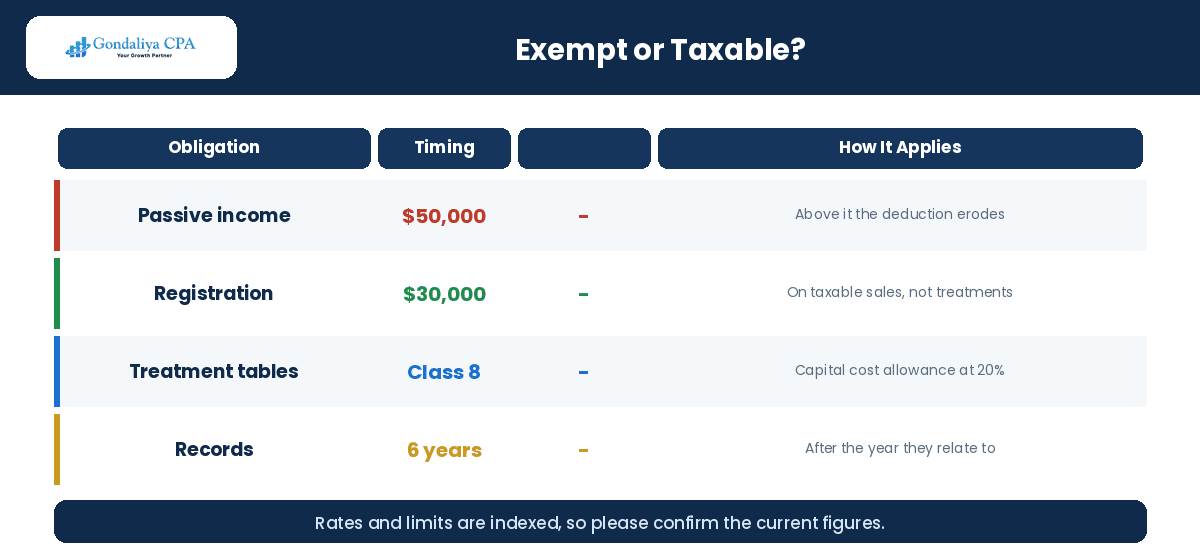
Four levers move an acupuncturist’s tax bill: the salary and dividend mix, keeping passive income below the threshold, separating exempt treatments from taxable retail sales, and clearing shareholder loans in time. Please note records must be kept six years.
| Aspect | Details |
|---|---|
| The pay mix | Salary builds RRSP room, dividends skip CPP. |
| The passive income | Above $50,000 it erodes the deduction. |
| The supplies | Treatments exempt, retail products taxable. |
| The loans | Repaid before they become taxable income. |
Reading time: 42 minutes.
Table of Contents
- Contact, Consultation and Who We Work With
- The Problems We Solve for Acupuncturists
- Services and Tax Optimization
- Application of GST/HST to Acupuncture Practices
- Getting Started with Gondaliya CPA
- Step-by-Step Guide to Tax Optimization
- Frequently Asked Questions
- Key Numbers and Planning Answers
- Practice Segments We Serve
- Professional Guidance and Quick Reference
The Numbers That Matter
This article covers Canada, with Ontario and Toronto context, and reflects rules current to 2026. It assumes an incorporated acupuncturist or traditional Chinese medicine practitioner, whether solo or in a multi-practitioner clinic. Figures marked illustrative are examples, not quotes, and any masked engagement notes end with “Figures changed for privacy.” This is educational information only and not tax or legal advice. Professional corporation and share ownership rules are set by your provincial regulator, so please confirm the position in your province.
Contact and Consultation
Contact, Consultation and Who We Work With
The Basics
If you’re an acupuncturist in Canada, tax stuff can feel really confusing. You need someone who gets your field—a good acupuncturist tax accountant helps a lot. At Gondaliya CPA, we focus on acupuncturist tax planning Canada so you can get the best advice for your practice.
We start with a chat to learn about your situation. Maybe you want help with setting up your corporation or finding ways to save on taxes for your acupuncture work. We keep things simple and answer all your questions.
Accounting for Health & Wellness Providers
People in health and wellness have unique tax rules. Good acupuncturist corporate tax planning means knowing how to report income right and what business expenses you can claim.
With smart acupuncture business tax strategies, you pay less tax legally. You can count costs like supplies, training, and rent for your clinic. These details help you manage money better while following Canada’s tax rules.
Some tips to remember:
- Know the limits for small business deductions.
- Keep track of all your spending carefully.
- Watch out for any new tax rules that affect healthcare workers.
Our team at Gondaliya CPA helps you put these ideas into practice. That way, you handle accounting easier and spend more time with patients.
Why Health & Wellness Providers Choose Gondaliya CPA
Gondaliya CPA works closely with health providers because we know acupuncturist corporate tax planning inside out. We serve mostly incorporated businesses in Ontario and beyond.
Here’s what makes us different:
- We understand health industry rules well.
- We charge flat fees—no surprises later.
- Over 1300 people gave us five-star reviews on Google because they like our clear advice.
Choosing us means you get experts who know how acupuncture clinics run. Plus, we give solid tips on cutting taxes the right way through CRA rules.
Who We Work With
We focus on incorporated acupuncturists and traditional Chinese medicine pros across Canada. Our goal is to help you make smart money decisions with clear info — that’s key with tricky acupuncture business tax strategies nowadays.
We work with different types of clients:
- Solo Practitioners: We help single-person clinics keep more of what they earn by cutting taxes smartly.
- Multi-Practitioner Clinics: We plan so groups grow without hurting each person’s benefits.
Reach out today! Let’s talk about boosting your finances and helping your clinic grow steadily!
The supplement shelf is where exempt practices quietly acquire a GST/HST obligation. It rarely gets noticed until the taxable sales have been running for a year or two. Figures changed for privacy.
Risk Warning: Selling retail products alongside exempt treatments changes your GST/HST position. Please track those sales separately from day one.
The Problems We Solve for Acupuncturists
The Problems We Solve for Acupuncturists
The Problems
Tax planning for acupuncturists in Canada can be tricky. It needs a good grasp of health rules and corporate tax laws. Many acupuncturists find it hard to figure out the best business tax strategies. They want to keep cash flow smooth but also follow CRA rules.
When you incorporate your practice, things get more complex. You must decide how to balance salary and dividends. Each choice affects your taxes in different ways.
Understanding the GST/HST Health Services Exemption is another challenge. Usually, acupuncture treatments by licensed pros don’t have GST/HST. But if your clinic sells supplements or retail items, you must handle mixed supplies carefully. Mistakes here can cost you big on input tax credits.
Instalment payment deadlines cause headaches for many incorporated acupuncturists. Missing a deadline leads to penalties and interest that mess with your cash flow. Also, picking whether to pay yourself a salary or dividends means thinking about RRSP room, CPP costs, and what money you need personally.
If you employ your spouse, it gets even more complicated. The pay must match the work done. Otherwise, CRA may look closely under “tax on split income” rules. Good records help show that all is legit and avoid problems.
Common issues acupuncturists face:
- Balancing salary vs dividends after incorporating
- Understanding GST/HST exemptions for health services
- Managing mixed supplies when selling retail products
- Keeping up with instalment payment deadlines
- Paying a spouse fairly and legally
Tax Optimization Challenges for Acupuncturists
Personal services business (PSB) rules are a major issue. If you mostly serve one client or don’t control how you work enough, CRA may call your corporation a PSB. That means fewer deductions and higher taxes.
Shareholder loans also create problems if not handled right. Under the Income Tax Act, loans that stay unpaid over a year turn into taxable benefits. Using company money for personal expenses without clear rules can trigger penalties too.
Setting aside money for taxes and instalments is tough because patient numbers change with seasons. Without strict plans or separate accounts just for tax savings, clinics often fall short. CRA charges interest on late payments.
Good record keeping supports your tax plans during any CRA review. You’ll need:
- Board resolutions for salary/dividend decisions
- Payroll records showing salaries paid (including spouse wages)
- Mileage logs if you claim vehicle expenses for mobile services
- Contracts with associates or contractors
- Receipts for business expenses like needles or equipment
- Corporate minutes showing important decisions
Here’s what you should keep and why:
| Record Type | Purpose | Keep For |
|---|---|---|
| Board Resolutions | Authorize pay methods | 6 years |
| Payroll Records | Support CPP & T4 filings | 6 years |
| Mileage Logs | Prove vehicle expense claims | 6 years |
| Associate Agreements | Define contractor vs employee | Contract + 6 years |
| Receipts & Invoices | Back up deductible expenses | 6 years |
CRA suggests keeping records at least six years after filing.
Tax Optimization Solutions Provided
You can try DIY tax planning, hire a CPA, or go with a non-CPA provider. Each has pros and cons. Non-CPAs might cost less but often miss healthcare-specific rules like professional corporation ownership limits or small business deduction caps in Ontario.
CPAs follow current laws closely — including changes coming in 2026 about passive income limits cutting small business deductions. They run detailed models to find the right mix of salary and dividends while making the most of RRSP room — something DIY plans usually miss.
At Gondaliya CPA, we start by understanding your incorporation setup and reviewing bookkeeping systems like QuickBooks linked with Hubdoc for accurate data capture. We build pay models that reduce CPP costs and time dividend payments so you avoid double taxes.
We look at GST/HST carefully when your clinic sells both exempt services and taxable products like herbal remedies. We also help set up cash flow forecasts with instalment schedules plus reserve accounts so surprises don’t hit at filing time.
Before year-end, we decide if bonuses or dividends make more sense based on available RRSP space before deadlines pass. We tidy receipts so no unproven deductions get questioned after filing.
Our flat annual fee includes support even on weekends or evenings with replies in one business day backed by many happy client reviews.
Need advice anytime? Call us at 647-212-9559 or email info@gondaliyacpa.ca for focused help on incorporated acupuncturist taxes in Toronto.
Personal services business risk is the one nobody asks about until it arrives. A practitioner working almost entirely through a single clinic contract is closer to it than they realise. Figures changed for privacy.
Key Stat: A shareholder loan left outstanding past the window becomes income personally. Please clear the balance rather than carrying it forward.
Services for Health and Wellness Professionals
Services and Tax Optimization
The Services
If you’re an acupuncturist in Canada, you need a tax accountant who gets your world. An acupuncturist tax accountant knows how to handle the tricky parts of healthcare taxes. They make sure you follow the rules while finding ways to save money. They also help with bookkeeping, corporate filings, payroll, and GST/HST specific to your clinic.
Here are some acupuncture business tax strategies you should know:
- Track expenses like needles, treatment tables, and clinic rent
- Keep receipts for professional dues and malpractice insurance
- Structure pay between salary and dividends smartly to lower your personal taxes
Good records help support your claims and avoid trouble with audits. A CPA firm that knows health sector taxes, especially in Ontario, can make your life easier. You get to focus on patients while they handle your money matters.
Tax Optimization for Acupuncturists
Tax planning for acupuncturists in Canada is all about knowing the rules for both corporate and personal taxes. When you decide when to incorporate or pick your fiscal year-end, it changes how much tax you pay.
Acupuncturist corporate tax planning uses things like the small business deduction. This lowers federal and provincial taxes on income up to $500,000. But watch out: if you have connected companies or make over $50,000 in passive income, your benefits can shrink.
Also, most acupuncture treatments don’t have GST/HST because they’re exempt health services. But selling stuff like supplements? That’s taxable. So you have to split input tax credits right.
A good plan balances saving money now against keeping cash flowing today—all while staying within CRA rules.
Acupuncture Business Tax Strategies
To cut down on taxes for your acupuncture business, keep an eye on deductible expenses related to running your clinic. Here’s a quick list:
- Needles and disposable supplies
- Treatment tables (Class 8 capital cost allowance at 20%)
- Clinic rent based on space used just for practice
- Annual licensing fees
- Malpractice insurance premiums
Buying big items near year-end? Watch the half-year rule; it limits some capital cost claims. If you sell herbal products or supplements, GST/HST gets tricky because of mixed supplies. Good records help sort this out.
Also, check shareholder loans regularly. If loans stay too long without repayment, CRA might add that amount back as income under section 15(2). That means more personal tax for you.
Acupuncturist Corporate Tax Planning
Corporate tax planning helps incorporated acupuncturists manage how they pay themselves. Picking between salary or dividends affects taxes now and later. Salary creates RRSP room but costs more payroll fees. Dividends get taxed lower but don’t add RRSP room.
Many combine a reasonable salary (to keep CPP contributions going) with dividends taxed at lower rates thanks to Canada’s integration system. This way keeps savings options open without extra payroll costs or higher taxes.
Your corporation must follow rules from provincial bodies like the College of Traditional Chinese Medicine Practitioners and Acupuncturists of Ontario. Usually, only licensed acupuncturists can own shares. Naming rules also apply.
An experienced acupuncturist tax accountant helps file T2 returns on time with all credits claimed—including adjustments when passive incomes cross $50K limits.
For questions about your acupuncture practice finances in Toronto, Ontario, or anywhere in Canada call Gondaliya CPA at 647‑212‑9559 or email info@gondaliyacpa.ca. They offer free consultations focused on smart plans that follow CRA rules exactly.
Practitioners paid entirely in dividends since incorporation often have no RRSP room at all. The tax saved each year was real; so is the retirement room never created. Figures changed for privacy.
Pro Tip: Please confirm share ownership rules with your provincial regulator before incorporating. In most provinces only licensed practitioners may hold shares.
Application of GST/HST to Acupuncture Practices in Canada
Application of GST/HST to Acupuncture Practices
The GST/HST
Acupuncturists in Canada need to know how GST/HST affects their services for smart tax planning. Usually, licensed acupuncturists don’t charge GST/HST on treatments. This comes from the Excise Tax Act’s health services exemption. This rule changes cash flow and what you must report, so it matters a lot for acupuncturist tax planning Canada and acupuncture business tax strategies.
The exemption means you don’t add GST/HST on treatment fees. That lowers paperwork but stops you from claiming input tax credits on related costs. Still, if you sell extra stuff like retail products, those usually need GST/HST. Planning your corporate taxes well helps keep reports right and claims valid without raising flags.
Knowing this helps clinics handle money better while following CRA rules.
GST/HST Exemption Criteria for Acupuncture Services
To get the GST/HST health services exemption, your acupuncture service must fit some rules from the Excise Tax Act:
- The person giving the service needs a license or registration with local bodies like Ontario’s College of Traditional Chinese Medicine Practitioners and Acupuncturists.
- The treatment must be recognized as healthcare aiming to fix or diagnose physical problems.
- Fees should only cover exempt health services; things like supplements are separate.
This is key in acupuncturist corporate tax planning because mixing up exempt and taxable items can cause trouble. A good acupuncturist tax accountant checks licenses and makes sure bills follow CRA rules.
For example, if a Toronto clinic sells herbal supplements along with treatments, only the treatment part is exempt. The supplement sales must include HST unless laws say otherwise.
Handling Supplies, Fees, and Registration
Acupuncture clinics face tricky choices about what supplies have GST/HST and when to register:
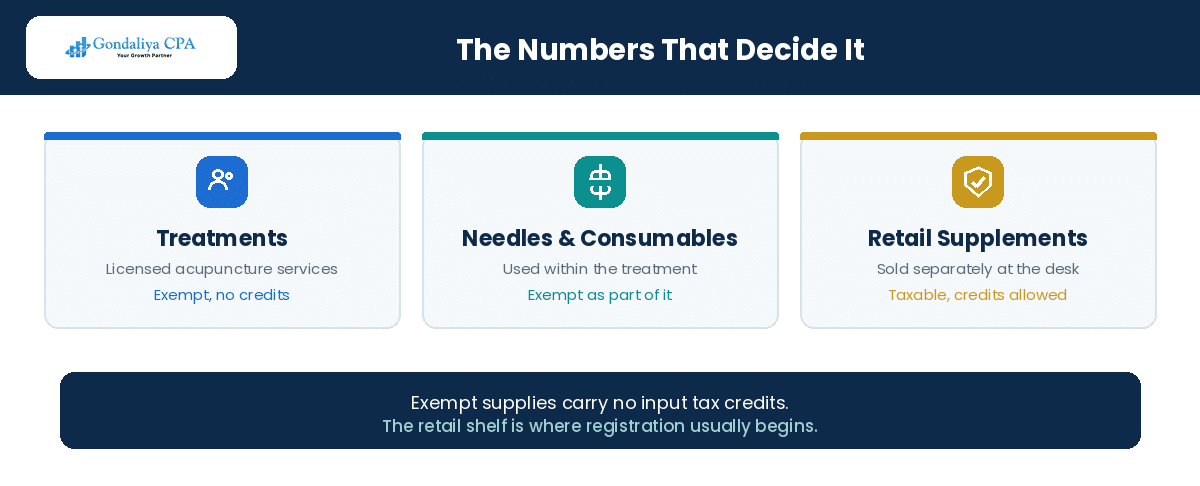
- Supplies: Needles used in treatment count as exempt because they’re part of healthcare. But vitamins or creams sold separately are taxable.
- Fees: Treatment charges stay outside HST if they meet exemption rules. Other fees like admin charges might need HST depending on what they cover.
- Registration: If a clinic earns more than $30,000 yearly from taxable goods or services, it must register for GST/HST. This includes sales of supplements or other taxable products.
A sharp acupuncturist tax accountant uses this info in acupuncture business tax strategies. Registering at the right time avoids fines and can help claim input tax credits when possible.
| Supply Type | Treatment Status | Chargeable HST? | Input Tax Credit Eligibility |
|---|---|---|---|
| Licensed Acupuncture | Exempt Health Service | No | No |
| Retail Supplements | Non-exempt | Yes | Yes |
| Needles & Consumables | Integral Treatment | No | No |
| Administrative Charges | Depends on Nature | Possibly | Possibly |
Corporate Supplies and Fee Sharing in Acupuncture Practices
Many incorporated acupuncture clinics have multiple practitioners who share costs or income streams. This calls for careful corporate setups:
- When groups split equipment costs or rent among different corporations representing each practitioner or a main clinic corporation, records must be clear.
- Fee-sharing between associates working through separate corporations needs written agreements that match work done and follow reasonableness tests under Income Tax Act.
- Good fee sharing helps claim expenses correctly without triggering personal services business rules that raise taxes.
Smart acupuncturist corporate tax planning plans these details ahead by setting clear contracts on duties and pay—whether salary or dividends—to lower total taxes for everyone involved.
For example, a Toronto multi-practitioner clinic divides shared leasehold improvements fairly to reduce each corporation’s capital cost allowance claim while staying within legal limits.
For advice that fits your practice’s structure into efficient, compliant taxation plans contact Gondaliya CPA at info@gondaliyacpa.ca or call 647‑212‑9559 for a free consultation focused on Canadian-accredited acupuncturists including those in Toronto/Ontario.
Exempt supplies come with a cost that is easy to miss: the GST/HST paid on rent, equipment and supplies is not recoverable. That is a real expense, not a rounding error. Figures changed for privacy.
Risk Warning: Fee-sharing between associate corporations needs written agreements that match the actual work. Please put them in place before the arrangement starts.
It’s Easy to Get Started with Gondaliya CPA
Getting Started with Gondaliya CPA
The Start
Starting tax planning for your acupuncture practice in Canada can be simple. Gondaliya CPA offers acupuncturist tax accountant help made just for practitioners and clinic owners. We use acupuncture business tax strategies that follow CRA rules so you can keep more money and stay legal.
First, we learn about your practice and what you want to achieve. Then, we find ways to lower your taxes by looking at things like how you pay yourself, what expenses you can claim, and corporate tax options for healthcare pros. This helps you pay less tax while making more money.
Working with Gondaliya CPA means you get clear pricing with an annual flat fee. We reply quickly—usually within one business day—and even offer weekend support if you need it. Whether you work alone or run a big clinic in Toronto or anywhere else in Canada, we handle the tricky tax stuff so you can focus on treating patients.
How to Discuss Your Acupuncture Practice Needs with an Accountant
When talking to an acupuncturist tax accountant about your corporate tax planning, come prepared. Have details about your practice ready like:
- Whether you’re incorporated and who owns shares
- How much money comes in yearly and from where (treatments vs product sales)
- How you want to pay yourself—salary or dividends
- Clinic costs like rent, equipment, and dues
- GST/HST registration status for health services versus taxable goods
- If family members help in the business and what they do
Sharing this info helps the accountant give advice based on current CRA rules for healthcare businesses. You can ask how they manage year-end tasks like bonuses or claiming depreciation for equipment.
Talk about cash flow too, so instalment payments don’t catch you off guard during slow seasons common in acupuncture. Make sure your accountant knows local rules from bodies like the College of Traditional Chinese Medicine Practitioners and Acupuncturists of Ontario.
Good talk leads to plans that balance deferring taxes and keeping records right so you don’t miss deductions.
Testimonials from Health & Wellness Clients
Lots of health pros across Canada trust Gondaliya CPA for their acupuncturist tax planning Canada needs. They know our team understands acupuncture business tax strategies well. Here’s what some clients say:
“Gondaliya CPA helped me set up my clinic incorporation under Ontario rules and chose the best mix of salary and dividends — my cash flow got better fast.” – Registered Acupuncturist, Vaughan
“They knew exactly which healthcare expenses I could claim like needles and insurance costs. That saved me hours of digging.” – Multi-Practitioner TCM Clinic Owner, Mississauga
“Whenever I had questions about GST/HST on supplements sold with treatments, they answered quick and clear.” – Fertility Specialist near Ottawa
We have over 1450 five-star Google reviews showing clients are happy. Gondaliya CPA gives straightforward advice based on Canadian law — no risky schemes — just solid corporate tax filing help that lasts.
Want help aligning your acupuncture practice finances with Canadian accounting standards? Reach out at info@gondaliyacpa.ca or call 647‑212‑9559 for a free consultation.
The most useful thing a practitioner brings to a first meeting is a revenue split between treatments and product sales. Everything else follows from that one number. Figures changed for privacy.
Verification: Our CPA Ontario firm registration can be checked on the public firm directory. Please verify any firm before granting access to your accounting file.
Step-by-Step Guide to Tax Optimization for Acupuncturists
Step-by-Step Guide to Tax Optimization
The Guide
Planning your taxes as an acupuncturist in Canada can feel tricky, but breaking it down helps a lot. First, check your practice’s legal setup. Incorporating might save you tax now, but it means more paperwork and costs.
Look for ways to use acupuncture business tax strategies like:
- Claiming all your eligible expenses.
- Using the small business deduction.
- Splitting pay between salary and dividends to save taxes.
Try to time income and expenses before year-end to help your cash flow. Use capital cost allowance (CCA) rules smartly when buying equipment or fitting out your clinic. Watch out for passive income inside your corporation—it can lower your small business tax break after 2026. Keep detailed records like board meeting notes and payroll slips in case the CRA asks.
Example: We helped a Toronto acupuncturist who mixed salary with dividends. This kept their RRSP room intact while lowering the total tax on money kept inside their corporation. Numbers changed to protect privacy.
Tools and Resources for Acupuncturist Tax Planning
Working with an acupuncturist tax accountant is a big help. They know the best acupuncture business tax strategies that fit Canadian rules.
Here are some handy tools accountants use:
- QuickBooks or Xero with Hubdoc for neat bookkeeping.
- Tax software that matches CRA forms, making GST/HST filing easier.
- Payroll systems like ADP or Wagepoint to handle CPP contributions and T4 slips right.
Keep an eye on CRA updates about small business deductions, passive income limits, and rules for professional corporations. These resources help you stay legal and manage your clinic’s cash flow better.
Examples of Tax Optimization for Acupuncturists
Good acupuncturist corporate tax planning can lower taxes if done correctly and legally. Here are some real-life ideas:
- Changing Pay Style: One practitioner moved from only dividends to mixing salary and dividends. This gave them RRSP room without raising taxes too much.
- Timing Expenses: Buying new treatment tables before year-end let them claim more depreciation faster, improving cash flow.
- Managing Passive Income: Another client kept investment income under $50,000 yearly inside their corporation. That way, they didn’t lose the full small business deduction after 2026 rules started.
They also kept thorough records, including minutes on paying back shareholder loans to avoid extra taxes.
These examples come from Ontario, near Toronto.
Tax Planning Tips and Best Practices
- Make sure you can incorporate by checking with your provincial regulator first.
- Pay family members only if they really work; keep good proof to avoid “tax on split income” penalties.
- Separate your health service sales (usually exempt) from taxable supplement sales in your books. This helps with input tax credits.
- Check instalment payments regularly so you don’t get hit with interest.
- Buy big equipment at the right time of year to use half-year CCA rules well.
It pays off to talk often with an acupuncturist corporate tax planning expert since rules can change for healthcare businesses in Canada.
Frequently Asked Questions Embedded Throughout
Q: Can I incorporate my acupuncture practice in Ontario?
Yes, but check share ownership rules from the College of Traditional Chinese Medicine Practitioners & Acupuncturists of Ontario before going ahead.
Q: How does paying myself dividends affect my RRSP contribution room?
Dividends don’t count as earned income needed for RRSP room. Mixing salary keeps your retirement savings options open while managing taxes smartly.
Q: Are supplements sold alongside treatments subject to GST/HST?
Supplements usually count as taxable supplies if sales go over $30,000 a year. You’ll need to register and carefully apportion input tax credits.
If you want more help with acupuncturist corporate tax planning or Canadian health care taxes, contact Gondaliya CPA at info@gondaliyacpa.ca or call 647‑212‑9559.
Buying a treatment table in the last week of the year buys you half a year of depreciation. Buying it in the first week of the next year buys you the same half year, twelve months later. Figures changed for privacy.
Key Stat: Passive investment income above $50,000 erodes the small business deduction. Please model that before building an investment portfolio inside the corporation.
Frequently Asked Questions for Acupuncturist Tax Planning Canada
Frequently Asked Questions
FAQ
What is the Small Business Deduction limit for incorporated acupuncturists in Ontario?+
The Small Business Deduction limit is $500,000 for qualifying corporate income. It lowers your corporate tax rate significantly.
What corporate tax rates apply to acupuncture clinics in Ontario?+
Ontario’s small business corporate tax rate is 2.2% from July 1, 2026 (3.2% before), while the general corporate tax rate is 11.5%.
How does the Dividend Tax Credit affect an acupuncturist’s taxes?+
Eligible dividends receive approximately a 15% federal tax credit, reducing personal tax on dividend income.
What is the current CPP contribution rate for incorporated acupuncturists?+
The total CPP contribution rate is 11.9% (scheduled to fall to 11.5% on January 1, 2027), split between employer and employee portions.
When are instalment payment deadlines for incorporated acupuncture practices?+
Instalment payments are due on March 15, June 15, September 15, and December 15 each year.
What is the RRSP contribution limit that affects incorporated acupuncturists?+
The RRSP contribution limit for the current year is $31,560 based on earned income from salary.
Who qualifies as an incorporated acupuncture clinic under Canadian tax rules?+
Clinics owned by licensed acupuncturists incorporated as professional corporations under provincial health regulators qualify.
Why is compliance with the College of Traditional Chinese Medicine Practitioners and Acupuncturists of Ontario important?+
They set rules on professional ownership and licensing, which affect corporate share structure and GST/HST exemptions.
Key Numbers at a Glance for Acupuncturist Tax Planning
Key Numbers and Planning Answers
Quick Reference
- Small Business Deduction Limit: $500,000
- Ontario Small Business Corporate Tax Rate: 2.2% (from July 1, 2026)
- General Corporate Tax Rate (Ontario): 11.5%
- Dividend Tax Credit (Eligible Dividend): ~15%
- CPP Contribution Rate (Total): 11.9%
- Instalment Payment Deadlines: March 15, June 15, Sept 15, Dec 15
- RRSP Contribution Limit: $31,560
What Actually Drives an Acupuncture Practice’s Tax Bill?
- Salary vs Dividends mix affects taxable income and RRSP room.
- Passive income above $50K reduces small business deduction eligibility.
- GST/HST on retail sales impacts input tax credits claimed.
- Personal services business rules can increase taxes if you work mostly for one client.
Does Incorporating Save an Acupuncturist Tax?
Incorporation often lowers overall tax by accessing small business deductions and deferring personal taxes through dividends. It adds complexity but offers benefits if planned correctly.
Salary or Dividends for an Incorporated Acupuncturist: Which Route Fits?
A blend of reasonable salary and dividends works best. Salary creates RRSP room and CPP contributions; dividends reduce personal tax rates but do not build retirement savings.
How Do You Use the Small Business Deduction Without Losing It?
Keep passive investment income below $50,000 yearly inside your corporation and avoid connected corporations to preserve full small business deduction benefits.
When Should You Pay a Spouse or Family Member?
Pay family only if they perform real work in the business. Keep thorough documentation to comply with CRA “tax on split income” rules and avoid penalties.
Which Practice Expenses Give the Best Legitimate Return?
Claim expenses like needles, treatment tables (Class 8 CCA), clinic rent proportional to use, professional dues, and malpractice insurance premiums fully.
How Do You Plan Equipment and Clinic Fit-Out Costs?
Use capital cost allowance rules smartly; buying before year-end can accelerate depreciation claims while managing cash flow with half-year rule awareness.
What Home Office and Vehicle Costs Can Be Planned Around?
Track vehicle mileage logs if used for mobile services; claim home office expenses only if space is dedicated to clinical practice with proper documentation.
How Should You Manage Cash Flow Across a Practice Year?
Set aside money monthly for tax instalments using cash flow forecasts; monitor seasonal revenue changes common in acupuncture clinics to avoid penalties or interest charges.
How Do You Set Aside Money for Tax and Instalments?
Open separate bank accounts or use bookkeeping tools to reserve funds for quarterly instalments due March 15, June 15, September 15, December 15 to stay compliant.
What Should You Do With Retained Earnings?
Retain earnings within your corporation to fund growth or future investments but beware of accumulating passive income that may reduce small business deductions.
How Do Shareholder Loans and Personal Spending Create Tax Problems?
Unpaid shareholder loans over one year become taxable benefits under Income Tax Act section 15(2). Avoid mixing personal expenses with company funds without clear repayment terms.
How Should Associates and Contractors Be Paid?
Use written agreements specifying duties; classify associates properly as employees or contractors to meet CRA reasonableness tests and prevent personal services business issues.
What Are the Year-End Planning Moves for a Practice Corporation?
Review salary vs dividend mix before year-end; plan bonuses or dividends according to RRSP room availability; finalize capital asset purchases considering CCA timing rules.
Which Strategies Should Acupuncturists Avoid?
Avoid ignoring GST/HST rules on mixed supplies; do not overlook instalment payments; never pay family members without proper work documentation; stay clear of personal services business traps.
What Records Support Every Planning Position?
Maintain board resolutions, payroll records including T4 slips, mileage logs, contractor agreements, receipts/invoices for expenses plus corporate minutes supporting key decisions per CRA guidelines.
Tax Planning: DIY vs CPA vs Non-CPA Provider – Which Route Fits?
DIY may miss complex healthcare-specific rules. Non-CPA providers might lack expertise in professional corporation laws. CPAs (Chartered Professional Accountants) like Gondaliya CPA offer expert compliance with tailored health sector knowledge.
How Do We Build an Acupuncturist’s Tax Plan at Gondaliya CPA?
We analyze incorporation status, bookkeeping systems like QuickBooks & Hubdoc integration, model salary-dividend mixes optimizing RRSP room while controlling CPP costs and ensure accurate GST/HST handling on mixed supplies.
What Deliverables Do You Get from Gondaliya CPA?
Flat fee annual service includes detailed tax plans, cash flow forecasts with instalment schedules, bookkeeping review support, year-end planning advice plus responsive communication even during weekends or evenings.
How Much Does Tax Planning Cost for an Acupuncture Practice in Canada?
Gondaliya CPA offers transparent flat fees tailored to practice size without hidden charges. Pricing reflects specialized health industry expertise ensuring maximum legal savings with clear upfront costs.
What Are the Top Planning Mistakes and How Do You Prevent Them?
Common errors include missing instalment deadlines causing interest charges, misclassifying sales causing GST issues, neglecting shareholder loan tracking risking taxable benefits—prevent with regular reviews by experienced CPA teams like Gondaliya CPA.
What Should You Prepare Before a Planning Engagement Starts?
Provide incorporation documents showing share structure; annual revenue breakdowns by source; payroll info including family members paid; detailed expense lists plus GST/HST registration status related to products/services sold.
Which Planning Levers Matter Most Across Ten Practice Segments We Serve?
Key levers include salary/dividend optimization varying by practitioner type (solo vs multi-practitioner), passive income management per clinic size, GST/HST handling based on product mix plus leveraging provincial regulatory compliance efficiently across locations served such as Toronto/Ontario regions including Vaughan & Mississauga.
A Realistic Numeric Walkthrough
A Toronto acupuncturist earning $150K split pay: $80K salary (CPP contributions + RRSP room), $70K dividends (lower personal taxes). Passive investments kept under $50K inside corporation maintain full small business deduction saving thousands annually versus salary-only approach.
How to Choose the Right CPA Firm in Toronto/Ontario for an Acupuncture Practice?
Pick firms with proven healthcare tax expertise like Gondaliya CPA Professional Corporation familiar with College licensing rules plus Ontario-specific small business deduction caps. Check client reviews showing clear communication plus timely filings respecting CRA regulations perfectly suited to acupuncturists’ needs.
Twenty-four questions and one answer underneath them all: the pay mix. It touches RRSP room, CPP, personal rate and how much stays in the company. Figures changed for privacy.
Practice Segments We Serve
Industry Expertise
Which planning lever matters most differs by segment. Here are ten and the usual focus.
| Practice Segment | The Main Planning Lever |
|---|---|
| Solo acupuncturists | Salary and dividend mix for one owner |
| Multi-practitioner clinics | Fee sharing and cost allocation agreements |
| TCM clinics with herbal dispensaries | Mixed exempt and taxable supply tracking |
| Fertility & specialist practices | Higher income and passive income planning |
| Sports & rehabilitation clinics | Equipment purchases and CCA timing |
| Mobile & home-visit practitioners | Vehicle mileage logs and travel costs |
| Associates working through corporations | Personal services business risk |
| Practitioners employing a spouse | Reasonableness and split income rules |
| Multi-location clinic groups | Associated corporations sharing one limit |
| Newly incorporated practitioners | Regulator share ownership rules first |
- Solo acupuncturists: Everything turns on how the single owner is paid across the year.
- Multi-practitioner clinics: Shared costs need written agreements before the arrangement begins.
- TCM clinics with herbal dispensaries: Retail sales sit outside the health service exemption.
- Fertility and specialist practices: Higher retained earnings make the passive income threshold live.
- Sports and rehabilitation clinics: Equipment timing changes the first-year depreciation claim.
- Mobile and home-visit practitioners: A mileage log is the only support a vehicle claim has.
- Associates working through corporations: A single dominant client raises personal services business risk.
- Practitioners employing a spouse: The wage must match documented work at a fair rate.
- Multi-location clinic groups: Corporations under common control share one business limit.
- Newly incorporated practitioners: The regulator decides who may hold shares, before any tax planning.
The segment changes which lever matters most. It does not change the discipline, which is check the structure, split exempt from taxable, then set the pay mix. Figures changed for privacy.
Professional Guidance and Quick Reference
Guidance
Professional Guidance for Acupuncturists: How Gondaliya CPA Lowers Your Tax Bill
Acupuncturist tax planning turns on four levers: the salary and dividend mix, keeping passive investment income below the threshold, separating exempt treatments from taxable retail sales, and clearing shareholder loans before they become income. The exempt status of your treatments shapes all of it. Gondaliya CPA handles the full cycle on a fixed annual fee.
We handle what decides the outcome: confirming share ownership against your regulator’s rules, modelling salary against dividends for RRSP room and CPP, monitoring passive income against the threshold, separating exempt health services from taxable supplement and retail sales, apportioning input tax credits correctly, testing personal services business risk on associate arrangements, supporting family wages with documented work, and timing equipment purchases for capital cost allowance.
Our team reviews the exempt and taxable revenue split first, because it determines whether you need to register at all. Solo practitioner or multi-practitioner clinic, you get clear advice and a fixed price before we start.
Quick Answers: Key Numbers & Concepts at a Glance
At a Glance
- Treatments: Generally exempt health services
- Retail sales: Generally taxable supplies
- Registration: $30,000 on taxable sales
- Input tax credits: Follow taxable supplies only
- Passive income: Grind begins above $50,000
- Salary: Creates RRSP room, attracts CPP
- Dividends: No RRSP room, no CPP
- Treatment tables: Class 8 at 20%
- Shareholder loans: Repay inside the window
- Records: Six years after filing
Who This Is For / Not For
Fit Check
- For: Incorporated Canadian acupuncturists and traditional Chinese medicine practitioners, solo or in multi-practitioner clinics.
- Not For: Licensing or scope of practice questions, which sit with your provincial regulator; we handle the tax and accounting.
People Also Ask
Related Questions
Do I charge GST/HST on acupuncture treatments?+
Generally no, where you are licensed and the service qualifies as an exempt health service. Retail products sold alongside are a separate question.
Can I claim input tax credits if my services are exempt?+
Not on costs relating to the exempt services. Credits follow taxable supplies, so the apportionment has to be done carefully.
Is the business limit $500,000 or $600,000?+
The federal business limit is $500,000. Please confirm the current figure before relying on any other number.
Glossary of Key Terms
- Professional corporation: An incorporated practice authorised by the provincial regulator.
- Exempt supply: A health service on which GST/HST is not charged and no credits arise.
- Taxable supply: A sale on which GST/HST is charged, such as retail supplements.
- Mixed supplies: A practice making both exempt and taxable sales.
- Input tax credit: GST/HST recoverable on purchases used in commercial activities.
- Apportionment: Splitting credits between exempt and taxable activity.
- Small business deduction: The reduced federal rate on active business income up to the business limit.
- Passive investment income: Investment earnings inside the corporation that erode that limit.
- Personal services business: A corporation treated as an incorporated employee, losing most deductions.
- Tax on split income: The rule taxing amounts paid to family without sufficient contribution.
- Shareholder loan: Funds drawn from the corporation that must be repaid.
- Instalments: Periodic tax payments made through the year.
- Capital cost allowance: The tax deduction for depreciation on eligible assets.
- Half-year rule: The restriction limiting first-year capital cost allowance.
- Class 8: The CCA class covering furniture and equipment at 20%.
- Board resolution: The corporate record authorising salary or dividend decisions.
Acupuncture Practice Readiness Check
This quick self-check indicates where your operation most likely has room. Please answer the six questions below.
Acupuncture Practice Readiness Check
Six quick questions on your practice. No fee shown.
Points to raise with us:
This is a general prompt, not tax or legal advice or a quote. Your position depends on your full facts. For a real review, please book a free consultation.
Want a checklist to work from? You can download our free acupuncture tax checklist before your consultation.
Confirm share ownership with your regulator first. Split exempt treatments from taxable retail sales. Register once taxable sales cross the threshold. Apportion input tax credits correctly. Set the salary and dividend mix early. Watch passive income against the threshold. Clear shareholder loans in the window. Please file the T2 inside six months.
2026 Update — what is current: This article notes 2026 changes to passive income limits affecting the small business deduction. The health service exemption for licensed practitioners, the $30,000 registration threshold on taxable sales, the $50,000 passive income threshold and Class 8 treatment at 20% are unchanged. Please note the article gives the business limit as $500,000 in two places and $600,000 in three others, gives an Ontario small business rate of 2.2% from July 1, 2026 and a general rate of 11.5%, a CPP rate of 11.9% and an RRSP limit of $31,560, all of which are indexed or set annually, gives corporate instalment dates as March 15, June 15, September 15 and December 15 where corporate instalments are usually monthly or quarterly based on the fiscal year, and cites Income Tax Act section 120(1)(d) for split income where TOSI sits in section 120.4, so please confirm each before relying on it.
Acupuncturist Tax Planning Canada: Key Business Tax Strategies and Corporate Tax Solutions by Gondaliya CPA
Split exempt from taxable first
Gondaliya CPA confirms share ownership against your regulator, models salary against dividends for RRSP room and CPP, monitors passive income against the threshold, separates exempt treatments from taxable retail sales, apportions input tax credits, tests personal services business risk, and times equipment purchases for capital cost allowance, on a flat annual fee including HST with a one-business-day response. Please book a free consultation.
Next Steps
Please book a free consultation with Gondaliya CPA and bring your revenue split between treatments and product sales, your incorporation documents showing share structure, and your last financial statements. Those three tell us immediately whether registration is required and whether the pay mix is doing what you assume it is. You will get a flat annual fee including HST before any work begins. If our content helps, please add gondaliyacpa.ca as a preferred source on Google.
Published: · Last updated:
Editorial policy: We research against CRA and CPA Ontario sources, fact-check the figures, and Sharad Gondaliya, CPA, reviews the content, which we update as the rules change.
Disclaimer: This article is educational information only and is not tax, legal, or financial advice. Figures marked illustrative are examples rather than quotes or guarantees. It reflects CRA rules current to 2026, including the $50,000 passive income threshold, the $30,000 registration threshold on taxable sales, the Class 8 rate of 20% on treatment tables, the shareholder loan repayment window, and the six-year record retention requirement. Rates, limits and expensing rules change and outcomes depend on your specific facts. Please consult a CPA Ontario member before acting.

Sharad Gondaliya is a CPA Canada & CPA USA with 15 Years+ experience of Accounting, Tax, Payroll of Corporate Small Businesses as Tax Accountant. He is a CPA Ontario member (61040184) and holds US CPA licences in Washington and Montana and is well known among corporate small businesses for tax planning, efficient tax solutions, and affordable CPA services. Sharad is the Principal (Director) of Gondaliya CPA – Affordable CPA Firm in Canada. Licenses: CPA Ontario: 61040184 | CPA USA (MT): PAC-CPAP-LIC-033176 | CPA USA (WA): 57629 | CPA Firm License: 61330051 View Full Author Bio