



The Ultimate Guide to Accounting and Tax Services for Ice Cream Shops in Canada
Gondaliya CPA provides dependable ice cream shop accounting services and tax solutions across Canada, combining expert knowledge as an ice cream business tax accountant with personalized support. Their offerings help ice cream shops manage finances efficiently while adhering to Canadian tax regulations.
Quick Summary
Four things decide an ice cream shop’s numbers: whether the point-of-sale codes tax correctly by product, whether card and delivery payouts reconcile to gross sales, whether tips are separated from wages, and whether the fiscal year-end suits the season. Please note records must be kept six years.
| Aspect | Details |
|---|---|
| The till | Every item coded to the right tax status. |
| The payouts | Processor deposits matched to gross sales. |
| The tips | Logged separately from wages for payroll. |
| The year-end | Chosen to fit the seasonal cycle. |
Reading time: 38 minutes.
Table of Contents
- Introduction to Ice Cream Shop Accounting Services
- Comprehensive Accounting and Bookkeeping Solutions
- Tax Planning and Compliance
- Unique Advantages of Our Services
- Client Engagement and Trust Building
- Taking the Next Step with Gondaliya CPA
- Frequently Asked Questions
- Key Points on Compliance and Management
- Frozen Dessert Sub-Sectors We Serve
- Professional Guidance and Quick Reference
The Numbers That Matter
This article covers Canada, with Ontario and Toronto context, and reflects rules current to 2026. It assumes an incorporated ice cream shop, gelato café or frozen dessert business, including franchises and multi-location operators. Figures marked illustrative are examples, not quotes, and any masked engagement notes end with “Figures changed for privacy.” This is educational information only and not tax or legal advice. Product tax status turns on specific facts, so please confirm each item before relying on it.
Introduction to Ice Cream Shop Accounting Services in Canada
Introduction to Ice Cream Shop Accounting Services
The Basics
Professional Ice Cream Shop Accountant Services Tailored for Canadian Businesses
Running an ice cream shop brings some unique money challenges. An ice cream shop accountant Canada knows these well and helps you stay legal while making the most profit. Gondaliya CPA offers accounting services made just for ice cream shops.
Our team gets how tricky it can be to handle money in this field. You deal with busy and slow times and lots of sales every day. Working with a ice cream business tax accountant lets you focus on your customers while we take care of your finances.
How Expert Accounting Supports Ice Cream Shops’ Financial Health
Good accounting keeps your ice cream shop’s money in shape. Here’s what expert accountants do for you:
- Cash Flow Management: Ice cream shops have busy seasons and quiet ones. A smart ice cream shop CPA Canada predicts your income and spending so you don’t run out of cash.
- Cost Control: Knowing how much ingredients, workers, and bills cost is key. Accountants help you spot ways to save and make more money.
- Tax Compliance: Taxes in Canada can be confusing. With a skilled ice cream shop CPA, you follow the rules and pay less tax by planning right.
Using pro accounting means you worry less about money stuff. Experts who know food businesses keep your books straight.
The Role of an Ice Cream Business Tax Accountant in Navigating Canadian Tax Regulations
An ice cream business tax accountant plays a big part in handling taxes for ice cream shops in Canada:
- Understanding GST/HST Implications: Some ice cream items have different GST or HST rates depending on what they are (like scoops versus packaged treats). We make sure these rules are followed.
- Filing Accuracy: Filing taxes late or wrong leads to fines from the CRA (Canada Revenue Agency). Our team files on time and checks everything carefully.
- Strategic Tax Planning: Good planning helps you use all deductions and credits for food businesses, cutting down your taxes.
Our accountants know the tax details that matter to ice cream shops. This helps you make smart choices that protect your profits while staying within Canadian laws.
So, hiring an ice cream shop accountant helps run things smoothly and keeps your finances strong — letting you spend more time making tasty treats!
The till is configured once, usually by whoever installed it, and never revisited. Every mis-coded product then repeats itself thousands of times over a summer. Figures changed for privacy.
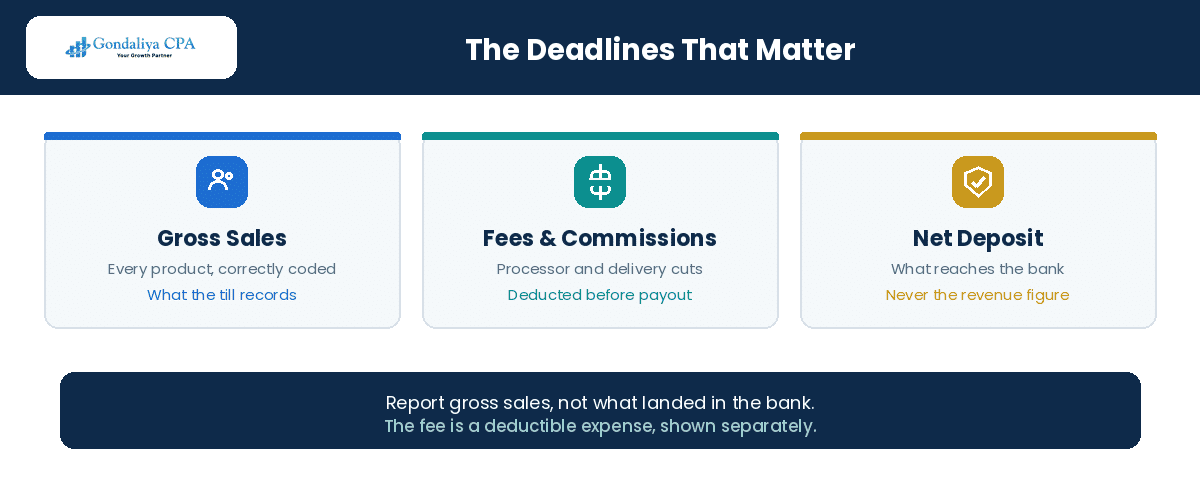
Risk Warning: Net deposits from a card processor are not your sales figure. Please reconcile to gross point-of-sale totals before reporting revenue.
Comprehensive Accounting and Bookkeeping Solutions for Ice Cream Shops
Comprehensive Accounting and Bookkeeping Solutions
The Systems
Ice cream shops in Canada deal with some tricky accounting stuff. They have to handle busy and slow seasons, both cash and card sales, and tricky tax rules. That’s where ice cream shop accounting services come in handy. An ice cream business tax accountant or ice cream shop CPA Canada knows all about CRA rules. They keep your books right and help with taxes, so you don’t get stressed.
Good bookkeeping paired with smart tax planning helps incorporated ice cream businesses everywhere—from Toronto to other provinces. It cuts down mistakes when filing GST/HST, payroll remittances, and corporate tax returns (T2). This way, owners can spend more time growing their scoop shops instead of worrying about numbers.
Bookkeeping and Accounting Services Designed for Small Food & Beverage Businesses
Bookkeeping for ice cream shops means keeping track of sales from different places—like cash registers, card processors, and delivery apps. Payroll needs careful handling too. A solid ice cream shop accountant Canada knows how to manage seasonal ups and downs while staying on top of things like T4 slip filing and payroll remittances.
Here’s what they usually do:
- Record daily gross sales by product with the right GST/HST codes.
- Separate tips from wages to follow CRA rules on CPP/EI deductions.
- Track inventory use against purchases to find cost of goods sold (COGS).
- Match bank deposits to point-of-sale reports each month.
- Prepare financial statements that follow ASPE standards.
These steps help avoid audits over missing income or wrong filings. For smaller food spots like gelato cafés or mobile vendors, flat-fee packages make costs clear without losing quality or compliance.
Setting Up Efficient Accounting Systems for Ice Cream Shops
The first step in good accounting is setting up the point-of-sale (POS) system right. Every item—whether a single scoop eaten there or a tub taken home—gets the correct tax code. The CRA’s Excise Tax Act tells which foods are zero-rated or taxable.
Daily sales records should include:
- Total receipts before fees from processors
- Cash counts checked against register numbers
- Delivery app payouts tracked separately
- Tips logged separately from total sales
Reconcilling card processor deposits with gross POS data stops revenue underreporting that causes GST/HST penalties. Cash controls matter too. Staff keeps a float logbook updated every day. Weekly checks spot any over/short amounts.
Systems like QuickBooks Point of Sale or Xero link POS data to ledgers automatically but need your ice cream business tax accountant to review them now and then. These steps keep your books clean and ready for compilation engagements under CSRS 4200.
Managing Payroll, Inventory, and Sales Tracking with Advanced Accounting Tools
Payroll gets tricky since many ice cream shops hire seasonal workers like students during summer. You must calculate holiday pay right, deduct CPP/EI on wages and separately report controlled tips on T4 slips.
Inventory tracking software connects with accounting tools to monitor ingredients—from base mix to cones—and control waste, which can be about 5% due to spoilage in frozen products. Accurate COGS needs regular physical counts that match Income Tax Act rules.
Sales tracking must handle lots of small transactions common in scoop shops but also wholesale orders if there are any. Reporting profit margins by product helps owners set prices that balance portion sizes with happy customers.
These tools give real-time info on labor costs versus sales patterns so owners can adjust ahead of busy seasons—a big plus when working with an experienced ice cream shop CPA Canada who gets this unique market well.
Delivery app payouts arrive net of commission and land days later. Treated as the sale itself, they understate revenue and hide a deductible expense at the same time. Figures changed for privacy.
Key Stat: Spoilage in frozen product runs around 5%. Please log waste weekly, because an unsupported write-off is not a deduction.
Tax Planning and Compliance for Ice Cream Businesses
Tax Planning and Compliance
The Compliance
Specialized Tax Planning Strategies for Ice Cream Shops Across Canada
Running an ice cream shop means dealing with busy summers and quiet winters. So, tax planning has to fit those ups and downs. Seasonal shops can choose a fiscal year-end that matches their busiest or slowest time. That way, their income reporting better reflects how much money they make.
Payroll remittances need careful timing. You have to deduct and send CPP, EI, and income tax on your workers’ pay just like the CRA says. For seasonal staff, it’s smart to track exactly when they work. This helps avoid paying too much or too little.
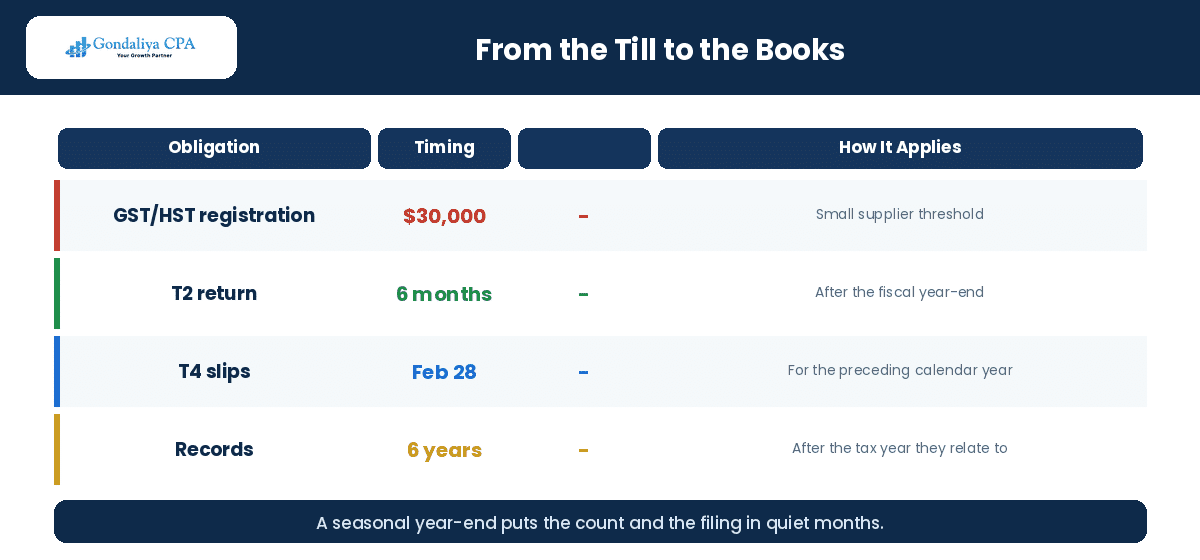
If your ice cream business makes less than $30,000 a year, you don’t have to register for GST/HST. But most incorporated shops pass this limit because they sell daily or have multiple spots or delivery orders. Signing up early helps you dodge penalties.
You can pick between the Quick Method or the regular way for GST/HST. The Quick Method uses a fixed rate which is easier but means fewer input tax credits. Shops selling mostly frozen desserts and some zero-rated groceries might prefer the regular method even if it takes more work.
Quick list:
- Pick fiscal year-end to match sales cycles
- Submit payroll deductions on time
- Register GST/HST if over $30,000 in sales
- Choose Quick Method for easier GST filing or regular method if credits help
Example: A scoop shop in Toronto closes its books March 31 after a busy summer. It has five seasonal workers May through September. They send payroll deductions monthly like CRA requires. Since revenue tops $30,000, they register for GST/HST. They use Quick Method but watch carefully which sales are taxable (numbers changed).
Ensuring Compliance with Canadian Tax Laws Relevant to Food Service Businesses
Knowing tax rules matters a lot. If you go over the GST/HST small supplier threshold but don’t register, you’ll face fines plus interest under Section 151 of the Income Tax Act.
The CRA bans Electronic Sales Suppression (ESS) software because it hides sales records. Ice cream shops must use honest POS systems that keep real data safe.
Payroll is tricky too. Employers must calculate CPP on all pay including tips if that applies. You also need to file T4 slips by February 28 after each calendar year and send deductions monthly or quarterly depending on your payroll size.
Keep good records every day—cash vs card sales, tips—since CRA wants proof you’re reporting right.
Main points:
- Register GST/HST once revenue passes threshold
- Avoid ESS software; keep honest sales records
- Calculate CPP on all wages including tips
- File T4 slips by Feb 28 yearly
- Submit payroll taxes on time monthly/quarterly
- Keep clear daily books of all sales
Example: A gelato place in Mississauga missed registering for GST/HST after making over $30K mid-year because their bookkeeping was slow. A CRA audit found ESS irregularities. They got hit with late-filing penalties plus extra taxes based on unreported sales (numbers changed).
Year-End Tax Filing and Preparation Services by Experienced Ice Cream Shop CPAs
If your ice cream business is a corporation, you must file a T2 Corporate Income Tax Return within six months of your fiscal year-end according to CRA rules. Late filings bring automatic penalties: 5% at first plus 1% each month up to a year unless you get relief.
Ice cream shop CPAs know how to prepare these returns well. They include things like capital cost allowance claims for equipment such as freezers or soft-serve machines using proper CRA classes.
They also check financial statements following ASPE standards so inventory counts include spoilage typical in frozen treats—a big deal for cost calculations during audits.
Year-end prep covers reviewing instalment payments and adjusting schedules based on seasonal earnings patterns. This reduces interest charges and may help claim credits like apprenticeship hiring incentives if qualified.
Checklist:
- File T2 return within six months after fiscal end
- Expect penalties for late filing unless excused
- Claim capital cost allowance on equipment
- Keep inventory valuation realistic with spoilage
- Align instalment payments with seasonality
- Explore credits like apprenticeship incentives
Example: A franchise with several locations in Vaughan hired Gondaliya CPA before their March year-end. The CPA handled all filings on time avoiding penalties. They also claimed asset costs which lowered taxable income helping cash flow during slower months (numbers changed).
Contact Information
For questions about accounting or taxes for your ice cream business anywhere in Canada — whether Ontario or beyond — feel free to contact Gondaliya CPA at info@gondaliyacpa.ca or call 647‑212‑9559 for advice that fits your shop’s needs and keeps everything compliant every season.
A March year-end after the season is the most useful choice a seasonal shop makes. It puts the count on quiet stock and the filing in a quiet month. Figures changed for privacy.
Risk Warning: Electronic sales suppression carries serious consequences beyond ordinary penalties. Please make sure your point-of-sale software retains complete records.
Unique Advantages of Gondaliya CPA’s Ice Cream Shop Accounting Services
Unique Advantages of Our Services
The Service
Gondaliya CPA works as an ice cream shop accountant Canada-wide. We know the ice cream business tax accountant needs well because we focus on this field. Running an ice cream shop has its ups and downs, like seasonal changes and lots of small sales. We get how GST/HST rules work for frozen treats. Our ice cream shop CPA Canada team mixes tax law knowledge with practical help for shops in Toronto and beyond.
Fixed Pricing Models Offering Clear Budgeting Confidence
We offer ice cream shop accounting services with fixed prices. This helps you plan your budget without surprises. Our flat annual fee covers bookkeeping, corporate tax filing (T2), GST/HST returns, payroll, and CRA help — all included.
Fixed pricing works great for shops that open only part of the year. It also helps owners with many locations keep track of reports and delivery platforms without extra costs.
Here’s what can change your price:
- More store locations mean more complex reports.
- Lots of transactions mean more work.
- Bigger staff means detailed payroll filings.
- Filing GST/HST more often adds to cost.
- Franchise reporting requires extra schedules.
Tips to save money:
- Combine reports if possible.
- Use a POS system that talks to accounting software.
- Automate payroll with tools like Wagepoint or ADP.
- Check if you qualify for simpler GST methods.
- Keep franchise agreements uniform.
Call us at 647-212-9559 or email info@gondaliyacpa.ca for a free talk about your costs.
Tech-Savvy Solutions Focused on Automation and Real-Time Financial Reporting
We use tech to avoid electronic sales suppression penalties. Your point-of-sale system must be set up right for taxes, or you risk fines. For example, selling single scoops is taxed differently than take-home packages. We make sure tax codes follow the Excise Tax Act.
We automate daily checks between payment processors like Stripe or Rotessa and delivery apps. This helps catch mistakes where net deposits don’t show actual sales — a common cause of audits. Our tools sync Z-reports into QuickBooks or Xero so you see your numbers live.
This way, you spot issues early like chargebacks or late payouts and fix them before month-end closing.
Peace of Mind Through Transparent Communication and Reliable Support
Messy books and missed filings can cost you big fines. We send regular reminders so you never miss a deadline for Ontario incorporated shops. Need help on weekends or evenings? We’re here with replies within one business day.
Good habits keep records clean all year long:
- Track waste weekly with simple logs.
- Count cash daily using easy sheets.
- Review monthly processor reports together.
These steps stop last-minute stress at year-end.
We back our service with a 30-Day Money-Back Guarantee and match fees within 60 days if needed.
Personalized Business Advisory and Coaching to Help Ice Cream Shops Grow
Seasonal shops face tricky tax planning. We help pick the best fiscal year-end date based on busy months and instalment payments.
Our advice goes past taxes into growth coaching too. Multi-store owners learn how to pay themselves smartly and use losses to lower taxes later. We watch for CRA review triggers like low profits or unreported tips in payroll audits.
Each plan fits your shop’s reality—whether it’s one store or many franchises—to lower audit risks while helping your business grow across Ontario.
If you want help from a Canadian ice cream shop accountant who really knows food service SMBs, contact Gondaliya CPA at info@gondaliyacpa.ca or call 647-212-9559 for a free chat.
Transaction volume drives our fee more than revenue does. Thousands of two-dollar cones is more work to reconcile than a handful of large tickets. Figures changed for privacy.
Pro Tip: Please connect the point-of-sale directly to your accounting software. Manual re-entry of daily totals is where most seasonal shops lose accuracy.
Client Engagement and Trust Building
Client Engagement and Trust Building
The Trust
Testimonials from Canadian Ice Cream Shop Owners Highlighting Personalized Expertise
Ice cream shop owners across Canada often share how much they value working with an ice cream shop accountant Canada who knows their business well. They say the advice fits their needs, especially when dealing with seasonal sales ups and downs or tricky tax rules. For example:
- A gelato café owner in Toronto mentioned how bookkeeping for ice cream shops helped them keep track of daily sales and handle GST/HST easily.
- A franchise owner with several locations told us that a skilled ice cream business tax accountant cut mistakes on tax filings and improved payroll handling.
These stories show how ice cream shop accounting services understand the unique parts of running frozen dessert shops. Clients like clear answers, quick replies, and tips that match their work in Ontario or anywhere in Canada.
Professional Ethics and Standards Upholding Integrity in All Accounting Services
Trust matters a lot when choosing an ice cream shop CPA Canada. These pros follow strict rules set by CPA Ontario’s Code of Professional Conduct. They keep client info private and stay fair and honest in all their work. This means:
- Financial reports meet rules from the Income Tax Act and Excise Tax Act made for food service businesses.
- Fees are clear with no surprise charges or false promises.
- They avoid conflicts when advising similar businesses, like nearby shops or franchises.
By sticking to these ethics, an ice cream shop accountant Canada builds trust. That trust helps during CRA audits or reviews when clients need solid support.
Access to Industry Resources Including CPA Canada Handbook and Complimentary Workshops
Clients of Gondaliya CPA get useful tools like the CPA Canada Handbook. This guide helps with accounting rules for small food shops like frozen dessert stores. Keeping up with law changes is important too—like the ones coming in 2026 about GST/HST on prepared foods.
Gondaliya CPA also runs free workshops sometimes. These sessions cover:
- Best bookkeeping tips for ice cream shops in Canada
- Corporate tax plans that fit seasonal sales
- Management advice that follows CRA rules
- Risks from electronic sales systems in busy small stores
These events help everyone—from solo scoop shops to big franchises—stay informed. It’s all based on what works best around Toronto and Ontario.
Supporting Remote Consultations and Virtual Accounting Services for Convenience
Technology makes it easy to get ice cream shop accounting services no matter where you are in Ontario or Canada. Gondaliya CPA offers secure calls over video or phone, fitting into your schedule—even nights or weekends after busy hours.
Their virtual bookkeeping works well with tools like QuickBooks or Xero plus Hubdoc to catch receipts digitally. This setup shows your transactions live while cutting down on errors common with seasonal staff.
This way you can keep up with things like:
- Filing GST/HST on time as income changes
- Preparing T2 tax returns for fluctuating profits
All without visiting an office but still backed by licensed pros trusted by many happy clients across the country.
If you want advice made just for your incorporated frozen dessert shop anywhere in Toronto/Ontario—or elsewhere in Canada—call Gondaliya CPA at 647-212-9559 or email info@gondaliyacpa.ca today. Get help from real experts who know your world as an ice cream shop accountant Canada focused on local rules.
Seasonal staff turnover is the quiet risk in these shops. Whoever counted the float in July is gone by October, so the process has to survive the person. Figures changed for privacy.
Verification: Our CPA Ontario firm registration can be checked on the public firm directory. Please verify any firm before granting access to your accounting file.
Taking the Next Step with Gondaliya CPA
Taking the Next Step with Gondaliya CPA
The Next Step
Picking the right ice cream shop accountant Canada-wide matters a lot. Gondaliya CPA works as an ice cream shop CPA Canada owners count on. We offer accounting and tax services made just for incorporated ice cream shops. Our team knows your business faces seasonal sales, different payment methods, and tricky GST/HST rules.
Contact Options to Schedule a Consultation or Request Customized Accounting Services
Want ice cream shop accounting services? Need an ice cream business tax accountant? Call Gondaliya CPA at 647-212-9559 or email info@gondaliyacpa.ca. You can book a free consultation to talk about your needs.
Here’s what we do:
- Fix bookkeeping messes
- Plan corporate taxes
- Fit solutions to your shop size and place
We keep things simple and clear. Whether you run one scoop shop in Toronto or many shops across Canada, we use flat-fee pricing so you know costs upfront.
How Gondaliya CPA Assists Ice Cream Shops Across Canadian Provinces
Gondaliya CPA helps incorporated ice cream shops in Ontario cities like Toronto, Mississauga, and Vaughan. We also support businesses all over Canada as a trusted ice cream shop accountant Canada owners trust.
We handle differences in payroll rules and local filings in each province. We stick closely to federal laws like the Income Tax Act and Excise Tax Act.
Our team understands food service details—like setting up point-of-sale systems correctly for GST/HST. This makes sure your books are right no matter where you run your shop in Canada.
Many franchisees and multi-location owners prefer us as their ice cream shop CPA Canada partner because we handle tough financial reports well.
Encouraging Proactive Financial Management for Sustainable Business Success
Managing money well helps your frozen dessert business last long. As your ice cream business tax accountant, we push for good bookkeeping done on time. We also plan taxes based on seasonal ups and downs typical for small, busy retailers.
Check these often:
- Inventory costs
- Waste tracking
- Payroll, including tips
- Instalment payments
These keep penalties away and profits steady. Spotting audit issues early makes CRA visits easier if they happen.
Working with experts who know food business accounting like Gondaliya CPA clears up confusion. You get better control of money to make smart choices anytime.
Awards and Recognition Demonstrating Commitment to Quality and Client Satisfaction
Gondaliya CPA earns respect from clients and pros as a solid ice cream shop CPA Canada trusts. Over 1450+ 5-star Google reviews show happy clients across food retail, including gelato cafes and mobile vendors.
We follow strict CRA guidelines closely. Our communication is clear too: weekend help plus replies within one day. Busy owners like this kind of reliable support from real advisors—not just accountants.
For advice from a licensed Canadian firm focusing on incorporated frozen dessert businesses: call 647-212-9559 or email info@gondaliyacpa.ca today. Get a no-cost talk about how to help your ice cream shop grow with smart accounting built just for you.
Owners call us in September when the season ends and the numbers finally sit still. The better call is in April, before the rush makes every process harder to fix. Figures changed for privacy.
Key Stat: Unreported tips are a standard payroll review trigger. Please separate them from wages in the records rather than blending the two.
Frequently Asked Questions for Ice Cream Shop Accounting by Gondaliya CPA
Frequently Asked Questions
FAQ
What is the record retention period for ice cream shop accounting documents?+
Canadian tax laws require keeping business records for six years from the end of the last tax year they relate to. This helps in case of audits by the CRA.
How should daily sales be recorded for an ice cream shop?+
Record total sales by product with correct GST/HST codes. Separate cash, card, and delivery app payments. Log tips separately to follow payroll rules.
What are the common penalties for electronic sales suppression (ESS) software use?+
CRA fines include heavy penalties and possible criminal charges if ESS software hides sales data. Use honest POS systems to avoid these risks.
What filing deadlines must incorporated ice cream shops meet in Canada?+
File T2 corporate tax returns within six months of fiscal year-end. Submit GST/HST returns monthly or quarterly as required. Payroll remittances are due monthly or quarterly based on payroll size.
What penalties apply if a shop files taxes late?+
Late T2 returns incur a 5% penalty plus 1% per month up to 12 months. Late GST/HST filings face fines and interest charges. Payroll late filings cause CRA penalties as well.
How should ice cream shops treat franchise fees, royalties, and marketing levies?+
Franchise fees can be capitalized or expensed based on terms. Royalties are usually deductible as business expenses. Marketing levies paid to franchisors are treated as operating costs.
Which equipment and leasehold costs can be capitalized?+
Freezers, soft-serve machines, and large kitchen tools qualify as capital assets. Leasehold improvements over $500 should be capitalized with half-year CCA rules applying in the first year.
How do rent, utilities, and occupancy costs factor into deductions?+
Rent paid for the shop is fully deductible as a business expense. Utilities like electricity and water are also deductible if directly related to operations.
What financial statements do landlords, lenders, or the CRA expect?+
Income statements showing revenue and expenses, balance sheets listing assets and liabilities, and cash flow statements provide a full picture of your shop’s finances.
What tax planning suits a seasonal ice cream shop best?+
Select a fiscal year-end that matches busy or slow seasons. Adjust instalment payments based on cash flow to reduce penalties and interest charges from the CRA.
Key Points on Ice Cream Shop Accounting Compliance & Management
Key Points on Compliance and Management
Quick Reference
- Scope: Applicable to incorporated ice cream shops across Canada including multi-location franchises.
- Single Serving Quantity Threshold: Tax codes differ for single scoop sales versus packaged goods under Excise Tax Act rules.
- Direct Answer: Use a qualified CPA specializing in ice cream shops like Gondaliya CPA for precise accounting solutions.
- Shop Accounting Differences: Seasonal sales cycles, mixed payment methods, and GST/HST nuances create unique accounting needs here.
- Financial Statements Required: ASPE-compliant income statements and balance sheets tailored for small food businesses.
- Record Retention: Keep all invoices, receipts, payroll records, GST/HST filings, and bank statements for minimum six years.
- Best Practices Daily Sales Recording: Capture gross sales per product category daily; reconcile POS data with bank deposits monthly; separate cash tips from wages; track inventory usage closely.
- Handling Franchise Fees & Marketing Levies: Capitalize initial franchise fees if contract terms exceed one year; deduct ongoing royalties and levies as expenses during each period incurred.
- Equipment Capitalization & Half-Year Rule: Apply half-year CCA rule on eligible equipment purchases in first fiscal year; claim depreciation annually thereafter per CRA guidelines.
- Payroll Remittances & T4 Filing Deadlines: Submit CPP/EI deductions monthly or quarterly; file T4 slips by February 28 each year following calendar year end.
- Penalties for Late Filings Table Summary: First-time late T2 filing triggers 5% penalty; recurring lateness adds 1% monthly up to max 12 months; GST/HST late submissions face escalating fines; payroll non-compliance leads to interest plus fines.
- Instalment Payment Schedules: Adjust payments quarterly based on prior year’s income or current profit trends; seasonal shops benefit from customized instalment timing aligned with revenue flow.
- CRA Review Triggers in Food Businesses: Unusually low profits compared to industry norms; inconsistent tip reporting; frequent late filings or payment defaults may prompt audit selection by CRA officials.
If you want expert guidance on any aspect of ice cream shop accounting or tax compliance in Canada—contact Gondaliya CPA at info@gondaliyacpa.ca or call 647‑212‑9559 today. We help your business stay compliant while optimizing finances all year round.
Thirteen points and one that underpins them: the daily sales record. Reconstructing a summer of two-dollar transactions after the fact is not realistically possible. Figures changed for privacy.
Frozen Dessert Sub-Sectors We Serve
Industry Expertise
Which issue dominates differs by sub-sector. Here are ten and the usual focus.
| Sub-Sector | The Accounting Focus |
|---|---|
| Scoop shops | High transaction volume and cash controls |
| Gelato cafés | Mixed dine-in and take-home tax coding |
| Soft-serve outlets | Equipment capital cost allowance claims |
| Frozen yogurt bars | Weigh-and-pay pricing on the till |
| Ice cream franchises | Royalties, levies and franchise fee treatment |
| Mobile trucks & carts | Vehicle costs and location-based sales |
| Seasonal stands | Fiscal year-end chosen around the season |
| Wholesale frozen producers | Bulk packaging and inventory valuation |
| Dessert bars & waffle shops | Prepared food generally taxable |
| Multi-location operators | Consolidated reporting across stores |
- Scoop shops: Thousands of small tickets make daily cash counts and float logs essential.
- Gelato cafés: The same product sold two ways needs two tax codes on the till.
- Soft-serve outlets: Machines are capital assets with a class and an available-for-use date.
- Frozen yogurt bars: Weight-based pricing must still map to the correct tax status per item.
- Ice cream franchises: Initial fees, royalties and marketing levies each get different treatment.
- Mobile trucks and carts: Vehicle costs and multiple selling locations complicate the records.
- Seasonal stands: A year-end after the season gives a cleaner count and a quieter filing month.
- Wholesale frozen producers: Bulk packs change classification and inventory valuation together.
- Dessert bars and waffle shops: Prepared and heated items sit outside basic groceries.
- Multi-location operators: Consolidated reporting needs consistent coding at every store.
The sub-sector changes which issue dominates. It does not change the discipline, which is code the till right, reconcile the payouts, and count the stock. Figures changed for privacy.
Professional Guidance and Quick Reference
Guidance
Professional Guidance for Ice Cream Shops: How Gondaliya CPA Keeps Your Books Clean
Ice cream shop accounting turns on the till. A single scoop and a take-home tub are taxed differently, and if the point-of-sale codes them the same way, every summer day compounds the error. Get the coding right, reconcile the payouts, and the rest of the year follows. Gondaliya CPA handles the full cycle on a fixed annual fee.
We handle what decides the outcome: coding every product to the correct tax status, reconciling card processor and delivery app payouts against gross point-of-sale totals, separating tips from wages for payroll, managing seasonal staff and T4 slips, choosing between the quick and regular GST/HST methods, selecting a fiscal year-end that suits the season, valuing inventory with realistic spoilage, and claiming capital cost allowance on freezers and machines.
Our team reviews the till configuration first, because it is the one setting that affects every transaction you make. Single shop, seasonal stand or franchise group, you get clear advice and a fixed price before we start.
Quick Answers: Key Numbers & Concepts at a Glance
At a Glance
- Registration: $30,000 small supplier threshold
- Tax coding: Set per product, not per sale
- Payouts: Reconciled to gross, not net
- Tips: Logged separately from wages
- T4 slips: By the last day of February
- T2 filing: Six months after year-end
- Late penalty: 5% plus 1% per month
- Equipment: Half-year rule on first-year CCA
- Spoilage: Around 5% on frozen product
- Records: Six years after the tax year
Who This Is For / Not For
Fit Check
- For: Incorporated Canadian ice cream shops, gelato cafés, frozen dessert businesses, franchises and multi-location operators.
- Not For: Food safety or municipal licensing advice, which sits with the regulator; we handle the tax and accounting.
People Also Ask
Related Questions
Is a single scoop taxed the same as a take-home tub?+
Often not. Preparation and packaging change the status, so the till needs the right code on each item rather than one blanket setting.
Do I register for GST/HST before I reach $30,000?+
You may register voluntarily. Many incorporated shops do, because it allows input tax credits on equipment and supplies from day one.
Should tips go through payroll?+
Controlled tips do, with the deductions that follow. Please keep them recorded separately from wages so the treatment is clear.
Glossary of Key Terms
- Point-of-sale coding: The tax status assigned to each product at the till.
- Zero-rated supply: A taxable supply at a rate of zero, such as qualifying basic groceries.
- Single serving: A portion size that can change an item from zero-rated to taxable.
- Gross sales: Total sales before processor fees, refunds and commissions.
- Net deposit: The amount actually received after those deductions.
- Z-report: The end-of-day till summary used to reconcile sales.
- Float log: The daily record of cash held in the register.
- Electronic sales suppression: Software that conceals sales records, which is prohibited.
- Controlled tips: Tips the employer distributes, which carry payroll obligations.
- Small supplier threshold: The $30,000 revenue level triggering GST/HST registration.
- Quick method: A simplified GST/HST calculation using a flat rate on sales.
- Cost of goods sold: The direct cost of product sold during the period.
- Spoilage: Frozen product lost to waste, logged to support the write-off.
- Capital cost allowance: The tax deduction for depreciation on eligible assets.
- Half-year rule: The restriction limiting first-year capital cost allowance.
- CSRS 4200: The Canadian standard governing compilation engagements.
Ice Cream Shop Readiness Check
This quick self-check indicates where your operation most likely has room. Please answer the six questions below.
Ice Cream Shop Readiness Check
Six quick questions on your shop. No fee shown.
Points to raise with us:
This is a general prompt, not tax or legal advice or a quote. Your position depends on your full facts. For a real review, please book a free consultation.
Want a checklist to work from? You can download our free ice cream shop checklist before your consultation.
Code every product at the till, not per sale. Reconcile processor payouts to gross totals monthly. Log tips apart from wages. Count the float daily. Register for GST/HST once you cross the threshold. Pick a year-end that suits the season. Log spoilage weekly. Please file the T2 inside six months.
2026 Update — what is current: This article notes 2026 changes to GST/HST on prepared foods. The $30,000 small supplier threshold, the six-month T2 deadline, the 5% plus 1% late filing penalty, the last-day-of-February T4 deadline and the six-year retention requirement are unchanged. Please note the article cites Section 151 of the Income Tax Act for GST/HST registration penalties where the Excise Tax Act governs, cites Income Tax Act section 230 for instalments and fiscal year-end rules where section 230 covers books and records, states leasehold improvements over $500 should be capitalised where no such threshold applies, and gives 5% spoilage as a general figure rather than a rule, so please confirm each before relying on it.
Ice Cream Shop Accounting Services and Tax Solutions in Canada by Gondaliya CPA: Trusted Ice Cream Business Accountant
Fix the till before the season starts
Gondaliya CPA reviews your point-of-sale tax coding product by product, reconciles processor and delivery payouts to gross sales, separates tips from wages for payroll, manages seasonal T4 filings, tests the quick method against the regular one, selects a year-end that suits your season, and claims capital cost allowance on freezers and machines, on a flat annual fee including HST with a one-business-day response. Please book a free consultation.
Next Steps
Please book a free consultation with Gondaliya CPA and bring a product list with the tax codes from your till, a month of processor payout statements, and your last financial statements. Those three tell us immediately whether your sales are coded correctly and whether reported revenue matches what was actually deposited. You will get a flat annual fee including HST before any work begins. If our content helps, please add gondaliyacpa.ca as a preferred source on Google.
Published: · Last updated:
Editorial policy: We research against CRA and CPA Ontario sources, fact-check the figures, and Sharad Gondaliya, CPA, reviews the content, which we update as the rules change.
Disclaimer: This article is educational information only and is not tax, legal, or financial advice. Figures marked illustrative are examples rather than quotes or guarantees. It reflects CRA rules current to 2026, including the $30,000 small supplier threshold, the six-month T2 filing deadline, the last-day-of-February T4 deadline, the 5% plus 1% late filing penalty, and the six-year record retention requirement. Rates, limits and expensing rules change and outcomes depend on your specific facts. Please consult a CPA Ontario member before acting.

Sharad Gondaliya is a CPA Canada & CPA USA with 15 Years+ experience of Accounting, Tax, Payroll of Corporate Small Businesses as Tax Accountant. He is a CPA Ontario member (61040184) and holds US CPA licences in Washington and Montana and is well known among corporate small businesses for tax planning, efficient tax solutions, and affordable CPA services. Sharad is the Principal (Director) of Gondaliya CPA – Affordable CPA Firm in Canada. Licenses: CPA Ontario: 61040184 | CPA USA (MT): PAC-CPAP-LIC-033176 | CPA USA (WA): 57629 | CPA Firm License: 61330051 View Full Author Bio