



Handyman Business Tax Deductions: What Canadian Contractors Can Legally Claim
If you’re looking to optimize your handyman tax deductions Canada, Gondaliya CPA can help you claim deductible handyman expenses such as tools tax deductions, vehicle expenses handyman, and insurance deductions handyman. By understanding contractor tax deductions Canada including advertising expenses contractor and home office deduction Canada, you can increase your handyman tax savings and reduce your taxable income effectively.
Quick Summary
Four things decide what a handyman can actually claim: whether a cost is current or capital, whether the vehicle log supports the business percentage, whether subcontractor payments were reported on T5018 slips, and whether the paperwork exists. Please note records must be kept six years.
| Aspect | Details |
|---|---|
| The tools | Small items expensed, larger ones depreciated. |
| The vehicle | Business percentage proven by a mileage log. |
| The subcontractors | T5018 slips where the threshold is met. |
| The proof | Receipts, logs and contracts, six years. |
Reading time: 41 minutes.
Table of Contents
- Overview of Handyman Tax Deductions
- Tools, Vehicle, Insurance and Advertising
- Licences, Rent, Wages and Other Expenses
- Motor Vehicle Rules and Required Records
- Strategic Tax Savings and Compliance
- Resources and Next Steps
- Frequently Asked Questions
- Key Considerations and Comparison
- Contractor Types We Serve
- Professional Guidance and Quick Reference
The Numbers That Matter
This article covers Canada, with Ontario and Toronto context, and reflects rules current to 2026. It assumes an incorporated handyman or small contracting business using subcontractors. Figures marked illustrative are examples, not quotes, and any masked engagement notes end with “Figures changed for privacy.” This is educational information only and not tax or legal advice. Vehicle and tool limits are indexed and change, so please confirm the current figures before acting.
Overview of Handyman Tax Deductions and Business Expenses in Canada
Overview of Handyman Tax Deductions
The Basics
Handyman Tax Deductions Canada: Understanding Eligibility and Key Concepts
Handyman tax deductions in Canada help contractors pay less tax. To claim them, expenses must be needed to earn income, be reasonable, and have proof. Typical handyman business expenses include buying tools, vehicle costs, insurance, and ads.
Knowing contractor tax deductions helps you manage money better. The CRA sets clear rules about what you can claim. Learning these rules helps you stay legal and save more on taxes.
Differentiating Current and Capital Expenses for Handyman Businesses
When you look at handyman business expenses, it’s key to split current and capital expenses. Current expenses happen during regular work and can usually be fully deducted that year. Some examples are:
- Supplies: Stuff bought for jobs.
- Repairs: Fixing tools or gear used daily.
Capital expenses are bigger buys that last a long time, like new machines or trucks. You don’t deduct them all at once. Instead, the CRA lets you spread out deductions over years through CCA (capital cost allowance). Knowing the difference can save you money on your handyman tax savings.
Income Reporting: Net Income (Loss) Before and After Adjustments
Reporting net income or loss correctly is a must for Canadian contractors. You start with total money earned. Then subtract allowable expenses to get net income. This number shows how much tax you owe or if you get a refund.
Sometimes, adjustments happen. You might have inventory changes or losses from past years affecting this year’s taxes. Adding these right means the CRA gets the correct story about your contractor tax deductions.
How GST/HST Input Tax Credits Affect Your Handyman Tax Deductions
If you register for GST/HST, input tax credits can cut your costs on supplies. When you pay GST/HST on materials or services for jobs:
- You can claim back the tax paid on those purchases.
- This lowers how much you spend overall.
- Keeping good records helps you get the most from these credits without CRA trouble.
Knowing how input credits work with other handyman business expenses keeps your cash flowing better and stops missed savings during tax time.
Importance of Accurate Record Keeping for CRA Business Expenses
Keeping accurate records is key when claiming handyman business expenses with the CRA because it helps in many ways:
- Proof: Shows your claims are real if audited.
- Easy filing: Makes taxes less stressful.
- Budgeting: Tracks where your money goes to plan better.
Save receipts, invoices, and mileage logs for all spending. Good records protect your claims and boost handyman tax savings every year.
The mileage log is the difference between a vehicle claim that survives review and one that gets reduced to nothing. Reconstructed logs rarely hold. Figures changed for privacy.
Risk Warning: Driving from home to your usual work site is commuting, not business travel. Please make sure your log distinguishes the two.
Tools and Equipment Tax Deductions for Handyman Services
Tools, Vehicle, Insurance and Advertising
The Deductions
In Canada, handyman tax deductions let you claim tools and equipment costs if they’re needed for your business. The CRA wants these expenses to be for making business income only. They also need to be reasonable and backed by good records.
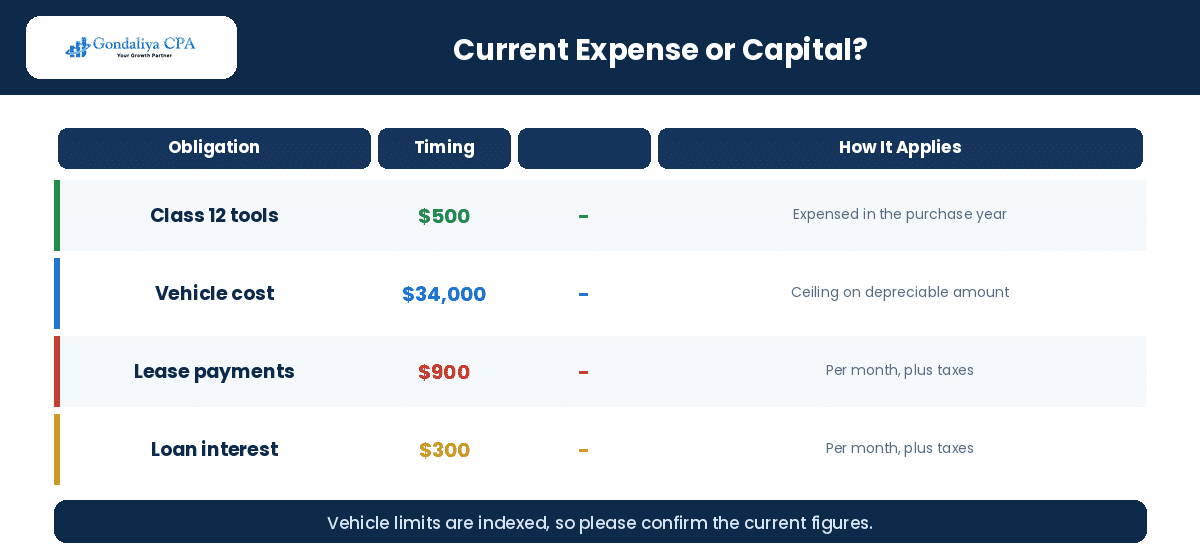
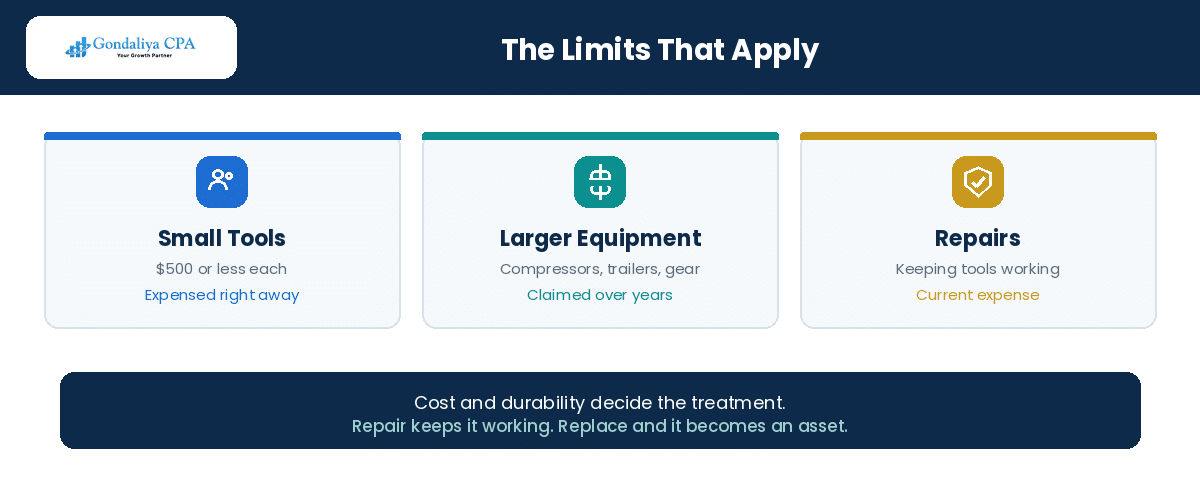
Small tools costing $500 or less usually fit in Class 12 for capital cost allowance (CCA). You can write off the full cost that year if it meets the limit. Bigger gear like compressors or power washers go into other classes and get depreciated over time. Fixing tools counts as an immediate expense, but replacing them might mean you have to capitalize the cost.
Keeping a tool list helps track what you buy, fix, or sell. Receipts must show what was bought, when, and how much. Claims for personal items won’t pass CRA checks.
Example: A handyman in Toronto buys a drill for $450 plus tax in 2026. Since it’s under the $550 limit, he writes off the entire amount right away with a clear invoice.
Vehicle and Fuel Expenses: Guidelines for Handyman Contractors
Vehicle expenses make up a big part of contractor tax deductions Canada. But CRA rules are strict here. Only trips linked to work count; driving from home to your usual job spot does not.
You can claim fuel, oil changes, maintenance, insurance based on business use, parking fees at work sites—not at home—and tolls when needed. To do this right:
- Keep a mileage log with dates, trip reasons, and km driven.
- Work out the percentage of business use from total km.
- Watch limits on passenger vehicle CCA ($34,000 plus taxes max), unless your vehicle is classed differently.
- Lease payments and loan interest have caps too.
CRA offers a per-km rate as an easier method but you still need good records.
Example: If a handyman drives 20,000 km yearly with 60% for client visits across Ontario and spends $3,600 on fuel, he claims $2,160 based on his logs.
Insurance Deductions: What Types Are Deductible for Your Business
Insurance costs paid just for your incorporated handyman business are deductible if they cover risks tied to your work. Common deductible insurance includes:
- General liability insurance for property damage or injury claims.
- Tool and equipment insurance against theft or damage.
- Commercial vehicle insurance matching your vehicle use claim.
WSIB premiums depend on province rules but don’t affect federal deductions much. Life insurance usually isn’t deductible unless set up specially—talk to an accountant first.
Keep invoices showing what coverage you have and payment proof from your business accounts.
Advertising Expenses Contractor: Rules and Limits for Marketing Costs
In Canada, advertising expenses deductible include reasonable marketing aimed at finding clients or keeping them legally. Eligible costs are things like:
- Online ads aimed at local customers (like Google Ads targeting Toronto).
- Directory listings for construction trades.
- Truck lettering showing your services while you work.
- Flyers handed out locally where allowed by law.
Website creation costs must separate building (capitalized) from hosting or updates (expensed). Ads on foreign media often have limits on deductibility; check with your accountant before claiming those.
Keep records proving these costs support only your incorporated handyman service—not personal branding or other businesses.
Phone and Office Expenses Including Home Office Deduction Canada
Phone bills fully dedicated to your corporation are fully deductible. For mixed-use plans, divide costs based on actual use shown in bills or call logs. Internet charges follow the same rule when used for invoicing software or scheduling jobs online.
Software like QuickBooks used only by your company counts as a deduction too.
For home office deduction in Canada, claim only part of your space that qualifies as workspace — it must be the main place where you do business. Utilities like electricity or heat get allocated based on room size. Keep floor plans and bills dated during claimed periods handy.
If you pay phone/internet personally but want reimbursement from your company, follow proper accounting steps to avoid issues with shareholder benefits.
Work Supplies Tax Deductions Relevant to Handyman Operations
Materials bought just for client jobs count as direct costs you can deduct against income earned. This covers lumber cut onsite for cabinet parts or drywall compound used during repairs—if invoices link supplies clearly to billed contracts without mixing personal use items.
Small consumables like nails, screws, sandpaper, or cleaning solvents that you keep restocking also count as current expenses with good records proving they’re only for jobs.
Dumping fees charged separately after debris removal can also be deducted if invoiced apart from labour charges reflecting real out-of-pocket costs per contract completion rules.
Renting equipment temporarily—like scaffolding rented during a paint job—is allowed once rental dates match project times exactly according to agreements.
Charging materials instead of expensing them causes trouble later since overstating inventory inflates profits wrongly—risking penalties during audits.
For advice about handyman tax deductions Canada contact Gondaliya CPA at info@gondaliyacpa.ca or call 647‑212‑9559 today.
Truck lettering is the deduction handymen most often forget they made. It was paid for in cash three years ago and never reached the books. Figures changed for privacy.
Key Stat: Website build costs are capital; hosting and updates are current. Please have the developer invoice split the two rather than billing one lump sum.
Business Taxes, Licences, and Memberships: What Handyman Contractors Can Deduct
Licences, Rent, Wages and Other Expenses
The Operations
If you’re a handyman contractor in Canada, you can deduct some business taxes, licences, and memberships. These must connect directly to making money. For example, if you need a municipal trade licence to work legally in Ontario or other provinces, that fee counts. Fees for professional associations linked to your incorporated handyman business also qualify as deductible handyman business expenses under CRA rules.
The main thing? The expense has to be just for business. Personal licences or memberships not related to your handyman work don’t count. Keep your invoices and payment receipts as proof when you claim them.
Here’s an example: A handyman in Toronto pays $350 each year for a city trade licence and $200 for a provincial contractor association membership. Both are fully deductible with proper receipts.
Rent, Repairs, and Maintenance Costs: Differentiating Deductible Expenses
Rent paid for a commercial space used only for your handyman company is deductible. If you rent a place partly for personal use, like a home office, only part of the rent counts. You must split it based on how much area or time is used for work.
Repairs that keep equipment or property working but don’t add value are current expenses. You can deduct them fully in the year you pay. But if repairs improve the asset or make it last longer, they become capital expenses and fall under Capital Cost Allowance (CCA) rules.
Maintenance contracts that cover regular upkeep of tools or rented spaces also count if they relate to business assets.
Keep invoices that clearly say what was repaired or improved plus proof of payment.
For example: A handyman in Etobicoke rents workshop space for $1,200 monthly just for his business. He can deduct the full rent each month if he has lease papers.
Salaries, Wages, and Benefits: Handling Subcontractor and Employee Payments
Your incorporated handyman business can deduct payments to employees and subcontractors if you keep good records.
- For employees: Pay reasonable wages reported on T4 slips. Employer contributions like CPP/QPP and EI premiums are deductible too.
- For subcontractors: Give T4A slips when needed. Report payments over $500 using T5018 forms as required in construction.
Don’t pay cash without records—auditors may reject those deductions.
Employee benefits related to work (like safety gear allowances) may also be deducted but keep these clear from personal benefits in your accounts.
Example: A contractor in Vaughan pays two helpers $60,000 total yearly plus WSIB premiums. All these costs can be claimed with proper payroll files.
Meals and Entertainment: Understanding the Deductibility Limits
You can claim meals bought during real business activities up to 50% of their cost under Canadian tax rules unless there’s an exception. Entertainment costs usually follow the same 50% rule unless they are clearly separate from social events that aren’t deductible.
One exception is meals at remote job sites where workers can’t leave during breaks—these might allow more than 50% deduction but you need strong proof like where it happened and why.
Keep receipts showing date, time, and who attended; this helps avoid partial denials during audits caused by inflated meal claims.
Example: A Mississauga handyman spends $300 on client lunches promoting his services; only $150 qualifies after applying the 50% rule with good bills saved digitally.
Handling Bad Debts and Other Miscellaneous Business Expenses
| Expense Type | When It’s Deductible | What To Keep |
|---|---|---|
| Bad Debts | Written off after collection attempts | Invoices + communication logs |
| Bank Charges | Only if on corporate accounts | Monthly bank statements |
| Office Supplies | Used fully or partly for service delivery | Purchase receipts |
Other miscellaneous expenses include bank fees on corporate accounts or small office supplies used in your work. These fall under general contractor tax deductions Canada if they clearly relate to earning income.
Good paperwork like emails about unpaid bills helps prove bad debts before deducting losses on taxes.
Prepaid Expenses: Treatment Under Cash vs Accrual Accounting Methods
Prepaid expenses happen when you pay ahead for goods or services covering more than one tax year—like insurance premiums paid upfront covering many months.
How you handle these depends on your accounting method:
- Cash method: You usually expense the full amount when paid because income and expenses match timing here.
- Accrual method: You expense only the part used in the current year; rest gets spread over future years to match benefits received later.
CRA wants clear schedules showing how much applies each year when big amounts affect taxable profits seriously.
Example: An Oshawa handyman prepays $1,200 annual liability insurance starting July 2026:
- Accrual method claims $600 in 2026.
- Cash method claims all $1,200 right away.
Keep invoices showing coverage dates clearly.
Cash paid to a helper with no invoice and no slip is not a deduction, however real the work was. That is the single most expensive habit in this trade. Figures changed for privacy.
Risk Warning: Subcontractor payments in construction need T5018 reporting. Please run that list before the deadline rather than discovering it during a review.
Motor Vehicle Expense Deduction Criteria and Required Records
Motor Vehicle Rules and Required Records
The Vehicle
In Canada, handyman tax deductions include vehicle expenses, but you must follow strict CRA rules. Only expenses tied directly to your work count. You need solid records to back up your claims. Handyman business expenses that involve vehicles follow the same rules as contractor tax deductions Canada. This helps you get handyman tax savings without problems with the CRA.
You have to clearly separate personal and business use of your vehicle. The CRA wants either detailed or simplified logbooks that show how many kilometres you drove for work. If you don’t keep good logs, your claim might be rejected or changed during an audit.
Simplified Logbook Method vs Detailed Logbooks for Vehicle Expenses
The CRA lets you pick between two ways to track vehicle use: simplified logbooks or detailed ones.
- Simplified Logbook Method You record your driving for one 12-week period every four years if your driving habits don’t change much. It’s easier but you still must track total kilometres and how many were for business.
- Detailed Logbooks Here, you write down every trip daily. Include date, where you went, why, and odometer readings at start and end. You need this if your driving changes a lot year to year or if you want very exact expense claims.
Both ways help calculate how much of your vehicle costs relate to business use. For 2026, the per-kilometre rate is $0.68/km. You can use this rate instead of tracking actual expenses when paying yourself or workers.
| Feature | Simplified Logbook | Detailed Logbook |
|---|---|---|
| Record Period | One continuous 12 weeks | Every day |
| Frequency | Every 4 years (if stable) | Every fiscal year |
| Business Use % Calculation | Based on sample period | Exact from all trips |
| Suitable For | Steady driving habits | Variable or heavy use |
Remember, the CRA wants valid mileage logs. Incomplete logs risk denial of deductions.
Leasing Costs and Interest Deductions Related to Business Vehicles
If you lease a vehicle for your handyman work through a corporation, the CRA limits what lease costs you can claim:
- Lease payments can’t be more than $900 plus taxes per month.
- If the lease lasts over 48 months, limits are prorated.
Also, interest on loans for passenger vehicles has caps:
- Interest claims max out at $300 plus taxes monthly.
These rules stop people from claiming too much. If you go over these limits, the CRA will reduce your claim unless you have strong proof why it’s needed.
Joint Ownership and Multiple Vehicles: Tax Considerations for Contractors
If you own several vehicles or share ownership in a handyman corporation:
- Each car must be put in the right CCA class:
- Class 10 usually applies with a 30% declining balance yearly.
- Class 10.1 covers passenger vehicles costing over $34,000 used value.
For incorporated handymen with multiple cars or trucks:
- Keep separate CCA schedules showing purchase dates, cost within allowed limits, and business use percentage.
Vehicles over $34,000 used cost limit face reduced depreciation claims; extra cost isn’t deductible until sold.
Keep purchase papers showing who owns what share. Also maintain mileage logs for each vehicle when needed.
Fuel Expenses Contractor: What Is Deductible and How to Claim
Fuel is part of handyman business expenses if you base it on business use percentage:
- Gasoline or diesel bought for work trips counts fully after prorating by kilometres driven.
Maintenance like oil changes counts as repairs but follows similar rules.
Parking fees at client locations are deductible if you keep receipts. Tolls paid during work travel also count if supported by trip logs.
Keep original receipts with vendor name, date, and amount. Also hold mileage records proving business vs personal travel split.
If you’re an incorporated handyman in Toronto/Ontario looking for help with handyman tax savings or contractor tax deductions Canada rules, reach out to Gondaliya CPA at info@gondaliyacpa.ca or call 647‑212‑9559 for a free consult.
The simplified logbook only works if the base year was genuinely representative. A quiet twelve weeks locked in as your business percentage costs you every year after. Figures changed for privacy.
Pro Tip: Please record the odometer on the first and last day of each fiscal year. Without both readings the percentage cannot be calculated at all.
Strategic Tax Savings and Compliance Tips for Handyman Contractors
Strategic Tax Savings and Compliance
The Strategy
If you’re a handyman in Canada, knowing your tax deductions can save you money. You have to plan carefully to follow the rules and claim the right handyman business expenses. Understanding contractor tax deductions Canada helps you cut down taxable income without causing problems with CRA. Keeping good records, sorting expenses right, and getting advice from a pro will help you find real handyman tax savings.
Reasonableness and Documentation: Avoiding CRA Scrutiny on Expense Claims
CRA wants your handyman business expenses to be reasonable. They must connect directly to making money and have proper proof like receipts or invoices. Don’t claim things you didn’t actually pay for or personal costs. Keep logs for things like mileage if you use a vehicle for work.
Reasonableness means your expense matches what’s normal in your trade—claiming way too much looks suspicious. For example, saying you spent $10,000 a year on small tools might get questioned unless you do tons of jobs. CRA prefers records made at the time of purchase, not guesses later.
Here’s what to remember:
- Only claim costs used just for business.
- Save original receipts or clear digital copies sorted by type.
- Keep a mileage log with date, distance, and reason for work trips.
- Write down deals with subcontractors and file T5018 slips when needed.
Good paperwork lowers chances of audits and backs up your claims under Income Tax Act sections 18(1)(a) and 67.
Commonly Overlooked Tax Deductions for Handyman and Contractor Businesses
Many handymen miss some deductions that could lower their taxes:
- Home office: You can claim part of utilities if you work there regularly.
- Phone & internet: Only the business part counts, so split personal vs business usage.
- Advertising: Costs like truck lettering often get ignored but are deductible.
- Subcontractor payments: Reporting payments properly with T5018 slips is important.
These areas can boost your handyman tax savings without risking trouble.
| Deduction Category | Common Mistake | CRA Info |
|---|---|---|
| Home Office | Claiming full home utilities | Income Tax Folio S4-F6 |
| Phone/Internet | Not splitting personal/business use | ITA section 18(1)(a) |
| Advertising | Forgetting truck lettering costs | CRA Guide RC4070 |
| Subcontractor Payments | Not filing T5018 slips | Regulation 238 |
Utilizing Business Expense Tracking Tools and Accounting Software
Keeping track of handyman business expenses makes tax time easier. Software like QuickBooks or Xero connects to your bank and works with receipt apps like Hubdoc. This automation helps sort expenses correctly.
Here’s why these tools matter:
- You see your spending as it happens, helping meet contractor tax deductions Canada rules.
- They separate capital buys from regular costs per CRA rules (like Class 12 tools).
- Some apps track miles driven for work so vehicle claims stay legit.
These tools cut errors from manual entry and keep documents ready in case CRA asks.
Importance of Working with a Contractor Tax Accountant to Maximize Handyman Tax Savings
Working with a contractor tax accountant who knows Ontario’s small business scene pays off. A CPA firm like Gondaliya CPA understands the tricky parts of incorporated handyman businesses all over Canada. They know about capital cost allowance classes (like Classes 8 vs 12), car cost limits, lease interest rules, GST/HST input credits, and filing T5018s on time.
A good accountant helps:
- Sort repairs vs improvements correctly so you don’t lose deductions.
- Use home office space wisely for reimbursements within allowed tests.
- Find smaller but real small business tax deductions Canada that many miss.
- Avoid mistakes that cause reassessments due to missing papers or silly claims.
Getting advice early stops missed chances and keeps you safe from CRA penalties during checks.
Tax Deduction Limits and Eligibility Criteria for Small Business Tax Deductions Canada
Canada sets limits on how much you can deduct in some categories important to handymen:
Tools & Equipment (Class 12): You can fully expense items up to $500 immediately; over that goes into capital pools with slower depreciation rates.
Passenger Vehicle Cost Limit: The max cost you can depreciate is $34,000 before taxes; leases have monthly caps depending on length.
Meals & Entertainment: Usually only half of these expenses are deductible except if working away from home over long periods where full amounts count.
To qualify each expense must:
- Be directly tied to earning income in your trade (Income Tax Act s9).
- Have proof kept at least six years after filing as per CRA recordkeeping rules.
Knowing these rules keeps you from claiming too much and losing possible handyman tax savings through careful planning that fits current Canadian laws.
Handymen underclaim far more often than they overclaim. Home office, phone split and truck lettering are legitimate and routinely left on the table. Figures changed for privacy.
Key Stat: Reasonableness is tested against what is normal for your trade. Please make sure the scale of a claim matches the scale of the work behind it.
Additional Resources and Next Steps for Handyman Business Tax Optimization
Resources and Next Steps
The Resources
Summary of Deductible Handyman Expenses and Tax Benefits
In Canada, handyman business expenses must be tied to earning income. They also need to be reasonable and well documented to count as handyman tax deductions. You can deduct things like tools costing under $500, vehicle expenses based on how much you use it for work, materials you use on jobs, liability insurance premiums, ads to reach clients, phone and internet bills split by usage, home office costs based on how much space you use only for business, payments to subcontractors if you issue the right slips (T4A or T5018), and safety gear required by rules.
Here’s a quick rundown:
- Tools (Class 12): Must cost less than $500. You can expense them right away.
- Vehicle: Only the business part counts. Keep a mileage log.
- Home office: Must be used only for work. Claim part of your utilities.
- Subcontractors: If you pay over certain amounts, issue slips like T4A or T5018.
Each kind of expense has CRA rules about limits and what records you need. For example:
| Expense Category | Condition | Limit/Condition | Record Needed | Source |
|---|---|---|---|---|
| Tools (Class 12) | Cost under $500 | Max $500 per tool | Purchase invoice | Income Tax Act Schedule II |
| Vehicle Expenses | Based on business km driven | Rate: 68¢/km (2026) | Mileage log | CRA Motor Vehicle Guide |
| Home Office | Exclusive workspace | % of home area | Floor plan + bills | CRA Home Office Guidelines |
| Subcontractor Payments | Must issue slips if over limit | Thresholds vary | Contracts + slips | Regulation 238 & ITA s.230 |
Make sure you follow these rules closely. It helps avoid trouble with CRA.
How Gondaliya CPA Supports Handyman Businesses in Claiming Contractor Tax Deductions
Gondaliya CPA works with incorporated handyman businesses across Toronto and Ontario. We help find every possible contractor tax deduction Canada-wide while following Income Tax Act rules.
Here’s what we do:
- Review bookkeeping focused on handyman business expenses.
- Sort tools from capital equipment using Class 12 rules.
- Calculate vehicle expenses with current per-kilometre rates.
- Prepare subcontractor reports like T5018 slips.
- Give advice to get handyman tax savings without audit risks.
We charge flat fees yearly and include full deduction reviews. New clients get free talks about their contractor tax duties or ways to save money.
Interactive Tools and Downloadable Checklists for Handyman Business Expense Tracking
Keeping good records is key since CRA demands you keep them at least six years after the last tax year they apply to.
We offer tools like a corporate tax calculator made for incorporated contractors. It lets you put in things like tool costs, vehicle kms, home office size, subcontractor payments with slip status, etc., to estimate deductions.
You can also download checklists that cover:
- How to capture receipts right
- Mileage log templates matching CRA needs
- Tool registers showing current vs capital assets
- Subcontractor agreements aligned with T5018 deadlines
- Home office measurement guides for correct claims
These help DIY reviews but also show when pros might reduce risks from complex claims or missing info.
Linking to Official CRA Guidelines and Authoritative Tax Resources
For solid guidance on handyman contractor tax deductions Canada-wide, check these official sources:
- Income Tax Act Schedule II: Talks about Capital Cost Allowance classes like Class 12 tools.
- CRA Business Expense Rules: Covers what’s deductible including reasonableness tests, timing, proof needed, meal limits, etc.
- Excise Tax Act Regulation 238: Covers reporting contractor payments needing T5018 slips.
Using these primary laws keeps your claims within CRA rules.
Encouraging Ethical Practices and Record-Keeping for Sustained Tax Compliance
Following ethical practices helps avoid reassessments or fines from CRA reviews. Only claim expenses actually paid for earning income with receipts or logs you can show.
You’ll need records like invoices; detailed mileage logs with date/km/purpose; contracts plus payroll/slip forms; floor plans measuring workspace; insurance papers showing coverage; bank statements matching claims — all kept safely as law requires.
If earlier claims were wrong or missing proof, fix them by filing amended returns before audits start. This might lower penalties if done quickly.
Good bookkeeping habits plus occasional pro deduction checks cut your risk while keeping handyman tax savings solid over time.
Want help tailored to your incorporated small contracting biz in Toronto/Ontario? Email info@gondaliyacpa.ca or call 647‑212‑9559 anytime. We offer free talks for those ready to sort their contractor tax deductions carefully and stay fully legal across Canada.
Fixing a weak prior claim before the CRA asks is a very different conversation from fixing it after. Timing is most of the outcome. Figures changed for privacy.
Verification: Our CPA Ontario firm registration can be checked on the public firm directory. Please verify any firm before granting access to your accounting file.
FAQs on Handyman Tax Deductions and Related Topics
Frequently Asked Questions
FAQ
What is the Class 12 tool cost limit for handyman tax deductions?+
Class 12 tools must cost $500 or less to be fully deductible in the purchase year under CRA rules.
How does the Passenger Vehicle Cost Limit affect my vehicle expense claims?+
You can only claim depreciation on passenger vehicles costing up to $34,000 plus taxes; amounts above are not deductible.
What is the Per-Kilometre Allowance Rate for handyman contractors in Canada?+
The CRA rate for 2026 is $0.68 per business kilometre driven, used for simplified vehicle expense claims.
Can I apply the Half-Year Rule Capital Cost Allowance on new equipment purchases?+
Yes, the half-year rule allows claiming only half the CCA in the year assets become available for use.
Are meals and entertainment fully deductible for handyman business?+
No, usually only 50% of meals and entertainment costs are deductible, with exceptions for remote job sites.
When is the T5018 Contract Payment Reporting Deadline?+
T5018 slips must be filed by March 31 annually to report subcontractor payments properly.
How long should I keep records to comply with CRA’s Records Retention Period?+
You must retain all tax-related records, receipts, and documents for at least six years after filing.
What is Regulation 238 and why is it important for handyman contractors?+
Regulation 238 requires reporting payments to subcontractors over $500 using T5018 slips to remain compliant.
What does Standby Charge Applicable mean for leased vehicles in a handyman business?+
It refers to a taxable benefit when a company vehicle is used personally beyond business needs, requiring inclusion in income.
Are laundry costs for safety gear deductible handyman expenses?+
Yes, laundry expenses for cleaning safety gear used exclusively at work can be deducted.
Key Tax Considerations for Handyman Contractors
Key Considerations and Comparison
Quick Reference
- Lease payments on vehicles have monthly caps of $900 plus taxes; exceeding amounts are non-deductible.
- Loan interest claims on vehicles max out at $300 plus taxes per month under CRA rules.
- Life insurance premiums paid personally are generally non-deductible unless structured as part of compensation plans.
- Advertising on foreign media has limitations; consult an accountant before claiming these expenses.
- Software subscriptions used solely for scheduling and invoicing qualify as deductible business expenses.
- Corporate reimbursement policies must clearly separate personal from home office expenses to avoid taxable benefits.
- Commuting from home to a regular workplace is non-deductible under CRA guidelines.
- Financing fees on loans must be amortized over the loan term rather than expensed immediately.
- Fines and penalties related to violations or late payments are never deductible expenses.
- Unpaid labour or informal work contributions do not qualify as deductible wages or expenses.
- Common audit triggers include excessive expense claims without proof and inconsistent mileage logs.
- Voluntary correction requests can reduce penalties when errors are identified early and corrected with CRA.
- Taxpayer relief requests may be submitted to waive penalties or interest due to circumstances beyond control.
- Digital receipt capture tools help maintain organized records required by CRA audits and reduce paperwork burden.
- Monthly bookkeeping closes ensure accurate financial statements and timely tax filings throughout the year.
- Mid-year and year-end reviews help identify missed deductions or compliance gaps early on.
Deduction Reviews: DIY vs CPA vs Non-CPA Provider
| Service Type | Pros | Cons | Best For |
|---|---|---|---|
| DIY | No cost, full control | Risk of errors, missed deductions | Small handyman businesses with simple finances |
| CPA Firm (e.g., Gondaliya CPA) | Expert knowledge, maximum savings, audit support | Higher cost than DIY | Medium to large handymen needing compliance assurance |
| Non-CPA Providers | Lower fees than CPAs | Less expertise, potential compliance risk | Basic bookkeeping services only |
Gondaliya CPA offers thorough deduction reviews focused on handyman contractor needs across Canada with guaranteed compliance support.
For personalized help with your handyman tax deductions Canada or contractor tax savings strategies, contact Gondaliya CPA at info@gondaliyacpa.ca or call 647‑212‑9559 today.
Sixteen considerations and one that carries most of them: keep the record at the moment of the purchase. Reconstruction after the fact is what fails. Figures changed for privacy.
Contractor Types We Serve
Industry Expertise
Which deduction carries the most value differs by trade. Here are ten and the usual focus.
| Contractor Type | The Main Deduction Focus |
|---|---|
| General handyman services | Small tools expensed under Class 12 |
| Painters & decorators | Consumables and equipment rental |
| Carpenters & finish trades | Larger tools crossing into capital classes |
| Plumbers & electricians | Licence fees and trade memberships |
| Flooring & tile installers | Materials tied to specific contracts |
| Drywall & renovation crews | Subcontractor payments and T5018 slips |
| Landscaping & property maintenance | Seasonal vehicle and trailer costs |
| Appliance & fixture installers | High vehicle mileage between calls |
| Home inspection & repair services | Home office and software subscriptions |
| Multi-trade contracting companies | Payroll, WSIB and mixed crew reporting |
- General handyman services: A steady flow of small purchases makes the tool register worth keeping properly.
- Painters and decorators: Consumables and short-term rentals dominate, so invoices need matching to jobs.
- Carpenters and finish trades: Larger equipment crosses the threshold and belongs in a capital class.
- Plumbers and electricians: Licences and association fees are deductible and often forgotten.
- Flooring and tile installers: Materials must link to billed contracts rather than sitting as unrecorded stock.
- Drywall and renovation crews: Subcontractor volume makes T5018 reporting the compliance priority.
- Landscaping and property maintenance: Seasonal patterns make the mileage log harder and more important.
- Appliance and fixture installers: Many short trips add up, so the business percentage needs real support.
- Home inspection and repair services: Office-based admin makes workspace and software claims relevant.
- Multi-trade contracting companies: Employees and subcontractors together mean both slip types apply.
The trade changes which deduction carries the most value. It does not change the discipline, which is business purpose, reasonable amount, and a record made at the time. Figures changed for privacy.
Professional Guidance and Quick Reference
Guidance
Professional Guidance for Handymen: How Gondaliya CPA Protects Your Claims
Handyman deductions turn on four things: whether a cost is current or capital, whether the vehicle log supports the business percentage you claim, whether subcontractor payments were reported on T5018 slips, and whether the paperwork exists at all. Most handymen underclaim rather than overclaim, and the gap is usually documentation. Gondaliya CPA handles the full cycle on a fixed annual fee.
We handle what decides the outcome: splitting small tools from capital equipment, tracking vehicle use with logs that survive review, applying the passenger vehicle cost, lease and interest limits, testing the home office workspace requirement, claiming phone and internet on a defensible split, separating website build costs from hosting, reporting subcontractor payments on T5018 slips, and applying the meals limit correctly.
Our team sets the record-keeping up front, because a claim reconstructed after a CRA letter rarely holds. Sole trade or multi-crew, you get clear advice and a fixed price before we start.
Quick Answers: Key Numbers & Concepts at a Glance
At a Glance
- Class 12 tools: $500 or less, expensed at once
- Larger equipment: Capitalised and depreciated
- Vehicle limit: $34,000 plus taxes on CCA
- Lease cap: $900 per month plus taxes
- Interest cap: $300 per month plus taxes
- Per-kilometre rate: 68 cents for 2026
- Meals: Generally 50% deductible
- Commuting: Not deductible
- T5018: Required for subcontractor payments
- Records: Six years after filing
Who This Is For / Not For
Fit Check
- For: Incorporated Canadian handyman, renovation and small contracting businesses using tools, vehicles and subcontractors.
- Not For: Trade licensing or WSIB registration advice, which sits with the regulator; we handle the tax and accounting.
People Also Ask
Related Questions
Is a $600 tool still deductible?+
Yes, but not all at once. It falls outside Class 12 and gets claimed over time through capital cost allowance instead.
Can I claim the drive to my first job of the day?+
Generally not, if it is your usual work location. Travel between job sites during the day normally does count.
Do I need a T5018 for a subcontractor I used once?+
If total payments in the reporting period exceed the threshold, yes. The test is the annual total, not the number of jobs.
Glossary of Key Terms
- Current expense: A cost fully deductible in the year it is incurred.
- Capital expense: A cost added to an asset class and claimed over time.
- Class 12: The CCA class allowing small tools to be written off quickly.
- Class 10 and 10.1: The CCA classes covering vehicles, split by cost.
- Passenger vehicle cost limit: The ceiling on the amount of a vehicle that can be depreciated.
- Half-year rule: The restriction limiting first-year capital cost allowance.
- Available for use: The point at which an asset is ready to operate and CCA may begin.
- Mileage log: The record of date, distance and purpose supporting a vehicle claim.
- Business use percentage: The share of total kilometres driven for work.
- Simplified logbook: A sample-period method of establishing that percentage.
- Standby charge: A taxable benefit arising from personal use of a company vehicle.
- Workspace test: The requirement a home office must meet to be claimable.
- T5018: The contract payment reporting slip for subcontractors.
- Regulation 238: The rule requiring contract payment reporting.
- Input tax credit: GST/HST recoverable on purchases used in commercial activities.
- Reasonableness test: The requirement that an expense fits the scale of the business.
Handyman Deduction Readiness Check
This quick self-check indicates where your operation most likely has room. Please answer the six questions below.
Handyman Deduction Readiness Check
Six quick questions on your records. No fee shown.
Points to raise with us:
This is a general prompt, not tax or legal advice or a quote. Your position depends on your full facts. For a real review, please book a free consultation.
Want a checklist to work from? You can download our free handyman deduction checklist before your consultation.

Split every purchase into current or capital before posting it. Keep the mileage log as you drive, not at year-end. Apply the vehicle cost, lease and interest limits. Test the home office workspace requirement honestly. Document the phone and internet split. File T5018 slips for subcontractors. Apply the 50% meals limit. Please retain everything six years.
2026 Update — what is current: This article reflects the 2026 per-kilometre rate of 68 cents. The $500 Class 12 threshold, the $900 monthly lease cap, the $300 monthly interest cap, the 50% meals limit and the six-year retention requirement are unchanged. Please note the article gives the tool limit as $500 in five places and $550 in one, gives the passenger vehicle cost limit as $34,000 where the current ceiling is higher and indexed annually, cites T5018 reporting to Excise Tax Act Regulation 238 where it sits in the Income Tax Regulations, gives the T5018 deadline as March 31 where it is six months after the reporting period end, and cites Income Tax Act section 230 for contract payment reporting where section 230 governs books and records, so please confirm each before relying on it.
Handyman Tax Deductions Canada: Maximize Your Handyman Business Expenses and Contractor Tax Savings with Gondaliya CPA
Keep the record when you make the purchase
Gondaliya CPA splits tools between Class 12 and capital classes, builds vehicle claims on logs that survive review, applies the passenger vehicle cost, lease and interest limits, tests the home office workspace requirement, documents the phone and internet split, files T5018 slips for subcontractors, and applies the meals limit correctly, on a flat annual fee including HST with a one-business-day response. Please book a free consultation.
Next Steps
Please book a free consultation with Gondaliya CPA and bring your mileage log, your tool and equipment purchase records, and your subcontractor payment list. Those three tell us immediately whether your vehicle claim will hold, whether tools are classified correctly, and whether any slips are outstanding. You will get a flat annual fee including HST before any work begins. If our content helps, please add gondaliyacpa.ca as a preferred source on Google.
Published: · Last updated:
Editorial policy: We research against CRA and CPA Ontario sources, fact-check the figures, and Sharad Gondaliya, CPA, reviews the content, which we update as the rules change.
Disclaimer: This article is educational information only and is not tax, legal, or financial advice. Figures marked illustrative are examples rather than quotes or guarantees. It reflects CRA rules current to 2026, including the $500 Class 12 tool threshold, the passenger vehicle cost limit, the $900 monthly lease cap, the 68 cent per-kilometre rate, and the six-year record retention requirement. Rates, limits and expensing rules change and outcomes depend on your specific facts. Please consult a CPA Ontario member before acting.

Sharad Gondaliya is a CPA Canada & CPA USA with 15 Years+ experience of Accounting, Tax, Payroll of Corporate Small Businesses as Tax Accountant. He is a CPA Ontario member (61040184) and holds US CPA licences in Washington and Montana and is well known among corporate small businesses for tax planning, efficient tax solutions, and affordable CPA services. Sharad is the Principal (Director) of Gondaliya CPA – Affordable CPA Firm in Canada. Licenses: CPA Ontario: 61040184 | CPA USA (MT): PAC-CPAP-LIC-033176 | CPA USA (WA): 57629 | CPA Firm License: 61330051 View Full Author Bio