



Common Tax and Accounting Mistakes Osteopaths Make in Canada and How to Avoid Costly CRA Problems
Osteopath Tax Mistakes Canada often include common osteopathy accounting mistakes and bookkeeping errors that impact CRA compliance, such as missed tax deductions, GST/HST issues, and payroll source deductions. Gondaliya CPA helps osteopaths manage expense tracking errors, filing deadlines, and CRA penalties to ensure smooth T2 corporate tax filing and avoid costly reassessment periods.
Quick Summary
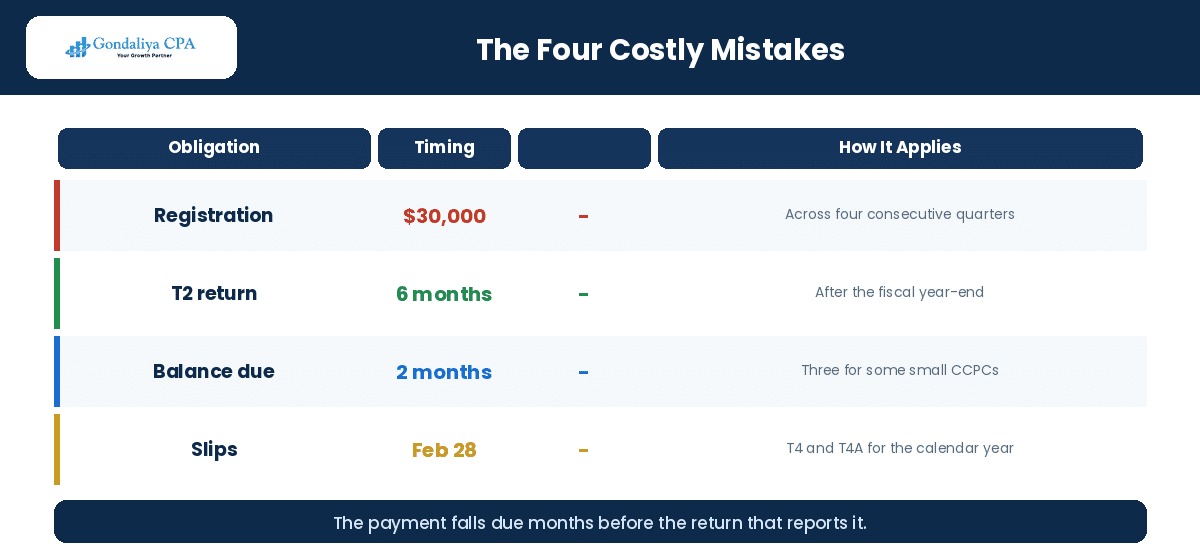
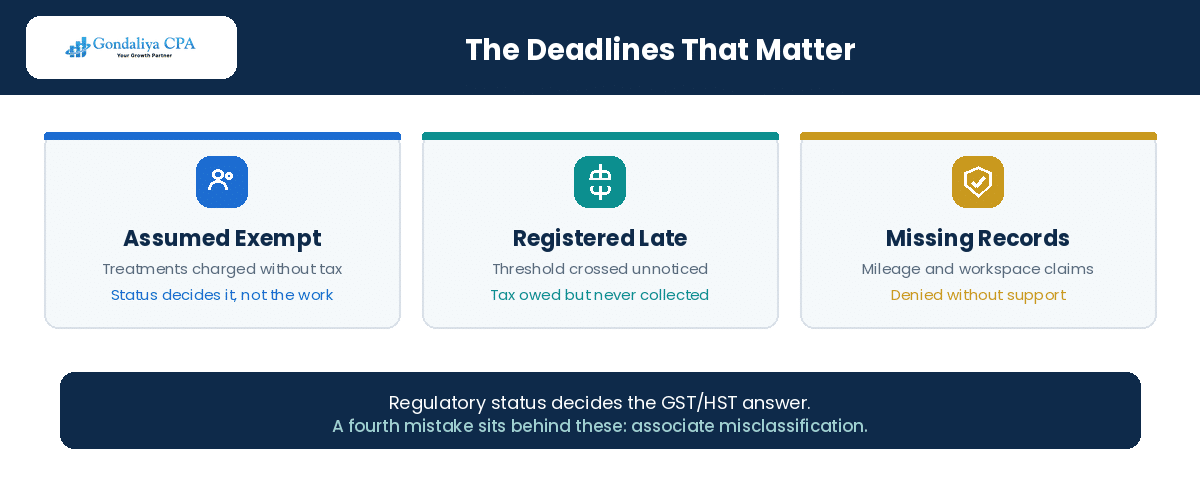
Four mistakes account for most osteopath reassessments: assuming treatments are GST/HST exempt, registering late after crossing the threshold, treating associates as contractors without support, and claiming vehicle or home office costs without records. Please note the registration threshold is $30,000.
| Aspect | Details |
|---|---|
| The exemption | Depends on regulatory status, not the treatment. |
| The threshold | $30,000 across four consecutive quarters. |
| The associates | Classified on the facts, not the label. |
| The records | Mileage logs and floor plans, six years. |
Reading time: 43 minutes.
Table of Contents
- Common Tax Errors Affecting CRA Compliance
- Accounting and Bookkeeping Mistakes
- GST/HST Registration, Exemptions and Credits
- CRA Compliance Risks and Audit Triggers
- Corporate Tax Filing and Planning
- Resources, Case Studies and Guidance
- Frequently Asked Questions
- Key Points on Compliance
- Osteopathy Practice Types We Serve
- Professional Guidance and Quick Reference
The Numbers That Matter
This article covers Canada, with Ontario and Toronto context, and reflects rules current to 2026. It assumes an incorporated osteopath or manual therapy clinic, whether solo or multi-practitioner. Figures marked illustrative are examples, not quotes, and any masked engagement notes end with “Figures changed for privacy.” This is educational information only and not tax or legal advice. Regulatory status differs by province and drives the GST/HST answer, so please confirm the position where you practise.
Common Tax Errors Among Osteopaths Affecting CRA Compliance
Common Tax Errors Affecting CRA Compliance
The Basics
Osteopaths in Canada often face tax challenges that can cause problems with the Canada Revenue Agency (CRA). Knowing these common mistakes helps avoid trouble and penalties. Some key errors are not registering for GST/HST, mixing up income types, and poor bookkeeping.
- Forgetting to register for GST/HST when required
- Confusing personal and business income
- Not keeping clear, organized records
These errors can lead to audits or fines if ignored.
Defining Key Terminology: Osteopath, Manual Osteopath, and Osteopathic Physician
It helps to understand who is who in osteopathy:
- Osteopath: Someone who uses hands-on therapy but may not be a regulated medical professional.
- Manual Osteopath: Focuses only on manual treatments and isn’t officially part of regular medicine.
- Osteopathic Physician: A licensed doctor with extra training in osteopathy.
Knowing these terms lets practitioners figure out their tax duties correctly.
Legal and Regulatory Framework Governing Osteopathy Taxation in Canada
The tax rules for osteopaths come from different laws. The Income Tax Act covers how to report income. The Excise Tax Act deals with GST/HST charges. In places like Ontario, manual osteopathy isn’t a regulated health profession.
So, manual osteopaths must follow both federal tax laws and any local rules tied to their work type.
For example: since manual osteopaths aren’t regulated like doctors, they usually have to charge GST/HST unless the CRA says their service qualifies for an exemption.
Distinguishing Medical Osteopaths from Manual Osteopaths for Tax Purposes
Tax rules differ between medical osteopaths and manual osteopaths because of their legal status.
- Medical osteopathic physicians get access to certain tax deductions related to healthcare work.
- Manual osteopaths get checked more closely on what counts as taxable or exempt services.
This means medical doctors might report income differently than unregulated practitioners offering similar treatments without official recognition.
Overview of GST/HST Obligations and Exemptions Related to Osteopathic Services
You must register for GST/HST once your yearly revenue passes $30,000. Many clinics reach this fast. But confusion comes in deciding which services need tax collection:
- Exempt Supplies: Services given by regulated professionals might not require GST/HST.
- Taxable Supplies: Most treatments by unregulated people—including many manual therapies—do require charging GST/HST at the point of sale.
Practitioners should check their qualifications carefully. Mistakes here can lead to big money issues if the CRA audits later.
Knowing these basics about common tax mistakes helps Canadian osteopaths keep clear of trouble with the CRA. Good accounting habits also make their business stronger over time.
Practitioners assume the exemption applies because the work is clinical. The test is regulatory status, not what happens on the table. Figures changed for privacy.
Risk Warning: Not charging GST/HST when required does not remove the liability. Please confirm your status before assuming your treatments are exempt.
Accounting and Bookkeeping Mistakes Frequently Encountered by Osteopaths
Accounting and Bookkeeping Mistakes
The Mistakes
Osteopathy accounting mistakes and osteopath bookkeeping mistakes can cause serious tax problems in Canada. These slip-ups often lead to missed deductions, wrong filings, and extra attention from the CRA. Knowing where errors happen helps osteopaths keep their records clean and manage money better.
Inaccurate Expense Tracking and Its Impact on Tax Deductions
Not tracking expenses right is a common osteopathy accounting mistake. When expenses aren’t recorded on time or sorted properly, tax deductions might be too low or too high. That can lead to CRA penalties or reassessments.
Here are some usual problems:
- Mixing personal expenses with clinic costs
- Losing receipts for supplies or bills
- Forgetting to record utilities linked to the business
These issues affect how much income you report and what taxes you pay.
To fix this, keep daily logs of spending with invoices saved digitally. Tools like QuickBooks or Xero help a lot. Check your records every month to catch mistakes before year-end.
Common Bookkeeping Errors Leading to CRA Penalties
Osteopath bookkeeping mistakes happen often when income isn’t fully recorded or deposits don’t match reports. Also, ignoring GST/HST input tax credit tracking raises audit chances.
Some examples:
- Mixing treatment fees with product sales without clear separation
- Late entry of transactions causing year-end cut-off errors
Since manual osteopathic services usually have different GST rules than some products, this causes reporting confusion.
You can avoid these errors by:
- Recording fees daily using practice software linked to bank feeds
- Reviewing books monthly to spot problems before filing T2 returns
Managing Payroll Source Deductions Correctly for Osteopathy Clinics
Getting payroll source deductions right is key for osteopath CRA compliance. Mistaking associates for contractors instead of employees can cause serious tax issues like unpaid CPP and EI plus penalties.
Payroll must follow federal rules:
- Deduct income tax correctly
- Calculate CPP contributions
- Calculate EI premiums
- Send payments on time to avoid fines
Issue correct T4 slips yearly for audits. Using payroll systems like ADP or Wagepoint automates this process. Also, keep signed contracts handy to prove employment status.
Mishandling of Shareholder Loans and Its Tax Implications
One big osteopathy accounting mistake involves mishandling shareholder loans. The CRA treats loans not repaid within a year as taxable income under section 15(2) of the ITA.
Common issues include:
- Withdrawing funds without formal loan papers
- Failing to repay loans on time
This results in unexpected personal taxes and messy company records.
Avoid trouble by:
- Drafting clear loan agreements with repayment terms
- Tracking repayments carefully in separate accounts
- Checking loan balances yearly during financial reviews
Challenges in Recording Vehicle and Home Office Expenses
Vehicle expense tracking causes lots of osteopathy accounting mistakes. Without a mileage log showing business trips versus daily commuting, claims get denied under ITA rules.
Home office claims also cause trouble. To qualify, work areas must be used only for business and claimed proportionally based on space size in the home.
Mistakes include:
- Overestimating utility bills or rent related to work area
- Missing proper mileage details when driving for work
Good habits include:
- Keeping detailed trip logs with date, reason, distance
- Matching logs with fuel receipts regularly
- Saving floor plans that show your office space clearly
- Allocating bills fairly according to use
Timing and Cut-Off Errors in Bookkeeping Affecting Fiscal Reporting
Timing errors happen when revenue or expenses are recorded in the wrong fiscal period—a classic osteopathy accounting mistake. For example, late December earnings might not get recorded until next year if deposits arrive late.
Also, delaying payment recording past year-end shifts expenses into another fiscal period, messing up profit calculations and tax installments.
Fix this by:
- Doing monthly closes with checklists for transaction cut-offs
- Making sure all earned revenues and incurred expenses fit the right fiscal year
This helps prepare accurate T2 returns filed six months after year-end per CRA rules.
If you want help fixing these common accounting issues at your Ontario practice, contact Gondaliya CPA’s team experienced in healthcare SMB incorporation at info@gondaliyacpa.ca or call 647-212-9559 for a free consult focused on avoiding costly osteopath tax mistakes Canada wide.
Associates labelled as contractors on a one-page agreement are the most expensive assumption in this sector. The CRA looks at control and risk, not the heading on the document. Figures changed for privacy.
Key Stat: Vehicle claims without a mileage log are routinely denied in full. Please record date, distance and purpose as you drive, not afterwards.
GST/HST Registration, Exemptions, and Input Tax Credits Relevant to Osteopaths
GST/HST Registration, Exemptions and Credits
The GST/HST
Requirement to Register for GST/HST: Thresholds and Criteria for Osteopaths
Osteopaths in Canada must register for GST/HST if their taxable revenue goes beyond $30,000 in four consecutive calendar quarters. Missing this registration is a common osteopath tax mistake Canada that can cause uncollected taxes and trouble with the CRA. You need to register right after you pass the threshold. Then, you have to file returns and pay the tax on time. Once registered, you must charge GST/HST on your taxable supplies unless they are exempt.
The small supplier threshold counts all worldwide taxable revenue from business activities. It does not include exempt supplies. Once you register, watch out for mistakes like late filings or wrong payments—these osteopathy accounting mistakes raise the chance of audits. Keeping good records helps you follow CRA rules.
Here’s a quick look at the key details:
- Small Supplier Threshold: $30,000 over 4 consecutive quarters
- Registration Effective Date: The day after crossing the threshold
- Obligation: Charge GST/HST on taxable supplies
Application of GST/HST to Manual Osteopathic Services versus Exempt Supplies
A big mistake is assuming manual osteopathic services are exempt from GST/HST. That’s not always true and leads to problems with CRA compliance. According to Part II Schedule V of the Excise Tax Act, many health care services by regulated medical pros are exempt. But manual osteopathy by non-medical practitioners usually isn’t exempt in Ontario. So, most manual osteopathy treatments have GST/HST added at your province’s rate.
Mixing this up means missing taxes and paying penalties later. You should check if your status fits provincial health rules. If your clinic offers several treatments, make sure invoices separate taxable and exempt services.
If you get this wrong, expect reassessments with interest and penalties from the CRA.
Handling Mixed Supplies of Taxable and Exempt Osteopathic Services
Many osteopaths sell both taxable items (like braces or supplements) and possibly exempt treatments. This mix causes confusion often seen as osteopath bookkeeping mistakes.
Don’t treat all income as one type. Instead:
- Track taxable products separately
- Track exempt treatments if you qualify for exemption
- Account separately for room rentals or courses—they may have special rules
Clear records help claim input tax credits (ITCs) properly on expenses tied to taxable supplies only. Mixing these can cause ITC claims to be denied or overclaimed.
To keep it simple:
| Revenue Type | Likely Tax Status | Record-Keeping Needed |
|---|---|---|
| Manual Osteopathy Treatment* | Usually Taxable | Separate invoices per service |
| Braces/Supplements Sales | Taxable | Detailed sales ledger |
| Teaching/Courses Income | Usually Taxable | Contracts documented |
*Check practitioner regulatory status
Eligibility and Claiming of Input Tax Credits (ITCs) for Registered Osteopaths
If you’re a registered osteopath, you can claim ITCs on business expenses used mainly for taxable supplies. Common examples include rent, utilities tied to your clinic space, and office gear used directly in taxable services.
Mistakes happen when ITCs get claimed without splitting costs between taxable and exempt activities—this is a big source of osteopathy accounting mistakes affecting CRA compliance.
Avoid problems by:
- Logging expenses carefully with usage percentages
- Keeping receipts showing purpose clearly
- Reviewing eligibility yearly as your practice changes
If not done right, audits may deny some ITCs and add taxes plus interest.
Examples Illustrating GST/HST Compliance and ITC Claims for Osteopathy Practices
At Gondaliya CPA, we often see clinics in Toronto stumble on HST registration timing or mixing up exemptions with taxed supplies.
For example:
- One solo practitioner missed registering after earning over $30,000 quarterly fees. They used voluntary disclosure later but had to file two years’ worth of returns plus interest—a tough catch-up.
- Another multi-practitioner clinic bundled product sales with treatments without separating invoices. Auditors flagged overstated input credits until corrected records proved proper separation.
These show why keeping clean books and getting expert help matter a lot when handling complex tax rules in healthcare settings like yours.
Registering late is recoverable. Registering late and never having charged the tax means paying it out of your own margin on treatments already delivered. Figures changed for privacy.
Risk Warning: Input tax credits must be apportioned where you make both taxable and exempt supplies. Please split them before claiming, not after a review.
CRA Compliance Risks and Common Audit Triggers for Osteopaths
CRA Compliance Risks and Audit Triggers
The Risks
Osteopaths often face specific risks when dealing with CRA compliance. Many tax mistakes happen because records are weak or deadlines get missed. Also, ignoring letters from the CRA can lead to bigger problems. Knowing these common triggers helps osteopaths keep their accounting clean and avoid trouble with the Canada Revenue Agency.
Typical CRA Audit Triggers Pertaining to Osteopathy Tax Returns
One big trigger for audits is poor records on cash, card, and third-party payments. If daily fee logs are incomplete or deposits don’t match reported income, it raises questions during reviews.
Another mistake is ignoring CRA mail, demands to file returns, or authorization requests. Not opening these letters can cause penalties or reassessments without the practitioner even knowing.
Here’s a quick look at key issues:
- Weak records on cash/card/third-party payments Consequence: Revenue mismatches that trigger audits. How to fix: Keep daily fee logs and reconcile deposits carefully
- Ignoring CRA mail and demands Consequence: Risk of penalties and reassessments. How to fix: Check mail regularly and authorize a representative if needed
Using software like QuickBooks or Xero linked with practice management tools helps reduce errors from mixed payment methods.
Understanding the Consequences of Late Filing, Demand to File Notices, and Reassessments
Missing T2 filing deadlines or balance due dates causes immediate late-filing penalties. These start at 5% of unpaid taxes plus 1% every month after until they reach a cap. Ignoring demand-to-file notices makes things worse by letting CRA estimate your income without your input. These guesses often push taxes owed higher than they should be.
To avoid this:
- File T2 returns within six months after year-end
- Pay amounts due by their deadline (usually two months post-year end)
- Open and respond to all CRA letters quickly
Failing these steps increases audit risk and costs dramatically.
Overview of CRA’s Voluntary Disclosure Program and Its Benefits for Osteopaths
The Voluntary Disclosures Program (VDP) offers osteopaths a chance to fix past tax mistakes before the CRA begins an audit. For example, failing to register for GST/HST or wrong expense claims can be corrected under this program. It may reduce penalties and interest but won’t erase them completely.
You have two main choices: submit a VDP or file an amended return. Which one fits depends on timing and error type:
| Factor | Voluntary Disclosure | Amended Return |
|---|---|---|
| When | Before audit starts | Anytime within reassessment period |
| Penalty relief | Possible | No penalty relief |
| Risk | Higher scrutiny if incomplete | Lower risk if simple correction |
Make sure you collect all documents before moving ahead. Getting help from a CPA who knows healthcare taxes is smart.
Identifying Gross Negligence and Late-Filing Penalties Specific to Healthcare Providers
Gross negligence means you knowingly or recklessly ignore rules—like not registering for GST/HST even when you should. This can cost you 50% of the tax owed that relates directly to your mistake.
Late-filing penalties go like this:
- Base penalty: 5% of unpaid taxes right after deadline
- Extra charge: 1% per month up to twelve months
If you fail repeatedly, these penalties double but won’t pass 25%.
Healthcare providers must watch deadlines closely because fines pile up fast with added interest every day until fixed.
Best Practices to Avoid Remittance Penalties and Maintain CRA Compliance
Missing instalment payments for corporate tax or payroll deductions triggers penalties based on how late they are. Directors may also face personal liability if remittances remain unpaid too long.
Here’s how to stay clear:
- Set monthly reminders for instalment dates
- Use payroll systems like ADP tied into your accounting software
- Match bank statements against expected remittances regularly
- Hire a professional yearly to catch any misses
Following these steps stops small bookkeeping mistakes from turning into expensive compliance problems later.
If your osteopathy clinic in Toronto or Ontario needs help with GST/HST registration, T2 filing, payroll tracking, or avoiding common mistakes that trigger CRA audits, contact Gondaliya CPA: info@gondaliyacpa.ca / 647‑212‑9559. We assist incorporated practitioners in keeping their financial affairs solid while dodging usual Canadian osteopathy accounting errors.
Unopened CRA mail turns a manageable question into an arbitrary assessment. The number the CRA estimates is almost always worse than the one you would have filed. Figures changed for privacy.
Key Stat: Unremitted payroll source deductions can attach personally to directors. Please treat those remittances as the first payment out, not the last.
Corporate Tax Filing and Planning Considerations for Osteopathy Clinics
Corporate Tax Filing and Planning
The Filing
Incorporated osteopathy clinics in Canada face unique challenges with corporate tax filing and planning. Mistakes like missing T2 deadlines or mixing personal and business expenses happen often. Overstating home office claims, wrong equipment expensing, incorrect income splits, and poor slip filing also cause trouble. These errors can lead to CRA compliance issues and costly penalties. Knowing these common osteopath tax mistakes Canada helps you avoid big headaches in your accounting.
T2 Corporate Tax Filing Requirements for Incorporated Osteopathy Practices
Missing the T2 deadline or balance due date triggers penalties and interest from the CRA. The law requires incorporated health businesses to file their T2 within six months after the fiscal year ends. If you miss this, expect a 5% penalty on unpaid taxes plus 1% each month for up to a year. Repeat misses mean bigger penalties.
You must pay any amount owing within two months of your fiscal year-end (sometimes three months if eligible). Late payments get daily compound interest until cleared.
Example:
A Toronto osteopathy clinic with a December 31 year-end files its return on July 15 — 15 days late — and owes $10,000. The clinic faces a $500 penalty (5%) plus $150 (1% × 5 months), totaling $650 in penalties plus interest on unpaid taxes during that time.
Filing on time keeps fees down and your status good with the CRA.
Strategic Approaches to Corporate Tax Planning and Expense Deductions
Running personal expenses through your corporation can trigger shareholder benefit assessments under section 15(2) of the Income Tax Act. This means more taxable income than expected. Use separate accounts for personal and business spending to avoid this.
Overstating home office or treatment space claims risks disallowed expenses at audit. Only spaces used solely for business count. Allocate costs based on square footage. Utilities must be fairly divided using usage data.
Claiming full expenses for equipment or leaseholds breaks CCA rules under Part XI of the Income Tax Regulations. For instance:
- Treatment tables go in Class 8 (20% declining balance).
- Leasehold improvements get capitalized over the lease using Class 13 rules.
The half-year rule limits first-year depreciation; ignoring it inflates deductions incorrectly.
Tip: Keep detailed asset lists with invoices and contracts to back claims per CRA guidelines.
Tax Treatment of Income Splits and Associates Fee Allocations
Calling associates contractors without proper proof risks reclassification by CRA. They check control over work, tools used, financial risk, exclusivity clauses, among other things (CRA RC4110).
Wrong classification means unpaid payroll deductions fall on directors personally. CRA may also demand retroactive CPP/EI payments.
Paying family members without real work records invites problems under split-income rules (TOSI). This may cause extra tax at top rates unless bona fide services are shown by timesheets or contracts.
Example:
An Ontario clinic owner pays their spouse monthly wages without records. CRA disallows these expenses, raising taxable income and payroll arrears.
Having clear associate agreements plus documented family member duties cuts audit risks and ensures fee allocation stays clean.
Maintaining Compliance with Slip Filing and Source Deductions Documentation
Issuing correct slips matters a lot: T4s for employees, T4As for contractors. Wrong slips cause mismatches that trigger audits or reassessments affecting both clinics and workers.
Payroll deductions — CPP/QPP, EI premiums, income tax — must be accurate using official tables, sent on time per schedules, and reconciled yearly including ROEs where needed.
Failing here exposes directors personally under subsection 227(3) ITA. Good recordkeeping paired with professional help helps avoid typical osteopath accounting mistakes.
Managing CRA Mail and Responding to Audit or Reassessment Communications
Ignoring CRA mail makes matters worse quickly. You may get demands-to-file notices, arbitrary assessments, or miss objection deadlines losing appeal chances.
Assign someone reliable to handle mail daily. Using AUT-01 authorization forms lets CPA reps like Gondaliya CPA manage communication smoothly.
Respond quickly even if you don’t fully understand the issue yet. Early contact often helps reduce later penalties.
For incorporated manual osteopaths needing help with complex corporate tax filing rules while avoiding common accounting errors that cause CRA issues across Ontario including Toronto, reach out to Gondaliya CPA’s team offering flat-fee annual pricing with strong client feedback. Contact info@gondaliyacpa.ca or call 647-212-9559 for a free consultation focused on your practice’s needs.
| Obligation | Deadline | Applies To | Consequence If Missed | Source |
|---|---|---|---|---|
| File Annual T2 Return | Within six months post fiscal year end | Incorporated Osteopathy Clinics | Penalties + Interest | ITA s150 & s152 |
| Pay Balance Due | Two Months Post Fiscal Year End | All Corporations | Interest Charges | ITA s230 |
| Issue Payroll Slips | Last day February following calendar year end | Employers Paying Employees | Slip Penalties + Audit Risk | CRA Payroll Guides |
| Remit Payroll Source Deductions | Regular schedule varies monthly/semi-monthly | Employers | Penalties + Director Liability | CRA Payroll Remittance Rules |
Illustrative figures only
If you want help fixing osteopath bookkeeping mistakes, keeping up with osteopath CRA compliance, improving corporate tax planning, or managing GST/HST in Toronto/Ontario areas contact Gondaliya CPA at info@gondaliyacpa.ca / 647-212-9559 for a free consult made just for incorporated manual osteopathic practitioners.
Sharad Gondaliya, CPA, has over 10 years experience helping many Canadian business owners keep compliant healthcare practices.
Leasehold improvements expensed in full is the single most common capital error we correct in clinic files. It inflates one year and understates the next four. Figures changed for privacy.
Risk Warning: Personal spending through the corporate account can be assessed as a shareholder benefit. Please keep separate accounts from the outset.
Resources, Case Studies, and Practical Guidance for Osteopath Tax Compliance
Resources, Case Studies and Guidance
The Evidence
Osteopaths in Canada face many tricky tax and accounting issues. These can lead to costly problems with CRA compliance if not handled right. Common osteopath tax mistakes Canada practitioners make include errors in bookkeeping and accounting. Knowing these mistakes helps you keep your practice on the right side of the law. This section shares useful resources, real case studies, and practical advice made for incorporated osteopathic professionals.
Key points to watch out for:
- Common tax mistakes by osteopaths across Canada
- Accounting errors typical in osteopathy
- Bookkeeping slip-ups that cause trouble
Illustrative Case Studies Demonstrating Common Osteopathy Tax and Accounting Issues
We have seen certain errors happen again and again in osteopathy practices during CRA audits. These problems often involve poor record keeping, confusion about GST/HST rules, and missed corporate filings—all affecting osteopath CRA compliance.
Case Study 1: Not Registering for GST/HST After Passing Threshold
One manual osteopath in Toronto made over $30,000 but didn’t register for GST/HST. They charged patients but never collected or paid HST on things like therapy products sold with treatments. The CRA hit them with back taxes plus penalties and interest going back three years. The fix? Registering late and filing amended returns.
Case Study 2: Mixing Up Taxable and Exempt Sales
A clinic with several practitioners combined income from treatment fees (tax-exempt) and supplement sales (taxable) under one category without separating them properly. When audited, their input tax credit claims were partly rejected because they couldn’t prove which revenue was taxable.
Case Study 3: Poor Mileage Records Led to Disallowed Deductions
A solo osteopath who traveled a lot didn’t keep detailed mileage logs when claiming vehicle expenses for home visits around Ontario. Without proof of business versus personal use, many car expense claims were denied during reassessments.
These examples show how small accounting mistakes can become big financial risks under Canadian tax laws.
Practical Steps to Rectify Past Bookkeeping or Tax Filing Errors
- Gather all financial info like bank statements, payment reports (e.g., Stripe), daily fee records from software like QuickBooks or Xero.
- Separate income into taxable product sales vs exempt health services as per Excise Tax Act rules.
- File corrected T2 corporate tax returns and amended GST/HST returns if needed.
- Keep detailed supporting docs such as contracts for associates’ fee splits and mileage logs showing dates, purpose, distance.
- Ask for taxpayer relief if penalties happened despite honest errors.
- Set up regular bookkeeping reviews instead of waiting until year-end; check associate agreements carefully to ensure proper slips.
Following these steps cuts risks and makes your filings cleaner moving forward.
Available Tax Resources and Official CRA References for Osteopathic Service Providers
| Resource | What It Covers |
|---|---|
| GST/HST Info for Health Care Services | Explains when health services are exempt or taxable depending on provider status |
| T2 Corporation Income Tax Guide | Details how to file corporate tax returns plus deadlines & penalties |
| Record Keeping Requirements | Lists books and records needed for audits including retention periods |
| Voluntary Disclosures Program Overview | Shows options to correct previously filed wrong returns without penalty |
Check these official resources regularly as laws may change through 2026 affecting healthcare GST/HST rules.
Contact Information and Consultation Opportunities with Gondaliya CPA for Osteopath Tax Assistance
If you want help fixing common issues like missed registrations or bookkeeping errors tied to osteopath tax mistakes Canada, Gondaliya CPA can assist. Our Ontario-based CPA firm understands challenges linked to osteopathy accounting mistakes.
We work with clients across Toronto, Etobicoke, Vaughan, Mississauga, and nearby areas. Our pricing includes flat-fee annual services covering cleanup plus planning designed around typical industry problems.
Contact us for a free chat:
- Phone: 647‑212‑9559
- Email: info@gondaliyacpa.ca
Over 1450 clients have rated us five stars on Google. Get started now before small errors grow costly.
Legal Disclaimer Regarding the Use of Tax Information Provided in This Article
This article gives general information about Canadian tax rules that apply to incorporated manual osteopathic practitioners. It’s not legal advice and doesn’t guarantee specific results on deductions or penalty relief with the CRA. Please talk to a licensed professional in your area before making decisions based on this content. Tax rules can vary between provinces—make sure you verify local requirements. Gondaliya CPA isn’t responsible for any issues arising from using this info without professional guidance.
Voluntary disclosure works best when the file is complete before it is submitted. A partial disclosure invites the very scrutiny it was meant to avoid. Figures changed for privacy.
Verification: Our CPA Ontario firm registration can be checked on the public firm directory. Please verify any firm before granting access to your accounting file.
Frequently Asked Questions (FAQs) About Osteopath Tax Mistakes in Canada
Frequently Asked Questions
FAQ
What are the penalties for late T2 corporate tax filing for osteopathy clinics?+
Late T2 filings incur a 5% penalty plus 1% for each full month late, up to 12 months. Repeat failures can raise the cap to 25%.
How does the GST/HST small supplier threshold apply to osteopaths?+
Osteopaths must register and charge GST/HST if taxable revenues exceed $30,000 over four consecutive calendar quarters.
Can I claim input tax credits (ITCs) on expenses if I provide both taxable and exempt osteopathic services?+
Yes, but only on expenses directly related to taxable supplies. You must carefully allocate and separate costs.
What is the per-kilometre allowance for vehicle expenses claimed by osteopaths in Canada?+
The CRA allows $0.68 per kilometer for passenger vehicles used for business in 2024.
How do payroll source deduction rules affect osteopathy clinics?+
You must deduct and remit income tax, CPP, and EI correctly for employees. Misclassification of contractors risks penalties.
What documentation should be kept to avoid CRA audits in osteopathic practices?+
Keep detailed fee logs, expense receipts, mileage records, associate agreements, and timely payroll slips.
How do shareholder loans affect my personal taxes as an osteopath owner?+
Unrepaid loans over one year are considered taxable income under ITA section 15(2), increasing personal tax liability.
What are common audit triggers specific to osteopathy clinics in Canada?+
Poor records on cash payments, ignored CRA letters, mixed income categories, and missed filing deadlines often trigger audits.
Key Points on Osteopath Tax and Accounting Compliance with Gondaliya CPA
Key Points on Compliance
Quick Reference
- GST/HST registration is mandatory after $30,000 revenue; failure leads to fines.
- File T2 corporate returns within six months post fiscal year-end to avoid penalties.
- Late-filing penalty starts at 5%, plus 1% per month up to twelve months max.
- Repeated failure penalty caps at 25% of balance due.
- Vehicle expense claims require detailed mileage logs at $0.68/km allowance.
- Meals and entertainment deductions limited to 50%.
- Capital Cost Allowance Classes include Class 8 (20%), 10, 12, 14.1, 50, and 53 assets.
- Multi-practitioner clinics need careful fee split allocations and payroll compliance.
- Use software like QuickBooks integrated with practice management tools for bookkeeping accuracy.
- Maintain separate accounts to prevent shareholder benefit assessments from personal expenses.
- Issue proper T4/T4A slips timely; failing exposes directors to personal liability.
- Family payments require bona fide work records due to TOSI rules.
- Payroll remittances must be made timely using platforms like ADP or Wagepoint.
- Authorized representatives via AUT-01 forms help manage CRA communications efficiently.
- Handle mixed supplies cautiously; separate taxable products from exempt treatments clearly on invoices.
- Set monthly reminders for tax installments and payroll deadlines to prevent penalties.
- Prepare all supporting documents before any cleanup or voluntary disclosure engagement starts with a CPA firm experienced in healthcare SMB incorporation like Gondaliya CPA.
For expert help avoiding costly tax mistakes or resolving CRA compliance issues across Ontario including Toronto, Mississauga, Vaughan, Brampton, Etobicoke, Hamilton, Oshawa, North York and nationwide: contact Gondaliya CPA at info@gondaliyacpa.ca or call 647‑212‑9559 today.
Seventeen points and one that decides the rest: know your regulatory status. Every GST/HST answer in this article turns on it. Figures changed for privacy.
Osteopathy Practice Types We Serve
Industry Expertise
Which mistake shows up first differs by practice type. Here are ten and the usual risk.
| Practice Type | The Main Risk Area |
|---|---|
| Solo manual osteopaths | Late GST/HST registration after the threshold |
| Multi-practitioner clinics | Associate classification and payroll arrears |
| Clinics selling braces or supplements | Mixed supplies and credit apportionment |
| Mobile and home-visit practitioners | Vehicle claims without mileage logs |
| Home-based practices | Workspace claims without floor plans |
| Osteopathic physicians | Different exemption position from manual practice |
| Teaching and course providers | Course income treated as taxable |
| Clinics renting rooms to others | Rental income with its own tax treatment |
| Newly incorporated practitioners | Shareholder loans and personal spending |
| Practices catching up on filings | Voluntary disclosure before an audit starts |
- Solo manual osteopaths: Crossing $30,000 quietly is the most common single failure in this group.
- Multi-practitioner clinics: Contractor labels that do not survive the CRA control test create payroll arrears.
- Clinics selling braces or supplements: Product revenue must be tracked apart from treatment fees.
- Mobile and home-visit practitioners: A log made as you drive is the only support that holds.
- Home-based practices: The space must be used for business, with a plan and a fair allocation.
- Osteopathic physicians: A different regulatory status gives a different GST/HST answer.
- Teaching and course providers: Course fees generally sit outside the health service exemption.
- Clinics renting rooms to others: Room rental is a separate supply needing its own treatment.
- Newly incorporated practitioners: Drawing funds informally creates shareholder loan balances.
- Practices catching up on filings: Coming forward first is worth far more than waiting.
The practice type changes which mistake appears first. It does not change the discipline, which is confirm your status, register on time, and keep the records as you go. Figures changed for privacy.
Professional Guidance and Quick Reference
Guidance
Professional Guidance for Osteopaths: How Gondaliya CPA Keeps You Out of Trouble
Four mistakes account for most osteopath reassessments: assuming treatments are GST/HST exempt, registering late after crossing the threshold, treating associates as contractors without support, and claiming vehicle or home office costs with no records behind them. Manual osteopathy is not a regulated health profession in Ontario, and that fact drives the first two. Gondaliya CPA handles the full cycle on a fixed annual fee.
We handle what decides the outcome: confirming your regulatory status and the GST/HST answer that follows, tracking taxable revenue against the $30,000 threshold, separating treatment fees from product and course income, apportioning input tax credits, testing associate classification against the CRA control factors, running payroll with correct source deductions and slips, documenting vehicle and workspace claims, and clearing shareholder loans before they become income.
Our team looks at registration timing first, because a late registration means paying tax you never collected. Solo practitioner or multi-practitioner clinic, you get clear advice and a fixed price before we start.
Quick Answers: Key Numbers & Concepts at a Glance
At a Glance
- Manual osteopathy: Usually taxable in Ontario
- Registration: $30,000 across four quarters
- Effective date: The day after crossing it
- Product sales: Tracked separately from fees
- Credits: Apportioned across taxable activity
- T2 filing: Six months after year-end
- Balance due: Two months, three for some CCPCs
- Slips: T4 and T4A by the end of February
- Treatment tables: Class 8 at 20%
- Records: Six years after the tax year
Who This Is For / Not For
Fit Check
- For: Incorporated Canadian osteopaths, manual osteopaths and multi-practitioner clinics.
- Not For: Regulatory status or scope of practice determinations, which sit with your province; we handle the tax and accounting.
People Also Ask
Related Questions
Is manual osteopathy exempt from GST/HST?+
Generally not, where the practitioner is not part of a regulated health profession in the province. Please confirm your own regulatory status.
Does calling an associate a contractor make them one?+
No. The CRA looks at control, tools, financial risk and exclusivity. The label on the agreement carries little weight on its own.
Can I fix a missed registration without penalties?+
The Voluntary Disclosures Program may reduce penalties if you come forward before an audit begins. Relief is possible, not guaranteed.
Glossary of Key Terms
- Manual osteopath: A practitioner offering manual treatment outside a regulated health profession.
- Osteopathic physician: A licensed physician with osteopathic training.
- Exempt supply: A health service on which GST/HST is not charged and no credits arise.
- Taxable supply: A sale on which GST/HST is charged, including most manual osteopathy.
- Mixed supplies: A practice making both taxable and exempt sales.
- Small supplier threshold: The $30,000 revenue level triggering registration.
- Input tax credit: GST/HST recoverable on purchases used in commercial activities.
- Apportionment: Splitting credits between exempt and taxable activity.
- Source deductions: Income tax, CPP and EI withheld from employee pay.
- Associate classification: Whether a practitioner is an employee or a contractor.
- Director liability: Personal responsibility for unremitted payroll deductions.
- Shareholder loan: Funds drawn from the corporation that must be repaid.
- Demand to file: A CRA notice requiring an outstanding return.
- Arbitrary assessment: A CRA estimate of income where no return was filed.
- Voluntary Disclosures Program: The CRA route for correcting errors before a review begins.
- Gross negligence penalty: A penalty applying where rules were knowingly or recklessly ignored.
Osteopathy Practice Readiness Check
This quick self-check indicates where your operation most likely has room. Please answer the six questions below.
Osteopathy Practice Readiness Check
Six quick questions on your records. No fee shown.
Points to raise with us:
This is a general prompt, not tax or legal advice or a quote. Your position depends on your full facts. For a real review, please book a free consultation.
Want a checklist to work from? You can download our free osteopath compliance checklist before your consultation.
Confirm your regulatory status before assuming exemption. Track taxable revenue against the threshold. Register the day after you cross it. Separate treatment fees from product income. Apportion input tax credits. Test associate classification on the facts. Keep mileage and workspace records as you go. Please file the T2 inside six months.
2026 Update — what is current: This article notes possible 2026 changes to healthcare GST/HST rules. The $30,000 registration threshold, the six-month T2 deadline, the 5% plus 1% late filing penalty, the 50% gross negligence penalty and the six-year retention requirement are unchanged. Please note the article gives a per-kilometre rate of 68 cents described as the 2024 figure, which is set annually, cites Income Tax Act section 230 for the balance due date where section 230 governs books and records, cites section 152(4) for late filing penalties where section 162(1) applies, cites Excise Tax Act section 323 for gross negligence where section 285 applies, and its worked penalty example counts five months on a fifteen-day delay, so please confirm each before relying on it.
Osteopath Tax Mistakes Canada: Common Osteopathy Accounting and Bookkeeping Errors Affecting CRA Compliance
Confirm your status before you assume
Gondaliya CPA confirms the GST/HST position that follows from your regulatory status, tracks taxable revenue against the threshold, separates treatment fees from product and course income, apportions input tax credits, tests associate classification against the CRA factors, runs payroll with correct deductions and slips, and clears shareholder loans before they become income, on a flat annual fee including HST with a one-business-day response. Please book a free consultation.
Next Steps
Please book a free consultation with Gondaliya CPA and bring your last four quarters of revenue, any associate agreements you have in place, and your last financial statements. Those three tell us immediately whether registration was required and when, and whether your associates would survive a classification review. You will get a flat annual fee including HST before any work begins. If our content helps, please add gondaliyacpa.ca as a preferred source on Google.
Published: · Last updated:
Editorial policy: We research against CRA and CPA Ontario sources, fact-check the figures, and Sharad Gondaliya, CPA, reviews the content, which we update as the rules change.
Disclaimer: This article is educational information only and is not tax, legal, or financial advice. Figures marked illustrative are examples rather than quotes or guarantees. It reflects CRA rules current to 2026, including the $30,000 registration threshold, the six-month T2 filing deadline, the 5% plus 1% late filing penalty, the last-day-of-February slip deadline, and the six-year record retention requirement. Rates, limits and expensing rules change and outcomes depend on your specific facts. Please consult a CPA Ontario member before acting.

Sharad Gondaliya is a CPA Canada & CPA USA with 15 Years+ experience of Accounting, Tax, Payroll of Corporate Small Businesses as Tax Accountant. He is a CPA Ontario member (61040184) and holds US CPA licences in Washington and Montana and is well known among corporate small businesses for tax planning, efficient tax solutions, and affordable CPA services. Sharad is the Principal (Director) of Gondaliya CPA – Affordable CPA Firm in Canada. Licenses: CPA Ontario: 61040184 | CPA USA (MT): PAC-CPAP-LIC-033176 | CPA USA (WA): 57629 | CPA Firm License: 61330051 View Full Author Bio