



Tax Deductions for Artists in Canada: How to Maximize Legitimate Business Expenses
Artist tax deductions Canada – Guide to artist business expenses and tax savings for creative professionals by Gondaliya CPA
Artist tax deductions Canada include various artist business expenses that creative professionals can claim to lower their taxes. Gondaliya CPA provides a helpful guide on identifying deductible costs such as supplies, workspace, and professional fees to enhance artist tax savings.
Quick Summary
Artists in Canada deal with special tax rules that affect their money. Knowing about artist tax deductions helps save cash. These deductions cover costs for art supplies, studio rent, and training.
Claiming these costs lowers taxable income. This means artists pay less tax overall. It also helps the creative world grow by keeping artists financially healthy.
Reading time: 45 minutes.
Table of Contents
- Overview of Artist Taxation in Canada
- Classification and Income Sources for Artists
- Deductible Expenses for Artists
- Reporting Requirements and Tax Filing
- Gifts, Inventory, Assets and Incorporation
- Practical Guidance and Worked Examples
- Frequently Asked Questions
- Top Tax Tips and Insights
- Artist Disciplines We Serve
- Professional Guidance and Quick Reference
The Numbers That Matter
This article covers Canada, with Ontario and Toronto context, and reflects rules current to 2026. It assumes a Canadian artist or creative professional, whether self-employed, employed or incorporated, claiming business expenses against artistic income. Figures marked illustrative are examples, not quotes, and any masked engagement notes end with “Figures changed for privacy.” This is educational information only and not tax or legal advice. Several figures in this area are indexed annually, so please confirm current amounts before filing.
Overview of Artist Taxation in Canada
Overview of Artist Taxation in Canada
The Basics
Definition of “artist” according to CRA standards
The Canada Revenue Agency (CRA) calls anyone who creates original art an “artist.” This includes painters, sculptors, musicians, actors, writers, and others making art.
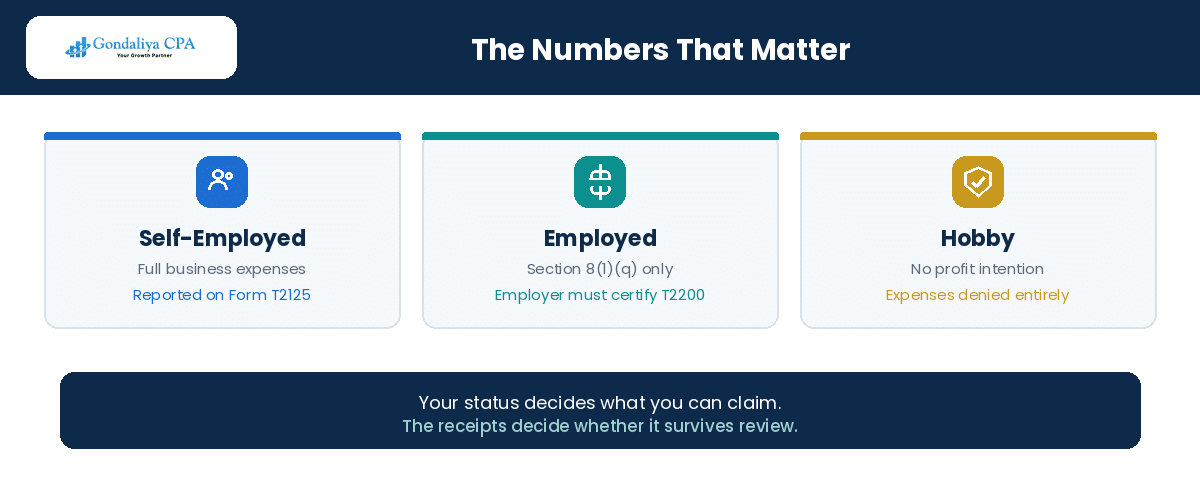
To claim deductions, artists must show they want to make a profit. They cannot just do it as a hobby. This is key when asking for artist business expenses on taxes.
Importance of accurate tax reporting for Canadian artists and creative professionals
Reporting taxes right matters a lot for Canadian artists. If you miss claiming artist tax savings, you lose money and risk CRA checks.
Artists should keep all receipts and records—like art supply bills or gallery payments. Working with people like Gondaliya CPA can help artists follow rules and claim what’s allowed.
Distinctions between types of artists: visual, performing, writers, and other creative professions
Different artists get different write-offs based on their work:
- Visual Artists: Costs for paints, canvases, and studio rent.
- Performing Artists: Travel costs for shows or rehearsals.
- Writers: Research fees and publishing costs.
- Other Creative Professions: Expenses vary depending on the field.
Knowing these differences helps artists figure out which expenses count as artist business expenses. This makes tax time easier and keeps everything legal.
Artists rarely arrive with no expenses. They arrive with expenses spread across a personal chequing account, three card statements and a shoebox. The deduction exists; the proof does not. Figures changed for privacy.
Risk Warning: Without a genuine intention to profit, the CRA treats the activity as a hobby and denies the expenses entirely. Please keep evidence that you run it as a business.
Classification and Income Sources for Artists
Classification and Income Sources for Artists
The Classification
Artists in Canada need to know how their income is classified. This helps with artist tax deductions Canada and handling creative professional tax deductions properly. The way income is classified decides which artist business expenses can be claimed. It also affects the total artist tax savings you get.
Determining Employment Status: Self-Employed vs Salaried Artist
The Canada Revenue Agency (CRA) looks at several things to decide if an artist is self-employed or salaried. They check who controls the work, who owns the tools, if there’s a chance for profit or loss, and how connected the artist is to an employer. This matters for creative professional tax deductions.
Self-employed artists run their own work schedules, find their own buyers, and take financial risks. They report business income and claim artist business expenses under the Income Tax Act. Salaried artists get paid wages with a T4 slip. They can claim only some employment expenses under section 8(1)(q), but not full business expenses like self-employed artists do.
Knowing your status helps you report income right. It also helps you claim the right deductions without breaking CRA rules.
Criteria Used by CRA to Classify Artist Status
CRA uses tests to see if your art activity counts as a business for artist tax deductions Canada. The main points they check are:
- Control: Who picks the work, when it happens, and where? More control means you’re likely self-employed.
- Ownership: Do you own your tools or materials?
- Financial Risk: Can you make a profit or lose money from your art?
- Integration: How tied is your work to someone else’s business?
If you run your art like a business and aim to make money, CRA usually says yes. Keeping contracts, invoices, ads, and workspace leases helps prove this.
If you don’t pass these tests, CRA may call your activity a hobby. That means most creative professional tax deductions won’t apply even if you spent money.
Types of Income for Artists
Artists earn money from different places. Each type affects taxes differently:
| Income Type | How It Works | Expense Treatment |
|---|---|---|
| Business Income | Sales direct or through galleries | Full artist business expenses claimable |
| Employment Income | Wages reported on a T4 slip | Limited employment expenses only |
| Royalties | Licensing of copyrights | Costs of earning royalties deductible |
| Grants and Awards | Production funding and bursaries | Taxable unless a scholarship exemption applies |
| Public Lending Right | Library lending payments to authors | Directly related costs deductible |
Getting these categories right helps apply deduction rules well. It boosts artist tax savings and keeps CRA audits away.
Understanding Public Lending Rights Payments and Their Tax Implications
Public Lending Right (PLR) payments go to Canadian authors when libraries lend their books. These payments are taxable income but not exactly like normal royalties since they come from the government.
If you get PLR, report it as taxable income and deduct expenses linked directly to earning PLR payments, such as promotion. Good records help prove what artist business expenses relate to PLR while keeping personal costs out.
Treatment of Financial Assistance Such As Art Production Grants And Scholarships
Art production grants give money for creating work but tax rules depend on details. Where a grant is government assistance meant only for making new art with no strings attached, it may fall under the scholarship rules in section 56(1)(n) of the Income Tax Act. Otherwise it counts as taxable income when received.
Expenses tied to the grant reduce your taxable amount but need clear proof showing they relate directly. Scholarships based on merit without work requirements often qualify as exempt. Many arts grants do not meet this strict test, so please check carefully before claiming.
Claiming costs without proof can lead CRA to deny them and cut down your artist tax savings.
Grant income is where most artist returns go wrong. The money arrives, the expenses follow months later, and the two never get matched to the same year. Figures changed for privacy.
Key Stat: Employment income limits your deductions sharply compared with business income. Please confirm your status before assuming which rules apply.
Deductible Expenses for Artists and Creative Professionals
Deductible Expenses for Artists
The Deductions
Artists in Canada can claim business expenses if they relate directly to earning income. Knowing which artist tax deductions Canada allows helps creative pros save money on taxes. The CRA has rules to follow, so keeping good records matters.
Eligible Business Expenses for Self-Employed Artists
Self-employed artists can deduct reasonable costs that help them earn money, according to CRA’s Income Tax Folio S4-F14-C1. These expenses include things like:
- Art materials
- Studio rent
- Professional fees
- Travel for shows or commissions
- Marketing costs like website hosting
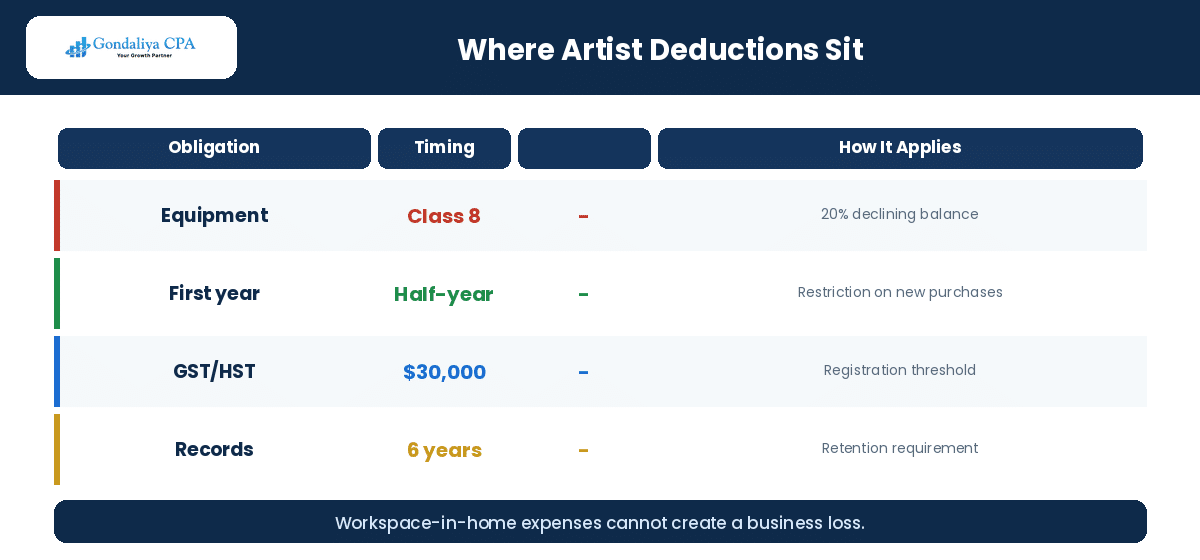
- Equipment purchases or rentals used only for art work
Each expense must have a clear income purpose and proof like receipts or contracts. Capital items get special treatment under depreciation rules. If you mix personal and business use, you must only claim the business part.
For example, paint and canvas used just for making art count as deductible supplies. But personal art projects without profit goals don’t qualify.
Limitations on Deductible Expenses for Employed Artists
Artists who work as employees face tighter limits on deductions than those self-employed. Section 8(1)(q) of the Income Tax Act lets employed artists claim certain job-related expenses, subject to a statutory cap and to your employer certifying the conditions of employment on Form T2200.
These deductions cover supplies used in job duties but usually exclude home office or vehicle costs unless your employer agrees. Unlike business owners, employed artists need employer proof to claim these expenses.
This means many creative professional tax deductions available to business owners don’t fully apply if you’re an employee.
Common Deductible Costs
Many artists miss out on common deductible expenses like:
- Art Supplies: Paints, brushes, canvases bought solely for making art.
- Studio Rent: Rent for studios used only for art; share costs if shared space.
- Professional Fees: Accountant fees related to tax filing.
- Equipment Rental: Renting cameras or lights needed for shoots.
- Travel: Transport and lodging tied directly to exhibitions or clients.
- Promotion & Marketing: Website hosting and gallery fees aimed at sales.
Good records are key—keep receipts with dates and show how the expense links to your work.
| Expense Category | Deductibility | Proof Needed |
|---|---|---|
| Art Supplies | Fully deductible | Receipts showing item use |
| Studio Rent | Partial if shared | Lease and floor plan |
| Professional Fees | Fully deductible | Invoices |
| Equipment Rental | Fully deductible | Rental contract |
| Travel | Limited by reasonableness | Mileage log and receipts |
| Promotion & Marketing | Fully deductible | Contracts and invoices |
Workspace in Home Expenses
You can deduct home workspace costs only if a part of your home is used regularly and exclusively for your art business. The space must mainly serve as an office or studio where you create art or meet clients.
Expenses include utilities like heat, electricity, water, and property taxes based on the workspace size compared to your whole home. Mortgage interest does not count but rent does if you rent your home.
To calculate claims, find the percentage of your home used for work and apply it to eligible bills consistently over time. You can’t create losses from this deduction; denied amounts roll forward until future profits cover them.
Keep good measurements plus marked utility bills ready if the CRA asks about your workspace claims within artist tax deductions Canada rules.
Motor Vehicle Expense Deductions and Record-Keeping
You can deduct vehicle costs only when using the car directly for art business activities—like moving artworks between studios or exhibitions. Driving from home to work does not count as a deductible trip.
Deductible car expenses include gas, maintenance on a proportional basis, insurance premiums, lease payments up to the prescribed capital cost limit, and parking fees during work tasks. Tickets and fines are not allowed.
You need detailed mileage logs with date, trip purpose, and distance plus all receipts for car costs over the year. Without good records, CRA may deny your whole vehicle expense claim, which cuts into your artist tax savings significantly.
Restrictions and Non-Deductible Expenses
Some expenses don’t count even if they seem related:
- Musical instruments bought just for fun don’t qualify unless essential tools required professionally.
- Training courses that don’t focus on current skills needed immediately in your trade get denied since they’re seen as personal growth.
- Everyday clothes including costumes do not count unless specialized protective gear is mandatory onsite.
- Personal grooming or hygiene products never qualify no matter how relevant they seem in performances.
The CRA strictly separates personal from business spending. Only expenses incurred to earn income pass the reasonableness test under section 67 of the Income Tax Act. This keeps claims fair and stops inflated write-offs often flagged among creative professionals nationally.
Sharad Gondaliya, CPA, advises keeping solid records matching these rules so you get every valid artist tax deduction possible while lowering audit risks common with creative professional tax deduction challenges countrywide.
The workspace claim is the one most often overstated. A corner of a living room used for four hours a week is not a studio, and the CRA reads floor plans carefully. Figures changed for privacy.
Pro Tip: Please photograph your studio space and keep a floor plan with measurements. It takes ten minutes and settles the question years later.
Reporting Requirements and Tax Filing for Artists
Reporting Requirements and Tax Filing
The Filing
Artists in Canada have specific rules to follow when reporting income and expenses. Claiming artist tax deductions Canada properly means you must keep good records of artist business expenses. This helps you get creative professional tax deductions without problems with the CRA.
Form T2125 for Self-Employed Artists
If you work as a self-employed artist, you use Form T2125, Statement of Business or Professional Activities, to report your earnings and costs. This form covers all artist business expenses tied to your art work. It includes things like materials, rent for your studio, equipment depreciation, marketing fees, and travel costs related to shows or exhibitions.
The form asks for total income from sales or services. You list expenses by categories—supplies, rent, utilities—to back up your claims under the Income Tax Act. Keep every receipt or invoice as proof.
You also separate current expenses, which you can deduct fully right away, from capital expenses that need to follow Capital Cost Allowance (CCA) rules. If something is used partly for business and partly personal, split the cost based on how much you use it for art.
An illustrator earns $45,000 from art sales yearly. They spend $12,000 on supplies and count 20% of their home as studio space costing $6,000. These numbers go on the T2125 with receipts and proof of studio size. Illustrative only.
Reporting Employment Income and T4 Slips
Artists working as employees get a T4 slip showing their pay. Creative professional tax deductions are different here. Employees can claim some work-related expenses under section 8(1)(q) only if their employer fills out Form T2200.
You can claim some supplies used at work but not big things like rent or car costs unless your employer agrees. Salaried artists can’t deduct normal business costs without this form.
Employers give out these slips:
- T4 — Shows your salary
- T4A — For fees paid if you do contract work
How these are classified matters a lot because it affects what you can deduct. Mixing them up might cause problems with CRA later.
GST/HST Registration Thresholds and Obligations
If your taxable income goes over $30,000 in four straight quarters, you must register for GST/HST. This means charging GST/HST on sales but also lets you claim back GST/HST paid on supplies or marketing fees.
Once registered, file GST/HST returns regularly, charge taxes based on where your buyers live, and keep clear records of taxes collected and input tax credits claimed.
Not registering when required brings fines plus interest charged retroactively.
If you earn less than $30,000 but want to register voluntarily, you can claim back GST/HST paid on big purchases like gallery fees or equipment even if it’s not mandatory.
Reporting Artistic Project Grants and Bursaries on T4A Box 105
Project grants often show up in Box 105, Other Income, on your T4A slip from funding groups.
These grants usually count as taxable income unless they qualify under scholarship rules. When reporting, include grant money fully as business income and deduct project costs that relate directly to those grants.
Matching income and expenses right avoids paying extra tax while staying compliant with CRA checks that focus on grants, since mistakes happen often there.
Claiming Scholarship Exemptions and Handling Financial Assistance
Some bursaries are exempt from tax under subsection 56(1)(n) of the Income Tax Act if they fit scholarship rules, meaning they are given just for artistic merit with no strings attached.
To claim these exemptions, make sure the bursary has no requirement to provide service back, keep award letters that explain the purpose, and report exempt amounts separately from other taxable money.
Putting scholarships wrongly into taxable income can cost you more taxes when relief was possible by following CRA rules properly.
Carrying Forward Unused Expenses and Strategic Tax Planning
Unused artist business expenses that don’t match this year’s income can sometimes carry forward, but only if CRA believes you aim to make a profit.
Some non-capital unused expenses may carry forward for a number of years if you show ongoing profit intent. If home office costs go beyond business income limits, they carry forward automatically. Capital Cost Allowance balances reduce taxable profits over time based on depreciation rules.
Good planning means buying supplies ahead of a high-income year or waiting until after year-end to buy big assets, keeping the half-year CCA rule in mind.
Keep solid records yearly so your claims stand up if CRA asks questions. Creative pros often lose write-offs due to poor proof or claiming too much beyond real costs.
| Key Numbers at a Glance | Value |
|---|---|
| GST/HST registration threshold | $30,000 |
| Artist’s employment expense limit | Statutory cap, employer certification required |
| Scholarship exemption reference | Subsection 56(1)(n) |
| Record retention period minimum | Six years after filing |
A T4A with an amount in Box 105 and no matching expenses on the T2125 is a common trigger. The grant was spent; it was simply never recorded. Figures changed for privacy.
Risk Warning: Home workspace expenses cannot create a business loss. Please expect the excess to carry forward rather than reduce other income this year.
Gifts, Inventory, Assets and Incorporation
Gifts, Inventory, Assets and Incorporation
The Detail
Tax Treatment of Gifts and Charitable Donations Involving Artworks
When artists give artworks or capital property as gifts or donations, Canadian tax rules apply in specific ways. If you donate original art to a registered charity, you can claim a tax credit based on the fair market value (FMV). But this only works if the FMV is certified by a CRA-approved appraiser. Also, the charity must be an official donee.
Donating inventory like prints or reproductions is different. Those are usually deductible at cost, but you don’t report any capital gain or loss. However, giving away capital property like unique paintings triggers capital gain rules. If the FMV is higher than your adjusted cost base (ACB), you report a gain, unless an exemption applies.
CRA wants proper proof of FMV. They ask for independent appraisals done near the donation date. Overvaluing your gift might cause penalties or denial of credits.
Keep detailed records. That means appraisal reports, official donation receipts, and emails confirming the gift was accepted. These help prove your claim during audits and fit with creative professional tax deduction guidelines.
Valuation and Inventory Rules for Visual Artists’ Unsold Work
Visual artists need to value their unsold work at year-end for tax purposes. The Income Tax Act says to use the lower of cost or net realizable value (NRV). This means you pick whichever is less between what it cost to make and what you could sell it for.
There’s also an option called election to deem inventory value nil under subsection 10(7). This applies if it’s tough to track all unsold pieces because of volume or other reasons. Choosing this means you don’t count unsold work as income until it sells, but once chosen, you must keep using it every year.
Valuing inventory right affects taxable income directly. Overstating reduces income wrongly; understating increases it unnecessarily.
You should keep good records that list each item’s quantity, description, production costs of materials plus labour, dates made, and sales info. Also save receipts for supplies and show how you split costs between personal use and business.
| Item | Treatment | Record Needed |
|---|---|---|
| Finished artwork | Lower of cost or net realizable value | Detailed inventory list |
| Election to deem nil | Defers income recognition | Written election filed |
Impact of Change-in-Use Rules for Assets Like Musical Instruments
Change-in-use rules kick in when you switch an asset from personal use to business use or the other way around. This changes how you treat costs on taxes.
Say a musician buys an instrument personally then uses it in their work. On that switch date, you have to record a deemed disposition at FMV according to section 13(21). This resets your adjusted cost base (ACB) to that new value for future depreciation claims via Capital Cost Allowance (CCA).
If later you stop using that instrument in your business and take it back for personal use without proof of ongoing business activity, another deemed disposition happens. That can cause recapture or terminal loss calculations affecting prior CCA claimed.
You need solid documents: purchase invoices showing original intent plus dated logs proving when use changed from personal enjoyment to earning money. Without clear evidence, CRA may deny expense claims during audits.
Possible Tax Benefits for Canadian Art Collectors
Canadian art collectors have some limited tax perks mostly tied to investment purposes rather than enjoyment:
- You can get capital gains treatment when selling original art held as capital property if its value goes up.
- Registered collectors may reclaim GST/HST input tax credits on art bought from GST/HST registrants but only if used in commercial activities.
- Donating artwork gets you charitable donation credits based on FMV, similar to artists donating their pieces.
Collectors can’t deduct art buying costs unless they operate commercially by reselling art regularly. Then those holdings count as inventory and gains or losses are treated differently.
Most private collectors don’t get artist tax savings like active creators do through their artist business expenses from sales or exhibitions, especially around Ontario and Toronto where firms like Gondaliya CPA serve clients.
Salary Versus Dividend Compensation for Incorporated Artists
Artist owners with incorporated businesses face choices on paying themselves via salary or dividends, and taxes differ for each option:
- Salary: Paying yourself salary reduces corporation profits taxable by the company but counts as employment income for you personally. That means CPP contributions and payroll withholdings.
- Dividends: Come from after-tax profits without payroll deductions or CPP contributions but don’t create RRSP contribution room. Dividends get gross-up and credit treatment which might lower total taxes depending on Ontario provincial brackets around Toronto areas.
Choosing between salary and dividends depends on cash flow needs, retirement plans since RRSP room needs salary income, health coverage tied only to salaried workers, plus effects on government benefits calculated using employment earnings instead of dividend income.
Incorporated creative professionals should talk with licensed CPAs familiar with this analysis before making final calls about pay methods.
Instruments and cameras bought years before the business started are the assets most often missed. A change-in-use election at fair value can bring real depreciation into the claim. Figures changed for privacy.
Key Stat: The inventory election under subsection 10(7) is binding once made. Please decide it deliberately, since you must apply it every year afterwards.
Practical Guidance and Resources for Artists
Practical Guidance and Worked Examples
In Practice
Keeping good records, sending clear invoices, and tracking expenses carefully help artists claim tax deductions in Canada. Proper paperwork backs up artist business expenses and follows CRA rules. Try using separate bank accounts or credit cards just for your art work to make tracking easier. Save all receipts, contracts, invoices, and mileage logs, and sort them by category as the year goes on.
Bookkeeping tools built for small businesses can help. Update your records every week or month so tax time won’t be stressful. Good record keeping proves your claims and helps find deductible costs artists sometimes miss.
Examples Illustrating Expense Calculations, Workspace Deductions, and Motor Vehicle Use
Say an artist uses 20% of their home as a studio. They can claim 20% of rent and utilities for home studio expenses. For vehicle use tied to shows or deliveries and not commuting, keep a detailed mileage log to figure out how much is for business.
| Scenario | Details | Deduction Calculation |
|---|---|---|
| Home Studio Expenses | $12,000 yearly rent and bills | $12,000 × 20% = $2,400 deductible |
| Vehicle Use | 10,000 km driven; 6,000 km business | Rate per km × 6,000 = deduction |
These examples show how good records help increase artist tax savings while following CRA rules. Figures are illustrative only.
Summary of Key Tax Saving Strategies and Common Pitfalls to Avoid
To get the most from artist tax deductions Canada, know what counts as business costs and what’s personal spending. Focus on these tips:
- Keep personal and business money separate.
- Track art supply buys carefully.
- Divide shared costs based on actual use.
- Capitalize big equipment purchases instead of expensing right away unless tools are small.
- Keep logs for trips and vehicle use only linked to earning income.
Common mistakes include claiming too much workspace percentage beyond art income, since CRA limits losses from home office claims, mixing personal items with art supplies without splitting costs, or missing proof for gallery fees or show costs, which could cause problems if audited.
Avoiding these errors protects your claims and keeps things smooth with CRA checks.
Personalized Tax Advice and Compliance Support
Tax rules around creative professional tax deductions can get tricky fast. Gondaliya CPA understands Canadian artists’ special needs well. We focus on incorporated small businesses including working artists in Toronto and Ontario.
Our team reviews your expenses carefully to match Income Tax Act rules. We help you claim what’s allowed without crossing lines while preparing you if CRA asks questions.
You can reach us at info@gondaliyacpa.ca or call 647-212-9559 for a free chat about how to manage your artist business expenses this year.
Maintaining Proactive Communication With Tax Professionals
Tax rules affecting artist business expenses change periodically. Talking regularly with CPAs who know artistic work keeps you on track and ready to adjust.
Check-ins catch changes like limits on car deductions or capital cost allowance rates that matter in Ontario and Toronto where many clients work. Staying connected cuts surprises when you file taxes and keeps your financial planning steady even as rules shift.
Separating the money is the single change that helps most. One card used only for art turns a January reconstruction project into a fifteen-minute export. Figures changed for privacy.
Pro Tip: Please open a dedicated account before the year starts, not after. Reconstructing twelve months of mixed spending is where the deductions get lost.
FAQs on Artist Tax Deductions Canada
Frequently Asked Questions
FAQ
What is the GST/HST Small Supplier Threshold for artists?+
Artists with taxable sales under $30,000 in four consecutive quarters do not need to register for GST/HST. Above this, registration and tax collection are mandatory.
What is the Artists’ Employment Expense Deduction limit for employed artists?+
Employed artists can claim a limited statutory amount of employment expenses under section 8(1)(q), and the employer must certify the conditions of employment on Form T2200.
How does the Passenger Vehicle Cost Limit affect artist car expense claims?+
The Income Tax Regulations set a maximum capital cost for passenger vehicles. Costs above that ceiling cannot be claimed for Capital Cost Allowance depreciation, and the limit is adjusted periodically.
What is the Capital Cost Allowance Rate for art-related equipment?+
Most art equipment falls under Class 8 with a 20% per annum declining balance rate. The half-year rule applies to first-year purchases.
Can I claim losses from my business use of home workspace?+
No. You cannot create or increase a loss using home workspace expenses. Excess amounts carry forward to future profitable years.
What mileage deduction rate applies to artists?+
The CRA sets a prescribed per-kilometre rate for motor vehicle business use, and it is revised annually. Please confirm the current rate before calculating your claim.
When is the deadline to file T4A slips reporting artist grants or fees?+
T4A slips must be filed with the CRA by the last day of February each year to report fees, grants, or other payments made to artists.
How do Gondaliya CPA reviews differ from DIY or non-CPA providers?+
Gondaliya CPA offers expert review with in-depth knowledge of artist tax rules, reducing audit risk and maximizing deductions legally.
What deliverables do clients get from a Gondaliya CPA artist deduction review?+
Clients receive detailed reports, expense categorization, advice on record keeping, and tailored tax-saving strategies.
How much does a typical artist deduction review cost at Gondaliya CPA?+
Pricing is a flat annual fee including HST, quoted before any work begins and set by the complexity of your records and filings.
What are common deduction mistakes artists make and how can they avoid them?+
Mistakes include poor record keeping, mixing personal expenses with business, and overstating home workspace claims. Accurate documentation prevents issues.
What should an artist prepare before starting a deduction review with Gondaliya CPA?+
Prepare receipts, invoices, contracts, mileage logs, workspace details, income records, and grant documentation.
Which deductions matter most across different artist practices?+
Key deductions vary but often include supplies, studio rent, professional fees, travel costs, marketing expenses, and equipment depreciation.
The question artists ask most is whether a purchase counts. The better question is whether it can be shown to count, which is a records problem more than a tax one. Figures changed for privacy.
Top Tax Tips and Insights from Gondaliya CPA for Canadian Artists
Top Tax Tips and Insights
Quick Reference
- Expertise: Sharad Gondaliya holds dual CPA licences in Canada and the USA with over 10 years of experience.
- Reputation: Proudly supported by over 1450 five-star Google reviews.
- GST/HST: Understand when you cross the $30K threshold to comply and claim input credits.
- Employment Expense Cap: Employees must respect the statutory limit and obtain employer certification.
- Vehicle Limits: Know the prescribed passenger vehicle cost cap before claiming CCA.
- CCA Rates: Use Class 8’s 20% declining balance method; apply the half-year rule in year one.
- Home Office Claims: Avoid losses; track workspace size precisely for allowable deductions.
- Mileage Rate: Apply the current CRA prescribed per-kilometre rate for business driving.
- Timely Filing: Submit T4A slips by the end of February to avoid penalties on grant reporting.
- Review Value: Professional CPA reviews reduce errors compared to DIY or non-CPA preparers.
- Clear Deliverables: Receive actionable insights and compliance-ready documentation.
- Affordable Pricing: Transparent flat fees aligned with your artist business scale and complexity.
- Common Pitfalls: Steer clear of oversights like poor separation of personal versus business expenses.
- Preparation Checklist: Organize all financial documents before engaging a professional review.
- Practice-Specific Focus: Tailored advice on key deductible categories per your artistic discipline.
Contact Gondaliya CPA at info@gondaliyacpa.ca or call 647-212-9559 for personalized support with your artist tax deductions in Toronto, Ontario and across Canada. You can also book a free consultation or contact us directly.
Fifteen tips and one underneath them: keep the art money separate. Almost every other item on this list becomes easier once that one is done. Figures changed for privacy.
Artist Disciplines We Serve
Industry Expertise
Which deductions dominate differs by discipline. Here are ten and the usual focus.
| Artistic Discipline | Where the Deductions Concentrate |
|---|---|
| Painters and sculptors | Materials, studio rent and unsold inventory valuation |
| Photographers | Camera equipment, capital cost allowance and travel |
| Musicians and composers | Instruments, change-in-use elections and touring costs |
| Actors and performers | Agent fees, auditions travel and coaching that maintains skills |
| Writers and authors | Research, publishing costs and public lending right income |
| Illustrators and designers | Software subscriptions, hardware and home workspace |
| Filmmakers and video artists | Equipment rental, crew fees and production grant matching |
| Craft and textile artists | Materials, market and fair fees, and inventory records |
| Dancers and choreographers | Studio hire, training that maintains current skills and travel |
| Digital and multimedia artists | Subscriptions, hardware depreciation and platform fees |
- Painters and sculptors: Year-end inventory valuation often matters more than the supply receipts.
- Photographers: Bodies and lenses are capital, not supplies, so the CCA class decides the timing.
- Musicians and composers: Instruments bought personally can enter the business at fair value.
- Actors and performers: Agent commission is usually the largest single deductible cost.
- Writers and authors: Public lending right payments are taxable and carry their own deductible costs.
- Illustrators and designers: Recurring software is a current expense; the workstation is not.
- Filmmakers and video artists: Grant income needs matching against production spending in the same year.
- Craft and textile artists: Fair and market fees are deductible but frequently unreceipted.
- Dancers and choreographers: Training that maintains existing skills is treated differently from new qualifications.
- Digital and multimedia artists: Platform and commission fees are deductible and easily overlooked.
The discipline changes where the deductions sit. It does not change the method, which is separate the money, keep the proof, then claim only the business share. Figures changed for privacy.
Professional Guidance and Quick Reference
Guidance
Professional Guidance for Artists: How Gondaliya CPA Reviews Your Deductions
Artists in Canada can deduct the costs of earning artistic income, provided the activity is run with a genuine intention to profit rather than as a hobby. Self-employed artists report on Form T2125 and claim materials, studio rent, professional fees, travel, marketing and equipment. Employed artists face a much tighter limit under section 8(1)(q) and need employer certification. Gondaliya CPA reviews artist deductions on a fixed annual fee.
We handle what decides the outcome: establishing whether the activity is a business or a hobby, separating self-employed from employment income, calculating the business share of workspace and vehicle costs, valuing unsold artwork at year-end, applying change-in-use elections to instruments and equipment bought personally, matching grant income to the production costs it funded, deciding what is a current expense and what is capital, and documenting every claim so it survives review.
Our team looks at your records before your receipts, because the deduction is rarely denied for being ineligible. It is denied for lacking proof. Painter, musician, writer or filmmaker, you get clear advice and a fixed price before we start.
Quick Answers: Key Numbers & Concepts at a Glance
At a Glance
- Self-employed form: T2125
- Employed artists: Section 8(1)(q), capped
- Employer form: T2200 certification
- GST/HST: $30,000 threshold
- Grants: T4A Box 105
- Equipment: Class 8, 20% declining
- First year: Half-year rule applies
- Workspace: Cannot create a loss
- Inventory: Lower of cost or net realizable value
- Records: Six years retention
Who This Is For / Not For
Fit Check
- For: Canadian artists and creative professionals, whether self-employed, employed or incorporated, claiming business expenses against artistic income.
- Not For: Hobby activity pursued without a genuine intention to profit, where the expenses are not deductible at all.
People Also Ask
Related Questions
Does selling art on Etsy or Instagram count as business income?+
Generally yes, if you are selling with an intention to profit. The platform does not change the classification; the intention and conduct do.
Can I deduct expenses in a year where I sold nothing?+
Often yes, provided the activity is genuinely commercial. Losses in an early year are normal for a business, but the profit intention must be evident.
Do I need to incorporate to claim artist expenses?+
No. Self-employed artists claim expenses on the T2125 without incorporating. Incorporation is a separate decision driven by income level and other factors.
Glossary of Key Terms
- T2125: The statement of business or professional activities.
- Pursuit of profit: The test separating a business from a hobby.
- Section 8(1)(q): The employed artist expense deduction provision.
- Form T2200: The employer certification of conditions of employment.
- Current expense: A cost deducted in full in the year incurred.
- Capital expense: A cost written down over time through depreciation.
- Capital cost allowance: The tax depreciation claimed on capital assets.
- Class 8: The CCA class covering most art equipment at 20%.
- Half-year rule: The first-year restriction on CCA claims.
- Workspace in home: The business-use portion of your residence.
- Change in use: Moving an asset between personal and business use.
- Deemed disposition: A notional sale at fair market value on a change in use.
- Net realizable value: The expected selling price less costs to sell.
- Public lending right: Payments to authors for library holdings.
- T4A Box 105: Where grant and bursary income is reported.
- Scholarship exemption: Relief under subsection 56(1)(n) for qualifying awards.
Artist Deduction Readiness Check
This quick self-check indicates where your operation most likely has room. Please answer the six questions below.
Artist Deduction Readiness Check
Six quick questions on your records. No fee shown.
Points to raise with us:
This is a general prompt, not tax or legal advice or a quote. Your position depends on your full facts. For a real review, please book a free consultation.
Want a checklist to work from? You can download our free artist deduction checklist before your consultation.

Run the art with a genuine profit motive. Keep art money in its own account. Capture receipts as you go, not in January. Measure the workspace and keep a floor plan. Log every business kilometre with date and purpose. Split mixed-use costs on actual use. Match grant income to the costs it funded. Please keep six years of records.
2026 Update — what is current: This article reflects rules current to 2026. Form T2125, the section 8(1)(q) employed artist deduction with Form T2200 certification, the $30,000 GST/HST registration threshold, the Class 8 rate of 20%, the half-year rule, the workspace-in-home loss restriction, the subsection 10(7) inventory election and the six-year retention requirement are unchanged. Please note that the passenger vehicle capital cost ceiling, the prescribed per-kilometre rate and the section 8(1)(q) cap are all indexed or revised periodically, so please confirm the current figures before filing rather than relying on any amount quoted in general guidance.
Artist Tax Deductions Canada: How Gondaliya CPA Helps Creative Professionals Claim Every Legitimate Expense
Records first, receipts second
Gondaliya CPA establishes whether your activity is a business or a hobby, separates self-employed from employment income, calculates the business share of workspace and vehicle costs, values unsold artwork at year-end, applies change-in-use elections to instruments and equipment bought personally, matches grant income to the production costs it funded and documents every claim so it survives review, on a flat annual fee including HST with a one-business-day response. Please book a free consultation.
Next Steps
Please book a free consultation with Gondaliya CPA and bring your income records including any T4A slips, a year of expense receipts however they are stored, and the measurements of your studio or workspace. Those three tell us immediately whether the activity qualifies as a business, what can be claimed, and where the proof is thin. You will get a flat annual fee including HST before any work begins. If our content helps, please add gondaliyacpa.ca as a preferred source on Google.
Published: · Last updated:
Editorial policy: We research against CRA and CPA Ontario sources, fact-check the figures, and Sharad Gondaliya, CPA, reviews the content, which we update as the rules change.
Disclaimer: This article is educational information only and is not tax, legal, or financial advice. Figures marked illustrative are examples rather than quotes or guarantees. It reflects CRA rules current to 2026, including Form T2125, the section 8(1)(q) employed artist deduction, the $30,000 GST/HST threshold, the Class 8 rate of 20%, and the six-year retention requirement. Rates, limits and expensing rules change and outcomes depend on your specific facts. Please consult a CPA Ontario member before acting.

Sharad Gondaliya is a CPA Canada & CPA USA with 15 Years+ experience of Accounting, Tax, Payroll of Corporate Small Businesses as Tax Accountant. He is a CPA Ontario member (61040184) and holds US CPA licences in Washington and Montana and is well known among corporate small businesses for tax planning, efficient tax solutions, and affordable CPA services. Sharad is the Principal (Director) of Gondaliya CPA – Affordable CPA Firm in Canada. Licenses: CPA Ontario: 61040184 | CPA USA (MT): PAC-CPAP-LIC-033176 | CPA USA (WA): 57629 | CPA Firm License: 61330051 View Full Author Bio