



The Ultimate Guide to Accounting and Tax Services for Personal Support Worker Businesses in Canada
Understanding PSW business accounting and tax benefits with Gondaliya CPA in Canada
Gondaliya CPA specializes in PSW business accounting and offers valuable insights into tax benefits available for personal support workers in Canada. Their PSW CPA Canada services simplify financial management and tax filing for PSWs, helping them save money and focus on their work.
Quick Summary
Personal Support Workers (PSWs) help many Canadians every day. They support people with tasks like getting dressed, cooking meals, or just keeping them company. In Ontario, especially around Toronto and nearby towns, home care agencies hire lots of PSWs. These workers make a big difference in the lives of those they serve.
Reading time: 44 minutes.
Table of Contents
- Introduction to PSW Business Accounting
- Understanding the Personal Support Worker Tax Credit
- PSW Business Accounting Essentials
- Tax Return Preparation and Maximizing Benefits
- Government Policies and Context
- How Gondaliya CPA Supports PSWs
- Frequently Asked Questions
- Key Points for Incorporated PSW Businesses
- PSW Situations We Handle
- Professional Guidance and Quick Reference
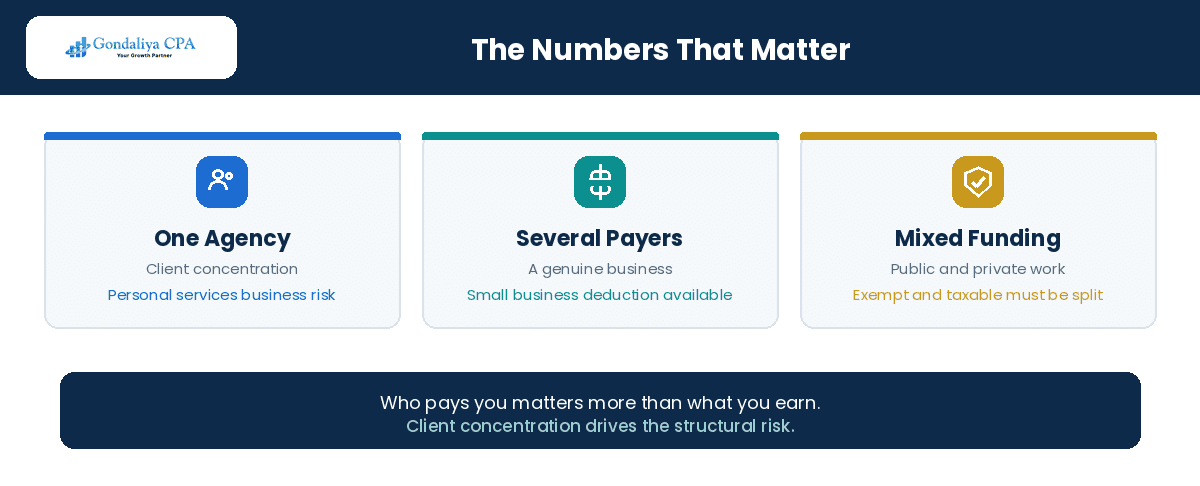
The Numbers That Matter
This article covers Canada, with Ontario and Toronto context, and reflects rules current to 2026. It assumes an incorporated personal support worker business or a home care agency employing PSWs. Figures marked illustrative are examples, not quotes, and any masked engagement notes end with “Figures changed for privacy.” This is educational information only and not tax or legal advice. Several programs described here are subject to legislative change and provincial variation, so please confirm current entitlements before relying on them.
Introduction to PSW Business Accounting and Tax Benefits in Canada
Introduction to PSW Business Accounting
The Basics
Importance of Specialized Accounting and Tax Services for PSWs
PSWs who run their own businesses or work as incorporated entities need accounting help that fits their field. A PSW accountant Canada knows the tax rules that affect this work. These experts handle corporate tax filing, bookkeeping, and payroll. They keep records clear and submit forms on time to the CRA (Canada Revenue Agency). This helps avoid fines or audits from the tax office.
Gondaliya CPA’s Expertise in PSW Business Accounting and Tax Support
Gondaliya CPA Professional Corporation is a CPA Ontario Registered Firm. They focus on helping incorporated personal support worker businesses in Toronto and beyond. Their team understands the special tax issues PSWs face and helps with business accounting and compliance.
Summary of Key Tax Benefits Available to PSWs in Canada
Incorporated personal support workers can use several tax benefits:
- Small Business Deduction: This cuts down the federal income tax on business earnings.
- GST/HST Small Supplier Threshold: If a business earns less than $30,000 yearly, it might not have to register for GST/HST.
- T2 Corporate Tax Filing Deadline: Companies must send their T2 tax forms within six months after their fiscal year ends.
- Payroll Remittance Due Dates: Employers must send employee deductions regularly and know these deadlines well.
By using these benefits with help from pros like Gondaliya CPA, PSWs can keep their finances in order and focus on caring for others.
Most PSW corporations we take on were set up by someone who never mentioned the personal services business rules. The structure works until the CRA looks at who the single client is. Figures changed for privacy.
Risk Warning: A corporation working almost entirely for one agency can be reassessed as a personal services business, which removes the small business deduction and most expense claims. Please have the structure reviewed before it becomes a problem.
Understanding the Personal Support Worker Tax Credit
Understanding the Personal Support Worker Tax Credit
The Credit
Support programs for personal support workers have taken several forms across federal and provincial governments, and entitlements change. Before relying on any credit described in this section, please confirm the current program, rate and eligibility with the CRA or with us directly.
The Personal Support Worker (PSW) Tax Credit is a federal benefit for incorporated personal support worker businesses in Canada. It helps lower their corporate tax load. This credit recognizes the vital work PSWs do in healthcare. A PSW accountant Canada trusts can guide you through these credits while handling corporate tax filing.
Explanation of the Federal PSW Tax Credit and Its Objectives
The federal PSW Tax Credit rewards personal support workers who run their own corporations. It offers tax relief on earnings that qualify. This credit aims to help incorporated personal support worker businesses deal with their unique financial situations. It also encourages proper accounting that follows CRA rules.
Here’s what matters:
- The credit supports incorporation among PSWs.
- It reduces tax for earnings from personal support work.
- Proper bookkeeping and reports help claim this credit.
Specialized accounting helps PSWs get the most out of this credit when they file their T2 corporate taxes.
Eligibility Criteria: Defining Eligible PSWs and Qualifying Earnings
To qualify, you must meet certain rules about your work and business type:
- Who qualifies? You must provide direct care or support as recognized by provincial health guidelines.
- Qualifying income: Most of your earnings must come from personal support work through an incorporated company.
- Single-client risk: If your corporation works only for one agency, it might be seen as a Personal Services Business (PSB). That classification can limit deductions and affect the credit under section 125(7) of the Income Tax Act.
A personal support worker tax accountant checks these details for you. They make sure you follow the rules and avoid costly mistakes tied to single-client setups.
Geographic Considerations and Provincial Differences
Gondaliya CPA Professional Corporation is a fully CPA Ontario Registered Firm serving Toronto clients and others across Canada. But keep in mind:
- Provinces like British Columbia, Newfoundland and Labrador, and the Northwest Territories have different rules or exclude some provincial incentives linked to home care.
- These differences do not affect federal measures but might change your overall accounting approach because of local funding or regulations.
Clients outside Ontario get advice that matches both their province’s rules and federal law.
Employer Certification and Its Role in Tax Credit Claims
Employer certification matters a lot when claiming the PSW Tax Credit. Incorporated personal support worker businesses must keep proof of employment status according to CRA standards under the Income Tax Act:
- Certification shows that workers meet eligibility criteria.
- Accurate documents make CRA audits smoother.
Gondaliya CPA helps manage this employer certification so it follows Canadian tax law. This lowers risks during T2 Corporate Return checks or payroll reviews.
Calculation Method and Illustrative Amounts
To figure out the credit, use your corporation’s fiscal year qualifying earnings:
- Find total eligible income from direct care services.
- Apply the prescribed rate set out in the relevant program.
- Subtract any amounts not allowed due to partial exemptions or mixed income sources.
Your incorporated PSW business earns $75,000 after adjustments. At an assumed 15% rate that would produce an $11,250 non-refundable credit reducing tax otherwise payable. This is an illustration of the arithmetic only and not a statement of any current entitlement.
Tax accountants who know this field can do exact calculations. We offer flat annual fees covering everything including meeting the T2 corporate filing deadline six months after year end.
Filing Requirements and Deadlines
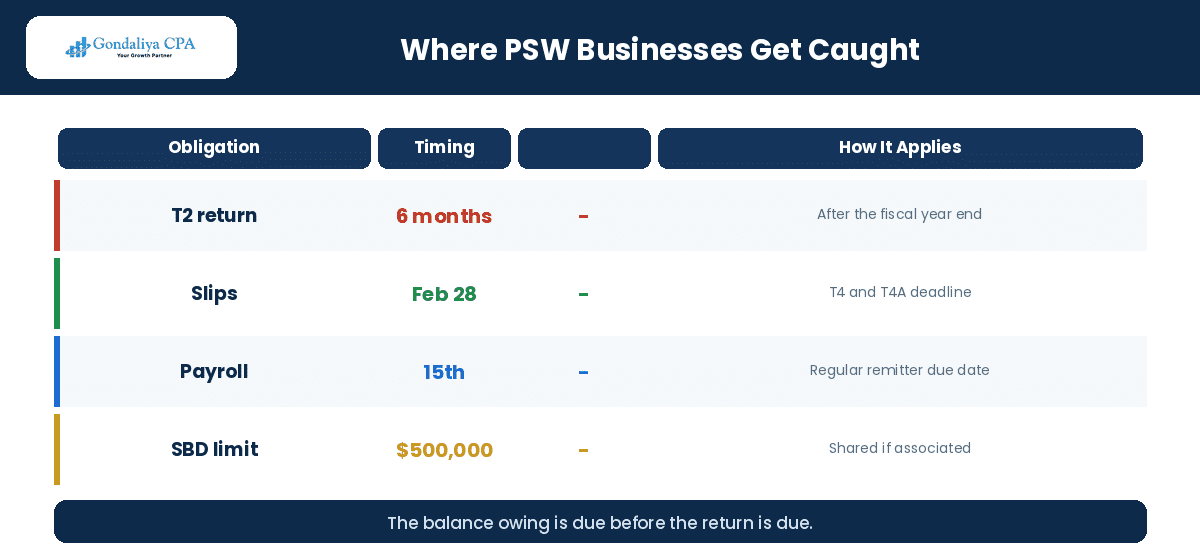
| Filing Requirement | Deadline | Notes |
|---|---|---|
| T2 Corporate Income Return | Six months after fiscal year-end | Includes forms supporting your claim |
| Slip Filings (T4/T4A) | Last day of February after tax year | Needed if you pay employees or contractors |
| Payroll Remittances | 15th day of month after payroll end | Regular remitters; other schedules exist |
Missing these dates can cause denied claims or CRA penalties. Good bookkeeping helps keep you on track.
Claims fail on documentation far more often than on eligibility. The work was done and the money was earned; nobody kept the certification on file. Figures changed for privacy.
Key Stat: The T2 return is due six months after year end, but any balance owing is due earlier. Please diarise the payment date separately from the filing date.
PSW Business Accounting Essentials
PSW Business Accounting Essentials
The Essentials
Personal support worker businesses in Canada have some specific accounting needs. A PSW accountant Canada or a personal support worker tax accountant helps keep track of income, expenses, and taxes correctly. This work covers bookkeeping, payroll, and tax filing for both incorporated PSWs and home care agencies. Good accounting keeps things clear and meets government rules.
Managing Income Streams and Record Keeping
Tracking shifts, hours, and billing is key for any PSW business. It makes sure invoices to agencies or clients are correct. This also helps with GST/HST reporting when it applies.
Here’s what a PSW business should do:
- Separate income by payer type, such as public programs versus private clients.
- Use bookkeeping software to organize transactions automatically.
- Keep detailed timesheets showing shift dates, start and end times, client names, hourly rates, and total hours worked.
This helps avoid missing billing any work done. It also lets you compare payroll costs paid to workers against the money you get from contracts.
Try to close your books every month. Do bank reconciliations and record all valid expenses separately, things like uniforms or training fees, not personal spending.
Tracking Eligible Earnings and Documenting Employer Certification
Knowing if workers are employees or contractors affects tax deductions. Employees need CPP contributions, EI premiums where they apply, and income tax withheld shown on T4 slips. Contractors usually get T4A slips without deductions.
The CRA looks at control factors when deciding status:
- Who controls schedules?
- How much supervision exists?
- Who provides tools or equipment?
You must give out the right slips each year, T4s for employees and T4As for contractors where required by CRA rules. Missing this can cause penalties.
Payroll remittances for regular remitters are due by the 15th of the month after wages are paid. Paying late means interest and penalties may apply. Keep employer certification records ready in case of audits.
Handling Payroll, Invoicing, and Expense Tracking
CRA expects payroll remittances on time, for most small employers by the 15th of the month following the pay period. Missing deadlines costs extra money in penalties.
Common deductible expenses include:
- Travel between clients, not the daily commute
- Uniforms that meet company rules, such as branded protective equipment
- Training needed for your work
- Phone use tied to business calls
- Insurance related to your operations
- Home office costs based on space used
- Software subscriptions used to run the business
Home care payroll rules require overtime pay following provincial laws plus holiday pay even if shifts change week to week. Vacation pay tracking is important because schedules vary so much in healthcare jobs.
Invoices should clearly show amounts that carry GST/HST where applicable. For example, privately paid companionship services may attract HST while government-funded homemaker services often do not.
Common Accounting Challenges and How to Address Them
The CRA often reviews these areas:
- GST/HST filings: Mistakes here can cause back taxes plus interest.
- Slip issuance: Forgetting required T4 or T4A slips leads to penalties.
- Worker classification: Wrong status means denied deductions and higher taxes.
Missing filings usually happen when books are not kept tidy monthly. Late-filing penalties begin at 5% of the balance owing plus 1% per complete month, to a maximum of twelve months, with higher amounts for repeat failures.
Try these tips:
- Keep monthly bookkeeping aligned with billing schedules.
- Use cloud software with receipt capture tools to reduce errors.
- Work with a CPA familiar with healthcare accounting rules.
- Keep written records about worker status decisions with signed agreements.
- Set calendar alerts well before deadlines to avoid late filings.
Worker classification is the file we are asked to fix most. A signed contractor agreement helps, but the CRA looks at how the relationship actually runs, not what the paperwork calls it. Figures changed for privacy.
Risk Warning: Treating an employee as a contractor shifts the CPP, EI and withholding liability onto your corporation when reassessed. Please document the classification decision at the time you make it.
Tax Return Preparation and Maximizing PSW Tax Benefits
Tax Return Preparation and Maximizing Benefits
The Filing
Step-by-Step Guide to Preparing a Tax Return
Filing taxes for a PSW business means watching deadlines and rules closely. The T2 corporate tax filing deadline is six months after your fiscal year ends. But you need to pay any balance owing sooner, within two or three months of year end depending on your corporation’s circumstances. GST/HST rules can be tricky, since some PSW services are taxable and others are not. Make sure you keep neat records for claiming input tax credits.
Start by collecting all your money info:
- Income from agencies and private clients
- Expense receipts
- Payroll summaries with timely source deductions
- Previous CRA notices
Fill out key schedules including Schedule 100 for the balance sheet, Schedule 125 for the income statement, and Schedule 141 for notes checklist information. These go with your T2 return.
Don’t forget to check if you qualify for the small business deduction based on your income. Also, review how GST/HST applies, since publicly funded home care might be exempt but private-pay usually is not. If the CRA asks questions or audits you, get ready to represent your corporation well.
Maximizing Available Tax Relief and Identifying Additional Deductions
PSWs can keep more money by tracking what they spend on work. Here’s what you might deduct:
- Travel between client homes, using mileage logs that follow CRA rules
- Uniforms required for the job plus laundry costs with proof
- Training courses needed for certifications
- Software subscriptions for scheduling or billing
- Insurance related to your business
Watch payroll remittance deadlines carefully. Late payments bring fines that cut into take-home pay. If your corporation meets the rules under the Income Tax Act, it may claim the small business deduction on up to $500,000 in active business income federally. Just remember, if you have multiple businesses linked together, the limit is shared under the associated corporations rules.
Keep good records, since they matter if the CRA wants to check expenses.
| Expense Type | When You Can Deduct It | Proof Needed |
|---|---|---|
| Travel Between Clients | Business use with logs | Mileage logs and fuel bills |
| Uniforms and Laundry | Required uniforms only | Receipts and policy papers |
| Training Costs | Directly related courses | Invoices |
Filing Amended Returns and Recovering Missed Claims
If you made mistakes or missed deductions, fix them promptly by filing amended returns. The CRA checks closely whether slips like T4s or T4As are correct and whether workers are classified right as employees or contractors. This affects which deductions you can claim.
To catch up when filings are missing:
- Use bank records and invoices to rebuild data.
- Prepare corrected T2 returns showing true numbers.
- File any missed GST/HST returns and confirm registration status fits.
- Send missing slips before penalties accumulate.
- Ask for taxpayer relief if fines piled up but you had good reasons.
Doing this lowers risks and puts your books back in order.
Coordinating Federal and Provincial Tax Considerations
If your PSW business runs in Ontario, you must follow federal laws like the Income Tax Act plus provincial rules on payroll and employment standards. Different provinces may have their own schedules for paying taxes or handling holidays and vacation time under their employment standards legislation.
If you operate in several provinces, keep track of each region’s payroll requirements separately. Your CRA business number links all program accounts across these areas to avoid gaps.
This way, you won’t miss federal corporate payments or provincial labour law steps that impact wages or deductions.
Role of Expert Tax Accountants in Optimizing PSW Tax Outcomes
Hiring a CPA Ontario Registered Firm that knows incorporated PSW businesses brings real benefits. From setting up your corporation to doing annual filings including GST/HST returns tailored for healthcare services, they handle complex work so you don’t have to guess.
Gondaliya CPA Professional Corporation works with Toronto-area PSWs running home care agencies or solo contracts through corporations. We offer flat fees covering bookkeeping help plus CRA representation to reduce audit issues tied to personal services business rules.
Our advice highlights deductions people often miss while keeping files compliant with the rules on GST/HST exemptions for publicly funded homemaker work.
Contact Gondaliya CPA at info@gondaliyacpa.ca or 647-212-9559 if you want help sorting corporate taxes accurately while making sure nothing slips through the cracks.
Publicly funded and private-pay work sitting in one revenue account is the most common GST/HST error we correct. The split has to exist in the bookkeeping, not just in the owner\u2019s head. Figures changed for privacy.
Key Stat: The $500,000 small business limit is shared across associated corporations. Please confirm your group structure before assuming you have the full amount.
Government Policies and Context Affecting PSWs in Canada
Government Policies and Context
The Policy
Personal support worker businesses in Canada deal with changing government rules. These rules affect their taxes, accounting, and how they manage staff. If you run an incorporated PSW business, knowing these rules helps you stay legal and save money. This section talks about key government policies. It focuses on wages, tax measures, filing dates, and possible changes, especially for those in Ontario.
Current PSW Wage Situation and Government Responses
The wage situation for PSWs is a live topic. Provinces try to address labour shortages by raising minimum wages. Ontario’s Employment Standards Act sets the minimum pay for home care agencies hiring PSWs. Incorporated personal support worker businesses must follow these wage laws when paying staff or issuing T4 slips.
Federal and provincial governments have entered bilateral agreements. These deals give extra funds to raise wages for publicly funded home care workers. Agencies must usually pass this money on as pay raises or benefits for PSWs they contract.
If you are an incorporated contractor working mainly with one agency, which happens often with solo operators, these rules affect how you negotiate contracts. But they don’t free you from the personal services business rules under the Income Tax Act.
PSW CPA Canada experts help clients set up pay packages that follow employment standards and lower risks tied to depending on one client.
Budget Initiatives Impacting PSW Tax Measures and Workforce Investments
Recent federal budgets have brought changes affecting health workers like PSWs, including measures aimed at small companies working in home care and similar fields.
Where such measures apply, they can make it easier to invest in training. You may deduct costs like certification courses without triggering problems linked to personal services business status.
GST/HST treatment has also been clarified over time. Only certain homemaker services qualify as exempt where government programs fund or subsidise them.
Incorporated PSW businesses should check the CRA’s current payroll guide for the thresholds that apply to source deductions.
Program Timelines and Application Periods
Where a support program applies, incorporated businesses that qualify apply each year through their T2 corporate tax filing. The return is due six months after your fiscal year ends.
You will need proof of expenses like training costs or approved employee benefits for each tax year. The deadlines for filing T4 or T4A slips do not change, since they are due by the last day of February after the calendar year.
The prescribed per-kilometre allowance rate for passenger vehicles used between client visits is revised annually. Please confirm the current rate before calculating travel expense deductions.
| Key Dates & Figures | Details |
|---|---|
| T2 Return Due | Six months after fiscal year-end |
| Balance Owing Due | Two or three months after year-end, by circumstance |
| Slip Filing Due | Last day of February after calendar year |
| Per-Km Rate | Prescribed annually by the CRA |
| Small Business Limit | $500,000, shared across associated corporations |
Future Policy Outlook and Possible Changes
- Late-Filing Penalties: Penalties get stricter if you file corporate returns late, including GST/HST returns where staffing fees are taxable.
- Capital Cost Allowance Rates: Depreciation treatment for vehicles used between client calls can shift with federal budget updates.
- Statutory Holiday Pay Minimums: Ontario and other provinces may update holiday pay rules affecting payroll even if contractors bill through corporations.
Watching these changes helps keep your books right and your deductions legal while avoiding trouble under the Income Tax Act’s personal services business rules.
Importance of Ongoing Advocacy and Support for PSWs
Advocates keep pushing governments, Ontario included, to recognize how vital PSWs are in healthcare systems. They also ask for fair pay backed by clear accounting rules.
Gondaliya CPA Professional Corporation offers expert help mainly to Toronto-based clients who run incorporated personal support worker businesses. Whether solo or multi-worker agencies, they face unique tax challenges.
Keeping current means your accounting matches the laws behind public funding models. It also protects against accidental mistakes with GST/HST exemptions or employment status under Canadian tax laws.
For advice about incorporated personal support worker business accounting across Toronto, Ontario and Canada, contact Gondaliya CPA at info@gondaliyacpa.ca or call 647-212-9559 for a free consultation today.
Funding announcements move faster than the accounting. An agency passes through a wage top-up, and nobody decides whether it runs through payroll or sits as revenue. Figures changed for privacy.
Pro Tip: Please confirm program eligibility in writing each year rather than assuming last year’s answer still holds. These measures are frequently amended.
How Gondaliya CPA Supports PSWs with Accounting and Tax Services
How Gondaliya CPA Supports PSWs
The Service
Gondaliya CPA helps personal support workers with accounting and tax services across Canada. We focus on PSW accountant Canada needs, covering business accounting, tax filing, bookkeeping, payroll, GST/HST rules, and dealing with the CRA. We know the specific challenges PSWs face when they run incorporated businesses or home care agencies.
Specialized PSW Accounting and Tax Return Preparation Services
Our firm offers accounting and tax help just for personal support workers. Whether you have your own corporation or work for a home care agency, we handle it all:
- Corporate Tax Filing (T2): We prepare your corporate tax return on time, six months after your fiscal year ends.
- Bookkeeping: We keep your records neat to track payments from agencies, clients, or insurers.
- Payroll Management: We set up payroll systems that follow government deduction rules and issue T4 and T4A slips correctly.
- GST/HST Compliance: We explain which services are taxable or exempt to avoid costly mistakes.
- CRA Representation: If the CRA audits you or sends questions about your taxes, we speak for you to reduce risks.
This makes us a solid choice if you want a PSW CPA Canada can trust for affordable and detailed financial help.
Financial Planning and Budgeting Tailored for Personal Support Workers
Good tax planning saves money. We help PSWs get the most from deductions while staying within rules by:
- Balancing salary and dividends so you don’t overpay CPP or lose RRSP room.
- Using the small business deduction by following rules for associated corporations.
- Planning when to buy equipment or vehicles to get proper tax write-offs.
- Watching how much profit stays in your company to avoid higher taxes later.
These plans cut down taxes without raising red flags about personal services business status.
Important Dates, Reminders, and Compliance Assistance
Missing deadlines costs you money. Incorporated PSWs should track these dates carefully:
| Task | Deadline | Penalty if Missed |
|---|---|---|
| T2 Corporate Tax Filing | 6 months after fiscal year ends | Late fees plus interest |
| Payroll Remittance | 15th day of next month after pay period | Penalties and interest |
| Slip Filing (T4/T4A) | Last day of February next year | Slip-related fines |
We send reminders and check compliance so nothing slips through.
Contact Information and Consultation Options
If you’re a personal support worker in Ontario, whether Toronto, Etobicoke, Vaughan, Mississauga, Brampton or Scarborough, or anywhere else in Canada, talk to us. Our licensed CPAs at Gondaliya CPA can help with your taxes and accounting questions.
Call 647-212-9559 or email info@gondaliyacpa.ca. We usually reply within one business day. Weekend or evening meetings are available too.
Why Professional Services Matter for Accurate Filings
Hiring a professional means your filings are correct under Canadian law. You also get the most tax relief allowed by the Income Tax Act without trouble.
Here’s why Gondaliya CPA works well:
- CPA Ontario Registered Firm certified by CPA Ontario
- Flat annual fee pricing keeps costs clear
- Cloud bookkeeping to keep books tidy
- Over 1300 positive Google reviews show client trust
We help reduce audit risks tied to GST/HST rules on homemaker services, personal services business status, payroll timing and vehicle expense limits, so you can focus on your work without stress.
Solo PSW corporations often arrive with no payroll account at all, taking everything as draws. Regularising that is usually the first job and the one that changes the tax outcome most. Figures changed for privacy.
Pro Tip: Please decide the salary and dividend mix before the year starts, not at filing time. The CPP and RRSP consequences follow the calendar, not the return.
Frequently Asked Questions About PSW Accountant Canada Services
Frequently Asked Questions
FAQ
What is the role of a PSW accountant Canada services provider?+
A PSW accountant Canada services provider manages corporate tax filing, payroll remittances, GST/HST compliance, and CRA representation for incorporated personal support worker businesses.
When is the T2 corporate tax return deadline for incorporated PSWs?+
The T2 corporate tax return must be filed within six months after the fiscal year-end to avoid late-filing penalties and interest charges. Any balance owing is due earlier.
How does GST/HST compliance affect personal support worker businesses?+
PSWs must track taxable and exempt services carefully to claim input tax credits and comply with GST/HST rules under the Excise Tax Act.
What are the payroll remittance due dates PSWs must follow?+
For regular remitters, payroll source deductions must be remitted by the 15th day of the month after each pay period. Other remitter types have different schedules.
What per-kilometre allowance rate applies to vehicle expenses?+
The CRA prescribes a per-kilometre rate for passenger vehicles used between client visits, and it is revised annually. Please confirm the current rate before claiming.
How do provincial regulations in Ontario impact incorporated PSW businesses?+
Ontario’s Employment Standards Act governs statutory holiday pay, overtime, and minimum wage for PSW employees.
What risks do single-client PSW corporations face under the Income Tax Act?+
They may be classified as a Personal Services Business, limiting deductions, removing the small business deduction and increasing audit risk from the CRA.
What are common causes of payroll remittance penalties for PSWs?+
Late payments, incorrect remittances, or missing filings often trigger penalties and interest from the CRA.
How can incorporated PSWs optimize their owner remuneration mix?+
Balancing salary and dividends manages CPP contributions while preserving RRSP room and minimizing overall taxes across the corporation and the shareholder.
Why is slip issuance compliance important for PSW businesses?+
Issuing accurate T4 or T4A slips on time prevents CRA fines and supports proper payroll reporting.
The question we hear most is whether to incorporate. The honest answer usually depends on how many payers you have, not on how much you earn. Figures changed for privacy.
Key Points on Managing Incorporated Personal Support Worker Businesses
Key Points for Incorporated PSW Businesses
Quick Reference
- Maintain monthly closes and reconciliations to ensure accurate records.
- Monitor associated corporations rules when multiple entities share ownership to apply small business deductions properly.
- Track capital cost allowance treatment carefully, especially for vehicles used between client visits.
- Review retained earnings periodically to plan capital purchases timing and limit corporate taxes.
- Prepare year-end packs with GIFI codes, notes to reader, and management discussion for smooth reviews.
- Use scheduling and timesheet systems to manage payroll efficiently.
- Be aware of late-filing penalties; repeated failure triggers higher fines under Income Tax Act regulations.
- Understand public funding GST/HST exemption rules to classify services correctly for tax purposes.
- Coordinate federal corporate instalments with provincial payroll source deduction deadlines.
- Apply taxpayer relief provisions if you face penalties due to circumstances beyond your control.
- Plan succession early to preserve limited liability benefits in incorporated PSW businesses.
For expert help with these areas, Gondaliya CPA offers flat annual fee pricing that covers bookkeeping, tax filing, CRA representation, and strategic financial planning tailored for personal support workers in Toronto, Etobicoke, Vaughan, Mississauga, Brampton, Scarborough, Ottawa, Oshawa, Guelph, Hamilton, North York, Windsor, and across Canada. Contact us at info@gondaliyacpa.ca, call 647-212-9559, or reach us here.
Eleven points and one underneath them: know who your payers are. Client concentration drives the personal services business risk, and everything else follows from that answer. Figures changed for privacy.
PSW Situations We Handle
Industry Expertise
Which issue dominates differs by setup. Here are ten and the usual focus.
| PSW Business Situation | The Main Issue |
|---|---|
| Solo PSW, one agency contract | Personal services business risk on client concentration |
| Solo PSW, several payers | Small business deduction available and worth protecting |
| Newly incorporated | Payroll account setup and remuneration mix from day one |
| Mixed public and private work | Separating exempt from taxable revenue for GST/HST |
| Agency employing PSWs | Worker classification, slips and remittance schedules |
| Heavy travel between clients | Mileage logs and vehicle expense substantiation |
| Behind on filings | Catch-up returns and taxpayer relief where warranted |
| Two related corporations | Associated corporations sharing the $500,000 limit |
| Growing past $30,000 | GST/HST registration and the exempt supply question |
| Planning to sell or wind up | Retained earnings, succession and limited liability |
- Solo PSW, one agency contract: The single biggest exposure, and it is structural rather than clerical.
- Solo PSW, several payers: Multiple payers strengthen the case that a real business exists.
- Newly incorporated: Draws taken without a payroll account create problems that compound.
- Mixed public and private work: The exempt and taxable split must live in the bookkeeping.
- Agency employing PSWs: Classification decisions drive CPP, EI and withholding liability.
- Heavy travel between clients: Without a log the whole vehicle claim usually falls.
- Behind on filings: Voluntary catch-up costs far less than waiting for the letter.
- Two related corporations: The limit is shared, not doubled.
- Growing past $30,000: Exempt supplies may change whether the threshold is even reached.
- Planning to sell or wind up: Retained earnings and structure decide the tax on exit.
The setup changes which issue comes first. It does not change the method, which is check the client concentration, get the payroll right, then keep the records. Figures changed for privacy.
Professional Guidance and Quick Reference
Guidance
Professional Guidance for PSW Businesses: How Gondaliya CPA Handles Your Compliance
Incorporated personal support worker businesses file a T2 corporate return six months after year end, remit payroll source deductions on schedule, issue T4 and T4A slips by the last day of February, and track which services carry GST/HST and which are exempt. The largest single risk is client concentration, since a corporation serving one agency can be reassessed as a personal services business. Gondaliya CPA handles PSW compliance on a fixed annual fee.
We handle what decides the outcome: assessing personal services business exposure on single-agency contracts, setting up payroll and remittance schedules correctly, documenting worker classification before the CRA asks, separating publicly funded exempt work from private-pay taxable work, substantiating travel between client homes, applying the small business deduction across associated corporations, planning the salary and dividend mix, and representing you if the CRA reviews any of it.
Our team looks at who pays you before anything else, because client concentration drives the structural risk and no amount of clean bookkeeping fixes it afterwards. Solo contractor or multi-worker agency, you get clear advice and a fixed price before we start.
Quick Answers: Key Numbers & Concepts at a Glance
At a Glance
- Corporate return: T2, six months after year end
- Balance owing: Due two or three months after year end
- Slips: T4 and T4A by end of February
- Payroll: 15th for regular remitters
- Small business limit: $500,000, shared if associated
- GST/HST: $30,000 registration threshold
- Exempt work: Often publicly funded homemaker services
- Taxable work: Often private-pay companionship
- Main risk: Personal services business reassessment
- Records: Six years retention
Who This Is For / Not For
Fit Check
- For: Incorporated personal support worker businesses and home care agencies in Canada, whether solo operators or multi-worker.
- Not For: PSWs employed directly on a T4 by an agency, who file a personal return rather than a corporate one.
People Also Ask
Related Questions
Should a PSW incorporate at all?+
It depends on income level, whether you work for more than one payer, and the personal services business risk. Incorporation is not automatically better.
Are all home care services exempt from GST/HST?+
No. Publicly funded homemaker services are often exempt while private-pay companionship work frequently is not. The split has to be tracked.
Can I claim mileage from home to my first client?+
Generally no. Travel between client homes is business travel; the first and last trips of the day are usually treated as commuting.
Glossary of Key Terms
- T2: The corporation income tax return.
- Personal services business: An incorporated employee arrangement taxed punitively.
- Client concentration: Reliance on a single payer for most revenue.
- Small business deduction: The reduced federal rate on active business income.
- Associated corporations: Related companies sharing one business limit.
- Source deductions: CPP, EI and income tax withheld from wages.
- Remitter type: The CRA classification setting your payroll due dates.
- T4 slip: The statement of remuneration paid to an employee.
- T4A slip: The statement of other income paid to a contractor.
- Worker classification: Whether a person is an employee or a contractor.
- Exempt supply: A service outside GST/HST, carrying no input tax credits.
- Taxable supply: A service on which GST/HST is charged.
- Input tax credit: GST/HST recoverable on business purchases.
- Capital cost allowance: Tax depreciation on vehicles and equipment.
- Retained earnings: Profit left inside the corporation after tax.
- Taxpayer relief: The route to requesting penalty and interest cancellation.
PSW Compliance Readiness Check
This quick self-check indicates where your operation most likely has room. Please answer the six questions below.
PSW Compliance Readiness Check
Six quick questions on your setup. No fee shown.
Points to raise with us:
This is a general prompt, not tax or legal advice or a quote. Your position depends on your full facts. For a real review, please book a free consultation.
Want a checklist to work from? You can download our free PSW compliance checklist before your consultation.
Check how concentrated your client base is. Set up payroll before taking draws. Document worker classification when you decide it. Split exempt from taxable revenue in the books. Log every kilometre between client homes. Diarise the balance due date separately from the filing date. Watch the associated corporations limit. Please keep six years of records.
2026 Update — what is current: This article reflects rules current to 2026. The T2 filing deadline of six months after year end, the last day of February for T4 and T4A slips, the 15th of the following month for regular payroll remitters, the $500,000 small business limit shared across associated corporations, the $30,000 GST/HST threshold and the personal services business rules are unchanged. Please note that support programs for personal support workers have taken several forms across federal and provincial governments and are frequently amended, so the credit described in section two, its rate, its eligibility conditions and its application period must all be confirmed against current CRA and provincial guidance before any claim is made. The prescribed per-kilometre rate is also revised annually.
PSW Business Accounting Canada: How Gondaliya CPA Supports Incorporated Personal Support Worker Businesses
Client concentration first
Gondaliya CPA assesses your personal services business exposure, sets up payroll and remittance schedules correctly, documents worker classification before the CRA asks, separates publicly funded exempt work from private-pay taxable work, substantiates travel between client homes, applies the small business deduction across associated corporations and plans your salary and dividend mix, on a flat annual fee including HST with a one-business-day response. Please book a free consultation.
Next Steps
Please book a free consultation with Gondaliya CPA and bring your agency contracts, a revenue breakdown by payer, and your last filed corporate return. Those three tell us immediately how exposed you are to the personal services business rules, whether the GST/HST treatment is right, and what needs correcting. You will get a flat annual fee including HST before any work begins. If our content helps, please add gondaliyacpa.ca as a preferred source on Google.
Published: · Last updated:
Editorial policy: We research against CRA and CPA Ontario sources, fact-check the figures, and Sharad Gondaliya, CPA, reviews the content, which we update as the rules change.
Disclaimer: This article is educational information only and is not tax, legal, or financial advice. Figures marked illustrative are examples rather than quotes or guarantees. It reflects CRA rules current to 2026, including the six-month T2 filing deadline, the end-of-February slip deadline, the $500,000 small business limit, the $30,000 GST/HST threshold, and the personal services business rules. Rates, limits and expensing rules change and outcomes depend on your specific facts. Please consult a CPA Ontario member before acting.

Sharad Gondaliya is a CPA Canada & CPA USA with 15 Years+ experience of Accounting, Tax, Payroll of Corporate Small Businesses as Tax Accountant. He is a CPA Ontario member (61040184) and holds US CPA licences in Washington and Montana and is well known among corporate small businesses for tax planning, efficient tax solutions, and affordable CPA services. Sharad is the Principal (Director) of Gondaliya CPA – Affordable CPA Firm in Canada. Licenses: CPA Ontario: 61040184 | CPA USA (MT): PAC-CPAP-LIC-033176 | CPA USA (WA): 57629 | CPA Firm License: 61330051 View Full Author Bio