



Common Tax and Accounting Mistakes Window and Door Installers Make in Canada and How to Avoid Costly CRA Problems
Window installer tax mistakes Canada and contractor bookkeeping mistakes: Key tips for staying compliant with CRA regulations by Gondaliya CPA
Window installer tax mistakes Canada and contractor bookkeeping mistakes often cause problems with CRA compliance; Gondaliya CPA shares practical tips to keep your accounting accurate and up to date. Managing expenses and records carefully is essential for window installers to meet CRA regulations and avoid penalties.
Quick Summary
Window installers in Canada often make tax mistakes that cause real money problems. Knowing these errors helps keep your business in good standing with the CRA and running smoothly.
Reading time: 47 minutes.
Table of Contents
- Common Tax and Bookkeeping Mistakes
- Recordkeeping, GST/HST and Capital Assets
- Meals, Dormant Filings and Documentation
- Separating Personal and Business Finances
- Building an Audit-Proof Bookkeeping Routine
- Practical Checklist and Proactive Planning
- Frequently Asked Questions
- Cleanup Options and Choosing a CPA
- Job Types We Handle
- Professional Guidance and Quick Reference
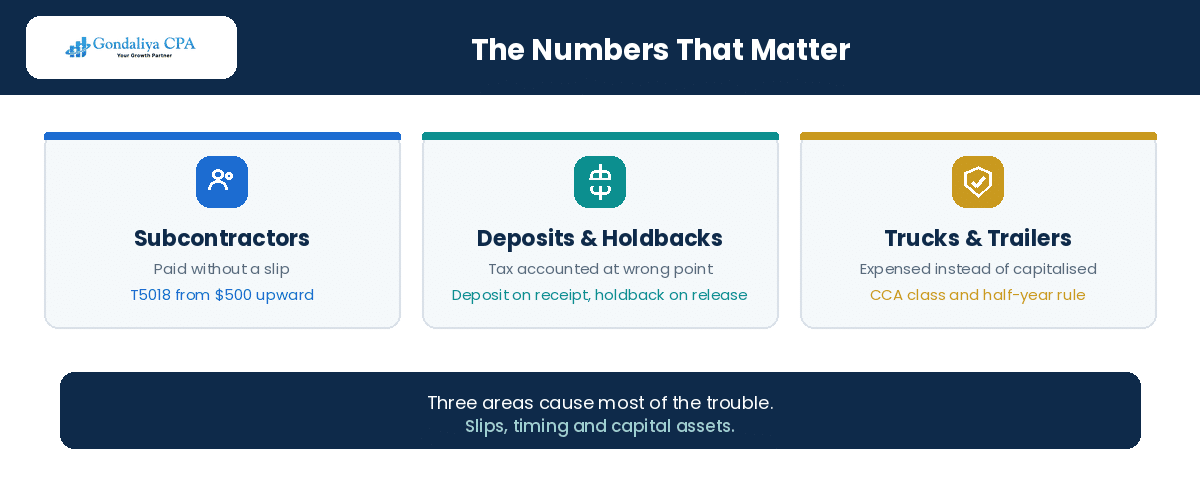
The Numbers That Matter
This article covers Canada, with Ontario and Toronto context, and reflects rules current to 2026. It assumes an incorporated window, door or glazing installation business dealing with subcontractors, deposits, progress billings and holdbacks. Figures marked illustrative are examples, not quotes, and any masked engagement notes end with “Figures changed for privacy.” This is educational information only and not tax or legal advice. Penalty amounts and deadlines are fact-specific, so please confirm your own position before acting.
Common Tax and Bookkeeping Mistakes Made by Window Installers in Canada
Common Tax and Bookkeeping Mistakes
The Mistakes
Common Tax Slip-Ups Among Window Installers
- Misclassifying workers as subcontractors instead of employees. This can bring big CRA fines.
- Forgetting to file T5018 slips when paying subcontractors. That triggers non-compliance troubles.
- Mixing personal spending with business expenses. This makes bookkeeping messy and raises audit risks.
- Reporting GST/HST wrong on invoices. Fixing this after audits costs time and money.
Spotting these mistakes early lets you fix them before they hurt your business.
The Financial Impact of Tax Errors
Tax errors don’t just cause paperwork headaches, they hit your wallet hard.
- Penalties pile up fast when you file late or report incorrectly.
- Interest grows on unpaid taxes, making your bills bigger the longer you wait.
- For example, missing a T2 return can cost you 5% of owed taxes plus 1% every month for up to a year, with higher amounts for repeat failures.
Knowing these numbers shows why good records and deadlines matter a lot.
Mixing Personal and Business Expenses: Risks and Correct Practices
Many contractors mix their personal expenses with company spending. That’s a risky move.
Why mixing expenses is bad:
- It makes it hard to keep clear books and track what’s really business.
- Auditors get suspicious when they see mixed transactions. That ups your audit chances.
How to do it right:
- Keep separate bank accounts for business and personal money.
- Check expense reports often so you don’t blur lines, which helps with shareholder loan repayments without problems.
Keeping things separate keeps your books clean and away from CRA trouble.
Consequences of Missing or Late Tax Filings and Remittances
Missing tax deadlines hits more than just your paperwork, it hurts cash flow too.
| Obligation | Deadline | What Happens If You Miss It |
|---|---|---|
| Payroll Remittance | Monthly for most small employers | Penalties plus interest start adding up |
| Instalment Payments | Quarterly or monthly by circumstance | Interest applies on shortfalls |
Late filings cost money right away. They also hurt how the CRA views your company.
Employee Misclassification: Identifying Employees vs. Contractors
One big mistake is treating workers like subcontractors when they’re actually employees.
Why getting worker status right matters:
- If the CRA says you got it wrong, you owe back taxes plus penalties.
- Poor records make audits worse, which can mess up future business plans.
You need solid contracts showing who does what, clearly following employment rules set by provincial authorities.
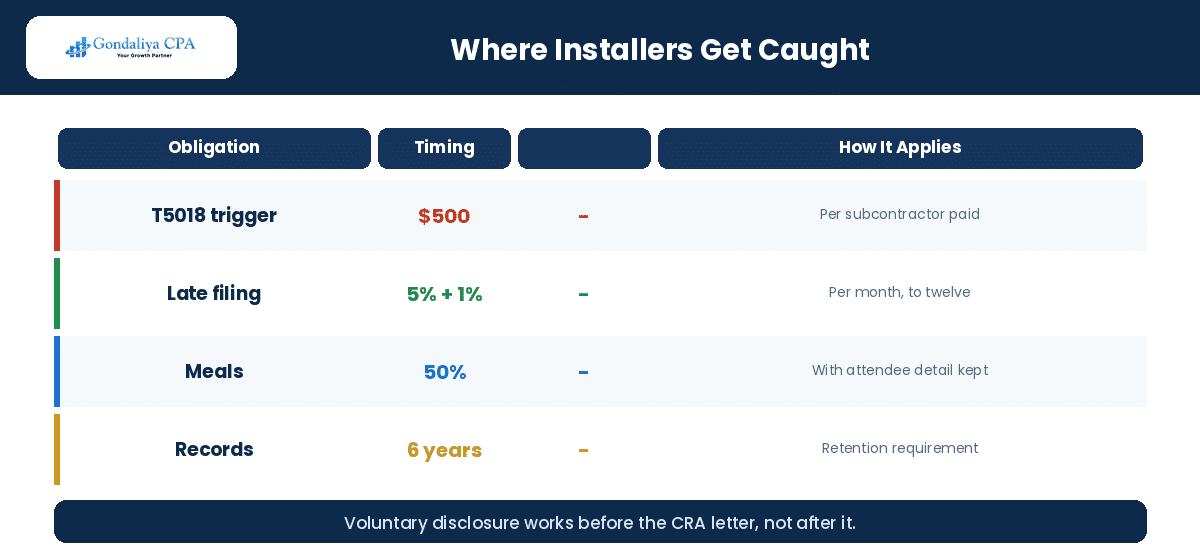
The pattern is remarkably consistent. A crew treated as subcontractors for years, no T5018 slips, and a CRA letter that arrives the season after the business finally grew. Figures changed for privacy.
Risk Warning: If workers are reclassified as employees, your corporation owes the CPP, EI and withholding that was never deducted, plus penalties. Please document the classification decision when you make it.
Poor Recordkeeping and DIY Bookkeeping Errors
Recordkeeping, GST/HST and Capital Assets
The Records
Poor recordkeeping causes many window installation accounting mistakes. Lots of window installers in Canada handle bookkeeping themselves, but errors creep in fast. When records aren’t organized, tax deductions get missed, reports go wrong, and audits become a headache.
Contractors often mix personal and business expenses by mistake. They might forget to enter receipts on time or fail to track costs for each job separately. This messes up profit calculations. For example, if you buy materials for several jobs but lump them all under one expense, you won’t know the true cost for each project.
DIY bookkeeping misses some key controls too. It’s easy to slip up when tracking GST/HST or paying subcontractors. Forgetting to add payments or entering deposits wrong can cause trouble later during year-end filings like T2 returns.
Here are some common errors:
- Mixing personal and business expenses
- Late entry of receipts and invoices
- No clear job cost breakdown
- Skipping subcontractor payments in records
Cloud bookkeeping helps cut down errors. But you still need regular reviews by an accountant who knows the construction business.
One Toronto installer put all bulk material buys into one account. This made two jobs look far more profitable than they really were. Fixing it meant going back through invoices and delivery notes to split costs correctly before amending returns. Figures changed for privacy.
Accurate GST/HST Input Tax Credit Tracking
Tracking GST/HST input tax credits (ITCs) correctly matters a lot for window installers’ CRA compliance. Claiming ITCs lowers your tax bill but you have to keep good proof that purchases relate only to your business sales.
Many window installers make tax mistakes in Canada by mixing taxable goods with exempt items or claiming personal assets wrongly for ITCs. Also, if your sales go past the GST/HST small supplier threshold, you must register for GST/HST or face fines plus interest on unpaid taxes.
You need vendor invoices showing GST/HST paid clearly, tied directly to your commercial window installation work in Ontario or other provinces.
Wrong ITC claims lead to reassessments, extra taxes owed, and late-filing penalties if fixed too late. Checking records monthly or quarterly can catch issues early before year-end filings close out GST/HST accounts.
Here’s a quick look at when you account for GST/HST on different payment types:
| Payment Type | When Tax Is Due | Records Needed | Common Mistake |
|---|---|---|---|
| Deposit | When deposit received | Deposit invoice and payment log | Treating deposit as prepayment |
| Progress Payment | On invoicing | Detailed progress billing | Leaving out partial payments |
| Holdback Release | When holdback is released | Holdback agreement and invoice | Accounting for HST late |
Vehicle Mileage Tracking Errors and CRA Logbook Requirements
Claiming vehicle expenses without a proper mileage log is a top mistake that causes CRA to deny deductions during audits. The vehicle per-kilometre allowance rate changes yearly, so only business kilometres count.
CRA wants a detailed logbook with date, destination, reason, odometer start and end readings, and total kilometres per trip. Guessing or estimating after the fact won’t hold up.
Window installers driving trucks around Toronto or other sites must track daily trips carefully. This helps separate personal use from work use when calculating fuel costs, maintenance, and capital cost allowance under vehicle classes 10 or 10.1.
The CRA accepts a representative sample logbook approach only where a full base-year log already exists, so please keep the detailed records rather than relying on a short sample alone.
Expensing Capital Equipment Incorrectly
Mistakes happen when installers expense tools, trailers, or equipment fully instead of using capital cost allowance (CCA) rules. The half-year rule generally limits you to half the normal CCA in the first year, subject to the available-for-use rules and any accelerated incentives that apply.
Small tools under certain limits can be expensed fully right away. But bigger items like trailers belong in proper CCA classes. Writing off big purchases in full throws off profit numbers because depreciation should spread over the asset’s life according to tax rules.
Classifying assets correctly follows the matching principle, so expenses reflect actual wear and tear over years instead of all at once, and keeps corporate income tax returns accurate across provinces like Ontario.
Getting advice from an accountant avoids mistakes that cause audit problems later.
Subcontractor Reporting Obligations: T5018 and T4A
Not filing T5018 slips on time for subcontractors puts window installation companies at risk of penalties and CRA scrutiny across Canada including Ontario. If you pay a subcontractor $500 or more in a reporting period, you must report their earnings on T5018 slips.
Mixing up employee T4 slips with contractor T5018s or T4As leads to missing source deductions and could mean director liability if remittances aren’t paid properly.
Missing instalment payments hurts cash flow and triggers interest until sorted out.
Make sure payroll systems match reported slip totals so no workers get missed in reporting, especially important when running multi-person crews under complex labour setups common in fenestration trades.
A glazing company in Etobicoke forgot to file five subcontractors’ payments via T5018 slips on time even though they tracked payments internally. They faced penalties plus interest but lowered the charges by voluntarily fixing it six months later. Figures changed for privacy.
If you want help avoiding these common issues that hurt your incorporated window installation business, reach out anytime at info@gondaliyacpa.ca or call 647-212-9559.
Holdbacks are where the timing goes wrong most often. The tax gets accounted for when the invoice is raised rather than when the holdback is released, and the cash is out the door early. Figures changed for privacy.
Key Stat: A single subcontractor payment of $500 or more triggers a T5018 obligation. Please treat every subcontractor as reportable until you have checked.
Meals, Dormant Filings and Supporting Documentation
Meals, Dormant Filings and Documentation
The Detail
Meals and Entertainment Expense Deductions
Window installers in Canada often mess up meals and entertainment deductions because CRA rules are tricky. A usual window installer tax mistake in Canada is claiming too much or not keeping good records. This can lead to audits or getting your claim cut.
The CRA lets you deduct only half of eligible meals and entertainment expenses. This covers client meetings, staff get-togethers, or meals during travel. Many contractors claim 100%, which is wrong.
You need proper proof. Receipts should have the date, place, amount, who was there, and why it was business. Without these details logged right away in your bookkeeping, CRA may reject your claim.
For incorporated window businesses, mixing personal dining with business meals causes contractor bookkeeping mistakes. It raises your audit risk. Keep separate accounts for personal and business meals to stay clear.
A glazing contractor from Ontario claimed $4,000 for team lunches but gave receipts only showing total amounts without who attended or dates. The CRA cut half during audit because the evidence wasn’t enough to prove all expenses were business-related. Figures changed for privacy.
Dormant Corporation Filing Responsibilities
Even if a corporation is dormant, it still must file under Canadian law. Window installers who incorporate but stop working still have to submit annual T2 returns even if no money came in or went out.
If you don’t file, the CRA can charge late-filing penalties and interest, and repeated failures attract higher amounts. Missing filings across several years compounds the exposure when you finally catch up.
Keeping up with filing avoids window installer CRA compliance problems that might lead to big fines or enforcement. Even if nothing happened during the year, you must file on time, six months after the fiscal year ends.
A Toronto door installer stayed inactive for two years and did not file T2 returns. When they restarted after three years, the CRA assessed several thousand dollars in late fees plus interest. Figures changed for privacy.
Reviewing Books Regularly to Prevent Costly Reconstruction
Checking your books regularly helps catch contractor bookkeeping mistakes before they cost you big. Window installation accounting mistakes usually come from waiting too long to fix errors like misreporting income or mixing up expenses.
Every month:
- Reconcile bank statements with invoices and receipts
- Verify subcontractor payments match T5018 slips
- Check GST/HST collected equals what you sent
- Confirm payroll entries match government filings
- Make sure job costs fit contract terms
- Review shareholder loan activity for reasonableness
- Monitor instalment payments status
- Match deposits with customer invoices
This stops small errors piling up till year-end when fixing them means expensive cleanup work rebuilding ledgers from patchy information.
Set monthly financial checkups using cloud accounting paired with receipt capture. It gives quick insight into how your books look.
Problems with Relying Solely on Bank Statements
Bank statements alone don’t prove business expenses well enough for CRA. Many window installers make this mistake by giving only statements instead of detailed invoices or receipts during audits. This common window installation accounting mistake can cause claims to be denied.
Statements show how much was paid but miss key details like vendor name or what was bought, materials versus tools, or if part was personal such as mixed fuel purchases. Without invoices listing dates, suppliers, descriptions, quantities, unit prices, taxes and payment proof linking back via invoice numbers, the record isn’t strong under section 230 of the Income Tax Act.
Relying just on bank information also hides input tax credits tied specifically to materials used onsite versus office supplies.
Best Practices in Digital Receipt Capture and Record Retention
Using digital receipt capture combined with solid record keeping helps fix many contractor bookkeeping mistakes that window installers face today. Scanning receipts right away with a phone app synced to cloud accounting keeps data fresh before paper piles up, a major cause of missing deductions flagged by auditors.
Good steps include:
- Snap every receipt as soon as you buy something
- Sort each digital image by job number or project code
- Keep electronic copies safe with offsite backups plus originals per the CRA’s six-year rule
- Check captured receipts weekly against bank records
- Keep meal logs listing attendees when claiming entertainment expenses
These habits cut errors from lost paperwork or missing information common among contractors relying on paper-only systems. They also help report GST/HST right when taxable supplies happen in construction work.
Starting digital record keeping early saves time during tax season. It avoids messy catch-up work later when past years weren’t kept up, reducing risk from wrong claims caused by poor records common across small fenestration firms nationwide.
Bank statements without invoices are the most common audit response we are handed. The money clearly left the account; what it bought is anyone\u2019s guess. Figures changed for privacy.
Risk Warning: A dormant corporation still files. Please keep the returns current rather than restarting years later with penalties attached.
Strategies for Separating Personal and Business Finances Effectively
Separating Personal and Business Finances
The Separation
Keeping personal and business money separate is key to avoiding common window installer tax mistakes in Canada. When you mix your own spending with corporate accounts, it causes trouble. Shareholder loan problems pop up, bookkeeping gets messy, and CRA audits become more likely. Staying clear of that helps you keep clean records, repay loans on time, and follow CRA rules without stress.
Real-Time Transaction Splitting and Accounting Software
Poor recordkeeping usually happens because people mix personal and business expenses. Cloud accounting helps a lot. You can split transactions right when you enter them. That way, each cost gets the right label, avoiding contractor bookkeeping mistakes.
For example, if you buy stuff partly for a job and partly for yourself, you break that purchase into two parts before you finish the books. Bank feeds can automate this so you don’t make manual errors. This habit keeps your expenses clear, business versus personal, and makes year-end work easier. Plus, it leaves a clear trail if CRA ever asks questions.
Mobile Solutions for Digital Mileage Logging and Expense Tracking
Claiming vehicle costs without a mileage log is a big mistake. The CRA motor vehicle expense guidelines want detailed records to allow deductions. The per-kilometre allowance rate is revised annually, so you must track exact kilometres driven only for work.
Mobile apps built for contractors track trips automatically using GPS. They log where you start and stop, trip reasons, dates, and distances, all needed if CRA checks your books. These apps protect you from losing deductions on fuel, repairs, or insurance based on business use. They also link to your accounting software for smoother monthly checks.
Benefits of Dedicated Commercial Accounts
Using separate commercial bank accounts keeps all your business money apart from personal spending. If you don’t do this, it often looks like shareholder loans happen when owners pay personal costs through the corporation but don’t pay back right away.
Separate accounts prove what money is what during CRA reviews, especially for installation businesses in Ontario or Toronto working with licensed CPAs.
Clear account boundaries also help you see cash flow better and make tracking payroll remittances easier. Missing instalments or late filings cause penalties, which contractors face a lot.
Here’s why separate accounts matter:
- Stops shareholder loan troubles by recording withdrawals properly
- Keeps audit trails clean with clear transaction history
- Shows cash flow clearly by separating deposits from payments
- Makes payroll compliance easier with correct deductions
Simplifying Monthly Bookkeeping Checks
Weak records cause problems in window installation accounting. Cash jobs without proper invoices, deposits not matched to bills, or undocumented change orders make the CRA suspicious. Doing monthly bookkeeping reviews helps catch these issues early before fines or interest build up.
Try these checks every month:
- Match deposits to customer invoices regularly
- Confirm subcontractor payment slips (T5018) match your ledger
- Make sure payroll remittances get paid on time
- Check instalments match estimated taxable income
- Review change order approvals carefully
- Document all changes clearly in your job costing system
Doing this cuts down risk a lot. It keeps financial data solid across crews working in Canadian fenestration businesses under strict rules.
Need help avoiding these common errors in your window installation company’s taxes across Ontario or Canada? Contact Gondaliya CPA at info@gondaliyacpa.ca or call 647-212-9559 for a free chat today.
Personal fuel on the company card is the transaction we untangle most. Individually small, cumulatively a shareholder loan balance nobody planned for. Figures changed for privacy.
Pro Tip: Please review the shareholder loan account monthly rather than at year end. A balance caught in month three is a transfer; caught in month fifteen it can become income.
Building an Audit-Proof Bookkeeping Routine
Building an Audit-Proof Bookkeeping Routine
The Routine
If you’re a window installer in Canada, keeping your books clean helps you dodge costly tax errors and CRA troubles. Lots of window installation accounting mistakes come from bad record-keeping, mixing personal and business expenses, or not tracking job costs right. Contractor bookkeeping mistakes pop up too when invoicing is sloppy or payments to subcontractors aren’t logged properly. Setting up clear steps cuts down errors that might lead to penalties or reassessments.
A good bookkeeping system records all income, expenses, deposits, holdbacks, and payroll information all year long. Cloud accounting gives you real-time access and makes bank statement checks easier. If you review monthly, you catch problems early instead of at year-end.
For instance, if material costs don’t get split correctly by job, your profit numbers get messed up. That can bring CRA attention to your inventory values under section 10 of the Income Tax Act. Also, knowing which expenses count as current versus capital helps avoid misstated income.
Keeping detailed records helps you claim valid deductions for things like vehicle use or tools. Plus, the CRA wants you to keep records for at least six years. Missing these deductions is a common tax mistake window installers in Canada make.
Pre-Payment Onboarding Process for Subcontractors
To stay on the right side of CRA rules, window installers must report subcontractor payments correctly using T5018 slips when needed. A pre-payment onboarding process means collecting all the information before paying anyone. This includes the legal business name, GST/HST registration number if needed, SIN or business number for individuals, contract terms with holdback clauses, and confirming if they are employees or independent contractors.
This step stops common window installer tax mistakes Canada often sees, like paying vendors who aren’t registered or misclassifying workers. It also makes sure you file T5018 slips on time.
You should check subcontractors against the construction industry reporting rules in the Income Tax Regulations. Keep signed agreements and match payments with invoices during your accounting close process.
Benefits of standardizing onboarding before paying:
- Cuts risk of source deduction liabilities.
- Ensures correct slip issuance.
- Helps avoid late-filing penalties that accrue per missing slip plus interest.
A glazing contractor in Toronto started this halfway through the year and cut their T5018 filing errors substantially within months just by gathering information upfront. Figures changed for privacy.
Managing the GST/HST Small Supplier Threshold
Window installers have to watch their taxable supplies carefully. If they go over $30,000, they must register for GST/HST and file on the frequency the CRA assigns. The rolling four-quarter test means you add up revenues from construction services looking back across four consecutive calendar quarters, not just calendar years, to see if you passed that limit.
Not registering on time can mean wrong GST/HST charges on invoices and owing taxes with interest. Many window installation accounting mistakes happen because businesses think they’re still small suppliers when they’ve actually passed the threshold but didn’t check regularly.
The CRA expects registered businesses to charge tax correctly, including on progress billings, and to keep receipts ready for input tax credits. Good bookkeeping systems warn you when thresholds get close.
| Aspect | Detail |
|---|---|
| Threshold Amount | $30,000 cumulative taxable supplies |
| Measurement Period | Four consecutive calendar quarters |
| Registration Deadline | Within 29 days after exceeding the threshold |
| Consequence | Interest plus possible penalty on unpaid tax |
Watching these rules closely helps avoid costly errors common among small incorporated installers in Ontario’s competitive market.
Capital Cost Allowance Asset Classes and Incentives
Knowing about CCA asset classes is key to claiming depreciation correctly, something many get wrong in window installation accounting. Tools and similar items fall into their own classes with their own limits. Vehicles go into Class 10 or 10.1 depending on cost, while trailers have different classes that change how write-offs work.
Accelerated investment incentives allow a larger first-year claim in certain circumstances. This boosts cash flow but requires accurate asset tracking based on when items become available for use. Getting classes wrong inflates expenses and risks reassessment.
Bookkeepers should keep fixed asset lists showing purchase price net of any GST/HST recovered, purchase dates, and confirmed class assignments. CPA advice is helpful here, especially for fenestration trades around Toronto, Vaughan and Mississauga.
An emergency board-up service operator expensed a trailer fully instead of applying the half-year rule. The audit denied thousands of dollars in claims, showing why it pays to stay current on CCA rules for construction equipment. Figures changed for privacy.
Common Contractor Bookkeeping Mistakes and How to Avoid Them
Contractor bookkeeping mistakes often come from mixing job costs with overheads. This messes up profit analysis during tax time. Here are common errors:
- Putting materials for different jobs into one purchase entry, which distorts margins.
- Forgetting freight or restocking fees when calculating total material costs.
- Not adjusting work-in-process inventories at year-end, which breaks the section 10 inventory rules.
- Skipping regular bank reconciliation between deposits and invoices, especially when cash and card payments mix.
Avoid these by following strict routines:
- Give each job a unique number as soon as it’s awarded.
- Enter each expense line with its project code daily.
- Reconcile bank deposits weekly against invoices including all payment methods.
- Hold monthly reviews focusing on financial differences flagged by your accountant familiar with fenestration sector specifics.
Doing these cuts errors and lowers the chance auditors will question your earnings, which matters since auditors watch industries with significant cash handling closely, including multi-site door and window installers serving Greater Toronto Area clients doing both residential retrofits and commercial glazing contracts.
Contractors using book-to-bank reconciliations combined with digital receipt capture face fewer surprises during corporate return season. That means less stress handling complex T2 filings yearly across provinces including Ontario.
Work-in-process at year end is the adjustment small contractors skip most. Jobs half finished on December 31 have costs in the books and no revenue against them. Figures changed for privacy.
Key Stat: The GST/HST threshold is measured across four consecutive quarters on a rolling basis. Please check it monthly rather than at year end.
Practical Checklist for Avoiding Tax and Bookkeeping Mistakes
Practical Checklist and Proactive Planning
The Checklist
Avoiding window installer tax mistakes Canada means keeping your books neat and following rules closely. Use a separate bank account just for business money. This stops personal spending from mixing up with company cash. Keep track of every material cost for each job, including shipping or restocking fees. This helps you get the right landed cost.
Choose good software to log invoices quickly. Don’t forget deposits, progress payments, holdbacks, or payments to subcontractors. Write down mileage for work vehicles too. Note date, kilometres driven, trip reason, and whether it’s a truck or passenger car.
Buy tools? List them carefully. Decide if they’re regular expenses or capital assets under CCA rules. File T5018 slips on time for subcontractors to dodge penalties.
Check your books every month instead of waiting for year-end. This catches errors in unbilled work and GST/HST on deposits versus final payments. Make a checklist that covers payroll remittances, sent on time with correct deductions.
If you pay family members, keep proof of actual work done. The CRA wants to see that payments are reasonable. Lastly, save all records digitally for six years as Canadian law requires.
When to Consult Gondaliya CPA
Call Gondaliya CPA when things get tricky, like switching workers from subcontractors to employees. Or when you need help with GST/HST rules on deposits and holdbacks that affect window installers in Ontario and Toronto.
If you made contractor bookkeeping mistakes like missing T5018 slips or messing up job costs that hurt your corporate return, fix it early to lower audit chances. The team can explain instalment payments, payroll deadlines, shareholder loan issues under section 15(2), plus ways to fix past errors.
Get help before the CRA sends demands or penalties caused by messy income reports common among fenestration contractors with many crews. Professional advice keeps you clear on window installer CRA compliance while using all legal deductions safely.
Summary of Key Compliance Tips
- Window installation accounting mistakes come from poor tracking of materials per job that messes up profits and taxes. Always match purchase invoices with project codes to track material costs right.
- Contractor bookkeeping mistakes include mixing up employee wages on T4s with contractor payments on T4A or T5018 slips. That matters because it changes payroll deductions significantly.
- People miss tax breaks by expensing tools fully instead of using capital cost allowance rules that spread the cost over years.
- Vehicle claims need good mileage logs showing business versus commute distances based on Income Tax Act rules.
- GST/HST errors happen when deposits get accounted for at the wrong time. Know the Excise Tax Act timing rules well to avoid costly corrections.
- Keep strong records: contracts must show any scope changes like change orders affecting bills; track holdback payments separately so GST/HST is accounted for at the right time, not too early.
Encouraging Proactive Tax Planning
Planning ahead cuts down window installer tax mistakes Canada and helps manage cash flow better by timing instalment payments with expected income during quarterly checks.
Spot problems early like mixing personal spending into business accounts so you avoid extra taxable benefits under section 15(2). Use weekly routines to capture receipts fast, which cleans up data and speeds month-end closing while stopping errors from piling up.
Save money by claiming input tax credits only on valid construction services and materials backed by vendor invoices meeting Excise Tax Act requirements.
Work closely with a CPA Ontario member firm like Gondaliya CPA that knows incorporated SMBs well. We help glazing contractors in Toronto and Ontario stay within rules while avoiding audit risks.
Contact Information and Resources
Need help fixing window installation accounting mistakes or sorting out contractor bookkeeping problems? Contact Gondaliya CPA Professional Corporation on 647-212-9559 or at info@gondaliyacpa.ca.
We offer free consultations for incorporated window installers in Toronto, Ontario and across Canada. Flat annual fees cover yearly tax cleanups including catch-up filings.
Gondaliya CPA responds quickly, usually within one business day, and offers weekend or evening support so you don’t miss important CRA deadlines that cause fines later.
Contractors who diarise the monthly review actually do it. Contractors who plan to review the books when things quieten down are the ones we meet in a catch-up engagement. Figures changed for privacy.
Pro Tip: Please assign a job number the day a contract is awarded. Costs coded from day one are far cheaper than costs allocated a year later.
FAQs on Window Installer Tax Mistakes and CRA Compliance
Frequently Asked Questions
FAQ
What is the Late Filing Penalty for T2 corporate tax returns?+
The CRA charges a 5% penalty of unpaid tax if your T2 return is late. An additional 1% is added each month it remains overdue, up to 12 months, with higher amounts for repeat failures.
Why must window installers repay Shareholder Loans timely?+
Shareholder loan balances not repaid within the prescribed period risk being included as income, causing extra tax and penalties under CRA rules.
How long is the Reassessment Period for corporate tax returns?+
The normal reassessment period is three years from the notice of assessment for a Canadian-controlled private corporation, and longer where misrepresentation is suspected.
What are Payroll Remittance Deadlines?+
Employers remit payroll deductions on a schedule set by their remitter type. Most small employers remit monthly. Missing these leads to penalties and interest charges.
Why do window and door installers often face CRA problems?+
Common reasons include misclassifying workers, missing T5018 slips, improper GST/HST handling, mixing personal and business expenses, and weak bookkeeping.
What happens if you don’t file T5018 slips for subcontractors?+
You risk CRA penalties per slip plus interest. It also increases audit risk and possible reassessments.
Why is treating installers as subcontractors without support risky?+
Misclassification causes unpaid payroll deductions, fines, and reassessments since workers may be employees under CRA definitions.
How do errors with GST/HST on deposits and progress payments affect you?+
Incorrect GST/HST timing leads to owing tax with interest and costly corrections during audits.
What’s wrong with ignoring GST/HST rules on holdbacks?+
Accounting for the tax at the correct point avoids penalties; getting it wrong triggers underpayment charges and interest.
Why is tracking material costs by job important?+
It ensures accurate profit calculations and prevents overstating expenses or income when filing taxes.
What risk comes from ignoring Work in Process at year-end?+
Not accounting for work in process distorts inventory values, causing inaccurate taxable income reporting under Income Tax Act rules.
Why is no job costing on labour and crew time a problem?+
Without detailed costing, profits per job are unclear, affecting pricing decisions and tax accuracy.
What happens if you expense tools or equipment in full improperly?+
You lose depreciation benefits over time and may trigger audits due to incorrect capital cost allowance claims.
Why claim vehicle costs only with a proper mileage log?+
The CRA requires detailed logs to allow deductions; missing logs result in denied claims during audits.
What issues arise from running personal spending through the corporation?+
This creates shareholder loan complications and raises audit flags due to mixed personal and business transactions.
Is paying family members without work records allowed?+
No. The CRA requires proof of actual work done and reasonable amounts, or payments may be disallowed.
What happens if instalments or payroll remittances are missed?+
Penalties and interest accumulate quickly, and cash flow suffers too.
Why are weak records on cash jobs, deposits, and change orders risky?+
They cause missing income reports or unsubstantiated expenses that trigger audits or reassessments.
How does ignoring CRA mail or demands hurt your business?+
Delays escalate penalties and limit options like voluntary disclosure for fixing errors without full penalties.
Nineteen questions, and seventeen of them come back to documentation. The rule was usually understood; the paperwork proving it was not kept. Figures changed for privacy.
Cleanup Options, Job Types and Choosing a CPA
Cleanup Options and Choosing a CPA
Quick Reference
Essential Points About Window Installer Tax Mistakes and Fixes
- Voluntary Disclosure lets you correct past tax errors before the CRA detects them, reducing penalties significantly.
- Amended returns fix mistakes after filing but may trigger reviews if large changes occur unexpectedly.
- DIY fixes save money but risk incomplete corrections; professional CPA help ensures accuracy and compliance.
- Gondaliya CPA provides tailored cleanup services specializing in window installer businesses across Canada.
- Deliverables include detailed reconciliations, corrected filings, ongoing bookkeeping setup, and compliance coaching.
- Fees are quoted as a flat annual amount including HST, with free initial consultations to scope your case before engagement starts.
- Warning signs like repeated notices from the CRA signal an urgent need for review before problems worsen.
- Prepare by gathering all bank records, invoices, contracts, mileage logs, payroll information, and prior tax returns for cleanup work.
Common Mistakes Across Various Window Installation Job Types
- Residential retrofits often miss progress billing GST/HST timing rules leading to unexpected taxes owed.
- Commercial glazing jobs frequently have incomplete subcontractor T5018 reporting risking hefty fines.
- Emergency board-ups sometimes expense trailers fully rather than applying the CCA half-year rule properly.
- New installation crews often mix personal fuel purchases with business vehicle costs without logs tracked correctly.
How to Choose the Right CPA Firm in Toronto and Ontario
- Look for firms with fenestration industry expertise who understand unique window installation accounting needs.
- Verify credentials like CPA licensing and experience handling contractor bookkeeping mistakes efficiently.
- Ask about flat fee cleanup pricing versus hourly billing for transparency.
- Check responsiveness, since quick replies prevent missed CRA deadlines.
- Gondaliya CPA combines local knowledge with proactive advice to avoid recurring issues.
Contact Gondaliya CPA at info@gondaliyacpa.ca, call 647-212-9559, or reach us here for expert help fixing tax mistakes and staying compliant all year round.
Voluntary disclosure works before the letter arrives, not after. That single piece of timing decides whether a cleanup is expensive or merely inconvenient. Figures changed for privacy.
Job Types We Handle
Industry Expertise
Which error dominates differs by job type. Here are ten and the usual focus.
| Job Type or Situation | Where the Errors Concentrate |
|---|---|
| Residential retrofits | GST/HST timing on deposits and progress billings |
| Commercial glazing contracts | Holdback release timing and T5018 completeness |
| Emergency board-up work | Trailers and equipment expensed instead of capitalised |
| New crews and rapid growth | Worker classification and payroll setup |
| Owner-operator with one truck | Personal fuel and shareholder loan balances |
| Multi-site installers | Job costing by project code and material allocation |
| Cash-heavy small jobs | Deposit matching and undocumented change orders |
| Growing past $30,000 | GST/HST registration and the rolling four-quarter test |
| Dormant or paused corporation | T2 returns still required each year |
| Behind on filings | Voluntary disclosure before the CRA writes first |
- Residential retrofits: Deposits are accounted for when received, not when the job finishes.
- Commercial glazing contracts: Holdbacks have their own timing, and every subcontractor needs a slip.
- Emergency board-up work: Trailers belong in a CCA class, not in the expense account.
- New crews and rapid growth: Classification decided quickly is the decision reassessed later.
- Owner-operator with one truck: Mixed fuel becomes a shareholder loan balance nobody planned.
- Multi-site installers: Material bought in bulk must be split by job or margins are fiction.
- Cash-heavy small jobs: Deposits unmatched to invoices are the first thing an auditor tests.
- Growing past $30,000: The count rolls across four quarters, not the fiscal year.
- Dormant or paused corporation: Filing obligations continue even with no activity.
- Behind on filings: Correcting first costs far less than correcting after contact.
The job type changes where the errors sit. It does not change the method, which is code every cost to a job, file every slip, then reconcile every month. Figures changed for privacy.
Professional Guidance and Quick Reference
Guidance
Professional Guidance for Installers: How Gondaliya CPA Fixes and Prevents These Errors
Window and door installers get into trouble with the CRA in a predictable handful of ways: subcontractors paid without T5018 slips, workers treated as contractors when they are employees, GST/HST accounted for at the wrong point on deposits and holdbacks, personal spending run through the corporation, vehicle costs claimed without a logbook, and equipment expensed rather than capitalised. Gondaliya CPA fixes and prevents these on a fixed annual fee.
We handle what decides the outcome: reviewing worker classification and documenting it properly, setting up T5018 reporting so no subcontractor is missed, getting the GST/HST timing right on deposits, progress billings and holdback releases, separating personal spending and clearing shareholder loan balances before they become income, building job costing by project code, applying the correct capital cost allowance classes to trucks and trailers, and correcting past years through voluntary disclosure where warranted.
Our team starts with the subcontractor ledger, because unreported contract payments are the fastest route to a CRA letter and the easiest thing to have missed. Owner-operator or multi-crew glazing contractor, you get clear advice and a fixed price before we start.
Quick Answers: Key Numbers & Concepts at a Glance
At a Glance
- T5018 trigger: $500 or more to a subcontractor
- Corporate return: T2, six months after year end
- Late filing: 5% plus 1% per month, to twelve
- GST/HST: $30,000 rolling four-quarter threshold
- Deposits: Tax accounted for when received
- Holdbacks: Tax accounted for on release
- Meals: 50% deductible with attendee detail
- Vehicles: Class 10 or 10.1, logbook required
- Dormant company: Still files every year
- Records: Six years retention
Who This Is For / Not For
Fit Check
- For: Incorporated window, door and glazing installation businesses in Canada, from owner-operators to multi-crew contractors.
- Not For: Installers employed on a T4 by a contractor, who file a personal return rather than a corporate one.
People Also Ask
Related Questions
How soon should I file T5018 slips after year-end?+
T5018 information returns are due within six months of the end of the reporting period you have chosen, which may be your fiscal year or the calendar year. Please confirm which basis you elected.
Can I claim GST/HST input credits on materials used personally sometimes?+
No. Input tax credits only apply to business-related purchases supported by proper invoices, and mixed-use items must be apportioned.
What documentation backs a shareholder loan repayment properly?+
Written agreements plus bank transfers clearly showing repayment dates, recorded in the shareholder loan account rather than netted against other entries.
Is digital record keeping accepted by CRA during audits now?+
Yes. Electronic records synced with cloud accounting meet the retention requirements, provided they are readable, complete and retained for six years.
Glossary of Key Terms
- T2: The corporation income tax return.
- T5018: The contract payment information return for construction.
- T4A: The statement of other income paid to a contractor.
- Worker classification: Whether a person is an employee or a contractor.
- Holdback: Amount retained from a progress payment until completion.
- Progress billing: Invoicing as stages of a contract are completed.
- Work in process: Costs incurred on jobs not yet billed at year end.
- Job costing: Allocating materials and labour to a specific project.
- Landed cost: Material cost including freight and restocking fees.
- Input tax credit: GST/HST recoverable on business purchases.
- Capital cost allowance: Tax depreciation on vehicles, tools and equipment.
- Half-year rule: The first-year restriction on CCA claims.
- Available for use: When an asset becomes eligible for depreciation.
- Shareholder loan: Amounts owed between owner and corporation.
- Instalments: Periodic prepayments of corporate tax.
- Voluntary disclosure: The route to correcting past errors with reduced penalties.
Installer Compliance Readiness Check
This quick self-check indicates where your operation most likely has room. Please answer the six questions below.
Installer Compliance Readiness Check
Six quick questions on your books. No fee shown.
Points to raise with us:
This is a general prompt, not tax or legal advice or a quote. Your position depends on your full facts. For a real review, please book a free consultation.
Want a checklist to work from? You can download our free window installer compliance checklist before your consultation.

File a T5018 for every subcontractor paid $500 or more. Document worker classification when you decide it. Account for GST/HST on deposits when received. Hold the tax on holdbacks until release. Code every material cost to a job number. Keep a logbook for every work vehicle. Clear shareholder loan balances promptly. Please keep six years of records.
2026 Update — what is current: This article reflects rules current to 2026. The $500 T5018 reporting trigger, the six-month T2 filing deadline, the 5% plus 1% per month late-filing penalty, the $30,000 GST/HST threshold measured across four consecutive quarters, the 50% limit on meals and entertainment, the six-year retention requirement and the vehicle logbook requirements are unchanged. Please note that T5018 information returns are due six months after the end of the reporting period you elected, which may be your fiscal year or the calendar year rather than a fixed February or 45-day date; that per-slip penalty amounts vary with the number of slips and the lateness; and that the per-kilometre allowance rate and capital cost allowance limits are revised annually, so please confirm each before relying on it.
Window Installer Tax Mistakes Canada: How Gondaliya CPA Keeps Fenestration Contractors CRA Compliant
Start with the subcontractor ledger
Gondaliya CPA reviews worker classification and documents it properly, sets up T5018 reporting so no subcontractor is missed, gets the GST/HST timing right on deposits, progress billings and holdback releases, clears shareholder loan balances before they become income, builds job costing by project code, applies the correct capital cost allowance classes to trucks and trailers and corrects past years through voluntary disclosure where warranted, on a flat annual fee including HST with a one-business-day response. Please book a free consultation.
Next Steps
Please book a free consultation with Gondaliya CPA and bring a list of subcontractors paid this year, a sample contract showing your deposit and holdback terms, and your last filed corporate return. Those three tell us immediately whether the slips are complete, whether the GST/HST timing is right, and what needs correcting. You will get a flat annual fee including HST before any work begins. If our content helps, please add gondaliyacpa.ca as a preferred source on Google.
Published: · Last updated:
Editorial policy: We research against CRA and CPA Ontario sources, fact-check the figures, and Sharad Gondaliya, CPA, reviews the content, which we update as the rules change.
Disclaimer: This article is educational information only and is not tax, legal, or financial advice. Figures marked illustrative are examples rather than quotes or guarantees. It reflects CRA rules current to 2026, including the $500 T5018 trigger, the six-month T2 filing deadline, the $30,000 GST/HST threshold, the 50% meals limit, and the six-year retention requirement. Rates, limits and expensing rules change and outcomes depend on your specific facts. Please consult a CPA Ontario member before acting.

Sharad Gondaliya is a CPA Canada & CPA USA with 15 Years+ experience of Accounting, Tax, Payroll of Corporate Small Businesses as Tax Accountant. He is a CPA Ontario member (61040184) and holds US CPA licences in Washington and Montana and is well known among corporate small businesses for tax planning, efficient tax solutions, and affordable CPA services. Sharad is the Principal (Director) of Gondaliya CPA – Affordable CPA Firm in Canada. Licenses: CPA Ontario: 61040184 | CPA USA (MT): PAC-CPAP-LIC-033176 | CPA USA (WA): 57629 | CPA Firm License: 61330051 View Full Author Bio