



How Recording Studios in Canada Can Reduce Taxes and Improve Cash Flow With Strategic Tax Planning
Recording Studio Tax Planning Canada: Effective Tax Strategies and Deductions for Music Businesses
Recording studio tax planning Canada is essential for managing studio business expenses and maximizing tax savings through strategic recording studio tax deductions and capital cost allowance for recording equipment. Gondaliya CPA offers expert CPA tax advisor services to help music businesses reduce business taxes in Canada while optimizing year end tax planning and cash flow management.
Quick Summary
Tax planning helps incorporated recording studios and music businesses keep control of their money. It keeps cash flow smooth and makes sure they follow Canadian tax rules. When you plan your taxes well, you can find more deductions and keep more money in the business.
Reading time: 46 minutes.
Table of Contents
- Introduction to Recording Studio Tax Planning
- Key Tax Strategies for Recording Studios
- Cash Flow and Financial Compliance
- Specialized Considerations for Music and Entertainment
- How Gondaliya CPA Supports Recording Studios
- Practical Next Steps and Resources
- Frequently Asked Questions
- Key Planning Points and Levers
- Studio Models We Serve
- Professional Guidance and Quick Reference
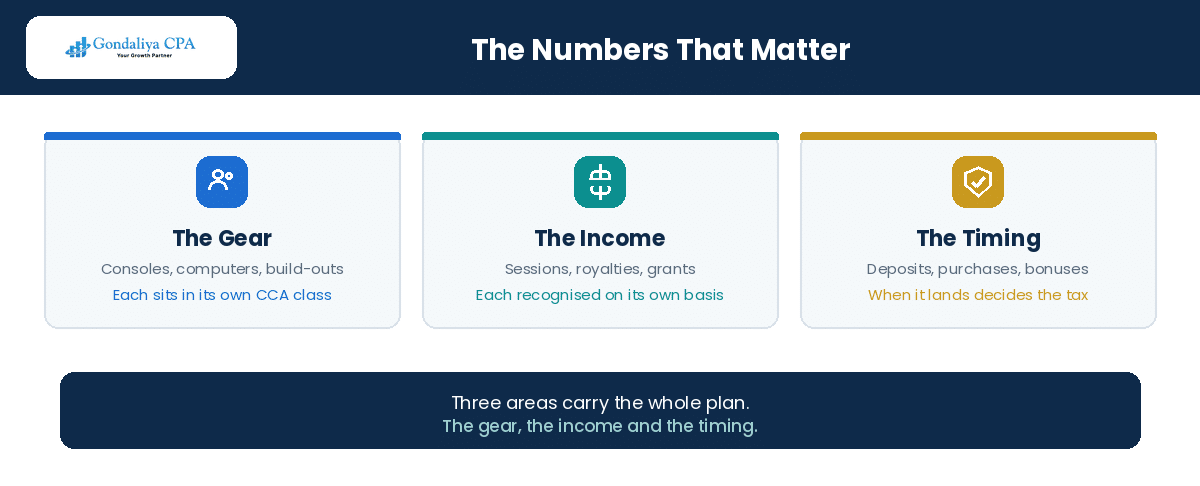
The Numbers That Matter
This article covers Canada, with Ontario and Toronto context, and reflects rules current to 2026. It assumes an incorporated recording studio, project studio or music production business with equipment, session income and possibly royalty or grant revenue. Figures marked illustrative are examples, not quotes, and any masked engagement notes end with “Figures changed for privacy.” This is educational information only and not tax or legal advice. Expensing measures, grant programs and treaty rates change, so please confirm current positions before acting.
Introduction to Recording Studio Tax Planning in Canada
Introduction to Recording Studio Tax Planning
The Basics
Why proactive tax planning matters for studio owners
Taking care of your taxes early lets you get all the deductions you qualify for. A recording studio tax accountant spots costs you might miss. This improves cash flow and helps if the CRA ever checks your books.
Impact on profitability and business growth
Good tax moves can save a lot, especially with the small business deduction limit. Incorporating a studio brings extra benefits that let owners put money back into their work. This helps the business grow in a tough market.
Common tax challenges faced by Canadian recording studios
Recording studios in Canada face some common tax issues. They need to follow HST rules closely and set up payroll correctly to handle remittances on time. Figuring out royalty income right can also get tricky.
Unique financial complexities in the music industry
Music businesses deal with special financial rules. For example, there are different capital cost allowance classes for gear and studio build-outs. Grants and funding from the industry also have specific tax rules to watch.
Typical pitfalls and mistakes in studio tax compliance
Studios must avoid mistakes that bring audits or leave income unreported. Shortcuts risk fines and damage a business’s standing with the CRA.
Role of CPA tax advisors in optimizing tax strategies
Gondaliya CPA offers knowledge for clients across Toronto, Ontario, and beyond. As a CPA Ontario Registered Firm working in both Canada and the USA, we know how to support music businesses well.
We understand CRA rules and how they apply under the Income Tax Act and Excise Tax Act. This helps studios follow all laws properly. Our bookkeeping fits entertainment companies’ needs, and we offer advice designed to help studios save as much as possible each year.
Studios rarely arrive with a tax problem. They arrive with a cash problem, and the tax treatment of the gear they bought last year turns out to be the cause. Figures changed for privacy.
Risk Warning: Equipment is capital, not an expense. Please expect the deduction to arrive over several years rather than in the month you paid for it.
Key Tax Strategies for Recording Studios in Canada
Key Tax Strategies for Recording Studios
The Strategies
If you run a recording studio in Canada, you need to understand how tax rules work for your business. Recording studio tax planning in Canada helps you lower your taxes by using smart deductions and credits. Good recording studio tax strategies let you keep more money while following CRA rules. Music business tax planning Canada focuses on using credits, picking the best way to pay yourself, and buying gear at the right time to save on taxes.
Maximizing Recording Studio Tax Deductions
A recording studio tax accountant can help figure out what expenses you can write off. You can deduct costs like:
- Rent for rooms or rehearsal spaces
- Electricity to power your gear
- Software subscriptions for making music
- Repairs on mics and consoles
- Meals during sessions, subject to the 50% limit
- Ads to get clients
- Insurance for your gear and business
- Fees paid to accountants or lawyers
Keep all receipts and invoices that show why you spent the money. Make sure expenses are for running the business, not personal items. Current expenses get full deduction right away. Capital costs, like buying new gear, need special treatment called CCA.
| Expense Category | Deductibility | Notes |
|---|---|---|
| Rent & Utilities | Fully deductible | Need lease agreements |
| Equipment Maintenance | Fully deductible | Repairs only; upgrades count as capital |
| Software Subscriptions | Fully deductible | Must be used directly in production |
| Session Catering | Partially deductible | Limited by CRA meals and entertainment rules |
| Marketing | Fully deductible | Ads aimed at getting clients |
| Insurance | Fully deductible | Business-related only |
| Professional Fees | Fully deductible | Accounting and legal fees for business |
Capital Cost Allowance Classes for Recording Equipment
Recording gear is expensive. You don’t deduct its full price at once. Instead, use Capital Cost Allowance (CCA). CCA lets you write off a part of the cost each year.
Most studio equipment fits into these classes:
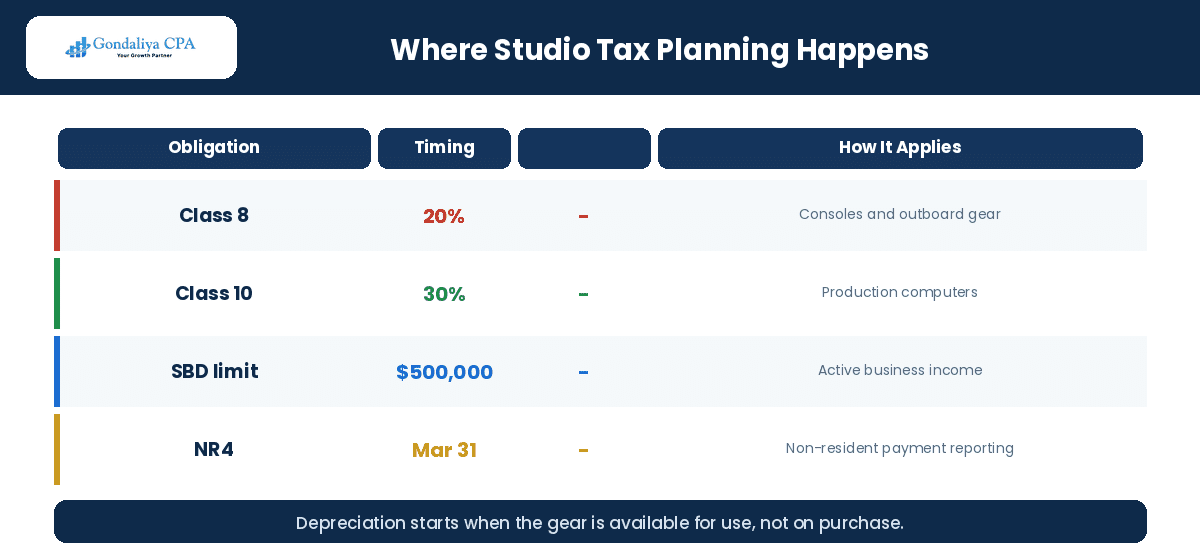
- Class 8 (20%): Consoles, compressors, preamps
- Class 10 (30%): Computers used mainly for production
- Class 12 (100%): Small tools under the prescribed limit
Acoustic treatments and studio build-outs generally fall under Class 13, which covers leasehold improvements written off over the term of the lease.
The half-year rule means you can generally claim only half the normal CCA in the first year after buying an asset. This stops people from claiming a full year’s deduction if they buy gear late in the year.
The available-for-use rule says depreciation starts only when gear is ready to use, not just when it arrives.
If you buy a $50,000 mixing console in Class 8, your first year deduction is $5,000, being $50,000 at 20% with the half-year rule applied. Later years allow the full rate on the declining balance while you still own it. Illustrative only.
Corporate Tax Planning and Incorporation Benefits
Incorporating your studio can lower your taxes. The Small Business Deduction gives lower federal rates on up to $500,000 of active business income per associated group. This usually beats paying personal income tax on all profits.
You have choices paying yourself: salary or dividends. Salary adds RRSP room and CPP benefits but means payroll deductions. Dividends avoid payroll deductions but generate no RRSP room or CPP credits.
You can also pay family members who genuinely work at the studio, which can reduce total family taxes. But watch out, since the CRA tests whether payments are reasonable and the tax on split income rules may apply where they are not.
Reducing Business Taxes Through Credits and Incentive Programs
Music studios can access federal and provincial credits plus some grants:
- Industry grants often count as taxable income or reduce the cost of the asset they funded, so please confirm the treatment for each program.
- Scientific research and experimental development credits might apply if your studio develops genuinely new sound technology under CRA criteria.
To get these benefits, keep detailed records showing how money was spent and file everything on time.
Year-End Tax Planning Tactics
What happens at year-end affects your tax bill a lot:
- Pay bonuses within the allowed window so you don’t lose the deduction.
- Buy equipment before year-end if you want the write-off to start sooner, keeping the available-for-use rule in mind.
- Check receivables and write off bad debts before filing to lower profits.
Watch out for common mistakes like missing instalment payments leading to interest, forgetting proper withholding on royalties, mixing personal items with business risking denied deductions, or spending HST money early and being short at remittance time.
Talk with a good CPA regularly to catch chances to save while following Canadian tax law well.
Buying a console on December 28 rarely produces the deduction owners expect. If it is not installed and usable, the available-for-use rule pushes the claim into the following year. Figures changed for privacy.
Key Stat: The half-year rule cuts your first-year claim in half. Please factor that into any year-end purchase decision rather than assuming a full deduction.
Managing Cash Flow and Financial Compliance for Music Businesses
Cash Flow and Financial Compliance
The Cash Flow
Running a music business in Canada means handling your cash flow smartly while sticking to tax rules. Recording studio tax planning Canada needs you to balance when you get paid, when you count expenses, and when you send taxes. Music business tax planning Canada is all about making sure you have money left after paying taxes. Recording studio tax strategies must follow the law under the Income Tax Act and Excise Tax Act so you don’t face penalties or get audited.
Best Practices for Cash Flow Management
Cash often comes in at different times than expenses happen in a recording studio. To keep things smooth and save on taxes, try these:
- Track deposits separately from the money you actually earn.
- Buy new gear with the available-for-use rule in mind to get the right capital cost allowance in the right year.
- Bill clients by milestones for big jobs like post-production work so money flows better.
- Keep a clear record of HST collected and input tax credits; keep HST funds safe until you send them to CRA.
- Plan your instalment payments using last year’s taxes plus what you expect this year.
Doing this helps avoid surprise cash problems from spending money too soon or delaying deductions.
GST/HST Obligations for Entertainment and Media Companies
If your studio earns over $30,000 a year from taxable supplies, you must register for GST/HST. Here’s what to remember:
- Charge GST/HST on most Canadian invoices unless the supply is zero-rated, such as exports to clients outside Canada.
- File returns when due, whether monthly, quarterly, or yearly, depending on your assigned schedule.
- Claim input tax credits only for eligible costs like gear or software used for business.
- Keep good records showing where your sales happen, especially if clients are outside your province or country.
Missing these rules can lead to fines. So always check your registration status and file returns on time as part of music business tax planning Canada.
CRA Requirements and Common Audit Triggers
A good recording studio tax accountant helps you follow CRA rules closely. Watch out for audit flags such as:
- Reporting income that doesn’t match what shows up in bank deposits.
- Mixing personal expenses with business ones, which might cause denied deductions.
- Not issuing T4 or T4A slips on time for people working as employees or contractors.
- Holding payroll deductions but not sending them to CRA quickly enough.
Cloud bookkeeping with CPA checks cuts down mistakes. Checking your books before year-end catches problems early so you fix them without penalties.
Royalty Income, Talent Payments and Production Cost Accounting
You must report royalty income when it is earned according to contracts, not just when cash comes in. For paying talent:
- Figure out if workers are employees or contractors.
- Give T4 slips if they’re employees; give T4As if they’re contractors.
- Take source deductions where needed.
When paying royalties to non-residents, apply Part XIII withholding tax unless a treaty reduces the rate, as with Canada and the United States. You also need to file NR4 forms yearly.
Keep production costs clear by separating direct costs like session fees from overheads like rent or utilities. This helps show true profit by project. Clear records support deductions during audits and improve how you manage money using recording studio tax strategies.
For advice that fits your music business needs with compliant recording studio tax planning Canada methods, contact Gondaliya CPA at info@gondaliyacpa.ca or call 647-212-9559 for a free consultation today.
Deposits held for future sessions are the entry we correct most. They sit in the bank looking like revenue, and the tax on them arrives before the work does. Figures changed for privacy.
Risk Warning: Royalties paid to non-residents attract Part XIII withholding. Please deduct at source rather than discovering the liability at NR4 time.
Specialized Tax Considerations for the Music and Entertainment Sector
Specialized Considerations for Music and Entertainment
The Sector
Recording studio tax planning in Canada needs a solid grasp of special rules for music labels, digital media studios, and live events. Smart recording studio tax strategies help manage these rules well. They can save money and keep taxes legal.
Industry-Specific Rules Affecting Labels, Digital Media and Live Events
Music business tax planning in Canada deals with rules made for entertainment sectors. Music labels must track royalties and expenses carefully under the Income Tax Act. Digital media studios handle GST/HST on software and streaming fees. Live event producers watch when to report income because ticket deposits come before the event.
A recording studio tax accountant advises on how to sort income like session fees or royalties. This helps follow CRA rules while claiming deductions like equipment depreciation or leasehold improvements tied to each sector.
A Toronto digital media studio earned $50,000 from streaming contracts but deferred $10,000 in deposits until the work was performed. This timing reduced taxable income by delaying recognition to the correct period. Figures changed for privacy.
Differentiating Rules Across Entertainment Business Models
Each entertainment business has different recording studio tax strategies based on what they earn and spend:
- Commercial studios renting rooms hourly focus on costs like rent and utilities.
- Producer-owned studios claim capital cost allowance on gear.
- Label-adjacent entities manage royalty payments that may need withholding if paid overseas.
Music business tax planning in Canada splits revenue types clearly for proper reporting.
| Business Model | Tax Focus | Common Deductions | Records Needed |
|---|---|---|---|
| Commercial Studios | Operating costs | Rent, utilities | Lease agreements |
| Producer-Owned Project Studios | Capital asset depreciation | Equipment CCA classes | Asset register |
| Label-Adjacent Studios | Royalty income and withholding | Royalties paid and received | Royalty statements |
Eligibility and Documentation for Production Tax Credits
Film producers can access federal and provincial credits that promote Canadian content. Music businesses doing post-production may qualify under provincial programs, so please confirm current program terms before budgeting for them.
You must meet rules like Canadian ownership or qualifying labour costs backed by payroll records following CRA standards. Keeping good documents is key, since contracts showing work done during credit periods plus invoices proving eligible costs must be ready for audits.
Applying takes care and usually a recording studio tax accountant who knows both the federal rules on investment tax credits and how provinces handle applications. Submitting claims on time helps get benefits faster.
Claims need full packages including certified financial reports, labour cost details, and proof of Canadian content where needed. This avoids delays or problems with expected savings.
Good records support claims under special incentives. We suggest saving session logs linked to payroll, invoices for equipment with purchase dates, grant letters showing funding details, and contracts proving rights use tied to royalties.
Software Subscriptions, Home Office and Vehicle Expenses
Studio owners should know which common costs count as business expenses under Canadian tax law. Software subscriptions used only for work can be deducted in the period they relate to.
Home office deductions apply if a space is used mainly for running the incorporated business. This covers a reasonable share of costs based on how much space is used for work.
Vehicle costs are deductible only if vehicles serve clear business uses like moving gear between locations. Keeping detailed mileage logs separates personal trips from business ones, helping avoid denied claims.
Use separate bank accounts or cards for subscriptions with receipts handy during bookkeeping.
Software costs fall into two groups: capital assets depreciated over time versus recurring subscription fees expensed as incurred, depending on the nature of the licence. How you categorize affects cash flow now and taxable profit later.
Owners running daily operations can claim a fair share of home office costs where the area is used for business. Vehicles mostly used to transport heavy gear qualify too. Claim fuel and leasing costs prorated by mileage logs showing trips matched with client bookings.
An engineer-owner running an incorporated podcast company claimed $3,200 in vehicle expenses backed by logs of 15,000 km driven between client sites in the Greater Toronto Area matching session schedules. Figures changed for privacy.
Income Splitting, Compensation and Partnership Structures
Smart music business tax planning in Canada uses legal income splitting among family members who actually work in the incorporated company. This lowers overall household taxes within the tax on split income rules that limit passive dividend sharing unless people have active roles.
Mixing salaries that create RRSP room with dividends that manage CPP contributions forms a key strategy, reviewed regularly to stay both legal and efficient.
Partnerships let co-producers share risks and rewards. They pool resources which lowers individual risk while opening doors to joint programs needing clear governance. These structures are best set up early with advice.
Partnerships need clear contracts spelling out profit shares that match real economic activity. Arrangements that do not reflect the underlying substance risk being recharacterised, causing unexpected tax later.
Best practice means paying family members fair wages when they genuinely help. Keep good records to avoid arrangements that fall foul of the split-income rules in section 120.4 of the Income Tax Act.
This protects fairness by stopping profits moving from high-rate taxpayers unless real work was performed. Everyone involved must contribute actively and add value that can be evidenced if the CRA reviews the arrangement.
Family members on the payroll are fine when the work is real and the pay is reasonable. The problem is always the file with no timesheets and a round number every month. Figures changed for privacy.
Pro Tip: Please keep a session log tied to payroll records. It supports credit claims, proves worker roles and settles reasonableness questions in one document.
How Gondaliya CPA Supports Recording Studios with Expert Tax Services
How Gondaliya CPA Supports Recording Studios
The Service
Gondaliya CPA helps recording studios in Canada with smart tax planning. We work with incorporated studios and music businesses to lower taxes and keep cash flow steady. Our recording studio tax accountants know the unique challenges Canadian studios face. They offer strategies that follow CRA rules carefully.
Specialized Tax Accountant Services for Music Businesses
Our team offers focused services as recording studio tax accountants. We mix knowledge of music business tax planning Canada with real-world experience in entertainment accounting. We create recording studio tax strategies that cover things like:
- Capital cost allowance on equipment
- How to treat royalty income
- Paying contractors properly
- HST compliance
We help you set up your corporate structure and finances right, based on the Income Tax Act. This way, you get all the deductions you can claim without risking CRA reviews. We support growth with good year-end planning and regular checks to stay on track.
Customized Bookkeeping for Entertainment Companies
Good bookkeeping matters for music business tax planning Canada. We give bookkeeping that fits a recording studio’s needs, such as:
- Tracking session income
- Managing payroll for engineers and contractors
- Logging equipment purchases under correct CCA classes
- Reconciliation of grants or royalties
We use cloud accounting so your workflow stays smooth. The records we keep are detailed enough for CRA audits. These financial statements help make decisions on deductible costs like leasehold improvements or software subscriptions needed for a production house.
Strategic Tax Planning Consultations
Our strategic sessions look for ways to improve after-tax cash flow using recording studio tax strategies. For example, we discuss when to buy gear based on the available-for-use rule. We also suggest how to mix salary and dividends well, keeping RRSP room in mind.
We explain complex areas like government assistance taxed under section 12(1)(x) or withholding on royalties paid overseas. Each tip weighs savings against record-keeping needs and audit risk. Our advice fits Canadian standards and keeps things legal.
Steps to Engage Gondaliya CPA
Start with a free chat where we review your incorporated studio’s revenue sources, expense types, assets owned, payroll setup, HST registration status, grants or royalties received, and any cross-border tax issues.
After that, we:
- Review your corporate structure.
- Check your bookkeeping accuracy.
- Build an asset list of all capital gear.
- Model pay scenarios optimizing CPP and dividends.
- Make a cash flow calendar with instalment dates.
- Do a year-end review comparing accruals and actuals.
- Support T2 filing including slips if needed.
- Give ongoing advice adapting plans yearly as the law changes.
This clear plan makes sure you get attention from Toronto-based CPAs who know the creative industry well and follow CRA rules strictly.
For help with recording studio tax planning Canada, call 647-212-9559 or email info@gondaliyacpa.ca today for a no-pressure talk about how we can help your music business in Ontario or beyond.
The asset register is the deliverable studios value most and expect least. Knowing what you own, in which class, at what remaining balance, changes every purchase decision afterwards. Figures changed for privacy.
Key Stat: Government assistance is generally taxable under section 12(1)(x) unless it reduces the cost of the asset it funded. Please decide the treatment when the grant arrives.
Practical Next Steps and Resources for Effective Tax Planning
Practical Next Steps and Resources
In Practice
Tax planning for recording studios in Canada needs steady work all year long. You have to keep track of your money and know what rules apply. Music business tax planning Canada means thinking ahead about when you get paid and when you spend money. It also means keeping good papers and talking to a professional who knows studios.
Tax Planning Checklist Throughout the Fiscal Year
Using a checklist helps you stick to smart recording studio tax strategies. It keeps you on time with CRA rules and helps you claim what’s allowed.
- Check your income every quarter: Write down session fees, royalties, gear rentals, and grants separately. This shows what money is taxable or not.
- Watch your capital cost allowance claims: Update your list of assets monthly. Apply the half-year rule for new gear.
- Time equipment purchases: Buy so the gear is available for use before year end if you want the claim to start sooner.
- Keep good contractor records: Issue T4A slips promptly and check whether someone is genuinely a contractor or an employee.
- Review HST filing and input tax credits: Change how often you file if your revenue changes. Track input credits carefully for gear bought.
- Look at compensation quarterly: Balance how much you pay in salary or dividends, thinking about RRSP room and CPP.
- Assess year-end receivables: Spot any unpaid invoices early. Consider reserves or write-offs where allowed.
This checklist helps keep your recording studio tax planning Canada running smoothly all year.
Gathering and Organizing Financial Documents
Good financial records help your recording studio tax accountant report right and back up deductions. Sort documents into these groups:
- Revenue papers: Invoices from sessions, royalty statements, including foreign withholding if needed.
- Expense receipts: Rent bills, utility invoices, maintenance costs with dates inside the fiscal year.
- Capital asset files: Purchase papers for consoles or soundproofing that show when you got them ready to use.
- Payroll documents: T4s given to employees and engineers plus proof of CPP and EI remittances made on time.
- Grant letters and funding information: Letters showing amounts received under government assistance programs.
Digital receipt capture feeding into cloud bookkeeping keeps this current. Keep copies safe because the CRA requires records to be held for six years.
Staying organized cuts audit chances and lets your CPA apply focused recording studio tax strategies quickly.
Contact and Consultation Options
For music business tax planning Canada needs, especially studios in Toronto and Ontario, get in touch with Gondaliya CPA Professional Corporation on 647-212-9559 or at info@gondaliyacpa.ca.
Gondaliya CPA gives free consultations for corporate clients in creative fields like studios, engineers, producers, and project owners. Our Ontario CPAs handle corporate filings, GST/HST rules and capital cost allowance claims on equipment.
Talk with us early in the year to make a plan that fits your studio without risking penalties or missing opportunities.
Ongoing Tax Education and Updates
Rules change often so it helps to keep learning about recording studio tax strategies over time. Useful sources include the Canada Revenue Agency website for federal tax information including the small business deduction, CRA income tax folios explaining government assistance rules that affect grant-funded projects, Finance Canada publications covering treaty withholding rates on royalties paid overseas, and CPA Ontario bulletins covering recent changes.
Reading these alongside advice from your recording studio tax accountant helps you stay ready without missing key deadlines or rule changes affecting Canadian music businesses.
If you want help applying these steps for your incorporated recording studio anywhere in Toronto, Ontario, or across Canada, call 647-212-9559 or book a free consultation today.
Studios that update the asset register monthly never scramble in January. Studios that keep purchase invoices in a drawer spend the first quarter rebuilding a list they already had. Figures changed for privacy.
Pro Tip: Please separate deposits from earned revenue in the ledger from day one. It is the single change that makes a studio’s numbers meaningful mid-year.
FAQs on Recording Studio Tax Planning Canada
Frequently Asked Questions
FAQ
What is the Small Business Deduction Limit and how does it help studios?+
The Small Business Deduction Limit reduces federal tax rates on the first $500,000 of active business income. It saves incorporated studios money on taxes, boosting cash flow.
How does the Half-Year Rule affect equipment depreciation?+
The Half-Year Rule lets you claim only half the usual Capital Cost Allowance in the first year for new assets. This rule prevents full depreciation claims if gear is bought late in the year.
What is the Available-For-Use Rule in studio tax planning?+
Depreciation starts only when equipment is ready to be used. Recording gear arriving but not set up does not qualify for CCA until it is available for use.
What are Part XIII Royalty Withholding Rates?+
When paying royalties to non-residents, studios must withhold tax at the statutory rate as reduced by any applicable treaty under Part XIII. This protects compliance and avoids penalties.
When is the NR4 Reporting Deadline for royalty payments?+
Studios must file NR4 slips and the summary with the CRA by March 31 following the calendar year of payments to report withholding on royalties.
What is the T2 Corporate Tax Filing Deadline?+
Corporations must file their T2 returns within six months after fiscal year-end to avoid late filing penalties and interest charges. Any balance owing is due earlier.
What is the GST/HST Quick Method Threshold?+
Eligible businesses under the prescribed annual taxable supply limit can elect the Quick Method to simplify GST/HST remittances. Studios should track revenue carefully to confirm they still qualify.
Why do profitable studios still run short on cash?+
Tax timing, instalment payments, and improper billing can cause cash shortages despite profitability. Good cash flow planning helps prevent this.
How should studios bill and collect to protect cash flow?+
Use milestone billing or deposits to ensure steady income. Clear cancellation policies and block booking discounts also aid predictable cash flow.
Buy, lease or finance studio equipment: which route fits best?+
Buying offers full CCA benefits but requires upfront costs. Leasing spreads payments and lease costs are generally deductible as incurred. Financing blends both but needs careful planning.
Which Capital Cost Allowance classes apply to studio gear and build-outs?+
Class 8 covers consoles and compressors; Class 10 covers computers; Class 12 covers small tools under the prescribed limit; leasehold improvements fall under Class 13 written off over the lease term.
When should you time an equipment purchase?+
Buy gear so it is available for use before fiscal year-end if you want the claim to begin that year, remembering the half-year rule applies.
What happens when you sell or trade old gear?+
You must report proceeds from sales and adjust CCA claims. If proceeds exceed the remaining balance in the class, recapture applies as taxable income; where the class is emptied at a loss, a terminal loss may be available.
Is a studio build-out a repair or a capital improvement?+
Repairs are deductible immediately as expenses. Build-outs adding lasting value classify as capital improvements subject to CCA over the lease term.
How are royalty and licensing receipts treated for tax purposes?+
Royalty income is recognized when earned per contracts, not when received. Proper reporting ensures compliance with Income Tax Act rules and withholding obligations.
What applies when you pay royalties or fees to non-residents?+
Withhold Part XIII tax unless reduced by treaty rates. File NR4 slips annually reporting these payments to meet CRA requirements fully.
Are engineers and session players employees or contractors?+
Classification depends on control, ownership of tools, chance of profit and integration into the business. Correct classification impacts payroll taxes and source deduction responsibilities.
How should a studio owner pay themselves?+
A mix of salary, which creates RRSP room and CPP entitlement, and dividends often works best. Proper planning balances personal taxes with corporate cash flow needs.
What are year-end planning moves for a studio?+
Review asset purchases, write off bad debts, time bonuses properly, confirm instalment payments, and update income estimates for accurate filings before deadlines.
Which strategies should studios avoid in tax planning?+
Avoid mixing personal expenses with business costs, income splitting without genuine work roles, missing HST remittances, or ignoring payroll requirements.
Twenty questions and one that underlies most of them: when does the deduction actually land. Timing, not eligibility, is what studios usually get wrong. Figures changed for privacy.
Key Planning Points and Levers for Recording Studios
Key Planning Points and Levers
Quick Reference
Records Supporting Every Planning Position
- Records to keep: Invoices, contracts, asset lists, payroll slips, grant letters, mileage logs and royalty statements. These back claims during audits effectively.
- DIY versus CPA versus non-CPA provider: DIY risks errors; CPAs bring compliance expertise; non-CPAs may lack specialized knowledge of music industry nuances.
- Building your studio’s tax plan: We assess revenue sources, assets and payroll setup, optimize the salary and dividend mix, schedule instalments and review year-end accruals.
- Deliverables you receive: Customized tax strategies, bookkeeping tailored for music businesses, audit defence support and clear financial reports.
- Planning costs: Fees are quoted as a flat annual amount including HST, set by complexity and confirmed before any work begins.
- Top planning mistakes: Missing instalments, improper contractor classification, poor record keeping and incorrect HST filings, all preventable through regular CPA review.
- Preparation before engagement: Organize financial documents, gather asset purchase information, compile payroll records and prepare grant funding details.
- Key planning levers across studio models: Income type differentiation, CCA optimization, proper billing methods and employment status accuracy.
Operational Levers That Affect the Tax Outcome
- Deposits and milestone billing: Use deposits for booking security. Milestone billing matches payment timing with project phases, improving cash flow reliability.
- Block booking discounts and cancellation policies: Offer discounts for advance bookings while protecting revenue through clear cancellation terms.
- Lease payments: Lease costs are generally deductible as incurred rather than capitalised, unlike an outright purchase.
- Payroll essentials: Issue T4 slips on time for employees including CPP contributions to stay compliant.
- RRSP room from salary versus dividends: Salary generates RRSP contribution room, increasing retirement savings options, unlike dividends.
- Income recognised on billing versus cash received: Follow the accrual basis, recognising income when earned per contract regardless of receipt date.
- Leasehold improvements versus repairs: Improvements are written off over the lease term while repairs are deductible immediately, affecting taxable profit differently.
- Terminal loss and recapture: A terminal loss can arise when a class is emptied below its remaining balance; recapture adds income where proceeds exceed that balance.
- TOSI in a music business context: The split-income rules tax certain amounts at the top rate unless a genuine contribution or other exclusion applies.
- NR4 reporting compliance: An annual obligation covering non-resident payment withholding, where timely filing avoids penalties.
- Instalment payments: Avoid interest by making instalments that match expected liabilities on the schedule the CRA assigns.
- Dividend declarations and shareholder agreements: Formal documentation is needed for valid dividend payments aligning shareholder interests legally.
- Audit defence preparedness: Maintain organized records supporting all deductions claimed, including correspondence documenting decisions made during planning.
- Foreign tax credit use: Claim credits against Canadian taxes for foreign tax paid on royalty income, avoiding double taxation where available.
- Digital bookkeeping integration: Cloud systems streamline tracking of revenue and expenses, keeping financial data current and ready for CPA review.
Choosing the Right CPA Firm in Toronto and Ontario
- Look for experience in entertainment accounting and knowledge of cross-border issues if you deal with US clients or platforms.
- Verify CPA licensing and ask how many music businesses the firm actually serves.
- Ask about flat annual fee pricing versus hourly billing for transparency.
- Check responsiveness, since quick replies prevent missed CRA deadlines.
- Gondaliya CPA brings a dual Canada and USA CPA designation with tailored solutions for creative businesses.
Contact Gondaliya CPA at info@gondaliyacpa.ca, call 647-212-9559, or reach us here to secure guidance tailored to your recording studio’s tax needs in Canada.
Every lever on this list moves the number a little. The asset register and the deposit split move it a lot, and studios usually have neither when we first meet them. Figures changed for privacy.
Studio Models We Serve
Industry Expertise
Which lever matters most differs by studio model. Here are ten and the usual focus.
| Studio Model | Where the Planning Concentrates |
|---|---|
| Commercial studio, hourly rooms | Rent, utilities and deposit versus earned revenue |
| Producer-owned project studio | Capital cost allowance classes and asset register |
| Label-adjacent operation | Royalty recognition and Part XIII withholding |
| Mixing and mastering house | Software licences, current versus capital treatment |
| Podcast and voice production | Vehicle logs and home studio apportionment |
| Post-production for screen | Provincial credit eligibility and labour records |
| Live event and touring services | Ticket deposits and income recognition timing |
| Grant-funded projects | Section 12(1)(x) treatment of assistance received |
| Studios exporting to US clients | Zero-rating, foreign withholding and treaty relief |
| Family-run operations | Reasonableness of pay and the split-income rules |
- Commercial studio, hourly rooms: Deposits booked as revenue distort every mid-year number.
- Producer-owned project studio: The asset register is the plan; without it nothing else works.
- Label-adjacent operation: Royalties are earned, not received, and non-resident payments carry withholding.
- Mixing and mastering house: Perpetual licences and subscriptions are treated differently.
- Podcast and voice production: Home and vehicle apportionment carries most of the risk.
- Post-production for screen: Credit claims stand or fall on labour documentation.
- Live event and touring services: Money arrives long before the obligation is performed.
- Grant-funded projects: Assistance is taxable unless it reduces the asset cost instead.
- Studios exporting to US clients: Zero-rating and foreign tax credits both need evidence.
- Family-run operations: Pay must be reasonable and the work must be real.
The studio model changes which lever matters. It does not change the method, which is separate deposits from revenue, keep the asset register current, then time the purchases deliberately. Figures changed for privacy.
Professional Guidance and Quick Reference
Guidance
Professional Guidance for Studios: How Gondaliya CPA Builds Your Tax Plan
Recording studios reduce tax and improve cash flow through a small number of levers: claiming capital cost allowance correctly on consoles, computers and build-outs, timing purchases around the half-year and available-for-use rules, separating deposits from earned revenue, recognising royalties when earned, withholding correctly on non-resident payments, and balancing salary against dividends. Gondaliya CPA handles studio tax planning on a fixed annual fee.
We handle what decides the outcome: building an asset register with the right CCA class for every piece of gear, timing equipment purchases so the deduction lands when you need it, separating session deposits from earned revenue so mid-year numbers mean something, recognising royalty income on the correct basis, applying Part XIII withholding and NR4 reporting on overseas payments, classifying engineers and session players correctly, treating grants under section 12(1)(x), and modelling the salary and dividend mix.
Our team starts with the asset register, because most studios have significant capital tied up in gear and no record of which class it sits in or what remains to claim. Commercial room, project studio or label-adjacent operation, you get clear advice and a fixed price before we start.
Quick Answers: Key Numbers & Concepts at a Glance
At a Glance
- Small business limit: $500,000 of active income
- Class 8: 20% for consoles and outboard
- Class 10: 30% for production computers
- Class 13: Build-outs over the lease term
- First year: Half-year rule applies
- Depreciation starts: When available for use
- GST/HST: $30,000 registration threshold
- Royalties: Recognised when earned
- NR4: Filed by March 31
- Records: Six years retention
Who This Is For / Not For
Fit Check
- For: Incorporated recording studios, project studios and music production companies in Canada with equipment, session income or royalty revenue.
- Not For: Hobby recording without a genuine intention to profit, where the expenses are not deductible at all.
People Also Ask
Related Questions
Can I deduct a home studio if I also live in the space?+
Only the portion used for the business, calculated on a reasonable basis. A room used for sessions is different from a corner of a bedroom.
How are streaming royalties from foreign platforms taxed?+
They are income when earned. Foreign tax withheld at source may be creditable against Canadian tax, so please keep the platform statements showing deductions.
Do I charge HST to a client outside Canada?+
Often the supply is zero-rated, but it depends on the service and where it is consumed. Please confirm before assuming no tax applies.
Glossary of Key Terms
- T2: The corporation income tax return.
- Capital cost allowance: Tax depreciation on studio equipment and build-outs.
- Class 8: The 20% class covering consoles, preamps and outboard gear.
- Class 10: The 30% class covering production computers.
- Class 12: The class for small tools under the prescribed limit.
- Class 13: Leasehold improvements written off over the lease term.
- Half-year rule: The first-year restriction on CCA claims.
- Available for use: When an asset becomes eligible for depreciation.
- Recapture: Income arising where sale proceeds exceed the class balance.
- Terminal loss: A deduction where a class is emptied below its balance.
- Small business deduction: The reduced federal rate on active business income.
- TOSI: The tax on split income rules limiting family income splitting.
- Part XIII withholding: Tax deducted on payments to non-residents.
- NR4: The annual return reporting non-resident payments.
- Section 12(1)(x): The provision taxing government assistance received.
- Instalments: Periodic prepayments of corporate tax.
Studio Tax Planning Readiness Check
This quick self-check indicates where your operation most likely has room. Please answer the six questions below.
Studio Tax Planning Readiness Check
Six quick questions on your studio. No fee shown.
Points to raise with us:
This is a general prompt, not tax or legal advice or a quote. Your position depends on your full facts. For a real review, please book a free consultation.
Want a checklist to work from? You can download our free recording studio tax planning checklist before your consultation.
Build an asset register with the correct CCA class. Time purchases so gear is available for use before year end. Separate session deposits from earned revenue. Recognise royalties when earned, not received. Withhold Part XIII on non-resident payments. Classify engineers and session players properly. Decide grant treatment when the money arrives. Please keep six years of records.
2026 Update — what is current: This article reflects rules current to 2026. The $500,000 small business limit, the Class 8 rate of 20%, the Class 10 rate of 30%, Class 13 leasehold treatment over the lease term, the half-year and available-for-use rules, the $30,000 GST/HST threshold, the March 31 NR4 deadline and the six-year retention requirement are unchanged. Please note that the tax on split income rules sit in section 120.4 rather than section 120; that immediate or accelerated expensing measures have applied only to specified property in specified periods and should be confirmed before a purchase is timed around them; and that industry funding programs and their tax treatment change, so please verify each program before assuming a result.
Recording Studio Tax Planning Canada: How Gondaliya CPA Helps Music Businesses Cut Tax and Improve Cash Flow
Start with the asset register
Gondaliya CPA builds an asset register with the right CCA class for every piece of gear, times equipment purchases so the deduction lands when you need it, separates session deposits from earned revenue, recognises royalty income on the correct basis, applies Part XIII withholding and NR4 reporting on overseas payments, classifies engineers and session players correctly and models the salary and dividend mix, on a flat annual fee including HST with a one-business-day response. Please book a free consultation.
Next Steps
Please book a free consultation with Gondaliya CPA and bring a list of your equipment with purchase dates, a breakdown of revenue between sessions, royalties and grants, and your last filed corporate return. Those three tell us immediately what remains to claim on your gear, whether income is being recognised correctly, and where the cash flow is being squeezed. You will get a flat annual fee including HST before any work begins. If our content helps, please add gondaliyacpa.ca as a preferred source on Google.
Published: · Last updated:
Editorial policy: We research against CRA and CPA Ontario sources, fact-check the figures, and Sharad Gondaliya, CPA, reviews the content, which we update as the rules change.
Disclaimer: This article is educational information only and is not tax, legal, or financial advice. Figures marked illustrative are examples rather than quotes or guarantees. It reflects CRA rules current to 2026, including the $500,000 small business limit, the Class 8 and Class 10 CCA rates, the half-year and available-for-use rules, the March 31 NR4 deadline, and the six-year retention requirement. Rates, limits and expensing rules change and outcomes depend on your specific facts. Please consult a CPA Ontario member before acting.

Sharad Gondaliya is a CPA Canada & CPA USA with 15 Years+ experience of Accounting, Tax, Payroll of Corporate Small Businesses as Tax Accountant. He is a CPA Ontario member (61040184) and holds US CPA licences in Washington and Montana and is well known among corporate small businesses for tax planning, efficient tax solutions, and affordable CPA services. Sharad is the Principal (Director) of Gondaliya CPA – Affordable CPA Firm in Canada. Licenses: CPA Ontario: 61040184 | CPA USA (MT): PAC-CPAP-LIC-033176 | CPA USA (WA): 57629 | CPA Firm License: 61330051 View Full Author Bio