



Common Tax and Accounting Mistakes Retirement Homes Make in Canada and How to Avoid Costly CRA Problems
Retirement Home Tax Mistakes Canada: Avoid Common Accounting and Senior Care Bookkeeping Errors for Better CRA Compliance
Retirement home tax mistakes Canada often stem from errors in accounting and senior care bookkeeping, which can lead to compliance issues with the CRA. Gondaliya CPA highlights key areas such as retirement home accounting mistakes and proper record keeping to help operators maintain accurate financials and avoid penalties.
Quick Summary
Retirement homes in Canada often run into tax issues that cost money. These problems usually come from errors in how they handle their accounts and books. Common mistakes include wrong subsidy recording, payroll mix-ups, miscalculating capital cost allowances, wrong input tax credit allocations, and thinking all resident income is exempt from GST/HST. Fixing these issues helps avoid penalties from the Canada Revenue Agency (CRA).
Reading time: 48 minutes.
Table of Contents
- Key Accounting and Bookkeeping Errors
- Nursing Homes Versus Retirement Homes
- Strategies for Accurate Filing and Compliance
- Examples and Case Studies
- Preventing Mistakes and Maintaining Compliance
- How Gondaliya CPA Supports Operators
- Frequently Asked Questions
- Checklists and Warning Signs
- Facility Situations We Handle
- Professional Guidance and Quick Reference
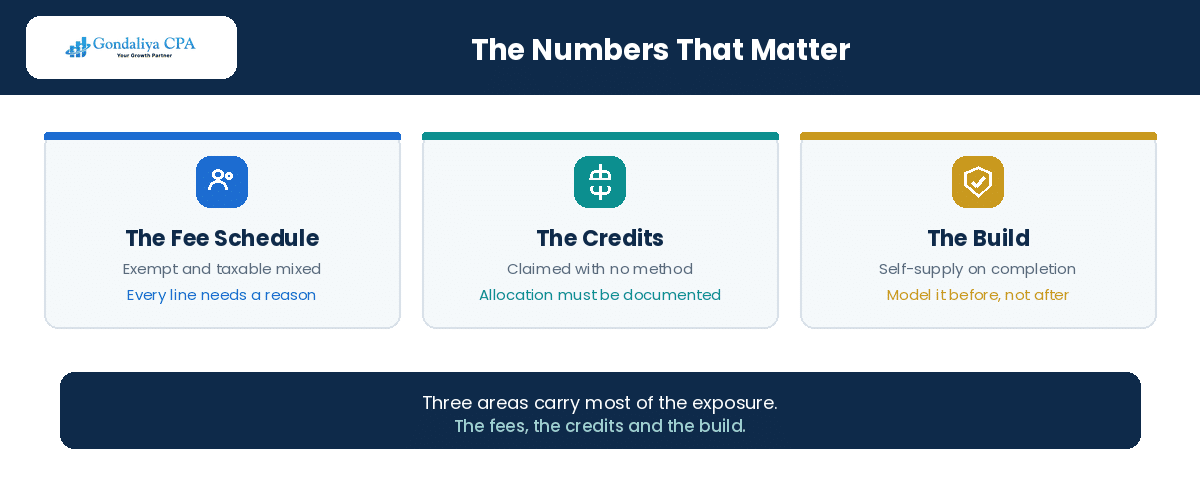
The Numbers That Matter
This article covers Canada, with Ontario and Toronto context, and reflects rules current to 2026. It assumes an incorporated retirement home or senior living operator with mixed exempt and taxable supplies, payroll, and capital property. Figures marked illustrative are examples, not quotes, and any masked engagement notes end with “Figures changed for privacy.” This is educational information only and not tax or legal advice. Rebate rates, licensing rules and exemption boundaries are fact-specific, so please confirm your own position before acting.
Retirement Home Tax Mistakes: Key Accounting and Bookkeeping Errors
Key Accounting and Bookkeeping Errors
The Errors
Incorrect Subsidy Recording of Government Funding
Many retirement homes get government subsidies to help cover costs. But some record these subsidies as income instead of reducing expenses. This mistake makes taxable income look bigger than it really is. It can lead to paying more tax and drawing unwanted CRA attention.
Payroll Errors on Shift Premiums for On-Call and Overnight Hours
Staff working overnight or on-call get extra pay called shift premiums. If payroll doesn’t count these correctly, workers might get paid wrong amounts. Payroll mistakes also cause errors in reported expenses. Both can hurt staff morale and create legal problems.
Capital Cost Allowance Building Misclassification
The capital cost allowance (CCA) lets homes claim depreciation on buildings over time. Putting buildings into the wrong CCA class changes the amount you can deduct, since each class carries its own rate and its own eligibility conditions. Getting this wrong distorts your deductions in either direction.
Input Tax Credit Allocation Issues
Input tax credits (ITCs) help recover GST/HST paid on business expenses. Retirement homes must split ITCs between exempt supplies like lodging and taxable supplies like extra services. If allocation is off, CRA may deny credits, leading to extra payments without benefits.
Treating All Resident Revenue as Exempt
Not all resident fees are exempt from GST/HST just because they relate to living space. Services like haircuts or certain meals might be taxable depending on the detail of the supply under the Excise Tax Act. You need to check each service carefully before claiming exemption.
Attendant Care and Eligible Expenses in Retirement Homes
Attendant care matters a lot in retirement homes where residents need help with daily tasks due to health conditions. Knowing what expenses qualify for tax claims is key. Proper documents help make sure you follow the rules and get the benefits allowed.
Issuing resident attendant care letters incorrectly. Care letters confirm a resident needs help and support medical expense claims at tax time. These letters must clearly say what care was given, including dates and amounts. If letters lack details, claims can fail or cause disputes.
Attendant care expense eligibility. The medical expense rules in section 118.2 of the Income Tax Act apply strictly. You need correct certification before filing claims and solid proof showing that expenses relate directly to needed care. Following these rules protects your residents’ claims and smooths out refunds or credits later on.
The first thing we look at is the fee schedule, line by line. Homes rarely have a written note explaining why each item is exempt, and that note is exactly what the CRA asks for. Figures changed for privacy.
Risk Warning: Claiming full input tax credits while reporting only exempt supplies is a visible inconsistency. Please document your allocation method in writing before the refund claim, not after the query.
Differences Between Nursing Homes and Retirement Homes for Tax Purposes
Nursing Homes Versus Retirement Homes
The Distinction
Retirement homes and nursing homes have different tax rules in Canada. It’s important to know these differences to avoid retirement home tax mistakes Canada operators often make. One big area is GST/HST rules and how they deal with CRA compliance.
Nursing homes usually follow provincial health care laws and get funding from government programs. They offer long-term care that is largely exempt from GST/HST under the health care and residential provisions of the Excise Tax Act. Retirement homes, on the other hand, are licensed in Ontario by the Retirement Homes Regulatory Authority. They work under the Retirement Homes Act, 2010, and provide various services like independent living, assisted living, memory care, plus other services.
The main tax difference is how supplies are classified:
- Nursing home supplies: Mostly exempt since they provide essential care.
- Retirement home supplies: Mixed. Some parts like accommodation may be exempt. Other things like salon services or parking fees are taxable. Each charge needs its own review with the single versus multiple supply test.
Senior care bookkeeping mistakes happen when people treat all income as exempt without checking these details. That leads to wrong GST/HST reports and more CRA audits for senior care businesses.
Also, nursing homes might get government subsidies which they record differently from retirement homes. Funding setups vary a lot between them. Personal and business expenses also mix differently because of how ownership works in retirement homes.
Operators must keep clear records that separate taxable from exempt activities. If not, input tax credits get denied. That means missed deductions on corporate taxes reported via T2 returns. It also raises chances of penalties for breaking retirement home CRA compliance rules.
Common Tax Filing and Compliance Mistakes in Retirement Home Accounting
Retirement home accounting mistakes come up a lot because of complicated income sources and tricky payroll systems unique to senior living places. These errors risk expensive problems with the CRA if not fixed early.
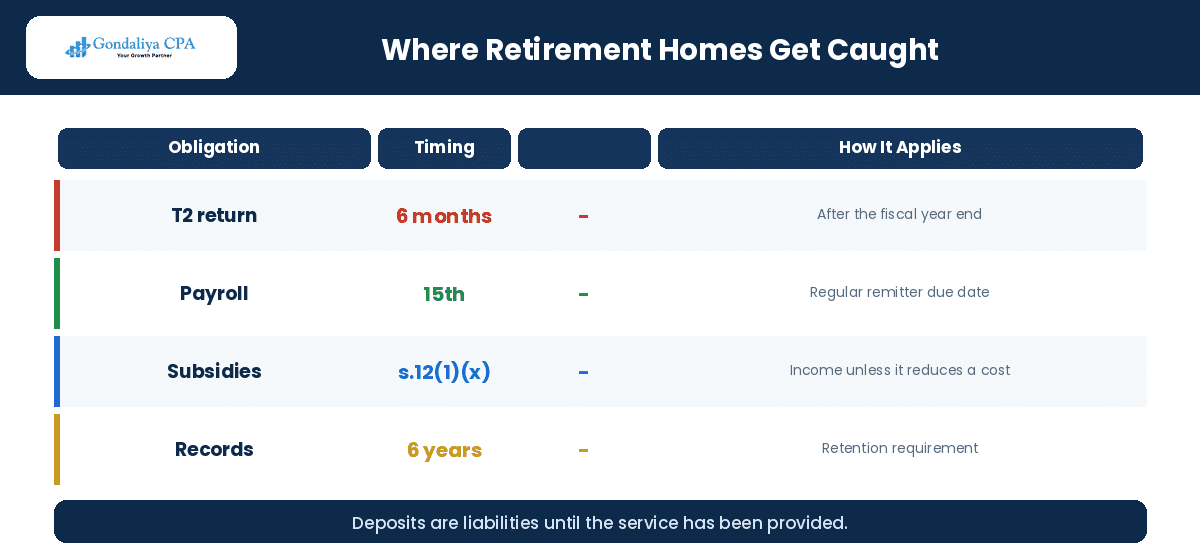
One common problem is tracking resident revenue wrong, like counting deposits or last month’s rent as income right away instead of as liabilities until earned. This error makes revenue look bigger than it really is and messes up GST/HST reporting and corporate taxes.
Payroll mistakes come up too. People mishandle shift premiums or agency staff pay without sending correct source deductions to the CRA. Also, treating personal support workers as contractors instead of employees causes T4 filing errors that can make directors responsible for unpaid amounts.
Facility expenses also get messed up by charging full renovation costs to expense instead of capitalizing them into the right CCA class. This mistake reduces future depreciation claims and inflates current profits subject to tax.
Another problem is mixing personal spending with business accounts, like unrecorded shareholder benefits creating hidden loans that need repayment records under section 15(2).
Some miss out on deductions related to operating costs such as utilities split correctly between suites versus common areas. This skews net profit numbers on T2 filings required for incorporated retirement homes in Ontario or Toronto.
It helps a lot to keep monthly bookkeeping up to date rather than waiting till year-end for fixes. Year-end adjustments often miss unpaid bills or subsidy entries causing audit red flags tied to common senior care bookkeeping mistakes nationwide.
Good internal controls over mail also help so no important letters from CRA are ignored. Ignoring those can lead to demand-to-file notices or arbitrary assessments when deadlines pass unnoticed by busy admin teams managing multiple homes.
To wrap it up, avoiding these issues means keeping tidy records that follow federal tax laws about mixed supplies in licensed retirement residences. It also means sticking closely to payroll deduction rules plus filing accurate corporate returns showing true finances without accidental errors that cause fines.
Deposits and last month\u2019s rent sitting in revenue is the entry we correct most often. It inflates the income statement and pulls GST/HST into the wrong period at the same time. Figures changed for privacy.
Key Stat: A retirement home almost always makes both exempt and taxable supplies. Please assume a mixed position until the fee schedule proves otherwise.
Strategies for Accurate Tax Filing and CRA Compliance in Senior Care
Strategies for Accurate Filing and Compliance
The Strategy
Filing taxes right and staying on top of retirement home CRA compliance can be tricky. Senior care bookkeeping mistakes happen because of mixed income sources, GST/HST rules, and payroll details. You need strong controls to separate taxable services from exempt ones. Good records help support input tax credit claims and avoid costly reassessments.
A smart move is to split resident accommodation fees from extras like salon or parking charges, since these extras are usually taxable. Checking resident accounts against general ledger balances every month cuts down revenue mistakes. Payroll must include correct deductions for shift premiums, on-call hours, and temporary workers to avoid penalties.
Use a detailed chart of accounts built for retirement homes. Train your accounting staff often about CRA rules. Spotting errors early with monthly reviews cuts audit risks too.
Checklist to Prevent Common Retirement Home Tax Mistakes
- Classify all income correctly, knowing what is exempt accommodation versus taxable
- Keep written policies for how ITCs get split each year
- Log self-supply amounts after any construction or conversions
- Keep personal and business expenses separate by using different bank accounts
- Do monthly payroll reconciliations comparing T4s with pay records
- Check government subsidies are reported as income or capital assistance properly
This checklist helps prevent late penalties, interest charges, and CRA assessments by catching problems before tax season ends.
Best Practices for Precise Bookkeeping Records
- Close books monthly within 30 days after month ends.
- Track resident fees by service type using sub-ledgers.
- Keep a capital asset register sorted by asset classes with purchase dates.
- Save timesheets showing shift premiums and keep contractor agreements clear.
- Use one consistent ITC allocation method every year unless you have good reason to change.
These steps make corporate tax filings accurate and lower risk if the CRA comes calling.
Timing Considerations for Seeking Professional Help
Get a CPA involved early, quarterly or twice a year, to boost retirement home CRA compliance. Catch mistakes early instead of waiting until year-end when fixes get harder. Waiting raises risk of penalties on missed instalments or GST/HST returns missing self-supply adjustments.
Early advice helps plan capital cost allowance elections and subsidy timing under section 12(1)(x). Payroll remittance frequency also depends on your remitter type, so plan ahead. If you wait until the CRA sends notices, you might lose access to relief options like the Voluntary Disclosures Program.
Professional Preparation Versus DIY
Doing taxes yourself may save money at first but often costs more later due to retirement home accounting mistakes like wrong revenue classifications or missed self-supply entries. These cause reassessments plus interest and penalties.
Professional help brings:
- Expertise with complicated rules for incorporated senior living facilities
- On-time filing to avoid late penalties
- Use of rebates such as the new residential rental property rebate where available
- Fixed pricing so you know costs upfront
- Audit representation that reduces stress and disruptions
DIY risks include missed deadlines and poor documentation that invite audits. For operators in Ontario cities like Toronto or Mississauga, CPAs save money over time by lowering penalties and improving tax outcomes.
Filing Systems Tailored for Retirement Homes
Using systems set up for retirement homes cuts errors by handling supply classification consistently. These systems handle:
- Separating resident fees into exempt accommodation versus taxable extras
- Automating ITC splits done the same way each year
- Linking self-supply reporting to building completions
- Tracking payroll deductions per CRA schedules
This reduces manual entry errors causing senior care bookkeeping mistakes. Real-time checks let you fix problems fast before filing deadlines.
Technology and Software for Bookkeeping Accuracy
Technology helps fix many issues from senior care bookkeeping mistakes by capturing data smoothly across locations. Cloud accounting with automated invoice capture, payroll management and electronic payment collection all reduce manual handling.
Automation spots mismatches quickly so reconciliations don’t pile up at year-end. Digital record keeping also satisfies the six-year retention requirement.
Educating Staff and Management on Tax Regulations
Trained teams help cut retirement home CRA compliance failures common across Canada. Teach them about:
- What counts as exempt accommodation versus taxable extras
- Documents needed to claim input tax credits properly
- When renovations or new builds trigger self-supply reporting
- Payroll deductions including overtime premiums
- Handling government funds under section 12(1)(x)
Keep refreshers regular with easy reference guides. This gives billing staff confidence day-to-day while management stays ready for CRA checks.
Preparing for Potential CRA Audits
Retirement homes face close scrutiny if they repeatedly claim GST/HST refunds without proper ITC splits or report only exempt supplies while taxable activities exist.
To reduce risk:
- Keep full audit trails explaining supply classifications supported by contracts and invoices matching services provided
- Respond quickly if the CRA asks for information
- Run internal reviews simulating audits to spot weak spots before the CRA does
Fixing issues early lowers penalty exposure compared with reacting after an audit starts, when the reassessment window can be extended where misrepresentation is suspected.
Financial Planning and Senior Care Tax Claims
Planning finances alongside attendant care claims helps maximize deductions while avoiding overstated salary allocations, a common problem in seniors’ residences. Attendant care letters must show the portion of salary linked only to caregiving duties, not administration, which can otherwise be denied.
This ties into estate planning where ownership affects deductibility. Accountants working with family-appointed attorneys keep tax decisions on solid ground while making sure facilities run smoothly.
Tax claims need aligning between corporate deductions from incorporated retirement homes and residents’ personal estate plans involving trusts or direct ownership. These can affect provincial credit eligibility differently.
CPAs skilled in both areas stop double counting caregiver expenses recorded inconsistently, which delays refunds and hurts cash flow near year-end. Clear separation helps preserve household wealth while balancing day-to-day operations against long-term estate goals.
Role of Enduring Power of Attorney in Managing Tax Affairs
An enduring power of attorney plays a key role in keeping books accurate and avoiding senior care bookkeeping mistakes when owners become unable to handle affairs themselves.
These authorized parties keep tax filings timely, avoid fines, and protect facility finances from accidental lapses caused by lack of oversight. They ensure operations continue despite owner incapacity, which benefits residents through uninterrupted service.
Homes that run one internal review a year rarely get surprised. Homes that wait for the query spend three months reconstructing a supply classification they could have written down once. Figures changed for privacy.
Pro Tip: Please write your ITC allocation method down once, apply it consistently, and keep the memo on file. Consistency matters more to the CRA than the precise percentage.
Examples and Case Studies Illustrating Retirement Home Tax Mistakes
Examples and Case Studies
In Practice
Retirement home tax mistakes Canada happen often. These come from mixed-up revenue streams and wrong expense labels. Many times, retirement home accounting mistakes pop up when GST/HST filings get done wrong. Also, businesses forget to apply input tax credits properly or mix personal and business expenses. Senior care bookkeeping mistakes show up as payroll errors or missing income from residents. These slip-ups can cause big trouble with the CRA and bring costly fines.
Misclassified Expenses Leading to Denied CRA Claims
A Toronto retirement home owner labelled some maintenance costs as regular expenses instead of capital ones. The CRA then denied input tax credit claims during a GST/HST review. On top of that, they mixed up employee versus contractor status, causing wrong T4 and T4A slips.
Input tax credits were denied, adding roughly $25,000 plus interest to taxes owed. Payroll penalties reached around $7,500 due to source deduction issues, and the CRA reassessed two past years because of inconsistent expense records. Figures changed for privacy.
What they did next: created rules to separate capital costs from current expenses based on tax law, and engaged a CPA who knows retirement homes to check payroll and worker status every year.
This shows how filing errors plus weak paperwork increase risks for retirement homes with the CRA.
Missing Documentation Causing Audit Penalties
An Ontario senior living owner waited until year-end to do bookkeeping updates. They ignored CRA letters for 18 months. The audit started because refund claims on salon services and guest meals didn’t match records. Missing invoices and unpaid resident bills came up.
Late-filing penalties added roughly $12,000 over three years. Interest accumulated on unpaid balances, and the exposure grew because replies to the CRA were slow or absent. Figures changed for privacy.
How to fix it: do monthly closes with bookkeeping checks, use mail scanning so no CRA letters get lost, and match the general ledger with resident billing regularly before deadlines.
Successful Claim of Attendant Care Expenses With Proper Certification
A retirement home with memory care units tracked attendant salaries carefully. They had certification letters that followed Income Tax Act rules. Families claimed medical expense deductions using the disability tax credit certificate along with detailed salary reports from the home’s accountants.
Why it worked: a clear split between taxable wages and the caregiving portion kept things simple, and keeping signed certification letters prevented disallowance by the CRA later on.
This proves good paperwork and proof of eligibility help get attendant care claims approved.
Comparing Claim Outcomes: Nursing Home Versus Retirement Home Residents
Nursing homes follow different provincial laws than Ontario’s Retirement Homes Act, and this affects taxes.
| Aspect | Nursing Homes | Retirement Homes |
|---|---|---|
| Licensing | Ministry-funded long-term care | Licensed under Retirement Homes Act |
| Resident Charges | Usually exempt from GST/HST | Some services taxed |
| Eligible Medical Expense Claims | Often fully claimable | Partial claims depending on service |
| Disability Tax Credit Role | Key for full claim eligibility | Helps with partial claims |
The disability tax credit certificate matters for residents or families claiming deductions for attendant care based on facility type.
Incomplete Payroll Filings and Director Personal Liability
Payroll remittance rules require careful following, and missing payments put directors at personal risk.
Common payroll errors include forgetting shift premiums or overnight pay, and labelling personal support workers as contractors instead of employees.
When this happens, directors can be assessed personally for unremitted source deductions, penalties grow after missed remittances, and correct paperwork for employee status stops T4 disputes. Payroll software tied to senior living bookkeeping helps catch mistakes early.
Official Guidelines Worth Knowing
Retirement home operators should stay current with CRA guidance on medical expense and attendant care claims, the disability tax credit certificate, GST/HST treatment of residential accommodation, and the corporate income tax return guide. Keeping current with official information avoids common retirement home tax mistakes Canada-wide.
Ignoring CRA mail is the single decision that turns a fixable file into an expensive one. Eighteen months of silence changes what relief is still available. Figures changed for privacy.
Risk Warning: Unremitted source deductions can be assessed against directors personally. Please treat payroll remittances as the first payment out, not the last.
Preventing Common Mistakes and Maintaining CRA Compliance
Preventing Mistakes and Maintaining Compliance
The Prevention
Retirement homes in Canada deal with tricky tax and accounting rules. Mistakes happen easily if you don’t watch out. Avoiding retirement home tax mistakes Canada means having clear steps, good bookkeeping, filing on time, and following CRA rules closely. Paying attention to senior care bookkeeping mistakes keeps you safe from audits and penalties.
Establishing Internal Protocols for Bookkeeping Accuracy
Having clear internal rules cuts down retirement home accounting mistakes a lot. Retirement homes should write down how they handle income, expenses, payroll, GST/HST, and assets. This way, everyone knows what to do.
Monthly checks of resident fees against occupancy reports stop revenue errors common in senior care bookkeeping mistakes, and regular staff training keeps the process smooth and accurate.
Setting Reminders to Avoid Late Filings
Late tax filings or missed GST/HST payments bring penalties and interest. Retirement homes must set up reminders for key dates like:
- T2 tax returns due six months after fiscal year-end
- GST/HST return deadlines based on filing frequency
- Payroll source deduction remittances
- Instalment payments if needed
Using calendar alerts in your accounting software helps avoid retirement home tax mistakes Canada caused by late filings.
Segregating Personal and Business Accounts
Mixing personal money with business accounts causes big retirement home accounting mistakes. It makes audits harder because the CRA may treat personal spending as shareholder benefits under section 15(2).
Keep separate bank accounts only for the business side of your retirement home. This stops confusion when tracing money during reviews and prevents problems from mixing funds, a common error in senior care bookkeeping mistakes.
Reviewing Income and Expense Classifications
Look over income sources regularly, like accommodation fees versus taxable extra services, and match them to ledger entries. This stops classification errors that lead to wrong GST/HST reporting or missed deductions.
Check expenses too, since capital spending gets different treatment than current costs. Proper classifications affect depreciation claims. Doing this each month catches errors early before year-end adjustments get messy.
| What to Do | Why It Helps |
|---|---|
| Reconcile income monthly | Reports revenue correctly |
| Review expense accounts | Supports capital cost claims |
| Check documentation | Prepares for audits |
Collecting Documentation and Certification Timely
Good record keeping means more than just numbers. You need certificates like attendant care letters to support claims. If these come late, you risk losing input tax credits or getting reassessed.
Get agency invoices quickly so you can tell contractors from employees correctly. This avoids payroll slip errors linked to senior care bookkeeping mistakes during audits.
Set deadlines for documents that fit your monthly closing cycles so everything is ready before filing time.
Monitoring GST/HST Submissions and Payroll Processes
GST/HST filings must clearly separate exempt residential fees from taxable extra services using the single supply and multiple supply tests. Mistakes here cause reassessments or self-supply charges if new buildings are involved.
Payroll needs close checks on things like shift premiums, overtime, and taxable benefits such as meals or parking. These often cause pensionable earnings errors that trigger penalties.
Run internal audits on these areas and use software controls to cut down on these common retirement home tax mistakes Canada.
When to Engage Professional Tax Advisors
Call in professionals when things get complex, like managing several homes with mixed supplies or handling self-supply after renovations. Talking early helps avoid costly audit issues later.
You should seek help if:
- Multiple entities own properties besides the operating company
- Government subsidies affect your income recognition
- Payroll involves agency workers with tricky rules
- You have overdue filings from past years
Good advice keeps you compliant year-round, not just at filing time.
Situations Requiring Specialized CPA Intervention
Some problems go beyond regular bookkeeping skills:
- No documentation for allocation methods risking denied input tax credits
- Wrong use of the small business deduction because of investment business rules
- Poor capital cost allowance class choices that lose depreciation opportunities
- Shareholder loans without agreements causing benefit assessments
These are high-risk spots where expert help can save you from significant problems tied to senior care bookkeeping mistakes seen across the sector. Knowing early lets you fix things before the CRA sends audit notices.
Benefits of Early Consultation
Getting advice early helps make plans that fit your type of operation, whether it’s independent living or multi-home setups with real estate holdings. It also lets you use the Voluntary Disclosures Program to lower penalties compared with waiting for CRA-initiated adjustments.
Early help improves your records so rebate claims work smoothly, including new residential rental property rebates after qualifying construction. It also makes audit responses faster so you spend less time on paperwork and more time running your home well.
For a free chat about tricky tax matters, contact Gondaliya CPA at info@gondaliyacpa.ca or call 647-212-9559 on weekdays or weekends. Our flat annual fee pricing suits many Toronto and Ontario clients who trust us with their books.
The homes that call us before a build or a conversion save the most. Self-supply is straightforward to plan for and expensive to discover afterwards. Figures changed for privacy.
Key Stat: Self-supply under sections 191 and 191.1 can crystallise a large liability on completion. Please model it before construction, not after occupancy.
How Gondaliya CPA Supports Retirement Home Operators
How Gondaliya CPA Supports Operators
The Service
Gondaliya CPA works with incorporated Canadian retirement homes, including operators licensed in Ontario by the Retirement Homes Regulatory Authority. We spot common errors like mixing personal and business funds or missing self-supply entries after renovations quickly.
Our team uses cloud accounting tools to fix problems without disrupting your routine. We make sure clients follow the rules while claiming all legal deductions, including the correct capital cost allowance classes for buildings versus equipment.
We offer ongoing checks, from monthly reconciliations to annual reviews, that keep your books ready well before deadlines come up.
Long-Term Advantages Over One-Time Fixes
Having a professional watch over your compliance changes how you handle finances for good, not just as a quick fix after mistakes pile up. Waiting too long means paying interest plus risking reputation in a strictly regulated environment protecting vulnerable seniors.
Keeping steady controls stops senior care bookkeeping mistakes from growing into bigger failures that hurt taxes and trust at once. That is avoidable with good governance started early rather than scrambling later when the CRA acts.
Long-term benefits include better cash flow planning through steady instalments plus corporate tax strategies maximizing deductions legally allowed. This keeps more money free to grow facilities amid shifting laws.
Summary of Key Takeaways for Retirement Home Tax Compliance
Operators of retirement homes in Canada often make tax mistakes. They misclassify resident revenue, file GST/HST incorrectly, or slip up on capital cost allowance claims. Mixing personal and business expenses is a common retirement home accounting mistake. Another is failing to properly allocate input tax credits.
Senior care bookkeeping mistakes show up too. Payroll reporting may be off, or attendant care expenses retirement homes face might not get tracked right.
Retirement home CRA compliance means knowing the GST/HST rules well. These rules differ for accommodation and for extra services. You have to claim capital cost allowance on buildings correctly, using the right class and applying the half-year rule where it applies.
Many GST/HST filing errors happen because people forget self-supply entries after new buildings or conversions. That raises the chance of reassessments.
Here are some ways to avoid trouble:
- Set strong controls on monthly bookkeeping closes
- Keep detailed memos classifying supplies
- Watch remittance deadlines closely
Also, record government subsidies properly under section 12(1)(x) of the Income Tax Act. This helps keep your records clean.
Finding the Right CPA Firm for a Cleanup
Finding the right CPA firm in Toronto and Ontario matters when cleaning up tax records for a retirement home. A licensed Ontario CPA with senior living tax knowledge knows how to handle complex rules. These include corporate tax filings, GST/HST allocations, payroll remittances, and managing capital assets.
At Gondaliya CPA, we fix mistakes step by step:
- Start with intake assessment
- Review rate sheets
- Check allocation methods
- Clean up bookkeeping
- Prepare adjusted returns
- Submit relief requests
- Do annual reviews
We work mainly with incorporated retirement home operators across Ontario: Toronto, Vaughan, Mississauga, Brampton, Scarborough, Ottawa, and more.
Trying to fix these errors yourself is risky. You might miss deadlines or overlook details that trigger CRA audits against senior care businesses. Non-CPA providers often cannot file corporate returns or represent you before CRA officers.
Hiring a skilled CPA cuts down your risks by ensuring accuracy and clear communication under CRA rules.
If you want help avoiding retirement home tax mistakes Canada, call Gondaliya CPA at 647-212-9559 or email info@gondaliyacpa.ca. We offer free consultations and have over 1450 five-star Google reviews from Ontario’s business community.
Cleanups follow the same order every time: rate sheet first, allocation method second, bookkeeping third. Skipping to the bookkeeping is why some cleanups have to be done twice. Figures changed for privacy.
Pro Tip: Please bring your current fee schedule to the first meeting. It tells us more about your GST/HST position in ten minutes than a year of ledgers.
Frequently Asked Questions on Retirement Home Tax Compliance
Frequently Asked Questions
FAQ
What triggers a CRA review of a retirement home?+
CRA reviews usually start from inconsistent GST/HST filings, missing ITC claims, payroll errors, or failure to respond to CRA letters. Poor record keeping raises flags.
What are the costs of penalties and interest for retirement homes?+
Penalties include late filing fines, interest on unpaid taxes, and gross negligence penalties. These can total thousands of dollars if issues persist.
How long is the CRA reassessment period?+
The normal reassessment period is three years from the notice of assessment for a Canadian-controlled private corporation. It can be extended without limit where the CRA alleges misrepresentation attributable to neglect, carelessness or wilful default.
What is the T2 corporate tax filing deadline for retirement homes?+
Retirement homes must file T2 returns within six months after their fiscal year-end to avoid late-filing penalties. Any balance owing is due earlier.
Can a retirement home claim the public service body rebate?+
Only if it qualifies as a public service body under the Excise Tax Act, which most privately operated retirement homes do not. Rebate rates differ by claimant type, so please confirm eligibility before claiming.
What happens if you miss the self-supply rule on a new build or conversion?+
Missing self-supply reporting triggers large tax liabilities and interest. The CRA expects self-supply calculations under sections 191 and 191.1 of the Excise Tax Act.
Why is assuming your home is a specified investment business a mistake?+
Classifying as a specified investment business limits access to the small business deduction and may increase the tax burden incorrectly.
How do you get capital cost allowance on buildings wrong?+
Claiming CCA in the wrong class changes your deduction. Each building class carries its own rate and its own eligibility conditions, so the classification has to match the property.
What are common mistakes in expensing renovations and suite refits?+
Fully expensing renovations instead of capitalizing them as CCA-eligible assets inflates current expenses but loses future depreciation benefits.
Why is treating personal support workers and agency staff as contractors risky?+
Incorrect contractor classification causes T4 slip errors and payroll remittance penalties. Employees must be reported properly for CRA compliance.
What are the consequences of missing payroll remittances and instalments?+
Failing to remit source deductions leads to penalties, interest charges, and possible personal liability for directors.
Why is recording deposits and last month’s rent as revenue a mistake?+
Recording deposits as revenue prematurely inflates income and distorts GST/HST reporting since these funds are liabilities until earned.
How should government funding and subsidies be recorded?+
Assistance is generally brought into income under section 12(1)(x) unless it reduces the cost of the property or expense it funded. Proper treatment avoids overstating taxable income.
What problems arise from running owner personal spending through the home?+
Mixing personal expenses with business causes shareholder benefit assessments under section 15(2), increasing tax liabilities unexpectedly.
What issues happen when books are left to year-end and CRA mail is ignored?+
Year-end backlogs cause missed deadlines. Ignoring CRA notices leads to escalated penalties or arbitrary assessments raised without your input.
What triggers director liability for payroll errors in retirement homes?+
Directors face liability when employer source deductions go unpaid due to late or missing remittances despite the legal obligation to remit.
How do self-supply rules affect new building projects in retirement homes?+
Self-supply rules require accounting for a deemed sale when the building is substantially complete and first occupied. Ignoring this causes significant tax exposure.
Can I claim all renovations immediately as an expense?+
No. Work that betters the property beyond its original condition is generally capital and must be added to the appropriate CCA class rather than expensed.
Eighteen questions and one running underneath them: which supply is this, and can you show why. Almost every retirement home file turns on that answer. Figures changed for privacy.
Checklists and Warning Signs for Retirement Home Operators
Checklists and Warning Signs
Quick Reference
Best Practices Checklist
- Separate exempt accommodation fees from taxable extras clearly each month.
- Reconcile resident accounts with the general ledger regularly to prevent revenue errors.
- Allocate input tax credits using documented written policies annually.
- Capitalize renovations appropriately per CCA class rules and avoid full expensing.
- Correctly classify employee versus contractor status with clear agreements.
- Remit payroll deductions on time and track instalment payments carefully.
- Treat deposits as liabilities until earned revenue recognition applies.
- Record government subsidies correctly under section 12(1)(x).
- Keep personal and business expenses strictly separate to avoid shareholder benefit issues.
- Close books monthly and respond promptly to all CRA correspondence using authorized representatives when needed.
How Gondaliya CPA Fixes Retirement Home Tax Mistakes
- Conduct detailed intake assessments identifying key risk areas swiftly.
- Review subsidy records, payroll processes, CCA classifications, and ITC allocations thoroughly.
- Clean up bookkeeping errors with monthly reconciliations tailored for retirement homes.
- Prepare amended corporate filings correcting past mistakes while minimizing penalties.
- Support clients through voluntary disclosure with CRA representation.
- Provide ongoing compliance monitoring and staff training on tax rules affecting senior care facilities.
Warning Signs You May Have Tax Problems
- Frequent discrepancies in GST/HST filings or input tax credit claims rejected by the CRA.
- Unreconciled payroll reports or missing source deduction remittances.
- Large variances between resident billing records and accounting ledgers monthly.
- Ignored or delayed responses to CRA audit letters or assessment notices.
- Confusion over subsidy reporting or inconsistent capital asset tracking in records.
- History of late T2 return filings with accrued penalties and interest charges.
What to Prepare Before Starting a Cleanup
- Detailed resident revenue reports separated by service type for at least one fiscal year.
- Payroll records including shift premiums, on-call hours, agency worker contracts, and T4 or T4A slips.
- Capital asset registers listing acquisition dates, asset classes, and renovation details with invoices attached.
- Copies of government subsidy agreements along with the accounting entries made historically.
- Bank statements showing clear separation of personal versus business expenditure.
- Prior GST/HST returns filed plus any correspondence received from the CRA related to audits or reassessments.
For expert help preventing costly retirement home tax mistakes in Canada, contact Gondaliya CPA at info@gondaliyacpa.ca, call 647-212-9559, or reach us here.
The cleanup preparation list looks long until you realise most of it already exists somewhere in the building. Gathering it is the work; producing it is not. Figures changed for privacy.
Facility Situations We Handle
Industry Expertise
Which issue dominates differs by facility. Here are ten and the usual focus.
| Facility Situation | Where the Exposure Sits |
|---|---|
| Independent living only | Whether extras are billed separately from accommodation |
| Assisted living with care packages | Single versus multiple supply on bundled fees |
| Memory care units | Attendant care certification and salary allocation |
| New build or major conversion | Self-supply under sections 191 and 191.1 |
| Recently renovated suites | Capital versus current expense classification |
| Heavy agency staffing | Worker classification and source deductions |
| Subsidy-funded operations | Section 12(1)(x) treatment of assistance |
| Owner-occupied premises | Shareholder benefit and section 15(2) exposure |
| Multiple homes under one group | Consistent allocation methods across entities |
| Behind on filings | Voluntary disclosure before the CRA writes first |
- Independent living only: Separately billed extras are usually where the taxable supplies hide.
- Assisted living with care packages: A bundled fee still has to be tested, not assumed.
- Memory care units: Certification letters must isolate the caregiving portion of salary.
- New build or major conversion: Self-supply crystallises on completion and occupancy.
- Recently renovated suites: Betterment is capital; repair is current, and the line matters.
- Heavy agency staffing: Contractor labels do not survive a control-and-integration review.
- Subsidy-funded operations: Assistance is income unless it reduces a cost instead.
- Owner-occupied premises: Personal spending through the corporation becomes a benefit.
- Multiple homes under one group: Inconsistent methods across entities invite questions.
- Behind on filings: Correcting first costs far less than correcting after contact.
The facility changes where the exposure sits. It does not change the method, which is classify every fee line, document the allocation, then reconcile every month. Figures changed for privacy.
Professional Guidance and Quick Reference
Guidance
Professional Guidance for Operators: How Gondaliya CPA Fixes and Prevents These Errors
Retirement homes run into CRA trouble in a predictable set of ways: treating all resident revenue as exempt, claiming input tax credits with no documented allocation method, recording subsidies as income when they should reduce a cost, booking deposits and last month’s rent as revenue, expensing renovations that belong in a capital class, missing self-supply on a new build, and misclassifying personal support workers as contractors. Gondaliya CPA fixes and prevents these on a fixed annual fee.
We handle what decides the outcome: classifying every line of the fee schedule as exempt or taxable and documenting why, setting a written input tax credit allocation method and applying it consistently, treating government assistance correctly under section 12(1)(x), modelling self-supply before construction rather than after occupancy, assigning renovations and building costs to the right capital cost allowance class, reviewing worker classification for agency and support staff, and correcting past years through voluntary disclosure where warranted.
Our team starts with the fee schedule, because the exempt and taxable split drives the GST/HST return, the input tax credit claim and the audit risk all at once. Independent living, assisted living or memory care, you get clear advice and a fixed price before we start.
Quick Answers: Key Numbers & Concepts at a Glance
At a Glance
- Corporate return: T2, six months after year end
- Payroll: 15th for regular remitters
- Slips: T4 and T4A by end of February
- Accommodation: Often exempt
- Salon, parking, guest meals: Often taxable
- Deposits: Liabilities until earned
- Subsidies: Section 12(1)(x) treatment
- Self-supply: Sections 191 and 191.1
- Shareholder benefits: Section 15(2) exposure
- Records: Six years retention
Who This Is For / Not For
Fit Check
- For: Incorporated retirement home and senior living operators in Canada with mixed exempt and taxable supplies, payroll and capital property.
- Not For: Government-funded long-term care homes, whose supplies and funding are governed by a different framework.
People Also Ask
Related Questions
Are meals included in a resident’s monthly fee taxable?+
It depends on whether the meal forms part of a single supply of accommodation or is billed as a separate service. The fee schedule decides it, not the intention.
Do I need to register for GST/HST if most of my supplies are exempt?+
Possibly. Registration depends on your taxable supplies, and homes making taxable extras alongside exempt accommodation often cross the threshold.
What if I already claimed input tax credits with no allocation method?+
Document the method you used, quantify the exposure, and consider correcting before the CRA raises it. Voluntary correction generally costs far less.
Glossary of Key Terms
- T2: The corporation income tax return.
- Exempt supply: A supply outside GST/HST, carrying no input tax credits.
- Taxable supply: A supply on which GST/HST is charged.
- Single supply: One combined supply tested as a whole.
- Multiple supply: Separate supplies tested and taxed individually.
- Input tax credit: GST/HST recoverable on business purchases.
- Allocation method: The documented basis for splitting credits.
- Self-supply: A deemed sale on completion of a residential build.
- Capital cost allowance: Tax depreciation on buildings and equipment.
- Betterment: Work improving property beyond its original condition.
- Section 12(1)(x): The provision taxing government assistance received.
- Section 15(2): The shareholder loan and benefit provision.
- Source deductions: CPP, EI and income tax withheld from wages.
- Attendant care letter: Certification supporting a resident medical expense claim.
- Specified investment business: A classification restricting the small business deduction.
- Voluntary disclosure: The route to correcting past errors with reduced penalties.
Retirement Home Compliance Readiness Check
This quick self-check indicates where your operation most likely has room. Please answer the six questions below.
Retirement Home Compliance Readiness Check
Six quick questions on your facility. No fee shown.
Points to raise with us:
This is a general prompt, not tax or legal advice or a quote. Your position depends on your full facts. For a real review, please book a free consultation.
Want a checklist to work from? You can download our free retirement home compliance checklist before your consultation.
Classify every fee line as exempt or taxable and note why. Document the input tax credit allocation method in writing. Record deposits as liabilities until earned. Model self-supply before a build completes. Review worker classification for agency staff. Capitalise betterment, expense repairs. Decide subsidy treatment when the money arrives. Please keep six years of records.
2026 Update — what is current: This article reflects rules current to 2026. The six-month T2 filing deadline, the section 12(1)(x) treatment of government assistance, the section 15(2) shareholder benefit rules, the self-supply rules in sections 191 and 191.1 of the Excise Tax Act, the single supply and multiple supply tests, and the six-year retention requirement are unchanged. Please note that the normal reassessment period runs three years from the notice of assessment for a Canadian-controlled private corporation and is extended without limit only where misrepresentation is alleged, rather than to a fixed seven years; that public service body rebate rates apply only to bodies that qualify as such, which most privately operated retirement homes do not; and that building CCA class and rate depend on the property and acquisition date, so please confirm each before relying on it.
Retirement Home Tax Mistakes Canada: How Gondaliya CPA Keeps Senior Living Operators CRA Compliant
Start with the fee schedule
Gondaliya CPA classifies every line of your fee schedule as exempt or taxable and documents why, sets a written input tax credit allocation method, treats government assistance correctly under section 12(1)(x), models self-supply before construction completes, assigns renovations and building costs to the right capital cost allowance class, reviews worker classification for agency and support staff and corrects past years through voluntary disclosure where warranted, on a flat annual fee including HST with a one-business-day response. Please book a free consultation.
Next Steps
Please book a free consultation with Gondaliya CPA and bring your current resident fee schedule, a year of GST/HST returns, and your last filed corporate return. Those three tell us immediately whether the exempt and taxable split is defensible, whether the input tax credits claimed are supportable, and what needs correcting. You will get a flat annual fee including HST before any work begins. If our content helps, please add gondaliyacpa.ca as a preferred source on Google.
Published: · Last updated:
Editorial policy: We research against CRA and CPA Ontario sources, fact-check the figures, and Sharad Gondaliya, CPA, reviews the content, which we update as the rules change.
Disclaimer: This article is educational information only and is not tax, legal, or financial advice. Figures marked illustrative are examples rather than quotes or guarantees. It reflects CRA rules current to 2026, including the six-month T2 filing deadline, the self-supply rules in sections 191 and 191.1, section 12(1)(x) assistance treatment, section 15(2) shareholder benefits, and the six-year retention requirement. Rates, limits and expensing rules change and outcomes depend on your specific facts. Please consult a CPA Ontario member before acting.

Sharad Gondaliya is a CPA Canada & CPA USA with 15 Years+ experience of Accounting, Tax, Payroll of Corporate Small Businesses as Tax Accountant. He is a CPA Ontario member (61040184) and holds US CPA licences in Washington and Montana and is well known among corporate small businesses for tax planning, efficient tax solutions, and affordable CPA services. Sharad is the Principal (Director) of Gondaliya CPA – Affordable CPA Firm in Canada. Licenses: CPA Ontario: 61040184 | CPA USA (MT): PAC-CPAP-LIC-033176 | CPA USA (WA): 57629 | CPA Firm License: 61330051 View Full Author Bio