



Tax Deductions for Hair Stylists in Canada: What Hairstylists Can Legally Claim as Business Expenses
Hair Stylist Tax Deductions Canada: Maximize Your Hairstylist Tax Savings with Business Expense Write-Offs by Gondaliya CPA
If you want to maximize hair stylist tax deductions in Canada, understanding deductible hair stylist expenses like salon supplies, scissors and tools, and chair rental costs is key. Gondaliya CPA helps you identify hairstylist tax deductions including professional insurance, advertising, travel, and phone expenses to boost your tax savings.
Chair renters, salon owners and mobile stylists each face a different version of the same questions. Our hair stylist accounting and tax services sort out which rules apply to you, on a fixed annual fee.
Quick Summary
If you’re a hair stylist in Canada, knowing your tax rules matters. Your employment status decides what you can claim, your supplies and tools split between current expenses and capital assets, and the records you keep decide whether the claim survives a review.
Reading time: 48 minutes.
Table of Contents
- Tax Obligations and Employment Status
- Identifying Deductible Expenses
- Tracking Expenses and Capital Assets
- Filing and Reporting
- Additional Compliance Considerations
- Practical Guidance and Next Steps
- Frequently Asked Questions
- Additional Key Tax Points
- Stylist Situations We Serve
- Professional Guidance and Quick Reference
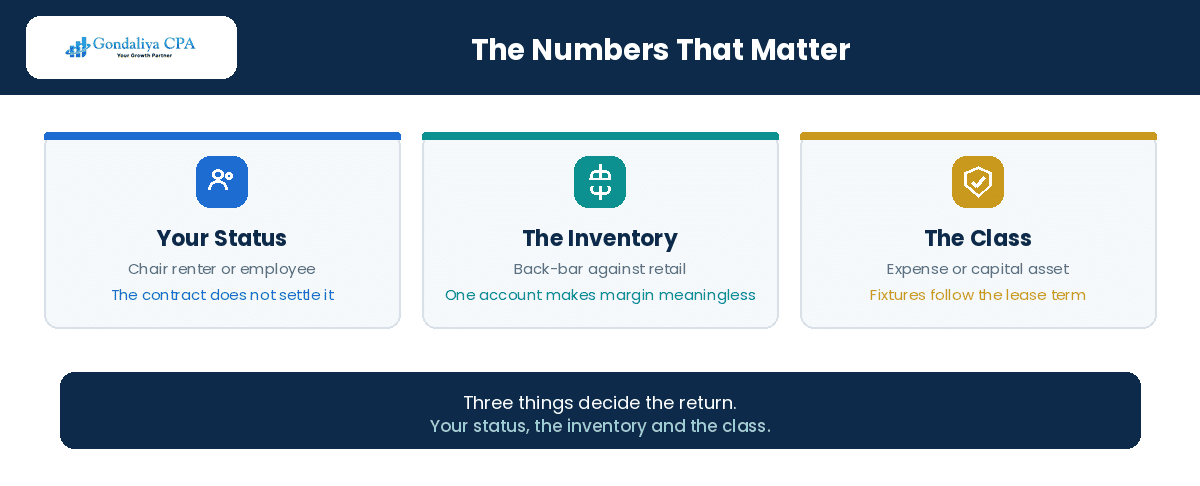
The Numbers That Matter
This article covers Canada, with Ontario and Toronto context, and reflects rules current to 2026. It applies to self-employed stylists, chair renters, barbers, mobile stylists, home salon operators and incorporated salon owners. Figures marked illustrative are examples, not quotes, and any masked engagement notes end with “Figures changed for privacy.” This is educational information only and not tax or legal advice. Provincial trade certification, health inspection and cosmetology licensing sit outside accounting scope.
Understanding Tax Obligations for Hair Stylists in Canada
Tax Obligations and Employment Status
The Basics
Employee or Independent Contractor
Your status changes your tax rules and what you can deduct. If you rent a chair in a salon, you may be an independent contractor rather than an employee, which changes how you report income and claim expenses.
The CRA looks at the substance of the relationship, not the label on the agreement:
- Control: Contractors choose when and how they work.
- Tools: Contractors buy their own shears, clippers and product.
- Chance of profit and risk of loss: Contractors carry the upside and the downside.
- Integration: How embedded you are in the salon’s business.
A stylist paid a percentage, working the salon’s hours, using the salon’s product and its booking system, is closer to an employee whatever the paperwork says.
CPP for Self-Employed Stylists
Self-employed stylists pay both the employee and employer share of Canada Pension Plan contributions on net business income after expenses.
Half of what you contribute is deductible against income, with the other half claimed as a credit. Rates and the earnings ceiling are set annually, so please confirm current figures.
This is why keeping records of income and costs matters twice over: it reduces both income tax and CPP.
Employment Insurance and Chair Rental
If you are genuinely self-employed, regular EI benefits are not automatic. Self-employed people can opt into the special benefits programme covering maternity, parental, sickness and caregiving, but once registered the commitment is long-term.
Note that some provinces treat barbers and hairdressers as insurable in specific circumstances, which can create EI obligations for the salon owner even where the stylist is otherwise self-employed. If chair rental is how your salon operates, please have that reviewed rather than assumed.
Managing Payments and Earnings
How you handle money affects what you keep:
- Record every client payment, including cash and tips.
- Track all business costs that qualify as deductions.
- Budget for slow months so cash flow stays steady across the year.
Payroll Where You Have Staff
If you employ stylists, assistants or apprentices, you withhold income tax, CPP and EI, and remit on the schedule set by your remitter type. T4 slips are due by the last day of February following the calendar year.
Keep records of each deduction for every pay period. These support the payroll expense and answer the first question a reviewer asks.
The chair rental agreement is the first document we ask for. The wording rarely matches how the salon actually runs, and the CRA looks at how it runs. Figures changed for privacy.
Risk Warning: A written contractor agreement does not settle your status. Please make sure the working relationship matches what the paperwork says.
Identifying and Managing Hair Stylist Business Expenses
Identifying Deductible Expenses
The Expenses
Hair stylists in Canada can claim business expenses to lower taxable income. The costs must be reasonable and incurred to earn income, with proper documentation behind them.
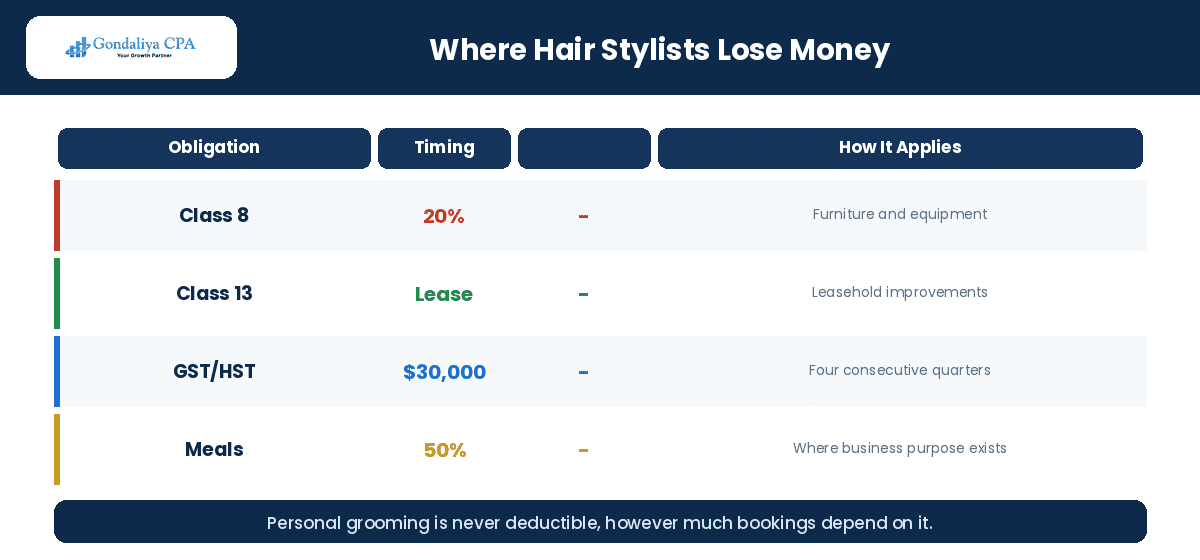
The catch is personal grooming. Your own haircut, colour and the products you use at home do not count, however much your appearance affects your bookings.
Salon Supplies and Back-Bar Product
Shampoos, conditioners, colour, developer, foils, toners and cleaning materials used on clients are current expenses, deducted when used.
Keep back-bar stock separate from retail product you sell. Retail inventory is tracked through cost of goods sold and counted at year end; back-bar is consumed in the service.
Mixing the two is the most common bookkeeping error in a salon, and it distorts both your margin and your taxable income.
Tools and Equipment
Shears, clippers, dryers and irons vary in treatment depending on cost and expected life:
| Item | Typical Treatment | Records to Keep |
|---|---|---|
| Combs, brushes, clips | Current expense | Purchase receipts |
| Professional shears | Class 8 at 20%, half-year rule | Purchase invoice with date |
| Dryers and irons | Depends on cost and durability | Invoice showing item and price |
| Styling chairs and stations | Class 8, or Class 13 if fixed to leased premises | Invoice plus lease agreement |
| Colour developer and product | Current expense when used | Supplier receipts |
Tools costing less than $500 may fall into Class 12, which carries a 100% rate, making the write-off much faster. Please confirm the treatment for each item rather than applying a single rule to the whole kit.
Recording purchase dates matters, because it separates items consumed quickly from assets that must be depreciated.
Rent, Chair Rental and Home Salons
Commercial salon rent supported by a lease is deductible in full where the space is used for the business.
Chair rental is more complicated. The payment itself is deductible if you are genuinely a contractor, but the CRA looks past the contract at who controls the hours, who supplies the tools and who carries the risk.
For a home salon, you can claim a share of household costs based on the proportion of your home used for the business, including rent or mortgage interest, utilities and internet.
A Toronto stylist uses one room of five exclusively for clients, giving a 20% business share. On $600 monthly rent that is $120 per month, with utilities apportioned the same way and supported by the year’s bills. Figures changed for privacy.
Keep a floor plan with measurements. A percentage you cannot explain is a percentage that gets reduced.
Insurance and Licensing
Professional liability insurance premiums are deductible where the coverage relates to your business. So are:
- Licensing fees charged by provincial regulators
- Membership dues for cosmetology associations
- Salon property and contents insurance
Keep the policy documents and payment records. Personal insurance is not deductible even where you carry it because you work.
Marketing, Advertising and Travel
Advertising aimed at attracting clients is deductible: local print, digital campaigns, and paid social media promoting your services. Personal posts are not advertising.
Travel strictly for client work outside your usual salon, or for training, can be claimed after separating personal time:
- Vehicle costs apportioned by a logbook percentage
- Parking during client appointments
- Meals subject to the 50% limit where there is a business purpose
Keep invoices showing the date, place and purpose. Vague entries are the ones that get questioned.
To discuss your hairstylist deductions, including chair rental arrangements, contact Gondaliya CPA at info@gondaliyacpa.ca or call 647-212-9559.
Back-bar and retail sitting in one inventory account is the error we correct most in salons. Neither the margin nor the cost of goods sold means anything until they are split. Figures changed for privacy.
Key Stat: Product used on clients is a business expense; product used on yourself is not. Please keep those purchases on separate receipts.
Tracking Expenses and Capital Assets
Tracking Expenses and Capital Assets
The Records
The best deductions available are worth nothing without records behind them. Tracking properly lowers the chance of a review and stops you missing claims.
Organizing Your Records
Keep receipts, invoices, lease documents, payroll records, inventory counts, vehicle logs and bank statements. These prove the cost relates to earning income.
Cloud accounting sorts expenses by category and keeps payments current. Reviewing the books regularly stops lost or duplicated claims.
| Deduction | Record That Supports It |
|---|---|
| Salon supplies | Invoices with purchase date and price |
| Chair rental | Signed agreement plus proof of payment |
| Vehicle and travel | Logbook with dates, destinations and distance |
| Home salon use | Floor plan plus utility bills |
| Advertising | Receipts showing what was promoted |
Separating Personal and Business
Mixing personal and business money undermines the whole claim. Use a separate bank account and card for salon costs.
Split phone, internet and software bills by actual business use, and keep something showing how you arrived at the percentage. Only the business share is deductible.
Personal grooming is not deductible. Ordinary clothing is not deductible either, even when you only wear it at work. A branded uniform required by the salon is a different matter.
A Practical Routine
Simple habits prevent most problems:
- Record daily sales and expenses as they happen
- Count inventory regularly, keeping back-bar separate from retail
- Maintain a list of capital assets with purchase dates and cost
- Keep vehicle logs for business trips only
- Record wages paid to helpers or family with the work performed
- Hold signed chair rental agreements even for contractors
Whether you handle this yourself or engage a CPA is a genuine trade-off. Doing it yourself saves fees but risks missed claims and misclassified assets, which usually costs more than the saving.
Depreciating Salon Furniture and Equipment
Salon furniture such as chairs and stations generally falls into Class 8 at a 20% declining balance rate. The half-year rule limits your claim to half the normal amount in the year the asset becomes available for use.
Fixtures attached to leased premises are leasehold improvements in Class 13, written off over the lease term rather than at a fixed percentage.
The repair or replace decision changes the treatment:
| Question | Repair | Replace |
|---|---|---|
| Deduct now | Yes | No |
| Capital cost allowance applies | No | Yes |
| Cash flow effect | Immediate | Spread over years |
| On disposal | None | Recapture or terminal loss possible |
Repairing restores the asset; replacing or bettering it is capital. Getting this backwards is one of the more common adjustments on a salon file.
What You Cannot Claim
Some costs never qualify however connected they feel:
- Your own haircuts, colour and grooming
- Ordinary clothing, even worn only at work
- Fines and penalties
- The personal portion of any mixed-use cost
Claiming personal grooming is the fastest way to have an entire expense category examined.
Stylists routinely capitalise a dryer that should have been expensed and expense a station build-out that should have gone to Class 13. Both cost money in different directions. Figures changed for privacy.
Risk Warning: Fixtures attached to leased premises are Class 13, not Class 8. Please check the lease term before setting the write-off period.
Filing Taxes and Reporting for Hair Stylists
Filing and Reporting
The Filing
You report all your business income and claim the deductions you are entitled to. Whether you own a salon, rent a chair or work mobile, the records prove every write-off.
Reporting Income and Expenses Accurately
- Record every dollar of income: client payments, retail product sales, chair rental received, and tips.
- Keep business and personal apart: only costs incurred for the business count.
- Save receipts and invoices: supplier bills, lease contracts, payment processor statements, payroll records and vehicle logs.
- Track inventory: opening stock, purchases during the year, and retail sales, kept separate from back-bar.
- Use accounting software: categorise transactions consistently through the year.
- Reconcile monthly: confirm deposits match reported income and watch for cash that never reached the bank.
Reporting on a Corporate Return
If your salon is incorporated, you file a T2 corporate return. A few points matter:
- Gross revenue goes on the income statement schedule before expenses come off.
- Consumable supplies are deducted as current expenses.
- Capital assets such as shears, dryers and furniture are claimed through capital cost allowance on the CCA schedule, not expensed outright.
Expenses must be reasonable relative to the size of your business.
| Expense Type | How It Works | Conditions |
|---|---|---|
| Chair rental fees | Current expense | Should reflect fair market value |
| Home salon utilities | Deducted proportionally | Based on the space used for work |
| Professional insurance | Fully deductible | Premiums for the period claimed |
| Salon equipment | Capital cost allowance | Assigned to the correct class |
Corrections Before and After Filing
Before filing, check that personal costs have not crept into business deductions, that inventory reflects any expired or unsaleable stock, and that assets are correctly split between current and capital.
If you find an error after filing, a corporation can request an adjustment to a filed return, generally within the normal reassessment period. Include a clear explanation and the supporting documents.
Correcting early avoids penalties and keeps legitimate expenses on the return.
Forms and Deadlines
| Obligation | Purpose | Deadline |
|---|---|---|
| T2 corporate return | Report the corporation’s income | Six months after fiscal year-end |
| Balance owing | Pay corporate tax due | Two or three months after year-end by circumstance |
| GST/HST return | Report tax collected and claim credits | Per your assigned reporting period |
| Payroll remittances | Remit source deductions | Per your remitter type |
| T4 slips | Report wages paid to staff | Last day of February |
Missing these brings penalties plus interest until corrected. Keeping the books current all year makes filing on time straightforward.
For help with corporate filings and deduction categories, contact Gondaliya CPA at info@gondaliyacpa.ca or call 647-212-9559.
Cash that never reaches the bank is where salon reviews start. The deposits and the appointment book tell the same story or they do not. Figures changed for privacy.
Key Stat: The T2 is due six months after year end, but the balance owing is due earlier. Please diarise the payment date separately.
Additional Considerations for Tax Compliance
Additional Compliance Considerations
The Detail
Tips for Self-Employed Stylists
Track your costs closely and you keep more. Deductible items include salon supplies, insurance, advertising, client travel, training and the business share of phone or internet.
Keep receipts, invoices, contracts and mileage logs to support the claims. For an incorporated stylist, separating personal from business matters more, because personal spending through the company builds a shareholder loan balance.
Where a cost is mixed, claim only the business proportion and be able to explain how you calculated it. Chair rent should be supported by a signed agreement and payment records.
Employing Staff and Apprentices
Salon owners with employees withhold and remit CPP, EI and income tax. Wages paid to assistants or apprentices are deductible where the hours are documented and the pay is reasonable for the work.
Employer-paid benefits including liability insurance are business expenses. Issue T4 slips on time showing gross pay and any taxable benefits.
Paying family members is fine where the work is real and the amount matches what you would pay anyone else. Without that evidence the claim is vulnerable.
Chair Renters and Multiple Locations
Chair renters face the status question every year. Control over the schedule, ownership of tools and chance of profit decide it. Getting the label wrong causes denied claims or unexpected payroll obligations for the salon.
Salons with more than one location split shared costs on a defensible basis such as floor space or revenue per site. Leasehold improvements are tracked separately for each location.
A salon with two Toronto locations allocated $12,000 of annual utilities between them by floor area taken from the two leases, documenting the calculation in the working papers. Figures changed for privacy.
Software and Digital Records
Accounting software suited to small business handles invoicing, purchase tracking, payroll and GST/HST reporting, which reduces the manual errors common in salon books.
Receipt capture apps prevent lost paper, which matters because thermal receipts from beauty suppliers fade well inside the six-year retention period.
Booking and scheduling subscriptions are deductible in the business proportion, with a note showing how the split was calculated where personal use exists.
Insurance Requirements
Insurance covering liability, property and contents is a legitimate business cost where the coverage relates to your salon or mobile work.
Keep policy documents showing the premium and payment dates matching the year claimed. Personal policies are not deductible even where you hold them because of your occupation.
For advice on your deductions, including chair rental arrangements across Ontario, contact Gondaliya CPA at 647-212-9559 or info@gondaliyacpa.ca.
Family on the payroll is fine and often sensible. What sinks it is no timesheet, no job description and a rate nobody could justify for the work. Figures changed for privacy.
Pro Tip: Please document the basis for allocating shared costs across locations once, in writing. Reconstructing it later never looks as convincing.
Practical Guidance and Next Steps
Practical Guidance and Next Steps
Next Steps
Summary of What You Can Claim
Hair stylists can claim a wide range of business costs: salon supplies, tools, chair rental, salon or home salon costs, insurance, advertising, work travel, training and the business share of phone and internet.
What matters is knowing which are current expenses and which are capital assets, and keeping the records that prove it.
| Expense Type | Treatment | Conditions | Records to Keep |
|---|---|---|---|
| Chair rental fees | Current expense | Supported by the rental agreement | Contract and payment records |
| Salon supplies and tools | Expense or capital by item | Depends on cost and durability | Purchase receipts with dates |
| Home salon costs | Proportional deduction | Requires a dedicated work area | Floor plan and utility bills |
| Advertising | Fully deductible | Must be reasonable in amount | Invoices showing what was promoted |
| Training and education | Generally deductible | Must relate to your existing work | Course receipts and certificates |
Three principles run through all of it: keep personal separate, keep claims reasonable, and keep the paperwork.
How We Help
Gondaliya CPA works with stylists and salon owners across Ontario and Canada:
- We review purchases to decide current expense against capital asset
- We apply the right class and rate, and identify faster write-offs where available
- We set up bookkeeping so your GST/HST filings reconcile
- We advise on chair rental arrangements against the CRA’s status tests
- We review the year end so nothing invites a query
You get clear pricing and deadline reminders, so nothing is missed.
Preparing for Filing Season
Getting ready early makes filing far less stressful:
- Sort invoices by type, keeping supplies separate from equipment
- Count inventory, separating back-bar from retail stock
- Keep a vehicle log showing business kilometres only
- Split phone and internet costs using itemized bills
- Gather lease and leasehold improvement documents
- Collect training receipts and certificates
Finding the Right Advisor
Look for a licensed firm familiar with small businesses in beauty services. A good advisor brings knowledge of the rules affecting salons, help with mixed personal and business costs, and representation if the CRA reviews your file.
Our CRA audit guide sets out what a review involves. Verifying that a firm is licensed with its provincial body is a reasonable first step with anyone you consider.
Building Better Habits
Consistent record-keeping is what protects every dollar you claim:
- Enter sales daily rather than reconstructing months later
- Keep digital copies of receipts sorted by date and category
- Reconcile bank statements monthly so errors do not accumulate
- Maintain a vehicle log separating business from personal kilometres
- Count retail stock annually to keep cost of goods sold accurate
- Review the position with your advisor before year end, not after
Planning ahead also informs bigger decisions: whether to incorporate, and when to invest in equipment.
Contact Gondaliya CPA at info@gondaliyacpa.ca, call 647-212-9559, or send us a message.
Stylists who enter sales daily spend an hour at year end. Stylists who reconstruct from memory spend a week and still miss things. Figures changed for privacy.
Pro Tip: Please book the year-end conversation before your fiscal year closes. After it closes, most of the useful decisions are already made.
FAQs on Hair Stylist Tax Deductions Canada
Frequently Asked Questions
FAQ
What is the Class 8 rate for hairstylist tools and equipment?+
Class 8 carries a 20% declining balance rate. It covers salon furniture and durable equipment. Tools costing less than $500 may instead fall into Class 12 at 100%.
How does the half-year rule affect depreciation?+
It generally limits your claim to half the normal capital cost allowance in the year the asset becomes available for use, spreading the deduction over a longer period.
What is the limit on meals and entertainment?+
Meals and entertainment are 50% deductible where there is a genuine business purpose, such as a client meeting or training.
What per-kilometre rate applies to vehicle expenses?+
The CRA prescribes a per-kilometre rate, revised annually. Note that the flat allowance is generally an employer reimbursement mechanism rather than a claim method for your own vehicle costs.
How long should hair stylists keep records?+
Six years after the end of the tax year they relate to, including receipts, logs and lease documents.
When is the T2 filing deadline for an incorporated stylist?+
Six months after fiscal year-end, which is 30 June for a 31 December year end. Any balance owing is due earlier.
What are the GST/HST filing deadlines?+
They depend on your assigned reporting period. Annual filing is common below $1.5 million in taxable supplies, quarterly between $1.5 million and $6 million, and monthly above that.
When do I have to register for GST/HST?+
Once taxable revenue exceeds $30,000 measured across four consecutive calendar quarters. Below that you are a small supplier and registration is optional.
Does the reasonableness requirement affect my claims?+
Yes. The Income Tax Act disallows expenses that are unreasonable in the circumstances. Section 67.1 separately limits meals and entertainment to 50%.
How are leasehold improvements treated in a salon?+
Fixtures attached to leased premises fall into Class 13 and are written off over the lease term rather than at a fixed percentage.
How is the business-use-of-home percentage calculated?+
Divide the area used for the business by the total area of the home. That percentage applies to eligible costs including utilities, rent or mortgage interest.
Are professional liability insurance premiums deductible?+
Yes, where the coverage relates to your hairstyling business. Personal policies are not deductible.
Do employer CPP and EI contributions count as business expenses?+
Yes. The employer portion of CPP and EI paid on employee wages is a deductible business expense.
What are the T4 requirements for salon staff?+
Employers issue T4 slips showing wages paid and amounts withheld, filed by the last day of February following the calendar year.
Can I claim input tax credits on GST/HST paid?+
Yes, once registered, on purchases relating to your taxable supplies. You need supplier invoices showing the registration number.
What happens on disposal of salon equipment?+
Proceeds above the class balance produce recapture, which is income. Emptying a class below its balance can produce a terminal loss, which is a deduction.
How does the CRA decide contractor against employee for a chair renter?+
It looks at control over the work, ownership of tools, chance of profit and risk of loss, and integration into the salon’s business. The contract wording alone does not settle it.
Are training courses deductible?+
Training that maintains or updates your existing skills is generally a current expense. A course conferring a new lasting qualification is treated differently.
Is social media advertising deductible?+
Yes, paid advertising promoting your services is a business expense. Keep the platform invoices.
How should tips and tip-outs be handled?+
Tips are income and must be reported. Where staff receive tips through the salon, they form part of payroll reporting, and tip-outs should be documented.
Twenty questions and one underneath most of them: was this for the client or for me. That line settles more stylist claims than any section of the Act. Figures changed for privacy.
Additional Key Tax Points for Canadian Hair Stylists
Additional Key Tax Points
Quick Reference
Payroll and Compliance
- Use the CRA payroll calculator to work out source deductions accurately.
- Remit payroll on your assigned schedule to avoid penalties and interest.
- Issue T4 slips by the last day of February following the calendar year.
- Keep payroll records including hours worked and rates paid.
- Follow provincial employment standards on record keeping and wage payment.
- Meet the books and records requirement in section 230 of the Income Tax Act.
- Hold supplier invoices with registration numbers for every input tax credit claimed.
Assets and Inventory
- Track leasehold improvements separately from equipment, under Class 13.
- Maintain an asset register with purchase dates, cost and assigned class.
- Count salon inventory physically rather than estimating it.
- Separate back-bar consumables from retail stock in the accounts.
- Account for shrinkage or expired product through inventory write-downs.
- Model recapture before selling equipment, since proceeds above the class balance are income.
Records and Reporting
- Use digital receipt capture, since thermal supplier receipts fade.
- Separate personal phone and internet use when claiming those bills.
- Keep a vehicle log with dates, destinations and kilometres for business trips only.
- Use a dedicated bank account and card for the business.
- Report all earnings including tips, retail sales, chair rentals and commissions.
- Prepare GST/HST returns on time and claim credits in the correct period.
- Diarise the T2 deadline and the earlier balance due date separately.
For advice on your deductions, contact Gondaliya CPA at info@gondaliyacpa.ca, call 647-212-9559, or book a free consultation.
Twenty points and one underneath them: keep the business and the personal apart, in the accounts and at the till. Everything else gets easier once that is done. Figures changed for privacy.
Stylist Situations We Serve
Industry Expertise
Which issue dominates differs by how you work. Here are ten and the usual focus.
| Stylist Situation | Where the Planning Concentrates |
|---|---|
| Chair renter in a salon | Contractor versus employee status |
| Commission stylist | Whether you are an employee at all |
| Incorporated salon owner | Payroll, inventory and capital assets |
| Home salon operator | Workspace-in-home conditions and measurement |
| Mobile stylist | Vehicle logs across client locations |
| Salon selling retail product | Back-bar separated from retail inventory |
| Barbershop with apprentices | Wage reasonableness and payroll records |
| Fitting out new premises | Class 13 leasehold improvements |
| Multi-location salon | Shared cost allocation between sites |
| Behind on filings | Voluntary disclosure before CRA contact |
- Chair renter in a salon: The agreement rarely matches how the salon actually runs.
- Commission stylist: Paid a percentage on the salon’s terms often means employee.
- Incorporated salon owner: Three systems to keep straight, not one.
- Home salon operator: The percentage has to be measurable and defensible.
- Mobile stylist: Without a log the travel claim has no foundation.
- Salon selling retail product: One inventory account makes margin meaningless.
- Barbershop with apprentices: Hours and rates need to be on record.
- Fitting out new premises: Fixtures follow the lease term, not a fixed rate.
- Multi-location salon: Allocate on a basis you can explain, once.
- Behind on filings: Disclosing first costs far less than being found.
How you work changes where the planning concentrates. It does not change the method, which is settle your status, separate business from personal, then classify each purchase correctly. Figures changed for privacy.
Professional Guidance and Quick Reference
Guidance
Professional Guidance for Stylists: How Gondaliya CPA Handles Your File
Hair stylists lose money in a predictable set of ways: personal grooming and clothing claimed and later denied, back-bar product and retail stock sitting in one inventory account, chair rental treated as a settled contractor arrangement when the working relationship says otherwise, salon fixtures put in Class 8 when they belong in Class 13, cash and tips absent from the records, and equipment either expensed when it should be depreciated or capitalised when it should not. Gondaliya CPA handles hair stylist accounting on a fixed annual fee.
We handle what decides the outcome: testing your status against the CRA’s control, tools and risk factors, separating back-bar consumables from retail inventory, splitting purchases between current expenses and the correct capital cost allowance class, treating leasehold fixtures under Class 13 over the lease term, calculating a defensible workspace-in-home percentage, setting up vehicle logs for mobile work, and making sure tips and cash bookings reach the records.
Our team starts with your status and your inventory, because those two shape everything else on a stylist return. Chair renter, mobile stylist or incorporated salon owner, you get clear advice and a fixed price before we start.
Quick Answers: Key Numbers & Concepts at a Glance
At a Glance
- GST/HST: $30,000 across four consecutive quarters
- Back-bar product: Current expense when used
- Retail stock: Inventory, counted at year end
- Tools under $500: May fall into Class 12 at 100%
- Furniture and equipment: Class 8 at 20%
- Leasehold fixtures: Class 13 over the lease term
- First year: Half-year rule applies
- Meals: 50% deductible
- Personal grooming: Never deductible
- Records: Six years retention
Who This Is For / Not For
Fit Check
- For: Self-employed stylists, chair renters, barbers, mobile stylists, home salon operators and incorporated salon owners across Canada.
- Not For: Provincial trade certification, cosmetology licensing and health inspection requirements, which sit with the relevant authority rather than accounting.
People Also Ask
Related Questions
Can I deduct my own haircut and colour?+
No. Personal grooming is never deductible, however much your appearance affects the clients you attract.
Is a client appreciation gift deductible?+
Business gifts are generally deductible where reasonable and connected to earning income, but gifts that are really entertainment fall under the 50% limit. Please check the specific item.
Should I incorporate my styling business?+
It depends on what you retain rather than what you bill. Incorporation gives a deferral advantage where profit stays in the company and little benefit where you draw it all.
Glossary of Key Terms
- Back-bar: Product consumed in performing the service.
- Retail stock: Product sold to clients, tracked as inventory.
- Chair rental: A fee paid for the use of a station in a salon.
- Current expense: A cost deducted in full in the year incurred.
- Capital expense: A cost written down over time through depreciation.
- Capital cost allowance: Tax depreciation on equipment and furniture.
- Class 8: The 20% class covering salon furniture and equipment.
- Class 12: The 100% class covering certain low-cost tools.
- Class 13: Leasehold improvements written off over the lease term.
- Half-year rule: The first-year restriction on CCA claims.
- Recapture: Income arising where proceeds exceed the class balance.
- Terminal loss: A deduction where a class is emptied below its balance.
- Workspace in home: The business-use portion of your residence.
- Small supplier: A business below the thirty thousand dollar GST/HST threshold.
- Input tax credit: GST/HST recoverable on business purchases.
- Voluntary Disclosures Program: The route to correcting past errors with reduced penalties.
Hair Stylist Readiness Check
This quick self-check indicates where your operation most likely has room. Please answer the six questions below.
Hair Stylist Readiness Check
Six quick questions on your business. No fee shown.
Points to raise with us:
This is a general prompt, not tax or legal advice or a quote. Your position depends on your full facts. For a real review, please book a free consultation.
Want a checklist to work from? You can download our free hair stylist deduction checklist before your consultation.

Confirm your contractor or employee status against the CRA tests. Separate back-bar product from retail inventory. Split each purchase into current expense or capital class. Put leasehold fixtures in Class 13 over the lease term. Keep a vehicle log for mobile work. Track the rolling GST/HST threshold quarterly. Record all tips and cash bookings. Please keep six years of records.
2026 Update — what is current: This article reflects rules current to 2026. The $30,000 GST/HST small supplier threshold measured across four consecutive calendar quarters, the Class 8 rate of 20%, Class 13 leasehold treatment over the lease term, the half-year and available-for-use rules, the 50% limit on meals and entertainment, the six-month T2 filing deadline and the six-year retention requirement are unchanged. Please note that capital cost allowance is claimed on the CCA schedule rather than the notes checklist; that section 67.1 is the meals and entertainment limitation while section 67 carries the general reasonableness requirement; that GST/HST monthly filing is required above $6 million in taxable supplies rather than $1.5 million, which is the quarterly threshold; that there is no general rule permitting assets under $1,000 to be written off in full; and that the per-meal amounts appearing in some guidance relate to the simplified method for long-haul drivers and do not apply to salon businesses.
Hair Stylist Tax Deductions Canada: How Gondaliya CPA Helps Stylists Claim Correctly
Start with your status and your inventory
Gondaliya CPA tests your status against the CRA control, tools and risk factors, separates back-bar consumables from retail inventory, splits purchases between current expenses and the correct capital cost allowance class, treats leasehold fixtures under Class 13 over the lease term, calculates a defensible workspace-in-home percentage, sets up vehicle logs for mobile work and makes sure tips and cash bookings reach the records, on a flat annual fee including HST with a one-business-day response. Please book a free consultation.
Next Steps
Please book a free consultation with Gondaliya CPA and bring your chair rental agreement or lease, a recent supplier invoice, and your last filed return. Those three tell us immediately whether your status holds up, whether the inventory is split correctly, and where the documentation is thin. You will get a flat annual fee including HST before any work begins. If our content helps, please add gondaliyacpa.ca as a preferred source on Google.
Published: · Last updated:
Editorial policy: We research against CRA and CPA Ontario sources, fact-check the figures, and Sharad Gondaliya, CPA, reviews the content, which we update as the rules change.
Disclaimer: This article is educational information only and is not tax, legal, or financial advice. Figures marked illustrative are examples rather than quotes or guarantees. It reflects CRA rules current to 2026, including the $30,000 GST/HST threshold, the Class 8 rate, Class 13 leasehold treatment, the half-year rule, and the six-year retention requirement. Rates, limits and expensing rules change and outcomes depend on your specific facts. Please consult a CPA Ontario member before acting.

Sharad Gondaliya is a CPA Canada & CPA USA with 15 Years+ experience of Accounting, Tax, Payroll of Corporate Small Businesses as Tax Accountant. He is a CPA Ontario member (61040184) and holds US CPA licences in Washington and Montana and is well known among corporate small businesses for tax planning, efficient tax solutions, and affordable CPA services. Sharad is the Principal (Director) of Gondaliya CPA – Affordable CPA Firm in Canada. Licenses: CPA Ontario: 61040184 | CPA USA (MT): PAC-CPAP-LIC-033176 | CPA USA (WA): 57629 | CPA Firm License: 61330051 View Full Author Bio