



How Interior Designers in Canada Can Reduce Taxes and Improve Cash Flow With Strategic Tax Planning
Interior Designer Tax Planning Canada: Effective Corporate Tax Strategies and Accounting Tips by Gondaliya CPA
Interior designer tax planning Canada requires understanding specific corporate tax strategies and accounting tips tailored to the interior design industry. Gondaliya CPA offers expert guidance on interior design tax strategies, helping businesses optimize deductions and manage compliance with Canadian tax regulations.
Most design studios we meet have the same three questions: when does a deposit become income, should I incorporate yet, and am I charging HST correctly on furniture. Our interior designer accounting and tax services answer all three on a fixed annual fee.
Quick Summary
Tax planning matters for interior designers because the income is lumpy, the deposits arrive before the work, and the furniture purchases raise questions most service businesses never face. Getting revenue timing, incorporation and HST treatment right does more for your cash flow than any single deduction.
Reading time: 47 minutes.
Table of Contents
- Why Tax Planning Matters
- Industry-Specific Considerations
- Incorporation and Corporate Strategy
- HST Planning and Compliance
- Deductions, Credits and Records
- Audit Readiness and Working With Us
- Frequently Asked Questions
- Key Planning Considerations
- Design Practices We Serve
- Professional Guidance and Quick Reference
The Numbers That Matter
This article covers Canada, with Ontario and Toronto context, and reflects rules current to 2026. It applies to self-employed and incorporated interior designers, design studios, decorators and staging professionals. Figures marked illustrative are examples, not quotes, and any masked engagement notes end with “Figures changed for privacy.” This is educational information only and not tax or legal advice. Professional association membership and any provincial title restrictions sit outside accounting scope.
Why Tax Planning Matters for Interior Designers
Why Tax Planning Matters
The Basics
Smart planning lowers tax, improves cash flow and keeps you compliant. Interior designers face rules that need attention because the business model does not look like a straightforward service practice.
The Three Recurring Problems
- Personal services business exposure: Designers who incorporate but work substantially for one builder or developer can be caught by the personal services business rules, which remove the small business deduction and most deductions.
- Shareholder loans and mixed spending: Personal spending through the company builds a balance that can be included in your income if it is not repaid properly.
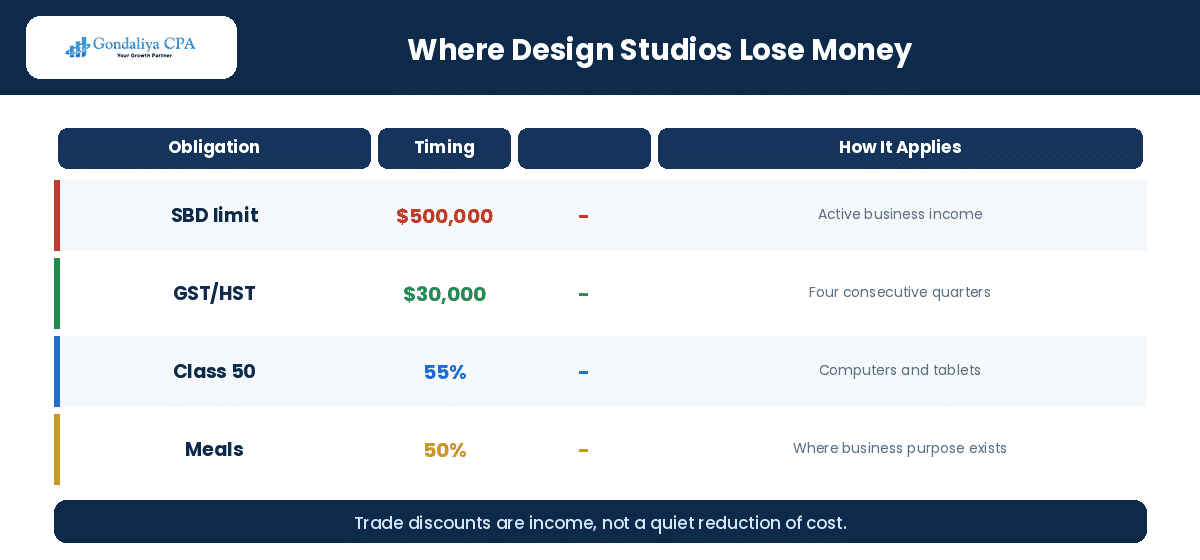
- GST/HST registration timing: Once taxable revenue passes $30,000 across four consecutive calendar quarters, registration is mandatory. Crossing it mid-project catches people out.
What Actually Moves the Number
Four things matter more than the rest:
- The small business deduction on the first $500,000 of active business income for a CCPC, shared across associated corporations
- The salary and dividend mix, which changes your personal tax, your RRSP room and your CPP cost
- Claiming every legitimate expense tied to earning income, from samples to software to site travel
- Revenue timing, so deposits and milestone billings land in the period they were earned
Everything else in this guide sits underneath those four.
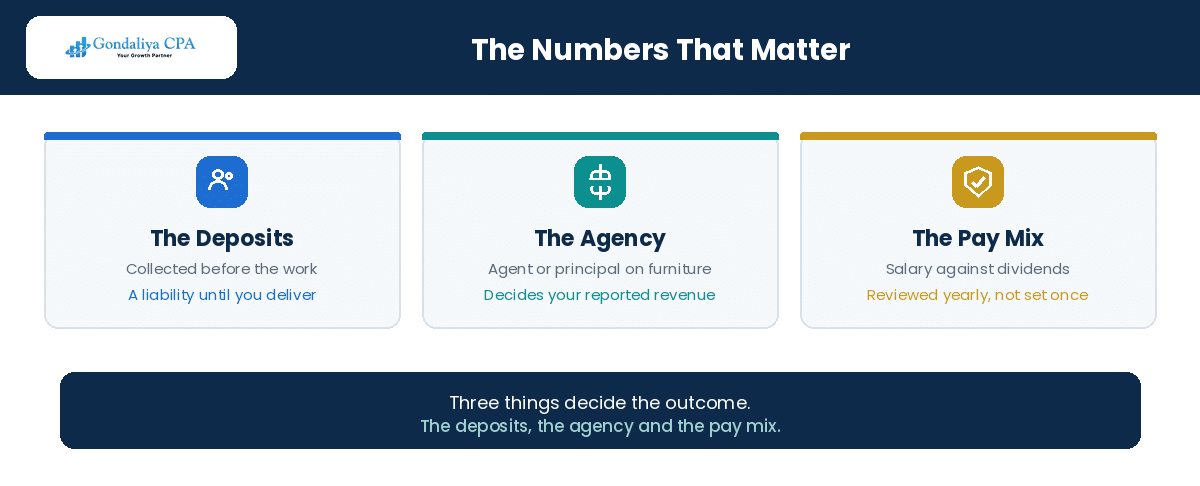
The question we get asked most is whether to incorporate. The question that actually decides the tax bill is when the deposit becomes income. Figures changed for privacy.
Risk Warning: Working substantially for one developer or builder raises the personal services business question. Please have the arrangement reviewed before incorporating around it.
Industry-Specific Tax Considerations
Industry-Specific Considerations
The Business Model
Interior design businesses work on projects that vary in length and value, so income arrives unevenly. That affects both tax and cash flow, and it is why a generic approach to bookkeeping does not serve the sector well.
- Project timelines drive when income is recognised
- Costs split between variable project spend and fixed overhead
- Salary and dividends balance personal tax against RRSP room and CPP
- Incorporation benefits have to exceed the compliance cost
- Fee structures need to be clear before the first invoice
- Deposits require proper accounting from day one
- Expense records have to tie to specific projects
Project Revenue and Deposits
Designers usually bill by stage. Milestone billing tied to completed phases keeps income aligned with the work and avoids a distorted year end.
Deposits received before work starts are deferred revenue, recorded as a liability until the service is performed. Recognising them on receipt overstates one year and empties the next.
| Planning Tool | What It Does | Records Needed |
|---|---|---|
| Milestone billing | Bills against completed project phases | Signed contract and invoices |
| Deferred revenue | Holds deposits as liabilities until earned | Deposit ledger and client agreement |
| Direct project costing | Links each cost to the job it serves | Receipts coded by project |
Common deductible project costs include samples used for clients, drafting and rendering software, courier fees, site travel supported by a log, photography of completed work, and showroom or trade access fees.
Professional Development and Education
Training that maintains or updates skills you already use in the business is generally a current expense. A course leading to an entirely new lasting qualification is treated differently, so please check before claiming a large fee.
Keep the course description, the receipt and the payment date. Personal items and home furnishings are not educational tools, and claiming them that way invites a wider review.
Technology and Equipment
Equipment falls into different classes depending on what it is:
| Item | Typical Treatment |
|---|---|
| Computers, tablets and monitors | Class 50 at 55% |
| Application software | Class 12 at 100%, half-year rule applies |
| Office furniture and studio fittings | Class 8 at 20% |
| Annual software subscriptions | Current expense in the period covered |
| Small tools below the threshold | Class 12 where the item qualifies |
A Toronto studio bought $12,000 of rendering software in December. As Class 12 property the rate is 100%, but the half-year rule limits the first-year claim to $6,000, with the balance available the following year. Buying in the first month of the fiscal year instead would not change the half-year restriction, but it would give the studio eleven more months of use for the same deduction. Figures changed for privacy.
Buying before year end accelerates the deduction into the current year, but the asset must be available for use before you can claim. Equipment still boxed on the last day of the year does not help that year.
Home Office
A workspace-in-home claim is available where the space is your principal place of business, or is used exclusively for the business and regularly for meeting clients.
The claim is based on the proportion of your home the workspace occupies, applied to eligible costs including rent or mortgage interest, utilities and internet.
Keep a floor plan with measurements and the bills for the period claimed. A percentage you cannot demonstrate is a percentage that gets reduced.
Deposits sitting in revenue is the most common thing we correct on a design file. The studio looks profitable in the year it collected and loses money in the year it delivered. Figures changed for privacy.
Key Stat: A deposit is a liability until the work is performed. Please keep it out of revenue until the corresponding phase is complete.
Incorporation and Corporate Tax Strategy
Incorporation and Corporate Strategy
The Structure
Corporation or Sole Proprietorship
The decision turns on income and on how much you retain. A corporation paying the small business rate keeps more of each dollar than you would personally, but only if the money stays in the company. If you draw everything out to live on, the advantage largely disappears.
Incorporation also brings limited liability, corporate filings, separate bookkeeping and higher annual cost. Below a certain income the compliance cost exceeds the benefit.
A designer with $150,000 of net business income who needs $90,000 to live on retains $60,000 in the company. That retained amount is taxed at the small business rate rather than at personal marginal rates, and the difference is a deferral until the money is drawn out. A designer with the same income who draws all of it sees very little benefit. Figures changed for privacy.
Personal Services Business Exposure
The personal services business rules catch an incorporated person who is effectively an employee of the payer. Where they apply, the small business deduction is denied and most expense deductions disappear, leaving a punitive rate.
Designers working substantially for one builder, developer or firm are exposed. Protection comes from working for several clients, controlling how the work is done, supplying your own tools and carrying real risk of profit and loss.
Contracts help but do not decide it. The working relationship does.
The Small Business Deduction
The small business deduction applies to the first $500,000 of active business income for a Canadian-controlled private corporation, shared across associated corporations. Access is also reduced where taxable capital or passive investment income is significant.
Retaining earnings in the company defers personal tax until the money is drawn, which frees working capital for growth or equipment.
Salary, Dividends and Family Shareholders
| Payment Type | Deductible to Company | Creates RRSP Room | CPP Required |
|---|---|---|---|
| Salary | Yes | Yes | Yes, both shares |
| Dividends | No | No | No |
A blend usually works best. Salary covers living costs and builds RRSP room; dividends move surplus out without payroll cost. The right mix changes annually with your income and your RRSP position.
Paying family members requires care. Salary must reflect work genuinely performed at a rate you would pay anyone else, supported by timesheets or a job description. Dividends to family shareholders who do not meaningfully contribute can be caught by the tax on split income, which applies the top marginal rate to the amount.
Shareholder Loans
Money taken from the company that is not salary or dividends builds a shareholder loan balance. If it is not repaid within the period the Act allows, the amount can be included in your personal income.
Track the balance quarterly rather than discovering it at year end, and document any genuine loan properly.
Bonuses and Timing
A bonus accrued at year end must be paid within the period set by the Act for the company to keep the deduction. Declaring a bonus and never paying it produces a denied deduction and an awkward conversation.
For advice on your studio’s structure, contact Gondaliya CPA at info@gondaliyacpa.ca or call 647-212-9559.
Designers ask about incorporating when revenue rises. The better question is what they retain. Two studios billing identically get opposite answers. Figures changed for privacy.
Risk Warning: Dividends to a family member who does not work in the business can attract the tax on split income at the top marginal rate. Please test this before declaring.
HST Planning and Compliance
HST Planning and Compliance
The Sales Tax
Sales tax is not just a payment obligation; for a design studio buying furniture on behalf of clients it shapes the entire cash flow cycle.
When to Register
You must register for GST/HST once taxable revenue exceeds $30,000 across four consecutive calendar quarters. This applies to studios, product resale and online consultations alike.
Two points catch designers out. The threshold is a rolling test rather than a calendar-year one, and once registered you account for the tax on your invoices whether or not the client has paid you.
Registering voluntarily below the threshold has merit where you are buying significant equipment or furniture, since the input tax credits become available immediately.
Input Tax Credits
Input tax credits recover the GST/HST you pay on business purchases: equipment, studio rent, professional services and goods bought as principal.
To claim correctly:
- Keep invoices showing the supplier’s registration number
- Claim business purchases only, kept separate from personal spending
- Apportion mixed-use items by actual business use, with something showing the calculation
- Claim in the correct reporting period
Agent or Principal on Furniture Purchases
This is the question that most distinguishes design accounting from other service businesses.
| Position | Revenue Reported | GST/HST Treatment | Contract Requirement |
|---|---|---|---|
| Agent | Your commission or fee only | Tax charged on the fee | Clear agency terms in writing |
| Principal | The full sale price | Tax charged on the full amount | Ownership and risk clearly stated |
The distinction turns on who bears the risk and who holds title, not on how the invoice is worded after the fact. Acting as principal inflates your reported revenue considerably, which can affect your GST/HST filing frequency and how your statements read to a lender.
Trade discounts and vendor rebates are generally income unless the arrangement says otherwise. Netting them silently against cost is where reassessments start.
Cross-Border and Interprovincial Work
Services supplied to a non-resident client can be zero-rated where the conditions in the Excise Tax Act are met, meaning tax at 0% while you keep your input tax credits. The conditions are specific and depend on documentation showing the recipient’s status.
For work across provinces, the place-of-supply rules determine which rate applies. Track interprovincial supplies separately so the return reports them correctly.
Filing and Timing
The CRA assigns your reporting period based on taxable supplies. Annual filing applies below $1.5 million, quarterly between $1.5 million and $6 million, and monthly above that.
Late filing brings a penalty calculated by reference to the amount owing and how many months the return is late, with interest running separately.
Aligning your instalments with project billing avoids the cash squeeze that hits studios during quiet months.
The agent against principal question changes a studio revenue figure by six figures on a single large project. It is worth settling in the contract, not in the bookkeeping. Figures changed for privacy.
Key Stat: Acting as principal puts the full furniture price in your revenue. Please decide the position in the client agreement before the order goes in.
Deductions, Credits and Financial Management
Deductions, Credits and Records
The Deductions
Business Expenses
Expenses must be reasonable and incurred to earn income. For a design studio the usual list includes:
- Project samples, finishes and presentation materials
- Drafting, rendering and project management software
- Courier and delivery fees tied to sites
- Photography of completed projects
- Trade show and showroom access fees
- Professional insurance and association dues
Vehicle costs are claimable in proportion to business use, supported by a logbook recording date, destination, purpose and distance, plus odometer readings for the year. Without total kilometres the percentage cannot be calculated.
Meals are 50% deductible where there is a genuine business purpose. Keep a note of who was present and what was discussed.
Tax Credits Worth Checking
Some design businesses undertake work that qualifies for scientific research and experimental development credits, typically where they are developing new software tools or techniques rather than applying existing ones. The bar is technological advancement and uncertainty, not creative innovation, so most conventional design work will not qualify.
Provincial interactive digital media credits may apply where a studio produces qualifying interactive content. Eligibility rules vary by province and change, so please confirm before budgeting on the credit.
Either way, the assessment has to happen during the project, not after filing.
Bookkeeping Built for Design Work
Cloud accounting with receipt capture reduces the manual entry errors common in project businesses. What matters more is the structure:
- Code every cost to a project so margin is visible by job
- Flag whether each purchase was made as agent or principal
- Keep reimbursed vendor purchases separate from fee income
- Track deposits in a liability account, released as work completes
- Reconcile the bank monthly rather than at year end
Monthly reconciliation also keeps your instalment calculations accurate, which avoids interest charges.
Monthly Review Habits
A monthly review lets you make decisions while they still matter: adjusting the salary and dividend mix, timing an equipment purchase, or seeing that a project is running over.
Keep the documents that support your positions:
- Client contracts showing fee structure and scope
- Purchase orders tied to specific projects
- Payroll records demonstrating that wages match work performed
- Shareholder loan statements showing the balance and repayments
- Vehicle logs and home office measurements
Records must be kept for six years from the end of the tax year they relate to.
Studios that code costs to projects can tell you which client type earns. Studios that do not are pricing the next job from memory. Figures changed for privacy.
Pro Tip: Please set up project codes before the next contract starts. Retrofitting them across a year of transactions is far more work than it sounds.
Audit Readiness and Working With Gondaliya CPA
Audit Readiness and Working With Us
The Support
What Draws CRA Attention
The patterns are consistent across design businesses:
- Personal furniture or home décor claimed as business assets
- Client deposits that do not reconcile between the books and the return
- Trade discounts netted against cost rather than reported
- Family wages with no timesheets or job description behind them
- Vehicle claims with no logbook
- Shareholder loan balances growing year on year
Our CRA audit guide sets out what a review involves and what gets requested.
Things Not Worth Doing
A few practices cause more damage than the tax they save:
- Claiming home furnishings that are not genuine sample or staging inventory
- Reducing cost by trade discounts without reporting them
- Paying family members for hours nobody worked
- Backdating invoices or reconstructing receipts after the fact
The last one moves the conversation from a disagreement about treatment to something considerably more serious.
How We Work With Design Studios
We support incorporated designers from first incorporation through to year-end filing:
- Corporate structure review and incorporation timing
- Deposit and deferred revenue setup so income lands correctly
- Agent against principal determination on furniture and trade purchases
- GST/HST registration, filing and input tax credit review
- Salary and dividend planning reviewed annually
- Shareholder loan monitoring and TOSI assessment on family shareholders
- Financial statements and the corporate return
Pricing is a flat annual fee including HST, quoted before any work begins, with a one-business-day response commitment.
Getting Started
We begin by understanding your studio: how you bill, how you buy, and what you retain. From there we set the structure and the bookkeeping to match, rather than fitting your business to a generic template.
Contact Gondaliya CPA at info@gondaliyacpa.ca, call 647-212-9559, or send us a message. We answer within one business day and offer evening and weekend availability during busy periods.
The single most useful hour we spend with a new design client is going through one completed project end to end. Deposit, purchases, discounts, final invoice. Everything shows up in that one file. Figures changed for privacy.
Pro Tip: Please bring one completed project file to the first meeting. It answers more questions than a year of bank statements.
FAQs on Interior Designer Tax Planning Canada
Frequently Asked Questions
FAQ
What is the small business deduction limit for interior designers?+
The first $500,000 of active business income for a Canadian-controlled private corporation, shared across associated corporations and reduced where taxable capital or passive income is significant.
Should an interior designer incorporate?+
It depends on what you retain rather than what you bill. Incorporation gives a deferral advantage where profit stays in the company and little benefit where you draw it all out.
How do CPP contributions affect an incorporated designer?+
Salary attracts both the employee and employer share of CPP, which is a real cost. Dividends avoid CPP but build no RRSP room. Rates and the earnings ceiling are set annually.
How are meals and entertainment treated?+
They are 50% deductible where there is a genuine business purpose. Keep a note of who attended and what was discussed.
When must an interior design business register for GST/HST?+
Once taxable revenue exceeds $30,000 across four consecutive calendar quarters. It is a rolling test rather than a calendar-year one.
How does the tax on split income affect family shareholders?+
Dividends to family members who do not meaningfully contribute to the business can be taxed at the top marginal rate rather than at the recipient’s own rate.
When are corporate instalments due?+
Corporate instalments are generally monthly, or quarterly for eligible CCPCs, based on your fiscal year rather than fixed calendar dates.
Are trade discounts and vendor commissions taxable?+
Generally yes. Trade discounts and rebates are income unless the arrangement provides otherwise, and netting them against cost without reporting draws attention.
How should designers handle vehicle and site visit costs?+
Keep a logbook recording date, destination, purpose and distance, plus odometer readings for the year, and claim only the business proportion.
Do I report the full furniture price as revenue?+
Only if you act as principal, bearing the risk and holding title. Acting as agent means you report your fee or commission. The contract should make the position clear.
Is a deposit taxable when I receive it?+
For income tax it is deferred revenue until the work is performed. For GST/HST the timing can differ, so both should be reviewed.
What records support my tax positions?+
Client contracts, invoices, project-coded receipts, bank statements, timesheets for family wages, shareholder loan statements and vehicle logs, kept for six years.
Twelve questions and one underneath most of them: whose money is this and when did it become mine. Deposits, discounts and furniture purchases all turn on that. Figures changed for privacy.
Key Planning Considerations for Interior Designers
Key Planning Considerations
Quick Reference
Structure and Thresholds
- Small business deduction: First $500,000 of active business income, shared if associated.
- GST/HST threshold: $30,000 across four consecutive quarters, a rolling test.
- Filing frequency: Annual below $1.5 million, quarterly to $6 million, monthly above.
- Personal services business: Exposure where one payer dominates your income.
- TOSI: Applies to family shareholders who do not meaningfully contribute.
- Shareholder loans: Included in income if not repaid within the period allowed.
- Salary and dividends: Reviewed annually, not set once.
- Records: Six years from the end of the tax year.
Revenue, Purchases and Assets
- Deposits: A liability until the corresponding work is performed.
- Milestone billing: Aligns income with completed phases.
- Agent or principal: Decides whether you report the fee or the full sale price.
- Trade discounts: Generally income, not a silent reduction of cost.
- Computers and tablets: Class 50 at 55%.
- Application software: Class 12 at 100%, subject to the half-year rule.
- Furniture and fittings: Class 8 at 20%.
- Available for use: Required before any capital cost allowance can be claimed.
- Meals: 50% deductible where a business purpose exists.
Habits That Protect the Position
- Code every cost to the project it serves.
- Hold deposits in a liability account and release them as work completes.
- State the agent or principal position in the client agreement.
- Report trade discounts and rebates rather than netting them.
- Keep a vehicle log with dates, destinations and distances.
- Measure the home office and keep the floor plan.
- Support family wages with timesheets and a job description.
- Monitor the shareholder loan balance quarterly.
- Hold supplier invoices with registration numbers for every input tax credit.
- Never reconstruct receipts or backdate invoices.
For tailored support on your interior designer corporate tax planning, contact Gondaliya CPA at info@gondaliyacpa.ca, call 647-212-9559, or book a free consultation.
Twenty-seven points and one underneath them: know when the money became yours and on what basis you bought the furniture. Those two answers shape the whole return. Figures changed for privacy.
Design Practices We Serve
Industry Expertise
Which issue dominates differs by how you work. Here are ten and the usual focus.
| Design Practice | Where the Planning Concentrates |
|---|---|
| Residential designer, solo | Deposit timing and incorporation threshold |
| Studio buying furniture for clients | Agent against principal on every order |
| Commercial and workplace design | Milestone billing across long projects |
| Designer working for one developer | Personal services business exposure |
| Studio with family shareholders | TOSI and wage reasonableness |
| Designer working from home | Workspace conditions and measurement |
| Practice with US or overseas clients | Zero-rating conditions and documentation |
| Home staging business | Sample and staging inventory treatment |
| Studio investing in rendering technology | CCA classes and available-for-use timing |
| Approaching the $30,000 threshold | Registration timing and input tax credits |
- Residential designer, solo: Deposits collected in one year, delivered in the next.
- Studio buying furniture for clients: The position decides your reported revenue.
- Commercial and workplace design: Long projects need phases billed as completed.
- Designer working for one developer: One dominant payer is a structural risk.
- Studio with family shareholders: Dividends without contribution attract top rates.
- Designer working from home: The percentage must be measurable.
- Practice with US or overseas clients: Zero-rating needs evidence, not assumption.
- Home staging business: Inventory held for clients is not your furniture.
- Studio investing in rendering technology: Boxed on 31 December helps nobody.
- Approaching the $30,000 threshold: A rolling test crossed mid-project.
How you work changes where the planning concentrates. It does not change the method, which is time the revenue correctly, settle the agent question, then structure the pay. Figures changed for privacy.
Professional Guidance and Quick Reference
Guidance
Professional Guidance for Designers: How Gondaliya CPA Handles Your File
Interior designers lose money in a predictable set of ways: client deposits taken into revenue on receipt rather than as the work is delivered, furniture bought as principal without anyone deciding that was the intention, trade discounts netted quietly against cost instead of reported as income, the $30,000 GST/HST threshold crossed mid-project without registering, dividends paid to family shareholders who do not work in the business, and incorporation entered before it does anything or delayed long past the point it would have helped. Gondaliya CPA handles interior designer tax planning on a fixed annual fee.
We handle what decides the outcome: setting up deferred revenue so deposits land in the period the work is performed, settling the agent against principal position in the client agreement rather than after the invoice, reporting trade discounts and vendor rebates correctly, tracking the rolling GST/HST threshold and registering at the right point, assigning technology and equipment to the correct capital cost allowance class, testing personal services business exposure where one payer dominates, and reviewing the salary and dividend mix against what you actually retain.
Our team starts with one completed project file, because the deposit, the purchases, the discounts and the final invoice all appear in it. Residential, commercial, staging or a studio with staff, you get clear advice and a fixed price before we start.
Quick Answers: Key Numbers & Concepts at a Glance
At a Glance
- Corporate return: T2, six months after year end
- Small business limit: $500,000, shared if associated
- GST/HST: $30,000 across four consecutive quarters
- Deposits: A liability until the work is done
- Agent: Report the fee only
- Principal: Report the full sale price
- Computers: Class 50 at 55%
- Software: Class 12 at 100%, half-year rule
- Meals: 50% deductible
- Records: Six years retention
Who This Is For / Not For
Fit Check
- For: Self-employed and incorporated interior designers, design studios, decorators and home staging professionals across Canada.
- Not For: Professional association membership, provincial title restrictions and building code compliance, which sit with the relevant authority rather than accounting.
People Also Ask
Related Questions
Can I claim furniture I bought for my own home as sample inventory?+
Only where it is genuinely held as sample or staging inventory for client use. Furnishings you live with are personal, and this is a common reassessment area.
Does my design work qualify for SR&ED credits?+
Usually not. The test is technological advancement and uncertainty rather than creative innovation, though a studio developing new software tools may qualify.
What happens if I registered for GST/HST late?+
You may owe the tax you should have charged from the date registration became mandatory. The Voluntary Disclosures Program may reduce penalties if you come forward first.
Glossary of Key Terms
- T2: The corporation income tax return.
- Deposit: Funds received before the work is performed.
- Deferred revenue: Unearned income recorded as a liability.
- Milestone billing: Invoicing against completed project phases.
- Agent: Buying on a client behalf, reporting only your fee.
- Principal: Buying on your own account, reporting the full sale.
- Trade discount: A supplier reduction that is generally income.
- Small business deduction: The reduced rate on active business income.
- Personal services business: An incorporated employee arrangement taxed punitively.
- TOSI: The tax on split income applying to certain family shareholders.
- Shareholder loan: Company funds used personally, taxable if not repaid properly.
- Class 50: The 55 percent class covering computers and tablets.
- Class 12: The 100 percent class covering application software and low-cost tools.
- Half-year rule: The first-year restriction on CCA claims.
- Input tax credit: GST/HST recoverable on business purchases.
- Zero-rated: A taxable supply at zero percent that still allows credits.
Interior Designer Readiness Check
This quick self-check indicates where your operation most likely has room. Please answer the six questions below.
Interior Designer Readiness Check
Six quick questions on your studio. No fee shown.
Points to raise with us:
This is a general prompt, not tax or legal advice or a quote. Your position depends on your full facts. For a real review, please book a free consultation.
Want a checklist to work from? You can download our free interior designer tax planning checklist before your consultation.
Hold client deposits as a liability until the work is performed. Set the agent or principal position in the client agreement. Report trade discounts and rebates as income. Code every cost to its project. Track the rolling GST/HST threshold quarterly. Support family wages with timesheets. Review the salary and dividend mix annually. Please keep six years of records.
2026 Update — what is current: This article reflects rules current to 2026. The $500,000 small business deduction limit, the $30,000 GST/HST registration threshold measured across four consecutive calendar quarters, the Class 50 rate of 55%, the Class 12 rate of 100%, the Class 8 rate of 20%, the half-year and available-for-use rules, the 50% meals limitation and the six-year retention requirement are unchanged. Please note that the small business limit is $500,000 rather than the $600,000 appearing in some guidance; that Class 12 covers tools below a $500 threshold rather than $5,000; that corporate instalments run monthly or quarterly against your fiscal year rather than on the fixed calendar dates used for personal instalments; that GST/HST monthly filing is required above $6 million in taxable supplies rather than $1.5 million, which is the quarterly threshold; and that the tax on split income applies the top marginal rate rather than a single flat percentage.
Interior Designer Tax Planning Canada: How Gondaliya CPA Helps Studios Keep More
Start with one completed project
Gondaliya CPA sets up deferred revenue so deposits land in the period the work is performed, settles the agent against principal position in the client agreement, reports trade discounts and vendor rebates correctly, tracks the rolling GST/HST threshold and registers at the right point, assigns technology and equipment to the correct capital cost allowance class, tests personal services business exposure where one payer dominates and reviews the salary and dividend mix against what you actually retain, on a flat annual fee including HST with a one-business-day response. Please book a free consultation.
Next Steps
Please book a free consultation with Gondaliya CPA and bring one completed project file, a recent client contract, and your last filed return. Those three tell us immediately whether deposits are timed correctly, whether the agency position holds up, and where the documentation is thin. You will get a flat annual fee including HST before any work begins. If our content helps, please add gondaliyacpa.ca as a preferred source on Google.
Published: · Last updated:
Editorial policy: We research against CRA and CPA Ontario sources, fact-check the figures, and Sharad Gondaliya, CPA, reviews the content, which we update as the rules change.
Disclaimer: This article is educational information only and is not tax, legal, or financial advice. Figures marked illustrative are examples rather than quotes or guarantees. It reflects CRA rules current to 2026, including the $500,000 small business limit, the $30,000 GST/HST threshold, the Class 50 and Class 12 rates, the half-year rule, and the six-year retention requirement. Rates, limits and expensing rules change and outcomes depend on your specific facts. Please consult a CPA Ontario member before acting.

Sharad Gondaliya is a CPA Canada & CPA USA with 15 Years+ experience of Accounting, Tax, Payroll of Corporate Small Businesses as Tax Accountant. He is a CPA Ontario member (61040184) and holds US CPA licences in Washington and Montana and is well known among corporate small businesses for tax planning, efficient tax solutions, and affordable CPA services. Sharad is the Principal (Director) of Gondaliya CPA – Affordable CPA Firm in Canada. Licenses: CPA Ontario: 61040184 | CPA USA (MT): PAC-CPAP-LIC-033176 | CPA USA (WA): 57629 | CPA Firm License: 61330051 View Full Author Bio