



Tax Deductions for Gyms in Canada: What Gym Owners Can Legally Claim as Business Expenses
Gym Tax Deductions Canada: How to Maximize Gym Business Expenses and Fitness Tax Savings with Gondaliya CPA
Gym tax deductions Canada can significantly reduce your taxable income when you properly track gym business expenses and claim fitness business tax deductions. Gondaliya CPA offers practical advice on gym tax savings strategies to help fitness professionals in Canada keep more of their earnings.
Independent studios, franchise locations and personal training facilities all hit the same three questions: when does a prepaid membership become income, which equipment gets written off now against over time, and are the trainers employees. Our gym accounting and tax services settle all three on a fixed annual fee.
Quick Summary
Tax deductions matter for gyms because the margins are thin and the capital spend is heavy. Getting membership revenue timing, equipment classification and trainer status right does more for your position than any single write-off.
Reading time: 48 minutes.
Table of Contents
- Why Deductions Matter and the Rules
- Equipment, Supplies and Payroll
- Facility, Marketing and Professional Fees
- What You Cannot Claim and GST/HST
- Records, Filing and Documentation
- Year-Round Planning and Working With Us
- Frequently Asked Questions
- Best Practices and Key Points
- Fitness Businesses We Serve
- Professional Guidance and Quick Reference
The Numbers That Matter
This article covers Canada, with Ontario and Toronto context, and reflects rules current to 2026. It applies to incorporated gyms, boutique studios, franchise locations, CrossFit boxes and personal training facilities. Figures marked illustrative are examples, not quotes, and any masked engagement notes end with “Figures changed for privacy.” This is educational information only and not tax or legal advice. Consumer protection rules on membership contracts, municipal licensing and health and safety regulation sit outside accounting scope.
Why Deductions Matter and the Rules That Govern Them
Why Deductions Matter and the Rules
The Basics
What Deductions Do for a Gym
Deductions cut the tax bill, which leaves more cash in the business. In a sector where equipment is expensive and membership pricing is competitive, that difference funds the next purchase.
Money saved on tax goes back into equipment, space, marketing or staff. All of those help attract and keep members, which is the whole business.
The Rules That Apply
The general test is straightforward: an expense must be incurred to earn income and must be reasonable in the circumstances. Personal costs do not qualify however connected they feel to the business.
Two provisions come up constantly for gyms:
- The 50% limit on meals and entertainment under section 67.1, which applies to promotional meals and member events
- Capital cost allowance, which spreads the cost of equipment and improvements over years rather than deducting them at once
The second one is what most affects a gym, because equipment is where the money goes.
Current Expense or Capital Asset
This distinction runs through everything below:
| Type | How It Is Treated | Gym Examples |
|---|---|---|
| Current expense | Deducted in full in the year incurred | Cleaning supplies, repairs, wages, rent |
| Capital asset | Written down over years through CCA | Treadmills, racks, sound systems |
| Leasehold improvement | Written off over the lease term | Rubber flooring, change rooms, mirrors fixed to walls |
Getting an item on the wrong side of that line is the single most common adjustment we make on a gym file.
New gym owners almost always expense the equipment fit-out in full and are surprised when it is reclassified. The deduction is not lost, but it arrives over years rather than in year one. Figures changed for privacy.
Risk Warning: Equipment cannot be written off in full in the year you buy it. Please plan cash flow around the capital cost allowance schedule, not the purchase price.
Equipment, Supplies and Payroll
Equipment, Supplies and Payroll
The Core Costs
Gym Equipment
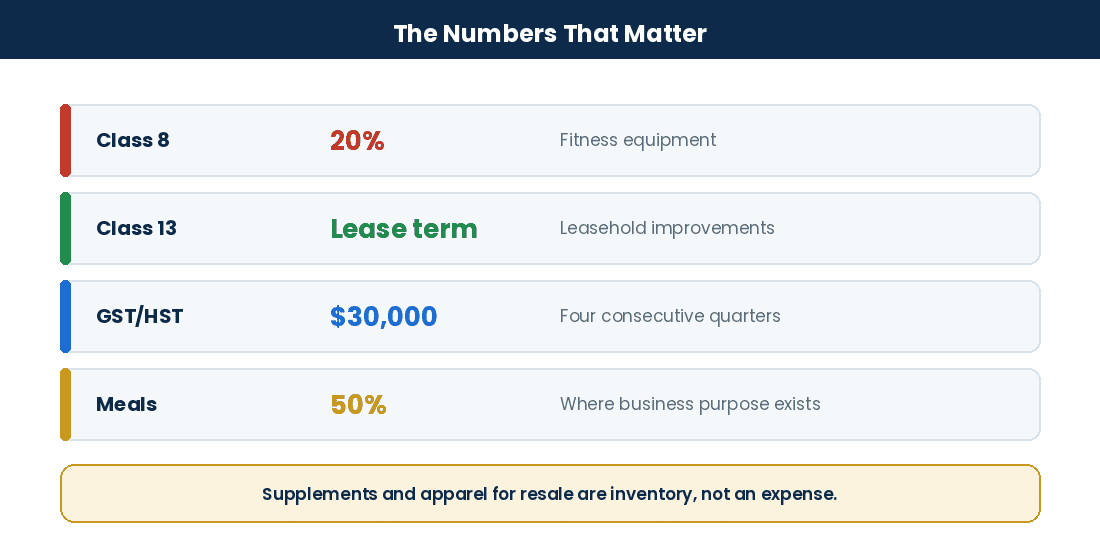
Fitness equipment is a capital purchase claimed over time through capital cost allowance. Treadmills, racks, benches, free weights and cardio machines generally fall into Class 8 at a 20% declining balance rate.
| Item | Typical Class | Rate |
|---|---|---|
| Cardio machines, racks, benches, weights | Class 8 | 20% |
| Computers, tablets and screens | Class 50 | 55% |
| Application software | Class 12 | 100%, half-year rule applies |
| Rubber flooring, mirrors and fixed fit-out | Class 13 | Over the lease term |
| Small tools below the threshold | Class 12 | 100% where the item qualifies |
The half-year rule limits your claim to half the normal amount in the year an asset becomes available for use. Equipment delivered but still crated on your year end does not qualify that year.
Keep the invoice showing the item, the date and the price. An asset register listing every machine with its class is what makes the claim defensible.
Maintenance Against Improvement
Repairs are current expenses deducted immediately: replacing a treadmill motor, restringing a cable machine, servicing HVAC.
Improvements that extend the asset’s life or increase its capacity are capital and go into a class. Replacing a worn belt is a repair; replacing the entire deck assembly with an upgraded unit usually is not.
The test is whether you restored the asset or bettered it. Document what was done, not just what it cost.
Consumables and Cleaning
Cleaning supplies, sanitiser, disposable wipes, towel laundering and equipment cleaning products are straightforward current expenses. So are chalk, resistance bands and other items consumed in use.
Where a cost has a personal element, claim only the business portion and be able to explain the split.
Wages and Payroll
Wages paid to front desk staff, cleaners and employed trainers are deductible where they are properly run through payroll. You withhold income tax, CPP and EI and remit on the schedule set by your remitter type.
T4 slips are due by the last day of February following the calendar year. The employer share of CPP and EI is itself a deductible expense.
Wages must be reasonable for the work performed. Paying a family member well above market rate for limited hours is the version of this that gets adjusted.
Trainers: Employee or Contractor
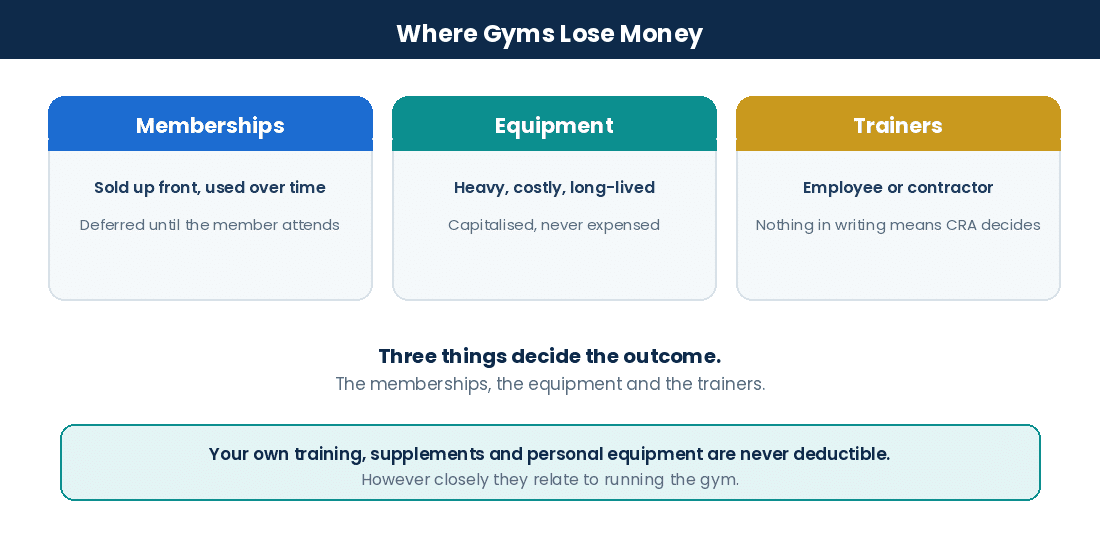
This is the classification question that costs gyms the most. The CRA looks at the substance of the relationship:
- Control: Who sets the hours, the rates and the training approach
- Tools: Who supplies the equipment and the space
- Chance of profit and risk of loss: Whether the trainer can profit from building a client base or lose on a quiet month
- Integration: How embedded the trainer is in your operation
A trainer using your equipment, on your schedule, at rates you set, with clients you assign, looks like an employee whatever the agreement says. A trainer renting space, setting their own rates and keeping their own clients looks like a contractor.
Genuine contractors are paid gross and reported on a T4A where applicable. Misclassification means the CRA can assess the source deductions that should have been withheld, plus penalties and interest, with directors carrying personal exposure on unremitted amounts.
Trainer classification is where gyms get assessed. A written contract helps, but the schedule, the rate card and who owns the client relationship tell the real story. Figures changed for privacy.
Key Stat: Equipment generally sits in Class 8 at 20%, with the half-year rule in year one. Please build an asset register before your first year end.
Facility, Marketing and Professional Fees
Facility, Marketing and Professional Fees
The Overheads
Rent and Leasehold Improvements
Commercial rent under a signed lease is fully deductible where the space is used for the business.
The fit-out is different. Rubber flooring, change rooms, reception build-outs, mirrors fixed to walls and installed lighting are leasehold improvements in Class 13, written off over the lease term including renewal options rather than at a fixed percentage.
Keep the lease alongside the contractor invoices. The lease term is what sets the write-off period, so the two documents work together.
Utilities
Electricity powering the equipment and lighting, water for showers, gas for heating, and internet for the booking system are all deductible.
Where any part of the premises is used personally, or where a residential unit shares a meter, apportion the cost and keep the bills showing the calculation.
Marketing and Advertising
Advertising to attract members is fully deductible: local print, digital campaigns, social media advertising, signage and community event sponsorship where it promotes the brand.
The exception is meals and entertainment connected to promotion, which are limited to 50% under section 67.1. A member appreciation event with catering falls into that category.
Keep invoices stating what each campaign promoted. “Marketing” as a single line with no supporting detail is what draws questions.
Insurance, Licences and Professional Fees
Deductible in the ordinary course:
- Liability and property insurance covering the business
- Municipal business licences and any required permits
- Accounting and bookkeeping fees
- Legal fees relating to business matters, not personal ones
- Industry association memberships
Franchise arrangements need care. An initial franchise fee is generally a capital outlay, falling into Class 14 where the agreement has a fixed term or Class 14.1 where it does not. Ongoing royalties are current expenses deducted as incurred. Please have the agreement reviewed rather than assuming either treatment.
Travel and Vehicle
Travel connected to the business, such as meeting suppliers or attending industry events, is deductible with receipts and a clear business purpose.
Vehicle costs are claimable in proportion to business use, supported by a logbook recording date, destination, purpose and distance, plus odometer readings at the start and end of the year. Without total kilometres the percentage cannot be calculated.
Bad Debts and Refunds
Unpaid membership dues can be written off as bad debts where the amount was included in income and you have genuinely attempted collection. Keep the invoices, the record of attempts and the write-off decision.
Refunds on cancelled memberships reduce revenue in the period they are given. They are an adjustment to income rather than a separate deduction, so recording them twice overstates your costs.
Leasehold improvements put into Class 8 instead of Class 13 is the second most common gym adjustment. The lease term decides the period, not the equipment rate. Figures changed for privacy.
Risk Warning: Fixed fit-out in a leased space is Class 13, written off over the lease term. Please check the lease before setting the write-off period.
What You Cannot Claim, and GST/HST
What You Cannot Claim and GST/HST
The Limits
Costs That Never Qualify
Gym owners test this line more than most, because the personal and business worlds overlap so heavily.
- Your own training and fitness: Personal workouts, coaching you receive and your own supplements are personal costs, not business expenses
- Home exercise equipment: Not deductible unless genuinely held and used in the business premises for clients
- Personal clothing: Ordinary athletic wear is personal even if you only wear it at work. Branded staff uniforms are different
- Fines and penalties: Never deductible
- The personal portion of mixed costs: Phone, vehicle, internet all need apportioning
Staff training is a different matter. A certification course that a trainer needs for their role is a legitimate business cost where it is documented and connected to the work.
Deferred Revenue on Memberships
This is where gyms most often report income in the wrong year.
An annual membership paid up front is not revenue on receipt. It is a liability that becomes income as the member uses the service across the year. The same applies to class packs, personal training packages and prepaid session blocks.
A Toronto studio sells $120,000 of annual memberships in January of a December year end. Recognising all of it that year overstates income by roughly eleven months of service still to be delivered. Under deferred revenue accounting, one twelfth is recognised monthly, and the unearned balance sits as a liability at year end. Figures changed for privacy.
Class packs raise a further question about expiry. Where unused sessions lapse under the contract, the treatment on breakage should be settled rather than left to chance.
GST/HST on Memberships
Memberships and fitness services are generally taxable supplies. You must register for GST/HST once taxable revenue exceeds $30,000 measured across four consecutive calendar quarters, which most gyms pass in their first months.
In Ontario that means charging 13% HST on memberships, personal training, drop-in fees and retail sales. Note that GST/HST timing on a prepaid membership can differ from the income tax deferral, so both need reviewing rather than assuming they align.
Input tax credits recover the tax you pay on equipment, rent, utilities and supplies, supported by supplier invoices showing the registration number. Registering before a large equipment purchase means recovering that tax immediately.
Retail and Supplement Inventory
Supplements, apparel and drinks held for resale are inventory, not an expense. The cost moves to cost of goods sold when the item sells, not when you buy the stock.
Count inventory at year end and record opening and closing values. A gym expensing every supplement order on purchase overstates costs in a growth year and understates them when stock runs down.
Employee Memberships and Benefits
Free or discounted memberships given to staff are generally a taxable benefit to the employee, reportable on their T4. The cost to you is deductible, but the benefit side has to be reported.
Gyms routinely miss this because the membership costs them little in cash terms. The reporting obligation does not depend on your marginal cost.
Prepaid memberships recognised on receipt is the error we correct most on gym files. It makes the opening year look excellent and every year after look worse than it is. Figures changed for privacy.
Key Stat: A prepaid annual membership is a liability until the service is delivered. Please recognise it across the membership period, not on receipt.
Records, Filing and Documentation
Records, Filing and Documentation
The Records
What to Keep
Every deduction needs something behind it. Keep receipts, invoices, the lease, payroll records, membership contracts, inventory counts, vehicle logs and bank statements.
Cloud accounting with receipt capture sorts costs by category as they arise, which beats reconstructing a year in March. Digital copies satisfy the requirement provided they stay legible and accessible.
Records must be kept for six years from the end of the tax year they relate to.
| Deduction | Record That Supports It |
|---|---|
| Equipment purchases | Invoice with item, date and price |
| Leasehold improvements | Contractor invoices plus the lease |
| Wages and contractor payments | Payroll records, contracts and slips |
| Utilities with mixed use | Bills plus the apportionment calculation |
| Advertising | Invoices stating what was promoted |
| Bad debts | Invoice, collection attempts and write-off decision |
Keep Business and Personal Separate
One business bank account and one business card solves more problems than any other single change. It makes bookkeeping faster and every claim more defensible.
For an incorporated gym it matters more, because personal spending through the company builds a shareholder loan balance that can be included in your income if it is not repaid properly.
Reconcile the bank monthly rather than annually so errors surface while they are small.
Filing the Corporate Return
An incorporated gym files a T2 within six months of fiscal year-end, with the balance owing due earlier, generally two months after year-end or three months for eligible CCPCs.
The return needs the income statement, the capital cost allowance schedule showing each class, and correct treatment of deferred revenue. The half-year rule applies to assets acquired during the year.
The recurring errors are consistent: capital items claimed as current expenses, prepaid memberships taken into income on receipt, and inventory expensed on purchase.
Payroll and Slip Deadlines
Source deductions are remitted on the schedule set by your remitter type. T4 and T4A slips are filed by the last day of February following the calendar year.
Issuing the wrong slip creates a mismatch the CRA sees directly, so settle trainer status before the slips go out rather than after.
If the CRA Reviews Your File
The patterns that draw attention in this sector are predictable: membership revenue that does not reconcile between the books and the return, equipment expensed in full, trainers on T4A slips who look like employees, and personal fitness costs in the accounts.
Our CRA audit guide sets out what a review involves and what gets requested.
The first document a reviewer asks a gym for is the membership contract, then the revenue schedule. If those two do not agree, everything else gets examined. Figures changed for privacy.
Pro Tip: Please reconcile membership revenue to your booking system monthly. The two should agree, and explaining a gap later is much harder.
Year-Round Planning and Working With Gondaliya CPA
Year-Round Planning and Working With Us
The Planning
Planning Through the Year
Monthly tracking beats a year-end scramble every time. Record utilities, rent, wages, advertising and equipment as they occur, categorised correctly from the start.
Purchase timing matters. Equipment bought and available for use before your fiscal year end starts its capital cost allowance that year. Bought a week later, it waits twelve months. That said, buying equipment you do not need for a deduction costs you more than it saves.
Other timing decisions worth reviewing before year end:
- Whether prepaid insurance or software covers the period claimed
- Whether a planned repair is genuinely a repair or an improvement
- Where the deferred revenue balance sits and whether it is accurate
- Whether the inventory count has been done
Structure and Rates
An incorporated gym that is a Canadian-controlled private corporation accesses the small business deduction on the first $500,000 of active business income, shared across associated corporations. Multi-location owners with several corporations need to watch that sharing.
The advantage comes from retaining profit in the company. If you draw everything out to live on, incorporation delivers far less than most owners expect. The salary and dividend mix should be reviewed annually rather than set once.
Franchise owners have an additional layer, since royalty structures and initial fees affect both the deduction pattern and the overall rate.
Grants and Programmes
Government programmes occasionally support health-focused businesses, community wellness initiatives or energy efficiency upgrades to premises.
These are not deductions and most gyms will not qualify for any given programme. Where funding is received, it usually reduces the cost base of what it funded rather than being ignored, so the accounting treatment needs checking rather than assuming it is free money.
How We Work With Gyms
We support incorporated gyms and studios on a flat annual fee covering:
- Bookkeeping with deferred revenue on memberships and class packs
- Asset register and capital cost allowance by class
- Repair against improvement decisions on equipment
- Trainer classification review against the CRA factors
- Payroll, T4 and T4A preparation
- GST/HST registration, filing and input tax credit review
- Inventory treatment for retail and supplements
- Financial statements and the corporate return
Pricing is quoted before any work begins, including HST, with a one-business-day response commitment.
Getting Started
We start by looking at three things: your membership contract, your equipment list and your last filed return. Those show us how revenue should be timed, what remains to claim on the fit-out, and what needs correcting.
Contact Gondaliya CPA at info@gondaliyacpa.ca, call 647-212-9559, or send us a message. If you are still at the planning stage, our guide on how to start a gym or personal training business in Canada covers the setup decisions.
Owners ask us how to pay less tax this year. The bigger win is usually fixing the revenue timing, which stops them paying tax early on money they have not yet earned. Figures changed for privacy.
Pro Tip: Please review the deferred revenue balance before year end, not after. It is the number that most affects what you owe.
FAQs on Gym Tax Deductions Canada
Frequently Asked Questions
FAQ
Which capital cost allowance classes apply to a gym?+
Cardio machines, racks and weights generally fall into Class 8 at 20%. Computers sit in Class 50 at 55%, application software in Class 12, and fixed fit-out in a leased space in Class 13 over the lease term.
How does the half-year rule affect equipment deductions?+
It generally limits your claim to half the normal capital cost allowance in the year an asset becomes available for use, which slows the deduction rather than removing it.
What is the limit on meals and entertainment?+
Meals and entertainment connected to the business are 50% deductible under section 67.1, including catering at member events and promotional meals.
Can I claim GST/HST input tax credits on gym purchases?+
Yes, once registered, on purchases relating to your taxable supplies. You need supplier invoices showing the registration number.
When must a gym register for GST/HST?+
Once taxable revenue exceeds $30,000 across four consecutive calendar quarters. Memberships and fitness services are generally taxable supplies.
When is the corporate tax filing deadline?+
Six months after fiscal year-end. The balance owing is due earlier, generally two months after year-end or three months for eligible CCPCs.
When are T4 and T4A slips due?+
By the last day of February following the calendar year they cover.
How long should a gym keep records?+
Six years from the end of the tax year they relate to, including contracts, invoices, payroll records and inventory counts.
Are leasehold improvements deductible?+
Not immediately. Fixed fit-out in a leased space is a Class 13 leasehold improvement written off over the lease term including renewal options.
How do I report membership prepayments and class packs?+
As deferred revenue, recognised across the period the service is delivered rather than on receipt. The unearned balance sits as a liability.
How is retail and supplement inventory treated?+
As inventory rather than an expense. The cost moves to cost of goods sold when the item sells, so count stock at year end.
Can I claim utilities, cleaning and maintenance?+
Yes, for the business portion. Where any part of the premises is used personally or shares a meter, apportion the cost and keep the calculation.
Are trainers employees or contractors?+
It depends on control, tools, chance of profit and integration. A trainer on your schedule using your equipment at your rates is likely an employee.
Which wage and benefit costs are deductible?+
Salaries, wages, the employer portion of CPP and EI, and reasonable benefits, all where properly reported through payroll.
Are insurance, licences and professional fees deductible?+
Yes, where they relate to the business. Liability and property insurance, municipal licences, accounting fees and business legal fees all qualify.
Is advertising fully deductible?+
Yes, except meals and entertainment connected to promotion, which are limited to 50%. Keep invoices stating what each campaign promoted.
Can software and technology costs be claimed?+
Subscriptions are current expenses for the period covered. Purchased application software is Class 12, and hardware is Class 50.
Is my own fitness a business expense?+
No. Your personal training, workouts and supplements are personal costs regardless of your occupation.
How are franchise fees and royalties treated?+
An initial franchise fee is generally capital, in Class 14 where the agreement has a fixed term or Class 14.1 where it does not. Ongoing royalties are current expenses.
Should I repair or replace equipment before year end?+
Repairs are deducted immediately; replacements are capitalised and written down over years. The decision should turn on the equipment, not the tax result.
Twenty questions and two underneath most of them: has it been earned yet, and is it current or capital. Those two settle nearly every gym claim. Figures changed for privacy.
Best Practices and Key Points for Gym Owners
Best Practices and Key Points
Quick Reference
Deadlines and Thresholds
- Corporate return: T2 within six months of fiscal year-end.
- Balance owing: Two or three months after year-end by circumstance.
- Slips: T4 and T4A by the last day of February.
- Payroll: Remittance schedule set by your remitter type.
- GST/HST: $30,000 across four consecutive quarters.
- Small business deduction: First $500,000 of active business income, shared if associated.
- Meals: 50% deductible where a business purpose exists.
- Records: Six years from the end of the tax year.
Assets and Inventory
- Track equipment by purchase date and assigned capital cost allowance class.
- Apply the half-year rule in the year an asset becomes available for use.
- Put fixed fit-out into Class 13 over the lease term, not Class 8.
- Decide repair against improvement on what was done, not what it cost.
- Count retail and supplement inventory at year end, recording opening and closing values.
- Keep an asset register listing every machine with its class and cost.
- Model recapture before disposing of equipment, since proceeds above the class balance are income.
Revenue, Payroll and Records
- Record membership prepayments and class packs as deferred revenue.
- Reconcile membership revenue to your booking system every month.
- Settle trainer status before slips are issued, supported by written agreements.
- Report free or discounted staff memberships as a taxable benefit.
- Apportion utilities, phone and vehicle costs between business and personal use.
- Hold supplier invoices with registration numbers for every input tax credit.
- Document bad debts with the invoice, the collection attempts and the write-off decision.
- Keep business and personal spending in separate accounts.
- Never claim personal fitness, supplements or ordinary athletic clothing.
- Review the deferred revenue balance and inventory count before year end.
For help with your gym tax deductions, contact Gondaliya CPA at info@gondaliyacpa.ca, call 647-212-9559, or book a free consultation.
Twenty-five points and one underneath them: know what you have earned and what you still owe your members in service. Almost every gym correction we make starts there. Figures changed for privacy.
Fitness Businesses We Serve
Industry Expertise
Which issue dominates differs by the operation. Here are ten and the usual focus.
| Fitness Business | Where the Planning Concentrates |
|---|---|
| Independent gym, single location | Deferred membership revenue and equipment classes |
| Boutique or group fitness studio | Class packs recognised as used |
| Franchise location | Franchise fee amortization and royalty treatment |
| Gym with a new build-out | Class 13 leasehold improvements over the lease term |
| Studio using contract trainers | Employee against contractor determination |
| Gym selling supplements and apparel | Inventory counted rather than expensed |
| Operator with several locations | Small business limit shared across associated corporations |
| Gym offering staff memberships | Taxable benefit reporting on T4 slips |
| Business taking cash payments | Deposits reconciling to reported revenue |
| Owner training at their own facility | Personal costs kept out of the business ledger |
- Independent gym, single location: Annual memberships collected up front, delivered over twelve months.
- Boutique or group fitness studio: A ten-class pack is ten separate revenue events.
- Franchise location: The upfront fee and the monthly royalty sit on different sides.
- Gym with a new build-out: Flooring and fit-out follow the lease, not a fixed rate.
- Studio using contract trainers: No written agreement means the CRA decides.
- Gym selling supplements and apparel: Stock on the shelf is an asset, not a deduction.
- Operator with several locations: One limit shared, not one per company.
- Gym offering staff memberships: Nearly free to provide, still a reportable benefit.
- Business taking cash payments: The deposits and the member list should agree.
- Owner training at their own facility: Your own fitness is never a business expense.
The operation changes where the planning concentrates. It does not change the method, which is defer the memberships, classify the equipment, then settle the trainers. Figures changed for privacy.
Professional Guidance and Quick Reference
Guidance
Professional Guidance for Gym Owners: How Gondaliya CPA Handles Your File
Gyms lose money in a predictable set of ways: annual memberships and class packs taken into revenue when sold rather than as they are used, equipment expensed in full when it belongs in a capital cost allowance class, flooring and fit-out put in Class 8 when leased premises make it Class 13, supplements and apparel expensed on purchase rather than counted as inventory, trainers paid as contractors with nothing in writing, free staff memberships never reported as a taxable benefit, and the owner’s own training sitting in the expense ledger. Gondaliya CPA handles gym accounting on a fixed annual fee.
We handle what decides the outcome: setting up deferred revenue so membership income is recognised as delivered, assigning each asset to the correct capital cost allowance class, treating build-out under Class 13 over the lease term, deciding repair against capital improvement before the invoice is coded, counting supplement and retail inventory properly, testing trainer classification against the CRA factors, reporting staff membership benefits, and reconciling cash payments against deposits.
Our team starts with the membership ledger and the asset register, because those two carry most of the risk on a gym return. Independent gym, boutique studio or franchise location, you get clear advice and a fixed price before we start.
Quick Answers
- Corporate return: T2, six months after year end
- Slips: T4 and T4A by end of February
- GST/HST: $30,000 across four consecutive quarters
- Small business limit: $500,000, shared if associated
- Memberships: Deferred until the service is used
- Equipment: Class 8 at 20%
- Build-out: Class 13 over the lease term
- First year: Half-year rule applies
- Meals: 50% deductible
- Records: Six years retention
Who This Is For
- For: Independent gyms, boutique and group fitness studios, franchise locations and personal training businesses operating from a facility across Canada.
- Not For: Municipal licensing, zoning, health and safety approval and consumer protection rules on membership contracts, which sit with the relevant authority.
People Also Ask
Is a free staff membership a taxable benefit?+
Generally yes. The benefit is reportable on the employee’s T4 even though the cash cost to you is low.
Do I charge HST on a personal training package?+
Yes, personal training is generally a taxable supply. The timing of the tax can differ from when you recognise the income.
What happens to unused class pack sessions?+
Where sessions expire under the contract, the treatment of that breakage should be settled in advance rather than left unrecorded.
Glossary of Key Terms
- T2: The corporation income tax return.
- Deferred revenue: Membership income received before the service is delivered.
- Class pack: Prepaid sessions recognised as each is used.
- Capital cost allowance: Tax depreciation on equipment and fit-out.
- Class 8: The 20 percent class covering fitness equipment.
- Class 13: Leasehold improvements written off over the lease term.
- Class 50: The 55 percent class covering computers and hardware.
- Half-year rule: The first-year restriction on CCA claims.
- Available for use: When an asset becomes eligible for depreciation.
- Recapture: Income arising where proceeds exceed the class balance.
- Current expense: A cost deducted in full in the year incurred.
- Inventory: Stock held for resale, recognised as cost when sold.
- Taxable benefit: A non-cash benefit reportable on an employee slip.
- Input tax credit: GST/HST recoverable on business purchases.
- Small business deduction: The reduced rate on active business income.
- Voluntary Disclosures Program: The route to correcting past errors with reduced penalties.
Gym Readiness Check
This quick self-check indicates where your operation most likely has room. Please answer the six questions below.
Gym Readiness Check
Six quick questions on your gym. No fee shown.
Points to raise with us:
This is a general prompt, not tax or legal advice or a quote. Your position depends on your full facts. For a real review, please book a free consultation.
Want a checklist to work from? You can download our free gym deduction checklist before your consultation.
Record memberships and class packs as deferred revenue. Recognise income as the service is delivered. Assign each asset to the correct CCA class. Put build-out in leased premises into Class 13. Count supplement and apparel inventory at year end. Put trainer arrangements in writing. Report staff memberships as a taxable benefit. Please keep six years of records.
2026 Update — what is current: This article reflects rules current to 2026. The $30,000 GST/HST registration threshold measured across four consecutive calendar quarters, the Class 8 rate of 20%, Class 13 leasehold treatment over the lease term, the Class 50 rate of 55%, the half-year and available-for-use rules, the 50% meals and entertainment limitation in section 67.1, the $500,000 small business limit and the six-year retention requirement are unchanged. Please note that section 67.1 governs meals and entertainment specifically, while section 67 carries the general reasonableness requirement; that fitness equipment falls into Class 8 rather than Class 12, which covers software and certain low-cost tools; that flooring and fixed installations in leased premises are Class 13 rather than Class 8; and that we have not been able to verify a general immediate expensing limit of one million dollars per taxation year, so please confirm any such measure before relying on it.
Gym Tax Deductions Canada: How Gondaliya CPA Helps Owners Claim Correctly
Start with the membership ledger
Gondaliya CPA sets up deferred revenue so membership income is recognised as delivered, assigns each asset to the correct capital cost allowance class, treats build-out under Class 13 over the lease term, decides repair against capital improvement before the invoice is coded, counts supplement and retail inventory properly, tests trainer classification against the CRA factors, reports staff membership benefits and reconciles cash payments against deposits, on a flat annual fee including HST with a one-business-day response. Please book a free consultation.
Next Steps
Please book a free consultation with Gondaliya CPA and bring your membership ledger, a list of your equipment with purchase dates, and your last filed return. Those three tell us immediately whether revenue is landing in the right period, what remains to claim on the equipment, and where the documentation is thin. You will get a flat annual fee including HST before any work begins. If our content helps, please add gondaliyacpa.ca as a preferred source on Google.
Sharad Gondaliya, CPA — Founder & Managing Director, Gondaliya CPA Professional Corporation
Sharad Gondaliya, CPA, has over 15 years of experience serving independent gyms, boutique studios, franchise locations and personal training businesses, covering deferred revenue on memberships and class packs, capital cost allowance on fitness equipment, Class 13 leasehold improvements on build-outs, repair against capital improvement decisions, trainer classification as employee or contractor, payroll and slip preparation, supplement and retail inventory, GST/HST registration and input tax credits, employee membership benefits, franchise fee and royalty treatment, and CRA audit representation. Gondaliya CPA is a CPA Ontario Registered Firm, serving clients across Toronto, Etobicoke, Vaughan, Mississauga, Brampton, Scarborough, Ottawa, Oshawa, Guelph, Hamilton, North York, Windsor, and Canada-wide. Verify our firm on the CPA Ontario public firm directory.
CPA Ontario | US CPA licences in Washington and Montana | CPA Ontario Registered Firm | 1450+ 5-star Google reviews
Published: · Last updated:
Editorial policy: We research against CRA and CPA Ontario sources, fact-check the figures, and Sharad Gondaliya, CPA, reviews the content, which we update as the rules change.
Disclaimer: This article is educational information only and is not tax, legal, or financial advice. Figures marked illustrative are examples rather than quotes or guarantees. It reflects CRA rules current to 2026, including the $30,000 GST/HST threshold, the Class 8 rate, Class 13 leasehold treatment, the half-year rule, and the six-year retention requirement. Rates, limits and expensing rules change and outcomes depend on your specific facts. Please consult a CPA Ontario member before acting.

Sharad Gondaliya is a CPA Canada & CPA USA with 15 Years+ experience of Accounting, Tax, Payroll of Corporate Small Businesses as Tax Accountant. He is a CPA Ontario member (61040184) and holds US CPA licences in Washington and Montana and is well known among corporate small businesses for tax planning, efficient tax solutions, and affordable CPA services. Sharad is the Principal (Director) of Gondaliya CPA – Affordable CPA Firm in Canada. Licenses: CPA Ontario: 61040184 | CPA USA (MT): PAC-CPAP-LIC-033176 | CPA USA (WA): 57629 | CPA Firm License: 61330051 View Full Author Bio