



How Barbershops in Canada Can Reduce Taxes and Improve Cash Flow With Strategic Tax Planning
Barbershop Tax Planning Canada: Effective Barber Business Tax Strategies with Gondaliya CPA
Barbershop tax planning Canada is essential for maximizing savings and compliance, and Gondaliya CPA specializes in barber business tax strategies that fit Canadian tax laws. Their expertise in corporate tax planning and tax accountant services helps barbershop owners reduce liabilities and improve financial outcomes.
Two shops on the same street can bill the same and keep very different amounts. The difference is rarely the haircut price. It is how the chairs are structured, how the owner takes money out, and whether the tips ever reached the books. That gap is what barbershop accounting and tax planning exists to close.
Quick Summary
Barbershops in Canada face a specific set of decisions: whether to incorporate, how to structure chair rental, how to pay yourself once incorporated, and how to handle tips and cash. Getting those right does more for what you keep than any individual deduction.
Reading time: 47 minutes.
Table of Contents
- What Actually Reduces the Tax Bill
- Chair Rental and Worker Classification
- Incorporation and Corporate Planning
- GST/HST, Tips and Cash
- Deductions, Equipment and Records
- Mistakes, Reviews and Working With Us
- Frequently Asked Questions
- Key Terms and Practices
- Barbershop Models We Serve
- Professional Guidance and Quick Reference
The Numbers That Matter
This article covers Canada, with Ontario and Toronto context, and reflects rules current to 2026. It applies to self-employed and incorporated barbers, single-chair operators, multi-chair shops and mobile barbers. Figures marked illustrative are examples, not quotes, and any masked engagement notes end with “Figures changed for privacy.” This is educational information only and not tax or legal advice. Provincial trade certification and health inspection requirements sit outside accounting scope. Hair stylists face overlapping but not identical rules, which we cover in our guide to hair stylist tax deductions.
What Actually Reduces the Tax Bill
What Actually Reduces the Tax Bill
The Basics
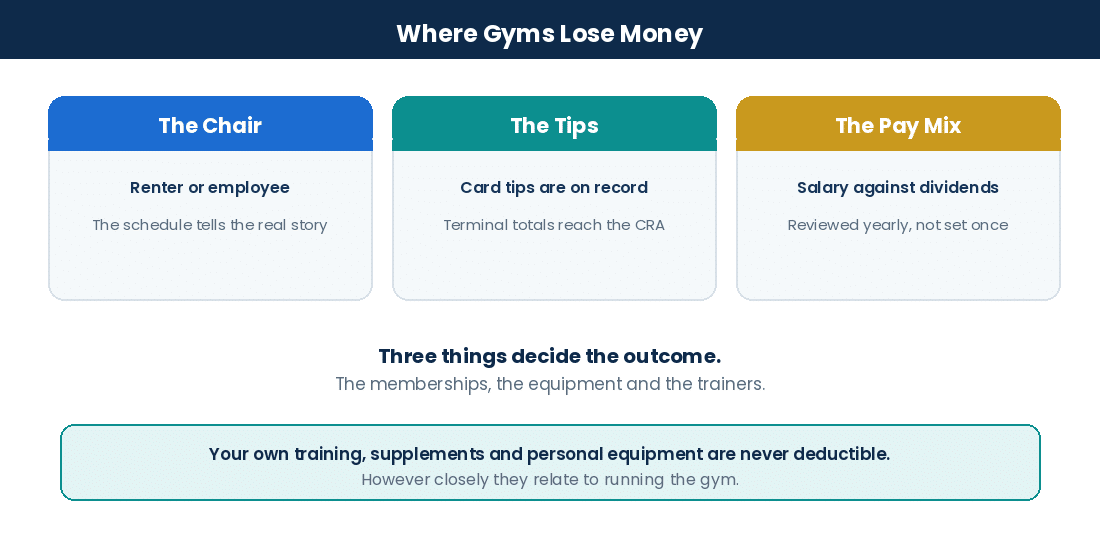
Most barbershop tax advice starts with deductions. Deductions matter, but they are the smallest of the four things that decide what you keep.
The Four Decisions That Move the Number
- Chair structure: Whether barbers are employees, genuine renters or something the CRA will disagree with. This drives payroll, GST/HST and liability all at once
- Business structure: Whether incorporation earns its cost, which depends on what you retain rather than what you bill
- How you pay yourself: The salary and dividend mix, which changes your personal tax, your RRSP room and your CPP cost
- What reaches the books: Tips, cash and product sales all reported, because unreported revenue undoes every other decision
Deductions Still Count
Within that framework, the ordinary deductions apply: product and supplies used on clients, equipment, chair and shop rent, insurance, advertising, professional dues and the business share of phone and internet.
What does not qualify is your own grooming. A barber’s haircut is a personal cost, however obviously connected it feels to the trade. Ordinary clothing is personal too, even worn only at work. A branded uniform is different.
Deferral Against Absolute Saving
Worth being precise about this, because the two get conflated constantly.
Deferral means paying corporate tax now at a lower rate and personal tax later when you draw the money out. The saving is the use of the money in between, not a permanent reduction.
Absolute saving means less total tax across both levels, which comes from things like using the dividend and salary mix well, or splitting income where the rules genuinely allow it.
A barber who draws everything out to live on gets deferral benefit of roughly nothing. A barber who leaves profit in the company gets real value. That distinction is why incorporation suits some shops and not others.
Owners ask which deduction they are missing. The answer is usually none of consequence, and the real money is in the chair arrangement and how they take pay. Figures changed for privacy.
Risk Warning: Chasing deductions while the chair arrangement is misclassified is fixing the wrong problem. Please settle the structure first.
Chair Rental and Worker Classification
Chair Rental and Worker Classification
The Chairs
This is the decision everything else rests on, and shops routinely get it wrong because the paperwork says one thing and the operation says another.
What the CRA Looks At
The label on the agreement does not settle it. The CRA examines the substance of the relationship:
| Factor | Points to Employee | Points to Contractor |
|---|---|---|
| Control | Shop sets hours, prices and standards | Barber sets own schedule and rates |
| Tools | Shop supplies clippers, product and station | Barber owns their own kit |
| Chance of profit | Paid a set rate or percentage | Can profit from building a book |
| Risk of loss | Paid regardless of a quiet week | Still owes rent on a quiet week |
| Client relationship | Shop owns the booking | Barber owns the client |
A barber who shows up when told, uses the shop’s clippers and product, charges the shop’s prices and takes clients from the shop’s booking system is an employee whatever the rental agreement says.
Fixed Rent Against Percentage Split
The two common arrangements behave differently, and the distinction matters more than most owners realise.
Fixed chair rent is the cleaner arrangement. The barber pays a set weekly or monthly amount regardless of how busy they are, which creates genuine risk of loss and points strongly toward contractor status. The rent is your revenue and a taxable supply.
Percentage splits are messier. Where the shop takes a share of each cut, the barber carries no fixed cost, the shop is exposed to their productivity, and the arrangement starts to look like commission employment. The characterisation of the payment also becomes less clear.
Two barbers work the same shop. One pays $250 a week for a station, sets his own prices, keeps his own clients and buys his own product. The other takes 60% of what he cuts, works the posted hours, uses shop product and takes whoever walks in. The first arrangement supports contractor treatment; the second is difficult to defend. Figures changed for privacy.
What It Costs to Get Wrong
Treating an employee as a chair renter means the CRA can assess the source deductions that should have been withheld, plus penalties and interest. Directors carry personal exposure on unremitted amounts.
The exposure runs backwards through open years, so a shop that has operated this way for four years faces four years of assessment rather than a correction going forward.
Where the position is genuinely unclear, a ruling can be requested from the CRA. That costs a fraction of defending an assumption after the fact.
If They Are Employees
You withhold income tax, CPP and EI, and remit on the schedule set by your remitter type. T4 slips are due by the last day of February following the calendar year.
Commission structures need care. Where barbers earn a percentage, that is employment income subject to the normal deductions, and any draw against future commission needs consistent treatment rather than informal netting.
If They Are Genuine Renters
Put it in writing, and make sure the written terms match what actually happens:
- A fixed rent amount and payment schedule
- The barber’s control over their own hours and pricing
- Who supplies tools, product and station equipment
- Who owns the client relationship and the booking
- The barber’s own registration and insurance obligations
Then keep the paperwork consistent. An agreement describing independence alongside a posted staff schedule undermines itself.
The chair agreement and the shop schedule usually contradict each other. Reviewers read both, and the schedule is the one that describes reality. Figures changed for privacy.
Key Stat: Fixed rent creates risk of loss, which supports contractor status. A percentage split usually does not. Please pick the structure deliberately.
Incorporation and Corporate Tax Planning
Incorporation and Corporate Planning
The Structure
Sole Proprietor or Corporation
The decision turns on three things: what you retain, what liability you carry, and whether the compliance cost is worth it.
| Factor | Sole Proprietor | Incorporated |
|---|---|---|
| Filing | Personal return with a business schedule | Corporate return plus personal return |
| Liability | Personal assets exposed | Separated, subject to guarantees |
| Tax advantage | None from structure | Deferral where profit stays in the company |
| Annual cost | Lower | Higher, with more filings |
| Best suited to | Barbers drawing most of their income | Shops consistently retaining profit |
People quote income thresholds for when incorporation makes sense. Treat those as a starting point rather than an answer, because two shops with identical revenue get different results depending on what the owner draws.
The Small Business Deduction
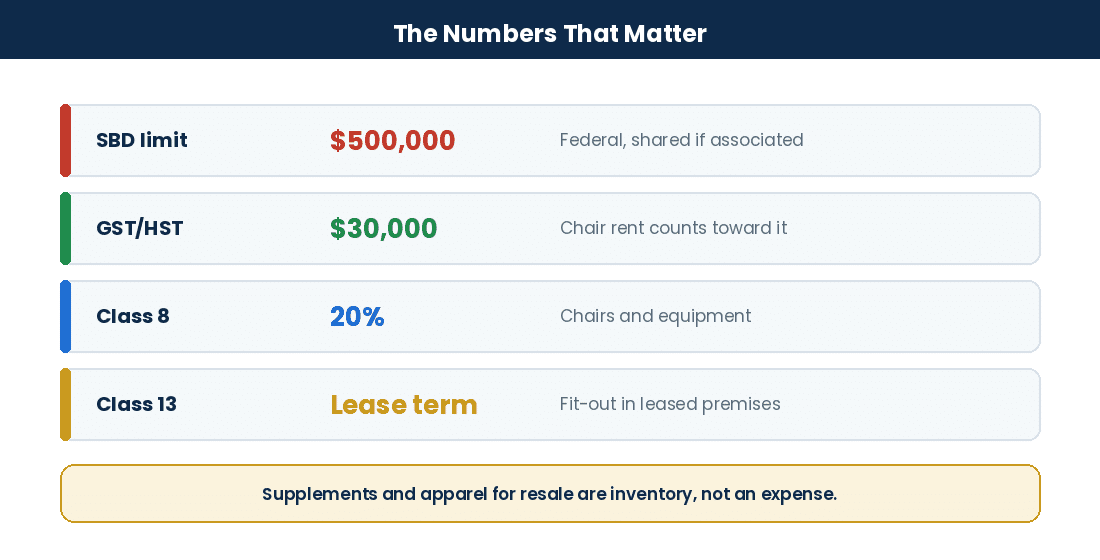
A Canadian-controlled private corporation pays a reduced federal rate of 9% on active business income up to the federal business limit of $500,000, shared across associated corporations.
Two points worth being precise about, because both circulate incorrectly:
- The federal limit is $500,000. Saskatchewan and Prince Edward Island use $600,000 provincially and Nova Scotia uses $700,000, which is where the higher figures come from. Ontario’s limit remains $500,000
- Passive investment income above $50,000 grinds the business limit down by $5 for every $1 over, eliminating it entirely at $150,000. It is not a dollar-for-dollar reduction
Ontario shops should also note the provincial small business rate change taking effect partway through 2026, which produces a blended provincial rate for calendar-year corporations. Please confirm the current combined rate when planning.
Salary, Dividends and the Mix
| Method | Deductible to Company | Creates RRSP Room | CPP Required |
|---|---|---|---|
| Salary | Yes | Yes | Yes, both shares |
| Dividends | No | No | No |
A blend usually works best. Salary covers living costs, builds RRSP room and creates CPP entitlement at the cost of contributions. Dividends move surplus out without payroll cost but build nothing for retirement.
The right mix changes annually with your income and your RRSP position. Setting it once and never revisiting it is the common mistake.
Shareholder Loans
Money taken from the company that is not salary or dividends builds a shareholder loan balance. If it is not repaid within the period the Income Tax Act allows, generally by the end of the following taxation year, the amount can be included in your personal income under the shareholder loan rules in section 15(2).
Where a loan is outstanding and carries no interest or below the prescribed rate, a taxable benefit arises on the difference.
Track the balance quarterly rather than discovering it at year end, and document any genuine loan properly.
Personal Services Business Risk
A barber who incorporates but works essentially as an employee of one shop risks personal services business treatment. That removes the small business deduction and most expense claims, leaving a punitive rate.
Working for several clients, controlling your own schedule, supplying your own tools and carrying real risk of profit and loss is the protection. A single-shop arrangement with everything supplied is exposed.
Barbers ask about incorporating when revenue climbs. The better question is what they leave in the company, and for most single-chair operators the honest answer is nothing. Figures changed for privacy.
Risk Warning: The federal small business limit is $500,000, not $600,000. Please check whether a higher figure you have been told relates to a different province.
GST/HST, Tips and Cash
GST/HST, Tips and Cash
The Revenue Side
When You Register
Barbering is a taxable supply. You must register for GST/HST once taxable revenue exceeds $30,000 measured across four consecutive calendar quarters.
The measure includes everything taxable, not just haircuts. Chair rent you collect, retail product sales and any other taxable service all count toward the threshold, which is how multi-chair shops cross it faster than they expect.
Chair Rent and GST/HST
Rent you charge a barber for a station is generally a taxable supply, so you charge tax on it and the barber may claim an input tax credit if they are registered.
This creates a practical consequence. A shop renting four chairs at a few hundred a week is generating taxable revenue from the rent alone, which pushes it over the threshold even if the owner cuts hair themselves only part-time.
Where the arrangement is a percentage split rather than rent, the characterisation needs settling, because what is being supplied and by whom becomes less obvious. Please have those agreements reviewed rather than assumed.
Input Tax Credits
Input tax credits recover the tax you pay on product, equipment, rent, utilities and supplies. Each needs a supplier invoice showing the registration number.
Registering before a fit-out or an equipment purchase means recovering that tax immediately, which is a real cash flow argument for voluntary registration in a shop’s first year.
Tips and Gratuities
This is the area barbershops most consistently get wrong, and it is worth being direct about it.
Tips are income. Whether they arrive in cash, on a card, or through a payment terminal, they are taxable to whoever receives them. Nothing about the payment method changes that.
The reporting depends on how they flow:
- Direct tips paid by the client to the barber and kept by them are the barber’s income to report
- Controlled tips that pass through the shop, such as card tips distributed by the owner, are generally treated as employment income subject to source deductions
- Tip-outs between staff need documenting so the amounts reported reconcile
Card tips are the practical issue. Once a tip goes through your terminal it is on a record you do not control, and the CRA can compare terminal totals against reported revenue.
Cash, Card Processors and Reconciliation
Payment processors report to the CRA. Your reported revenue should reconcile to what those processors show, and a persistent gap invites questions.
Cash cuts are legitimate revenue and have to be recorded. The pattern reviewers look for is straightforward: a shop with an unusually low cash percentage compared to sector norms, or deposits that do not match reported sales.
- Record daily sales split between services, product and chair rent
- Log cash takings daily and deposit them so the two agree
- Reconcile processor statements to the books monthly
- Keep the terminal reports alongside the daily sheets
Card tip totals sitting well above what appeared in the payroll records is the single clearest signal on a barbershop file. The terminal already reported them. Figures changed for privacy.
Key Stat: Chair rent counts toward the $30,000 GST/HST threshold. Please include it when tracking whether you have crossed.
Deductions, Equipment and Records
Deductions, Equipment and Records
The Deductions
What You Can Claim
The ordinary business costs of running a shop:
- Product used on clients, from clipper oil to shave cream
- Cleaning supplies, sanitiser and disposables
- Shop or chair rent you pay
- Utilities, phone and internet in the business proportion
- Liability and contents insurance
- Advertising, signage and paid social media
- Professional dues and association memberships
- Booking software and payment processing fees
Retail product held for resale is inventory rather than an expense. The cost moves to cost of goods sold when it sells, so count it at year end.
Equipment and Capital Cost Allowance
| Item | Typical Treatment |
|---|---|
| Combs, brushes, capes, small tools | Current expense given cost and replacement rate |
| Barber chairs, stations, mirrors on stands | Class 8 at 20% |
| Clippers and professional equipment | Class 8, or Class 12 where the item qualifies |
| Computers, tablets and booking terminals | Class 50 at 55% |
| Application software | Class 12 at 100%, half-year rule applies |
| Flooring, fixed mirrors, built-in stations | Class 13 over the lease term |
The distinction that catches shops out is between equipment and leasehold improvement. Anything fixed to leased premises, including flooring, wall-mounted stations and installed lighting, is a Class 13 leasehold improvement written off over the lease term rather than an equipment class.
The half-year rule limits the claim to half the normal amount in the year an asset becomes available for use.
What You Cannot Claim
- Your own haircuts and grooming: Personal, regardless of trade
- Ordinary clothing: Personal even if worn only at work. Branded uniforms differ
- Family wages for work not performed: Amounts must be reasonable for the work actually done
- Fines and penalties: Never deductible
- The personal share of mixed costs: Phone, vehicle and internet all need apportioning
Paying a family member is legitimate where they genuinely work and the rate matches what you would pay anyone else. Support it with a timesheet and a job description, not just a payroll entry.
Prepaid Packages and Memberships
Shops selling cut packages or memberships collect money before delivering the service. That is deferred revenue, recorded as a liability and released as the cuts are actually provided.
Taking the full amount into income on sale overstates the year you sold and understates the year you delivered. Where packages expire unused, the treatment of that breakage should be settled rather than left unrecorded.
Records That Support the Claim
- Daily sales sheets splitting services, product and chair rent
- Chair rental agreements matching how the shop actually runs
- Payroll records with timesheets and slips
- Supplier invoices showing registration numbers
- Processor statements reconciled monthly
- Equipment purchase records with dates and assigned class
- The lease, where leasehold improvements are claimed
Records must be kept for six years from the end of the tax year they relate to. Photographs of receipts count provided they stay legible.
Shops capitalise clippers and expense the station build-out, when it is usually the other way round. Both errors cost money in opposite directions. Figures changed for privacy.
Pro Tip: Please check the lease before setting the write-off period on your fit-out. Class 13 follows the lease term, not an equipment rate.
Mistakes, Reviews and Working With Gondaliya CPA
Mistakes, Reviews and Working With Us
The Compliance
Deadlines and Instalments
| Obligation | Deadline | If Missed |
|---|---|---|
| T2 corporate return | Six months after fiscal year-end | 5% plus 1% per month, to twelve |
| Balance owing | Two or three months after year-end | Interest from the due date |
| GST/HST return | Per your assigned reporting period | Penalty plus interest |
| Payroll remittances | Per your remitter type | Penalty and director liability |
| T4 and T4A slips | Last day of February | Penalty by slip count |
Corporate instalments are generally required where net tax payable exceeds $3,000, paid monthly or quarterly for eligible CCPCs against your fiscal year rather than on fixed calendar dates. Interest on late instalments compounds daily.
The Errors That Cost Money
- Chair renters who are really employees: The largest exposure, assessed backwards through open years
- Tips absent from the records: Particularly card tips, which the terminal already reported
- Personal grooming claimed as business: Denied on review and it draws attention to the rest
- Family wages without support: No timesheet, no job description, rate nobody could justify
- Shareholder loan balances left to grow: Included in income when the repayment period passes
- Prepaid packages taken into income on sale: Revenue in the wrong year
- Fit-out expensed instead of Class 13: A deduction claimed too fast, then adjusted
What Draws a Review
The patterns are consistent across personal services businesses: expenses high relative to reported revenue, deposits exceeding reported sales, an unusually low cash percentage against sector norms, card tip totals inconsistent with payroll, and chair renters issued no slips of any kind.
Our CRA audit guide sets out what a review involves and what gets requested.
Fixing Past Years
Where filings are behind or past positions were wrong, coming forward through the Voluntary Disclosures Program may reduce penalties, provided the disclosure is complete and made before the CRA raises the issue with you.
The order for a cleanup matters: settle the chair classification first, then rebuild revenue including tips and cash, then the corporate returns, then GST/HST on the corrected figures. Filing before the classification is settled means filing twice.
How We Work With Barbershops
We support incorporated barbershops on a flat annual fee covering:
- Chair rental structure review against the CRA factors
- Bookkeeping with daily sales split by service, product and rent
- Processor and terminal reconciliation each month
- Payroll, commission structures, T4 and T4A preparation
- Tips and gratuity reporting set up correctly from the start
- GST/HST registration, filing and input tax credit review
- Capital cost allowance including the Class 8 against Class 13 split
- Salary and dividend planning reviewed annually
- Shareholder loan monitoring and financial statements
Pricing is quoted before any work begins, including HST, with a one-business-day response.
Getting Started
Bring three things to the first conversation: a chair rental agreement if you use one, a recent month of terminal statements, and your last filed return. Those show us whether the structure holds up, whether the revenue reconciles, and what needs correcting.
Contact Gondaliya CPA at info@gondaliyacpa.ca, call 647-212-9559, or send us a message.
Shops that fix the chair structure sleep better than shops that found another deduction. One removes an exposure that compounds; the other saves a few hundred dollars. Figures changed for privacy.
Pro Tip: Please reconcile terminal totals to reported revenue monthly. The processor has already told the CRA what went through it.
FAQs on Barbershop Tax Planning
Frequently Asked Questions
FAQ
At what income does incorporating a barbershop make sense?+
There is no fixed threshold. It depends on what you retain rather than what you bill, since the advantage is deferral on profit left in the company. A barber drawing everything out gains little.
How does incorporation affect liability?+
A corporation is a separate legal person, so business debts and claims generally do not reach your personal assets, subject to any personal guarantees you have given.
When does the compliance cost outweigh the benefit?+
Where income is modest or you draw all of it, the corporate filings, bookkeeping and annual costs can exceed the tax saved.
How does the CRA decide if a chair renter is an employee?+
It looks at control over the work, who supplies tools and product, chance of profit and risk of loss, and who owns the client relationship. The agreement wording alone does not settle it.
Do personal services business rules affect incorporated barbers?+
Yes. A barber incorporating but working essentially as an employee of one shop risks that treatment, which removes the small business deduction and most expense claims.
Should an incorporated barber take salary or dividends?+
Usually a mix. Salary builds RRSP room and CPP entitlement at the cost of contributions; dividends avoid payroll cost but build neither. The right split changes annually.
Is chair rent subject to GST/HST?+
Rent charged for a station is generally a taxable supply, so tax applies. Percentage split arrangements need reviewing separately since what is being supplied is less clear.
Does chair rent count toward the $30,000 threshold?+
Yes. The threshold measures all taxable revenue, including chair rent and retail product sales, not just haircuts.
How must tips be reported?+
Tips are income however they arrive. Direct tips are the barber’s income to report; tips passing through the shop are generally employment income subject to source deductions.
How is income from prepaid packages recognised?+
As deferred revenue, released as the cuts are actually provided rather than when the package is sold.
What is the federal small business limit?+
$500,000 of active business income for a CCPC, shared across associated corporations. Saskatchewan and Prince Edward Island use $600,000 provincially and Nova Scotia $700,000.
How does passive income affect the small business deduction?+
Investment income above $50,000 reduces the business limit by $5 for every $1 over, eliminating it entirely at $150,000. It is not a dollar-for-dollar reduction.
What happens to an unpaid shareholder loan?+
If not repaid within the period the Act allows, the amount can be included in your personal income under the shareholder loan rules. Interest-free balances also create a benefit.
Can I claim my own haircut as a business expense?+
No. Personal grooming is not deductible regardless of your trade. Branded uniforms and product used on clients are different.
How are barber chairs and fit-out treated?+
Chairs and free-standing equipment generally sit in Class 8 at 20%. Anything fixed to leased premises is a Class 13 leasehold improvement over the lease term.
How long must a barbershop keep records?+
Six years from the end of the tax year they relate to, covering sales sheets, rental agreements, payroll records and supplier invoices.
Sixteen questions and one underneath most of them: is this barber working for you or renting from you. That answer shapes payroll, GST/HST and the whole return. Figures changed for privacy.
Key Terms and Practices for Barbershops
Key Terms and Practices
Quick Reference
Terms Worth Knowing
- Fixed chair rent: A set fee for a station regardless of how busy the barber is.
- Percentage split: The shop takes a share of each cut rather than charging rent.
- Multi-chair operator: A shop with several working stations, rented or staffed.
- Controlled tips: Tips passing through the shop before reaching the barber.
- Direct tips: Tips paid straight to the barber and kept by them.
- Deferral: Paying corporate tax now and personal tax later on money drawn out.
- Absolute saving: Less total tax across corporate and personal levels combined.
- Leasehold improvement: Fit-out fixed to leased premises, written off over the lease term.
- Shareholder loan: Company funds used personally, taxable if not repaid in time.
- Personal services business: An incorporated employee arrangement taxed punitively.
Numbers to Have Right
- Federal small business limit: $500,000, shared across associated corporations.
- Federal small business rate: 9% on active business income within the limit.
- Passive income grind: $5 of limit lost per $1 above $50,000, gone at $150,000.
- GST/HST threshold: $30,000 across four consecutive quarters, chair rent included.
- Instalments: Generally where net tax payable exceeds $3,000.
- Class 8: 20% for chairs, stations and equipment.
- Class 13: Leasehold improvements over the lease term.
- Corporate return: Six months after fiscal year-end.
- Slips: T4 and T4A by the last day of February.
- Records: Six years from the end of the tax year.
Practices That Protect You
- Settle chair classification against the CRA factors before anything else.
- Put rental terms in writing and make sure the shop actually operates that way.
- Record all tips, including card tips the terminal has already reported.
- Reconcile processor statements to reported revenue every month.
- Log daily cash takings and deposit them so the two agree.
- Split daily sales between services, product and chair rent.
- Treat retail stock as inventory and count it at year end.
- Hold prepaid packages as deferred revenue until the cuts are delivered.
- Put fit-out into Class 13 and free-standing equipment into Class 8.
- Support family wages with timesheets and a job description.
- Monitor the shareholder loan balance quarterly.
- Review the salary and dividend mix each year rather than setting it once.
- Never claim personal grooming or ordinary clothing.
For advice on your barbershop’s structure and taxes, contact Gondaliya CPA at info@gondaliyacpa.ca, call 647-212-9559, or book a free consultation.
Thirty-three points and one underneath them: know who works for you and what actually came through the till. Everything else in barbershop planning follows from those two. Figures changed for privacy.
Barbershop Models We Serve
Industry Expertise
Which issue dominates differs by how the shop is set up. Here are ten and the usual focus.
| Barbershop Model | Where the Planning Concentrates |
|---|---|
| Single-chair owner-operator | Whether incorporation earns its cost |
| Multi-chair shop renting stations | Chair classification and GST/HST on rent |
| Shop paying percentage splits | Whether the barbers are really employees |
| Barber renting a chair elsewhere | Personal services business exposure |
| Mobile barber | Vehicle logs and workspace in home |
| Shop selling retail product | Inventory rather than expense |
| High card volume | Tip reporting against terminal totals |
| Shop selling cut packages | Deferred revenue until delivered |
| Owner fitting out leased premises | Class 13 over the lease term |
| Behind on filings | Classification settled before returns are fixed |
- Single-chair owner-operator: What you retain decides it, not what you bill.
- Multi-chair shop renting stations: Rent is taxable revenue and counts toward the threshold.
- Shop paying percentage splits: No fixed cost to the barber usually means employment.
- Barber renting a chair elsewhere: One shop supplying everything is a structural risk.
- Mobile barber: The log is the claim; without it the travel falls.
- Shop selling retail product: Stock is an asset until it sells.
- High card volume: The terminal already reported the tips.
- Shop selling cut packages: Money collected is not money earned.
- Owner fitting out leased premises: The lease term sets the write-off period.
- Behind on filings: Fix the structure first or you will file twice.
The setup changes where the planning concentrates. It does not change the method, which is settle the chair arrangement, get all the revenue into the books, then decide how you take money out. Figures changed for privacy.
Professional Guidance and Quick Reference
Guidance
Professional Guidance for Barbers: How Gondaliya CPA Handles Your File
Barbershops lose money in a predictable set of ways: barbers treated as chair renters while the shop sets their hours, prices and supplies their product, card tips never reaching the payroll records when the terminal has already reported them, chair rent left out of the GST/HST threshold calculation, the shop fit-out expensed instead of written off over the lease term, prepaid cut packages taken into income on sale, and shareholder loan balances allowed to grow until they are included in personal income. Gondaliya CPA handles barbershop accounting on a fixed annual fee.
We handle what decides the outcome: testing the chair arrangement against the CRA control, tools and risk factors, putting rental terms in writing that match how the shop actually operates, setting up tip reporting so direct and controlled tips are handled correctly, reconciling terminal statements to reported revenue monthly, tracking chair rent toward the GST/HST threshold, splitting the fit-out between Class 8 equipment and Class 13 leasehold, holding prepaid packages as deferred revenue, and reviewing the salary and dividend mix against what you actually retain.
Our team starts with the chair arrangement and a month of terminal statements, because those two decide your payroll exposure and whether the revenue reconciles. Single chair, multi-chair shop or mobile barber, you get clear advice and a fixed price before we start.
Quick Answers
- Small business limit: $500,000 federally, shared if associated
- Federal rate: 9% within the limit
- Passive income grind: $5 per $1 above $50,000
- GST/HST: $30,000 including chair rent
- Chair rent: Generally a taxable supply
- Tips: Income however they arrive
- Equipment: Class 8 at 20%
- Fit-out: Class 13 over the lease term
- Corporate return: Six months after year end
- Records: Six years retention
Who This Is For
- For: Self-employed and incorporated barbers, single-chair operators, multi-chair shops and mobile barbers across Canada.
- Not For: Provincial trade certification, apprenticeship registration and health inspection requirements, which sit with the relevant authority rather than accounting.
People Also Ask
Can I pay my spouse from the barbershop?+
Yes, where they genuinely work and the rate matches what you would pay anyone else. Support it with a timesheet and job description rather than just a payroll entry.
Do I charge GST/HST on a percentage split with a barber?+
It depends what is actually being supplied and by whom, which the split arrangement often leaves ambiguous. Please have the agreement reviewed.
What if my chair renters have never received any slips?+
That gap is itself a signal. Settle the classification first, then deal with the slips or payroll that should have followed from it.
Glossary of Key Terms
- T2: The corporation income tax return.
- Fixed chair rent: A set fee for a station regardless of takings.
- Percentage split: The shop taking a share of each cut.
- Direct tips: Tips paid straight to the barber and kept.
- Controlled tips: Tips passing through the shop before distribution.
- Deferral: Corporate tax now, personal tax on withdrawal.
- Absolute saving: Less total tax across both levels combined.
- Small business deduction: The reduced rate on active business income.
- Passive income grind: The reduction in the limit above $50,000 of investment income.
- Class 8: The 20 percent class covering chairs and equipment.
- Class 13: Leasehold improvements over the lease term.
- Half-year rule: The first-year restriction on CCA claims.
- Deferred revenue: Prepaid package income held as a liability.
- Shareholder loan: Company funds used personally, taxable if not repaid.
- Personal services business: An incorporated employee arrangement taxed punitively.
- Input tax credit: GST/HST recoverable on business purchases.
Barbershop Readiness Check
This quick self-check indicates where your operation most likely has room. Please answer the six questions below.
Barbershop Readiness Check
Six quick questions on your shop. No fee shown.
Points to raise with us:
This is a general prompt, not tax or legal advice or a quote. Your position depends on your full facts. For a real review, please book a free consultation.
Want a checklist to work from? You can download our free barbershop tax planning checklist before your consultation.
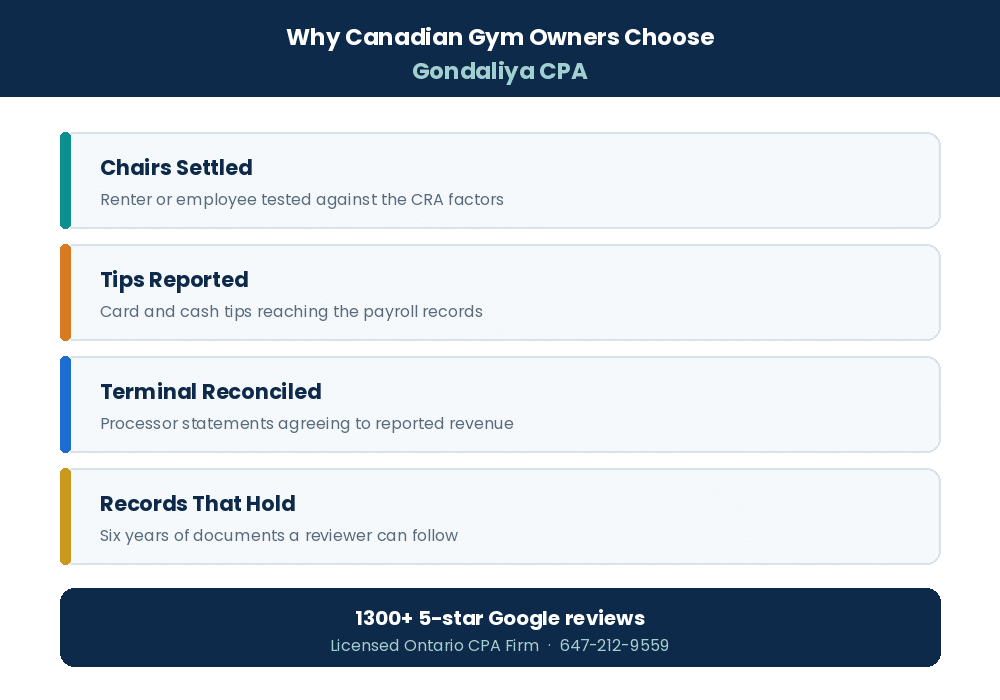
Settle whether barbers are employees or genuine renters before anything else. Put rental terms in writing that match how the shop runs. Record all tips including card tips. Reconcile terminal statements to revenue monthly. Count chair rent toward the GST/HST threshold. Split the fit-out between Class 8 and Class 13. Hold prepaid packages as deferred revenue. Please keep six years of records.
2026 Update — what is current: This article reflects rules current to 2026. The $30,000 GST/HST registration threshold measured across four consecutive calendar quarters, the Class 8 rate of 20%, Class 13 leasehold treatment over the lease term, the half-year and available-for-use rules, the shareholder loan repayment rules in section 15(2), the six-month T2 filing deadline and the six-year retention requirement are unchanged. Please note that the federal small business limit is $500,000 and not $600,000; the higher figure belongs to Saskatchewan and Prince Edward Island provincially, with Nova Scotia at $700,000, and Ontario remains at $500,000. Note also that the passive investment income grind reduces the business limit by $5 for every $1 above $50,000, eliminating it at $150,000, rather than dollar for dollar. Ontario reduced its provincial small business rate partway through 2026, which produces a blended provincial rate for calendar-year corporations, so please confirm the current combined rate before planning.
Barbershop Tax Planning Canada: How Gondaliya CPA Supports Barbershops
Start with the chair arrangement
Gondaliya CPA tests the chair arrangement against the CRA control, tools and risk factors, puts rental terms in writing that match how the shop operates, sets up tip reporting so direct and controlled tips are handled correctly, reconciles terminal statements to reported revenue monthly, tracks chair rent toward the GST/HST threshold, splits the fit-out between Class 8 equipment and Class 13 leasehold, holds prepaid packages as deferred revenue and reviews the salary and dividend mix against what you retain, on a flat annual fee including HST with a one-business-day response. Please book a free consultation.
Next Steps
Please book a free consultation with Gondaliya CPA and bring a chair rental agreement if you use one, a recent month of terminal statements, and your last filed return. Those three tell us immediately whether the structure holds up, whether the revenue reconciles, and what remains to claim on the equipment, and where the documentation is thin. You will get a flat annual fee including HST before any work begins. If our content helps, please add gondaliyacpa.ca as a preferred source on Google.
Published: · Last updated:
Editorial policy: We research against CRA and CPA Ontario sources, fact-check the figures, and Sharad Gondaliya, CPA, reviews the content, which we update as the rules change.
Disclaimer: This article is educational information only and is not tax, legal, or financial advice. Figures marked illustrative are examples rather than quotes or guarantees. It reflects CRA rules current to 2026, including the $30,000 GST/HST threshold, the Class 8 rate, Class 13 leasehold treatment, the half-year rule, and the six-year retention requirement. Rates, limits and expensing rules change and outcomes depend on your specific facts. Please consult a CPA Ontario member before acting.

Sharad Gondaliya is a CPA Canada & CPA USA with 15 Years+ experience of Accounting, Tax, Payroll of Corporate Small Businesses as Tax Accountant. He is a CPA Ontario member (61040184) and holds US CPA licences in Washington and Montana and is well known among corporate small businesses for tax planning, efficient tax solutions, and affordable CPA services. Sharad is the Principal (Director) of Gondaliya CPA – Affordable CPA Firm in Canada. Licenses: CPA Ontario: 61040184 | CPA USA (MT): PAC-CPAP-LIC-033176 | CPA USA (WA): 57629 | CPA Firm License: 61330051 View Full Author Bio