



The Ultimate Guide to Accounting and Tax Services for Used-Car Dealerships in Canada
Used Car Dealership Accountant Canada: Expert CPA and Tax Services for Used Auto Dealers
Gondaliya CPA offers reliable used car dealership accountant Canada services, including bookkeeping for used car dealerships, dealership corporate tax, and used car dealership tax services Canada. Our expertise in accounting for used car dealerships ensures accurate financial statements, dealer tax compliance Canada, and efficient tax planning tailored to your business needs.
Ask ten dealers what a car on the lot cost them and most will quote the auction price. The real number includes the buyer fee, the transport, the safety, the reconditioning parts and the labour, and it is the only figure that makes gross profit mean anything. Getting to it is where accounting for used car dealerships either earns its keep or does not.
Quick Summary
Used-car dealerships in Canada face accounting problems most businesses never encounter: inventory that costs five figures a unit, floor plan interest that has to be matched to specific vehicles, trade-ins that change the tax base of a sale, and salespeople paid on commission against draws. Getting these right is the difference between a return that survives review and one that does not.
Reading time: 50 minutes.
Table of Contents
- Why Dealership Accounting Is Different
- Inventory and Unit-Level Costing
- Floor Plan Financing
- GST/HST, Trade-Ins and Sale Types
- Payroll, Demo Vehicles and Assets
- Filings, CRA Reviews and Working With Us
- Frequently Asked Questions
- Key Numbers and Practices
- Dealership Models We Serve
- Professional Guidance and Quick Reference
The Numbers That Matter
This article covers Canada, with Ontario and Toronto context, and reflects rules current to 2026. It applies to incorporated used-car dealerships, independent lots, wholesale operators and dealers offering in-house financing. Figures marked illustrative are examples, not quotes, and any masked engagement notes end with “Figures changed for privacy.” This is educational information only and not tax or legal advice. Dealer registration and consumer protection requirements are set provincially, by OMVIC in Ontario and by different regulators elsewhere, and sit outside accounting scope.
Why Dealership Accounting Is Different
Why Dealership Accounting Is Different
The Basics
Inventory Is the Whole Business
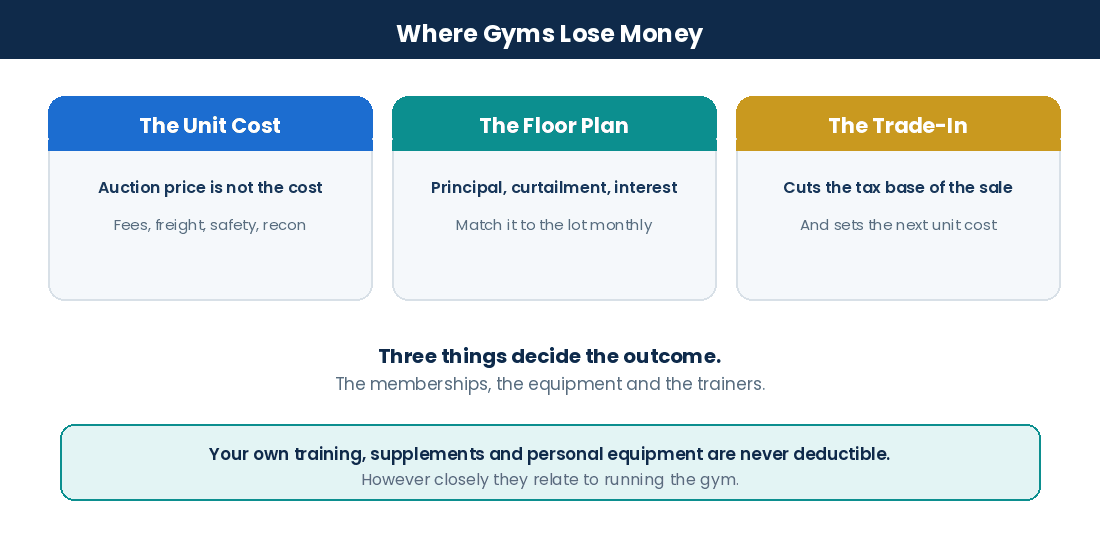
For most retailers inventory is a line item. For a used-car dealer it is the balance sheet, the gross profit calculation and the financing arrangement all at once.
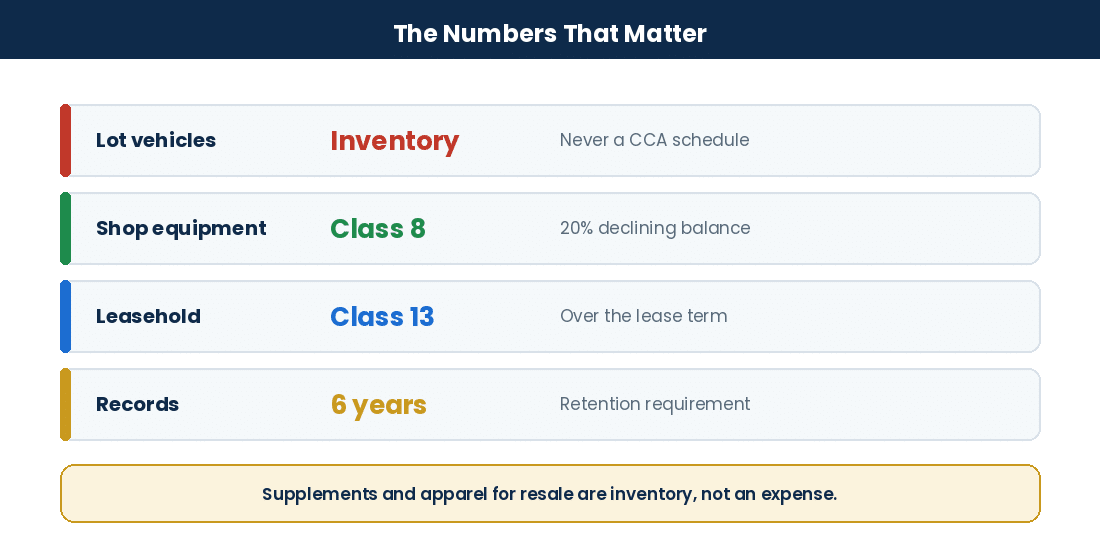
The first thing to settle is that vehicles held for resale are inventory, not capital property. They do not go on a capital cost allowance schedule, they do not depreciate for tax purposes, and their cost moves to cost of goods sold when the unit sells.
Dealers who put lot vehicles into Class 10 get two things wrong at once: they claim depreciation they are not entitled to, and their gross profit per unit becomes meaningless.
What Makes It Complicated
- Unit-level costing: Every vehicle carries its own cost stack, and averaging across the lot hides which deals actually made money
- Floor plan interest: Financing has to be matched to specific units, both for the deduction and for the lender
- Trade-ins: A trade reduces the tax base of the sale and simultaneously adds a unit to inventory at a value you set
- Mixed sale types: Retail, wholesale, consignment and export are all taxed differently
- Commission payroll: Salespeople on draws against commission need careful handling
What a Specialist Actually Does
Sector knowledge matters here more than in most businesses because the errors are structural rather than clerical. A generalist will file the return correctly on the numbers given; the numbers are the problem.
The work is building the unit cost properly, matching the floor plan, applying the trade-in rules, and keeping records that survive a margin analysis.
The first question we ask a new dealer is what a specific car cost them. If the answer is the auction price, the gross profit on every deal in the file is overstated. Figures changed for privacy.
Risk Warning: Vehicles held for resale are inventory, not depreciable property. Please do not put lot stock on a capital cost allowance schedule.
Inventory and Unit-Level Costing
Inventory and Unit-Level Costing
The Inventory
What Goes Into the Cost of a Vehicle
The cost of a unit is everything spent to get it ready for sale, not just what you paid for it:
| Cost | Treatment | Why |
|---|---|---|
| Purchase or auction price | Added to unit cost | The base acquisition cost |
| Auction buyer fees | Added to unit cost | Directly attributable to acquiring the unit |
| Transport to the lot | Added to unit cost | Cost of bringing inventory to its location |
| Safety inspection and certification | Added to unit cost | Required to bring the unit to saleable condition |
| Reconditioning parts and labour | Added to unit cost | Costs of preparing the specific unit for sale |
| Lot rent, insurance, general overhead | Expensed as incurred | Period costs, not attributable to a unit |
| Advertising the lot generally | Expensed as incurred | Not a cost of any specific vehicle |
A dealer buys a unit at auction for $14,000, pays a $600 buyer fee, $350 transport, $180 safety, and $1,870 in reconditioning parts and labour. The unit cost is $17,000, not $14,000. Sold at $20,500, the gross profit is $3,500 rather than the $6,500 the auction price alone would suggest. Figures changed for privacy.
That gap is the entire reason unit-level costing matters. A dealer working from the auction price prices the next car wrong.
Tracking Unit by Unit
Each vehicle gets a stock number tied to its VIN, and every cost touching that vehicle codes to that number. Reconditioning invoices, transport bills and safety receipts all carry the stock number before they reach the books.
The system should also record days in inventory. Aged stock is the leading indicator of a write-down, and knowing which units have been sitting eighty days changes what you do about them.
- Stock number assigned at acquisition and used on every document
- Costs coded to the unit rather than to a general repairs account
- Days in inventory tracked from acquisition, not from when it hit the lot
- Floor plan matched to the specific unit financed
- Physical count reconciled to the inventory listing at least annually
Inventory Valuation and Write-Downs
Inventory is generally valued at the lower of cost and fair market value, which for a dealer means a unit that will not sell at cost has to be written down.
The write-down is a legitimate deduction where the value genuinely is below cost, supported by evidence: comparable auction results, market listings, or the eventual sale price. What it cannot be is a year-end plug to reduce income.
Aged units are where this bites. A car sitting past a hundred and twenty days rarely sells at the price that justified its acquisition, and carrying it at full cost overstates both inventory and profit.
The Physical Count
Count the lot at year end and reconcile it to the listing. Every discrepancy has an explanation: a unit sold and not recorded, a unit at a body shop, a trade-in never entered, or a wholesale deal not written up.
A count that does not reconcile is the fastest route to questions about unreported sales, because the CRA reads a missing unit as a sale nobody recorded.
Reconditioning invoices posted to a general repairs account rather than to the unit is the most common error we correct. The deduction is still there, but the gross profit per unit becomes fiction. Figures changed for privacy.
Key Stat: The auction price is rarely more than eighty percent of what a unit actually cost you. Please build the full cost stack before pricing the next one.
Floor Plan Financing
Floor Plan Financing
The Financing
How It Works in the Books
Floor plan financing funds inventory unit by unit. The lender advances against a specific vehicle, and the advance is repaid when that vehicle sells.
Two components need separating on every statement:
- Principal: A liability. Drawing on the line is not income and repaying it is not an expense
- Interest: A deductible expense, subject to the general interest deductibility rules where the borrowing was used to earn income
Curtailments, the scheduled principal reductions lenders require on aged units, reduce the liability. They are not an expense, and treating them as one overstates costs while understating the balance owed.
Matching Interest to Units
Interest should be traceable to the vehicle it financed. This matters for three reasons: the deduction has to be supportable, the true margin on each unit includes its carrying cost, and the lender expects a reconciliation.
Monthly lender statements typically break out interest and principal by unit. Those statements are the working paper, and they should reconcile to the inventory listing every month.
A unit costing $17,000 sits on the lot for ninety days carrying floor plan interest. Sold at $20,500, the headline gross profit is $3,500, but the carrying cost reduces the real contribution. A dealer measuring only the spread between cost and sale price never sees what aging costs them. Figures changed for privacy.
What Goes Wrong
- Principal draws recorded as revenue, which overstates income dramatically
- Curtailments expensed rather than applied against the liability
- Interest lumped into one account with no link to units
- The floor plan balance never reconciled to units still on the lot
- A unit sold while the advance stays on the books, or vice versa
The last one matters most. A floor plan balance that does not agree to the physical lot is the clearest possible signal that something has been sold and not recorded.
What Lenders Expect
Floor plan lenders review your financial statements as a condition of the line. They want statements prepared to a recognised standard, typically a compilation engagement under CSRS 4200, with inventory and the floor plan liability reconciling.
Statements that do not tie out affect the line itself, which for a dealership is the difference between buying at auction next week and not. This is the practical reason clean books matter here beyond tax.
The floor plan reconciliation is the report that saves dealers money twice: it satisfies the lender and it catches the unit that left the lot without a sale entry. Figures changed for privacy.
Risk Warning: A floor plan draw is a liability, not revenue, and a curtailment is a repayment, not an expense. Please make sure the statement is split before it reaches the books.
GST/HST, Trade-Ins and Sale Types
GST/HST, Trade-Ins and Sale Types
The Sales Tax
Different sale types carry different tax treatment, and a dealership does all of them in the same week.
Retail Sales and Registration
A used vehicle sold by a registered dealer is a taxable supply. You must register for GST/HST once taxable revenue exceeds $30,000 across four consecutive calendar quarters, which any dealership passes on a handful of cars.
This is worth stating plainly because buyers often think used vehicles are exempt. They are thinking of private sales between individuals, where a provincial tax applies at registration instead. A dealer sale is not that.
Trade-Ins and the Reduced Tax Base
This is the provision dealers most need to get right. Where a customer trades in a vehicle as part of the purchase, and the trade is not a taxable supply from that customer, the tax is calculated on the net amount rather than the full sale price.
A retail customer buys a $20,500 vehicle and trades in their old car at an allowance of $6,000. Tax is calculated on the $14,500 difference rather than on $20,500. The trade-in simultaneously enters your inventory at the $6,000 allowance, which becomes its cost base for the eventual resale. Figures changed for privacy.
Two things follow. The tax you collect is lower than the sticker price implies, and the allowance you give sets the cost of a unit you now own. Over-allowing on a trade to close a deal shifts the margin problem to the next sale rather than removing it.
Note that where the customer is themselves registered and trading a vehicle used in their business, the treatment differs. Please have those deals reviewed rather than applying the retail rule automatically.
Wholesale and Dealer-to-Dealer
Sales to another registered dealer are still taxable supplies. The buying dealer claims an input tax credit, so the tax washes through, but you still charge, collect and remit it, and you still need their registration number on file.
Wholesale margins are thin enough that getting the tax wrong on a dealer-to-dealer deal can eliminate the profit entirely.
Consignment Sales
Consignment raises the agent against principal question. Where you sell a vehicle on behalf of an owner, whether you report the full sale price or only your commission depends on the arrangement.
The Excise Tax Act contains specific rules for supplies made through agents and auctioneers, and the outcome turns on the terms of the consignment agreement. Get the agreement right first and the accounting follows.
The practical error is reporting only the commission while the paperwork says you sold the vehicle, which puts your reported revenue well below what the transaction record shows.
Exports and Sales Into the United States
A vehicle exported from Canada may qualify for zero-rating, meaning tax at 0% while you keep your input tax credits. The conditions are specific and documentation-driven.
You need evidence the vehicle actually left Canada: export documentation, shipping records, and the customer’s non-resident status where relevant. Zero-rating claimed without that evidence is simply uncollected tax.
Cross-border deals are also where reviews concentrate, because the claim is easy to make and the documentation is often thin.
Input Tax Credits
Input tax credits recover the tax you pay on reconditioning parts, shop supplies, transport, professional fees and lot costs. Each needs a supplier invoice showing the registration number.
Vehicles bought from a non-registrant, which includes most trade-ins from retail customers, carry no tax to recover. A dealer claiming credits on those acquisitions is claiming tax nobody charged.
Zero-rated export claims with no shipping documentation behind them is the fastest way to lose a GST/HST review. The rule is real; the evidence has to be too. Figures changed for privacy.
Key Stat: A trade-in reduces the tax base of the sale and sets the cost of a unit you now own. Please record both sides of that transaction.
Payroll, Demo Vehicles and Capital Assets
Payroll, Demo Vehicles and Assets
The People and the Lot
Salespeople: Employees or Contractors
Most dealership salespeople are employees. They work your hours, on your lot, selling your inventory at prices you set, using your systems. The CRA looks at control, tools, chance of profit and integration, and a commissioned salesperson usually fails the contractor test on several of those.
Calling them contractors to avoid payroll is the exposure that costs dealers most. The CRA can assess the source deductions that should have been withheld, plus penalties and interest, and directors carry personal exposure on unremitted amounts.
Commission and Draws
Commission structures with draws need care. A draw is an advance against future commission, and how you treat it depends on whether it is recoverable.
- Recoverable draws are advances against earnings, recovered from later commission
- Non-recoverable draws function as guaranteed minimum pay and are employment income when paid
- Either way, source deductions apply to what the salesperson actually receives as remuneration
- Year-end reconciliation should clear any draw balances properly rather than carrying them indefinitely
Chargebacks on cancelled or unwound deals also need a consistent treatment rather than being netted informally against the next pay run.
Demonstrator and Owner Vehicles
A vehicle from inventory used personally by the owner or an employee creates a taxable benefit. Two components apply: a standby charge based on availability, and an operating expense benefit for costs the business paid.
The standby charge turns on availability rather than kilometres driven, which surprises dealers who assume light personal use means no benefit.
Demonstrator arrangements are common and legitimate, but the benefit still has to be calculated and reported on the T4. A logbook separating business from personal kilometres supports a reduced charge where business use is high.
There is also an inventory question. A unit pulled from stock for demo use may change character, so the treatment should be settled rather than left ambiguous.
Lot, Building and Equipment
Unlike the vehicles, your fixed assets do go through capital cost allowance:
| Asset | Typical Class | Rate |
|---|---|---|
| Shop equipment, hoists, tools | Class 8 | 20% |
| Computers and dealer management systems hardware | Class 50 | 55% |
| Application software | Class 12 | 100%, half-year rule applies |
| Building you own | Class 1 | 4%, with possible additional allowance |
| Improvements to leased premises | Class 13 | Over the lease term |
| Service or tow vehicles you keep | Class 10 | 30% |
Lot paving, lighting, fencing and signage are frequently misfiled. Where the premises are leased they generally belong in Class 13 over the lease term rather than in an equipment class.
The half-year rule limits the claim to half the normal amount in the year an asset becomes available for use.
In-House Financing and Receivables
Dealers offering their own financing carry receivables, which introduces further questions. Revenue recognition on the vehicle sale, interest income on the financing, and bad debt treatment when a customer defaults are three separate matters.
A repossessed vehicle returns to inventory at a value that has to be established, and the shortfall against the receivable is where the loss sits. Keeping the financing book reconciled separately from the sales ledger is what makes this manageable.
Demonstrator vehicles are the benefit dealers most often miss. The car is on the lot, it is technically stock, and nobody reported the standby charge for three years. Figures changed for privacy.
Risk Warning: Commissioned salespeople on your lot selling your stock are usually employees. Please have the classification tested before the next pay run.
Filings, CRA Reviews and Working With Gondaliya CPA
Filings, CRA Reviews and Working With Us
The Compliance
Deadlines That Matter
| Obligation | Deadline | If Missed |
|---|---|---|
| T2 corporate return | Six months after fiscal year-end | Penalty plus interest |
| Balance owing | Two or three months after year-end | Interest from the due date |
| GST/HST return | Per your assigned reporting period | Penalty plus interest |
| Payroll remittances | Per your remitter type | Penalty and director liability |
| T4 slips | Last day of February | Penalty by slip count |
The corporate late-filing penalty is 5% of the unpaid balance plus 1% per complete month, to a maximum of twelve. Repeat failures within the following three years attract higher rates, which is why a second late year costs disproportionately more than the first.
GST/HST filing frequency is assigned by the CRA based on your taxable supplies. Annual applies below $1.5 million, quarterly between $1.5 million and $6 million, and monthly above that. A growing dealership can move between them without noticing.
What Triggers a Review
Dealership reviews follow a pattern, and it is worth knowing what they look at:
- Margin analysis: Gross profit per unit compared against sector norms, with unusually thin margins read as unreported cash
- Deposits against sales: Bank deposits exceeding reported revenue
- Inventory reconciliation: Units on the floor plan or on the lot with no corresponding sale entry
- Trade-in reporting: Vehicles acquired as trades never entered into inventory
- Floor plan interest: Interest claimed without unit-level support
- Export claims: Zero-rating without shipping documentation
Our CRA audit guide sets out what a review involves and what gets requested. The short version is that a dealer with a reconciled lot, a matched floor plan and unit costs that build up from source documents has already answered most of it.
Catching Up on Missed Filings
Where filings are behind, the rebuild works from the documents dealers already have: deal jackets, auction invoices, floor plan statements, consignment agreements and bank records.
The order matters. Inventory and unit costing first, then revenue, then the corporate returns, then GST/HST on the corrected figures. Filing returns before the inventory is rebuilt produces numbers that need correcting again.
Where you come forward before the CRA raises the issue, the Voluntary Disclosures Program may reduce penalties. Once they have written to you about it, that route generally closes.
How We Work With Dealerships
We support incorporated used-car dealers on a flat annual fee covering:
- Bookkeeping with unit-level costing from auction to retail
- Floor plan reconciliation against inventory each month
- Inventory valuation and aged stock write-down support
- GST/HST on trade-ins, wholesale, consignment and export
- Commission payroll including draws and chargebacks
- Demonstrator vehicle benefit calculations
- Capital cost allowance on lot, building and shop assets
- Financial statements prepared under CSRS 4200 for your floor plan lender
- T2 corporate return and CRA correspondence
Pricing is quoted before any work begins, including HST, with a one-business-day response. Catch-up work is quoted separately once we have seen the scope.
Getting Started
Bring three things to the first conversation: your current inventory listing, a recent floor plan statement, and your last filed corporate return. Those show us whether unit costs are being built properly, whether the lot reconciles, and what needs correcting.
Contact Gondaliya CPA at info@gondaliyacpa.ca, call 647-212-9559, or send us a message.
Margin analysis is what dealers get reviewed on. A lot that reconciles and unit costs built from source documents answers the question before it is asked. Figures changed for privacy.
Pro Tip: Please reconcile the floor plan to the physical lot monthly. It satisfies the lender and catches the unit that sold without a sale entry.
FAQs on Used-Car Dealership Accounting
Frequently Asked Questions
FAQ
Are lot vehicles inventory or capital assets?+
Inventory. Vehicles held for resale do not go on a capital cost allowance schedule. Their cost moves to cost of goods sold when the unit sells.
What is the T2 filing deadline for a dealership?+
Six months after fiscal year-end. The balance owing is due earlier, generally two months after year-end or three months for eligible CCPCs.
How often does a dealership file GST/HST?+
The CRA assigns your reporting period by taxable supplies. Annual below $1.5 million, quarterly to $6 million, and monthly above that.
When are payroll remittances due?+
On the schedule set by your remitter type, which depends on your average monthly withholding rather than a fixed date.
How long must inventory records be kept?+
Six years from the end of the tax year they relate to, covering deal jackets, auction invoices, reconditioning bills and floor plan statements.
What is the late-filing penalty for corporate returns?+
5% of the unpaid balance plus 1% per complete month, to twelve. Repeat failures within the following three years attract higher rates.
Which costs go into the cost of a vehicle?+
Purchase price, auction fees, transport, safety and certification, and reconditioning parts and labour. Lot rent and general overhead are period costs.
How do trade-ins affect GST/HST?+
Where a customer trades in a vehicle that is not a taxable supply from them, tax is calculated on the net amount after the allowance rather than the full sale price.
Do I charge GST/HST on every used vehicle sale?+
A sale by a registered dealer is a taxable supply. The exemption people think of applies to private sales between individuals, where provincial tax applies at registration instead.
How are consignment sales recorded?+
It depends on whether you act as agent or principal under the consignment agreement, which decides whether you report the full sale price or only your commission.
Can I zero-rate a vehicle exported to the United States?+
Possibly, where the conditions are met and you hold documentation showing the vehicle left Canada. Without that evidence the claim does not stand.
How is floor plan financing treated?+
Principal is a liability and curtailments reduce it. Interest is a deductible expense and should be traceable to the unit it financed.
Are salespeople employees or contractors?+
Usually employees. They work your hours on your lot selling your inventory at your prices, which fails the contractor test on control and integration.
How are demonstrator vehicles treated?+
Personal use of a dealership vehicle creates a taxable benefit, comprising a standby charge based on availability and an operating expense benefit, reportable on the T4.
When can I write down aged inventory?+
Where the fair market value is genuinely below cost, supported by comparable auction results or market evidence. It cannot be a year-end adjustment to reduce income.
What triggers a CRA review of a dealership?+
Margin analysis against sector norms, deposits exceeding reported sales, inventory that does not reconcile, unrecorded trade-ins, and unsupported export claims.
Sixteen questions and one underneath most of them: what did this specific unit cost. Answer that properly and the margin, the tax and the review all follow. Figures changed for privacy.
Key Numbers and Practices for Dealerships
Key Numbers and Practices
Quick Reference
Deadlines and Rates
- Corporate return: T2 within six months of fiscal year-end.
- Balance owing: Two or three months after year-end by circumstance.
- Late filing: 5% plus 1% per complete month, to twelve, with higher rates on repeat failures.
- GST/HST: $30,000 registration threshold across four consecutive quarters.
- Filing frequency: Annual below $1.5 million, quarterly to $6 million, monthly above.
- Payroll: Remittance schedule set by your remitter type.
- Slips: T4 by the last day of February.
- Shop equipment: Class 8 at 20%.
- Leasehold improvements: Class 13 over the lease term.
- Records: Six years from the end of the tax year.
Inventory and Financing
- Treat lot vehicles as inventory, never as depreciable property.
- Build the unit cost from auction price, fees, transport, safety and reconditioning.
- Assign a stock number at acquisition and code every cost to it.
- Track days in inventory from acquisition, not from arrival on the lot.
- Value inventory at the lower of cost and fair market value.
- Support write-downs with comparable auction results or market evidence.
- Count the lot at year end and reconcile every discrepancy.
- Split floor plan statements between principal, curtailments and interest.
- Match floor plan interest to the specific unit financed.
- Reconcile the floor plan balance to the physical lot every month.
Sales, Payroll and Compliance
- Calculate tax on the net amount where a retail trade-in applies.
- Record the trade-in allowance as the cost of the unit you now own.
- Keep registration numbers on file for dealer-to-dealer sales.
- Settle the agent or principal position in every consignment agreement.
- Hold export documentation before claiming zero-rating.
- Claim input tax credits only where tax was actually charged to you.
- Run commissioned salespeople through payroll with proper source deductions.
- Clear draw balances at year end rather than carrying them forward.
- Report standby charges and operating benefits on demonstrator vehicles.
- Respond to every CRA letter within the deadline given.
For support with your dealership’s accounting and taxes, contact Gondaliya CPA at info@gondaliyacpa.ca, call 647-212-9559, or book a free consultation.
Thirty points and one underneath them: know what each unit cost and where each unit is. A dealer who can answer both has already passed most of a review. Figures changed for privacy.
Dealership Models We Serve
Industry Expertise
Which issue dominates differs by how you operate. Here are ten and the usual focus.
| Dealership Model | Where the Exposure Sits |
|---|---|
| Independent lot, retail focus | Unit cost stack and trade-in tax base |
| High-volume auction buyer | Fees and transport folded into unit cost |
| Dealer using floor plan financing | Interest matched to units and monthly reconciliation |
| Wholesale and dealer-to-dealer | Registration numbers and thin margins |
| Consignment sales | Agent against principal in the agreement |
| Exporting into the United States | Zero-rating evidence and shipping records |
| Buy-here-pay-here financing | Receivables, interest income and repossessions |
| Lot with commissioned sales staff | Draws, chargebacks and worker classification |
| Owner driving stock personally | Standby charge and operating benefit |
| Behind on filings | Inventory rebuild before returns are amended |
- Independent lot, retail focus: The auction price is not the cost, and the trade changes the tax base.
- High-volume auction buyer: Fees and freight belong in the unit, not in overhead.
- Dealer using floor plan financing: A balance that does not match the lot is a missing sale.
- Wholesale and dealer-to-dealer: Tax washes through but still has to be charged.
- Consignment sales: The agreement decides whether you report gross or commission.
- Exporting into the United States: The rule is real; the documentation has to be too.
- Buy-here-pay-here financing: Three separate accounting questions in one deal.
- Lot with commissioned sales staff: Draws left uncleared distort both sides.
- Owner driving stock personally: Availability triggers the benefit, not mileage.
- Behind on filings: Rebuild the inventory first or you will file twice.
The model changes where the exposure sits. It does not change the method, which is cost every unit properly, reconcile the lot to the floor plan, then apply the right tax treatment to each sale type. Figures changed for privacy.
Professional Guidance and Quick Reference
Guidance
Professional Guidance for Dealers: How Gondaliya CPA Handles Your File
Used-car dealerships lose money in a predictable set of ways: lot vehicles put on a capital cost allowance schedule when they are inventory, unit cost built from the auction price alone with fees, freight, safety and reconditioning left in overhead, floor plan draws recorded as revenue and curtailments expensed, tax charged on the full sale price when a retail trade-in reduces the base, commissioned salespeople paid as contractors, and demonstrator vehicles driven for years with no taxable benefit reported. Gondaliya CPA handles used-car dealership accounting on a fixed annual fee.
We handle what decides the outcome: building the unit cost stack from auction through reconditioning, assigning stock numbers so every invoice codes to a vehicle, splitting floor plan statements between principal, curtailments and interest, reconciling the floor plan to the physical lot monthly, applying the trade-in rules to both the tax base and the incoming unit cost, settling agent against principal on consignment, documenting export zero-rating, running commission payroll with draws cleared, and calculating standby charges on demonstrator use.
Our team starts with the inventory listing and the floor plan statement, because those two decide your margin, your deduction and how a review goes. Independent lot, wholesale operator or buy-here-pay-here, you get clear advice and a fixed price before we start.
Quick Answers
- Lot vehicles: Inventory, not depreciable property
- Corporate return: T2, six months after year end
- Late filing: 5% plus 1% per month, to twelve
- Unit cost: Price, fees, transport, safety, reconditioning
- Trade-ins: Tax on the net amount at retail
- Floor plan: Principal is a liability, interest is an expense
- Shop equipment: Class 8 at 20%
- Slips: T4 by end of February
- GST/HST: $30,000 registration threshold
- Records: Six years retention
Who This Is For
- For: Incorporated used-car dealerships, independent lots, wholesale operators and dealers offering in-house financing across Canada.
- Not For: Provincial dealer registration and consumer protection requirements, set by OMVIC in Ontario and other regulators elsewhere, which sit with those authorities.
People Also Ask
What class do my shop hoists and tools go in?+
Shop equipment generally sits in Class 8 at 20%. Lot paving and lighting on leased premises usually belong in Class 13 over the lease term.
Can I claim an input tax credit on a trade-in from a retail customer?+
No. A private individual is not charging you tax, so there is nothing to recover. Credits arise on reconditioning, transport and other taxable purchases.
What happens when I repossess a financed vehicle?+
The vehicle returns to inventory at an established value and the shortfall against the receivable is where the loss sits. Both sides need recording.
Glossary of Key Terms
- T2: The corporation income tax return.
- Unit cost: The full cost of getting one vehicle ready for sale.
- Stock number: The internal identifier tying every cost to a VIN.
- Cost of goods sold: Unit cost recognised when the vehicle sells.
- Reconditioning: Parts and labour capitalised into the unit.
- Days in inventory: How long a unit has been held since acquisition.
- Write-down: Reducing carrying value to fair market value.
- Floor plan: Financing advanced against specific inventory units.
- Curtailment: A scheduled principal reduction on an aged unit.
- Trade-in allowance: Credit given on a customer vehicle taken in.
- Reduced tax base: Tax calculated net of a qualifying trade-in.
- Consignment: Selling a vehicle owned by someone else.
- Zero-rated: A taxable supply at zero percent that still allows credits.
- Draw: An advance against future commission earnings.
- Standby charge: The taxable benefit from a vehicle being available.
- Compilation engagement: Financial statements prepared under CSRS 4200.
Dealership Readiness Check
This quick self-check indicates where your operation most likely has room. Please answer the six questions below.
Dealership Readiness Check
Six quick questions on your lot. No fee shown.
Points to raise with us:
This is a general prompt, not tax or legal advice or a quote. Your position depends on your full facts. For a real review, please book a free consultation.
Want a checklist to work from? You can download our free used-car dealership checklist before your consultation.
Treat lot vehicles as inventory, never as depreciable property. Build the unit cost from auction price, fees, transport, safety and reconditioning. Code every invoice to a stock number. Split floor plan statements between principal, curtailments and interest. Reconcile the floor plan to the lot monthly. Apply the trade-in rules to both the tax base and the incoming unit. Run commissioned staff through payroll. Please keep six years of records.
2026 Update — what is current: This article reflects rules current to 2026. The treatment of vehicles held for resale as inventory rather than depreciable property, inventory valuation at the lower of cost and fair market value, the reduced tax base on qualifying trade-ins under the Excise Tax Act, the $30,000 GST/HST registration threshold, the Class 8 rate of 20%, Class 13 leasehold treatment over the lease term, the 5% plus 1% per month corporate late-filing penalty, the end-of-February slip deadline and the six-year retention requirement are unchanged. Please note that interest deductibility rests on the general interest provision rather than the bad debt provision cited in some guidance; that reconditioning costs are capitalised into inventory rather than being governed by the capital cost allowance schedule; that payroll remittance dates depend on your remitter type rather than a fixed day of the month; that GST/HST monthly filing is required above $6 million in taxable supplies rather than $1.5 million; and that dealer registration requirements are provincial, so Ontario OMVIC rules do not apply in other provinces.
Used Car Dealership Accountant Canada: How Gondaliya CPA Supports Dealers
Start with the inventory listing
Gondaliya CPA builds the unit cost stack from auction through reconditioning, assigns stock numbers so every invoice codes to a vehicle, splits floor plan statements between principal, curtailments and interest, reconciles the floor plan to the physical lot monthly, applies the trade-in rules to both the tax base and the incoming unit cost, settles agent against principal on consignment, documents export zero-rating and calculates standby charges on demonstrator use, on a flat annual fee including HST with a one-business-day response. Please book a free consultation.
Next Steps
Please book a free consultation with Gondaliya CPA and bring your current inventory listing, a recent floor plan statement, and your last filed return. Those three tell us immediately whether unit costs are being built properly, whether the lot reconciles, and what remains to claim on the equipment, and where the documentation is thin. You will get a flat annual fee including HST before any work begins. If our content helps, please add gondaliyacpa.ca as a preferred source on Google.
Published: · Last updated:
Editorial policy: We research against CRA and CPA Ontario sources, fact-check the figures, and Sharad Gondaliya, CPA, reviews the content, which we update as the rules change.
Disclaimer: This article is educational information only and is not tax, legal, or financial advice. Figures marked illustrative are examples rather than quotes or guarantees. It reflects CRA rules current to 2026, including the $30,000 GST/HST threshold, the Class 8 rate, Class 13 leasehold treatment, the half-year rule, and the six-year retention requirement. Rates, limits and expensing rules change and outcomes depend on your specific facts. Please consult a CPA Ontario member before acting.

Sharad Gondaliya is a CPA Canada & CPA USA with 15 Years+ experience of Accounting, Tax, Payroll of Corporate Small Businesses as Tax Accountant. He is a CPA Ontario member (61040184) and holds US CPA licences in Washington and Montana and is well known among corporate small businesses for tax planning, efficient tax solutions, and affordable CPA services. Sharad is the Principal (Director) of Gondaliya CPA – Affordable CPA Firm in Canada. Licenses: CPA Ontario: 61040184 | CPA USA (MT): PAC-CPAP-LIC-033176 | CPA USA (WA): 57629 | CPA Firm License: 61330051 View Full Author Bio