



Nail Salon Bookkeeping Guide: How to Track Service Revenue, Product Sales, Technician Payments, and Expenses
Nail Salon Bookkeeping Canada: Complete Nail Salon Accounting and Business Bookkeeping Services by Gondaliya CPA
Nail salon bookkeeping Canada requires accurate tracking of nail service revenue, client payment reconciliation, and nail product inventory accounting to keep finances in order. Gondaliya CPA offers expert nail salon accounting and business bookkeeping services focused on cash flow management, salon supply expense tracking, and payroll for nail technicians.
A busy salon runs a hundred small transactions a day across cards, cash and e-transfers, sells polish off a retail shelf, consumes similar-looking product at the station, and pays technicians four different ways. Keeping those four streams apart is the whole of nail salon bookkeeping and accounting, and it is where most salons quietly lose track.
Quick Summary
Nail salons deal in high transaction volume and low individual value, which makes them unusually easy to get wrong. Service revenue, retail sales, back-bar consumption and technician pay all need separating, and the discipline that holds it together is a monthly reconciliation rather than a year-end scramble.
Reading time: 48 minutes.
Table of Contents
- Setting the Books Up Properly
- Service Revenue and Payment Reconciliation
- Retail Stock and Back-Bar Supplies
- Technicians, Tips and Booth Rent
- GST/HST, Packages and Gift Cards
- Monthly Close, Records and Working With Us
- Frequently Asked Questions
- Essential Bookkeeping Practices
- Salon Models We Serve
- Professional Guidance and Quick Reference
The Numbers That Matter
This article covers Canada, with Ontario and Toronto context, and reflects rules current to 2026. It applies to incorporated nail salons, single-station operators, multi-technician shops, booth rental models and mobile technicians. Figures marked illustrative are examples, not quotes, and any masked engagement notes end with “Figures changed for privacy.” This is educational information only and not tax or legal advice. Public health inspection, infection control and municipal licensing requirements sit outside accounting scope. Adjacent beauty businesses face overlapping rules, which we cover in our guide to hair stylist tax deductions.
Setting the Books Up Properly
Setting the Books Up Properly
The Foundation
Nail salon bookkeeping is not complicated in principle. It becomes difficult because of volume: a hundred small transactions a day across several payment methods, with product moving in two directions at once.
The Four Streams to Keep Apart
- Service revenue: Manicures, pedicures, gel, acrylic, nail art and repairs, tracked by type
- Retail sales: Polish, files, creams and tools sold to clients, which carry inventory
- Back-bar consumption: Product used delivering services, which is a supply expense, not inventory for resale
- Booth or chair rent: Where technicians rent space, which is separate revenue with its own tax treatment
Salons that pool these into one sales account and one supplies account cannot tell which service earns, cannot price properly, and produce a year end that takes weeks to unpick.
A Chart of Accounts That Works
| Account Group | What Sits In It |
|---|---|
| Service revenue by type | Separate lines for manicure, pedicure, gel, acrylic and nail art |
| Retail revenue | Product sold to clients, kept apart from services |
| Booth or chair rent revenue | Amounts charged to technicians renting space |
| Cost of goods sold | Retail stock cost recognised when the item sells |
| Back-bar supplies | Product consumed in service delivery |
| Payroll and contractor costs | Wages, commissions, source deductions and contractor payments |
| Deferred revenue | Prepaid packages and unredeemed gift cards |
| Merchant fees | Card processing costs, shown as an expense not netted |
Setting this up at the start costs an hour. Retrofitting it across a year of transactions costs considerably more.
Systems That Reduce the Work
Cloud accounting connected to your booking and point-of-sale system removes most manual entry. Where the systems talk to each other, each appointment produces a coded sale rather than a line somebody types later.
Receipt capture handles the supplier side. Digital records satisfy the retention requirement provided they stay legible and can be produced when asked.
What technology does not do is decide the coding. The categories still have to be set up correctly and the reconciliation still has to be done.
Salons that split revenue by service type discover that pedicures carry the shop and one popular service loses money on product cost. Nobody sees that from a single sales line. Figures changed for privacy.
Risk Warning: Back-bar product and retail stock look identical on the shelf and behave completely differently in the books. Please separate them at the point of purchase.
Service Revenue and Payment Reconciliation
Service Revenue and Payment Reconciliation
The Revenue
Recording Service Revenue
Every service produces a ticket with a date, a service type and an amount. Recorded consistently, that gives you revenue by service line and a total that can be checked against something.
Daily totals by service type are the working record. Monthly, those totals should agree to your point-of-sale reports and to what reached the bank.
The Gross Against Net Problem
This is the error that costs salons the most, and it is entirely mechanical.
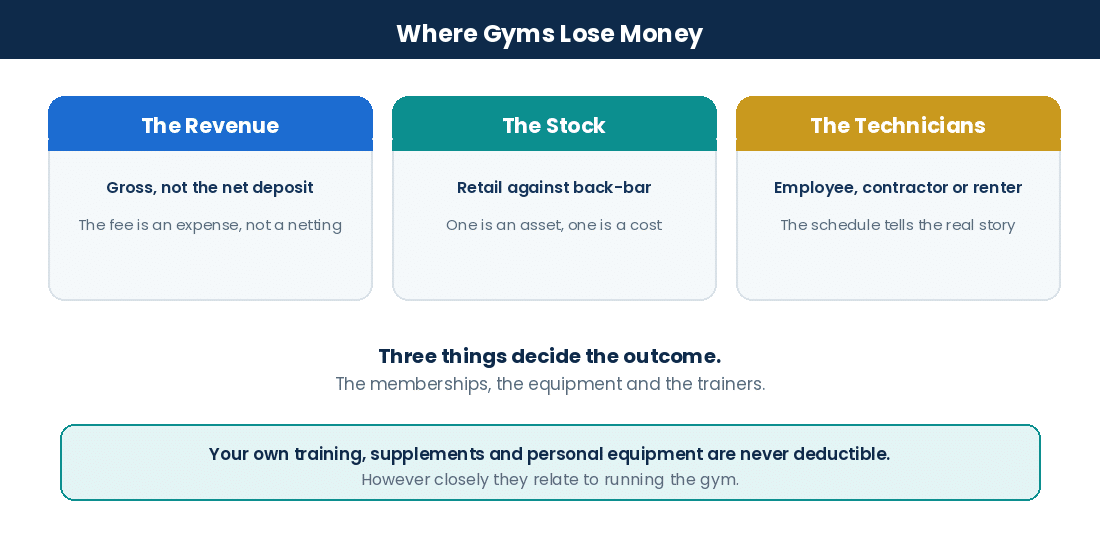
A card processor takes its fee before depositing. A $10,000 month of card sales might arrive as roughly $9,700. Recording the deposit as revenue does two things wrong at once: it understates sales by the fee, and it loses the fee as a deductible expense.
A salon takes $10,000 in card sales in a month and the processor deposits $9,720 after fees. Revenue is $10,000 and merchant fees are a $280 expense. Booking $9,720 as revenue understates the top line, hides the cost, and creates a gap against what the processor reports. Figures changed for privacy.
The correct entry records gross sales, the fee as an expense, and the net to the bank. Your processor statement shows all three.
Reconciling Each Payment Method
| Method | What to Match | Common Failure |
|---|---|---|
| Card | Gross sales to processor statement, fee to expense | Net deposit recorded as revenue |
| E-transfer | Deposit date to the invoice or ticket | Deposits with no matching sale entry |
| Cash | Daily cash log to the deposit slip | No log, so shortfalls are invisible |
| Gift card redemption | Release from deferred revenue, not new income | Counted twice, on sale and on use |
| Package redemption | Release from deferred revenue as sessions are used | Full amount taken on sale |
Cash Controls
Cash is legitimate revenue and needs recording like any other. What protects you is a daily cash log completed and signed at close, showing takings, the float and what was deposited.
Without it, a shortfall is indistinguishable from a sale nobody rang in, and you cannot demonstrate which it was.
An unusually low cash percentage compared to sector norms is one of the patterns that draws attention in this industry, so the log matters for that reason as much as for internal control.
The Monthly Check
- Point-of-sale totals by service type, summed for the month
- Processor statements showing gross sales and fees separately
- Cash log totals against deposit slips
- Bank statement, reconciled line by line
- Deferred revenue balance for packages and gift cards
When those five agree, the month is closed. When they do not, the gap is findable while it is one month old rather than eleven.
Net card deposits recorded as revenue is the most common single error on a salon file. It understates sales, drops the merchant fee, and the processor has already reported the gross figure. Figures changed for privacy.
Key Stat: Record gross card sales with the processing fee as a separate expense. Please never book the net deposit as revenue.
Retail Stock and Back-Bar Supplies
Retail Stock and Back-Bar Supplies
The Product
A bottle of polish on the retail shelf and the same bottle at the station are accounted for completely differently. Salons that treat them alike distort both margin and tax.
The Distinction
| Retail Stock | Back-Bar Supplies | |
|---|---|---|
| What it is | Product held for resale to clients | Product consumed delivering services |
| Treatment | Inventory, an asset until sold | Current expense as consumed |
| When cost hits | Cost of goods sold at the point of sale | In the period incurred |
| Year end | Counted and valued | Restock log, no closing inventory |
| Examples | Polish, files, creams sold at the counter | Acetone, cotton, gloves, station product |
The practical rule is intent at purchase. Product bought to sell is inventory; product bought to use is a supply. Split the invoice at the point of purchase rather than trying to reconstruct it later.
Counting Inventory
Retail stock is counted monthly, or at minimum at year end, and valued at the lower of cost and net realisable value. Expired, damaged or discontinued product is written down or written off with a note of the reason.
A salon that expenses every product order on purchase overstates costs in a stocking-up month and understates them when the shelf runs down. Over a year that distorts every monthly figure even if the annual total happens to land close.
- Count on the same day each month so the comparison means something
- Record opening stock, purchases, closing stock and the resulting cost of sales
- Note write-offs with the reason: expiry, breakage or discontinued
- Keep the count sheets, which are the support for the deduction
Staff Purchases and Discounts
Product sold to staff at a discount can create a taxable benefit for the employee where the discount is not available to the general public and the price falls below cost.
Salons rarely track this, because the amounts feel trivial and the product is going out the door either way. The reporting obligation does not depend on the amount being large.
Product taken by the owner for personal use is a different matter again, creating either a shareholder benefit or a drawing depending on the structure.
Equipment and Fit-Out
| Item | Typical Treatment |
|---|---|
| Manicure tables, pedicure chairs, stools | Class 8 at 20% |
| UV and LED lamps, drills, small tools | Class 8, or expensed where cost is low |
| Computers and booking terminals | Class 50 at 55% |
| Ventilation, plumbing, fixed stations, flooring | Class 13 over the lease term |
| Application software | Class 12 at 100%, half-year rule applies |
Pedicure plumbing and ventilation are the items most often misfiled. In leased premises they are leasehold improvements written off over the lease term, not equipment.
Salons expense the whole product order and capitalise nothing, or capitalise the pedicure chairs and expense the plumbing that made them work. Both cost money in opposite directions. Figures changed for privacy.
Risk Warning: Retail stock is an asset until it sells, not an expense when you buy it. Please count it monthly and record opening and closing values.
Technicians, Tips and Booth Rent
Technicians, Tips and Booth Rent
The People
Employee or Contractor
Nail salons use every arrangement going: hourly staff, commission technicians, booth renters and a mix. The classification decides your payroll obligations and it is decided by the working relationship, not the agreement.
- Control: Who sets the hours, the prices and the service standards
- Tools: Who supplies the station, the equipment and the product
- Chance of profit and risk of loss: Whether the technician can profit from building a book or loses on a quiet week
- Integration: How embedded the technician is in the salon
A technician working posted hours at salon prices using salon product on walk-in clients is an employee. A technician paying fixed rent, setting their own prices and keeping their own clients is not.
Misclassification means the CRA can assess the source deductions that should have been withheld, plus penalties and interest, and directors carry personal exposure on unremitted amounts.
Paying Employees
You withhold income tax, CPP and EI and remit on the schedule set by your remitter type. T4 slips are due by the last day of February following the calendar year.
Commission structures need care. Where a technician earns a percentage of services performed, that is employment income. Draws against future commission need consistent treatment and a clear balance rather than informal netting from one pay run to the next.
Genuine contractors are paid gross and reported on a T4A where applicable.
Tips
Tips are income however they arrive. The reporting depends on how they flow through the salon:
| Type | How It Works | Treatment |
|---|---|---|
| Direct tips | Client pays the technician, who keeps it | The technician’s income to report |
| Controlled tips | Card tips collected by the salon and distributed | Generally employment income with source deductions |
| Tip pools | Shared among staff by an agreed formula | Documented so amounts reconcile |
Card tips are where salons get caught. Once a tip passes through your terminal it sits on a record the processor reports, and the total should be traceable through your payroll.
Booth and Chair Rent
Where technicians rent space, the rent is your revenue and generally a taxable supply, so it counts toward your GST/HST threshold and carries tax when you are registered.
Get the arrangement documented properly:
- A written agreement with the rent amount and payment schedule
- The technician’s control over their own hours and pricing
- Who supplies equipment, product and consumables
- Who owns the client relationship and the booking
- Invoices issued for the rent, creating a proper receivable
Fixed rent creates genuine risk of loss for the technician, which supports contractor status. A percentage of takings does not, and starts to look like commission employment.
The booth rental agreement and the posted staff schedule usually contradict each other. The schedule is the document that describes what actually happens. Figures changed for privacy.
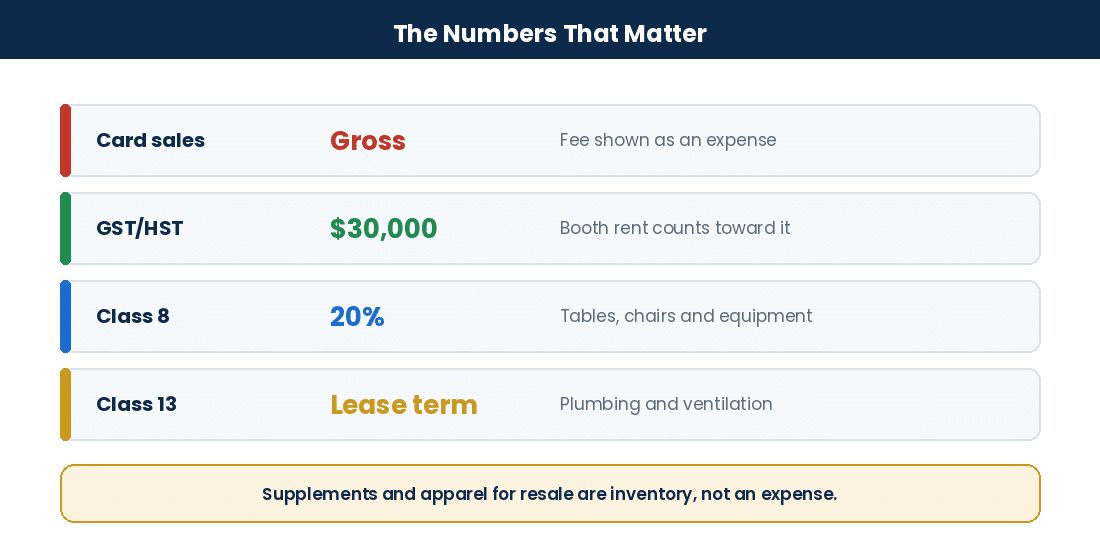
Key Stat: Booth rent is your revenue and counts toward the $30,000 GST/HST threshold. Please include it when tracking whether you have crossed.
GST/HST, Packages and Gift Cards
GST/HST, Packages and Gift Cards
The Tax Side
Registration
Nail services are a taxable supply. You must register for GST/HST once taxable revenue exceeds $30,000 across four consecutive calendar quarters.
The threshold counts everything taxable: services, retail product and booth rent together. A salon with four rented stations can cross on rent alone, which owners regularly miss because they are only counting the services they perform themselves.
Registering voluntarily before a fit-out means recovering the tax on equipment and build-out immediately, which is a real cash argument in a first year.
Input Tax Credits
Input tax credits recover tax paid on retail stock, back-bar product, equipment, rent, utilities and professional fees. Each needs a supplier invoice showing the registration number.
Merchant processing fees also carry tax in most cases, and salons routinely miss those credits because the fee is netted off a deposit rather than entered as a purchase.
Prepaid Packages
A client buying a course of ten pedicures pays now for services delivered over months. That money is deferred revenue, held as a liability and released as each session is used.
A salon sells $18,000 of prepaid packages in December with a December year end. Recognising all of it that year overstates income for services not yet performed and empties the following year. Under deferred revenue accounting, each redemption releases its share and the unearned balance sits as a liability at year end. Figures changed for privacy.
Tracking redemptions by client is what makes this work. A deferred revenue balance nobody can break down by client is a number you cannot defend.
Gift Cards
Gift cards behave similarly but with an extra question. The sale is not revenue; the redemption is. What happens to cards that are never used is the part that needs settling.
Note also that provincial consumer protection legislation restricts expiry on many gift cards, which affects how long the liability stays on your books. That is a legal question rather than an accounting one, so please confirm the position that applies to you.
- Record the sale as a liability, not income
- Release to revenue as cards are redeemed
- Track the outstanding balance so it can be broken down
- Settle the treatment of unredeemed balances rather than leaving them to accumulate
Filing
The CRA assigns your reporting period based on taxable supplies. Annual filing applies below $1.5 million, quarterly between $1.5 million and $6 million, and monthly above that.
Late filing brings a penalty calculated by reference to the amount owing and how many months the return is late, with interest running separately.
Prepaid packages recognised on sale makes December look excellent and the following spring look like a collapse. The business did not change; the accounting did. Figures changed for privacy.
Pro Tip: Please claim the input tax credit on merchant processing fees. Salons miss it because the fee never appears as a purchase entry.
Monthly Close, Records and Working With Gondaliya CPA
Monthly Close, Records and Working With Us
The Discipline
The Monthly Close
Everything above only works if it happens on a cycle. A salon closing its books monthly spends an hour; a salon closing annually spends weeks and finds problems it can no longer fix.
- Reconcile the bank, line by line
- Match gross card sales to processor statements with fees expensed
- Agree cash log totals to deposits
- Count retail inventory and record the movement
- Review the deferred revenue balance for packages and gift cards
- Confirm payroll remittances went out on schedule
- Check the booth rent receivable against invoices issued
Statements prepared this way support a compilation engagement under CSRS 4200, which is what a lender or landlord asks for.
Deadlines
| Obligation | Deadline | If Missed |
|---|---|---|
| T2 corporate return | Six months after fiscal year-end | 5% plus 1% per month, to twelve |
| Balance owing | Two or three months after year-end | Interest from the due date |
| GST/HST return | Per your assigned reporting period | Penalty plus interest |
| Payroll remittances | Per your remitter type | Penalty and director liability |
| T4 and T4A slips | Last day of February | Penalty by slip count |
Records must be kept for six years from the end of the tax year they relate to.
The Errors That Cost Money
- Net card deposits recorded as revenue, dropping both sales and the fee
- Cash takings with no daily log to support them
- Card tips absent from payroll when the processor has reported them
- Retail stock expensed on purchase rather than held as inventory
- Back-bar product mixed with retail, making margin meaningless
- Prepaid packages and gift cards taken into income on sale
- Booth renters with no written agreement and no slips of any kind
- Pedicure plumbing and ventilation expensed rather than Class 13
Our CRA audit guide covers what a review involves. The short version is that a salon with monthly reconciliations and a cash log has already answered most of it.
How We Work With Salons
We support incorporated nail salons on a flat annual fee covering:
- Chart of accounts set up by service line, retail and booth rent
- Monthly bookkeeping with gross revenue and merchant fees separated
- Payment reconciliation across card, cash and e-transfer
- Retail inventory tracking and back-bar expense separation
- Technician classification review against the CRA factors
- Payroll, commission structures, tips, T4 and T4A preparation
- GST/HST registration, filing and input tax credit review
- Deferred revenue for packages and gift cards
- Financial statements and the corporate return
Pricing is quoted before any work begins, including HST, with a one-business-day response. Catch-up work is quoted separately once we have seen the scope.
What Drives the Fee
Fees scale with volume rather than revenue: the number of stations, monthly transaction count, headcount, whether you carry retail stock, and how many months are outstanding.
You can reduce it. A connected point-of-sale system, a clean chart of accounts, settled worker classification and separated stock all cut the work meaningfully.
Getting Started
Bring three things: a month of point-of-sale reports, a processor statement, and a booth rental agreement if you use one. Those show us whether revenue reconciles, whether fees are handled correctly, and whether the classification holds up.
Contact Gondaliya CPA at info@gondaliyacpa.ca, call 647-212-9559, or send us a message.
The salons that never need catch-up work are the ones doing a monthly reconciliation. It is not sophisticated, it is just done. Figures changed for privacy.
Pro Tip: Please reconcile the processor statement monthly. It is the fastest check on whether your recorded revenue matches what actually went through.
FAQs on Nail Salon Bookkeeping Canada
Frequently Asked Questions
FAQ
How do I track service revenue in a nail salon?+
Record daily sales by service type with a ticket number and date, then agree the monthly totals to your point-of-sale reports and the bank.
Should I record card sales gross or net?+
Gross, with the processing fee as a separate expense. Booking the net deposit understates revenue and loses the fee as a deduction.
How do I handle cash sales?+
Keep a daily cash log completed and signed at close, showing takings, float and deposit, and agree it to the deposit slip.
What is the difference between retail stock and back-bar supplies?+
Retail stock is held for resale and is an asset until it sells. Back-bar product is consumed delivering services and is a current expense.
How often should I count inventory?+
Monthly is ideal and year end is the minimum. Record opening stock, purchases, closing stock and any write-offs with the reason.
Are staff product discounts a taxable benefit?+
They can be, where the discount is not available to the general public and the price falls below cost. The amount being small does not remove the obligation.
How do I decide if a technician is an employee or contractor?+
By the working relationship: control over hours and pricing, who supplies tools and product, chance of profit and risk of loss, and integration into the salon.
How should tips be reported?+
Direct tips kept by the technician are their income to report. Card tips collected and distributed by the salon are generally employment income with source deductions.
Is booth rent subject to GST/HST?+
Rent charged for a station is generally a taxable supply, so it carries tax once registered and counts toward the registration threshold.
Does booth rent count toward the $30,000 threshold?+
Yes. The threshold measures all taxable revenue including services, retail sales and booth rent together, not just the services you perform.
How do I account for prepaid packages?+
As deferred revenue, held as a liability and released as each session is used, with redemptions tracked by client.
How are gift cards treated?+
The sale is a liability rather than income, released to revenue on redemption. Provincial consumer protection rules restrict expiry, so the liability may persist.
What equipment classes apply to a nail salon?+
Tables, chairs and equipment generally sit in Class 8 at 20%. Computers are Class 50. Ventilation, plumbing and fixed stations in leased premises are Class 13 over the lease term.
When are T4 and T4A slips due?+
By the last day of February following the calendar year they cover.
How long must a nail salon keep records?+
Six years from the end of the tax year they relate to, covering sales reports, cash logs, inventory counts, payroll records and supplier invoices.
What triggers a CRA review of a salon?+
Deposits exceeding reported sales, an unusually low cash percentage against sector norms, card tips inconsistent with payroll, and booth renters with no slips or agreements.
Sixteen questions and one underneath most of them: does what you recorded match what actually moved. Cards, cash, stock and packages all turn on that. Figures changed for privacy.
Essential Bookkeeping Practices for Nail Salons
Essential Bookkeeping Practices
Quick Reference
Revenue and Payments
- Split service revenue by type so you can see which services earn.
- Record gross card sales with the processing fee as a separate expense.
- Keep a daily cash log completed and signed at close.
- Match e-transfer deposits to the ticket or invoice they settle.
- Reconcile processor statements to recorded revenue every month.
- Keep booth rent revenue in its own account with invoices issued.
- Release package and gift card redemptions from deferred revenue, not as new income.
Product and Assets
- Separate retail stock from back-bar supplies at the point of purchase.
- Hold retail stock as inventory and recognise cost when it sells.
- Count inventory monthly and record opening and closing values.
- Note write-offs with the reason: expiry, breakage or discontinued.
- Track staff discounts that may create a taxable benefit.
- Put tables, chairs and equipment into Class 8 at 20%.
- Put ventilation, plumbing and fixed stations into Class 13 over the lease term.
- Apply the half-year rule in the year an asset becomes available for use.
People, Tax and Records
- Test each technician against the CRA control, tools and risk factors.
- Put booth rental terms in writing and make sure the salon operates that way.
- Run commission technicians through payroll with proper source deductions.
- Track draws against commission with a clear balance rather than netting informally.
- Report card tips through payroll, since the processor has already reported them.
- Count services, retail and booth rent toward the $30,000 GST/HST threshold.
- Claim the input tax credit on merchant processing fees.
- Close the books monthly rather than annually.
- Keep six years of records including cash logs and inventory count sheets.
For help with your salon’s books, contact Gondaliya CPA at info@gondaliyacpa.ca, call 647-212-9559, or book a free consultation.
Twenty-four points and one underneath them: keep the four revenue streams apart and reconcile them monthly. Almost every salon correction we make starts with those two. Figures changed for privacy.
Salon Models We Serve
Industry Expertise
Which issue dominates differs by how the salon runs. Here are ten and the usual focus.
| Salon Model | Where the Bookkeeping Concentrates |
|---|---|
| Single-station owner-operator | Gross against net card revenue |
| Multi-technician salon | Classification, commissions and tip reporting |
| Booth rental model | Rent as revenue and toward the threshold |
| Salon with a retail shelf | Inventory against back-bar separation |
| High cash volume | Daily logs and deposit matching |
| Selling prepaid packages | Deferred revenue tracked by client |
| Selling gift cards | Liability until redeemed, expiry restricted |
| Salon fitting out leased premises | Class 13 on plumbing and ventilation |
| Mobile technicians | Vehicle logs and remote payment capture |
| Behind on the books | Reconciliation before returns are prepared |
- Single-station owner-operator: The processor deposits net; your books need gross.
- Multi-technician salon: Commission is employment income, and the tips run through payroll.
- Booth rental model: Rent is taxable revenue that counts toward registration.
- Salon with a retail shelf: Stock is an asset until it sells.
- High cash volume: Without a log, a shortfall and an unrecorded sale look identical.
- Selling prepaid packages: Money collected is not money earned.
- Selling gift cards: The liability can outlast the year it was sold in.
- Salon fitting out leased premises: The lease term sets the write-off period.
- Mobile technicians: The log is the claim; without it the travel falls.
- Behind on the books: Reconcile first or the return gets prepared twice.
The model changes where the bookkeeping concentrates. It does not change the method, which is keep the revenue streams apart, separate stock from supplies, then reconcile every month. Figures changed for privacy.
Professional Guidance and Quick Reference
Guidance
Professional Guidance for Salon Owners: How Gondaliya CPA Handles Your File
Nail salons lose money in a predictable set of ways: net card deposits recorded as revenue so both the sales figure and the merchant fee disappear, cash takings with no daily log to support them, retail stock expensed on purchase when it is an asset until it sells, back-bar product mixed in with retail so margin becomes meaningless, prepaid packages and gift cards taken into income on sale, card tips absent from payroll when the processor has already reported them, and booth renters working under posted salon hours with no agreement and no slips. Gondaliya CPA handles nail salon bookkeeping on a fixed annual fee.
We handle what decides the outcome: setting up a chart of accounts that splits service revenue by type from retail and booth rent, recording gross card sales with fees expensed, reconciling card, cash and e-transfer against processor statements monthly, separating retail inventory from back-bar consumption at the point of purchase, testing technician classification against the CRA control, tools and risk factors, running commissions and tips through payroll correctly, tracking deferred revenue by client, and splitting the fit-out between Class 8 equipment and Class 13 leasehold.
Our team starts with a month of point-of-sale reports and a processor statement, because those two show immediately whether the recorded revenue matches what actually moved. Single station, multi-technician shop or booth rental, you get clear advice and a fixed price before we start.
Quick Answers
- Card sales: Record gross, fee as an expense
- Cash: Daily log signed at close
- Retail stock: Inventory until it sells
- Back-bar: Expense as consumed
- Packages and gift cards: Deferred revenue
- Booth rent: Taxable revenue, counts to the threshold
- GST/HST: $30,000 across four quarters
- Equipment: Class 8 at 20%
- Fit-out: Class 13 over the lease term
- Records: Six years retention
Who This Is For
- For: Incorporated nail salons, single-station operators, multi-technician shops, booth rental models and mobile technicians across Canada.
- Not For: Public health inspection, infection control and municipal licensing requirements, which sit with the relevant authority rather than accounting.
People Also Ask
Can I claim the input tax credit on card processing fees?+
Generally yes, but salons miss it because the fee is netted off the deposit and never entered as a purchase. Recording it as an expense makes the credit visible.
What if my booth renters have never received any slips?+
That absence is itself a signal. Settle the classification first, then deal with the slips or payroll that should have followed from it.
Do I need to track which client redeemed which package session?+
Yes. A deferred revenue balance you cannot break down by client is a figure you cannot support if it is questioned.
Glossary of Key Terms
- T2: The corporation income tax return.
- Gross revenue: Sales before the processor deducts its fee.
- Merchant fee: The processing cost, an expense rather than a netting.
- Retail stock: Product held for resale, an asset until sold.
- Back-bar supplies: Product consumed delivering services.
- Cost of goods sold: Inventory cost recognised when stock sells.
- Deferred revenue: Prepaid package and gift card money held as a liability.
- Direct tips: Tips paid to the technician and kept by them.
- Controlled tips: Card tips collected and distributed by the salon.
- Booth rent: Amounts charged to a technician for station space.
- Commission draw: An advance against future commission earnings.
- Class 8: The 20 percent class covering salon equipment.
- Class 13: Leasehold improvements over the lease term.
- Half-year rule: The first-year restriction on CCA claims.
- Input tax credit: GST/HST recoverable on business purchases.
- Compilation engagement: Financial statements prepared under CSRS 4200.
Nail Salon Readiness Check
This quick self-check indicates where your operation most likely has room. Please answer the six questions below.
Nail Salon Readiness Check
Six quick questions on your salon. No fee shown.
Points to raise with us:
This is a general prompt, not tax or legal advice or a quote. Your position depends on your full facts. For a real review, please book a free consultation.
Want a checklist to work from? You can download our free nail salon bookkeeping checklist before your consultation.
Record card sales at gross with the fee expensed. Keep a daily cash log signed at close. Separate retail stock from back-bar supplies at purchase. Count inventory monthly. Test technician classification against the CRA factors. Report card tips through payroll. Hold packages and gift cards as deferred revenue. Please close the books monthly and keep six years of records.
2026 Update — what is current: This article reflects rules current to 2026. The $30,000 GST/HST registration threshold measured across four consecutive calendar quarters, the Class 8 rate of 20%, Class 13 leasehold treatment over the lease term, the half-year and available-for-use rules, the end-of-February slip deadline, the six-month T2 filing deadline and the six-year retention requirement are unchanged. Please note that we have not been able to verify a separate set of CRA electronic records rules taking effect in 2026, so please confirm any such requirement before relying on it; that payroll remittance frequency follows your remitter type rather than a fixed monthly or quarterly split by account size; that GST/HST monthly filing is required above $6 million in taxable supplies rather than at lower levels; and that gift card expiry is restricted by provincial consumer protection legislation, which is a legal question outside accounting and varies by province.
Nail Salon Bookkeeping Canada: How Gondaliya CPA Supports Salon Owners
Start with a month of reports
Gondaliya CPA sets up a chart of accounts splitting service revenue by type from retail and booth rent, records gross card sales with merchant fees expensed, reconciles card, cash and e-transfer against processor statements monthly, separates retail inventory from back-bar consumption at purchase, tests technician classification against the CRA control, tools and risk factors, runs commissions and tips through payroll correctly, tracks deferred revenue by client and splits the fit-out between Class 8 and Class 13, on a flat annual fee including HST with a one-business-day response. Please book a free consultation.
Next Steps
Please book a free consultation with Gondaliya CPA and bring a month of point-of-sale reports, a processor statement, and a booth rental agreement if you use one. Those three tell us immediately whether the revenue reconciles, whether fees are handled correctly, and what remains to claim on the equipment, and where the documentation is thin. You will get a flat annual fee including HST before any work begins. If our content helps, please add gondaliyacpa.ca as a preferred source on Google.
Published: · Last updated:
Editorial policy: We research against CRA and CPA Ontario sources, fact-check the figures, and Sharad Gondaliya, CPA, reviews the content, which we update as the rules change.
Disclaimer: This article is educational information only and is not tax, legal, or financial advice. Figures marked illustrative are examples rather than quotes or guarantees. It reflects CRA rules current to 2026, including the $30,000 GST/HST threshold, the Class 8 rate, Class 13 leasehold treatment, the half-year rule, and the six-year retention requirement. Rates, limits and expensing rules change and outcomes depend on your specific facts. Please consult a CPA Ontario member before acting.

Sharad Gondaliya is a CPA Canada & CPA USA with 15 Years+ experience of Accounting, Tax, Payroll of Corporate Small Businesses as Tax Accountant. He is a CPA Ontario member (61040184) and holds US CPA licences in Washington and Montana and is well known among corporate small businesses for tax planning, efficient tax solutions, and affordable CPA services. Sharad is the Principal (Director) of Gondaliya CPA – Affordable CPA Firm in Canada. Licenses: CPA Ontario: 61040184 | CPA USA (MT): PAC-CPAP-LIC-033176 | CPA USA (WA): 57629 | CPA Firm License: 61330051 View Full Author Bio