



Common Tax and Accounting Mistakes Laundry Business Owners Make in Canada and How to Avoid Costly CRA Problems
Laundry Business Tax Mistakes Canada: Common Laundry Accounting and Bookkeeping Errors for CRA Compliance by Gondaliya CPA
Laundry business tax mistakes Canada often arise from incorrect coin and cash revenue recording, mixing personal and business expenses, and failure to track prepaid cards or accounts properly. Gondaliya CPA highlights key laundry bookkeeping mistakes such as inaccurate payroll source deductions, GST/HST registration errors, and maintaining adequate books and records to meet Canadian tax compliance and reduce CRA audit risk.
Very few businesses left in Canada still take most of their revenue in coins from machines nobody watches. That single fact shapes everything about laundry business accounting and CRA compliance, because the burden of showing what you earned sits entirely with you.
Quick Summary
Laundry businesses attract CRA attention because they are cash-intensive and equipment-heavy. Coin revenue with no meter log, net card deposits recorded as sales, prepaid cards taken into income on sale, and machines expensed instead of depreciated account for most of the problems we see.
Reading time: 49 minutes.
Table of Contents
- Coin, Cash and Card Revenue
- Prepaid Cards and Deferred Revenue
- Equipment, CCA and the 2026 Change
- Repairs, Leasehold and Utilities
- Payroll, GST/HST and Records
- Penalties, Disclosure and Working With Us
- Frequently Asked Questions
- Key Compliance Points
- Laundry Operations We Serve
- Professional Guidance and Quick Reference
The Numbers That Matter
This article covers Canada, with Ontario and Toronto context, and reflects rules current to 2026. It applies to incorporated laundromats, dry cleaners, wash-dry-fold operators, commercial laundries and multi-site route operators. Figures marked illustrative are examples, not quotes, and any masked engagement notes end with “Figures changed for privacy.” This is educational information only and not tax or legal advice. Provincial environmental regulation of dry cleaning solvents and municipal licensing sit outside accounting scope.
Coin, Cash and Card Revenue
Coin, Cash and Card Revenue
The Revenue
Everything else in this article matters less than this section. A laundry business is judged on whether it can demonstrate what it collected.
Why a Bank Deposit Is Not Enough
Owners routinely assume that banking the coins is the record. It is not. A deposit shows money arrived; it does not show that all the money arrived.
What supports the revenue figure is the machine meter reading. Each machine counts its own cycles, and cycles multiplied by price gives expected revenue. That figure compared against the coins collected is the control.
Without meter readings, a reviewer has no way to test your revenue except by estimating it, and estimates in cash businesses rarely land in your favour.
The Coin Collection Routine
- Read every machine meter at each collection and log the reading
- Count the coins before they leave the premises, not at the bank
- Record the collection date, machines emptied and amount counted
- Deposit intact and keep the slip against the collection log
- Investigate variances between expected and actual rather than ignoring them
- Have a second person verify counts where the operation supports it
An operator collects from twenty washers priced at $4.50. Meter readings show 1,180 cycles since the last collection, giving expected revenue of $5,310. Coins counted total $5,240. The $70 variance is documented and investigated. That record is what makes the $5,240 defensible, not the deposit slip alone. Figures changed for privacy.
Card and App Revenue Recorded Net
Payment processors deduct their fee before depositing. Recording the deposit as revenue understates sales by the fee and simultaneously loses the fee as a deductible expense.
The correct entry records gross sales, the processing fee as an expense, and the net to the bank. Your processor statement shows all three, and the processor reports the gross figure independently.
Reconcile the statement to your books monthly. A persistent gap between what the processor reports and what you declare is arithmetic rather than judgement, and it is visible.
Multi-Site and Route Operations
Operators running machines across several locations, or route operators servicing sites they do not own, need collection logged by site as well as in total.
Revenue sharing arrangements with site owners need documenting too. What you keep is your revenue and what you pay over is a cost, and both sides of that need a record.
The first request in a laundry review is the meter log. Operators who have one answer the question in an afternoon; operators who do not spend months arguing about an estimate. Figures changed for privacy.
Risk Warning: Bank deposits alone do not substantiate coin revenue. Please log meter readings at every collection and keep them with the deposit slips.
Prepaid Cards and Deferred Revenue
Prepaid Cards and Deferred Revenue
The Timing
Loading a Card Is Not a Sale
Laundries moving away from coins sell value on a card or app that the customer draws down over weeks. Recording the load as revenue reports income for services not yet delivered.
The load is a liability. It becomes revenue as the customer uses the machines, which is when you actually perform the service.
| Event | Correct Treatment |
|---|---|
| Customer loads $50 onto a card | Cash in, deferred revenue liability of $50 |
| Customer runs $12 of machines | $12 released from the liability to revenue |
| Balance remains on the card | Stays as a liability at period end |
| Card lapses or is written off | Treatment settled in advance, not left to accumulate |
| Card refunded to the customer | Liability discharged, no revenue arises |
Tracking the Balance
The deferred revenue balance has to be breakable down. A single figure nobody can reconcile to outstanding card balances is a number you cannot defend.
Most card systems report the outstanding float. That report is your supporting schedule and it should agree to the liability on your balance sheet each month.
- Reconcile the card system float to the deferred revenue account monthly
- Track loads and redemptions separately rather than netting them
- Keep the system report as the schedule behind the balance
- Settle the treatment of dormant balances rather than letting them build indefinitely
Commercial Accounts and Linen Contracts
Commercial laundries and linen services bill accounts rather than taking coins, which introduces a different set of timing questions.
Revenue is recognised as the service is performed, not when the invoice is paid. Where a contract runs across a year end, the work performed but not yet billed belongs in the period it was done.
Deposits taken on commercial contracts follow the same principle as card loads: a liability until the service is delivered.
Why the Timing Matters
Getting revenue into the wrong period does not change what you earn over the life of the business, but it changes what you pay and when.
A laundry recognising card loads on receipt reports higher income in a growth year and lower income later, paying tax early on money it had not yet earned. In a business with thin margins that is real cash out the door.
Card float recorded as revenue makes the year you install the system look excellent. The following year looks like a decline when nothing about the business changed. Figures changed for privacy.
Key Stat: A card load is a liability until the machines are used. Please reconcile the card system float to your deferred revenue balance monthly.
Equipment, Capital Cost Allowance and the 2026 Change
Equipment, CCA and the 2026 Change
The Assets
Laundry is equipment-heavy, so this is where the money sits. It is also where the rules changed materially in 2026.
Which Class Applies
| Asset | Typical Class | Rate |
|---|---|---|
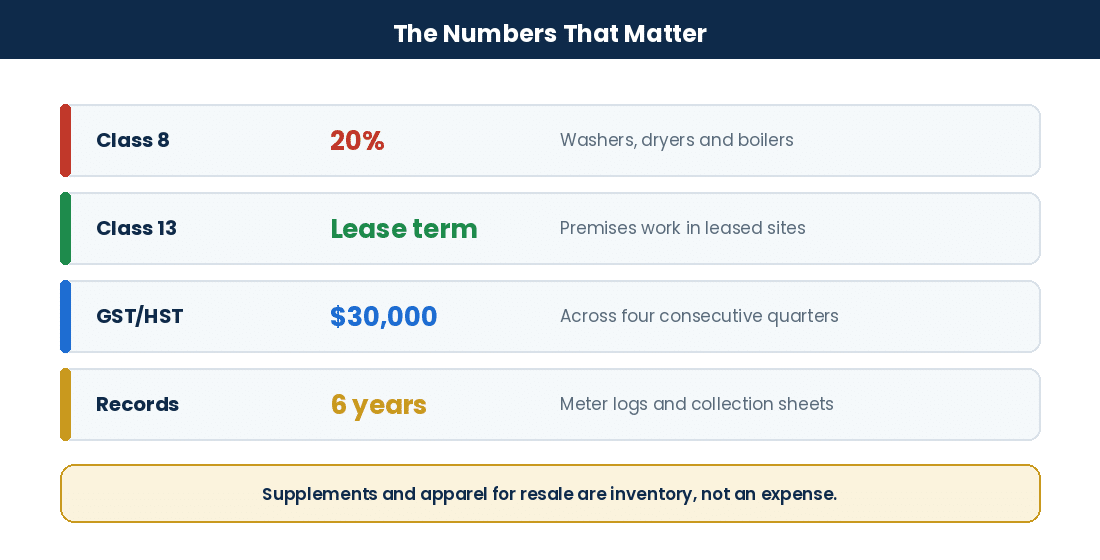
| Washers, dryers and extractors | Class 8 | 20% |
| Boilers and water heating plant | Class 8, unless part of the building | 20% |
| Dry cleaning machines | Class 8 | 20% |
| Card systems, computers and terminals | Class 50 | 55% |
| Application software | Class 12 | 100% |
| Fit-out in leased premises | Class 13 | Over the lease term |
| A building you own | Class 1 | 4% |
Please note Class 13 is leasehold improvements written off over the lease term rather than at a declining-balance rate. A boiler described as Class 13 at 30% is wrong on both counts.
Machines are capital assets. Expensing a $40,000 equipment purchase in full because it feels like a cost of doing business is the error we correct most often on these files.
What Changed in 2026
Bill C-15 received Royal Assent on 26 March 2026 and reinstated the accelerated investment incentive along with immediate expensing for certain classes.
For most depreciable property acquired after 2024 and available for use before 2030, the half-year rule is effectively suspended and an enhanced first-year deduction applies. Laundry equipment in Class 8 falls into this general category rather than the manufacturing classes that get full immediate expensing.
The enhancement is phased down for property becoming available for use after 2029 and eliminated after 2033.
A laundromat buys $60,000 of Class 8 washers. Under the ordinary half-year rule the first-year claim would be 10% of cost. With the reinstated incentive applying, the first-year deduction is materially larger, which changes both the tax result and the instalment position for that year. Please have the exact calculation confirmed for your acquisition date. Figures changed for privacy.
This matters practically. If you bought machines in the last two years and your return applied the plain half-year rule, the claim may have been understated. That is worth reviewing.
Disposals, Recapture and Terminal Loss
Laundries replace machines on a cycle, which makes disposals routine and the tax result easy to overlook.
- Recapture: Where proceeds exceed the remaining class balance, the excess is income
- Terminal loss: Where a class is emptied for less than its balance, the shortfall is a deduction
- Trade-ins: The allowance is proceeds, not a discount on the new machine
- Scrapped machines: Still a disposal, at nil or scrap proceeds
Larger first-year deductions make recapture more likely later, because the class balance falls faster than the machines lose value. Claiming more now is usually right, but the disposal should be modelled rather than discovered.
The Asset Register
Every claim rests on a register listing each machine with its purchase date, cost, assigned class, claims to date and disposal details when it leaves.
Without one, the fleet becomes a single number nobody can defend, and machines that left years ago sit on the books indefinitely.
Operators who bought machines in 2025 and applied the plain half-year rule may have understated the claim. It is worth checking before that year closes for adjustment. Figures changed for privacy.
Risk Warning: Washers and dryers are capital assets, not an expense. Please put them on the register with a class rather than writing them off in full.
Repairs, Leasehold Improvements and Utilities
Repairs, Leasehold and Utilities
The Costs
Repair or Improvement
The distinction decides whether you deduct now or over years, and laundry equipment generates the question constantly.
| Work Done | Treatment | Why |
|---|---|---|
| Replacing a worn drive belt | Current expense | Restores the machine to working order |
| Fixing a leaking valve | Current expense | Repair, no betterment |
| Rebuilding a motor to original spec | Current expense | Restoration rather than improvement |
| Upgrading to a higher-capacity motor | Capital | Increases the machine’s capability |
| Repiping to raise water pressure throughout | Capital | Betterment to the premises or the system |
The test is whether you restored the asset or bettered it. Document what was done rather than only what it cost, because the invoice amount does not answer the question.
Leasehold Improvements
Most laundries lease. Work done to the premises to make them suitable, including electrical upgrades for machines, plumbing runs, drainage, venting and flooring, is a leasehold improvement in Class 13, written off over the lease term including renewal options.
The machines themselves stay in their own class. Splitting the contractor invoice between the two at the time of the work is far easier than reconstructing it later.
Keep the lease with the invoices. The lease term is what sets the write-off period, so the two documents work together.
Utilities
Water, gas and electricity are among the largest costs in this business and the most poorly tracked. Owners with several sites frequently cannot say what any individual location consumes.
Where each site has its own meter, keep the bills separate and code them to the site. Where sites share a supply, sub-metering solves it properly. Failing that, allocate on a defensible basis such as machine count, connected load or measured usage, and document the basis.
Two consequences follow from getting this wrong. Site profitability becomes fiction, so you cannot tell which location to close or invest in. And where any part of the premises is used personally or by another business, the input tax credit apportionment has no support.
The Cost Per Load
Utilities, detergent, machine depreciation and labour together give you the real cost of running a cycle. That figure is what pricing should be built on.
Operators who have never calculated it are pricing from what the shop down the road charges, which tells them nothing about whether they make money at that price.
A spike in water consumption with no corresponding revenue increase usually means a machine is faulty, and it shows up in the utility allocation long before anyone notices on the floor.
Personal and Business Separation
Paying personal costs through the company builds a shareholder loan balance. If it is not repaid within the period the Income Tax Act allows, generally by the end of the following taxation year, the amount can be included in your personal income under section 15(2).
In a cash business this compounds. Coins taken from the till for personal use, never recorded, appear as neither revenue nor drawings, and the books stop describing anything real.
One business account and one business card removes the problem entirely.
Utility allocation is the analysis owners resist and benefit from most. It has found faulty machines, a neighbouring tenant on the same meter, and one site that had been losing money for two years. Figures changed for privacy.
Pro Tip: Please split contractor invoices between machine installation and premises work at the time. Class 8 and Class 13 write off very differently.
Payroll, GST/HST and Records
Payroll, GST/HST and Records
The Compliance
Attendants, Drivers and Classification
Laundries employ attendants, pressers, counter staff and delivery drivers, and in a cash business the temptation to pay informally is obvious. It is also the most expensive mistake available.
Where someone works your hours on your premises using your equipment, they are an employee. You withhold income tax, CPP and EI and remit on the schedule set by your remitter type. A regular remitter pays by the fifteenth of the following month; other schedules apply depending on your average withholding.
Paying cash without records means the CRA can assess the source deductions that should have been withheld, plus penalties and interest, and directors carry personal exposure on unremitted amounts. Late remittance penalties start at 3% and rise with the delay.
T4 slips are due by the last day of February following the calendar year. Genuine contractors are paid gross and reported on a T4A where applicable.
GST/HST Registration
Laundry services are a taxable supply. You must register for GST/HST once taxable revenue exceeds $30,000 across four consecutive calendar quarters, with registration required within 29 days of ceasing to be a small supplier.
The CRA assigns your reporting period based on taxable supplies. Annual filing applies below $1.5 million, quarterly between $1.5 million and $6 million, and monthly above that.
Coin-Operated Machines and the Special Rule
The Excise Tax Act contains a specific provision for mechanical coin-operated devices. Where a supply is made through such a device that accepts only a single coin of a low prescribed denomination, the tax is deemed to be nil.
Most laundry machines take considerably more than that per cycle, so the relief will not apply to a typical wash. It does come up on small vending, so please have your specific machines reviewed rather than assuming either way.
Vending sales, soap dispensers and commercial contracts each need tracking separately from the machine revenue, because the treatment is not uniform across them.
Input Tax Credits
Input tax credits recover the tax you pay on machines, utilities, detergent, rent, repairs and professional fees. Each needs a supplier invoice showing the registration number and the tax charged.
Two things get claims denied. Claiming without the documentation, and claiming the full amount on a cost that is partly personal or shared with another occupant. Apportion and keep the calculation.
Inventory and Supplies
Detergent, softener, packaging, hangers and vending stock are all inventory or supplies depending on whether they are resold or consumed.
- Vending and retail stock is inventory, counted and valued at period end
- Detergent used in wash-dry-fold service is a supply, expensed as consumed
- Dry cleaning solvent is a supply, with handling governed by provincial environmental rules outside accounting
- Count regularly enough to notice shrinkage rather than only at year end
Records
Records must be kept for six years from the end of the tax year they relate to. For a laundry that means meter logs, collection sheets, deposit slips, processor statements, card system reports, utility bills, payroll records, the asset register and supplier invoices.
Failure to keep adequate records carries penalties in its own right, and in a cash business the practical consequence is worse: without records the CRA can assess on an estimated basis and you carry the burden of displacing it.
Attendants paid in cash with no records is the exposure that ends laundry files badly. It converts a bookkeeping problem into a payroll assessment across every open year. Figures changed for privacy.
Risk Warning: Paying staff in cash without payroll records exposes the corporation and its directors personally. Please run everyone through payroll.
Penalties, Disclosure and Working With Gondaliya CPA
Penalties, Disclosure and Working With Us
The Cleanup
Deadlines and What Missing Them Costs
| Obligation | Deadline | If Missed |
|---|---|---|
| T2 corporate return | Six months after fiscal year-end | 5% plus 1% per complete month, to twelve |
| Balance owing | Two or three months after year-end | Interest from the due date |
| GST/HST return | Per your assigned reporting period | Penalty plus interest |
| Payroll remittances | Per your remitter type | Penalty from 3%, rising with delay |
| T4 and T4A slips | Last day of February | Penalty by slip count |
Repeat late filing within the following three years attracts higher rates, which is why a second late year costs disproportionately more than the first.
Where the CRA concludes that a false statement was made knowingly or in circumstances amounting to gross negligence, a separate and much larger penalty applies. It is rare, but cash businesses are where it surfaces.
What Draws a Review
- Deposits inconsistent with meter readings, or no meter readings at all
- Reported revenue below what the processor reports on card and app sales
- Utility costs out of line with declared volume, suggesting more machine hours than revenue
- Payroll gaps, where a site clearly needs staff and none appear on the books
- Personal expenses in the accounts and a growing shareholder loan
- Equipment expensed in full rather than capitalised
The utility one surprises owners. A reviewer can form a view on machine usage from water and gas consumption, and compare it against what you declared.
Our CRA audit guide sets out what a review involves and what gets requested.
Coming Forward Before They Do
Where past returns were wrong or filings are behind, the Voluntary Disclosures Program may reduce penalties. The disclosure must be complete, made in good faith, and critically made before the CRA contacts you about the issue.
Relief is not automatic and does not cover every situation, so the position should be assessed rather than assumed. Where a genuine circumstance outside your control caused the delay, a taxpayer relief request is a separate route.
The arithmetic is straightforward. Disclosing costs the tax plus interest with relief on penalties. Being found costs all of it plus a considerably harder relationship going forward.
Rebuilding a Laundry File
Catch-up work follows an order:
- Reconstruct revenue from meter data, collection records, processor statements and deposits
- Build the asset register from purchase invoices and identify what has been disposed of
- Recalculate capital cost allowance across the affected years
- Separate personal spending and quantify the shareholder loan
- Prepare or amend the corporate returns
- Bring GST/HST current on the corrected figures
- Prepare any missing payroll slips
Revenue first, because everything downstream depends on it.
How We Work With Laundry Businesses
We support incorporated laundries on a flat annual fee covering bookkeeping with coin and card revenue controls, monthly processor reconciliation, deferred revenue on card float, the asset register and capital cost allowance including the reinstated incentive, repair against capital decisions, utility allocation across sites, payroll and slips, GST/HST filing, financial statements and the corporate return.
Pricing is quoted before any work begins, including HST, with a one-business-day response. Catch-up work is quoted separately once we have seen the scope.
Getting Started
Bring three things: a month of collection records with meter readings, a processor statement, and your last filed corporate return. Those show us whether revenue is supported, whether card sales are recorded gross, and what needs correcting.
Contact Gondaliya CPA at info@gondaliyacpa.ca, call 647-212-9559, or send us a message.
Owners assume a cash business is harder to review. It is easier, because the reviewer can model expected revenue from utilities and meters. The records are what protect you. Figures changed for privacy.
Pro Tip: Please keep the meter log even in quiet months. A gap in the record is harder to explain than a low month.
FAQs on Laundry Business Tax Mistakes
Frequently Asked Questions
FAQ
Is a bank deposit enough to support coin revenue?+
No. A deposit shows money arrived, not that all of it did. Machine meter readings logged at each collection are what substantiate the revenue figure.
How should I record coin collections?+
Read and log every machine meter at collection, count the coins on the premises, record the date and amount, deposit intact and keep the slip against the log.
Should card and app sales be recorded gross or net?+
Gross, with the processing fee as a separate expense. Recording the net deposit understates sales and loses the fee as a deduction.
When does a prepaid card load become revenue?+
When the customer uses the machines, not when the card is loaded. The load is a liability until the service is performed.
Which CCA class covers washers and dryers?+
Laundry equipment generally sits in Class 8 at 20%. Card systems and computers are Class 50, and fit-out in leased premises is Class 13 over the lease term.
Did the capital cost allowance rules change in 2026?+
Yes. Bill C-15 received Royal Assent on 26 March 2026, reinstating the accelerated investment incentive with an enhanced first-year deduction for most property acquired after 2024 and available for use before 2030.
Can I write off laundry machines in full?+
Generally no. Full immediate expensing applies to manufacturing and processing classes rather than general equipment, though the reinstated incentive gives a larger first-year claim than the plain half-year rule.
What is the difference between a repair and an improvement?+
A repair restores the asset to working order and is deducted now. An improvement betters it or increases its capability and is capitalised.
How are leasehold improvements treated?+
As Class 13, written off over the lease term including renewal options. Electrical, plumbing, drainage and venting work in leased premises falls here.
How should utilities be allocated across sites?+
By separate meters where possible, sub-metering where not, or a documented basis such as machine count or connected load.
Can I pay attendants in cash?+
Not without payroll records. Where they are employees you must withhold and remit, and paying informally exposes the corporation and its directors personally.
When must a laundry register for GST/HST?+
Once taxable revenue exceeds $30,000 across four consecutive calendar quarters, with registration required within 29 days of ceasing to be a small supplier.
Is there a special GST/HST rule for coin machines?+
The Excise Tax Act deems tax nil on supplies through a mechanical device accepting a single low-denomination coin. Most laundry cycles cost more than that, so it rarely applies.
How long must a laundry keep records?+
Six years from the end of the tax year they relate to, including meter logs, collection sheets, deposit slips, processor statements and the asset register.
What triggers a CRA review of a laundry business?+
Deposits inconsistent with meter readings, revenue below what processors report, utility consumption out of line with declared volume, and payroll gaps at staffed sites.
Does voluntary disclosure help if I am behind?+
It may reduce penalties where the disclosure is complete, made in good faith and made before the CRA raises the issue. Relief is not automatic.
Sixteen questions and one underneath most of them: can you show it. In a coin business the record is the whole defence. Figures changed for privacy.
Key Compliance Points for Laundry Businesses
Key Compliance Points
Quick Reference
Revenue and Records
- Log machine meter readings at every collection, without exception.
- Count coins on the premises before they go to the bank.
- Investigate variances between expected and actual rather than ignoring them.
- Record card and app sales at gross with the fee as a separate expense.
- Reconcile processor statements to the books monthly.
- Hold prepaid card loads as deferred revenue until the machines are used.
- Reconcile the card system float to the deferred revenue balance monthly.
- Track revenue by site where you operate more than one location.
- Keep six years of meter logs, collection sheets and deposit slips.
Equipment and Costs
- Capitalise machines rather than expensing them in full.
- Maintain an asset register with purchase date, cost, class and claims to date.
- Review whether the reinstated investment incentive applies to recent purchases.
- Model recapture before disposing of or trading in machines.
- Judge repair against improvement on what was done, not what it cost.
- Put premises work in leased sites into Class 13 over the lease term.
- Split contractor invoices between machine installation and premises work.
- Meter or sub-meter utilities by site and document any allocation basis.
- Calculate the cost per load so pricing rests on something.
People, Tax and Structure
- Run every worker through payroll with proper source deductions.
- Remit on the schedule set by your remitter type, not a guess.
- File T4 and T4A slips by the last day of February.
- Register for GST/HST once taxable revenue passes $30,000 over four quarters.
- Hold supplier invoices with registration numbers for every input tax credit.
- Apportion credits where a cost is partly personal or shared.
- Keep business and personal spending in separate accounts.
- Monitor the shareholder loan balance quarterly.
- Respond to every CRA letter within the deadline given.
- Consider voluntary disclosure before the CRA raises an issue, not after.
For help with your laundry business books, contact Gondaliya CPA at info@gondaliyacpa.ca, call 647-212-9559, or book a free consultation.
Twenty-eight points and one underneath them: the record is the revenue. In a business built on coins nobody watched, what you wrote down is all you have. Figures changed for privacy.
Laundry Operations We Serve
Industry Expertise
Which issue dominates differs by the operation. Here are ten and the usual focus.
| Laundry Operation | Where the Exposure Sits |
|---|---|
| Coin laundromat, unattended | Meter logs supporting the revenue |
| Card or app converted site | Gross revenue and deferred card float |
| Multi-site operator | Utility allocation and revenue by location |
| Route operator servicing others’ sites | Revenue sharing recorded on both sides |
| Wash-dry-fold service | Supplies consumed against vending stock |
| Dry cleaner | Solvent handling costs and equipment classes |
| Commercial linen contracts | Revenue recognised as service is performed |
| Recently re-equipped site | The reinstated investment incentive |
| Attended site with staff | Payroll classification and remittance |
| Behind on filings | Revenue rebuilt before returns are prepared |
- Coin laundromat, unattended: Deposits alone prove nothing without the meters.
- Card or app converted site: The load is a liability, and the processor reports gross.
- Multi-site operator: Without allocation, site profitability is guesswork.
- Route operator servicing others’ sites: What you keep and what you pay over both need records.
- Wash-dry-fold service: Consumed detergent and resale stock behave differently.
- Dry cleaner: Environmental rules sit outside accounting but the costs do not.
- Commercial linen contracts: Work performed before year end belongs in that year.
- Recently re-equipped site: A larger first-year claim may be available.
- Attended site with staff: Cash payment without records is the worst exposure here.
- Behind on filings: Rebuild the revenue first or you will file twice.
The operation changes where the exposure sits. It does not change the method, which is substantiate the revenue, capitalise the equipment properly, then run everyone through payroll. Figures changed for privacy.
Professional Guidance and Quick Reference
Guidance
Professional Guidance for Operators: How Gondaliya CPA Handles Your File
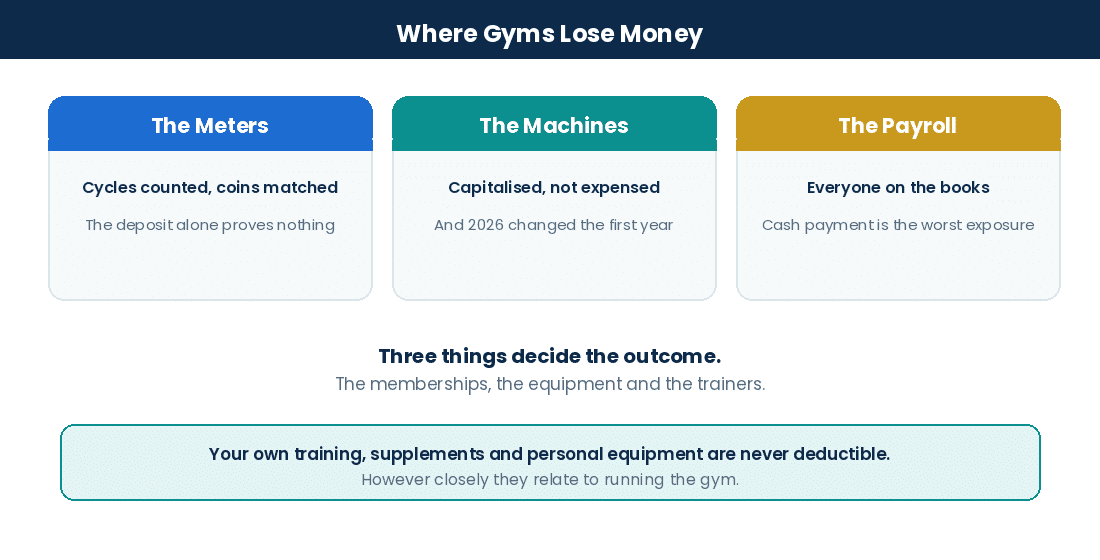
Laundry businesses lose money in a predictable set of ways: coin revenue banked with no meter reading behind it, net card and app deposits recorded as sales so both the revenue and the processing fee disappear, prepaid card loads taken into income before the machines are used, washers and dryers expensed in full instead of capitalised, premises work put in an equipment class rather than Class 13, utilities never allocated so nobody knows which site earns, and attendants paid in cash with no payroll records at all. Gondaliya CPA handles laundry business accounting on a fixed annual fee.
We handle what decides the outcome: building a collection routine that logs meter readings against coins counted, recording card and app revenue at gross with fees expensed, holding card float as deferred revenue reconciled monthly, maintaining an asset register and reviewing whether the reinstated investment incentive applies to recent purchases, deciding repair against capital improvement on what was done, splitting contractor invoices between machine installation and Class 13 premises work, allocating utilities by site, and running every worker through payroll properly.
Our team starts with a month of collection records and a processor statement, because those two show immediately whether the revenue is supported and whether card sales are recorded correctly. Single laundromat, multi-site operator or commercial laundry, you get clear advice and a fixed price before we start.
Quick Answers
- Coin revenue: Meter log, not just the deposit
- Card sales: Gross, fee as an expense
- Card loads: Deferred until the machines are used
- Machines: Class 8 at 20%, capitalised
- 2026 change: Investment incentive reinstated
- Premises work: Class 13 over the lease term
- GST/HST: $30,000 across four quarters
- Payroll: Everyone on the books, no exceptions
- Corporate return: Six months after year end
- Records: Six years retention
Who This Is For
- For: Incorporated laundromats, dry cleaners, wash-dry-fold operators, commercial laundries and multi-site route operators across Canada.
- Not For: Provincial environmental regulation of dry cleaning solvents and municipal licensing, which sit with the relevant authority rather than accounting.
People Also Ask
What happens to unused prepaid card balances?+
They stay as a liability. The treatment of dormant balances should be settled deliberately rather than left to accumulate indefinitely.
Can a reviewer estimate my revenue from utility bills?+
They can form a view on machine usage from water and gas consumption and compare it against what you declared. Records are what displace an estimate.
Should I review returns filed before the 2026 change?+
Possibly. If machines were bought after 2024 and the plain half-year rule was applied, the first-year claim may have been understated.
Glossary of Key Terms
- T2: The corporation income tax return.
- Meter reading: The machine cycle count supporting expected revenue.
- Collection log: The record of machines emptied and coins counted.
- Gross revenue: Sales before the processor deducts its fee.
- Card float: Value loaded but not yet spent on machines.
- Deferred revenue: Prepaid amounts held as a liability until earned.
- Capital cost allowance: Tax depreciation on machines and equipment.
- Class 8: The 20 percent class covering laundry equipment.
- Class 13: Leasehold improvements over the lease term.
- Accelerated investment incentive: The enhanced first-year deduction reinstated in 2026.
- Available for use: When an asset becomes eligible for depreciation.
- Recapture: Income arising where proceeds exceed the class balance.
- Terminal loss: A deduction where a class is emptied below its balance.
- Shareholder loan: Company funds used personally, taxable if not repaid.
- Input tax credit: GST/HST recoverable on business purchases.
- Voluntary Disclosures Program: The route to correcting past errors with reduced penalties.
Laundry Readiness Check
This quick self-check indicates where your operation most likely has room. Please answer the six questions below.
Laundry Readiness Check
Six quick questions on your operation. No fee shown.
Points to raise with us:
This is a general prompt, not tax or legal advice or a quote. Your position depends on your full facts. For a real review, please book a free consultation.
Want a checklist to work from? You can download our free laundry business compliance checklist before your consultation.
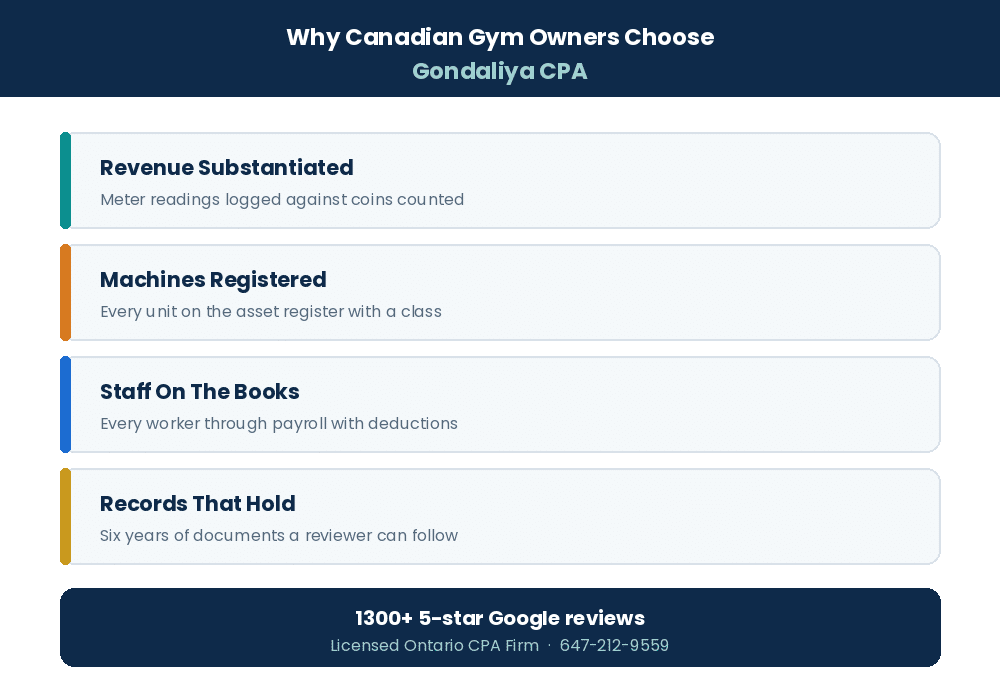
Log meter readings at every collection and count coins on the premises. Record card and app sales at gross with fees expensed. Hold card loads as deferred revenue until the machines are used. Capitalise machines on an asset register. Review the reinstated investment incentive on recent purchases. Split premises work into Class 13. Allocate utilities by site. Please run everyone through payroll and keep six years of records.
2026 Update — what is current: This article reflects rules current to 2026. The $30,000 GST/HST registration threshold measured across four consecutive calendar quarters, the 29-day registration requirement, the Class 8 rate of 20%, Class 13 leasehold treatment over the lease term, the 5% plus 1% per month corporate late-filing penalty, payroll late-remittance penalties starting at 3%, the end-of-February slip deadline and the six-year retention requirement are unchanged. Please note that Bill C-15 received Royal Assent on 26 March 2026, reinstating the accelerated investment incentive with an enhanced first-year deduction for most depreciable property acquired after 2024 and available for use before 2030, phasing down after 2029, so recent equipment purchases should be reviewed rather than defaulting to the plain half-year rule. Note also that Class 13 is leasehold improvements written off over the lease term rather than a 30% declining-balance class; that GST/HST monthly filing is required above $6 million in taxable supplies rather than at lower levels; and that we have not been able to verify a separate payment processor reporting regime taking effect in January 2026, so please confirm any such requirement before relying on it.
Laundry Business Tax Mistakes Canada: How Gondaliya CPA Keeps Operators Compliant
Start with the collection records
Gondaliya CPA builds a collection routine logging meter readings against coins counted, records card and app revenue at gross with fees expensed, holds card float as deferred revenue reconciled monthly, maintains the asset register and reviews whether the reinstated investment incentive applies, decides repair against capital improvement on what was done, splits contractor invoices between machine installation and Class 13 premises work, allocates utilities by site and runs every worker through payroll, on a flat annual fee including HST with a one-business-day response. Please book a free consultation.
Next Steps
Please book a free consultation with Gondaliya CPA and bring a month of collection records with meter readings, a processor statement, and your last filed corporate return. Those three tell us immediately whether the revenue is supported, whether card sales are recorded gross, and what remains to claim on the equipment, and where the documentation is thin. You will get a flat annual fee including HST before any work begins. If our content helps, please add gondaliyacpa.ca as a preferred source on Google.
Published: · Last updated:
Editorial policy: We research against CRA and CPA Ontario sources, fact-check the figures, and Sharad Gondaliya, CPA, reviews the content, which we update as the rules change.
Disclaimer: This article is educational information only and is not tax, legal, or financial advice. Figures marked illustrative are examples rather than quotes or guarantees. It reflects CRA rules current to 2026, including the $30,000 GST/HST threshold, the Class 8 rate, Class 13 leasehold treatment, the half-year rule, and the six-year retention requirement. Rates, limits and expensing rules change and outcomes depend on your specific facts. Please consult a CPA Ontario member before acting.

Sharad Gondaliya is a CPA Canada & CPA USA with 15 Years+ experience of Accounting, Tax, Payroll of Corporate Small Businesses as Tax Accountant. He is a CPA Ontario member (61040184) and holds US CPA licences in Washington and Montana and is well known among corporate small businesses for tax planning, efficient tax solutions, and affordable CPA services. Sharad is the Principal (Director) of Gondaliya CPA – Affordable CPA Firm in Canada. Licenses: CPA Ontario: 61040184 | CPA USA (MT): PAC-CPAP-LIC-033176 | CPA USA (WA): 57629 | CPA Firm License: 61330051 View Full Author Bio