



How Driving Schools in Canada Can Reduce Taxes and Improve Cash Flow With Strategic Tax Planning
Driving School Tax Strategies and Corporate Tax Planning in Canada with Gondaliya CPA Experts
Effective driving school tax strategies and corporate tax planning in Canada are essential for minimizing tax liabilities and maximizing deductions. Gondaliya CPA serves as a trusted driving school tax accountant, providing specialized advice on tax credits, expenses, and regulatory requirements for driving school businesses.
Most operators assume their lessons carry HST like any other service. Some do and some do not, and the answer changes whether you can recover the tax on a fleet of cars. That question sits at the front of driving school accounting and tax planning because everything else is built on top of it.
Quick Summary
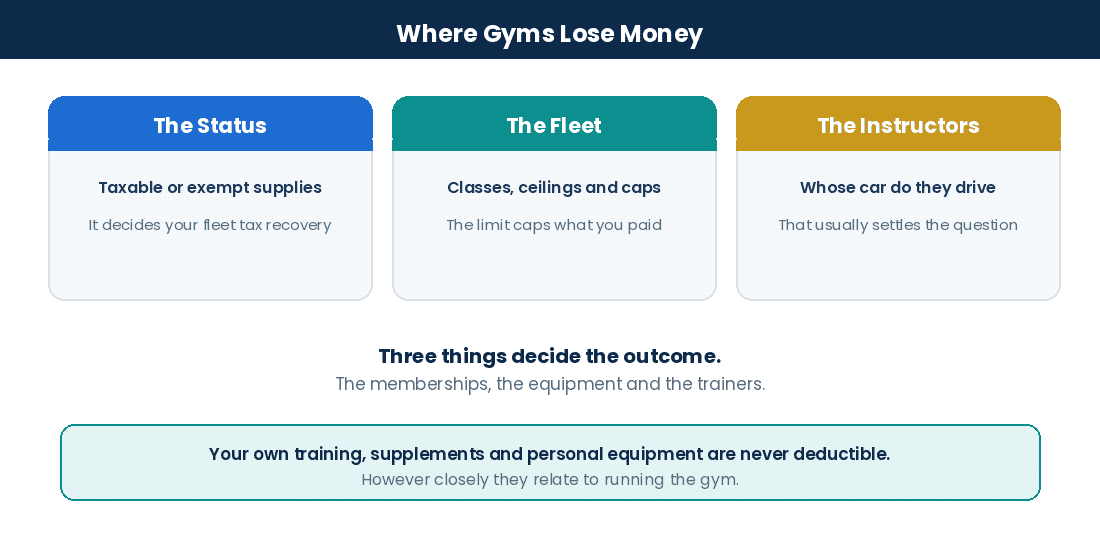
Driving schools are vehicle-heavy service businesses with seasonal income and a workforce that is often misclassified. Four things decide the outcome: your GST/HST status, how the vehicles are owned and classified, whether instructors are employees or contractors, and when prepaid lesson income is recognised.
Reading time: 49 minutes.
Table of Contents
- What Actually Decides the Tax Bill
- GST/HST: Taxable or Exempt
- Vehicles, Classes and Ceilings
- Instructors and Classification
- Prepaid Lessons and Seasonality
- Structure, Compliance and Working With Us
- Frequently Asked Questions
- Key Planning Points
- Driving School Models We Serve
- Professional Guidance and Quick Reference
The Numbers That Matter
This article covers Canada, with Ontario and Toronto context, and reflects rules current to 2026. It applies to incorporated driving schools, single-instructor operators, multi-vehicle schools and commercial driver training providers. Figures marked illustrative are examples, not quotes, and any masked engagement notes end with “Figures changed for privacy.” This is educational information only and not tax or legal advice. Driving school licensing, instructor certification and curriculum approval are provincial matters, handled in Ontario by the Ministry of Transportation, and sit outside accounting scope.
What Actually Decides the Tax Bill
What Actually Decides the Tax Bill
The Basics
Driving school advice usually starts with deductions. For this sector that is the wrong end. Four decisions matter more, and one of them is structural.
The Four That Move the Number
- Your GST/HST status: Whether the instruction you supply is taxable or exempt. This determines whether you charge tax and, more importantly, whether you can recover the tax on your vehicles
- Vehicle ownership and class: How cars are held, which class they fall into, and whether the prescribed cost ceiling applies
- Instructor classification: Employees or contractors, and whether an incorporated instructor is caught by the personal services business rules
- Revenue timing: When prepaid lesson packages become income, and how that interacts with a seasonal year
Deductions matter, but a school that gets the first point wrong is losing the tax on every vehicle it buys, which dwarfs anything a fuel log recovers.
Why Vehicles Dominate
A driving school is a fleet business that happens to sell instruction. The cars are the largest asset, the largest recurring cost and the source of the most complicated tax treatment on the file.
Purchase price, capital cost allowance ceilings, lease caps, fuel, insurance, dual controls, personal use benefits and disposal recapture all attach to the same vehicles, and each has its own rule.
Deductions Still Count
The ordinary business costs apply: fuel, maintenance, commercial insurance, classroom rent, booking software, advertising, instructor training and professional development.
Meals with staff or clients are 50% deductible where there is a genuine business purpose. The higher simplified figure some operators quote applies to long-haul transport employees and not to a driving school lunch.
Schools ask which expenses they are missing. The answer is usually none of consequence, and the money sits in the GST/HST position and the vehicle classes. Figures changed for privacy.
Risk Warning: If your instruction is exempt, you cannot recover the tax on your vehicles. Please settle that status before buying a fleet.
GST/HST: Taxable or Exempt
GST/HST: Taxable or Exempt
The Big One
This is the question that decides more money than anything else in this article, and it is the one most driving schools have never properly asked.
Why It Matters So Much
A taxable supply means you charge HST and recover the tax you pay on vehicles, fuel, insurance and everything else through input tax credits. An exempt supply means you charge nothing and recover nothing.
For a service business with low input costs, exemption is often welcome. For a fleet business buying cars, it is expensive. The tax on a single vehicle purchase can exceed a year of fuel credits.
The Rules That Apply
Part III of Schedule V to the Excise Tax Act exempts certain educational services. Two provisions come up for driving schools.
Vocational courses. Section 8 exempts a supply, made by a government, school authority, vocational school, public college or university, of instructing individuals in courses leading to certificates, diplomas, licences or similar documents, or classes or ratings in respect of licences, that attest to the competence of individuals to practise or perform a trade or vocation.
That wording matters. A commercial licence attesting to competence to drive professionally sits much closer to that description than an ordinary passenger licence does. Training somebody to drive their own car to work is not usually training them for a trade or vocation.
Courses following a designated curriculum. Separate provisions exempt instruction in courses approved for credit by, or following a curriculum designated by, a school authority, generally at the elementary or secondary level.
| Type of Instruction | Usual Position |
|---|---|
| Ordinary passenger licence lessons | Generally taxable |
| Commercial driver training leading to a trade licence | May be exempt where the supplier qualifies |
| Defensive driving and refresher courses | Generally taxable |
| Retail sales of manuals and materials | Taxable |
| Vehicle rental for a road test | Taxable |
Whether a particular school is a vocational school within the meaning of the Act, and whether a specific course meets the wording, are fact-specific determinations. Please have your own courses reviewed rather than assuming either way, because getting it wrong in either direction is costly.
The Election Nobody Mentions
Where a supply would be exempt under the vocational course provision, the supplier may elect to have those supplies treated as taxable instead.
That election exists precisely for businesses in this position. A school making exempt supplies cannot recover tax on its fleet. Electing to be taxable means charging HST on lessons and recovering the tax on the cars, fuel, insurance and premises.
Whether that helps depends on your inputs and your customers. A school buying two vehicles a year and paying commercial rent may be considerably better off taxable. One with minimal inputs and price-sensitive students may not.
A commercial driver training school buys three vehicles in a year. If its instruction is exempt, the HST on those purchases is a cost with no recovery. If the supplies are taxable, whether by nature or by election, that tax is recoverable through input tax credits, though HST must then be charged on the training. The comparison turns on the size of the input tax relative to the price sensitivity of the students. Figures changed for privacy.
Registration and Mixed Supplies
Where your supplies are taxable, you must register for GST/HST once taxable revenue exceeds $30,000 across four consecutive calendar quarters. Exempt supplies do not count toward that threshold.
Many schools make both kinds. Where you do, input tax credits must be apportioned between taxable and exempt activity on a reasonable basis, documented.
A school claiming full credits while making substantial exempt supplies is overclaiming, and it is a straightforward adjustment on review.
The GST/HST status is the first thing we test on a driving school file and the last thing most operators have looked at. It decides whether a fleet purchase costs thirteen percent more. Figures changed for privacy.
Key Stat: Where instruction is exempt, an election may be available to treat it as taxable and recover the tax on your vehicles. Please have the comparison modelled.
Vehicles, Classes and Ceilings
Vehicles, Classes and Ceilings
The Fleet
The 2026 Figures
| Limit | 2026 Amount | Notes |
|---|---|---|
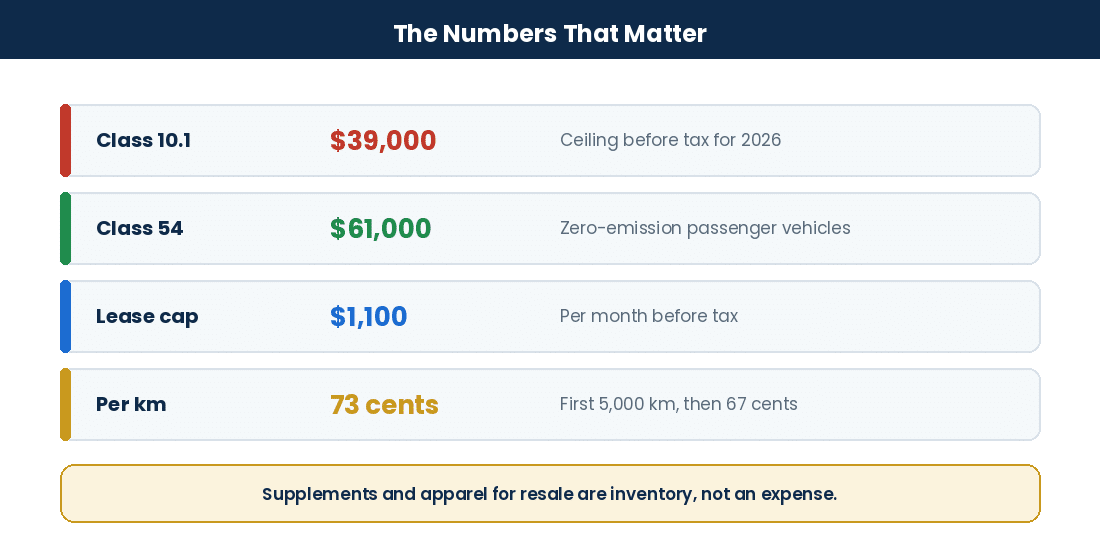
| Class 10.1 capital cost ceiling | $39,000 before tax | Up from $38,000 in 2025 |
| Class 54 zero-emission ceiling | $61,000 before tax | Unchanged |
| Deductible lease cost | $1,100 per month before tax | New leases from 1 January 2026 |
| Deductible loan interest | $350 per month | On a passenger vehicle loan |
| Per-kilometre allowance | 73¢ first 5,000 km, 67¢ after | Provinces; higher in the territories |
Class 10 or Class 10.1
A passenger vehicle costing $39,000 or less before tax goes into Class 10 at 30%, pooled with your other Class 10 vehicles. Above that figure it goes into its own separate Class 10.1, still at 30%, but with the depreciable cost capped at the ceiling regardless of what you paid.
Class 10.1 behaves differently on disposal. There is no recapture and no terminal loss, which simplifies matters but removes any extra deduction if the car loses value faster than the schedule.
Please note that dual controls do not remove a training car from the passenger vehicle definition. Schools sometimes assume a dual-control car is commercial equipment outside the ceiling. The exclusions from that definition are specific and a driving school car is not obviously among them, so please have your own vehicles confirmed rather than assuming the cap does not apply.
Zero-Emission Vehicles
Electric and qualifying plug-in hybrid vehicles fall into Class 54 with a higher ceiling of $61,000 and an enhanced first-year deduction. For a school running high mileage on predictable urban routes, the combination of a larger capital allowance and lower fuel cost is worth modelling properly rather than dismissing on sticker price.
The 2026 Capital Cost Allowance Change
Bill C-15 received Royal Assent on 26 March 2026, reinstating the accelerated investment incentive. For most depreciable property acquired after 2024 and available for use before 2030, the half-year rule is effectively suspended and an enhanced first-year deduction applies, phasing down after 2029.
Vehicles in Class 10, 10.1 and 54 are within the general property covered. If you bought cars in the last two years and the return applied the plain half-year rule, the first-year claim may have been understated and is worth reviewing.
Buy, Lease or Finance
| Factor | Buying | Leasing |
|---|---|---|
| Deduction | Capital cost allowance, subject to the ceiling | Lease payments, capped at $1,100 per month |
| Cash outlay | Large upfront or financed | Spread evenly |
| Interest | Deductible, capped at $350 per month | Built into the payment |
| On disposal | Recapture possible, except Class 10.1 | Return the vehicle, nothing to model |
| Suits | Schools keeping cars for years | Schools replacing on a short cycle |
Note that both caps bite on more expensive vehicles. A lease above $1,100 a month is only deductible to the cap, and the excess is simply not claimable.
Personal Use and Standby Charges
Where a school vehicle is available to an owner or instructor for personal use, a taxable benefit arises: a standby charge based on availability, plus an operating expense benefit for costs the business paid.
The standby charge turns on availability rather than distance driven, which catches people out. A car sitting at an instructor’s home overnight is available.
A logbook recording business and personal kilometres is what supports a reduced charge where business use is high. Without one, the full charge applies and the deduction side looks weak too.
Instructors taking training cars home is normal and almost never reported as a benefit. It is the adjustment we most often have to make on a driving school payroll review. Figures changed for privacy.
Key Stat: The Class 10.1 ceiling for 2026 is $39,000 before tax. Please check the figure for the year of acquisition rather than the current one.
Instructors and Classification
Instructors and Classification
The People
Employee or Contractor
Driving schools engage instructors every way imaginable, and the classification decides your payroll obligations regardless of what the agreement says.
- Control: Who sets the schedule, the lesson structure and the pricing
- Tools: Who supplies the vehicle, which in this sector is decisive
- Chance of profit and risk of loss: Whether the instructor can profit from efficiency or carries a real cost
- Integration: How embedded they are in the school
The vehicle is the point that distinguishes this sector. An instructor teaching in your car, on your schedule, with students you booked, at prices you set, is difficult to characterise as anything but an employee. An instructor supplying their own dual-control vehicle, setting their own hours and carrying their own insurance looks genuinely independent.
Misclassification means the CRA can assess the source deductions that should have been withheld, plus penalties and interest, and directors carry personal exposure on unremitted amounts.
Incorporated Instructors and Personal Services Business Risk
Some instructors incorporate and invoice the school. That arrangement carries a specific risk for the instructor rather than for you.
Where an incorporated individual would reasonably be regarded as an employee of the payer but for the corporation, the personal services business rules apply. The corporation loses the small business deduction and most expense deductions, leaving a punitive rate.
Protection comes from working for several schools, controlling the work, supplying the vehicle and carrying real risk. A single-school arrangement with the school’s car is exposed.
This matters to you as well, because an instructor who discovers the problem after the fact will look for someone to blame.
How Instructors Are Paid
| Structure | What to Watch |
|---|---|
| Hourly wage | Straightforward payroll, predictable cost |
| Per lesson | Matches cost to revenue, more record keeping |
| Base plus bonus on pass rates | Bonus is employment income, timing matters |
| Vehicle allowance on top of pay | Taxable unless it is a reasonable per-kilometre allowance |
| Instructor uses own vehicle | Reasonable per-kilometre allowance, supported by a log |
Where an instructor uses their own car, a per-kilometre allowance within the prescribed rates is generally not taxable to them and deductible to you. For 2026 the rates are 73 cents for the first 5,000 kilometres and 67 cents thereafter, higher in the territories. An allowance above those rates, or a flat monthly amount not based on distance, is generally taxable in full.
Family Members
Paying a spouse or family member for scheduling, bookkeeping or administration is legitimate where they genuinely do the work and the rate matches what you would pay anyone else.
Support it with a timesheet and a job description rather than just a payroll entry. Amounts paid without corresponding work are denied, and dividends to family members who do not meaningfully contribute can be caught by the tax on split income at the top marginal rate.
The car settles the classification argument in this sector. An instructor driving your dual-control vehicle on your bookings is an employee whatever the invoice says. Figures changed for privacy.
Risk Warning: An instructor teaching in your vehicle on your schedule is almost certainly an employee. Please test the arrangement before the next pay run.
Prepaid Lessons and Seasonality
Prepaid Lessons and Seasonality
The Timing
Packages Sold Before Lessons Are Delivered
Driving schools sell packages: ten hours, a full beginner course, a road test package. The money arrives at the start and the service is delivered over weeks or months.
That money is deferred revenue. It becomes income as the lessons are actually taught, not when the package is sold.
A school sells $10,000 of ten-hour packages before its December year end and has delivered six hours against them. Revenue for the year is $6,000, and the remaining $4,000 sits as a liability until those lessons are taught. Recognising the full $10,000 reports income for four hours of teaching not yet done. Figures changed for privacy.
The consequence is not theoretical. It inflates taxable income, raises your instalment base for the following year, and pays tax early on money you have not yet earned.
Tracking Unused Hours
The deferred revenue balance needs to break down by student. Your booking system should report unused hours outstanding, and that report is the schedule behind the liability.
- Record package sales to a liability account, not to revenue
- Release to revenue as lessons are delivered
- Reconcile the booking system’s unused hours to the liability monthly
- Handle refunds against the liability rather than as a revenue reversal
- Settle the treatment of packages that lapse rather than leaving them to accumulate
Refunds are the practical reason this matters beyond tax. A school that cannot say what it owes in undelivered lessons does not know its real obligations.
Choosing a Year End
Driving school income is seasonal, concentrated around school breaks, warmer months and exam periods. That gives you a genuine planning choice most businesses do not have.
A year end falling after your peak means you close with lessons delivered and cash collected, which gives a cleaner picture and a more representative instalment base. A year end mid-season means closing with a large deferred revenue balance and work in progress.
The choice is made at incorporation and changing it later requires approval, so it is worth thinking about at the start.
Instalments and Cash Flow
Corporate instalments are generally required where net tax payable exceeds $3,000, paid monthly or quarterly for eligible CCPCs against your fiscal year rather than on fixed calendar dates.
The trap in a seasonal business is basing instalments on last year without adjusting for what this year is doing. Where the current year is weaker, paying on the prior-year basis ties up cash you need in the quiet months.
- Take deposits on packages so the cash arrives before the cost
- Time vehicle purchases for after the peak, when financing is easier to service
- Set aside from strong months rather than borrowing through the quiet ones
- Review the instalment basis against actual performance rather than defaulting
Package revenue recognised on sale makes the busy year look better than it was and the following one look like a decline. Nothing about the school changed. Figures changed for privacy.
Pro Tip: Please reconcile unused lesson hours to the deferred revenue balance monthly. It is also the only reliable view of what you owe in undelivered service.
Structure, Compliance and Working With Gondaliya CPA
Structure, Compliance and Working With Us
The Structure
Incorporation and the Small Business Deduction
An incorporated driving school that is a Canadian-controlled private corporation pays a reduced federal rate of 9% on active business income up to the federal business limit of $500,000, shared across associated corporations.
That figure is $500,000 federally, not $600,000. Saskatchewan and Prince Edward Island use $600,000 provincially and Nova Scotia $700,000, which is where the higher number circulating in the sector comes from. Ontario’s limit remains $500,000.
The advantage is deferral on profit left in the company. A school drawing everything out to live on gains little from incorporating; one retaining profit to buy vehicles gains real value.
Salary and Dividends
| Method | Deductible to Company | Creates RRSP Room | CPP Required | Slip |
|---|---|---|---|---|
| Salary | Yes | Yes | Yes, both shares | T4 |
| Dividends | No | No | No | T5 |
A blend usually works best, and the right mix changes annually with your income and RRSP position. Setting it once and never revisiting it is the common error.
Bonuses accrued at year end must be paid within the period the Act allows for the company to keep the deduction. Declaring a bonus and never paying it produces a denied deduction.
Shareholder Loans
Money taken from the company that is not salary or dividends builds a shareholder loan balance. If it is not repaid within the period the Act allows, generally by the end of the following taxation year, the amount can be included in your personal income.
Track it quarterly. A balance discovered at year end is a balance you have limited time to deal with.
Deadlines
| Obligation | Deadline | If Missed |
|---|---|---|
| T2 corporate return | Six months after fiscal year-end | 5% plus 1% per complete month, to twelve |
| Balance owing | Two or three months after year-end | Interest from the due date |
| GST/HST return | Per your assigned reporting period | Penalty plus interest |
| Payroll remittances | Per your remitter type | Penalty and director liability |
| T4 and T4A slips | Last day of February | Penalty by slip count |
What Draws a Review
- Full input tax credits claimed while making substantial exempt supplies
- Vehicles claimed above the prescribed ceiling
- Instructors on T4A slips who look like employees
- No standby charge reported where vehicles clearly go home with staff
- Package revenue recognised on sale with no deferred balance
- Family wages with no timesheets behind them
Our CRA audit guide sets out what a review involves. Where past filings were wrong, the Voluntary Disclosures Program may reduce penalties, provided you come forward before the CRA raises the issue.
How We Work With Driving Schools
We support incorporated driving schools on a flat annual fee covering GST/HST status review including the election where relevant, bookkeeping with deferred revenue on packages, the vehicle register with class assignment and ceiling application, standby charge and operating benefit calculations, instructor classification review, payroll and slips, seasonal instalment planning, salary and dividend structuring, financial statements and the corporate return.
Pricing is quoted before any work begins, including HST, with a one-business-day response.
Getting Started
Bring three things: a list of your vehicles with purchase dates and prices, a sample of the courses you offer with what students pay, and your last filed corporate return. Those show us your GST/HST position, whether the vehicles are classified correctly, and what needs fixing.
Contact Gondaliya CPA at info@gondaliyacpa.ca, call 647-212-9559, or send us a message.
The most valuable hour on a driving school file is spent on the course list and the vehicle invoices. Those two documents settle the GST/HST position and the fleet classes together. Figures changed for privacy.
Pro Tip: Please settle the GST/HST status before the next vehicle purchase. The recovery on one car can exceed a year of other planning.
FAQs on Driving School Tax Planning
Frequently Asked Questions
FAQ
Are driving lessons subject to GST/HST?+
It depends on the course and the supplier. Ordinary passenger licence lessons are generally taxable. Commercial driver training leading to a licence attesting to competence in a trade or vocation may be exempt where the supplier qualifies.
Why does exempt status cost a driving school money?+
Exempt supplies mean no input tax credits, so the tax paid on vehicles, fuel, insurance and premises becomes an unrecoverable cost. For a fleet business that is substantial.
Can I choose to be taxable if my supplies are exempt?+
Where supplies are exempt under the vocational course provision, an election may be available to treat them as taxable. That restores input tax credit recovery but means charging tax on lessons.
What is the Class 10.1 ceiling for 2026?+
$39,000 before tax, up from $38,000 in 2025. A passenger vehicle costing more than that goes into its own separate Class 10.1 capped at the ceiling.
What is the ceiling for an electric training vehicle?+
$61,000 before tax under Class 54, with an enhanced first-year deduction. That is materially higher than the conventional passenger vehicle ceiling.
How much of a lease payment is deductible?+
Up to $1,100 per month before tax for new leases entered into from 1 January 2026. Amounts above the cap are not deductible.
Does a dual-control car escape the passenger vehicle cost limit?+
Do not assume so. The exclusions from the passenger vehicle definition are specific and a training car is not obviously among them, so please have your vehicles confirmed.
Did the capital cost allowance rules change in 2026?+
Yes. Bill C-15 received Royal Assent on 26 March 2026, reinstating the accelerated investment incentive with an enhanced first-year deduction for most property acquired after 2024.
What per-kilometre rate can I pay an instructor using their own car?+
For 2026, 73 cents for the first 5,000 kilometres and 67 cents thereafter in the provinces, with higher rates in the territories. Above those, the allowance is generally taxable.
When does an instructor taking a car home create a benefit?+
When the vehicle is available for personal use. The standby charge turns on availability rather than distance driven, plus an operating expense benefit for costs you paid.
Are my instructors employees or contractors?+
It depends on control, tools, chance of profit and integration. Whose vehicle is used is usually decisive in this sector.
What is the personal services business risk for an incorporated instructor?+
Where the individual would be regarded as an employee of the school but for the corporation, the corporation loses the small business deduction and most expense claims.
When does prepaid package income become revenue?+
As the lessons are delivered, not when the package is sold. The undelivered portion sits as a liability at period end.
What is the small business deduction limit?+
$500,000 of active business income federally, shared across associated corporations. The $600,000 figure sometimes quoted belongs to Saskatchewan and Prince Edward Island provincially.
When are corporate instalments due?+
Generally where net tax payable exceeds $3,000, paid monthly or quarterly for eligible CCPCs against your fiscal year rather than fixed calendar dates.
How long must a driving school keep records?+
Six years from the end of the tax year they relate to, including vehicle documents, logbooks, lesson records, payroll records and package schedules.
Sixteen questions and one underneath most of them: are your supplies taxable. That single answer decides the fleet economics of the whole business. Figures changed for privacy.
Key Planning Points for Driving Schools
Key Planning Points
Quick Reference
The 2026 Numbers
- Class 10.1 ceiling: $39,000 before tax, up from $38,000.
- Class 54 zero-emission ceiling: $61,000 before tax.
- Lease deduction cap: $1,100 per month before tax.
- Loan interest cap: $350 per month on a passenger vehicle.
- Per-kilometre rates: 73 cents to 5,000 km, then 67 cents.
- Small business limit: $500,000 federally, shared if associated.
- GST/HST threshold: $30,000 of taxable supplies over four quarters.
- Instalments: Generally where net tax payable exceeds $3,000.
- Corporate return: Six months after fiscal year end.
- Records: Six years from the end of the tax year.
Status and Vehicles
- Settle whether your courses are taxable or exempt before buying vehicles.
- Model the election where supplies would otherwise be exempt.
- Apportion input tax credits where you make both taxable and exempt supplies.
- Confirm whether the passenger vehicle ceiling applies to your training cars.
- Keep a vehicle register with purchase date, cost, class and claims to date.
- Review whether the reinstated investment incentive applies to recent purchases.
- Compare buying against leasing with both caps applied.
- Model recapture before disposing of vehicles, noting Class 10.1 differs.
- Consider zero-emission vehicles against the higher ceiling and running costs.
People, Revenue and Records
- Test each instructor against the CRA control, tools and risk factors.
- Treat whose vehicle is used as the decisive factor in this sector.
- Warn incorporated instructors about personal services business exposure.
- Keep a logbook wherever a school vehicle is available personally.
- Report standby charges and operating benefits on the T4.
- Pay per-kilometre allowances within the prescribed rates.
- Hold package sales as deferred revenue until lessons are delivered.
- Reconcile unused lesson hours to the liability monthly.
- Review the instalment basis against actual performance in a seasonal year.
- Support family wages with timesheets and a job description.
For advice on your driving school’s structure and taxes, contact Gondaliya CPA at info@gondaliyacpa.ca, call 647-212-9559, or book a free consultation.
Twenty-nine points and one underneath them: know your GST/HST status and know what each car cost. The rest of driving school planning sits on those two answers. Figures changed for privacy.
Driving School Models We Serve
Industry Expertise
Which issue dominates differs by the school. Here are ten and the usual focus.
| Driving School Model | Where the Planning Concentrates |
|---|---|
| Single instructor, one car | Whether incorporation earns its cost |
| Multi-vehicle school | Fleet classes and the cost ceiling |
| Commercial driver training | Whether supplies are exempt or taxable |
| School using incorporated instructors | Personal services business exposure |
| Instructors using their own cars | Per-kilometre allowances within the rates |
| Vehicles going home overnight | Standby charges and operating benefits |
| Selling lesson packages | Deferred revenue until lessons are taught |
| Strongly seasonal school | Year end choice and instalment basis |
| School moving to electric vehicles | Class 54 ceiling and enhanced deduction |
| Behind on filings | GST/HST status settled before returns |
- Single instructor, one car: What you retain decides it, not what you bill.
- Multi-vehicle school: The ceiling caps the claim whatever you paid.
- Commercial driver training: The status decides the fleet economics entirely.
- School using incorporated instructors: The risk sits with them and rebounds on you.
- Instructors using their own cars: Within the rates it is not taxable; above, it is.
- Vehicles going home overnight: Availability triggers the benefit, not mileage.
- Selling lesson packages: Money collected is not money earned.
- Strongly seasonal school: A year end after the peak reads more honestly.
- School moving to electric vehicles: A higher ceiling and a larger first-year claim.
- Behind on filings: Fix the status first or the returns get done twice.
The school changes where the planning concentrates. It does not change the method, which is settle the GST/HST status, classify the fleet correctly, then sort out the instructors. Figures changed for privacy.
Professional Guidance and Quick Reference
Guidance
Professional Guidance for Operators: How Gondaliya CPA Handles Your File
Driving schools lose money in a predictable set of ways: never settling whether their instruction is taxable or exempt, so the tax on every vehicle is either overclaimed or quietly forfeited, claiming capital cost allowance above the prescribed ceiling on cars that exceed it, assuming a dual-control car sits outside the passenger vehicle definition, instructors teaching in school vehicles on school bookings paid as contractors, vehicles going home overnight with no standby charge reported, and lesson packages taken into income on sale rather than as the lessons are taught. Gondaliya CPA handles driving school tax planning on a fixed annual fee.
We handle what decides the outcome: reviewing whether your courses fall within the educational exemptions and whether the election to be taxable is worth making, apportioning input tax credits where supplies are mixed, maintaining the vehicle register with the right class and the correct year’s ceiling, checking whether the reinstated investment incentive applies to recent purchases, calculating standby charges and operating benefits, testing instructor classification against the CRA factors, holding package sales as deferred revenue, and setting the instalment basis against a seasonal year.
Our team starts with the course list and the vehicle invoices, because those two documents settle the GST/HST position and the fleet classification together. Single instructor, multi-vehicle school or commercial training provider, you get clear advice and a fixed price before we start.
Quick Answers
- GST/HST status: Decides fleet tax recovery
- Class 10.1 ceiling: $39,000 before tax for 2026
- Class 54 ceiling: $61,000 for zero-emission
- Lease cap: $1,100 per month before tax
- Per-kilometre: 73 cents, then 67 cents
- Standby charge: Triggered by availability
- Packages: Deferred until lessons are taught
- Small business limit: $500,000 federally
- Corporate return: Six months after year end
- Records: Six years retention
Who This Is For
- For: Incorporated driving schools, single-instructor operators, multi-vehicle schools and commercial driver training providers across Canada.
- Not For: Driving school licensing, instructor certification and curriculum approval, which are provincial matters handled by the Ministry of Transportation in Ontario.
People Also Ask
Should I choose a year end after my busy season?+
It generally gives a cleaner picture, since you close with lessons delivered rather than a large undelivered balance. Changing it later requires approval, so decide early.
Can I claim the full HST on a car if I make some exempt supplies?+
No. Credits must be apportioned between taxable and exempt activity on a reasonable, documented basis. Claiming in full is a straightforward adjustment.
Is a flat monthly car allowance to an instructor taxable?+
Generally yes. An allowance not based on distance driven is usually taxable in full, unlike a reasonable per-kilometre allowance within the prescribed rates.
Glossary of Key Terms
- T2: The corporation income tax return.
- Exempt supply: A supply carrying no tax and no input tax credit recovery.
- Taxable supply: A supply carrying tax with credits available on inputs.
- Vocational course exemption: The Schedule V provision covering trade and vocation licences.
- Section 8 election: The choice to treat otherwise exempt educational supplies as taxable.
- Input tax credit: GST/HST recoverable on business purchases.
- Passenger vehicle: A defined class of vehicle subject to the cost ceiling.
- Class 10: Vehicles at or below the ceiling, pooled at 30 percent.
- Class 10.1: A separate class for each vehicle above the ceiling.
- Class 54: Zero-emission passenger vehicles with a higher ceiling.
- Accelerated investment incentive: The enhanced first-year deduction reinstated in 2026.
- Standby charge: The taxable benefit from a vehicle being available.
- Operating benefit: The taxable benefit from running costs paid by the employer.
- Deferred revenue: Package income held as a liability until lessons are taught.
- Personal services business: An incorporated employee arrangement taxed punitively.
- Recapture: Income arising where proceeds exceed the class balance.
Driving School Readiness Check
This quick self-check indicates where your operation most likely has room. Please answer the six questions below.
Driving School Readiness Check
Six quick questions on your school. No fee shown.
Points to raise with us:
This is a general prompt, not tax or legal advice or a quote. Your position depends on your full facts. For a real review, please book a free consultation.
Want a checklist to work from? You can download our free driving school tax planning checklist before your consultation.
Settle whether your courses are taxable or exempt before buying vehicles. Model the election where supplies would otherwise be exempt. Apportion credits where supplies are mixed. Keep a vehicle register with the right class and the correct year ceiling. Review the reinstated investment incentive on recent purchases. Report standby charges where cars go home. Hold packages as deferred revenue. Please keep six years of records.
2026 Update — what is current: This article reflects rules current to 2026. The Class 10.1 capital cost ceiling rose to $39,000 before tax for vehicles acquired on or after 1 January 2026, up from $38,000 in 2025. The Class 54 zero-emission ceiling remains $61,000, the deductible lease cost remains $1,100 per month before tax for new leases from 1 January 2026, deductible loan interest remains $350 per month, and the per-kilometre allowance rates rose to 73 cents for the first 5,000 kilometres and 67 cents thereafter in the provinces, with 77 cents and 71 cents in the territories. Bill C-15 received Royal Assent on 26 March 2026, reinstating the accelerated investment incentive with an enhanced first-year deduction for most depreciable property acquired after 2024 and available for use before 2030. Please note that the federal small business limit is $500,000 and not $600,000, the higher figure belonging to Saskatchewan and Prince Edward Island provincially; that a driving school car is not obviously excluded from the passenger vehicle definition, so the cost ceiling should be assumed to apply until confirmed otherwise; that corporate instalments run against your fiscal year rather than fixed calendar dates; and that meals are limited to 50% rather than a fixed dollar amount per person.
Driving School Tax Strategies Canada: How Gondaliya CPA Supports Schools
Start with the course list
Gondaliya CPA reviews whether your courses fall within the educational exemptions and whether the election to be taxable is worth making, apportions input tax credits where supplies are mixed, maintains the vehicle register with the right class and the correct year ceiling, checks whether the reinstated investment incentive applies to recent purchases, calculates standby charges and operating benefits, tests instructor classification against the CRA factors, holds package sales as deferred revenue and sets the instalment basis against a seasonal year, on a flat annual fee including HST with a one-business-day response. Please book a free consultation.
Next Steps
Please book a free consultation with Gondaliya CPA and bring a list of your vehicles with purchase dates and prices, a sample of the courses you offer with what students pay, and your last filed corporate return. Those three tell us immediately what your GST/HST position is, whether the vehicles are classified correctly, and what remains to claim on the equipment, and where the documentation is thin. You will get a flat annual fee including HST before any work begins. If our content helps, please add gondaliyacpa.ca as a preferred source on Google.
Published: · Last updated:
Editorial policy: We research against CRA and CPA Ontario sources, fact-check the figures, and Sharad Gondaliya, CPA, reviews the content, which we update as the rules change.
Disclaimer: This article is educational information only and is not tax, legal, or financial advice. Figures marked illustrative are examples rather than quotes or guarantees. It reflects CRA rules current to 2026, including the $30,000 GST/HST threshold, the Class 8 rate, Class 13 leasehold treatment, the half-year rule, and the six-year retention requirement. Rates, limits and expensing rules change and outcomes depend on your specific facts. Please consult a CPA Ontario member before acting.

Sharad Gondaliya is a CPA Canada & CPA USA with 15 Years+ experience of Accounting, Tax, Payroll of Corporate Small Businesses as Tax Accountant. He is a CPA Ontario member (61040184) and holds US CPA licences in Washington and Montana and is well known among corporate small businesses for tax planning, efficient tax solutions, and affordable CPA services. Sharad is the Principal (Director) of Gondaliya CPA – Affordable CPA Firm in Canada. Licenses: CPA Ontario: 61040184 | CPA USA (MT): PAC-CPAP-LIC-033176 | CPA USA (WA): 57629 | CPA Firm License: 61330051 View Full Author Bio