



Dance School Year-End Accounting Checklist: How to Prepare Your Studio for Corporate Tax Filing in Canada
Dance School Year End Accounting and Corporate Tax Filing Services by Gondaliya CPA in Canada
Gondaliya CPA specializes in dance school year end accounting and corporate tax filing, providing accurate T2 filing services tailored for dance schools across Canada. Their expert team ensures compliance with Canadian tax laws while handling financial statements and tax returns efficiently.
A studio takes registration money in August for classes it will teach until June, sells costumes it has not yet received, collects recital ticket revenue on behalf of nobody in particular, and pays instructors four different ways. Closing that year properly is what dance school year end accounting is really about, and most of the work is timing.
Quick Summary
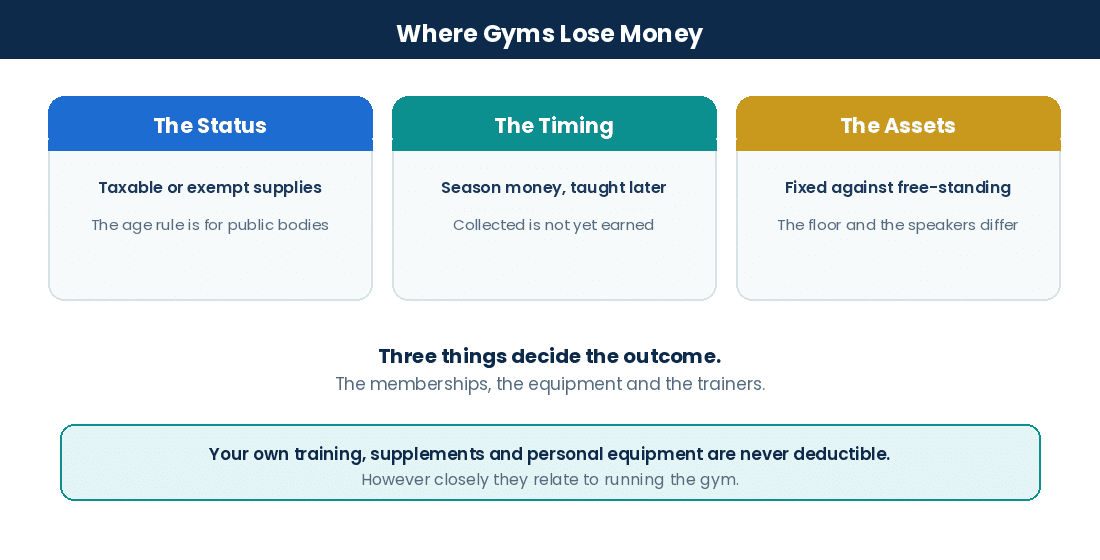
Dance studios collect money long before they deliver the service, which makes revenue timing the central problem at year end. Alongside that sit a widely misunderstood GST/HST position, instructor classification, and capital assets that get filed in the wrong classes.
Reading time: 49 minutes.
Table of Contents
- The GST/HST Question Studios Get Wrong
- Revenue Timing and Deferred Income
- Reconciling Payments and Inventory
- Instructors, Slips and Benefits
- Studio Assets and Capital Cost Allowance
- The Close, the T2 and Working With Us
- Frequently Asked Questions
- The Year-End Checklist
- Studio Models We Serve
- Professional Guidance and Quick Reference
The Numbers That Matter
This article covers Canada, with Ontario and Toronto context, and reflects rules current to 2026. It applies to incorporated private dance schools, performing arts studios and multi-location academies. Figures marked illustrative are examples, not quotes, and any masked engagement notes end with “Figures changed for privacy.” This is educational information only and not tax or legal advice. GST/HST status turns on specific facts about your courses and your organisation, so please have your own position confirmed rather than relying on general guidance.
The GST/HST Question Studios Get Wrong
The GST/HST Question Studios Get Wrong
Start Here
Almost every dance studio owner has been told that classes for children under fifteen are GST/HST exempt. For a private for-profit studio that is generally not correct, and it is the most expensive misunderstanding in this sector.
Where the Belief Comes From
Section 12 of Part VI of Schedule V to the Excise Tax Act does exempt instructional programs involving dance provided primarily to children fourteen and under. The provision is real and the age is real.
What gets dropped is the first condition. That exemption applies to supplies made by a public sector body, which means a charity, non-profit organisation, municipality or similar. A private incorporated studio operating for profit is not one.
The CRA has ruled directly on this, confirming that there is generally no provision exempting dance instruction supplied by a private for-profit dance school. A studio that stopped charging tax on children’s classes on the strength of the age rule has been under-collecting, and the assessment reaches back across open years.
What Can Actually Be Exempt
Two genuine routes exist for a private studio, and both are narrower than the age rule people rely on.
| Supply | Usual Position |
|---|---|
| Recreational children’s classes at a for-profit studio | Generally taxable |
| Adult and social dance classes | Taxable |
| Drop-in classes | Taxable |
| Graded vocational syllabus levels with examinations and certificates | May be exempt where the studio is a vocational school |
| Day camps where the primary purpose is care and supervision | May be exempt as a child care service |
| Costume and merchandise sales | Taxable |
| Recital ticket sales | Taxable, subject to the specific arrangement |
Vocational syllabus courses. Where a for-profit dance school qualifies as a vocational school and offers graded syllabus levels requiring examinations, with certificates awarded on passing that attest to ability to progress or pursue a career in dance, the instruction in those courses can be exempt. Recreational, drop-in and social classes at the same studio are not, even where a participation certificate is handed out.
Day camps. A for-profit studio running a dance day camp for children fourteen and under, where the primary purpose is care and supervision for periods normally under twenty-four hours, can be making an exempt supply of child care services. A weekly ballet class is not that; a full-day summer camp with supervision and lunch may be.
What Follows From Getting It Right
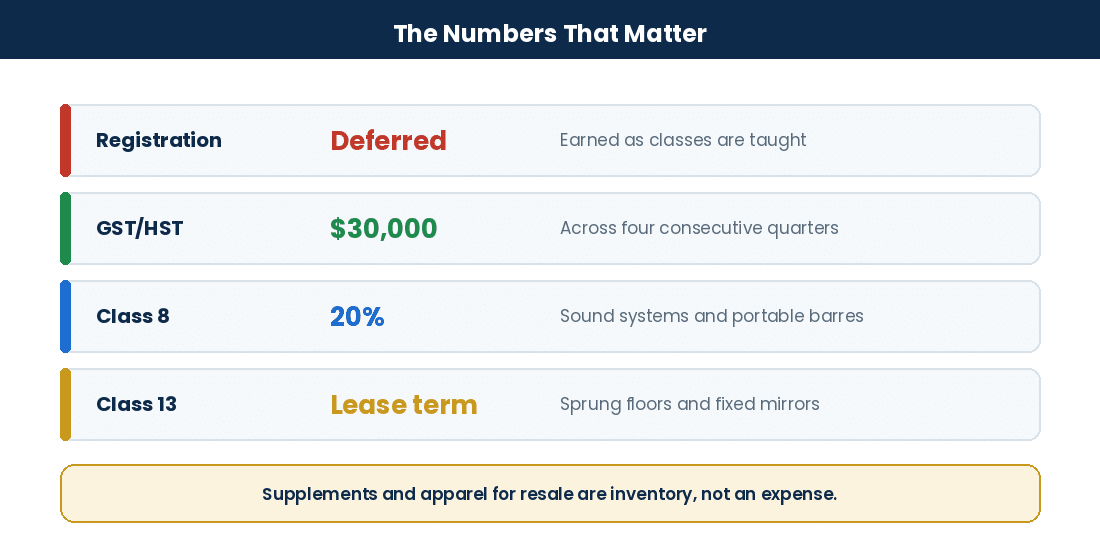
Where your supplies are taxable, you must register for GST/HST once taxable revenue exceeds $30,000 across four consecutive calendar quarters, and you recover the tax on rent, floors, mirrors, costumes and everything else through input tax credits.
Where you make both taxable and exempt supplies, credits must be apportioned on a reasonable, documented basis. Claiming in full while running exempt syllabus programs is a straightforward adjustment on review.
Where supplies would be exempt under the vocational course provision, an election may be available to treat them as taxable instead, which restores credit recovery. That is worth modelling for a studio with significant fit-out costs.
A studio told to stop charging tax on children’s classes carried that position for four years. The correction was the largest single item on the file, and none of it was avoidable by then. Figures changed for privacy.
Risk Warning: The under-fifteen exemption applies to public sector bodies, not private studios. Please have your own status confirmed before relying on it.
Revenue Timing and Deferred Income
Revenue Timing and Deferred Income
The Timing
A dance school’s financial year rarely matches its dance year, and money arrives months before the service is delivered. That gap is where most year-end adjustments live.
Registration and Tuition
Registration fees collected in August for a season running to June are not August revenue. The amount is earned as classes are taught, so the undelivered portion sits as a liability at year end.
Recognising the full season on receipt overstates income for classes not yet given, inflates the instalment base for the following year, and pays tax early on money still owed in service.
A studio with a 31 August year end collects $180,000 in registration for a September to June season. Almost none of that is earned at the year end, so it sits as deferred revenue and is released month by month as classes run. A studio recognising it all in the collection year reports a strong year followed by an apparent collapse. Figures changed for privacy.
Class Packages and Punch Cards
Multi-class packs behave the same way. The sale creates a liability and each class attended releases its share to revenue.
The balance needs to be breakable down by student. Your registration system should report unused classes outstanding, and that report is the schedule behind the liability.
- Record package sales to a liability account, not to revenue
- Release as classes are attended, not as time passes
- Reconcile the system’s unused class count to the balance monthly
- Settle the treatment of packs that expire rather than letting them accumulate
Discounts, Siblings and Adjustments
Sibling discounts, early-bird pricing and multi-class reductions all reduce the revenue recognised. They are not an expense.
Studios that record gross tuition and then book the discount as a marketing cost overstate both revenue and expenses. The figures net out but every ratio in between is wrong, and it matters if a lender or landlord is reading the statements.
Recital and Competition Money
This is the area studios most often handle loosely.
Where you sell recital tickets and keep the proceeds, that is your revenue. Where you collect money from families on behalf of somebody else, such as a competition entry fee or a group travel booking, you may be acting as agent rather than principal.
Amounts collected as agent are a liability until paid over, not income. Amounts collected as principal are revenue with the corresponding cost as an expense.
The distinction changes your reported revenue substantially in a studio running a competitive program, so please have the arrangements reviewed rather than defaulting to whichever is simpler.
Travel Collections
Money collected for competition trips, accommodation and travel is usually held on behalf of the families paying it. That sits as a liability until spent, and the balance at year end should agree to what is still owed for the trip.
A studio showing travel collections as revenue and the trip costs as expenses inflates both sides and creates a figure nobody can explain.
Registration money recognised on receipt is the single largest adjustment we make on dance school files. It usually moves six figures between two years. Figures changed for privacy.
Key Stat: Season registration collected before classes run is deferred revenue. Please release it as classes are taught, not on receipt.
Reconciling Payments and Inventory
Reconciling Payments and Inventory
The Reconciliation
Gross Against Net
Payment processors and pre-authorised debit providers deduct their fee before depositing. Recording the deposit as revenue understates sales by the fee and loses the fee as a deductible expense.
Record gross revenue, the processing fee as an expense, and the net to the bank. The processor statement shows all three and reports the gross figure independently.
| Item | What to Match | Common Failure |
|---|---|---|
| Card and debit deposits | Gross sales to processor statement, fee to expense | Net deposit recorded as revenue |
| Chargebacks | Reversal against the original sale | Netted silently, leaving revenue overstated |
| Failed and returned payments | Receivable reinstated | Treated as if collected |
| Registration system totals | Billed tuition to recorded revenue | Never compared at all |
| Bank | Line by line to the ledger | Reconciled only at year end |
Chargebacks and failed payments matter more in this sector than most, because studios bill monthly on file and a proportion always fails. A studio that never reverses them is carrying revenue it did not receive.
Accounts Receivable at Year End
Age the receivables before you close. Families who left mid-season with a balance owing are a different matter from current-month billing not yet processed.
A bad debt is deductible where the amount was included in income and you have genuinely tried to collect. Keep the invoice, the record of attempts and the write-off decision. A balance written off with none of that behind it is a deduction with no support.
Costume and Merchandise Inventory
Costumes, shoes, uniforms and branded merchandise held for sale are inventory, not an expense when purchased. The cost moves to cost of goods sold when the item sells.
Studios buy costumes in bulk for recital season and expense the whole order, which distorts the year the order was placed and the year the costumes were sold.
- Count stock at year end and value it at the lower of cost and net realisable value
- Record opening stock, purchases, closing stock and the resulting cost of sales
- Write down damaged, unsold or size-broken stock with a note of the reason
- Separate costumes ordered for specific students, which may be a pass-through rather than stock
- Keep the count sheets, which are the support for the deduction
Costumes ordered on behalf of named families and paid for separately behave more like an agency arrangement than inventory. Which it is depends on who bears the risk if the order is cancelled.
Prepaid Expenses
Studios pay for things ahead too. Venue deposits for a recital in the following year are prepaid expenses sitting as an asset, not a cost of the year they were paid.
The same applies to insurance premiums, music licensing and competition entry fees paid in advance. Match them to the period they cover.
The registration system total and the recorded revenue almost never agree on a first review. The gap is usually chargebacks nobody reversed and discounts booked as expenses. Figures changed for privacy.
Risk Warning: A bulk costume order is inventory until the costumes are sold. Please count what is left rather than expensing the whole invoice.
Instructors, Slips and Benefits
Instructors, Slips and Benefits
The People
Employee or Contractor
Studios engage teachers every way going: salaried staff, hourly instructors, guest choreographers, and long-standing teachers who invoice. The classification decides your obligations regardless of what the agreement says.
- Control: Who sets the timetable, the class content and the fee charged to students
- Tools: Who supplies the studio, the sound system and the music licence
- Chance of profit and risk of loss: Whether the teacher carries any real financial risk
- Integration: How embedded they are in the school’s programme
A teacher on your published timetable, in your studio, teaching your syllabus to students you enrolled, at rates you set, is an employee whatever the invoice says. A visiting choreographer engaged for a single workshop is a different matter.
Misclassification means the CRA can assess the source deductions that should have been withheld, plus penalties and interest, with directors carrying personal exposure on unremitted amounts.
Slips and Deadlines
| Position | Withholding | Slip |
|---|---|---|
| Employed instructor or administrator | Income tax, CPP and EI | T4 |
| Genuine self-employed teacher or choreographer | None | T4A where applicable |
| Owner taking salary | Income tax, CPP | T4 |
| Owner taking dividends | None | T5 |
T4 and T4A slips are due by the last day of February following the calendar year. Source deductions are remitted on the schedule set by your remitter type, which depends on your average withholding rather than a fixed rule.
Studios often have a large number of small T4s from assistants and junior teachers. The per-slip penalty scales with volume, so a late filing costs more here than in a business with three employees.
Taxable Benefits
The benefits that arise in studios are easy to miss because they are not paid in cash.
- Free or discounted classes for staff and their children
- Costumes, shoes or dancewear provided without charge
- Competition or convention fees paid for a teacher’s own participation
- Travel and accommodation beyond what the work requires
Where a benefit is personal rather than required for the job, it is generally reportable on the employee’s T4. The cost to you is deductible, but the benefit side has to be reported.
Studios routinely provide free classes to teachers’ children and never report it, because the marginal cost of one more child in an existing class is nothing. The reporting obligation does not depend on your marginal cost.
Family Members
Paying a spouse or family member for administration, front desk or bookkeeping work is legitimate where they genuinely do it and the rate matches what you would pay anyone else.
Support it with a timesheet and a job description. Dividends to family members who do not meaningfully contribute can be caught by the tax on split income at the top marginal rate.
Free classes for teachers\u2019 children is the benefit nobody reports and every studio provides. It is small per person and adds up across a staff of twenty. Figures changed for privacy.
Key Stat: Slip penalties scale with the number of slips. Please file T4 and T4A by the last day of February, particularly with a large casual teaching staff.
Studio Assets and Capital Cost Allowance
Studio Assets and Capital Cost Allowance
The Assets
Which Class Applies
| Asset | Typical Class | Rate |
|---|---|---|
| Sprung floors, fixed barres, wall mirrors, installed lighting | Class 13 | Over the lease term |
| Sound systems, portable barres, furniture, storage | Class 8 | 20% |
| Computers, tablets and front desk terminals | Class 50 | 55% |
| Registration and studio management software | Class 12 | 100%, subject to the rules below |
| Small tools and low-cost items | Class 12 | Where the item qualifies |
| A building you own | Class 1 | 4% |
The split that matters is fixed against free-standing. A sprung floor installed in leased premises is a leasehold improvement written off over the lease term. A portable barre you could carry to another studio is equipment.
Mirrors are the item most often misfiled. Fixed to the wall in a leased studio they are Class 13, not an equipment class and not a repair.
Note that Class 13 is written off over the lease term including renewal options rather than at a declining-balance rate, so the lease itself is part of the working paper.
The 2026 Capital Cost Allowance Change
Bill C-15 received Royal Assent on 26 March 2026, reinstating the accelerated investment incentive. For most depreciable property acquired after 2024 and available for use before 2030, the half-year rule is effectively suspended and an enhanced first-year deduction applies, phasing down after 2029.
Certain classes are excluded from the reinstated incentive, and leasehold improvements are among the exclusions, so a sprung floor does not benefit in the same way a sound system might.
If you fitted out or re-equipped a studio in the last two years and the return applied the plain half-year rule throughout, the treatment is worth reviewing.
Available for Use
An asset only starts earning capital cost allowance once it is available for use. Equipment delivered in the last week of your fiscal year but not installed until the new season does not help the year it was bought.
For a studio doing summer renovations before a September start, the timing of the year end and the timing of the fit-out interact directly.
Disposals and Recapture
Replacing a sound system or selling equipment when a location closes produces a disposal. Where proceeds exceed the remaining class balance, the excess is recaptured as income. Where a class is emptied for less than its balance, a terminal loss arises.
Leaving a studio at the end of a lease raises a further question about the remaining Class 13 balance, so please have that reviewed rather than assuming it simply disappears.
The Asset Register
Every claim rests on a register listing each asset with its purchase date, cost, assigned class, claims to date and disposal details. Without one, the fit-out becomes a single number nobody can defend and equipment disposed of years ago sits on the books indefinitely.
Sprung floors expensed in full is the classic dance studio adjustment. It is a large number, it is clearly a leasehold improvement, and it is caught every time. Figures changed for privacy.
Pro Tip: Please split the fit-out invoice between fixed installations and free-standing equipment at the time. Class 13 and Class 8 write off very differently.
The Close, the T2 and Working With Gondaliya CPA
The Close, the T2 and Working With Us
The Filing
What to Gather
| Document | What It Supports |
|---|---|
| Registration system export | Billed tuition, unused classes, discounts |
| Processor and pre-authorised debit statements | Gross revenue, fees, chargebacks |
| Bank statements for the full period | Cash position and reconciliation |
| Payroll records and slips | Wages, deductions, benefits |
| Instructor agreements | Classification support |
| Costume and merchandise counts | Cost of goods sold |
| Lease and fit-out invoices | Class 13 write-off period |
| Recital and competition records | Agent against principal treatment |
| Prior year notices of assessment | Carryforwards and opening balances |
Deadlines
| Obligation | Deadline | If Missed |
|---|---|---|
| T2 corporate return | Six months after fiscal year-end | 5% plus 1% per complete month, to twelve |
| Balance owing | Three months for eligible CCPCs, otherwise two | Interest from the due date |
| GST/HST return | Per your assigned reporting period | Penalty plus interest |
| Payroll remittances | Per your remitter type | Penalty and director liability |
| T4 and T4A slips | Last day of February | Penalty by slip count |
Repeat late filing within the following three years attracts higher rates, so a second late year costs disproportionately more than the first.
Choosing a Year End
Dance schools have an unusually clear seasonal shape, which makes the year-end choice worth thinking about rather than defaulting to the incorporation date.
A year end after the season closes and recital costs have settled gives a cleaner picture, with fewer classes owed and less deferred revenue carried. A mid-season year end means closing with a large liability and substantial work still to deliver.
The choice is made at incorporation and changing it later requires approval.
What Draws a Review
- No tax charged on children’s classes at a private for-profit studio
- Full input tax credits claimed alongside exempt syllabus or camp programmes
- Registration revenue with no deferred balance at year end
- Instructors on T4A slips who appear on a published timetable
- Free classes for staff never reported as a benefit
- Sprung floors and mirrors expensed rather than capitalised
- Travel and competition collections shown as revenue
Our CRA audit guide sets out what a review involves. Where past filings were wrong, the Voluntary Disclosures Program may reduce penalties, provided you come forward before the CRA raises the issue. For a studio that has been under-collecting tax on children’s classes, that route is worth assessing quickly.
How We Work With Dance Schools
We support incorporated studios on a flat annual fee covering GST/HST status review across recreational, syllabus and camp supplies, deferred revenue on registration and packages, processor reconciliation with fees expensed, costume and merchandise inventory, instructor classification, payroll and slips, benefit reporting, the asset register with the Class 8 and Class 13 split, financial statements under CSRS 4200 for lenders and landlords, and the corporate return.
Fees scale with student numbers, locations, transaction volume, staff headcount and whether catch-up work is needed. Pricing is quoted before any work begins, including HST, with a one-business-day response.
Getting Started
Bring three things: a registration system export for the year, a processor statement, and your last filed corporate return. Those show us whether revenue is timed correctly, whether fees are handled properly, and what needs fixing.
Contact Gondaliya CPA at info@gondaliyacpa.ca, call 647-212-9559, or send us a message.
The registration export and the general ledger are the two documents that settle a dance school year end. Everything else is checking they agree. Figures changed for privacy.
Pro Tip: Please export the registration system before you close. It is the only reliable record of what you have been paid for and not yet taught.
FAQs on Dance School Year-End Accounting
Frequently Asked Questions
FAQ
Are children’s dance classes GST/HST exempt?+
Generally not at a private for-profit studio. The under-fifteen exemption applies to supplies made by public sector bodies such as charities, non-profits and municipalities. The CRA has ruled that there is generally no provision exempting dance instruction supplied by a private for-profit school.
Is anything a private dance studio supplies exempt?+
Possibly. Graded vocational syllabus courses with examinations and certificates may be exempt where the studio qualifies as a vocational school, and a day camp whose primary purpose is care and supervision of children fourteen and under may be an exempt child care service.
What happens if I stopped charging tax on children’s classes?+
You may have been under-collecting across open years. Coming forward through the Voluntary Disclosures Program before the CRA raises it may reduce penalties, so the position should be assessed quickly.
When must a dance studio register for GST/HST?+
Once taxable revenue exceeds $30,000 across four consecutive calendar quarters. Exempt supplies do not count toward that threshold.
How do I treat registration fees collected before the season?+
As deferred revenue. The amount is earned as classes are taught, so the undelivered portion sits as a liability at year end.
How are multi-class packages accounted for?+
The sale creates a liability and each class attended releases its share to revenue, tracked by student through your registration system.
Should sibling discounts be an expense?+
No. Discounts reduce the revenue recognised. Recording gross tuition and the discount as marketing overstates both revenue and expenses.
How do I handle competition and travel collections?+
Where you collect on behalf of families or a third party, the amount is a liability until paid over rather than revenue. Whether you act as agent or principal depends on the arrangement.
Should processor deposits be recorded gross or net?+
Gross, with the processing fee as a separate expense. Recording the net deposit understates revenue and loses the fee as a deduction.
How are chargebacks and failed payments handled?+
Reversed against the original sale, with the receivable reinstated where the amount is still owed. A studio that never reverses them carries revenue it did not receive.
Are costumes inventory or an expense?+
Inventory where held for sale, with the cost moving to cost of goods sold when the item sells. Costumes ordered for named families may be a pass-through instead.
Which class covers a sprung floor?+
Class 13 as a leasehold improvement, written off over the lease term including renewal options. Free-standing equipment such as portable barres and sound systems generally sits in Class 8.
Did the capital cost allowance rules change in 2026?+
Yes. Bill C-15 received Royal Assent on 26 March 2026, reinstating the accelerated investment incentive. Certain classes are excluded, including leasehold improvements.
Are free classes for staff a taxable benefit?+
Generally yes, where the benefit is personal rather than required for the job. The low marginal cost to the studio does not remove the reporting obligation.
Are my instructors employees or contractors?+
It depends on control, tools, chance of profit and integration. A teacher on your published timetable in your studio teaching your syllabus is usually an employee.
How long must a dance school keep records?+
Six years from the end of the tax year they relate to, including registration exports, processor statements, inventory counts and payroll records.
Sixteen questions and two underneath most of them: are your supplies taxable, and have you earned the money yet. Those two settle most of a dance school year end. Figures changed for privacy.
The Dance School Year-End Checklist
The Year-End Checklist
Quick Reference
Revenue and Status
- Confirm your GST/HST status across recreational, syllabus and camp supplies.
- Do not assume children’s classes are exempt at a private for-profit studio.
- Apportion input tax credits where you make both taxable and exempt supplies.
- Hold registration and package money as deferred revenue until classes are taught.
- Reconcile unused classes in the registration system to the liability.
- Record discounts as a reduction of revenue, never as an expense.
- Separate amounts collected as agent from amounts earned as principal.
- Hold travel and competition collections as a liability until spent.
Reconciliation and Inventory
- Record processor deposits at gross with the fee expensed.
- Reverse chargebacks and failed payments against the original sale.
- Reconcile the registration system total to recorded revenue.
- Reconcile the bank line by line, not just at year end.
- Age the receivables and support any write-off with collection evidence.
- Count costume and merchandise stock and value it properly.
- Write down damaged or unsold stock with a note of the reason.
- Record venue deposits and prepaid insurance as assets, not costs.
People, Assets and Filing
- Test each instructor against the CRA control, tools and risk factors.
- File T4 and T4A slips by the last day of February.
- Report free classes and dancewear provided to staff as a taxable benefit.
- Support family wages with timesheets and a job description.
- Split the fit-out between Class 13 fixed installations and Class 8 equipment.
- Check the available-for-use date before claiming on new equipment.
- Review whether the reinstated investment incentive applies, noting exclusions.
- Maintain an asset register with class, cost and claims to date.
- File the T2 within six months and pay the balance on time.
- Keep six years of records including registration exports and count sheets.
For help closing your studio’s year, contact Gondaliya CPA at info@gondaliyacpa.ca, call 647-212-9559, or book a free consultation.
Twenty-six points and two underneath them: what have you actually earned, and are those supplies taxable. Every dance school correction we make starts with one of those. Figures changed for privacy.
Studio Models We Serve
Industry Expertise
Which issue dominates differs by the studio. Here are ten and the usual focus.
| Studio Model | Where the Year End Concentrates |
|---|---|
| Recreational studio, children’s classes | Whether tax should have been charged |
| Studio running graded syllabus levels | Exempt supplies and credit apportionment |
| Studio running summer day camps | Child care treatment on camp fees |
| Season registration collected up front | Deferred revenue across the year end |
| Competitive program with travel | Agent against principal on collections |
| Studio selling costumes and merchandise | Inventory rather than expense |
| Large casual teaching staff | Classification and slip volume |
| Recently fitted-out premises | Class 13 against Class 8 split |
| Multi-location academy | Consolidated reporting and shared limits |
| Behind on the books | Status settled before returns are prepared |
- Recreational studio, children’s classes: The age exemption belongs to public sector bodies.
- Studio running graded syllabus levels: Exempt supplies restrict credit recovery.
- Studio running summer day camps: Care and supervision changes the analysis.
- Season registration collected up front: Money collected is not money earned.
- Competitive program with travel: Held for families is a liability, not income.
- Studio selling costumes and merchandise: Stock is an asset until it sells.
- Large casual teaching staff: Slip penalties scale with headcount.
- Recently fitted-out premises: The floor and the sound system differ.
- Multi-location academy: One business limit across associated corporations.
- Behind on the books: Fix the status first or the returns get done twice.
The studio changes where the year end concentrates. It does not change the method, which is settle the GST/HST status, time the revenue properly, then reconcile the registration system to the ledger. Figures changed for privacy.
Professional Guidance and Quick Reference
Guidance
Professional Guidance for Studio Owners: How Gondaliya CPA Handles Your File
Dance schools lose money in a predictable set of ways: stopping tax on children’s classes on the strength of an exemption that belongs to public sector bodies rather than private studios, recognising a full season of registration in the year it was collected, recording processor deposits net so both revenue and the fee disappear, expensing a bulk costume order that is still sitting in the store room, showing competition and travel collections as revenue when the money belongs to families, teachers on a published timetable paid as contractors, free classes for staff never reported as a benefit, and sprung floors expensed rather than written off over the lease term. Gondaliya CPA handles dance school year end accounting on a fixed annual fee.
We handle what decides the outcome: reviewing GST/HST status across recreational, graded syllabus and day camp supplies and apportioning credits where they are mixed, setting up deferred revenue so registration and packages land as classes are taught, reconciling the registration system to recorded revenue with chargebacks reversed, treating costume stock as inventory with a year-end count, separating amounts held as agent from amounts earned as principal, testing instructor classification against the CRA factors, reporting staff benefits, and splitting the fit-out between Class 13 and Class 8.
Our team starts with the registration export and the processor statement, because those two show immediately whether the revenue is timed correctly and whether it reconciles. Single studio, competitive program or multi-location academy, you get clear advice and a fixed price before we start.
Quick Answers
- Children’s classes: Generally taxable at a private studio
- Under-15 exemption: Public sector bodies only
- Syllabus courses: May be exempt where you are a vocational school
- Day camps: May be exempt as child care
- Registration: Deferred until classes are taught
- Processor deposits: Record gross, fee as expense
- Costumes: Inventory until sold
- Sprung floors: Class 13 over the lease term
- Slips: T4 and T4A by end of February
- Records: Six years retention
Who This Is For
- For: Incorporated private dance schools, performing arts studios, competitive programs and multi-location academies across Canada.
- Not For: Registered charities and non-profit community programs, whose GST/HST position and reporting obligations differ substantially from a for-profit studio.
People Also Ask
Can I claim the full HST on my studio fit-out?+
Only where your supplies are taxable. Where you also run exempt syllabus or camp programmes, credits must be apportioned on a reasonable, documented basis.
Should my year end fall after recital season?+
It generally gives a cleaner close, with fewer classes owed and recital costs settled. Changing it later requires approval, so decide early.
Are music licensing fees deductible?+
Yes, where incurred for the business. Fees paid in advance for a future period are prepaid expenses matched to the period they cover.
Glossary of Key Terms
- T2: The corporation income tax return.
- Public sector body: A charity, non-profit, municipality or similar organisation.
- Exempt supply: A supply carrying no tax and no input tax credit recovery.
- Vocational school: A defined status affecting which courses can be exempt.
- Child care service: Care and supervision of children, exempt in its own right.
- Deferred revenue: Registration and package money held as a liability until earned.
- Agent: Collecting on behalf of others, so the money is a liability.
- Principal: Selling on your own account, so the money is revenue.
- Gross revenue: Sales before the processor deducts its fee.
- Chargeback: A reversed payment that must be taken back out of revenue.
- Cost of goods sold: Costume and merchandise cost recognised on sale.
- Class 8: The 20 percent class covering free-standing equipment.
- Class 13: Leasehold improvements over the lease term.
- Available for use: When an asset becomes eligible for depreciation.
- Taxable benefit: A perk reportable as employee income.
- Compilation engagement: Financial statements prepared under CSRS 4200.
Dance Studio Readiness Check
This quick self-check indicates where your operation most likely has room. Please answer the six questions below.
Dance Studio Readiness Check
Six quick questions on your studio. No fee shown.
Points to raise with us:
This is a general prompt, not tax or legal advice or a quote. Your position depends on your full facts. For a real review, please book a free consultation.
Want a checklist to work from? You can download our free dance school year-end checklist before your consultation.
Confirm your GST/HST status rather than assuming the age exemption applies. Apportion credits where supplies are mixed. Hold registration and packages as deferred revenue. Record processor deposits at gross. Count costume and merchandise stock. Separate agent collections from your own revenue. Split the fit-out between Class 13 and Class 8. Please report staff benefits and keep six years of records.
2026 Update — what is current: This article reflects rules current to 2026. The $30,000 GST/HST registration threshold measured across four consecutive calendar quarters, the Class 8 rate of 20%, Class 13 leasehold treatment over the lease term, the six-month T2 filing deadline, the 5% plus 1% per month late-filing penalty, the end-of-February slip deadline and the six-year retention requirement are unchanged. Bill C-15 received Royal Assent on 26 March 2026, reinstating the accelerated investment incentive for most depreciable property acquired after 2024 and available for use before 2030, with certain classes excluded including leasehold improvements. Please note that the exemption for instructional programs provided primarily to children fourteen and under applies to supplies made by a public sector body and not to a private for-profit studio; that a graded vocational syllabus course may nonetheless be exempt where the studio qualifies as a vocational school; that a day camp whose primary purpose is care and supervision may be an exempt child care service; that mirrors and sprung floors fixed in leased premises are Class 13 rather than an equipment class; and that the corporate balance owing is due three months after year-end for eligible CCPCs and otherwise two.
Dance School Year End Accounting Canada: How Gondaliya CPA Supports Studios
Start with the registration export
Gondaliya CPA reviews your GST/HST status across recreational, graded syllabus and day camp supplies and apportions credits where they are mixed, sets up deferred revenue so registration and packages land as classes are taught, reconciles the registration system to recorded revenue with chargebacks reversed, treats costume stock as inventory with a year-end count, separates amounts held as agent from amounts earned as principal, tests instructor classification, reports staff benefits and splits the fit-out between Class 13 and Class 8, on a flat annual fee including HST with a one-business-day response. Please book a free consultation.
Next Steps
Please book a free consultation with Gondaliya CPA and bring a registration system export for the year, a processor statement, and your last filed corporate return. Those three tell us immediately whether revenue is timed correctly, whether it reconciles, and what remains to claim on the equipment, and where the documentation is thin. You will get a flat annual fee including HST before any work begins. If our content helps, please add gondaliyacpa.ca as a preferred source on Google.
Published: · Last updated:
Editorial policy: We research against CRA and CPA Ontario sources, fact-check the figures, and Sharad Gondaliya, CPA, reviews the content, which we update as the rules change.
Disclaimer: This article is educational information only and is not tax, legal, or financial advice. Figures marked illustrative are examples rather than quotes or guarantees. It reflects CRA rules current to 2026, including the $30,000 GST/HST threshold, the Class 8 rate, Class 13 leasehold treatment, the half-year rule, and the six-year retention requirement. Rates, limits and expensing rules change and outcomes depend on your specific facts. Please consult a CPA Ontario member before acting.

Sharad Gondaliya is a CPA Canada & CPA USA with 15 Years+ experience of Accounting, Tax, Payroll of Corporate Small Businesses as Tax Accountant. He is a CPA Ontario member (61040184) and holds US CPA licences in Washington and Montana and is well known among corporate small businesses for tax planning, efficient tax solutions, and affordable CPA services. Sharad is the Principal (Director) of Gondaliya CPA – Affordable CPA Firm in Canada. Licenses: CPA Ontario: 61040184 | CPA USA (MT): PAC-CPAP-LIC-033176 | CPA USA (WA): 57629 | CPA Firm License: 61330051 View Full Author Bio