



How Snow Removal Businesses in Canada Can Reduce Taxes and Improve Cash Flow With Strategic Tax Planning
Snow Removal Business Tax Planning: Effective Tax Strategies to Reduce Taxes for Snow Removal Contractors in Canada | Gondaliya CPA
Snow removal business tax planning is key to managing your finances and reducing tax liabilities in the competitive Canadian market. Gondaliya CPA offers practical tax strategies for snow removal businesses that help contractors optimize deductions and manage expenses effectively.
Quick Summary
Snow removal is the most seasonal trade there is: revenue lands in five months and cost runs across twelve. Prepaid contract timing, instalment planning, the salt pile at year end, the capital cost allowance class on plows against trucks, and seasonal payroll and worker classification decide most of the tax outcome.
Reading time: 54 minutes.
Table of Contents
- Tax Planning Foundations for Snow Removal Businesses in Canada
- Maximizing Eligible Tax Deductions for Equipment and Vehicle Expenses
- Avoiding Illegal Agreements Related to Pricing and Territory with Competitors
- CRA Audit Preparedness And Representation For Snow Removal Businesses
- Labour Planning and Scaling Strategies Aligned With Tax Optimization
- Overview of Priority Road Clearing and Winter Storm Event Requirements
- Contact Information for Expert Tax Assistance at Gondaliya CPA
- Frequently Asked Questions (FAQ)
- Essential Tax Planning Points for Snow Removal Businesses
- Professional Guidance and Quick Reference
The Numbers That Matter
This article covers Canada, with Ontario and Toronto context, and reflects rules current to 2026. It applies to incorporated snow removal businesses including single-truck plow operators, multi-crew winter maintenance contractors, municipal subcontractors, property management service providers and landscaping companies running a winter division. Figures marked illustrative are examples, not quotes, and any masked engagement notes end with “Figures changed for privacy.” This is educational information only and not tax or legal advice. Municipal licensing, salt management permits, WSIB classification and Competition Act interpretation sit outside accounting scope, so please confirm those with the relevant authority or with counsel.
Tax Planning Foundations for Snow Removal Businesses in Canada
Tax Planning Foundations for Snow Removal Businesses in Canada
The Foundations
Snow removal businesses and key tax planning considerations
Tax planning for snow removal businesses matters a lot. It helps contractors keep more money and follow Canadian rules well. Snow removal contractor tax planning in Canada means knowing when and how to pay taxes so you don’t pay too much. You can reduce taxes snow removal business owners face by being smart about your finances.
Understanding the unique tax needs of the snow removal industry
Snow removal has special tax needs because income goes up and down with the seasons. During busy winter months, costs go up, too. Using tax strategies for snow removal businesses means handling seasonal cash flow gaps wisely. Plus, corporate tax savings can ease the load during slow times.
Aligning business structure with tax efficiency
If you run an incorporated snow removal company, you can plan your owner remuneration mix carefully. Paying yourself partly in salary and partly in dividends helps lower your personal taxes. Also, knowing how to use the small business deduction limit will save money.
Understanding seasonal income patterns and tax implications
Snow removal usually means seasonal income spikes when demand hits its peak. CRA rules require timing instalment payments right to avoid penalties or surprises. Managing the off-season cash gap is key because there’s less work outside winter.
Recognizing cash flow trends across peak and off-peak periods
You need to plan for payroll changes like layoffs after winter ends. Some winters bring heavy work; others don’t. If a winter is strong, consider instalment reduction next year to balance cash flow better.
Planning for consistent taxable income reporting
Prepaid contracts make taxable income tricky. You must record revenue properly when work is done or contracts end—often at year-end after winter finishes—to keep your reports steady.
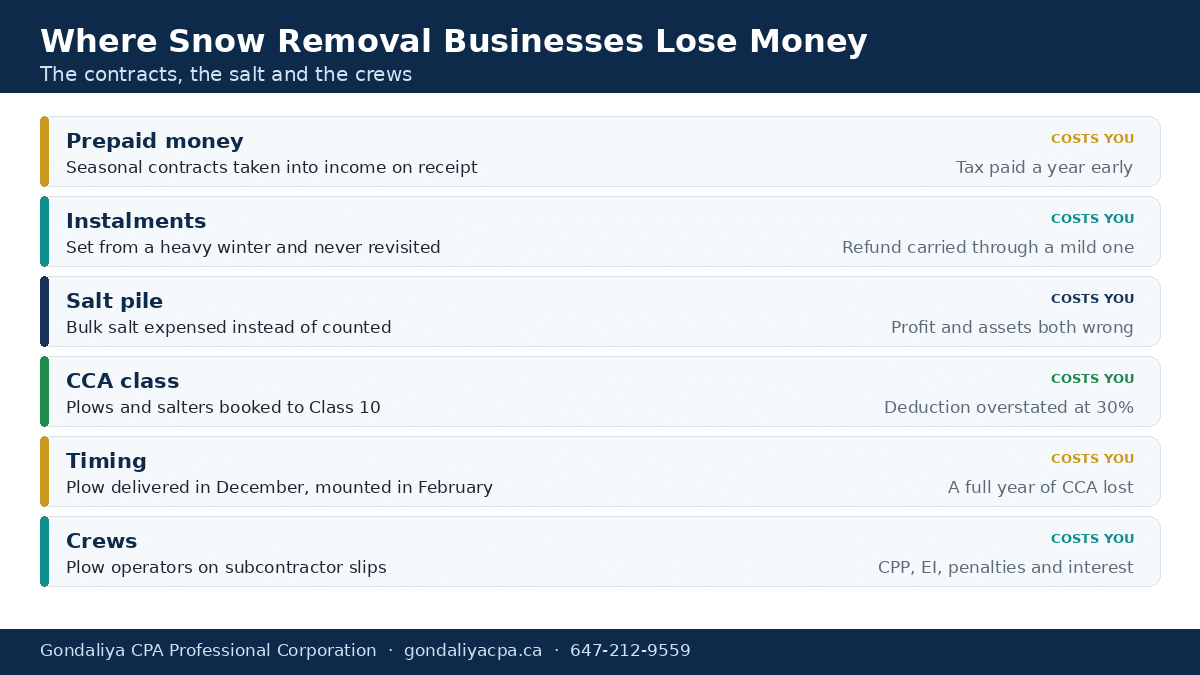
Money collected before the work is delivered is a liability, not revenue. A seasonal contract billed in November for a November to March season is earned month by month, and the unearned portion sits as deferred revenue at year end.
Incorporating your snow removal business: benefits and responsibilities
Should a snow removal operator incorporate? It depends on factors like limited liability protection versus added paperwork in Ontario or Canada.
Choosing between sole proprietorship, partnership, or incorporation
If you make about $350K or more yearly, incorporation often makes sense. It offers legal protection and financing options but comes with compliance rules like bookkeeping and payroll tasks that you must handle carefully.
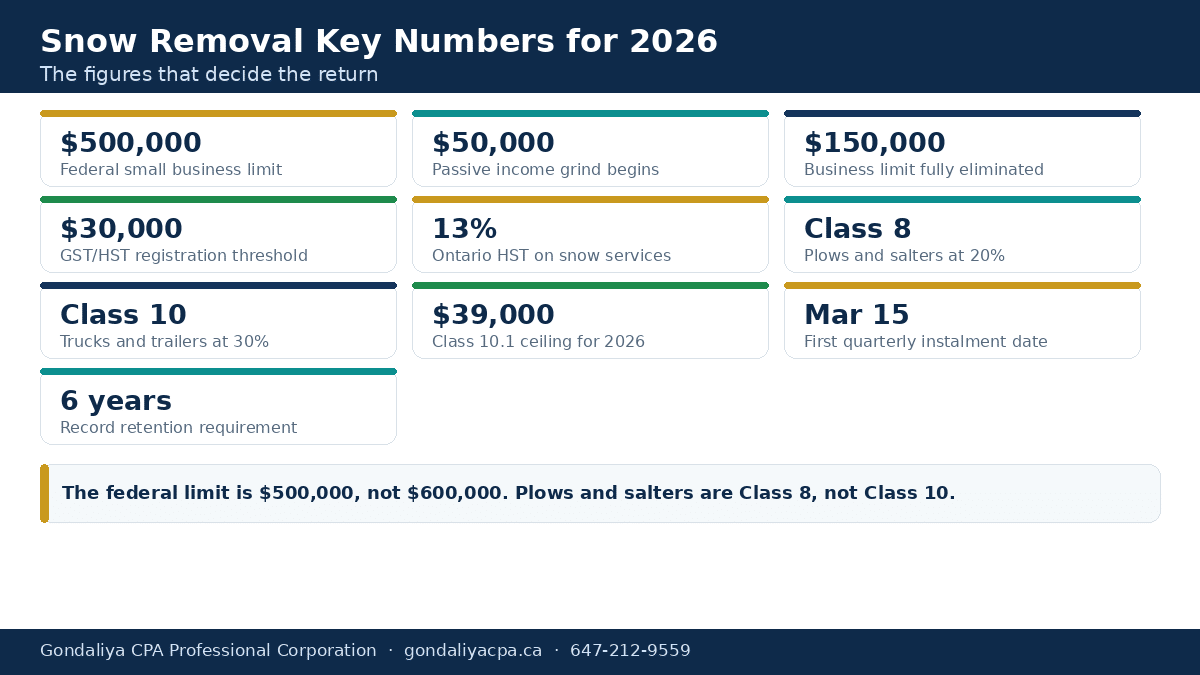
GST/HST registration is mandatory once worldwide taxable revenue exceeds $30,000 in a single calendar quarter or across four consecutive calendar quarters. In Ontario the rate is 13%.
Tax benefits of incorporation for contractors
Incorporated owners in places like Toronto or elsewhere in Ontario/Canada can access small business deductions not available to sole proprietors or partnerships. This tax benefit can really help contractors save money.
Essential bookkeeping practices for snow removal contractors
Good records back up every tax position you take. They also prepare you for CRA audits that check documentation closely for this kind of work.
Maintaining accurate records of income and expenses
Keep payroll slips (T4s) ready, along with dividend resolution paperwork that shows how you pay yourself as employer and owner. Accurate records must reflect your remuneration mix clearly throughout contracts.
Tracking job-specific costs
Track equipment purchase invoices carefully and maintain asset registers for capital cost allowance (CCA) claims. Salt inventory counts also matter—keep receipts neat so costs are easy to prove when needed.
GST/HST registration and filing requirements for snow removal operations
If your revenues top $30K annually, GST/HST registration becomes necessary. This affects how you plan since input tax credits (ITCs) come into play, helping recover some taxes paid on purchases. You can choose quick method accounting if it fits your situation better. Filing frequency also changes cash flow timing — something important to watch closely when running your operation.
Maximizing Eligible Tax Deductions for Equipment and Vehicle Expenses
Maximizing Eligible Tax Deductions for Equipment and Vehicle Expenses
Equipment & Vehicles
Running a snow removal business means dealing with a lot of equipment and vehicles. Those costs add up fast. But here’s the good part: you can reduce taxes snow removal business owners pay by claiming deductions. The key is smart snow removal business tax planning.
Keep track of what you buy, how much fuel you use, and the repairs you make. Don’t forget to log your motor vehicle allowances too. These details help you get the most from tax strategies for snow removal businesses.
Always keep your invoices, receipts, and logs safe. They prove your claims if CRA ever asks. When you buy gear or fix machines also matters. Timing can affect your cash flow and tax savings.
Listing Deductible Equipment Types
Most snow clearing equipment fits into Capital Cost Allowance (CCA) Class 10, which has a 30% rate. This includes plows, trucks mainly used for business, salters, and specialized tools like skid steers.
Please check the class before claiming. Class 10 at 30% covers the truck itself. Plows, salters, spreaders, blowers and skid steers are generally Class 8 at 20%, and Class 38 at 30% applies to heavy power-operated excavation equipment. Booking everything to Class 10 overstates the deduction.
When you buy matters. Getting plows or trucks before year-end means you start claiming CCA sooner. But watch out—the half-year rule cuts your first-year deduction in half.
Smaller tools under a certain cost might be expensed right away instead of capitalized. And not all gear counts—office computers are treated differently.
Make sure you sort your assets correctly to stay on CRA’s good side.
Claiming Fuel, Repairs, and Maintenance
You can claim fuel costs in two ways: either keep all your receipts and claim actual expenses or use the CRA’s per-kilometre motor vehicle allowance. If you use personal vehicles partly for work during winter—say for site visits—track your miles carefully.
The per-kilometre rate is an allowance for reimbursing an employee who uses a personal vehicle. A corporation deducts actual costs on a vehicle it owns, supported by a mileage log for any personal use.
Repairs like oil changes or fixing tires after heavy use are fully deductible in the year you pay for them—if they don’t extend the machine’s life too much.
Deciding whether to go actual cost or per-kilometre depends on how much record-keeping you want to do and how many business kms you drive in the season.
Capital Cost Allowance (CCA) Rules for Snow Removal Machinery
Most snow removal machines fit into Class 10 with a 30% CCA rate. But here’s a catch: the half-year rule says you can only claim half of that deduction in the year you buy something.
So if you get expensive equipment late in the season, your tax break that year shrinks. But that leaves more value to depreciate later on. When selling assets, any amount over their remaining cost must be reported as income (recapture).
Knowing these rules helps time purchases to balance cash flow with tax benefits.
Bill C-15 received Royal Assent on 26 March 2026, reinstating the accelerated investment incentive. For most depreciable property acquired after 2024 and available for use before 2030 the half-year rule is effectively suspended and an enhanced first-year deduction applies, phasing down after 2029.
Categorizing Qualified Property
Qualified property means assets directly used in snow clearing — like truck-mounted plows or owned salting machines. Buying them before year-end lets you start depreciation sooner but triggers half-year limits on first-year claims.
Remember: leased gear isn’t qualified property because lease payments count as regular expenses—not capital investments.
Getting this classification right avoids trouble with CRA audits or reassessments.
Optimizing Depreciation Schedules
You want to balance quick write-offs against saving deductions for future years since seasonal income varies widely. Using full CCA early drops taxable income now but reduces future deductions as asset value shrinks.
The half-year rule restricts first-year claims to 50%, no matter when during the year you buy an asset.
Plan around busy seasons so depreciation matches when income is highest, avoiding unexpected tax bills common among Toronto-area contractors who serve everything from driveways to parking lots.
Comparing Buying vs Contracting: Tax Impacts on Snow Clearing for Rental Properties
Should landlords buy equipment or contract services? It matters tax-wise. Buying means capital expenses spread out via CCA rules. Contracting gives an immediate expense deduction reducing taxes right away.
Here’s a quick look:
- Upfront cost: buying is high; contracting is low.
- Deduction timing: buying spreads over years; contracting deducts immediately.
- Who fixes gear: owner vs contractor.
- Flexibility: ownership less flexible; contracting more so.
Many prefer contracting for steady yearly tax results despite higher costs per job. Owners wanting equity may lean toward buying gear backed by smart financing suited for Ontario winters.
Landlords who contract the work out get a clean current-year deduction and no asset to manage. Owners who buy get the deduction over years and the resale value. Figures changed for privacy.
Deductibility of Contract Payments Versus Capital Expenditures
Payments to subcontractors are fully deductible as current expenses within the year paid, unlike capital purchases that spread deductions over years via CCA classes.
- For example:
- Paying someone for ice management reduces profits right away.
- Buying a new salting truck spreads out write-offs according to its class plus half-year rules.
Clear contracts help avoid confusion between operating costs and capital expenses—which CRA watches closely during audits.
Tax-Efficient Decision-Making for Landlords and Contractors
Smart tax planning helps save money while following Canada Revenue Agency rules for incorporated companies across Canada including Toronto/Ontario. Timing big purchases after peak revenue avoids tight cash flow in busy seasons typical in snow removal.
Tips include:
- Postpone big buys until after winter if possible.
- Use small business deduction carefully—it has limits across related companies.
- Mix salaries and dividends wisely considering RRSP room and CPP costs.
These steps lower taxes without breaking laws under relevant Income Tax Act sections.
The Class 10.1 passenger vehicle ceiling is $39,000 before tax for 2026, up from $38,000 in 2025, with the Class 54 zero-emission ceiling at $61,000, deductible lease cost capped at $1,100 per month and deductible interest at $350 per month.
Managing Payroll Taxes And Contractor Payments Effectively
Handling payroll taxes well needs knowing current CPP employer contribution rates plus EI premiums when employees qualify during snowy months.
Keep in mind:
- Salaries mean paying CPP/EI—costly but give RRSP room.
- Dividends avoid payroll taxes but don’t build RRSP room.
- Layoffs must follow rules; issue Records Of Employment fast to avoid penalties.
If using contractors, classify workers properly to avoid missing source deductions—a common audit trigger in snow removal firms across Toronto’s multi-crew setups.
Classifying Workers Correctly
Labeling workers as employees or contractors changes payroll taxes plus legal protections like WSIB coverage depending on provincial laws around Ontario areas such as Scarborough or Etobicoke.
Mistakes here cause:
- Fines
- Back taxes owed
- Lost GST/HST input credits linked to payroll errors
Keep detailed job descriptions showing duties done onsite at snowy locations to clear up any confusion—especially for small single-truck operators growing into multi-unit crews nearby.
Remitting CPP/EI And Income Tax As Required
Paying CPP/EI and income tax on time stops penalties from piling up after missed deadlines. Seasonal businesses mostly running November–March around GTA spots like North York and Hamilton must stay sharp.
Salary pay attracts monthly remittances while dividends skip those but affect personal returns—so plan compensation carefully.
Use digital payroll systems if possible—they help manage temporary hires laid off after winter contracts run out.
Plow operators on subcontractor slips who run the company route in a company truck is the classification pattern that draws a payroll review. Figures changed for privacy.
Tax Planning For Owners Of Single-Truck Operations Versus Multi-Crew Contractors
Single-truck operators face simpler pay setups than multi-crew contractors who juggle more staff during busy Nov-April seasons.
Single-truck highlights:
- Less payroll hassle
- Dividend-only approach works if no RRSP room
- Watch shareholder loans closely
Multi-crew points:
- More payroll accounts mean higher employer costs
- Bonus timing helps defer taxes
- Manage associated corporations’ small-business limits carefully
Mix salaries/dividends based on profits seen each season at Toronto-based companies.
Payroll remittance timing follows your remitter type. A regular remitter must remit by the 15th day of the month following the month the employees were paid, and penalties start at 3% and rise to 10%, with 20% for repeat failures in a year.
Unique Deductions For Varying Business Sizes
Small businesses get special breaks through the small business deduction capped federally near $600k but watch out passive investment income triggers cuts. Incorporation adds liability protection but brings bookkeeping, filing, and payroll duties plus compliance checks that raise fixed costs.
The federal small business deduction limit is $500,000, not $600,000. The higher figure belongs to the provincial limits in Saskatchewan, Prince Edward Island and Nova Scotia. Please plan against $500,000 federally, and remember the limit is reduced by $5 for every $1 of adjusted aggregate investment income above $50,000 and is gone at $150,000.
Weigh break-even revenues against these fees before deciding on incorporation especially across GTA cities where bundled accounting packages serve SMBs broadly.
Coordinating Personal And Corporate Tax Liabilities
Balancing salary with dividends lets owners optimize combined personal-corporate taxes while respecting RRSP limits and avoiding extra CPP payments common among incorporated Toronto-area operators serving suburbs.
Plan compensation alongside expected instalments so cash flow stays smooth given seasonal ups-and-downs unique here.
Need help with your snow removal business tax planning? Contact Gondaliya CPA at info@gondaliyacpa.ca or call 647-212-9559 for a free consult made just for your operation serving Toronto/Ontario clients nationwide.
Avoiding Illegal Agreements Related to Pricing and Territory with Competitors
Avoiding Illegal Agreements Related to Pricing and Territory with Competitors
Staying Legal
When you run a snow removal business in Canada, you have to follow the law closely. That means no secret deals about prices or service areas with your competitors. Such agreements break the Competition Act and can cause big fines. You want to keep your pricing and territory decisions on your own.
For snow removal contractor tax planning in Canada, focus on legal ways to work. Sharing tips about equipment care is fine, but do not agree on prices or where you’ll work. Staying independent helps you avoid trouble and keeps your tax strategies safe.
- Keep detailed records of all talks with competitors.
- Never write or say anything about prices or service zones together.
Price Fixing and Anti-Competitive Behaviour Risks
Price fixing means agreeing with other companies to set prices instead of letting the market decide. This is illegal and can lead to penalties and bad reputation for your snow removal business.
Trying to reduce taxes for your snow removal business should not mean breaking rules. Instead, look at smart cost control, claiming capital cost allowance properly, and planning owner pay within the Income Tax Act.
- Use clear pricing based on market rates.
- Avoid risky deals that can cause CRA audits or competition investigations.
Operating Within the Competition Act Guidelines
When doing snow removal contractor tax planning in Canada, understand the Competition Act well. Gondaliya CPA warns never to discuss limits on how much work you do, setting minimum fees together, or dividing up customers by location.
Make all business choices on your own with good reasons like market needs—not because of what competitors want. This protects your corporate tax savings from penalties linked to bad competition practices.
- You may lose some cooperative chances.
- But avoiding penalties is worth it in the long run.
Understanding Municipal Bylaws, Permits, and Salt Management Plans Affecting Tax Status
Municipal rules control things like how much salt you can use and where you store it. These rules affect how you track expenses but don’t directly change your taxable income under federal law.
For tax strategies for snow removal businesses aiming to reduce taxes:
- Count salt inventory correctly if you buy in bulk.
- Include storage costs if permits require special facilities.
Ignoring these can cause denied expenses during CRA reviews and hurt cash flow even if capital cost allowance claims are solid elsewhere.
Bulk salt bought in October and still on the pile in April is inventory, not an expense. On a mild winter it is often the largest single year-end adjustment we make. Figures changed for privacy.
Complying With Local Business License Requirements
Snow contractors working in Ontario cities must have proper licenses. Not having one can mean fines and losing tax deductions tied to licensed operations. Gondaliya CPA stresses getting all licenses before starting business.
Licensing also helps with GST/HST filings because unlicensed work makes input tax credit claims tricky during busy winter seasons when payrolls and material buys peak.
- Always get local licenses before operating.
- Keep licenses updated for smooth tax filing.
Impact of Salt Reporting Plans on Expense Tracking
Many towns want reports showing how much salt you use each season compared to what you bought. This matters because unused salt counts as an asset, not an expense, affecting capital cost allowance (CCA) claims.
You also must handle GST/HST carefully so you claim credits only on salt actually used. Good logs help keep expenses accurate without triggering CRA doubts about inventory numbers.
Clear reporting makes sure CCA benefits line up right without audit problems over wrong inventory values.
| Item | Treatment | Record Needed | Source |
|---|---|---|---|
| Purchased Salt Inventory | Asset until used | Purchase invoices & counts | ITA Regs Sch II / CRA |
| Used Salt Expense | Deductible when consumed | Usage logs & municipal reports | CRA Seasonal Business Guide |
Addressing Slip-and-Fall Liability and Insurance Considerations in Tax Deductions
Slip-and-fall risks are real for snow removal companies. You need insurance covering this liability. Insurance premiums count as deductible business expenses if they relate directly to your work under Canadian Income Tax rules.
Reducing taxes for a snow removal business means budgeting for insurance along with other costs like vehicle leases where partial CCA applies. Gondaliya CPA knows these details well for this industry.
Integrating Insurance Premiums Into Deductible Expenses
Insurance premiums are regular operating costs fully deductible when linked only to making income through active winter services. These premiums indirectly protect capital assets by covering unexpected repairs under policy terms.
Tax strategies for snow removal businesses include clear documentation of premiums tied strictly to insured winter activities. This helps avoid audit questions separating personal from corporate expenses or shareholder loans scrutiny.
Preparing For Potential Client Claims
Setting money aside for possible client claims is smart planning. Snow plowing contracts sometimes lead to disputes during tough weather months. Incorporating reserves before the season starts keeps cash ready for quick claim payouts without hurting reputation or profits.
Gondaliya CPA advises clients on managing these seasonal cash flow gaps while staying within Canadian Income Tax Act rules so funds are available when needed most without penalty risks.
CRA Audit Preparedness And Representation For Snow Removal Businesses
CRA Audit Preparedness And Representation For Snow Removal Businesses
Audit Readiness
Gondaliya CPA offers help making sure seasonal contractors have all documents ready if CRA comes knocking. Audits often happen after big equipment buys claiming fast CCA classes. Having clean books showing salary vs dividends separates personal draws from taxable benefits protecting corporate tax savings too.
Being ready cuts disruptions during reviews triggered by unusual deductions common in this business sector.
Maintaining Audit-Ready Documentation
Good snow removal business tax planning means keeping up-to-date papers like:
- Contracts showing job details
- Route sheets proving completed work
- Payroll files including ROEs when needed
- Salt/material inventories at year-end
These records prove income and expense claims match filings as required by Income Tax Regulations and Excise Tax rules.
Having solid documentation smooths out any audit issues fast without causing delays or disputes later on.
Understanding CRA Review Triggers
CRA may review if they see things like:
- Big asset buys just before year-end misusing half-year CCA rule
- Unusual salary-dividend mixes lacking RRSP support
- Prepaid revenues recognized too soon against deferral laws
These signs raise flags that lead to deeper checks increasing taxes owed beyond what you planned while trying to reduce taxes snow removal business owners seek legitimately.
Knowing these triggers early helps fix problems fast keeping credibility intact through complex seasonal cash flows typical in this trade.
Records are retained for six years from the end of the last tax year they relate to. Where you disagree with an assessment, a notice of objection must generally be filed within 90 days of the date on the notice.
Catch-Up Tax Filings And Rectifying Past Reporting Errors
If you’ve missed returns or made mistakes, Gondaliya CPA steps in to help file catch-up returns properly following Canadian Income Tax Act rules. They recalculate missed depreciation allowances and apply current small-business deduction limits improving your past filings honestly without shortcuts forbidden by law.
This clears your record so future strategic corporate taxation plans aimed at reducing seasonal cash flow gaps work smoothly moving forward.
Voluntary Disclosure Options
Voluntary disclosure lets taxpayers fix errors before authorities find them avoiding penalties or interest charges. Using this program wisely lets you include missed expenses like extra insurance premiums relevant in winter seasons improving after-tax outcomes safely for local plow operators served by Gondaliya CPA experts skilled at handling such cases discreetly.
Act quickly once you spot issues; timing matters a lot here preserving good standing with CRA helping long-term relationships remain stable between taxpayers and officials alike.
Correcting Errors Without Penalties
Submitting corrected returns through voluntary disclosure stops fines protecting incorporation perks widely used across Canada such as limited liability plus access to small-business deduction. Fixing errors openly keeps eligibility valid showing trustworthiness both inside company circles—shareholders/employees—and outside towards lenders/customers supporting steady growth needed during ongoing winter operation expansions managed carefully with expert help from firms like Gondaliya CPA who deliver solid compliant results every time.
A voluntary disclosure made before the CRA raises the issue is a different conversation from one made after. The order matters more than the amount. Figures changed for privacy.
Labour Planning and Scaling Strategies Aligned With Tax Optimization
Labour Planning and Scaling Strategies Aligned With Tax Optimization
Labour & Scaling
Good labour planning helps with snow removal business tax planning. Matching your workforce and growth plans with tax rules can reduce taxes snow removal business owners pay. Tax strategies for snow removal businesses focus on sizing the crew right, timing pay, and using deductions safely.
Snow removal work changes a lot by season. You want to keep employee costs low when it’s slow but have enough people during heavy snowfall. This balance helps your business grow without big jumps in taxable income that hike your taxes or instalment payments.
- Plan workforce size by demand
- Schedule payroll to avoid tax spikes
- Use all allowed deductions carefully
Hiring Timing to Match Demand and Tax Impact
Hire workers close to busy season to handle seasonal cash flow gaps better. Snow removal firms often earn mostly in winter but have costs year-round, like wages if staff stay too long.
If you hire too early, you pay wages before getting revenue. That can cause cash strain in slow months. Hiring just before work starts cuts salary costs outside busy times and lowers taxable income during cash-tight months.
Also, check Employment Standards Act rules about layoffs and recalls in Ontario. You must give proper notices if you lay off or recall staff.
A plow company in Toronto waits until November to bring on crew instead of September. This saves about $12,000 a year in early wages. It helps cover the off-season cash gap without hurting service.
A contractor with a 31 December year end commissions a $60,000 salter in November rather than the following February. Under the reinstated incentive the first-year deduction is materially larger than the half-year amount, and the machine earns through the season it was bought for. Figures changed for privacy.
Using Seasonal Contracts Efficiently
Seasonal payroll compliance means tracking hours and contract terms well for fixed-term workers common in snow removal. Good records stop mix-ups between employees and contractors, which affects deductions like CPP and EI.
Clear seasonal contracts let you match pay with actual work periods. That way, you avoid paying during downtime. Keep records showing start/end dates and hours worked each day or event.
This helps with CRA rules for expense claims and smooths out cash flow across busy and slow times.
- Use fixed-term contracts for seasonal work
- Track work hours carefully
- Keep detailed employment records
Equipment Acquisition Decisions Factoring In Tax Benefits and Depreciation
Buying stuff like plows, trucks, and salters costs a lot for incorporated snow removal companies. You need smart timing based on Capital Cost Allowance (CCA) rates and depreciation rules.
Class 10 CCA applies at 30% per year on passenger vehicles used for business — this includes light trucks used for snow clearing. The half-year rule limits claiming full CCA in the first year; only half applies unless special expensing rules kick in.
When Should You Buy Plows, Trucks And Salters?
Buying equipment before your fiscal year ends means bigger CCA deductions that year but also paying financing during off-season when use is low. Getting gear early may save on taxes but might squeeze cash flow if not planned with expected income.
Think about:
- How long you’ll use the asset each year
- Interest on loans vs tax savings from deductions
- If immediate expensing applies
A contractor near Mississauga buys a salter truck on December 15 instead of January 20 next year. They claim $9,000 CCA first year instead of $4,500 due to half-year rule—lowering taxable income more that year.
Buy, Lease Or Rent Winter Equipment: Which Route Fits?
Buying fits those sure they’ll use equipment many seasons wanting max depreciation; leasing keeps payments steady; renting works if workload is unpredictable.
| Factor | Buying | Leasing | Renting |
|---|---|---|---|
| Deduction Pattern | CCA depreciation | Lease payments fully deductible monthly | Rental fees fully deductible |
| Cash Flow Impact | Big upfront cost | Predictable monthly payment | Pay only when you rent |
| Seasonal Use | Full ownership | Fixed lease term | Use as needed |
| Maintenance | Owner’s responsibility | Lessor handles maintenance | Rental company handles it |
Developing Contingency Plans For Equipment Breakdowns And Their Financial Impact
Managing off-season cash gap means setting aside money for unexpected breakdown repairs or replacements outside peak billing months. Sudden gear failure stops work and adds repair bills which hit budgets tightest in winter.
Build an emergency fund based on past maintenance costs to smooth out money surprises. Avoid borrowing at high interest that cuts profits.
Keep up regular preventive maintenance too. Digital logs help predict big repairs so you can plan reserves better over spring/summer downtime.
Available for use is the test, not the invoice date. A plow delivered in December but not mounted and road-ready until February belongs to the following fiscal year.
Digital Recordkeeping And Software Solutions To Simplify Tax Reporting
Strict records compliance needs good digital bookkeeping showing all transactions tied to snow clearing. Using cloud accounting tools plus receipt capture automates capturing receipts and invoices so fewer errors happen compared to manual entries.
Track salt inventory carefully after winter too; proper stock numbers help report closing inventory right on T2 tax forms per CRA audits. Payroll software made for seasonal workers calculates source deductions properly while following Employment Standards schedules, avoiding fines.
These digital tools boost data accuracy and build solid audit trails—important because prepaid contracts received ahead of service must be handled correctly as income is earned.
Partnership Opportunities With Accountants And Tax Advisors Specializing In Snow Removal
Working with accountants who know corporate tax planning Canada inside out can save headaches and spot savings specific to incorporated snow removal contractors. Gondaliya CPA focuses on Toronto snow removers offering up-to-date advice including current small business deduction limits. We help clients with CRA representation issues too—like disputes over reasonable pay or GST/HST credit claims tied directly to your work.
Having a CPA firm onboard simplifies yearly filings—from bookkeeping checks through final T2 returns—making sure no credits or deadlines are missed. This teamwork also keeps instalment payments matched to changing income caused by weather swings so you avoid interest charges.
Text-only consults available at Gondaliya CPA — call 647-212-9559 or email info@gondaliyacpa.ca anytime.
Instalments calculated from a heavy winter and never revisited is how a snow operation ends up carrying a refund through a mild one. Figures changed for privacy.
Overview of Priority Road Clearing and Winter Storm Event Requirements
Overview of Priority Road Clearing and Winter Storm Event Requirements
Contracts & Regions
Priority road clearing is key during winter storms to keep people safe and follow the rules. Snow removal businesses should plan tax strategies that fit the timing and size of these storms to reduce taxes snow removal business owners face. The Income Tax Act lets you deduct costs like overtime pay or equipment rentals if they happen during a declared storm event. You need good records, like timesheets, rental contracts, and city notices to prove these expenses.
Winter storm jobs can bring sudden revenue jumps. Smart tax planning means matching when you report expenses with income peaks. You also want to manage cash flow by adjusting instalments based on seasonal ups and downs. This helps incorporated contractors make the most of deductions without delaying income incorrectly.
Here are some points to remember:
- Keep track of priority roads separately for accurate costing.
- Write down all extra costs related to storm responses.
- Buy big equipment like plows or salt spreaders before year-end if you can, so you can claim Capital Cost Allowance (CCA) under Class 10 rules.
Doing this can lower taxable income while keeping your operations ready for storms.
Implications of Sidewalk and Driveway Snow Clearing on Business Expenses
Clearing sidewalks and driveways makes up a big part of costs for snow removal businesses. These jobs often mean smaller contracts but more frequent billing than big commercial sites. For incorporated companies in Canada, it’s important to record expenses right so your taxable income is accurate.
You can deduct things like fuel, salt use, small equipment repairs, and vehicle maintenance tied to sidewalk or driveway work if you keep good records. Payroll for workers handling residential areas should be tracked apart from commercial jobs because contract terms and busy seasons differ.
Snow removal contractor tax planning Canada needs clear separation between pay-per-job charges and flat seasonal fees. Getting paid in advance might change how you account for it under CRA rules. Keeping detailed route logs helps match expenses with when you actually did the work, not just invoice dates.
Good cost tracking here helps you predict cash flow during slow months by showing which costs stay fixed and which change with work volume. This approach supports reducing your corporate taxes legally.
Managing Property Management Contracts and Municipal Subcontracting Tax Issues
Property management contracts often have monthly retainer fees plus extra charges after heavy snowfalls. Municipal subcontracting comes with strict reporting rules, including GST/HST registration under Canada’s Excise Tax Act.
For snow removal contractor tax planning Canada:
- Recognize income based on contract terms. Retainers go over time; event fees count after work finishes.
- Claim input tax credits (ITCs) on supplies like salt or gear used only for property management contracts, if your records show it.
- Municipal subcontractors should have clear subcontracts that define work limits and show they follow local bylaws. Good bookkeeping keeps GST/HST reports accurate and avoids fines for mistakes.
This careful approach helps save on corporate taxes across Canada and keeps audit trails clear for sales tax purposes.
Handling Damaged Mailboxes and Windrow Removal: Tax Considerations
Fixing mailboxes damaged by plows or clearing windrows happens often in this business. You usually can deduct repair costs only if they come from normal business incidents that you document well.
To reduce taxes snow removal business owners pay, it’s smart to record repair expenses quickly against the revenue from that period rather than waiting too long.
Capital Cost Allowance (CCA) Class 10 covers trucks with plows, which depreciate at about 30% per year using declining balance. If a vehicle gets parts replaced or upgraded after mailbox damage or windrow cleanup:
You might be able to expense those costs immediately if they meet the current rules.
Keep detailed reports of incidents and invoices so you can claim deductions properly. This also avoids problems with shareholder benefit rules when insurance covers personal-use damages.
Regional Factors Influencing Snow Removal Business Tax Planning in Western Canada
The weather in Western Canada means different tax planning is needed compared to places like Ontario served by Gondaliya CPA. Winters last longer here with more payroll months, plus provincial laws change what deductions are allowed.
Incorporated contractors in Alberta, British Columbia, Saskatchewan deal with different small business deduction limits because of associated corporation rules across provinces. Seasonal tax planning here focuses on:
- Setting up payroll methods that fit provincial CPP contribution differences.
- Timing purchases of capital assets based on local weather forecasts to get the best use of CCA since active seasons are shorter.
- Provincial sales taxes also vary widely. Understanding how they work alongside federal GST/HST is important especially if services cross borders.
Planning this way helps keep cash flowing through long winters while staying fully legal under federal rules for Canadian-controlled private corporations in winter services.
A CCPC pays a reduced federal rate of 9% on active business income up to the $500,000 federal business limit. Ontario reduced its small business rate to 2.2% effective 1 July 2026, giving a combined rate near 11.2%.
Contact Information for Expert Tax Assistance at Gondaliya CPA
Contact Information for Expert Tax Assistance at Gondaliya CPA
Getting Help
If you run a snow removal business and want to lower your taxes, you need solid tax planning. Gondaliya CPA knows snow removal contractor tax planning in Canada well. They help you reduce taxes snow removal business owners face, using methods that fit the Income Tax Act and CRA rules.
Direct Phone and Email Details
You can get direct help for snow removal business tax planning here:
- Phone: 647-212-9559
- Email: info@gondaliyacpa.ca
This Ontario CPA firm works with seasonal operators across Canada. They offer affordable advice on corporate taxes made for your kind of business.
Accessing Downloadable Guides and Checklists for Tax Compliance
Gondaliya CPA gives you step-by-step tax planning templates. These guides explain tax strategies for snow removal businesses clearly. They help contractors follow the rules and reduce taxes legally.
Step-by-Step Tax Planning Templates
Here’s what the guides include:
- When to buy equipment to save on taxes
- How to balance salary and dividends
- How to adjust instalment payments
Using these templates makes filing taxes easier and helps keep more money in your pocket.
Audit Preparation Materials
Good record keeping is key to avoid audits or CRA penalties. The audit prep materials include checklists for:
- T4 slips
- Tracking shareholder loans
- Payroll remittances
- Recording amounts received before service
Following these keeps your files clean and ready if the CRA checks.
How to Report Tax Concerns or Suspicious Activity Affecting the Industry
Reporting problems helps keep things fair for honest contractors.
Links to CRA Tip-Off Lines and Resources
- CRA Informant Leads Program
- General info on Canada Revenue Agency rules
These links keep your tip confidential under federal laws.
Confidentiality and Whistleblower Policies
CRA keeps whistleblowers’ info secret. For seasonal contractors, some firms provide special support to handle reports carefully without hurting their work or reputation.
Customer Testimonials Highlighting Successful Tax Planning Outcomes
Gondaliya CPA helped many clients get better corporate tax savings. They focus on expert corporate tax planning that fits Canadian laws right now. With more than 1450 five-star Google reviews, they have a solid track record with seasonal Toronto-area businesses.
Real-world Examples of Tax Savings
Clients saved money by adjusting how they pay themselves—mixing salary with dividends smartly. This balances CPP contributions and RRSP room. Also, timing capital cost allowance claims before buying equipment helps lower taxable income while staying within rules.
Business Growth Stories Enabled by Expert Planning
Some clients run more than one related business (like landscaping plus winter plowing). Careful planning lets them use small business deductions fully in all parts. They also manage earnings wisely during slow months to fund growth without losing tax breaks.
Staying Updated on Changes in Tax Laws and Snow Removal Regulations in Canada
It’s important to watch new rules that affect your snow removal business taxes.
Resources for Ongoing Compliance
Key rules include Income Tax Act s.249 about picking year-end dates. This affects when income gets reported—important if your revenue changes with weather or seasons. Checking these regularly helps you calculate instalments right even if income swings a lot.
Email Lists and Update Alerts
Sign up for CRA alerts about instalment deadlines: March 15, June 15, September 15, December 15. These reminders help seasonal incorporated contractors plan cash flow around due dates and avoid late penalties.
For personal help putting these ideas into action, contact Gondaliya CPA today at info@gondaliyacpa.ca or call 647-212-9559 — trusted advisors serving Toronto/Ontario area seasonal businesses across Canada.
Carry prepaid seasonal money as a liability until the work is delivered. Calculate instalments on taxable income rather than a heavy winter. Check the class before claiming, and confirm the machine was available for use. Count the salt pile at year end. Plan against a $500,000 federal limit and watch the $50,000 grind. Please keep six years of records.
Frequently Asked Questions (FAQ)
Frequently Asked Questions (FAQ)
FAQ
What is the Half-Year Rule Fraction and how does it affect tax planning?+
The Half-Year Rule Fraction limits the Capital Cost Allowance claim to 50% in the year you acquire an asset. It delays full deductions to future years, helping balance cash flow and taxes in snow removal businesses.
When are instalment due dates for snow removal contractors?+
Instalment due dates are March 15, June 15, September 15, and December 15. Paying on time avoids penalties and keeps cash flow steady for seasonal snow removal firms.
What is the Tax on Split Income (TOSI) threshold?+
TOSI rules limit income splitting benefits with family members to reduce tax avoidance. The threshold defines amounts that can be taxed at lower rates when paying spouses or relatives.
Why does a seasonal business need a different tax plan?+
Seasonal businesses have fluctuating income and expenses. They require tailored plans to manage cash flow gaps, match deductions with income peaks, and avoid instalment penalties.
How do seasonal and prepaid contracts affect income timing?+
Prepaid contracts may require deferring income recognition until work completion. This affects taxable income timing, making careful revenue tracking essential.
How do you plan around salt and materials inventory?+
Salt purchased but unused counts as inventory, not expense. Accurate tracking of usage versus purchases ensures correct expense claims and prevents audit issues.
How do you manage the off-season cash gap in snow removal businesses?+
Plan payroll and purchases to align with revenue timing. Use reserves or short-term financing to cover slow months without jeopardizing operations.
How do you plan instalments after a heavy winter season?+
Review increased income from heavy winters and adjust instalments accordingly. Reducing next year’s payments may ease cash flow but watch for CRA penalties if underpaid.
When should you pay a spouse or family member in your business?+
Pay family members only if they perform real work. Proper documentation avoids TOSI penalties and supports legitimate income splitting.
How do you handle seasonal crews and layoffs effectively?+
Hire close to busy periods to minimize idle wages. Follow Employment Standards Act rules on layoffs and issue Records of Employment promptly.
What should you do with retained earnings between seasons?+
Retained earnings should fund off-season expenses or equipment replacement. Avoid unnecessary dividends that increase personal tax burdens.
How do shareholder loans and personal spending create tax problems?+
Mixing personal expenses with shareholder loans can trigger taxable benefits or reassessments by CRA. Keep clear records separating business funds from personal use.
Does having a second corporation or holding company help with tax planning?+
A second corporation can protect assets or manage investments separately but adds complexity. Evaluate benefits versus compliance costs carefully.
What are key year-end planning moves for a snow removal corporation?+
Review capital purchases before year-end, optimize salary-dividend mix, reconcile prepaid contract revenues, and adjust instalments for upcoming tax obligations.
Which tax strategies should snow contractors avoid?+
Avoid illegal price-fixing agreements, aggressive expense claims without documentation, misclassifying workers, or ignoring GST/HST registration thresholds.
What records support every tax planning position for snow removal contractors?+
Maintain contracts, invoices, payroll slips, mileage logs, equipment registers, salt inventory counts, insurance documents, and bank statements consistently.
Sixteen questions and two underneath most of them: when is the money actually earned, and is the plow operator an employee. Those two settle most snow removal files. Figures changed for privacy.
Essential Tax Planning Points for Snow Removal Businesses
Essential Tax Planning Points for Snow Removal Businesses
Quick Reference
- Manage instalment payments by key due dates: Mar 15, Jun 15, Sep 15, Dec 15.
- Understand TOSI rules before paying family members salaries or dividends.
- Track salt use meticulously to differentiate between asset inventory and expenses.
- Align workforce hiring with seasonal demand to control payroll costs legally.
- Separate personal spending from shareholder loans to avoid taxable benefits.
- Plan equipment purchases around the Half-Year Rule Fraction for optimal deductions.
- Use clear contracts for prepaid services to correctly time revenue recognition.
- Keep detailed payroll records including Records of Employment during layoffs.
- Retain earnings prudently for off-season liquidity needs instead of excess dividends.
- Evaluate pros/cons of multiple corporations in complex tax structures cautiously.
- Avoid collusion on pricing or territories; maintain independent competitive practices.
- Maintain audit-ready documentation supporting all deductions claimed annually.
How Gondaliya CPA Builds Your Snow Removal Tax Plan
- Analyze your business structure for optimal incorporation benefits.
- Create a customized salary-dividend compensation strategy compliant with CRA rules.
- Schedule instalment payments based on your actual seasonal cash flow trends.
- Advise on capital asset acquisitions timed around fiscal year ends considering CCA rules.
- Guide accurate recordkeeping including salt inventories and equipment logs for audits.
- Support compliance with provincial employment laws on seasonal hiring and layoffs.
- Provide catch-up filing assistance if past returns need correction under voluntary disclosure programs.
What Deliverables You Get from Gondaliya CPA
- Comprehensive year-round tax planning guide tailored for your snow removal business type.
- Detailed checklists covering payroll remittances, GST/HST filings, capital expenditures tracking.
- Financial models projecting instalment amounts under various winter season scenarios.
- Ongoing updates on legislative changes impacting snow removal contractor taxation across Canada.
- Personalized consultations explaining key planning strategies clearly without jargon.
- Representation services during CRA audits focused on protecting your deductions legally.
Professional Guidance and Quick Reference
Guidance
Who This Is For
- For: Incorporated snow removal businesses across Canada, including single-truck plow operators, multi-crew winter maintenance contractors, municipal subcontractors, property management service providers and landscaping companies running a winter division.
- Also for: Operators buying their first plow truck or salter, operators several years behind on filings, and owners preparing statements for a lender or bonding company.
- Not for: Unincorporated sole proprietors and partnerships, whose filing obligations run through a personal return rather than a T2.
- Not for: Municipal licensing, salt management permits and WSIB classification appeals, which sit with the relevant authority rather than accounting.
- Not for: Competition Act interpretation, contract drafting and slip-and-fall liability defence, which are legal questions for counsel.
People Also Ask
How much does accounting cost for a snow removal business in Canada?+
Our fee is fixed, quoted annually and includes HST. It is set before work begins based on transaction volume, payroll headcount and whether the operation runs a summer division as well.
Do I need a CPA or is a bookkeeper enough?+
A bookkeeper maintains the ledger. A CPA firm is required for compilation financial statements a lender or bonding company will accept, corporate tax planning, and representation on a CRA review.
What financial statements will a lender or bonding company expect?+
A balance sheet, an income statement and notes covering deferred revenue on prepaid seasonal contracts, prepared as a compilation engagement under CSRS 4200.
Glossary of Key Terms
- T2 Return: The corporation income tax return filed annually by an incorporated business.
- SBD (Small Business Deduction): The reduced federal rate on active business income up to the business limit.
- Business Limit: The $500,000 of active business income eligible for the reduced rate, shared across associated corporations.
- Passive Income Grind: The reduction of the business limit by $5 for every $1 of adjusted aggregate investment income above $50,000.
- Deferred Revenue: Money received before the work is performed, carried as a liability.
- Instalments: The periodic payments of corporate tax, generally due 15 March, 15 June, 15 September and 15 December for a quarterly remitter.
- CCA (Capital Cost Allowance): The tax depreciation claimed on capital assets.
- UCC (Undepreciated Capital Cost): The remaining tax value of a capital cost allowance class.
- Half-Year Rule: The rule limiting first-year capital cost allowance to half the normal amount.
- Accelerated Investment Incentive: The enhanced first-year deduction reinstated by Bill C-15 in 2026.
- Available for Use: The point at which an asset can first earn capital cost allowance.
- Recapture: Income added back when an asset is sold above its undepreciated capital cost.
- Terminal Loss: The deduction arising when the last asset in a class is sold below its undepreciated capital cost.
- Class 8: The 20 percent class covering plows, salters, spreaders and shop equipment.
- Class 10: The 30 percent class covering trucks and trailers.
- Class 10.1: A separate class opened for each passenger vehicle above the prescribed cost ceiling.
- ITC (Input Tax Credit): The GST/HST recovered on business purchases supported by a supplier invoice.
- Quick Method: An optional simplified GST/HST remittance calculation available to smaller registrants.
- ROE (Record of Employment): The form issued on each interruption of earnings, including seasonal layoff.
- TOSI: The tax on split income, which taxes certain amounts paid to related people at the top rate.
- Shareholder Loan: Company funds used personally, taxable if not repaid within the period the Act allows.
- VDP: The Voluntary Disclosures Program, which may reduce penalties on a complete disclosure made first.
Snow Removal Readiness Check
This quick self-check indicates where your operation most likely has room. Please answer the six questions below.
Snow Removal Readiness Check
Six quick questions on your company. No fee shown.
Points to raise with us:
This is a general prompt, not tax or legal advice or a quote. Your position depends on your full facts. For a real review, please book a free consultation.
Want a checklist to work from? You can download our free snow removal business tax checklist before your consultation.
This article reflects rules current to 2026. The $30,000 GST/HST registration threshold, the 13% Ontario HST rate, the federal small business limit of $500,000, the federal reduced rate of 9%, the $50,000 to $150,000 passive income grind, the Class 8 rate of 20%, the Class 10 rate of 30%, the six-month T2 filing deadline, the 90-day objection window and the six-year retention requirement are unchanged. The Class 10.1 capital cost ceiling rose to $39,000 before tax for vehicles acquired on or after 1 January 2026, with the Class 54 zero-emission ceiling at $61,000, deductible lease cost at $1,100 per month and deductible interest at $350 per month. Ontario reduced its small business rate to 2.2% effective 1 July 2026, giving a combined rate near 11.2%. Bill C-15 received Royal Assent on 26 March 2026, reinstating the accelerated investment incentive. Please note that the federal business limit is $500,000 rather than $600,000; that plows, salters and spreaders are generally Class 8 at 20% rather than Class 10; and that the per-kilometre rate is an employee allowance rather than a deduction method for a vehicle the corporation owns.
Snow Removal Business Tax Planning Canada: How Gondaliya CPA Supports Operators
Start with the contract list and the asset register
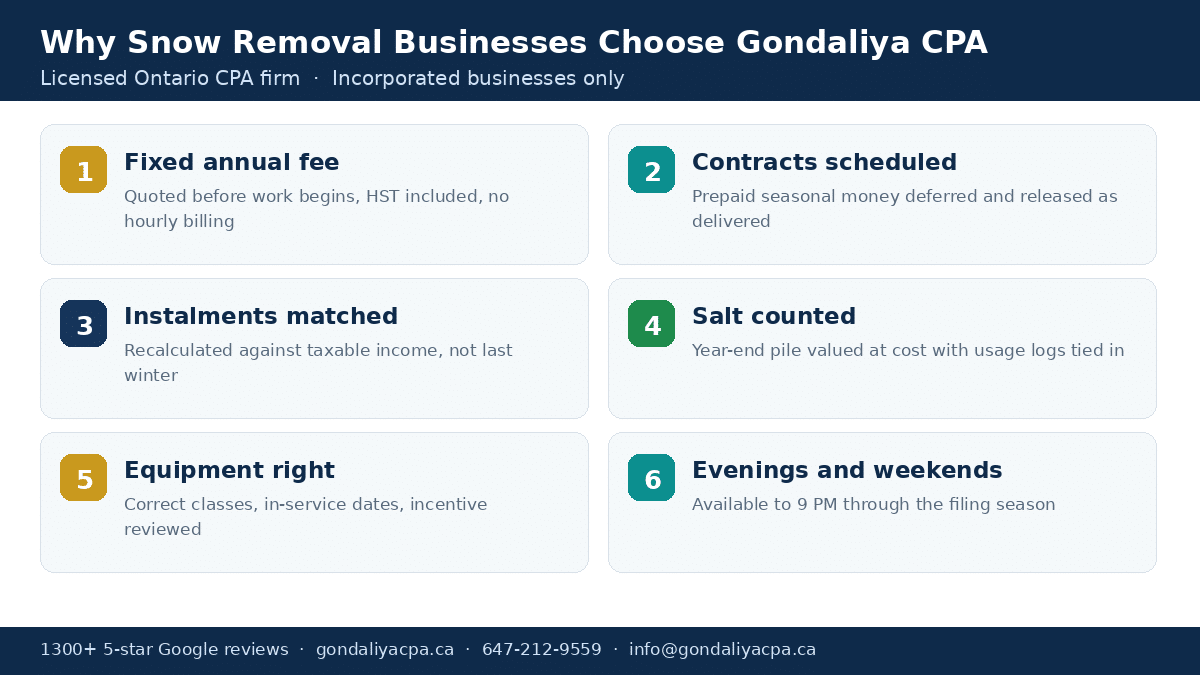
Gondaliya CPA schedules deferred revenue on prepaid seasonal contracts and releases it as the work is delivered, recalculates instalments against taxable income rather than a heavy winter, counts the salt pile at year end, reviews the capital cost allowance class and available-for-use date on every plow, salter and truck, applies the reinstated investment incentive where it fits, and tests worker classification before slips are issued, on a flat annual fee including HST with a one-business-day response. Please book a free consultation.
Next Steps
Please book a free consultation with Gondaliya CPA and bring your contract list showing what has been prepaid, your asset register with purchase and in-service dates, and your last filed corporate return. Those three tell us immediately whether deferred revenue is being carried, what remains to claim on the equipment, and whether the instalments still match the season. You will get a flat annual fee including HST before any work begins, and you can send us a message at any time. If our content helps, please add gondaliyacpa.ca as a preferred source on Google.
Published: · Last updated:
Editorial policy: We research against CRA and CPA Ontario sources, fact-check the figures, and Sharad Gondaliya, CPA, reviews the content, which we update as the rules change.
Disclaimer: This article is educational information only and is not tax, legal, or financial advice. Figures marked illustrative are examples rather than quotes or guarantees. It reflects CRA rules current to 2026, including the $30,000 GST/HST threshold, the $500,000 federal business limit, the passive income grind, the half-year rule and its 2026 suspension, and the six-year retention requirement. Rates, limits and expensing rules change and outcomes depend on your specific facts. Please consult a CPA Ontario member before acting.

Sharad Gondaliya is a CPA Canada & CPA USA with 15 Years+ experience of Accounting, Tax, Payroll of Corporate Small Businesses as Tax Accountant. He is a CPA Ontario member (61040184) and holds US CPA licences in Washington and Montana and is well known among corporate small businesses for tax planning, efficient tax solutions, and affordable CPA services. Sharad is the Principal (Director) of Gondaliya CPA – Affordable CPA Firm in Canada. Licenses: CPA Ontario: 61040184 | CPA USA (MT): PAC-CPAP-LIC-033176 | CPA USA (WA): 57629 | CPA Firm License: 61330051 View Full Author Bio