



Tax Deductions for Garage Door Companies in Canada: What Business Owners Can Legally Claim
Garage Door Company Tax Deductions and Business Expenses Every Contractor Should Know – Gondaliya CPA
Garage door company tax deductions can significantly reduce your taxable income by accounting for common garage door business expenses like equipment, vehicle use, and office costs. Gondaliya CPA helps contractors identify key tax deductions for garage door contractors to keep their finances organized and compliant.
Most garage door guidance is written for sole proprietors and then handed to incorporated companies, where several of the rules work differently. Sorting out which set applies to you is the first job in garage door company accounting and tax services, and it changes the answer on vehicles, home office and owner pay alike.
Quick Summary
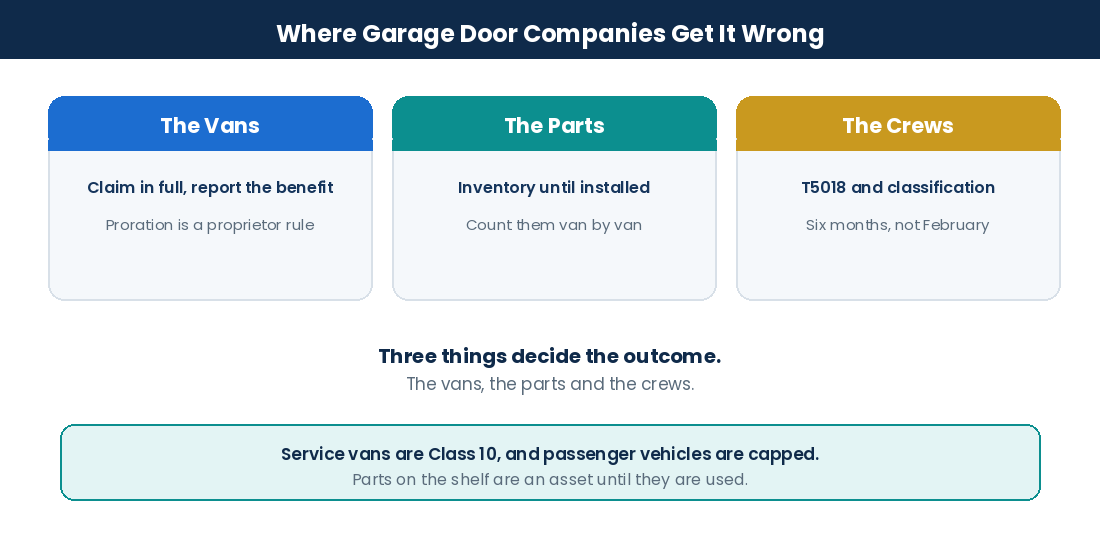
Garage door work runs on service vans, van stock and subcontract crews. The corporate rules on vehicles, the current against capital line, parts inventory and T5018 reporting account for nearly everything that goes wrong, and the vehicle point is the one most often got backwards.
Reading time: 50 minutes.
Table of Contents
- Corporation or Proprietor: Why It Changes the Answer
- Service Vans and the Rule Everyone Gets Backwards
- Tools, Equipment and the 2026 Change
- Parts, Van Stock and Inventory
- Premises, Home Office and Mixed Costs
- Crews, Callbacks and Working With Us
- Frequently Asked Questions
- The Deduction Checklist
- Garage Door Businesses We Serve
- Professional Guidance and Quick Reference
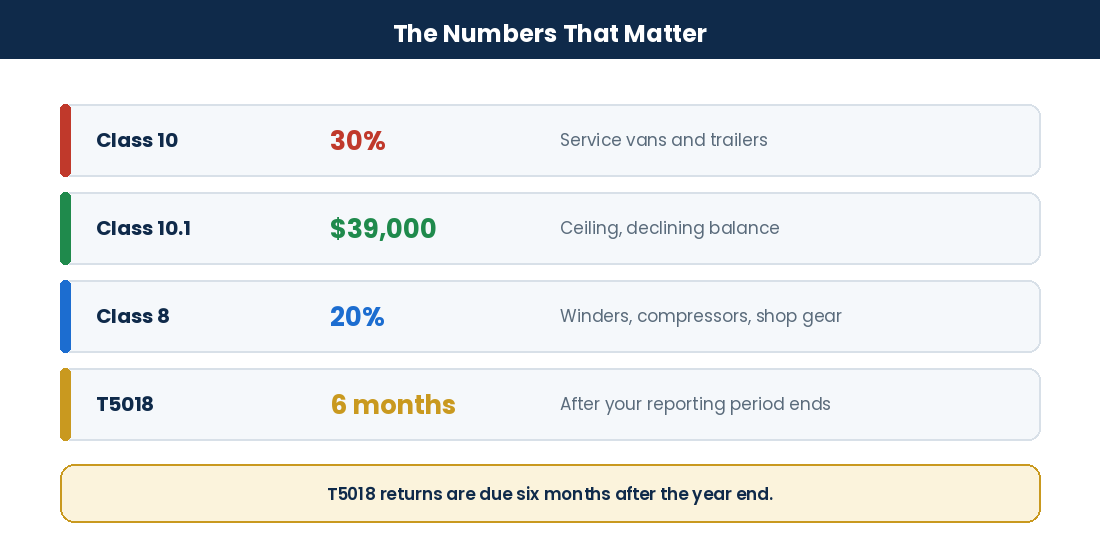
The Numbers That Matter
This article covers Canada, with Ontario and Toronto context, and reflects rules current to 2026. It applies to incorporated garage door companies including residential service and repair operators, commercial and industrial door installers, opener and automation specialists and builder-contract installers. Figures marked illustrative are examples, not quotes, and any masked engagement notes end with “Figures changed for privacy.” This is educational information only and not tax or legal advice. Trade certification, licensing and workplace safety requirements sit outside accounting scope. This article addresses Canadian tax only.
Corporation or Proprietor: Why It Changes the Answer
Corporation or Proprietor: Why It Changes the Answer
Start Here
Nearly all trade deduction guidance is written for the unincorporated operator. If you are incorporated, several of those rules do not apply to you, and applying them anyway produces claims that get adjusted.
Where the Two Diverge
| Item | Sole Proprietor | Corporation |
|---|---|---|
| Vehicle used partly personally | Prorate the claim by business use | Claim in full; report a taxable benefit |
| Home office | Workspace in the home rules apply directly | Reimbursement or rent arrangement with the owner |
| Owner’s pay | Business profit is your income | Salary or dividends, each with consequences |
| Money taken out | A drawing, no tax event | A shareholder loan with a repayment window |
| Return filed | On the personal return | T2, six months after year end |
| Tax on profit left in | Taxed to you regardless | Deferred at the corporate rate |
The vehicle line is the one that costs money, and it gets its own section because it is so consistently reversed.
What Makes an Expense Deductible
Whichever structure you use, three things have to hold:
- Purpose: Incurred to earn business income rather than for personal benefit
- Reasonableness: The amount is proportionate to what was received
- Documentation: An invoice showing what, when, from whom and how much
Reasonableness is the test contractors underestimate. A wage paid to a family member who does no work fails it however well the payment itself is documented.
Current Cost or Capital Asset
The other line that decides more than any missed deduction. A cost consumed within the year is deducted now. Property with a life beyond the year goes on the register and is written off over time.
For a garage door company that means springs, cables, rollers, lubricant and fasteners on one side, and vans, lifts, winders, compressors and shop equipment on the other.
Repairs that restore equipment are current. Work that betters it or extends its life is capital. Document what was done rather than only what it cost.
Incorporated contractors arrive using proprietor rules because that is what the trade guidance says. The vehicle treatment is where it shows up and where it costs. Figures changed for privacy.
Risk Warning: Trade guidance written for sole proprietors does not translate to a corporation. Please check which rules apply before claiming.
Service Vans and the Rule Everyone Gets Backwards
Service Vans and the Rule Everyone Gets Backwards
The Fleet
The Proration Error
Trade guidance routinely shows a calculation like this: take the capital cost allowance on the van, multiply by the business use percentage, claim the result.
That is the sole proprietor method. A corporation that owns a vehicle does not prorate. It claims the full capital cost allowance and the full operating costs, and the personal use is dealt with on the other side as a taxable benefit to whoever had the vehicle available.
Applying the proration method inside a corporation reduces the company’s deduction and usually leaves the benefit unreported as well, which is losing on both sides of the same transaction.
A company buys a $45,000 service van. Under the proprietor method quoted in trade guidance, the claim would be reduced by the personal use proportion. In the corporation, the full capital cost allowance and operating costs are claimed, and a standby charge plus operating benefit is reported on the driver’s T4. The deduction is larger, the benefit is reported, and both sides are correct. Figures changed for privacy.
Standby Charges
Where a company vehicle is available to an owner or employee for personal use, a taxable benefit arises: a standby charge based on availability, plus an operating expense benefit for costs the business paid.
The charge turns on availability rather than distance driven. A van parked at an installer’s house overnight is available, and in this trade almost every van goes home.
A logbook recording business and personal kilometres is what supports a reduced charge where business use is high. Certain clearly marked work vehicles carrying tools attract different treatment, but that depends on the vehicle and the actual use, so please confirm rather than assume.
Which Class, and Does the Ceiling Apply
| Vehicle | Class | Notes |
|---|---|---|
| Service van or cargo van used in the business | Class 10 | 30% declining balance, no ceiling if outside the passenger vehicle definition |
| Pickup used mainly to transport goods or equipment | Class 10 | Depends on configuration and business use |
| Passenger vehicle above the prescribed ceiling | Class 10.1 | 30% declining balance, capped, no recapture or terminal loss |
| Zero-emission passenger vehicle | Class 54 | Higher ceiling and enhanced first-year deduction |
| Trailers | Class 10 | 30% declining balance |
Please note Class 10.1 is declining balance at 30%, not straight-line. Guidance describing it as straight-line is wrong, and the distinction matters when you model a claim.
The 2026 Figures
| Limit | 2026 Amount |
|---|---|
| Class 10.1 capital cost ceiling | $39,000 before tax, up from $38,000 |
| Class 54 zero-emission ceiling | $61,000 before tax |
| Deductible lease cost | $1,100 per month before tax |
| Deductible loan interest | $350 per month |
| Per-kilometre allowance | 73¢ to 5,000 km, then 67¢ |
The $34,000 ceiling still quoted in contractor guidance has not applied for years. Check the figure for the year of acquisition rather than the current one.
The per-kilometre rates apply to allowances paid to an employee using their own vehicle. They are not a substitute for claiming actual costs on a vehicle the company owns.
Logbooks and Fleet Costs
- Record date, destination, purpose and kilometres for business trips
- Note opening and closing odometer readings for the year
- Keep a full-year log, or a sample period alongside a base-year log
- Fuel, insurance, maintenance, tires and licensing are deductible fleet costs
- Parking and tolls incurred on service calls are deductible
- Parking fines are not deductible, whatever the circumstances
Vans going home with installers is universal here and rarely reported. The company usually understated its own claim as well, so the correction runs both ways. Figures changed for privacy.
Risk Warning: A corporation does not prorate vehicle claims by business use. Please claim in full and report the benefit instead.
Tools, Equipment and the 2026 Change
Tools, Equipment and the 2026 Change
The Equipment
Which Class Applies
| Asset | Class | Rate |
|---|---|---|
| Spring winders, torsion bars, larger power tools | Class 8 | 20% |
| Compressors, generators, shop equipment | Class 8 | 20% |
| Shop shelving, benches, office furniture | Class 8 | 20% |
| Computers, tablets and dispatch terminals | Class 50 | 55% |
| Scheduling and quoting software | Class 12 | 100%, subject to the rules |
| Hand tools costing under $500 | Class 12 | 100% |
| Shop fit-out in leased premises | Class 13 | Over the lease term |
Two corrections to the classes commonly quoted for this trade. A compressor used on installations is ordinary equipment in Class 8; Class 43 covers manufacturing and processing machinery and does not apply to a service business. And application software sits in Class 12 rather than Class 50, which covers the hardware it runs on.
The 2026 Capital Cost Allowance Change
Bill C-15 received Royal Assent on 26 March 2026, reinstating the accelerated investment incentive. For most depreciable property acquired after 2024 and available for use before 2030, the half-year rule is effectively suspended and an enhanced first-year deduction applies, phasing down after 2029.
Certain classes are excluded, including leasehold improvements. Vehicles and equipment are within the general property covered.
This matters practically. Worked examples in trade guidance still apply the plain half-year rule, halving the first-year base before applying the rate. For property acquired after 2024 that understates the claim, and returns already filed on that basis are worth reviewing.
Available for Use
An asset only starts earning capital cost allowance once it is available for use. A van delivered in the last week of your fiscal year but not plated and in service until the following month does not help the year it was bought.
Where a purchase is timed around year end, that date matters more than the invoice date.
Repair, Replace or Rent
| Action | Treatment | Records |
|---|---|---|
| Repair restoring equipment to working order | Current expense, deducted in full | Invoice describing the work done |
| Upgrade extending life or capability | Capital, added to the class | Invoice plus the asset register entry |
| Replacement | New asset, disposal of the old | Purchase invoice and disposal record |
| Short-term equipment rental | Current expense | Rental agreement or invoice |
| Trade-in | Allowance is proceeds on the old asset | Invoice showing the trade-in value |
Trade-ins are the one contractors handle loosely. The allowance given against a new lift or van is proceeds of disposition on the old one, not a discount on the new purchase. Treating it as a discount understates both the disposal and the new asset’s cost.
Disposals and Recapture
Where proceeds exceed the remaining class balance, the excess is recaptured as income. Where a class is emptied for less than its balance, a terminal loss arises. Class 10.1 behaves differently, with neither recapture nor terminal loss.
Larger first-year deductions make recapture more likely on a later sale, because the class balance falls faster than the equipment loses value. Model the disposal rather than discovering it.
Trade-in allowances treated as a discount on the new invoice is the quiet error here. The old asset never leaves the register and the new one goes on at the wrong cost. Figures changed for privacy.
Key Stat: Bill C-15 received Royal Assent on 26 March 2026. Please do not halve the first-year base on equipment bought after 2024 without checking.
Parts, Van Stock and Inventory
Parts, Van Stock and Inventory
The Parts
Parts Are Inventory Until They Are Installed
Springs, cables, rollers, hinges, brackets, weatherseal, openers, remotes and safety sensors are inventory until installed or sold. They become a cost when consumed on a job, not when purchased from the supplier.
Contractors expense the whole purchase order, which distorts the month they stocked up and the month they worked through it. Across a year the totals converge, but every period in between is wrong and no job costing built on it means anything.
Van Stock Is the Balance Nobody Counts
Every service van carries a working inventory: assorted springs, a few openers, rollers, cables, fasteners and hardware. On a fleet of five or six vans that is a real balance sitting entirely in expenses.
- Count van stock at year end alongside the shop
- Track it by vehicle so shortfalls are traceable
- Restock from the shop with a record, not informally
- Value at cost including inbound freight
- Write off damaged or superseded parts with a reason logged
- Keep the count sheets as the support for the deduction
Counting by van has a second benefit beyond the year end. It is the only way to see whether parts are walking, which in a trade with high-value openers is worth knowing.
Special Orders and Custom Doors
Doors ordered for a specific customer raise a timing question. Where the door has been ordered and paid for by the customer in advance, the deposit is a liability until the door is installed, and the door itself is inventory until then.
Where you have ordered stock speculatively, it is simply inventory. The distinction matters where a custom order is cancelled and you are left holding a door nobody else wants, which is a write-down with evidence behind it.
Deposits Taken From Customers
A deposit on an install is not revenue. It is a liability until the work is performed, at which point it becomes revenue with the corresponding cost released.
In a business taking deposits on most installs, the balance at year end can be substantial. Recognising deposits on receipt overstates income for work not yet done and pays tax early.
Warranty Callbacks
Garage door work carries callbacks: a spring that goes early, an opener that fails, a door out of balance. The cost of returning to fix it is an ordinary business expense in the period the work is done.
Where you carry a formal warranty obligation and a provision is booked for accounting purposes, tax treats reserves differently from accounting, so the Schedule 1 reconciliation has to pick that up. The cost is deductible when incurred, not when provided for.
Bad Debts
Residential service generates uncollectible invoices. A bad debt is deductible where the amount was included in income and you have genuinely tried to collect it.
Keep the invoice, the record of collection attempts and the decision to write it off. A balance removed with none of that behind it is a deduction with no support.
Van stock across a service fleet is regularly a five-figure balance sitting in expenses. Counting by vehicle also tends to answer a question the owner had not asked. Figures changed for privacy.
Key Stat: Parts on the vans are inventory, not expense. Please count them by vehicle at year end.
Premises, Home Office and Mixed Costs
Premises, Home Office and Mixed Costs
The Overheads
Shop and Warehouse Rent
Rent on a shop, yard or warehouse used for the business is fully deductible. There is a persistent error in trade guidance suggesting you prorate rent to the portion used for parts storage, deducting only that share.
That is wrong. If you rent premises for the business, the whole rent is a business expense. Splitting by function tells you where money goes internally, but it does not reduce what you can deduct.
The proration question only arises where part of the premises is genuinely not used for the business, such as space sublet to someone else or used personally.
Utilities, Security and Waste
Electricity, heating, water, alarm monitoring and waste disposal on business premises are deductible operating costs. Where the same meter serves a personal area, apportion on a documented basis.
Leasehold improvements are different. Shelving fixed to the wall, racking, lighting and door openings cut into a leased unit are Class 13, written off over the lease term rather than expensed.
Free-standing racking you could take with you is equipment. The test is whether it is fixed to the premises.
Insurance, Licences and Fees
- General liability and completed operations cover, deductible
- Tools and equipment cover, deductible
- Commercial vehicle insurance on the fleet, deductible
- Bonding required by contracts, deductible
- Municipal business licences and trade registrations, deductible
- Association dues related to the trade, deductible
- Accounting, bookkeeping and legal fees for business matters, deductible
- Fines and penalties, not deductible under any circumstances
Legal fees follow what they were incurred for. Advice on a contract or a collection is a business cost. Personal legal work run through the company is not, even where the company paid.
Home Office for a Corporation
Where an owner runs dispatch, scheduling and paperwork from home, the analysis differs from the sole proprietor version quoted in most trade guidance.
A corporation does not claim a workspace in the home deduction in the way an individual does. The usual routes are a reimbursement of the business portion of specific costs, supported by calculation, or a formal rent arrangement between the owner and the company, which creates rental income on the personal side.
Either route needs to be set up deliberately and documented. A company that simply pays a share of the household hydro without an arrangement has made a shareholder benefit rather than a deduction.
Note also that a contractor with a shop and yard generally has their principal place of business there, which affects the analysis regardless of structure.
Phone, Internet and Software
Dispatch software, scheduling and quoting tools, cloud storage and the internet connection at the shop are business costs. Mobile phones carried by installers are business costs where supplied for the work.
A personal phone used partly for work is apportioned on a documented basis. A round percentage with nothing behind it is the claim that gets reduced.
Advertising and Lead Generation
Online advertising, directory listings, lead generation fees, vehicle wraps, signage, flyers and sponsorship are deductible where incurred to earn income.
Vehicle wraps sit on a line worth knowing. The wrap itself is advertising; where it is substantial and long-lived it may be capital. Most wraps are treated as advertising, but a significant spend is worth reviewing.
Shop rent prorated down to the storage bay is an error we see repeatedly, and it costs the contractor money for no reason. The whole rent is a business expense. Figures changed for privacy.
Pro Tip: Please do not prorate business premises rent by function. The full amount is deductible where the premises are used for the business.
Crews, Callbacks and Working With Gondaliya CPA
Crews, Callbacks and Working With Us
The Compliance
T5018 and the February Myth
Where your primary source of business income is construction activity, payments to subcontractors for construction services are reported on a T5018 information return.
Trade guidance says the deadline is 28 February. It is not. The return is due within six months of the end of the reporting period you have chosen, which may be the calendar year or your fiscal period, applied consistently. February is the T4 deadline for employees, and the two get conflated.
A reporting threshold applies per subcontractor, and payments purely for goods are excluded. Where an invoice covers both a door and its installation, the construction services portion is reportable, so ask subcontractors to split their invoices.
Our guide to T5018 filing requirements covers the mechanics in full.
Employee or Subcontractor
Garage door firms run installers who look like employees and invoice like contractors. The classification is decided by the working relationship, not the invoice.
- Control: Who dispatches the work and sets the schedule
- Tools: Who supplies the van, the tools and the parts
- Chance of profit and risk of loss: Whether the worker carries real financial exposure
- Integration: How embedded the worker is in your operation
An installer running your dispatch, in your van, fitting your parts, on calls you booked, is an employee whatever the invoice says. Misclassification means the CRA can assess the source deductions that should have been withheld, plus penalties and interest, with directors personally exposed.
Wages, Family and Safety Gear
Wages, employer CPP and EI, accrued vacation pay and genuine performance bonuses are deductible. Paying a spouse or family member for dispatch, invoicing or administration is legitimate where they do the work at a rate you would pay anyone else, supported by a timesheet and job description.
Protective equipment, safety boots required for the work, harnesses and eye protection are business costs rather than taxable benefits. Ordinary clothing is personal even when worn on site. Trade training and certification required for the work is deductible.
Builder Contracts and Holdbacks
Where you install for builders rather than homeowners, construction lien legislation applies and a statutory holdback is retained on each payment.
An amount held back under lien legislation is excluded from income until it becomes receivable. That is a real deferral written into the Act, and a garage door company doing volume builder work can carry a meaningful balance.
Keep a holdback schedule by project rather than a single figure, and apply the same treatment to holdbacks you retain from your own subcontractors.
GST/HST and Deadlines
Garage door services are taxable supplies. You must register for GST/HST once taxable revenue exceeds $30,000 across four consecutive calendar quarters. Input tax credits recover the tax on parts, vans, fuel, shop rent and professional fees, each supported by an invoice showing the registration number.
| Obligation | Deadline | If Missed |
|---|---|---|
| T2 corporate return | Six months after fiscal year-end | 5% plus 1% per complete month, to twelve |
| Balance owing | Three months for eligible CCPCs, otherwise two | Interest from the due date |
| T5018 return | Six months after your reporting period ends | Penalty by slip count |
| GST/HST return | Per your assigned reporting period | Penalty plus interest |
| Payroll remittances | Per your remitter type | Penalty and director liability |
| T4 and T4A slips | Last day of February | Penalty by slip count |
Please note GST/HST filing frequency follows your assigned reporting period rather than a fixed one-month rule after year end. Annual, quarterly and monthly filers each have different due dates.
What Draws a Review
- Vehicle claims with no logbook and no standby charge reported
- Equipment expensed in full rather than capitalised
- Subcontractor payments with no T5018 filed
- Installers on T5018 slips who look like employees
- Parts expensed with no inventory balance at year end
- Customer deposits recognised as revenue
- Personal spending in the accounts and a growing shareholder loan
Our CRA audit guide sets out what a review involves. Where past filings were wrong, the Voluntary Disclosures Program may reduce penalties, provided you come forward first.
How We Work With Garage Door Companies
We support incorporated companies on a flat annual fee covering bookkeeping with job costing, the asset register with the reinstated incentive reviewed, vehicle classes and standby charge calculations, van stock and shop counts, customer deposits and holdback schedules, warranty and bad debt treatment, T5018 preparation on the correct deadline, worker classification review, payroll and slips, GST/HST filing, financial statements and the corporate return.
Pricing is quoted before any work begins, including HST, with a one-business-day response.
Getting Started
Bring three things: your vehicle and equipment purchase invoices, a sample of subcontractor invoices, and your last filed corporate return. Those show us whether the vehicle treatment is right, whether T5018 is being handled, and what needs fixing.
Contact Gondaliya CPA at info@gondaliyacpa.ca, call 647-212-9559, or send us a message.
Vehicle invoices and a few subcontractor bills settle a garage door file quickly. They show the proration error and the T5018 exposure in the same sitting. Figures changed for privacy.
Pro Tip: Please diarise T5018 from your reporting period end, not from February. The two deadlines are four months apart.
FAQs on Garage Door Company Tax Deductions
Frequently Asked Questions
FAQ
Do I prorate my van claim by business use?+
Not if you are incorporated. A corporation claims the full capital cost allowance and operating costs, and reports the personal use as a taxable benefit. Proration is the sole proprietor method.
What is the passenger vehicle ceiling for 2026?+
$39,000 before tax under Class 10.1, up from $38,000 in 2025. The $34,000 figure in older contractor guidance is out of date.
Does the ceiling apply to my service vans?+
Often not. A cargo or service van used to carry goods and equipment may fall outside the passenger vehicle definition, in which case it sits in Class 10 with no cap. The analysis is fact-specific.
Is Class 10.1 straight-line or declining balance?+
Declining balance at 30%, the same rate as Class 10. Guidance describing it as straight-line is wrong. What differs is the cap and the absence of recapture or terminal loss.
When does a van going home create a taxable benefit?+
When the vehicle is available for personal use. The standby charge turns on availability rather than distance, plus an operating benefit for costs the business paid.
Which class covers a compressor?+
Class 8 at 20% for a service business. Class 43 covers manufacturing and processing machinery and does not apply to garage door installation.
Did the capital cost allowance rules change in 2026?+
Yes. Bill C-15 received Royal Assent on 26 March 2026, reinstating the accelerated investment incentive with an enhanced first-year deduction for most property acquired after 2024.
How is a trade-in treated?+
The allowance is proceeds of disposition on the old asset, not a discount on the new one. Treating it as a discount understates both the disposal and the new asset’s cost.
Are parts an expense when I buy them?+
No. Springs, openers, rollers and hardware are inventory until installed or sold. Count shop stock and van stock at year end.
Do I have to count stock on the vans?+
Yes. Parts carried on service vehicles are inventory. Across a fleet it is regularly a five-figure balance sitting in expenses.
Are customer deposits revenue?+
No. A deposit on an install is a liability until the work is performed, at which point it becomes revenue with the cost released.
Can I deduct warranty callback costs?+
Yes, in the period the work is done. A provision booked for accounting is treated differently for tax, so the reconciliation has to pick that up.
When can I write off a bad debt?+
Where the amount was included in income and you have genuinely tried to collect. Keep the invoice, the collection record and the write-off decision.
Do I prorate shop rent to the storage area?+
No. Rent on premises used for the business is fully deductible. Proration only arises where part of the premises is genuinely not used for the business.
When is the T5018 return due?+
Six months after the end of your chosen reporting period, which may be the calendar year or your fiscal period. It is not the end of February, which is the T4 deadline.
How does a corporation claim a home office?+
Not the way an individual does. The usual routes are a documented reimbursement of the business portion of specific costs, or a formal rent arrangement that creates rental income personally.
Sixteen questions and one underneath most of them: are you applying corporate rules or proprietor rules. Get that wrong and the vehicle claim goes wrong with it. Figures changed for privacy.
The Garage Door Company Deduction Checklist
The Deduction Checklist
Quick Reference
Vehicles and Equipment
- Claim vehicle costs in full in the corporation, then report the benefit.
- Do not apply the sole proprietor proration method inside a company.
- Use the $39,000 Class 10.1 ceiling for 2026 acquisitions.
- Check whether your vans fall outside the passenger vehicle definition.
- Treat Class 10.1 as declining balance at 30%, not straight-line.
- Keep logbooks with date, destination, purpose and kilometres.
- Report standby charges and operating benefits on the T4.
- Put compressors and shop equipment in Class 8, not Class 43.
- Claim hand tools under $500 through Class 12.
- Review whether the reinstated investment incentive applies to recent purchases.
- Record trade-in allowances as proceeds, not as a discount.
Parts and Revenue
- Treat springs, openers and hardware as inventory until installed.
- Count van stock by vehicle at year end alongside the shop.
- Value stock at cost including inbound freight.
- Write off damaged or superseded parts with a reason logged.
- Hold customer deposits as a liability until the work is performed.
- Deduct warranty callback costs in the period the work is done.
- Support bad debt write-offs with collection evidence.
- Keep a holdback schedule by project on builder contracts.
Premises, People and Filing
- Deduct business premises rent in full rather than prorating by function.
- Put fixed shelving and racking into Class 13 over the lease term.
- Set up any home office arrangement deliberately and document it.
- Apportion personal phone use on a documented basis.
- File T5018 within six months of your reporting period end, not February.
- Test each installer against control, tools, risk and integration.
- Support family wages with timesheets and a job description.
- Deduct protective equipment and required trade training.
- Never claim fines or penalties.
- Keep six years of records including logs, count sheets and the register.
For help with your company’s deductions, contact Gondaliya CPA at info@gondaliyacpa.ca, call 647-212-9559, or book a free consultation.
Twenty-nine points and one underneath them: use the rules that match your structure. Half the corrections we make on these files come from proprietor guidance applied to a company. Figures changed for privacy.
Garage Door Businesses We Serve
Industry Expertise
Which issue dominates differs by the operation. Here are ten and the usual focus.
| Garage Door Business | Where the Deductions Concentrate |
|---|---|
| Residential service and repair | Van stock and vehicle treatment |
| New install specialist | Customer deposits and parts inventory |
| Commercial and industrial doors | Equipment classes and larger tooling |
| Opener and automation specialist | High-value stock carried on the vans |
| Builder contract installer | Statutory holdbacks and revenue timing |
| Owner-operator with one van | The proration error and standby charge |
| Multi-van fleet | Benefits across the crew and logbooks |
| Firm using subcontract installers | T5018 and classification |
| Recently re-equipped shop | The reinstated investment incentive |
| Behind on the books | Classification settled before returns |
- Residential service and repair: Parts on the van are still inventory.
- New install specialist: A deposit is a liability, not a sale.
- Commercial and industrial doors: Bigger tooling belongs on the register.
- Opener and automation specialist: High-value stock is worth counting by vehicle.
- Builder contract installer: Holdback is not income until receivable.
- Owner-operator with one van: Corporations do not prorate.
- Multi-van fleet: Availability triggers the benefit, not mileage.
- Firm using subcontract installers: Six months, not the end of February.
- Recently re-equipped shop: A larger first-year claim may be available.
- Behind on the books: Fix the classification first or file twice.
The operation changes where the deductions concentrate. It does not change the method, which is use the rules that match your structure, classify the spend correctly, then count what is on the vans. Figures changed for privacy.
Professional Guidance and Quick Reference
Guidance
Professional Guidance for Contractors: How Gondaliya CPA Handles Your File
Garage door companies lose money in a predictable set of ways: applying the sole proprietor proration method to a corporate vehicle so the company understates its own claim and leaves the benefit unreported, using a vehicle ceiling that has not applied for years, treating Class 10.1 as straight-line, putting compressors in a manufacturing class, recording trade-in allowances as a discount rather than proceeds, expensing parts that are still sitting on the vans, recognising customer deposits as revenue, prorating shop rent down to the storage bay, and filing T5018 in February when the deadline is six months after the reporting period ends. Gondaliya CPA handles garage door company accounting on a fixed annual fee.
We handle what decides the outcome: applying the corporate rules on vehicles and calculating standby charges properly, using the current ceilings and confirming whether your vans fall outside the passenger vehicle definition, maintaining the asset register with the right classes and checking the reinstated incentive, recording trade-ins as disposals, counting van stock by vehicle, holding customer deposits as liabilities, keeping a holdback schedule on builder work, and preparing T5018 on the correct period and deadline.
Our team starts with your vehicle invoices and a handful of subcontractor bills, because those two show the proration error and the T5018 exposure in the same sitting. Residential service, commercial install or builder contracts, you get clear advice and a fixed price before we start.
Quick Answers
- Corporate vehicles: Claim in full, report the benefit
- Class 10.1: $39,000 ceiling, declining balance
- Service vans: Often outside the passenger definition
- Compressors: Class 8, not Class 43
- Tools under $500: Class 12 at 100%
- Trade-ins: Proceeds, not a discount
- Parts on vans: Inventory until installed
- Customer deposits: A liability until the work is done
- T5018: Six months after your period ends
- Records: Six years retention
Who This Is For
- For: Incorporated garage door companies including residential service and repair operators, commercial and industrial door installers, opener specialists and builder-contract installers across Canada.
- Not For: Unincorporated operators, whose vehicle and home office rules differ substantially, and trade certification, licensing and workplace safety requirements.
People Also Ask
Are holdbacks on builder contracts taxable when invoiced?+
No. An amount held back under construction lien legislation is excluded from income until it becomes receivable. Keep a schedule by project.
Is a vehicle wrap advertising or capital?+
Most wraps are treated as advertising and deducted. A substantial, long-lived spend may be capital, so a significant amount is worth reviewing.
Are safety boots a taxable benefit?+
No, where required for the work. Protective equipment is a business cost. Ordinary clothing is personal even when worn on site.
Glossary of Key Terms
- T2: The corporation income tax return.
- Current expense: A cost deducted in full in the year incurred.
- Capital asset: Property with a life beyond the year, written off over time.
- Capital cost allowance: Tax depreciation on equipment and vehicles.
- Class 8: The 20 percent class covering tools and shop equipment.
- Class 10: The 30 percent class covering vans and trailers.
- Class 10.1: A capped class for each vehicle above the ceiling.
- Class 12: The 100 percent class covering low-cost tools.
- Passenger vehicle: A defined class of vehicle subject to the cost ceiling.
- Standby charge: The taxable benefit from a vehicle being available.
- Accelerated investment incentive: The enhanced first-year deduction reinstated in 2026.
- Recapture: Income arising where proceeds exceed the class balance.
- Van stock: Parts carried on service vehicles, which are inventory.
- Customer deposit: Money held as a liability until the work is performed.
- Statutory holdback: The amount retained under construction lien legislation.
- T5018: The contract payment information return for construction.
Garage Door Company Readiness Check
This quick self-check indicates where your operation most likely has room. Please answer the six questions below.
Garage Door Company Readiness Check
Six quick questions on your company. No fee shown.
Points to raise with us:
This is a general prompt, not tax or legal advice or a quote. Your position depends on your full facts. For a real review, please book a free consultation.
Want a checklist to work from? You can download our free garage door company deduction checklist before your consultation.
Claim vehicle costs in full in the corporation and report the benefit rather than prorating. Use the current ceiling and check whether your vans fall outside the passenger definition. Put equipment on the register with the right class. Review the reinstated incentive on anything bought after 2024. Count van stock by vehicle. Hold customer deposits as liabilities. File T5018 six months after your period ends. Please keep six years of records.
2026 Update — what is current: This article reflects rules current to 2026. The $30,000 GST/HST registration threshold, the Class 8 rate of 20%, the Class 10 rate of 30%, the $500 Class 12 tool threshold, the six-month T2 filing deadline, the 5% plus 1% per month late-filing penalty, the end-of-February T4 slip deadline and the six-year retention requirement are unchanged. The Class 10.1 capital cost ceiling rose to $39,000 before tax for vehicles acquired on or after 1 January 2026, up from $38,000 in 2025, with the Class 54 zero-emission ceiling at $61,000, deductible lease cost at $1,100 per month and deductible interest at $350 per month. Bill C-15 received Royal Assent on 26 March 2026, reinstating the accelerated investment incentive for most depreciable property acquired after 2024 and available for use before 2030. Please note that a corporation claims vehicle costs in full and reports a taxable benefit rather than prorating by business use, which is the sole proprietor method; that Class 10.1 is declining balance at 30% rather than straight-line; that a compressor used in a service business is Class 8 rather than the manufacturing and processing Class 43; that the T5018 return is due six months after the end of your chosen reporting period rather than at the end of February; and that GST/HST filing dates follow your assigned reporting period rather than a fixed one month after year end.
Garage Door Company Tax Deductions Canada: How Gondaliya CPA Supports Contractors
Start with the vehicle invoices
Gondaliya CPA applies the corporate rules on vehicles and calculates standby charges properly, uses the current ceilings and confirms whether your vans fall outside the passenger vehicle definition, maintains the asset register with the right classes and checks the reinstated investment incentive, records trade-ins as disposals, counts van stock by vehicle, holds customer deposits as liabilities, keeps a holdback schedule on builder work and prepares T5018 on the correct period and deadline, on a flat annual fee including HST with a one-business-day response. Please book a free consultation.
Next Steps
Please book a free consultation with Gondaliya CPA and bring your vehicle and equipment purchase invoices, a sample of subcontractor invoices, and your last filed corporate return. Those three tell us immediately whether the vehicle treatment is right, whether T5018 is being handled, and what remains to claim on the equipment, and where the documentation is thin. You will get a flat annual fee including HST before any work begins. If our content helps, please add gondaliyacpa.ca as a preferred source on Google.
Published: · Last updated:
Editorial policy: We research against CRA and CPA Ontario sources, fact-check the figures, and Sharad Gondaliya, CPA, reviews the content, which we update as the rules change.
Disclaimer: This article is educational information only and is not tax, legal, or financial advice. Figures marked illustrative are examples rather than quotes or guarantees. It reflects CRA rules current to 2026, including the $30,000 GST/HST threshold, the Class 8 rate, Class 13 leasehold treatment, the half-year rule, and the six-year retention requirement. Rates, limits and expensing rules change and outcomes depend on your specific facts. Please consult a licensed CPA before acting.

Sharad Gondaliya is a CPA Canada & CPA USA with 15 Years+ experience of Accounting, Tax, Payroll of Corporate Small Businesses as Tax Accountant. He is fully certified CPA Ontario and CPA USA and is well known among corporate small businesses for tax planning, efficient tax solutions, and affordable CPA services. Sharad is the Principal (Director) of Gondaliya CPA – Affordable CPA Firm in Canada. Licenses: CPA Ontario: 61040184 | CPA USA (MT): PAC-CPAP-LIC-033176 | CPA USA (WA): 57629 | CPA Firm License: 61330051 View Full Author Bio