



How Specialized Haulers in Canada Can Reduce Taxes and Improve Cash Flow With Strategic Tax Planning
Specialized Hauler Tax Planning Canada: Heavy Haul Tax Strategies and Transport Tax Accountant Insights by Gondaliya CPA
Specialized hauler tax planning Canada helps businesses reduce hauling business taxes through effective heavy haul tax strategies and insights from a specialized transport tax accountant at Gondaliya CPA. This includes capital cost allowance for heavy equipment, fuel tax planning, and commercial vehicle tax strategies designed to improve specialized transport cash flow.
Two things in this sector are worth more than everything else combined: putting your tractors in the right class, and knowing that long-haul drivers do not use the ordinary meal limitation. Specialized hauler accounting and tax services start with both.
Quick Summary
Heavy haul tax planning turns on four things: classifying tractors and trailers correctly, timing acquisitions around the available-for-use test, claiming the enhanced meal rate long-haul drivers are entitled to, and handling freight sales tax and fuel reporting properly.
Reading time: 52 minutes.
Table of Contents
- Your Equipment Is Probably in the Wrong Class
- Timing, and the 2026 Expensing Reality
- Drivers, Meals and the 80% Rule
- Fuel, Distance and Interjurisdictional Reporting
- GST/HST on Freight, Interlining and Recharges
- Structure, Loans and Working With Us
- Frequently Asked Questions
- The Heavy Haul Planning Checklist
- Hauling Businesses We Serve
- Professional Guidance and Quick Reference
The Numbers That Matter
This article covers Canada, with Ontario and Toronto context, and reflects rules current to 2026. It applies to incorporated specialized haulers including heavy haul and oversized load carriers, flatbed, lowboy and step-deck operators, machinery movers and general freight fleets. Figures marked illustrative are examples, not quotes, and any masked engagement notes end with “Figures changed for privacy.” This is educational information only and not tax or legal advice. Vehicle deduction caps are indexed and set by acquisition year, so please confirm the figure for your own year. Operating authorities, safety ratings, oversize permits, escort requirements and interjurisdictional registration sit with transport regulators rather than with accounting.
Your Equipment Is Probably in the Wrong Class
Your Equipment Is Probably in the Wrong Class
The Classification
Where the Guidance Goes Wrong
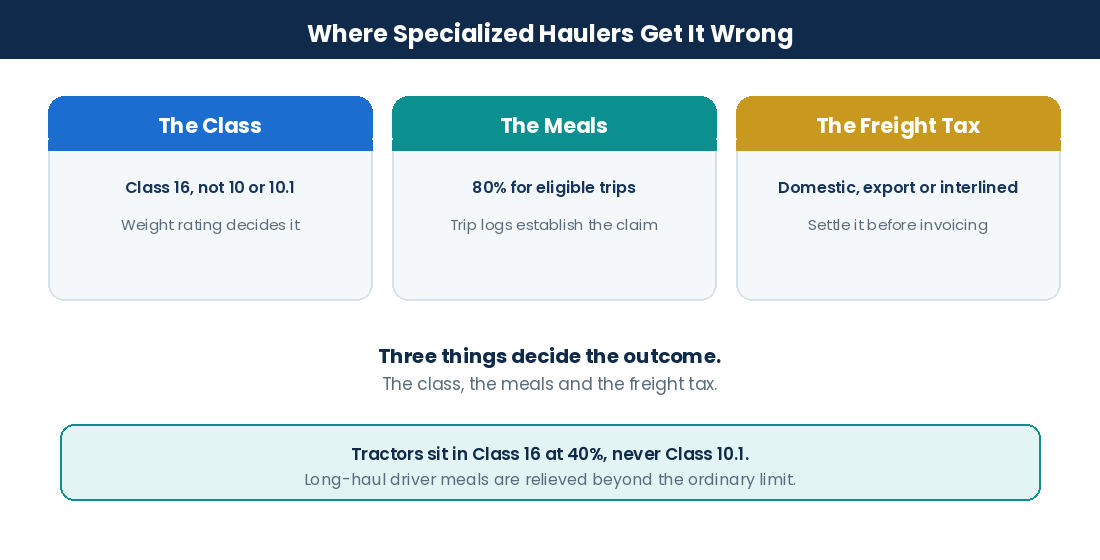
A great deal of hauling tax guidance states that tractors and trailers fall into Class 10 or Class 10.1. That is wrong in both directions and it costs real money.
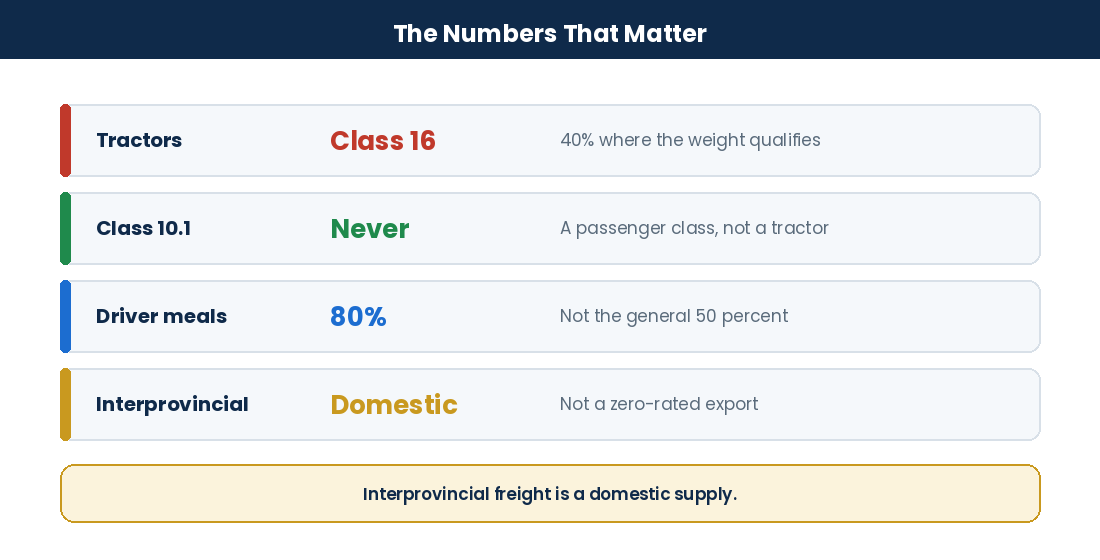
Class 10.1 is for passenger vehicles. It exists to cap deductions on expensive cars. A highway tractor is not a passenger vehicle and cannot be in Class 10.1 at any price. Guidance applying a passenger vehicle cost cap to a $150,000 tractor is describing something that does not exist.
And Class 10 is often not the best answer either, because a qualifying freight truck belongs in Class 16 at a higher rate.
Where It Actually Goes
| Asset | Usual Class | Rate |
|---|---|---|
| Highway tractor above the weight threshold, hauling freight | Class 16 | 40% |
| Tractor or truck below that threshold | Class 10 | 30% |
| Trailers, lowboys, step-decks, flat decks | Class 10 | 30% |
| Rigging, chains, straps, dunnage and yard equipment | Class 8 | 20% |
| Shop tools and diagnostic equipment | Class 8 | 20% |
| Pilot cars and light service vehicles | Class 10, or 10.1 if capped | 30% |
| Telematics hardware and office computers | Class 50 | 55% |
| Shop or yard building you own | Class 1 | 4% |
Class 16 covers freight trucks above the weight threshold used in a business of transporting freight, alongside taxis and daily rental vehicles. For a heavy haul operator, most of the tractor fleet is the natural candidate.
The difference between 40% and 30% compounds across a fleet. On a $200,000 tractor the first-year gap alone is meaningful, and it repeats every year the asset is held.
The Test Is Weight and Use
- Confirm the gross vehicle weight rating against the threshold
- Confirm the vehicle is used in a business of transporting freight
- Keep the registration and specification sheet with the asset record
- Do not assume the whole fleet takes the same class; test each unit
- Note that pilot cars and light service vehicles follow different rules entirely
The pilot car point is worth flagging. A specialized hauler running escort vehicles has a genuine passenger vehicle question on those units, with the caps attached, while its tractors have none. One fleet, two entirely different regimes.
Tractors sitting in Class 10 when they qualified for Class 16 is the most common finding on a heavy haul file. Nobody checked the weight rating. Figures changed for privacy.
Risk Warning: A highway tractor can never be in Class 10.1, which is a passenger vehicle class. Please check the weight rating against Class 16 before defaulting to Class 10.
Timing, and the 2026 Expensing Reality
Timing, and the 2026 Expensing Reality
The Timing
What Immediate Expensing Actually Covers
This needs stating plainly because a good deal of circulating guidance is out of date. There was a temporary measure allowing eligible businesses to immediately expense a substantial amount of capital property per year. That measure has ended. Articles quoting a general seven-figure immediate expensing allowance for 2026 are describing something that expired.
What is current is different. Bill C-15 received Royal Assent on 26 March 2026, reinstating the accelerated investment incentive for most depreciable property acquired after 2024 and available for use before 2030, with leasehold improvements among the excluded classes. It also reinstated full immediate expensing for specific categories, principally manufacturing and processing machinery and zero-emission vehicles.
| Measure | Position for a Hauler |
|---|---|
| General immediate expensing of any capital asset | The temporary measure has ended |
| Accelerated investment incentive | Reinstated for property acquired after 2024 |
| Immediate expensing for M&P machinery | Reinstated, but a tractor is not M&P machinery |
| Enhanced treatment for zero-emission vehicles | Reinstated, phasing down over time |
| Class 16 at 40% with the incentive | The realistic lever for most heavy haul fleets |
The practical answer for a heavy haul operator is not a headline expensing number. It is correct classification into Class 16, plus the reinstated incentive lifting the first-year claim above the plain half-year rule.
Available for Use Decides the Year
Capital cost allowance begins when the asset is available for use, not when it is ordered, paid for or delivered.
For a specialized hauler this gap is real. A tractor may need a fifth wheel installed, a trailer may need a deck built or hydraulics fitted, and equipment may need safety certification before it can work. Where a purchase is timed to land in a particular year, the commissioning date is what to manage.
- Order with enough lead time for fit-out and certification before year-end
- Record the date the unit first became capable of earning revenue
- Keep the certification and inspection documents with the asset record
- Where a unit arrives late, accept the deduction falls in the following year
A hauler orders a $200,000 tractor in November and takes delivery on 20 December. Fit-out and safety certification complete on 8 January. Despite the December delivery and payment, the unit was not available for use until January, so no claim arises in the earlier year. Ordering six weeks sooner would have moved the entire first-year deduction. Figures changed for privacy.
A Worked Illustration
A qualifying tractor costing $200,000 in Class 16. Under the plain half-year rule the first-year claim is $200,000 × 40% × 50%, which is $40,000. In year two the claim is $160,000 × 40%, which is $64,000.
Where the reinstated incentive applies, the first-year claim is materially higher than $40,000 and the pool draws down faster from the outset.
Please note that examples circulating in hauling guidance showing a $150,000 tractor generating a $45,000 first-year claim “under Class 10.1” are not arithmetically or legally possible. Class 10.1 caps the cost entering the class far below $150,000, and a tractor does not belong there at all.
Recapture on Trade-Ins
Faster depreciation means the pool falls faster than the market value of well-maintained equipment. Trading a tractor above its remaining pool balance creates recapture, which is income.
A fleet replacing several units in one year can generate substantial recapture, and it is entirely predictable if anyone models it before the trade rather than discovering it on the return.
Where you are both disposing and acquiring in the same year, the additions and disposals interact within the class, which usually softens the effect. That is another argument for planning replacements together rather than one at a time.
That planning belongs before the fiscal year closes rather than at filing, since the commissioning date and the trade date are both decisions rather than reporting. Our guide to corporate year-end accounting and filings sets out what remains open at each stage.
A unit delivered in December and certified in January is the classic miss. The cheque cleared in the old year and the deduction landed in the new one. Figures changed for privacy.
Key Stat: The general immediate expensing measure has ended. Please plan around Class 16 and the reinstated incentive rather than a headline expensing figure.
Drivers, Meals and the 80% Rule
Drivers, Meals and the 80% Rule
The Sector Advantage
The Deduction Most Haulers Under-Claim
Meals and entertainment are generally limited to 50% for a business. There is a specific exception for the transport sector that a great deal of guidance misses entirely, including guidance written for haulers.
Meals and beverages consumed by a long-haul truck driver during an eligible travel period are deductible at 80%, not 50%. That is a materially better rate, and it applies to the exact circumstance a specialized hauler operates in every week.
| Condition | What It Means |
|---|---|
| Long-haul truck | A vehicle designed to haul freight, above the weight threshold |
| Long-haul truck driver | An employee whose main duty is driving such a truck to transport goods |
| Eligible travel period | A period of at least 24 hours away, transporting goods beyond a set radius from the home terminal |
| Rate | 80% of eligible meal costs |
| Records | Trip logs establishing the period, distance and destination |
The conditions are specific and the records matter. What establishes the claim is the trip log showing the driver was away for the required period, transporting goods beyond the required distance from the terminal.
Please have your own drivers and routes tested against the conditions rather than assuming the enhanced rate applies to every trip. A local delivery run does not qualify; a multi-day interprovincial haul commonly does.
Claiming Meals Without Every Receipt
There is a simplified method allowing a flat amount per meal to be claimed without keeping every receipt, subject to keeping the travel records that establish the trip.
The flat amount is set by the CRA and changes, so please confirm the current figure rather than relying on one quoted in an article. The trade-off is straightforward: the simplified method is easier to administer, while the detailed method with receipts can be worth more where actual costs run higher.
Either way the travel log is doing the work. Without it, neither method holds up.
Employee or Owner-Operator
Owner-operators are common in specialized hauling and classification is where the largest exposure sits.
The test looks at control over how the work is done, who supplies the tractor and equipment, whether the driver carries a chance of profit and risk of loss, and how integrated they are in your operation. An owner-operator supplying their own tractor, choosing loads and carrying commercial risk looks quite different from a driver running your equipment on your dispatch.
Misclassification means the CRA can assess the source deductions that should have been withheld, plus penalties and interest, and directors are personally liable for unremitted source deductions.
Driver Costs and Allowances
- Wages, employer contributions and accrued vacation are deductible
- Reasonable travel allowances may be non-taxable to the driver where the conditions are met
- Lodging on the road is deductible in full; it is the meals that carry a limitation
- Safety equipment, licensing and medical certification costs are deductible
- Training and endorsements required for the work are deductible
- Where a driver takes a company vehicle home, a taxable benefit can arise
Note the lodging point, which is regularly confused. Accommodation is not subject to the meal limitation. Only food and beverage is.
The 80% long-haul meal rate is the most under-claimed item in this sector. Fleets apply 50% because that is what general guidance says. Figures changed for privacy.
Key Stat: Eligible long-haul driver meals are deductible at 80%, not the general 50%. Please check whether your trips meet the conditions.
Fuel, Distance and Interjurisdictional Reporting
Fuel, Distance and Interjurisdictional Reporting
The Fuel
Two Separate Systems
Fuel reporting and income tax are different regimes, and confusing them creates unnecessary work.
| System | What It Does | Who Administers It |
|---|---|---|
| Interjurisdictional fuel tax reporting | Allocates fuel tax between jurisdictions travelled | Your base jurisdiction and member authorities |
| Apportioned vehicle registration | Allocates registration fees by distance travelled | The registration authority |
| Income tax | Deducts fuel as a business cost | The CRA |
| GST/HST | Recovers tax paid on fuel through credits | The CRA |
The fuel tax and registration systems reallocate amounts between jurisdictions. They do not change what you deduct for income tax, and a balance owing or refund under them is not itself a tax deduction or income item in the ordinary sense.
Their real value to your accounting is the data. Distance by jurisdiction and fuel by unit is exactly what an income tax reconciliation needs, so the reporting you already do supports the tax file if the records are kept together.
Getting the Records Right Once
- Capture distance by jurisdiction from telematics or driver logs
- Capture fuel purchases by unit, with jurisdiction and volume
- Reconcile fuel purchased against distance travelled monthly
- Keep receipts or card statements supporting every purchase
- Match trip records to the loads and invoices they relate to
- File on the required schedule; late filing carries its own penalties
The monthly reconciliation is the one worth building in. Fuel consumption that does not track distance is the first thing tested on a transport audit, and it is also how a fleet finds a card being used off-unit.
Cross-Border Operations
Running into the United States adds currency to the picture. Fuel bought in US dollars is recorded at the rate on the transaction date, and the payable is translated at period end if still outstanding.
Where you invoice in US dollars, the same applies to receivables. Note that inventory and non-monetary items are not retranslated; only monetary balances are.
Cross-border work can also raise questions about taxable presence in the other jurisdiction, particularly where you maintain a terminal, yard or staff there. Occasional trips generally do not create a presence; a facility can. That is a question worth answering before it becomes a filing obligation you did not know about.
Fuel and Carbon Costs
Fuel costs, including any carbon or emissions charges embedded in the price, are ordinary deductible business costs. Some relief and rebate programmes have existed for particular sectors and jurisdictions, and they change, so please confirm what currently applies to your operation rather than relying on a general statement.
Track the components separately in the ledger where your supplier itemises them. It costs nothing at the time and makes any future claim straightforward.
Fleets treat fuel tax filing and income tax as one exercise. They are separate, but the distance and fuel data serves both if it is captured once, properly. Figures changed for privacy.
Pro Tip: Please reconcile fuel to distance monthly by unit. It is the first thing tested on a transport audit and it catches card misuse.
GST/HST on Freight, Interlining and Recharges
GST/HST on Freight, Interlining and Recharges
The Sales Tax
Domestic Against International Freight
| Movement | General Position |
|---|---|
| Freight moving entirely within Canada | Taxable, on the destination rules |
| Freight from Canada to a destination outside Canada | Generally zero-rated as international freight |
| Freight from outside Canada into Canada | Generally zero-rated as international freight |
| A domestic leg forming part of a continuous international movement | May be zero-rated where the conditions and documentation are met |
| Freight moving between two provinces | Domestic and taxable, not an export |
The fourth row is where documentation earns its place. A domestic leg can qualify as part of a continuous international movement, but it depends on the arrangement and on holding the evidence, including the shipper’s declaration where required.
The fifth row is a common misunderstanding. Hauling from Ontario to Alberta is a domestic taxable supply, not an export. Zero-rating for international freight is about leaving the country, not crossing a provincial line.
Interlining
Where more than one carrier moves a single shipment under a continuous freight arrangement, specific interlining rules apply so the shipment is not taxed repeatedly through the chain.
Broadly, where you are not the invoicing carrier, the service you supply to the other carrier can fall outside the ordinary treatment. Getting this wrong means either charging tax on a movement that should not carry it, or failing to charge where you were the invoicing carrier.
Specialized haulers frequently interline, since an oversized move can involve multiple carriers and specialist equipment. Establish in writing which carrier is invoicing the shipper before the load moves, because that determines the treatment.
Permits, Escorts and Recharges
Oversized work generates costs that get billed on to the customer: permits, pilot cars, escorts, route surveys, engineering assessments and sometimes police escorts.
- Where you incur the cost and rebill it, it is generally your expense and your revenue
- The recharge normally follows the tax treatment of the freight service it relates to
- Simply passing through a cost does not automatically make it tax-free
- Keep the underlying invoice and the customer contract showing the arrangement
- Where you are acting purely as agent, the treatment differs and the agency must be documented
The agency point matters. Recording a recharge net when you were acting as principal understates revenue and cost by the same amount, which distorts every ratio without changing profit.
Credits and Filing
Input tax credits recover tax on fuel, repairs, parts, equipment, insurance where taxable, permits and professional fees, each supported by an invoice showing the supplier’s registration number.
A carrier with substantial zero-rated international freight collects little tax while paying it on costs, which puts it in a refund position. Where that is your situation, filing more frequently releases working capital rather than leaving it with the government.
Your reporting period is assigned on taxable supplies, and you can generally elect a more frequent period. For a refund business that election is usually worth making.
Interlined moves taxed twice, or not at all, is a recurring finding. Nobody had established in writing which carrier was invoicing the shipper. Figures changed for privacy.
Risk Warning: An interprovincial haul is domestic and taxable, not an export. Please reserve zero-rating for freight genuinely leaving Canada.
Structure, Loans and Working With Gondaliya CPA
Structure, Loans and Working With Us
The Structure
Separating Equipment From Operations
Holding the fleet in one company and running operations through another is common in this sector, usually for asset protection and financing reasons.
The tax consequence needs understanding before it is done. Where two corporations are associated, they share one $500,000 federal business limit between them rather than each having their own. Association turns on control and share ownership, including through family members, not on whether the businesses are commercially separate.
- Confirm the association position before incorporating a second company
- File an allocation agreement dividing the limit where they are associated
- Document any lease or rental arrangement between the companies
- Set inter-company rates at a reasonable level and apply them consistently
- Remember the taxable capital and passive income grinds are measured across the group
Owners who incorporate a second company expecting a second $500,000 are usually mistaken. The structure can still be the right decision for commercial reasons; it simply should not be done on a tax expectation that does not hold.
Shareholder Loans
Money taken from the company that is neither salary nor dividend builds a shareholder loan. If it is not repaid within the period the Act allows, generally by the end of the taxation year following the one in which it arose, it can be included in your personal income.
Note that this is not a flat “one year” window, which is how it is often described. Depending on when in the year the advance was made, the actual period can be close to two years. It is still a hard, dated deadline, and it is worth knowing the real one.
A deemed interest benefit can also arise on an outstanding balance, and repaying then immediately re-borrowing can be challenged.
Where past returns were filed on the wrong classification or missed the enhanced meal rate, amending is generally straightforward. Where something was reported incorrectly in a way that carries a penalty, the Voluntary Disclosures Program may help, provided you come forward before the CRA raises it.
Deadlines
| Obligation | Deadline | If Missed |
|---|---|---|
| T2 corporate return | Six months after fiscal year-end | 5% of the unpaid tax plus 1% per complete month, to twelve |
| Balance owing | Three months for an eligible CCPC, otherwise two | Interest from the due date |
| Corporate instalments | Monthly, or quarterly for an eligible CCPC | Instalment interest |
| GST/HST return | Per your assigned reporting period | Penalty plus interest |
| Payroll remittances | Per your remitter type | Penalty and director liability |
| T4 and T4A slips | Last day of February | Penalty by slip count |
Please note the late-filing penalty is a percentage of the unpaid tax, not a flat dollar amount. Guidance describing a fixed opening fee plus daily charges is not describing the corporate late-filing penalty.
What Draws a Review
- Fuel claims that do not track distance travelled
- Tractors classified inconsistently across the fleet
- Zero-rated freight with no evidence of international movement
- Owner-operators who look like employees
- Meal claims with no trip logs behind them
- Recharges recorded net where you acted as principal
- Personal spending in the accounts and a growing shareholder loan
Our CRA audit guide covers what a review involves. General freight operators may also want our trucking company accounting services.
How We Work With Specialized Haulers
We support incorporated haulers on a flat annual fee covering bookkeeping with fuel and distance reconciliation by unit, an asset register with each unit’s class and its basis documented, capital cost allowance with the reinstated incentive applied, recapture modelling before trade-ins, the enhanced meal deduction assessed against your actual routes, GST/HST including international freight and interlining treatment, permit and escort recharge handling, owner-operator classification review, payroll and slips, financial statements and the corporate return.
Pricing is quoted before any work begins, including HST, with a one-business-day response and evening and weekend availability. Our engagements carry a 30-day money-back arrangement and a 60-day fee-matching arrangement.
Getting Started
Bring three things: your equipment list with weight ratings, costs and in-service dates, one month of fuel and trip records, and your last filed corporate return. Those show us whether the classifications hold, whether the enhanced meal rate applies, and what needs fixing.
Contact Gondaliya CPA at info@gondaliyacpa.ca, call 647-212-9559, or send us a message.
An equipment list with weight ratings answers the biggest question on a heavy haul file in about ten minutes. Most fleets have never been asked for it. Figures changed for privacy.
Pro Tip: Please confirm association before incorporating an equipment company. Two corporations share one business limit, not one each.
FAQs on Specialized Hauler Tax Planning
Frequently Asked Questions
FAQ
What class do my tractors belong in?+
A tractor above the weight threshold used to transport freight generally goes in Class 16 at 40%. Below that threshold it is Class 10 at 30%. Trailers are usually Class 10.
Can a tractor be in Class 10.1?+
No. Class 10.1 is a passenger vehicle class that exists to cap deductions on expensive cars. A highway tractor cannot be in it at any price, and guidance placing one there is simply wrong.
Is there a large immediate expensing allowance for 2026?+
Not a general one. The temporary measure allowing substantial immediate expensing of most capital property has ended. What is current is the reinstated investment incentive, plus full expensing for specific categories.
What did Bill C-15 change?+
It received Royal Assent on 26 March 2026, reinstating the accelerated investment incentive for most property acquired after 2024 and available for use before 2030, and reinstating immediate expensing for certain categories.
When does depreciation start on new equipment?+
When the unit is available for use, not when it is ordered, paid for or delivered. Fit-out and safety certification can push that into the following year.
What meal rate applies to my drivers?+
Eligible long-haul truck drivers are at 80%, not the general 50%, for meals consumed during an eligible travel period. The trip log establishes the claim.
What makes a travel period eligible?+
Broadly, at least 24 hours away from the home terminal, transporting goods beyond a set radius. Please have your own routes tested rather than assuming every trip qualifies.
Can I claim meals without every receipt?+
There is a simplified method allowing a flat amount per meal, subject to keeping the travel records. The flat amount changes, so confirm the current figure.
Is lodging subject to the meal limitation?+
No. Accommodation on the road is deductible in full. Only food and beverage carries the limitation.
Are owner-operators contractors?+
It depends on the relationship. The test looks at control, who supplies the tractor, chance of profit and risk of loss, and integration. Directors are personally liable for unremitted source deductions.
Does interjurisdictional fuel reporting change my deduction?+
No. It reallocates fuel tax between jurisdictions and operates separately from income tax. Its value to your accounting is the distance and fuel data it produces.
Is an interprovincial haul zero-rated?+
No. Freight moving between two provinces is a domestic taxable supply. Zero-rating for international freight is about leaving Canada, not crossing a provincial line.
How does interlining work for sales tax?+
Where several carriers move one shipment under a continuous freight arrangement, specific rules prevent repeated taxation. Establish in writing which carrier invoices the shipper before the load moves.
How do I treat permits and escort recharges?+
Where you incur the cost and rebill it, it is generally your expense and your revenue, following the treatment of the freight service. Recording it net when acting as principal understates both.
Will a second company give me another $500,000?+
Generally not. Associated corporations share one federal business limit. Association turns on control and share ownership, including through family members.
How long do I have to repay a shareholder loan?+
Generally until the end of the taxation year following the one in which it arose, which depending on timing can be close to two years. It is not a flat one-year window.
Sixteen questions and two underneath most of them: what class is that unit, and did the trip qualify. Those two decide most of a heavy haul file. Figures changed for privacy.
The Heavy Haul Planning Checklist
The Heavy Haul Planning Checklist
Quick Reference
Equipment and Timing
- Check every tractor’s weight rating against the Class 16 threshold.
- Never place a tractor in Class 10.1; that is a passenger vehicle class.
- Put trailers and decks in Class 10, rigging and yard gear in Class 8.
- Test pilot cars separately, since the passenger vehicle caps can apply.
- Record the weight rating and specification with each asset.
- Plan around the reinstated incentive, not a headline expensing figure.
- Date claims from availability for use, after fit-out and certification.
- Order with lead time so commissioning lands in the intended year.
- Model recapture before trading units, especially several at once.
- Plan replacements together so additions and disposals interact.
Drivers and Meals
- Test routes against the eligible travel period conditions.
- Claim 80% on eligible long-haul driver meals, not 50%.
- Keep trip logs establishing period, distance and destination.
- Choose deliberately between the simplified and detailed meal methods.
- Deduct road lodging in full; only food carries the limitation.
- Test every owner-operator against the classification factors.
- Remit source deductions on schedule; directors are personally liable.
- Report a benefit where a driver takes a company vehicle home.
Fuel, Sales Tax and Structure
- Reconcile fuel to distance monthly, by unit.
- Keep distance by jurisdiction and fuel by unit together.
- Record foreign currency purchases at the transaction date rate.
- Translate monetary balances only at period end.
- Treat interprovincial hauls as domestic and taxable.
- Hold evidence supporting any zero-rated international freight.
- Establish in writing which carrier invoices the shipper on interlined moves.
- Record permit and escort recharges gross where you act as principal.
- Consider a more frequent GST/HST period if you sit in a refund position.
- Confirm association before incorporating an equipment company.
- Diarise the real shareholder loan repayment deadline.
- Keep six years of trip logs, fuel records, permits and payroll.
For a review of your fleet’s classifications and claims, contact Gondaliya CPA at info@gondaliyacpa.ca, call 647-212-9559, or book a free consultation.
Thirty points and two underneath them: the weight rating and the trip log. Those two documents carry most of the money in specialized hauling. Figures changed for privacy.
Hauling Businesses We Serve
Industry Expertise
Which issue dominates differs by the operation. Here are ten and the usual focus.
| Hauling Business | Where the Money Concentrates |
|---|---|
| Heavy haul and oversized loads | Permit and escort recharges, and Class 16 |
| Lowboy and machinery moving | Trailer classification and recapture on trades |
| Flatbed and step-deck carriers | Rigging in Class 8 and securement equipment |
| Long-haul interprovincial freight | The enhanced driver meal rate |
| Cross-border carriers | Zero-rated freight evidence and currency |
| Carriers who interline regularly | Who invoices the shipper |
| Fleets using owner-operators | Classification and director liability |
| Operators with a separate equipment company | Association and one shared business limit |
| Fleets replacing units this year | Available for use and the reinstated incentive |
| Anyone running pilot cars | The passenger vehicle caps on those units |
- Heavy haul and oversized loads: Gross or net changes the picture.
- Lowboy and machinery moving: Fast pools mean fast recapture.
- Flatbed and step-deck carriers: Rigging is its own class.
- Long-haul interprovincial freight: 80% is not 50%.
- Cross-border carriers: Evidence, not assumption.
- Carriers who interline regularly: Settle it before the load moves.
- Fleets using owner-operators: The relationship, not the contract.
- Operators with a separate equipment company: One limit, not two.
- Fleets replacing units this year: Certification date decides the year.
- Anyone running pilot cars: Two regimes in one fleet.
The operation changes which item costs the most. It does not change the method, which is classify the equipment, test the trips, then handle the freight tax properly. Figures changed for privacy.
Professional Guidance and Quick Reference
Guidance
Professional Guidance: How Gondaliya CPA Handles Your Hauling File
Specialized haulers lose money in a predictable set of ways: leaving tractors in Class 10 when the weight rating qualified them for Class 16 at a higher rate, following guidance that places heavy equipment in Class 10.1, which is a passenger vehicle class a tractor can never occupy, planning around a general immediate expensing allowance that has since ended, claiming driver meals at the general 50% when eligible long-haul drivers qualify at 80%, treating an interprovincial haul as a zero-rated export, taking delivery in December and certifying the unit in January so the deduction lands in the wrong year, and recording permit and escort recharges net when acting as principal. Gondaliya CPA handles specialized hauler accounting on a fixed annual fee.
We handle what decides the outcome: checking every unit\u2019s weight rating against the Class 16 threshold and documenting the classification, applying the reinstated investment incentive and dating claims from availability for use, modelling recapture before trade-ins, testing routes against the eligible travel period conditions so the enhanced meal rate is claimed where it applies, reconciling fuel to distance by unit, handling international freight and interlining evidence, and reviewing association before a second corporation is formed.
Our team starts with your equipment list showing weight ratings, a month of fuel and trip records and your last filed return. Those three answer the biggest questions quickly. Heavy haul, lowboy, flatbed or general freight, you get clear advice and a fixed price before we start.
Quick Answers
- Tractors: Class 16 at 40% where they qualify
- Class 10.1: Passenger vehicles only, never a tractor
- Trailers: Class 10 at 30%
- Rigging: Class 8 at 20%
- Expensing: The general measure has ended
- Driver meals: 80% where the trip qualifies
- Lodging: Deductible in full
- Interprovincial: Domestic, not an export
- Interlining: Settle the invoicing carrier first
- Records: Six years retention
Who This Is For
- For: Incorporated specialized haulers including heavy haul and oversized load carriers, flatbed, lowboy and step-deck operators, machinery movers and general freight fleets across Canada.
- Not For: Operating authorities, safety ratings, oversize permits, escort requirements and interjurisdictional registration, which sit with transport regulators rather than with accounting.
People Also Ask
What is the corporate late-filing penalty?+
5% of the unpaid tax plus 1% per complete month outstanding, to a maximum of twelve months. It is not a flat dollar amount plus daily charges.
Should I file GST/HST more often?+
If substantial international freight puts you in a refund position, yes. Filing more frequently releases working capital instead of leaving it with the government.
Does cross-border work create a US filing obligation?+
Occasional trips generally do not create a taxable presence. A terminal, yard or staff there can. It is worth answering before it becomes a filing you did not know about.
Glossary of Key Terms
- T2: The corporation income tax return.
- Class 16: Qualifying freight trucks, taxis and rentals at 40 percent.
- Class 10: Motor vehicles and trailers at 30 percent.
- Class 10.1: Capped passenger vehicles, never a heavy tractor.
- Class 8: Rigging, shop and yard equipment at 20 percent.
- Available for use: When an asset becomes eligible for depreciation.
- Recapture: Income arising where proceeds exceed the pool balance.
- Long-haul truck driver: A driver whose main duty is hauling freight by heavy truck.
- Eligible travel period: The away-from-terminal period supporting the enhanced meal rate.
- Simplified method: A flat per-meal claim supported by travel records.
- Zero-rated freight: International movement taxed at nil with credits recoverable.
- Interlining: Several carriers moving one shipment under a continuous arrangement.
- Recharge: A cost incurred and rebilled to the customer.
- Associated corporations: Companies sharing one business limit.
- Shareholder loan: Company funds used personally, taxable if not repaid in time.
- Input tax credit: Recovery of GST/HST on business costs.
Heavy Haul Planning Check
This quick self-check indicates where your operation most likely has room. Please answer the six questions below.
Heavy Haul Planning Check
Six quick questions on your operation. No fee shown.
Points to raise with us:
This is a general prompt, not tax or legal advice or a quote. Your position depends on your full facts. For a real review, please book a free consultation.
Want a checklist to work from? You can download our free heavy haul planning checklist before your consultation.
Check every tractor\u2019s weight rating against the Class 16 threshold. Never place heavy equipment in Class 10.1. Date claims from availability for use, after fit-out and certification. Claim 80% on eligible long-haul driver meals. Reconcile fuel to distance monthly by unit. Treat interprovincial hauls as domestic. Settle the invoicing carrier before an interlined load moves. Please keep six years of records.
2026 Update — what is current: This article reflects rules current to 2026. The Class 16 rate of 40%, the Class 10 rate of 30%, the Class 8 rate of 20%, the Class 50 rate of 55%, the 80% meal rate for eligible long-haul truck drivers, the six-month T2 filing deadline, the end-of-February slip deadline and the six-year retention requirement are unchanged. Bill C-15 received Royal Assent on 26 March 2026, reinstating the accelerated investment incentive for most depreciable property acquired after 2024 and available for use before 2030, together with immediate expensing for specific categories including manufacturing and processing machinery and zero-emission vehicles. Please note that the temporary general immediate expensing measure has ended, so guidance quoting a seven-figure annual expensing allowance for ordinary capital property is out of date; that Class 10.1 is a passenger vehicle class and a heavy tractor cannot be placed in it at any price; that a qualifying freight truck above the weight threshold belongs in Class 16 rather than Class 10; that eligible long-haul driver meals are deductible at 80% rather than the general 50%, while road lodging is deductible in full; that freight moving between two provinces is a domestic taxable supply rather than a zero-rated export; and that the corporate late-filing penalty is 5% of the unpaid tax plus 1% per complete month rather than a flat dollar amount with daily charges.
Specialized Hauler Tax Planning Canada: How Gondaliya CPA Supports Heavy Haul Operators
Start with the equipment list
Gondaliya CPA checks every unit\u2019s weight rating against the Class 16 threshold and documents the classification, applies the reinstated investment incentive and dates claims from availability for use, models recapture before trade-ins, tests routes against the eligible travel period conditions so the enhanced meal rate is claimed where it applies, reconciles fuel to distance by unit, handles international freight and interlining evidence and reviews association before a second corporation is formed, on a flat annual fee including HST with a one-business-day response. Please book a free consultation.
Next Steps
Please book a free consultation with Gondaliya CPA and bring your equipment list with weight ratings, costs and in-service dates, one month of fuel and trip records, and your last filed corporate return. Those three tell us whether the classifications hold, whether the enhanced meal rate applies, and what remains to claim on the equipment, and where the documentation is thin. You will get a flat annual fee including HST before any work begins. If our content helps, please add gondaliyacpa.ca as a preferred source on Google.
Published: · Last updated:
Editorial policy: We research against CRA and CPA Ontario sources, fact-check the figures, and Sharad Gondaliya, CPA, reviews the content, which we update as the rules change.
Disclaimer: This article is educational information only and is not tax, legal, or financial advice. Figures marked illustrative are examples rather than quotes or guarantees. It reflects CRA rules current to 2026, including the $30,000 GST/HST threshold, the Class 8 rate, Class 13 leasehold treatment, the half-year rule, and the six-year retention requirement. Rates, limits and expensing rules change and outcomes depend on your specific facts. Please consult a licensed CPA before acting.

Sharad Gondaliya is a CPA Canada & CPA USA with 15 Years+ experience of Accounting, Tax, Payroll of Corporate Small Businesses as Tax Accountant. He is fully certified CPA Ontario and CPA USA and is well known among corporate small businesses for tax planning, efficient tax solutions, and affordable CPA services. Sharad is the Principal (Director) of Gondaliya CPA – Affordable CPA Firm in Canada. Licenses: CPA Ontario: 61040184 | CPA USA (MT): PAC-CPAP-LIC-033176 | CPA USA (WA): 57629 | CPA Firm License: 61330051 View Full Author Bio