



Tax Deductions for Fleet Owners in Canada: What Fleet Businesses Can Legally Claim
Fleet Owner Tax Deductions Canada: Maximizing Savings on Commercial Vehicle and Fleet Business Expenses
Fleet owner tax deductions Canada can help reduce your overall tax burden by covering expenses like fuel, vehicle repairs, insurance, and fleet maintenance deductions. Gondaliya CPA guides commercial vehicle owners on maximizing savings through fleet business expenses, including lease, financing, parking, tolls, and driver expense tax deductions.
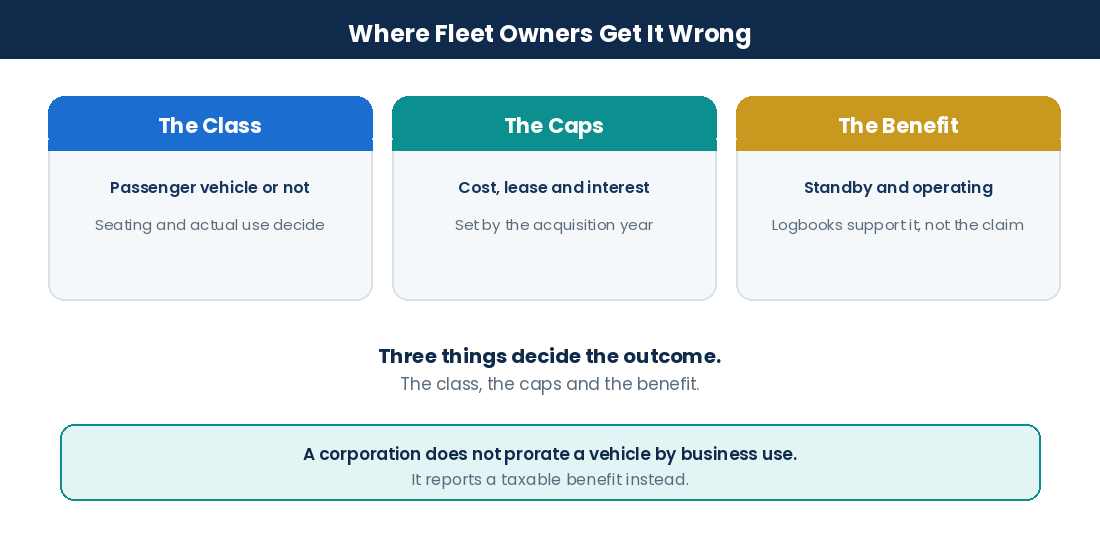
The single question that decides most of your tax position is whether a given vehicle is a passenger vehicle or not. Fleet accounting and tax services start there, because that classification controls the class, the caps and the deduction.
Quick Summary
Fleet tax turns on four things: understanding that a corporation claims in full and reports a benefit rather than prorating, classifying each vehicle correctly, knowing which of the three caps apply to it, and documenting personal use properly.
Reading time: 52 minutes.
Table of Contents
The Numbers That Matter
This article covers Canada, with Ontario and Toronto context, and reflects rules current to 2026. It applies to incorporated fleet operators including trucking companies, couriers and delivery fleets, rental and leasing operators, and service businesses running multiple vehicles. Figures marked illustrative are examples, not quotes, and any masked engagement notes end with “Figures changed for privacy.” This is educational information only and not tax or legal advice. The capital cost, lease and interest limits are indexed and set by the year a vehicle was acquired or a lease began, so please confirm the figure for your own year rather than relying on any single number quoted without a date. Operating authorities, safety certification and interjurisdictional fuel and registration programmes sit with transport regulators rather than with accounting.
A Corporation Does Not Prorate
A Corporation Does Not Prorate
The Framing
Two Different Methods
Most vehicle tax guidance describes one method: total your costs, work out a business-use percentage from a logbook, and deduct that share. That is the sole proprietor method, and applying it to an incorporated fleet produces the wrong answer.
| Question | Sole Proprietor | Corporation |
|---|---|---|
| Who owns the vehicle | The individual | The company |
| How costs are deducted | Business-use percentage of the total | In full, as company costs |
| How personal use is handled | Excluded from the claim | Reported as a taxable benefit to the driver |
| Where the benefit appears | Nowhere | On the driver’s T4 |
| What the logbook does | Sets the deductible share | Supports the benefit calculation |
The logbook still matters enormously for a corporation. It simply does a different job: rather than deciding how much you deduct, it decides how large a benefit an employee reports.
Why This Costs Money in Both Directions
Applying the proprietor method to a corporation understates the deduction, because a share of legitimate company costs is left unclaimed. It also usually means the taxable benefit was never reported, which is the CRA’s side of the same error.
So the business has deducted too little and under-reported an employee benefit at the same time, and both are corrected on assessment.
A fleet runs vehicles with roughly 85% business use and deducts 85% of operating costs, leaving around $19,000 of real company expenditure unclaimed across the year. No standby charge or operating benefit was reported for any driver. On review, the deduction was restored and benefits were assessed on the drivers for the same periods. Figures changed for privacy.
Where Vehicles Are Owned Personally
Some fleets have vehicles registered to the owner rather than the company. That is the one case where an allowance or reimbursement approach applies, and it works differently again.
- A reasonable per-kilometre allowance paid to an employee is generally not taxable to them and is deductible to the company, subject to the prescribed rate
- The prescribed rate is for employee allowances; it is not a substitute for actual costs on company-owned vehicles
- An allowance that is not reasonable, or that is combined with reimbursing actual costs, can become taxable
- Where the company pays costs on a personally owned vehicle without an allowance structure, a benefit generally arises
Decide deliberately which model each vehicle sits in. A fleet running both arrangements without documenting which is which creates avoidable confusion at year-end.
Fleets applying a business-use percentage to company-owned vehicles is the most common structural error we see. It costs a deduction and creates an unreported benefit at once. Figures changed for privacy.
Risk Warning: A corporation claims vehicle costs in full and reports a benefit. Please do not apply the sole proprietor percentage method to company-owned vehicles.
Is It a Passenger Vehicle?
Is It a Passenger Vehicle?
The Gate
This is the question that decides everything else. A passenger vehicle is subject to three deduction caps and a restrictive class. A vehicle that falls outside the definition is not.
The Distinction
“Motor vehicle” is the broad category. “Passenger vehicle” is a narrower subset designed to catch cars used for personal transport, and it is that subset the caps apply to.
A vehicle escapes passenger vehicle treatment based on seating capacity and how it is used, not on what it looks like or what the dealer called it.
| Vehicle | Usual Position |
|---|---|
| Sedan or SUV used by a manager | Passenger vehicle; caps apply |
| Pickup seating no more than the driver and two passengers, used predominantly to transport goods or equipment | Generally outside the definition |
| Extended-cab pickup used all or substantially all to transport goods, equipment or passengers for work | Fact dependent; the use test decides |
| Cargo van with no rear seating | Generally outside the definition |
| Passenger van seating more than eight, used predominantly for work transport | Generally outside the definition |
| Truck over the weight threshold hauling freight | Outside, and may fall in its own class |
| Vehicle used as a taxi or in a daily rental business | Outside; separate class treatment |
The pickup rows are where fleets gain or lose the most. A crew-cab pickup that carries a work crew and equipment may well escape the caps, but the position depends on seating and on how the vehicle is actually used across the year.
Document the Use, Not Just the Purchase
The use tests are proportional: a vehicle qualifies where it is used predominantly, or in some cases all or substantially all, for the transport of goods, equipment or passengers in earning income.
- Record the intended use in writing when the vehicle is acquired
- Keep trip records showing what it actually carried and where
- Photograph any permanent fit-out, racking, shelving or equipment mounting
- Keep the registration showing seating configuration
- Review annually, since a change in use can change the classification
The last point catches fleets out. A pickup that qualified in its first year because it hauled equipment, then became a manager’s daily driver, may not qualify in the next.
Where a fleet is expanding or replacing units, the classification question belongs in the purchase decision rather than the year-end. That is part of what corporate tax planning is for, and it is considerably cheaper to answer before signing than to defend afterwards.
Why It Is Worth Getting Right
For a vehicle inside the passenger definition, the capital cost is capped regardless of what you paid, lease deductions are capped, interest is capped, and it sits in a class with restrictive disposal rules.
For a vehicle outside it, the full cost enters the pool, lease and interest are deductible on ordinary principles, and normal disposal rules apply.
On a $75,000 truck, that difference is substantial and permanent. It is worth ten minutes of analysis before the purchase rather than a year afterwards.
The pickup question decides more tax than anything else on a fleet file. Seating and actual use, not the badge on the tailgate. Figures changed for privacy.
Key Stat: The passenger vehicle definition turns on seating capacity and actual use, not on vehicle type. Please test each unit rather than assuming.
The Classes and the 2026 Changes
The Classes and the 2026 Changes
The Depreciation
The Classes That Matter to a Fleet
| Class | Covers | Rate |
|---|---|---|
| Class 10 | Motor vehicles, and passenger vehicles at or below the capital cost limit | 30% |
| Class 10.1 | Passenger vehicles costing more than the limit, one class per vehicle | 30% |
| Class 16 | Freight trucks above the weight threshold, taxis and daily rental vehicles | 40% |
| Class 54 | Zero-emission passenger vehicles, with their own cost limit | 30% |
| Class 55 | Zero-emission vehicles that would otherwise be Class 16 | 40% |
| Class 56 | Certain zero-emission automotive equipment not on roads | 30% |
| Class 8 | Trailers, shop and yard equipment | 20% |
| Class 50 | Telematics hardware, tablets and computers | 55% |
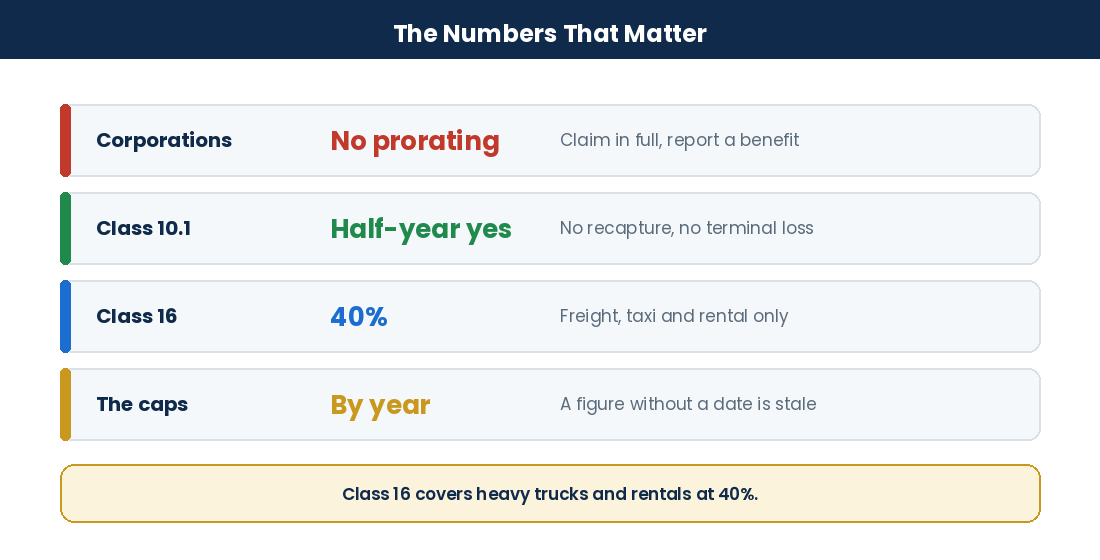
Class 16 is worth chasing where it applies, at 40% against the 30% of Class 10. It covers freight trucks above the weight threshold used in a business of hauling freight, along with taxis and vehicles in a daily rental business. It is not a general category for “heavy vehicles”.
What Class 10.1 Actually Does
This is described wrongly more often than any other point in fleet guidance, so it is worth being precise.
| Feature | Class 10.1 |
|---|---|
| One separate class per vehicle | Yes |
| Capital cost entered | Capped at the limit for the acquisition year |
| Subject to the half-year rule | Yes |
| Recapture on disposal | No |
| Terminal loss on disposal | No |
| Claim in the year of disposal | A special half-rate claim may be available |
Guidance stating that Class 10.1 is exempt from the half-year rule is wrong. It is subject to it. What Class 10.1 does escape is recapture and terminal loss, which is a different exemption entirely and the two get swapped constantly.
The practical consequence is that selling an expensive passenger vehicle produces no recapture income, which is favourable, but also no terminal loss where it sells below its remaining balance, which is not.
The 2026 Change
Bill C-15 received Royal Assent on 26 March 2026, reinstating the accelerated investment incentive for most depreciable property acquired after 2024 and available for use before 2030, with leasehold improvements among the excluded classes. It also reinstated enhanced first-year treatment for zero-emission vehicles in Classes 54, 55 and 56.
For a fleet replacing units, this materially raises the first-year claim over the plain half-year rule. Any return prepared for a recent year on the half-year basis alone is worth revisiting.
Please note that the enhanced zero-emission rates phase down over time, so the rate available depends on the year of acquisition and availability for use rather than being a single fixed figure.
A Worked Illustration
A freight truck qualifying for Class 16 costs $120,000. Under the plain half-year rule the first-year claim would be $120,000 × 40% × 50%, which is $24,000, leaving $96,000. In year two the claim is $96,000 × 40%, which is $38,400. Where the reinstated incentive applies, the first-year claim is materially higher than $24,000 and the pool draws down faster. Please note that a commonly circulated version of this example shows $18,000 in year one, which does not follow from a 40% rate. Figures changed for privacy.
Disposal
Outside Class 10.1, selling a vehicle for more than its remaining pool balance can create recapture, which is income. Selling the last asset in a class for less can create a terminal loss, which is a deduction.
Larger first-year claims make recapture more likely later, because the pool falls faster than the vehicle loses market value. Model the disposal before trading a unit rather than finding it on the return.
For a fleet turning over several units in a year, the combined recapture can be material enough to change the tax position, which is why the asset register belongs in the corporate year-end accounting process rather than being updated once the return is already drafted.
Class 10.1 escaping the half-year rule is the most repeated error in fleet guidance. It escapes recapture and terminal loss instead, which is a different thing. Figures changed for privacy.
Risk Warning: Class 10.1 is subject to the half-year rule. What it escapes is recapture and terminal loss. Please do not confuse the two.
The Three Caps
The Three Caps
The Limits
Where a vehicle is a passenger vehicle, three separate limits apply. They are independent of each other, and a fleet can hit one, two or all three.
An Important Point About the Figures
These caps are indexed and change, and the figure that applies is set by the year the vehicle was acquired or the lease began, not by the year you are filing.
That is why any article quoting a single dollar figure without a year is unreliable, and why several widely circulated numbers for these caps are simply out of date. A vehicle bought three years ago carries the limit from that year for its whole life in the class.
Please confirm the applicable figure for your own acquisition or lease commencement year rather than relying on a number quoted in isolation. Keep a note of the limit alongside each unit in the asset register so it does not have to be researched again.
The Capital Cost Limit
For a passenger vehicle, the amount entering the capital cost allowance class is capped, plus applicable sales tax on the capped amount. Pay more and the excess simply never enters the pool.
- The cap applies per vehicle, and each capped vehicle sits in its own Class 10.1
- The excess above the cap is not deductible in any year
- Zero-emission passenger vehicles have their own, higher limit under Class 54
- The limit is set by the acquisition year
- The cap does not apply to vehicles outside the passenger definition
This is the clearest argument for testing the passenger vehicle question before signing. Where a vehicle can properly be structured outside the definition, its full cost enters the pool.
The Lease Limit
Lease payments on a passenger vehicle are deductible only up to a monthly ceiling, plus tax. There is also a second restriction that reduces the deduction where the vehicle’s value is high relative to the lease terms, so two vehicles with identical payments can have different deductible amounts.
The applicable figures are set by reference to when the lease began. A lease signed years ago carries the ceiling from that time.
The Interest Limit
Interest on money borrowed to buy a passenger vehicle is deductible only up to a daily amount, expressed as a monthly maximum. Interest above it is simply lost.
This limit has been increased in recent years, and it applies by reference to when the vehicle was acquired, so different units in one fleet can carry different ceilings.
| Cap | Applies To | Set By |
|---|---|---|
| Capital cost | The amount entering the class | Year of acquisition |
| Lease deduction | Monthly lease payments | When the lease began |
| Interest deduction | Interest on the purchase loan | Year of acquisition |
Lease Against Buy
| Factor | Buying | Leasing |
|---|---|---|
| Deduction mechanism | Capital cost allowance over time | Lease payments as incurred |
| Cap that applies | Capital cost, and interest on borrowing | The lease ceiling and value restriction |
| Cash at the outset | Higher, or financed | Lower |
| Balance sheet | An asset and usually a loan | Depends on the lease terms |
| On disposal | Recapture or terminal loss possible | Return the vehicle; no disposal event |
| Residual value risk | Yours | Generally the lessor’s |
Please note that lease payments are not fully deductible on a passenger vehicle regardless of amount, which is a claim that appears in a good deal of fleet guidance. The ceiling applies.
The genuine decision is commercial rather than tax-driven. Leasing suits fleets replacing units on a cycle and wanting predictable cost; buying suits operators running vehicles well past a lease term.
Caps quoted without a year are the trap. The limit follows the vehicle from its acquisition year, so one fleet can be running three different ceilings at once. Figures changed for privacy.
Key Stat: All three caps are set by the acquisition or lease commencement year, not the filing year. Please record the applicable limit against each unit.
Running Costs, Drivers and Benefits
Running Costs, Drivers and Benefits
The Operations
What a Fleet Deducts
- Fuel, supported by card statements or receipts tied to units
- Repairs, servicing, tires and preventive maintenance
- Insurance, including liability and cargo cover
- Licensing, registration and plate fees
- Safety inspections and certification costs
- Tolls and business parking
- Washing, detailing and yard costs
- Telematics subscriptions and dispatch software
- Driver wages, employer contributions and accrued vacation
Two exclusions to note. Fines and penalties imposed under law are not deductible, which covers traffic tickets and most enforcement penalties. And parking at a driver’s home is personal, not a fleet cost.
Repairs Against Improvements
Routine maintenance is a current expense. Work that materially improves a vehicle or extends its useful life beyond restoring it is capital and enters the class.
An engine rebuild, a major body conversion or a permanent equipment installation generally sits on the capital side. Brakes, tires and servicing do not. Where the amount is large, decide deliberately and record the reasoning.
Drivers: Employee or Contractor
Owner-operators and contracted drivers are common in this sector, and classification is where the largest exposure sits.
The test looks at control over how the work is done, who supplies the vehicle and tools, whether the driver carries a chance of profit and risk of loss, and how integrated they are in your operation. A driver operating your truck, on your schedule, on your authority, paid by the hour, looks like an employee whatever the agreement says.
Misclassification means the CRA can assess the source deductions that should have been withheld, plus penalties and interest, and directors are personally liable for unremitted source deductions. That liability follows the individual out of the company.
Payroll Timing
Remittance deadlines depend on your remitter type, which is set by your average monthly withholding. A regular remitter pays by the 15th of the following month; accelerated remitters pay more frequently, in the largest category within a few working days of the pay date.
Guidance stating a flat rule such as “within seven days of the pay period” is not describing any of the actual categories. Please confirm which remitter type applies to you, since it changes as payroll grows.
Taxable Benefits Where Drivers Take Vehicles Home
Two separate benefits can arise where an employee has personal use of a company vehicle.
| Benefit | What It Reflects |
|---|---|
| Standby charge | Having the vehicle available, based on cost or lease payments and days available |
| Operating expense benefit | The company paying running costs used personally |
| Reduced standby charge | May apply where business use is high and personal driving is limited |
| Employee reimbursement | Reduces the benefit where paid within the required period |
Both are reported on the driver’s T4 and both are supported by the logbook, which is why the logbook remains essential even though it no longer sets the deduction.
Note that a vehicle falling outside the passenger vehicle definition may not attract a standby charge in the same way, though an operating benefit and a benefit for personal use can still arise. The commuting question is the one to settle: travelling between home and a regular place of work is generally personal, while travelling from home directly to a client or job site is often not.
Setting a Policy
- State in writing what personal use is permitted
- Require logbooks or telematics data from every driver
- Decide whether drivers reimburse operating costs, and by when
- Calculate benefits during the year rather than in February
- Keep the records supporting any reduced standby charge claimed
Vehicles going home overnight with no benefit calculated is the single most common payroll finding on a fleet. The logbook existed; nobody used it for the benefit. Figures changed for privacy.
Risk Warning: Directors are personally liable for unremitted source deductions. Please test driver classification before assuming contractor status.
Sales Tax, Records and Working With Gondaliya CPA
Sales Tax, Records and Working With Us
The Compliance
Input Tax Credits on Fleet Costs
A registered fleet recovers input tax credits on fuel, repairs, insurance where taxable, leases, telematics and vehicle purchases, each supported by an invoice showing the supplier’s registration number.
- On a passenger vehicle, the credit is generally limited by reference to the capped capital cost
- Where a vehicle has personal use, an adjustment may be required
- Credits on a leased passenger vehicle follow the deductible lease amount
- Credits are generally claimable within four years
- Selling a used commercial vehicle is normally a taxable supply; charge tax unless a specific relief applies
Interjurisdictional fuel and registration programmes operate separately from GST/HST and do not change your credit position, though the records they require overlap usefully with what you need for tax.
Records
Records must be kept for six years from the end of the tax year they relate to. For a fleet that means:
| Record | Why It Matters |
|---|---|
| Logbooks or telematics data by unit | Supports benefit calculations and business use |
| Fuel card statements reconciled to units | Ties fuel to vehicles and to distance travelled |
| Repair invoices with parts and labour | Separates current repairs from capital work |
| Purchase invoices and registrations | Establishes cost, seating and classification |
| Lease agreements | Sets the applicable ceiling and terms |
| Loan documents and interest statements | Supports the capped interest deduction |
| Insurance policies | Confirms coverage and the period |
| Driver contracts and payroll records | Supports classification and remittances |
Reconciling fuel to distance monthly is the check worth building in. Fuel consumption that does not track distance is the first thing an auditor tests on a fleet, and it is also how you find a card being used off-fleet.
An Asset Register Built for a Fleet
A fleet’s asset register should carry more than cost and date. For each unit: the classification decision and its basis, the class it sits in, the applicable cap for its acquisition year, the available-for-use date, and the accumulated claim.
That register is what makes a year-end straightforward and an audit unremarkable. Without it, every classification argument is reconstructed from scratch.
What Draws a Review
- Fuel claims that do not track distance travelled
- Vehicle costs with no logbook behind them
- No taxable benefit reported where drivers take vehicles home
- Long-term drivers on contractor arrangements
- Passenger vehicles claimed without the caps applied
- Repairs of a size that look like capital work
- Personal spending in the accounts and a growing shareholder loan
Our CRA audit guide covers what a review involves. Where past returns claimed vehicle costs on the wrong basis or omitted benefits that should have been reported, the Voluntary Disclosures Program may reduce penalties, provided you come forward before the CRA raises it.
How We Work With Fleets
We support incorporated fleet operators on a flat annual fee covering bookkeeping with fuel and card reconciliation by unit, the asset register with classification decisions documented, capital cost allowance with the caps and the reinstated incentive applied, disposal and recapture modelling, standby charge and operating benefit calculation, driver classification review, payroll and slips, GST/HST including credits on vehicle costs, financial statements and the corporate return.
Pricing is quoted before any work begins, including HST, with a one-business-day response and evening and weekend availability. Our engagements carry a 30-day money-back arrangement and a 60-day fee-matching arrangement.
Getting Started
Bring three things: your vehicle list with costs and acquisition dates, one month of fuel and maintenance records, and your last filed corporate return. Those show us whether the classifications hold, whether the caps were applied, and what needs fixing.
Contact Gondaliya CPA at info@gondaliyacpa.ca, call 647-212-9559, or send us a message.
A vehicle list with costs and dates answers most of a fleet file in twenty minutes. The classifications either hold up or they do not. Figures changed for privacy.
Pro Tip: Please reconcile fuel to distance monthly. It is the first thing tested on a fleet audit and it catches card misuse too.
FAQs on Fleet Owner Tax Deductions
Frequently Asked Questions
FAQ
Does my corporation prorate vehicle costs by business use?+
No. That is the sole proprietor method. A corporation claims the costs in full and reports a taxable benefit for any personal use by a driver.
If we do not prorate, why keep a logbook?+
Because it supports the benefit calculation instead of the deduction. It also supports classification and the reduced standby charge where that applies.
What makes a vehicle a passenger vehicle?+
Seating capacity and how the vehicle is actually used, not what type it is. A pickup or van meeting the seating and use tests can fall outside the definition.
Why does the passenger vehicle question matter so much?+
Because three caps and a restrictive class follow from it. Outside the definition, the full cost enters the pool and lease and interest are deductible on ordinary principles.
Is Class 10.1 exempt from the half-year rule?+
No. Class 10.1 is subject to it. What Class 10.1 escapes is recapture and terminal loss on disposal, and the two exemptions are constantly confused.
What is Class 16 for?+
Freight trucks above the weight threshold used in a business of hauling freight, along with taxis and daily rental vehicles, at 40%. It is not a general heavy vehicle category.
What are the current capital cost, lease and interest caps?+
They are indexed and set by the year of acquisition or lease commencement, so a single figure quoted without a year is unreliable. Please confirm the limit for your own year.
Are lease payments fully deductible?+
Not on a passenger vehicle. A monthly ceiling applies, plus a second restriction where the vehicle’s value is high relative to the lease terms.
Did the capital cost allowance rules change in 2026?+
Yes. Bill C-15 received Royal Assent on 26 March 2026, reinstating the accelerated investment incentive for property acquired after 2024 and enhanced treatment for zero-emission vehicles.
What happens when I sell a fleet vehicle?+
Outside Class 10.1, selling above the remaining pool balance can create recapture income, and selling the last asset in a class below it can create a terminal loss.
Are traffic fines deductible?+
No. Fines and penalties imposed under law are not deductible, including tickets incurred while driving company vehicles.
Are repairs always a current expense?+
Routine maintenance is. Work that materially improves a vehicle or extends its life beyond restoring it is capital and enters the class.
Can I treat my drivers as contractors?+
Only if the relationship supports it. The test looks at control, who supplies the vehicle, chance of profit and risk of loss, and integration. Directors are personally liable for unremitted deductions.
When are payroll remittances due?+
It depends on your remitter type, set by average monthly withholding. A regular remitter pays by the 15th of the following month; accelerated remitters pay more often.
What benefits arise when a driver takes a vehicle home?+
A standby charge for having it available, and an operating expense benefit where the company pays running costs used personally. Both go on the T4.
Can I recover GST/HST on a fleet vehicle purchase?+
Yes for a registrant, though on a passenger vehicle the credit is generally limited by reference to the capped capital cost, and personal use may require an adjustment.
Sixteen questions and one underneath most of them: is that unit a passenger vehicle. Answer it correctly and the rest follows. Figures changed for privacy.
The Fleet Deduction Checklist
The Fleet Deduction Checklist
Quick Reference
Classification and Capital
- Claim company vehicle costs in full; do not prorate by business use.
- Test every unit against the passenger vehicle seating and use tests.
- Document the classification decision when the vehicle is acquired.
- Review classification annually, since a change in use can change it.
- Use Class 16 only where the freight, taxi or rental conditions are met.
- Remember Class 10.1 is subject to the half-year rule.
- Remember Class 10.1 has no recapture and no terminal loss.
- Record the applicable cap for each unit’s acquisition year.
- Check whether the reinstated incentive applies to units from 2025.
- Date claims from the available-for-use point, not the invoice.
- Model recapture before disposing of or trading a unit.
Running Costs
- Reconcile fuel to distance travelled every month.
- Tie fuel card statements to specific units.
- Separate routine maintenance from capital improvements.
- Keep repair invoices showing parts and labour.
- Never claim fines or penalties imposed under law.
- Exclude parking at a driver’s home as personal.
- Spread prepaid insurance across the coverage period.
Drivers, Benefits and Filing
- Test every long-term driver against the classification factors.
- Confirm your remitter type and the deadline that follows from it.
- Calculate standby and operating benefits during the year, not in February.
- Require logbooks or telematics from every driver.
- Set a written policy on permitted personal use.
- Decide whether drivers reimburse operating costs, and by when.
- Report benefits on the T4 by the last day of February.
- Limit input tax credits on passenger vehicles by the capped cost.
- Charge tax on used commercial vehicle sales unless relief applies.
- Keep six years of logbooks, invoices, leases and payroll records.
- Maintain an asset register carrying the classification basis for each unit.
For a review of your fleet’s classifications and claims, contact Gondaliya CPA at info@gondaliyacpa.ca, call 647-212-9559, or book a free consultation.
Twenty-nine points and two underneath them: what class is it in, and did anyone report the benefit. Those two carry most of the money on a fleet file. Figures changed for privacy.
Fleet Businesses We Serve
Industry Expertise
Which issue dominates differs by the operation. Here are ten and the usual focus.
| Fleet Type | Where the Money Concentrates |
|---|---|
| Long-haul trucking | Class 16 eligibility and unit depreciation |
| Courier and last-mile delivery | Van classification and driver status |
| Service fleets with home-parked vans | Standby charge and operating benefits |
| Contractors running crew-cab pickups | The passenger vehicle seating and use tests |
| Executive and sales vehicles | All three caps, and Class 10.1 |
| Daily rental operators | Class 16 treatment and turnover on disposal |
| Taxi and ride operations | Class 16, and benefits on personal use |
| Fleets moving to electric units | Zero-emission classes and their own limits |
| Operators with owner-drivers | Classification and director liability |
| Fleets replacing units this year | The reinstated incentive and recapture |
- Long-haul trucking: The weight and freight tests decide the rate.
- Courier and last-mile delivery: Cargo configuration matters.
- Service fleets with home-parked vans: Somebody has a benefit.
- Contractors running crew-cab pickups: Seating and actual use.
- Executive and sales vehicles: Capped in three directions.
- Daily rental operators: Fast pools mean fast recapture.
- Taxi and ride operations: Personal use is still a benefit.
- Fleets moving to electric units: Different classes, different limits.
- Operators with owner-drivers: The relationship, not the contract.
- Fleets replacing units this year: The first-year claim changed.
The fleet type changes which unit causes the trouble. It does not change the method, which is classify each vehicle, apply the right caps, then report the benefit. Figures changed for privacy.
Professional Guidance and Quick Reference
Guidance
Professional Guidance: How Gondaliya CPA Handles Your Fleet File
Fleet operators lose money in a predictable set of ways: applying the sole proprietor business-use percentage to company-owned vehicles, which understates the deduction and leaves an unreported benefit at the same time, assuming a crew-cab pickup or cargo van is automatically outside the passenger vehicle definition without testing seating and use, treating Class 10.1 as exempt from the half-year rule when what it actually escapes is recapture and terminal loss, using a capital cost or lease cap quoted without a year when those limits are indexed and set by the acquisition or lease commencement year, never calculating a standby charge on vehicles that go home overnight, and claiming maintenance that was really a capital improvement. Gondaliya CPA handles fleet accounting on a fixed annual fee.
We handle what decides the outcome: testing every unit against the passenger vehicle seating and use tests and documenting the decision, maintaining an asset register carrying the class, the applicable cap and the available-for-use date for each vehicle, applying the reinstated investment incentive and the zero-emission measures, modelling recapture before a disposal, calculating standby and operating benefits during the year, testing driver classification, and reconciling fuel to distance monthly.
Our team starts with your vehicle list, a month of fuel and maintenance records and your last filed return. Those three show whether the classifications hold. Trucking, courier, rental or a service fleet, you get clear advice and a fixed price before we start.
Quick Answers
- Corporations: Claim in full, report a benefit
- The gate: Is it a passenger vehicle
- The test: Seating and actual use
- Class 10.1: Half-year rule applies
- Class 10.1: No recapture, no terminal loss
- Class 16: 40%, on freight, taxi and rental
- The caps: Set by the acquisition year
- Leases: Capped, not fully deductible
- Benefits: Standby plus operating expense
- Records: Six years retention
Who This Is For
- For: Incorporated fleet operators including trucking companies, couriers and delivery fleets, rental and leasing operators, and service businesses running multiple vehicles across Canada.
- Not For: Operating authorities, safety certification, and interjurisdictional fuel and registration programmes, which sit with transport regulators rather than with accounting.
People Also Ask
Is commuting business travel?+
Travel between home and a regular place of work is generally personal. Travel from home directly to a client or job site often is not.
Does the per-kilometre rate apply to company vehicles?+
No. The prescribed rate is for allowances paid to employees using their own vehicles. Company-owned vehicles use actual costs.
Do interjurisdictional fuel programmes affect my deductions?+
No. They operate separately from income tax and GST/HST, though the distance and fuel records they require overlap usefully.
Glossary of Key Terms
- T2: The corporation income tax return.
- Motor vehicle: The broad category of road vehicles.
- Passenger vehicle: The narrower subset the deduction caps apply to.
- Class 10: Motor vehicles at 30 percent declining balance.
- Class 10.1: Capped passenger vehicles, one class per vehicle.
- Class 16: Freight trucks, taxis and rental vehicles at 40 percent.
- Class 54: Zero-emission passenger vehicles.
- Class 55: Zero-emission vehicles otherwise in Class 16.
- Capital cost limit: The maximum amount entering the class.
- Half-year rule: The first-year restriction on the claim.
- Available for use: When an asset becomes eligible for depreciation.
- Recapture: Income arising where proceeds exceed the pool balance.
- Terminal loss: A deduction where the last asset sells below the balance.
- Standby charge: The benefit for having a vehicle available.
- Operating expense benefit: The benefit for costs paid on personal use.
- Input tax credit: Recovery of GST/HST on business costs.
Fleet Deduction Check
This quick self-check indicates where your operation most likely has room. Please answer the six questions below.
Fleet Deduction Check
Six quick questions on your fleet. No fee shown.
Points to raise with us:
This is a general prompt, not tax or legal advice or a quote. Your position depends on your full facts. For a real review, please book a free consultation.
Want a checklist to work from? You can download our free fleet deduction and logbook checklist before your consultation.
Claim company vehicle costs in full and report the benefit rather than prorating. Test every unit against the passenger vehicle seating and use tests. Apply the caps set by each unit\u2019s acquisition year. Remember Class 10.1 takes the half-year rule but escapes recapture. Reconcile fuel to distance monthly. Calculate standby and operating benefits during the year. Please keep six years of records.
2026 Update — what is current: This article reflects rules current to 2026. The Class 10 and Class 10.1 rate of 30%, the Class 16 rate of 40%, the Class 8 rate of 20%, the Class 50 rate of 55%, the six-month T2 filing deadline, the end-of-February slip deadline and the six-year retention requirement are unchanged. Bill C-15 received Royal Assent on 26 March 2026, reinstating the accelerated investment incentive for most depreciable property acquired after 2024 and available for use before 2030, and reinstating enhanced first-year treatment for zero-emission vehicles in Classes 54, 55 and 56, with those enhanced rates phasing down over time. Please note that a corporation claims vehicle costs in full and reports a taxable benefit rather than prorating by business use, which is the sole proprietor method; that Class 10.1 is subject to the half-year rule and what it escapes is recapture and terminal loss on disposal; that the capital cost, lease and interest limits are indexed and determined by the year a vehicle was acquired or a lease began, so a figure quoted without a year is unreliable and several widely circulated numbers are out of date; that lease payments on a passenger vehicle are capped rather than fully deductible; that Class 16 covers freight trucks above the weight threshold, taxis and daily rental vehicles rather than heavy vehicles generally; and that payroll remittance deadlines follow your remitter type rather than any single flat rule.
Fleet Owner Tax Deductions Canada: How Gondaliya CPA Supports Fleet Operators
Start with the vehicle list
Gondaliya CPA tests every unit against the passenger vehicle seating and use tests and documents the decision, maintains an asset register carrying the class, the applicable cap and the available-for-use date for each vehicle, applies the reinstated investment incentive and the zero-emission measures, models recapture before a disposal, calculates standby and operating benefits during the year rather than in February, tests driver classification and reconciles fuel to distance monthly, on a flat annual fee including HST with a one-business-day response. Please book a free consultation.
Next Steps
Please book a free consultation with Gondaliya CPA and bring your vehicle list with costs and acquisition dates, one month of fuel and maintenance records, and your last filed corporate return. Those three tell us whether the classifications hold, whether the caps were applied, and what remains to claim on the equipment, and where the documentation is thin. You will get a flat annual fee including HST before any work begins. If our content helps, please add gondaliyacpa.ca as a preferred source on Google.
Published: · Last updated:
Editorial policy: We research against CRA and CPA Ontario sources, fact-check the figures, and Sharad Gondaliya, CPA, reviews the content, which we update as the rules change.
Disclaimer: This article is educational information only and is not tax, legal, or financial advice. Figures marked illustrative are examples rather than quotes or guarantees. It reflects CRA rules current to 2026, including the $30,000 GST/HST threshold, the Class 8 rate, Class 13 leasehold treatment, the half-year rule, and the six-year retention requirement. Rates, limits and expensing rules change and outcomes depend on your specific facts. Please consult a licensed CPA before acting.

Sharad Gondaliya is a CPA Canada & CPA USA with 15 Years+ experience of Accounting, Tax, Payroll of Corporate Small Businesses as Tax Accountant. He is fully certified CPA Ontario and CPA USA and is well known among corporate small businesses for tax planning, efficient tax solutions, and affordable CPA services. Sharad is the Principal (Director) of Gondaliya CPA – Affordable CPA Firm in Canada. Licenses: CPA Ontario: 61040184 | CPA USA (MT): PAC-CPAP-LIC-033176 | CPA USA (WA): 57629 | CPA Firm License: 61330051 View Full Author Bio