



GST/HST for Appliance Repair Businesses in Canada: What Repair Companies Need to Know
Appliance Repair GST/HST Guide for Canada: Gondaliya CPA Explains Tax Rules and Accounting Tips
Appliance repair GST HST is a key consideration for businesses in Canada offering these services, and Gondaliya CPA provides clear guidance on tax rules, including how to manage both labour and parts under GST and HST regulations. Their advice also covers appliance repair tax Canada and how appliance repair accountants can help maintain compliance and optimize tax reporting.
The useful starting point is accepting that nearly everything a repair business does is taxable, then focusing on registration timing, the Quick Method and full credit recovery. Appliance repair accounting and tax services are built around exactly that.
Quick Summary
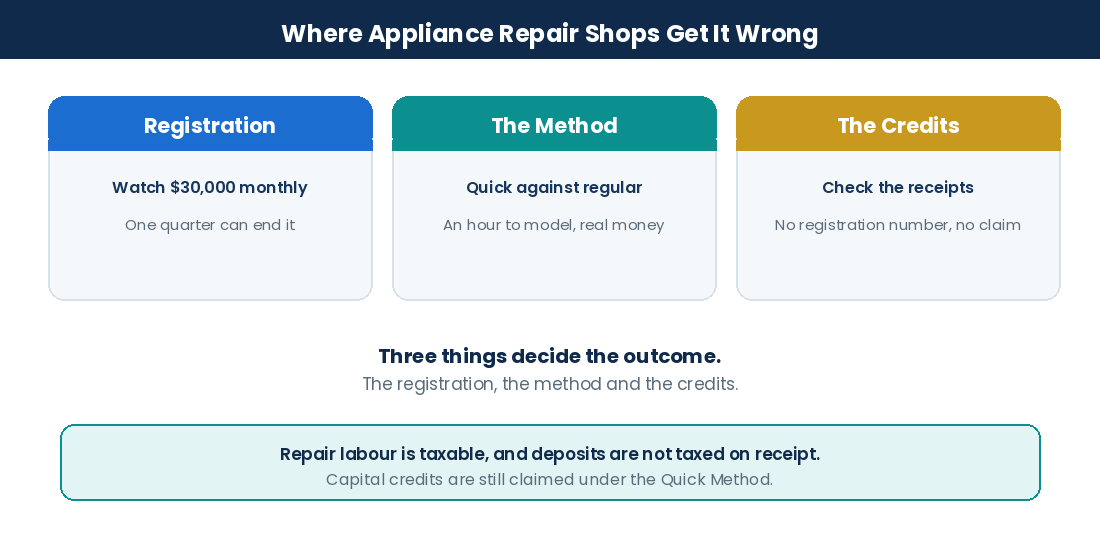
Appliance repair sales tax turns on four things: understanding that labour, parts and call-out fees are all taxable, getting registration timing right, deciding whether the Quick Method beats claiming actual credits, and knowing that deposits are not taxed when received.
Reading time: 52 minutes.
Table of Contents
- The Exemptions You Are Looking For
- Registration, Thresholds and Timing
- What You Charge and When
- The Quick Method Decision
- Input Tax Credits and Records
- Filing, Penalties and Working With Us
- Frequently Asked Questions
- The Appliance Repair GST/HST Checklist
- Repair Businesses We Serve
- Professional Guidance and Quick Reference
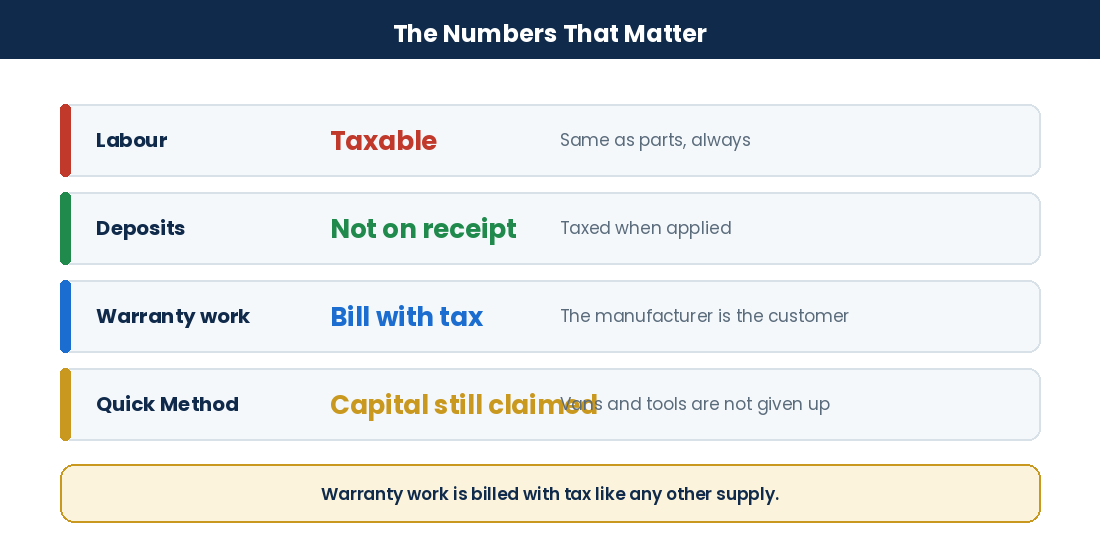
The Numbers That Matter
This article covers Canada, with Ontario and Toronto context, and reflects rules current to 2026. It applies to appliance repair and home service businesses, whether incorporated or operating as sole proprietors, including in-home service operators, warranty service contractors, commercial and restaurant equipment technicians and parts retailers. Figures marked illustrative are examples, not quotes, and any masked engagement notes end with “Figures changed for privacy.” This is educational information only and not tax or legal advice. Rates change and differ by province, so please confirm the rate applying to your own supplies. Trade certification, electrical and gas licensing and consumer protection requirements sit with the relevant provincial authority rather than with accounting.
The Exemptions You Are Looking For
The Exemptions You Are Looking For
The Framing
Almost Everything Is Taxable
Repair operators spend a surprising amount of effort trying to find something in their work that escapes tax. In this sector, essentially nothing does.
| Charge | Position |
|---|---|
| Labour for diagnosis, repair or installation | Taxable |
| Parts supplied and installed | Taxable |
| Service call or trip charge | Taxable |
| Diagnostic fee, even where no repair follows | Taxable |
| Emergency and after-hours premiums | Taxable |
| Old appliance removal, haul-away and disposal | Taxable |
| Work billed to a manufacturer under warranty | Taxable supply to the manufacturer |
| A mileage or fuel surcharge on the invoice | Taxable |
The belief that labour is somehow different from parts is the most persistent misunderstanding in this trade. It is not. Where labour and parts are supplied together as one job, they are generally treated as a single supply and taxed on the whole amount.
Splitting them into separate lines on the invoice is fine for clarity and useful for your own costing. It does not change the tax on either line.
Why That Is Actually Good News
Being fully taxable is an advantage, not a burden. A business making taxable supplies recovers the tax it pays on parts, tools, vehicles, fuel, rent, insurance, software and professional fees.
An exempt supplier recovers nothing. If appliance repair were exempt, every dollar of tax on your van, your parts inventory and your shop rent would be a permanent cost rather than something you get back.
So the productive question is not “what can I avoid charging” but “am I recovering everything I am entitled to, and am I using the right accounting method.”
Where Real Relief Does Exist
- Goods brought into Canada temporarily for repair and then exported may qualify for relief, with documentation
- Certain sales to First Nations customers attract point-of-sale relief, which is not the same as zero-rating
- Below the small supplier threshold, you are not required to register at all
- The Quick Method can leave you remitting less than you collect
- Full credit recovery on business inputs is the largest one, and the most under-used
Those are the genuine levers. Everything else in this article is about applying them properly and not creating problems along the way.
Operators arrive convinced labour must be treated differently from parts. It is not, and the hunt for that distinction distracts from the Quick Method question, which is worth real money. Figures changed for privacy.
Risk Warning: Labour is not exempt. Please charge tax on labour, parts, service calls and diagnostic fees alike.
Registration, Thresholds and Timing
Registration, Thresholds and Timing
The Threshold
The Small Supplier Test
You must register once your worldwide taxable supplies exceed $30,000. The test runs over four consecutive calendar quarters, and it is measured on revenue rather than profit.
Two timing rules matter and they are frequently confused.
| How You Cross It | What Happens |
|---|---|
| You exceed $30,000 in a single calendar quarter | You stop being a small supplier immediately, from that supply |
| You exceed $30,000 across four consecutive quarters | Small supplier status ends after a short transition period |
| You register voluntarily while below | You charge tax from your effective date and claim credits |
The single-quarter rule catches busy operators out. One strong season can end small supplier status part way through a quarter, and tax is owed from that point whether or not it was charged to customers.
If you are approaching the threshold, watch it monthly rather than discovering it at year end. Tax not charged to a customer is still tax you owe, and going back to a homeowner months later to ask for it rarely succeeds.
Voluntary Registration
Registering below the threshold is a real option and often the right one for a repair business.
- You recover tax on your van, tools, parts inventory and shop costs
- Commercial and landlord customers are registered themselves and are indifferent to the tax
- You avoid the awkward mid-year transition when you do cross
- You look established rather than very small to commercial clients
- The cost is filing obligations and the discipline they require
The calculation turns on your customer mix. A business serving mostly homeowners is adding a real cost to the customer’s bill. One serving property managers, landlords and commercial clients is not, because those customers recover it.
An operator below the threshold buys a service van, tools and initial parts inventory. Registering voluntarily lets the tax on those purchases be recovered rather than absorbed, which on a start-up outlay of that size is a meaningful amount in the first year. Where the customer base is commercial, the offsetting cost of charging tax is close to nil. Figures changed for privacy.
Choosing Your Reporting Period
| Annual Taxable Supplies | Assigned Period | Can Elect |
|---|---|---|
| $1,500,000 or less | Annual | Quarterly or monthly |
| Over $1,500,000 to $6,000,000 | Quarterly | Monthly |
| Over $6,000,000 | Monthly | Not applicable |
Please note the actual thresholds are $1.5 million and $6 million. Guidance quoting a $3 million monthly filing threshold, or stating that anything over $1.5 million files monthly, is not describing the current structure.
The election is made on the prescribed form, and the practical trade-off is straightforward. Annual filing means less administration but a single large payment, plus instalments where net tax passes the threshold. More frequent filing spreads the payments and surfaces errors sooner.
For a repair business collecting tax on every job, annual filing means holding other people’s money for up to a year, which is a temptation and a cash flow trap in equal measure. Quarterly usually suits the trade better.
Instalments
An annual filer whose net tax passes the threshold has to pay quarterly instalments during the year, with the balance on filing. Instalments are generally based on the prior year or an estimate of the current one.
Operators moving to annual filing to reduce paperwork are sometimes surprised to find they still make four payments a year, just without the accompanying return.
The reporting period also interacts with your corporate year end, since an annual filer’s deadline runs from the fiscal year end rather than a calendar date. Our guide to corporate year-end accounting and filings sets out how the two calendars fit together.
Crossing the threshold mid-quarter and not noticing is the single most common problem we see in this trade. The tax was owed; nobody charged it. Figures changed for privacy.
Key Stat: Exceeding $30,000 in one quarter ends small supplier status immediately. Please monitor the threshold monthly, not annually.
What You Charge and When
What You Charge and When
The Invoice
Which Rate Applies
For a service performed on an appliance at a customer’s location, the rate generally follows where the work is done, not where you are based and not where you post the invoice.
| Situation | Rate Generally Follows |
|---|---|
| In-home repair at a customer’s address | The province where the work is performed |
| Repair at your shop, customer collects | Your province |
| Part shipped to a customer | The destination province |
| Remote diagnostic or phone support | The customer’s address on your records |
| Work for a manufacturer across several provinces | Each job on its own facts |
An operator working near a provincial boundary, or a warranty contractor covering a region, can genuinely be charging different rates on different jobs in the same week. Set the rate per job in your system rather than defaulting to a single company-wide rate.
Rates change. Please confirm the current rate for each province you work in rather than relying on a figure quoted in an article, since at least one province has adjusted its rate in recent years.
Deposits: The Rule Most Guidance Gets Wrong
A genuine deposit is not taxed when you receive it. It becomes consideration for the supply, and therefore taxable, when it is applied against the price.
Guidance stating that deposits are taxed on receipt is wrong, and following it means remitting tax early on money that is not yet consideration, sometimes on jobs that never proceed.
- Hold deposits in their own account, not in revenue
- Apply tax when the deposit is applied to the invoice
- Where a deposit is forfeited, the treatment changes; get it reviewed
- A prepayment for a specific supply is different from a refundable deposit
- Progress billing on a longer job is taxed as each amount becomes due or is paid
Special-order parts are where this bites in appliance repair. Taking money up front for a part that takes six weeks to arrive is common, and the timing question is real.
Warranty Work
This confuses people because the customer pays nothing, so it feels as though no supply occurred.
The customer is not who you supplied. Where a manufacturer or warranty administrator pays you to perform the work, they are your customer and the supply to them is taxable in the ordinary way. Invoice the manufacturer with tax.
| Arrangement | General Position |
|---|---|
| Manufacturer pays you for warranty repair | Taxable supply to the manufacturer |
| Third-party administrator pays you | Taxable supply to the administrator |
| You sell an extended warranty as agent | Your commission is your consideration |
| You carry the warranty obligation yourself | Different treatment; have the arrangement reviewed |
| Goodwill repair you absorb entirely | No consideration, but watch the input side |
Warranty administrators are usually registered, so charging them tax costs them nothing. Failing to charge it costs you, because the assessment lands on you regardless of whether you collected it.
Point-of-Sale Relief
Relief is available on qualifying sales to eligible First Nations customers in some provinces. This needs describing accurately because it is regularly mischaracterised.
It is not zero-rating. In Ontario the relief applies to the provincial portion of the HST on qualifying supplies, with the federal portion treated according to its own rules. The mechanics, the eligibility conditions and the documentation required are specific.
Where you apply relief, record the customer’s identification details at the time of the sale. Reconstructing eligibility later is the point at which these claims fail.
Discounts, Coupons and Adjustments
A discount given at the time of sale simply reduces the amount on which tax is calculated. An adjustment made afterwards, whether a price reduction, a return or a credit for unsatisfactory work, is handled through a credit note.
Credit notes let you adjust the tax previously charged without refiling the earlier return. There are time limits and the note has to contain prescribed information, so issue them properly rather than simply reversing an invoice in your system.
Deposits remitted on receipt is a genuine and common error. The money was not consideration yet, and on cancelled jobs the tax was never owed at all. Figures changed for privacy.
Risk Warning: A genuine deposit is not taxed when received. Please apply the tax when the deposit is applied against the invoice.
The Quick Method Decision
The Quick Method Decision
The Lever Most Miss
What It Actually Does
Under the regular method you remit the tax you collected less the tax you paid on business inputs. Under the Quick Method you remit a fixed percentage of your tax-included sales and stop tracking input credits on operating costs.
The remittance percentage is set below the rate you charge. The gap between what you collect and what you remit is yours to keep, and for the right business it is worth real money every year.
| Feature | Regular Method | Quick Method |
|---|---|---|
| What you remit | Tax collected less credits claimed | A fixed percentage of tax-included sales |
| Credits on operating costs | Claimed individually | Built into the rate, not claimed separately |
| Credits on capital purchases | Claimed | Still claimed separately |
| Bookkeeping effort | Higher | Lower |
| Best where | Inputs are a large share of costs | Labour is a large share of costs |
The capital purchase row is the detail most often missed. Choosing the Quick Method does not stop you claiming credits on a van, major tools or equipment. Those are still claimed in the ordinary way.
Why It Suits Some Repair Businesses
The method rewards businesses whose costs are mostly labour rather than purchased inputs, because the rate assumes a certain level of input credits and you keep the difference where your actual inputs are lower.
An appliance repair business sits interestingly on that line, and the answer differs by operator.
- A diagnostic-heavy operator billing mostly labour, using few parts, leans toward the Quick Method
- A parts-heavy operator supplying and installing expensive components leans toward the regular method
- An operator with high vehicle and premises costs leans toward the regular method
- A one-van technician with low overheads often benefits from the Quick Method
- A business expanding its fleet and shop should model both before electing
There is no general answer for the trade. It has to be calculated on your own revenue and cost mix, and the calculation is not difficult once someone actually runs it.
Conditions and Mechanics
The method is available to smaller businesses below a revenue threshold, and certain types of business are excluded. Rates differ depending on whether you primarily supply services or goods, and on the province.
- The election is made on the prescribed form and generally applies for at least a year
- There is a credit on an initial portion of eligible sales each year
- Confirm your eligibility against the current threshold before electing
- Model the outcome on last year’s actual figures before committing
- Revisit the decision as your cost mix changes
Modelling It Properly
A labour-heavy operator with modest parts usage and low overheads models both methods on the prior year. The Quick Method produces a lower net remittance, plus reduced bookkeeping time, while capital purchases continue to be claimed separately. A second operator with heavy parts throughput models the same comparison and finds the regular method clearly better. Same trade, opposite answers, and only a calculation distinguishes them. Figures changed for privacy.
Please run the comparison rather than assuming. We see operators on the regular method who would gain from electing, and operators who elected years ago and should now switch back because their cost mix has changed.
The Quick Method question is the most valuable one nobody asks in this trade. It takes an hour to model and the answer often surprises the operator. Figures changed for privacy.
Key Stat: The Quick Method still allows credits on capital purchases such as vans and equipment. Please do not assume electing it gives those up.
Input Tax Credits and Records
Input Tax Credits and Records
The Recovery
What You Can Recover
A registrant recovers the tax paid on purchases used in making taxable supplies. For a repair business that is a long list.
- Parts, components and shop supplies
- Tools, diagnostic equipment and test gear
- Service vehicle purchase or lease, fuel and maintenance
- Shop or unit rent where tax is charged, and utilities
- Insurance where the premium carries tax
- Software, dispatch systems and phone service
- Advertising, signage and vehicle graphics
- Professional fees and subcontracted technicians
- Uniforms, safety equipment and training
Our overview of input tax credits in Canada covers the entitlement rules in more detail.
The Documentation That Actually Supports a Claim
A credit card statement is not support. The prescribed information has to be there, and above certain amounts the requirements increase.
| Element | Why It Matters |
|---|---|
| Supplier’s name or trading name | Identifies who made the supply |
| Supplier’s registration number | The item most often missing on small receipts |
| Date of the invoice or supply | Establishes the period |
| Amount of tax, or a statement it is included | Quantifies the claim |
| Your name, above the higher threshold | Required on larger invoices |
| Description of the supply | Establishes the business connection |
The registration number is the recurring failure. A parts receipt from a small supplier that omits it will not support a claim, and the time to notice is at the counter rather than during a review two years later.
Mixed Use
Where something serves both business and personal purposes, only the business portion is recoverable, and the apportionment needs a defensible basis.
The service van is the obvious case. A vehicle used for jobs during the week and personally at weekends is mixed use, and the split has to come from records rather than an estimate. Note also that where the business is incorporated and owns the vehicle, personal use by an owner or employee raises a taxable benefit question on the income tax side as well.
Home office costs, personal phone lines carrying business calls and tools that go home with a technician all raise the same question. Decide the basis once, document it, and apply it consistently.
Restrictions
- Meals and entertainment credits are restricted, broadly to half
- Club memberships and certain recreational costs are excluded
- Nothing is recoverable on purchases relating to exempt activity
- Personal expenditure is not recoverable regardless of how it was paid
- Purchases from an unregistered supplier carry no tax and so no credit
The last point matters when buying used parts or subcontracting to a very small operator. If they are not registered, no tax was charged and there is nothing to recover. Claiming it anyway is a straightforward assessment.
Subcontracting also raises a separate question worth settling early: whether a long-term technician working under your direction is genuinely a contractor at all, since misclassification carries payroll consequences alongside the credit issue. Our tax planning reviews cover both sides of that.
Timing
Most registrants have up to four years from the relevant return to claim a credit, with a shorter window for larger businesses and certain financial institutions.
That gives room to correct genuine omissions, but it is not a reason to file loosely. Reconstructing a year of small parts receipts long after the fact is expensive and usually incomplete.
Records
Records must be kept for six years from the end of the year they relate to. For a repair business the practical set is invoices showing tax separately, purchase receipts with supplier registration numbers, work orders tied to invoices, payment processor statements, mileage and vehicle records, and the bookkeeping behind the returns.
File purchase receipts by job number where they relate to a specific repair. It supports the credit, and it also tells you what each job actually cost, which most small operators never see.
Missing supplier registration numbers on parts receipts is the most common credit failure. The tax was genuinely paid; the paperwork simply does not support it. Figures changed for privacy.
Pro Tip: Please check parts receipts for the supplier’s registration number at the counter. Without it the credit does not stand up.
Filing, Penalties and Working With Gondaliya CPA
Filing, Penalties and Working With Us
The Compliance
Deadlines
| Reporting Period | Return Due | Payment Due |
|---|---|---|
| Monthly | One month after the period ends | Same date |
| Quarterly | One month after the period ends | Same date |
| Annual, corporation | Three months after the fiscal year end | Same date |
| Annual, individual with a 31 December year end | 15 June | 30 April |
The last row catches sole proprietors every year. The filing date and the payment date are different, and the money is due six weeks before the return is.
Most registrants file electronically, and it is mandatory above a revenue threshold. Payment is made through online banking, pre-authorised debit or at a financial institution.
Penalties
The failure to file penalty is calculated as a percentage of the amount owing, with an additional element for each month the return is outstanding, up to a maximum number of months. Interest runs separately on unpaid amounts.
Two figures that circulate in repair sector guidance are worth correcting. There is no flat penalty of $250 for late registration and no flat $100 late filing penalty in this regime. The penalty is formula-based and driven by the amount outstanding, which means a nil return filed late generally carries no penalty while a large balance filed late carries a significant one.
Where circumstances beyond your control caused the delay, a taxpayer relief request may be available. It asks for penalties and interest to be cancelled; it does not change the tax itself.
Director Liability
This is the point every incorporated operator should understand. Tax collected from customers is held in trust, and directors can be held personally liable for amounts the corporation failed to remit.
A due diligence defence exists where a director genuinely took reasonable steps to prevent the failure, but it depends on demonstrating what was actually done. There are also time limits on assessing a director after they cease to hold office.
The practical implication is that using collected tax as working capital during a slow month is not a corporate risk. It is a personal one.
Objections and Corrections
- An objection to an assessment must generally be filed within 90 days
- Errors in your own favour or against can often be corrected on a later return
- Credit notes adjust tax previously charged, within the time limits
- Bad debts may allow recovery of tax already remitted, with conditions
- Unfiled periods are addressed by filing them, oldest first
Where past periods went unregistered or unfiled, the Voluntary Disclosures Program may reduce penalties, provided you come forward before the CRA raises the issue. Our CRA audit guide covers what a review involves.
What Draws a Review
- Revenue on the income tax return that does not tie to sales tax filings
- Deposits into the business account exceeding reported sales
- Credits claimed with no supporting invoices
- Labour treated as though it were not taxable
- Warranty reimbursements not reported as taxable supplies
- A long run of returns showing refunds with no obvious reason
- Registration that started late relative to the revenue history
The first item is the one to build a control around. Reconcile revenue to your sales tax filings quarterly. It is the comparison most likely to be run on your file, so run it first.
How We Work With Repair Businesses
We support appliance repair and home service operators on a flat annual fee covering bookkeeping with job-level costing, registration and threshold monitoring, the Quick Method against regular method comparison modelled on your actual figures, place of supply and rate setting, deposit and warranty billing treatment, credit recovery with documentation review, reporting period selection, sales tax filing, financial statements and the corporate return.
Pricing is quoted before any work begins, including HST, with a one-business-day response and evening and weekend availability. Our engagements carry a 30-day money-back arrangement and a 60-day fee-matching arrangement.
Getting Started
Bring three things: twelve months of sales figures, a month of purchase receipts, and your last filed return if you have one. Those let us check your registration position, model the Quick Method against the regular method, and see whether your credits are being supported properly.
Contact Gondaliya CPA at info@gondaliyacpa.ca, call 647-212-9559, or send us a message.
Collected tax spent during a slow month is the risk operators underestimate. It is trust money, and the exposure follows the director personally. Figures changed for privacy.
Risk Warning: Directors are personally liable for unremitted tax. Please treat collected amounts as trust money, not working capital.
FAQs on Appliance Repair GST/HST
Frequently Asked Questions
FAQ
Is labour taxed differently from parts?+
No. Both are taxable. Where labour and parts are supplied together as one job they are generally treated as a single supply and taxed on the whole amount. Separating the lines is fine but changes nothing.
Are service call and diagnostic fees taxable?+
Yes, including where no repair follows. Trip charges, after-hours premiums, mileage surcharges and old appliance haul-away are all taxable supplies.
When do I have to register?+
Once worldwide taxable supplies exceed $30,000. Exceeding it in a single calendar quarter ends small supplier status immediately; exceeding it across four quarters ends it after a short transition.
Should I register voluntarily below the threshold?+
Often yes, especially with commercial or landlord customers who recover the tax themselves. You recover tax on your van, tools, parts and shop costs rather than absorbing it.
Which reporting period will I be assigned?+
Annual up to $1.5 million in taxable supplies, quarterly above that to $6 million, and monthly beyond. You can elect a more frequent period on the prescribed form.
Is a deposit taxable when I receive it?+
No. A genuine deposit is not consideration until applied against the price. Guidance saying deposits are taxed on receipt is wrong, and following it means remitting early on money not yet earned.
How do I bill manufacturer warranty work?+
The manufacturer is your customer, not the homeowner. The supply to them is taxable in the ordinary way, so invoice the manufacturer with tax. They are usually registered, so it costs them nothing.
Which province’s rate applies?+
For in-home work, generally the province where the work is performed rather than where you are based. Shop work follows your province; shipped parts follow the destination.
What is point-of-sale relief for First Nations customers?+
Relief on qualifying supplies, applying to the provincial portion of the HST in Ontario. It is not zero-rating, and it requires the customer’s identification details recorded at the time of sale.
What is the Quick Method?+
You remit a fixed percentage of tax-included sales instead of tracking credits on operating costs. The gap between what you collect and what you remit is yours, and it suits labour-heavy operators.
Does the Quick Method mean giving up all credits?+
No. Credits on capital purchases such as vans, major tools and equipment are still claimed separately. Only credits on operating costs are built into the rate.
Which method is better for my business?+
It depends on your revenue and cost mix. Diagnostic and labour-heavy operators often gain from the Quick Method; parts-heavy operators with high overheads usually do not. Model both on last year’s figures.
What documentation supports a credit claim?+
The supplier’s name and registration number, the date, the tax amount or a statement it is included, and a description. The registration number is the item most often missing on small parts receipts.
How do I handle a van used personally as well?+
Only the business portion is recoverable, apportioned on a documented basis. Where an incorporated business owns the vehicle, personal use also raises a taxable benefit question on the income tax side.
What are the penalties for filing late?+
The penalty is formula-based on the amount owing plus a monthly element, not a flat dollar figure. A nil return filed late generally carries no penalty; a large balance filed late carries a significant one.
Can I be held personally liable?+
Yes. Tax collected is held in trust, and directors can be personally liable for amounts a corporation failed to remit. A due diligence defence exists but depends on showing what was actually done.
Sixteen questions and one underneath most of them: is this taxable. Almost always yes, which is why the method question matters more. Figures changed for privacy.
The Appliance Repair GST/HST Checklist
The Appliance Repair GST/HST Checklist
Quick Reference
Registration and Method
- Monitor the $30,000 threshold monthly, not annually.
- Remember one strong quarter can end small supplier status immediately.
- Consider voluntary registration if customers are commercial or landlords.
- Model the Quick Method against the regular method on last year’s figures.
- Remember capital purchases are still claimed under the Quick Method.
- Revisit the method choice when your cost mix changes.
- Choose a reporting period that suits your cash discipline.
- Check whether instalments apply if you file annually.
Charging Correctly
- Charge tax on labour, parts, call-outs and diagnostic fees alike.
- Set the rate by where the work is performed, per job.
- Confirm current rates for every province you work in.
- Do not tax a genuine deposit until it is applied to the invoice.
- Hold deposits in their own account, separate from revenue.
- Invoice manufacturers and warranty administrators with tax.
- Record identification details at the time for any point-of-sale relief.
- Use proper credit notes for post-sale adjustments and returns.
- Show your registration number on every invoice you issue.
Credits, Records and Filing
- Check parts receipts for the supplier’s registration number.
- Claim credits on tools, vehicle, fuel, rent, software and insurance.
- Apportion mixed-use costs on a documented basis.
- Remember purchases from unregistered suppliers carry no credit.
- Restrict meals and entertainment credits appropriately.
- File purchase receipts by job number where they relate to a repair.
- Reconcile revenue to your sales tax filings quarterly.
- Note that annual individual filers pay in April and file in June.
- Treat collected tax as trust money, never as working capital.
- Object within 90 days if you disagree with an assessment.
- Keep six years of invoices, receipts, work orders and statements.
For a review of your registration position and method choice, contact Gondaliya CPA at info@gondaliyacpa.ca, call 647-212-9559, or book a free consultation.
Twenty-eight points and two that carry most of the money: the method choice and the receipts. Everything else is administration. Figures changed for privacy.
Repair Businesses We Serve
Industry Expertise
Which issue dominates differs by the operation. Here are ten and the usual focus.
| Repair Business | Where the Money Concentrates |
|---|---|
| One-van in-home technicians | The Quick Method against the regular method |
| Operators near the threshold | Registration timing and the single-quarter rule |
| Manufacturer warranty contractors | Billing the manufacturer with tax |
| Businesses taking special-order deposits | Not taxing deposits on receipt |
| Parts-heavy repair operations | Credit recovery and receipt documentation |
| Operators working across a provincial border | Setting the rate per job, not per company |
| Businesses serving landlords and property managers | Voluntary registration well before the threshold |
| Commercial and restaurant equipment technicians | Higher-value invoices and documentation thresholds |
| Operators with a van used personally too | Apportionment and the benefit question |
| Anyone with unfiled or unregistered periods | Coming forward before contact is made |
- One-van in-home technicians: An hour of modelling, real money.
- Operators near the threshold: One busy quarter ends it.
- Manufacturer warranty contractors: They are your customer.
- Businesses taking special-order deposits: Not consideration yet.
- Parts-heavy repair operations: Check for the registration number.
- Operators working across a provincial border: Rate follows the work.
- Businesses serving landlords and property managers: They recover it.
- Commercial and restaurant equipment technicians: More on the invoice.
- Operators with a van used personally too: Two regimes, one vehicle.
- Anyone with unfiled or unregistered periods: Timing decides the penalty.
The operation changes which item costs the most. It does not change the order, which is register at the right time, pick the right method, then recover everything you paid. Figures changed for privacy.
Professional Guidance and Quick Reference
Guidance
Professional Guidance: How Gondaliya CPA Handles Your Repair Business File
Appliance repair businesses lose money in a predictable set of ways: hunting for an exemption on labour that does not exist, crossing the $30,000 threshold in a single busy quarter without noticing and owing tax nobody charged, remitting tax on deposits when they are received rather than when applied, not invoicing manufacturers and warranty administrators with tax on work the homeowner did not pay for, never modelling the Quick Method against the regular method, losing credits because parts receipts omit the supplier registration number, and applying one company-wide rate when the rate follows where the work is performed. Gondaliya CPA handles appliance repair accounting on a fixed annual fee.
We handle what decides the outcome: monitoring the registration threshold monthly, modelling the Quick Method against the regular method on your actual figures, setting rates by place of supply per job, treating deposits and warranty billing correctly, reviewing credit documentation before it fails, apportioning mixed-use costs on a documented basis and reconciling revenue to sales tax filings quarterly.
Our team starts with twelve months of sales figures, a month of purchase receipts and your last filed return. Those three settle your registration position, the method question and whether credits are supported. One van or a fleet of technicians, you get clear advice and a fixed price before we start.
Quick Answers
- Labour: Taxable, same as parts
- Service calls: Taxable, even with no repair
- Threshold: $30,000 in taxable supplies
- One quarter: Can end small supplier status at once
- Deposits: Taxed when applied, not received
- Warranty work: Bill the manufacturer with tax
- Rate: Follows where the work is performed
- Quick Method: Capital credits still claimable
- Receipts: Supplier registration number required
- Records: Six years retention
Who This Is For
- For: Appliance repair and home service businesses across Canada, whether incorporated or sole proprietors, including in-home service operators, warranty service contractors, commercial and restaurant equipment technicians and parts retailers.
- Not For: Trade certification, electrical and gas licensing and consumer protection requirements, which sit with the relevant provincial authority rather than with accounting.
People Also Ask
How long do I have to claim a missed credit?+
Most registrants have up to four years from the relevant return, with a shorter window for larger businesses. It is room to correct genuine omissions, not a reason to file loosely.
What if I should have registered years ago?+
File the outstanding periods, oldest first. The Voluntary Disclosures Program may reduce penalties provided you come forward before the CRA raises the issue.
How long do I keep records?+
Six years from the end of the year they relate to, covering invoices, purchase receipts, work orders, processor statements and the bookkeeping behind the returns.
Glossary of Key Terms
- GST: The federal goods and services tax.
- HST: The harmonised tax combining federal and provincial portions.
- Taxable supply: A sale on which tax must be charged.
- Zero-rated: Taxed at nil, with credits still recoverable.
- Exempt: No tax charged and no credits recoverable.
- Registrant: A business registered to collect and remit.
- Small supplier: A business below the $30,000 threshold.
- Input tax credit: Recovery of tax paid on business purchases.
- Place of supply: The rules setting which province’s rate applies.
- Single supply: Labour and parts on one job taxed as one thing.
- Deposit: Money held that is not yet consideration for a supply.
- Quick Method: Remitting a fixed percentage of tax-included sales.
- Credit note: A document adjusting tax previously charged.
- Point-of-sale relief: Relief on qualifying supplies, not zero-rating.
- Director liability: Personal exposure for unremitted trust amounts.
- Voluntary Disclosures Program: Correcting filings before CRA contact.
Appliance Repair GST/HST Check
This quick self-check indicates where your operation most likely has room. Please answer the six questions below.
Appliance Repair GST/HST Check
Six quick questions on your repair business. No fee shown.
Points to raise with us:
This is a general prompt, not tax or legal advice or a quote. Your position depends on your full facts. For a real review, please book a free consultation.
Want a checklist to work from? You can download our free appliance repair GST/HST checklist before your consultation.
Charge tax on labour, parts and call-outs alike. Monitor the $30,000 threshold monthly. Model the Quick Method against the regular method. Do not tax deposits until they are applied. Invoice manufacturers with tax on warranty work. Set the rate by where the work is performed. Check parts receipts for the supplier registration number. Please keep six years of records.
2026 Update — what is current: This article reflects rules current to 2026. The $30,000 small supplier threshold, the $1.5 million and $6 million reporting period thresholds, the general four-year window to claim input tax credits, the 90-day period to object to an assessment and the six-year retention requirement are unchanged. Please note that labour, parts, service calls, diagnostic fees, call-out charges and appliance haul-away are all taxable supplies, and that labour supplied with parts on one job is generally a single supply taxed on the whole amount; that a genuine deposit is not taxed when received but when applied against the price, so guidance stating deposits are taxable on receipt is incorrect; that where a manufacturer or administrator pays for warranty work they are your customer and the supply to them is taxable; that point-of-sale relief for eligible First Nations customers applies to the provincial portion of the HST in Ontario and is not zero-rating; that the failure to file penalty is formula-based on the amount owing rather than a flat $250 or $100 charge; and that provincial rates change, with at least one province having adjusted its HST rate in recent years, so please confirm the current rate for every province in which you perform work.
Appliance Repair GST/HST Canada: How Gondaliya CPA Supports Repair Businesses
Start with twelve months of sales
Gondaliya CPA monitors your registration threshold monthly, models the Quick Method against the regular method on your actual revenue and cost mix, sets rates by place of supply on each job, treats deposits and warranty billing correctly, reviews credit documentation before it fails a check, apportions mixed-use vehicle and premises costs on a documented basis and reconciles revenue to your sales tax filings quarterly, on a flat annual fee including HST with a one-business-day response. Please book a free consultation.
Next Steps
Please book a free consultation with Gondaliya CPA and bring twelve months of sales figures, one month of purchase receipts, and your last filed return if you have one. Those three tell us your registration position, whether the Quick Method beats the regular method for you, and what remains to claim on the equipment, and where the documentation is thin. You will get a flat annual fee including HST before any work begins. If our content helps, please add gondaliyacpa.ca as a preferred source on Google.
Published: · Last updated:
Editorial policy: We research against CRA and CPA Ontario sources, fact-check the figures, and Sharad Gondaliya, CPA, reviews the content, which we update as the rules change.
Disclaimer: This article is educational information only and is not tax, legal, or financial advice. Figures marked illustrative are examples rather than quotes or guarantees. It reflects CRA rules current to 2026, including the $30,000 GST/HST threshold, the Class 8 rate, Class 13 leasehold treatment, the half-year rule, and the six-year retention requirement. Rates, limits and expensing rules change and outcomes depend on your specific facts. Please consult a licensed CPA before acting.

Sharad Gondaliya is a CPA Canada & CPA USA with 15 Years+ experience of Accounting, Tax, Payroll of Corporate Small Businesses as Tax Accountant. He is fully certified CPA Ontario and CPA USA and is well known among corporate small businesses for tax planning, efficient tax solutions, and affordable CPA services. Sharad is the Principal (Director) of Gondaliya CPA – Affordable CPA Firm in Canada. Licenses: CPA Ontario: 61040184 | CPA USA (MT): PAC-CPAP-LIC-033176 | CPA USA (WA): 57629 | CPA Firm License: 61330051 View Full Author Bio