



Pilates Studio Taxes in Canada: GST/HST, Memberships, Private Sessions & Class Packages
Pilates studio taxes Canada explained: registration, taxable versus exempt supplies, and input tax credits
Pilates studio taxes Canada require careful attention to GST/HST registration, taxable versus exempt supplies, and input tax credits to keep your Pilates business compliant. Gondaliya CPA helps with bookkeeping, payroll source deductions, prepaid class packages, and corporate tax filing to simplify managing your studio’s tax obligations.
Quick Summary
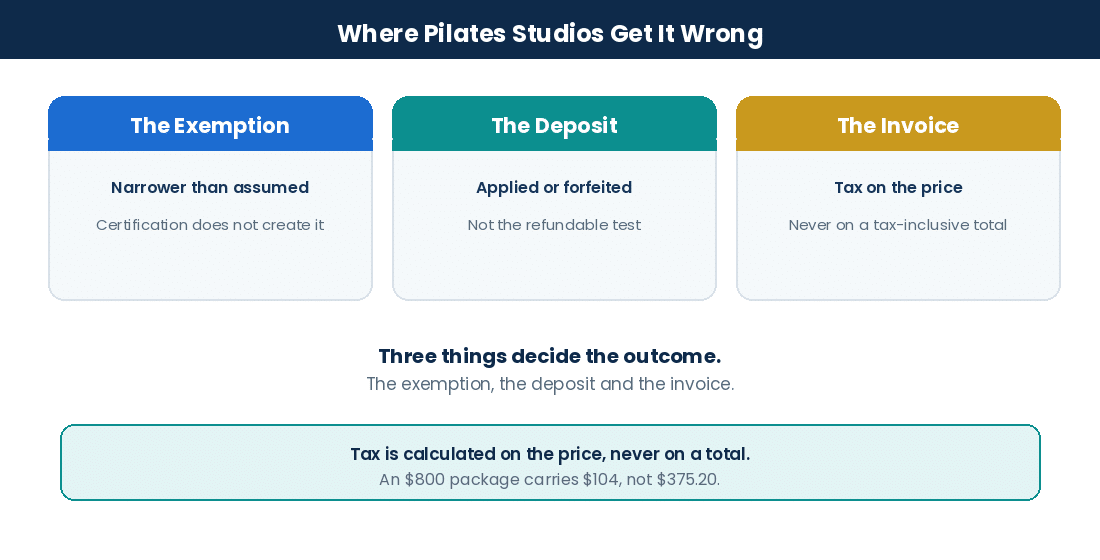
Most Pilates instruction is taxable. A deposit becomes taxable when it is applied or forfeited, not on a refundable test. And tax is calculated on the price, never on a figure that already includes tax.
Reading time: 52 minutes.
Table of Contents
- Three Things You Have Been Told
- GST/HST Obligations and the Exemption Question
- Private Sessions, Online Classes, Training and Retail
- Bookkeeping, Payroll and Input Tax Credits
- Corporate Filing, Capital Cost Allowance and Planning
- Audit Triggers and Working With Us
- Frequently Asked Questions
- Essential Topics and Best Practices
- Businesses We Serve
- Professional Guidance and Quick Reference
The Numbers That Matter
This article covers Canada, with Ontario and Toronto context, and reflects rules current to 2026. It is written for incorporated Canadian Pilates studios, including reformer studios, multi-location operators and studios running teacher training. Figures marked illustrative are examples, not quotes, and any masked engagement notes end with “Figures changed for privacy.” This is educational information only and not tax or legal advice. Provincial rules differ, so please confirm the position where you operate.
Three Things You Have Been Told
Three Things You Have Been Told
The Corrections
| What Circulates | The Rule |
|---|---|
| Pilates classes may be exempt health care | Almost never for a commercial studio |
| Deposit tax turns on refundable against non-refundable | Tax applies when the deposit is applied or forfeited |
| Ten sessions at $80 comes to $1,175.20 | It comes to $904.00 |
The Package That Taxes the Tax
This example circulates widely and it is worth walking through, because a studio using it overcharges every client.
| Line | Calculation | Amount |
|---|---|---|
| Ten sessions at $80 | 10 × $80 | $800.00 |
| HST at 13% | $800 × 13% | $104.00 |
| Total charged to the client | $800 plus $104 | $904.00 |
The published version reaches $1,175.20. It computes the $104 of tax correctly, then treats that $104 as the price per session, multiplies by ten to get $1,040, and applies 13% again to arrive at $135.20 of further tax.
The result is $271.20 of tax that does not exist on an $800 sale. A studio invoicing this way is collecting money it cannot keep and cannot properly remit, and every client has been overcharged by roughly a third of a session.
Tax is always calculated on the consideration for the supply. It is never calculated on a figure that already contains tax.
The Exemption You Probably Do Not Have
Guidance on this topic tends to present the health care exemption as something a studio can reach with the right certification. In practice a commercial Pilates studio almost never reaches it.
- The exemption attaches to listed health care services supplied by specified practitioners, not to the content of a class
- Pilates instruction is not on that list
- An instructor certification, however rigorous, does not create the exemption
- Where a regulated professional delivers a service within their own practice, that professional’s service may qualify on its own footing, which is a different supply from a studio class
- A further condition requires the supply to be made for a health care purpose rather than general fitness
Please treat exempt status as something you confirm before relying on, not something you assume. Getting it wrong runs in both directions: you fail to charge tax you owed, and you lose the input tax credits on rent, build-out and equipment that you were entitled to.
The Deposit Rule That Is Not the Rule
The refundable against non-refundable distinction is not the test. A deposit becomes consideration when it is applied to the price or forfeited, and tax applies at that point.
| Event | Tax Position |
|---|---|
| Deposit received and held | Not yet consideration |
| Applied to a course or package | Consideration; tax applies |
| Forfeited on cancellation | Treated as consideration at that point |
| Refunded in full | No supply, no tax |
We recalculate the package pricing on every studio file at intake. The tax-on-tax error is the one that has usually been running longest. Figures changed for privacy.
Risk Warning: Please check your package invoices against a simple 13% of the pre-tax price. If the total exceeds that, you are collecting tax you cannot keep.
Understanding GST/HST Obligations for Pilates Studios in Canada
GST/HST Obligations and the Exemption Question
Sales Tax
GST/HST Registration Requirements and Small Supplier Threshold
Register once taxable revenues exceed $30,000 over four consecutive calendar quarters, or in a single calendar quarter. Exempt supplies do not count toward the threshold. Our page on GST/HST registration covers the mechanics.
The single-quarter test is omitted from most guidance and it matters here. A studio selling annual memberships in January can cross $30,000 in that quarter alone, and the obligation starts then rather than a year later.
Once registered, charge at the rate for the place of supply. Ontario is 13%.
Differentiating Taxable and Exempt Supplies in Pilates Services
Do Pilates classes attract GST/HST in Canada? For a commercial studio, yes. The exemption route is narrow, and the conditions are about who supplies the service and what the service is, rather than about the quality of the instruction.
| Situation | Usual Position |
|---|---|
| Group Pilates class at a studio | Taxable |
| Private session with a certified instructor | Taxable |
| Reformer session sold as fitness | Taxable |
| Physiotherapy delivered by a physiotherapist, using equipment | Potentially exempt as that professional’s own service |
| Retail sales of mats, socks and apparel | Taxable |
Note the fourth row carefully. What may be exempt there is the regulated professional’s service, supplied by that professional. It is not your studio class becoming exempt because a regulated professional happens to be on the premises.
Where you genuinely have both streams, keep the revenue separate in the ledger from the first day. Reconstructing the split afterwards is difficult and unconvincing.
Why an Incorrect Exemption Claim Costs Twice
Exempt is not the same as zero-rated. On an exempt supply you charge nothing and you recover nothing.
- You did not collect tax you were required to collect, and the liability is yours
- You lost the input tax credits on rent, build-out, reformers and equipment
- For a studio that has just fitted out a space, the lost credits are usually the larger number
Membership Fees, Prepaid Class Packages, and Tax Treatment
Two different clocks run here and they should not be confused.
| Item | When Tax Applies | When It Is Income |
|---|---|---|
| Membership paid upfront | Earlier of payment and when it becomes due | Over the membership period |
| Ten-class package | Earlier of payment and when it becomes due | As classes are delivered |
| Deposit on a course | When applied or forfeited | As the course is delivered |
| Gift certificate | On redemption, not on sale | On redemption |
The gift certificate row is worth isolating, because it is the one item that genuinely is not taxed when the money arrives. Selling a certificate is not a supply; redeeming it is.
Everything else follows the ordinary timing rule. The sales tax generally falls in the period the client pays, while the income is deferred until the classes are actually delivered. A studio with a strong January intake and a December year end will otherwise report revenue it has not earned.
Expiry and Unused Sessions
When a package expires unused, the amount is recognised at that point according to your own written terms. Two practical points follow.
- Put the expiry terms in writing and apply them consistently, since the terms are what determine the timing
- Track the deferred balance by classes remaining, not by dollars collected
- Reconcile that balance to the booking system monthly
Studios that never wrote down an expiry policy end up carrying a deferred balance that nobody can justify or release. Figures changed for privacy.
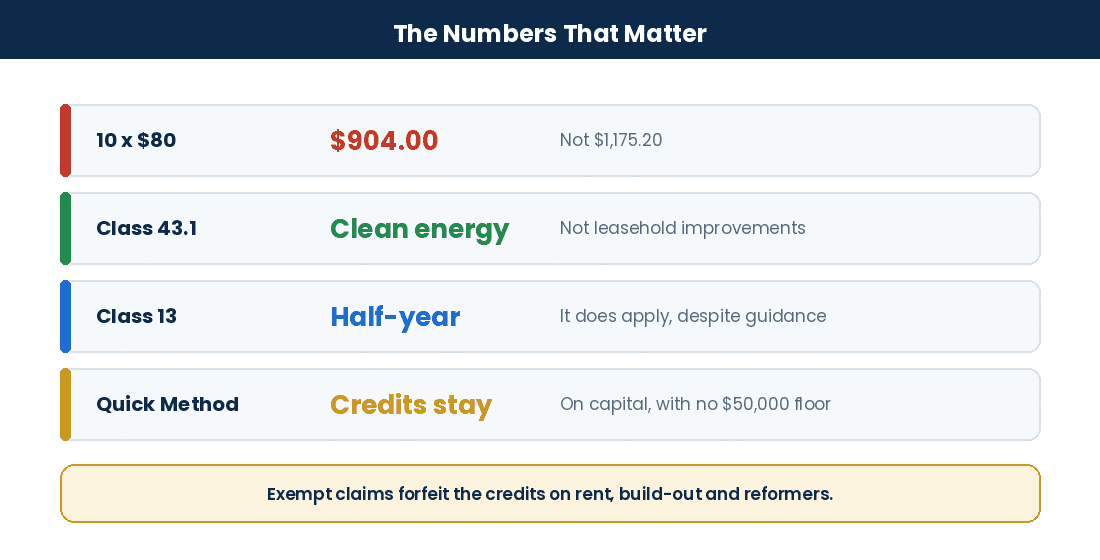
Key Stat: Exempt supplies carry no input tax credit recovery. For a newly fitted studio, a wrong exemption claim usually costs more on the credits than on the tax.
Private Sessions, Online Classes, Training and Retail
Private Sessions, Online Classes, Training and Retail
The Revenue Streams
GST/HST on Private Sessions and Clinic-Linked Pilates Services
Private sessions are taxable, whether one-to-one or in a small group. Cancellation and no-show fees are taxable in the same way once charged.
Where sessions are delivered through a clinic, please check the actual arrangement rather than the setting. The questions are who is supplying the service to the client, in what professional capacity, and whether the service itself is a listed one. A studio invoicing a clinic is usually making a taxable supply to that clinic regardless of what the clinic then does.
Tax Considerations for Online and Streamed Pilates Classes
Streamed and on-demand classes are taxable. The rate follows the place of supply, which for these services generally turns on the recipient’s address.
| Recipient Location | Rate on Your CRA Return | Note |
|---|---|---|
| Ontario | 13% HST | Single return |
| Alberta | 5% GST | Single return |
| British Columbia | 5% GST | PST is a separate registration |
| Quebec | 5% GST | QST is administered separately by Revenu Québec |
| Outside Canada | Generally zero-rated | Credits still recoverable |
Please note the Quebec row. Guidance listing “Quebec 14.975%” as a place of supply rate is combining GST and QST into a single figure. Only the 5% appears on your CRA return; the QST is a separate registration and a separate filing.
Zero-rated is not exempt. On a zero-rated supply you charge nothing and still recover your credits in full, which is why the distinction is worth getting right on international subscribers.
Where a platform collects from the client and remits you a net amount, record the gross and expense the platform fee. Recording only the net understates revenue, understates the expense, and loses the recoverable tax on the fee.
Taxation of Teacher Training and Certification Programs
Teacher training run by a commercial studio is generally taxable. The vocational training exemption exists but is narrow, and guidance implying a studio reaches it by having a formal curriculum and qualified instructors overstates it considerably.
- The exemption is directed at supplies by governments, school authorities and bodies with the relevant statutory or regulatory standing
- A recognised industry certification is not the same as the statutory recognition the exemption contemplates
- Manuals, props and equipment sold alongside a course are taxable in their own right
- Where a course spans two fiscal years, recognise the income across delivery rather than at booking
If you believe your programme qualifies, please get that confirmed in writing before you stop charging tax on it. The cost of being wrong compounds across every cohort.
Retail Sales Tax Issues Related to Pilates Studios
Grip socks, apparel, mats and small equipment are taxable retail sales, and the stock is inventory until sold.
The same applies to a franchise studio selling branded stock under a franchisor’s programme. The supply is yours, so the tax and the inventory are yours.
| Practice | Why |
|---|---|
| Separate retail revenue from class revenue | Different margins, and a cleaner audit trail |
| Record cost of goods sold against retail revenue | Otherwise the margin is invisible |
| Count stock at the year end and sign the sheet | Inventory is an asset until sold |
| Value at the lower of cost and net realizable value | Stops carrying dead stock at full price |
| Reconcile the point of sale system to deposits | Cash handling is a standard review area |
| Code low-value lines consistently | A shelf of grip socks should not sit in supplies |
Credits are available on wholesale purchases and on point of sale software used in the business, provided the invoice carries the prescribed information. Items taken for personal use are not business costs, and coding them to the shareholder loan account at the time is simpler than explaining them later.
Studios almost always have a retail line and almost never have a cost of goods sold line against it. The margin then looks like pure profit. Figures changed for privacy.
Risk Warning: Zero-rated and exempt are different. Please do not use one word for the other, since only one of them preserves your credits.
Bookkeeping and Payroll Essentials for Pilates Studios
Bookkeeping, Payroll and Input Tax Credits
The Operations
Effective Bookkeeping Practices Tailored for Pilates Businesses
Business income is computed on the accrual basis. Record income when earned, not when the money arrives, and let the booking system drive the revenue rather than the bank feed.
- Reconcile booking system revenue to bank deposits every month
- Check the package and membership liability balance monthly
- Post payroll on time rather than in batches
- Store receipts digitally, using QuickBooks or Xero with Hubdoc
- Monitor instalments against the tax actually expected
- Split the income statement by stream: group classes, private sessions, training, retail
- Prepare a year-end checklist covering deferred revenue and fixed assets
Payroll Source Deductions for Studio Employees and Contractors
Classification comes first, and it is decided on the facts: control over the schedule, who supplies the equipment, chance of profit or risk of loss, and how far the instructor is integrated into the business. A studio that sets the timetable, provides the reformers and lists the instructor publicly is describing employment.
| Average Monthly Withholding | Remitter Type | When to Remit |
|---|---|---|
| Under $25,000 | Regular | By the 15th of the following month |
| $25,000 to under $100,000 | Accelerated, threshold 1 | Twice a month |
| $100,000 and over | Accelerated, threshold 2 | Up to four times a month, within three working days |
A correction here. Guidance stating that remittance is due within three working days once average monthly withholding passes $25,000 is describing the wrong tier. The three-working-day rule belongs to the $100,000 threshold. A studio at $30,000 remits twice a month, not within three days.
T4 and T4A slips are due by the last day of February. The late-filing penalty is a sliding scale based on how many slips are outstanding and how late they are. It is not a flat amount per slip, and figures of “$25 to $100 per slip” do not describe it.
Amounts withheld are held in trust, and directors can be assessed personally for amounts not remitted. Free classes and merchandise given to staff are taxable benefits and belong on the slip.
Managing Input Tax Credits to Optimize Cash Flow
| Expense Type | Credit Allowed | Notes | Documents Needed |
|---|---|---|---|
| Reformer Equipment | Yes | Full credit on purchase; CCA is the separate income tax mechanism | Invoice showing GST/HST paid |
| Leasehold Improvements | Yes | Business premises | Contract plus invoice |
| Rent | Yes | Business use portion where space is shared | Lease and payment records |
| Software Subscriptions | Yes | Business use | Vendor tax invoice |
| Mixed Personal Use | Partial | Documented allocation basis | Records supporting the split |
Please note the first row. For sales tax the credit on equipment is claimed in full in the period acquired. Capital cost allowance is a separate income tax deduction spread over years. Guidance describing the credit as “subject to capital cost allowance” is merging two different taxes.
Every claim needs an invoice carrying the prescribed information, including the supplier’s registration number above a modest threshold. That single missing line is where most denied claims come from. Our guide to input tax credits in Canada sets out the requirements in full.
Should Your Studio Use the Quick Method?
| Factor | Position |
|---|---|
| Eligibility | Taxable supplies within the prescribed annual limit |
| Remittance rate | A prescribed rate by province and business type |
| Credits on operating costs | Given up, since the rate already reflects them |
| Credits on capital property | Still claimable |
| Election timing | By the due date of the return for the first period it is to apply |
Two corrections. Credits on capital property remain claimable under the Quick Method, and there is no $50,000 floor on that. Guidance stating that only capital assets above $50,000 qualify is describing a threshold that does not exist. And the election is not tied to your first return after registering; it is made by the due date of the return for the first period you want it to apply to.
For a studio carrying rent, a build-out and reformers, the ordinary method usually recovers more. Please model both before electing rather than choosing on simplicity.
The Quick Method suits a service business with almost no input costs. A reformer studio is not that business. Figures changed for privacy.
Pro Tip: Please check the registration number appears on your recurring supplier invoices. Subscriptions are the usual gap.
Corporate Income Tax Filing Obligations in Canada
Corporate Filing, Capital Cost Allowance and Planning
The Filings
Key Deadlines and Filing Requirements for Incorporated Pilates Studios
| Obligation | Deadline | Applies To |
|---|---|---|
| T2 corporate return | Six months after fiscal year end | All corporations, including dormant ones |
| Corporate tax payment | Three months for an eligible CCPC, two for others | Corporations with a balance owing |
| GST/HST, monthly or quarterly | One month after the period end | Registered studios |
| GST/HST, annual filer | Generally three months after the year end | Smaller registrants |
| Payroll source deductions | 15th of the following month for a regular remitter | Employers |
| T4 and T4A slips | Last day of February | Employers and payers |
| Record retention | Six years from the end of the taxation year concerned | All records |
Note the payment row, which is missing from most versions of this list. It falls earlier than the filing deadline, and it is the one studios miss. Filing on time with the balance unpaid still accrues interest from the payment date.
The corporate late-filing penalty is 5% of the unpaid tax plus 1% per complete month, to a maximum of twelve. The GST/HST failure-to-file penalty is calculated differently, and describing both as “1% and rising” conflates them.
Utilizing Capital Cost Allowance and Leasehold Improvements Deductions
| Asset | Class | Rate | Half-Year Rule |
|---|---|---|---|
| Reformers, towers, chairs, barrels | Class 8 | 20% declining balance | Applies |
| Mat racks, props storage, furniture | Class 8 | 20% declining balance | Applies |
| Flooring, mirrors, partitions, fixed installations | Class 13 | Over the lease term | Applies |
| Computers and systems software | Class 50 | 55% declining balance | Applies |
| Application software | Class 12 | 100% | Generally applies |
| Buildings you own | Class 1 | 4% | Applies |
Two corrections on this table as it usually circulates.
- Class 43.1 is not an alternative for leasehold improvements. That class covers clean energy generation and conservation equipment. Energy-efficient flooring or lighting inside a leased studio is still a Class 13 leasehold improvement.
- The half-year rule does apply to Class 13. Guidance marking it “No” is wrong. Class 13 is written off over the lease term including renewal options within limits, and the first-year restriction still applies.
On 2026. Bill C-15 received Royal Assent on 26 March 2026, reinstating the accelerated investment incentive for most depreciable property acquired after 2024 and available for use before 2030. Where it applies, an enhanced first-year deduction replaces the ordinary half-year rule.
The claim year is set by when an asset becomes available for use, not by the invoice date, so reformers ordered in November and installed in January fall in the later year. And a capital cost allowance claim is a maximum rather than an obligation, so claiming less in a weak year preserves the pool.
Balancing Salary Versus Dividends for Studio Owners
| Route | Corporate Deduction | Payroll | RRSP Room |
|---|---|---|---|
| Salary | Deductible to the corporation | CPP applies; EI usually not for an owner | Creates room |
| Dividend | Not deductible; paid from after-tax income | No source deductions | Creates none |
The EI point is worth stating. A shareholder controlling more than 40% of the voting shares is generally not insurable, so the usual comparison is CPP rather than CPP and EI together.
There is no single right answer. It turns on the amount needed personally, the corporate rate applying, whether you want RRSP room, and what the corporation needs to retain. Please review it annually rather than setting it once, which is part of our corporate tax planning work.
Financial Statements and Reporting
Compilation engagements are prepared under CSRS 4200, with the underlying figures on ASPE. The T2 carries GIFI schedules:
- Schedule 100, the balance sheet
- Schedule 125, the income statement
- Schedule 141, the notes checklist
Please note that Schedule 141 is the notes checklist, not a cash flow statement. Guidance labelling it that way is incorrect, and there is no GIFI cash flow schedule.
Class 43.1 turns up on studio files because someone searched for an energy-efficient flooring deduction. The flooring is still Class 13. Figures changed for privacy.
Key Stat: Corporate tax is payable two or three months after year end, before the six-month filing deadline. Please diarise them separately.
Common CRA Audit Triggers for Pilates Studios
Audit Triggers and Working With Us
The Engagement
- Not registering after passing the threshold on either test
- Treating classes as exempt health care without the conditions being met
- Recording package revenue in full on sale rather than as classes are delivered
- Paying instructors without issuing T4 or T4A slips
- Instructors called contractors while being directed like employees
- Cash payments that never reach the records
- Missed GST/HST or payroll remittance deadlines
- Personal costs claimed as business expenses
Illustrative example. A Toronto studio collected $12,000 in prepaid memberships mid-year, recorded the whole amount as revenue on receipt and did not remit the tax collected. The review that followed covered both the revenue timing and the unremitted tax. Figures changed for privacy.
What a GST/HST Review Actually Looks At
| Area | What Is Compared |
|---|---|
| Revenue | Booking system totals against filed returns and bank deposits |
| Deferred revenue | The liability balance against unused passes |
| Input tax credits | Claims against invoices carrying the prescribed information |
| Payroll | Classification, remittances and slips |
| Exempt claims | The basis for treating any supply as exempt |
Each of these is answered by a document you either kept or did not. None of them is answered by explanation.
Strategies to Defend Against Reviews and Penalties
Where a registration was missed or returns were filed incorrectly, correcting it promptly is the strongest position available. Amended returns limit interest, and where a penalty would otherwise apply the Voluntary Disclosures Program may be available, but only before the CRA raises the issue.
Please note two boundaries that are often misunderstood. Taxpayer relief is discretionary, limited to a ten-year window, and reaches interest and penalties rather than the tax itself. And reliance on an adviser is generally not accepted as a ground on its own.
How We Handle a Pilates Studio File
| Phase | What You Send | What We Do |
|---|---|---|
| Intake and registration check | Incorporation documents and past filings | Confirm business number and account status |
| Bookkeeping setup | Bank statements and invoices | Clean the ledger and split revenue by stream |
| Sales tax reconciliation | Booking system reports | Reconcile and prepare returns |
| Payroll | Timesheets and class counts | Calculate deductions and remit |
| Year end | Remaining records | Compile statements and file the T2 |
The first phase is short and it decides most of the rest. Registration status, the exemption position and the package pricing are settled before any bookkeeping is done, because correcting those later means reopening periods.
Choosing Tax Help: DIY, CPA or Non-CPA Provider
| Route | Strength | Weakness |
|---|---|---|
| DIY | Lowest direct cost | Exemption, timing and classification decided by default |
| Non-CPA provider | Handles routine bookkeeping | Depth varies on the decisions that matter |
| CPA firm | Technical depth and regulatory accountability | Higher direct cost |
Anyone you authorise may deal with the CRA in Canada, so the difference is capability rather than legal standing.
What Drives the Fee
- Number of locations
- Volume of memberships and packages billed
- Instructors on payroll against contract
- Whether you carry retail stock
- Whether you stream or run teacher training
Fees are quoted before work begins, including HST, on a flat annual basis. We respond within one business day and are available evenings and weekends. Our engagements carry a 30-day money-back arrangement and a 60-day fee-matching arrangement.
Bring three things to a first conversation: your last filed corporate return, a booking report showing unused passes, and a sample package invoice. Contact Gondaliya CPA at info@gondaliyacpa.ca, call 647-212-9559, or send us a message. Where records have drifted, our catch-up bookkeeping services handle the correction first, and our bookkeeping and accounting services keep it running afterwards.
The sample package invoice is the fastest diagnostic we have. It tells us the exemption position and the pricing arithmetic in one page. Figures changed for privacy.
Risk Warning: Taxpayer relief does not reach the tax itself, only interest and penalties, and the window is ten years.
Frequently Asked Questions on Pilates Studio Taxes Canada
Frequently Asked Questions
FAQ
Does Ontario charge HST on Pilates classes?+
Yes. Classes supplied by a commercial studio in Ontario are taxable at 13%. An instructor certification does not make them exempt.
What is the Capital Cost Allowance rate for reformers in a Pilates studio?+
Reformers sit in Class 8 at 20% on a declining balance, with the half-year rule in the year they become available for use, or the reinstated incentive where it applies.
How long should Pilates studios keep records for tax purposes?+
Six years from the end of the taxation year the records relate to. That is measured from the year end, not from the filing date.
When is the T4 and T4A slip deadline?+
The last day of February for the preceding calendar year. The late penalty is a sliding scale, not a flat amount per slip.
When can Pilates studios claim input tax credits?+
Once you hold an invoice carrying the prescribed information, including the supplier’s registration number above a modest threshold, for a cost used in your taxable activities.
How are unused sessions and expired packages treated?+
The amount is recognised when the client’s right lapses under your written terms. Put the expiry policy in writing, since the terms drive the timing.
Are cancellation and no-show fees taxable?+
Yes. Where you charge the client for a missed or cancelled session, that is consideration for a supply and tax applies.
How are gift certificates taxed when sold by Pilates studios?+
Not on sale. Issuing a certificate is not a supply. Tax applies when it is redeemed for classes or goods.
What is the payroll remittance deadline for Pilates studios?+
A regular remitter pays by the 15th of the following month. The deadline tightens as average monthly withholding rises, and the three-working-day rule applies from $100,000, not from $25,000.
Which studio costs are deductible as business expenses?+
Rent, utilities, insurance, instructor pay, advertising, booking software and professional fees, with equipment and build-out deducted through capital cost allowance rather than in full.
How do leasehold improvements affect depreciation claims?+
They go to Class 13 and are written off over the lease term including renewal options within limits. Class 43.1 is clean energy equipment and does not apply to a studio build-out.
Can a home-based Pilates instructor deduct home office expenses?+
A sole proprietor prorates household costs by the area used exclusively for the business. An incorporated studio does not prorate; it uses a reasonable arrangement or reimburses supported costs.
What financial statements do CPA firms prepare for Pilates studios?+
Compilation financial statements under CSRS 4200, with the T2 carrying Schedule 100 for the balance sheet, Schedule 125 for the income statement and Schedule 141 as the notes checklist.
When are GST/HST filing deadlines for registered Pilates businesses?+
Monthly and quarterly filers file one month after the period end. Annual filers generally have three months.
Is teacher training exempt from GST/HST?+
Generally no when run by a commercial studio. The vocational training exemption is narrow and turns on the supplier’s statutory standing, not on the quality of the curriculum.
Should my studio use the Quick Method?+
Usually not if you carry rent, a build-out and reformers, since the ordinary method recovers more. Credits on capital property remain claimable under the Quick Method, with no $50,000 floor.
Sixteen questions, and the two on exemptions account for most of the money at stake on a studio file. Figures changed for privacy.
Essential Tax Topics for Canadian Pilates Studios
Essential Topics and Best Practices
Quick Reference
- CRA Review Triggers: Late remittances, misclassified instructors, unreported cash and weak records.
- Monthly Booking Reconciliation: Match booking data to bank deposits every month.
- Punch Card Expiry Policies: Written terms decide when unused sessions become income.
- Deposits: Taxable when applied or forfeited, not on a refundable test.
- Gift Certificates: Taxed on redemption, never on sale.
- Digital Place of Supply: The rate follows the recipient; non-resident sales are generally zero-rated.
- Mixed Offerings: Separate retail, class, private and training revenue in the ledger.
- Receipts for Credits: Keep supplier invoices six years, with the registration number visible.
- Taxable Benefits: Free classes and merchandise for staff belong on the slip.
- Pro-rated Course Income: Spread across delivery, not recognised at booking.
- Inventory at Year End: Counted, signed, and valued at the lower of cost and net realizable value.
- Personal Use Allocation: Documented basis before any claim on a mixed-use asset.
Best Practices to Keep the Year Clean
- Confirm your registration status against both threshold tests.
- Check package invoices calculate tax on the pre-tax price.
- Confirm any exempt treatment in writing before relying on it.
- Reconcile deferred revenue to unused passes monthly.
- Decide instructor classification on the facts and document it.
- Issue T4 and T4A slips by the last day of February.
- Record platform and processor settlements gross, with fees expensed.
- Keep retail revenue, inventory and cost of goods sold separate.
- Maintain an asset register with dates, cost and availability for use.
- Diarise the corporate payment date separately from the filing date.
Corrections Worth Carrying
- Pilates instruction at a commercial studio is not exempt health care.
- A deposit is not taxed on the refundable against non-refundable test.
- Tax is never calculated on an amount that already includes tax.
- Class 43.1 is clean energy equipment, not leasehold improvements.
- The half-year rule does apply to Class 13.
- Credits on capital property survive the Quick Method, with no $50,000 floor.
- The three-working-day remittance rule starts at $100,000, not $25,000.
- Schedule 141 is the notes checklist, not a cash flow statement.
- Exempt and zero-rated are not the same; only one preserves credits.
- An incorporated studio does not prorate home premises by area.
For expert advice tailored to your Pilates studio taxes Canada needs, contact Gondaliya CPA at info@gondaliyacpa.ca, call 647-212-9559, or book a free consultation.
Thirty-two points, and the ten corrections are all things a studio owner was told confidently by something they read. Figures changed for privacy.
Businesses We Serve
Industry Expertise
Studio and wellness businesses share the same issues. Here are ten and the usual finding.
| Business | The Issue That Usually Appears |
|---|---|
| Reformer Pilates studios | Package invoices calculating tax on a tax-inclusive figure |
| Mat and group class studios | Classes treated as exempt health care |
| Studios running teacher training | Training assumed exempt under the vocational rules |
| Clinic-linked studios | The clinic setting mistaken for the exemption itself |
| Studios selling memberships | Prepaid amounts recorded as revenue on receipt |
| Studios streaming classes | Platform settlements recorded net of fees |
| Studios with retail shelves | No cost of goods sold against retail revenue |
| Studios with several instructors | Classification never actually decided |
| Multi-location operators | Association sharing one small business deduction limit |
| Anyone buying equipment | Post-2024 purchases on the plain half-year rule |
- Reformer Pilates studios: Tax the price, not the total.
- Mat and group class studios: Confirm before relying on it.
- Studios running teacher training: Generally taxable.
- Clinic-linked studios: Who supplies what, to whom.
- Studios selling memberships: Deferred until delivered.
- Studios streaming classes: Record gross, expense the fee.
- Studios with retail shelves: Count it, cost it, separate it.
- Studios with several instructors: Facts decide, not the label.
- Multi-location operators: One limit, shared.
- Anyone buying equipment: Check the 2026 incentive.
The apparatus changes. The questions do not: is it exempt, when does the tax fall due, and is the arithmetic on the invoice right. Figures changed for privacy.
Professional Guidance and Quick Reference
Guidance
Professional Guidance: How Gondaliya CPA Handles Your Studio
Pilates studios get into difficulty in a predictable set of ways: calculating tax on a package total that already contains tax, which on ten sessions at $80 turns a correct $904.00 into $1,175.20 and overcharges every client, treating classes or teacher training as exempt when the health care and vocational exemptions turn on the supplier’s standing rather than the certification held, taxing deposits on a refundable against non-refundable test that is not the rule, recording prepaid memberships and packages as revenue when the money arrives rather than as classes are delivered, and putting leasehold improvements in Class 43.1 which covers clean energy equipment. Gondaliya CPA handles studio accounting on a flat annual fee.
We handle what decides the outcome: recalculating package pricing so tax falls on the consideration, confirming the exemption position in writing before any supply is treated as exempt, reconciling deferred revenue to unused passes monthly, tracking deposits until applied or forfeited, testing instructor classification on the facts and issuing the correct slips on time, assigning equipment to Class 8 and build-outs to Class 13 with availability-for-use timing, and modelling the Quick Method against your actual credits before any election.
Our team starts with your last filed corporate return, a booking report showing unused passes and one sample package invoice. Whatever your studio, you get clear advice and a fixed price before we start.
Quick Answers
- Ten sessions at $80: $904.00 in Ontario
- Classes: Taxable, not exempt health care
- Teacher training: Generally taxable too
- Deposits: Taxed when applied or forfeited
- Gift certificates: Taxed on redemption only
- Memberships: Deferred until delivered
- Reformers: Class 8 at 20%
- Build-out: Class 13, over the lease term
- Quick Method: Capital credits survive it
- Corporate payment: Before the filing deadline
Who This Is For
- For: Incorporated Canadian Pilates studios, including reformer studios, multi-location operators, studios running teacher training and studios streaming classes.
- Not For: Sole proprietors, whose home premises treatment differs, or regulated health professionals assessing their own practice exemption, which turns on their own status.
People Also Ask
How much tax is on ten sessions at $80?+
$104.00, giving a total of $904.00 in Ontario. Any figure above that is taxing an amount that already includes tax.
Is a non-refundable deposit taxed on receipt?+
No. A deposit becomes consideration when it is applied to the price or forfeited, and that is when tax applies.
Do I charge tax to a client streaming from outside Canada?+
Such supplies are generally zero-rated, so you charge nothing and still recover your input tax credits in full.
Glossary of Key Terms
- Taxable supply: A supply carrying GST/HST, with credits recoverable.
- Exempt supply: A supply carrying no tax and no credit recovery.
- Zero-rated supply: Taxed at 0%, with credits still fully recoverable.
- Small supplier: Below $30,000 on both threshold tests.
- Deferred revenue: Prepaid memberships and packages not yet delivered.
- Deposit: Money held, becoming consideration when applied or forfeited.
- Gift certificate: Not a supply on issue; taxed on redemption.
- Place of supply: What determines which rate applies.
- Input tax credit: Recovery of tax paid on business costs.
- Quick Method: A prescribed remittance rate in place of operating credits.
- Class 8: Reformers and studio equipment, at 20%.
- Class 13: Leasehold improvements, over the lease term.
- Available for use: When an asset becomes eligible for depreciation.
- Worker classification: Employee or contractor, decided on the facts.
- CSRS 4200: The standard for a compilation engagement.
- Trust amounts: Collected sales tax and payroll source deductions.
Studio Tax Check
This quick self-check indicates where your operation most likely has room. Please answer the six questions below.
Studio Tax Check
Six quick questions on your studio. No fee shown.
Points to raise with us:
This is a general prompt, not tax or legal advice or a quote. Your position depends on your full facts. For a real review, please book a free consultation.
Want a checklist to work from? You can download our free Pilates studio tax checklist before your consultation.
Check package invoices calculate tax on the pre-tax price. Confirm any exempt treatment in writing before relying on it. Reconcile deferred revenue to unused passes monthly. Capitalise the build-out to Class 13 over the lease term. Decide instructor classification on the facts and issue the correct slips. Record platform settlements gross. Check post-2024 equipment against the reinstated incentive. Please keep six years of records.
2026 Update — what is current: This article reflects rules current to 2026. The $30,000 small supplier threshold on both tests, the Class 8 rate of 20%, the Class 13 write-off over the lease term, the last day of February deadline for T4 and T4A slips, the six-month T2 filing deadline and the six-year record retention requirement are unchanged. Bill C-15 received Royal Assent on 26 March 2026, reinstating the accelerated investment incentive for most depreciable property acquired after 2024 and available for use before 2030, and Ontario\u2019s small business rate moves to 2.2% from 1 July 2026. Please note that tax is calculated on the consideration for the supply and never on a figure that already includes tax, so ten sessions at $80 comes to $904.00 in Ontario rather than the $1,175.20 that circulates; that Pilates instruction supplied by a commercial studio is taxable, since the health care exemption attaches to listed services supplied by specified practitioners rather than to an instructor certification, and the vocational training exemption turns on the supplier\u2019s statutory standing; that a deposit becomes consideration when applied to the price or forfeited rather than on a refundable test, while a gift certificate is taxed only on redemption; that Class 43.1 covers clean energy equipment and is not an alternative for leasehold improvements, and the half-year rule does apply to Class 13; that credits on capital property remain claimable under the Quick Method with no $50,000 floor; that the three-working-day payroll remittance rule begins at $100,000 of average monthly withholding rather than $25,000; and that Schedule 141 is the notes checklist rather than a cash flow statement.
Pilates Studio Taxes Canada: How Gondaliya CPA Supports Studios
Start with one package invoice
Gondaliya CPA recalculates package pricing so tax falls on the consideration, confirms the exemption position in writing before any supply is treated as exempt, reconciles deferred revenue to unused passes monthly, tracks deposits until applied or forfeited, tests instructor classification on the facts and issues the correct slips on time, assigns reformers to Class 8 and build-outs to Class 13 with availability-for-use timing, and models the Quick Method against your actual credits, on a flat annual fee including HST with a one-business-day response. Please book a free consultation.
Next Steps
Please book a free consultation with Gondaliya CPA and bring your last filed corporate return, a booking report showing unused passes, and one sample package invoice. Those three show where the real position is, what is misstated, and what remains to claim on the equipment, and where the documentation is thin. You will get a flat annual fee including HST before any work begins. If our content helps, please add gondaliyacpa.ca as a preferred source on Google.
Published: · Last updated:
Editorial policy: We research against CRA and CPA Ontario sources, fact-check the figures, and Sharad Gondaliya, CPA, reviews the content, which we update as the rules change.
Disclaimer: This article is educational information only and is not tax, legal, or financial advice. Figures marked illustrative are examples rather than quotes or guarantees. It reflects CRA rules current to 2026, including the $30,000 GST/HST threshold, the Class 8 rate, Class 13 leasehold treatment, the half-year rule, and the six-year retention requirement. Rates, limits and expensing rules change and outcomes depend on your specific facts. Please consult a licensed CPA before acting.

Sharad Gondaliya is a CPA Canada & CPA USA with 15 Years+ experience of Accounting, Tax, Payroll of Corporate Small Businesses as Tax Accountant. He is fully certified CPA Ontario and CPA USA and is well known among corporate small businesses for tax planning, efficient tax solutions, and affordable CPA services. Sharad is the Principal (Director) of Gondaliya CPA – Affordable CPA Firm in Canada. Licenses: CPA Ontario: 61040184 | CPA USA (MT): PAC-CPAP-LIC-033176 | CPA USA (WA): 57629 | CPA Firm License: 61330051 View Full Author Bio