



Call Centre Tax Deductions in Canada: Employee Costs, Technology, Rent & Business Expenses
Call centre tax deductions in Canada include a variety of expenses such as rent, employee benefits, and technology costs that help reduce your taxable income. Gondaliya CPA provides practical advice on call centre tax write offs and managing call centre business expenses to ensure you claim every eligible deduction.
Quick Summary
Most of a call centre’s spend is deductible, but the money is won or lost on three distinctions: current expense versus capital asset, business portion versus personal portion, and allowance versus reimbursement for home-based agents. Get those right and the rest follows.
- Deduct wages, rent, utilities and subscriptions in the year incurred.
- Capitalise computers, furniture and build-outs into the right CCA class.
- Split phone and internet between business and personal use, and keep the working.
- Have a signed T2200 on file for every agent claiming a home workspace.
Reading time: 23 minutes.
Table of Contents
Key Numbers at a Glance
This info is for call centres that are incorporated and run in Ontario or elsewhere in Canada. It follows the rules the CRA sets now. You should check for any updates or talk to a pro before deciding.
Call Centre Tax Deductions in Canada
Call Centre Tax Deductions in Canada
Foundations
Call centres in Canada can save money with tax deductions. Knowing about call centre tax deductions Canada helps you keep more of your earnings. The CRA lets you write off many call centre business expenses. These include wages, rent, and technology costs.
Quick look at some common expenses:
- Employee wages
- Software subscriptions
- Rent payments
- Equipment purchases
Key Numbers at a Glance
| Expense Type | Deductibility Status | Record Required |
|---|---|---|
| Employee Wages | Current Expense | Payroll Records |
| Software Subscriptions | Current Expense | Invoices |
| Purchased Software Licences | Capital — Class 12 | Invoices |
| Rent Payments | Current Expense | Lease Agreements |
| Equipment Purchases | Capital Expenditure | Purchase Receipts |
Quick Answer
| Question | Answer |
|---|---|
| What are Call Centre Tax Deductions? | They are costs you can subtract from your income to pay less tax. |
| Who Can Claim Them? | Businesses that run call centres and are incorporated. |
| Common Deductible Expenses | Employee wages, technology costs, office rent |
What Makes a Call Centre Expense Deductible?
An expense counts if it meets these points:
- You need it to earn money.
- It’s a fair price, not too high.
- You don’t count the part used for personal stuff.
- You have proof like receipts or records.
For example, paying your workers is deductible because it helps your business make money.
Current Expense or Capital: How Do You Classify Spend?
You have two types of expenses:
- Current Expenses: Costs you take off right away, like wages.
- Capital Expenditures: Big buys that last long, like computers.
Mixing these up can cause problems if the CRA checks your books. So it’s smart to label them right.
Key Stat: The practical dividing line for small equipment is $500. A tool or piece of gear costing under $500 falls into Class 12 at 100%, deducted across two years under the half-year rule. At $500 or more it goes to Class 8 at 20% declining balance, which takes far longer to recover.
Knowing these basics about call centre tax deductions Canada helps you follow rules and save money. Keep good records for all call centre business expenses. If you want specific advice, ask an expert like Gondaliya CPA who knows Canadian tax rules well.
Common Tax Write-Offs for Call Centres
Common Tax Write-Offs
Write-Offs
Home Office Expenses
Eligibility requirements
Owners and remote staff can claim costs for a home workspace if they use the space mostly for business. For call centre workers at home, phone and internet bills might count if they show clear business use. The law says phone, internet, or equipment costs must match who uses them more—business or employee—and you need good proof [Income Tax Act s.8(1)(i), s.8(13); CRA Guide T4044]. Employers must sign Form T2200 to confirm this use.
Calculation methods
To figure home office expenses, you measure how much of your home you use just for work. You can do this by room count or square feet used. Employers have to say in writing how much is used for work when paying employees back. If not, the money might be taxed as a benefit [CRA Guide T4130 – Employers’ Guide to Taxable Benefits]. Making fair estimates helps avoid problems with CRA.
CRA documentation guidelines
Keep the signed T2200 that sets out the conditions of employment, including use of a home workspace. Also keep receipts for rent, utilities, phone, and internet that relate to your work area [CRA Guide T4044; keep records at least six years after filing]. Without these papers, CRA can reject your claim or tax any payment you got as income.
Equipment and Supplies
Computers, headsets & telephones
Call centres write off computers, headsets, phones, and other gear as either normal expenses or capital assets. These assets fall under classes including Class 8 (general equipment and office furniture), Class 12 (tools under $500 and application software), Class 13 (leasehold improvements), and Class 50 (computer hardware and systems software acquired after 18 March 2007) [Income Tax Regulations Schedule II; CRA CCA guide]. Items under $500 go to Class 12 at 100%; pricier ones must be depreciated over time under the half-year rule [Income Tax Regulations subsection 1100(2)].
| Class | What It Covers in a Call Centre | Rate |
|---|---|---|
| Class 8 | Desks, chairs, cubicles, general equipment, tools $500 and over | 20% |
| Class 12 | Headsets and tools under $500; purchased application software | 100%, half-year rule |
| Class 13 | Leasehold improvements — cabling, partitions, acoustic treatment | Over lease term, min 5 / max 40 years |
| Class 50 | Computers, servers and systems software | 55% |
Stationery & miscellaneous supplies
Things like paper, pens, printer ink, and cleaning supplies are regular call centre business expenses. They fall under section 18(1)(a) of the tax law [ITA s.18(1)(a); CRA General Business Expenses]. You can fully deduct these costs in the year you buy them if they are needed to earn income.
Maintenance costs
Costs to keep your tech safe—like data security checks—and fees for professional certificates required by law are deductible. These expenses fix or keep things running and don’t add new value so they count as current expenses [ITA s.18(1)(a); data security costs classed as operating expenses].
Vehicle Expenses and Mileage
Vehicle Expenses & Mileage
Vehicles
Business vs. personal use
Call centres must split vehicle costs between business and personal use clearly. Only fair costs linked to making money count. For example, fuel used driving to clients counts but not daily trips from home to work, which CRA treats as personal [ITA s.18(1)(a); CRA Motor Vehicle Expenses]. Meals while travelling on business are limited to 50% of the amount paid under section 67.1; where you use the simplified method instead of receipts, the flat rate is $23 per meal to a maximum of $69 per day, and the 50% limit still applies to the business deduction. Club fees not tied to business are never deductible [ITA s.18(1)(l)].
Don’t claim crazy vehicle costs or CRA might check your records hard and charge penalties.
| Expense Type | Deductible Portion | Limit / Condition |
|---|---|---|
| Fuel | Business kilometers only | Keep good mileage logs |
| Parking | Fees related to business parking | Keep receipts |
| Insurance | Portion based on work use | Personal part excluded |
| Repairs & Maintenance | For work vehicles only | Save service bills |
Mileage Tracking
Keeping a detailed mileage log is key. Write down trip date, why you went there, and how far you drove [CRA recordkeeping best practices]. This helps separate work travel from personal trips. It also helps during CRA reviews.
Employers should ask agents who drive for work outside usual places to keep monthly logs.
Allowable Deductions
Allowed vehicle deductions include fuel for client visits or trips between offices in Canada with good records [ITA s.18(1)(a)]. Leasing fees can be deducted too but only the part used for business, and passenger vehicle lease deductions are further capped by the prescribed monthly limit [Income Tax Regulations s.1100 and s.67.3].
Fines like speeding tickets cannot be deducted because they’re penalties [ITA section 67.6].
Pro Tip: The commute rule catches call centres out more than any other vehicle issue. Travel between an agent’s home and their regular place of work is personal, no matter who pays for it — and reimbursing it creates a taxable benefit on the agent’s T4 rather than a clean deduction for you. Travel between two of your own sites, or out to a client, is business.
If you run an incorporated Canadian call centre—especially around Toronto—and want clear info about call centre tax deductions Canada or call centre tax write offs Canada, contact Gondaliya CPA at info@gondaliyacpa.ca or call 647-212-9559. We can look at your situation free of charge.
Business Expenses You Can Claim
Business Expenses You Can Claim
Claimable
If you run a call centre in Canada, you can claim many business expenses to lower your taxes. These call centre tax deductions Canada let you reduce your taxable income by writing off costs like rent, utilities, phones, internet, and paying your employees. But the expense has to follow rules. It should be needed for the business, reasonable in amount, and well documented.
Keep good records. Save invoices, contracts, payroll sheets, and receipts. If you don’t claim properly, the CRA might check and fine you. Knowing which expenses count helps you follow the rules while saving money on taxes for your call centre anywhere in Canada or Toronto.
Rent and Utilities
Rent paid for your office counts as a business expense if you only use it for work [CRA Business Expenses Guide]. This means lease payments on a space where agents or managers work.
Landlords often charge common area fees (CAC) for shared things like cleaning or security [CRA Occupancy Costs]. You can also claim utilities like heat or electricity if they pay for your rented space [ITA s.18(1)(a)].
Build-outs or improvements need careful thinking:
- If they last more than a year, count as capital expenses.
- You add them to Class 13 of Capital Cost Allowance (CCA).
- You can’t deduct them all at once; instead, write off over the lease term plus the first renewal option, subject to a minimum of five years and a maximum of forty [Income Tax Regulations Schedule II].
Make sure to keep lease agreements that show payment details. Keep utility bills with addresses and invoices for any build-outs. Pictures help prove condition when you sell or remove stuff.
A Toronto sales call centre pays $8,000 rent monthly plus $500 CAC. Electricity costs $600 per month during work hours. Last year they spent $20,000 on new cubicles lasting over five years. Because cubicles are movable furniture rather than a fixture attached to the premises, that cost goes into Class 8 at 20% — Class 13 is for improvements built into the leased space itself, such as cabling, partitions and acoustic treatment [CRA; ITA s.18(1)(a), Regs Schedule II].
| Expense Type | How You Claim | Notes | Needed Docs | Source |
|---|---|---|---|---|
| Office Rent | Current Expense | Must be for business only | Lease & receipts | CRA – Business Expenses Guide |
| Common Area Charges | Current Expense | For shared services | Invoices | CRA – Occupancy Costs |
| Utilities | Current Expense | Must relate to leased space | Utility bills | CRA – Business Expenses |
| Build-Out Costs | Capital Expense | Add to Class 13 CCA | Contractor invoice & photos | ITA s18(1)(a), Regs Schedule II |
| Furniture & Cubicles | Capital Expense | Class 8 at 20% | Purchase invoices | Regs Schedule II |
Telecommunications Costs
Phones and internet are key in call centres. Monthly charges for phone lines used only by agents count as current expenses [CRA Telecommunication Services Deductibility].
Software like dialers or CRM subscriptions usually get expensed right away unless bought permanently. If you buy licences outright without expiry:
- They go in Class 12 CCA at 100%.
- The half-year rule applies, so you deduct 50% in year one and 50% in year two.
- Subscriptions are fully deductible each year [Income Tax Regulations Schedule II, Class 12].
Headsets and telephony gear may fit under computer equipment classes (Class 50). Internet bills that cover personal use need to be split up properly using logs or policies.
A BPO pays $2,400 a year for CRM licenses ($200/month), deducted in full as a current expense. It bought dialer software outright last year for $15,000 under Class 12 CCA — $7,500 deductible in year one under the half-year rule and $7,500 in year two [Income Tax Regulations Schedule II, Class 12].
They spend about $1,500 monthly on internet but half is personal use. So they claim only half each month.
Employee Salaries and Benefits
Paying employees is one of the biggest expenses for a call centre. You can deduct wages if you keep payroll records that meet CRA rules [CRA Payroll Deductions Tables]. This includes regular pay plus extra shift premiums after hours.
Overtime pay is also deductible if it follows local labour laws [Employment Standards Acts, Ontario and other provinces]. Bonuses tied to performance are allowed if they’re reasonable compared to the industry [ITA s.67].
Commissions from sales agents earn can be claimed too but keep proof of how much each agent made [ITA s.9, s.18(1)(a)].
You must send payroll deductions (CPP, EI, income tax) on time (ITA s.153; Income Tax Regulations s.108). Late payments mean penalties that start at 3% and rise to 10% once you are more than seven days late, with 20% for a repeat failure.
T4 slips showing yearly pay must be sent by the last day of February after the calendar year (CRA T4 Filing Requirements).
A contact centre has 50 full-time agents with total wages about $900K including overtime ($45K). The employer’s own CPP and EI contributions come to roughly $70K on that payroll, remitted monthly by the 15th [ITA s.153; CRA Payroll Deductions Online Calculator].
For help with your call centre tax deductions Canada, contact Gondaliya CPA at info@gondaliyacpa.ca or call 647‑212‑9559. They offer advice especially for small incorporated operators in Toronto and Ontario.
How to Maximize Your Call Centre Tax Deductions
Maximizing Your Deductions
Records
Record Keeping and Documentation
You need good record keeping to claim call centre tax deductions Canada. Keep all your call centre business expenses proof in order. This means holding on to payroll records, agent agreements, invoices, and an asset register. The Income Tax Act says you must have these papers to show your expenses are real [ITA s.230(1)]. Without them, your deductions might get rejected or cause audits.
Payroll records must list wages paid, taxes sent in, and any benefits given. Agent agreements tell if a worker is an employee or contractor — that matters for what you can deduct. Vendor invoices must describe what was bought or the service provided for your call centre. The asset register keeps track of things like computers and office gear with their purchase dates and prices.
Organize your files well. It cuts mistakes when you file and helps you follow CRA rules on call centre tax write offs Canada.
Digital Records vs. Paper Records
Canada’s tax rules accept both digital and paper records if they’re complete and easy to get. Many businesses like digital storage because it’s easier to find stuff fast during audits. Payroll registers stored online need to have all payment details required by Income Tax Act section 230(1).
You can scan vendor invoices but make sure they stay clear during the whole retention period. Always back up your data so it’s safe from crashes or hacks.
Whether you keep paper files or use cloud storage, be consistent in how you arrange payroll sheets, contracts, receipts, and other papers. This helps meet CRA’s documentation rules quickly.
Consistency and Accuracy
Recording expenses consistently shows reasonableness — a test under Income Tax Act sections 18(1)(a) and 67. Separate personal parts of bills from business use correctly. For example, only the work part of your phone bill counts as a deduction.
Keep notes on how you figure out these splits every year without changing them randomly. This avoids trouble with auditors. For instance, if internet is used at home for calls too, track usage logs or bills yearly to prove business use.
Follow CRA guidelines closely. Don’t overstate claims or you might face penalties after reassessments.
Retention Periods
You must keep records for six years after the tax year ends for call centre tax deductions Canada. That includes payroll papers, agent contracts, rent invoices, software bills, insurance documents tied to work — plus asset lists showing big purchases.
The Income Tax Act section 150 sets filing deadlines, and section 230(1) requires you to keep books until the reassessment period ends.
Holding onto files longer than required helps protect you if CRA checks old returns within allowed time frames.
Consulting a Tax Professional
Claiming call centre tax write offs Canada can get tricky with rules about employee types, remote-agent allowances versus reimbursements, capital cost allowance classes, and reporting benefits properly.
A CPA firm familiar with Toronto-area small call centres knows when tech costs count as current expenses or capital assets.
They help avoid costly mistakes that cause reassessments plus interest fees. They also help find all legit savings using CRA rules smartly.
When to Seek Advice
Get expert help if you’re unsure about worker status, remote-agent pay plans, workers outside Canada, handling big office changes such as leasehold improvements, or fixing late filings.
Watch out for common audit triggers like paying agents wrong as contractors without T4A slips, unreported taxable benefits from allowances, or wrongly expensing leasehold improvements instead of using CCA properly.
Talk to a pro early so you’re ready before CRA calls—not scrambling later under stress.
Risk Warning: The allowance-versus-reimbursement distinction is where call centres most often create a problem they cannot see. A reimbursement of a documented business cost is not income to the agent. A flat monthly allowance for “internet and phone” with no accounting is generally a taxable benefit, reportable on the T4 and subject to CPP and income tax withholding. The company still gets its deduction either way — the exposure lands on the agent, and on you for the withholding you did not make.
Choosing the Right CPA
Pick a CPA firm that works with Ontario/Toronto call centres. They get your industry’s special needs—like handling labour costs, timing payroll taxes right, and tech asset rules.
Look for firms licensed by CPA Ontario that offer clear pricing plus quick replies and good client care with lots of positive reviews like “1300+ 5-star Google reviews.”
Gondaliya CPA stands out by focusing on Canadian contact centres working remotely across provinces while sticking strictly to federal laws.
Tax Planning Strategies
To maximize call centre business expenses:
- Use reasonableness tests on all costs (wages, software, rent) so claims aren’t too high.
- Keep full records showing income-earning reasons.
- Split personal versus business parts clearly (phones, internet).
- Classify expenses right: operating costs can be claimed right away; capital assets need depreciation using Capital Cost Allowance classes per Income Tax Regulations Schedule II.
- Review expense types yearly along with financial reports.
- Claim GST/HST input tax credits on time to help cash flow.
Need help with complicated call centre tax deductions Canada? Reach Gondaliya CPA: info@gondaliyacpa.ca | 647-212-9559
Deductible Expense Qualifications for Call Centres
Deductible Expense Qualifications
Qualifying
If you run a call centre in Canada, you can only deduct expenses that are reasonable and used to make business income. The Income Tax Act section 18(1)(a) says you can deduct expenses only if they help you earn money. You can’t count personal costs. Also, you must keep your records for at least six years after filing your taxes.
CRA rules and definitions
The Canada Revenue Agency (CRA) says deductible call centre expenses follow Income Tax Act sections 9 and 18(1)(a). This means costs must help earn income. Expenses must also be reasonable in amount under section 67. Payroll must be reported on T4 or T4A slips following Income Tax Regulations section 200(1).
The Excise Tax Act section 169 deals with GST/HST credits on things your call centre buys. CRA rules say you have to separate personal and business use clearly when you claim expenses or credits.
Here’s a quick list of key rules:
- Expenses must relate to earning income
- Payroll amounts appear on T4 or T4A slips
- GST/HST input tax credits apply to business purchases
- Keep personal and business use separate
Eligible business expenses
You can deduct wages, bonuses, commissions, and shift premiums paid to employees. Your payroll source deductions have to be sent on time according to CRA deadlines [ITA s.153; CRA Payroll Deductions Guide]. These amounts must show up correctly on yearly T4/T4A slips.
Capital assets like computers, headsets, servers, office furniture, and other gear fit into Capital Cost Allowance (CCA) classes: 8 (equipment and furniture), 12 (tools under $500 and application software), 13 (leasehold improvements), and 50 (computers and systems software) [Income Tax Regulations Schedule II; CRA CCA Classes]. When you buy these in the first year, only half the cost counts because of the half-year rule [Income Tax Regulations subsection 1100(2)].
Keep good records like invoices with purchase dates and prices for these assets. Day-to-day things like software subscriptions or phone bills get fully expensed when you pay them.
Key points about eligible expenses:
- Employee wages and bonuses count
- Payroll deductions must be timely
- Capital assets fall into specific CCA classes
- First-year asset costs get halved due to the half-year rule
- Keep detailed invoices and asset lists
Common audit triggers
Watch out! Mixing up capital assets as current expenses often brings audits. CRA may reassess your return and add penalties because it wrongly lets you write off too much right away.
Paying agents as contractors without proper agreements or missing T4A slips invites trouble too. If allowances don’t show what they pay for, CRA might check if they’re taxable benefits [ITA s.6(1)(b)]. Late payroll remittances attract a penalty of 3% to 10% of the amount remitted late, depending on how many days late, plus interest [CRA Penalty Guidelines].
Here’s what triggers audits often:
- Calling capital assets current expenses
- Paying contractors without agreements or slips
- Unreported allowances that might be taxable
- Late payroll deduction remittances
Proving business intent
To prove an expense is okay under Income Tax Act s.18(1)(a), you have to show it helps earn income from your call centre in Toronto, Ontario, or anywhere in Canada.
Keep these documents safe for six years after filing:
- Vendor invoices showing what you bought
- Payroll registers proving payments made
- Signed agent agreements explaining roles
- Asset lists tracking your equipment
These papers back up your claims when CRA checks your records.
Claiming Expenses While Working from Home
Claiming Expenses Working from Home
Remote Agents
Hybrid and remote work scenarios
In Canada, call centre tax deductions let companies claim costs for hybrid and remote work setups. These call centre tax write offs cover equipment, internet, and workspace for agents working partly or fully from home. Call centre business expenses must show real use for earning income. You need clear records that separate office work from home work.
Remote-agent models need special paperwork to back up claims. The Income Tax Act says allowances or reimbursements must be tracked well. This helps see if they are deductible without causing taxable benefits for workers [ITA ss.6(1)(a), 6(1)(b); CRA Guide T4130].
Home workspace requirements
To claim expenses for a home workspace, the employer must certify the conditions of employment on Form T2200, and the workspace must either be the place where the employee principally performs their duties, or be used exclusively and regularly for meeting people in the course of employment [ITA s.8(13)]. The space has to be used regularly during working hours.
Remote-agent allowances depend on how they are structured. If the allowance pays for phone, internet, or gear without the employee accounting for the actual cost, it generally counts as a taxable benefit [ITA s.6(1)(b)]. Having the right T2200 on file and reimbursing documented amounts instead clears this up and lowers audit risks.
Proportionate expense calculation
Only the part of home expenses related to work can be deducted. You must split costs between personal and business use. It’s important to be reasonable [CRA Guide T4044]. For example, if an agent uses their internet 60% of time for calls and 40% for personal stuff, only 60% is deductible.
Good records help a lot. Keep logs of when you use services or bills that show different charges by type. Without proof of how much you use stuff for work, CRA might deny your claim or ask questions.
- Internet: 70% business use = $700 deductible on $1000 bill
- Phone: 80% business use = $160 deductible on $200 bill
- Utilities: Split based on square footage used
Risk Warning: An employee’s home-workspace claim is narrower than a business’s. A salaried employee can claim a share of rent, electricity, heat and maintenance for the work area — but not mortgage interest, property taxes, home insurance, or capital cost allowance. A commissioned employee can add property taxes and insurance. The company’s own occupancy costs for its premises face none of these restrictions, which is why agent claims and company claims should never be worked out on the same template.
Claiming internet, phone, utilities
Phone and internet are treated like trunk lines charged per seat in call centres. When agents connect from home, businesses can deduct parts of these costs if they have proof showing how much is used for work.
Internet fees count when data plans are just for agents and invoices show separate user charges. Phone costs, including headsets used only for jobs, qualify as deductible call centre tech expenses with proper records.
Utilities like electricity or heat used in a certified workspace also count but only for the business part [ITA s.8(1)(i); CRA Guide T4044]. You cannot claim personal use without risk of denial or having to pay tax on it.
For advice about your Toronto call centre’s hybrid setup and how to claim these expenses properly, contact Gondaliya CPA. They know Canadian tax laws well and can help with legit deductions.
FAQs on Call Centre Tax Deductions Canada
Frequently Asked Questions
FAQ
What is the payroll remittance due date for call centres?+
For a regular remitter, with average monthly withholding under $25,000, remittances are due by the 15th of the following month. Accelerated remitters pay twice a month, or within three working days at $100,000 or more in average monthly withholding. Timely payment avoids penalties.
When is the T2 Return filing deadline for incorporated call centres?+
The T2 corporate tax return is due six months after the fiscal year-end of your call centre.
Is there a limit on meals and entertainment expenses?+
Yes. Section 67.1 limits the deduction to 50% of the amount paid, or 50% of a reasonable amount if that is less. There is no annual dollar cap. Where you use the simplified method rather than receipts, the flat rate is $23 per meal to a maximum of $69 per day, and the 50% limit still applies.
How long can you claim GST/HST input tax credits?+
Generally four years after the end of the reporting period in which the credit could first have been claimed. The window is two years for large businesses and certain financial institutions.
What happens if a T4 slip is filed late?+
For a first failure on 1 to 50 slips, the penalty is $10 per day the return is late, with a minimum of $100 and a maximum of $1,000 for the return as a whole. Higher ceilings apply to much larger filers.
Are shift premiums deductible for call centre employees?+
Yes, shift premiums paid to employees are deductible business expenses if properly documented.
Can commissions paid to agents be deducted?+
Commissions are deductible if you keep accurate records and issue appropriate slips like T4 or T4A.
What employer contributions to statutory plans are deductible?+
Employer portions of CPP, EI, and workers’ compensation premiums are deductible expenses.
Are recruitment advertising and agency placement fees tax-deductible?+
Yes, costs for recruitment ads and agency fees for hiring staff qualify as business expenses.
Can paid employee training and certification costs be written off?+
Yes, training and certification costs necessary for work duties are deductible. Training that provides a lasting benefit, such as a qualification in a new field, may need to be capitalised instead.
How do you report payments to non-resident workers?+
Where a non-resident performs services in Canada, you withhold 15% under Regulation 105 and file a T4A-NR. An agent working entirely from outside Canada falls outside both, so no withholding and no T4A-NR arise on that basis.
What are taxable benefits that must be reported on T4 slips?+
Benefits like employer-paid phone bills for personal use, unaccounted allowances, and gifts must be reported as taxable benefits on T4 slips.
How does the capital cost allowance half-year rule affect asset claims?+
In the first year, you can only claim half of the CCA deduction for eligible assets purchased. The rule sits in Income Tax Regulations subsection 1100(2).
Are leasehold improvements or build-out costs immediately deductible?+
No. These costs must be capitalized and deducted over time using Class 13 CCA.
Can common area charges (CAC) be deducted as business expenses?+
Yes. CAC fees paid in leased office spaces are deductible current expenses with receipts.
Are professional fees for compliance and security tax-deductible?+
Professional fees related to legal compliance or data security audits count as business expenses.
Can incentive awards and gift cards given to employees be written off?+
Yes, they are deductible to the employer. Note that gift cards are near-cash and are generally a taxable benefit to the employee, reportable on the T4.
Are club dues and fines tax-deductible for call centres?+
Dues for a club whose main purpose is dining, recreation or sport are denied outright under section 18(1)(l), even where the use is genuinely for business. Fines and penalties are denied under section 67.6.
Can unpaid client invoices be written off as bad debts?+
Yes. Under section 20(1)(p) you may deduct a debt established to have become bad in the year, where it was previously included in income. You can also recover the GST/HST already remitted on it through a bad debt adjustment.
Additional Important Call Centre Expense Points
Additional Expense Points
At a Glance
- Payroll Remittance: Submit employer CPP, EI, income tax by the 15th of the following month as a regular remitter, sooner if accelerated. Penalties of 3% to 10% apply otherwise.
- T2 Return: File your corporate taxes within six months after fiscal year ends. Avoid late filing penalties.
- Meals & Entertainment: Only half of eligible meal expenses qualify for deduction under section 67.1. There is no annual dollar cap.
- GST/HST Credits: Claim input tax credits within four years from your GST reporting period end date, or two years for large businesses.
- T4 Slip Penalty: Late filing of T4s triggers $10 per day, minimum $100 and maximum $1,000 for 1–50 slips; timely submission avoids fines.
- Shift Premiums & Commissions: Fully deduct extra wages or commissions paid to agents with clear records.
- Employer Contributions: Employer-paid CPP, EI, WCB premiums reduce taxable income as legitimate expenses.
- Recruitment Costs: Fees spent on ads or agencies for hiring call centre staff qualify as current expense deductions.
- Training & Certification: Training courses and certifications required by job roles count as deductible costs.
- Non-Resident Payments: Issue T4A-NR slips and withhold 15% under Regulation 105 when paying non-resident agents for services performed in Canada.
- Taxable Benefits Reporting: Report perks like company phones used personally or unaccounted allowances correctly on employee T4 forms.
- Capital Cost Allowance Rule: Half-year rule limits first-year CCA claims on assets like computers or equipment.
- Leasehold Improvements: Capitalize build-out costs; deduct gradually through Class 13 CCA schedules over years.
- Common Area Charges: Deduct CAC fees related to your leased space as part of occupancy costs with documentation.
- Compliance Fees & Security Audits: Deduct professional fees spent on legal advice or IT security audits annually.
- Incentive Awards/Gift Cards: Deductible to the employer; gift cards are near-cash and generally a taxable benefit to the employee.
- Club Dues & Fines: Club dues are denied under section 18(1)(l); fines and penalties are denied under section 67.6.
- Bad Debts Write-Offs: Uncollected client invoices may be written off under section 20(1)(p) once established to have become bad.
For expert guidance tailored to your call centre’s unique needs, contact Gondaliya CPA at info@gondaliyacpa.ca or call 647‑212‑9559 today.
Professional Guidance and Quick Reference
Professional Guidance & Quick Reference
Guidance
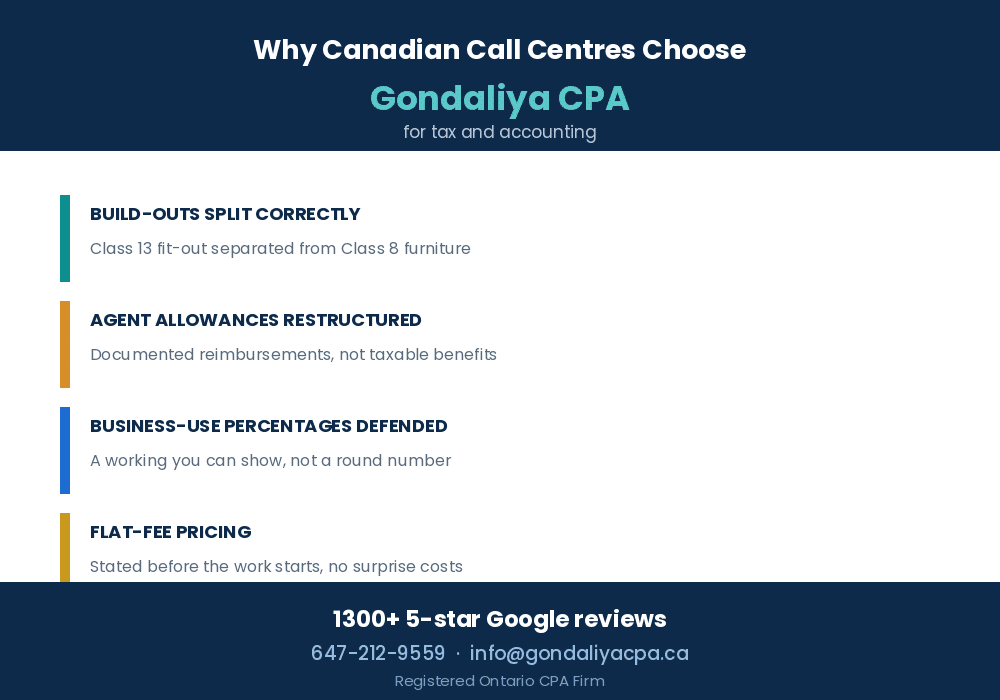
Call centres get into difficulty in a predictable set of ways: build-outs and furniture expensed instead of capitalised, flat allowances to home-based agents that quietly become taxable benefits, phone and internet claimed in full when half the use is personal, and agents paid as contractors on a label rather than on the facts. Gondaliya CPA handles contact centre accounting on a flat annual fee.
We handle what decides the outcome: splitting build-out costs between Class 13 and Class 8, restructuring allowances into documented reimbursements, setting a defensible business-use percentage and keeping the working, issuing the right slips for every payee, and reconciling payroll and GST/HST before anything is filed.
Quick Answers
| Question | Answer |
|---|---|
| Meals and entertainment | 50% under s.67.1, no annual cap |
| Simplified meal rate | $23 per meal, $69 per day maximum |
| Payroll remittance, regular remitter | 15th of the following month |
| T4 late-filing penalty, 1–50 slips | $10/day, $100 minimum, $1,000 maximum |
| Tools and gear under $500 | Class 12, 100%, half-year rule |
| Furniture and cubicles | Class 8, 20% |
| Cabling, partitions, fit-out | Class 13, over lease term |
| Computers and servers | Class 50, 55% |
| Home workspace certification | Form T2200 under ITA s.8(13) |
| Fines and club dues | Denied under s.67.6 and s.18(1)(l) |
Who This Is For
- For: Incorporated Canadian call centres and contact centres — inbound support, outbound sales, subtitling and back-office teams — particularly those with home-based agents or a recent office fit-out.
- Not For: Individual agents employed on a T4 by a single employer, whose claims run on the employment expense rules in T4044 rather than these, and non-resident operators with no Canadian presence.
Glossary of Key Terms
- Current expense: A cost deducted in full in the year it is incurred.
- Capital expenditure: A cost giving a lasting benefit, recovered through capital cost allowance.
- Half-year rule: Income Tax Regulations subsection 1100(2) — only half the normal CCA in the year of acquisition.
- Class 8: Office furniture, cubicles and general equipment at 20%.
- Class 12: Tools under $500 and purchased application software at 100%.
- Class 13: Leasehold improvements, over the lease term plus first renewal, minimum five and maximum forty years.
- Class 50: Computers and systems software acquired after 18 March 2007, at 55%.
- Form T2200: The employer declaration of conditions of employment supporting an agent’s home-workspace claim.
- Allowance vs reimbursement: An unaccounted allowance is generally a taxable benefit; a reimbursement of a documented cost is not.
- Regulation 105: 15% withholding on fees paid to a non-resident for services rendered in Canada.
This quick self-check indicates where your call centre’s deductions most likely have room. Please answer the five questions below.
Call Centre Deduction Check
Five quick questions on your call centre. No fee shown.
Points to raise with us:
This is a general prompt, not tax or legal advice or a quote. Your position depends on your full facts. For a real review, please book a free consultation.
Three splits decide most of a call centre’s tax outcome. Current versus capital: cubicles and computers are assets, not expenses, and the class you pick sets how fast you recover them. Business versus personal: phone, internet and vehicle costs need a percentage you can defend and a working you keep. Allowance versus reimbursement: a documented reimbursement is tax-free to the agent, an unaccounted flat allowance is a taxable benefit with withholding attached. Meals are half, fines are nothing, and everything needs six years of paper behind it.
Call Centre Tax Deductions: How Gondaliya CPA Supports You
Not sure what to expense and what to capitalise?
We split your build-out between Class 13 and Class 8, restructure agent allowances into documented reimbursements, set a defensible business-use percentage for phone and internet, issue the right slips, and file the T2 — on a flat annual fee stated before the work starts.
Next Steps
Please book a free consultation with Gondaliya CPA and bring your last filed corporate return, your asset register or a list of equipment bought in the year, and a sample of agent agreements and allowance arrangements. Those three show where the real position sits. You will get a flat fee stated before any work begins.
Published: · Last updated:
Editorial policy: Figures, deadlines and statutory references are verified against the Income Tax Act, its Regulations and CRA publications before publication, and updated when the rules change.
Disclaimer: This article is educational information only and is not tax, legal, or financial advice. Rules change and outcomes depend on your specific facts. Please speak with a CPA before acting.

Sharad Gondaliya is a CPA Canada & CPA USA with 15 Years+ experience of Accounting, Tax, Payroll of Corporate Small Businesses as Tax Accountant. He is fully certified CPA Ontario and CPA USA and is well known among corporate small businesses for tax planning, efficient tax solutions, and affordable CPA services. Sharad is the Principal (Director) of Gondaliya CPA – Affordable CPA Firm in Canada. Licenses: CPA Ontario: 61040184 | CPA USA (MT): PAC-CPAP-LIC-033176 | CPA USA (WA): 57629 | CPA Firm License: 61330051 View Full Author Bio