



Factoring Company Tax Treatment in Canada: Factoring Fees, Receivables & Bad Debts
Factoring company accounting and tax treatment in Canada includes handling factoring fees tax deduction, managing bad debts factoring company issues, and addressing factoring company GST HST obligations. Gondaliya CPA supports businesses by providing insights into factoring income tax, factoring company bookkeeping, and factoring company CPA services for accurate factoring receivables accounting.
Quick Summary
Four questions settle a factor’s tax position: is each arrangement a true sale or a secured loan, when is the fee earned, is the loss a reserve or a write-off, and how much of your input tax is recoverable once most of your revenue is exempt. All four are answered by the contract and the ledger, not by the label.
- Characterise each deal as a sale or a financing, because it decides who bears the loss.
- Recognise discount income over the term, not on funding day.
- Use the doubtful debt reserve while collecting, the write-off once the debt is bad.
- Apportion input tax credits, since exempt supplies carry none.
Reading time: 26 minutes.
Table of Contents
- Invoice Factoring and Its Role
- Recourse Versus Non-Recourse
- Accounting Principles for Factors
- Bad Debts, Reserves and Write-Offs
- Tax Treatment of Factoring Income
- GST/HST and Input Tax Credits
- Documentation and Compliance
- Factoring Versus Other Financing
- Frequently Asked Questions
- Professional Guidance and Quick Reference
The Numbers That Matter
This article covers Canada, with Ontario and Toronto context, and reflects rules current to 2026. It is written for incorporated factoring companies and commercial finance businesses, and for the companies that sell receivables to them. Advance rates and fee ranges quoted are market observations rather than statutory figures. This is educational information only and not tax or legal advice.
Understanding Invoice Factoring and Its Role in Canadian Business
Invoice Factoring and Its Role
Foundations
Invoice factoring means selling your unpaid invoices to a factoring company at a discount. This lets you get cash right away instead of waiting for customers to pay. In Canada, how this is taxed depends on whether the deal is a sale or a secured loan in substance. So, factoring company tax Canada rules come into play here.
Industries Commonly Using Factoring
Many businesses use factoring to keep cash flowing. Sectors like freight, staffing agencies, healthcare, and construction rely on it. These industries face cash flow problems often. Factoring helps them handle bills while waiting on customer payments.
How Invoice Factoring Works
First, you send an invoice after delivering goods or services. Then, you sell that invoice to a factor. The factor pays you an advance — usually 70% to 90% of what the invoice is worth — quickly after checking your customer’s credit. When your customer pays the factor, they send you the rest minus their fees.
- Issue an invoice to your customer.
- Sell the invoice to a factoring company at a discount.
- Receive an advance payment, typically around 80%.
- Customer pays the factor directly.
- Factor settles the balance with you after payment.
This speeds up your cash flow and shifts some collection risks to the factor. It also affects factoring fees tax Canada and how your accounting records look.
Key Stakeholders and Their Roles
- Business Owner: Sends invoices and sells them.
- Factor: Buys invoices and collects payments.
- Customers/Debtors: Pay invoices directly to the factor.
- Accountants/CPAs: Handle proper accounting according to CRA rules on factoring business tax treatment.
Key Stat: Everything downstream depends on one question: is the arrangement a true sale of receivables or a secured loan dressed as a sale? On a true sale the factor owns the debt and bears the loss. On a financing the client still owns it, the advance is a loan, and the “discount” is interest. The contract terms decide, not the heading on page one — and CRA will read the risk allocation, not the title.
Recourse Versus Non-Recourse Factoring
Recourse Versus Non-Recourse
Structures
With recourse factoring, if customers don’t pay, you must buy back those unpaid invoices from the factor. That means some risk stays with your business. Usually, fees are lower because you share risks with the factor.
For example, if you sell $10,000 in receivables but one client doesn’t pay $2,000 after three months, you might need to repurchase that invoice. This changes when and by whom the loss is claimed.
Non-recourse means the factor takes the credit risk if customers don’t pay. You don’t owe anything back in that case. But it costs more because factors do extra checks before advancing money. Note that most non-recourse agreements cover credit risk only — a dispute over the goods or services delivered usually still triggers a chargeback.
Common Business Situations Suited to Factoring
- Cash flow gaps: Bills fall due before customer money arrives.
- Seasonal revenue: Busy and slow seasons that disrupt steady income.
- Fast growth: Working capital needs rising faster than collections, without adding debt.
Advantages and Disadvantages
Factoring helps improve liquidity by turning unpaid bills into cash quickly. Businesses can pay employees and suppliers on time without stressing about late-paying customers. Factors often handle credit checks and collections which lightens the load.
Factoring comes at a cost — fees reduce overall profit margins. Some clients might also feel uneasy knowing their payments go through a third party, which could affect relationships.
Risk Warning: Recourse factoring is very often a secured loan in substance, not a sale. Where the client guarantees collection, repurchases defaulted invoices and retains the credit risk, the factor has lent money against receivables. That changes everything: the discount is interest income rather than a gain on purchase, the receivable stays on the client’s books, and the client, not the factor, claims the bad debt. Labelling the agreement a “purchase” does not make it one.
Accounting Principles for Factoring Companies in Canada
Accounting Principles for Factors
Accounting
Factoring companies need to keep a close eye on their receivables. They either buy or finance these receivables. How they record them depends on the deal — sometimes it’s a sale, other times just collateral for a loan. This matters because it changes when income shows up and how taxes are reported. Keep clear ledgers showing advances, reserves, fees, and collections.
Recognition and De-recognition of Receivables
Whether you recognise or de-recognise a receivable depends on control and risk. If the factoring company gets control and the risks of ownership, the receivable comes off the seller’s books. If not, it stays on as security for a loan. Under Canadian accounting standards for private enterprises, the derecognition test sits in ASPE Section 3856, Financial Instruments. It is important to have paperwork like assignment notices to back this up.
Impact on Financial Statements
Factoring fees change how revenue and expenses look in your books. Discounts reduce gross income while service fees show as separate income. If you don’t get this right, your taxable income could be wrong. It’s best to keep fees clearly separated so profits are measured correctly.
Recording Factoring Fees and Related Expenses
You record factoring fees over time as you earn them — not all at once — unless your contract says otherwise. Expenses tied to factoring, like credit checks or collection costs, should match the period you earn that income. Keeping detailed schedules linking invoices with fee accruals helps during audits.
Classification of Factoring Fees
Factoring fees come in types: discount charges (which reduce money received), service charges (which count as operating revenue), or interest parts if it’s a financing. How you classify these affects GST/HST treatment and how the income is reported.
Treatment Under Canadian Accounting Standards
Most factoring companies in Canada report under ASPE. Section 3856 decides whether a transfer is a sale or a secured borrowing, which drives what appears as an asset or a liability. Revenue recognition for service fees follows ASPE Section 3400, Revenue. IFRS 15 applies only to companies that have adopted IFRS, which most private Canadian factors have not.
Pro Tip: Accounting treatment and tax treatment are decided separately, and they do not have to match. A transfer can be a sale under ASPE 3856 and still be a financing for income tax purposes, or the reverse. Factors that assume the tax position simply follows the financial statements are the ones who find the two reconciled for them on audit. Document the tax characterisation in its own memo at the time the facility is written.
Bad Debts, Reserves and Write-Offs
Bad Debts, Reserves and Write-Offs
Losses
Bad debts happen when debtors don’t pay after factoring. Whether you can deduct them depends on recourse terms and who already included the income. Two different provisions do two different jobs, and they are frequently confused:
| Mechanism | Provision | What It Does | What It Needs |
|---|---|---|---|
| Doubtful debt reserve | Paragraph 20(1)(l) | Reduces income now for a debt at risk; added back the following year and re-claimed if still doubtful | Aged listings and a reasoned estimate, claimed on Schedule 13 |
| Bad debt write-off | Paragraph 20(1)(p)(i) | Permanent deduction for an amount previously included in income | The debt established to have become bad in the year |
| Write-off of loan principal | Subparagraph 20(1)(p)(ii) | Permanent deduction of uncollectible principal | The lender must be in the business of lending money |
Allowances estimate doubtful accounts based on past losses and need clear annual documentation. Write-offs happen when specific debts become uncollectible. Keep records like letters, legal steps, or insolvency documents ready to support your claim.
Implications for Factoring Arrangements
The tax treatment depends on whether the deal is a true sale, where risk transfers, or a secured loan, where it does not. That choice decides who can claim the loss at all. Getting it wrong may cause denied deductions or the wrong GST/HST treatment.
Risk Warning: A factor that buys a receivable at a discount has not included the face amount in income, so paragraph 20(1)(p)(i) — which requires the amount to have been previously included — may not be available on default. The deduction the factor is actually looking for is usually a loss on the purchase price paid, or, where the arrangement is a financing, a bad debt on the loan under subparagraph 20(1)(p)(ii) if the factor is in the business of lending money. Claiming the full face value as a bad debt is a common and costly error.
Distinguishing Factoring Fees from Other Expenses
| Cost | Nature | Tax Treatment |
|---|---|---|
| Discount or factoring fee | Reduces invoice proceeds | Deductible in full where incurred to earn income |
| Credit check costs | Due diligence before funding | Deductible current expense |
| Office rent | General overhead | Deductible current expense |
| Client entertainment | Business entertainment | 50% deductible under section 67.1 |
| Club dues | Dining, recreation or sport club | Denied under paragraph 18(1)(l) |
Fee Identification and Segregation
Contracts often mix different fee types. Identify each fee clearly so discounts don’t get mixed with service charges. This prevents confusing exempt financial services with taxable ones that need input tax credit tracking.
Expense Classification for Tax Purposes
Expenses fall into current deductible costs or capital expenditures depending on whether they give a lasting benefit. Software subscriptions are current expenses; building or installing a system that will be used for years is capital, recovered through capital cost allowance.
Maintaining Accurate Invoice and Payment Records
Keep detailed records of original factored invoices, payments from debtors, reserve account details where funds are held back, plus any chargebacks. CRA requires keeping these records for six years after the end of the taxation year. These papers help prove your numbers during reviews and cut audit risk.
Claiming bad debts without proof of collection efforts is the reassessment we see most in this sector. The loss is usually real; what is missing is the aged listing, the reminder correspondence and the file note showing when the debt was concluded to be bad. Figures changed for privacy.
Tax Treatment of Factoring Income in Canada
Tax Treatment of Factoring Income
Income Tax
In Canada, tax rules for factoring companies depend on how they classify income and expenses. You must carefully sort fees, receivables, and bad debts under the Income Tax Act and the Excise Tax Act.
Factoring Income and Business Expense Deductions
Factoring income comes from discount fees, service charges, and any interest component. Canadian tax law treats these as business income when earned or accrued using the accrual method [Income Tax Act sections 9(1) and 12(1)(b)]. Fees count as revenue unless they are returns of capital.
You can deduct business expenses related directly to earning factoring income. These include credit checks, collections, insurance on receivables, and professional advice tied to factoring [section 18(1)(a)]. Bad debt treatment is strict: only amounts previously included in income can be written off under paragraph 20(1)(p), and a reserve under paragraph 20(1)(l) is available while collection is still being pursued.
A Toronto-based factor earns $100,000 in discount fees this year. It spends $15,000 on credit checks and writes off $5,000 relating to income recognised last year. It reports the $100,000 as revenue and deducts both amounts, leaving $80,000 of income from the activity. Figures changed for privacy.
Fee Recognition Timing
Factoring fees are business income subject to corporate tax when earned over the contract. If a fee is paid upfront for work extending into future periods, it is recognised over that period rather than all at once.
| Fee Type | Recognised When | Year-End Accrual | Evidence Needed |
|---|---|---|---|
| Upfront discount | Over the term the funds are outstanding | Yes | Contract terms and accrual schedule |
| Annual service fee | Spread over the service period | Yes | Invoices and payment schedules |
| Interest component | Accrued to year-end | Yes | Facility agreement and statements |
| Chargeback recovery | When the right to the amount arises | Yes | Chargeback notice and ledger entry |
Risk Warning: Recognising the whole discount on funding day is the single most common trigger for a CRA review of a factoring book. On a 60-day invoice funded in November, part of that discount is earned in the following fiscal year. Booking it all in the current year overstates income now and understates it later, and where the pattern repeats across a whole portfolio the adjustment is substantial.
Recourse and Non-Recourse Compared
Recourse and non-recourse deals affect how losses get handled:
- Recourse factoring: the factor bears less risk since clients must buy back unpaid invoices. Losses fall on the client on repurchase, and the arrangement is more likely to be a financing in substance.
- Non-recourse factoring: the factor takes the credit risk. Where the factor has genuinely purchased the debt, its loss is measured against what it paid, supported by evidence of failed collection.
An Ontario factor buys a $500K invoice pool on non-recourse terms with reserves held separately. After six months of no payment despite documented reminders, it writes off the unrecovered portion of what it paid, net of reserves released. Figures changed for privacy.
The Section 22 Election on Sales of Receivables
Where a business sells all or substantially all of its assets and the purchaser continues the business, vendor and purchaser can jointly elect under section 22 on Form T2022. The election lets the vendor deduct the discount from face value in full as income rather than taking a 50% capital loss, with the same amount included in the purchaser’s income.
This is a long-standing provision, not a recent change, and it does not apply to ordinary invoice factoring. Selling receivables into a factoring facility is not a sale of substantially all the assets of a business, so section 22 is unavailable on routine deals.
Reporting Requirements and Filing Dates
Factoring companies must file slips for payments made yearly. Interest paid to investors needs T5 slips. Payments to non-residents may require NR4 slips and withholding, though interest paid to an arm’s length non-resident on ordinary debt is generally exempt from Part XIII tax.
| Obligation | Due Date | Consequence if Late |
|---|---|---|
| Corporate T2 return | Six months after fiscal year-end | 5% of unpaid tax plus 1% per complete month, maximum 12 months |
| Balance of tax owing | Two months after year-end; three for an eligible CCPC | Interest compounded daily at the prescribed rate |
| Instalments | Monthly under section 157; quarterly for eligible small CCPCs | Instalment interest, and a penalty where interest is large |
| T5 slips | Last day of February | $10 per day, $100 minimum, $1,000 maximum for 1–50 slips |
| NR4 return | 31 March | Same penalty structure |
Filing on time avoids trouble and keeps your reports clear.
GST/HST and Input Tax Credits
GST/HST and Input Tax Credits
GST/HST
“Financial service” is defined in subsection 123(1) of the Excise Tax Act, and the exemption itself is listed in Schedule V, Part VII. Most invoice factoring is an exempt financial service because it deals in debt securities. So:
- Factors usually don’t charge GST/HST on discount or service fees where these are exempt.
- You can’t claim input tax credits on expenses tied only to exempt supplies.
- If some work involves taxable services, such as consulting or administrative work sold separately, those parts carry GST/HST.
Clients selling invoices still charge GST/HST on their underlying sales normally; the factor handles gross proceeds without adding tax.
Risk Warning: Exemption is not a benefit to a factor — it is a cost. Because exempt supplies carry no input tax credits, the GST/HST you pay on rent, software, legal fees and collection services is unrecoverable and becomes a real expense. The planning question is not how to avoid charging tax but how to apportion input tax fairly between exempt and taxable activities, and to document the method. A factor with a genuine taxable service line can recover the input tax attributable to it; one that keeps no allocation recovers nothing.
Key Stat: Exempt supplies do not count toward the $30,000 small supplier threshold. A factor whose revenue is entirely exempt financial services is not required to register on the strength of that revenue, however large the book. Registration becomes relevant once there are taxable supplies — and registering is what makes any input tax credit apportionment claimable at all.
Keep clear records separating exempt from taxable revenues in your accounting software.
Documentation, Compliance and Working with a CPA
Documentation and Compliance
Records
Factoring company tax Canada rules need solid proof to back up income and expenses. You want clear agreements, invoices, and all related correspondence.
Drafting Clear Agreements
Clear agreements make factoring company accounting easier. The contract should say whether it is a sale of receivables or a financing. This choice changes how fees count for taxes.
Agreements should cover:
- Who takes the credit risk, and the recourse terms
- How fees break down between discount, service and interest
- Who controls collection rights
- How reserve or holdback accounts work
- What triggers a chargeback, including disputes as distinct from credit failure
Recordkeeping Responsibilities
The CRA requires records be kept for six years after the end of the taxation year. Records that prove deductions or losses include:
- Signed agreements with terms
- Copies of assigned or sold invoices
- Detailed lists of aged receivables showing reserves
- Letters about chargebacks or buybacks
- Proof of collection efforts before writing off debts
Responding to Inquiries and Audits
CRA reviews often happen when factors report all discount revenue upfront but lack proof of matching fee accruals, or when reserves are claimed without detailed aged listings.
If your records fall behind: rebuild your receivable ledgers carefully, get missing slips like T5s filed, amend returns if needed, and request taxpayer relief where penalties arose from circumstances beyond your control. Fast answers with full documents lower audit risk.
Systems and Technology
Use bookkeeping systems built for factoring. Track advance rates, reserves and chargebacks, and link these to annual filings. Cloud accounting tools track receivables purchased and advances made in real time, which helps spread discount revenue over the term instead of booking it all at once — a common CRA audit flag.
These systems can generate aged reports automatically, backing doubtful reserve claims. Digital tools cut manual errors and keep supporting correspondence accessible for the full retention period.
When to Bring in a CPA
Deciding whether to handle taxes yourself or hire a CPA depends on your deal’s complexity. Call in professionals when you have:
- Multiple investor-funded deals needing slips
- Cross-border invoices with currency exchange
- Mixed recourse and non-recourse facilities in the same book
- Large doubtful account reserves needing strong support
- Any meaningful taxable service line requiring input tax credit apportionment
Gondaliya CPA is a licensed Ontario firm focused on incorporated businesses that do factoring across Toronto, Ontario, and Canada-wide. We support bookkeeping setups using QuickBooks or Xero through compilation reports prepared under CSRS 4200.
Comparing Factoring to Alternative Financing
Factoring Versus Other Financing
Comparison
Lines of Credit Versus Factoring
Lines of credit let you borrow up to a limit, often secured by assets or personal guarantees. Interest is deductible where the borrowed money is used to earn income, under paragraph 20(1)(c). Factoring means selling invoices for cash at a discount; for the client, that fee is a business expense under section 9 and paragraph 18(1)(a) rather than interest. For accounting, lines of credit need interest and repayments tracked separately from sales income, while factoring focuses on splitting fees over time and labelling discounts against interest.
Asset-Based Loans
Asset-based loans let you borrow using inventory or invoices as collateral. You keep ownership; it is a loan. Commitment and standby charges are deducted over five years under paragraph 20(1)(e) rather than in the year paid. Factoring differs because it involves the purchase of invoices rather than a borrowing, so the treatment of the fee differs accordingly.
Typical Fee Structures
| Fee Component | Description | Treatment |
|---|---|---|
| Discount rate | Percentage taken off invoice value | Income to the factor over the term; deductible expense to the client |
| Service fees | Fixed monthly administration charge | Operating revenue to the factor; deductible expense to the client |
| Reserve holdback | Amount retained until the debtor pays | Liability until released; not income when withheld |
| Chargeback | Invoice returned to the client | Reverses the original transaction; recorded when the right arises |
Market rates in Canada commonly run in the low single digits per month depending on risk, volume and whether the facility is recourse or non-recourse. These are commercial observations, not figures set by CRA.
Calculating the True Cost
The full cost isn’t just the fees you pay right away. It also includes the effect of reserves held back, which delay part of the cash. You need to separate fees deducted immediately from amounts recognised over time as income is earned.
Sample Entries for the Client Selling Receivables
| Transaction | Debit | Credit |
|---|---|---|
| Invoice sold, advance received | Cash (advance); Due from factor (reserve); Factoring expense (fee) | Accounts receivable (face value) |
| Debtor pays the factor, reserve released | Cash | Due from factor |
| Chargeback on an unpaid invoice | Accounts receivable | Due from factor or Cash |
Your tax return reflects net income including factoring fees as a deduction, supported by records matching your ledgers.
Qualification Criteria
To apply for factoring services in Canada you generally need an incorporated company registered federally or provincially with books kept to ASPE. Expect to provide clear contracts explaining recourse terms, financial statements showing reserve calculations, and evidence of GST/HST treatment.
Frequently Asked Questions
Frequently Asked Questions
FAQ
What is the typical advance rate in Canadian factoring agreements?+
Usually 70% to 90% of invoice value, depending on the debtor’s credit and industry norms. The balance is held as a reserve and released when the debtor pays, less fees.
When is factoring income recognised?+
When earned or accrued under sections 9(1) and 12(1)(b), using the accrual method. Discount income is earned over the period the funds are outstanding, not in full on the funding date.
Which expenses are deductible for a factoring company?+
Credit checks, collection costs, insurance on receivables, professional fees and other costs incurred to earn the income, under paragraph 18(1)(a). Business entertainment is limited to 50% under section 67.1, and club dues are denied under paragraph 18(1)(l).
What is the difference between a doubtful debt reserve and a bad debt write-off?+
A reserve under paragraph 20(1)(l) reduces income now for a debt at risk but is added back the following year and re-claimed if the doubt persists. A write-off under paragraph 20(1)(p) is permanent and requires the debt to be established to have become bad in the year. They are different provisions doing different jobs.
Can a factor write off the face value of a defaulted invoice?+
Generally not. Paragraph 20(1)(p)(i) requires the amount to have been previously included in income, and a factor that purchased at a discount never included the face amount. The loss is measured against the purchase price, or is a bad debt on a loan under subparagraph 20(1)(p)(ii) where the arrangement is a financing and the factor is in the business of lending money.
What is the record retention period?+
Six years after the end of the taxation year, under section 230 of the Income Tax Act.
Do factoring companies need to register for GST/HST?+
Exempt supplies do not count toward the $30,000 small supplier threshold, so a factor whose revenue is entirely exempt financial services is not required to register on that revenue. Registration matters once there are taxable supplies, and it is what makes input tax credit apportionment claimable.
Why can’t a factor claim input tax credits?+
Because input tax credits are only available for inputs used in making taxable supplies. Where supplies are exempt, the GST/HST paid on rent, software and professional fees is unrecoverable and becomes a real cost. Inputs used for a taxable service line can be apportioned and claimed, provided the method is documented.
How do recourse and non-recourse differ for tax?+
Recourse arrangements, where the client repurchases defaulted invoices and keeps the credit risk, are more likely to be financings in substance, with the loss falling on the client. Non-recourse arrangements where the factor genuinely acquires the debt put the loss with the factor, measured against what it paid.
What is the section 22 election, and does it apply to factoring?+
Section 22 lets a vendor and purchaser jointly elect, on Form T2022, to treat a sale of receivables as being on income account where a business sells all or substantially all of its assets. It gives a full deduction for the discount rather than a 50% capital loss. It does not apply to ordinary invoice factoring, which is not a sale of substantially all the assets of a business.
What are the filing deadlines and penalties?+
T2 within six months of fiscal year-end; balance owing two months after year-end, or three for an eligible CCPC. Late filing costs 5% of the unpaid tax plus 1% per complete month to a maximum of 12 months. T5 slips are due the last day of February, NR4 by 31 March, both carrying $10 per day with a $100 minimum and $1,000 maximum for 1 to 50 slips.
Are corporate instalments quarterly?+
Generally monthly under section 157. Quarterly instalments are available only to an eligible small CCPC meeting the taxable income, taxable capital and compliance conditions.
Professional Guidance and Quick Reference
Professional Guidance and Quick Reference
Guidance
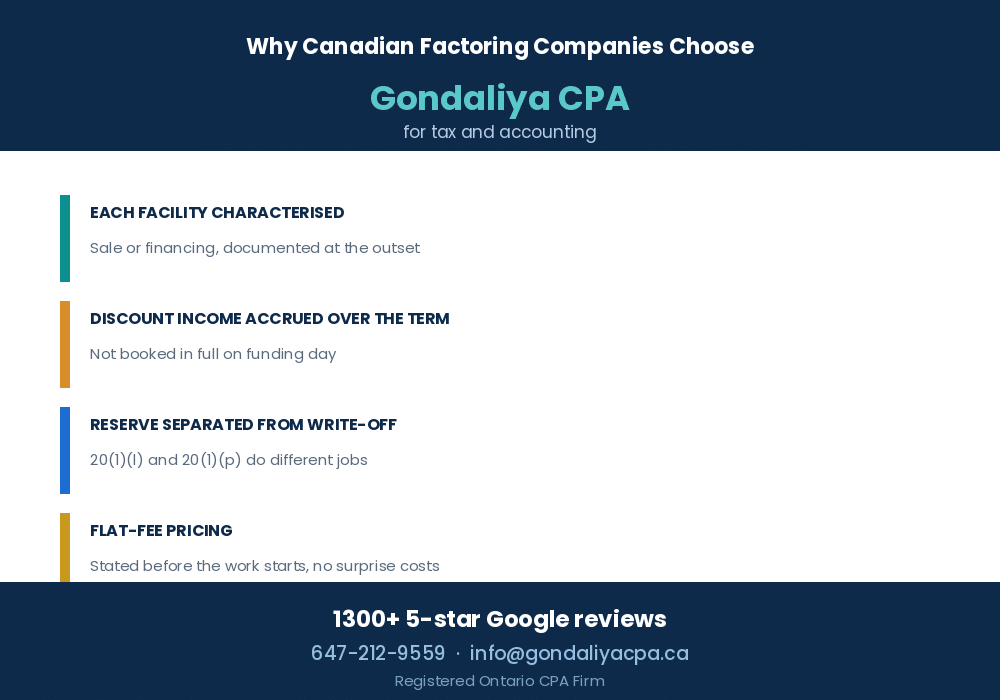
Factoring companies get into difficulty in a predictable set of ways: recourse facilities treated as sales when they are financings, the whole discount booked on funding day, face-value bad debts claimed on receivables bought at a discount, and no input tax credit apportionment at all because the revenue is exempt. Gondaliya CPA handles factoring company accounting on a flat annual fee.
We handle what decides the outcome: characterising each facility as a sale or a financing and documenting it, building the discount accrual so income lands in the right year, separating the doubtful debt reserve from the write-off with evidence behind both, reconciling reserves and chargebacks to the aged listing, and setting a defensible input tax apportionment method.
Quick Answers: Key Numbers & Concepts at a Glance
At a Glance
| Question | Answer |
|---|---|
| Income recognition | Accrual, ss.9(1) and 12(1)(b), over the term |
| Doubtful debt reserve | Paragraph 20(1)(l), added back next year |
| Bad debt write-off | Paragraph 20(1)(p), permanent |
| Lender’s principal write-off | Subparagraph 20(1)(p)(ii) |
| Financial service definition | ETA subsection 123(1) |
| Exemption | ETA Schedule V, Part VII |
| Input tax credits on exempt supplies | None; apportion where there are taxable supplies |
| Small supplier threshold | $30,000, excluding exempt supplies |
| Sale of receivables election | Section 22, Form T2022, on a sale of the business |
| Derecognition test | ASPE Section 3856 |
| Corporate instalments | Monthly under s.157; quarterly for eligible small CCPCs |
| Record retention | Six years under section 230 |
Who This Is For / Not For
Fit Check
- For: Incorporated Canadian factoring companies and commercial finance businesses, including freight, staffing and construction specialists, and the companies selling receivables to them.
- Not For: Businesses using factoring occasionally whose only question is deducting the fee, and non-resident factors with no Canadian establishment.
People Also Ask
Quick Answers
Are factoring fees tax deductible in Canada?+
Yes. For the business selling invoices, factoring fees are an ordinary business expense deductible under section 9 and paragraph 18(1)(a), since they are incurred to earn income. They are a current expense, not a capital cost, so there is no amortisation.
Is invoice factoring a loan or a sale?+
It depends on the contract. Where the factor genuinely acquires the debt and bears the credit risk, it is a sale. Where the client guarantees collection and repurchases defaults, it is a secured loan in substance regardless of what the agreement is called. The distinction decides who carries the receivable and who claims the loss.
Do you charge GST/HST on factoring fees?+
Generally no. Factoring is usually an exempt financial service, so no GST/HST is charged on the discount or service fee. The trade-off is that the factor cannot recover GST/HST on its own costs. Separately billed taxable services, such as consulting, do carry tax.
Does factoring affect my ability to get other financing?+
It can. A factor typically registers a security interest over receivables, which affects the position of other lenders. Clean records showing what has been assigned, what reserves are held and how fees are treated make it easier for both the factor and any other lender to assess the position.
Can a factoring company deduct losses on invoices it bought?+
Yes, but measured against what it paid rather than the invoice face value, because the face amount was never included in its income. Where the arrangement is a financing and the factor is in the business of lending money, the principal may be written off under subparagraph 20(1)(p)(ii).
Glossary of Key Terms
Plain-English Definitions
- Advance rate: The percentage of invoice face value paid on funding, typically 70% to 90%.
- Reserve or holdback: The portion retained until the debtor pays, released less fees.
- Chargeback: An unpaid or disputed invoice returned to the client under the agreement.
- Recourse: The client’s obligation to repurchase invoices the debtor does not pay.
- Non-recourse: The factor bearing the credit risk, usually excluding disputes.
- Discount fee: The charge expressed as a percentage of face value, earned over the term.
- Doubtful debt reserve: A deduction under paragraph 20(1)(l), added back the following year.
- Bad debt write-off: The permanent deduction under paragraph 20(1)(p).
- Exempt financial service: A supply defined in ETA subsection 123(1) and exempted under Schedule V Part VII, carrying no GST/HST and no input tax credits.
- Input tax credit apportionment: Allocating GST/HST paid between exempt and taxable activities.
- Section 22 election: The joint election on Form T2022 where receivables are sold with a business.
- ASPE Section 3856: The standard deciding whether a transfer of receivables is a sale or a secured borrowing.
Essential Compliance Points
Reference
- Characterise each facility as a sale or a secured loan, and document the reasoning.
- Separate discount fees from service charges so income timing is right.
- Recognise discount income over the term the funds are outstanding.
- Maintain clear reserve and holdback accounts with accurate tracking.
- Document chargebacks and repurchases thoroughly for audit defence.
- Track doubtful account reserves using detailed aged receivables reports.
- Claim the reserve under 20(1)(l) while collecting, the write-off under 20(1)(p) once bad.
- Measure a purchased-receivable loss against what you paid, not the face value.
- Apportion and document input tax credits where you have any taxable supplies.
- File T5 by the last day of February and NR4 by 31 March.
- Follow monthly instalment deadlines unless you qualify for quarterly.
- Keep records for six years after the end of the taxation year.
This quick self-check indicates where your book most likely has room. Please answer the five questions below.
Factoring Company Tax Check
Five quick questions on your book. No fee shown.
Points to raise with us:
This is a general prompt, not tax or legal advice or a quote. Your position depends on your full facts. For a real review, please book a free consultation.
Decide sale or financing first, because it settles who owns the receivable and who claims the loss when a debtor defaults — and a recourse facility is very often a loan whatever the agreement is called. Spread discount income over the term rather than booking it on funding day. Keep the doubtful debt reserve under 20(1)(l) separate from the write-off under 20(1)(p), and remember a factor that bought at a discount cannot write off face value. Then treat the GST/HST exemption as the cost it is, and apportion input tax where you have any taxable supplies at all.
2026 Update — what is current: There is no new receivable sale election for 2026. The section 22 election on Form T2022 is long-standing and applies where a business sells all or substantially all of its assets, not to ordinary invoice factoring. Unchanged for 2026: the accrual basis for factoring income under sections 9(1) and 12(1)(b); the doubtful debt reserve in paragraph 20(1)(l) and the write-off in paragraph 20(1)(p); the exemption for financial services in Schedule V Part VII of the Excise Tax Act, with exempt supplies excluded from the $30,000 small supplier threshold and carrying no input tax credits; monthly corporate instalments under section 157, quarterly only for eligible small CCPCs; the T2 late-filing penalty of 5% plus 1% per complete month to a maximum of 12; and the six-year record retention requirement under section 230. Slip deadlines remain the last day of February for T5 and 31 March for NR4.
Factoring Company Taxes: How Gondaliya CPA Supports You
Mixed book of recourse and non-recourse facilities?
We characterise each facility and document it, build the discount accrual so income lands in the right year, separate the reserve from the write-off with evidence behind both, reconcile reserves and chargebacks to the aged listing, and set a defensible input tax apportionment — on a flat annual fee stated before the work starts.
Next Steps
Please book a free consultation with Gondaliya CPA and bring your last filed corporate return, a sample factoring agreement from each product type you offer, and an aged receivable listing showing reserves and chargebacks. Those three show where the real position sits. You will get a flat fee stated before any work begins.
Published: · Last updated:
Editorial policy: Figures, deadlines and statutory references are verified against the Income Tax Act, the Excise Tax Act, their Regulations and CRA publications before publication, and updated when the rules change. Advance rates and fee ranges are market observations rather than statutory figures.
Disclaimer: This article is educational information only and is not tax, legal, or financial advice. Rules change and outcomes depend on your specific facts. Please speak with a CPA before acting.

Sharad Gondaliya is a CPA Canada & CPA USA with 15 Years+ experience of Accounting, Tax, Payroll of Corporate Small Businesses as Tax Accountant. He is fully certified CPA Ontario and CPA USA and is well known among corporate small businesses for tax planning, efficient tax solutions, and affordable CPA services. Sharad is the Principal (Director) of Gondaliya CPA – Affordable CPA Firm in Canada. Licenses: CPA Ontario: 61040184 | CPA USA (MT): PAC-CPAP-LIC-033176 | CPA USA (WA): 57629 | CPA Firm License: 61330051 View Full Author Bio