



The Ultimate Guide to BPO Company Taxes and Accounting in Canada
BPO company taxes Canada require precise handling of tax compliance, corporate taxes, and GST HST to avoid penalties. Gondaliya CPA offers specialized BPO accounting services including bookkeeping, tax preparation, and financial reporting to help BPO businesses in Canada manage their taxes efficiently.
Quick Summary
A BPO’s tax position turns on three things: whether intercompany service charges are priced and documented at arm’s length, whether payroll is registered and remitted correctly in every province where staff work, and whether foreign-client revenue genuinely qualifies as a zero-rated export. Get those three right and most of the rest follows.
- Document transfer pricing before the T2 is filed, not after a query arrives.
- Register payroll in each province where employees perform their work.
- Test export zero-rating against Schedule VI Part V, with proof on file.
- File the T2 within six months of year-end and pay the balance earlier.
Reading time: 24 minutes.
Table of Contents
The Numbers That Matter
This article covers Canada, with Ontario and Toronto context, and reflects rules current to 2026. It is written for incorporated Canadian BPO, outsourcing, managed services and shared services businesses, including those with related entities abroad and staff in more than one province. This is educational information only and not tax or legal advice. Please confirm the position where you operate.
BPO Company Taxes in Canada: Overview of Tax Obligations and Compliance
Overview of Tax Obligations
Foundations
Understanding Canadian Tax Regulations for BPO Companies
BPO companies in Canada must follow tax rules that apply to them. The Income Tax Act covers corporate income taxes. The Excise Tax Act deals with GST/HST taxes. For example, Income Tax Act Section 150 says corporations need to file a T2 Corporate Tax Return six months after their fiscal year ends.
Overview of Federal and Provincial Tax Laws
Canadian incorporated BPOs pay taxes at two levels: federal and provincial. The Income Tax Section 247 has rules about transfer pricing when related companies do business with each other. Also, Income Tax Act section 157 says corporations generally pay monthly instalments during the year, with quarterly instalments available to an eligible small CCPC.
Key Registration Requirements for BPO Firms
Before starting, BPO firms must register properly:
- Obtain a NUANS name search report to support incorporation of your company name.
- Open a payroll account on your business number before your first pay run.
- Register as a GST/HST registrant if your taxable sales go over $30,000.
These steps help you follow Canadian laws and file taxes right.
Reporting Deadlines and Compliance Procedures
BPO companies must watch their deadlines carefully:
- File your T2 Corporate Tax Return within six months after your fiscal year ends.
- If you file late, the penalty is five percent plus one percent extra per month up to twelve months on any tax you owe.
Late filing can cost a lot, so stay on time.
GST/HST and Corporate Tax Compliance
BPOs need to know how GST/HST applies to their services. Most services by Canadian businesses get taxed unless they are exports that qualify for zero-rating under Schedule VI Part V of the Excise Tax Act.
| Average Monthly Withholding | Remitter Type | When to Remit |
|---|---|---|
| Under $25,000 | Regular | By the 15th of the following month |
| $25,000 to under $100,000 | Accelerated, threshold 1 | Twice a month |
| $100,000 and over | Accelerated, threshold 2 | Up to four times a month, within three working days |
Filing Requirements and Deadlines
You must file GST/HST returns either quarterly or monthly:
- Larger firms usually file monthly.
- Smaller ones file quarterly, and registrants with $1.5 million or less in annual taxable supplies default to annual filing.
Missing these dates can cause penalties or interest from the CRA (Canada Revenue Agency).
Implications for Cross-Provincial Operations
If your BPO has employees in different provinces, payroll gets trickier. Income tax, CPP and EI remittance deadlines are federal and set by your remitter threshold, but each province sets its own employer health tax or payroll levy — Ontario EHT, BC EHT, Quebec HSF, Manitoba HE Levy, Newfoundland HAPSET. Employers must follow rules for all provinces where they have workers. It’s important to keep track of these rules to avoid mistakes with payroll taxes.
Key Stat: Remittance deadlines for income tax, CPP and EI are federal and do not vary by province — they are set by your remitter threshold. What genuinely varies province by province is the employer health tax or payroll levy: Ontario’s EHT, Manitoba’s HE Levy, Newfoundland’s HAPSET, BC’s Employer Health Tax and Quebec’s HSF, each with its own rate, exemption and filing date. That is the multi-province exposure worth tracking, and Quebec adds QPP, QPIP and its own source deductions on top.
By knowing these tax basics for Canadian BPO companies—like corporate income tax rules, GST/HST filing schedules, and registration needs—and by filing on time, you can keep your business’s finances in order and avoid fines or problems with CRA.
BPO Accounting in Canada: Key Principles and Practices
BPO Accounting Principles
Principles
BPO accounting Canada means keeping track of money coming in, money going out, and taxes right. Good BPO company accounting helps avoid fines and makes business choices easier. Canadian BPOs follow special tax laws for companies and deal with tricky cross-border deals too.
Core Accounting Principles Applicable to BPO Companies
Canadian BPO companies count income when they earn it, not just when they get paid. For example, finishing a job or reaching a billing step means they owe tax then. Expenses only count if they link to earning money and have receipts or contracts to prove it.
If a company sends an invoice after the year ends, it must pay tax that year even if payment comes later. The CRA wants businesses to bring unfinished work into income at the value earned to the year-end date, with records to back it up. If you skip this, the CRA may charge extra taxes and interest.
BPO business taxes also include watching GST/HST collected and credits for purchases. Payroll source deductions need paying on time based on where employees work.
Essential Components of BPO Company Accounting
Bookkeeping means tracking money customers owe you (accounts receivable) and money you owe others (accounts payable). This keeps your cash flow clear and financial reports ready for T2 tax filing.
Payroll processing means figuring out employee pay, taking out CPP, EI, and taxes correctly by province rules, then sending these payments before the payroll remittance deadline set by CRA. If you miss deadlines, penalties and interest pile up.
A Canadian BPO usually makes these financial reports every year:
- Trial balance showing all accounts
- General Index of Financial Information (GIFI) forms with T2 returns
- Compilation reports under CSRS 4200 for banks or investors
These papers show you follow accounting rules and report income properly.
Accounts receivable and payable management
Managing bad debts matters. You can only write off bad debts if you tried hard to collect first. Disputed invoices should have notes explaining why payment is delayed or adjusted.
If you ignore bad debts, auditors might reject deductions. This can make your taxes higher. Good records stop mix-ups over who owes what and help with cash planning.
Payroll processing and compliance
Payroll source deductions include income tax withheld from paychecks plus CPP/QPP pension and Employment Insurance premiums. Employers must register in every province where workers do their jobs.
Running payroll across provinces means knowing each place’s rates. You also need to prepare T4 slips yearly showing pay by location. Filing late invites fines that hurt your standing with the CRA.
Internal controls and audit readiness
Transfer pricing documents are needed when charging related foreign companies for services from a Canadian BPO. The law requires prices like what unrelated parties would agree on—often cost-plus markup or similar methods.
Missing or wrong transfer pricing papers can bring fines and extra taxes. Strong controls mean all related-party deals have signed agreements stored safely with invoices to avoid mistakes during audits.
Late filing penalties hit many areas like T2 returns, T4 slips, GST/HST returns. These increase risk if you don’t act fast.
Pro Tip: The section 247 penalty is not a penalty for getting the price wrong — it is 10% of the transfer pricing adjustment, and it applies where the adjustment exceeds the lesser of $5 million and 10% of gross revenue, unless you made reasonable efforts to determine and use arm’s length prices. “Reasonable efforts” means contemporaneous documentation complete by the T2 filing due date. Documentation prepared after CRA asks does not retroactively count, which is why the timing matters more than the analysis.
References
- Income Tax Act sections 9 & 18(1)(a), CRA Business Income Guide
- Income Tax Act section 20(1)(p), CRA Expense Deductibility Rules
- Income Tax Act section 9 – Revenue Recognition
- Excise Tax Act sections 165 & 169 – Input Tax Credits Documentation Requirements
- CRA Payroll Deductions Tables & Remittance Deadlines Guide
- Provincial Employer Health Tax and Payroll Levy Legislation – Provincial Variations
- Income Tax Act section 20(1)(p) – Bad Debt Write-Off Conditions
- CRA Multi-province Payroll Registration Instructions
- Income Tax Act section 247 – Transfer Pricing Documentation Requirement [EDITOR: verify current position]
- OECD Transfer Pricing Guidelines referenced by CRA Guidance Notes
- Income Tax Act subsection 247(3) – Transfer Pricing Penalty
- Excise Tax Act Section 280.1 – GST/HST Filing Penalties
For expert help navigating complex BPO company accounting requirements in Canada including payroll compliance across provinces call Gondaliya CPA at 647-212-9559 or email info@gondaliyacpa.ca today for a free consultation.
Managing BPO Business Taxes: Strategies and Considerations
Managing BPO Business Taxes
Planning
Handling BPO company taxes in Canada takes some planning. Canadian incorporated BPOs have rules they must follow to pay less tax without breaking any laws. You need to know when to report income, how to set up your business, and what expenses you can write off. Doing this well helps keep your taxes down and keeps the CRA happy.
Strategies to Minimize Tax Liabilities for BPO Companies in Canada
Planning taxes all year helps control when you count income and expenses. This can lower the amount you owe by matching money coming in with costs properly.
Setting up your company right matters a lot. A holding company can support creditor protection and tax deferral on retained earnings. Income splitting is far more limited than it once was: the tax on split income rules in Income Tax Act section 120.4 apply the top marginal rate to dividends paid to family members who fail an excluded-amount test, and associated corporations must share the $500,000 small business limit.
The timing of money is important too. Under accrual accounting, delaying an invoice does not delay the income — revenue for work performed belongs in the year it was earned. What timing can legitimately shift is discretionary expenditure, and when work is actually performed. Be sure to follow CRA rules on when to record income and costs.
Here’s an example: A managed services firm in Toronto completes a $50,000 project in December and bills it on January 15. The income still belongs to the December year because the work was performed then; the unbilled amount is carried as accrued revenue at year-end (numbers changed for privacy).
Common Tax Deductions Available to BPO Companies
BPO companies can write off many business costs if those costs relate directly to earning money. Keeping good records is key for proof.
Which Operating Expenses Can a BPO Deduct?
You can deduct things like:
- Fees paid to subcontractors
- Insurance costs
- Staff training expenses
- Recruiting fees
- Security services
- Marketing campaigns
- Professional fees like accountants or lawyers
Keep invoices and contracts safe—they help if the CRA asks questions [Income Tax Act sections 18(1)(a), 20(1)(p)].
How Do You Deduct Technology and Automation Tools?
Software subscriptions usually count as operating expenses. You can deduct them fully when paid monthly or yearly.
If you buy software licenses outright, those go under capital cost allowance (CCA) Class 12 at 100%, subject to the half-year rule — so 50% comes off in year one and 50% in year two. Systems software bundled with hardware follows the hardware into Class 50 at 55%. Automation projects might need part of their cost capitalized depending on what they are. Having clear documents helps here.
How Do You Deduct Facilities, Rent and Build-Outs?
Rent for office space is fully deductible if used only for work. Charges for maintenance of common areas count too if billed separately.
Utility bills like electricity also qualify if you have proof showing dates within the fiscal period [Income Tax Act section 18(1)(a)].
Leasehold improvements must be capitalized under CCA Class 13. You depreciate these over the lease term plus the first renewal option, subject to a minimum of five years and a maximum of forty [ITA Regulation Schedule II]. Keeping a list of these assets and costs is important for reviews.
For advice that fits your Canadian incorporated BPO’s needs—like help with corporate tax filings—reach out to Gondaliya CPA at info@gondaliyacpa.ca or call 647-212-9559 for a free talk today.
Accounting Best Practices for BPO Firms to Ensure Accuracy and Compliance
Accounting Best Practices
Best Practices
BPO company taxes Canada need clear and correct accounting. If you mess up, you can get in trouble with the law. Good BPO accounting Canada helps you file taxes on time and follow CRA rules. When BPO companies keep neat records, they avoid problems and pay the right amount of business taxes.
Financial Reporting Standards for BPO Accounting and Their Importance
Canadian BPOs make financial statements that show how their business is doing. These usually include:
- A trial balance
- Financial statements made with ASPE (Accounting Standards for Private Enterprises)
- Detailed schedules for corporate income tax
Owners have to decide if they want to be paid by salary or dividends. Salary means payroll taxes and T4 slips. Dividends don’t have payroll taxes but affect personal tax differently. This choice changes how much tax owners pay and the company’s cash flow.
Corporate income tax filings must match the Income Tax Act rules about when to count revenue. GST/HST filings depend on where your clients are and what services you sell.
For example: A Toronto BPO makes monthly bookkeeping reports. They check these every three months before making yearly financial statements. Those help fill out their T2 return.
Compliance Requirements Specific to BPO Businesses in Canadian Tax Law
BPOs have to file their T2 Corporate Tax Return within six months after the year ends. GST/HST filing frequency depends on how much sales you have—monthly, quarterly, or yearly. Payroll remittances have strict deadlines based on your total monthly withholdings.
If you file late, penalties start at 5% of what you owe plus 1% extra per month, up to 12 months. Transfer pricing docs are a must when dealing with related foreign parties. If you skip this, CRA can reassess your taxes under section 247 of the Income Tax Act.
| Obligation | Deadline | Consequence | Source |
|---|---|---|---|
| T2 Corporate Tax Return | Six months after fiscal year-end | Late filing penalty & interest | CRA – Filing Deadlines |
| GST/HST Filing | Monthly / Quarterly / Annually | Penalties & interest | Excise Tax Act |
| Payroll Remittance | On set deadlines | Interest & penalties | CRA – Payroll |
| Transfer Pricing Docs | With return filing | Reassessment + penalties | ITA Section 247 |
Documentation and Audit Trail Maintenance
You must keep papers that prove what you claimed in your tax returns. The records retention period is usually six years from the end of the related tax year. You should save:
- Contracts
- Invoices
- Intercompany agreements
- Payroll registers
- Bank statements
- Export proofs for zero-rated services
- Transfer pricing studies
- Letters or emails from CRA
Having a good audit trail helps if CRA asks questions later. It shows you followed the law.
Tip: Keep digital copies sorted by type with dates matching transactions so you can find them fast during an audit.
Handling Cross-Border Transactions and Audits
Cross-Border & Audits
Cross-Border
Handling Cross-Border Transactions
If your BPO deals with related companies outside Canada, transfer pricing rules apply under section 247 of the Income Tax Act. Prices charged must be like what unrelated companies would pay. You need documents explaining how you decided prices, like studies using similar transactions.
You also must report cross-border deals with non-arm’s-length non-residents totalling more than CAD $1,000,000 in the year on Form T106, due on the T2 filing due date.
If you don’t keep proper documents, CRA may increase your taxable income and add big penalties [EDITOR: verify current position].
Key Stat: The T106 threshold is CAD $1,000,000 in total reportable transactions with non-arm’s-length non-residents in the year. The form is due on the T2 filing due date — six months after year-end — and late filing attracts its own penalty of $25 per day, minimum $100, to a maximum of $2,500 per form, rising sharply where the failure is knowing or grossly negligent.
Example: A Canadian-led offshore center charges costs plus a margin backed by a cost study completed by the T2 filing due date and produced to CRA within three months of a written request.
Dealing with Tax Audits and Inquiries
CRA looks closely when things seem off, like missing intercompany charges or wrong zero-rated foreign sales claims. Not filing required info returns also raises flags.
Penalties hit if you file late: 5% of unpaid tax plus 1% per month for up to a year; interest builds every day until paid fully.
Answering fast with full records cuts your risk during audits.
For expert help with Canadian BPO firms handling tricky cross-border work or payroll in many provinces contact Gondaliya CPA at info@gondaliyacpa.ca or call 647-212-9559 for a free consult today.
References
- CSRS 4200 – Compilation Engagements
- Income Tax Act s150(1)
- Excise Tax Act Part IX
- CRA Payroll Deductions Tables
- Income Tax Act s230(1) – Books and Records
- ITA s247 – Transfer Pricing Rules
- CRA Records Retention Guidelines
- ITA s247 Documentation Requirement
- Form T106 Instructions – Non-Resident Reporting
- Example adapted from Gondaliya CPA client experience (figures changed).
- CRA Penalty Information
The Role of Accountants in Supporting BPO Business Tax and Accounting Needs
The Role of Accountants
Support
Accountants help BPO companies with their taxes in Canada. They keep track of money and make sure accounting is done right. This stops mistakes and helps businesses follow tax rules for BPO business taxes.
They organize financial papers so the company pays what it owes. Without accountants, it’s easy to miss deadlines or do things wrong. So, they are very important for good BPO accounting Canada.
Professional Support for Accurate Tax Preparation and Planning
Accountants prepare corporate taxes for BPO companies carefully. They fill out T2 tax forms and file GST/HST returns based on where clients live. Plus, they plan taxes so the company can pay less and avoid trouble.
At Gondaliya CPA, we handle tricky things like GST/HST for services across borders. We check CRA rules to keep everything legal. We also help pick the best time to claim deductions and credits that save money.
Good bookkeeping is part of this work. It means writing down all income, bills, payroll info, and transactions clearly. These records make financial reports reliable when banks or auditors want to see them.
Here is what accountants do well:
- Prepare accurate corporate tax returns
- File GST/HST on time
- Plan taxes to reduce risks
- Keep clear books with revenue and expenses
- Manage payroll and transactions properly
Challenges in BPO Taxation and Accounting with Practical Solutions
BPO companies face some tough rules on taxes. One big thing is transfer pricing documentation. Canadian law says related companies must charge fair prices for services between countries. If they don’t keep papers proving this, CRA can charge penalties.
Another tricky part is payroll source deductions. Employers must take out income tax, CPP, and EI on time by law. This gets confusing if employees work in different provinces or remotely.
Non-resident reporting also needs care. Regulation 105 withholding of 15% and the T4A-NR apply where a non-resident performs services in Canada — an offshore team working entirely from abroad falls outside both. Where a non-resident specialist does travel here, withhold unless a treaty waiver is obtained before payment.
Some ways to fix these problems are:
- Make transfer pricing files before filing taxes
- Use payroll software that follows provincial rules
- Track payments to non-residents closely
- Hire CPAs who know Canadian laws well
These steps help BPO businesses stay clear of fines or audits from CRA.
For help with your BPO company taxes anywhere in Canada — especially Toronto or Ontario — call Gondaliya CPA at 647-212-9559 or email info@gondaliyacpa.ca. We offer free talks about your accounting needs including corporate tax preparation with current CRA rules.
Final Thoughts and Next Steps for BPO Accounting and Tax Success
Next Steps & Compliance Strategy
Next Steps
Handling BPO company taxes Canada means you need to stay on top of rules. You can’t just do it once and forget. Taxes change, deadlines come up, and mistakes cost money. This guide talked about the main parts of BPO business taxes and BPO accounting Canada to help you get started right.
Developing an Ongoing Compliance Strategy
Your BPO needs a plan to keep taxes correct and on time. That means picking the right CPA firm, keeping good records, deciding if you want to do your taxes yourself or pay a pro, and following clear steps.
Periodic Review of Tax Obligations
You should check what tax forms to file and when. Some common ones are:
- Corporate tax return (T2)
- GST/HST returns
- Payroll payments
- Slips like T4s or T4As
- Non-resident info returns (like T106)
- Transfer pricing documents
If you file late, CRA charges penalties. These start at 5% of what you owe plus 1% for each complete month, to a maximum of 12 months. Interest is separate and compounds daily.
Here’s when things are usually due:
| Obligation | Deadline | Penalty if Late |
|---|---|---|
| Corporate Tax Return (T2) | Six months after year-end | Penalty + interest on amount due |
| GST/HST Return | Monthly/quarterly/yearly | Interest + penalty on overdue sum |
| Payroll Remittance | 15th of the following month for a regular remitter; sooner for accelerated remitters | Penalties + possible audit |
| Information Returns (T4/T4A) | Last day of February | $10 per day, $100 minimum, $1,000 maximum (1–50 slips) |
Remittance deadlines are federal; provincial payroll levies have their own filing dates.
Checking your filings often helps catch missed forms early. That way, you avoid big fines or CRA audits.
Leveraging Technology for Accounting Accuracy
Tech tools help keep your books tidy. They also help if you claim SR&ED credits for automation work. The CRA has rules about what counts as a tech expense.
For example:
- Subscriptions can be expensed right away.
- Buying software outright goes to Class 12 at 100%, deducted across two years under the half-year rule.
Automation also helps with invoicing in other currencies by tracking exchange rates well.
Some popular tools are QuickBooks or Xero combined with Hubdoc for capturing receipts. These keep records neat — which CRA likes if they audit your books.
Establishing Partnerships With Specialized CPA Firms
Hiring a CPA who knows BPO tax stuff is smart. BPOs have tricky parts like cross-border deals that must follow special rules like those in Income Tax Act section 247.
A CPA in Toronto or Ontario can help since they know local laws and filing dates.
Look for firms that offer flat fees covering:
- Corporate tax returns (T2)
- Bookkeeping checks
- GST/HST help
- Intercompany charges
- Payroll across provinces
- CRA support if needed
Gondaliya CPA is one example with many positive reviews and quick replies—even on weekends.
Preparing For Future Changes In Canadian Tax Laws
Preparing for Future Changes
Looking Ahead
Tax laws in Canada keep changing. Watching updates helps avoid surprises during CRA checks or audits — especially on new rules about non-residents or transfer pricing starting in 2026 [Finance Canada Update].
Monitoring Legislative Updates
Keep an eye on changes like:
- New transfer pricing documentation rules.
- Changes in withholding taxes on non-resident fees.
- Electronic filing, already mandatory where you file more than five information returns of a type.
Missing these could cause CRA to review your files more closely. They might find missing info returns or shaky intercompany charges. That can cost thousands in fines [CRA Audit Triggers].
Check official CRA bulletins often. Talk to your CPA when new laws affect your business.
Engaging In Proactive Tax Planning
Plan how owners get paid — salary or dividends? This affects taxes differently at personal and corporate levels. CPP contributions matter too; a shareholder controlling more than 40% of voting shares is generally not EI-insurable, so EI is not withheld on their salary.
Make sure pay slips like T4s or T5s get issued correctly every year [CRA Payroll Guide].
Also, use legal deductions smartly. Expenses like subcontractor fees must be incurred to earn income and be reasonable in amount under Income Tax Act rules (ITA ss.18(1)(a), 67).
Talk with your accountant about paying instalments on time to avoid interest while keeping cash flowing well between December and February — common fiscal year ends for Toronto companies working across provinces.
Continuing Professional Development For Staff
Train staff regularly about things like transfer pricing documentation since cross-border deals get complex (Income Tax Act s.247).
They should learn to keep records for six years after year-end per CRA’s guidelines [CRA Records Retention]. Also, staff must know new digital tools that improve financial reports following CPA Canada/CPA Ontario standards (CSRS 4200).
Good training cuts down mistakes that CRA often flags—especially for contracts linked to multi-year service agreements common in IT outsourcing firms in Toronto/Ontario.
If you want advice about managing BPO company accounting across Canada, especially tricky cross-border stuff, contact Gondaliya CPA at info@gondaliyacpa.ca or call 647-212-9559 for a free chat without any pressure.
Professional Guidance and Quick Reference
Professional Guidance & Quick Reference
Guidance
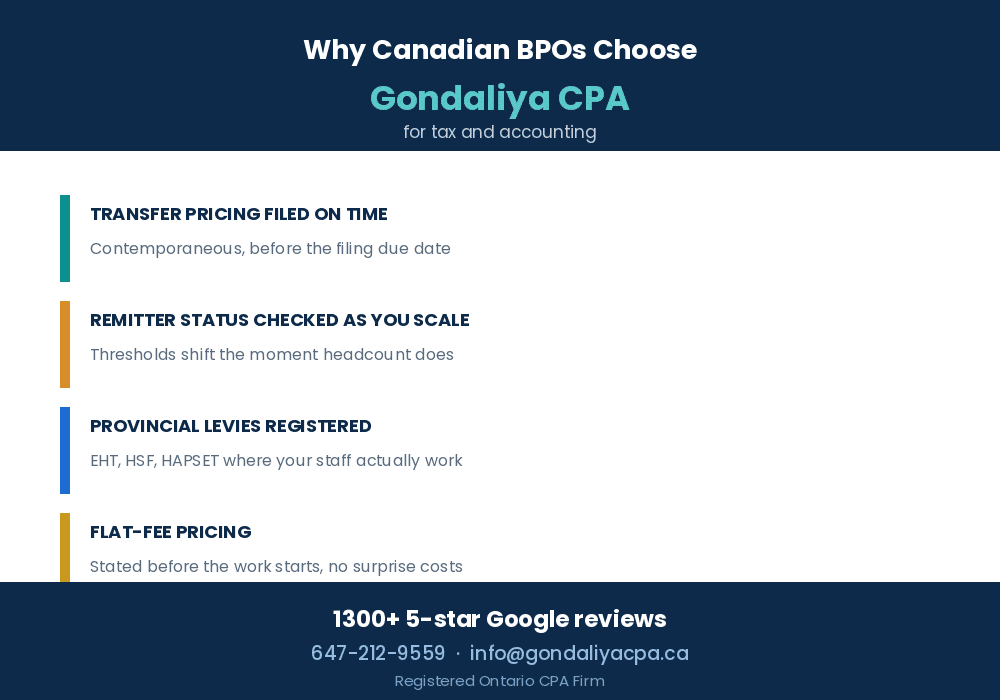
BPOs get into difficulty in a predictable set of ways: intercompany charges priced sensibly but documented after the fact, remitter frequency left unchecked while headcount grows, provincial payroll levies missed where staff work remotely, and export invoices zero-rated because the client is abroad rather than because Schedule VI Part V is satisfied. Gondaliya CPA handles BPO accounting on a flat annual fee.
We handle what decides the outcome: preparing contemporaneous transfer pricing documentation before the filing due date, confirming remitter status in writing each time headcount moves, registering and filing the provincial payroll levies, testing each export against the Part V conditions with proof on file, and reconciling GST/HST and payroll to the books before anything is filed.
Quick Answers
| Question | Answer |
|---|---|
| Payroll remittance, regular remitter | 15th of the following month |
| Three working days | Accelerated threshold 2 only, $100,000+ monthly withholding |
| T4 / T4A deadline | Last day of February |
| Slip penalty, 1–50 slips, first failure | $10/day, $100 minimum, $1,000 maximum |
| T2 late-filing penalty | 5% + 1% per complete month, capped at 12 months |
| Purchased application software | Class 12, 100%, half-year rule — deducted over two years |
| Corporate instalments | Monthly under ITA s.157; quarterly for eligible small CCPCs |
| T106 threshold and deadline | CAD $1M; due on the T2 filing due date |
Who This Is For
- For: Incorporated Canadian BPO, outsourcing, managed services and shared services companies — call centres, back-office processors and IT outsourcing firms — particularly those with related entities abroad or staff across provinces.
- Not For: Non-resident outsourcing providers with no Canadian presence, whose obligations run on the cross-border and permanent establishment rules rather than these, and individual contractors working through a single client.
Glossary of Key Terms
- Contemporaneous documentation: Transfer pricing records complete by the T2 filing due date — the test for reasonable efforts under s.247.
- Regular remitter: An employer with average monthly withholding under $25,000, remitting by the 15th of the following month.
- Accelerated threshold 2: $100,000 or more in average monthly withholding, remitting within three working days.
- T106: The information return for non-arm’s-length transactions with non-residents above CAD $1M.
- Schedule VI Part V: The zero-rating provisions for exported services.
- Class 12: The CCA class covering application software at 100%, subject to the half-year rule.
- Class 13: Leasehold improvements, written off over the lease term plus first renewal, minimum five years and maximum forty.
- Employer health tax: A provincial payroll levy — Ontario EHT, BC EHT, Quebec HSF, Manitoba HE Levy, Newfoundland HAPSET.
This quick self-check indicates where your BPO’s compliance most likely has room. Please answer the five questions below.
BPO Compliance Check
Five quick questions on your business. No fee shown.
Points to raise with us:
This is a general prompt, not tax or legal advice or a quote. Your position depends on your full facts. For a real review, please book a free consultation.
Documentation timing beats pricing analysis — a defensible margin without contemporaneous records still meets the section 247 penalty. Confirm your remitter frequency in writing whenever headcount moves, since the threshold shifts as you hire. File slips by the last day of February and the T106 by the T2 due date. Put purchased software in Class 12 and build-outs in Class 13. And register the provincial payroll levies where your staff actually work, which is the part that genuinely varies by province — remittance deadlines do not.
BPO Company Taxes: How Gondaliya CPA Supports You
Charging a related company offshore?
We prepare contemporaneous transfer pricing documentation before the filing due date, file the T106, confirm remitter frequency as you scale, register the provincial payroll levies where your staff actually work, and file the T2 — on a flat annual fee stated before the work starts.
Next Steps
Please book a free consultation with Gondaliya CPA and bring your last filed corporate return, your current CRA remitter notice, and a schedule of intercompany charges with the agreements behind them. Those three show where the real exposure sits. You will get a flat fee stated before any work begins.
Published: · Last updated:
Editorial policy: Every rule stated here is checked against the Income Tax Act, the Excise Tax Act, their Regulations, or CRA publications current at the date above. Figures, deadlines and statutory references are verified before publication and updated when the rules change.
Disclaimer: This article is educational information only and is not tax, legal, or financial advice. Rules change and outcomes depend on your specific facts. Please speak with a CPA before acting.

Sharad Gondaliya is a CPA Canada & CPA USA with 15 Years+ experience of Accounting, Tax, Payroll of Corporate Small Businesses as Tax Accountant. He is fully certified CPA Ontario and CPA USA and is well known among corporate small businesses for tax planning, efficient tax solutions, and affordable CPA services. Sharad is the Principal (Director) of Gondaliya CPA – Affordable CPA Firm in Canada. Licenses: CPA Ontario: 61040184 | CPA USA (MT): PAC-CPAP-LIC-033176 | CPA USA (WA): 57629 | CPA Firm License: 61330051 View Full Author Bio