



Translation Services Business Taxes in Canada: A Guide for Translation Companies
Translation business taxes Canada require careful attention to revenue, expenses, and tax credits specific to translation services and companies. Gondaliya CPA provides an essential guide covering corporate income tax, payroll deductions, and HST compliance relevant to translation companies operating in Canada.
Quick Summary
A translation company’s tax position turns on three things: whether a client sits inside or outside Canada for GST/HST, whether a translator is an employee or a contractor, and where that contractor performs the work. Several penalty figures and CCA classes circulating in this guide need correcting before they reach a return.
- Zero-rate exported services only with documented proof of the client’s non-residence.
- Test translator status on the facts — control, tools, risk and integration.
- Register for GST/HST once worldwide taxable revenue passes $30,000 over four quarters.
- File the T2 within six months of year-end and pay the balance earlier.
Reading time: 23 minutes.
Table of Contents
The Numbers That Matter
This article covers Canada, with Ontario and Toronto context, and reflects rules current to 2026. It is written for translation and localisation businesses — agencies, LSPs, subtitling and interpretation firms — both incorporated and sole proprietor. This is educational information only and not tax or legal advice. Please confirm the position where you operate.
What Circulates Versus the Rule
What Circulates Versus the Rule
The Corrections
Six items in this guide are the kind of detail that circulates widely in translation-industry tax guidance generally. Each is stated below exactly as it appears in our own guidance, then corrected against the rule.
| What Circulates | The Rule |
|---|---|
| T2 late penalties are “5% of unpaid tax plus 1% daily to 12 months max” | The 1% is charged per complete month, not per day. Under subsection 162(1) the penalty is 5% of the unpaid tax plus 1% for each complete month the return is late, to a maximum of 12 months — a 17% ceiling. A daily 1% would reach 365% in a year, which no provision imposes. |
| GST/HST late-filing fines are “1% per month up to 12 months” | The formula is A + (B × C): A is 1% of the amount owing, B is 25% of A, and C is the number of complete months overdue, capped at 12. The maximum is 4%, not 12%. Interest is separate and compounds daily. |
| T4A-NR slips are issued “if they pay foreign freelancers working outside Canada”; Regulation 105 covers “non-resident translators” | Regulation 105 withholding applies to fees paid to a non-resident for services rendered in Canada. A freelance translator working from their own country is performing services outside Canada, so Regulation 105 does not apply and no T4A-NR arises on that basis. The 15% rate is correct — but only for the in-Canada case, such as an interpreter flown in for a deposition. |
| CCA: Class 12 “tools under $5,000”; Class 53 “computers bought before March 19, 2007”; Class 14.1 “patents or copyrights” | Class 12 covers tools costing less than $500, plus non-systems (application) software at 100%. Class 53 is manufacturing and processing machinery acquired 2016–2025 — not computers; pre-19-March-2007 computers sit in Class 45 (45%) or Class 10. And Class 14.1 is the goodwill and former eligible-capital-property class; patents and limited-life licences are Class 14 or Class 44. |
| Corporate instalments are “quarterly… last day of March/June/Sep/Dec”, cited to Regulations Schedule II | Corporate instalments are generally monthly, due the last day of each month of the corporation’s tax year — not fixed calendar quarters. Quarterly instalments are available only to an eligible small CCPC meeting the taxable income, taxable capital and compliance tests. Regulations Schedule II is the list of CCA classes; instalments are in ITA section 157. |
| Citations: meals at “s.67(2)(b)”; subcontractor T4As under “Regulations section 105”; home office per “T4044”; revenue recognition per “IT-470R3” | The 50% meals limit is ITA s.67.1. Domestic subcontractor T4A reporting is Regulation 200(1), not 105. T4044 is Employment Expenses — business-use-of-home for the self-employed is T4002, which this guide cites correctly elsewhere. And IT-470R covers employees’ fringe benefits, not revenue recognition. |
Where the Translator Works Decides Everything
This is the correction with the most money attached, because a translation agency’s subcontractor pool is usually spread across several countries.
| Who You Pay | Where the Work Is Done | Withholding | Slip |
|---|---|---|---|
| Canadian resident subcontractor | Anywhere | None | T4A under Regulation 200(1) |
| Non-resident freelance translator | Their own country | None — Regulation 105 doesn’t reach it | No T4A-NR on that basis |
| Non-resident interpreter | On site in Canada | 15% under Regulation 105, unless a treaty waiver is obtained | T4A-NR |
| Employee | Anywhere | Income tax, CPP, EI | T4 |
The practical consequence runs both ways. An agency that withholds 15% from a translator in Spain who never sets foot in Canada is deducting tax it had no authority to deduct, and the translator has to file a Canadian return to recover it. An agency that pays an interpreter to attend a hearing in Toronto and withholds nothing is liable for the tax it failed to withhold, plus penalty and interest.
Risk Warning: Regulation 105 liability sits with the payer, not the non-resident. If you should have withheld and didn’t, CRA assesses your company for the amount, and the fact that the translator later paid their own tax at home doesn’t discharge it. Where a treaty reduces or eliminates the tax, the route is a waiver applied for before payment — not a decision made at your desk.
The T2 Penalty, Worked Through
On $20,000 of unpaid corporate tax, filed five complete months late: 5% of $20,000 = $1,000, plus 1% × 5 months = $1,000. Total penalty $2,000, or 10%. Under the “1% daily” version circulating here, the same return would appear to attract 5% + 150% = $31,000 — more than the tax itself. The daily charge that does exist is interest, compounded daily at the prescribed rate, and it has no ceiling.
A localisation agency came to us having withheld 15% from every non-resident translator on its roster for two years, on the reading that Regulation 105 covers anyone who isn’t Canadian. Almost none of the work was performed in Canada. The money had gone to CRA correctly as a remittance, but it was never owed, and recovering it meant each translator filing a Canadian return — which several simply declined to do. Figures changed for privacy.
Professional guidance. Two questions settle most of this guide: for each client, are they resident outside Canada and can you prove it; and for each translator you pay, are they resident in Canada, and if not, was the work performed here. Answer those and the GST/HST treatment, the withholding and the slips all follow. Get them wrong and the errors compound across every invoice in the year.
Understanding Tax Obligations for Translation Services and Companies in Canada
Understanding Tax Obligations
Foundations
Key Tax Categories Applicable to Translation Businesses
Taxes for translation services business in Canada can get tricky. Here are the main ones translation companies need to watch out for:
- Corporate Income Tax means tax on company profits. You must file a T2 Corporate Tax Return every year.
- Payroll Obligations kick in if you have employees. You need to take income tax from paychecks and send money to social programs.
- GST/HST Application applies depending on what you do and where your clients live.
- Instalment Payments usually happen during the year based on how much tax you might owe.
Corporate Income Tax
If your translation company is a corporation, filing corporate income tax is a must. You have to file your T2 Corporate Tax Return by six months after your fiscal year ends.
You might wonder if you should pay yourself a salary or dividends. Think about what suits your needs and the company’s cash flow. Salary and dividends affect personal taxes and how the company handles money.
Personal Income Tax (for Sole Proprietors)
If you run your translation business as a sole proprietor, taxes work a bit different. The Income Tax Act section 9 explains when to report revenue from projects, retainers, deposits, or work not yet billed.
Payroll Taxes
When you run payroll, keep these in mind:
- Send withheld taxes by the 15th day of the month after you deduct them.
- Know if someone is an employee or contractor; this affects tax slips and what you must withhold.
- Follow rules for paying taxes depending on worker type.
Sales Taxes (GST/HST/PST)
Sales taxes can be confusing but here’s what to know:
- When should your translation business register for GST/HST? Usually when revenue passes $30,000.
- Do you charge GST/HST on foreign clients? It depends on rules in Schedule VI of the Excise Act.
- Figure out which input tax credits (ITCs) you can claim for business expenses.
- Charge clients in other provinces according to their province’s rates.
Key Stat: For a service supplied to a Canadian client, the rate follows the place of supply, which for most translation work is determined by the client’s business address obtained in the ordinary course. A Toronto agency serving an Alberta client charges 5% GST, not 13% HST — the supplier’s own location does not set the rate. This is the mistake the guide’s own later section flags.
Recognizing Taxable and Non-Taxable Revenue Streams
Translation Services to Canadian Clients
Money earned from translating for Canadian clients usually counts as taxable revenue. This includes payments from project milestones, retainers, deposits, and even unbilled work. Income Tax Act section 9 guides when to report it.
International Revenue Considerations
Working with non-resident clients? Then check exported service rules under Schedule VI of the Excise Act. To call it zero-rated supply (no GST/HST), keep proof of where your client lives and their registration info if needed.
Exempt vs. Taxable Supplies
If your sales stay under $30,000 over four quarters, you’re a small supplier—no need to register for GST/HST yet. But if you want, registration is voluntary so you can claim input tax credits. Keep good records to follow rules right.
A note on terminology: a zero-rated export is a taxable supply at 0%, not an exempt one. The distinction matters because zero-rated sales still carry full input tax credit recovery, while exempt supplies do not. A translation company billing overseas clients is making taxable supplies and keeps its ITCs.
Claiming Business Expenses Specific to Translation Companies
Claiming Business Expenses
Deductions
Deductible Expenses for Translation Services
If you run a translation company in Canada, you can deduct many business expenses. These help lower your taxable income. Common costs include paying subcontractors, office rent, memberships, and marketing. The Canada Revenue Agency (CRA) says these must be reasonable and related to making money.
You can also deduct CAT tools, software subscriptions, and machine translation platforms. If you buy expensive stuff like servers or special hardware, you might have to claim them over time using Capital Cost Allowance (CCA) classes. Smaller software subscriptions can usually be deducted right away.
Do you work from home? If you use a space just for work regularly, you can deduct some home office costs. You need to figure out how much space you use and keep good records.
Travel expenses tied to interpretation jobs or client visits are also deductible. But don’t include personal travel costs. Meals during travel get a 50% deduction unless they fit CRA exceptions. Save your receipts and keep detailed notes.
A legal translation firm in Toronto paid $3,000 yearly for CAT tool subscriptions. They spent $5,000 on renting an office just for their team. They counted 20% of their home utility bills as remote workspace expenses. Travel costs were $2,500, with meal receipts backing half the amount claimed under CRA rules. These deductions lowered their taxable income while following CRA rules.
One caution on that example: a firm renting a dedicated office for its team will have difficulty also claiming 20% of home utilities, since business-use-of-home requires the space to be either the principal place of business or used exclusively and regularly for meeting clients. Where a commercial office exists, the home claim usually fails.
GST/HST Registration and Compliance for Translation Services
Translation businesses must register for GST/HST if their total worldwide taxable revenues go over $30,000 in four straight calendar quarters. This rule covers all provinces where services are supplied inside Canada.
When do you charge GST/HST? It depends on where your client is:
- For clients in Canada: Charge the GST/HST rate that applies where the service is delivered.
- For clients outside Canada: You might zero-rate the service if it meets export rules under Schedule VI of the Excise Tax Act[EDITOR: verify current position].
Zero-rating means charging no GST/HST but only if you have proof the client lives outside Canada and other rules apply. Otherwise, local tax rates apply.
Input Tax Credits (ITCs) let you get back GST/HST paid on business purchases like software or subcontractor fees linked to your taxable supplies. Keep invoices showing vendor tax numbers to claim ITCs properly when filing.
Table: When Must a Translation Business Register for GST/HST?
| Condition | Threshold | Effective Date | Source |
|---|---|---|---|
| Total worldwide taxable revenue | Over $30,000 | Day after threshold crossed | CRA – Small Supplier Test |
A subtitling agency in Ontario made over $35,000 last quarter. It registered right after. It charges 13% HST on Canadian invoices but zero-rates projects billed to US law firms with residency proof kept on file.
On the timing in that example: exceeding $30,000 in a single calendar quarter ends small supplier status immediately — you are a registrant from that supply onward and must register within 29 days, with tax charged on the supply that pushed you over. Exceeding it across four quarters cumulatively gives you a one-month grace period instead. The two routes have different start dates.
Which Input Tax Credits Can a Translation Business Claim?
Translation companies can claim ITCs on most goods and services bought just for business activities taxed by GST/HST:
- Software licenses like CAT tools
- Subcontractor payments with valid tax numbers
- Office rent
- Professional fees (accounting or legal advice)
- Marketing materials
To claim ITCs successfully:
- Keep original vendor invoices with correct registration numbers.
- Make sure purchases relate only to your business activities.
- Keep bookkeeping organized so each input cost links clearly to taxed supplies.
If documents aren’t proper, CRA may deny credits and charge penalties.
References
- Income Tax Act sections 18(1)(a), 67 – Expense deductibility rules
- Income Tax Regulations Classes 8 & 12 – CCA treatment of computer equipment/software
- CRA Guide T4044 – Business Use of Home Expenses
- Income Tax Act section 67(2)(b); CRA Interpretation Bulletin IT–518R – Meals & Entertainment Limits
- Excise Tax Act section 240(1); CRA – Small Supplier Thresholds
- Excise Tax Act Schedule VI Part V – Exported Services Conditions [EDITOR: verify current position]
- Excise Tax Act sections168–169; CRA Guide RC4022 – Input tax credits
Risk Warning: Two citations here are wrong, as set out in section one. The meals limit is ITA s.67.1, not s.67(2)(b) — section 67 is the general reasonableness test. And T4044 is the Employment Expenses guide; the self-employed business-use-of-home rules are in T4002, which this guide cites correctly in a later reference list. Computer hardware also belongs in Class 50, not Class 8, for anything acquired after 18 March 2007.
For expert help managing translation services business taxes Canada, contact Gondaliya CPA at info@gondaliyacpa.ca or call 647‑212‑9559 today for a free consultation focused on incorporated SMBs across Toronto/Ontario regions including Etobicoke and Mississauga.
Payroll Deduction Requirements
Payroll Deduction Requirements
Payroll
If you run a translation services business in Canada, you have to follow payroll obligations carefully. Employers must take out income tax, Canada Pension Plan (CPP), and Employment Insurance (EI) from employees’ paychecks. Then, these amounts go to the Canada Revenue Agency (CRA).
You need to send the money by certain deadlines. Usually, it’s 15 days after the month ends. Bigger companies might pay even faster. Sending money late can cause penalties or interest.
Keep good records of how much you withhold for tax, CPP, and EI for each worker. This helps if CRA checks your books.
Whether your company is in Ontario or anywhere else in Canada, you must meet these rules. The CRA wants source deductions to be correct and on time every pay period.
Contractor Payments and Compliance
Are your freelance translators contractors or employees? This question matters a lot for translation company taxes Canada. Contractors get T4A slips with no payroll deductions. Employees get T4 slips with deductions.
If you mix this up, CRA can charge penalties, interest on arrears, and reassess unpaid source deductions. CRA looks at how much control you have over workers, who provides tools, if they can earn profit or loss, and how much they fit into your business—not just what the contract says.
You must send the right info slips: T4s for employees, T4As for subcontractors. This follows Income Tax Act Regulations section 105. Missing or wrong slips can make an audit more likely.
If a contractor gets reclassified as an employee later, your company might owe back CPP/EI contributions plus fines. Clear agreements that match real work help avoid this risk.
Getting worker status right means paying the right translation services business taxes Canada and stopping surprises from payroll deduction mistakes.
| Payee Type | Status Test Factors | Slip Issued | Withholding Required | Deadline | Source |
|---|---|---|---|---|---|
| Employee | Control + Tools + Schedule | T4 | Yes (Income tax/CPP/EI) | Last day Feb next yr | CRA Employer’s Guide |
| Independent Contractor | Autonomy + Own tools + Profit/Loss Chance | T4A | No | Last day Feb next yr | Income Tax Regulations s.105 |
The source cited twice above is wrong, as set out in section one. Regulation 105 governs 15% withholding on fees paid to non-residents for services rendered in Canada. A T4A for a Canadian-resident subcontractor is issued under Regulation 200(1). The two are unrelated, and citing 105 for domestic subcontractors invites exactly the confusion that leads agencies to withhold from foreign translators who owe nothing. Everything else in the table is correct.
Verdict: Labeling translators right stops costly reassessments tied to payroll obligations under Canadian law.
References
- CRA Payroll Deductions
- Income Tax Act – Sections relevant
- Excise Tax Act – Exported Services
Income Tax Filing Requirements for Incorporated and Sole Proprietor Translation Firms
Income Tax Filing Requirements
Filing
If you run a translation business in Canada, taxes matter. Whether you work as a sole proprietor or have an incorporated company, the rules change. Your translation company taxes Canada will depend on how your business is set up.
Sole Proprietorship Tax Filing
Sole proprietors put their translation income on their personal tax return. They use the T1 form for this. All money earned from translation services goes in with other personal income.
Deducting Eligible Business Expenses
Sole proprietors can take off some costs to lower their taxes. These must be real expenses related to the business. Here are common ones:
- Paying freelancers or subcontractors.
- Software like CAT tools and subscriptions for machine translation.
- Costs for a home office, like part of your rent or internet.
- Fees for professional groups or certifications.
- Marketing expenses like website fees or ads.
If you buy software outright, you might need to spread the cost over time using Capital Cost Allowance (CCA). Subscriptions can usually be deducted right away. For your home office, only the space used just for work counts.
Keep good records! Save receipts, contracts, and invoices. The CRA may ask to see them later. Claiming wrong expenses can cause trouble and fines.
On buying software outright: purchased application software goes to Class 12 at 100%, subject to the half-year rule, so it is written off over two years rather than spread over many. Systems software bundled with hardware follows the hardware into Class 50. A monthly CAT tool subscription is a current expense, not a capital asset at all.
Corporate Tax Filing for Incorporated Translation Companies
If your translation firm is incorporated, it files taxes differently. You’ll use a T2 corporate income tax return every year.
T2 Corporate Income Tax Return
The T2 return must be filed within six months after your company’s fiscal year ends. It shows all income the corporation made inside Canada.
You also send GST/HST returns based on sales tax collected and paid during the year. Provincial forms might be needed too if you are in Ontario or another province.
Good bookkeeping helps here. Track revenue carefully so it matches when projects finish or when you bill clients. Mistakes can cause wrong tax amounts to be reported.
A resident corporation reports its worldwide income on the T2, not only income made inside Canada. For a translation company billing clients in the US and Europe, that foreign revenue belongs on the return, converted at an appropriate exchange rate, with any foreign tax paid considered for foreign tax credit purposes.
Dividend vs. Salary Compensation Strategies
As an owner of an incorporated translation business, you can pay yourself with salary or dividends:
| Factor | Salary | Dividends |
|---|---|---|
| Payroll Deductions | Must withhold CPP and EI | No need |
| Personal Income Taxes | Deductible for corporation | Not deductible; taxed by owner |
| CPP Contributions | Paid by employer & employee | None |
| Payment Timing | Fixed schedule | Can pay anytime |
One refinement on the Payroll Deductions row: an owner-manager who controls more than 40% of the voting shares is generally not insurable, so EI is not withheld on their salary. CPP still applies. The row is right for arm’s-length employees and overstates the position for the owner themselves.
Salary reduces corporate taxable income but means more paperwork like remitting payroll taxes and issuing slips (T4). Dividends avoid payroll deductions but don’t lower corporate profits. You pay personal tax on them instead.
Picking salary or dividends depends on what suits your cash flow, plans, and CRA rules about fair pay levels. Many find using both works best.
Need help? For questions about Toronto or Ontario tax rules, call Gondaliya CPA at 647-212-9559 or email info@gondaliyacpa.ca for advice.
References
- CRA Guide T4002 – Business Use-of-home Expenses
- Excise Tax Act Section 169 – Documentary Requirements
- Income Tax Act Section 150(1) – Corporate Return Deadline
- CRA GST/HST Guide RC4022 – General Information for Registrants
- CRA Interpretation Bulletin IT-470R3 – Revenue Recognition Principles
- Income Tax Act Sections 230 & 248(1) – Salary vs Dividend Rules
- CRA Payroll Deductions Online Calculator & Reasonableness Guidelines
Two notes on this list. IT-470R is Employees’ Fringe Benefits, not revenue recognition — revenue timing for a business runs on ITA section 9 and case law, which this guide cites correctly earlier. And sections 230 and 248(1) are the books-and-records and definitions provisions; they do not set out salary versus dividend rules.
Common Tax Credits and Incentives for the Translation Sector
Tax Credits & Incentives
Credits
Overview of Tax Credits
If you run a translation company in Canada, you can get some tax breaks. The small supplier threshold means that if your business makes less than $30,000, you don’t have to charge GST or HST. This helps smaller translation agencies avoid extra paperwork.
Here are some Capital Cost Allowance (CCA) classes that matter for translation businesses:
- Class 8 covers office furniture and general equipment.
- Class 12 includes tools under $5,000, like some software licenses.
- Class 14.1 relates to patents or copyrights for special translation tools.
- Class 50 is for computer hardware bought after March 18, 2007.
- Class 53 applies to computers bought before March 19, 2007.
Risk Warning: Three of these five lines will misclassify assets if used as written, as corrected in section one. Class 12 is under $500, not $5,000 — a $3,000 tool goes to Class 8 at 20%. Class 53 is manufacturing and processing machinery acquired 2016–2025; computers bought before 19 March 2007 are Class 45 at 45%. And Class 14.1 is the goodwill class — patents belong in Class 14 or Class 44. Class 8 and Class 50 are stated correctly.
| Class | What It Actually Covers | Rate |
|---|---|---|
| Class 8 | Office furniture, general equipment, tools costing $500 or more | 20% |
| Class 12 | Tools under $500; application (non-systems) software such as CAT tool licences | 100% |
| Class 14 / 44 | Patents and limited-life licences | Varies / 25% |
| Class 14.1 | Goodwill and former eligible capital property | 5% |
| Class 45 | Computers acquired after 22 March 2004 and before 19 March 2007 | 45% |
| Class 50 | Computer hardware and systems software acquired after 18 March 2007 | 55% |
| Class 53 | Manufacturing and processing machinery acquired 2016–2025 | 50% |
When you buy assets in these classes during the year, the half-year rule says you can only claim half of the CCA amount in your first year. That means your tax deduction starts slower.
If your company tries new tech—like making better language software—you might get the SR&ED tax credit. It helps with costs but needs good records to prove your work.
Also, Canadian-controlled private corporations (CCPCs) can claim a Small Business Deduction on their first $500,000 in active business income. This lowers the federal corporate tax rate compared to regular companies.
Using these credits right can cut your taxes and keep more cash in your business.
Pro Tip: On SR&ED for a translation business, the bar is technological uncertainty resolved through systematic investigation — not the novelty of the output. Training or fine-tuning a model on your own corpus, or building a terminology engine where the outcome genuinely isn’t predictable from existing knowledge, can qualify. Routine use of an existing MT platform, however sophisticated, does not. Contemporaneous records matter more than the write-up at year-end.
Maintaining Accurate Financial Records for Canadian Translation Companies
Canadian rules say that translation companies must keep their financial records for six years after their last tax year ends. You need these records to back up everything you report—like income, expenses, asset claims such as CCA, and payroll info like T4 slips for workers or contractors.
It’s smart to organize invoices by client location and currency because foreign exchange can matter a lot. Keep contracts with subcontractors and payment proofs too. Many use digital tools like QuickBooks or Xero since these help keep things tidy and ready if CRA checks your books.
Having good records stops problems like missing receipts or unsupported zero-rated sales claims. It also helps you file forms on time—like T2 corporate income tax returns and GST/HST reports—without penalties.
References
- Canada Revenue Agency (CRA), “GST/HST – Small Supplier Threshold,” canada.ca
- Income Tax Act Regulations Schedule II; CRA Guide T4002 – Business and Professional Income
- CRA SR&ED Program Overview; Excise Tax Act Schedule VI Part V
- Income Tax Act section 125(1); CRA Corporate Income Tax Rates Summary
- Income Tax Act section 230(1); CRA Record Keeping Requirements
For questions about translation services business taxes Canada or translation company taxes Canada, reach out to Gondaliya CPA at info@gondaliyacpa.ca or call 647-212-9559 for advice on how to handle your taxes right.
Addressing Frequently Encountered Tax Issues in the Translation Industry
Frequently Encountered Tax Issues
Common Problems
Taxes for translation services business taxes Canada can be tricky. Translation companies often get confused about reporting income, claiming expenses, and paying the right taxes. Many translation businesses have trouble with GST/HST registration, payroll payments, instalments, and billing clients abroad. Knowing these tax rules helps avoid fines and keeps you safe with CRA rules.
Best Practices for Efficient Tax Management in Translation Businesses
You need to watch deadlines and keep good records to handle translation business taxes Canada well:
- GST/HST Small Supplier Threshold: You must register for GST/HST if your taxable sales go over $30,000 in four straight quarters. If you make less, registering is up to you.
- Tax Records Retention Period: Keep all papers that show your income and costs for six years after the tax year ends. This means invoices, contracts, bank records, and bookkeeping stuff.
- Payroll Remittance Deadline: You have to send payroll deductions each month or quarter depending on your withholding amounts. Missing this date means penalties.
- Instalment Due Dates: Companies pay corporate taxes in four instalments every year. These are based on last year’s tax or what you think you owe now. Pay late and interest adds up.
Following these steps lowers audit chances and makes yearly filing easier.
| Obligation | Requirement | Deadline/Frequency | Source |
|---|---|---|---|
| GST/HST Registration | Register if >$30K taxable revenue | Within 29 days after threshold exceeded | CRA Guide RC4022 |
| Record Retention | Keep all relevant documents | Minimum 6 years post-filing | Income Tax Act s230(1) |
| Payroll Remittance | Monthly/quarterly remittance of source deductions | By 15th following month/quarter end | CRA Payroll Deductions Online Calculator |
| Corporate Instalments | Quarterly payment of estimated taxes | Last day of March/June/Sep/Dec | Income Tax Act Schedule II |
The Corporate Instalments row is wrong on both the frequency and the source, as set out in section one. Instalments are generally monthly, due the last day of each month of the corporation’s own tax year — a company with a 30 June year-end does not pay on calendar quarters. Quarterly instalments are available only to an eligible small CCPC meeting the taxable income, taxable capital and compliance conditions. The governing provision is ITA section 157; Regulations Schedule II lists CCA classes. Note too that a corporation owing $3,000 or less in the year generally need not pay instalments at all.
How Professional Accounting Support Simplifies Taxes for Translation Companies
Accountants make handling translation company taxes Canada easier. They follow CRA T2 Guide rules so everything is filed right. The Income Tax Act s230(1) says books and records must back up reported numbers. The Excise Tax Act Schedule VI shows when services count as exported supplies that don’t need GST/HST — this matters for foreign clients.
A good CPA knows:
- When to mark sales as taxable or zero-rated exports
- How to claim input tax credits correctly
- How to prepare T2 returns with foreign currency info
- Rules for payroll source deductions
This know-how cuts down mistakes that cause audits or fines.
Benefits of working with a specialized CPA firm
Gondaliya CPA Professional Corporation offers licensed and affordable corporate tax filing plus bookkeeping made just for incorporated translation businesses across Toronto and all Canada. We handle tricky issues like multi-province GST/HST rules, issuing slips (T4A) for subcontractors, payroll management including checking family wages are fair, and making sure export services meet Excise Tax Act rules [CRA reference].
Clients get flat fees with a 30-day money-back option and weekend help — so less stress while staying legal.
Customized tax planning for translation services
Good planning avoids problems like late-filing penalties. Those start at 5% plus daily fees if you miss deadlines. Also, non-resident translators working in Canada have withholding tax rules — miss those and extra taxes come due under Regulation 105.
Plans include:
- Paying instalments on time with cash flow in mind
- Choosing salary vs dividends smartly
- Keeping proof for exports per Excise Tax Act Schedule VI
This lowers risks while saving money.
“5% plus daily fees” conflates two charges. The penalty is 5% plus 1% per complete month to a 17% ceiling; the daily charge is compound interest at the prescribed rate, which is separate and uncapped. Note also that this sentence gets Regulation 105 right — “working in Canada” is the test, which is exactly what the FAQ section below contradicts.
Case examples of tax solutions for translation companies
CRA may review you if you claim zero-rated sales without proof the client lives outside Canada or if you pay contractors but skip required slips (T4A). Other warnings are missing withholding on foreign workers or mismatched payroll records vs filed slips.
Top mistakes include:
- Charging HST/GST only by where supplier is, not by client’s address
- Using wrong exchange rates on foreign invoices which messes up income numbers
- Forgeting depreciation on CAT tool software licenses so you lose deductions [CRA references]
Fix these by:
- Keeping clear books showing client locations
- Matching payroll data to slips regularly
- Doing internal checks focusing on export service rules backed by signed client statements on residency when needed
Got questions about translation company taxes Canada? Contact Gondaliya CPA at info@gondaliyacpa.ca or call 647‑212‑9559 for a free consult. We work with language service providers all over Toronto and beyond.
References
- CRA Guide RC4022 – General Information – Goods & Services Tax / Harmonized Sales Tax
- Income Tax Act s230(1) – Books & Records Retention Requirements
- CRA Payroll Deductions Online Calculator – Remittance Frequency Rules
- Income Tax Regulations Schedule II – Instalment Payment Deadlines
- CRA Penalties & Interest Rates Overview
- Income Tax Regulations Section 105 – Non-resident Withholding Obligations
FAQs on Translation Business Taxes Canada
Frequently Asked Questions
FAQ
What are T4A-NR slips and when should translation companies issue them?+
T4A-NR slips report payments to non-resident contractors or workers. Translation companies must issue them if they pay foreign freelancers working outside Canada.
Correction: the opposite. T4A-NR and Regulation 105 withholding attach to services rendered in Canada by a non-resident. A freelancer working from their own country falls outside both. See section one.
How do salary or dividends affect tax planning for translation company owners?+
Salary triggers payroll deductions and lowers corporate taxable income. Dividends do not require payroll remittance but increase personal tax. Combining both can optimize taxes.
What are the specific tax filing deadlines for translation businesses in Canada?+
Corporations file T2 returns within six months after fiscal year-end. GST/HST returns vary by filing frequency, usually monthly or quarterly. Payroll remittances are due by the 15th of the following month.
What CRA taxpayer relief provisions help translation companies with late filings or payments?+
CRA may waive penalties and interest if delays occur due to circumstances beyond control, like illness or disasters. Companies must apply promptly with evidence. Relief is limited to the ten calendar years before the year the request is made.
Can you explain place of supply rules for GST/HST in translation services?+
GST/HST applies where the service is delivered. For Canadian clients, charge based on their province’s rate. Foreign clients may qualify for zero-rated export status under Schedule VI.
What are the numeric values of late-filing penalty rates for translation businesses?+
Late T2 return penalties start at 5% of unpaid tax plus 1% daily to 12 months max. GST/HST late-filing fines can be 1% per month up to 12 months.
Correction: the T2 charge is 1% per complete month, not daily, capping at 17%. The GST/HST penalty is A + (B × C), capping at 4%. Interest is the daily charge, and it has no ceiling. See section one.
What common CRA review triggers should translation firms avoid?+
Inconsistent income reporting, missing source deductions, claiming ITCs without invoices, and unsupported zero-rated sales invite CRA scrutiny.
How can a translation business catch up if filings are behind?+
File all outstanding returns immediately, pay any taxes owing, and consider requesting taxpayer relief from CRA to reduce penalties. Where income was unreported rather than merely late, the Voluntary Disclosures Program is the route to consider, and it must be approached before CRA contacts you.
What are the pros and cons of DIY accounting vs hiring a CPA or non-CPA for translation taxes?+
DIY saves money but risks errors and missed credits. Non-CPA bookkeepers handle basics but lack tax expertise. CPA firms ensure accuracy and strategic tax planning.
How do you choose the right CPA firm in Toronto/Ontario for a translation business?+
Look for firms with experience in small business taxes, understanding of GST/HST rules, payroll compliance knowledge, and good client reviews.
Do I charge GST/HST to a client in the United States?+
Generally no — translation supplied to a non-resident who is not registered for GST/HST is typically zero-rated under Schedule VI Part V. You still need documented proof of the client’s non-residence on file, and the sale remains a taxable supply at 0%, so your input tax credits are unaffected.
Which CCA class does a purchased CAT tool licence go in?+
Application software goes to Class 12 at 100%, subject to the half-year rule. A monthly or annual subscription is a current expense instead, deducted in full in the year.
Key Tax Details & Tips for Translation Businesses
Key Tax Details & Tips
Quick Reference
- Withholding Tax Rates on Non-Residents: Usually 15% on payments to non-resident translators under Regulation 105 unless reduced by treaty.
- Travel & Interpretation Assignments: Deduct reasonable travel costs tied to work; meals get 50% deduction unless exceptions apply.
- Writing Off Unpaid Client Invoices: Only write off bad debts after reasonable collection attempts; report as income reduction in the year written off.
- Corporate Year-End Filing: Corporations must file T2 within six months after year-end; pay any balance owing within three months to avoid interest.
- Salary or Dividends: How Should You Pay Yourself? Salary suits steady cash flow needs; dividends save payroll costs but lack CPP benefits—consider a mix.
- What Does the Corporation Pay and File at Year-End? File T2 return, remit corporate taxes owed, submit GST/HST return if applicable, issue T4 slips for employees.
- Penalties & Interest for Late Filing/Remittance: CRA charges penalties starting at 5%, with daily interest on unpaid amounts—early compliance avoids this cost.
- Handle Taxes Yourself or Use a CPA Firm? Which Fits Best? If comfortable with bookkeeping and tax law, DIY works; otherwise, CPAs provide accuracy and save time/money long term.
- Top Tax Rules Across 10 Translation Segments: Revenue recognition, GST/HST application, payroll compliance, ITC claims vary slightly by segment—know your niche specifics well.
- Realistic Numeric Walkthrough Example: A $100K revenue firm pays approx $15K corporate tax after deductions; timely GST remittances avoid $500+ penalties; salary/dividends split affects personal tax owed.
Risk Warning: Two lines here need qualifying. The 15% withholding applies only where the non-resident performs the services in Canada — the phrasing here reads as though residence alone triggers it, and that misreading is what causes agencies to over-withhold. And the three-month balance-due date applies to a CCPC claiming the small business deduction; other corporations pay within two months of year-end. Getting that wrong costs a month of compound daily interest.
On the walkthrough figure: $15,000 of corporate tax on $100,000 of revenue implies roughly $100,000 of taxable income at Ontario’s combined small business rate of about 12.2%, which leaves no room for the deductions the sentence assumes. On $100,000 of revenue with real expenses, taxable income is normally a fraction of that, and so is the tax. Treat it as illustrative only.
Glossary of Key Terms
- T4 Slip: Report employee income and deductions to CRA.
- T4A-NR Slip: Reports payments made to non-resident individuals.
- ITC (Input Tax Credit): Refund claim for GST/HST paid on business expenses.
- CCA (Capital Cost Allowance): Depreciation method for claiming asset costs over years.
- Schedule VI (Excise Act): Rules defining zero-rated exported services.
- Regulation 105: Withholding tax rules for non-resident workers.
- Small Supplier Threshold: $30K revenue limit below which GST/HST registration isn’t mandatory.
- Dividend: Distribution of corporation profits to shareholders without payroll deductions.
- Salary: Regular wages subject to payroll deductions like CPP and EI.
Two glossary entries to read with section one in mind: the T4A-NR reports amounts paid to non-residents for services performed in Canada, and Regulation 105 is the withholding rule for those same in-Canada services. Neither turns on residence alone.
For personalized help managing your translation business taxes Canada, contact Gondaliya CPA at info@gondaliyacpa.ca or call 647‑212‑9559 today.
Professional Guidance and Quick Reference
Professional Guidance & Quick Reference
Guidance
Translation businesses get into difficulty in a predictable set of ways: withholding 15% from translators who never worked in Canada, charging the supplier’s own provincial rate instead of the client’s, zero-rating exports without documentation on file, and budgeting for penalties several times larger than the ones the Act imposes. Gondaliya CPA handles translation company accounting on a flat annual fee.
We handle what decides the outcome: testing each client for non-residence and filing the proof, testing each translator for residence and place of performance before any withholding, setting the right provincial rate from the client’s business address, assigning software and hardware to the right CCA class, and reconciling GST/HST collected to revenue before the return goes in.
Quick Answers
| Question | Answer |
|---|---|
| T2 late-filing penalty, first offence | 5% + 1% per complete month, 12 months — 17% ceiling |
| GST/HST late-filing penalty | A + (B × C), maximum 4% |
| Regulation 105 withholding | 15%, services rendered in Canada only |
| Translator working abroad | No withholding, no T4A-NR on that basis |
| Domestic subcontractor slip | T4A under Regulation 200(1) |
| Application software (CAT licence) | Class 12, 100%, half-year rule |
| Computer hardware after 18 March 2007 | Class 50, 55% |
| Corporate instalments | Monthly under ITA s.157; quarterly only for eligible small CCPCs |
Who This Is For
- For: Canadian translation and localisation businesses — agencies, LSPs, subtitling and interpretation firms — billing clients across provinces or abroad, and paying subcontractors at home or overseas.
- Not For: Non-resident agencies with no Canadian presence, whose obligations run on the cross-border rules rather than these, and translators employed on a T4 by a single employer.
Glossary Additions
- Zero-rated supply: A taxable supply at 0% — input tax credits remain fully recoverable.
- Exempt supply: No tax charged and no ITC recovery; listed in Schedule V.
- Place of supply: The rules setting which province’s rate applies, generally the client’s business address obtained in the ordinary course.
- Regulation 200(1): The reporting rule for T4A slips to Canadian-resident subcontractors.
- ITA section 157: The corporate instalment provision.
- Eligible small CCPC: A corporation meeting the taxable income, taxable capital and compliance tests that permit quarterly instalments.
This quick self-check indicates where your translation business’s tax setup most likely has room. Please answer the five questions below.
Translation Business Tax Check
Five quick questions on your business. No fee shown.
Points to raise with us:
This is a general prompt, not tax or legal advice or a quote. Your position depends on your full facts. For a real review, please book a free consultation.
Ask where the work happens, not who holds which passport. Regulation 105 withholding attaches to services performed in Canada, so a translator working abroad gets paid in full. Charge the client’s provincial rate, not your own. Zero-rate exports only with the non-residence proof on file. Put CAT licences in Class 12 and hardware in Class 50. And budget the T2 penalty at 17% and the GST/HST penalty at 4% — the daily charge that has no ceiling is interest, not penalty.
Translation Business Taxes: How Gondaliya CPA Supports You
Billing abroad or paying translators overseas?
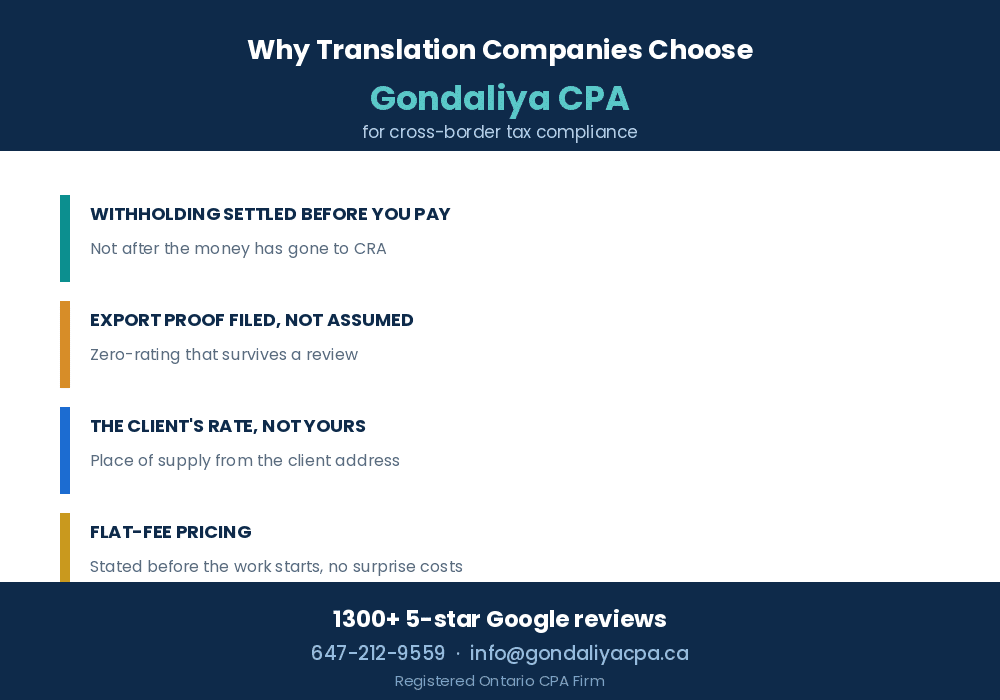
We test each client for non-residence and file the proof, settle the Regulation 105 question before you withhold, set the right provincial rate from the client’s address, assign software and hardware to the right CCA class, and file the T2 — on a flat annual fee stated before the work starts.
Next Steps
Please book a free consultation with Gondaliya CPA and bring your last filed corporate return, a client list showing billing country and province, and a subcontractor list showing residence and where the work was performed. Those three settle most of what this guide covers. You will get a flat fee stated before any work begins.
Published: · Last updated:
Editorial policy: Every rule stated here is checked against the Income Tax Act, the Excise Tax Act, their Regulations, or CRA publications current at the date above. Where a statement in the original guidance was incorrect, the original wording has been preserved and corrected alongside it rather than removed.
Disclaimer: This article is educational information only and is not tax, legal, or financial advice. Rules change and outcomes depend on your specific facts. Please speak with a CPA before acting.

Sharad Gondaliya is a CPA Canada & CPA USA with 15 Years+ experience of Accounting, Tax, Payroll of Corporate Small Businesses as Tax Accountant. He is fully certified CPA Ontario and CPA USA and is well known among corporate small businesses for tax planning, efficient tax solutions, and affordable CPA services. Sharad is the Principal (Director) of Gondaliya CPA – Affordable CPA Firm in Canada. Licenses: CPA Ontario: 61040184 | CPA USA (MT): PAC-CPAP-LIC-033176 | CPA USA (WA): 57629 | CPA Firm License: 61330051 View Full Author Bio