



Debt Collection Agency Tax Deductions in Canada: Collection Costs, Legal Fees & Employee Expenses
Maximizing debt collection agency tax write offs and business expenses in Canada is essential for reducing costs and enhancing profitability. Gondaliya CPA provides practical tips on identifying deductible expenses and optimizing tax strategies tailored for debt collection agencies.
Quick Summary
The deductions themselves are mostly straightforward. What trips agencies up is the revenue side: whether money collected is yours or your client’s, whether a written-off account was ever your income, and whether the GST you remitted on an unpaid commission can come back.
- Report earned commission, not gross collections, and keep trust funds separate.
- Deduct bad debts under 20(1)(p), and only where the amount was in income first.
- Claim the GST/HST bad debt adjustment on line 107, not by rebate application.
- Classify collectors as employees or contractors on the facts, not the contract label.
Reading time: 27 minutes.
Table of Contents
- Overview of Deductions
- Deductible Operating Expenses
- Legal, Professional and Financing Costs
- Bad Debts and GST/HST Adjustments
- Trust Accounts and Revenue Reporting
- Compliance and Record-Keeping
- Tax Strategy and Optimization
- Deadlines, Slips and Penalties
- Frequently Asked Questions
- Professional Guidance and Quick Reference
The Numbers That Matter
This article covers Canada, with Ontario and Toronto context, and reflects rules current to 2026. It is written for incorporated debt collection agencies, including consumer and commercial collectors, contingency agencies and debt portfolio buyers. Provincial collection agency licensing and bonding requirements vary, so confirm your obligations locally. This is educational information only and not tax or legal advice.
Overview of Debt Collection Agency Tax Deductions in Canada
Overview of Deductions
Foundations
Debt collection agencies in Canada can save money by using certain tax deductions. Knowing which expenses count helps keep more cash and stay within CRA rules.
Understanding Tax Deductible Expenses
Tax-deductible expenses lower the income you pay tax on. For debt collection agencies, common business expenses include:
- Operational costs: rent, utilities, office supplies, and gear needed every day.
- Employee salaries: money paid to staff working on collections.
- Legal fees: amounts spent on lawyers chasing debts.
- Advertising: costs for ads to get clients or promote services.
Keep good records like invoices and receipts. The CRA wants proof for every deduction you claim.
Current Year Expenses Versus Capital Expenses
| Expense Type | What It Means | How It’s Handled |
|---|---|---|
| Current year expense | Day-to-day costs incurred during the year | Fully deductible in that year |
| Capital expense | Larger purchases giving a lasting benefit | Deducted over time through capital cost allowance |
Capital cost allowance lets you write off part of capital costs gradually instead of all at once. Class 8 at 20% covers furniture and fixtures. Class 50 at 55% covers computers and systems software, and Class 12 at 100% covers tools and application software under $500.
Purchased debt portfolios are a different question again. The cost is recovered against collections as they come in rather than expensed in full on purchase, which is why portfolio buyers need cost recovery tracked per pool.
The CRA’s Role
- Payroll remittance deadlines apply, and missing them causes penalties of 3% to 10% depending on how late.
- Section 67 of the Income Tax Act requires expenses to be reasonable in the circumstances.
- GST/HST applies to your commission as a taxable supply. Money you collect as agent for a client is not your revenue, and section 177 of the Excise Tax Act governs agency arrangements.
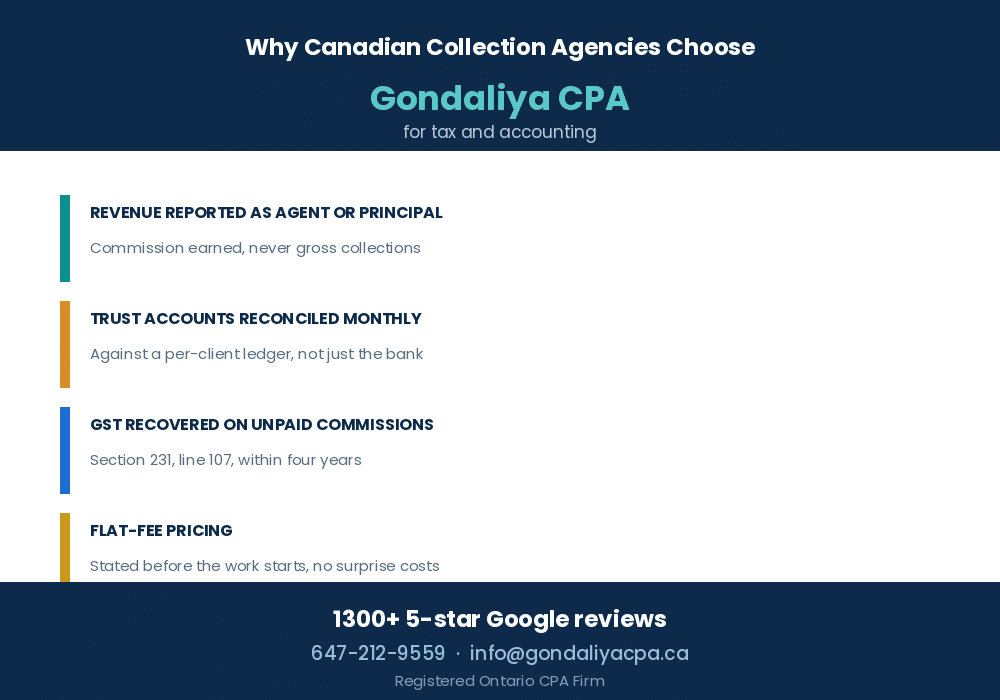
Key Stat: The largest reporting error in this sector is not a deduction at all. A contingency agency that collects $500,000 and keeps a 30% commission has revenue of $150,000, not $500,000. The other $350,000 is client money held in trust and never enters income. Agencies that report gross collections overstate revenue massively, distort every ratio CRA looks at, and invite a review they did not need.
Deductible Operating Expenses
Deductible Operating Expenses
Deductions
Advertising and Promotion
Advertising costs that help a debt collection agency bring in business are deductible. This includes online ads, flyers, sponsoring events, and marketing materials. Keep invoices, contracts, and payment proofs to back up these claims.
Agencies can write off ads that promote their services or brand under paragraph 18(1)(a) of the Income Tax Act. Personal or unrelated promotions don’t count.
A company spends $5,000 on Google Ads targeting Toronto businesses and holds the invoice and payment proof. It deducts the amount in full as a current business expense. Figures changed for privacy.
Business Start-Up Costs
Costs incurred before the business actually commences are generally not deductible, because paragraph 18(1)(a) requires an existing source of income. Once the business has started, ordinary costs are deductible as incurred.
Incorporation costs have their own rule: the first $3,000 is deductible as a current expense under paragraph 20(1)(b), and any excess goes to Class 14.1 at 5%. Licences and similar intangibles with an unlimited life also land in Class 14.1; a licence with a fixed term goes to Class 14 instead.
A firm spends $8,500 on incorporating and $4,200 on training before opening. The first $3,000 of incorporation cost is deducted currently, the balance goes to Class 14.1, and pre-commencement training is not deductible until the business has begun. Figures changed for privacy.
Taxes, Fees, Licences and Dues
Municipal business licences and provincial collection agency licensing fees are deductible. Bond premiums required for licensing also qualify where paid annually with proof.
Membership dues paid to professional bodies relevant to collections may be claimed. Personal memberships don’t qualify, and fines and penalties are denied outright under section 67.6.
A collector pays $3,600 yearly in Ontario licensing and bonding fees with supporting invoices. These are fully deductible against gross income. Figures changed for privacy.
Delivery, Freight and Courier Costs
Costs for sending letters or court papers by courier are current expenses. Freight on office supply shipments also qualifies. Motor vehicle costs are tracked separately, against business kilometres.
Keep receipts showing service dates matching billing cycles, and exclude any personal use.
Insurance Premiums
Insurance for risks faced by collectors — liability, or errors and omissions — is deductible for the period the policy covers. Where a premium spans two fiscal years, the portion relating to the following year is a prepaid expense and is deducted then.
Office, Telephone, Utilities and Supplies
Office supplies like paper, pens and printer ink, plus utilities such as electricity, heating, phone lines and internet, form part of usual overheads.
Make sure phone bills separate personal from business use so only the business portion is deducted. Small purchases below the capital threshold can be expensed immediately.
Dialer subscriptions, skip-tracing services and collection management software are current operating expenses where paid periodically. Software bought outright with a perpetual licence goes to Class 12 at 100%, deducted across two years under the half-year rule.
A North York collection firm spends about $950 monthly on telecom, split between office lines and remote workers. Itemised bills allow precise claims and reduce audit risk. Figures changed for privacy.
Maintenance, Repairs and Management Fees
Regular repairs that keep office equipment running are current expenses. Vendor invoices should distinguish a repair from an upgrade, since an upgrade that improves the asset beyond its original condition is capital.
Property management fees on leased office space qualify where the lease shows business use. Management consulting unrelated to the business is not deductible; where it partly applies, the reasonable business portion can be claimed under section 67.
Meals and Entertainment
Meals and entertainment are limited to 50% of the amount paid under section 67.1. This applies to entertainment as well as meals — entertainment is not disallowed outright, and alcohol served with a meal falls inside the same 50% limit rather than facing an extra restriction.
Under the simplified method for travel, the flat rate is $23 per meal to a maximum of $69 per day, with the 50% limit still applying. There are limited exceptions to the 50% rule, including staff events open to all employees at a place of business, up to six such events a year.
Collectors in Vaughan spend around $750 quarterly dining with potential clients to discuss contracts. Guest lists and agendas support writing off half the cost under section 67.1. Figures changed for privacy.
Legal, Professional and Financing Costs
Legal, Professional and Financing Costs
Professional
Legal, Accounting and Professional Fees
Legal fees for handling contested accounts are deductible where they relate directly to collecting money owed. Court filing fees work the same way.
Accounting services tied to bookkeeping and reporting commission income are valid deductions. Consultants advising on tax strategy may qualify, though fees relating to acquiring or reorganising capital structure are capital in nature.
A collector spends $9,400 on lawyers defending garnishment proceedings plus $6,300 on CPA services preparing annual financial statements. Both are deductible. Figures changed for privacy.
Risk Warning: Legal costs recovered from debtors are the recovery agencies forget to report. Where a court awards costs and you recover them, the amount is income in the year received, offsetting the fee you already deducted. Deducting the legal fee and omitting the recovery is a straightforward understatement, and it shows up cleanly when CRA compares your legal expense account against your receipts ledger.
Interest, Bank Charges and Loan Fees
Interest on money borrowed for working capital is deductible under paragraph 20(1)(c), provided the borrowed funds are traceable to an income-earning use. Interest on money borrowed to buy a capital asset follows the same paragraph, though certain soft costs must be capitalised.
Bank charges on operating accounts are deductible. Charges on client trust accounts should be tracked separately, since trust funds are not agency money.
Loan arrangement, standby and guarantee fees are deducted over five years on a straight-line basis under paragraph 20(1)(e), not over the loan term, and are accelerated if the debt is repaid early.
A commercial collector borrows $100,000 on an operating line at prime plus 2% to cover payroll timing gaps, paying roughly $1,750 in interest each quarter. Bank statements confirm the periods, so the interest is deductible while principal repayments are not. Figures changed for privacy.
Bad Debts and GST/HST Adjustments
Bad Debts and GST/HST Adjustments
Bad Debts
When clients don’t pay, you may be able to write off the loss. But it is not just a matter of crossing the account off your books. Two different provisions apply, and the income tax and GST/HST consequences are separate.
The Income Tax Deduction
A bad debt is deducted under paragraph 20(1)(p), not under the general expense rule. Two conditions matter: the amount must have been included in income in the year or a previous year, and the debt must be established to have become bad in the year. While collection is still being pursued, a doubtful debt reserve under paragraph 20(1)(l) is available instead, added back the following year and re-claimed if the doubt persists.
| Mechanism | Provision | Effect | What It Needs |
|---|---|---|---|
| Doubtful debt reserve | Paragraph 20(1)(l) | Reduces income now; added back next year | Aged listing and a reasoned estimate, Schedule 13 |
| Bad debt write-off | Paragraph 20(1)(p) | Permanent deduction | Amount previously in income; debt established bad |
| GST/HST recovery | ETA section 231 | Deduction from net tax | Debt written off in the books; arm’s length; line 107 |
There is no statutory waiting period. A debt does not become deductible because it has sat unpaid for six or twelve months — it becomes deductible when, on the evidence, you concluded it had become bad. Keep the calls, letters, legal steps and the file note recording that conclusion.
A collection agency writes off $12,000 owed by an insolvent debtor after six months of documented attempts, holding records showing the commission was previously taken into income. That inclusion is what makes the deduction available under paragraph 20(1)(p). Figures changed for privacy.
Risk Warning: An agency can only write off its own bad debt — the unpaid commission it billed and included in income. The client’s uncollected receivable is not the agency’s loss and is not the agency’s deduction, however much work went into chasing it. Agencies that write off the face value of accounts they were merely collecting on are claiming someone else’s loss, and it is the first thing a reviewer tests.
Documentation for Bad Debt Claims
Keep trust account reconciliations showing money held against money remitted. Your ledgers should track each debtor’s status. Save:
- Contracts showing commission terms
- Logs of collection attempts with dates and methods
- Copies of letters, emails, or dialer reports
- Legal bills where enforcement was used
- Bank statements from trust accounts showing receipts
CRA requires records be kept six years after the end of the taxation year.
Direct Write-Off Versus Allowance
| Accounting Method | Expense Recorded | Complexity | Who Uses It |
|---|---|---|---|
| Direct write-off | When the account is confirmed uncollectible | Low | Most small and medium collectors |
| Allowance | Estimated each year from aging data | Moderate | Larger firms with portfolios |
For financial statement purposes, ASPE Section 3856 governs impairment of receivables. For tax, an estimated allowance is not itself deductible — the deduction comes through the 20(1)(l) reserve or the 20(1)(p) write-off, which is why the book figure and the tax figure often differ.
Recovering the GST/HST
You charge GST/HST on collection commissions when they are billed, whether or not the client pays. Where a commission goes bad, section 231 of the Excise Tax Act allows recovery of the tax already remitted.
The mechanics matter, and they are widely misunderstood:
- It is a deduction from net tax, claimed on line 107 of your GST/HST return — not an input tax credit, and not a rebate application on Form GST189.
- The debt must actually be written off in your books; an overdue account is not enough.
- The debtor must be dealing with you at arm’s length.
- You must already have reported and remitted the net tax for the period in which the tax first became collectible.
- The adjustment must be claimed within four years of the return for the period in which the debt was written off.
- If you later recover the amount, the tax must be added back in that period.
Risk Warning: The section 231 conditions are applied strictly, and the courts have upheld that strictness. Claiming the adjustment as an input tax credit on line 108, claiming it before the account is written off in the books, or claiming it while net tax for the original period remains unremitted will each defeat the claim. Because it is a deduction from net tax rather than a credit, it also has to be tracked separately in your working papers.
Trust Accounts and Revenue Reporting
Trust Accounts and Revenue Reporting
Revenue
The single most important question for a collection agency’s return is whether you act as agent or principal.
A contingency agency collecting on a client’s behalf is an agent. Money collected belongs to the client and is held in trust. Only the commission is the agency’s revenue, recognised when earned under the contract per sections 9(1) and 12(1)(b). A portfolio buyer is a principal: it owns the debt, and collections are its own receipts, recovered against the cost of the portfolio.
Keep client funds in a separate trust account, reconciled monthly against the bank statement and against your ledger of amounts owing to each client. Mixing trust money with operating cash is both a licensing problem and a tax reporting problem.
Pro Tip: Where you act as agent, section 177 of the Excise Tax Act governs the GST/HST position, and your taxable supply is the commission — not the amount collected. Charging tax on gross collections, or failing to charge it on the commission because the client’s underlying debt was exempt, are opposite errors with the same cause: treating the collection as your supply. Set the invoice template up so the commission is the line that carries tax.
Timing of Commission Income
Commission is income when earned under the contract, not when the cash clears. Where the agreement says commission is earned on receipt of funds, that is the trigger. Recognising commission before the contractual trigger overstates income; deferring it past the trigger understates it.
Purchased Debt Portfolios
A purchased portfolio is not deductible on acquisition. Its cost is recovered against collections as they are received, pool by pool. Writing off an entire portfolio purchase in the year of acquisition is a common and material error, and one that is easy for a reviewer to spot from the balance sheet.
Compliance and Record-Keeping
Compliance and Record-Keeping
Records
Detailed paperwork proves your business expenses are real and meet CRA’s standards. This helps avoid audits and secures the deductions you are entitled to.
Essential Records
- Invoices and receipts
- Contracts and payroll registers
- Legal bills and software licences
- Bank statements and trust account reconciliations
These show the costs were incurred to earn income under paragraph 18(1)(a). Each record should explain what the expense was for and whether it is current or capital.
Communication Logs
Keep logs of calls, letters, and emails with debtors, with dates and the account they relate to. Add billing information for dialer systems or skip-tracing subscriptions, which are current operating expenses. This paper trail supports both the expense claims and any bad debt position.
Agreements, Invoices and Proof of Unrecoverability
Save agreements that explain commission terms or portfolio purchases. These determine when income arises under sections 9(1) and 12(1). Signed contracts establish whether money collected is yours or held for clients.
Evidence that a debt cannot be collected — a court order, an insolvency filing, or a documented collection history ending in a decision to write off — is needed before deducting it.
Accuracy in Bookkeeping
Use trusted software such as QuickBooks or Xero with receipt capture tools. Reconcile trust accounts monthly to keep client funds separate from operating cash. Correct payroll records help distinguish employee pay from contractor pay, avoiding T4 and T4A slip errors.
Common Errors to Avoid
- Counting gross collections as income instead of net commissions
- Mixing client trust funds with operating money
- Recognising commissions before they are earned under the contract
- Writing off whole portfolio purchases at once instead of recovering cost against collections
- Forgetting to report legal cost recoveries from debtors
- Paying collectors as contractors without facts supporting that status
- Issuing slips late, leading to penalties
- Claiming personal phone use, or meals beyond the 50% limit
- Claiming the GST/HST bad debt adjustment as an input tax credit rather than on line 107
Risk Warning: Worker classification is decided on the facts — control, ownership of tools, chance of profit and risk of loss — not on what the agreement calls the arrangement. Collectors working set hours on your dialer, using your accounts and your scripts, look like employees whatever the contract says. A reclassification makes you liable for the employer and employee shares of CPP and EI, plus penalties and interest, going back over the open years.
Tax Strategy and Optimization
Tax Strategy and Optimization
Strategy
Structuring Payment Terms and Collection Policies
Setting clear payment terms helps by matching when you recognise income with when you incur deductible costs. If your agency uses commission pay, the contract must say precisely when commission is earned and when money is merely held for clients. That contractual trigger is what determines taxable income under section 9(1).
Terms that encourage early or partial payment reduce your own bad debts. Keep the policies documented so the treatment holds up on review.
Automated Reminders and Early Payment Incentives
Software subscriptions and phone costs tied to reminder systems are deductible business expenses where they help earn income. Early payment discounts reduce the amount collected and therefore your commission, which also affects the GST/HST charged on that commission.
Keep clear logs of reminder schedules, discount offers, and payments received.
Timing Expense Recognition
Current costs such as wages, rent and phone charges are deductible in the year incurred. Larger purchases go into capital cost allowance classes, with the first-year restriction under Regulation 1100(2) unless an accelerated measure applies.
Prepaying for services that will be delivered in a later year does not accelerate the deduction — the amount is a prepaid expense until the service is received.
Using Professional CPA Services
Working with licensed CPAs who know collection work helps find every deduction and stay compliant. Gondaliya CPA reviews bookkeeping, checks trust accounts, prepares payroll slips to meet the end-of-February deadline, and advises on employee versus contractor status.
We also track portfolio cost recovery across years and confirm that legal fees are deductible rather than capital.
Deadlines, Slips and Penalties
Deadlines, Slips and Penalties
Deadlines
| What You File | When It’s Due | If Late |
|---|---|---|
| T2 corporate return | Six months after fiscal year-end | 5% of unpaid tax plus 1% per complete month, maximum 12 months |
| Balance of tax owing | Two months after year-end; three for an eligible CCPC | Interest compounded daily at the prescribed rate |
| Corporate instalments | Monthly under section 157; quarterly for eligible small CCPCs | Instalment interest |
| GST/HST returns | Monthly, quarterly or annually per your assigned period | Penalty and interest on amounts owing |
| Payroll source deductions | 15th of the following month for a regular remitter; sooner if accelerated | 3% to 10% by days late, 20% for a repeat failure |
| T4 and T4A slips | Last day of February | $10 per day, $100 minimum, $1,000 maximum for 1–50 slips |
A 31 December year-end means a T2 due 30 June, not earlier. If deductions are denied because documents are missing or filings arrive late, penalties compound quickly. Good records support both the claim and any request for taxpayer relief, which reaches back ten calendar years under subsection 220(3.1).
Frequently Asked Questions
Frequently Asked Questions
FAQ
What collection costs are deductible?+
Employee wages, legal fees, dialer and skip-tracing subscriptions, courier services and other costs incurred to earn collection income, under paragraph 18(1)(a) and subject to the reasonableness test in section 67.
Can software expenses be claimed?+
Subscriptions are current expenses deducted as incurred. Software bought outright with a perpetual licence is capital, going to Class 12 at 100% and deducted across two years under the half-year rule.
Are employee expenses fully deductible?+
Salaries, benefits and the employer share of CPP and EI are deductible where properly documented and reported on slips. Amounts paid to family members must also be reasonable for the work actually done.
How do trust account rules affect tax filings?+
Client funds held in trust are not your revenue. Only the commission is. Trust accounts should be reconciled monthly and kept entirely separate from operating cash, which is both a licensing requirement and what supports your revenue figure on the T2.
Which bad debts can a collection agency actually deduct?+
Only its own — the unpaid commission it billed and included in income, written off under paragraph 20(1)(p). The client’s uncollected receivable is the client’s loss, not the agency’s, no matter how much effort went into pursuing it.
Is there a waiting period before a debt can be written off?+
No. There is no six or twelve month rule. The test is whether the debt has been established to have become bad in the year, on the evidence you hold. Document the collection history and the decision to write off.
How do I recover GST/HST on an unpaid commission?+
Under section 231 of the Excise Tax Act, as a deduction from net tax on line 107 of your GST/HST return. It is not an input tax credit and not a rebate application. The debt must be written off in your books, the debtor must be at arm’s length, net tax for the original period must already be remitted, and the claim must be made within four years.
Are telephone and connectivity costs deductible?+
Yes, for the business portion. Where a line or plan is used personally as well, split it on a reasonable and consistently applied basis and keep the working.
What licensing, bonding and compliance costs can be written off?+
Provincial collection agency licences, municipal business licences and annual bond premiums are deductible with proof of payment. Fines and penalties are denied under section 67.6.
Can training costs be expensed immediately?+
Training that maintains or updates existing skills is a current expense. Training that provides a lasting benefit, such as a qualification in a new field, may need to be capitalised. Training incurred before the business commenced is not deductible.
How are purchased debt portfolios treated?+
The purchase price is not deductible on acquisition. Cost is recovered against collections as they are received, tracked pool by pool. Expensing an entire portfolio in the year of purchase is a material error.
What are the incorporation cost rules?+
The first $3,000 of incorporation costs is deductible as a current expense under paragraph 20(1)(b). Any excess goes to Class 14.1 and is depreciated at 5%.
When is the T2 due?+
Six months after the fiscal year-end. A 31 December year-end means a 30 June filing deadline. The balance owing is due two months after year-end, or three for an eligible CCPC claiming the small business deduction.
Professional Guidance and Quick Reference
Professional Guidance and Quick Reference
Guidance
Collection agencies get into difficulty in a predictable set of ways: gross collections reported as revenue, trust money mixed with operating cash, the client’s uncollected debt claimed as the agency’s bad debt, portfolio purchases expensed in one year, and the GST/HST bad debt adjustment claimed on the wrong line or not at all. Gondaliya CPA handles collection agency accounting on a flat annual fee.
We handle what decides the outcome: confirming whether you act as agent or principal and reporting revenue accordingly, reconciling trust accounts monthly to a per-client ledger, timing commission income to the contractual trigger, taking the 20(1)(p) write-off with evidence behind it and recovering the tax under section 231, and testing collector classification before CRA does.
Quick Answers: Key Numbers & Concepts at a Glance
At a Glance
| Question | Answer |
|---|---|
| Revenue for a contingency agency | Commission earned, not gross collections |
| GST/HST taxable supply | The commission; agency rules in ETA s.177 |
| Bad debt write-off | Paragraph 20(1)(p), amount must have been in income |
| Doubtful debt reserve | Paragraph 20(1)(l), added back next year |
| GST/HST bad debt recovery | ETA s.231, line 107, within four years |
| Incorporation costs | First $3,000 current; excess to Class 14.1 at 5% |
| Furniture and fixtures | Class 8, 20% |
| Computers | Class 50, 55% |
| Meals and entertainment | 50% under s.67.1 |
| Financing fees | Paragraph 20(1)(e), over five years |
| Payroll remittance | 15th of the following month for a regular remitter |
| Record retention | Six years under section 230 |
Who This Is For / Not For
Fit Check
- For: Incorporated Canadian debt collection agencies — consumer and commercial collectors, contingency agencies, portfolio buyers and first-party outsourcers — particularly those holding client funds in trust.
- Not For: Businesses collecting only their own receivables in house, whose position runs on ordinary bad debt rules rather than agency reporting, and collection law practices, which have their own trust and billing rules.
People Also Ask
Quick Answers
Is a collection agency taxed on what it collects or what it keeps?+
On what it keeps. Where you collect as agent for a client, the funds belong to the client and are held in trust; only the commission is your income. A portfolio buyer is different — it owns the debt, so collections are its own receipts, recovered against what it paid for the pool.
Do you charge GST/HST on debt collection services?+
Yes. Collection services are a taxable supply, so GST/HST applies to your commission at the rate for the place of supply. It does not apply to the money you collect and remit to the client, which is not your supply at all.
Can a collection agency write off debts it fails to collect for clients?+
No. Those are the client’s receivables and the client’s losses. The agency’s only bad debt is its own unpaid commission, deducted under paragraph 20(1)(p) once the amount has been included in income and the debt established to have become bad.
Are commission-only collectors employees or contractors?+
Pay structure does not decide it. The test is control, ownership of tools, chance of profit and risk of loss. Collectors working set hours on the agency’s dialer, using its accounts and scripts, generally look like employees regardless of what the agreement says, and reclassification brings CPP and EI liability with penalties and interest.
How do you account for buying a debt portfolio?+
As an asset, not an expense. Collections are applied against the purchase price pool by pool, with income arising once recoveries exceed the cost allocated to that pool. Expensing the purchase in full in the year of acquisition is one of the clearest errors a reviewer can find.
Glossary of Key Terms
Plain-English Definitions
- Agent versus principal: Whether you collect for a client or own the debt yourself, which decides what your revenue is.
- Trust account: The separate account holding client funds collected but not yet remitted.
- Contingency commission: The agency’s fee, usually a percentage of amounts recovered.
- Doubtful debt reserve: A deduction under paragraph 20(1)(l), added back the following year.
- Bad debt write-off: The permanent deduction under paragraph 20(1)(p).
- Section 231 adjustment: Recovery of GST/HST remitted on a commission that later went bad, claimed on line 107.
- Portfolio cost recovery: Applying collections against the price paid for purchased debt, pool by pool.
- Class 14.1: The 5% class holding incorporation costs above $3,000 and similar intangibles.
- Worker classification: Employee or contractor, decided on control and the facts rather than the contract.
Essential Compliance Points
Reference
- Report earned commission, never gross collections.
- Keep client trust funds separate and reconcile monthly.
- Recognise commission at the contractual trigger, not on cash receipt alone.
- Deduct only your own bad debts, under paragraph 20(1)(p).
- Claim the GST/HST recovery on line 107 within four years of the write-off.
- Recover portfolio cost against collections rather than expensing the purchase.
- Report legal cost recoveries received from debtors as income.
- Test collector classification on the facts before CRA does.
- File T4 and T4A slips by the last day of February.
- File the T2 within six months of year-end.
- Keep records for six years after the end of the taxation year.
This quick self-check indicates where your agency most likely has room. Please answer the five questions below.
Collection Agency Tax Check
Five quick questions on your book. No fee shown.
Points to raise with us:
This is a general prompt, not tax or legal advice or a quote. Your position depends on your full facts. For a real review, please book a free consultation.
Settle agent or principal first, because it decides whether your revenue is the commission or the collection — and a contingency agency reporting gross collections has overstated income before a single deduction is considered. Keep trust money in its own account, reconciled monthly. Write off only your own unpaid commission, under 20(1)(p), once it has actually been in income. Recover the GST on line 107 within four years, not as a credit and not by rebate. And recover portfolio cost against collections rather than expensing the purchase.
2026 Update — what is current: The section 231 GST/HST bad debt rules continue to be applied strictly, and Tax Court decisions in 2026 have confirmed that a claim fails where the technical preconditions are not met — the debt actually written off in the books, an arm’s length debtor, and net tax for the original period already reported and remitted under subsection 231(1.1). Unchanged for 2026: the bad debt deduction in paragraph 20(1)(p) and the doubtful debt reserve in paragraph 20(1)(l); incorporation costs deductible to $3,000 with the excess in Class 14.1 at 5%; the 50% meals and entertainment limit under section 67.1; financing fees over five years under paragraph 20(1)(e); the T2 six-month filing deadline with a late penalty of 5% plus 1% per complete month to a maximum of 12; payroll remittance by the 15th of the following month for a regular remitter; T4 and T4A slips by the last day of February; and the six-year record retention requirement under section 230. Worker classification continues to be decided on the long-standing common law factors of control, tools, chance of profit and risk of loss.
Collection Agency Taxes: How Gondaliya CPA Supports You
Holding client funds, or buying portfolios?
We confirm whether you report as agent or principal, reconcile trust accounts to a per-client ledger, time commission income to the contractual trigger, take the bad debt deduction with evidence behind it and recover the GST under section 231, track portfolio cost recovery pool by pool, and test collector classification — on a flat annual fee stated before the work starts.
Next Steps
Please book a free consultation with Gondaliya CPA and bring your last filed corporate return, a client agreement showing how commission is earned, and your most recent trust account reconciliation. Those three show where the real position sits. You will get a flat fee stated before any work begins.
Published: · Last updated:
Editorial policy: Figures, deadlines and statutory references are verified against the Income Tax Act, the Excise Tax Act, their Regulations and CRA publications before publication, and updated when the rules change.
Disclaimer: This article is educational information only and is not tax, legal, or financial advice. Provincial collection agency licensing and bonding requirements vary. Rules change and outcomes depend on your specific facts. Please speak with a CPA before acting.

Sharad Gondaliya is a CPA Canada & CPA USA with 15 Years+ experience of Accounting, Tax, Payroll of Corporate Small Businesses as Tax Accountant. He is fully certified CPA Ontario and CPA USA and is well known among corporate small businesses for tax planning, efficient tax solutions, and affordable CPA services. Sharad is the Principal (Director) of Gondaliya CPA – Affordable CPA Firm in Canada. Licenses: CPA Ontario: 61040184 | CPA USA (MT): PAC-CPAP-LIC-033176 | CPA USA (WA): 57629 | CPA Firm License: 61330051 View Full Author Bio