



Subscription Box Business Tax Rules in Canada: How Recurring Subscription Income Is Taxed
Subscription box business tax Canada explained: prepaid income, the reserve, and GST/HST on what is in the box
Subscription box business tax Canada involves understanding specific tax rules such as GST/HST collection, income reporting, and allowable deductions. Gondaliya CPA highlights how correctly managing subscription box business taxes and local regulations helps ensure compliance and optimize tax obligations for your Canadian subscription business.
Quick Summary
The reserve for undelivered boxes is 20(1)(m), not 18(1)(e). An incorporated business cannot elect cash accounting. And corporate instalments fall on the last day of the month or quarter, never on the fifteenth.
Reading time: 48 minutes.
Table of Contents
- Three Things You Have Been Told
- Obligations, Registration and Income Timing
- GST/HST and What Is Inside the Box
- Deductible Expenses
- Capital Cost Allowance, Bad Debts and Limits
- Filing, Compliance and Penalties
- Tracking, Software and Registration
- Frequently Asked Questions
- Essential Topics and Best Practices
- Businesses We Serve
- Professional Guidance and Quick Reference
The Numbers That Matter
This article covers Canada, with Ontario and Toronto context, and reflects rules current to 28 September 2026. It is written for incorporated Canadian subscription box businesses billing monthly or on prepaid annual plans and shipping physical product. Gondaliya CPA performs compilation engagements; we do not perform audits or review engagements. Figures marked illustrative are examples, not quotes, and any masked engagement notes end with “Figures changed for privacy.” This is educational information only and not tax or legal advice. Provincial rules differ, so please confirm the position where you operate.
Three Things You Have Been Told
Three Things You Have Been Told
The Corrections
Three points about subscription box businesses circulate widely and all three are wrong. Each of them costs money in a different way, so they are worth settling before anything else.
The Reserve That Is the Wrong Provision
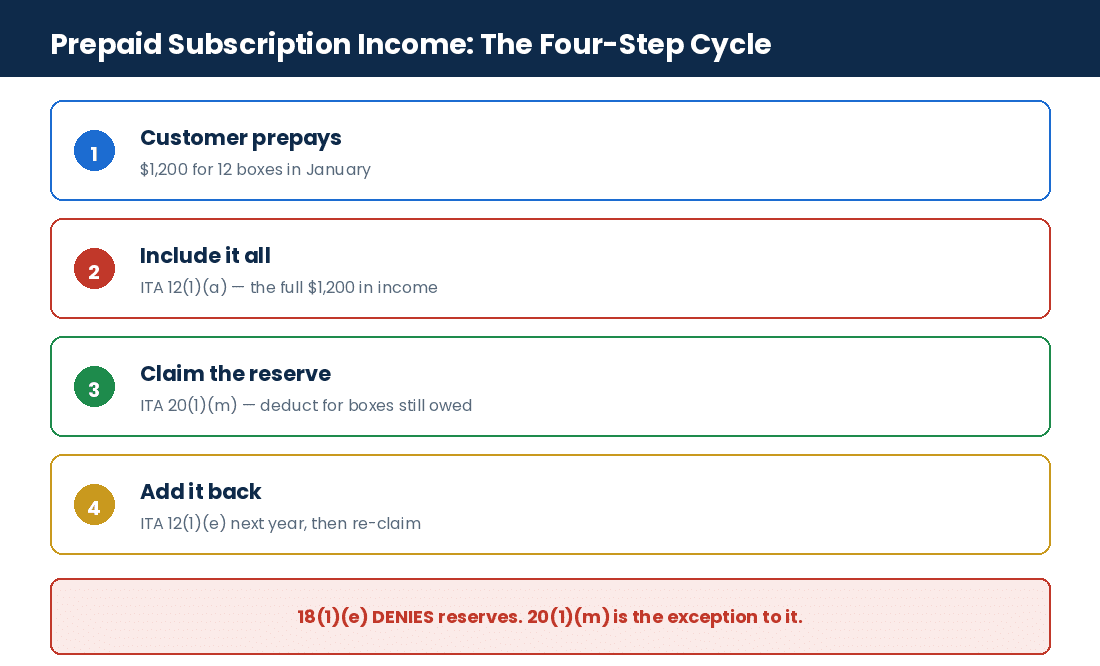
The relief for boxes billed but not yet shipped sits in paragraph 20(1)(m) of the Income Tax Act. Paragraph 18(1)(e) is the provision that denies reserves and contingent amounts, and 20(1)(m) is the express exception carved out of it. They do opposite things.
The sequence matters more than the numbering. Money received for undelivered boxes is included in income under paragraph 12(1)(a) when it arrives. A reserve is then deducted under 20(1)(m) for the portion covering goods still owed. That reserve is added back the following year under paragraph 12(1)(e) and re-claimed if the boxes are still undelivered.
The net effect resembles deferral, but it is a claim you have to calculate and document. It is not available on an amount you never included in the first place, which is why reporting only what shipped is a position that fails on review even when the tax lands in the same place.
The Accounting Method You Do Not Get to Choose
Guidance on this topic routinely offers cash basis and accrual basis as alternatives and invites you to pick. An incorporated business has no such choice.
- Section 9 requires business income to be computed as profit in accordance with well-accepted business principles, which means the accrual basis
- The cash method is a statutory exception under section 28, available only to farming and fishing businesses
- No election exists to put a corporation onto a cash basis for business income
- What a subscription business actually has is the 20(1)(m) reserve, which produces a deferral-like outcome inside the accrual system
The Instalment Dates That Belong to Someone Else
The dates 15 March, 15 June, 15 September and 15 December are personal instalment dates under section 156. A corporation does not use them.
| Payer | Instalment Dates | Provision |
|---|---|---|
| Individual | 15 March, June, September, December | ITA 156 |
| Corporation, monthly | Last day of each month | ITA 157(1)(a) |
| Eligible CCPC, quarterly | Last day of each quarter | ITA 157(1.1) |
| Taxes payable $3,000 or less | None required | ITA 157(2.1) |
| First taxation year | None required | ITA 157(1) |
A corporation on the personal dates is roughly two weeks early in March and two weeks late in every quarter that matters, and instalment interest accrues quietly on the difference.
A Vaughan subscription business had been paying corporate instalments on 15 March, June, September and December for three years, on a bookkeeper’s advice.
The corporation’s dates were the last day of each quarter, so every payment landed late and instalment interest had been accruing the whole time. Moving the payments and requesting relief under 220(3.1) closed it out. Figures changed for privacy.
Risk Warning: Please check which provision your reserve is claimed under. A reserve cited to 18(1)(e) is claimed under the rule that denies it.
Understanding Subscription Box Business Taxes in Canada
Obligations, Registration and Income Timing
Foundations
Registration Requirements and Thresholds for Mandatory Registration
You cease to be a small supplier under section 148 of the Excise Tax Act once worldwide taxable supplies exceed $30,000, and must register under subsection 240(1). Section 240 is the requirement to register; it is not where the threshold lives.
There are two routes across it, with different consequences. Exceed $30,000 in a single calendar quarter and small supplier status ends immediately, on the supply that put you over, with 29 days to register. Exceed it across four consecutive quarters without exceeding it in one, and you have one further month first. A launch selling 800 annual subscriptions in a week is the first case, and the single-quarter test is the one most guidance omits.
Classification of Income
Subscription income is business income under section 9. Amounts receivable are included under paragraph 12(1)(b); amounts received for goods not yet delivered are included under paragraph 12(1)(a), with the 20(1)(m) reserve available against them.
- Monthly billing: charged and shipped in the same period, so little or no reserve arises
- Prepaid annual plans: the full amount is income on receipt, with a reserve for the boxes still owed
- Gift subscriptions: same treatment as a prepaid plan, from the date paid
- Account credits and store credit: a liability, not revenue, until redeemed
Federal vs. Provincial Tax Differences
Risk Warning: 15% is the general federal corporate rate, not the rate most subscription boxes pay. A Canadian-controlled private corporation claiming the small business deduction pays 9% federally on active business income up to the $500,000 business limit.
| Rate | Small Business Income | General Active Business Income |
|---|---|---|
| Federal | 9% | 15% |
| Ontario | 3.2% | 11.5% |
| Combined, Ontario | 12.2% | 26.5% |
Provincial rates on small business income run from 0% to roughly 3.2%, not the 11% to 16% figure that circulates. That range describes general provincial rates, which apply only above the business limit. Combining 15% federal with 11% to 16% provincial overstates the burden on a small subscription business by more than double.
Income Reporting Standards: Cash vs. Accrual Accounting Methods
- Track income by subscriber and billing period, not by bank deposit
- Keep the reserve calculation as a standing schedule: subscribers, boxes owed, value per box
- Separate account credits from revenue, since an unredeemed credit is a liability
- Record processor fees as an expense rather than netting them against subscription revenue
- Reconcile the processor settlement to the bank deposit every period
A Mississauga operator selling annual prepaid subscriptions had reported only the boxes actually shipped, leaving roughly $210,000 of prepayments off the return entirely.
The correct treatment was to include all of it under 12(1)(a) and claim a 20(1)(m) reserve for the undelivered portion, which lands in nearly the same place. The difference was not the tax; it was that there had been no reserve calculation to show. Figures changed for privacy.
Key Stat: A prepaid annual plan puts twelve months of cash into income in month one. The reserve is what brings it back, and it only exists if you calculate it.
GST/HST Collection and Remittance Requirements
GST/HST and What Is Inside the Box
Sales Tax
Calculating, Collecting, and Remitting GST/HST
Tax becomes payable under section 168 on the earlier of the day consideration is paid and the day it becomes due. For a prepaid annual subscription that is normally the payment date, which is why a January prepayment sits on your January return while eleven boxes are still unshipped. For monthly billing it is each billing date.
| Annual taxable supplies | Assigned filing period | Filing and payment due |
|---|---|---|
| $1.5 million or less | Annual | Three months after fiscal year-end |
| Over $1.5 million to $6 million | Quarterly | One month after quarter-end |
| Over $6 million | Monthly | One month after month-end |
Please note the annual row. Describing every registrant as filing “one month after the fiscal year ends” is wrong in both directions: monthly and quarterly filers file one month after their reporting period, and annual filers get three months.
Implications for Digital vs. Physical Products
Key Stat: What is inside the box can change whether you charge tax on it at all. Basic groceries are zero-rated under Part III of Schedule VI, while snack foods, candy, carbonated drinks and most prepared items are fully taxable.
The deciding question is whether you are making a single supply or multiple supplies. A curated box the customer cannot unbundle is generally one supply taking one treatment. A box of separately priced, separably delivered items may be several supplies, each taxed on its own footing. A coffee-and-mug box is not the same question as a produce box.
| What Ships | Usual Position |
|---|---|
| Snack box of candy and chips | Taxable |
| Produce or pantry box of basic groceries | Zero-rated |
| Mixed box sold as one curated item | Generally one treatment for the whole |
| Digital content included in the box | Place of supply follows the recipient’s residence |
| Shipping charged to the subscriber | Follows the goods, ETA s.138 |
| Shipped to a subscriber outside Canada | Generally zero-rated, credits preserved |
Zero-rated is not exempt. On a zero-rated supply you charge nothing and still recover your input tax credits in full, which is why a grocery box operator is usually better off registered than not.
Record-Keeping for Input Tax Credits
The supporting information is prescribed by the Input Tax Credit Information (GST/HST) Regulations under subsection 169(4), and the requirements step up with the invoice amount.
| Invoice total | What the document must show |
|---|---|
| Under $30 | Supplier name, date, total amount |
| $30 to under $150 | The above plus the supplier’s GST/HST registration number and the tax charged |
| $150 and over | The above plus the recipient’s name, the terms of payment and a description of the supply |
The missing registration number on a recurring supplier invoice is where most denied claims come from. Credits are also lost outright after the four-year claim window, whatever the reason for the delay.
A Toronto snack box operator had been charging 13% HST on every box, treating the whole thing as one taxable supply.
Roughly 40% of each box by value was basic groceries, and the way the boxes were built and priced pointed to multiple supplies rather than one. Restructuring the invoicing so the zero-rated items were separately identified cut about $18,000 a year of tax off customer prices without touching margin. Figures changed for privacy.
Risk Warning: Zero-rated and exempt are different words for different outcomes. Only one of them preserves your credits.
Tax Deductible Expenses for Subscription Box Businesses
Deductible Expenses
Deductions
Everything below turns on two provisions: paragraph 18(1)(a), which allows an expense incurred to earn income, and section 67, which requires it to be reasonable.
Advertising and Marketing Expenses
- Paid social, search, influencer fees and print, deducted in the period incurred.
- Invoices, contracts, campaign dates and placement retained as support.
- Product sent to influencers leaves inventory without a sale — it is a promotional expense, not shrinkage.
Business Start-Up Costs and Their Treatment
Risk Warning: eligible capital property no longer exists. It was abolished on 1 January 2017. Intangibles that used to sit in the ECP pool — trademarks, customer lists, goodwill, licences — now go into Class 14.1 and are written down at 5% declining balance.
Nor are start-up costs universally deferred. Once the business has commenced, ordinary operating costs are deducted currently. Incorporation costs have their own rule: the first $3,000 is deductible outright under paragraph 20(1)(b), with any excess going to Class 14.1. A website build may be current or capital depending on whether it creates an enduring benefit.
Delivery, Freight, and Shipping Expenses
| Item | Treatment | Support |
|---|---|---|
| Inbound freight on product | Inventory cost, released to COGS on shipment | Carrier and customs invoices |
| Outbound postage and courier | Selling expense when incurred | Carrier statements |
| Shipping fee charged to the subscriber | Revenue — not a deduction | Billing records |
| Packaging materials on hand | Inventory until used | Supplier invoices |
Inbound freight is not an expense of the year you pay it; it is part of the cost of the goods and comes out as cost of goods sold when the box ships. And a shipping charge collected from a subscriber is income, whatever the line is called in the platform export.
Insurance Premiums, Professional Fees, Rent and Office Expenses
- Liability, property and cargo insurance premiums on the business, deductible over the period covered.
- Legal and accounting fees, including bookkeeping and the cost of preparing the return.
- Rent for warehouse or office space, with property taxes charged through the lease.
- Utilities apportioned where space is shared, on a documented basis.
Salaries, Wages, and Employer Contributions
- Wages for packing, fulfilment and support staff, with payroll deducted and remitted on schedule.
- Employer CPP at 5.95% and EI at 1.4 times the employee premium for 2026, plus CPP2 where earnings exceed the first ceiling.
- Amounts still unpaid 179 days after the year-end are deemed not incurred in that year under subsection 78(4), and deducted when paid.
- Remittance frequency set by your average monthly withholding amount, with director liability under 227.1 behind it.
Telephone, Utilities, and Digital Subscriptions
- Business phone lines and internet, on the business-use share.
- Software subscriptions — accounting, subscription management, email, design — deducted as incurred.
- Purchased application software is capital, Class 12 at 100%; subscriptions are not.
Travel and Meal Expense Guidelines
Travel to source product or attend trade shows is deductible with a log of dates, destinations and purpose. Meals and entertainment are limited to 50% by section 67.1, with the receipt showing date, place, attendees and the business reason. Dues for a club whose main purpose is dining, recreation or sport are denied outright by paragraph 18(1)(l), however much business gets done there.
Interest, Bank Charges, and Loan-Related Fees
- Interest on money borrowed to earn business income, including inventory financing, under paragraph 20(1)(c).
- Financing fees amortised over five years under paragraph 20(1)(e).
- Bank and merchant processing charges on the business account, deducted as incurred.
- Note that financial services are exempt for GST/HST, so there is no input tax credit on most bank charges.
Maintenance, Repairs, and Management Fees
Repairs that restore packaging or fulfilment equipment to working order are current expenses; work that improves it or extends its life is capital. Third-party fulfilment and management fees are deductible as incurred, with an invoice describing the service.
Subscription operators almost always have an influencer and seeding line, and almost never take those units out of inventory.
The cost is a deductible promotional expense either way. What goes wrong is the balance sheet: stock that left the warehouse is still sitting in the count, so inventory is overstated and cost of goods sold is understated for the year. Figures changed for privacy.
Pro Tip: Please check the supplier registration number appears on your recurring software invoices. Subscriptions are the usual gap on an input tax credit review.
Capital Cost Allowance, Bad Debts and Deduction Limits
Capital, Bad Debts and Limits
Capital
Capital Cost Allowance and Intangible Property
Capital cost allowance spreads the cost of an asset across the years it earns income. Rate and class are set by Schedule II of the Regulations.
| Asset | Class | Rate |
|---|---|---|
| Packaging and fulfilment equipment, shelving, furniture | 8 | 20% |
| Computers and systems software | 50 | 55% |
| Purchased application software | 12 | 100% |
| Trademarks, customer lists, goodwill, licences | 14.1 | 5% |
| Delivery van meeting the 90% goods test | 10 | 30% |
The available-for-use rule in subsections 13(26) to (32) gates the first claim, and the half-year rule is suspended for eligible property acquired after 31 December 2024 and available for use before 2034 under Bill C-15. A Toronto operator buying $20,000 of packaging equipment in January claims the full $4,000 at Class 8’s 20% in year one — which under the old half-year rule would have been $2,000.
Treatment of Bad Debts in Subscription Businesses
Risk Warning: writing off the receivable is only half the entry. The GST/HST goes with it. A bad debt is deducted under paragraph 20(1)(p)(i) where the amount was previously included in income and is established to have become bad in the year. Paragraph 20(1)(l) is the reserve for doubtful debts, which is a different claim.
Because you already remitted the GST/HST on that subscription, section 231 of the Excise Tax Act lets you recover the tax portion on a later return. Writing off a failed subscriber’s balance in the books without making that adjustment leaves the tax sitting with CRA. Any later recovery comes back into income under paragraph 12(1)(i).
- Evidence of collection attempts: dunning emails, retry logs, final notice.
- The invoice and the accounting entry identifying it as written off.
- Chargebacks recorded as they arise rather than netted against revenue.
- No deduction for debts you merely expect to go bad — only actual write-offs count.
Deductibility Limits for Meals, Entertainment, and Related Expenses
Section 67.1 limits meals and entertainment to 50% of the amount, and to 50% of a reasonable amount where the bill itself is not. A $200 client lunch produces a $100 deduction, and the corresponding input tax credit is recaptured to 50% as well. Keep the date, place, attendees and purpose on the receipt at the time, not from memory in March.
Business-Use-of-Home Expenses Applicable to Subscription Box Operators
Risk Warning: a home workspace does not have to be used exclusively for business. Subsection 18(12) gives two alternative tests: the space is either (a) the individual’s principal place of business, or (b) used exclusively to earn income and on a regular and continuous basis for meeting customers.
Test (a) carries no exclusivity requirement, and it is the one that fits most subscription operators packing boxes from a spare room. The real limit is different: the deduction cannot create or increase a loss, and the denied amount carries forward indefinitely against future income from the same business.
- Workspace area against total finished floor area, measured and documented.
- Utilities, heat, insurance, maintenance and rent apportioned on that basis.
- Mortgage interest and property tax for an owner, but not principal.
- CCA on the home is available but rarely advisable, since it puts the principal residence exemption on that portion at risk.
- Note that 18(12) applies to an individual; a corporation operating from the owner’s home pays rent under a written agreement at a reasonable rate instead.
Restrictions on Non-Compliant Short-Term Rental Expenses
Risk Warning: the short-term rental restriction has nothing to do with renting storage space, and nothing to do with minimum lease terms. Section 67.6‘s neighbour, section 67.7, denies expenses to a taxpayer operating a non-compliant short-term rental — a residential property rented for under 90 days in a province or municipality that prohibits it, or where the operator lacks the required licence or registration.
It applies from 1 January 2024, not “early 2026”, and it reaches short-term rental operators. A subscription box business renting a storage unit on a month-to-month basis is not caught by it, and there is no minimum term requirement for a storage rental to be deductible. It is deductible if it was incurred to earn income and is reasonable, like any other rent.
Handling Prepaid Expenses and Accounting Method Impact
Where you pay in advance for something that benefits a later year — annual warehouse insurance, a twelve-month software licence — subsection 18(9) limits the deduction to the portion relating to the current year and pushes the rest forward. The accounting entry and the tax treatment agree here, which is unusual and worth taking advantage of: a clean prepaid schedule does both jobs.
Eligible capital property turns up on subscription files constantly, usually attached to a trademark or a purchased customer list.
The pool has not existed since 1 January 2017. Those assets belong in Class 14.1 at 5%, and a file still carrying an ECP balance has been rolled forward without anyone opening it for nearly a decade. Figures changed for privacy.
Risk Warning: Writing off a failed subscriber in the books is only half the entry. The GST/HST you already remitted comes back under ETA section 231, and only if you claim it.
Filing and Compliance Considerations for Canadian Subscription Businesses
Filing, Compliance and Penalties
Compliance
Important Tax Forms and Reporting Deadlines
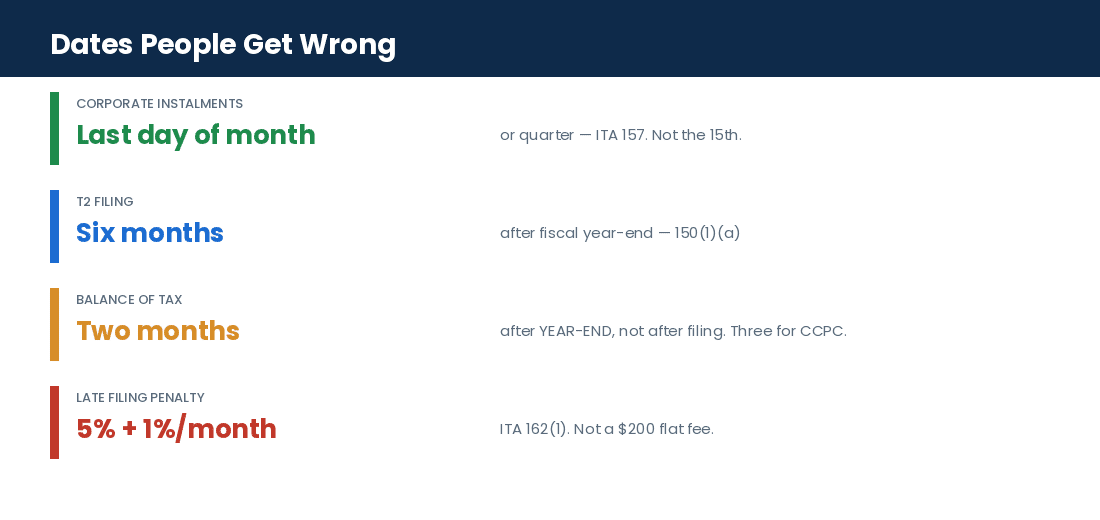
Risk Warning: the corporate balance is due two months after the year-end, not two months after the filing deadline. The T2 is filed within six months of the fiscal year-end under paragraph 150(1)(a), but the money is due at two months — or three for a CCPC claiming the small business deduction. Reading it as “two months after the six-month deadline” leaves you four months late with interest running.
Corporate instalments are also not 15 March, June, September and December. Those are personal dates under section 156. A corporation pays monthly on the last day of each month under paragraph 157(1)(a), or quarterly on the last day of each quarter under subsection 157(1.1) if it is an eligible CCPC. No instalments are required where total taxes payable are $3,000 or less, or in the corporation’s first taxation year.
| Obligation | Deadline | Provision |
|---|---|---|
| T2 return | Six months after year-end | ITA 150(1)(a) |
| Balance of tax | Two months after year-end; three for an eligible CCPC | ITA 157(1)(b) |
| Corporate instalments | Last day of each month or quarter | ITA 157(1)(a), 157(1.1) |
| GST/HST return | By assigned frequency | ETA 238 |
| T4 slips and summary | Last day of February | Reg 205(1) |
| Ontario Annual Return | Six months after year-end, via the Ontario Business Registry | OBCA |
Record-Keeping Requirements and Documentation Best Practices
- Subscriber billing records and shipment logs, matched to each other.
- The 20(1)(m) reserve calculation for each year-end: subscribers, boxes owed, value attributed to each.
- Processor statements from Stripe, Rotessa or whoever settles your billing, reconciled to deposits.
- Carrier invoices separated from shipping charged out to customers.
- Cancellations, refunds, chargebacks and account credits documented individually.
- Retained six years from the end of the taxation year under paragraph 230(4)(b), with section 286 of the Excise Tax Act imposing the same period for GST/HST.
Adjustments for Grants, Rebates, and Financial Assistance
Government assistance for a business is generally included in income under paragraph 12(1)(x), unless you elect under subsection 13(7.4) or 53(2.1) to reduce the cost of the related property instead. Where the assistance relates to an expense you have deducted, the inclusion offsets it. What matters is not treating a grant as tax-free by default and not netting it silently against costs — the choice between inclusion and cost reduction is an election, with consequences for future CCA.
Understanding Employment Status and CPP/EI Rulings
Whether someone packing your boxes is an employee or a contractor is decided on the Wiebe Door factors as refined in Sagaz and, where there is a written agreement, Connor Homes: control, ownership of tools, chance of profit and risk of loss, and the parties’ shared intention tested against the actual working relationship. CRA’s guide RC4110 sets out how it applies them, and either party can request a CPP/EI ruling on Form CPT1.
- Onsite packers working set hours with your materials generally look like employees.
- A third-party fulfilment company invoicing for a service is generally a contractor.
- A wrong call means the employer’s and employee’s CPP and EI, plus interest and penalty, assessed against you.
- Contractors are paid on invoice; a T4A is required where fees for services exceed $500 in the year.
Consequences of Non-Compliance and Penalty Overview
Risk Warning: the late filing penalty is not “$200 growing to $1,000 by company size”. Subsection 162(1) charges 5% of the unpaid tax at the filing due date, plus 1% per complete month the return is late, to a maximum of twelve months.
Where CRA issued a demand and you were also penalised in any of the three prior years, subsection 162(2) doubles it: 10% plus 2% per month to twenty months. Both are percentages of unpaid tax, so a late return with nothing owing attracts no 162(1) penalty at all — though it still puts the Ontario Annual Return and your GST/HST standing at risk.
- Interest under subsection 161(1) compounds daily at the prescribed rate, and is not deductible.
- Instalment interest under 161(2), with a further penalty under section 163.1 only where that interest exceeds $1,000.
- Input tax credits are lost after the four-year claim window, whatever the reason for the delay.
- Taxpayer relief from penalty and interest may be requested under subsection 220(3.1) on Form RC4288, within ten calendar years.
The instalment and balance dates are the two we check first on any incorporated file at intake.
They are the errors that run longest, because nothing bounces and no letter arrives until the interest has compounded for a few years. Figures changed for privacy.
Key Stat: Corporate tax is payable two or three months after year-end, before the six-month filing deadline. Please diarise them separately.
Strategies for Accurate Expense Tracking and Deductions
Tracking, Software and Registration
Systems
- Categorise by type at entry: product, packaging, fulfilment, outbound postage, advertising, processor fees.
- Keep invoices, receipts and contracts filed against the transaction rather than in a folder.
- Watch timing above all — inbound freight into inventory, prepaid amounts across periods, accrued pay against the 179-day rule.
Choosing Reliable Software Tools
- QuickBooks Online or Xero for the ledger, with the subscription platform feeding it rather than replacing it.
- Rates applied by the ship-to province, and zero-rated lines flagged separately from taxable ones.
- Processor settlements imported gross, with fees as their own expense line.
- A report that shows boxes owed at period end, which is what the reserve calculation is built from.
Setting Up Chart of Accounts
- Revenue split by monthly, prepaid annual and one-off box sales.
- Deferred subscription revenue as a liability, reconciled to boxes owed.
- Account credits and gift cards as a separate liability, never revenue until redeemed.
- COGS: product, packaging, inbound freight, fulfilment fees.
- Selling: outbound postage, processor fees, advertising.
- GST/HST payable and input tax credits as distinct control accounts.
Recommendations for GST/HST Registration and Reporting
When to register: on crossing $30,000, per the two routes set out earlier. Voluntary registration below the threshold is worth considering where you import product or buy heavily from registered suppliers, because it unlocks input tax credits you otherwise absorb — against the cost of charging tax to consumers who cannot recover it.
Record-keeping for input tax credits: the supporting information is prescribed by the Input Tax Credit Information (GST/HST) Regulations under subsection 169(4), and the requirements step up with the invoice amount. Above $30 you need the supplier’s name and the date; above $150 you also need the supplier’s GST/HST registration number, the recipient’s name, the terms and a description of the supply. An invoice without the registration number above $150 will not support the claim.
The Digital News Subscription Tax Credit
Risk Warning: a subscription box business cannot claim the Digital News Subscription Tax Credit, and the credit has expired. It was a personal non-refundable credit under section 118.02, claimed by an individual on a T1 for amounts they paid to a qualified Canadian journalism organisation for a digital news subscription.
It was never available to a corporation, and putting digital news content into a gift box does not create an entitlement for the seller or the recipient. It also applied only to the 2020 through 2024 taxation years and is no longer available in 2026. Any accounting system set up to track it is tracking something that does not exist.
Tips for Efficient Use of Accounting Software
A T2 must be filed using software certified by CRA for the relevant tax year, and CRA publishes the certified list. Consumer personal-tax products are not interchangeable with corporate ones, so check the list rather than assuming a familiar brand covers T2. Whatever you use, the inputs decide the output: prepaid subscriptions dated to receipt, shipments dated to dispatch, and processor exports mapped so gross revenue and fees land in different places.
When to Consult a Tax Professional or Gondaliya CPA
- The year-end reserve calculation, which is where most of the money is and most of the exposure.
- Whether your box is a single supply or several, and what that does to the tax you charge.
- A first year crossing the registration threshold mid-year.
- Worker classification before it becomes a CRA review.
- Any year where instalments started, or should have.
We work with incorporated businesses across Ontario on a flat annual fee including HST, covering bookkeeping, GST/HST, compiled statements under CSRS 4200, the T2 and tax planning around recurring billing.
Frequently Asked Questions on Subscription Box Business Taxes in Canada
Frequently Asked Questions
FAQ
What are the key GST/HST registration thresholds for subscription box businesses?+
$30,000 of worldwide taxable supplies, under section 148 of the Excise Tax Act — section 240(1) is the requirement to register, not the threshold. Exceed it in a single calendar quarter and small supplier status ends on that supply, with 29 days to register. Exceed it over four consecutive quarters and you get one further month.
When does subscription income become taxable?+
Business income is computed under section 9, with amounts received for goods not yet delivered included under paragraph 12(1)(a) when received. Paragraph 18(1)(a) governs deductions and has nothing to say about when income arises — a common misattribution.
How does the reserve for undelivered goods affect income reporting?+
The prepayment goes into income under 12(1)(a), then paragraph 20(1)(m) allows a reserve for the portion covering boxes not yet delivered. It is added back the following year under 12(1)(e) and re-claimed if still undelivered. Paragraph 18(1)(e) is the rule that would otherwise deny it — the two are often swapped.
What is the T2 deadline for an incorporated subscription box business?+
Filed within six months of the fiscal year-end under paragraph 150(1)(a). The balance is due two months after the year-end — three for a CCPC claiming the small business deduction — not two months after the filing deadline.
How long must records be retained for CRA compliance?+
Six years from the end of the taxation year to which they relate, under paragraph 230(4)(b). Section 286 of the Excise Tax Act imposes the same period for GST/HST records. Keep the reserve calculations for the same period; they are what a review asks for first.
How do instalment payments work for subscription businesses?+
Monthly, on the last day of each month under paragraph 157(1)(a), or quarterly on the last day of each quarter under subsection 157(1.1) for an eligible CCPC. 15 March, June, September and December are personal dates. No instalments are required where total taxes payable are $3,000 or less, or in the first taxation year.
What costs can be claimed as cost of goods sold?+
Product purchase cost, packaging materials, inbound freight, duty and brokerage, and per-unit fulfilment fees — recognised when the box ships, not when the supplier is paid. Outbound postage is a selling expense. Shipping fees charged to subscribers are revenue.
When should GST/HST be charged to subscribers?+
Tax becomes payable under section 168 on the earlier of the day consideration is paid and the day it becomes due. For a prepaid annual plan that is normally the payment date, so the tax is remitted well before the last box ships. For monthly billing it is each billing date.
Is a snack or food box taxable?+
It depends on the contents and on whether you are making one supply or several. Basic groceries are zero-rated under Schedule VI Part III; snack foods, candy and carbonated drinks are taxable. A curated box sold as a single item generally takes one treatment for the whole box. This is worth getting a view on before you set prices.
Can my corporation use cash accounting?+
No. Section 9 requires the accrual basis, and the cash method in section 28 is available only to farming and fishing businesses. The 20(1)(m) reserve is what gives a subscription business its deferral, within the accrual system.
Can I claim the Digital News Subscription Tax Credit?+
Not as a business. It was a personal credit under section 118.02 for an individual’s own digital news subscription with a qualified Canadian journalism organisation, and it applied only to the 2020 to 2024 tax years. It is no longer available, and never applied to a corporation or to news content included in a box you sell.
Do I still have eligible capital property?+
No. ECP was abolished on 1 January 2017. Trademarks, customer lists, goodwill and licences now sit in Class 14.1 at 5% declining balance. Incorporation costs are deductible to $3,000 under 20(1)(b), with the excess to Class 14.1.
How do I write off a subscriber who stopped paying?+
Deduct it under paragraph 20(1)(p)(i) once it is established to have gone bad, with the collection attempts documented. Then recover the GST/HST you already remitted on it under section 231 of the Excise Tax Act — the step most operators miss.
Does the short-term rental expense restriction affect my storage unit?+
No. Section 67.7 targets taxpayers operating non-compliant short-term rentals of residential property, from 1 January 2024. It does not impose minimum lease terms on commercial storage, and a month-to-month storage rental is deductible like any other rent if it was incurred to earn income.
Are influencer boxes and free samples deductible?+
The cost is deductible as a promotional expense, and the units must come out of inventory when they ship. Leaving them in stock overstates the balance sheet and understates COGS, which is one of the more common subscription box reconciliation gaps.
What happens to unused account credits and gift cards?+
They are a liability when issued, not revenue. Revenue is recognised on redemption. Gift certificates are generally not subject to GST/HST on issue; the tax applies when they are redeemed for a taxable supply.
Do I need a T4A for my fulfilment contractor?+
Where fees for services paid to a contractor exceed $500 in the calendar year, yes. That is separate from the question of whether they are actually an employee — if they are, it is a T4 with CPP and EI, and the ruling process on Form CPT1 settles it.
What is the late filing penalty?+
Under subsection 162(1), 5% of the unpaid tax plus 1% per complete month, to twelve months. On a repeat within three years following a demand, subsection 162(2) doubles it to 10% plus 2% to twenty months. Both are percentages of unpaid tax, so a nil return filed late attracts no 162(1) penalty.
Eighteen questions, and the two on the reserve account for most of the money at stake on a subscription file.
The rest are timing and documentation. The reserve is where the position either holds or does not. Figures changed for privacy.
Essential Tax Topics for Canadian Subscription Box Businesses
Essential Topics and Best Practices
Quick Reference
Key Points on Ontario Subscription Box Tax and Corporate Filing
- Prepaid Cash: Included under 12(1)(a) on receipt, reserved under 20(1)(m).
- Reserve Add-Back: Into income the following year under 12(1)(e), then re-claimed.
- Accounting Method: Accrual, always. Cash basis is farming and fishing only.
- Registration Threshold: $30,000 under ETA 148, on either the quarter or the four-quarter test.
- GST/HST Timing: Earlier of paid and due, under ETA 168.
- Box Contents: Basic groceries zero-rated; snack food taxable.
- Single or Multiple Supply: Decides the treatment for the whole box.
- Ontario Rates: 12.2% combined on small business income, 26.5% general.
- T2 Filing: Six months after year-end; balance at two or three.
- Corporate Instalments: Last day of the month or quarter.
- Records: Six years from the end of the taxation year.
- Intangibles: Class 14.1 at 5%; eligible capital property ended in 2017.
Practical Tips on Managing Subscription Business Taxes
- Define monthly and prepaid plans distinctly in the ledger, since only one generates a reserve.
- Hold account credits and gift cards as liabilities, separate from revenue.
- Apply rates by ship-to province, with zero-rated lines flagged at entry.
- Release the cost of a box to cost of goods sold on dispatch, not on purchase or billing.
- Process cancellations, refunds and chargebacks with documentation as they happen.
- Keep shipping charged out and shipping paid on separate lines, since one of them is revenue.
- Take influencer and sample units out of inventory when they ship.
- Reconcile processor settlements to bank deposits every period, gross.
- Build the reserve schedule monthly rather than reconstructing it at year-end.
- Diarise the corporate payment date separately from the filing date.
Guidance on Employment Status and CRA Reviews
- Classify against the Wiebe Door factors and CRA Guide RC4110, not against what the contract calls the relationship.
- Employees get payroll deductions and a T4; contractors invoice and receive a T4A above $500.
- Either party can request a CPP/EI ruling on Form CPT1 rather than guessing.
- Onsite packers on set hours using your materials generally look like employees.
- A third-party fulfilment company invoicing for a service is generally a contractor.
- Late filings, unsupported reserves and inconsistent bookkeeping are what draw a review.
Points Worth Carrying
- The reserve for undelivered boxes is 20(1)(m); 18(1)(e) is what denies reserves.
- An incorporated business cannot elect cash accounting.
- Corporate instalments fall on the last day of the month or quarter, not the fifteenth.
- The T2 balance is due two months after year-end, not after the filing deadline.
- Section 148 holds the $30,000 threshold; section 240 is the requirement to register.
- Eligible capital property was abolished on 1 January 2017.
- Section 67.7 restricts short-term rental operators, not tenants of storage space.
- The Digital News Subscription Tax Credit was personal and expired after 2024.
- The late filing penalty is 5% plus 1% per month, not a flat fee.
- Basic groceries in a box are zero-rated, which is not the same as exempt.
Thirty-eight points, and the ten at the end are all things an operator was told confidently by something they read.
None of them are obscure provisions. They are the ordinary rules, cited to the wrong section number often enough that the wrong number now circulates as the right one. Figures changed for privacy.
Businesses We Serve
Industry Expertise
Recurring-revenue businesses share the same issues. Here are ten and the usual finding.
| Business | The Issue That Usually Appears |
|---|---|
| Snack and food box operators | Whole box taxed when part of it is zero-rated |
| Beauty and grooming boxes | Influencer seeding never leaving inventory |
| Annual prepaid subscriptions | Only shipped boxes reported, no reserve calculated |
| Coffee and tea clubs | Inbound freight expensed instead of costed to inventory |
| Pet subscription boxes | Storage rentals assumed non-deductible |
| Book and hobby boxes | Account credits and gift cards booked as revenue |
| Curated gift box companies | Single versus multiple supply never considered |
| Boxes with contractor fulfilment | Worker classification never actually decided |
| Operators importing product | Border GST added to landed cost instead of claimed |
| Any incorporated operator | Instalments on personal dates, balance date missed |
- Snack and food box operators: Check what is actually zero-rated.
- Beauty and grooming boxes: Seeding is an expense, and it leaves stock.
- Annual prepaid subscriptions: Include it, then reserve it.
- Coffee and tea clubs: Freight in is inventory until dispatch.
- Pet subscription boxes: Month-to-month storage is deductible.
- Book and hobby boxes: Credits are a liability until redeemed.
- Curated gift box companies: One supply or several decides the rate.
- Boxes with contractor fulfilment: Facts decide, not the label.
- Operators importing product: Duty in, border GST claimed.
- Any incorporated operator: Last day of the month or quarter.
The box changes. The questions do not: when does the income fall, is the reserve calculated, and does the tax follow what is actually inside.
A coffee club and a pet box have almost nothing in common commercially and file nearly identical returns. Figures changed for privacy.
Professional Guidance and Quick Reference
Guidance
Professional Guidance: How Gondaliya CPA Handles Your Subscription Business
Subscription box businesses get into difficulty in a predictable set of ways: reporting only the boxes shipped rather than including the prepayment under paragraph 12(1)(a) and claiming the reserve under paragraph 20(1)(m), or citing that reserve to paragraph 18(1)(e) which is the provision that denies reserves; assuming a corporation can elect cash accounting when section 9 requires accrual and the cash method under section 28 belongs to farmers and fishers; paying corporate instalments on 15 March, June, September and December, which are personal dates, instead of the last day of each month or quarter under section 157; reading the T2 balance as due two months after the six-month filing deadline rather than two months after the year-end; charging tax on a whole box when basic groceries inside it are zero-rated under Schedule VI Part III; and carrying eligible capital property nearly a decade after it was abolished. Gondaliya CPA handles subscription box accounting on a flat annual fee.
We handle what decides the outcome: building and documenting the 20(1)(m) reserve from your subscriber and shipment data rather than reconstructing it at filing, reviewing whether your box is a single supply or several and what that does to the rate you charge, setting the chart of accounts so deferred revenue and account credits sit as liabilities, releasing box costs to cost of goods sold on dispatch, putting the instalments and the balance date on the calendar correctly, recovering the GST/HST on written-off subscribers under ETA section 231, testing worker classification on the facts before a review does it for you, and assigning intangibles to Class 14.1 with the half-year rule suspension applied where it fits.
Our team starts with your subscriber count at year-end, the boxes owed against it, and one month of processor settlements. Whatever you ship, you get clear advice and a fixed price before we start.
Quick Answers
At a Glance
- Prepaid subscription income: Included on receipt, ITA 12(1)(a)
- The reserve: ITA 20(1)(m), not 18(1)(e)
- Accounting method: Accrual only
- GST/HST threshold: $30,000, ETA 148
- When tax is payable: Earlier of paid and due, ETA 168
- Basic groceries: Zero-rated, credits preserved
- Ontario combined rate: 12.2% small business
- T2 filing: Six months after year-end
- Balance of tax: Two months, three for a CCPC
- Corporate instalments: Last day of month or quarter
- Late filing penalty: 5% plus 1% per month
- Intangibles: Class 14.1 at 5%
Who This Is For
Fit Check
- For: Incorporated Canadian subscription box businesses billing monthly or on prepaid annual plans and shipping physical product across Canada, including food, beauty, pet, hobby and curated gift boxes.
- Not For: Sole proprietors, whose filing dates and home premises treatment differ, and pure software subscriptions with no goods, where the 20(1)(m) reserve operates differently.
People Also Ask
Quick Answers
Is the reserve 20(1)(m) or 18(1)(e)?+
20(1)(m) allows it. 18(1)(e) is the general denial of reserves that 20(1)(m) is an exception to. They do opposite things and are frequently cited the wrong way round.
When are corporate instalments actually due?+
The last day of each month, or of each quarter for an eligible CCPC. The 15th-of-the-month dates belong to personal tax.
Is the federal corporate rate 15%?+
That is the general rate. A CCPC claiming the small business deduction pays 9% federally on active business income up to $500,000, plus 3.2% in Ontario, for 12.2% combined.
Do I charge tax on a prepaid annual plan up front?+
Yes, on the earlier of payment and the day consideration becomes due under ETA 168. The tax is remitted long before the last box ships, which is a cash flow point worth planning for.
Can I deduct a storage unit rented month to month?+
Yes. There is no minimum term for commercial rent to be deductible. The short-term rental restriction in section 67.7 applies to operators of residential short-term rentals, not to tenants of storage space.
Glossary of Key Terms
Glossary
- Paragraph 12(1)(a): Includes amounts received for goods not yet delivered.
- Paragraph 20(1)(m): The reserve for those undelivered goods.
- Paragraph 18(1)(e): The general denial of reserves and contingent amounts.
- Paragraph 12(1)(e): Brings last year’s reserve back into income.
- Accrual basis: Income recognised when earned, required by section 9.
- Deferred subscription revenue: The liability for boxes billed but not shipped.
- Small supplier: Below $30,000 of taxable supplies, ETA section 148.
- Single supply: A bundle taking one tax treatment for the whole.
- Basic groceries: Zero-rated food under Schedule VI, Part III.
- Zero-rated supply: Taxed at 0%, with credits still fully recoverable.
- Exempt supply: No tax charged and no credit recovery.
- Class 14.1: Intangibles at 5%, replacing eligible capital property.
- Available for use: When an asset becomes eligible for depreciation.
- Section 157: Corporate instalment and balance due dates.
- CSRS 4200: The standard for a compilation engagement.
- Trust amounts: Collected sales tax and payroll source deductions.
Additional Resources and Support
Sources
References to Official CRA Publications and Legislation
| Question | Authority |
|---|---|
| Income from a business | ITA section 9 |
| Prepaid amounts included when received | ITA 12(1)(a) |
| Reserve for undelivered goods | ITA 20(1)(m); add-back 12(1)(e) |
| Reserves otherwise denied | ITA 18(1)(e) |
| Expenses incurred to earn income | ITA 18(1)(a); reasonableness, s.67 |
| Small supplier threshold | ETA section 148 |
| Requirement to register | ETA 240(1) |
| When tax becomes payable | ETA section 168 |
| Zero-rated basic groceries | ETA Schedule VI, Part III |
| GST/HST on bad debts | ETA section 231 |
| General guidance | CRA Guide T4002; Guide RC4022 |
Links to Government and Authoritative Tax Guidance
- CRA — Business taxes, covering T2 filing and corporate obligations.
- Excise Tax Act, for registration, place of supply and the zero-rating schedules.
- Income Tax Act, for sections 9, 12, 18, 20, 157 and 162.
- CRA Guide T4002, Self-employed Business, Professional, Commission, Farming and Fishing Income.
- CRA Guide RC4022, General Information for GST/HST Registrants.
Contact Information for Further Assistance
Gondaliya CPA Professional Corporation, Toronto. Phone 647-212-9559, email info@gondaliyacpa.ca. We reply within one business day, including weekends around year-end and filing deadlines, and offer a free initial consultation. Our clients include incorporated subscription and recurring-revenue businesses across Toronto, Vaughan, Mississauga, Scarborough, North York, Etobicoke, Hamilton and Ottawa.
Feedback Opportunities and Privacy Notice Statements
Questions and corrections are welcome at info@gondaliyacpa.ca. On privacy: client financial information is handled under PIPEDA, the federal private-sector statute, together with the confidentiality obligations in the CPA Ontario Code of Professional Conduct. Ontario has no general private-sector privacy law of its own, so guidance describing PIPEDA as an Ontario law is misdescribing it.
Subscription Box Tax Check
This quick self-check indicates where your operation most likely has room. Please answer the five questions below.
Subscription Box Tax Check
Five quick questions on your business. No fee shown.
Points to raise with us:
This is a general prompt, not tax or legal advice or a quote. Your position depends on your full facts. For a real review, please book a free consultation.
Want a checklist to work from? You can download our free subscription box tax checklist before your consultation.
Include prepaid subscription cash under 12(1)(a) when it arrives, then claim the reserve under 20(1)(m) for the boxes still owed, and keep the calculation. Cite that reserve to the right provision, since 18(1)(e) is what denies reserves. Accept that an incorporated business computes income on the accrual basis and that the cash method belongs to farmers and fishers. Check what is actually inside the box, because basic groceries are zero-rated and whether the box is one supply or several decides the treatment for the whole. Move corporate instalments to the last day of the month or quarter. Diarise the balance of tax two months after year-end, separately from the six-month filing date. Take influencer and sample units out of inventory. Recover the GST/HST on written-off subscribers under ETA section 231. Please keep six years of records.
2026 Update — what is current: This article reflects rules current to 28 September 2026. The $30,000 small supplier threshold under ETA 148 on both tests, the requirement to register under 240(1), the timing rule in section 168, the six-month T2 filing deadline under 150(1)(a) and the six-year retention requirement under 230(4)(b) are unchanged. The half-year rule is suspended for eligible property acquired after 31 December 2024 and available for use before 2034 under Bill C-15, and Part XX digital platform reporting has applied since 1 January 2024. Please note that no change to the prepaid revenue rules takes effect in 2026 — the 12(1)(a) inclusion with the 20(1)(m) reserve and its add-back under 12(1)(e) has operated the same way for decades, and paragraph 18(1)(e) remains the provision that denies reserves generally; that business income is computed on the accrual basis under section 9, with the cash method in section 28 confined to farming and fishing; that corporate instalments fall on the last day of each month under 157(1)(a) or quarter under 157(1.1), with none required below $3,000 or in a first year, and the balance of tax two months after year-end or three for an eligible CCPC; that the late filing penalty under 162(1) is 5% of unpaid tax plus 1% per complete month, doubled under 162(2) on repeat, rather than a flat amount; that Ontario combined corporate rates are 12.2% on small business income and 26.5% general; that basic groceries are zero-rated under Schedule VI Part III subject to single or multiple supply analysis; that eligible capital property was abolished on 1 January 2017 and intangibles sit in Class 14.1 at 5%, with incorporation costs deductible to $3,000 under 20(1)(b); that bad debts are deducted under 20(1)(p)(i) with the GST/HST recovered under ETA 231; that the short-term rental restriction in section 67.7 applies from 1 January 2024 to operators of non-compliant residential short-term rentals and not to commercial storage tenants; and that the Digital News Subscription Tax Credit under section 118.02 was a personal credit for the 2020 to 2024 tax years and is no longer available.
Subscription Box Business Tax Canada: How Gondaliya CPA Supports Operators
Start with your boxes owed at year-end
Gondaliya CPA builds and documents the 20(1)(m) reserve from your actual subscriber and shipment data, reviews whether your box is a single supply or several and what that does to the rate you charge, sets the chart of accounts so deferred revenue and account credits sit as liabilities rather than income, releases box costs to cost of goods sold on dispatch, puts the corporate instalments and the balance date on the calendar correctly, recovers the GST/HST on written-off subscribers under ETA 231, and files the GST/HST, the compiled statements and the T2 from one reconciled set of books, on a flat annual fee including HST with a one-business-day response. Please book a free consultation.
Next Steps
Please book a free consultation with Gondaliya CPA and bring your subscriber count at year-end, the boxes owed against it, and one month of processor settlements. Those three build the reserve calculation, which is where most of the tax and most of the exposure sits in a subscription business, and they show where the documentation is thin. You will get a flat annual fee including HST before any work begins. If our content helps, please add gondaliyacpa.ca as a preferred source on Google.
Published: · Last updated:
Editorial policy: We research against CRA and CPA Ontario sources, fact-check the figures, and Sharad Gondaliya, CPA, reviews the content, which we update as the rules change.
Disclaimer: This article is educational information only and is not tax, legal, or financial advice. Figures marked illustrative are examples rather than quotes or guarantees. It reflects CRA rules current to 2026, including the $30,000 GST/HST threshold, the 20(1)(m) reserve, the section 157 instalment dates, the Class 14.1 rate and the six-year retention requirement. Rates, limits and expensing rules change and outcomes depend on your specific facts. Please consult a licensed CPA before acting.

Sharad Gondaliya is a CPA Canada & CPA USA with 15 Years+ experience of Accounting, Tax, Payroll of Corporate Small Businesses as Tax Accountant. He is fully certified CPA Ontario and CPA USA and is well known among corporate small businesses for tax planning, efficient tax solutions, and affordable CPA services. Sharad is the Principal (Director) of Gondaliya CPA – Affordable CPA Firm in Canada. Licenses: CPA Ontario: 61040184 | CPA USA (MT): PAC-CPAP-LIC-033176 | CPA USA (WA): 57629 | CPA Firm License: 61330051 View Full Author Bio