



Engineering Consultant Tax Deductions in Canada: Professional Fees, Software, Equipment & Business Expenses
Engineering consultant expenses Canada explained: CCA classes, vehicle ceilings, home office and PSB risk
Engineering consultant expenses Canada involve various deductible costs like vehicle expenses, home office setup, and business-related software and equipment. Gondaliya CPA offers insights into consulting tax deductions, corporate tax planning, GST/HST filing, subcontractor payments, and proper bookkeeping Canada to keep your finances compliant and efficient.
Quick Summary
Computers sit in Class 50 at 55%, not Class 8 at 20%. The passenger vehicle lease ceiling is $1,100 a month, not $900. And a personal services business pays 33% federally, not the small business rate, with almost every deduction denied by paragraph 18(1)(p).
Reading time: 49 minutes.
Table of Contents
- Three Things You Have Been Told
- Obligations and Deductible Expenses
- Home Office, Vehicle and Subcontractors
- Corporate and Personal Tax Planning
- SR&ED and Tax Credits
- Regional and Industry Factors
- Practical Applications and Case Studies
- Frequently Asked Questions
- Essential Topics and Best Practices
- Businesses We Serve
- Professional Guidance and Quick Reference
The Numbers That Matter
This article covers Canada, with Ontario and Toronto context, and reflects rules current to 30 September 2026. It is written for incorporated Canadian engineering consultants, including sole practitioners and multi-engineer firms billing on milestones, retainers and holdbacks. Gondaliya CPA performs compilation engagements; we do not perform audits or review engagements, and where a lender or contract requires one we refer it out. Figures marked illustrative are examples, not quotes, and any masked engagement notes end with “Figures changed for privacy.” This is educational information only and not tax or legal advice. Provincial rules differ, so please confirm the position where you operate.
Three Things You Have Been Told
Three Things You Have Been Told
The Corrections
Three points about engineering consultant deductions circulate widely and all three are wrong. Two cost you deductions; the third can cost you the small business rate entirely.
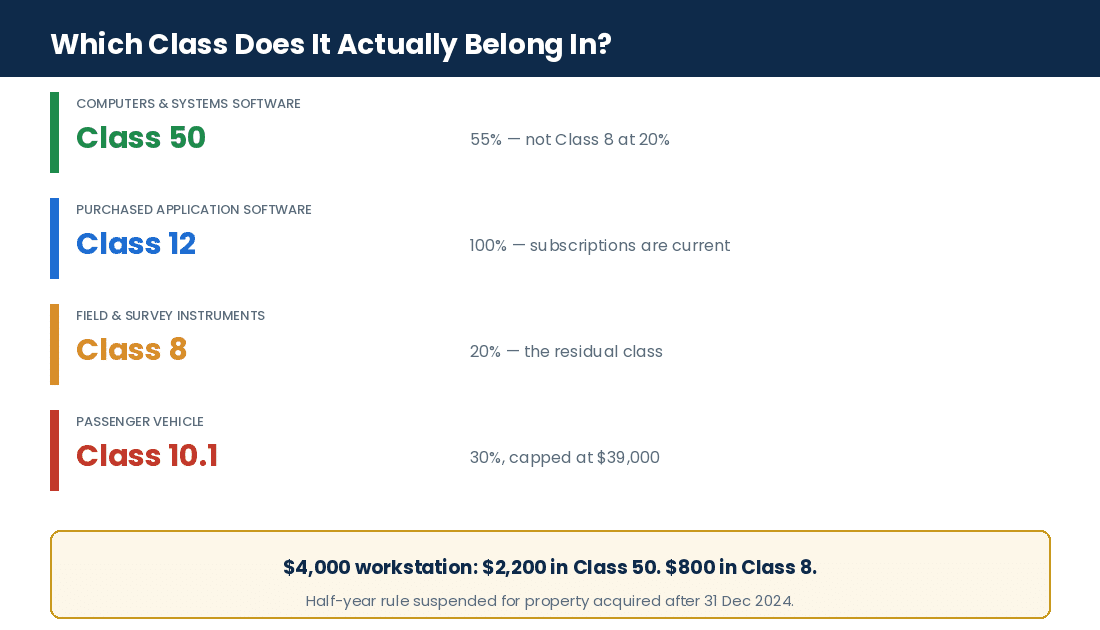
Computers Are Class 50, Not Class 8
The single most repeated error in consulting tax guidance puts computer equipment in Class 8 at 20%. Computers and systems software acquired after 18 March 2007 sit in Class 50 at 55% declining balance.
| Asset | Class | Rate |
|---|---|---|
| Computers, servers, systems software | 50 | 55% |
| Purchased application software | 12 | 100% |
| Software subscriptions | Not capital | Current expense |
| Field instruments, survey gear, furniture | 8 | 20% |
| Trademarks, goodwill, licences | 14.1 | 5% |
| Passenger vehicle | 10.1 | 30%, capped at $39,000 |
Class 8 is the residual class. Field instruments and furniture belong there; the laptop does not. Claiming a $4,000 workstation at 20% instead of 55% understates the first-year deduction by $1,400, and the error compounds across the pool for years.
The Lease Ceiling Is $1,100, Not $900
The passenger vehicle limits were raised and the figures that circulate are a decade out of date.
| Limit | Current | Often quoted |
|---|---|---|
| Monthly lease cost | $1,100 plus tax | $800 or $900 |
| Class 10.1 capital cost | $39,000 plus tax | $30,000 or $34,000 |
| Zero-emission vehicle, Class 54 | $61,000 plus tax | $55,000 or $59,000 |
| Interest on a vehicle loan | $350 per month | $300 |
Personal Services Business Costs Far More Than the SBD
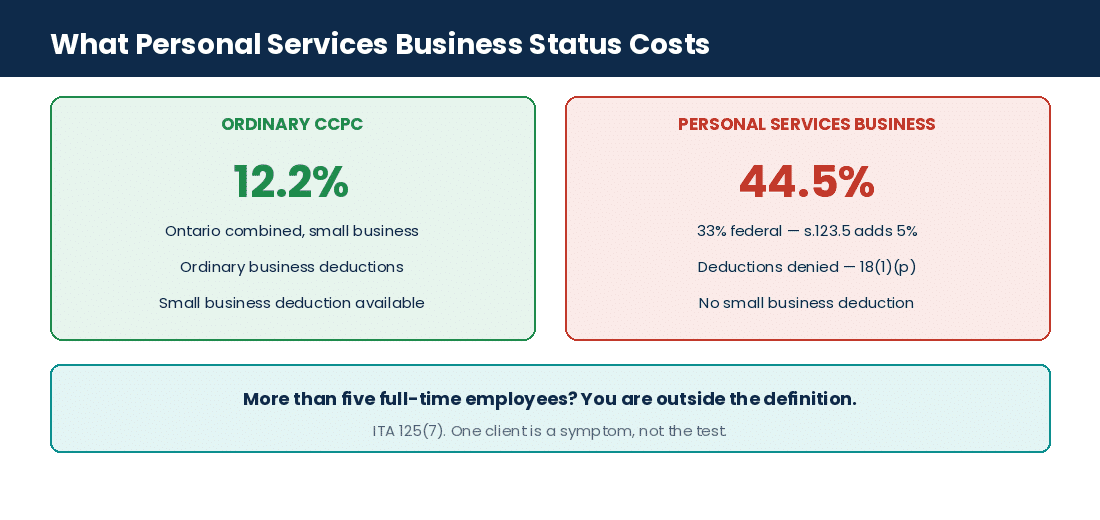
Risk Warning: a personal services business does not simply lose the small business deduction. It pays the full general federal rate plus an additional 5% tax under section 123.5, for a federal rate of 33%.
Worse is paragraph 18(1)(p), which denies essentially every deduction other than salary and wages paid to the incorporated employee, certain employment-related benefits, and legal expenses of collecting amounts owing. Software, equipment, home office, vehicle costs, professional dues — all denied. Adding Ontario’s 11.5% gives roughly 44.5% on income that would otherwise have been taxed at 12.2%.
The test in subsection 125(7) is not “mainly one client”. It asks whether the incorporated employee would reasonably be regarded as an officer or employee of the payer but for the existence of the corporation, unless the corporation employs more than five full-time employees throughout the year or the income comes from an associated corporation. One client is a symptom; the relationship is the test.
A Toronto consulting engineer had been claiming his laptop, monitors and CAD workstation in Class 8 for four years on a predecessor’s advice.
They belonged in Class 50 at 55%. Rebuilding the pools across the open years released roughly $21,000 of additional capital cost allowance. Nothing had been claimed improperly; it had simply been claimed slowly. Figures changed for privacy.
Risk Warning: Please check which class your computers sit in before this year’s return. Class 8 and Class 50 differ by 35 percentage points in year one.
Engineering Consultant Tax Obligations and Deductible Expenses Overview
Obligations and Deductible Expenses
Foundations
The governing rules are short. Paragraph 18(1)(a) allows an expense incurred to earn income; section 67 requires it to be reasonable; and the split between current and capital decides whether you deduct it now or over years.
Common Business Expenses Eligible for Deduction: Professional Fees, Software, Equipment
- Professional fees: accounting, legal and bookkeeping costs, deducted as incurred.
- Professional dues: PEO licence fees, OSPE and association memberships.
- Liability and errors and omissions insurance on the practice.
- Continuing professional development: courses and seminars maintaining existing skills are current expenses; a programme conferring a lasting new qualification may be capital.
- Software: a subscription is a current expense; a purchased licence is capital.
- Equipment: capital, by class — Class 50 for computers, Class 8 for instruments.
Distinguishing Current Versus Capital Costs and Their Tax Impact
| Expense | Classification | Treatment |
|---|---|---|
| Office supplies, small repairs | Current | Fully deductible when incurred |
| Software subscription | Current | Fully deductible when incurred |
| Computer equipment | Capital | Class 50, 55% |
| Purchased application software | Capital | Class 12, 100% |
| Systems software | Capital | Class 50, 55% |
| Field and survey instruments | Capital | Class 8, 20% |
The first claim on any capital asset is gated by the available-for-use rule in subsections 13(26) to (32). And the half-year rule is suspended for eligible property acquired after 31 December 2024 and available for use before 2034 under Bill C-15, so a full first-year claim is currently available where it once would have been halved.
Key Stat: A $4,000 workstation in Class 50 gives $2,200 in year one. The same asset misfiled in Class 8 gives $800. Same money, same year, different class.
Home Office, Vehicle and Subcontractor Costs
Home Office, Vehicle and Subcontractors
Expenses
Home Office Expense Deductions: Eligibility and Calculation Methods
Risk Warning: the workspace does not have to be used exclusively for work. Subsection 18(12) sets out two alternative tests. Under (a) the space is the individual’s principal place of business, and there is no exclusivity requirement. Only test (b) — used exclusively to earn income and regularly for meeting clients — requires it.
The real limit is different: the deduction cannot create or increase a loss, with the denied amount carried forward indefinitely against income from the same business.
There is also a structural point most guidance misses. Subsection 18(12) applies to an individual. An incorporated consultant does not claim home office on the T2 at all. The corporation pays rent to the shareholder under a written agreement at a reasonable rate, which the corporation deducts and the shareholder reports as property income against the related costs.
- Workspace area against total finished floor area, measured and documented.
- Utilities, heat, insurance and maintenance apportioned on that basis.
- Mortgage interest and property tax for an owner, never principal.
- CCA on the home available but rarely advisable, since it puts the principal residence exemption at risk on that portion.
Vehicle Expenses for Consulting Work: Tracking and Claiming Costs
- A logbook recording date, destination, purpose and kilometres for each business trip, with opening and closing odometer readings.
- CRA accepts a simplified log: a full base year, then a three-month sample in later years, provided the business-use percentage stays within 10 percentage points of the base year.
- Fuel, maintenance, insurance and licensing claimed on the business-use share.
- Lease payments capped at $1,100 a month plus tax, with a further restriction where the vehicle’s value exceeds the capital ceiling.
- Travel between home and a regular place of business is personal, whatever the reason for the trip.
Managing Subcontractor Payments and Related Tax Considerations
Risk Warning: there is no withholding tax under the Excise Tax Act. Two separate regimes get conflated here, and neither works the way the phrase suggests.
Income tax: Regulation 105 requires 15% withholding on fees paid to a non-resident for services rendered in Canada, under paragraph 153(1)(g), reported on a T4A-NR. Work performed entirely offshore is outside it. Treaty relief needs a waiver on Form R105 obtained in advance. GST/HST: services acquired from a non-resident are handled by self-assessment under section 218 where they are for non-commercial use — there is no withholding mechanism at all.
- Written contracts setting scope, control, tools and risk of loss.
- A T4A where fees for services to a resident contractor exceed $500 in the calendar year.
- Worker status tested on the Wiebe Door factors as refined in Sagaz and Connor Homes, with CRA Guide RC4110 and a ruling available on Form CPT1.
- GST/HST charged by registered subcontractors, recoverable by you on a compliant invoice.
A consulting firm engaging a European specialist for a remote design review had withheld 15% on the fee.
The work was performed entirely in Europe, so Regulation 105 did not apply and nothing should have been withheld. Recovering it for the non-resident took months and an amended T4A-NR. The test is where the services are rendered, not where the payer sits. Figures changed for privacy.
Corporate and Personal Tax Planning for Engineering Consultants
Corporate and Personal Tax Planning
Planning
Corporate Tax Filing Essentials for Consulting Engineering Firms
| Obligation | Deadline | Provision |
|---|---|---|
| T2 corporate return | Six months after fiscal year-end | ITA 150(1)(a) |
| Balance of tax | Two months; three for an eligible CCPC | ITA 157(1)(b) |
| Corporate instalments | Last day of each month or quarter | ITA 157(1)(a), 157(1.1) |
| T4 and T4A slips | Last day of February | Reg 205(1) |
| Ontario Annual Return | Six months after year-end | Ontario Business Registry |
A Toronto structural consulting firm with a 31 December year-end files its T2 by 30 June. The balance, though, was due at 28 February — or 31 March for a CCPC claiming the small business deduction. The payment date comes first, which is the part most guidance omits entirely.
Personal Services Business Rules Affecting Engineering Consultants
| Factor | Points toward PSB | Points toward business |
|---|---|---|
| Control over work | Client sets schedule and method | Consultant sets own hours |
| Tools and equipment | Client provides | Consultant owns |
| Ability to subcontract | Not permitted | Free to hire others |
| Chance of profit, risk of loss | None borne | Fixed-price and rework risk |
| Integration | Client email, badge, org chart | Independent presence |
| Employees | Five or fewer full-time | More than five full-time |
That last row is the statutory escape. A corporation employing more than five full-time employees throughout the year is outside the PSB definition regardless of the other factors.
Instalment Payments and Holdbacks: Navigating Cash Flow and Tax Timing
Risk Warning: income timing is not a personal services business rule. It applies to every corporation. Guidance that files milestone billing, unbilled work and holdbacks under “PSB rules” invites a firm that is not a PSB to conclude none of it applies to them.
Income is business income under section 9, included when it becomes receivable under paragraph 12(1)(b), with unbilled work carried as work in progress under subsection 10(5). Milestones make amounts receivable; not invoicing does not change that. A holdback not legally receivable until certification is a genuine exception, because the amount is not yet receivable.
- Milestone dates recorded against completion, not against the invoice run.
- Amounts held back tracked separately from amounts billed and paid.
- Unbilled work valued at each year-end as a standing schedule.
- Retainers received in advance: included under paragraph 12(1)(a), with a reserve available under paragraph 20(1)(m) for services not yet rendered.
GST/HST Filing Requirements and Best Practices for Consultants
- Annual filing to $1.5M of taxable supplies, payable three months after year-end; quarterly to $6M; monthly above, each due one month after the period ends.
- Registration required under subsection 240(1) once the $30,000 small supplier threshold in section 148 is exceeded.
- Input tax credits supported under subsection 169(4): over $30 the supplier’s name and date, over $150 the supplier’s registration number, the recipient’s name, terms and a description.
- Credits lost after the four-year claim window.
- Late filing penalised under ETA 280.1 at 1% plus 0.25% per month, on top of interest.
Payroll Source Deductions, T4, and T4A Slips
Remittance dates follow your average monthly withholding amount under section 153 and Regulation 108, not your payroll frequency. A regular remitter pays by the 15th of the following month; accelerated remitters pay twice or four times monthly; quarterly remitters by the 15th after the quarter. Penalties run under subsection 227(9) from 3% to 10%, with directors personally liable under section 227.1.
Bookkeeping Importance and Strategies Tailored for Engineering Consulting
- Cloud accounting with bank feeds, reconciled monthly rather than at year-end.
- An asset register separating current from capital, with class and available-for-use date.
- Vehicle kilometres logged daily against an approved format.
- Invoices organised by project code, with milestone certificates attached.
- A standing shareholder loan schedule, since an amount owing is included in income under subsection 15(2) unless repaid within one year after the end of the corporation’s taxation year under 15(2.6).
- Records retained six years from the end of the taxation year under paragraph 230(4)(b) — not from the filing date.
A Hamilton structural firm working almost entirely for one client had been filing as an ordinary CCPC at 12.2%.
The contract gave the client control over hours and method, supplied the tools, barred subcontracting and ran through the client’s own project management system. On a PSB reassessment the rate would have been roughly 44.5% with almost every deduction denied under 18(1)(p). Restructuring the engagement terms, adding a second client and documenting the risk of loss moved the position. Figures changed for privacy.
Maximizing Tax Credits and Claims Relevant to Engineering Consultants
SR&ED and Tax Credits
Credits
Overview of SR&ED Claims and Eligibility for Consulting Engineering Projects
SR&ED is defined in subsection 248(1): basic research, applied research or experimental development, carried out through systematic investigation to resolve a scientific or technological uncertainty. Routine engineering, standard design to known methods and regulatory work do not qualify, however demanding the project.
Risk Warning: the SR&ED reporting deadline is 18 months after the fiscal year-end, not the six-month T2 deadline. Guidance that says both is contradicting itself, and only one of the two is right.
Subsection 37(11) makes filing within that period a condition of the deduction itself, which is why a late claim is not a late filing that attracts a penalty — it is no claim at all. Taxpayer relief under subsection 220(3.1) reaches penalties and interest and cannot restore it.
Identifying Eligible Salaries, Materials, Contracts, Overhead, and Capital Expenditures
| Expenditure | Treatment | Authority |
|---|---|---|
| Salaries and wages of staff directly engaged | Qualified expenditure | ITA 37(1)(a) |
| Materials consumed or transformed | Qualified expenditure | ITA 37(1)(a); Reg 2900 |
| Contract payments to an arm’s-length performer | Qualified at 80% | ITA 127(9) |
| Overhead | Traditional at actual, or proxy at 55% of directly engaged salaries | Reg 2900(4) |
| Capital equipment | Not eligible | Removed for property acquired after 2013 |
That last row matters. Capital expenditures were removed from SR&ED eligibility for property acquired after 31 December 2013. Equipment bought for a research project is still depreciable in its ordinary class, but it is no longer a qualified SR&ED expenditure and no longer earns the investment tax credit. Any guidance putting “equipment used for R&D” into an SR&ED claim is describing the pre-2014 regime.
The overhead choice is also either-or. You elect the traditional method and track actual overhead, or the proxy method at 55% of directly engaged salaries. Never both.
Documentation Requirements and Record-Keeping to Support Claims
- Project descriptions stating the uncertainty, the hypothesis and what was tested.
- Time records separating SR&ED hours from production and routine work.
- Design iterations, test results and failures — failures are often the best evidence of uncertainty.
- Invoices for materials and contract payments.
- Records retained six years from the end of the taxation year under paragraph 230(4)(b).
Calculating Total SR&ED Expenditures and Applicable Tax Credit Rates
| Claimant | Rate | Refundability |
|---|---|---|
| CCPC, first $3 million of qualified expenditures | 35% | Fully refundable |
| CCPC, above $3 million | 15% | 40% refundable |
| Other corporations | 15% | Non-refundable |
| Ontario Innovation Tax Credit | 3.5% | Refundable |
| Ontario Research and Development Tax Credit | 3.5% | Non-refundable |
A personal services business cannot claim SR&ED meaningfully in any event, since paragraph 18(1)(p) denies the underlying expenditures.
Claim Optimization Techniques Including Multi-Year Planning and Categorization, and the Filing Process
- Diarise the 18-month date separately from the T2 deadline, since they are different dates with different consequences.
- File Form T661 with Schedule 31 for the corporate investment tax credit.
- Assign expenditures to the fiscal year in which the work was performed.
- Separate software subscriptions from purchased licences so classification stays consistent year to year.
- Expect a technical or financial review. CRA may reassess within three years of the original notice of assessment for a CCPC, and four for other corporations, under subsection 152(3.1).
Pro Tip: Please write the SR&ED documentation while the work is happening. A claim reconstructed seventeen months later rarely survives a technical review, even where the uncertainty was real.
Industry-Specific Considerations and Regional Tax Factors
Regional and Industry Factors
Regional
Tax Implications for Consulting Engineering Firms Across Different Provinces
| Province | Small business rate | General rate | Sales tax |
|---|---|---|---|
| Ontario | 3.2% (12.2% combined) | 11.5% (26.5%) | HST 13% |
| Alberta | 2% (11%) | 8% (23%) | GST 5%, no PST |
| British Columbia | 2% (11%) | 12% (27%) | GST 5% + PST 7% |
| Quebec | 3.2% (12.2%) | 11.5% (26.5%) | GST 5% + QST 9.975% |
Risk Warning: capital cost allowance, vehicle limits and home office rules are federal and identical in every province. Claims that Alberta has stricter vehicle limits, or that full CCA is an Ontario feature, describe rules that do not vary by province.
PST is also not recoverable as an input tax credit. Only GST and the federal part of HST are. BC PST is a cost; Quebec QST has its own separate input tax refund system with its own registration.
Where crews work in more than one province, taxable income is allocated under Regulation 402 — half by gross revenue attributable to each permanent establishment, half by salaries and wages paid there — with permanent establishment defined in Regulation 400(2). It is filed on Schedule 5.
Influence of Economic Updates and Political Context on Tax Measures
Federal budgets do move the rules that matter here, and two recent changes are worth knowing. The half-year rule is suspended for eligible property acquired after 31 December 2024, and Part XX digital platform reporting has applied since 1 January 2024.
What has not changed is the timing of milestone billing revenue. Income has been included when receivable under paragraph 12(1)(b) for decades, and no 2026 amendment alters that. There is likewise no 2026 change tightening the personal services business tests, no change to software capital cost classes, and no extension of the SR&ED filing deadline — all three circulate and none exist.
Federal Initiatives Impacting Consulting Engineers: Infrastructure and Defence Projects
- Procurement rules can restrict subcontracting and equipment choices, which changes what you spend but not how it is deducted.
- Class 53 at 50% covers manufacturing and processing machinery, not field instruments, and has no connection to holding a federal contract.
- Where a project genuinely involves resolving technological uncertainty, test it against the 248(1) definition rather than assuming the contract type qualifies it.
- Security clearance, bonding and insurance costs required by a contract are ordinary deductible expenses.
Navigating Approvals, Red Tape Reduction, and Procurement Reforms
- Signed contracts in place before work starts, with scope and milestones defined.
- Progress reports tying billing to completion.
- Subcontractor payments documented, with Regulation 105 tested on where the services were rendered.
- Audit trails retained for the full six years from the year-end.
Sustainable Finance Considerations
Energy-efficient equipment and clean technology have their own accelerated classes — Class 43.1 at 30% and Class 43.2 at 50% for qualifying clean energy generation and conservation equipment, with Class 54 and 55 for zero-emission vehicles. Environmental monitoring instruments are ordinary Class 8 property; they are not Class 50, which is computers and systems software.
Provincial Credits and Incentives Available to Engineering Consultants
- Ontario Innovation Tax Credit, 3.5% refundable, stacking with the federal SR&ED credit on eligible Ontario expenditures.
- Ontario Research and Development Tax Credit, 3.5% non-refundable against Ontario tax.
- Ontario Business Research Institute Tax Credit, 20% refundable on eligible contracts with approved research institutes.
- Quebec and British Columbia operate their own R&D credit regimes with separate eligibility and filing.
Provincial credits are claimed with the corporate return for the year, on the relevant schedule, supported by the same expenditure records as the federal claim.
Firms regularly arrive convinced that Alberta has tighter vehicle limits or that full capital cost allowance is an Ontario feature.
Neither is true. Capital cost allowance, the passenger vehicle ceilings and the home workspace tests are all federal and identical in every province. What genuinely varies is the corporate rate, the sales tax and the provincial R&D credits. Figures changed for privacy.
Practical Applications and Case Studies in Engineering Consultant Taxation
Practical Applications and Case Studies
Worked Examples
Example Calculations of Deductible Expenses Including Home Office and Vehicle Costs
Home office. A home of 2,000 square feet with a 200 square foot office is 10%. Household costs of $12,000 give $1,200. For a sole proprietor that is the 18(12) claim, capped so it cannot create a loss. For an incorporated consultant it is the basis for a reasonable rent under a written agreement between the corporation and the shareholder, not a T2 deduction claimed directly.
Vehicle. Driving 20,000 kilometres of which 8,000 are business is 40%. Costs of $6,500 give $2,600, provided the lease stays within the $1,100 monthly ceiling and the logbook records date, destination, purpose and odometer readings.
Case Study on Effective Corporate Tax Planning for an Engineering Consulting Firm
A structural firm working predominantly for one client faced personal services business exposure. The steps that actually moved the position:
- Contract terms rewritten so the firm controlled method and schedule, supplied its own tools and bore rework risk.
- A second client engaged, and subcontracting permitted under the agreement.
- Software subscriptions classified as current expenses; purchased licences to Class 12.
- Instruments to Class 8 and computers to Class 50, correcting a long-standing misfiling.
- Owner compensation split between salary and dividends, with TOSI under section 120.4 tested on any dividends to family.
- Shareholder loan balances cleared within the 15(2.6) window.
- Subcontractor agreements reviewed, with Regulation 105 applied only where services were rendered in Canada.
Scenario Demonstrating SR&ED Claim Preparation and Tax Credit Realization
A consulting firm developing a remediation technique with no known equivalent tracked the uncertainty, the hypotheses tested, the iterations that failed and the hours of each person directly engaged. Salaries and consumed materials formed the qualified expenditures; overhead went on the proxy method at 55%; the equipment purchased for the trials was depreciated in its ordinary class but not claimed as an SR&ED expenditure, because capital has been outside the programme since 2013. The claim was filed within 18 months of year-end on Form T661 with Schedule 31.
Illustrations of Bookkeeping Best Practices Improving Tax Compliance
- A separate business bank account and card, with no personal traffic through either.
- Cloud accounting with document capture, reconciled monthly.
- GST/HST collected reconciled to filed returns each period, not at year-end.
- Subcontractor payments tracked so the February T4A run is mechanical.
- An asset register with class, cost and available-for-use date per item.
Impact Analysis of Tax Changes Based on Recent Economic Updates
What is actually current for 2026: the half-year rule is suspended for eligible property acquired after 31 December 2024; passenger vehicle limits stand at $1,100 monthly lease, $39,000 Class 10.1 and $61,000 Class 54; and Part XX platform reporting has applied since 2024. The personal services business tests, the software CCA classes and the SR&ED deadline are unchanged.
Strategies to Optimize Tax Position Using Milestone Billing and Retainer Management
| Item | When income arises | Provision |
|---|---|---|
| Milestone billing | When the amount becomes receivable | ITA 12(1)(b) |
| Unbilled work in progress | Carried at lower of cost and fair market value | ITA 10(5) |
| Retainer received in advance | Included on receipt, reserve available | ITA 12(1)(a); 20(1)(m) |
| Holdback | When legally receivable | ITA 12(1)(b) |
Contracts that tie payment to defined work stages give you a defensible position on when each amount became receivable. What they do not do is let you defer income by withholding the invoice — the amount was receivable when the milestone was met.
A firm had been treating retainers received in December as a liability and reporting none of it.
For accounting that was right. For tax the amount is included under 12(1)(a) when received, with a 20(1)(m) reserve claimed for the services not yet rendered — which lands in nearly the same place but is a position that survives a review. The difference was that no reserve schedule existed to show. Figures changed for privacy.
FAQs on Engineering Consultant Tax Deductions and Related Topics
Frequently Asked Questions
FAQ
What is the personal services business risk for engineering consultants?+
Under subsection 125(7), a corporation is a PSB where the incorporated employee would reasonably be regarded as an officer or employee of the payer but for the corporation, unless it employs more than five full-time employees throughout the year. The cost is not just the small business deduction: the federal rate becomes 33% with the 5% additional tax under section 123.5, and paragraph 18(1)(p) denies almost every deduction.
When should income from milestone billing be recognized?+
When the amount becomes receivable under paragraph 12(1)(b), which is ordinarily on completion of the milestone. This applies to every corporation, not only a PSB — a common misattribution.
How are retainers and holdbacks treated for tax timing?+
A retainer received in advance is included under paragraph 12(1)(a) when received, with a reserve available under paragraph 20(1)(m) for services not yet rendered. A holdback is income when it becomes legally receivable, which under provincial construction legislation may be on certification rather than at invoice.
What are the payroll remittance deadlines?+
They follow your average monthly withholding amount, not your payroll frequency. A regular remitter (AMWA under $25,000) pays by the 15th of the following month. Accelerated remitters pay twice or four times a month; quarterly remitters by the 15th after the quarter.
When must T4 and T4A slips be filed?+
By the last day of February following the calendar year they cover, under Regulation 205(1). A T4A is required where fees for services to a resident contractor exceed $500 in the year.
What records must be kept to comply with the six-year retention rule?+
Contracts, invoices, milestone certificates, timesheets, expense receipts, the asset register and vehicle logs — kept six years from the end of the taxation year to which they relate, under paragraph 230(4)(b). From the year-end, not the filing date.
How should vehicle expenses be documented?+
A logbook with date, destination, purpose and kilometres for each business trip, plus opening and closing odometer readings. CRA accepts a full base year followed by a three-month sample in later years, provided business use stays within 10 percentage points of the base year.
What is the passenger vehicle expense ceiling?+
$1,100 per month plus tax on a lease — not $900, which is a superseded figure. The Class 10.1 capital ceiling is $39,000, the zero-emission Class 54 ceiling is $61,000, and deductible interest on a vehicle loan is capped at $350 a month.
How do software subscriptions differ from licenses in tax classification?+
A subscription is a current expense, deducted as incurred. A purchased application licence is capital in Class 12 at 100%. Systems software is Class 50 at 55%, alongside the hardware it runs on.
What applies to owner pay: dividends or salary?+
Salary is deductible to the corporation, subject to CPP and, where applicable, EI, and it creates RRSP room. Dividends are not deductible and carry no payroll cost, but they generate no RRSP room and, where paid to family, are tested under TOSI in section 120.4.
How does shareholder loan monitoring affect compliance?+
An amount owing by a shareholder is included in their income under subsection 15(2) unless repaid within one year after the end of the corporation’s taxation year under 15(2.6) — not one year from the advance. A prescribed-rate interest benefit also arises under section 80.4 on an outstanding balance.
What triggers CRA audits for engineering consultants?+
Single-client revenue with employee-like contract terms, unbilled work missing at year-end, large deductions without documentation, assets misfiled between classes, shareholder loans left outstanding, and subcontractor payments with no slips issued.
Why is an asset register important?+
It fixes the class, the cost and the available-for-use date for each asset, which is what the CCA claim rests on. It is also the fastest way to find a Class 8 entry that should have been Class 50.
Are professional dues considered deductible expenses?+
Yes. PEO licence fees and association memberships required or reasonably related to the practice are deductible under paragraph 18(1)(a). Dues for a club whose main purpose is dining, recreation or sport are denied outright by paragraph 18(1)(l).
Can liability insurance be deducted?+
Yes. Professional liability and errors and omissions premiums covering the consulting practice are deductible, spread over the period the policy covers where it straddles a year-end, under subsection 18(9).
Are continuing professional development expenses deductible?+
Courses and seminars maintaining existing professional skills are current expenses. A programme conferring a lasting new qualification may be capital in nature, and a course leading to a degree usually is.
What are the meal and entertainment limits?+
50% under section 67.1, with the input tax credit recaptured to 50% as well. Being away overnight is not an exception. The exceptions are narrow and include meals billed to a client and separately identified on the invoice.
Is equipment bought for an SR&ED project a qualified expenditure?+
No. Capital expenditures were removed from SR&ED for property acquired after 31 December 2013. The equipment is still depreciable in its ordinary class, but it earns no SR&ED investment tax credit.
Eighteen questions, and the one on personal services business status carries more money than the other seventeen combined.
The rest are classification and timing. PSB is a cliff edge: roughly 12.2% on one side and 44.5% with almost no deductions on the other. Figures changed for privacy.
Essential Tax Management Tips for Engineering Consultants
Essential Topics and Best Practices
Quick Reference
- Apply the subsection 125(7) tests regularly, including the more-than-five-employees escape.
- Match retainer income recognition to 12(1)(a) with the 20(1)(m) reserve.
- Track holdbacks and record them when legally receivable.
- Use timesheets to support project billing, income timing and any SR&ED claim.
- Keep business and personal spending fully separate.
- Confirm your payroll remitter band in writing and use its date.
- Prepare T4 and T4A slips by the last day of February.
- Classify assets by their actual class — Class 50 for computers, Class 8 for instruments, Class 12 for purchased application software.
- Keep vehicle logs with date, destination, purpose and odometer readings.
- Observe the $1,100 lease ceiling and the $39,000 Class 10.1 cap.
- Separate software subscriptions from purchased licences in the ledger.
- Keep shareholder loan records and clear balances within the 15(2.6) window.
- Deduct professional dues and liability insurance each fiscal year.
- Claim CPD that maintains existing skills; treat lasting new qualifications as capital.
- Limit meals and entertainment to 50% under section 67.1.
- Retain records six years from the end of the taxation year.
- Reconcile GST/HST collected to filed returns each period, and claim credits inside the four-year window.
- Update the asset register whenever anything is bought or disposed of.
Points Worth Carrying
- Computers are Class 50 at 55%, not Class 8 at 20%.
- The lease ceiling is $1,100 a month, not $900.
- A PSB pays 33% federally and loses almost every deduction under 18(1)(p).
- Income timing rules apply to all corporations, not only personal services businesses.
- The home workspace need not be exclusive under test (a) of 18(12).
- An incorporated consultant pays rent rather than claiming home office on the T2.
- There is no withholding tax under the Excise Tax Act — Reg 105 is income tax, s.218 is self-assessment.
- SR&ED capital expenditures have been ineligible since 2013.
- The SR&ED deadline is 18 months, and it is not the T2 deadline.
- CCA classes, vehicle limits and home office rules do not vary by province.
Twenty-eight points, and the ten at the end are all things a consulting engineer was told confidently by something they read.
None are obscure. They are ordinary rules attached to the wrong class number, the wrong dollar figure or the wrong statute. Figures changed for privacy.
Businesses We Serve
Industry Expertise
Engineering and technical consulting practices share the same issues. Here are ten and the usual finding.
| Practice | The Issue That Usually Appears |
|---|---|
| Structural engineering consultancies | Single-client contracts creating PSB exposure |
| Civil and municipal engineering firms | Holdbacks recorded at the wrong time |
| Mechanical and electrical consultants | CAD workstations misfiled in Class 8 |
| Geotechnical practices | Field instruments and computers pooled together |
| Sole practitioner engineers | Home office claimed on the T2 instead of rent paid |
| Firms using offshore design support | Reg 105 withheld on work rendered abroad |
| Practices developing novel methods | SR&ED filed to the six-month deadline |
| Firms with retainer arrangements | Advances reported as a liability only |
| Owner-managed practices | Shareholder loans left past the 15(2.6) window |
| Multi-province consultancies | No Schedule 5 allocation filed |
- Structural engineering consultancies: test 125(7), including the employee count.
- Civil and municipal engineering firms: receivable when certified.
- Mechanical and electrical consultants: Class 50 at 55%.
- Geotechnical practices: instruments Class 8, computers Class 50.
- Sole practitioner engineers: rent agreement, not a T2 claim.
- Firms using offshore design support: where the services were rendered decides.
- Practices developing novel methods: 18 months, no relief.
- Firms with retainer arrangements: 12(1)(a) plus the 20(1)(m) reserve.
- Owner-managed practices: one year after the corporation’s year-end.
- Multi-province consultancies: Regulation 402, 50/50 formula.
The discipline changes. The questions do not: is this a personal services business, which class does the asset belong in, and when did the amount become receivable.
A geotechnical practice and a mechanical consultancy look nothing alike on site and file nearly identical returns. Figures changed for privacy.
Professional Guidance and Quick Reference
Guidance
Supporting Resources and Calls to Action: How Gondaliya CPA Assists Engineering Consultants with Tax Planning and Compliance
Engineering consultants get into difficulty in a predictable set of ways: filing computers in Class 8 at 20% when they belong in Class 50 at 55%, which quietly understates the deduction for years; working to a $900 monthly lease ceiling that was superseded by $1,100, alongside a $30,000 capital cap that is now $39,000; treating personal services business status as merely the loss of the small business deduction, when it brings the full general rate plus the 5% additional tax under section 123.5 and the near-total denial in paragraph 18(1)(p); believing the home workspace must be used exclusively for work, when test (a) of subsection 18(12) imposes no such requirement and an incorporated consultant pays rent rather than claiming at all; withholding on offshore subcontractors under a supposed Excise Tax Act rule that does not exist, when Regulation 105 reaches only services rendered in Canada; and filing SR&ED to the six-month T2 date rather than the 18-month reporting deadline, which subsection 37(11) makes fatal. Gondaliya CPA handles engineering consultant accounting on a flat annual fee.
Services offered cover the full year: T2 preparation and filing, bookkeeping with an asset register that records class and available-for-use date, GST/HST filing to your assigned frequency, payroll and slips, compiled financial statements under CSRS 4200, tax planning on salary and dividend mix, and CRA representation where a PSB or expense claim is questioned.
Tools and documentation. We work in QuickBooks Online or Xero, maintain the capital cost allowance schedule by class, track vehicle logs against the CRA format, keep the shareholder loan schedule current, and retain everything six years from the year-end. Contracts are reviewed for PSB risk at onboarding rather than at reassessment, because by then the position is fixed.
Encouragement to consult specialists. Income timing, asset classification and personal services business exposure are where a consulting engineer either keeps the small business rate or does not, and they are decided by contract terms written long before the return. Early advice on personalized corporate tax strategies costs less than a reassessment.
Contact information and steps to engage Gondaliya CPA. Call 647-212-9559 or email info@gondaliyacpa.ca for a free consultation. We serve Toronto, Etobicoke, Vaughan, Mississauga and the rest of Ontario, reply within one business day including weekends around deadlines, and price on a flat annual fee including HST.
Quick Answers
At a Glance
- Computers: Class 50 at 55%
- Purchased application software: Class 12 at 100%
- Software subscriptions: current expense
- Field instruments: Class 8 at 20%
- Vehicle lease ceiling: $1,100 per month
- Class 10.1 capital cap: $39,000
- PSB federal rate: 33%, with 18(1)(p) denial
- Home office: 18(12), two alternative tests
- Reg 105 withholding: 15%, services rendered in Canada
- SR&ED deadline: 18 months, no relief
- Meals: 50% under section 67.1
- Records: six years from the taxation year-end
Who This Is For
Fit Check
- For: Incorporated Canadian engineering consultants, from sole practitioners to multi-engineer firms, billing on milestones, retainers or holdbacks.
- Not For: Salaried engineers, whose employment expenses run through form T2200 on a T1, and firms requiring a review or audit engagement, which we refer out.
People Also Ask
Quick Answers
Are computers Class 8 or Class 50?+
Class 50, at 55% declining balance, for computers and systems software acquired after 18 March 2007. Class 8 is the residual class for instruments and furniture.
Is the vehicle lease limit $900 a month?+
No. It is $1,100 plus tax. The Class 10.1 capital ceiling is $39,000, zero-emission Class 54 is $61,000, and vehicle loan interest is capped at $350 a month.
Does a PSB just lose the small business deduction?+
No. It also pays a 5% additional tax under section 123.5, taking the federal rate to 33%, and paragraph 18(1)(p) denies nearly every deduction other than salary to the incorporated employee.
Must a home office be used only for work?+
Not under test (a) of subsection 18(12), the principal-place-of-business test, which has no exclusivity requirement. Only test (b) requires it. An incorporated consultant pays rent under an agreement instead.
Do I withhold tax on an offshore subcontractor?+
Only where the services are rendered in Canada. Regulation 105 requires 15% on those payments, reported on a T4A-NR. Work performed entirely abroad is outside it, and there is no withholding mechanism under the Excise Tax Act at all.
Glossary of Key Terms
Glossary
- Class 50: Computers and systems software, 55% declining balance.
- Class 12: Purchased application software, 100%.
- Class 8: The residual class for instruments and furniture, 20%.
- Class 10.1: Passenger vehicles, capped at $39,000.
- Personal services business: Defined in subsection 125(7); taxed at 33% federally.
- Paragraph 18(1)(p): The denial of deductions to a personal services business.
- Section 123.5: The 5% additional tax on personal services business income.
- Subsection 18(12): The two alternative home workspace tests.
- Regulation 105: 15% withholding on services rendered in Canada by a non-resident.
- Section 218: GST/HST self-assessment on imported taxable supplies.
- Work in progress: Unbilled work, carried under subsection 10(5).
- Paragraph 20(1)(m): The reserve for services not yet rendered.
- Subsection 37(11): Makes SR&ED filing a condition of the claim.
- Proxy method: SR&ED overhead at 55% of directly engaged salaries.
- Available for use: When an asset becomes eligible for CCA, ITA 13(26) to (32).
- CSRS 4200: The standard for a compilation engagement.
Engineering Consultant Tax Check
This quick self-check indicates where your practice most likely has room. Please answer the five questions below.
Engineering Consultant Tax Check
Five quick questions on your business. No fee shown.
Points to raise with us:
This is a general prompt, not tax or legal advice or a quote. Your position depends on your full facts. For a real review, please book a free consultation.
Want a checklist to work from? You can download our free engineering consultant tax checklist before your consultation.
Move your computers and systems software out of Class 8 and into Class 50 at 55%, keep purchased application licences in Class 12 and treat subscriptions as current expenses. Use the current vehicle figures: $1,100 a month on a lease, $39,000 in Class 10.1, $61,000 for a zero-emission vehicle and $350 a month of loan interest. Take personal services business risk seriously, because the cost is the full federal rate plus the 5% additional tax and the near-total denial in paragraph 18(1)(p), not merely the small business deduction. Understand that income timing applies whether or not you are a PSB: amounts are included when receivable, unbilled work is carried as work in progress, and retainers go in under 12(1)(a) with a 20(1)(m) reserve. Pay rent under an agreement rather than claiming home office on the T2, and remember that test (a) of 18(12) has no exclusivity requirement. Withhold under Regulation 105 only on services rendered in Canada. File SR&ED within 18 months and leave capital equipment out of the claim. And please keep six years of records from the year-end.
2026 Update — what is current: This article reflects rules current to 30 September 2026. The six-month T2 filing deadline under 150(1)(a), the 50% meals limit in section 67.1, the $500 T4A threshold and the six-year retention requirement under 230(4)(b) are unchanged. Please note that computers and systems software are Class 50 at 55%, purchased application software is Class 12 at 100% and subscriptions are current expenses; that the half-year rule is suspended for eligible property acquired after 31 December 2024 and available for use before 2034 under Bill C-15; that passenger vehicle limits stand at $1,100 monthly lease, $39,000 in Class 10.1, $61,000 in Class 54 and $350 monthly interest; that a personal services business under subsection 125(7) pays the general rate plus the 5% additional tax in section 123.5 for 33% federally, with deductions denied by paragraph 18(1)(p), and that the more-than-five-full-time-employees exception remains in the definition; that income is included when receivable under paragraph 12(1)(b) with work in progress under subsection 10(5) and retainers under 12(1)(a) with the 20(1)(m) reserve, none of which is a PSB-specific rule; that subsection 18(12) offers two alternative home workspace tests and applies to an individual rather than a corporation; that Regulation 105 withholding of 15% applies only to services rendered in Canada and there is no withholding mechanism in the Excise Tax Act, imported services instead being self-assessed under section 218; that the SR&ED reporting deadline is 18 months after the year-end under subsection 37(11) with no relief available, credits run at 35% refundable on the first $3 million for a CCPC, overhead is traditional or 55% proxy but never both, and capital expenditures have been ineligible since 2013; and that CCA classes, vehicle limits and home office rules are federal and uniform, with no province-specific variation.
Engineering Consultant Tax Deductions Canada: How Gondaliya CPA Supports Consultants
Start with your contracts and your asset register
Gondaliya CPA reviews your engagement terms for personal services business risk before it becomes a reassessment, rebuilds the capital cost allowance schedule with computers in Class 50 and instruments in Class 8, applies the current vehicle ceilings, sets up a rent agreement rather than a home office claim on the T2, applies Regulation 105 only where services are rendered in Canada, builds the unbilled work and retainer reserve schedules, and files the GST/HST, the compiled statements, the T2 and any SR&ED claim to its own 18-month deadline — on a flat annual fee including HST with a one-business-day response. Please book a free consultation.
Next Steps
Please book a free consultation with Gondaliya CPA and bring your main client contract, your asset register or last CCA schedule, and one month of vehicle logs. Those three settle the personal services business question, the classification question and the vehicle question, which is where most of the money sits for a consulting engineer. You will get a flat annual fee including HST before any work begins. We serve Toronto, Etobicoke, Vaughan, Mississauga, Hamilton and the rest of Ontario, and work with firms across Canada. If our content helps, please add gondaliyacpa.ca as a preferred source on Google.
Published: · Last updated:
Editorial policy: We research against CRA, CPA Canada and CPA Ontario sources, fact-check the figures, and Sharad Gondaliya, CPA, reviews the content, which we update as the rules change.
Disclaimer: This article is educational information only and is not tax, legal, or financial advice. Figures marked illustrative are examples rather than quotes or guarantees. It reflects rules current to 2026, including the Class 50 rate, the $1,100 vehicle lease ceiling, the personal services business rate, the 18-month SR&ED deadline and the six-year retention requirement. Rates, limits and expensing rules change and outcomes depend on your specific facts. Please consult a licensed CPA before acting.

Sharad Gondaliya is a CPA Canada & CPA USA with 15 Years+ experience of Accounting, Tax, Payroll of Corporate Small Businesses as Tax Accountant. He is fully certified CPA Ontario and CPA USA and is well known among corporate small businesses for tax planning, efficient tax solutions, and affordable CPA services. Sharad is the Principal (Director) of Gondaliya CPA – Affordable CPA Firm in Canada. Licenses: CPA Ontario: 61040184 | CPA USA (MT): PAC-CPAP-LIC-033176 | CPA USA (WA): 57629 | CPA Firm License: 61330051 View Full Author Bio