



Supplement Brand Tax Accounting in Canada: Inventory, Product Costs & Cost of Goods Sold
Supplement company accounting Canada: inventory valuation, batch costing and GST/HST classification
Supplement company accounting Canada requires clear handling of supplement business taxes Canada and financial reporting standards. Gondaliya CPA offers expert advice for supplement brands on tax planning, bookkeeping, and compliance tailored to the supplement business accounting landscape in Canada.
Quick Summary
Three things decide a supplement brand’s tax position: how each product is classified for GST/HST, what goes into batch cost before a unit is sold, and whether the paperwork behind a write-down would survive a reviewer. The first is where most of the money is.
Reading time: 44 minutes.
Table of Contents
- GST/HST on Supplement Products
- Zero-Rated, Exempt and Exported Goods
- Inventory, Batch Cost and COGS
- Write-Downs, Samples and Short-Dated Stock
- Allowable Business Expenses
- Financial Reporting and Compliance
- Payroll, T4, EHT and WSIB
- Record-Keeping Standards
- International Supplement Companies
- Best Practices and Audit Readiness
- Frequently Asked Questions
- Quick Answers, Glossary and Next Steps
The Numbers That Matter
This guide covers Canada, with Ontario and Toronto context, and reflects rules current to 2026. It is written for incorporated Canadian supplement brands — powders, capsules, functional drinks and bars — selling wholesale, retail or direct to consumer, including brands using contract manufacturers and third-party fulfilment. Figures marked illustrative are examples rather than quotes, and masked engagement notes end with “Figures changed for privacy.” This is educational information only and not tax or legal advice. Product classification turns on the specific product, its label and its marketing, so please confirm each one before relying on a position.
GST/HST on Supplement Products
GST/HST on Supplement Products
Classification
In Canada, supplement products carry GST/HST unless they are zero-rated or exempt. You need to know the rules well to follow supplement brand tax Canada laws and get your supplement business taxes Canada right. If you mix up the tax type, you might charge too much or too little. That can bring fines or cause you to miss tax credits.
The Excise Tax Act requires you to check supplements like vitamins, protein powders, and meal replacements carefully before adding GST/HST. Your supplement company accounting Canada system should keep clear records about these product types. This helps when filing taxes or during audits.
The line that decides the rate
Two CRA publications govern this: GST/HST Memorandum 4.3, Basic Groceries, and GST/HST Info Sheet GI-001, Products Commonly Described as Dietary Supplements. Between them they draw one line, and it is not the line most brands assume.
Products commonly described as dietary supplements are not basic groceries. They are taken for a therapeutic or beneficial effect rather than to allay hunger or thirst, and they are taxable at the applicable provincial rate. Products labelled as a “meal replacement” or a “nutritional supplement” that meet the requirements of the Food and Drugs Act and its Regulations are treated as food, fall within basic groceries, and are zero-rated. You do not charge tax on them.
| Product | Usual treatment | What drives it |
|---|---|---|
| Vitamins and minerals in tablet or capsule form | Taxable | Dietary supplement; therapeutic purpose |
| Protein powder marketed for performance or physique | Taxable | Dietary supplement, per CRA rulings on protein powders |
| Product labelled “meal replacement” under the Food and Drug Regulations | Zero-rated | Qualifies and is labelled as a meal replacement |
| Product labelled “nutritional supplement” under those Regulations | Zero-rated | Same test; the label is the evidence |
| Formulated liquid diet product | Zero-rated | Treated with meal replacements |
| Meal replacement or nutritional supplement bar | Zero-rated, except from a vending machine | Memorandum 4.3 treats qualifying bars as groceries |
| Granola, fruit or nut bar not meeting those standards | Taxable | Snack food, excluded from zero-rating |
| Powder sold as an ingredient to be mixed into food or drink | Can be zero-rated | Sold as an ingredient rather than for a therapeutic effect |
If a product is represented as a meal replacement, nutritional supplement or formulated liquid diet product on its label, CRA will accept that representation as fact in determining its tax status. The label does real work here, which is why reformulation and relabelling are tax events as well as marketing ones.
What the wrong answer costs
Both directions hurt, and they hurt differently.
| Error | What happens | Who absorbs it |
|---|---|---|
| Charging 13% on a zero-rated meal replacement | Tax collected that was never owed. Section 225 still requires you to remit it, so you cannot simply keep it | Your customers, then you — on refunds and corrections |
| Charging nothing on a taxable dietary supplement | The liability is yours whether or not you collected it, plus interest | You, out of margin |
On $500,000 of meal replacement sales in Ontario, the first error is $65,000 of tax collected in error. The second, on the same volume of vitamin sales, is $65,000 of tax you never charged and still owe.
A Toronto brand selling both a capsule line and a labelled meal replacement shake had applied 13% across the whole catalogue because the catalogue was simpler that way. The shake qualified under the Food and Drug Regulations and should have been zero-rated. Roughly $412,000 of shake revenue over two years carried about $53,500 of tax that was never owed. Unwinding it meant crediting customers who could be identified and adjusting returns for those who could not. Figures changed for privacy.
Do not read this as a reason to treat protein powder as zero-rated. CRA has ruled repeatedly that plant-based and whey protein powders marketed for health, performance or physique benefits are dietary supplements and are taxable, even where they contain real nutritional content. The zero-rated route runs through the meal replacement and nutritional supplement standards in the Food and Drug Regulations, not through the protein content.
Assessing product information before tax application
Before you charge GST/HST on a supplement sale, check some key points:
- What ingredients are inside?
- Is it for nutrition or medicine?
- What does the packaging claim?
- Does Health Canada license it?
These points help decide the correct treatment. Section 165 of the Excise Tax Act imposes the tax; Schedule VI decides what escapes it. A powder sold as a vitamin is treated differently from one labelled and formulated to replace a meal.
Having good product info keeps your tax charges consistent in all sales—whether to customers or stores. It also stops mistakes when working on supplement brand tax Canada reports.
Professional guidance. Build a one-page classification sheet per SKU and keep it with the batch file: the label copy, the Food and Drug Regulations standard relied on where one is, the Natural Product Number where the product carries one, the conclusion, and the date. When a reviewer asks why a SKU was zero-rated three years ago, that sheet is the answer. Reconstructing the reasoning afterwards almost never convinces anyone.
A Natural Product Number from Health Canada tells you the product is licensed as a natural health product. It does not make the product zero-rated, and in practice an NPN points toward a therapeutic positioning, which points toward taxable. Keep the licence on file as product information, not as a tax conclusion.
Tax-Exempt Sales and Non-Taxed Items in Canada
Zero-Rated, Exempt and Exported Goods
The Categories
Running a supplement brand in Canada means you need to know how taxes work. Dietary supplements are not treated like basic groceries when it comes to GST/HST. This changes how you charge and report taxes. We’ll explain how supplements fit under Canadian tax rules, how you can claim input tax credits on imports, and why keeping good records is key for GST/HST.
Zero-rated, exempt and taxable are three different things
These words get used interchangeably and they are not interchangeable. The difference decides whether you keep your input tax credits.
| Category | Rate you charge | Input tax credits | Supplement examples |
|---|---|---|---|
| Taxable | 5% to 15% by province | Recoverable in full | Vitamins, most protein powders, capsules |
| Zero-rated | 0% | Recoverable in full | Labelled meal replacements, nutritional supplements, exports |
| Exempt | No tax charged | Not recoverable | Rare for products; covers certain health services |
Zero-rated is the comfortable category. You charge nothing and still recover the tax you paid on ingredients, packaging, co-packing and freight. Exempt is the painful one, because the credits disappear with the tax. For a supplement brand the practical point is that almost nothing you sell is exempt, so a zero-rated product is not costing you your credits.
Basic groceries, prescription drugs and medical devices
Dietary supplements do not qualify as basic groceries. That means they stay taxable for GST/HST. Here is how the neighbouring categories work:
- Basic groceries like milk and fruit are zero-rated.
- Prescription drugs dispensed on a prescription are zero-rated under Schedule VI, Part I — not exempt. The distinction matters because zero-rating preserves credits.
- Certain medical devices listed in Schedule VI, Part II are also zero-rated, some only when prescribed.
If your supplements are not dispensed on prescription, treat them as taxable unless they meet the meal replacement or nutritional supplement standards. Mixing this up causes trouble during audits or tax filings.
Exported goods and imported ingredients
If you export supplements from Canada, those sales are generally zero-rated where you hold the right export evidence. No GST/HST applies on exports outside Canada, and your credits survive.
When you bring in ingredients or packaging from other countries, GST is generally payable at the border on the value for duty. You can usually recover that tax through input tax credits, provided the imported goods are for use in your commercial activity and you hold the customs accounting documents to prove it.
| Movement | GST/HST position | Document that proves it |
|---|---|---|
| Finished goods sold to a customer outside Canada | Generally zero-rated | Shipping and export evidence |
| Raw ingredients imported for production | GST payable at the border, recoverable as a credit | Customs accounting document (B3) showing tax paid |
| Packaging imported for finished goods | Same as ingredients | Customs accounting document plus supplier invoice |
| Samples shipped abroad at no charge | No consideration, so no supply to tax | Sample log showing quantity, date and destination |
Professional guidance. The credit on an import is claimed by the person who is the importer of record and liable for the tax. Where a customs broker or a third-party logistics provider appears on the paperwork instead of your corporation, the claim can be denied even though your brand funded the shipment. Check whose business number is on the customs document before you claim, not after.
It is important to keep all GST/HST input tax credit paperwork for your business expenses—including buying supplement stock. Keep invoices with vendor registration numbers and proof of payment safe for six years after your fiscal year ends.
Good record-keeping helps when licensed accountants review your books during audits or reports—especially in cities like Toronto, Vaughan, Mississauga and Brampton served by firms like Gondaliya CPA Professional Corporation.
Common errors: undercharging and overcharging tax
Brands often mess up by mixing up product types, causing these issues:
- No tax charged on dietary supplements wrongly treated like food.
- Full HST applied to a labelled meal replacement that should have been zero-rated.
- Full HST applied when only part of a bundle is taxable.
These errors mess up financial records by showing wrong revenue numbers. That hurts calculations in supplement company accounting Canada systems. CRA may review your returns and add interest if you don’t fix mistakes quickly.
Check sales invoices against batch costs regularly to catch errors early before tax deadlines hit.
Bundles are where single-rate catalogues break. Where a zero-rated item and a taxable item are combined and sold for one price, the whole supply generally takes one treatment rather than splitting pro rata. A starter pack containing a labelled meal replacement and a bottle of capsules is not half zero-rated. Price and invoice the components separately if you want them treated separately.
Documentary requirements for input tax credits are prescribed under subsection 169(4) of the Excise Tax Act by the Input Tax Credit Information (GST/HST) Regulations, SOR/91-45. Above a modest threshold the supplier’s registration number must appear on the invoice. A missing registration number is the single most common reason a claim is denied.
GST/HST record-keeping standards
Canadian law makes businesses registered for GST/HST keep detailed books showing all taxable sales. Section 286 of the Excise Tax Act carries the record-keeping obligation on the sales tax side, and records should include:
- Sales invoices with the rate applied per item
- Purchase receipts including any import duties
- Input tax credit claims with vendor registration numbers
- Inventory checks matched monthly to batch cost files
Keep these records at least six years after the end of the year they relate to. Not doing so can cause fines and mess with margins shown in trial balances made using software common in Toronto-area accounting offices like QuickBooks or Xero.
Good record keeping lowers risk at tax time and helps manage cash flow by tracking input credits closely within ongoing supplement business accounting across Ontario spots such as Brampton.
For expert guidance tailored specifically toward your incorporated brand’s supplement brand tax needs across Ontario contact Gondaliya CPA at info@gondaliyacpa.ca or call 647-212-9559 today for a free consultation focused on compliant supplement business taxes management nationwide.
Inventory, Batch Cost and Cost of Goods Sold
Inventory, Batch Cost and COGS
The Product Cost
This is where supplement accounting differs from ordinary retail. A supplement brand rarely buys a finished unit. It buys raw material, pays a contract manufacturer to blend and encapsulate it, pays for packaging, pays for release testing, and then owns finished goods sitting in somebody else’s warehouse. Every one of those costs belongs in inventory until the unit sells.
What goes into batch cost
Batch cost includes raw materials, contract manufacturing fees, packaging, testing costs, freight, and assembly costs needed to produce finished goods. Under ASPE Section 3031, inventory is measured at the lower of cost and net realizable value, and cost includes the costs of purchase, the costs of conversion, and other costs incurred in bringing the inventory to its present location and condition.
| Cost | Treatment | Why |
|---|---|---|
| Raw ingredients and actives | Into batch cost | Cost of purchase |
| Contract manufacturing and encapsulation fees | Into batch cost | Cost of conversion |
| Bottles, caps, labels, cartons | Into batch cost | Cost of purchase, directly attributable |
| Release testing before the batch can ship | Into batch cost | Required to bring the goods to saleable condition |
| Inbound freight on ingredients | Into batch cost | Bringing inventory to its present location |
| Outbound freight to the customer | Period expense | Selling cost, incurred after the goods are saleable |
| Storage at a third-party warehouse | Generally period expense | Not required to bring goods to present condition |
| Abnormal waste on a failed batch | Period expense | Excluded from cost under ASPE 3031 |
| Marketing, influencer fees, ad spend | Period expense | Selling cost, never inventoriable |
The two rows that cause most of the trouble are outbound freight and storage. Both feel like product costs to an operator because both are paid per unit shipped, and neither belongs in inventory.
Inventory valuation
Use consistent inventory valuation methods based on cost or fair market value. For tax, section 10 of the Income Tax Act requires inventory to be valued at the lower of cost and fair market value, and Income Tax Regulation 1801 permits a business to elect instead to value its entire inventory at fair market value. Whichever basis you adopt, apply it consistently and document the method in your working papers.
A Mississauga brand arrived with a gross margin that moved between 41% and 68% across four quarters on a stable product mix. Nothing was being stolen. Release testing and inbound freight were being expensed as incurred, so a quarter with two large production runs looked catastrophic and the following quarter looked excellent. Moving roughly $186,000 of testing and inbound freight into batch cost flattened the margin to a steady 54% and changed what the owner believed about his own pricing. Figures changed for privacy.
Worked example: building a batch cost
A 10,000-unit production run of a capsule product, with figures rounded for illustration.
| Component | Batch total | Per unit |
|---|---|---|
| Actives and excipients | $38,000 | $3.80 |
| Capsules, bottles, caps, desiccant | $11,500 | $1.15 |
| Labels and cartons | $4,200 | $0.42 |
| Contract manufacturing and encapsulation | $17,000 | $1.70 |
| Release testing | $3,800 | $0.38 |
| Inbound freight on ingredients | $2,500 | $0.25 |
| Batch cost | $77,000 | $7.70 |
| Outbound freight and storage | Period expense — not in the $7.70 | |
If 6,400 units sell in the year, cost of goods sold is 6,400 × $7.70 = $49,280, and 3,600 units remain in inventory at $27,720. Expensing the whole $77,000 when the invoices arrive would overstate cost of goods sold by $27,720 in that year and understate it by the same amount later.
What Cost of Goods Sold covers
COGS covers batch costs of raw materials, labour related to production including payroll taxes, overhead such as utilities tied to manufacturing, and shrinkage or spoilage adjustments. For a brand that outsources production, most of the labour and overhead arrives inside the contract manufacturer’s invoice rather than on your own payroll, which is why the co-packer invoice detail matters so much.
Professional guidance. Ask your contract manufacturing partner for invoices that separate conversion from materials rather than quoting one all-in price per unit. A single blended figure works until you need to explain a margin movement, defend a write-down, or price a reformulation, at which point you are reverse-engineering numbers you could have been given.
Co-packer and third-party stock
Co-packer stock ownership requires clear agreements. Inventory physically held by co-packers still belongs to the company and must be reflected accurately in financial statements. The same applies to units sitting at a fulfilment centre or in an e-commerce marketplace’s warehouse.
- Reconcile third-party stock reports to your own records monthly, not annually
- Agree in writing who bears the loss on damage, shrinkage and expiry
- Record goods in transit according to the shipping terms, not the arrival date
- Count at least once a year with a signed count sheet
Units a marketplace has lost, destroyed or reimbursed you for are three different entries. A reimbursement is revenue or a cost recovery; a destroyed unit is a write-off; a lost unit that later reappears reverses both. Brands that take the marketplace’s monthly settlement as the whole story usually have inventory on the balance sheet that no longer physically exists.
Write-Downs, Samples and Short-Dated Stock
Write-Downs, Samples and Short-Dated Stock
The Evidence
Supplements expire. That single fact produces more denied deductions in this sector than anything else, because the loss is real, the paperwork usually is not, and a reviewer cannot allow what nobody recorded.
Documenting a write-down
Write-downs from short-dated or old stock need clear proof like expiry dates from physical counts. Without signed destruction certificates or other evidence, your deduction might get rejected in an audit.
| Stage | What to keep | What it proves |
|---|---|---|
| Identification | Count sheet showing lot, quantity and expiry date | The stock existed and was short-dated |
| Valuation | Batch cost per unit from the costing file | The amount written down is the actual cost |
| Decision | Internal note on why it could not be sold or discounted | The write-down was a business judgement, not a plug |
| Disposal | Signed destruction certificate from the disposal contractor | The goods left inventory permanently |
| Recording | Journal entry referencing the lot and the certificate | The books match the physical event |
A write-down to net realizable value is available under ASPE 3031 and under section 10 of the Income Tax Act without destroying the goods — a batch six months from expiry that can only move at half price is written down to that recoverable amount. Destruction evidence is what you need when the units are written off entirely.
A brand claimed roughly $94,000 of expired stock across one year. The stock had genuinely expired and had genuinely been destroyed. What existed on file was a supplier email saying “disposed of the old lots.” No lot numbers, no quantities, no dates, no certificate. We could support about $61,000 from warehouse movement reports and batch records; the balance had no trail at all. The loss was real and a third of it was not claimable. Figures changed for privacy.
Samples removed from stock
Keep detailed logs when removing samples from inventory. Show how many samples you took and when. This shows samples are deductible expenses instead of losses that hurt margins wrongly.
Samples matter for two separate reasons. They move units out of inventory without a sale, so unlogged samples make your stock records wrong and your margin look worse than it is. And they land in different expense accounts depending on who receives them.
- Samples to prospective wholesale buyers or at trade shows are promotional costs
- Samples to influencers under a contract are advertising, and where goods are given in exchange for services there may be a barter transaction to record on both sides
- Product taken by shareholders or staff for personal use is not a business expense at all and may be a taxable benefit
Professional guidance. A sample log needs five columns and no more: date, SKU, lot, quantity, recipient category. Brands that try to log a reason in free text stop filling it in within a month. Brands that log five fields keep it going for years, and it is the only document that explains a quantity variance to a reviewer.
Where product is given away free, the input tax credits you already claimed on the ingredients and co-packing generally stay claimable, because the goods were acquired for use in your commercial activity. Where product is taken for personal use by a shareholder, that is a different matter — a benefit may be included in the shareholder’s income under subsection 15(1), and the corporation gets no deduction. Logging the recipient category is what keeps these two apart.
Understanding Allowable Business Expenses for Supplement Companies
Allowable Business Expenses
Deductions
In Canada, supplement companies can deduct many business expenses to lower their taxable income. These costs must relate directly to running the business. Knowing what you can deduct helps with supplement brand tax planning and keeps you compliant with Canadian tax laws.
Advertising and promotion
Advertising and promotion are key for supplement brands to reach customers. Costs spent on ads—online or offline—can usually be deducted if they are incurred to earn income, the general test in paragraph 18(1)(a) of the Income Tax Act. Where you advertise to a Canadian market through a foreign broadcaster or a foreign periodical, sections 19 and 19.1 can restrict the deduction, which is worth checking before a large placement.
Capital property and depreciation
Capital property includes items like blending equipment, filling lines or office equipment that your business uses over time. The Capital Cost Allowance system lets you claim depreciation yearly on these assets. This spreads the cost of equipment across the years it helps produce revenue rather than deducting it all at once.
Bad debts
If a wholesale customer doesn’t pay what they owe, that amount might count as a bad debt. Paragraph 20(1)(p) allows a deduction once the debt is established to have become bad in the year, provided the amount was previously included in income. Where you also remitted GST/HST on that sale, section 231 of the Excise Tax Act allows a corresponding bad debt adjustment on your next return — a recovery brands routinely miss.
Start-up costs and commencement of operations
Costs become deductible once the business has commenced. The test is whether there was a continuous and substantial activity directed toward earning income, not the date on the incorporation certificate. Market research and promotional work carried out while the business is genuinely operating are deductible; costs incurred before the business has begun generally are not.
Initial inventory is a separate matter. Ingredients and packaging bought before launch are not an expense at all — they are inventory, and they stay on the balance sheet until the finished units sell.
Deductible taxes, licences and dues
Supplement companies should keep good records of taxes paid, including GST/HST. You can claim input tax credits where you hold documents meeting the prescribed requirements. Licences for operating in certain areas are also deductible, as are site licence and product licence fees payable to Health Canada under the Natural Health Products Regulations.
Delivery, freight and express charges
Delivery fees for raw materials or finished products count as business costs, but they do not all land in the same place. Inbound freight on ingredients goes into batch cost. Outbound freight to customers is a period expense. This covers freight that goes into batch costing alongside ingredients bought through contract manufacturing plus packaging needed during product release testing before shipping.
Fuel, insurance and special cases
Fuel costs for delivery vehicles used only for business qualify. Insurance premiums protecting against risks that could affect product quality during distribution are deductible. Product liability insurance is ordinarily a period expense rather than a cost of inventory, even though it protects the product.
Interest and bank charges
Interest paid on money borrowed to earn business income is deductible under paragraph 20(1)(c). Interest on borrowings used for personal purposes is not, which makes the tracing of what the money was actually used for the thing to document. Keep clear records of these expenses to file correctly each year.
Legal, accounting and professional fees
Hiring professionals like lawyers or accountants is deductible where the fees relate to earning income. Legal fees connected with acquiring a capital asset or defending title are capital rather than current. Deciding whether to handle your books yourself or hire a CPA depends on what works best for your brand’s needs.
Meals, entertainment and industry-specific exceptions
Meal and entertainment expenses are generally limited to 50% of the lesser of the amount paid and a reasonable amount, under section 67.1 of the Income Tax Act. Certain exceptions apply at 100%, including a staff event open to all employees at a particular place of business, available up to six times a year.
Keep this in mind:
- The 50% limit applies to the food and beverage element, not to every cost at an event.
- Entertainment costs attract the same restriction.
- Always gather proof of payments and keep receipts handy.
Office expenses versus capital items
Office expenses cover supplies used day-to-day like stationery or software subscriptions, while capital items are larger purchases such as computers or furniture expected to last years. The distinction turns on the nature of the outlay rather than its price.
- Use consistent inventory valuation methods based on cost or fair market value.
- Don’t mix up office supplies with capital assets; they get different tax treatments.
- Keep detailed records supporting how you classify items.
Prepaid and property expenses
Prepaid expenses are payments made in advance—for rent or insurance—and must be matched to the periods they cover rather than deducted when paid. If property values decline due to damage or obsolescence, write-down documentation is needed to support the deduction.
- Document all prepaids clearly showing periods covered.
- Keep proof of any property impairments.
- File supporting paperwork if you reduce asset values.
Rent, salaries, wages and employer contributions
Rent on warehouse, office or production space is deductible as incurred. Salaries and wages are deductible, together with the employer’s share of Canada Pension Plan contributions and Employment Insurance premiums.
Supplies, utilities and workspace
Maintaining proper records is critical here because input tax credits depend on valid documentation held for six years. Utilities tied directly to a production space form part of conversion cost; utilities for an office are a period expense.
Records must be kept for six years from the end of the last taxation year to which they relate, under subsection 230(4) of the Income Tax Act. Where a return is filed late, the six years run from the date the return was filed rather than from the year-end.
Financial Reporting and Compliance for Supplement Brands
Financial Reporting and Compliance
Reporting
Supplement business accounting Canada needs clear financial reporting. This helps you follow tax laws and keep good company records. Incorporated supplement companies must watch their sales, expenses, inventory costs, payroll taxes, and other tax duties closely. Doing this right avoids fines and audits.
Gondaliya CPA offers supplement company accounting Canada help for incorporated brands in Ontario and beyond. We make sure your financial reports show what’s real and follow all the rules.
Tax form selection
Picking the right tax form matters in supplement business accounting Canada. You want to report income just right.
- Use T2125 (Statement of Business or Professional Activities) if you run a sole proprietorship or partnership—not if incorporated.
- The T2042 (Statement of Farming Activities) doesn’t apply unless you farm ingredients yourself.
- T2121 (Statement of Fishing Activities) is not for supplement businesses.
Incorporated supplement brands file their income on the corporate T2 return. Still, it helps to know these forms if you have related unincorporated parts. Most Canadian incorporated supplement firms focus on good bookkeeping for the annual T2 filing instead of forms like T2125.
Financial statements and the engagement
Incorporated brands typically report under ASPE, with inventory measured under Section 3031. Where a bank, investor or lender asks for statements prepared by a CPA firm, that work is usually a compilation engagement performed under CSRS 4200, which produces a compilation engagement report rather than an audit or review opinion. CSRS 4200 governs the engagement; ASPE governs the measurement. They are two different standards doing two different jobs.
The T2 itself carries GIFI schedules, which are the standardised financial codes CRA uses to read your statements:
- Schedule 100, the balance sheet
- Schedule 125, the income statement
- Schedule 141, the notes checklist
Reporting business portions of shared expenses
Supplement brand tax Canada rules say you must split shared costs between personal and business use. For example:
- Home office expenses if you work at home partly.
- Vehicles used for deliveries and personal trips.
Only the business part can lower your taxable income. You need clear ways to divide costs—like measuring home workspace or logging vehicle kilometres. Keep these records tight so CRA doesn’t question them. If you claim too much, you risk penalties.
Professional guidance. The proportionate home-office claim most owners picture — a share of utilities, rent and maintenance by floor area — is the self-employed mechanism. An incorporated brand does not prorate the owner’s house on the T2. The corporation either rents the space from the homeowner at a reasonable rate, with that rent taxable in the homeowner’s hands, or reimburses specific supported costs. Applying the sole-proprietor method inside a corporation is one of the more frequent corrections we make.
Documenting rebates, grants and assistance
In supplement company accounting Canada, volume rebates from suppliers generally reduce the cost of the goods they relate to rather than counting as sales income. Government assistance is a different matter: paragraph 12(1)(x) of the Income Tax Act generally includes grants, subsidies and inducements in income, with elections available in some cases to reduce the cost of the related property instead.
Keep good paperwork for any assistance you receive. Show who qualifies and when money arrives. Put these amounts in your accounts clearly so profits match what you actually earned on your tax returns.
Record-keeping requirements and best practices
Record keeping supports all parts of supplement brand tax Canada compliance. You need proof for inventory values and expenses claimed by law. Usually, keep files for six years after the end of the year they relate to:
- Sales invoices
- Receipts for buying ingredients or packaging
- Cost sheets including contracts with manufacturers
- Yearly inventory counts
- Payroll logs and payment slips
A good idea: digitize using QuickBooks with Hubdoc for automatic capture. Make backups that are safe but easy to find if CRA asks fast.
If you fail to keep good records, deductions might get denied. That raises your taxable income—and taxes owed plus interest grow.
Payroll Reporting, T4 Filing and Employer Health Tax
Payroll, T4, EHT and WSIB
Payroll
Payroll is a major part of supplement business accounting in Canada with several legal requirements:
- You must file T4 slips annually for employees.
- Employer Health Tax applies in Ontario above the annual exemption.
- Register for WSIB if required by provincial law.
- Deduct appropriate source deductions from wages.
- Track contributions carefully for benefits programs.
Handling payroll right keeps both workers happy and authorities satisfied with your supplement business taxes Canada compliance efforts.
Seeking CPP/EI rulings on employment status
Figuring out if workers are employees or independent contractors changes the Canada Pension Plan contributions and Employment Insurance premiums your company owes. Mislabelling can cause big bills later plus penalties.
If unsure, you can request a ruling from CRA on whether a worker is an employee or self-employed, using Form CPT1. The determination looks at control, ownership of tools, chance of profit and risk of loss, and how far the worker is integrated into the business.
T4 filing and deadlines
Employers must prepare accurate year-end T4 slips showing total pay plus deductions including CPP contributions, EI premiums and income tax withheld, then file them with the T4 Summary. The deadline is the last day of February following the calendar year.
| Number of slips | Penalty |
|---|---|
| 1 to 5 | $100 flat |
| 6 to 50 | $10 per day, maximum $1,000 |
| 51 to 500 | $15 per day, maximum $1,500 |
| 501 to 2,500 | $25 per day, maximum $2,500 |
Ontario employers owe Employer Health Tax on total Ontario remuneration above the annual exemption, where the employer is eligible for it. Associated employers share a single exemption between them. Good payroll records matching bank payments stop costly problems during provincial checks.
WSIB registration for employees in Ontario
Any incorporated Canadian supplement brand hiring workers in Ontario must register with the Workplace Safety and Insurance Board where its activity is covered under the Workplace Safety and Insurance Act. This insurance covers workplace injuries, paid through employer premiums set by classification and payroll.
Not registering means risk of substantial costs from uninsured claims plus penalties. This applies to operations making powders, capsules, or drinks sold wholesale or direct-to-consumer across Toronto areas served by Gondaliya CPA clients.
A brand with four warehouse staff had treated all of them as contractors because each invoiced monthly. The studio set the shifts, provided the equipment and supervised the work directly. On a CRA review the four were reassessed as employees, and the corporation was assessed for both the employee and employer portions of CPP and EI plus penalties and interest across two years — roughly $38,000, none of which was recoverable from the workers. The invoices made no difference. Figures changed for privacy.
Record-Keeping Standards and Documentation
Record-Keeping Standards
Documentation
You must keep solid documents explaining why each product is taxed a certain way. This should include:
- Specifications from manufacturers
- Health Canada licences, as product information
- Internal notes explaining why products got classified
- Supplier letters about where ingredients come from
This paper trail backs up your tax positions during audits and helps CPA firms doing your supplement company accounting Canada work. Without it, CRA may doubt your records or your inventory valuation Canada process during inspections.
| Record | Why it exists | Retention |
|---|---|---|
| SKU classification sheet | Supports the rate charged on every sale of that product | Six years after the last year it applied |
| Batch cost file | Supports inventory value, COGS and any write-down | Six years from the related year-end |
| Co-packer statements and count sheets | Proves what you owned and where it sat | Six years |
| Destruction logs and certificates | Supports a write-off rather than a write-down | Six years |
| Sample removal records | Explains quantity variances without a sale | Six years |
| Import papers and customs documents | Supports input tax credits on imported goods | Six years |
| Supplier invoices with registration numbers | Meets the prescribed input tax credit requirements | Six years |
The six-year period runs under subsection 230(4) of the Income Tax Act for income tax records and section 286 of the Excise Tax Act for GST/HST records. Where CRA has required you to keep records longer, or where an objection or appeal is outstanding, the period extends.
Accounting and Tax Services for International Supplement Companies
International Supplement Companies
Cross-Border
International supplement companies moving into Canada deal with some specific challenges. They must handle supplement business accounting Canada, supplement company accounting Canada, and the rules of supplement business taxes Canada. Keeping accurate books that follow Canadian tax laws helps avoid problems and keeps money matters clear. This section looks at key services to help international brands that sell powders, capsules, functional drinks, or use wholesale channels in Ontario and across Canada.
Setting up a Canadian Business Number
If your foreign supplement brand plans to carry on taxable business in Canada, you need a Business Number. This number links you to CRA for corporate income tax, GST/HST, payroll deductions, and import/export accounts.
- Register through CRA’s Business Registration Online service.
- Use the BN on all important filings like T2 returns and GST/HST reports.
- Keep good records tied to this number as required by law.
Getting your BN early makes supplement business accounting Canada easier. It puts all your tax accounts under one number.
Incorporating versus opening a Canadian branch
Deciding whether to incorporate a new company or open a branch changes your legal setup and tax duties.
| Canadian subsidiary | Branch of the foreign parent | |
|---|---|---|
| Legal form | New company registered provincially or federally | Extension of the foreign parent; no new company |
| Liability | Limits exposure of the parent | Parent is directly responsible for Canadian liabilities |
| Filing | Files its own T2 on worldwide income | Files a T2 on income from the Canadian business |
| Banking and credit | Easier to obtain locally | Harder; credit sits with the parent |
| Extra tax to consider | Withholding on dividends paid to the parent | Branch tax under Part XIV, subject to treaty relief |
Supplement company accounting Canada changes a lot between these two. Many brands pick incorporation because it separates finances clearly and simplifies rules in Ontario.
Corporate income tax filing and refund opportunities
Canadian-incorporated supplement brands must file T2 Corporation Income Tax Returns every year—even if they don’t make money. You have six months after your fiscal year ends to file. Payment is due earlier: generally two months after year-end, or three months for an eligible Canadian-controlled private corporation claiming the small business deduction.
- You can deduct costs like ingredients, contract manufacturing, packaging, and testing fees. These costs count as inventory until you sell products.
- To write down stock that’s near expiry, keep proof like expiry logs or destruction records before claiming deductions.
- You might also get refundable investment tax credits through SR&ED if you carry out eligible experimental development, such as genuine reformulation work rather than routine flavour changes. The claim must be filed within twelve months of the T2 due date for the year, and that deadline cannot be extended.
Provincial sales tax variations
Most provinces apply GST/HST to supplements, since taxable supplies are taxed under section 165 of the Excise Tax Act and place of supply is determined under section 144.1 and Schedule IX. Some provinces run separate sales tax systems needing their own registrations:
| Province | Sales Tax Type | Registration Needed |
|---|---|---|
| British Columbia | PST | Register if selling into the province above thresholds |
| Manitoba | Retail Sales Tax | Separate RST account required |
| Saskatchewan | PST | Separate registration for out-of-province sellers |
| Quebec | QST | Register alongside GST |
Dietary supplements usually aren’t zero-rated groceries, so charging no sales tax can cause trouble unless you have checked the classification. Watch provincial thresholds when shipping across provinces.
Payroll taxes for foreign employees
If you hire workers in Canada, Canadian payroll obligations apply. This includes CPP contributions and EI premiums where required, income tax withholding based on the province of employment and the employee’s TD1 forms, and employer remittances on CRA’s schedule.
Even remote workers outside Ontario trigger these if they are employed in Canada. Setting this up correctly avoids penalties for late payments or wrong classifications.
E-commerce and online supplement store requirements
Online stores selling supplements to Canadians face rules covering invoicing, digital record keeping, tax charged at the point of sale, refund policies matching consumer protection laws, and privacy standards across provinces.
Supplement company accounting Canada handles these by using tools like QuickBooks or Xero connected with payment systems such as Stripe—helping track sales accurately per channel.
Professional guidance. Record marketplace and payment processor settlements gross, with the platform’s fees expensed separately. A brand that books the net deposit understates both revenue and expenses, loses the input tax credit on the fees, and — where the catalogue includes zero-rated meal replacements and taxable capsules — loses the ability to reconcile tax collected to tax reported by product line.
Check that the rate charged fits the product’s status, since dietary supplements are taxable supplies while labelled meal replacements and nutritional supplements are zero-rated.
Adapting global bookkeeping for Canadian operations
International brands often need changes when fitting global bookkeeping into Canadian ASPE-based reporting:
- Inventory Valuation: Use cost or fair market value consistently. Document your method clearly based on batch costing.
- Currency Translation: Convert foreign transactions at the rate in effect on the transaction date, and translate monetary balances at the year-end rate. Avoid mismatches that distort margin.
- Tax Status Checks: Make sure each product’s classification matches CRA’s published positions to prevent losing input tax credits during audits.
- Stock Reconciliation: Regularly check stock counts at co-packers or fulfilment partners so ownership is clear for correct balance sheets.
These steps help fit smoothly with Gondaliya CPA’s services designed for incorporated SMBs selling supplements across Toronto, Mississauga, Brampton, and beyond, including brands handling import duties on ingredients.
For help setting up your international supplement company’s books to match federal and provincial rules contact Gondaliya CPA at info@gondaliyacpa.ca or call 647-212-9559.
Best Practices and Solutions for Supplement Company Compliance
Best Practices and Audit Readiness
Practice
Regular review of tax classifications and label changes
Supplement brands in Canada need to check their classifications often. Dietary supplements are taxable supplies under the Excise Tax Act; labelled meal replacements and nutritional supplements meeting the Food and Drug Regulations standards are zero-rated basic groceries.
Keep good records to claim input tax credits. Keep invoices and receipts for ingredients, packaging, contract manufacturing fees, and testing costs. These expenses count toward your batch cost inventory until you sell the products.
If you change labels or reformulate products, re-check the classification. A reformulation that drops a product below the meal replacement standard moves it from 0% to 13% in Ontario, and nobody in the marketing approval chain is usually thinking about that.
- Review tax classifications regularly
- Keep all purchase documents for input tax credits
- Watch for label or product changes that may affect the rate
Guidance on forms, publications and CRA resources
Incorporated supplement companies must file corporate income tax returns yearly, six months after fiscal year-end. Staying organized helps with correct filing and audit readiness.
CRA requires records to be kept for six years from the end of the related tax year. That includes batch cost files, co-packer statements, count sheets, destruction logs, sample removal records, import papers, contracts, test reports and ingredient invoices.
Practical tips for documentation and audit preparedness
Match batch costing files with third-party stock reports from contract manufacturers or fulfilment providers often. This keeps numbers accurate when CRA auditors review your supplement business taxes in Canada.
- Document expiry dates for write-downs
- Log sample removals with dates and amounts
- Reconcile costing files with third-party reports regularly
Support channels
Gondaliya CPA offers bookkeeping services designed for incorporated supplement brands handling GST/HST filing and corporate income taxes across Ontario and Canada-wide — including Toronto, Brampton and Mississauga areas. We also support food and beverage businesses working through the same classification questions.
Our team helps clients manage batch cost build-up following current laws. We respond fast—usually within one business day—and have over 1300 five-star Google reviews for our work on supplement brand tax Canada topics.
For advice about your specific supplement business accounting Canada questions contact us at info@gondaliyacpa.ca or call 647-212-9559 today.
FAQs on Supplement Brand Tax Accounting in Canada
Frequently Asked Questions
FAQ
What is the inventory valuation basis for supplement companies in Canada?+
Supplement companies usually value inventory at the lower of cost and fair market value under section 10 of the Income Tax Act, or elect under Income Tax Regulation 1801 to value the entire inventory at fair market value. The chosen method must be applied consistently for batch cost build-up and COGS calculations.
How do you document write-downs for expired or damaged supplements?+
Write-down documentation should include lot numbers, quantities, expiry dates from a physical count, destruction logs and signed certificates. A write-down to net realizable value does not require destruction; a full write-off generally does.
What determines a taxable supply status for supplements under Canadian law?+
Classification turns on the product’s ingredients, format, labelling and marketing. Products commonly described as dietary supplements are taxable. Products labelled as a meal replacement or nutritional supplement meeting the Food and Drugs Act and Regulations are zero-rated basic groceries.
Which costs are included in batch cost calculation for supplements?+
Batch cost includes raw materials, contract manufacturing fees, packaging, release testing costs, inbound freight, and assembly costs needed to produce finished goods. Outbound freight, storage and marketing are period expenses rather than inventory.
How long must supplement companies retain tax and accounting records?+
At least six years after the end of the year to which they relate, under subsection 230(4) of the Income Tax Act and section 286 of the Excise Tax Act. This includes invoices, inventory counts, payroll records, and import documents.
When are corporate tax filing deadlines for incorporated supplement brands in Canada?+
T2 returns must be filed within six months after the fiscal year-end. Payment is due earlier — two months after year-end, or three for an eligible CCPC. Instalments may be required monthly or quarterly based on prior-year tax.
What is included in Cost of Goods Sold for supplement companies?+
COGS covers batch costs of raw materials, labour related to production including payroll taxes, overhead such as utilities tied to manufacturing, and shrinkage or spoilage adjustments. Abnormal waste on a failed batch is expensed rather than inventoried.
What is release testing in supplement company accounting?+
Release testing refers to quality control tests performed before a batch can ship. Testing fees form part of batch cost and stay in inventory until the product sells.
How does co-packer stock ownership affect accounting records?+
Inventory physically held by co-packers still belongs to the company and must be reflected in financial statements. Agreements should state who bears loss on damage, shrinkage and expiry, and third-party reports should be reconciled monthly.
Why track samples removed from stock by supplement brands?+
Samples move units out of inventory without a sale. Logging them keeps stock records accurate, supports the promotional deduction, and separates business giveaways from product taken for personal use, which is treated very differently.
Do I charge GST/HST on supplements in Canada?+
It depends on the product. Vitamins, minerals and most protein powders are dietary supplements and are taxable at the applicable rate. Products labelled as meal replacements or nutritional supplements under the Food and Drug Regulations are zero-rated, as are formulated liquid diet products and qualifying bars except from vending machines.
Is a product with a Natural Product Number zero-rated?+
No. An NPN shows Health Canada has licensed the product as a natural health product. It is product information, not a tax conclusion, and a therapeutic positioning generally points toward taxable treatment.
What happens if I charged tax on a zero-rated product?+
Tax collected must still be accounted for and remitted. The practical route is to correct the classification going forward, credit customers you can identify, and adjust your returns. On $500,000 of Ontario sales that error is $65,000.
Can I claim input tax credits on a zero-rated product line?+
Yes. Zero-rated supplies are taxable supplies at 0%, so credits on ingredients, co-packing, packaging and freight remain fully recoverable. Only exempt supplies cost you the credits, and almost nothing a supplement brand sells is exempt.
Can my corporation claim home office expenses by floor area?+
Not the way a sole proprietor does. The proportionate claim is the self-employed mechanism. A corporation generally needs a rental arrangement with the homeowner at a reasonable rate, taxable in their hands, or reimbursement of specific supported costs.
Is release testing deductible when paid?+
No. It is a cost of bringing the batch to saleable condition, so it sits in inventory and reaches the income statement through cost of goods sold as the units sell.
Quick Answers
Reference
| Question | Answer |
|---|---|
| Vitamins and capsules | Taxable at the provincial rate |
| Labelled meal replacement | Zero-rated |
| Labelled nutritional supplement | Zero-rated |
| Most protein powders | Taxable — dietary supplement |
| Meal replacement bar from a vending machine | Taxable |
| Credits on zero-rated lines | Fully recoverable |
| Credits on exempt supplies | Not recoverable |
| Release testing | Batch cost, not a period expense |
| Outbound freight | Period expense, not batch cost |
| Record retention | Six years |
| T2 filing | Six months after year-end |
| T4 slips | Last day of February |
Who This Is For
Fit
- For: Incorporated Canadian supplement brands selling powders, capsules, functional drinks or bars, including brands using contract manufacturers, third-party fulfilment or online marketplaces, and non-resident brands entering the Canadian market.
- Not For: Sole proprietors, whose home-office and filing mechanics differ throughout; retailers reselling finished supplements without owning production, whose costing questions are simpler; and regulated health professionals assessing exemptions that turn on their own professional status.
People Also Ask
Related
Why is my gross margin swinging between quarters?
Usually because costs that belong in batch cost are being expensed as incurred. Release testing, inbound freight and co-packing paid in a heavy production quarter crush that quarter’s margin and flatter the next one. Moving them into inventory stabilises the number.
Does a reformulation change my tax position?
It can. If a product qualified and was labelled as a meal replacement and the reformulation takes it below that standard, it moves from zero-rated to taxable. Treat label changes as a tax review point, not only a marketing one.
Can I write off stock that has not been destroyed yet?
You can write it down to net realizable value if that is lower than cost, with a count sheet and a valuation basis. A full write-off normally needs evidence that the goods left inventory permanently.
Who claims the GST paid at the border?
The person liable for the tax as importer of record. If a broker or logistics provider appears on the customs document instead of your corporation, your claim can be denied even though you funded the shipment.
Do free samples cost me my input tax credits?
Generally no, where the goods were acquired for use in your commercial activity. Product taken for personal use by a shareholder is a different question and may be a taxable benefit.
Does my brand need a compilation engagement?
Only if a lender, investor or other user asks for CPA-prepared statements. Where they do, the work is performed under CSRS 4200 and produces a compilation engagement report rather than an audit or review opinion.
Glossary
Terms
- ASPE Section 3031: The Canadian accounting standard measuring inventory at the lower of cost and net realizable value.
- Basic groceries: Food, beverages and ingredients zero-rated under Schedule VI, Part III of the Excise Tax Act.
- Batch cost: The total cost of producing one production run, divided across the units it yields.
- Conversion cost: The cost of turning raw materials into finished goods, including contract manufacturing fees.
- Co-packer: A contract manufacturer that blends, fills and packages product on the brand’s behalf.
- Cost of goods sold: Batch cost released to the income statement as units sell.
- CSRS 4200: The Canadian standard for compilation engagements, producing a compilation engagement report.
- Dietary supplement: A product taken for therapeutic or beneficial effect; not a basic grocery, and taxable.
- Formulated liquid diet product: A product defined in the Food and Drug Regulations, treated with meal replacements and zero-rated.
- GIFI: The General Index of Financial Information, the standardised codes used on T2 schedules.
- Input tax credit: Recovery of GST/HST paid on purchases used in commercial activity.
- Meal replacement: A formulated food defined in the Food and Drug Regulations that can replace one or more daily meals; zero-rated when labelled as such.
- Natural Product Number: A Health Canada licence number for a natural health product; product information, not a tax status.
- Net realizable value: Estimated selling price less the costs of completion and sale.
- Nutritional supplement: A food sold as a supplement to a diet that may be inadequate, defined in the Food and Drug Regulations; zero-rated when labelled as such.
- Regulation 1801: The Income Tax Regulation permitting an election to value the entire inventory at fair market value.
- Release testing: Quality control testing before a batch may ship; part of batch cost.
- Section 286: The Excise Tax Act provision requiring GST/HST records to be kept.
- Subsection 230(4): The Income Tax Act provision setting the six-year record retention period.
- Zero-rated: Taxed at 0% with input tax credits fully recoverable, unlike exempt supplies.
Key Points: Supplement Brand Tax Compliance Essentials
- Classify every SKU before it ships, and keep the classification sheet with the batch file.
- Maintain accurate tax instalment payment schedules to avoid interest charges.
- File T2 corporate returns timely to meet CRA deadlines and reduce penalties.
- Track Employer Health Tax liabilities accurately when operating in Ontario.
- Ensure Workplace Safety and Insurance Board registration if employing workers.
- Complete payroll source deductions including CPP and EI withholdings and T4 filings.
- Follow input tax credit documentation retention requirements strictly.
- Use proper GIFI financial codes when preparing corporate income tax filings.
- Where statements are required by a lender or investor, obtain a compilation engagement under CSRS 4200.
- Verify classifications again whenever a label or formulation changes.
- Keep detailed batch cost build-up files including conversion costs and contract manufacturing fees.
- Reconcile third-party stock counting reports with internal inventory counts consistently.
- Document all inventory write-downs with destruction schedules compliant with audit standards.
- Claim SR&ED tax credits only with full supporting project documentation, within twelve months of the T2 due date.
- Recover GST paid on imports using valid customs accounting documents in your own name.
- Keep records for six years under Income Tax Act subsection 230(4) and Excise Tax Act section 286.
- Prepare for CRA review triggers by maintaining transparent books reflecting true product costs.
- Mitigate late filing penalties through early submission and proactive compliance checks.
- Assess conversion cost inclusions carefully when calculating cost of goods sold adjustments.
- Evaluate brand accounting DIY versus CPA assistance based on complexity and scale needs.
Want a checklist to work from? You can download our free supplement brand tax checklist before your consultation.
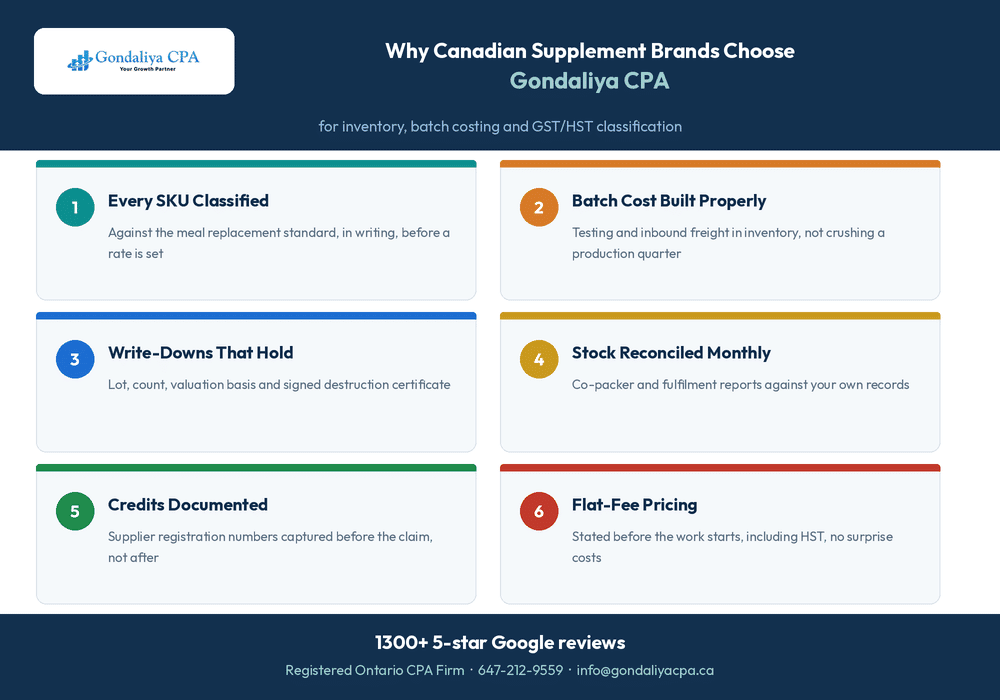
Classify each SKU against the meal replacement and nutritional supplement standards before you set a rate, because the gap between 0% and 13% is the largest number in this guide. Put ingredients, co-packing, packaging, release testing and inbound freight into batch cost, and keep outbound freight and storage out of it. Document write-downs with lot numbers, counts and destruction certificates before the stock leaves. Log every sample in five fields. Reconcile co-packer and fulfilment stock monthly rather than annually. And keep six years of records, because every position above is only as good as the file behind it.
What is current: The classification line between dietary supplements and labelled meal replacements remains as set out in GST/HST Memorandum 4.3 and Info Sheet GI-001, and CRA rulings through the 2020s have consistently confirmed that protein powders marketed for therapeutic, performance or physique benefits are taxable dietary supplements rather than basic groceries. The Ontario rate remains 13%, record retention remains six years, the T2 filing deadline remains six months after year-end, and T4 slips remain due the last day of February.
What changed: The Input Tax Credit Information (GST/HST) Regulations were last amended on 20 June 2024, raising the documentary thresholds at which supplier registration numbers and additional information must be captured — worth checking against your accounts payable workflow if it was set up before that date. The 2026 Ontario Budget, tabled 26 March 2026, also reduced the provincial small business corporate income tax rate from 3.2% to 2.2% effective 1 July 2026, taking the combined rate on the first $500,000 of active business income from 12.2% to 11.2%, with a blended rate for year-ends straddling that date.
Start with one SKU and one batch file
Gondaliya CPA classifies each product against the meal replacement and nutritional supplement standards in writing before a rate is set, builds batch cost so release testing and inbound freight sit in inventory rather than crushing a production quarter, documents write-downs to a standard a reviewer will accept, and reconciles co-packer and fulfilment stock monthly. Flat annual fee including HST, stated before the work starts, with a one-business-day response. Please book a free consultation.
Next Steps
Please book a free consultation with Gondaliya CPA and bring three things: the label copy for your top-selling SKU, one complete batch cost file, and your most recent third-party stock report. Those three show whether the rate you charge is right, whether your margin means anything, and whether the inventory on your balance sheet still exists. You will get a flat annual fee including HST before any work begins. For tailored advice on supplement brand tax accounting in Canada contact Gondaliya CPA at info@gondaliyacpa.ca or call 647-212-9559 today.
Published: · Last updated:
Editorial policy: We research against the Excise Tax Act, the Income Tax Act, CRA memoranda and info sheets, CRA rulings and CPA Canada standards, fact-check the figures, and Sharad Gondaliya, CPA, reviews the content, which we update as the rules change.
Disclaimer: This article is educational information only and is not tax, legal, or financial advice. Figures marked illustrative are examples rather than quotes or guarantees. Product classification for GST/HST depends on the specific product, its label and its marketing, and must be confirmed product by product. Rates, limits and standards change and outcomes depend on your specific facts. Please consult a licensed CPA before acting.

Sharad Gondaliya is a CPA Canada & CPA USA with 15 Years+ experience of Accounting, Tax, Payroll of Corporate Small Businesses as Tax Accountant. He is fully certified CPA Ontario and CPA USA and is well known among corporate small businesses for tax planning, efficient tax solutions, and affordable CPA services. Sharad is the Principal (Director) of Gondaliya CPA – Affordable CPA Firm in Canada. Licenses: CPA Ontario: 61040184 | CPA USA (MT): PAC-CPAP-LIC-033176 | CPA USA (WA): 57629 | CPA Firm License: 61330051 View Full Author Bio