



The Ultimate Guide to Construction Project Management Firm Taxes and Accounting in Canada
Construction project management accounting Canada explained: holdbacks, T5018, GST/HST timing and overhead
At Gondaliya CPA, we provide tailored construction project management accounting Canada services including payroll management using tools like ADP and Wagepoint, bookkeeping through QuickBooks and Xero, and reliable corporate tax filing (T2). Our expertise covers subcontractor agreements, progress billing, input tax credits, GST/HST registration, and compilation engagements that keep your construction management firm accounting compliant and organized.
Quick Summary
The Contract Payment Information Return is due six months after the end of the reporting period you elect. GST/HST on a holdback is payable on the earlier of the day it is paid and the day the holdback period expires, under ETA 168(7). And Ontario’s Construction Lien Act became the Construction Act in 2018.
Reading time: 49 minutes.
Table of Contents
- Three Things You Have Been Told
- Introduction and Core Services
- Essential Accounting and Tax Services
- Construction-Specific Tax Considerations
- Streamlining Accounting Operations
- Process Overview and Client Engagement
- Why Choose Gondaliya CPA
- Frequently Asked Questions
- Essential Topics and Best Practices
- Businesses We Serve
- Professional Guidance and Quick Reference
The Numbers That Matter
This article covers Canada, with Ontario and Toronto context, and reflects rules current to 30 September 2026. It is written for incorporated construction project management firms — agency managers paid a fee, trade contract managers carrying subcontracts, owner’s representatives and design-build managers. Gondaliya CPA performs compilation engagements; we do not perform audits or review engagements, and where a lender or surety requires one we refer it out. Figures marked illustrative are examples, not quotes, and any masked engagement notes end with “Figures changed for privacy.” This is educational information only and not tax or legal advice. Lien legislation differs by province, so please confirm the position where you build.
Three Things You Have Been Told
Three Things You Have Been Told
The Corrections
Three points about construction management tax circulate widely and all three are wrong. The first appears in two mutually contradictory versions in the same guidance.
The T5018 Is Not Due in 45 Days, and Not on 28 February
Risk Warning: the Contract Payment Information Return is due six months after the end of the reporting period you elect. Guidance stating “45 days after calendar year-end” and, elsewhere in the same document, “by February 28” is wrong twice and inconsistent with itself.
The obligation sits in Regulation 238 of the Income Tax Regulations — not in ITA section 286.4, which does not exist, and not in Excise Tax Act section 165, which imposes GST. You elect either a calendar year or your fiscal period as the reporting period, and the return is due six months after it ends.
| Element | The rule |
|---|---|
| Who files | A business whose primary activity is construction |
| What is reported | Payments to subcontractors for construction services |
| Threshold | $500 or more to a subcontractor in the reporting period |
| Reporting period | Calendar year or fiscal period, by election |
| Deadline | Six months after the period ends |
| Guide | CRA Guide RC4445 |
CRA Guide RC4110 is Employee or Self-Employed? — a useful publication, but not the T5018 guide it gets cited as.
General Overhead Is Just as Deductible as Project Overhead
Risk Warning: “only project overhead is deductible against its related revenue under subsection 18(1)(a)” is wrong. Paragraph 18(1)(a) allows any outlay made for the purpose of gaining or producing income from the business, subject to reasonableness under section 67.
Admin salaries, office rent and utilities are fully deductible. The project-versus-general distinction is a costing question — which costs attach to work in progress and which are period costs — not a deductibility question. A firm that stops claiming its general overhead because of this has given up a real deduction for no reason.
GST/HST on a Holdback Has Its Own Rule
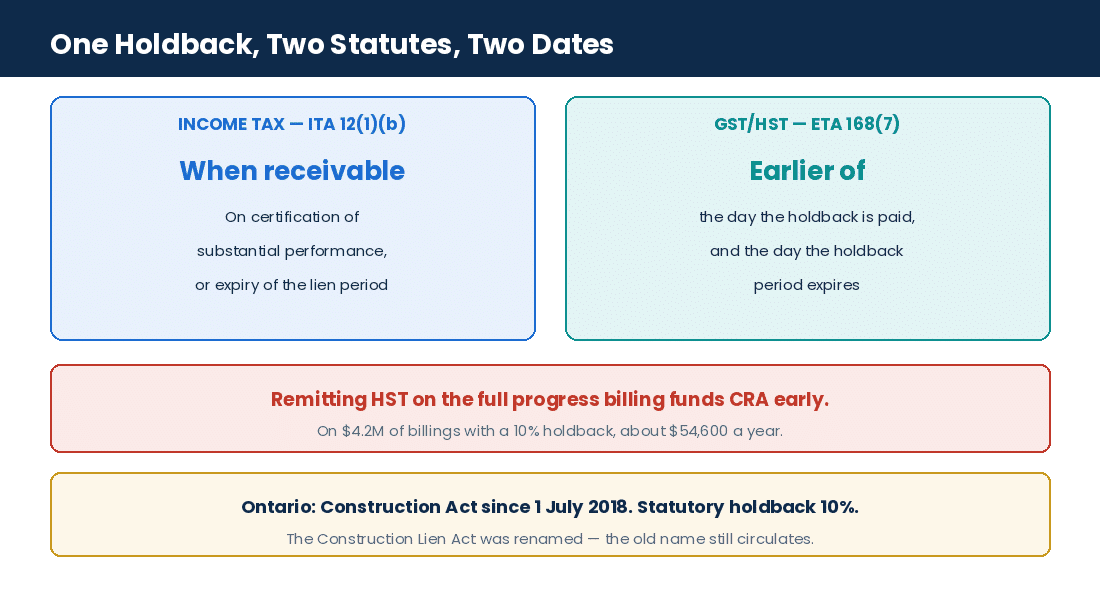
Income tax and GST/HST treat a holdback differently, and the GST/HST rule is specific to construction.
| Question | Rule | Provision |
|---|---|---|
| When is a holdback income? | When it becomes receivable — on certification or expiry of the lien period | ITA 12(1)(b) |
| When is GST/HST on a holdback payable? | Earlier of the day it is paid and the day the holdback period expires | ETA 168(7) |
| Construction of real property generally | Earlier of payment, due date, and one month after substantial completion | ETA 168(3)(c) |
Subsection 168(7) exists precisely because a contractor should not have to remit tax on money the owner is lawfully withholding. Firms that remit on the full invoice including holdback are funding CRA out of working capital, sometimes for a year.
A Toronto design-build manager had been remitting HST on the full progress billing, holdback included, for three years.
Under ETA 168(7) the tax on the 10% holdback was not payable until the holdback was released or the lien period expired. On roughly $4.2 million of annual billings that is about $54,600 of HST remitted early, every year, on money not yet received. Figures changed for privacy.
Introduction to Construction Project Management Accounting in Canada
Introduction and Core Services
Foundations
Construction Project Management Accounting Services for Canadian Firms
A construction management firm carries accounting problems a general service business never meets: revenue that depends on certification rather than invoicing, statutory holdbacks with their own tax timing, subcontractor reporting obligations, and the question of whether you are an agent earning a fee or a principal carrying the trades.
Key Benefits of Specialized Accounting for Construction Management Businesses
- Deductions identified across project costs, general overhead and capital equipment.
- GST/HST filed on the right base, with holdback tax deferred under ETA 168(7).
- Payroll remitted by your band, not by a rule of thumb.
- Capital cost allowance claimed in the right class — Class 38 for earth-moving equipment, not Class 8.
- The T5018 filed to its actual deadline.
Compliance with the Income Tax Act and Excise Tax Act
The provisions that actually govern are worth stating correctly. Business income is computed under section 9, with amounts included when receivable under paragraph 12(1)(b). Expenses are deductible under paragraph 18(1)(a) where incurred to earn income, subject to reasonableness in section 67.
Paragraph 12(1)(a) concerns amounts received for goods not yet delivered or services not yet rendered — relevant to a deposit, not to contract revenue generally. Paragraph 18(1)(e) denies reserves and contingent liabilities. Neither is a general rule about reporting income or claiming deductions, and citing them as such sends readers to the wrong place.
Importance of Accurate Tax Filing and Bookkeeping
- The Contract Payment Information Return filed six months after the reporting period ends.
- Records retained six years from the end of the taxation year to which they relate, under paragraph 230(4)(b).
- Certified progress claims, lien certificates and change orders filed against each contract.
- Holdbacks receivable and payable tracked as separate schedules.
Key Stat: Ontario’s Construction Lien Act became the Construction Act on 1 July 2018. The statutory holdback is 10%, released after the lien period expires following publication of the certificate of substantial performance.
Two files a year arrive citing “ITA section 286.4” for the Contract Payment Information Return.
The Income Tax Act has no section 286. The obligation is Regulation 238 of the Income Tax Regulations, and the confusion appears to come from ETA section 286, which concerns books and records. Figures changed for privacy.
Essential Accounting and Tax Services for Construction Management Firms
Essential Accounting and Tax Services
Core Services
Corporate Tax Filing and Planning for Incorporated Firms
| Obligation | Deadline | Provision |
|---|---|---|
| T2 return | Six months after fiscal year-end | ITA 150(1)(a) |
| Balance of tax | Two months; three for an eligible CCPC | ITA 157(1)(b) |
| Corporate instalments | Last day of each month or quarter | ITA 157(1)(a), 157(1.1) |
| T5018 | Six months after the reporting period | Reg 238 |
| T4 and T4A slips | Last day of February | Reg 205(1) |
The balance is due before the filing deadline, which is the date most firms miss. No instalments are required where total taxes payable are $3,000 or less, or in a first taxation year.
Worked example. A Toronto design-build firm reports $1.2 million of contract fees for a year ending 31 December. Holdbacks of $120,000 become receivable on 15 January following certification, and are included in income then under paragraph 12(1)(b). The HST on that holdback becomes payable under ETA 168(7) on the earlier of release and expiry of the lien period — a separate date from the income inclusion. Figures changed for privacy.
Handling Payroll and T4/T4A Slips for Site Staff and Supervisors
| Remitter type | Average monthly withholding | Due |
|---|---|---|
| Quarterly | Under $1,000 with a clean record | 15th of the month after the quarter |
| Regular | Under $25,000 | 15th of the following month |
| Accelerated, threshold 1 | $25,000 to $99,999.99 | 25th of the same month; 10th of the following |
| Accelerated, threshold 2 | $100,000 or more | Within 3 working days of the period end |
The band follows your average monthly withholding amount under section 153 and Regulation 108, not your headcount. Late remittance is penalised under subsection 227(9) from 3% to 10%, with directors personally liable under section 227.1 — not under subsection 162(2), which is the repeat late-filing penalty for returns.
- Employed site supervisors receive a T4 with CPP and EI withheld.
- Self-employed supervisors and contractors receive a T4A where fees for services exceed $500 in the year, under Regulation 200(1).
- Classification follows the Wiebe Door factors as refined in Sagaz and Connor Homes, with CRA Guide RC4110 and a ruling on Form CPT1.
Managing GST/HST Registration, Filing, and Input Tax Credits
Registration is required under subsection 240(1) once the $30,000 small supplier threshold in section 148 is exceeded. Section 238 is the provision requiring returns to be filed, not the threshold.
| Event | GST/HST payable when | Provision |
|---|---|---|
| Progress billing issued | Earlier of payment and the day consideration becomes due | ETA 168(1) |
| Construction of real property | Also no later than one month after substantial completion | ETA 168(3)(c) |
| Holdback | Earlier of payment and expiry of the holdback period | ETA 168(7) |
| Input tax credit on a purchase | When the tax becomes payable or is paid, whichever is earlier | ETA 169(1) |
- Filing frequency: annual to $1.5M of taxable supplies with payment three months after year-end; quarterly to $6M; monthly above, each due one month after the period ends. There is no three-day grace period.
- Input tax credit support under subsection 169(4): over $30 the supplier’s name and date, over $150 the supplier’s registration number, the recipient’s name, terms and a description.
- Credits lost after the four-year claim window.
- Late filing penalised under ETA 280.1 at 1% plus 0.25% per month, on top of interest.
Bookkeeping Solutions Using QuickBooks, Xero, and Construction Software
- A chart of accounts separating fee revenue from gross billings, which is the agency-versus-principal question in ledger form.
- Job costing by contract, with committed cost and cost-to-complete visible.
- Holdback receivable and holdback payable as distinct control accounts.
- Hubdoc or equivalent capturing vendor invoices to support input tax credits.
- Records retained six years from the end of the taxation year under paragraph 230(4)(b) — not under Schedule II, which holds the capital cost allowance classes.
Reporting Subcontractor Payments and Contractor Classification
A business whose primary activity is construction files the T5018 under Regulation 238, reporting payments of $500 or more to each subcontractor, due six months after the elected reporting period ends. Written agreements should set control, tools, chance of profit and risk of loss, because misclassification produces assessed source deductions for both employer and employee shares plus interest and penalty.
Compilation Engagements and Financial Statements
A compilation engagement under CSRS 4200 assembles financial statements from information supplied by management, with a basis of accounting note and a report stating that no assurance is provided. Under ASPE, revenue on construction contracts is dealt with in Section 3400 — Revenue — not Section 3061, which is property, plant and equipment, and not Section 3065, which is leases.
An Etobicoke firm had been remitting payroll on the 15th of the following month while its average monthly withholding had grown past $25,000.
It had moved into accelerated threshold 1, where remittance is due on the 25th of the same month and the 10th of the following. Every remittance had been late for two years, with 227(9) penalties accruing quietly. Figures changed for privacy.
Construction-Specific Tax Considerations and Compliance
Construction-Specific Tax Considerations
Industry Rules
Understanding Holdback Timing and Contract Payment Reporting
| Item | Recognised when | Record required |
|---|---|---|
| Holdback receivable | Becomes receivable under the contract and lien legislation — on certification or expiry of the lien period | Certified progress claim, certificate of substantial performance |
| Holdback payable | Deductible once the related cost is incurred | Trade invoice and proof of payment |
| GST/HST on holdback | Earlier of payment and expiry of the holdback period, ETA 168(7) | Lien period calculation |
Worked example. A Vaughan design-build manager bills $50,000 in October with a 10% holdback. The holdback is certified on 15 December, so it becomes receivable and is included in income on that date under paragraph 12(1)(b). The HST on it follows ETA 168(7) and the related trade cost is deducted when incurred, which may be a third date entirely. Figures changed for privacy.
Navigating Lien Rules, Progress Billing, Change Orders, and Claims
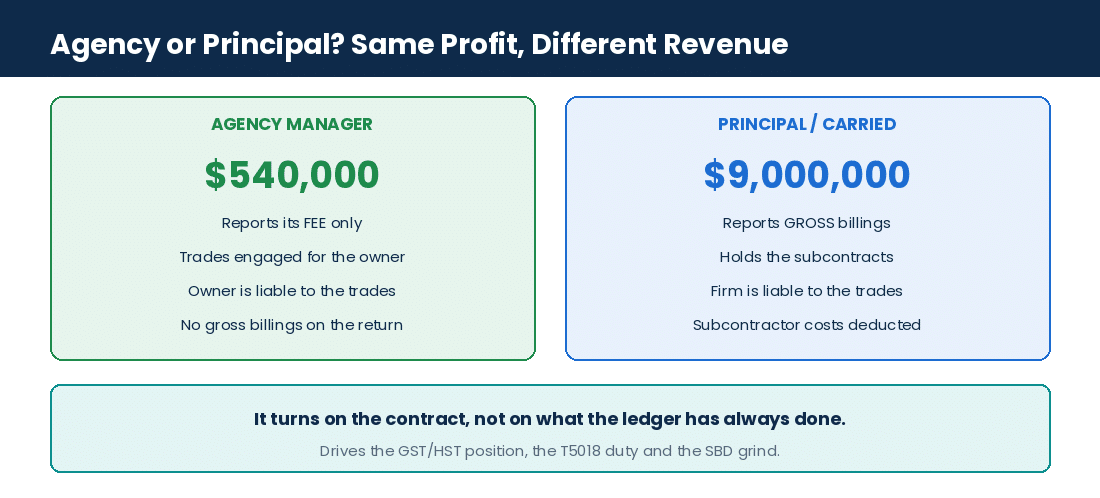
Key Stat: agency or principal is the question that changes your revenue line by an order of magnitude. An agent engaging trades on the owner’s behalf reports only its fee. A principal carrying the subcontracts reports gross billings with subcontractor costs deducted.
Same profit, wildly different revenue — and it drives the GST/HST position, the T5018 obligation and the small business deduction grind. It turns on the contract: who is liable to the trades, who bears the risk, whose name is on the subcontract.
| Event | Treatment | Timing |
|---|---|---|
| Approved change order | Additional revenue | On approval, when receivable |
| Disputed claim | Excluded until it becomes receivable | On settlement |
| Cost-plus margin | Included as earned | Proportionally |
| Unbilled work at year-end | Work in progress, included | At the cut-off |
Unbilled work is not deferred income. It is work in progress carried under subsection 10(5), and not invoicing it does not move the tax.
Treatment of Deficiency Provisions and Bad Debts
Risk Warning: the provision denying a deficiency reserve is paragraph 18(1)(e), not section 67. Section 67 is the reasonableness test. Paragraph 18(1)(e) denies a deduction for a reserve, contingent liability or sinking fund except where the Act expressly permits one, and nothing permits a deficiency provision.
The cost is deductible when the remedial work is incurred. An accounting provision recognised under ASPE is added back on Schedule 1.
- Bad debts deducted under paragraph 20(1)(p)(i) where the amount was previously included in income and is established to have gone bad — not under section 67.
- Paragraph 20(1)(l) is the separate reserve for doubtful debts.
- The GST/HST already remitted on a written-off receivable is recoverable under section 231 of the Excise Tax Act — the step most firms miss.
- Collection correspondence retained as evidence.
A firm writing off $12,500 owed by an owner’s representative after six months of collection attempts deducts it under 20(1)(p)(i) and recovers the HST component under ETA 231.
Capital Cost Allowance and the Meals Limit
| Asset | Class | Rate |
|---|---|---|
| Excavating, moving, placing or compacting equipment | 38 | 30% |
| General site equipment, tools, furniture | 8 | 20% |
| Tools and instruments costing under $500 | 12 | 100% |
| Computers and systems software | 50 | 55% |
| Trucks and automotive equipment | 10 | 30% |
| Passenger vehicle | 10.1 | 30%, capped at $39,000 |
Describing all site equipment as Class 8 at 20% understates the claim on the machinery that actually moves earth, which is Class 38 at 30%. The first claim is gated by the available-for-use rule in subsections 13(26) to (32), and the half-year rule is suspended for eligible property acquired after 31 December 2024 under Bill C-15.
Risk Warning: there is no overtime exception to the 50% meals limit. Section 67.1 restricts food, beverages and entertainment to 50%, and working late is not one of the exceptions.
What is relevant to construction is subsection 67.1(2), which relieves meals provided at a temporary or remote work site. That turns on the site, not the shift. Section 67.1 is also the right citation — IT-529 concerns flexible employee benefit programs, not meals.
Record Retention Requirements and Electronic Filing Best Practices
- Six years from the end of the taxation year to which they relate, paragraph 230(4)(b) — not seven, and not from the filing date. Section 286 of the Excise Tax Act imposes the same period for GST/HST.
- Electronic filing of the T2 is mandatory for most corporations under subsection 150.1(2.1).
- Contracts, certified progress claims, change orders, lien certificates and trade invoices held for the full period.
CRA Compliance Essentials for Agency Managers and Owner’s Representatives
- Holdbacks included in income before they became receivable.
- HST remitted on holdbacks before 168(7) made it payable.
- T5018 not filed despite subcontractor payments above $500.
- Fee-only revenue reported gross, or gross billings reported net.
- Deficiency provisions deducted before the work was done.
- Subcontractor agreements missing, leaving classification undocumented.
- Unbilled work absent from year-end income.
An agency manager should hold signed engagement letters and a fee schedule that make the agency relationship plain on its face. Where the contract is silent, CRA reads the conduct.
Streamlining Accounting Operations for Construction Project Management Firms
Streamlining Accounting Operations
Operations
Implementing Payroll Services with ADP, Wagepoint, and Payroll Compliance
- Remittance automated to your band under section 153 and Regulation 108, with the band re-tested each year as the withholding amount grows.
- T4 slips filed by the last day of February, Regulation 205(1).
- Employer CPP at 5.95% and EI at 1.4 times the employee premium for 2026, plus CPP2 above the first ceiling.
- Accrued remuneration paid within 179 days of year-end under subsection 78(4), or the deduction shifts to the year of payment.
- Penalties under subsection 227(9), not 162(2), with director liability under section 227.1.
Integrating Project Overhead and General Overhead Costs
Project overhead — site offices, hoarding, temporary services, equipment rental on a contract — attaches to that contract and forms part of work in progress. General overhead — admin salaries, head office rent, utilities, insurance — is a period cost.
Both are fully deductible under paragraph 18(1)(a). The distinction determines when a cost lands in the income statement through work in progress, not whether it may be claimed.
Utilizing Project Software and Tools
- QuickBooks Online or Xero as the ledger, with job costing by contract.
- Hubdoc capturing vendor invoices with the detail subsection 169(4) requires.
- Stripe or Rotessa for collections, reconciled gross with fees expensed separately.
- ADP or Wagepoint feeding payroll into the ledger.
- A committed-cost report so cost-to-complete is visible before the month closes.
Managing Multi-Site Construction Firms Efficiently
- Centralised cloud bookkeeping with per-project reporting.
- A consistent cut-off policy for unbilled work applied across every site.
- One subcontractor register feeding the T5018.
- Overhead allocation applied on the same basis year to year.
- Provincial allocation on Schedule 5 where a permanent establishment exists in more than one province, under Regulations 400(2) and 402.
Best Practices for Bookkeeping and Income Tracking
- Vendor invoices linked to contracts, timesheets to labour costs, proof of payment to both.
- Signed change orders and lien certificates filed against the contract they affect.
- Income recognised when receivable, ordinarily on certification — not when invoiced.
- Unbilled work accrued at year-end with progress reports behind it.
- Separate ledger accounts so project funds do not mix with general funds.
- Records held six years from the end of the taxation year, not seven.
A firm had been told to keep records for seven years and was storing an extra year of paper and cloud data across nine active sites.
The requirement is six years from the end of the taxation year to which the records relate, under paragraph 230(4)(b). The seventh year was neither required nor harmful — but the same guidance had also put the T5018 deadline at 45 days, and that one had cost real penalties. Figures changed for privacy.
Process Overview and Client Engagement for Construction Accounting Support
Process Overview and Client Engagement
Process
How Construction Firms Work with Professional Accountants
The work divides into four streams: bookkeeping that tracks progress billings, holdbacks, change orders and claims by contract; payroll remitted to the right band with the right slips; GST/HST filed on the right base with holdback tax deferred where 168(7) allows; and the T2 with its GIFI schedules tied to compiled statements.
Step-by-Step Process from Financial Review to Ongoing Tax Planning and Filing
- Review contracts live at year-end and identify which progress claims have been certified.
- Include holdbacks in income only once receivable under the contract and lien legislation.
- Record approved change orders; exclude disputed claims until they become receivable.
- Accrue unbilled work in progress at the cut-off, with progress reports behind it.
- Reconcile the subcontractor register and file the T5018 six months after the reporting period.
- Reconcile payroll and confirm the remitter band.
- Compute GST/HST, applying 168(7) to holdbacks and 168(3)(c) to real property construction.
- Prepare compiled financial statements under CSRS 4200, with no assurance provided.
- File the T2 within six months, having paid the balance at two or three.
Transparent Pricing Models and Service Guarantees
A flat annual fee including HST for incorporated construction management firms, quoted on your structure before work begins: number of active contracts, whether you operate as agent or principal, how many subcontractors, how many provinces. The engagement letter states that a compilation provides no assurance and that reviews and audits are referred out. Gondaliya CPA offers a 30-Day Money-Back Guarantee and a 60-Day Fees-Matching Policy.
Ensuring Accurate Filing Deadlines and Instalment Payments
| Obligation | Deadline | Reference |
|---|---|---|
| Corporate T2 filing | Six months after fiscal year-end | ITA 150(1)(a) |
| Balance of tax | Two months; three for an eligible CCPC | ITA 157(1)(b) |
| Corporate instalments | Last day of each month or quarter | ITA 157(1)(a), 157(1.1) |
| Contract Payment Information Return | Six months after the reporting period | Reg 238 |
| Payroll remittance | By remitter band | ITA 153; Reg 108 |
| GST/HST filing | By assigned frequency | ETA 238 |
Instalments are based on the prior year or an estimate of the current year, whichever produces the lower total, with interest under subsection 161(2) and a further penalty under section 163.1 only where that interest exceeds $1,000.
Support for CRA Audits, Tax Notices, and Catch-Up Filings
- Rebuilding contract files: signed agreements, certified claims, change orders, lien certificates, trade invoices.
- Filing the oldest year first, so opening balances and loss carryforwards flow correctly.
- Voluntary disclosure considered before CRA contact, where the conditions are met.
- Relief from penalties and interest requested under subsection 220(3.1) on Form RC4288, within ten calendar years.
- CRA representation on holdback timing, agency status and worker classification.
An owner’s representative firm had been reporting gross billings of roughly $9 million when it was acting purely as an agent on a fee.
Its actual revenue was the fee, around $540,000. Reporting gross had pushed it past the small business deduction taxable capital tests on paper and produced a GST/HST position that never reconciled. The contracts made the agency plain; the ledger did not. Figures changed for privacy.
Why Choose Gondaliya CPA for Construction Project Management Accounting
Why Choose Gondaliya CPA
Why Us
Expertise in Construction Industry Accounting and Tax Compliance
- Holdback timing handled on both statutes: receivable under 12(1)(b), GST/HST under ETA 168(7).
- Agency versus principal settled from the contract, with the ledger built to match.
- T5018 filed to its real deadline, with the $500 threshold applied per subcontractor.
- Capital cost allowance claimed in Class 38, 8, 12, 50 and 10 as the asset actually requires.
- Deficiency provisions added back under 18(1)(e) and released when incurred.
- Unbilled work accrued under subsection 10(5) at the cut-off.
Experienced Team Supporting Corporate Clients Across Ontario and Canada
We work with agency managers paid a fee, trade contract managers carrying subcontracts, owner’s representatives across multiple sites and design-build managers with staged billing. Books run in QuickBooks Online or Xero with payroll through ADP or Wagepoint, and compiled statements prepared under CSRS 4200 to support lenders and sureties who do not require assurance.
Commitment to Reliable, Transparent, and Personalized Service
- A licensed Ontario CPA firm, verifiable on the CPA Ontario public directory.
- Google-verified client feedback across Ontario and beyond.
- Flat annual fee including HST, quoted before work begins.
- A reply within one business day, including weekends around deadlines.
- 30-Day Money-Back Guarantee and 60-Day Fees-Matching Policy.
Client Success Stories Demonstrating Effective Tax Planning and Accounting Solutions
The two findings that recur most often are holdbacks brought into income or into a GST/HST return before either statute made them due, and a T5018 filed late because the deadline was taken from guidance rather than from Regulation 238. Both are fixable, and both cost less to fix before a review.
Contact Information and Next Steps to Engage Gondaliya CPA
Call 647-212-9559 or email info@gondaliyacpa.ca to book a free consultation. We serve Toronto, Etobicoke, Vaughan, Mississauga, Brampton, Scarborough, Hamilton and Ottawa, and work with firms across Canada.
FAQs on Construction Project Management Firm Taxes and Accounting
Frequently Asked Questions
FAQ
When is the Contract Payment Information Return due?+
Six months after the end of the reporting period you elect — either a calendar year or your fiscal period. Not 45 days, and not 28 February. The obligation sits in Regulation 238 of the Income Tax Regulations, and the guide is RC4445.
What is the penalty for late T5018 filing?+
A penalty applies per information return, scaled by the number of slips and the lateness, with a minimum of $100. The practical exposure is the repeat: a firm that files late every year accumulates it every year.
How long must a construction firm keep accounting records?+
Six years from the end of the taxation year to which they relate, under paragraph 230(4)(b) — not seven, and not six years from the filing date. Section 286 of the Excise Tax Act imposes the same period for GST/HST records.
When is a holdback income for tax purposes?+
When it becomes receivable under the contract and the applicable lien legislation — ordinarily on certification of substantial performance or expiry of the lien period, under paragraph 12(1)(b). Invoicing it earlier does not make it receivable.
When is GST/HST on a holdback payable?+
Under subsection 168(7) of the Excise Tax Act, on the earlier of the day the holdback is paid and the day the holdback period expires. This is a different date from the income inclusion, and remitting on the full progress billing means funding CRA out of working capital.
What is the meals and entertainment deduction limit?+
50% under section 67.1, with the input tax credit recaptured to 50%. There is no overtime exception. The relevant carve-out for construction is meals provided at a temporary or remote work site under subsection 67.1(2), which turns on the site rather than the shift.
What are the payroll remittance due dates?+
They follow your average monthly withholding amount, not headcount. A regular remitter pays by the 15th of the following month; quarterly remitters by the 15th after the quarter; accelerated remitters twice or four times a month. “Last day after the quarter ends” is not a CRA date.
How should project overhead be treated?+
Project overhead attaches to its contract and forms part of work in progress; general overhead is a period cost. Both are fully deductible under paragraph 18(1)(a). The split affects when a cost hits income, not whether it can be claimed.
What is the difference between agency and principal reporting?+
An agent engaging trades on the owner’s behalf reports only its fee as revenue. A principal carrying the subcontracts reports gross billings and deducts subcontractor costs. Same profit, very different revenue, and it drives the GST/HST and T5018 positions.
Can I deduct a deficiency provision?+
Not until the remedial cost is incurred. Paragraph 18(1)(e) denies reserves and contingent liabilities — not section 67, which is the reasonableness test. The ASPE provision is added back on Schedule 1.
How are bad debts handled?+
Deducted under paragraph 20(1)(p)(i) where the amount was previously included in income and has become bad, with collection efforts documented. The GST/HST already remitted is recovered separately under section 231 of the Excise Tax Act.
What CCA class does site equipment fall into?+
Equipment for excavating, moving, placing or compacting earth is Class 38 at 30%. General site equipment, tools and furniture are Class 8 at 20%; tools under $500 are Class 12 at 100%; computers are Class 50 at 55%. The half-year rule is suspended for eligible property acquired after 31 December 2024.
Should a construction management firm handle accounting in-house or hire a CPA firm?+
A bookkeeper can run the day-to-day. What a licensed firm adds is the judgement: agency or principal, when a holdback became receivable, which overhead attaches to work in progress, and whether a worker is a contractor. Only a licensed firm can issue a CSRS 4200 compilation report.
What deliverables do clients receive?+
Monthly reconciled books with job costing, payroll and slips, GST/HST returns, the T5018, compiled financial statements under CSRS 4200, the T2 with GIFI, holdback receivable and payable schedules, and CRA correspondence handled.
How much does construction management firm accounting cost in Canada?+
A flat annual fee including HST, quoted on your structure before work begins. What moves it is the number of active contracts, whether you act as agent or principal, how many subcontractors and how many provinces.
What are the common mistakes in construction project management accounting?+
Holdbacks brought into income before they were receivable; HST remitted on holdbacks before 168(7) made it payable; the T5018 filed to the wrong deadline; general overhead treated as non-deductible; deficiency provisions deducted early; unbilled work omitted at the cut-off; and gross billings reported where only a fee was earned.
What should firms prepare before engaging a CPA firm?+
Signed contracts with holdback terms, progress billings and certified claims, change orders and claim status, the subcontractor register, payroll records, lien certificates, prior filings and notices, and the unbilled work schedule at the last year-end.
What triggers a CRA review in this sector?+
Early holdback recognition, missing T5018 filings against visible subcontractor payments, revenue that mixes fee-only with gross billing, expenses claimed before incurred, and payroll deductions inconsistent with the slips issued.
Eighteen questions, and the two on holdbacks carry more money than the other sixteen combined.
They are also the two where income tax and GST/HST give different answers on the same dollar, which is why so many firms get one of them right and the other wrong. Figures changed for privacy.
Key Points: Construction Project Management Tax & Accounting Essentials
Essential Topics and Best Practices
Quick Reference
- Holdback income: receivable on certification or expiry of the lien period, ITA 12(1)(b).
- Holdback GST/HST: earlier of payment and expiry of the holdback period, ETA 168(7).
- Real property construction: tax also payable one month after substantial completion, ETA 168(3)(c).
- T5018: six months after the reporting period, $500 per subcontractor, Regulation 238.
- Payroll: remit by average monthly withholding band; penalties under 227(9).
- Records: six years from the end of the taxation year, 230(4)(b).
- Meals: 50% under 67.1, with a work-site carve-out, no overtime exception.
- Overhead: project and general both fully deductible under 18(1)(a).
- Deficiency provisions: denied by 18(1)(e) until incurred.
- Bad debts: 20(1)(p)(i), with GST/HST recovered under ETA 231.
- Site equipment: Class 38 at 30% for earth-moving; Class 8 at 20% otherwise.
- Compilation: CSRS 4200, no assurance provided.
Which Tax Obligations Matter Across Business Segments
- GST/HST registration once taxable supplies exceed $30,000, under ETA 148 and 240(1).
- Payroll remittance, T4 and T4A slips by the last day of February.
- Corporate tax filing at six months, with the balance at two or three.
- Contract Payment Information Return at six months after the reporting period.
- Provincial allocation on Schedule 5 where a permanent establishment exists elsewhere.
- Work in progress accrued at each year-end under subsection 10(5).
How Firms Catch Up When Filings Are Behind
- Rebuild contract files first: agreements, certified claims, change orders, trade invoices.
- Reconstruct the subcontractor register for every missed reporting period.
- File the oldest year first, so balances and carryforwards flow properly.
- Consider a voluntary disclosure before CRA makes contact.
- Request relief under subsection 220(3.1) on Form RC4288, within ten years.
Points Worth Carrying
- The T5018 is due six months after the reporting period, not 45 days or 28 February.
- Regulation 238 governs it — there is no ITA section 286.4.
- RC4445 is the T5018 guide; RC4110 is Employee or Self-Employed?.
- General overhead is fully deductible.
- ETA 168(7) defers GST/HST on holdbacks.
- Ontario’s Construction Lien Act became the Construction Act in 2018.
- Records run six years, not seven.
- 18(1)(e) denies deficiency provisions, not section 67.
- ASPE 3400 is Revenue; 3061 is PP&E; 3065 is Leases.
- Earth-moving equipment is Class 38 at 30%.
Twenty-eight points, and the ten at the end are all things a construction manager was told confidently by something they read.
None are obscure. They are ordinary rules attached to the wrong section, the wrong deadline or the wrong accounting standard. Figures changed for privacy.
Businesses We Serve
Industry Expertise
Construction management practices share the same issues whatever they build. Here are ten and the usual finding.
| Practice | The Issue That Usually Appears |
|---|---|
| Agency construction managers | Gross billings reported where only a fee was earned |
| Trade contract managers | T5018 filed to the wrong deadline or not at all |
| Design-build managers | HST remitted on holdbacks before ETA 168(7) |
| Owner’s representatives | Agency status undocumented in the contracts |
| Multi-site firms | No Schedule 5 provincial allocation filed |
| Cost-plus contractors | Shared savings arrangements undocumented |
| Firms with earth-moving plant | Class 38 equipment pooled into Class 8 |
| Firms carrying deficiencies | Provisions deducted before the work was done |
| Firms with year-end cut-offs | Unbilled work omitted from income |
| Growing payrolls | Remitter band never re-tested as withholding grew |
- Agency construction managers: the fee is the revenue.
- Trade contract managers: six months, $500 per subcontractor.
- Design-build managers: ETA 168(7) defers the holdback tax.
- Owner’s representatives: put the agency in the engagement letter.
- Multi-site firms: Regulations 400(2) and 402, Schedule 5.
- Cost-plus contractors: document base cost and agreed margin.
- Firms with earth-moving plant: Class 38 at 30%.
- Firms carrying deficiencies: 18(1)(e) until incurred.
- Firms with year-end cut-offs: WIP under subsection 10(5).
- Growing payrolls: re-test the band annually.
The project changes. The questions do not: are you agent or principal, when did the holdback become receivable, and which statute is asking.
A residential design-build manager and an industrial owner’s representative look nothing alike on site and file nearly identical returns. Figures changed for privacy.
Professional Guidance and Quick Reference
Guidance
Professional Guidance: How Gondaliya CPA Handles Your Construction Firm
Construction management firms get into difficulty in a predictable set of ways: filing the Contract Payment Information Return to a deadline taken from guidance rather than from Regulation 238, which sets it at six months after the elected reporting period rather than 45 days or 28 February; remitting GST/HST on the full progress billing when subsection 168(7) defers the tax on the holdback until it is paid or the holdback period expires; treating general overhead as somehow less deductible than project overhead, when paragraph 18(1)(a) allows both in full; bringing holdbacks into income before they became receivable under paragraph 12(1)(b) and the applicable lien legislation; deducting deficiency provisions that paragraph 18(1)(e) denies until the remedial work is incurred; pooling earth-moving plant into Class 8 at 20% when it belongs in Class 38 at 30%; and reporting gross billings where the firm was acting purely as an agent on a fee. Gondaliya CPA handles construction management accounting on a flat annual fee.
We handle what decides the outcome: settling agency versus principal from the contracts and building the ledger to match, tracking holdback receivable and payable as separate schedules with their two different tax dates, filing the T5018 to Regulation 238’s deadline with the $500 threshold applied per subcontractor, re-testing the payroll remitter band each year, accruing unbilled work at the cut-off under subsection 10(5), claiming capital cost allowance in the class the asset actually falls into with the half-year rule suspension applied, adding deficiency provisions back on Schedule 1 and releasing them when incurred, and preparing compiled statements under CSRS 4200 that state plainly that no assurance is provided.
Our team starts with one contract, one certified progress claim and your subcontractor register. Whatever you build, you get clear advice and a fixed price before we start.
Quick Answers
At a Glance
- T5018 deadline: six months after the reporting period
- T5018 threshold: $500 per subcontractor
- Holdback income: when receivable, ITA 12(1)(b)
- Holdback GST/HST: ETA 168(7)
- Real property supply: ETA 168(3)(c)
- Overhead: both types fully deductible
- Deficiency provisions: denied by 18(1)(e)
- Bad debts: 20(1)(p)(i) plus ETA 231
- Earth-moving equipment: Class 38 at 30%
- Meals: 50% under 67.1
- T2: six months; balance at two or three
- Records: six years from the taxation year-end
Who This Is For
Fit Check
- For: Incorporated Canadian construction project management firms — agency managers, trade contract managers, owner’s representatives and design-build managers, single-site or multi-province.
- Not For: Sole proprietors, who file a T1 with form T2125 on different dates, and firms needing a review or audit for a surety or lender, which we refer out.
People Also Ask
Quick Answers
Is the T5018 due 45 days after year-end?+
No. Six months after the end of the reporting period you elect, under Regulation 238. Neither 45 days nor 28 February is correct.
Do I remit HST on the holdback portion of a progress billing?+
Not yet. Subsection 168(7) makes the tax on a holdback payable on the earlier of the day it is paid and the day the holdback period expires. Remitting earlier funds CRA out of your working capital.
Is general overhead deductible?+
Yes, fully, under paragraph 18(1)(a). The project-versus-general distinction is about which costs attach to work in progress, not about deductibility.
Which lien statute applies in Ontario?+
The Construction Act. The Construction Lien Act was renamed effective 1 July 2018. The statutory holdback is 10%.
Is all site equipment Class 8?+
No. Equipment for excavating, moving, placing or compacting earth is Class 38 at 30%. Class 8 at 20% is the residual for general equipment, tools and furniture.
Glossary of Key Terms
Glossary
- Holdback: An amount withheld under lien legislation, 10% in Ontario.
- Substantial performance: The milestone triggering the lien period and release.
- Certificate of substantial performance: The published certificate starting the lien clock.
- ETA 168(7): Defers GST/HST on a holdback until paid or expired.
- ETA 168(3)(c): Tax on real property construction, one month after substantial completion.
- Regulation 238: The Contract Payment Information Return requirement.
- T5018: The slip reporting subcontractor payments of $500 or more.
- Agency manager: A firm engaging trades for the owner, reporting only its fee.
- Carried contract: A firm holding the subcontracts, reporting gross billings.
- Progress billing: An interim invoice, not necessarily revenue.
- Work in progress: Unbilled work carried under subsection 10(5).
- Deficiency provision: An estimate of remedial cost, denied by 18(1)(e) until incurred.
- Class 38: Earth-moving equipment at 30% declining balance.
- Project overhead: Costs attaching to a specific contract.
- ASPE 3400: The revenue standard governing construction contracts.
- CSRS 4200: The compilation engagement standard, providing no assurance.
Construction Firm Tax Check
This quick self-check indicates where your firm most likely has room. Please answer the five questions below.
Construction Firm Tax Check
Five quick questions on your business. No fee shown.
Points to raise with us:
This is a general prompt, not tax or legal advice or a quote. Your position depends on your full facts. For a real review, please book a free consultation.
Want a checklist to work from? You can download our free construction management tax checklist before your consultation.
File the Contract Payment Information Return six months after the reporting period you elected, under Regulation 238, and stop working to a 45-day or February deadline that appears nowhere in the rules. Separate the two holdback dates: income when the amount becomes receivable on certification or expiry of the lien period, and GST/HST on the earlier of payment and expiry under ETA 168(7), which means you should not be remitting tax on holdback money you have not received. Claim your general overhead in full, because paragraph 18(1)(a) does not care whether a cost attaches to a contract. Add deficiency provisions back under 18(1)(e) and release them when the remedial work is actually done. Put earth-moving plant in Class 38 at 30% rather than pooling it into Class 8. Settle agency versus principal from the contract before the ledger is built, since it changes the revenue line by an order of magnitude. Accrue unbilled work at the cut-off under subsection 10(5). And please keep six years of records from the year-end, not seven.
2026 Update — what is current: This article reflects rules current to 30 September 2026. The six-month T2 filing deadline under 150(1)(a), the 50% meals limit in section 67.1, the $500 T4A and T5018 thresholds and the six-year retention requirement under 230(4)(b) are unchanged. Please note that the Contract Payment Information Return is governed by Regulation 238 and due six months after the elected reporting period, with CRA Guide RC4445; that GST/HST on a holdback is payable under subsection 168(7) on the earlier of payment and expiry of the holdback period, with real property construction also caught by 168(3)(c) one month after substantial completion; that holdbacks are included in income when receivable under paragraph 12(1)(b) and unbilled work is carried under subsection 10(5); that both project and general overhead are fully deductible under paragraph 18(1)(a) subject to section 67; that deficiency provisions are denied by paragraph 18(1)(e) until incurred and bad debts deducted under 20(1)(p)(i) with the GST/HST recovered under ETA 231; that earth-moving equipment sits in Class 38 at 30% and the half-year rule is suspended for eligible property acquired after 31 December 2024 under Bill C-15; that payroll remittance follows the average monthly withholding band under section 153 and Regulation 108 with penalties under subsection 227(9); that Ontario’s Construction Lien Act has been the Construction Act since 1 July 2018, with a 10% statutory holdback; and that construction contract revenue is dealt with under ASPE 3400, not 3061 or 3065.
Construction Project Management Accounting Canada: How Gondaliya CPA Supports Firms
Start with one contract and your subcontractor register
Gondaliya CPA settles agency versus principal from your contracts and builds the ledger to match, tracks holdback receivable and payable with their two separate tax dates, defers GST/HST on holdbacks where ETA 168(7) allows, files the T5018 to Regulation 238’s deadline with the $500 threshold applied per subcontractor, re-tests your payroll remitter band, accrues unbilled work at the cut-off, claims capital cost allowance in the right class, and files the GST/HST, the compiled statements and the T2 with its GIFI from one reconciled set of books — on a flat annual fee including HST with a one-business-day response. Please book a free consultation.
Next Steps
Please book a free consultation with Gondaliya CPA and bring one signed contract with its holdback terms, one certified progress claim, and your subcontractor register. Those three settle the agency question, the holdback timing question and the T5018 obligation, which is where most of the exposure sits for a construction management firm. You will get a flat annual fee including HST before any work begins. We serve Toronto, Etobicoke, Vaughan, Mississauga, Brampton, Scarborough, Hamilton and Ottawa, and work with firms across Canada. If our content helps, please add gondaliyacpa.ca as a preferred source on Google.
Published: · Last updated:
Editorial policy: We research against CRA, CPA Canada and CPA Ontario sources, fact-check the figures, and Sharad Gondaliya, CPA, reviews the content, which we update as the rules change.
Disclaimer: This article is educational information only and is not tax, legal, or financial advice. Figures marked illustrative are examples rather than quotes or guarantees. It reflects rules current to 2026, including the Regulation 238 reporting deadline, the ETA 168(7) holdback rule, the Class 38 rate, the suspension of the half-year rule and the six-year retention requirement. Lien legislation and rates differ by province and outcomes depend on your specific facts. Please consult a licensed CPA before acting.

Sharad Gondaliya is a CPA Canada & CPA USA with 15 Years+ experience of Accounting, Tax, Payroll of Corporate Small Businesses as Tax Accountant. He is fully certified CPA Ontario and CPA USA and is well known among corporate small businesses for tax planning, efficient tax solutions, and affordable CPA services. Sharad is the Principal (Director) of Gondaliya CPA – Affordable CPA Firm in Canada. Licenses: CPA Ontario: 61040184 | CPA USA (MT): PAC-CPAP-LIC-033176 | CPA USA (WA): 57629 | CPA Firm License: 61330051 View Full Author Bio