



Cross-Border E-Commerce Tax in Canada: Foreign Currency, Exchange Gains & International Sales
Cross-border ecommerce tax Canada: GST/HST, foreign currency reporting and CRA compliance
Cross-border ecommerce tax Canada requires careful attention to GST/HST rules, foreign currency reporting, and CRA compliance to avoid penalties and arrears interest. Gondaliya CPA helps businesses manage place of supply, electronic filing, foreign tax credits, and accurate bookkeeping for smooth T2 corporate tax filing and proper foreign balances reporting.
Quick Summary
Selling abroad produces three recurring problems: converting every transaction at the right rate rather than one annual average, knowing which gains are taxable and when, and working out whether your foreign bank balance is reportable at all. The last one is where most sellers are given the wrong answer.
Reading time: 44 minutes.
Table of Contents
- GST/HST Basics for International Sellers
- Marketplaces and Direct Website Sales
- Foreign Currency Translation
- Exchange Gains, Losses and Conversion Fees
- The Functional Currency Election
- Foreign Balances and Form T1135
- Bill C-15, the DST and What Changed
- Transfer Pricing for Related Parties
- Hidden Costs, Conversion Fees and Landed Cost
- US Sales Tax and European VAT
- Frequently Asked Questions
- Quick Answers, Glossary and Next Steps
The Numbers That Matter
This guide covers Canada, with Ontario and Toronto context, and reflects rules current to 2026. It is written for incorporated Canadian businesses selling internationally through their own sites and through marketplaces, holding balances in foreign currency. Figures marked illustrative are examples rather than quotes, and masked engagement notes end with “Figures changed for privacy.” Whether a particular foreign balance is specified foreign property depends on how it is actually used, and must be assessed on your facts. This is educational information only and not tax or legal advice.
GST/HST Basics for International E-Commerce Sellers
GST/HST Basics for International Sellers
Sales Tax
If you sell online from Canada to other countries, GST/HST matters a lot. Canadian sellers add GST or HST to taxable sales within Canada. Exports of goods are generally zero-rated under Schedule VI, Part V of the Excise Tax Act, which means no tax is charged on those sales while input tax credits on the related costs remain fully recoverable.
The three indirect taxes
- GST at 5% applies federally.
- HST combines the federal and provincial components in Ontario, New Brunswick, Newfoundland and Labrador, Nova Scotia and Prince Edward Island.
- PST remains separate in British Columbia, Manitoba and Saskatchewan, and Quebec runs QST administered by Revenu Québec. Alberta and the territories have no provincial sales tax.
| Destination | Rate |
|---|---|
| Ontario | 13% HST |
| Nova Scotia | 14% HST, reduced from 15% on 1 April 2025 |
| British Columbia | 5% GST plus 7% PST |
| Alberta | 5% GST only |
| Outside Canada | Generally zero-rated with export evidence |
Registration thresholds
You must register once taxable supplies exceed $30,000 over four consecutive calendar quarters, or in a single calendar quarter. The two tests behave differently and the second is the one sellers miss.
| Test | When small supplier status ends | When to apply |
|---|---|---|
| Four consecutive quarters | First day of the second month after the quarter in which you exceeded | Before that date |
| Single calendar quarter | Immediately, on the supply that crossed the threshold | Within 29 days of that day |
The threshold counts associated persons together, so a group of related corporations cannot each claim a fresh $30,000. Failure to register does not avoid the tax: you remain liable for tax on supplies made after the date registration was required, whether or not you collected it.
The penalty exposure here sits in the Excise Tax Act, not the Income Tax Act, and the real cost is rarely a fixed fine. It is the tax you should have charged and did not, which comes out of margin, plus compound daily interest at the prescribed rate plus four percentage points. On a year of unregistered Ontario sales of $400,000, that is $52,000 of tax you never collected from your customers.
Place of supply
Place of supply decides which rate applies. It is determined under section 144.1 and Schedule IX of the Excise Tax Act, and for goods it generally follows where the goods are delivered or made available to the customer — not where your business sits and not the billing address.
For a supply made outside Canada, or an export supported by evidence that the goods left the country, the supply is zero-rated. Zero-rated is not exempt: you charge nothing and keep every input tax credit. That distinction is worth real money to an exporter.
Marketplaces and Direct Website Sales
Marketplaces and Direct Website Sales
Platforms
Tax duties change depending on whether you sell through a marketplace or your own website. The rules that govern this came from the digital economy amendments to the Excise Tax Act, in force since 1 July 2021, and they sit in sections 211.1 to 211.25.
Under subsection 211.23(1), where a registered distribution platform operator facilitates a supply of goods made by a vendor who is not registered for GST/HST, the platform operator is treated as the supplier and is responsible for charging and remitting the tax. The unregistered vendor is not.
| Scenario | Who charges GST/HST | What you still do |
|---|---|---|
| Registered Canadian seller, own website | You | Register, charge by destination, remit, keep records |
| Registered Canadian seller, marketplace | Generally you — the deeming rule targets unregistered vendors | Reconcile what the platform reports against your own records |
| Unregistered non-resident vendor, marketplace | The platform operator | Report the income; the tax duty sits with the platform |
| Non-resident selling digital products to Canadian consumers | The vendor or platform, under the simplified regime | Register under the simplified or normal regime as applicable |
The common misreading is that a marketplace takes over the tax duties of every seller on it. The deeming rule is aimed at supplies by vendors who are not registered. A registered Canadian corporation selling through a marketplace generally remains the supplier for its own sales and keeps its own obligations.
A Toronto seller on a major marketplace stopped remitting GST/HST on Canadian orders after reading that the platform now handled it. The corporation was registered, so the deeming rule did not apply to its supplies. Fourteen months of Canadian sales had tax collected by nobody. The assessment covered roughly $63,000 of tax plus interest, none of which could be recovered from customers who had bought at a tax-inclusive price. Figures changed for privacy.
If you sell directly on your own site you register, charge the correct rate for the destination, remit on your assigned schedule, and keep records showing where each supply was made. Our Amazon seller GST/HST guidance covers the marketplace side in detail.
Input tax credits
Input tax credits let a registrant recover GST/HST paid on purchases used in commercial activity. The documentary requirements are prescribed under subsection 169(4) by the Input Tax Credit Information (GST/HST) Regulations, and above a modest threshold the supplier’s registration number must appear on the invoice.
Where supplier invoices are denominated in a foreign currency, translate them at the rate for the transaction date rather than a period average. For GST paid at the border on imported goods, the credit belongs to the importer of record — check whose business number is on the customs accounting document before claiming, because a broker or logistics provider appearing there can defeat the claim even though you funded the shipment.
Filing frequency
GST/HST filing frequency is federal and is set by your annual taxable supplies. It does not vary by province.
| Annual taxable supplies | Assigned frequency | Return due |
|---|---|---|
| $1.5 million or less | Annual, with the option to elect more often | Three months after fiscal year-end |
| Over $1.5 million to $6 million | Quarterly, with the option to elect monthly | One month after the period end |
| Over $6 million | Monthly | One month after the period end |
An annual filer whose net tax for the previous year was $3,000 or more generally makes quarterly instalments during the year. Our GST/HST filing work covers registration and the return cycle.
Foreign Currency Translation
Foreign Currency Translation
Translation
If your Canadian company sells internationally, you report revenue and balances in Canadian dollars. Section 261 of the Income Tax Act requires amounts to be translated using the exchange rate quoted for the day the transaction arose, unless a functional currency election applies.
Transaction rate against average rate
The default is the rate for the day of each transaction. CRA accepts an average rate over a period — monthly, quarterly or annual — where the rate does not fluctuate significantly over that period and the approach is applied consistently.
What you cannot do is apply the year-end closing rate to every transaction in the year. That silently converts currency movement into reported income or loss on transactions that were already settled.
| Method | When acceptable | Record required |
|---|---|---|
| Transaction-date rate | Always — the default | Invoice and payment dates with source documents |
| Period average rate | Where rates were stable and use is consistent | Written policy plus the calculation log |
| Year-end closing rate for everything | No | — |
Worked example
A Toronto seller takes US$50,000 on a US marketplace in March 2026, when the rate was 1 USD = 1.30 CAD.
| Approach | Reported revenue | Status |
|---|---|---|
| Transaction-date rate at 1.30 | $65,000 | Correct |
| Single annual average at 1.36 | $68,000 | Only if rates were stable and applied consistently |
| Year-end closing rate at 1.42 | $71,000 | Not acceptable |
The spread between the first and third rows is $6,000 of revenue on a single month’s sales, created by nothing but the method. Across a year of marketplace payouts the distortion compounds.
Use a single published source and stay with it. The Bank of Canada publishes a daily exchange rate, and CRA accepts rates from that source or from another source that is widely available, verifiable and used consistently. Switching sources mid-year to whichever is more favourable is the pattern that attracts attention.
Exchange Gains, Losses and Conversion Fees
Exchange Gains, Losses and Conversion Fees
Gains
Three things get conflated here constantly: a gain that has been realised, a movement that has not, and a bank fee. They are taxed differently and belong in different places.
| Item | Treatment | When recognised |
|---|---|---|
| Realised gain or loss on an operating transaction | Income account under section 9 | On settlement or conversion |
| Realised gain or loss on a capital transaction | Capital under subsection 39(2) | On settlement or conversion |
| Unrealised movement on a held balance | Generally not taxable | Only on realisation |
| Bank or platform conversion fee | Deductible expense | When incurred |
Whether a gain is income or capital follows the character of the underlying transaction. Foreign exchange on trade receivables from selling your product is on income account, because the receivable arose in the ordinary course of business. Foreign exchange on, say, a long-term investment holding is capital.
Worked example
A Mississauga seller receives US$10,000 on 15 May when USD/CAD is 1.28, and converts it two weeks later at 1.25.
| Step | Amount |
|---|---|
| Revenue recognised at 1.28 | $12,800 |
| Cash received on conversion at 1.25 | $12,500 |
| Realised exchange loss | $300 |
| Conversion fee charged by the platform | Separate deductible expense |
The $300 reduces business income as a foreign exchange loss. It is not a reduction of revenue, and the revenue figure stays at $12,800. Netting the loss into sales understates both revenue and the loss, and makes the margin unreadable.
Conversion fees deducted by a marketplace before payout are an expense, not a discount on your sales. Record the gross payout as revenue and the fee as a cost. A seller who books only the net deposit understates revenue, understates expenses, loses the deduction’s visibility, and — where the fee carried GST/HST — loses the input tax credit entirely.
A seller holding USD across two platform accounts had been revaluing the balances at every month end and putting the movement through income. Over three years that produced a swing of roughly $41,000 of reported income that had never been realised. Unwinding it meant restating three years of statements. The money had never moved; only the spreadsheet had. Figures changed for privacy.
Hedging
Where a forward contract is entered into to hedge a specific transaction, the gain or loss on the contract generally takes the same character as the item hedged. The documentation matters: the hedging relationship should be identified when the contract is entered into, not reconstructed at year-end to suit the outcome.
The Functional Currency Election
The Functional Currency Election
Election
A Canadian corporation can elect to report in a qualifying functional currency instead of Canadian dollars, under section 261 of the Income Tax Act. For a seller whose revenue is overwhelmingly in US dollars, that can remove a great deal of translation work.
The conditions are strict:
- The corporation must be resident in Canada throughout the year and not an investment fund.
- The chosen currency must be a qualifying currency — US dollar, euro, pound sterling or Australian dollar.
- It must be the primary currency in which the corporation maintains its records for financial reporting.
- The election is filed in prescribed form on or before the day that is 60 days after the start of the first taxation year to which it applies.
- Once made it applies to that year and every year after, until revoked, and revocation has its own timing rules.
The deadline is the trap. The election must be filed within 60 days of the beginning of the first year it applies to — not at year-end and not with the return. A corporation that decides in month ten that USD reporting would have been easier has missed the window for that year entirely, and a late election is not generally accepted.
The election is not automatically beneficial. It converts a translation problem into a different one, because Canadian-dollar costs, Canadian payroll and the eventual Canadian tax payment all then require translation the other way. It suits a corporation whose revenue, costs and financing are genuinely predominantly in one foreign currency, and it suits few others.
A Vaughan seller taking roughly 90% of revenue on a US marketplace asked about electing USD. On review, inventory was bought in CAD from a Canadian distributor, the warehouse and all four staff were in Ontario, and the only USD item was revenue. The election would have created translation work on the cost side larger than the work it removed on the revenue side. We did not file it. Figures changed for privacy.
Foreign Balances and Form T1135
Foreign Balances and Form T1135
Reporting
This is the area where cross-border sellers are most often given the wrong instruction, in both directions.
What specified foreign property is
Form T1135 must be filed where the total cost amount of all specified foreign property exceeded $100,000 CAD at any time in the year. The test is cost, not market value, and it is an aggregate across all such property.
Specified foreign property is defined in subsection 233.3(1) and includes funds held outside Canada, shares of non-resident corporations, foreign real estate held other than for personal use, and debts owed by non-residents.
What is excluded — and why it matters here
The definition expressly excludes property used or held exclusively in the course of carrying on an active business. For a cross-border e-commerce corporation, that exclusion is the whole question.
| Asset | Specified foreign property? |
|---|---|
| USD operating account used exclusively to receive marketplace payouts and pay suppliers | No — used exclusively in the active business |
| Inventory held in a foreign fulfilment warehouse for the business | No — active business property |
| Receivables from foreign customers of the business | No — active business property |
| Surplus cash parked in a foreign account beyond business needs | Likely yes — not used exclusively in the business |
| Foreign shares or ETFs held by the corporation as investments | Yes |
| Foreign rental property | Yes |
| USD account at a Canadian bank | No — the funds are not held outside Canada |
The last row is worth its own sentence. A US-dollar chequing account at a Canadian bank is not specified foreign property, because the location of the institution decides it rather than the currency. Many sellers assume the opposite.
What the penalties actually are
| Situation | Penalty |
|---|---|
| Basic late filing, subsection 162(7) | $25 per day, minimum $100, maximum $2,500 |
| Failure knowing or grossly negligent | $500 per month to 24 months, maximum $12,000 |
| Failure after a formal demand to file | $1,000 per month to 24 months, maximum $24,000 |
| Continuing beyond 24 months | 5% of the cost of the foreign property, less penalties already levied |
The basic penalty runs at $25 a day for up to 100 days and stops at $2,500 per return per year. Three missed years caps at $7,500, not at six figures.
A seller was quoted a five-figure exposure for not filing T1135 on a US$180,000 marketplace settlement account. Two things were wrong with that. The account was used exclusively to receive payouts and pay suppliers, so it was active business property and outside the definition. And even had the form been required, the basic late-filing penalty tops out at $2,500 a year. The correct answer was a short memo supporting the exclusion, kept on file. Figures changed for privacy.
The exclusion is not a licence to ignore the form. It turns on the word exclusively. An account that receives business payouts and also holds the owner’s surplus funds, or that is used to buy foreign securities on the side, is no longer used exclusively in the active business. Mixed-use accounts are the ones that get assessed, and the fix is to keep a separate account rather than a separate argument.
Simplified and detailed reporting
Where the form is required and total cost is between $100,000 and $250,000 at all times in the year, the simplified method in Part A may be used. At $250,000 or more at any time, the detailed Part B reporting applies, requiring per-property disclosure including the maximum cost during the year, cost at year end, income, and any gain or loss on disposition.
T1135 asks for the name of the institution and the country, not account numbers.
The T1135 deadline matches the return it accompanies. For a corporation that means six months after fiscal year-end, alongside the T2. The form is an information return, not a tax charge — filing it costs nothing, and the penalty for not filing is the entire exposure.
Bill C-15, the DST and What Changed
Bill C-15, the DST and What Changed
Legislation
Two separate developments get run together, and keeping them apart matters because they affect different taxpayers.
The marketplace rules came in 2021
The requirement for distribution platform operators and non-resident digital suppliers to register and collect GST/HST came from the digital economy amendments to the Excise Tax Act, effective 1 July 2021, announced in the Fall Economic Statement 2020 and revised in April 2021. The operative provisions are sections 211.1 to 211.25.
Bill C-15 repealed the Digital Services Tax
The Digital Services Tax Act was enacted by Bill C-59, receiving Royal Assent on 20 June 2024, imposing a 3% tax on certain Canadian digital services revenue. The government announced on 29 June 2025 that it would rescind the tax, the day before the first payment deadline.
Bill C-15, the Budget 2025 Implementation Act, repeals the Digital Services Tax Act retroactive to 20 June 2024, removes references to it from other federal statutes, and requires CRA to refund any DST already paid, with interest from the date of payment. It passed third reading in the House on 26 February 2026 and received Royal Assent on 26 March 2026.
| Date | Event |
|---|---|
| 1 July 2021 | Digital economy GST/HST rules take effect |
| 20 June 2024 | Digital Services Tax Act receives Royal Assent via Bill C-59 |
| 29 June 2025 | Government announces the DST will be rescinded |
| 26 March 2026 | Bill C-15 receives Royal Assent, repealing the DSTA retroactively |
If your corporation registered for or paid DST before the rescission, the repeal requires CRA to refund it with interest from the date of payment. That is a recoverable amount sitting with CRA rather than a rule to comply with, and it will not arrive by itself if the registration was never followed up.
With the DST gone, the weight falls back on place of supply and on proving that exports are what you say they are. Keep shipping records and customer location evidence, because a zero-rated supply you cannot evidence is a taxable supply.
Transfer Pricing for Related Parties
Transfer Pricing for Related Parties
Related Parties
Where a Canadian corporation transacts with a non-arm’s-length non-resident — a US affiliate, a parent company, a related supplier — subsection 247(2) requires the terms to be those that arm’s-length parties would have used.
Contemporaneous documentation must be prepared by the filing due date for the year. It should describe the property or services involved, the terms, the parties and their relationships, the functions performed, assets used and risks assumed, and the data and methods used to set the price.
| Requirement | Detail |
|---|---|
| Standard | Arm’s-length terms, subsection 247(2) |
| Documentation deadline | The filing due date for the taxation year |
| Penalty | 10% of the transfer pricing adjustment under subsection 247(3) |
| Penalty threshold | Applies where adjustments exceed the lesser of $5 million and 10% of gross revenue |
| Relief | Reasonable efforts to determine and use arm’s-length prices, evidenced by the documentation |
The threshold matters. The 10% penalty is not charged on every adjustment — it applies once the adjustments pass the lesser of $5 million and 10% of gross revenue. For most SMB sellers, the practical exposure is the reassessment itself and the double taxation that follows, not the penalty.
Prices set in multiple currencies should be translated on the same basis as every other transaction: the rate for the transaction date, documented.
A Vancouver firm buying from a US affiliate had no documentation and prices that moved whenever the affiliate’s margin needed help. Preparing a contemporaneous study, pricing against comparable third-party arrangements and translating each invoice at its own transaction date resolved it before any reassessment. The documentation was the protection; the prices themselves turned out to be defensible once they were explained. Figures changed for privacy.
Hidden Costs, Conversion Fees and Landed Cost
Hidden Costs, Conversion Fees and Landed Cost
Costs
Marketplaces charge more than listing and selling fees. They add currency conversion fees when money crosses borders, and those fees lower what you actually earn without ever appearing as a line on your sales report.
Platform conversion against bank conversion
Banks convert at the mid-market rate plus a spread. Marketplace conversion services include their margin inside the rate rather than as a stated fee. Neither is free, and the comparison worth running is the all-in rate you receive, not the headline fee.
| Route | Where the cost sits | What to keep |
|---|---|---|
| Marketplace conversion service | Inside the exchange rate applied to the payout | Payout report showing gross USD and net CAD |
| Bank wire and conversion | Spread plus a stated wire fee | Bank advice showing rate and fee separately |
| Multi-currency account | Deferred — you convert when you choose | Monthly statements per currency |
Multi-currency accounts reduce the number of conversions and let you choose timing, which matters when you also hold USD costs. They do not remove the translation obligation: revenue is still recognised at the transaction-date rate whether or not the money has been converted.
Holding a foreign balance does not create taxable income. Converting it does. A multi-currency account lets you separate the commercial decision about when to convert from the accounting requirement to record revenue at the transaction rate — and keeping the business account distinct from any surplus funds also keeps the active business exclusion clean.
Landed cost and import GST
Landed cost is the full cost of getting goods to your warehouse: product, freight, duty, insurance and brokerage. GST paid at the border is generally recoverable as an input tax credit where the goods are for use in your commercial activity and you hold the customs accounting document. Duty is not recoverable — it is part of the cost of the goods.
| Component | Treatment | Record required |
|---|---|---|
| Customs duty | Into inventory cost | Import documents and the customs accounting document |
| Freight and brokerage | Into inventory cost | Carrier and broker invoices |
| Import GST | Recoverable input tax credit | Customs accounting document in your own name |
| Platform fees | Deductible expense | Fee statements |
Tariff classification drives the duty rate, and a wrong classification raises or lowers cost in ways that are expensive to unwind later. Our import and export accounting work covers the customs side.
US Sales Tax and European VAT
US Sales Tax and European VAT
Foreign Regimes
Selling abroad brings foreign indirect taxes that Canadian rules say nothing about.
United States
US sales tax is state-level. Most states apply an economic nexus test based on sales into the state, commonly a dollar threshold and in some states a transaction count, with no physical presence required. Marketplace facilitator laws mean the platform often collects on marketplace sales, while sales through your own site remain yours to handle. Registration, collection and filing are per state.
Where you pay US income tax on business profits, a foreign tax credit may be available against Canadian tax on the same income, subject to the treaty and to the limits in section 126. Our US corporation and LLC filing work covers the US return side.
European Union
The EU replaced country-by-country distance selling thresholds on 1 July 2021. For intra-EU distance sales there is now a single EU-wide threshold of €10,000, above which the rate of the customer’s member state applies, reported through the One Stop Shop.
For a Canadian seller shipping from outside the EU, the relevant scheme is the Import One Stop Shop, available for consignments valued at €150 or less, which lets you charge VAT at the point of sale and report it through a single registration. Above €150, import VAT and duty apply on entry.
The pre-2021 picture — separate distance selling thresholds for each member state — still circulates widely and has been wrong for years. A Canadian seller planning EU expansion against those old thresholds will register in the wrong places, at the wrong time, and may have shipments held at the border for want of an IOSS number.
Frequently Asked Questions on Cross-Border Ecommerce Tax Canada
Frequently Asked Questions
FAQ
Does my USD business account go on Form T1135?+
Generally not, if it is used exclusively in carrying on your active business. Property used or held exclusively in an active business is excluded from specified foreign property under subsection 233.3(1). Surplus or passive funds in the same account change that answer, which is why a separate operating account is worth having.
What is the penalty for failing to file T1135?+
The basic penalty is $25 per day, minimum $100, maximum $2,500 per return per year. Where the failure is knowing or grossly negligent it rises to $500 per month to a $12,000 maximum, or $1,000 per month to $24,000 after a formal demand, and beyond 24 months to 5% of the cost of the property.
What is the specified foreign property reporting threshold?+
Total cost amount of all specified foreign property exceeding $100,000 CAD at any time in the year. The test is cost, not market value, and it aggregates across all such property.
Is a US-dollar account at a Canadian bank reportable?+
No. It is the location of the institution that matters, not the currency. A USD chequing account at a Canadian bank is not funds held outside Canada.
How does section 261 affect currency translation?+
It requires amounts to be translated into Canadian dollars using the rate quoted for the day the transaction arose, unless a functional currency election applies. An average rate over a period is acceptable where rates did not fluctuate significantly and the approach is consistent.
Can I use one annual exchange rate for everything?+
Only where an average rate is genuinely appropriate and applied consistently. Applying the year-end closing rate to every transaction in the year is not acceptable, because it converts currency movement into reported income on transactions already settled.
What are the conditions for a functional currency election?+
The corporation must be resident in Canada, the currency must be a qualifying currency — US dollar, euro, pound sterling or Australian dollar — and it must be the primary currency in which records are kept for financial reporting. The election is filed within 60 days of the beginning of the first taxation year it applies to, and continues until revoked.
Are unrealised exchange movements taxable?+
Generally not. A gain or loss is recognised on settlement or conversion. Revaluing a held foreign balance at each month end and running the movement through income overstates or understates income on money that has not moved.
Are conversion fees deductible?+
Yes, as a separate expense. They should not be netted against revenue. Netting understates both revenue and expenses and can lose the input tax credit where the fee carried GST/HST.
Did Bill C-15 make marketplaces collect GST/HST?+
No. The marketplace and digital economy rules came from amendments to the Excise Tax Act effective 1 July 2021, in sections 211.1 to 211.25. Bill C-15, the Budget 2025 Implementation Act, repealed the Digital Services Tax Act retroactive to 20 June 2024 and received Royal Assent on 26 March 2026.
If I am registered, does the marketplace handle my GST/HST?+
Generally no. The deeming rule in subsection 211.23(1) applies to supplies by vendors who are not registered. A registered Canadian corporation selling through a platform usually remains the supplier for its own sales and keeps its own obligations.
Can I get back Digital Services Tax I already paid?+
Yes. The repeal requires CRA to refund DST paid, with interest from the date of payment. If your corporation registered or paid before the June 2025 rescission, that is a recoverable amount.
When must I register for GST/HST?+
Once taxable supplies exceed $30,000 over four consecutive calendar quarters, or in a single calendar quarter. The single-quarter test ends small supplier status immediately on the supply that crossed it, with registration required within 29 days.
How are exports treated?+
Generally zero-rated under Schedule VI, Part V, with input tax credits fully recoverable. You need evidence that the goods left Canada — shipping documents and the invoice showing the foreign destination.
When is the T2 due for a cross-border seller?+
Six months after fiscal year-end, with payment due earlier — two months after year-end, or three for an eligible CCPC claiming the small business deduction.
How long must records be kept?+
Six years from the end of the last taxation year to which they relate, under subsection 230(4) of the Income Tax Act, with section 286 of the Excise Tax Act applying on the sales tax side. Keep original foreign-currency invoices, payout reports and bank statements showing rates and fees.
Do I need to register for US sales tax?+
Possibly, state by state, where you meet that state’s economic nexus test. Marketplace facilitator laws often shift collection to the platform for marketplace sales, while sales through your own site remain yours.
What are the EU VAT thresholds now?+
Country-by-country distance selling thresholds were replaced on 1 July 2021 by a single EU-wide €10,000 threshold for intra-EU distance sales, reported through the One Stop Shop. A Canadian seller shipping from outside the EU uses the Import One Stop Shop for consignments of €150 or less.
What triggers a CRA review on cross-border filings?+
Mismatches between platform-reported revenue and filed income, inconsistent exchange rate sources, unrealised movements run through income, netted conversion fees, and missing or unnecessary T1135 filings.
Quick Answers
Reference
| Item | Answer |
|---|---|
| USD operating account, active business | Not specified foreign property |
| USD account at a Canadian bank | Not specified foreign property |
| T1135 threshold | $100,000 cost, at any time in the year |
| T1135 basic penalty | $25/day, max $2,500 |
| Simplified reporting | $100,000 to $250,000 cost |
| Translation rule | Transaction-date rate, section 261 |
| Functional currency election | Within 60 days of the year’s start |
| Unrealised movements | Generally not taxable |
| Conversion fees | Separate deductible expense |
| Marketplace rules | In force 1 July 2021 |
| DST | Repealed retroactive to 20 June 2024 |
| Exports | Zero-rated with evidence |
Who This Is For
Fit
- For: Incorporated Canadian businesses selling internationally through marketplaces or their own sites, holding balances in foreign currency, importing inventory, or transacting with related non-residents.
- Not For: Businesses selling only domestically in Canadian dollars; sole proprietors, whose filing mechanics differ; and non-residents with no Canadian presence, who face a different registration analysis entirely.
People Also Ask
Related
Why does my platform revenue not match my books?
Usually because the platform reports gross and you recorded the net deposit, or because the payout was converted at a rate different from the transaction-date rate used for revenue. Both are normal; both need to be visible rather than absorbed.
Should I open a multi-currency account?
It reduces the number of conversions and lets you choose timing, which helps if you also pay costs in that currency. It does not change when revenue is recognised, and keeping it exclusively for the business protects the active business exclusion.
Is a foreign exchange loss a reduction of revenue?
No. Revenue stays at the transaction-date amount and the exchange difference is a separate gain or loss. Netting it into sales makes the margin unreadable and hides the exposure.
Do I pay tax twice on US sales?
Not if the foreign tax credit is claimed properly. Where US tax is paid on the same business income, a credit may be available against Canadian tax under section 126 and the treaty, supported by the US return and proof of payment.
What if my books are behind on foreign reporting?
Reconcile using the correct transaction-date rates, establish whether T1135 was actually required, and file what is outstanding. Where penalties are material, consider whether a voluntary disclosure is available before filing in the ordinary course.
Does holding USD create a tax bill?
No. Holding does not. Converting or settling does, and that is when a realised gain or loss arises.
Glossary
Terms
- Active business exclusion: Property used or held exclusively in carrying on an active business, excluded from specified foreign property.
- Distribution platform operator: A platform that facilitates supplies by other vendors; deemed the supplier for unregistered vendors’ supplies.
- Functional currency election: An election under section 261 to report in a qualifying currency rather than Canadian dollars.
- Import One Stop Shop: The EU scheme for consignments of €150 or less, allowing VAT at the point of sale under one registration.
- Input tax credit: Recovery of GST/HST paid on purchases used in commercial activity.
- Place of supply: The rules in section 144.1 and Schedule IX fixing which rate applies.
- Qualifying currency: US dollar, euro, pound sterling or Australian dollar, for functional currency purposes.
- Realised gain: An exchange gain recognised on settlement or conversion.
- Section 126: The foreign tax credit provision relieving double taxation.
- Section 233.3: Defines specified foreign property and requires Form T1135.
- Section 247: The transfer pricing rules, with the 10% penalty in subsection 247(3).
- Section 261: The currency translation rules and the functional currency election.
- Simplified reporting method: T1135 Part A, available where cost is $100,000 to $250,000.
- Specified foreign property: Foreign assets reportable on T1135 where total cost exceeds $100,000.
- Subsection 211.23(1): Deems a registered platform operator the supplier for unregistered vendors’ goods.
- Subsection 39(2): Governs exchange gains and losses on capital account.
- Unrealised movement: A change in Canadian-dollar value of a held balance, generally not taxable until realised.
- Zero-rated: Taxed at 0% with input tax credits fully recoverable, unlike exempt supplies.
Key Obligations Checklist Before Starting Cross-Border Ecommerce Tax Work
- Verify your GST/HST registration status against both the four-quarter and single-quarter tests.
- Establish whether each foreign balance is used exclusively in the active business before assuming a T1135 obligation.
- Gather all foreign currency invoices with their exact transaction dates.
- Collect monthly statements for every foreign account and currency.
- Record conversion fees separately from sales revenue.
- Separate realised gains and losses from unrealised movements.
- Document any hedging relationship when the contract is entered into, not at year-end.
- Prepare transfer pricing documentation by the filing due date if you deal with related non-residents.
- Confirm your translation method follows section 261 and use one published rate source consistently.
- File the T2 within six months of fiscal year-end, with payment diarised earlier.
- Compile input tax credit claims with invoices meeting the prescribed requirements.
- Check whether DST was ever paid, since the repeal requires a refund with interest.
- Retain records for six years under subsection 230(4).
Want a checklist to work from? You can download our free cross-border ecommerce tax checklist before your consultation.
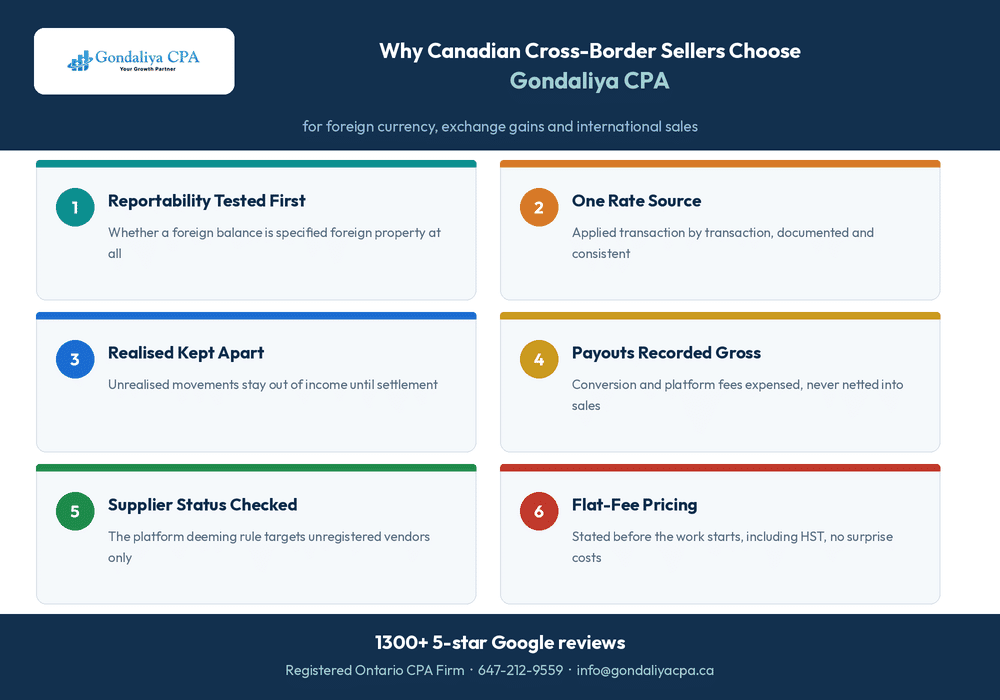
Before filing anything on a foreign balance, establish whether it is specified foreign property at all — an account used exclusively in your active business is excluded, and so is a USD account at a Canadian bank. Where T1135 is required, the basic penalty stops at $2,500 a year. Translate every transaction at its own date from one published source, keep realised gains apart from unrealised movements, and record conversion fees as expenses rather than netting them into sales. If you are registered for GST/HST, do not assume the marketplace is handling your tax — the deeming rule targets unregistered vendors. And if you ever paid Digital Services Tax, go and get it back.
What is current: The section 261 translation rules and the functional currency election are unchanged, as is the $100,000 T1135 threshold measured on cost, the active business exclusion in subsection 233.3(1), the $25 per day basic penalty capped at $2,500, the $30,000 GST/HST registration threshold on both tests, and the digital economy rules in force since 1 July 2021. Record retention remains six years and the T2 deadline remains six months after year-end.
What changed: Bill C-15, the Budget 2025 Implementation Act, received Royal Assent on 26 March 2026 and repealed the Digital Services Tax Act retroactive to 20 June 2024, with CRA required to refund DST paid plus interest. Nova Scotia’s HST fell to 14% on 1 April 2025. The 2026 Ontario Budget, tabled 26 March 2026, cut the provincial small business rate from 3.2% to 2.2% effective 1 July 2026, taking the combined rate on the first $500,000 of active business income from 12.2% to 11.2%.
Start with the foreign balance question
Gondaliya CPA establishes whether each foreign account is specified foreign property before any T1135 is filed, sets a single translation source and applies it transaction by transaction, separates realised gains from unrealised movements, reconciles platform payouts gross with fees expensed, and checks whether the marketplace deeming rule actually applies to your sales. Flat annual fee including HST, stated before the work starts, with a one-business-day response. Please book a free consultation.
Next Steps
Please book a free consultation with Gondaliya CPA and bring three things: one month of platform payout reports showing gross and net, statements for every foreign account you hold, and your last filed T2. Those three show whether your revenue is being translated correctly, whether any foreign balance is actually reportable, and whether the marketplace rules have been applied to the right party. You will get a flat annual fee including HST before any work begins. For expert help with cross-border ecommerce tax issues including accurate foreign currency translation, contact Gondaliya CPA today at info@gondaliyacpa.ca or call 647-212-9559, serving incorporated SMBs selling internationally from Toronto areas and across Canada. Growing sellers may also want to look at corporate tax planning for ecommerce companies and, where the finance function is stretched, CFO services.
Published: · Last updated:
Editorial policy: We research against the Income Tax Act, the Excise Tax Act, CRA publications and interpretations, and Department of Finance releases, fact-check the figures, and Sharad Gondaliya, CPA, reviews the content, which we update as the rules change.
Disclaimer: This article is educational information only and is not tax, legal, or financial advice. Figures marked illustrative are examples rather than quotes or guarantees. Whether a foreign balance qualifies for the active business exclusion depends on how it is actually used and must be assessed on your facts. Foreign indirect tax obligations in the United States and the European Union are governed by those jurisdictions. Please consult a licensed CPA before acting.

Sharad Gondaliya is a CPA Canada & CPA USA with 15 Years+ experience of Accounting, Tax, Payroll of Corporate Small Businesses as Tax Accountant. He is fully certified CPA Ontario and CPA USA and is well known among corporate small businesses for tax planning, efficient tax solutions, and affordable CPA services. Sharad is the Principal (Director) of Gondaliya CPA – Affordable CPA Firm in Canada. Licenses: CPA Ontario: 61040184 | CPA USA (MT): PAC-CPAP-LIC-033176 | CPA USA (WA): 57629 | CPA Firm License: 61330051 View Full Author Bio