



IT Staffing Company Tax Planning in Canada: Managing Contractor Costs, Payroll & Business Taxes
IT staffing company tax planning Canada explained: worker classification, remittance bands and placement agency rules
IT staffing company tax planning Canada involves managing payroll source deductions, corporate tax filing with T2 returns, and GST/HST registration to stay compliant. Gondaliya CPA offers support on worker classification, remittance timing, and input tax credits to help your staffing business handle accounting and bookkeeping accurately.
Quick Summary
The $30,000 small supplier threshold in ETA section 148 is fully in force and nothing was removed from section 123(1). Accrued remuneration must be paid within 179 days of year-end under subsection 78(4). And the placement agency rules that actually drive CPP and EI on your contractors are CPP Regulation 34 and EI Regulation 6(g).
Reading time: 50 minutes.
Table of Contents
- Three Things You Have Been Told
- Why Tax Planning Matters Here
- Corporate Tax Filing Requirements
- Payroll, CPP, EI and Slips
- GST/HST Registration and Compliance
- Specialized Planning Strategies
- Bookkeeping and Record Retention
- Frequently Asked Questions
- Essential Topics and Best Practices
- Businesses We Serve
- Professional Guidance and Quick Reference
The Numbers That Matter
This article covers Canada, with Ontario and Toronto context, and reflects rules current to 1 October 2026. It is written for incorporated Canadian IT staffing and recruitment agencies placing contractors and permanent hires, including firms operating in more than one province. Gondaliya CPA performs compilation engagements; we do not perform audits or review engagements, and where a lender or client requires one we refer it out. Contribution rates and maximums for CPP and EI are set annually by CRA, so the current year’s figures should be confirmed before any calculation. Figures marked illustrative are examples, not quotes, and any masked engagement notes end with “Figures changed for privacy.” This is educational information only and not tax or legal advice.
Three Things You Have Been Told
Three Things You Have Been Told
The Corrections
Three points about IT staffing tax circulate widely and all three are wrong. The first would have you register for GST/HST when you may not need to.
The $30,000 Threshold Was Not Removed
Risk Warning: the small supplier threshold is fully in force and it is not in section 123(1). Guidance stating that “the small supplier threshold was removed from Excise Tax Act s.123(1), so many firms must register regardless of revenue” is wrong on both counts.
The threshold lives in section 148, it remains $30,000 of taxable supplies, and nothing has been removed. Section 123(1) contains definitions. Registration is required under subsection 240(1) once you cease to be a small supplier — not from the first dollar of revenue.
Most incorporated staffing agencies will cross $30,000 in their first month, so the practical answer is usually “yes, register”. But a firm told the threshold no longer exists cannot assess its own position, and a brand-new agency billing nothing in its first quarter is not obliged to register on day one.
Accrued Pay Has 179 Days — Not 180, Not 365
The source material on this topic gives three different answers, which is itself the tell.
| Figure in circulation | Status |
|---|---|
| Within 12 months after year-end | Wrong — roughly six months too generous |
| Within one year after fiscal year-end | Same error, restated |
| Within 180 days | One day out |
| Within 179 days, ITA 78(4) | Correct |
Subsection 78(4) is precise: remuneration owed at year-end and still unpaid on the 179th day after the end of that taxation year is deemed not to have been incurred in the year, and is instead deducted in the year it is paid. For a 31 December year-end that date is 28 June. A firm working to twelve months will miss it by half a year and lose the deduction for a full year. The provision is also 78(4), not 18(1)(e), which denies reserves.
Remittance Follows Your Monthly Withholding, Not Your Annual Total
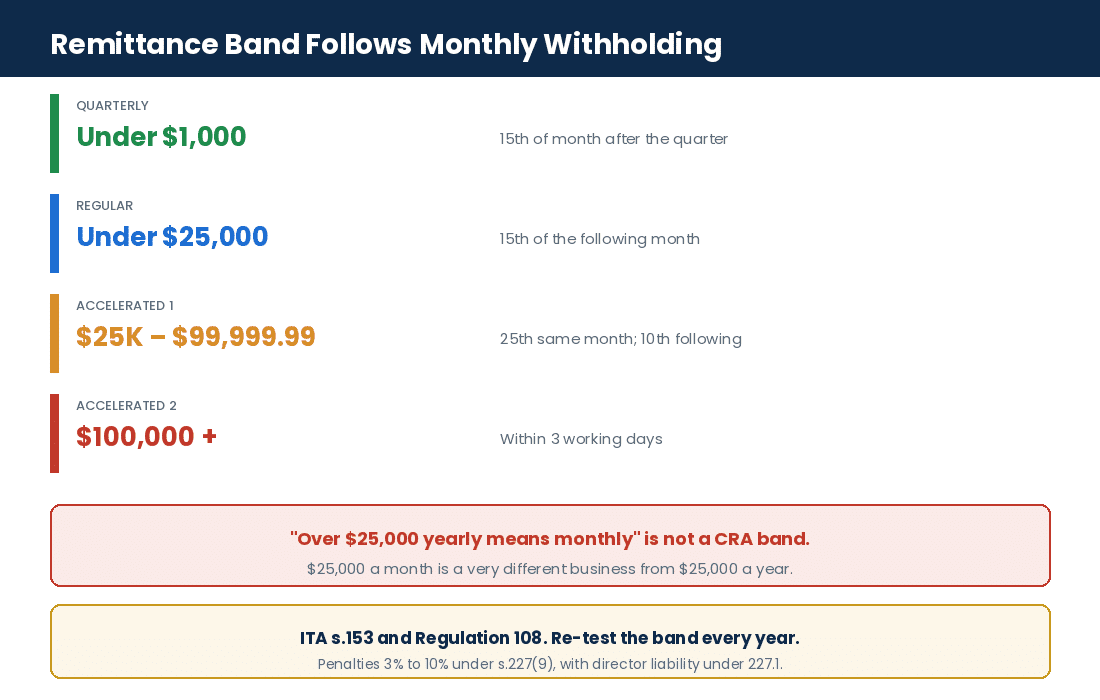
Risk Warning: “withhold over $25,000 yearly and you must remit monthly” describes no CRA band. The threshold is the average monthly withholding amount, and $25,000 a month is a very different business from $25,000 a year.
| Remitter type | Average monthly withholding | Due |
|---|---|---|
| Quarterly | Under $1,000 with a perfect compliance record | 15th of the month after the quarter |
| Regular | Under $25,000 | 15th of the following month |
| Accelerated, threshold 1 | $25,000 to $99,999.99 | 25th of the same month; 10th of the following |
| Accelerated, threshold 2 | $100,000 or more | Within 3 working days of each quarter-month period |
A staffing agency withholding $25,000 a year is a regular remitter paying on the 15th of the following month — not a monthly accelerated filer. Penalties under subsection 227(9) run from 3% to 10%, with directors personally liable under section 227.1.
A Toronto agency had been clearing owner bonuses at the twelve-month mark on the understanding that the window matched the fiscal year.
Subsection 78(4) gives 179 days. Roughly $180,000 of bonus deduction shifted into the following year in each of two years. Nothing was lost permanently, but the corporation paid tax a year early, twice. Figures changed for privacy.
Introduction and Importance of Tax Planning for IT Staffing Companies in Canada
Why Tax Planning Matters Here
Foundations
Understanding the Basics and Benefits
- Key elements of tax planning: accurate bookkeeping, filing to the right dates, and deductions claimed on a defensible basis.
- Immediate advantages: contractor payments coded correctly from the start, so the slip run in February is mechanical rather than archaeological.
- Long-term advantages: remittance obligations predictable enough to plan cash around, which matters when margins are thin and billings are lumpy.
Key Tax Challenges Unique to IT Staffing Businesses in Canada: Complex Contractor Arrangements
Key Stat: the placement agency rules are the single most distinctive feature of staffing tax, and they have their own provisions. CPP Regulation 34 and EI Regulation 6(g) deem a worker placed by an agency to be in pensionable and insurable employment with the agency where the worker is not the agency’s employee but performs services under the client’s direction and control.
So an agency can owe CPP and EI on a person it never employed, and calling the arrangement a contract does not displace the regulation. This is the rule behind every “even if you call them a contractor” warning, and it is worth citing properly rather than gesturing at.
Multi-Province Operations
- Payroll registered and remitted in each province where employees report to work.
- Provincial income allocated under Regulations 400(2) and 402 on Schedule 5 where a permanent establishment exists in more than one province.
- Employer health taxes applied where they exist — Ontario EHT, Manitoba HELT, BC Employer Health Tax — each with its own exemption and rate.
- Workers’ compensation registration per province, separate from payroll.
- One GST/HST registration covers the country; only BC, Saskatchewan, Manitoba and Quebec require their own separate sales tax registration.
Variable Revenue Recognition
Income is included when it becomes receivable under paragraph 12(1)(b), with unbilled hours carried as work in progress under subsection 10(5). A placement completed in the last week of the year is income even if it invoices in January, and holding the invoice does not move the tax.
How Timely Tax Planning Supports Compliance and Profitability
- The remittance band confirmed in writing once a year, since it moves as the payroll grows.
- Worker status reviewed against the placement agency regulations before a CPP/EI ruling forces it.
- Accrued bonuses diarised to day 179, not to the filing deadline.
- Gross billings reported as revenue with contractor cost deducted — not margin reported as revenue.
Gondaliya CPA’s Approach to Tailored Tax Solutions for IT Staffing Companies
Books built so gross billings, contractor cost and margin are each visible; worker status documented at onboarding; the remittance band tested annually; and the T2, GST/HST and slips filed from one reconciled set of records on a flat annual fee including HST.
Overview of Corporate Tax Filing Requirements for IT Staffing Companies
Corporate Tax Filing Requirements
Corporate
Navigating T2 Corporate Tax Returns: Filing Obligations, Deadlines and Essential Documentation
| Obligation | Deadline | Provision |
|---|---|---|
| T2 return | Six months after fiscal year-end | ITA 150(1)(a) |
| Balance of tax | Two months; three for an eligible CCPC | ITA 157(1)(b) |
| Corporate instalments | Last day of each month or quarter | ITA 157(1)(a), 157(1.1) |
| T4 and T4A slips | Last day of February | Reg 205(1) |
| Accrued remuneration paid | 179 days after year-end | ITA 78(4) |
| Ontario Annual Return | Six months after year-end | Ontario Business Registry |
The balance is due before the filing deadline, which most agencies miss. A 31 December year-end files by 30 June but pays by 28 February, or 31 March for a CCPC claiming the small business deduction. No instalments are required where total taxes payable are $3,000 or less, or in a first taxation year.
The slip deadline is the last day of February, not 28 February — the two coincide in most years and diverge in a leap year.
Federal and Provincial Considerations
| Rate | Small business income | General active business income |
|---|---|---|
| Federal | 9% | 15% |
| Ontario | 2.2% | 11.5% |
| Combined, Ontario | 11.2% | 26.5% |
The small business deduction applies to the first $500,000 of active business income under section 125. Two grinds reduce it: taxable capital between $10 million and $50 million under subsection 125(5.1), and adjusted aggregate investment income above $50,000, eliminating the limit at $150,000. Associated agencies share one limit under section 256 — which matters where an owner runs several staffing entities.
Required Forms and Schedules
- GIFI Schedules 100, 125 and 141 with the T2.
- Schedule 5 for provincial allocation where you have a permanent establishment in more than one province.
- Schedule 23 where associated corporations share the business limit.
- T4 for employees, T4A for contractors where fees for services exceed $500 in the calendar year.
- T4A-NR for non-residents providing services in Canada, with Regulation 105 withholding at 15%.
Eligible Business Deductions Specific to IT Staffing Operations
- Salaries and wages, with source deductions withheld and remitted, under paragraph 18(1)(a).
- Recruiter commissions tied to placements, deductible as incurred. The provision is 18(1)(a) — IT-533 is interest deductibility and is not the authority for this.
- Job board and sourcing subscriptions used for recruitment.
- Contractor costs, recorded as cost of sales against the related billing.
- Immigration and work permit legal fees for placed workers, deductible where incurred to earn income; the GST/HST on them is an input tax credit to the extent of commercial use.
- Background checks, skills testing and applicant tracking software.
An agency with three related staffing entities under common ownership had been claiming the small business deduction on each.
They were associated under section 256 and shared a single $500,000 business limit between them. Two of the three had been taxed at 11.2% (from July 1, 2026) on income that belonged at 26.5%, with a reassessment covering three years. Figures changed for privacy.
Payroll Taxes in IT Staffing: CPP, EI, and Withholding Requirements
Payroll, CPP, EI and Slips
Payroll
Withholding Taxes: How CPP and EI Actually Work
Risk Warning: $3,500 is the CPP basic exemption, not a maximum contribution. Guidance describing “CPP contributions up to a max of $3,500 per worker” has inverted the figure entirely.
CPP is calculated on pensionable earnings above the $3,500 basic exemption and up to the year’s maximum pensionable earnings, at the base rate. CPP2 then applies at a separate rate on earnings between the first ceiling and the year’s additional maximum. Employer and employee each contribute the same base amount; the employer’s EI premium is 1.4 times the employee’s, which is the part most agencies forget when costing a placement.
| Element | How it works |
|---|---|
| CPP basic exemption | $3,500 — earnings below this are not pensionable |
| CPP base contribution | Employee and employer each at the base rate, to the first ceiling |
| CPP2 | A second contribution between the first and second ceilings |
| EI employee premium | Rate applied to insurable earnings, to the annual maximum |
| EI employer premium | 1.4 × the employee premium |
| Quebec | QPP replaces CPP; a reduced EI rate applies because of QPIP |
Rates, ceilings and maximums are set annually by CRA and change every January. Quoting a fixed dollar maximum in an article is how three different figures end up in the same document; the structure is what stays constant.
Remittance Schedules and Employer Responsibilities
- Band determined by the average monthly withholding amount under section 153 and Regulation 108, re-tested annually.
- Income tax, CPP and EI withheld each pay period and remitted together.
- Penalties under subsection 227(9) from 3% to 10%, rising with lateness, and director liability under section 227.1.
- Payroll registers kept per pay period, supporting the calculation and the remittance.
- Accrued remuneration paid within 179 days of year-end, subsection 78(4).
Common Errors and How to Avoid Them
- Not withholding where the placement agency regulations apply, because the worker was called a contractor.
- Reading the band off the annual rather than the monthly withholding figure.
- Reporting only margin as revenue, which will not reconcile to the GST/HST returns.
- Where filings have slipped, rebuild from timesheets and billing reports, fix the missing remittances first since those penalties compound fastest, and consider a voluntary disclosure before CRA makes contact.
Impact of Worker Classification on Tax Obligations and Reporting: Employee vs Contractor Distinction
Contractor fees are a cost of sales, not a payroll liability — unless the placement agency regulations apply. CPP Regulation 34 and EI Regulation 6(g) can bring CPP and EI into play on a worker who is not your employee at all, where the agency places them and the client directs the work.
- Timesheets matched to client billings and to contractor payments.
- Written agreements setting control, tools, chance of profit and risk of loss.
- Worker status tested on the Wiebe Door factors as refined in Sagaz and Connor Homes, with CRA Guide RC4110 and a ruling available on Form CPT1.
- Gross billings reported as revenue with contractor cost deducted — reporting margin as revenue is a standing review trigger.
T4 and T4A Slip Preparation and Electronic Filing
- T4 for employees with source deductions; T4A for contractors above $500 of fees for services.
- Both due the last day of February under Regulation 205(1).
- Electronic filing is mandatory where you file more than five information returns of a type — the threshold dropped from 50 to 5 for returns filed after 2023, which catches almost every agency.
- Late filing penalised under subsection 162(7.01) on a sliding scale by slip count, starting at $10 per day with a $100 minimum and rising in bands. It is not a flat $25 a day, which is the separate records penalty in 162(7).
Record of Employment
The ROE is due within five calendar days after the end of the pay period in which the interruption of earnings occurs, not five days after the interruption itself. Monthly and 13-pay-period payrolls have their own variants, and electronic filers have longer windows than paper.
Addressing Placement Guarantees, Unbilled Hours, and Accrued Pay in Accounting
Risk Warning: a placement fee guarantee provision is recognised for accounting and denied for tax. Under ASPE you may recognise a liability for expected refunds during the guarantee period. Paragraph 18(1)(e) denies that same amount for tax, because it is a reserve or contingent liability.
So the provision sits on the balance sheet and is added back on Schedule 1, becoming deductible only when a refund is actually made. Treating the accounting entry as a deduction is the error.
- Unbilled hours at year-end are receivable under 12(1)(b) and carried as work in progress under 10(5).
- Guarantee period liabilities tracked by placement, with the expiry date recorded.
- Accrued bonuses cleared by day 179.
GST/HST Registration and Compliance for IT Staffing Firms
GST/HST Registration and Compliance
GST/HST
Thresholds and Timelines
Registration under subsection 240(1) is required once you cease to be a small supplier under section 148 — $30,000 of worldwide taxable supplies. Staffing services are fully taxable, so for most agencies the whole revenue line counts toward it.
| Route across the threshold | Status ends | Time to register |
|---|---|---|
| Over $30,000 in a single calendar quarter | Immediately, on the supply that crosses it | 29 days |
| Over $30,000 across four consecutive quarters | End of the month after that quarter | One further month |
Collecting and Remitting GST/HST
Risk Warning: you do not register a GST/HST account in each province. One registration with CRA covers GST and HST nationally. Only BC PST, Saskatchewan PST, Manitoba RST and Quebec QST are separate, each administered by its own province.
What changes by province is the rate. For a service, the place of supply generally follows the recipient’s address obtained in the ordinary course of business, under Schedule IX and the Place of Supply Regulations — not “where the service is delivered”, which gives the wrong answer whenever a contractor works remotely for a client in another province.
| Annual taxable supplies | Assigned frequency | Filing and payment due |
|---|---|---|
| $1.5 million or less | Annual | Three months after fiscal year-end |
| Over $1.5 million to $6 million | Quarterly | One month after quarter-end |
| Over $6 million | Monthly | One month after month-end |
The $1.5 million threshold moves you from annual to quarterly, not to monthly. Monthly filing begins above $6 million. Remittance is under section 228; late filing is penalised under ETA 280.1 at 1% plus 0.25% per month.
Utilizing Input Tax Credits Effectively
- Input tax credits under section 169 to the extent of use in commercial activity — which for a staffing agency is usually all of it.
- Documentary support under subsection 169(4) and the ITC Information Regulations: over $30 the supplier’s name and date; over $150 the supplier’s registration number, the recipient’s name, terms and a description.
- Credits available on job boards, applicant tracking software, recruiter subscriptions, office costs and professional fees.
- Claims lost after the four-year window.
- Subcontractor GST/HST recoverable where the subcontractor is registered and the invoice is compliant — which is worth verifying, since an unregistered contractor charging tax creates a denied claim.
An agency had been charging 13% HST to every client because the agency sits in Ontario.
Several clients were in Alberta and British Columbia, where the rate follows the recipient’s address at 5% GST. Three years of over-collection had to be corrected and credited back to clients, with the agency out of pocket on the administration. Figures changed for privacy.
Specialized Tax Planning Strategies for IT Staffing Companies
Specialized Planning Strategies
Strategy
Tax Treatment of Incorporated Consultants and Personal Services Business Rules
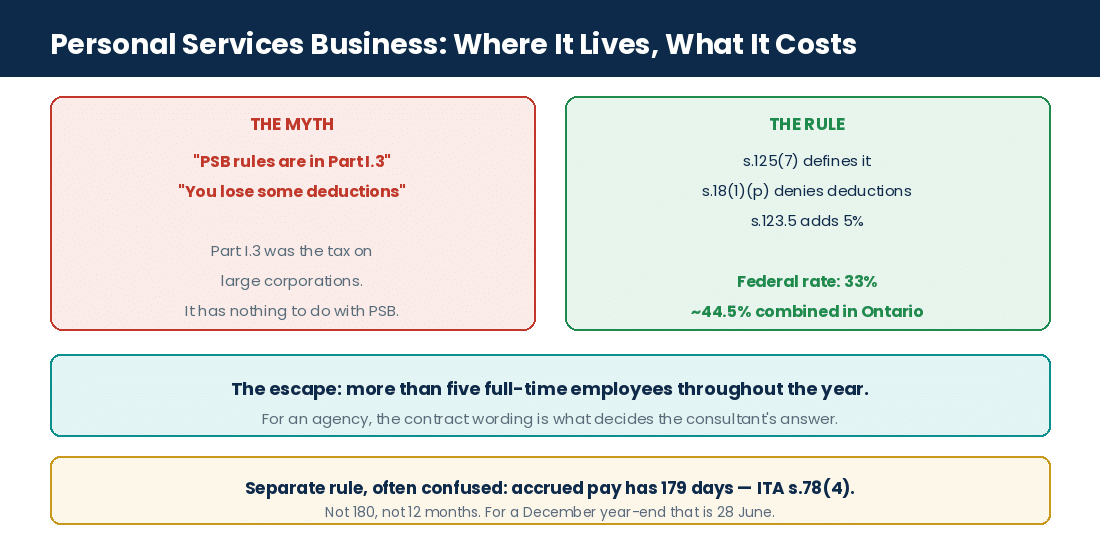
Risk Warning: personal services business rules are not in Part I.3 of the Income Tax Act. Part I.3 was the tax on large corporations. A PSB is defined in subsection 125(7), its deductions are denied by paragraph 18(1)(p), and section 123.5 adds a 5% tax on top of the general rate.
The cost is far more than “losing some deductions”: the federal rate becomes 33%, roughly 44.5% combined in Ontario, and 18(1)(p) denies almost everything other than salary to the incorporated employee. The exception most often available is employing more than five full-time employees throughout the year.
This matters twice over for a staffing agency: your own structure, and the incorporated consultants you place. A consultant’s corporation that works almost exclusively through you, under the client’s direction, is exposed — and the agency is the party that holds the contracts determining the answer.
- Agreements that reflect real independence: the right to subcontract, own tools, scheduling control.
- Consultants encouraged to hold multiple engagements.
- Contract terms reviewed before placement, since CRA looks at the facts rather than the label.
- No “180-day document window” exists for PSB — that figure belongs to accrued remuneration and the correct number there is 179.
Optimizing Corporate Structure for Tax Efficiency in IT Staffing Businesses
- CCPC status for the small business deduction, with association tested under section 256 where owners hold several entities.
- Owner compensation split between salary and dividends — salary creates RRSP room and CPP, dividends do neither, and TOSI under section 120.4 applies to dividends paid to family.
- A holding company considered where retained earnings build up, with intercorporate dividends under section 112 subject to subsection 55(2).
- Shareholder loans cleared within one year after the corporation’s year-end under subsection 15(2.6).
Capital Cost Allowance on Technology Assets
| Asset | Class | Rate |
|---|---|---|
| Computers, servers, systems software | 50 | 55% |
| Purchased application software | 12 | 100% |
| Office furniture and general equipment | 8 | 20% |
| Applicant tracking software, subscription | Not capital | Current expense |
| Goodwill, client lists, trade names | 14.1 | 5% |
The first claim is gated by the available-for-use rule in subsections 13(26) to (32), and the half-year rule is suspended for eligible property acquired after 31 December 2024 under Bill C-15 — so a full first-year claim is currently available where it would once have been halved.
Cross-Border Considerations for International Placements
- Regulation 102: withholding on employees performing services in Canada, including non-resident employees, with a waiver available.
- Regulation 105: 15% withholding on fees paid to a non-resident for services rendered in Canada, reported on a T4A-NR, with treaty relief obtained in advance on Form R105.
- Work performed entirely outside Canada is outside Regulation 105.
- Permanent establishment risk in a foreign jurisdiction where staff or contractors are physically present, under the applicable treaty.
- US state registration and withholding where workers are placed there, which is a state-by-state question rather than a federal one.
Year-End Tax Planning Checklist Tailored to IT Staffing Firms
| Task | What to do | Deadline |
|---|---|---|
| Pay accrued remuneration | Clear bonuses and owed wages | 179 days after year-end, ITA 78(4) |
| Recognise unbilled hours | Accrue work in progress at the cut-off | At fiscal year-end, ITA 10(5) |
| Add back guarantee provisions | Schedule 1 adjustment | At filing, ITA 18(1)(e) |
| Pay the corporate balance | Before the filing deadline | Two or three months after year-end |
| File the T2 | With GIFI and Schedule 5 | Six months after year-end |
| Confirm the remittance band | Re-test the average monthly withholding | Annually |
An agency placing a long-term contractor through the consultant’s own corporation was asked by the client to novate the contract directly.
The consultant worked exclusively for that one client, used the client’s equipment and took direction from its project manager. That is a personal services business on the 125(7) test, with 18(1)(p) denying the corporation’s deductions and section 123.5 taking the federal rate to 33%. The agency’s contract wording was what stood between the consultant and that outcome. Figures changed for privacy.
Best Practices for Accounting, Bookkeeping, and Record Retention
Bookkeeping and Record Retention
Records
Maintaining Accurate Bookkeeping Records and Using Accounting Software to Streamline Compliance
- Choosing accounting software: QuickBooks Online or Xero as the ledger, linked to timesheet capture and to payroll in ADP or Wagepoint, with bank feeds reconciled monthly.
- Separation of business and personal expenses: a separate account and card, with no personal traffic through either. Mixed accounts invite denied deductions under paragraph 18(1)(a) and section 67.
- Gross billings, contractor cost and margin visible as three separate figures.
- Timesheets reconciled to client invoices and to contractor payments every month.
- Guarantee period liabilities tracked by placement with expiry dates.
Compilation Engagements and CRA-Ready Financial Statements
A compilation engagement under CSRS 4200 assembles financial statements from information supplied by management, with a basis of accounting note and a report stating that no assurance is provided. It is the right engagement for most agencies, it is not a light audit, and where a client or lender requires assurance that is a review under CSRE 2400 or an audit, which we refer out.
- Trial balance with gross billings reported as revenue.
- Contracts for placed workers, including incorporated consultants.
- Timesheets for hours billed but not yet invoiced.
- Accrued pay and guarantee period liabilities.
- GST/HST returns and payroll registers.
- Provincial allocation working papers where Schedule 5 applies.
Records Retention Policies and Documentation Best Practices for Tax Audits
Records are kept six years from the end of the taxation year to which they relate, under paragraph 230(4)(b) — subsection 230(1) is the requirement to keep them, not the period. Section 286 of the Excise Tax Act imposes the same period for GST/HST records.
- Contracts, invoices, proof of payment, timesheets and placement fee agreements.
- T4 and T4A slips filed, payroll remittance confirmations, GST/HST returns.
- Correspondence on disputes, rate changes and guarantee claims.
- Digital storage is acceptable provided records are readable and retrievable for the full period — that requirement sits in section 230, and in ETA section 286 for sales tax, not in ETA 169, which concerns input tax credits.
- Failing to keep records is penalised under subsection 162(7); late slips are a separate penalty under 162(7.01).
CRA Representation and Common Audit Triggers
- “Contractor” labels applied without testing the placement agency regulations.
- Margin reported as revenue instead of gross billings with contractor cost deducted.
- T4 and T4A slips filed late, or on paper above the five-return threshold.
- Guarantee provisions deducted rather than added back.
- Accrued bonuses cleared after day 179.
- Associated corporations each claiming a full small business deduction.
- HST charged at the agency’s own provincial rate regardless of the client’s address.
Where filings are behind, the Voluntary Disclosures Program under Information Circular IC00-1R6 may limit penalties if you come forward before CRA makes contact. Relief from penalties and interest is separately available under subsection 220(3.1) on Form RC4288, within ten calendar years. CRA representation covers worker status, revenue presentation and remittance disputes.
An agency with roughly $6 million of gross billings had been reporting only its margin — about $900,000 — as revenue.
Profit was identical either way, but the presentation did not reconcile to the GST/HST returns, which were filed on gross. That mismatch is one of the fastest routes to a review, and it took a restated set of statements to close. Figures changed for privacy.
Frequently Asked Questions
Frequently Asked Questions
FAQ
What are the payroll remittance thresholds for IT staffing companies?+
They follow your average monthly withholding amount, not your annual total. Under $25,000 a month is a regular remitter paying by the 15th of the following month; $25,000 to $99,999.99 is accelerated threshold 1; $100,000 or more is threshold 2. “Over $25,000 yearly means monthly” is not a CRA band.
When is the Record of Employment due?+
Within five calendar days after the end of the pay period in which the interruption of earnings occurs — not five days after the interruption itself. Monthly and 13-pay-period payrolls have their own variants, and electronic filers get longer than paper.
What is the accrued remuneration payment window?+
179 days after the end of the taxation year, under subsection 78(4). Not 180, not 12 months, and not one year. For a 31 December year-end that is 28 June. Pay later and the deduction moves to the year of payment.
How do placement agency rules affect contractor classification?+
CPP Regulation 34 and EI Regulation 6(g) deem a worker placed by an agency to be in pensionable and insurable employment with the agency where the client directs and controls the work. So CPP and EI can apply to someone who is not your employee, and a contract label does not displace the regulation.
When should revenue be recognised?+
When it becomes receivable under paragraph 12(1)(b), with unbilled hours carried as work in progress under subsection 10(5). Not when cash arrives, and not when you choose to invoice. Report gross billings as revenue with contractor cost deducted, rather than margin as revenue.
How do personal services business rules affect incorporated consultants?+
A PSB is defined in subsection 125(7) — not Part I.3, which was the large corporations tax. The federal rate becomes 33% with the 5% additional tax in section 123.5, and paragraph 18(1)(p) denies nearly every deduction. The main exception is employing more than five full-time employees throughout the year.
What are placement fee guarantee periods and their tax implications?+
A refund obligation during the guarantee window. For accounting you may recognise a liability under ASPE; for tax paragraph 18(1)(e) denies it as a reserve, so it is added back on Schedule 1 and becomes deductible only when a refund is actually paid.
How does multi-province operation affect compliance?+
Payroll registration and remittance in each province where employees report to work, plus employer health taxes where they apply and workers’ compensation per province. Corporate income is allocated under Regulations 400(2) and 402 on Schedule 5. GST/HST is one national registration; only BC, Saskatchewan, Manitoba and Quebec have separate sales tax accounts.
Can owners pay themselves dividends to reduce payroll taxes?+
Dividends carry no CPP and no EI, but they are not deductible to the corporation, create no RRSP room, and where paid to family are tested under TOSI in section 120.4. Salary is deductible and builds RRSP room at the cost of CPP. The mix is a calculation, not a rule.
What triggers a CRA review for staffing agencies?+
Contractor labels applied without testing the placement agency regulations, margin reported instead of gross billings, slips filed late or on paper above the five-return threshold, guarantee provisions deducted, accrued bonuses cleared past day 179, and associated corporations each claiming a full small business deduction.
How can agencies catch up on late filings?+
The Voluntary Disclosures Program under Information Circular IC00-1R6 may limit penalties where you come forward before CRA contact and the conditions are met. Penalty and interest relief is separately available under subsection 220(3.1) on Form RC4288, within ten years. File the oldest year first so balances flow.
What are the agency accounting methods, and how do I choose among DIY, CPA, or non-CPA options?+
A bookkeeper can run the day-to-day well. What a licensed firm adds is the judgement calls: worker status against the placement agency regulations, gross versus margin presentation, guarantee provisions, association for the small business deduction, and the T2. Only a licensed firm can issue a CSRS 4200 compilation report.
How do I choose a CPA firm in Ontario for an IT staffing company?+
Look for a working position on CPP Regulation 34 and EI Regulation 6(g), experience with gross billing presentation, multi-province payroll and Schedule 5, a flat annual fee quoted before work begins, and a licence verifiable on the CPA Ontario public directory.
What deliverables come with the service?+
Monthly reconciled books with gross billings and contractor cost separated, payroll and slips, GST/HST returns, compiled financial statements under CSRS 4200, the T2 with GIFI and Schedule 5, worker classification documentation, and CRA correspondence handled.
How much does agency accounting typically cost in Canada?+
A flat annual fee including HST, quoted on your structure before work begins. What moves it is headcount on payroll, number of contractors, how many provinces, and whether incorporated consultants are in the mix. We do not publish a single figure, because it would be wrong for most agencies who read it.
What are the top planning mistakes staffing companies make?+
Assuming the $30,000 threshold no longer exists; reading the remittance band off the annual rather than monthly withholding; clearing accrued pay at twelve months; reporting margin as revenue; deducting guarantee provisions; charging the agency’s own provincial HST rate to every client; and claiming a full small business deduction in each associated entity.
Do I need to register for GST/HST in every province I bill into?+
No. One registration with CRA covers GST and HST nationally; the rate follows the recipient’s address for a service. Separate registration applies only to BC PST, Saskatchewan PST, Manitoba RST and Quebec QST.
Is CPP capped at $3,500 per worker?+
No — $3,500 is the basic exemption, the amount of earnings on which no CPP is payable. Contributions are calculated above it, to the year’s maximum pensionable earnings, with CPP2 above the first ceiling. The employer’s EI premium is 1.4 times the employee’s.
Eighteen questions, and the one on placement agency rules carries more money than any other on a staffing file.
CPP Regulation 34 and EI Regulation 6(g) create liability for people the agency never employed, and an assessment covers both employer and employee shares plus interest. Figures changed for privacy.
Key Tax Planning Points for IT Staffing Operations
Essential Topics and Best Practices
Quick Reference
Key Points for Multi-Agency Operations
- Test association under section 256 across every entity under common control — one $500,000 business limit is shared, not multiplied.
- File Schedule 23 allocating the business limit between associated corporations.
- Consolidate reporting for management while filing each entity separately.
- Monitor combined payroll, since the remittance band is set per payroll account.
- Apply one worker classification policy across all entities.
- Price intercompany charges at fair market value under subsection 69(1).
Detailed Breakdown: Payroll, Recruiting and Immigration Costs
- Payroll: wages, employer CPP at the base rate, employer EI at 1.4× the employee premium, CPP2 above the first ceiling, plus provincial employer health taxes.
- Recruiting: recruiter commissions and job board subscriptions, deductible under paragraph 18(1)(a) as incurred.
- Immigration: legal fees and government charges for work permits, deductible where incurred to earn income, with GST/HST on the legal fees recoverable as an input tax credit. Government filing fees generally carry no GST/HST to recover.
- Background checks and skills testing, deductible as incurred.
Multi-Province GST/HST Place of Supply
- For a service, the rate generally follows the recipient’s address obtained in the ordinary course of business.
- Where more than one address is held, the one most closely connected with the supply governs.
- Schedule IX and the Place of Supply Regulations set the rules; section 165 imposes the tax.
- One national registration — no provincial GST/HST accounts.
- Working papers kept showing how each client’s rate was determined.
CRA Representation and Audit Support Essentials
- Worker classification documented at onboarding, not reconstructed at assessment.
- Gross billing presentation reconciled to the GST/HST returns.
- Timesheets matched to invoices and to contractor payments.
- Prompt, complete responses to CRA requests, with a professional representative engaged early.
Points Worth Carrying
- The $30,000 threshold is in ETA section 148 and remains in force.
- Accrued remuneration has 179 days under ITA 78(4).
- The remittance band follows the average monthly withholding amount.
- $3,500 is the CPP basic exemption, not a maximum.
- Employer EI is 1.4 times the employee premium.
- CPP Reg 34 and EI Reg 6(g) are the placement agency rules.
- PSB sits in 125(7), 18(1)(p) and 123.5 — not Part I.3.
- Slips are due the last day of February, electronically above five returns.
- Guarantee provisions are denied for tax by 18(1)(e).
- Records run six years from the taxation year-end, under 230(4)(b).
Thirty points, and the ten at the end are all things an agency owner was told confidently by something they read.
None are obscure. They are ordinary rules attached to the wrong number of days, the wrong part of the Act, or a threshold that was never repealed. Figures changed for privacy.
Businesses We Serve
Industry Expertise
Staffing and recruitment businesses share the same issues whatever they place. Here are ten and the usual finding.
| Practice | The Issue That Usually Appears |
|---|---|
| IT contract staffing agencies | Placement agency CPP/EI rules never tested |
| Permanent placement recruiters | Guarantee period provisions deducted for tax |
| Agencies placing incorporated consultants | PSB exposure undocumented in contracts |
| Multi-province agencies | No Schedule 5 allocation, HST at one flat rate |
| Owner-managed agencies | Accrued bonuses cleared past day 179 |
| Groups with several entities | Full small business deduction claimed in each |
| Agencies with growing payrolls | Remittance band never re-tested |
| Agencies billing gross to clients | Margin reported as revenue on the statements |
| Firms placing foreign talent | Regulation 102 and 105 withholding missed |
| New agencies | Registered for GST/HST on a threshold they were told was gone |
- IT contract staffing agencies: CPP Reg 34, EI Reg 6(g).
- Permanent placement recruiters: add the provision back on Schedule 1.
- Agencies placing incorporated consultants: the contract decides 125(7).
- Multi-province agencies: Regulation 402, and the recipient’s address for HST.
- Owner-managed agencies: 179 days, ITA 78(4).
- Groups with several entities: section 256 association, Schedule 23.
- Agencies with growing payrolls: re-test the band annually.
- Agencies billing gross: gross billings as revenue, contractor cost deducted.
- Firms placing foreign talent: services rendered in Canada decide it.
- New agencies: section 148 is alive and well.
The skill set changes. The questions do not: is this worker caught by the placement agency regulations, is revenue gross or margin, and when did the pay clear.
A permanent placement desk and a contract staffing book look nothing alike commercially and file nearly identical returns. Figures changed for privacy.
Professional Guidance and Quick Reference
Guidance
Support, Resources and Next Steps: How Gondaliya CPA Handles Your Agency
IT staffing agencies get into difficulty in a predictable set of ways: registering for GST/HST on the belief that the $30,000 threshold was repealed, when section 148 is fully in force and nothing was removed from section 123(1); reading the remittance band off the annual withholding total when section 153 and Regulation 108 set it by the average monthly amount; clearing accrued bonuses at twelve months when subsection 78(4) allows 179 days; treating “$3,500” as a CPP maximum when it is the basic exemption, and forgetting that the employer’s EI premium is 1.4 times the employee’s; looking for personal services business rules in Part I.3, which was the large corporations tax, rather than in subsection 125(7) with 18(1)(p) and 123.5; deducting placement guarantee provisions that paragraph 18(1)(e) denies; and reporting margin as revenue when the GST/HST returns are filed on gross. Gondaliya CPA handles IT staffing accounting on a flat annual fee.
We handle what decides the outcome: testing each placement against CPP Regulation 34 and EI Regulation 6(g) rather than against the contract label, re-confirming the remittance band each year as the payroll grows, diarising the 179-day date separately from the filing deadline, presenting gross billings with contractor cost deducted so the statements reconcile to the sales tax returns, adding guarantee provisions back on Schedule 1 and releasing them on actual refund, testing association under section 256 across related entities, applying the recipient’s address for HST on services, and preparing compiled statements under CSRS 4200 that state plainly that no assurance is provided.
Identifying When to Consult Tax Professionals, and Preparing for Tax Planning Meetings
When to consult a professional: before a placement is structured, not after a CPP/EI ruling. What to bring: corporate trial balance, contractor agreements, client billing reports with timesheets, payroll registers, GST/HST filings, last year’s T2 and any CRA notices, placement fee schedules with guarantee periods, and the unbilled hours list at year-end.
Benefits of Proactive Tax Planning and Ongoing Accounting Support
Planning before year-end rather than after it is what makes the placement agency position, the gross billing presentation and the 179-day date manageable instead of remedial. Ongoing bookkeeping keeps the books current to CRA standards so the T2 is assembled rather than reconstructed, and it keeps the remittance schedule predictable across provinces.
Contact Information and Service Offerings to Assist IT Staffing Businesses Across Canada
Call 647-212-9559 or email info@gondaliyacpa.ca to book a free consultation. We serve Toronto, Mississauga, Vaughan, Brampton, Ottawa and the rest of Ontario, and work with agencies across Canada.
Quick Answers
At a Glance
- GST/HST threshold: $30,000, ETA 148, in force
- Accrued pay: 179 days, ITA 78(4)
- Remittance band: average monthly withholding
- Regular remitter: 15th of the following month
- CPP $3,500: basic exemption, not a maximum
- Employer EI: 1.4 × the employee premium
- Placement agency rules: CPP Reg 34, EI Reg 6(g)
- PSB: ITA 125(7), 18(1)(p), 123.5 — 33% federal
- Guarantee provisions: denied by 18(1)(e)
- Slips: last day of February; electronic above five
- T2: six months; balance at two or three
- Records: six years from the taxation year-end
Who This Is For
Fit Check
- For: Incorporated Canadian IT staffing and recruitment agencies placing contractors or permanent hires, single-province or national, including those engaging incorporated consultants.
- Not For: Independent consultants contracting directly without an agency, who face the PSB question on their own facts, and agencies requiring a review or audit, which we refer out.
People Also Ask
Quick Answers
Was the $30,000 GST/HST threshold removed?+
No. It sits in ETA section 148 and remains $30,000 of taxable supplies. Section 123(1) contains definitions, and nothing was repealed from it. Registration is required under 240(1) once you cease to be a small supplier.
Is the remittance threshold $25,000 a year?+
No — it is $25,000 of average monthly withholding. An agency withholding $25,000 a year is a regular remitter paying by the 15th of the following month.
Do placement agency rules apply even to genuine contractors?+
They can. CPP Regulation 34 and EI Regulation 6(g) deem a placed worker to be in pensionable and insurable employment with the agency where the client directs and controls the work, regardless of the contract label.
Where are personal services business rules found?+
Subsection 125(7) defines it, paragraph 18(1)(p) denies the deductions, and section 123.5 adds 5% for a federal rate of 33%. Part I.3 was the large corporations tax and has nothing to do with it.
Can I deduct a placement guarantee provision?+
Not for tax. Paragraph 18(1)(e) denies reserves and contingent liabilities. Recognise it for accounting, add it back on Schedule 1, and deduct the refund when it is actually paid.
Glossary of Key Terms
Glossary
- CPP Regulation 34: Deems placed workers to be in pensionable employment with the agency.
- EI Regulation 6(g): The equivalent insurable employment rule for placement agencies.
- Average monthly withholding amount: Sets your payroll remittance band.
- CPP basic exemption: $3,500 of earnings on which no CPP is payable.
- CPP2: The second contribution above the first earnings ceiling.
- Subsection 78(4): The 179-day rule for unpaid remuneration.
- Personal services business: Defined in 125(7); taxed at 33% federally.
- Paragraph 18(1)(p): Denies most deductions to a personal services business.
- Section 123.5: The 5% additional tax on PSB income.
- Gross billings: Total client invoicing, reported as revenue.
- Margin: Gross billings less contractor cost — a profit figure, not revenue.
- Placement fee guarantee: A refund obligation denied for tax by 18(1)(e).
- Unbilled hours: Work in progress, carried under subsection 10(5).
- Regulation 105: 15% withholding on non-residents for services rendered in Canada.
- Section 148: The $30,000 small supplier threshold.
- CSRS 4200: The compilation engagement standard, providing no assurance.
IT Staffing Tax Check
This quick self-check indicates where your agency most likely has room. Please answer the five questions below.
IT Staffing Tax Check
Five quick questions on your business. No fee shown.
Points to raise with us:
This is a general prompt, not tax or legal advice or a quote. Your position depends on your full facts. For a real review, please book a free consultation.
Want a checklist to work from? You can download our free IT staffing tax checklist before your consultation.
Work from section 148, which still sets the $30,000 small supplier threshold and was never repealed from section 123(1). Read your remittance band off the average monthly withholding amount rather than the annual total, and re-test it each year as the payroll grows. Clear accrued remuneration by day 179 under subsection 78(4), which for a December year-end means 28 June. Treat $3,500 as the CPP basic exemption rather than a ceiling, and cost the employer’s EI at 1.4 times the employee premium when you quote a placement. Test every placed contractor against CPP Regulation 34 and EI Regulation 6(g), because those regulations can create CPP and EI liability for workers you never employed. Look for personal services business rules in subsection 125(7) with 18(1)(p) and 123.5, not in Part I.3, and understand that the federal rate becomes 33%. Recognise guarantee provisions for accounting and add them back on Schedule 1. Report gross billings as revenue with contractor cost deducted, so your statements reconcile to your sales tax returns. Charge HST at the rate for the recipient’s address. And please keep six years of records from the year-end.
2026 Update — what is current: This article reflects rules current to 1 October 2026. The six-month T2 filing deadline under 150(1)(a), the $500 T4A threshold, the last-day-of-February slip deadline under Regulation 205(1) and the six-year retention requirement under 230(4)(b) are unchanged. Please note that the $30,000 small supplier threshold in ETA 148 remains fully in force and nothing was removed from section 123(1); that payroll remittance bands follow the average monthly withholding amount under section 153 and Regulation 108, with penalties under subsection 227(9); that accrued remuneration must be paid within 179 days of year-end under subsection 78(4); that $3,500 is the CPP basic exemption and the employer’s EI premium is 1.4 times the employee’s, with CPP2 applying above the first earnings ceiling and all rates set annually by CRA; that the placement agency rules are CPP Regulation 34 and EI Regulation 6(g); that a personal services business is defined in subsection 125(7), denied deductions by paragraph 18(1)(p) and taxed at 33% federally through section 123.5, with the escape being more than five full-time employees; that placement fee guarantee provisions are denied by paragraph 18(1)(e) until a refund is paid; that information returns must be filed electronically above five returns of a type, a threshold reduced from 50 for returns filed after 2023; that GST/HST is a single national registration with the rate for a service following the recipient’s address, and separate registration only for BC PST, Saskatchewan PST, Manitoba RST and Quebec QST; and that the half-year rule is suspended for eligible property acquired after 31 December 2024 under Bill C-15.
IT Staffing Company Tax Planning Canada: How Gondaliya CPA Supports Agencies
Start with one contractor agreement and your last payroll remittance
Gondaliya CPA tests each placement against CPP Regulation 34 and EI Regulation 6(g) rather than the contract label, re-confirms your remittance band annually, diarises the 179-day accrued pay date separately from the filing deadline, presents gross billings with contractor cost deducted so the statements reconcile to the sales tax returns, adds guarantee provisions back on Schedule 1, tests association across related entities, applies the recipient’s address for HST, and files the GST/HST, the compiled statements and the T2 with its GIFI and Schedule 5 from one reconciled set of books — on a flat annual fee including HST with a one-business-day response. Please book a free consultation.
Next Steps
Please book a free consultation with Gondaliya CPA and bring one contractor agreement, your last payroll remittance confirmation, and your most recent financial statements. Those three settle the placement agency question, the remittance band question and the gross-versus-margin question, which is where most of the exposure sits for a staffing agency. You will get a flat annual fee including HST before any work begins. We serve Toronto, Mississauga, Vaughan, Brampton, Scarborough, Ottawa and the rest of Ontario, and work with agencies across Canada. If our content helps, please add gondaliyacpa.ca as a preferred source on Google.
Published: · Last updated:
Editorial policy: We research against CRA, CPA Canada and CPA Ontario sources, fact-check the figures, and Sharad Gondaliya, CPA, reviews the content, which we update as the rules change.
Disclaimer: This article is educational information only and is not tax, legal, or financial advice. Figures marked illustrative are examples rather than quotes or guarantees. It reflects rules current to 2026, including the ETA section 148 threshold, the 179-day rule in subsection 78(4), the placement agency regulations, the personal services business provisions and the six-year retention requirement. CPP and EI rates and ceilings are set annually and change each January, and outcomes depend on your specific facts. Please consult a CPA Ontario member before acting.

Sharad Gondaliya is a CPA Canada & CPA USA with 15 Years+ experience of Accounting, Tax, Payroll of Corporate Small Businesses as Tax Accountant. He is a CPA Ontario member (61040184) and holds US CPA licences in Washington and Montana and is well known among corporate small businesses for tax planning, efficient tax solutions, and affordable CPA services. Sharad is the Principal (Director) of Gondaliya CPA – Affordable CPA Firm in Canada. Licenses: CPA Ontario: 61040184 | CPA USA (MT): PAC-CPAP-LIC-033176 | CPA USA (WA): 57629 | CPA Firm License: 61330051 View Full Author Bio