



Hardware Startup Tax Credits in Canada: SR&ED, Investment Incentives & Eligible Development Costs
Hardware startup tax Canada guide: programs, incentives, and SR&ED tax credits explained
Hardware startup tax Canada involves various programs and incentives such as SR&ED tax credits that encourage innovation and cost savings for hardware firms. Gondaliya CPA provides expert advice to help hardware startups in Canada navigate these tax options and optimize their financial benefits.
Quick Summary
The SR&ED reporting deadline is 12 months after the T2 filing due date, which is 18 months after your fiscal year end. The prescribed proxy amount for overhead is 55% of eligible salaries. And SR&ED capital expenditures, ineligible since 2014, have been restored for property acquired on or after 16 December 2024.
Reading time: 44 minutes.
Table of Contents
- Three Things You Have Been Told
- What SR&ED Is and Why It Matters
- Eligibility and Qualifying Hardware Work
- Filing an SR&ED Claim
- Optimizing Your Claim
- Other Programs and Incentives
- Working with a CPA Firm
- Frequently Asked Questions
- Essential Topics and Best Practices
- Businesses We Serve
- Professional Guidance and Quick Reference
The Numbers That Matter
This article covers Canada, with Ontario and Toronto context, and reflects rules current to 1 October 2026. It is written for incorporated Canadian hardware startups — electronics, devices, instruments, robotics and combined hardware-software products — claiming SR&ED as a Canadian-controlled private corporation. SR&ED parameters changed materially for taxation years beginning on or after 16 December 2024, including the expenditure limit and the treatment of capital expenditures, so the year you are claiming decides which rules apply. Gondaliya CPA performs compilation engagements; we do not perform audits or review engagements. Figures marked illustrative are examples, not quotes, and any masked engagement notes end with “Figures changed for privacy.” This is educational information only and not tax or legal advice.
Three Things You Have Been Told
Three Things You Have Been Told
The Corrections
Three points about SR&ED circulate widely and all three are wrong. The first costs you the claim outright.
The Deadline Is 18 Months, Not 15
Risk Warning: the SR&ED reporting deadline is 12 months after the T2 filing due date — 18 months after your fiscal year end. Guidance stating “within 15 months after the end of your fiscal year” is three months short, and the same document says 18 months elsewhere.
The deadline is a statutory condition under subsection 37(11), not an administrative one. CRA has no discretion to accept a late claim, and taxpayer relief under 220(3.1) does not reach it. A firm working to a 15-month date is simply three months early, which is harmless. A firm told 15 months and then granted an informal extension to “18 months” has lost nothing. The danger is the reverse: a firm that reads 18 months, assumes a cushion, and discovers the clock started at the year-end rather than the filing date.
| Year-end | T2 due | SR&ED deadline |
|---|---|---|
| 31 December 2026 | 30 June 2027 | 30 June 2028 |
| 31 March 2027 | 30 September 2027 | 30 September 2028 |
| 31 July 2027 | 31 January 2028 | 31 January 2029 |
The Proxy Rate Is 55%, Not 65%
The prescribed proxy amount under Regulation 2900(4) is 55% of eligible SR&ED salaries and wages. It was 65% many years ago, stepped down through 60%, and has been 55% since 2014. Claiming 65% overstates the overhead component by almost a fifth and is the kind of arithmetic error a reviewer finds immediately.
| Overhead method | What it gives you | Trade-off |
|---|---|---|
| Proxy | 55% of eligible salaries, no tracking | Capped; ignores actual overhead |
| Traditional | Actual overhead attributable to SR&ED | Requires allocation records |
You elect one method per year on Form T661 and you cannot use both. For a hardware startup with a lab, clean bench or test rig, the traditional method sometimes beats proxy — but only where the allocation can be evidenced.
The Specified Employee Cap Is Five Times the YMPE, Not $3 Million
Risk Warning: “salary expenditures per claim have a cap of $3 million for specified employees” conflates two unrelated rules. The $3 million figure is the expenditure limit that sets how much of your spending attracts the enhanced 35% rate — and it has since been increased.
The specified employee cap is a different thing entirely: salary for a specified employee is limited to five times the year’s maximum pensionable earnings under subsection 37(9.1), applied per employee, not per claim. A specified employee is one who does not deal at arm’s length with the corporation or owns 10% or more of any class of shares — which in a founder-led hardware startup is usually the people doing the actual engineering.
A founder-run robotics startup claimed two founders’ full salaries of roughly $190,000 each as SR&ED labour.
Both were specified employees, so each was capped at five times the YMPE rather than at a $3 million figure that applies to nothing here. Roughly $50,000 of claimed salary came out, and the proxy overhead calculated on it came out with it. Figures changed for privacy.
Introduction to Hardware Startup Tax Credits and Incentives in Canada
What SR&ED Is and Why It Matters
Foundations
Understanding the SR&ED Program: What Are Tax Credits for Hardware Startups?
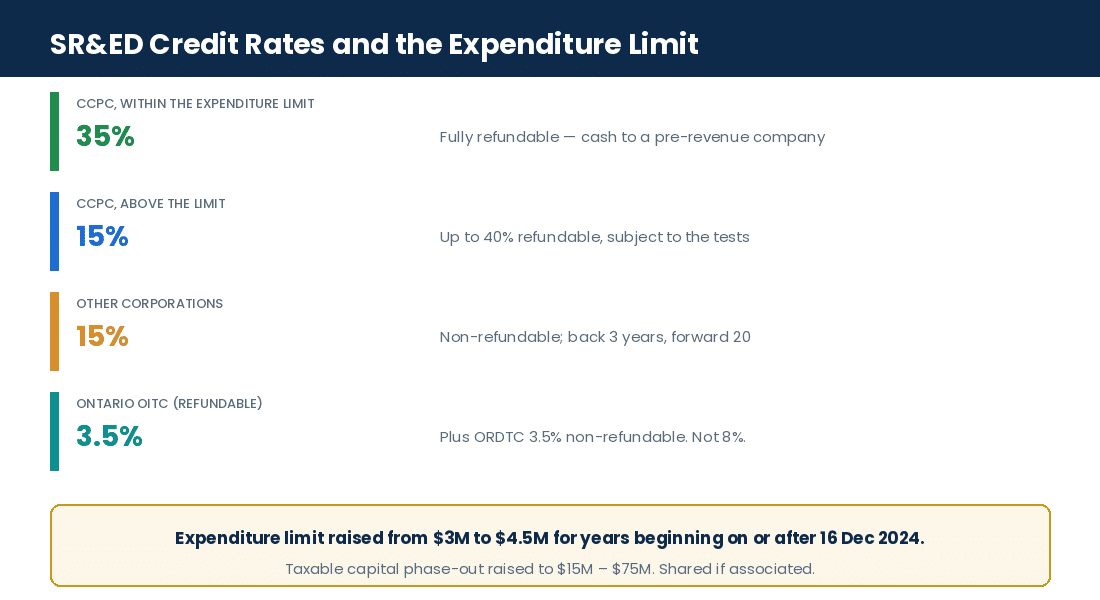
Scientific Research and Experimental Development is defined in subsection 248(1) of the Income Tax Act. The deduction sits in section 37; the investment tax credit sits in section 127. For a hardware startup the practical effect is that money spent resolving genuine technical uncertainty comes back, often in cash.
| Claimant | Rate | Refundability |
|---|---|---|
| CCPC, within the expenditure limit | 35% | Fully refundable |
| CCPC, above the limit | 15% | Up to 40% refundable, subject to the income and capital tests |
| Other corporations | 15% | Non-refundable; carry back 3 years, forward 20 |
“Refundable” is the part that matters to a pre-revenue hardware company. A startup with no taxable income still receives the 35% as cash, which is why SR&ED functions as working capital rather than as a tax planning item.
Why Tax Credits and Incentives Matter: Key Benefits and Potential Savings for Hardware Companies
- Non-dilutive funding — no equity given up, no debt taken on.
- Cash returned on money already spent, which shortens the runway maths.
- Documentation discipline that investors and acquirers read as a positive signal.
- Stackable with provincial credits and, for the right assets, with clean economy investment tax credits.
The Three Criteria CRA Actually Applies
Key Stat: eligibility turns on three tests, all of which must be met. Technological uncertainty — could the outcome be determined from standard practice and available knowledge? Systematic investigation — was there a hypothesis, testing and analysis, in that order? Technological advancement — was the knowledge base advanced, even if the project failed?
A failed project is fully claimable. A successful project with no uncertainty is not. That inversion catches out more hardware founders than any other feature of the programme.
Eligibility Criteria and Qualifying Hardware Work
Eligibility and Qualifying Hardware Work
Eligibility
Eligible Expenditures
| Cost | Treatment | Note |
|---|---|---|
| Salaries and wages for SR&ED staff | Fully eligible | Specified employees capped at 5 × YMPE, ITA 37(9.1) |
| Materials consumed in SR&ED | Fully eligible | Destroyed or rendered valueless by the work |
| Materials transformed | Cost less the value of the resulting product | The distinction that most hardware claims turn on |
| Arm’s length SR&ED contracts | 80% of the contract payment | ITA 127(9); work must be performed in Canada |
| Non-arm’s length contracts | Flow-through of the performer’s own qualified expenditures | No 80% reduction, but no markup either |
| Overhead | Proxy at 55% of salaries, or traditional | Elected per year; never both |
| Salary for work outside Canada | Up to 10% of total Canadian SR&ED salary | ITA 37(1.4) and (1.5) |
Hardware Activities and Projects That Qualify
- Sensor architectures where the performance envelope is not known in advance.
- Custom electronics integrated with control software, where the interaction is the uncertainty.
- Pilot plant work — a facility built to test a process, as distinct from commercial production.
- Thermal, mechanical or RF behaviour that could not be predicted from datasheets.
- Materials selection where standard engineering did not resolve the question.
- Work performed by a contract manufacturer on your behalf, in Canada, under an arm’s length contract.
| Activity | Supports a claim? | Documentation |
|---|---|---|
| Early prototype iteration against a stated uncertainty | Yes | Design logs, test results, failed attempts |
| Pilot plant runs testing a process | Yes | Timesheets, material consumption records |
| Contract manufacturer testing | Conditional | Arm’s length contract, invoices, Canadian performance |
| Routine engineering or cost-down redesign | No | — |
| Commercial production once the process is proven | No | — |
| Market research, sales promotion, style changes | No | Excluded by 248(1)(e) to (k) |
CRA Qualification Criteria and Common Exclusions: What the Act Actually Excludes
The exclusions are not a CRA list; they are paragraphs (e) through (k) of the SR&ED definition in subsection 248(1): market research and sales promotion, quality control and routine testing, research in the social sciences or humanities, prospecting and drilling for minerals or petroleum, commercial production, style changes, and routine data collection.
Risk Warning: the blanket statement that capital equipment never qualifies is out of date. SR&ED capital expenditures were made ineligible on 1 January 2014 — which is where that advice comes from.
Capital expenditure eligibility has since been restored for property acquired on or after 16 December 2024, for both the deduction under section 37 and the investment tax credit. For a hardware startup buying test equipment, environmental chambers or measurement instruments, that is a material change, and the acquisition date decides the answer.
A device company treated its entire first production run as SR&ED because the line was “still being tuned”.
Pilot plant work is claimable; commercial production is excluded by paragraph 248(1)(i). The honest line was the point at which saleable units began leaving the line, and roughly 60% of the claimed material cost sat after it. Separating the two before filing is cheaper than defending the whole on review. Figures changed for privacy.
Filing an SR&ED Claim for Hardware in Canada
Filing an SR&ED Claim
Filing
Step-by-Step Overview of the Claim Process
- Identify projects against the three criteria — uncertainty, systematic investigation, advancement — not against how novel the product feels.
- Draw the project boundary: where the uncertainty began and where it was resolved.
- Collect salaries, materials consumed and transformed, and contract payments, separated by project.
- Elect the overhead method: proxy at 55% or traditional.
- Complete Form T661 with the technical narratives in Part 2 and the costs in Part 3.
- Complete Schedule 31 (T2SCH31) for the federal investment tax credit.
- Add the provincial schedule — Schedule 508 for the Ontario Innovation Tax Credit.
- File with the T2 by the SR&ED reporting deadline: 12 months after the T2 due date, so 18 months after year-end.
Required Documentation and Reporting Standards
- Timesheets or project-coded time records tying hours to specific SR&ED projects.
- Payroll records supporting the salary figures, with specified employees identified.
- Material records distinguishing consumed from transformed, with the value of resulting product tracked.
- Arm’s length contracts and invoices, with the place of performance evidenced.
- Design logs, test plans, failed results, version history, bench photographs and firmware commits.
- Records held six years from the end of the taxation year under paragraph 230(4)(b).
Contemporaneous evidence is worth more than a well-written narrative composed a year later. A dated test log showing a failure is stronger support than any prose, because it demonstrates the systematic investigation rather than asserting it.
Preparing Technical Narratives and Supporting Evidence
Form T661 asks three questions per project, and answering them in order is most of the work:
- What technological uncertainties did you attempt to overcome? State what you could not determine from standard practice. “We did not know whether X would hold at Y” beats “we wanted to build a better device”.
- What work did you perform? Hypothesis, experiment, result, next hypothesis. Include what failed.
- What technological advancements did you achieve? Knowledge gained, which may be the knowledge that an approach does not work.
Narratives are capped by character count on T661, so the discipline is to describe the uncertainty rather than the product. Reviewers are looking for the gap in available knowledge, not for the commercial story.
A startup’s narrative described the product in detail and the technological uncertainty in a single clause.
The review focused on the one clause, which could not carry the claim on its own. Rewritten around the uncertainty — stating what was unknown, what was tried, and what failed — the same project, same costs, same evidence, read entirely differently. Figures changed for privacy.
Strategies to Optimize SR&ED Claims for Hardware Startups
Optimizing Your Claim
Optimization
Tips for Accurate Claim Preparation
- Project codes in the time tracking system from day one, so labour allocation is a report rather than a reconstruction.
- Materials coded consumed or transformed at the point of issue, not at year-end.
- Hardware and software components of a combined project described as one investigation where the uncertainty is in their interaction — splitting them artificially weakens both.
- Contracts checked for arm’s length status and place of performance before the work starts.
- The overhead election modelled both ways before it is made, as part of annual tax planning.
Maximizing Eligible Expenditures and Credit Amounts
Key Stat: the expenditure limit sets how much of your spending attracts 35% rather than 15%. It was $3 million and has been increased to $4.5 million for taxation years beginning on or after 16 December 2024, with the taxable capital phase-out range raised to $15 million to $75 million.
The limit is also ground down by prior-year taxable income and is shared among associated corporations under section 127(10.2) and following. Two related hardware entities do not get two limits.
- Capital expenditures reconsidered for property acquired on or after 16 December 2024, now that eligibility has been restored.
- Equipment acquired before that date claimed through capital cost allowance instead — Class 50 at 55% for computers, Class 8 at 20% for general lab and test equipment, Class 12 at 100% for tools under $500.
- The half-year rule is suspended for eligible property acquired after 31 December 2024 under Bill C-15, which brings the deduction forward.
- Provincial credits layered on top, which for Ontario means OITC and ORDTC.
Government Assistance Reduces the Pool, Not the Credit
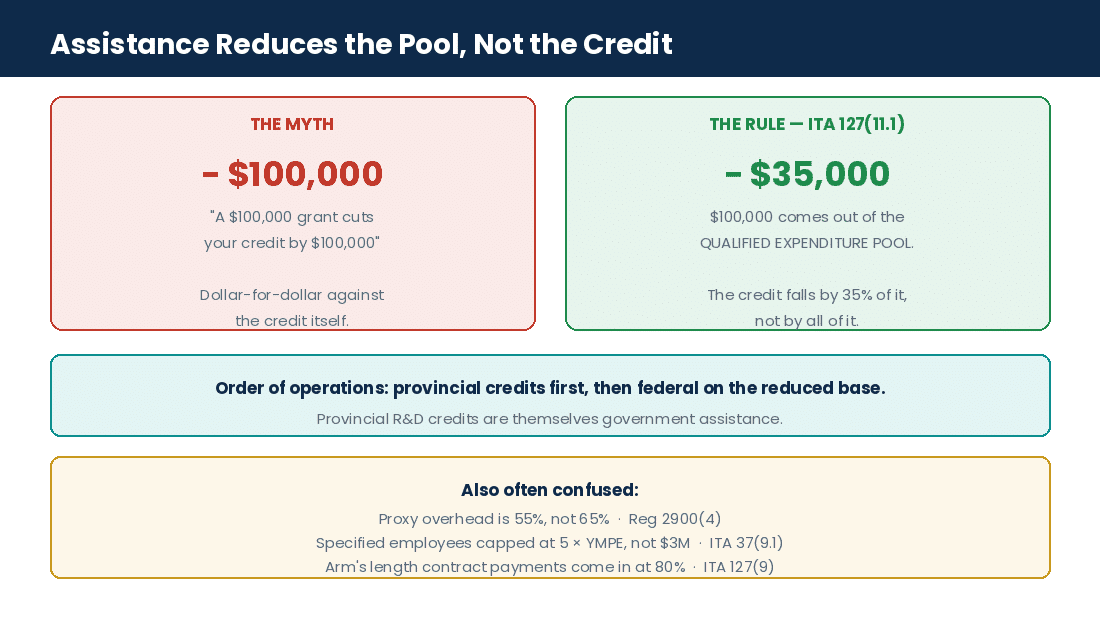
Risk Warning: a grant does not cut your credit dollar-for-dollar. Subsection 127(11.1) reduces the qualified expenditure pool by the amount of government or non-government assistance received, receivable or expected.
So a $100,000 grant against SR&ED costs removes $100,000 from the pool, and the credit falls by $35,000 at the enhanced rate — not by $100,000. The reduction is at the expenditure level. Subsection 127(9) contains the definitions; 127(11.1) does the reducing.
Provincial credits are themselves government assistance and reduce the federal pool. The order of operations matters: provincial first, then federal on the reduced base.
Avoiding Common Filing Mistakes and Pitfalls
- Routine engineering or quality control described as SR&ED — excluded by 248(1)(e) to (k).
- Transformed materials claimed at full cost without deducting the value of the resulting product.
- Specified employee salaries claimed above five times the YMPE.
- Proxy overhead calculated at 65% instead of 55%.
- Arm’s length contract payments claimed at 100% instead of 80%.
- Grants not deducted from the pool under 127(11.1).
- Commercial production included once the process was proven.
- The claim filed after the 18-month deadline, which no relief provision can fix.
Additional Programs, Incentives, and Tax Credits Relevant to Hardware Companies
Other Programs and Incentives
Programs
Clean Economy Investment Tax Credits
These are not in section 127 with SR&ED. Each clean economy credit has its own section, its own rate and its own labour requirements.
| Credit | Section | Headline rate |
|---|---|---|
| Clean Technology ITC | 127.45 | Up to 30% |
| Clean Technology Manufacturing ITC | 127.49 | 30% |
| Carbon Capture, Utilization and Storage | 127.44 | Varies by stream |
| Clean Hydrogen ITC | 127.48 | Tiered by carbon intensity |
The headline rates generally depend on meeting labour requirements — prevailing wage and apprenticeship conditions — with a reduction of 10 percentage points where they are not met. These credits are also government assistance for SR&ED purposes, so claiming both on the same property reduces the SR&ED pool.
Accelerated Investment Incentive and Capital Asset Write-Offs
- The half-year rule is suspended for eligible property acquired after 31 December 2024 under Bill C-15, giving a full first-year claim where it would once have been halved.
- The first claim is gated by the available-for-use rule in subsections 13(26) to (32) — equipment in a crate does not generate CCA.
- Classes and rates are in Schedule II of the Regulations with rates applied under Regulation 1100. Section 13(7) concerns change in use and deemed cost, not class assignment.
- The consumed-versus-transformed distinction belongs to the SR&ED rules, not to Schedule II.
Strategic Innovation Fund and Innovation Support Initiatives
The Strategic Innovation Fund provides contribution funding rather than a tax credit. Programmes under the National Research Council’s IRAP are often more accessible to an early hardware company. Both are government assistance and reduce the SR&ED pool under 127(11.1) — a grant is not free money against a claim, it is a substitution.
Provincial and Territorial R&D Tax Credits
| Credit | Rate | Refundable? |
|---|---|---|
| Ontario Innovation Tax Credit (OITC) | 3.5% | Refundable |
| Ontario R&D Tax Credit (ORDTC) | 3.5% | Non-refundable |
| Ontario Business Research Institute Tax Credit | 20% | Refundable; eligible institute contracts only |
| British Columbia SR&ED credit | 10% | Refundable for CCPCs to the limit |
| Quebec R&D salary credit | Up to 30% for eligible SMEs | Refundable |
Risk Warning: two provincial claims in circulation are wrong. There is no Ontario credit “adding up to 8%” — the OITC is 3.5% refundable and the ORDTC is 3.5% non-refundable. And Quebec’s credits do not cover work performed abroad; they require the work to be carried out in Quebec.
Federally, SR&ED must be performed in Canada under paragraph 37(1)(a), with a narrow allowance for salary on work outside Canada capped at 10% of total Canadian SR&ED salary under subsections 37(1.4) and (1.5). BC’s credit is 10% of qualified expenditures, not a wage-based advanced manufacturing incentive.
A startup budgeted its SR&ED refund on “35% federal plus 8% Ontario” and planned a hire against it.
Ontario adds 3.5% refundable through the OITC, and because the provincial credit is government assistance it reduces the federal pool before the 35% applies. The combined figure was meaningfully below what had been modelled, and the hire had to wait a quarter. Figures changed for privacy.
Benefits of Engaging Professional Accountants
Working with a CPA Firm
Why Us
What a CPA Firm Actually Adds
- The consumed-versus-transformed split on prototype materials, applied consistently.
- Specified employees identified and capped at five times the YMPE.
- Arm’s length contract payments taken in at 80%, non-arm’s length flowed through.
- Overhead election modelled both ways before it is made.
- Assistance deducted from the pool under 127(11.1) in the right order.
- Capital expenditures reassessed against the 16 December 2024 restoration.
- Narratives written around the uncertainty rather than the product.
A clean tech hardware company claimed a 30% Clean Technology ITC on a piece of test equipment and the full SR&ED cost on the same asset.
The clean economy credit is government assistance, so it reduces the SR&ED qualified expenditure pool under 127(11.1). Claiming both at full value on one asset double-counts, and the correction came with interest. The two credits can coexist; they cannot both be gross. Figures changed for privacy.
Local Expertise and Sector Insights for Hardware Startups
Ontario claims carry OITC and ORDTC on Schedule 508, each with their own interaction with the federal pool. For a company blending firmware with physical product, the line between experimental development and routine engineering is drawn differently than it would be for a pure software claim — the uncertainty usually lives in the interaction between the two, and describing it as two separate projects weakens both.
Ongoing Compliance, Audit Support, and Strategic Planning
- Year-round advisory and preparation for audits: project tracking reviewed quarterly so evidence is contemporaneous, with a documentation standard set before the work rather than after it.
- Long-term tax strategy and innovation planning: acquisition timing against the capital restoration date, the expenditure limit against expected spend, and the grant-versus-credit trade-off modelled before funding is accepted.
- Compiled financial statements prepared under CSRS 4200 alongside the claim, with CRA review support on eligibility, cost allocation and technical narratives, with CRA representation where a claim is challenged.
- Bookkeeping structured so project-coded costs fall out of the ledger rather than being rebuilt each spring.
Resources and Contact Information for Hardware Tax Support: Key Government and SR&ED Program Resources
- CRA’s SR&ED policy papers on eligibility, salary, materials, contracts and overhead, read alongside your corporate tax filing position.
- Form T661, Schedule 31 and Ontario Schedule 508.
- Subsection 248(1) for the definition; section 37 for the deduction; section 127 for the credit.
- The CRA pre-claim consultation service, which gives a view on eligibility before you file.
- Note that Interpretation Bulletin IT-151R5 (Consolidated) is archived and superseded by CRA’s policy papers — IT-151R3 is an earlier version still cited in circulating guidance.
Further Information and Support Channels
Call 647-212-9559 or email info@gondaliyacpa.ca. We reply within one business day and offer a free initial consultation. Gondaliya CPA is a CPA Ontario Registered Firm, verifiable on the CPA Ontario public firm directory, serving Toronto, Vaughan, Mississauga, Brampton, Ottawa and clients across Canada.
FAQs on Hardware Startup Tax Credits and SR&ED Claims
Frequently Asked Questions
FAQ
What is the current SR&ED refundable credit rate for hardware startups?+
35%, fully refundable, for a Canadian-controlled private corporation on qualified expenditures within the expenditure limit. Above the limit the rate is 15%, of which up to 40% may be refundable for a CCPC subject to the income and capital tests. Other corporations get 15% non-refundable, carried back three years or forward twenty.
Is there an expenditure limit for enhanced SR&ED credits?+
Yes. It was $3 million and has been increased to $4.5 million for taxation years beginning on or after 16 December 2024, with the taxable capital phase-out range raised to $15 million to $75 million. The limit is shared among associated corporations.
What is the official deadline for filing an SR&ED claim?+
Twelve months after the T2 filing due date, which is 18 months after your fiscal year end — not 15 months. It is a statutory condition under subsection 37(11), so CRA has no discretion to accept a late claim and taxpayer relief does not reach it.
How long must I keep records supporting my claim?+
Six years from the end of the taxation year to which they relate, under paragraph 230(4)(b) — not six years from the claim date. Where a claim is under review or objection, keep them until the matter is resolved.
What is the proxy method overhead rate?+
The prescribed proxy amount is 55% of eligible SR&ED salaries and wages under Regulation 2900(4). It was 65% historically, stepped down through 60%, and has been 55% since 2014. The alternative is the traditional method using actual overhead, elected per year; you cannot use both.
Is there a wage limit for specified employees?+
Yes, and it is not $3 million. Salary for a specified employee is capped at five times the year’s maximum pensionable earnings under subsection 37(9.1), applied per employee. A specified employee does not deal at arm’s length with the corporation or owns 10% or more of any class of shares — which usually describes the founders.
Can lab equipment be claimed under capital cost allowance?+
Yes. Classes and rates sit in Schedule II of the Regulations, applied under Regulation 1100 — section 13(7) concerns change in use, not class assignment. Note also that SR&ED capital expenditure eligibility has been restored for property acquired on or after 16 December 2024, so for recent purchases the question is no longer CCA or nothing.
Did the enhanced SR&ED rate or limits change recently?+
The 35% rate is unchanged, but two things did change for taxation years beginning on or after 16 December 2024: the expenditure limit rose from $3 million to $4.5 million with a higher taxable capital phase-out, and capital expenditures became eligible again. “No change expected” is not accurate.
How much of an arm’s length contract payment can I claim?+
80% of the contract payment, under the qualified expenditure definition in subsection 127(9), where the work is performed in Canada on your behalf. Non-arm’s length contracts work differently — the performer’s own qualified expenditures flow through, with no 80% reduction and no markup.
How do grants affect my claim?+
Government and non-government assistance reduces the qualified expenditure pool under subsection 127(11.1) — not the credit dollar-for-dollar. A $100,000 grant removes $100,000 from the pool, so the credit falls by $35,000 at the enhanced rate. Provincial credits are themselves assistance and reduce the federal pool.
Can I claim work done outside Canada?+
SR&ED must be carried on in Canada under paragraph 37(1)(a). There is a narrow allowance for salary and wages on work performed outside Canada by Canadian-resident employees, capped at 10% of total Canadian SR&ED salary, under subsections 37(1.4) and (1.5). Quebec’s provincial credits require the work to be in Quebec.
Does a failed project still qualify?+
Yes. Eligibility turns on technological uncertainty, systematic investigation and advancement of the knowledge base — and learning that an approach does not work is an advancement. A successful project with no uncertainty does not qualify. The inversion catches out more hardware founders than anything else in the programme.
Is pilot production claimable?+
Pilot plant work testing a process is claimable. Commercial production is excluded by paragraph 248(1)(i), and the line is drawn where saleable units begin leaving the line. Where a run serves both purposes, the costs must be split.
How can I catch up if my records are thin or incomplete?+
Start project-coded time tracking immediately, reconstruct what can be evidenced from commits, emails, test files and purchase records, and obtain third-party confirmations where possible. Claim what you can support rather than what you spent. Reconstructed narratives unsupported by contemporaneous evidence are the weakest claims on review.
What are the top mistakes in hardware SR&ED claims?+
Working to a 15-month deadline; proxy at 65% instead of 55%; contract payments at 100% instead of 80%; specified employees claimed above five times the YMPE; transformed materials claimed at full cost; grants not deducted from the pool; commercial production included; and routine engineering described as experimental development.
Why choose Gondaliya CPA for a hardware startup claim?+
We work the mechanics that decide the outcome: the consumed-versus-transformed split, specified employee caps, the 80% contract rule, the overhead election modelled both ways, assistance deducted in the right order, and the capital restoration applied to the right acquisition dates. Narratives are written around the uncertainty rather than the product.
What deliverables do you receive?+
A project eligibility assessment against the three criteria, Form T661 with technical narratives, Schedule 31 and Ontario Schedule 508, cost schedules separating salaries, materials, contracts and overhead by method, a documentation standard for the year ahead, and CRA review support if the claim is examined.
How much does startup accounting cost in Canada?+
A flat annual fee including HST, quoted on your situation before work begins. What moves it is the number of SR&ED projects, how many provinces, whether grants are in the mix, and the state of your records. We do not publish a single figure, because it would be wrong for most startups who read it.
Eighteen questions, and the one on the deadline is the only one that cannot be fixed afterwards.
Every other error here is correctable on amendment or defensible on review. A claim filed on day one of month nineteen is gone, and subsection 37(11) leaves CRA no room to help. Figures changed for privacy.
Key Considerations for Hardware Startups Claiming Tax Credits in Canada
Essential Topics and Best Practices
Quick Reference
- Understand which development-stage decisions change the tax outcome, particularly the pilot-to-production line.
- Keep documentation segmented by project and by expense type, coded at the point of entry.
- Cap specified employee salary at five times the YMPE, per employee, under 37(9.1).
- Use the proxy method at 55%, or the traditional method, elected per year.
- Separate materials consumed from materials transformed, deducting the value of resulting product.
- Take arm’s length contract payments in at 80%.
- File by the 18-month SR&ED reporting deadline under 37(11) — there is no relief.
- Retain records six years from the end of the taxation year under 230(4)(b).
- Deduct assistance from the pool under 127(11.1), provincial before federal.
- Reassess capital purchases against the 16 December 2024 restoration date.
- Check the expenditure limit, now $4.5 million, and whether it is shared with associated corporations.
- Work with a firm that handles hardware claims and Canadian R&D incentives specifically.
Points Worth Carrying
- The deadline is 18 months, not 15, and it is statutory.
- Proxy overhead is 55%, not 65%.
- The specified employee cap is 5 × YMPE, not $3 million.
- $3 million was the old expenditure limit; it is now $4.5 million.
- Arm’s length contracts come in at 80%.
- Capital expenditures are eligible again from 16 December 2024.
- Assistance reduces the pool, not the credit.
- Ontario adds 3.5% refundable, not 8%.
- Quebec requires the work to be in Quebec.
- A failed project qualifies; a certain one does not.
Twenty-two points, and the ten at the end are all things a hardware founder was told confidently by something they read.
None are obscure. They are ordinary SR&ED mechanics attached to the wrong percentage, the wrong number of months, or a limit that was superseded. Figures changed for privacy.
Businesses We Serve
Industry Expertise
Hardware companies share the same SR&ED issues whatever they build. Here are ten and the usual finding.
| Practice | The Issue That Usually Appears |
|---|---|
| Sensor and instrumentation startups | Prototype materials claimed as consumed when transformed |
| Robotics companies | Founder salaries claimed above the specified employee cap |
| Connected device makers | Hardware and firmware split into two weaker projects |
| Medical device developers | Regulatory testing claimed as experimental development |
| Clean tech hardware | Clean economy ITC claimed without reducing the SR&ED pool |
| Startups using contract manufacturers | Contract payments claimed at 100% instead of 80% |
| Grant-funded startups | Assistance not deducted under 127(11.1) |
| Companies moving to production | Commercial production included past the pilot line |
| Capital-intensive labs | Equipment written off only to CCA, post-restoration |
| Late filers | Working to a 15-month deadline |
- Sensor and instrumentation startups: deduct the value of resulting product.
- Robotics companies: five times the YMPE, per employee.
- Connected device makers: the uncertainty is usually in the interaction.
- Medical device developers: routine testing is excluded by 248(1)(f).
- Clean tech hardware: both credits, one reduced pool.
- Startups using contract manufacturers: 80%, performed in Canada.
- Grant-funded startups: provincial first, then federal.
- Companies moving to production: draw the line at saleable units.
- Capital-intensive labs: check the acquisition date against 16 December 2024.
- Late filers: 18 months, and no relief exists.
The product changes. The questions do not: was there genuine uncertainty, were the materials consumed or transformed, and what reduced the pool.
A medical device company and a robotics company look nothing alike on the bench and file nearly identical T661s. Figures changed for privacy.
Professional Guidance and Quick Reference
Guidance
Professional Guidance: How Gondaliya CPA Handles Your Hardware Claim
Hardware startups get into difficulty in a predictable set of ways: working to a 15-month deadline when the SR&ED reporting deadline under subsection 37(11) is twelve months after the T2 due date, so 18 months after the year-end, with no relief available; calculating proxy overhead at 65% when Regulation 2900(4) has prescribed 55% since 2014; treating “$3 million” as a specified employee salary cap when it was the old expenditure limit and the real cap is five times the YMPE per employee under 37(9.1); claiming arm’s length contract payments in full when subsection 127(9) allows 80%; assuming a grant cuts the credit dollar-for-dollar when 127(11.1) reduces the expenditure pool; writing off lab equipment to capital cost allowance alone when SR&ED capital eligibility was restored for property acquired on or after 16 December 2024; and budgeting an Ontario top-up of 8% when the OITC is 3.5% refundable. Gondaliya CPA handles hardware startup SR&ED on a flat annual fee.
We handle what decides the outcome: testing each project against technological uncertainty, systematic investigation and advancement rather than against how novel the product feels; splitting materials consumed from materials transformed and deducting the value of resulting product; identifying specified employees and applying the 37(9.1) cap; taking arm’s length contracts in at 80% and flowing non-arm’s length through; modelling the overhead election both ways before making it; deducting provincial credits and grants from the pool in the right order; drawing the pilot-to-commercial-production line where saleable units begin; and writing narratives around the uncertainty rather than the product.
Our team starts with one project, one month of time records and your last T2. Whatever you build, you get clear advice and a fixed price before we start.
Quick Answers
At a Glance
- Deadline: 18 months after year-end, ITA 37(11)
- CCPC rate: 35% refundable on the limit
- Above the limit: 15%, up to 40% refundable
- Expenditure limit: $4.5M from 16 Dec 2024
- Proxy overhead: 55%, Reg 2900(4)
- Specified employee: 5 × YMPE, ITA 37(9.1)
- Arm’s length contracts: 80%
- Work abroad: salary capped at 10%
- Assistance: reduces the pool, 127(11.1)
- Capital: eligible again from 16 Dec 2024
- Ontario: OITC 3.5% refundable, ORDTC 3.5% not
- Records: six years from the taxation year-end
Who This Is For
Fit Check
- For: Incorporated Canadian hardware startups — electronics, devices, instruments, robotics, clean tech hardware and combined hardware-software products — claiming SR&ED as a CCPC.
- Not For: Sole proprietors and partnerships, whose SR&ED credits work differently and are not refundable at 35%, and companies needing a review or audit engagement, which we refer out.
People Also Ask
Quick Answers
Is the SR&ED deadline 15 months or 18?+
Eighteen months after the fiscal year end — twelve months after the T2 filing due date. Subsection 37(11) makes it a statutory condition, so a late claim cannot be accepted at all.
Is the proxy rate 55% or 65%?+
55% of eligible SR&ED salaries, under Regulation 2900(4). The 65% figure is historical and has not applied since the step-down completed in 2014.
Is there a $3 million wage cap for founders?+
No. That figure was the old expenditure limit. The specified employee salary cap is five times the year’s maximum pensionable earnings, per employee, under subsection 37(9.1).
Does a grant cancel my SR&ED credit?+
No. Subsection 127(11.1) reduces the qualified expenditure pool by the assistance. A $100,000 grant removes $100,000 from the pool, so the credit falls by $35,000 at the enhanced rate — not by $100,000.
Can I claim the equipment I bought for the lab?+
For property acquired on or after 16 December 2024, yes — SR&ED capital expenditure eligibility has been restored. For earlier acquisitions it is capital cost allowance only, under Schedule II and Regulation 1100.
Glossary of Key Terms
Glossary
- SR&ED: Defined in subsection 248(1) of the Income Tax Act.
- Technological uncertainty: Whether the outcome could be determined from standard practice.
- Systematic investigation: Hypothesis, experiment, analysis, in order.
- Technological advancement: Knowledge gained, including that something does not work.
- Expenditure limit: The spending that attracts the enhanced 35% rate.
- Specified employee: Non-arm’s length, or holding 10% or more of a share class.
- Prescribed proxy amount: 55% of eligible salaries, in lieu of actual overhead.
- Traditional method: Actual overhead attributable to SR&ED.
- Materials consumed: Destroyed or rendered valueless by the work.
- Materials transformed: Incorporated into something with residual value.
- Pilot plant: A facility built to test a process, not to produce for sale.
- Qualified expenditure: The pool on which the credit is calculated.
- Government assistance: Grants and provincial credits that reduce the pool.
- Form T661: The SR&ED claim form, with narratives in Part 2.
- Schedule 31: The federal investment tax credit schedule.
- Schedule 508: The Ontario Innovation Tax Credit schedule.
Hardware Startup SR&ED Check
This quick self-check indicates where your claim most likely has room. Please answer the five questions below.
Hardware Startup SR&ED Check
Five quick questions on your business. No fee shown.
Points to raise with us:
This is a general prompt, not tax or legal advice or a quote. Your position depends on your full facts. For a real review, please book a free consultation.
Want a checklist to work from? You can download our free hardware startup SR&ED checklist before your consultation.
File by the SR&ED reporting deadline, which is twelve months after your T2 due date and therefore 18 months after your fiscal year end, because subsection 37(11) makes it a statutory condition that no relief provision can reach. Calculate proxy overhead at 55% of eligible salaries, not 65%, or elect the traditional method and keep the allocation records to support it. Cap specified employee salary at five times the year’s maximum pensionable earnings per employee, and stop treating the $3 million figure as a wage limit, because it was the old expenditure limit and that has since risen to $4.5 million. Take arm’s length contract payments in at 80% and flow non-arm’s length ones through. Deduct grants and provincial credits from the qualified expenditure pool under 127(11.1) rather than from the credit itself, provincial before federal. Reconsider lab and test equipment acquired on or after 16 December 2024, since SR&ED capital eligibility has been restored. Split materials consumed from materials transformed and draw the pilot-to-commercial-production line where saleable units begin. Budget Ontario at 3.5% refundable through the OITC, not 8%. And please keep six years of records from the year-end.
2026 Update — what is current: This article reflects rules current to 1 October 2026. The 35% enhanced refundable rate for a CCPC, the 15% basic rate, the three-year carryback and twenty-year carryforward, the 55% prescribed proxy amount in Regulation 2900(4), the 80% inclusion for arm’s length contract payments, the five times YMPE specified employee cap in subsection 37(9.1), the 10% allowance for salary on work performed outside Canada under 37(1.4) and (1.5), and the six-year retention requirement under 230(4)(b) are unchanged. Two things did change for taxation years beginning on or after 16 December 2024: the expenditure limit rose from $3 million to $4.5 million, with the taxable capital phase-out range raised to $15 million to $75 million; and SR&ED capital expenditures became eligible again for property acquired on or after that date, reversing their exclusion since 1 January 2014. Please also note that the SR&ED reporting deadline under subsection 37(11) is twelve months after the T2 filing due date — 18 months after year-end, not 15; that government assistance reduces the qualified expenditure pool under 127(11.1) rather than the credit; that Ontario adds 3.5% refundable through the OITC and 3.5% non-refundable through the ORDTC, with no 8% credit; that Quebec’s R&D credits require the work to be carried out in Quebec; that British Columbia’s SR&ED credit is 10% of qualified expenditures; and that the half-year rule is suspended for eligible property acquired after 31 December 2024 under Bill C-15.
Hardware Startup Tax Canada: How Gondaliya CPA Supports Innovators
Start with one project and one month of time records
Gondaliya CPA tests your projects against technological uncertainty, systematic investigation and advancement, splits materials consumed from materials transformed, applies the specified employee cap at five times the YMPE, takes arm’s length contracts in at 80%, models the overhead election both ways, deducts grants and provincial credits from the pool in the right order, reassesses capital purchases against the 16 December 2024 restoration, and files Form T661 with Schedule 31 and Ontario Schedule 508 by the 18-month deadline — on a flat annual fee including HST with a one-business-day response. Please book a free consultation.
Next Steps
Please book a free consultation with Gondaliya CPA and bring one project description, one month of time records, and your last T2 with any prior T661. Those three settle the eligibility question, the cost allocation question and the deadline question, which is where most of the value sits for a hardware startup. You will get a flat annual fee including HST before any work begins. We serve Toronto, Vaughan, Mississauga, Brampton, Ottawa and the rest of Ontario, and work with startups across Canada. If our content helps, please add gondaliyacpa.ca as a preferred source on Google.
Published: · Last updated:
Editorial policy: We research against CRA, CPA Canada and CPA Ontario sources, fact-check the figures, and Sharad Gondaliya, CPA, reviews the content, which we update as the rules change.
Disclaimer: This article is educational information only and is not tax, legal, or financial advice. Figures marked illustrative are examples rather than quotes or guarantees. It reflects rules current to 2026, including the 18-month SR&ED reporting deadline in subsection 37(11), the 55% prescribed proxy amount, the five times YMPE specified employee cap, the increased expenditure limit and the restoration of capital expenditure eligibility for property acquired on or after 16 December 2024. SR&ED parameters change and the taxation year you are claiming decides which rules apply. Please consult a CPA Ontario member before acting.

Sharad Gondaliya is a CPA Canada & CPA USA with 15 Years+ experience of Accounting, Tax, Payroll of Corporate Small Businesses as Tax Accountant. He is a CPA Ontario member (61040184) and holds US CPA licences in Washington and Montana and is well known among corporate small businesses for tax planning, efficient tax solutions, and affordable CPA services. Sharad is the Principal (Director) of Gondaliya CPA – Affordable CPA Firm in Canada. Licenses: CPA Ontario: 61040184 | CPA USA (MT): PAC-CPAP-LIC-033176 | CPA USA (WA): 57629 | CPA Firm License: 61330051 View Full Author Bio